

Monitoring and estimating tropical forest carbon stocks: making REDD a reality
Open accessThe DOI matches its Crossref record; 86 of the 86 references it cites were found in a registry or an index.
Abstract
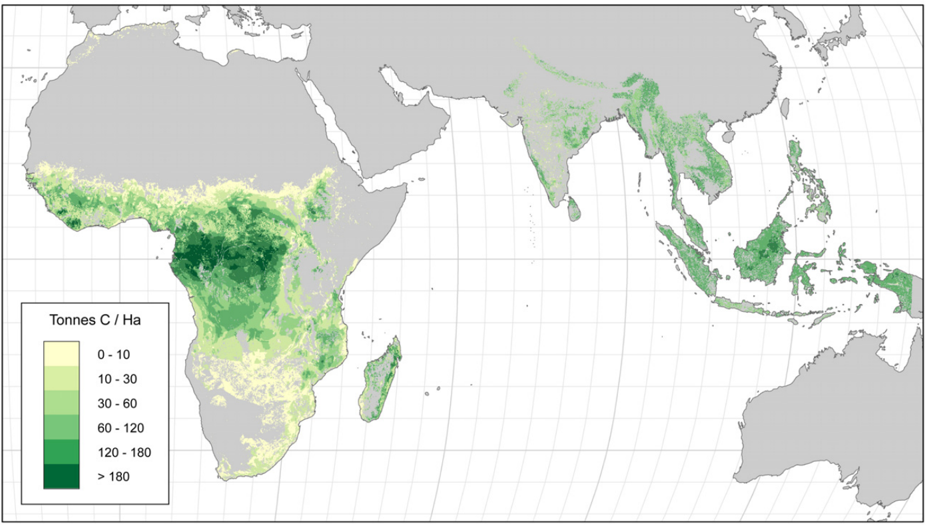
Reducing carbon emissions from deforestation and degradation in developing countries is of central importance in efforts to combat climate change. Key scientific challenges must be addressed to prevent any policy roadblocks. Foremost among the challenges is quantifying nations’ carbon emissions from deforestation and forest degradation, which requires information on forest clearing and carbon storage. Here we review a range of methods available to estimate national-level forest carbon stocks in developing countries. While there are no practical methods to directly measure all forest carbon stocks across a country, both ground-based and remote-sensing measurements of forest attributes can be converted into estimates of national carbon stocks using allometric relationships. Here we synthesize, map and update prominent forest biomass carbon databases to create the first complete set of national-level forest carbon stock estimates. These forest carbon estimates expand on the default values recommended by the Intergovernmental Panel on Climate Change’s National Greenhouse Gas Inventory Guidelines and provide a range of globally consistent estimates.
Overview
The claims and statistics of this paper haven’t been checked yet.
Free: it reads the open-access text and checks the first 5 claims that cite a source we can check. Create a free account to check every claim.
Integrity signals
Registry
Cites
Statistics
Figures
Verification
Claims the paper makes
The claims and statistics of this paper haven’t been checked yet.
Free: it reads the open-access text and checks the first 5 claims that cite a source we can check. Create a free account to check every claim.
Claims other papers make about this one
Each is checked against this paper’s own text: does it say what the citing paper says it does?
The source backs part of the claim, not all of it — or backs it for a different population, condition or comparison.
In the citing paper
“Tropical ecosystems store an enormous 340 billion tonnes of carbon (Gibbs et al 2007), equivalent to more than 40 times the total annual anthropogenic emissions from fossil fuel combustion (Canadell et al 2007).”
From Carbon payback times for crop-based biofuel expansion in the tropics: the effects of changing yield and technology (2008) · cites this paper as Gibbs et al 2007
Experimental — accuracy not yet measuredThe source backs part of the claim, not all of it — or backs it for a different population, condition or comparison.
In the citing paper
“However, estimating forest characteristics such as canopy height or biomass from optical images is a challenging task14, as the physical relationships between spectral signatures and vertical forest structure are complex and not well understood15.”
From A high-resolution canopy height model of the Earth (2023) · cites this paper as [14]
Experimental — accuracy not yet measuredThe cited source says what the claim attributes to it.
In the citing paper
“To estimate the potential carbon stocks that can accumulate in the long term in above-and belowground biomass after restoration, we used an approach commonly used in global estimates (for example, ref. 53 ).”
From Global priority areas for ecosystem restoration (2020) · cites this paper as [53]
In the citing paper
“However, with policies such as REDD in place, farmers and large-scale producers would have greater incentives to improve management of previously cleared land and receive carbon payments for avoiding carbon release from further deforestation (45,46).”
From Tropical forests were the primary sources of new agricultural land in the 1980s and 1990s (2010) · cites this paper as [45]
In the citing paper
“We assign biomass and soil organic carbon content values to each biome from the literature ([27](#r27)–[29](#r29)), and assume an uncertainty of ±20% in these values, reflective of regional differences”
From Greenhouse gas mitigation by agricultural intensification (2010) · cites this paper as [28]
Self-check
Percentages, sums and reported differences re-computed from the paper’s own numbers.
The self-check needs the paper’s full text.
Citations
Cites
Tree allometry and improved estimation of carbon stocks and balance in tropical forests
Chave, J., Andalo, C., Brown, S., Cairns, M. A., Chambers, J. Q., Eamus, D., Fölster, H., Fromard, F., Higuchi, N., Kira, T., et al. (2005) · Oecologia · doi:10.1007/s00442-005-0100-x · Cited by 3,533 · cited 1×
“example, none of the trees Chave et al (2005) used to develop”
MethodSelf-citationGood Practice Guidance for Land Use, Land-Use Change and Forestry
Penman, J., Gytarsky, M. L., Hiraishi, T., Krug, T., Kruger, D., Pipatti, R., Buendia, L. V., Miwa, K., Ngara, T., Tanabe, K., et al. (2003) · IIASA PURE (International Institute of Applied Systems Analysis) · Cited by 2,254
Determination of Deforestation Rates of the World's Humid Tropical Forests
Achard, F., Eva, H. D., Stibig, H.-J., Mayaux, P., Gallego, J., Richards, T., & Malingreau, J.-P. (2002) · Science · doi:10.1126/science.1070656 · Cited by 1,993 · cited 6×
“…of biome-average datasets where a single representative value of forest carbon per unit area (e.g. tonnes of C per hectare) is applied to broad forest categories or biomes (e.g. Fearnside 2000, Houghton 1999, Houghton et al 2001, DeFries et al 2002, Achard et al 2002, 2004, Ramankutty et al 2007).”
BackgroundInfluentialThe amount of carbon released from peat and forest fires in Indonesia during 1997
Page, S. E., Siegert, F., Rieley, J. O., Boehm, H.-D. V., Jaya, A., & Limin, S. (2002) · Nature · doi:10.1038/nature01131 · Cited by 1,885
Root biomass allocation in the world's upland forests
Cairns, M. A., Brown, S., Helmer, E. H., & Baumgardner, G. A. (1997) · Oecologia · doi:10.1007/s004420050201 · Cited by 1,622
Self-citationCritical analysis of root : shoot ratios in terrestrial biomes
MOKANY, K., RAISON, R. J., & PROKUSHKIN, A. S. (2006) · Global Change Biology · doi:10.1111/j.1365-2486.2005.001043.x · Cited by 1,588 · cited 1×
“For example, root biomass is typically estimated to be 20% of the aboveground forest carbon stocks (e.g. Houghton et al 2001, Achard et al 2002, Ramankutty et al 2007) based on a predictive relationship established from extensive literature reviews (Cairns et al 1997, Mokany et al 2006).”
BackgroundLand use, land use change and forestry
(2015) · Research Handbook on Climate Change Mitigation Law · doi:10.4337/9781849805834.00023 · Cited by 1,492
Estimating biomass and biomass change of tropical forests: A primer
Brown, S. (1997) · Medical Entomology and Zoology · Cited by 1,320
Self-citationBiomass Estimation Methods for Tropical Forests with Applications to Forest Inventory Data
Brown, S., Gillespie, A. J. R., & Lugo, A. E. (1989) · Forest Science · doi:10.1093/forestscience/35.4.881 · Cited by 1,279 · cited 1×
“…has gone into developing tools and models that can ‘scale up’ or extrapolate destructive harvest data points to larger scales based on proxies measured in the field or from remotesensing instruments (e.g. Brown et al, 1989, 1993, Waring et al 1995, Brown 1997, Chave et al 2005, Saatchi et al 2007).”
BackgroundSelf-citationMcGroddy, M. E., Daufresne, T., & Hedin, L. O. (2004) · Ecology · doi:10.1890/03-0351 · Cited by 1,124
Research works printed but not linked: 12
- Brown S, 1992, Interciencia, 17, 8
- Brown S Pearson T, 2005, Report to The Nature Conservancy
- IPCC, 2006, IPCC Guidelines for National Greenhouse Gas Inventories. Prepared by the National Greenhouse Gas Inventories Programme
- Mette T Papathanassiou K P Hajnsek I Zimmerman R, 2003, Proc. POLnSAR
- Olander L P, 2007, Environ. Res. Lett.
- Pearson T Brown S Petrova S Moore N Slaymaker D, 2005, Report to The Nature Conservancy
- Pearson T Walker S Brown S, 2005, Winrock International and the BioCarbon Fund of the World Bank, 57
- Penman J, 2003, IPCC National Greenhouse Gas Inventories Programme and Institute for Global Environmental Strategies, Kanagawa, Japan
- Post W M Izaurralde R C Mann L K Bliss N Rosenberg N J Izaurralde R C Malone E L, 1999, Proc. Symp. Carbon Sequestration in Soils Science, Monitoring and Beyond, 41
- Rosenqvist A Shimada M Igarashi T Watanabe M Tadono T Yamamoto H, 2003, Geoscience and Remote Sensing Symposium, 2003 Proc. 2003 IEEE International, 1471
- Shimada M Rosenqvist A Watanabe M Tadono T, 2005, Proc. POLinSAR 2005
- Watson R T Noble I R Bolin B Ravindranath N H Verardo D J Dokken D J, 2000, Special Report of the Intergovernmental Panel on Climate Change, 375
Cited by
Items 401–500 of 1,000
Eisfelder, C., Klein, I., Bekkuliyeva, A., Kuenzer, C., Buchroithner, M., & Dech, S. W. (2016) · Ecological Indicators · doi:10.1016/j.ecolind.2016.07.042 · Cited by 50
Mukul, S. A., Herbohn, J., & Firn, J. L. (2016) · Biotropica · doi:10.1111/btp.12389 · Cited by 53
“In tropical regions, uncertainties in biomass carbon and forest distribution and recovery are one of the main constraints for including secondary forests degraded by shifting cultivation in the global voluntary carbon market (Gibbs et al. 2007, Mertz 2009, Ziegler et al. 2012).”
BackgroundMokria, M., Mekuria, W., Gebrekirstos, A., Aynekulu, E., Belay, B., Gashaw, T., & Bräuning, A. (2018) · Environmental Research Letters · doi:10.1088/1748-9326/aaa495 · Cited by 55
Poorazimy, M., Shataee, S., McRoberts, R. E., & Mohammadi, J. (2020) · Remote Sensing of Environment · doi:10.1016/j.rse.2020.111669 · Cited by 53
“Aboveground, living tree biomass (AGB) is the largest forest carbon pool that is directly influenced by deforestation and forest degradation (Vashum and Jayakumar, 2012; Gibbs et al., 2007).”
BackgroundTesfaye, M. A., Gardi, O., Anbessa, T. B., & Blaser, J. (2020) · Journal of Ecology and Environment · doi:10.1186/s41610-019-0146-z · Cited by 52
Assessment of carbon in woody plants and soil across a vineyard-woodland landscape
Williams, J. N., Hollander, A. D., O'Geen, A. T., Thrupp, L. A., Hanifin, R. C., Steenwerth, K. L., McGourty, G. T., & Jackson, L. E. (2011) · Carbon Balance and Management · doi:10.1186/1750-0680-6-11 · Cited by 56
“Forests are storehouses of both biodiversity and C [10-13] compared to most agricultural systems, which are typically rebuked for their role as emitters of greenhouse gases (GHG) from soil and drivers of forest loss [14-17].”
BackgroundKuyah, S., Muthuri, C. W., Jamnadass, R., Mwangi, P. N., Neufeldt, H., & Dietz, J. (2012) · Agroforestry Systems · doi:10.1007/s10457-012-9529-1 · Cited by 49
“Diameter is preferred as predictor variable because it can be measured with ease and high accuracy, and explains over 95 % of the variability observed in aboveground biomass (Brown 1997; Gibbs et al. 2007).”
Dhanda, P., Nandy, S., Kushwaha, S. P. S., Ghosh, S., Murthy, Y. V. N. K., & Dadhwal, V. K. (2017) · Progress in Physical Geography Earth and Environment · doi:10.1177/0309133317693443 · Cited by 50
Rahman, M. S., Donoghue, D. N. M., Bracken, L. J., & Hossain, M. (2021) · Environmental Research Letters · doi:10.1088/1748-9326/ac31ee · Cited by 48
“A range of remote sensing (RS) technologies can indirectly infer forest biomass but field data are needed to calibrate and validate products (Gibbs et al 2007, Chave et al 2019, Réjou-Méchain et al 2019).”
BackgroundKuyah, S., Sileshi, G. W., & Rosenstock, T. (2016) · Forests · doi:10.3390/f7020013 · Cited by 52
Live aboveground carbon stocks in natural forests of Colombia
Phillips, J. F., Duque, Á., Scott, C., Wayson, C. A., Galindo, G., Cabrera, E., Chave, J., Peña, M. A., Álvarez‐Dávila, E., Cárdenas, D., et al. (2016) · Forest Ecology and Management · doi:10.1016/j.foreco.2016.05.009 · Cited by 50
Performance of non-parametric algorithms for spatial mapping of tropical forest structure
Xu, L., Saatchi, S. S., Yang, Y., Yu, Y., & WHITE, L. J. T. (2016) · Carbon Balance and Management · doi:10.1186/s13021-016-0062-9 · Cited by 51
“The uncertainty in the distribution of AGB and forest structure at local to regional scales has impacted the estimation of greenhouse gas (GHG) emissions and removals from land use activities [4, 5], the monitoring of the global carbon cycle [6], and the development of climate change mitigation policies in the framewo…”
BackgroundLouhaichi, M., Hassan, S., Clifton, K., & Johnson, D. E. (2017) · Agroforestry Systems · doi:10.1007/s10457-017-0079-4 · Cited by 48
“The most accurate method for estimating biomass is by destructive sampling—clipping and weighing the grazable portion in the field (Gibbs et al. 2007; Chojnacky and Milton 2008).”
MethodSulieman, H. M. (2017) · The Science of The Total Environment · doi:10.1016/j.scitotenv.2017.11.210 · Cited by 49
Rex, F. E., Silva, C. A., Côrte, A. P. D., Klauberg, C., Mohan, M., Cardíl, A., da Silva, V. S., de Almeida, D. R. A., García, M., Broadbent, E. N., et al. (2020) · Remote Sensing · doi:10.3390/rs12091498 · Cited by 52
“Forests by sequestering and storing great quantities of carbon act as natural ‘brakes’ on global climate change [1,2].”
BackgroundNesha, K., Hussin, Y. A., van Leeuwen, L. M., & Sulistioadi, Y. B. (2020) · International Journal of Applied Earth Observation and Geoinformation · doi:10.1016/j.jag.2020.102158 · Cited by 48
Impacts of precipitation variability on the dynamics of a dry tropical montane forest
Hiltner, U., Bräuning, A., Gebrekirstos, A., Huth, A., & Fischer, R. (2015) · Ecological Modelling · doi:10.1016/j.ecolmodel.2015.09.021 · Cited by 55
Behera, M. D., Tripathi, P., Mishra, B., Kumar, S., Chitale, V. S., & Behera, S. K. (2015) · Advances in Space Research · doi:10.1016/j.asr.2015.11.010 · Cited by 47
“Most of these studies are focused on remote sensing using optical sensors, which have the disadvantages of low saturation levels and non-availability of cloud-free data at times (Lu, 2006; Gibbs et al., 2007).”
Background- LiDAR Remote Sensing of Vegetation Biomass
Chen, Q. (2013) · CRC Press eBooks · doi:10.1201/b15159-26 · Cited by 48
Owers, C. J., Rogers, K., & Woodroffe, C. D. (2018) · Estuarine Coastal and Shelf Science · doi:10.1016/j.ecss.2018.02.027 · Cited by 48
“This is particularly important to facilitate and validate broad-scale mapping relevant for national and regional assessments of biomass and above-ground carbon storage (Gibbs et al., 2007; Chave et al., 2014).”
BackgroundGraves, S., Caughlin, T. T., Asner, G. P., & Bohlman, S. (2018) · Remote Sensing of Environment · doi:10.1016/j.rse.2018.09.009 · Cited by 49
Allometric models for improving aboveground biomass estimates in West African savanna ecosystems
Ganamé, M., Bayen, P., Ouédraogo, I., Balima, L. H., & Thiombiano, A. (2021) · Trees Forests and People · doi:10.1016/j.tfp.2021.100077 · Cited by 50
Schneibel, A., Frantz, D., Röder, A., Stellmes, M., Fischer, K., & Hill, J. (2017) · Remote Sensing · doi:10.3390/rs9090905 · Cited by 49
“However, one general method to measure carbon across the landscape does not yet exist and the aspect of forest degradation in this context has long been disregarded [26,27].”
BackgroundMethodTadese, S., Soromessa, T., Aneseyee, A. B., Gebeyehu, G., Noszczyk, T., & Kindu, M. (2023) · Carbon Balance and Management · doi:10.1186/s13021-023-00243-z · Cited by 50
“Deforestation and forest degradation also have an impact on the amount of carbon sequestered in larger trees with larger diameters [102].”
BackgroundHow can ecologists help realise the potential of payments for carbon in tropical forest countries?
Baker, T. R., Jones, J. P. G., Rendon, O. R., Román-Cuesta, R. M., Torres, D. D. C., Aguilar, I. C., Torres, J., & Healey, J. R. (2010) · Journal of Applied Ecology · doi:10.1111/j.1365-2664.2010.01885.x · Cited by 61
Petty, A. M., Isendahl, C., Brenkert–Smith, H., Goldstein, D. J., Rhemtulla, J. M., Rahman, S. A., & Kumasi, T. C. (2014) · Global Environmental Change · doi:10.1016/j.gloenvcha.2014.11.004 · Cited by 52
Zhang, H., Song, T., Wang, K., Wang, G., Liao, J., Xu, G., & Zeng, F. (2015) · Environmental Research Letters · doi:10.1088/1748-9326/10/4/044014 · Cited by 46
A review of forest and tree plantation biomass equations in Indonesia
Anitha, K., Verchot, L. V., Joseph, S., Herold, M., Manuri, S., & Avitabile, V. (2015) · Annals of Forest Science · doi:10.1007/s13595-015-0507-4 · Cited by 46
Hussin, Y. A., Gilani, H., van Leeuwen, L. M., Murthy, M. S. R., Shah, R., Baral, S., Tsendbazar, N., Shrestha, S., Shah, S. K., & Qamer, F. M. (2014) · Applied Geomatics · doi:10.1007/s12518-014-0126-z · Cited by 48
“NIR and red, both reflectance bands, are vegetation sensitive, so most of vegetation indices are based on the ratio of these two bands which give a more clear and prominent picture of vegetation health (Foody et al. 2003; Lu 2005; Gibbs et al. 2007; Kajisa et al. 2009; Zheng et al. 2004).”
BackgroundMethodCao, L., Liu, K., Shen, X., Wu, X., & Liu, H. (2019) · IEEE Journal of Selected Topics in Applied Earth Observations and Remote Sensing · doi:10.1109/jstars.2019.2918572 · Cited by 46
“with traditional approaches, remote sensing technologies have a strong potential to provide “wall-to-wall” and spatially explicit observations [8]; as well as rapid and accurate measurements of”
BackgroundMohan, M., de Mendonça, B. A. F., Silva, C. A., Klauberg, C., Ribeiro, A. S. D. S., de Araújo, E. J. G., Monte, M. A., & Cardíl, A. (2019) · Ecological Modelling · doi:10.1016/j.ecolmodel.2019.108736 · Cited by 47
Using Bayesian Model Averaging to Predict Tree Aboveground Biomass in Tropical Moist Forests
Picard, N., Henry, M., Mortier, F., Trotta, C., & Saint‐André, L. (2012) · Forest Science · doi:10.5849/forsci.10-083 · Cited by 58
Implementation of REDD+ in sub-Saharan Africa: state of knowledge, challenges and opportunities
Henry, M., Maniatis, D., Gitz, V., Huberman, D., & Valentini, R. (2011) · Environment and Development Economics · doi:10.1017/s1355770x11000155 · Cited by 51
“Previous carbon stock assessment in SSA used coarser spatial resolution or did not consider the whole continent (Gibbs et al., 2007; Baccini et al., 2008; Goetz et al., 2009).”
BackgroundLessons for REDD+ from measures to control illegal logging in Indonesia
Luttrell, C., Obidzinski, K., Brockhaus, M., Muharrom, E., Petkova, E., Wardell, A., & Halperin, J. (2011) · doi:10.17528/cifor/003505 · Cited by 46
Rueda, X. (2010) · Regional Environmental Change · doi:10.1007/s10113-010-0115-7 · Cited by 45
“…of proposed programs (e.g., REDD, Reducing Emissions from Deforestation and forest Degradation) to compensate the tropical world for X. Rueda (&) Federacion Nacional de Cafeteros de Colombia, Bogota, Colombia e-mail: xrueda@alum.mit.edu maintaining their forests as carbon sinks (Gibbs et al. 2007).”
BackgroundImplications of allometric model selection for county-level biomass mapping
Duncanson, L. I., Huang, W., Johnson, K. D., Swatantran, A., McRoberts, R. E., & Dubayah, R. (2017) · Carbon Balance and Management · doi:10.1186/s13021-017-0086-9 · Cited by 46
“Forest aboveground biomass mapping has emerged as a critically important initiative for both constraining the global carbon cycle [18] and facilitating climate mitigation initiatives such as REDD+ [8].”
BackgroundEstimates and determinants of stocks of deep soil carbon in Gabon, Central Africa
Wade, A. M., Richter, D. D., Medjibe, V. P., Bacon, A. R., Heine, P. R., WHITE, L. J. T., & Poulsen, J. R. (2019) · Geoderma · doi:10.1016/j.geoderma.2019.01.004 · Cited by 48
Nakakaawa, C. A., Vedeld, P., & Aune, J. B. (2010) · Mitigation and Adaptation Strategies for Global Change · doi:10.1007/s11027-010-9251-0 · Cited by 50
“Comparing current woodland biomass to the range of average estimates for sub Saharan Africa, (17–70 tons carbon/ha) (Gibbs et al. 2007); there are opportunities for improving current stocks through sustainable woodland management.”
BackgroundInfluentialLangner, A., Achard, F., & Grassi, G. (2014) · Environmental Research Letters · doi:10.1088/1748-9326/9/12/124008 · Cited by 41
“Gibbs et al (2007) point out that bibliographic studies, on which the IPCC default values are based, generally focus on mature forest stands, which are not representative for whole ecological zones.”
BackgroundInfluentialLutz, D. A., Burakowski, E. A., Murphy, M. B., Borsuk, M. E., Niemiec, R. M., & Howarth, R. B. (2015) · Ecological Applications · doi:10.1890/14-2207 · Cited by 49
“A large focus of forest biomass climate mitigation strategies has focused on tropical rainforests (Gibbs et al. 2007 ), yet as of late, domestic funding of such strategies in Europe and North America have garnered interest in temperate forests as well (Tittmann and Yeh 2013 ).”
BackgroundBiomass dynamics in a logged forest: the role of wood density
Nam, V. T., Anten, N. P. R., & van Kuijk, M. (2018) · Journal of Plant Research · doi:10.1007/s10265-018-1042-9 · Cited by 44
Ozone pollution: impacts on ecosystem services and biodiversity
Mills, G., Wagg, S., & Harmens, H. (2013) · Cited by 74
Siikamaki, J. V., & Newbold, S. C. (2012) · AMBIO · doi:10.1007/s13280-011-0243-4 · Cited by 52
“In the context of climate change, deforestation is among the chief contributors to global greenhouse gas (GHG) emissions and is a particularly pressing problem in the developing world (IPCC 2007; Gibbs et al. 2007; Angelsen 2008).”
BackgroundForest aboveground biomass estimation by GEDI and multi-source EO data fusion over Indian forest
Mohite, J. D., Sawant, S. A., Pandit, A., Sakkan, M., Pappula, S., & Parmar, A. (2024) · International Journal of Remote Sensing · doi:10.1080/01431161.2024.2307944 · Cited by 44
“The forest ecosystem plays a pivotal role in global climate regulation and the carbon budget (Baccini et al. 2012; Brown 2002; Gibbs et al. 2007; W. Li et al. 2020) and significantly influences the global water cycle by sequestering atmospheric CO2 as carbon within plant biomass and soil (R. A.…”
BackgroundOptions for a national REDD+ architecture
Vatn, A., & Angelsen, A. (2009) · CGSPace A Repository of Agricultural Research Outputs (Consultative Group for International Agricultural Research) · Cited by 64
Lindner, A., & Sattler, D. (2011) · New Forests · doi:10.1007/s11056-011-9281-9 · Cited by 50
“These findings can contribute to the discussion on the value of different forest management strategies within the context of the reductions in emissions from deforestation in developing countries (REDD) debate (Gibbs et al. 2007; Shevliakova et al. 2009; Reyer et al. 2009).”
BackgroundEcosystem carbon pools of coppice-originated oak forests at different development stages
Makineci, E., Özdemir, E., Çalışkan, S., Yılmaz, E., Kumbaşlı, M., Keten, A., Beşkardeş, V., Zengin, H., & Yılmaz, H. (2014) · European Journal of Forest Research · doi:10.1007/s10342-014-0854-y · Cited by 44
“…School of Forestry, Istanbul University, Istanbul, Turkey role in regulating the C balance and maintaining the global climate (Jasal et al. 2010), there is a significant amount of interest in estimating the C sequestration in forests (Gibbs et al. 2007; Laumonier et al. 2010; Gratani et al. 2011).”
BackgroundPadmakumar, B., Sreekanth, N. P., Shanthiprabha, V., Paul, J., Sreedharan, K., Augustine, T., Jayasooryan, K. K., Rameshan, M., Mohan, M., Ramasamy, E. V., et al. (2018) · iForest - Biogeosciences and Forestry · doi:10.3832/ifor2190-011 · Cited by 43
Kumar, A., Kishore, B. S. P. C., Saikia, P., Deka, J., Bharali, S., Singha, L. B., Tripathi, O. P., & Khan, M. L. (2019) · Physics and Chemistry of the Earth Parts A/B/C · doi:10.1016/j.pce.2019.03.007 · Cited by 45
Identifying Biases in Global Tree Cover Products: A Case Study in Costa Rica
Cunningham, D., Cunningham, P., & Fagan, M. E. (2019) · Forests · doi:10.3390/f10100853 · Cited by 46
Gurung, M. B., Bigsby, H. R., Cullen, R., & Manandhar, U. (2015) · Forest Ecology and Management · doi:10.1016/j.foreco.2015.07.024 · Cited by 51
“Our combined value of AGB and BGB of 130.50 Mg ha-1 is lower than those estimates of 150 Mg ha-1 (DeFries et al., 2002; Houghton, 1999), 142 Mg ha-1 (Gibbs et al., 2007), but higher than 105 Mg ha-1 (IPCC, 2006) for moist deciduous forest and 103 Mg ha-1 (Saatchi et al., 2011) for forest of Nepal.”
BackgroundMethodInfluentialLangner, A., Samejima, H., Ong, R. C., Titin, J., & Kitayama, K. (2012) · International Journal of Applied Earth Observation and Geoinformation · doi:10.1016/j.jag.2012.02.006 · Cited by 53
Lupala, Z. J., Lusambo, L. P., Ngaga, Y. M., & Makatta, A. A. (2015) · International Journal of Forestry Research · doi:10.1155/2015/459102 · Cited by 42
“The management comprises more than 10% of forest globally [20, 24, 33].”
BackgroundMilne, E., Neufeldt, H., Rosenstock, T. S., Smalligan, M., Cerri, C. E. P., Malin, D., Easter, M., Bernoux, M., Ogle, S. M., Casarim, F., et al. (2013) · Environmental Research Letters · doi:10.1088/1748-9326/8/1/015019 · Cited by 46
“However, in a landscape-scale assessment, especially those including tropical forests where hundreds of species may be present, the use of generalized equations may be necessary (Gibbs et al. 2007).”
BackgroundA small subset of protected areas are a highly significant source of carbon emissions
Collins, M., & Mitchard, E. T. A. (2017) · Scientific Reports · doi:10.1038/srep41902 · Cited by 45
Phua, M., Johari, S. A., Wong, O. C., Ioki, K., Mahali, M. B., Nilus, R., Coomes, D. A., Maycock, C. R., & Hashim, M. (2017) · Forest Ecology and Management · doi:10.1016/j.foreco.2017.10.007 · Cited by 51
Seasonality of gross primary production in the Atlantic Forest of Brazil
Delgado, R. C., Pereira, M. G., Teodoro, P. E., dos Santos, G. L., de Carvalho, D. C., Magistrali, I. C., & Vilanova, R. S. (2018) · Global Ecology and Conservation · doi:10.1016/j.gecco.2018.e00392 · Cited by 42
Biomass allometric equation and expansion factor for a mountain moist evergreen forest in Mozambique
Lisboa, S. N., Guedes, B. S., Ribeiro, N. S., & Sitoe, A. A. (2018) · Carbon Balance and Management · doi:10.1186/s13021-018-0111-7 · Cited by 42
“[13] argued that the effort required to develop species or site-specific BAE would not typically improve accuracy in AGB estimations.”
BackgroundMethodResultInfluentialOjoatre, S., Zhang, C., Hussin, Y. A., Kloosterman, H. E., & Ismail, M. H. (2019) · IEEE Journal of Selected Topics in Applied Earth Observations and Remote Sensing · doi:10.1109/jstars.2019.2944779 · Cited by 44
“The laser system can estimate full spatial variability of forest carbon stock with low to medium uncertainties [24].”
BackgroundPeneva-Reed, E. I., Krauss, K. W., Bullock, E. L., Zhu, Z., Woltz, V. L., Drexler, J. Z., Conrad, J. R., & Stehman, S. V. (2020) · Estuarine Coastal and Shelf Science · doi:10.1016/j.ecss.2020.106750 · Cited by 43
Sedano, F., Lisboa, S. N., Duncanson, L. I., Ribeiro, N. S., Sitoe, A. A., Sahajpal, R., HURTT, G. C., & Tucker, C. J. (2020) · International Journal of Applied Earth Observation and Geoinformation · doi:10.1016/j.jag.2020.102184 · Cited by 48
Bharadwaj, P. S., Kumar, S., Kushwaha, S. P. S., & Bijker, W. (2015) · Physics and Chemistry of the Earth Parts A/B/C · doi:10.1016/j.pce.2015.09.003 · Cited by 45
Singh, M., Malhi, Y. S., & Bhagwat, S. (2014) · International Journal of Remote Sensing · doi:10.1080/01431161.2014.903441 · Cited by 50
“This makes ecological and field studies in tropical forests difficult because the presence of large, inaccessible regions makes it nearly impossible to perform ground surveys (Gibbs et al. 2007; Pearson et al. 2005), and certain attributes of forest stand parameters, such as the crowns of large canopy trees, are hard…”
BackgroundForest carbon in lowland P apua N ew G uinea: Local variation and the importance of small trees
Vincent, J. B., Henning, B. M., Saulei, S., Sosanika, G., & Weiblen, G. D. (2014) · Austral Ecology · doi:10.1111/aec.12187 · Cited by 41
Mbatu, R. S. (2015) · Forest Policy and Economics · doi:10.1016/j.forpol.2014.12.012 · Cited by 47
Henry, M., Cifuentes, M., Réjou‐Méchain, M., Piotto, D., Fuentes, J. M. M., Wayson, C. A., Alice, F. E., Lombis, H. C., Castellanos, E. J., Lara, R. C., et al. (2015) · Annals of Forest Science · doi:10.1007/s13595-015-0465-x · Cited by 43
“Unless for homogenous ecosystems, such as plantations or mangroves, it is not easy to take into consideration the floristic composition in the sampling scheme for the tropics because the number of tree species can be up to 300 per hectare (Gibbs et al. 2007).”
BackgroundOta, T., Ahmed, O. S., Franklin, S. E., Wulder, M. A., Kajisa, T., Mizoue, N., Yoshida, S., Takao, G., Hirata, Y., Furuya, N., et al. (2014) · Remote Sensing · doi:10.3390/rs61110750 · Cited by 46
“Forests sequester and store more carbon than any other terrestrial ecosystem and are considered to be an important natural “brake” on climate change [1].”
BackgroundKHAN, K., Iqbal, J., Ali, A., & Khan, S. N. (2020) · Applied Ecology and Environmental Research · doi:10.15666/aeer/1801_783815 · Cited by 41
“The destructive method is also called harvest method (Gibbs et al., 2007).”
MethodNyamari, N., & Cabral, P. (2021) · Applied Geography · doi:10.1016/j.apgeog.2021.102479 · Cited by 42
Aljenaid, S. S., Abido, M. A., Kadhem, G., Alkhuzaei, M., Marsan, Y., Khamis, A., Naser, H. A., AlRumaidh, M., & Alsabbagh, M. (2022) · Regional Studies in Marine Science · doi:10.1016/j.rsma.2022.102282 · Cited by 47
Iizuka, K., & Tateishi, R. (2015) · Remote Sensing · doi:10.3390/rs71115082 · Cited by 47
“Utilizing satellite remote sensing data for quantitative C/CO2 estimations is challenging but well-known method for improving broad scale estimations compared to conventional ground-based observations [9].”
Methodvan der Laan, C., Wicke, B., Verweij, P. A., & Faaij, A. P. C. (2016) · GCB Bioenergy · doi:10.1111/gcbb.12353 · Cited by 47
“In all three scenarios, peatland and forests were excluded to minimise carbon emissions and carbon payback time (Gibbs et al., 2007).”
BackgroundBong, I. W., Felker, M. E., & Maryudi, A. (2016) · PLoS ONE · doi:10.1371/journal.pone.0145330 · Cited by 41
Kachamba, D., Ørka, H. O., Næsset, E., Eid, T., & Gobakken, T. (2017) · Remote Sensing · doi:10.3390/rs9060610 · Cited by 40
Bochenek, Z., Ziółkowski, D., Bartold, M., Orlowska, K., & Ochtyra, A. (2017) · European Journal of Remote Sensing · doi:10.1080/22797254.2017.1414573 · Cited by 40
Wassihun, A. N., Hussin, Y. A., van Leeuwen, L. M., & Latif, Z. A. (2019) · ENVIRONMENTAL SYSTEMS RESEARCH · doi:10.1186/s40068-019-0155-z · Cited by 40
Climate Change and Forests: Biological Perspectives
Singh, H. (2024) · Springer eBooks · doi:10.1007/978-981-97-3905-9_1 · Cited by 39
Can payments for environmental services reduce deforestation and forest degradation
Wunder, S. (2009) · CGSPace A Repository of Agricultural Research Outputs (Consultative Group for International Agricultural Research) · Cited by 58
Willcock, S., Phillips, O. L., Platts, P. J., Balmford, A. P., Burgess, N. D., Lovett, J. C., Ahrends, A., Bayliss, J., Doggart, N. H., Doody, K., et al. (2012) · PLoS ONE · doi:10.1371/journal.pone.0044795 · Cited by 39
“Thus, regionally appropriate values, indicating uncertainties (‘Tier 2’), and those derived from intensive multiple census inventory data (‘Tier 3’) are preferable [12,16].”
BackgroundCho, M. A., Ramoelo, A., Debba, P., Mutanga, O., Mathieu, R., van Deventer, H., & Ndlovu, N. (2013) · Landscape Ecology · doi:10.1007/s10980-013-9908-7 · Cited by 43
“…a major sink of atmospheric carbon dioxide and several studies have shown that tropical forest deforestation and degradation were major sources of global greenhouse emission in the 1990s (Malhi and Grace 2000; Achard et al. 2004, Fearnside and Laurance 2004; Gibbs et al. 2007; DeFries et al. 2002).”
BackgroundHijbeek, R., Koedam, N. E., Khan, M. N. I., Kairo, J. G., Schoukens, J., & Dahdouh‐Guebas, F. (2013) · PLoS ONE · doi:10.1371/journal.pone.0067201 · Cited by 39
“Despite the necessity, quantifying biomass in forests remains a challenge [6].”
BackgroundFeyisa, K., Beyene, S., Megersa, B., Said, M. Y., de Leeuw, J., & Angassa, A. (2016) · Agroforestry Systems · doi:10.1007/s10457-016-9997-9 · Cited by 41
Borah, J. R., Evans, K. L., & Edwards, D. P. (2018) · Ecological Applications · doi:10.1002/eap.1764 · Cited by 42
Temperate coastal wetland near-surface carbon storage: Spatial patterns and variability
Owers, C. J., Rogers, K., Mazumder, D., & Woodroffe, C. D. (2020) · Estuarine Coastal and Shelf Science · doi:10.1016/j.ecss.2020.106584 · Cited by 41
Mukuralinda, A., Kuyah, S., Ruzibiza, M., Ndoli, A., Nabahungu, N. L., & Muthuri, C. W. (2020) · Trees Forests and People · doi:10.1016/j.tfp.2020.100050 · Cited by 43
Adnan, S., Maltamo, M., Mehtätalo, L., Ammaturo, R. N. L., Packalén, P., & Valbuena, R. (2021) · Remote Sensing of Environment · doi:10.1016/j.rse.2021.112464 · Cited by 42
Growing stock and woody biomass assessment in Asola-Bhatti Wildlife Sanctuary, Delhi, India
Kushwaha, S. P. S., Nandy, S., & Gupta, M. (2014) · Environmental Monitoring and Assessment · doi:10.1007/s10661-014-3828-0 · Cited by 39
Mattsson, E., Ostwald, M., Nissanka, S. P., Holmer, B., & Palm, M. (2008) · Ocean & Coastal Management · doi:10.1016/j.ocecoaman.2008.09.007 · Cited by 39
“Contrary, forests may also function as a source and add carbon dioxide (CO2) into the atmosphere through deforestation, forest fires or decomposition of wood products [1].”
BackgroundSinha, S., Jeganathan, C., Sharma, L. K., Nathawat, M. S., Das, A. K., & Mohan, S. (2016) · Journal of Earth System Science · doi:10.1007/s12040-016-0692-z · Cited by 39
“∗Corresponding author. e-mail: sumanrumpa.sinha@gmail.com Forest stand biomass serves as an effective indicator for monitoring REDD (reducing emissions from deforestation and forest degradation).”
BackgroundMethodInfluentialBowler, D. E., Buyung-Ali, L. M., Healey, J. R., Jones, J. P. G., Knight, T., & Pullin, A. S. (2010) · Environmental Evidence · Cited by 38
Gumbo, D., Clendenning, J., Martius, C., Moombe, K., Grundy, I., Nasi, R., Mumba, K. Y., Ribeiro, N. S., Kabwe, G., & Petrokofsky, G. (2018) · Environmental Evidence · doi:10.1186/s13750-018-0128-0 · Cited by 38
“The carbon stored in the above-ground living biomass of trees is a large pool directly impacted by deforestation and forest degradation [4, 47], while soil carbon represents another important carbon sink.”
BackgroundTerefe, B., & Kim, D. (2019) · Plant and Soil · doi:10.1007/s11104-019-03942-0 · Cited by 41
Delgado-Aguilar, M. J., Hinojosa, L., & Schmitt, C. B. (2019) · Applied Geography · doi:10.1016/j.apgeog.2019.02.003 · Cited by 39
Opportunities and challenges for an Indonesian forest monitoring network
Brearley, F. Q., Adinugroho, W. C., Cámara‐Leret, R., Krisnawati, H., Ledo, A., Qie, L., Smith, T. E. L., Aini, F. K., Garnier, F., Lestari, N. S., et al. (2019) · Annals of Forest Science · doi:10.1007/s13595-019-0840-0 · Cited by 42
Hu, J., Herbohn, J., Chazdon, R. L., Baynes, J., & Vanclay, J. K. (2020) · The Science of The Total Environment · doi:10.1016/j.scitotenv.2020.139098 · Cited by 42
Balima, L. H., Kouamé, F. N., Bayen, P., Ganamé, M., Nacoulma, B. M. I., Thiombiano, A., & Dodiomon, S. (2021) · Environmental Challenges · doi:10.1016/j.envc.2021.100123 · Cited by 40
REDD+ readiness implications for Sri Lanka in terms of reducing deforestation
Mattsson, E., Persson, U. M., Ostwald, M., & Nissanka, S. P. (2012) · Journal of Environmental Management · doi:10.1016/j.jenvman.2012.01.018 · Cited by 38
“By dividing the total carbon stock by total forest area, we arrive at an average carbon density estimate in the range of 66e244 tC ha 1 using original figures by Gibbs et al. (2007).”
MethodKashaigili, J. J., Mdemu, M., Nduganda, A. R., & Mbilinyi, B. P. (2013) · Advances in Remote Sensing · doi:10.4236/ars.2013.21001 · Cited by 38
Simonson, W. D., Ruiz‐Benito, P., Valladares, F., & Coomes, D. A. (2016) · Biogeosciences · doi:10.5194/bg-13-961-2016 · Cited by 41
“In the context of climate change mitigation and emissions target agreements made at national level, robust methodologies are needed for the regular assessment of carbon stocks in forests (Gibbs et al., 2007).”
BackgroundKrofcheck, D., Litvak, M. E., Lippitt, C. D., & Neuenschwander, A. (2016) · Remote Sensing · doi:10.3390/rs8060453 · Cited by 38
“Thus, the ability to accurately assess structural properties, such as AGB, at ecosystem and landscape scales is an essential precursor to monitoring carbon dynamics in semi-arid biomes and extends a critical component to global and national-scale climate change mitigation strategies, such as REDD+ (Reduced Emissions f…”
Background
Metadata
- Authors
- Gibbs, H. K., Brown, S., Niles, J. O., & Foley, J. A.
- Affiliations
- University of Wisconsin–Madison (US)
- Winrock International (United States) (US)
- ORCID
- Gibbs, Holly K
- Venue
- Environmental Research Letters
- Publisher
- IOP Publishing
- Published
- 2007-10
- Volume
- 2
- Issue
- 4
- Pages
- 045023
- ISSN
- 1748-9326 (ISSN-L)
- OpenAlex
- W2040120109
- Cited by
- 1,653
- References
- 86
- Citations by year
- 2026: 49 · 2025: 68 · 2024: 79 · 2023: 75 · 2022: 97 · 2021: 95 · 2020: 116 · 2019: 98 · 2018: 97 · 2017: 108 · 2016: 99 · 2015: 108 · 2014: 138 · 2013: 103 · 2012: 105
- FWCI
- 35.91
- Type
- journal article
- Language
- en
- Open access
- gold
- doi.org
- Licence
- cc-by
- Locations
- Environmental Research Letters (publishedVersion, cc-by)
- Funders
- U.S. Department of Energy
- National Aeronautics and Space Administration
- Topics
- Life Sciences › Agricultural and Biological Sciences › Forestry › Forest ecology and management
- Life Sciences › Agricultural and Biological Sciences › Forestry › Remote Sensing and LiDAR Applications
- Life Sciences › Agricultural and Biological Sciences › Forestry › Forest Management and Policy
- Keywords
- REDD+, deforestation, forest degradation, CO2 emissions, forest biomass carbon, allometric relationships, remote sensing, ground-based observations, developing countries
About these checks
Registry, retraction, Cites and statistics results are computed, not judged, with one exception: a printed reference that no index lists is read once by a model before it counts as a citation error. Claims are extracted by a model and kept only when their quote appears verbatim in the text; each cited source is then checked, with a model’s help, for whether it says what the claim relies on. Those verdicts can be wrong — read the claim’s quote and the cited source before relying on one.
Statistics and arithmetic are recomputed, not judged.
Confidence bands are shown only for fields calibrated on our annotated test set. None is calibrated yet, so no band is shown.
What counts as a claim ›How we measure confidence ›How we check this ›
Are you an author, or do you see a problem with this page? Request a review
Data sources
Bibliographic data: Semantic Scholar, OpenAlex, Crossref.
Contains information from the Semantic Scholar Academic Graph Datasets, made available under the ODC Attribution License (ODC-BY 1.0).
Semantic Scholar’s data is described in: Kinney, R., et al. (2023). The Semantic Scholar Open Data Platform. arXiv:2301.10140.
