

Monitoring and estimating tropical forest carbon stocks: making REDD a reality
Open accessThe DOI matches its Crossref record; 86 of the 86 references it cites were found in a registry or an index.
Abstract
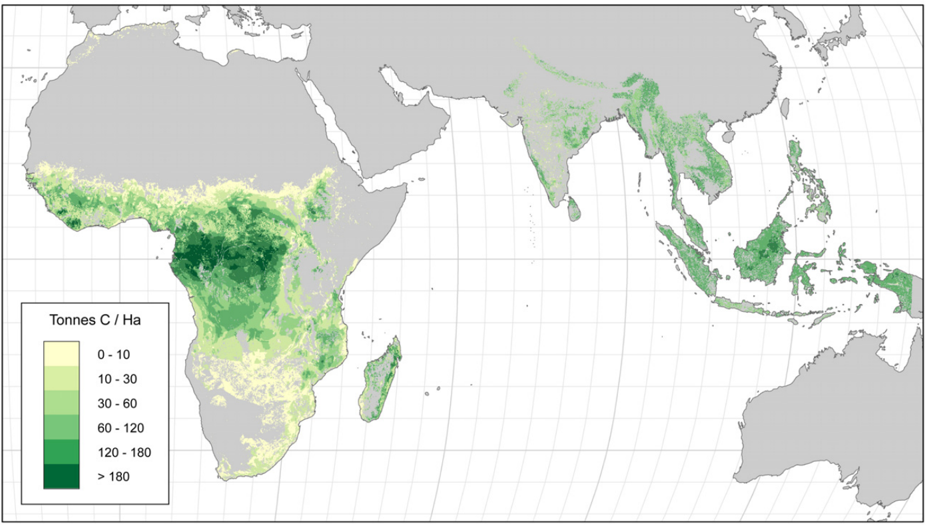
Reducing carbon emissions from deforestation and degradation in developing countries is of central importance in efforts to combat climate change. Key scientific challenges must be addressed to prevent any policy roadblocks. Foremost among the challenges is quantifying nations’ carbon emissions from deforestation and forest degradation, which requires information on forest clearing and carbon storage. Here we review a range of methods available to estimate national-level forest carbon stocks in developing countries. While there are no practical methods to directly measure all forest carbon stocks across a country, both ground-based and remote-sensing measurements of forest attributes can be converted into estimates of national carbon stocks using allometric relationships. Here we synthesize, map and update prominent forest biomass carbon databases to create the first complete set of national-level forest carbon stock estimates. These forest carbon estimates expand on the default values recommended by the Intergovernmental Panel on Climate Change’s National Greenhouse Gas Inventory Guidelines and provide a range of globally consistent estimates.
Overview
The claims and statistics of this paper haven’t been checked yet.
Free: it reads the open-access text and checks the first 5 claims that cite a source we can check. Create a free account to check every claim.
Integrity signals
Registry
Cites
Statistics
Figures
Verification
Claims the paper makes
The claims and statistics of this paper haven’t been checked yet.
Free: it reads the open-access text and checks the first 5 claims that cite a source we can check. Create a free account to check every claim.
Claims other papers make about this one
Each is checked against this paper’s own text: does it say what the citing paper says it does?
The source backs part of the claim, not all of it — or backs it for a different population, condition or comparison.
In the citing paper
“Tropical ecosystems store an enormous 340 billion tonnes of carbon (Gibbs et al 2007), equivalent to more than 40 times the total annual anthropogenic emissions from fossil fuel combustion (Canadell et al 2007).”
From Carbon payback times for crop-based biofuel expansion in the tropics: the effects of changing yield and technology (2008) · cites this paper as Gibbs et al 2007
Experimental — accuracy not yet measuredThe source backs part of the claim, not all of it — or backs it for a different population, condition or comparison.
In the citing paper
“However, estimating forest characteristics such as canopy height or biomass from optical images is a challenging task14, as the physical relationships between spectral signatures and vertical forest structure are complex and not well understood15.”
From A high-resolution canopy height model of the Earth (2023) · cites this paper as [14]
Experimental — accuracy not yet measuredThe cited source says what the claim attributes to it.
In the citing paper
“To estimate the potential carbon stocks that can accumulate in the long term in above-and belowground biomass after restoration, we used an approach commonly used in global estimates (for example, ref. 53 ).”
From Global priority areas for ecosystem restoration (2020) · cites this paper as [53]
In the citing paper
“However, with policies such as REDD in place, farmers and large-scale producers would have greater incentives to improve management of previously cleared land and receive carbon payments for avoiding carbon release from further deforestation (45,46).”
From Tropical forests were the primary sources of new agricultural land in the 1980s and 1990s (2010) · cites this paper as [45]
In the citing paper
“We assign biomass and soil organic carbon content values to each biome from the literature ([27](#r27)–[29](#r29)), and assume an uncertainty of ±20% in these values, reflective of regional differences”
From Greenhouse gas mitigation by agricultural intensification (2010) · cites this paper as [28]
Self-check
Percentages, sums and reported differences re-computed from the paper’s own numbers.
The self-check needs the paper’s full text.
Citations
Cites
Tree allometry and improved estimation of carbon stocks and balance in tropical forests
Chave, J., Andalo, C., Brown, S., Cairns, M. A., Chambers, J. Q., Eamus, D., Fölster, H., Fromard, F., Higuchi, N., Kira, T., et al. (2005) · Oecologia · doi:10.1007/s00442-005-0100-x · Cited by 3,533 · cited 1×
“example, none of the trees Chave et al (2005) used to develop”
MethodSelf-citationGood Practice Guidance for Land Use, Land-Use Change and Forestry
Penman, J., Gytarsky, M. L., Hiraishi, T., Krug, T., Kruger, D., Pipatti, R., Buendia, L. V., Miwa, K., Ngara, T., Tanabe, K., et al. (2003) · IIASA PURE (International Institute of Applied Systems Analysis) · Cited by 2,254
Determination of Deforestation Rates of the World's Humid Tropical Forests
Achard, F., Eva, H. D., Stibig, H.-J., Mayaux, P., Gallego, J., Richards, T., & Malingreau, J.-P. (2002) · Science · doi:10.1126/science.1070656 · Cited by 1,993 · cited 6×
“…of biome-average datasets where a single representative value of forest carbon per unit area (e.g. tonnes of C per hectare) is applied to broad forest categories or biomes (e.g. Fearnside 2000, Houghton 1999, Houghton et al 2001, DeFries et al 2002, Achard et al 2002, 2004, Ramankutty et al 2007).”
BackgroundInfluentialThe amount of carbon released from peat and forest fires in Indonesia during 1997
Page, S. E., Siegert, F., Rieley, J. O., Boehm, H.-D. V., Jaya, A., & Limin, S. (2002) · Nature · doi:10.1038/nature01131 · Cited by 1,885
Root biomass allocation in the world's upland forests
Cairns, M. A., Brown, S., Helmer, E. H., & Baumgardner, G. A. (1997) · Oecologia · doi:10.1007/s004420050201 · Cited by 1,622
Self-citationCritical analysis of root : shoot ratios in terrestrial biomes
MOKANY, K., RAISON, R. J., & PROKUSHKIN, A. S. (2006) · Global Change Biology · doi:10.1111/j.1365-2486.2005.001043.x · Cited by 1,588 · cited 1×
“For example, root biomass is typically estimated to be 20% of the aboveground forest carbon stocks (e.g. Houghton et al 2001, Achard et al 2002, Ramankutty et al 2007) based on a predictive relationship established from extensive literature reviews (Cairns et al 1997, Mokany et al 2006).”
BackgroundLand use, land use change and forestry
(2015) · Research Handbook on Climate Change Mitigation Law · doi:10.4337/9781849805834.00023 · Cited by 1,492
Estimating biomass and biomass change of tropical forests: A primer
Brown, S. (1997) · Medical Entomology and Zoology · Cited by 1,320
Self-citationBiomass Estimation Methods for Tropical Forests with Applications to Forest Inventory Data
Brown, S., Gillespie, A. J. R., & Lugo, A. E. (1989) · Forest Science · doi:10.1093/forestscience/35.4.881 · Cited by 1,279 · cited 1×
“…has gone into developing tools and models that can ‘scale up’ or extrapolate destructive harvest data points to larger scales based on proxies measured in the field or from remotesensing instruments (e.g. Brown et al, 1989, 1993, Waring et al 1995, Brown 1997, Chave et al 2005, Saatchi et al 2007).”
BackgroundSelf-citationMcGroddy, M. E., Daufresne, T., & Hedin, L. O. (2004) · Ecology · doi:10.1890/03-0351 · Cited by 1,124
Research works printed but not linked: 12
- Brown S, 1992, Interciencia, 17, 8
- Brown S Pearson T, 2005, Report to The Nature Conservancy
- IPCC, 2006, IPCC Guidelines for National Greenhouse Gas Inventories. Prepared by the National Greenhouse Gas Inventories Programme
- Mette T Papathanassiou K P Hajnsek I Zimmerman R, 2003, Proc. POLnSAR
- Olander L P, 2007, Environ. Res. Lett.
- Pearson T Brown S Petrova S Moore N Slaymaker D, 2005, Report to The Nature Conservancy
- Pearson T Walker S Brown S, 2005, Winrock International and the BioCarbon Fund of the World Bank, 57
- Penman J, 2003, IPCC National Greenhouse Gas Inventories Programme and Institute for Global Environmental Strategies, Kanagawa, Japan
- Post W M Izaurralde R C Mann L K Bliss N Rosenberg N J Izaurralde R C Malone E L, 1999, Proc. Symp. Carbon Sequestration in Soils Science, Monitoring and Beyond, 41
- Rosenqvist A Shimada M Igarashi T Watanabe M Tadono T Yamamoto H, 2003, Geoscience and Remote Sensing Symposium, 2003 Proc. 2003 IEEE International, 1471
- Shimada M Rosenqvist A Watanabe M Tadono T, 2005, Proc. POLinSAR 2005
- Watson R T Noble I R Bolin B Ravindranath N H Verardo D J Dokken D J, 2000, Special Report of the Intergovernmental Panel on Climate Change, 375
Cited by
Items 801–900 of 1,000
Reduced Emissions for Deforestation and Degradation: A Critical Review
Hufty, M. (2011) · Columbia Academic Commons (Columbia University) · doi:10.7916/d8kk9c5c · Cited by 16
“Monitoring deforestation and degradation and evaluating the carbon sequestered have greatly improved with remote sensing (DeFries et al., 2006; Gibbs et al., 2007).”
BackgroundSilva‐Parra, A., Trujillo‐González, J. M., & Brevik, E. C. (2021) · Greenhouse Gases: Science and Technology · doi:10.1002/ghg.2066 · Cited by 16
Ecosystem services valuation of homestead forests: A case study from Fatikchari, Bangladesh
Yeasmin, S., Islam, K. S., Jashimuddin, M., & Islam, K. N. (2021) · Environmental Challenges · doi:10.1016/j.envc.2021.100300 · Cited by 16
Longley-Wood, K., Engels, M. S., Lafferty, K. D., McLaughlin, J. P., & Wegmann, A. S. (2022) · PLoS ONE · doi:10.1371/journal.pone.0262621 · Cited by 17
“While estimates of SOC are generally in line with those from comparable geographies, estimates of aboveground carbon at Palmyra were much lower than the 17–255 Mg C ha reported from other tropical forests [57].”
ResultRapid remote monitoring reveals spatial and temporal hotspots of carbon loss in Africa’s rainforests
Csillik, O., Reiche, J., Sy, V. D., Araza, A. B., & Herold, M. (2022) · Communications Earth & Environment · doi:10.1038/s43247-022-00383-z · Cited by 21
Chaves, J. E., Acuña, M. A., Rodríguez‐Souilla, J., Cellini, J. M., Rappa, N. J., Lencinas, M. V., Peri, P. L., & Pastur, G. J. M. (2023) · Ecological Processes · doi:10.1186/s13717-023-00418-z · Cited by 18
Carbon stock of Agoro Agu Central Forest reserve, in Lamwo district, Northern Uganda
Birungi, V., Dejene, S. W., Mbogga, M. S., & Dumas-Johansen, M. (2023) · Heliyon · doi:10.1016/j.heliyon.2023.e14252 · Cited by 16
“These terrestrial biomes sequester and store carbon (C) through the process of photosynthesis thus contributing to the stabilisation of atmospheric Carbon dioxide (CO2) concentrations [2,3] Forests store C in five major pools which include; above-ground and below-ground biomass, deadwood, litter and soil carbon [4].”
BackgroundCarbon sequestration potential of trees from urban green spaces of Kolhapur city, Maharashtra, India
Vasagadekar, P. R., Gargate, A. V., Patil, Y. Y., & Raut, P. D. (2023) · Environmental & Socio-economic Studies · doi:10.2478/environ-2023-0014 · Cited by 16
Local-Scale Mapping of Biomass in Tropical Lowland Pine Savannas Using ALOS PALSAR
Michelakis, D. G., Stuart, N., Lopez, G., Linares, V., & Woodhouse, I. H. (2014) · Forests · doi:10.3390/f5092377 · Cited by 16
“) that are appropriate for woodland patches within broader savanna areas [15,16].”
BackgroundTree species biomass and carbon stock measurement using ground based-LiDAR
Maan, G. S., Singh, C. K., Singh, M. K., & Nagarajan, B. (2014) · Geocarto International · doi:10.1080/10106049.2014.925003 · Cited by 18
“Deforestation, fossil fuel combustion and forest degradation are the reasons for the increase in greenhouse gases in most of the tropical countries (Gibbs et al. 2007).”
BackgroundSchüller, E., Martínez-Ramos, M., & Hietz, P. (2013) · Biotropica · doi:10.1111/btp.12016 · Cited by 16
“…to quantify their role in the global carbon cycle and also to specify payments for REDD (Reducing Emissions from Deforestation and Degradation, Gibbs et al. 2007), there is increasing interest to understand regional, species-wise, and withintree variation in WSG. Wood specific gravity is also…”
BackgroundPlugge, D., & Köhl, M. (2012) · Canadian Journal of Forest Research · doi:10.1139/x2012-129 · Cited by 16
“Remote sensing techniques facilitate the monitoring of spatially explicit AD (Gibbs et al. 2007) but often are not sensitive enough to provide reliable information of in situ changes (Baldauf et al.”
BackgroundNizami, S. M., Yiping, Z., Zheng, Z., Lu, Z., Guoping, Y., & Liqing, S. (2017) · Environmental Science and Pollution Research · doi:10.1007/s11356-017-8506-7 · Cited by 16
“So there is a need to conserve them for combating global climate change (Bunker et al. 2005; Gibbs et al. 2007).”
BackgroundInfluentialLiDAR-Assisted Multi-Source Program (LAMP) for Measuring Above Ground Biomass and Forest Carbon
Kauranne, T., Joshi, A. R., Gautam, B., Manandhar, U., Nepal, S., Peuhkurinen, J., Hämäläinen, J., Junttila, V., Gunia, K., Latva-Käyrä, P., et al. (2017) · Remote Sensing · doi:10.3390/rs9020154 · Cited by 16
Carbon Costs and Bushmeat Benefits of Hunting in Tropical Forests
Brodie, J. F. (2018) · Ecological Economics · doi:10.1016/j.ecolecon.2018.05.028 · Cited by 16
Giri, K., Pandey, R., Jayaraj, R. S. C., Nainamalai, R., & Ashutosh, S. (2019) · Current Science · doi:10.18520/cs/v116/i1/75-81 · Cited by 16
Carbon benefits from avoiding and repairing forest degradation
Putz, F. E., & Nasi, R. (2009) · Cross Connect (Southern Cross University) · Cited by 16
Equity In Climate Change: An Analytical Review
Subramanian, A., & Mattoo, A. (2010) · The World Bank Open Knowledge Repository (World Bank) · doi:10.1596/1813-9450-5383 · Cited by 16
Pati, P. K., Kaushik, P., Khan, M. L., & Khare, P. K. (2022) · Tropical Ecology · doi:10.1007/s42965-022-00279-1 · Cited by 15
“Quantification of carbon emissions or avoided emissions requires information on the rate of deforestation and the carbon stocks at a given time (Moutinho and Schwartzman 2005; Gibbs et al. 2007).”
BackgroundQuantifying forest stocking changes in Sundarbans mangrove using remote sensing data
Ali, Y., & Rahman, M. M. (2024) · Science of Remote Sensing · doi:10.1016/j.srs.2024.100181 · Cited by 19
Afroz, M. S., Ashraf, S. M. K., Rana, M. T., Ripta, S. K., Asha, S. B. R., Urmi, S. M. S. T., Hyakumura, K., & Islam, K. K. (2025) · Sustainability · doi:10.3390/su17083697 · Cited by 17
Assessing Forest Production Using Terrestrial Monitoring Data
Hasenauer, H., & Eastaugh, C. S. (2012) · International Journal of Forestry Research · doi:10.1155/2012/961576 · Cited by 15
“There is therefore great interest in alternative measures to estimate forest growth, such as remote sensing [1] or mechanistic process modeling [2].”
BackgroundSingh, T. P., & Das, S. (2014) · Journal of the Indian Society of Remote Sensing · doi:10.1007/s12524-013-0335-7 · Cited by 17
“When forests are cleared or degraded by anthropogenic actions and natural disturbances a large amount of carbon is released into the atmosphere (Gibbs et al. 2007).”
BackgroundJaquetti, R. K., & Gonçalves, J. F. D. C. (2017) · Anais da Academia Brasileira de Ciências · doi:10.1590/0001-3765201720160734 · Cited by 16
Schneider, L. C., Lerner, A. M., McGroddy, M., & Rudel, T. K. (2018) · Journal of Land Use Science · doi:10.1080/1747423x.2018.1542463 · Cited by 15
Khan, M. R., Khan, I. A., Baig, M. H. A., Liu, Z., & Ashraf, M. I. (2020) · Journal of Mountain Science · doi:10.1007/s11629-019-5968-8 · Cited by 15
Biomass and Carbon Stock in the Sal (Shorea robusta) Forest of Dang District Nepal
Regmi, S., Dahal, K. P., Sharma, G., Regmi, S., & Miya, M. S. (2021) · Indonesian Journal of Social and Environmental Issues (IJSEI) · doi:10.47540/ijsei.v2i3.281 · Cited by 15
“And they act as a natural brake for climate change and related issues (Gibbs et al., 2007; Fahey et al., 2010).”
BackgroundBauernschuster, S., Pichler, M., Ingalls, M., Thongmanivong, S., & Gingrich, S. (2022) · Land Use Policy · doi:10.1016/j.landusepol.2022.106293 · Cited by 15
Chinembiri, T. S., Mutanga, O., & Dube, T. J. (2022) · Ecological Informatics · doi:10.1016/j.ecoinf.2022.101934 · Cited by 15
Dang, H. N., Ba, D. D., Ngo, T. D., & Nguyen, H. H. V. (2022) · Sustainability · doi:10.3390/su142416857 · Cited by 15
Toomey, M., Roberts, D. A., Caviglia‐Harris, J. L., Cochrane, M. A., Dewes, C. F., Harris, D. W., Numata, I., Sales, M., Sills, E. O., & Souza, C. (2013) · Journal of Geophysical Research Biogeosciences · doi:10.1002/jgrg.20033 · Cited by 16
Spatial assessment of carbon stocks of living vegetation at the national level in Lao PDR
Hett, C., Heinimann, A., & Messerli, P. (2011) · Geografisk Tidsskrift-Danish Journal of Geography · doi:10.1080/00167223.2011.10669519 · Cited by 15
“The possibility ofupscaling these data for use at the national level is limited, though, because the results are highly location-specific (Brown, 1997; Gibbs et al., 2007) and data gaps exist as local case studies do not cover the”
BackgroundBell, A. R., Caviglia‐Harris, J. L., & Cak, A. D. (2013) · Journal of Land Use Science · doi:10.1080/1747423x.2013.832427 · Cited by 15
Phua, M., Ling, Z.-Y., Wong, W. V. C., Korom, A., Ahmad, B., Besar, N. A., Tsuyuki, S., Ioki, K., Hoshimoto, K., Hirata, Y., et al. (2014) · Journal of Forest and Environmental Science · doi:10.7747/jfs.2014.30.2.233 · Cited by 15
“Our findings support the use of DBH as the main predictor for AGB estimation in the tropics (Brown 2002; Gibbs et al. 2007).”
ResultKomba, C., & Muchapondwa, E. (2016) · Climate and Development · doi:10.1080/17565529.2016.1145098 · Cited by 15
Quantifying Tree Biomass Carbon Stocks and Fluxes in Agricultural Landscapes
Kuyah, S., Mbow, C., Sileshi, G. W., van Noordwijk, M., Tully, K. L., & Rosenstock, T. S. (2016) · Springer eBooks · doi:10.1007/978-3-319-29794-1_6 · Cited by 18
“Despite the challenges, crown area allometry is likely the most promising approach to transform our ability to capture information on aboveground biomass stocks, potentially for relatively low total costs in the future (Gibbs et al. 2007 ; Wulder et al. 2008 ).”
BackgroundKearney, S. P., Coops, N. C., Chan, K. M. A., Fonte, S. J., Siles, P., & Smukler, S. (2017) · Journal of Environmental Management · doi:10.1016/j.jenvman.2017.07.039 · Cited by 15
“Monitoring approaches utilizing remote sensing data to develop wall-to-wall AGWB-C maps show promise to overcome the challenges of ‘stratify and multiply’ approaches in smallholder landscapes, although with limitations (Gibbs et al., 2007).”
BackgroundAoyagi, R., Imai, N., Fujiki, S., Sugau, J. B., Pereira, J. T., & Kitayama, K. (2017) · Forest Ecology and Management · doi:10.1016/j.foreco.2017.07.026 · Cited by 15
Saryono, S., Rakhmana, S., Rahayu, F., Ardhi, A., Rusli, R., Pratiwi, N. W., & Nugroho, T. T. (2017) · Biodiversitas Journal of Biological Diversity · doi:10.13057/biodiv/d180120 · Cited by 15
Otuoma, J., Anyango, B., Ouma, G., Okeyo, D. O., Muturi, G. M., & Oindo, B. O. (2016) · Forest Ecology and Management · doi:10.1016/j.foreco.2016.01.028 · Cited by 15
Biomass and Carbon in a Seasonal Semideciduous Forest in Minas Gerais
Silva, H. F., Ribeiro, S. C., Botelho, S. A., Liska, G. R., & Cirillo, M. Â. (2018) · Floresta e Ambiente · doi:10.1590/2179-8087.050816 · Cited by 15
“However, to assess the real contribution of forests to the removal of atmospheric carbon and the magnitude of GHG emissions in the case of deforestation, it is essential to quantify aboveground forest biomass and carbon stock (Gibbs et al., 2007).”
BackgroundStas, S. M. (2014) · doi:10.17528/cifor/005258 · Cited by 15
“Financial mechanisms such as REDD (reduced emissions from deforestation and forest degradation) are proposed for the conservation of tropical forests.”
BackgroundInfluentialMas, J., Couturier, S., Paneque‐Gálvez, J., Skutsch, M., Pérez‐Vega, A., Santiago, M., & Bocco, G. (2016) · Remote Sensing · doi:10.3390/rs8070533 · Cited by 15
“LiDAR systems, whether terrestrial or aerial, are becoming increasingly popular in this context [35], though their price remains a serious constraint.”
BackgroundLütjens, B., Liebenwein, L., & Kramer, K. (2019) · arXiv (Cornell University) · doi:10.48550/arxiv.1912.07850 · Cited by 15
“Allometric equations can be used to calculate forest biomass and carbon stocks, from canopy height, crown diameter, and species [6], [12].”
Lee, S., Lee, J., Kim, S., Roh, Y., Salim, K. A., Lee, W., & Son, Y. (2017) · Journal of Forestry Research · doi:10.1007/s11676-017-0410-y · Cited by 14
“Forests are important ecosystems in terms of carbon sink and climate change, because forests sequester more carbon than any other terrestrial ecosystems (Gibbs et al. 2007; Khaine and Woo 2015).”
BackgroundRibeiro, N. S., Cumbana, M., Mamugy, F. P. S., & Chaque, A. (2012) · InTech eBooks · doi:10.5772/16608 · Cited by 14
“There are two drawbacks of biomass estimation using optical remote sensing techniques: (i) field plots are rarely designed to be related to spaceborne data and (ii) saturation at dense leaf canopies restricts estimates to low biomass levels when passive sensor data is used (Gibbs et al., 2007).”
BackgroundOmar, H., & Misman, M. A. (2018) · Carbon Balance and Management · doi:10.1186/s13021-018-0108-2 · Cited by 15
Combination of SAR Polarimetric Parameters for Estimating Tropical Forest Aboveground Biomass
Tuong, T. T. C., Tani, H., Wang, X., Thang, N., & Bui, H. (2020) · Polish Journal of Environmental Studies · doi:10.15244/pjoes/112900 · Cited by 14
“These were carried out at national and regional scales, mainly based on inventory measurement, and exploited the correlation between AGB and stand structure parameters to improve the allometric equation [16-20].”
MethodBoucher, Y., Auger, I., Arseneault, D., Elzein, T., & Sirois, L. (2020) · Forest Ecology and Management · doi:10.1016/j.foreco.2020.118744 · Cited by 15
Schlund, M., & Boehm, H. (2021) · International Journal of Remote Sensing · doi:10.1080/01431161.2020.1871101 · Cited by 14
“The combination of field measurements and remote sensing seems particularly useful for forest monitoring and the estimation of the structural properties of forests on a large spatial scale (Gibbs et al. 2007).”
BackgroundMuumbe, T. P., Tagwireyi, P., Mafuratidze, P., Hussin, Y. A., & van Leeuwen, L. M. (2021) · Southern Forests a Journal of Forest Science · doi:10.2989/20702620.2020.1818535 · Cited by 14
“This method is also known as destructive sampling, which is also time-consuming and impractical for large-scale sampling (Gibbs et al. 2007).”
BackgroundMethodAgboola, O. O., Fasona, M., Adeonipekun, P. A., Akintuyi, A., Ogunsanwo, G., Ogundipe, O. T., Omojola, A. S., & Soneye, A. (2021) · Trees Forests and People · doi:10.1016/j.tfp.2021.100158 · Cited by 14
Mada, G., Anjulo, A., & Gelaw, A. (2022) · Food and Energy Security · doi:10.1002/fes3.399 · Cited by 14
Can landscape restoration improve soil carbon stock? A study from Sero Watershed, Northern Ethiopia
Gebrehiwot, G., Teka, K., & Welday, Y. (2022) · Global Ecology and Conservation · doi:10.1016/j.gecco.2022.e02274 · Cited by 14
Ekka, P., Parmar, K., Parmar, V., Kumar, A., & Saikia, P. (2022) · Springer eBooks · doi:10.1007/978-981-19-5478-8_13 · Cited by 14
Bacar, F. F., Lisboa, S. N., & Sitoe, A. A. (2023) · Wetlands · doi:10.1007/s13157-023-01707-1 · Cited by 14
“The trees represent the most proportion of above-ground biomass in the forest compared to other above-ground biomass pools (Gibbs et al. 2007; Murdiyarso et al. 2009; Kauffman and Donato 2012).”
BackgroundSingh, K. P., Singh, B., Patil, S. K., Rahangdale, C. P., Banerjee, A., Shukla, R., Sahu, K., & Jhariya, M. K. (2023) · Environmental Monitoring and Assessment · doi:10.1007/s10661-023-11892-5 · Cited by 14
“These are natural systems that store CO 2 from the atmosphere (Gibbs et al., 2007).”
BackgroundSyartinilia, S., Condro, A. A., & Tsuyuki, S. (2024) · Geography and sustainability · doi:10.1016/j.geosus.2024.01.009 · Cited by 18
Estimation of carbon stocks in the forest plantations of Sri Lanka
Costa, W. A. J. M. D., & Suranga, H. R. (2012) · Journal of the National Science Foundation of Sri Lanka · doi:10.4038/jnsfsr.v40i1.4166 · Cited by 14
Mateo‐Vega, J., Potvin, C., Monteza, J., Bacorizo, J., Barrigón, J., Barrigón, R., López, N., Omi, L., Opua, M., Serrano, J., et al. (2017) · Ecosphere · doi:10.1002/ecs2.1635 · Cited by 14
Generalized and species-specific prediction models for aboveground biomass in semi-steppe rangelands
Sanaei, A., Ali, A., Ahmadaali, K., & Jahantab, E. (2018) · Journal of Plant Ecology · doi:10.1093/jpe/rty037 · Cited by 14
Mahlangu, P., Mathieu, R., Wessels, K., Naidoo, L., Verstraete, M. M., Asner, G. P., & Main, R. (2018) · Remote Sensing · doi:10.3390/rs10101537 · Cited by 15
Gakou‐Kakeu, J., Gregorio, M. D., Paavola, J., & Sonwa, D. (2021) · Forest Policy and Economics · doi:10.1016/j.forpol.2021.102642 · Cited by 14
Leley, N., Langat, D. K., Kisiwa, A. K., Maina, G. M., & Muga, M. (2021) · Open Journal of Forestry · doi:10.4236/ojf.2022.121002 · Cited by 14
“Estimates suggest that terrestrial ecosystems release about 10 to 20% of the total global CO2 to the atmosphere due to land degradation, but also sequesters about 30% of CO2 emissions from anthropogenic activities (Gibbs et al., 2007; Harris et al., 2012; Houghton et al., 2012; Houghton & Nassikas, 2018; Friedlingstei…”
BackgroundConservation trust funds as a model for REDD+ national financing
Spergel, B., & Wells, M. (2009) · Cited by 19
Variación de la biomasa forestal en el sur de Brasil: impacto de los árboles de Araucaria
Rosenfield, M. F., & Souza, A. F. F. (2014) · Revista de Biología Tropical · doi:10.15517/rbt.v62i1.7923 · Cited by 14
Mapping tree aboveground biomass and carbon in Omo Forest Reserve Nigeria using Landsat 8 OLI data
Chenge, I. B., & Osho, J. S. A. (2018) · Southern Forests a Journal of Forest Science · doi:10.2989/20702620.2018.1463150 · Cited by 14
“Thus, estimating aboveground forest biomass and carbon is the most critical step in quantifying carbon stocks and fluxes from tropical forests (Gibbs et al. 2007) with regard to carbon sequestration studies.”
BackgroundKrofcheck, D., Litvak, M. E., & Hurteau, M. D. (2019) · Ecosphere · doi:10.1002/ecs2.2905 · Cited by 14
Madron, L. D. D., Bauwens, S., Giraud, A., Hubert, D., & Billand, A. (2011) · BOIS & FORETS DES TROPIQUES · doi:10.19182/bft2011.308.a20476 · Cited by 14
Forest agencies' early adaptations to climate change.
Eastaugh, C. S., Reyer, C., González‐Moreno, P., Wu, J., Biscaia, A. G., & Pentelkina, O. (2009) · Publication Database PIK (Potsdam Institute for Climate Impact Research (PIK)) · Cited by 14
Mukhwana, L., Luke, Q., Delmas, E., Otoi, K., Hamerlynck, O., Vandepitte, L., & Adkins, B. (2016) · African Journal of Aquatic Science · doi:10.2989/16085914.2016.1151401 · Cited by 13
“Carbon credits have mainly been thought of for tropical forests with very high above-ground carbon levels of around 200 Mg ha−1 (Gibbs et al. 2007), but the vast expanses of semi-arid lands in sub-Saharan Africa, although with lower standing stocks, have substantial carbon storage potential…”
BackgroundSharifi, A., Felegari, S., Tariq, A., & Siddiqui, S. (2021) · Wiley eBooks · doi:10.1002/9781119793403.ch4 · Cited by 13
A comprehensive assessment of mangrove species and carbon stock on Pohnpei, Micronesia
Woltz, V. L., Peneva-Reed, E. I., Zhu, Z., Bullock, E. L., MacKenzie, R. A., Apwong, M., Krauss, K. W., & Gesch, D. B. (2022) · PLoS ONE · doi:10.1371/journal.pone.0271589 · Cited by 14
“To determine total carbon stock in mangroves on Pohnpei, the forest strata approach was used by applying the mean AGC in all plots to mangrove area as determined by the 2018 high-resolution mangrove map [42].”
MethodPitol, M. N. S., & Mian, M. B. (2022) · Saudi Journal of Biological Sciences · doi:10.1016/j.sjbs.2022.103498 · Cited by 13
International forest carbon and the climate change challenge: issues and options.
Olander, L. P., Boyd, W., Lawlor, K., Madeira, E. M., & Niles, J. O. (2009) · Cited by 18
Self-citationAn assessment of carbon stock for various land use system in Aravally mountains, Western India
Kumar, J., Patel, K., KUMAR, R. N., & Bhoi, R. (2010) · Mitigation and Adaptation Strategies for Global Change · doi:10.1007/s11027-010-9240-3 · Cited by 13
“Below ground carbon stocks components are roots of live or dead plants, soil organisms and soil organic matter (H K Gibbs et al. 2007 ).”
BackgroundTHE SPATIAL DISTRIBUTION OF ABOVEGROUND BIOMASS IN TROPICAL FORESTS OF MEXICO
México, T. D., & Návar-Chaidez, J. (2011) · Tropical and Subtropical Agroecosystems · Cited by 13
Reddy, R. S., Rajashekar, G., Jha, C. S., Dadhwal, V. K., Pélissier, R., & Couteron, P. (2016) · Journal of the Indian Society of Remote Sensing · doi:10.1007/s12524-016-0630-1 · Cited by 13
“The most accurate way of estimating biomass is using extensive field measurements, especially using destructive sampling (Gibbs et al. 2007; De Boer 2008).”
MethodBernardo, J. W. Y., Männich, M., Hilgert, S., Fernandes, C. V. S., & Bleninger, T. (2017) · AMBIO · doi:10.1007/s13280-016-0874-6 · Cited by 13
An Outlook on the Biomass Energy Development Out to 2100 in China
Li, Z., Deng, X., Chu, X., Jin, G., & Qi, W. (2017) · Computational Economics · doi:10.1007/s10614-016-9644-6 · Cited by 13
LUONG, V. N., To, T. T., KHOI, A. L., HONG, X. T., HOAN, T. N., & THUY, T. L. H. (2019) · Applied Ecology and Environmental Research · doi:10.15666/aeer/1701_015031 · Cited by 13
ALMACENAMIENTO DE CARBONO COMO SERVICIO AMBIENTAL EN TRES RESERVAS NATURALES DEL ECUADOR
Orejuela, I. F. P., CASTRO, S., & Rodríguez, F. (2019) · Revista Geoespacial · doi:10.24133/geoespacial.v16i1.1275 · Cited by 13
Neto, V., Ainuddin, N. A., Wong, M., & Ting, H. (2012) · JOURNAL OF TROPICAL FOREST SCIENCE · Cited by 13
Phua, M., Tsuyuki, S., Lee, J., & Ghani, M. A. A. (2012) · International Journal of Remote Sensing · doi:10.1080/01431161.2011.643460 · Cited by 22
“The Tier I approach is based on the estimates of forest cover area and forest carbon density values (Gibbs et al. 2007).”
BackgroundMethodJeyanny, V., Husni, M. H. A., Rasidah, K. W., Kumar, B., Arifin, A., & Hisham, M. K. (2014) · Universiti Putra Malaysia Institutional Repository (Universiti Putra Malaysia) · Cited by 13
Fonton, N., Medjibe, V. P., Djomo, A. N., Kondaoulé, J., Rossi, V., Ngomanda, A., & Maïdou, H. M. (2017) · Open Journal of Forestry · doi:10.4236/ojf.2017.74023 · Cited by 13
“Each method has advantages and disadvantages (Gibbs et al. 2007); however, allometric equations are common methods used (van Breugel et al., 2011) in association with forest inventory and remote sensing.”
MethodLuintel, H., Scheller, R. M., & BLUFFSTONE, R. A. (2018) · Forest Science · doi:10.1093/forsci/fxx024 · Cited by 13
Koju, U. A., Zhang, J., Maharjan, S., Zhang, S., Bai, Y., Vijayakumar, D. B. I. P., & Yao, F. (2018) · Journal of Forestry Research · doi:10.1007/s11676-018-0743-1 · Cited by 14
“, optical, lidar and radar) are used in various studies to estimate FAGB and carbon stocks (Gibbs et al. 2007).”
MethodAbove‐ground biomass and vegetation attributes in the forest‐savannah mosaic of Togo, West Africa
Atsri, K. H., Kokou, K., Abotsi, K. E., Kokutsè, A. D., & Cuní‐Sanchez, A. (2020) · African Journal of Ecology · doi:10.1111/aje.12758 · Cited by 15
Review of existing methods for carbon accounting
Bird, D. N., Pena, N., Schwaiger, H., & Zanchi, G. (2010) · Center for International Forestry Research (CIFOR) eBooks · doi:10.17528/cifor/003278 · Cited by 13
“The first of these points has already been identified by numerous authors (Gibbs et al. 2007, Pelletier et al. in press).”
BackgroundEstimation of Above-Ground Forest Biomass Using Landsat ETM+, Aster GDEM and Lidar
Cortes, L. (2014) · Forest Research Open Access · doi:10.4172/2168-9776.1000117 · Cited by 14
“This is due to the fact that terrestrial ecosystems are the greatest contributors to the global carbon balance [1]; they contain close to 60% of the carbon stored in vegetation and 50% of that stored in the soil [2].”
BackgroundWestholm, L., Henders, S., Ostwald, M., & Mattsson, E. (2009) · RePEc: Research Papers in Economics · Cited by 13
Penman, J., Green, C., Olofsson, P., Raison, J., Woodcock, C., Balzter, H., Baltuck, M., & Foody, G. M. (2016) · Repository@Nottingham (University of Nottingham) · Cited by 14
Ecosystem Services Provided by Urban and Peri-Urban Forests
Singh, R., Chavan, S. B., Kakade, V. D., Morade, A., Singh, A., Rawale, G. B., Uthappa, A. R., Keerthika, A., Chichaghare, A. R., Gurav, S., et al. (2024) · Springer eBooks · doi:10.1007/978-3-031-67837-0_20 · Cited by 12
A review on aboveground biomass estimation methods utilizing forest structural characteristics
Utla, C. S., Dashora, A., Mishra, R. K., & Zhang, Y. (2025) · International Journal of Remote Sensing · doi:10.1080/01431161.2025.2524082 · Cited by 13
“Moreover, due to diverse species in different ecological zones, developing global allometrics results in inconsistent models (Gibbs et al. 2007).”
Sanz, M. J., & Blazquez, A. K. P. (2025) · Earth System Governance · doi:10.1016/j.esg.2025.100278 · Cited by 17
Carbon Stock Analysis of Mangrove Ecosystems in Paliat Island Sumenep East Java
Hidayah, Z., & Andriyani, L. (2019) · IOP Conference Series Earth and Environmental Science · doi:10.1088/1755-1315/276/1/012034 · Cited by 12
“Over 55% of biological carbon (green carbon) is captured by mangroves and their related environments [34].”
BackgroundZhang, Q., Xu, L., Zhang, M., Wang, Z., Gu, Z., Wu, Y., Shi, Y., & Lu, Z. (2020) · ISPRS International Journal of Geo-Information · doi:10.3390/ijgi9010048 · Cited by 12
Akim, F. A., Fousseni, F., Yao, W. A., Kperkouma, W., & Koffi, A. (2021) · Revue Ecosystèmes et Paysages · doi:10.59384/recopays.tg.v1i1.16 · Cited by 12
REDDcalculator.com: a web‐based decision‐support tool for implementing Indonesia’s forest moratorium
Koh, L. P., Gibbs, H., Potapov, P. V., & Hansen, M. C. (2011) · Methods in Ecology and Evolution · doi:10.1111/j.2041-210x.2011.00147.x · Cited by 15
“Belowground carbon values in this table, which include roots only and not soil, were estimated by assuming a generic 0Æ20 root-to-shoot ratio for all vegetation (Gibbs et al. 2007).”
MethodSelf-citation
Metadata
- Authors
- Gibbs, H. K., Brown, S., Niles, J. O., & Foley, J. A.
- Affiliations
- University of Wisconsin–Madison (US)
- Winrock International (United States) (US)
- ORCID
- Gibbs, Holly K
- Venue
- Environmental Research Letters
- Publisher
- IOP Publishing
- Published
- 2007-10
- Volume
- 2
- Issue
- 4
- Pages
- 045023
- ISSN
- 1748-9326 (ISSN-L)
- OpenAlex
- W2040120109
- Semantic Scholar
- 6d28e7b3cb196fc6233340c2b9201e21c6d89a85
- Cited by
- 1,653
- References
- 86
- Citations by year
- 2026: 49 · 2025: 68 · 2024: 79 · 2023: 75 · 2022: 97 · 2021: 95 · 2020: 116 · 2019: 98 · 2018: 97 · 2017: 108 · 2016: 99 · 2015: 108 · 2014: 138 · 2013: 103 · 2012: 105
- FWCI
- 35.91
- Type
- journal article
- Language
- en
- Open access
- gold
- doi.org
- Licence
- cc-by
- Locations
- Environmental Research Letters (publishedVersion, cc-by)
- Funders
- U.S. Department of Energy
- National Aeronautics and Space Administration
- Topics
- Life Sciences › Agricultural and Biological Sciences › Forestry › Forest ecology and management
- Life Sciences › Agricultural and Biological Sciences › Forestry › Remote Sensing and LiDAR Applications
- Life Sciences › Agricultural and Biological Sciences › Forestry › Forest Management and Policy
- Keywords
- REDD+, deforestation, forest degradation, CO2 emissions, forest biomass carbon, allometric relationships, remote sensing, ground-based observations, developing countries
About these checks
Registry, retraction, Cites and statistics results are computed, not judged, with one exception: a printed reference that no index lists is read once by a model before it counts as a citation error. Claims are extracted by a model and kept only when their quote appears verbatim in the text; each cited source is then checked, with a model’s help, for whether it says what the claim relies on. Those verdicts can be wrong — read the claim’s quote and the cited source before relying on one.
Statistics and arithmetic are recomputed, not judged.
Confidence bands are shown only for fields calibrated on our annotated test set. None is calibrated yet, so no band is shown.
What counts as a claim ›How we measure confidence ›How we check this ›
Are you an author, or do you see a problem with this page? Request a review
Data sources
Bibliographic data: Semantic Scholar, OpenAlex, Crossref.
Contains information from the Semantic Scholar Academic Graph Datasets, made available under the ODC Attribution License (ODC-BY 1.0).
Semantic Scholar’s data is described in: Kinney, R., et al. (2023). The Semantic Scholar Open Data Platform. arXiv:2301.10140.
