

Monitoring and estimating tropical forest carbon stocks: making REDD a reality
Open accessThe DOI matches its Crossref record; 86 of the 86 references it cites were found in a registry or an index.
Abstract
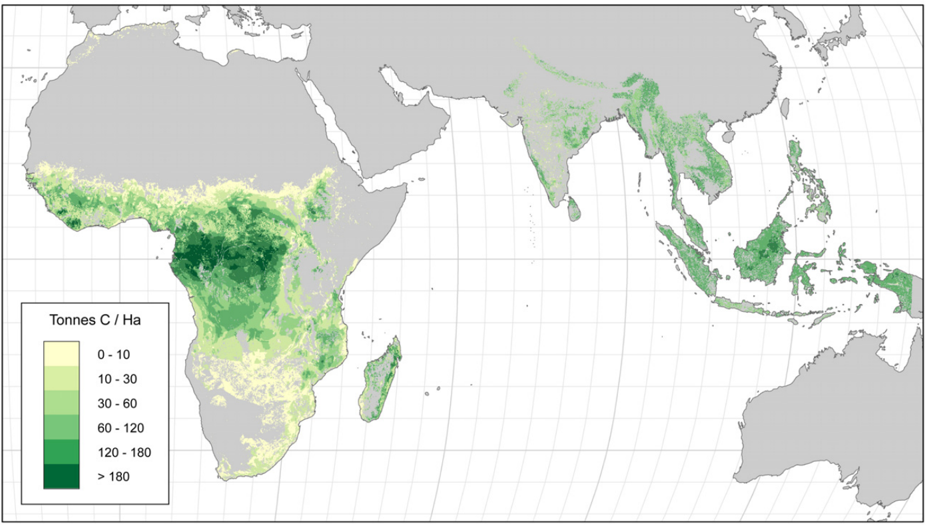
Reducing carbon emissions from deforestation and degradation in developing countries is of central importance in efforts to combat climate change. Key scientific challenges must be addressed to prevent any policy roadblocks. Foremost among the challenges is quantifying nations’ carbon emissions from deforestation and forest degradation, which requires information on forest clearing and carbon storage. Here we review a range of methods available to estimate national-level forest carbon stocks in developing countries. While there are no practical methods to directly measure all forest carbon stocks across a country, both ground-based and remote-sensing measurements of forest attributes can be converted into estimates of national carbon stocks using allometric relationships. Here we synthesize, map and update prominent forest biomass carbon databases to create the first complete set of national-level forest carbon stock estimates. These forest carbon estimates expand on the default values recommended by the Intergovernmental Panel on Climate Change’s National Greenhouse Gas Inventory Guidelines and provide a range of globally consistent estimates.
Overview
The claims and statistics of this paper haven’t been checked yet.
Free: it reads the open-access text and checks the first 5 claims that cite a source we can check. Create a free account to check every claim.
Integrity signals
Registry
Cites
Statistics
Figures
Verification
Claims the paper makes
The claims and statistics of this paper haven’t been checked yet.
Free: it reads the open-access text and checks the first 5 claims that cite a source we can check. Create a free account to check every claim.
Claims other papers make about this one
Each is checked against this paper’s own text: does it say what the citing paper says it does?
The source backs part of the claim, not all of it — or backs it for a different population, condition or comparison.
In the citing paper
“Tropical ecosystems store an enormous 340 billion tonnes of carbon (Gibbs et al 2007), equivalent to more than 40 times the total annual anthropogenic emissions from fossil fuel combustion (Canadell et al 2007).”
From Carbon payback times for crop-based biofuel expansion in the tropics: the effects of changing yield and technology (2008) · cites this paper as Gibbs et al 2007
Experimental — accuracy not yet measuredThe source backs part of the claim, not all of it — or backs it for a different population, condition or comparison.
In the citing paper
“However, estimating forest characteristics such as canopy height or biomass from optical images is a challenging task14, as the physical relationships between spectral signatures and vertical forest structure are complex and not well understood15.”
From A high-resolution canopy height model of the Earth (2023) · cites this paper as [14]
Experimental — accuracy not yet measuredThe cited source says what the claim attributes to it.
In the citing paper
“To estimate the potential carbon stocks that can accumulate in the long term in above-and belowground biomass after restoration, we used an approach commonly used in global estimates (for example, ref. 53 ).”
From Global priority areas for ecosystem restoration (2020) · cites this paper as [53]
In the citing paper
“However, with policies such as REDD in place, farmers and large-scale producers would have greater incentives to improve management of previously cleared land and receive carbon payments for avoiding carbon release from further deforestation (45,46).”
From Tropical forests were the primary sources of new agricultural land in the 1980s and 1990s (2010) · cites this paper as [45]
In the citing paper
“We assign biomass and soil organic carbon content values to each biome from the literature ([27](#r27)–[29](#r29)), and assume an uncertainty of ±20% in these values, reflective of regional differences”
From Greenhouse gas mitigation by agricultural intensification (2010) · cites this paper as [28]
Self-check
Percentages, sums and reported differences re-computed from the paper’s own numbers.
The self-check needs the paper’s full text.
Citations
Cites
Tree allometry and improved estimation of carbon stocks and balance in tropical forests
Chave, J., Andalo, C., Brown, S., Cairns, M. A., Chambers, J. Q., Eamus, D., Fölster, H., Fromard, F., Higuchi, N., Kira, T., et al. (2005) · Oecologia · doi:10.1007/s00442-005-0100-x · Cited by 3,533 · cited 1×
“example, none of the trees Chave et al (2005) used to develop”
MethodSelf-citationGood Practice Guidance for Land Use, Land-Use Change and Forestry
Penman, J., Gytarsky, M. L., Hiraishi, T., Krug, T., Kruger, D., Pipatti, R., Buendia, L. V., Miwa, K., Ngara, T., Tanabe, K., et al. (2003) · IIASA PURE (International Institute of Applied Systems Analysis) · Cited by 2,254
Determination of Deforestation Rates of the World's Humid Tropical Forests
Achard, F., Eva, H. D., Stibig, H.-J., Mayaux, P., Gallego, J., Richards, T., & Malingreau, J.-P. (2002) · Science · doi:10.1126/science.1070656 · Cited by 1,993 · cited 6×
“…of biome-average datasets where a single representative value of forest carbon per unit area (e.g. tonnes of C per hectare) is applied to broad forest categories or biomes (e.g. Fearnside 2000, Houghton 1999, Houghton et al 2001, DeFries et al 2002, Achard et al 2002, 2004, Ramankutty et al 2007).”
BackgroundInfluentialThe amount of carbon released from peat and forest fires in Indonesia during 1997
Page, S. E., Siegert, F., Rieley, J. O., Boehm, H.-D. V., Jaya, A., & Limin, S. (2002) · Nature · doi:10.1038/nature01131 · Cited by 1,885
Root biomass allocation in the world's upland forests
Cairns, M. A., Brown, S., Helmer, E. H., & Baumgardner, G. A. (1997) · Oecologia · doi:10.1007/s004420050201 · Cited by 1,622
Self-citationCritical analysis of root : shoot ratios in terrestrial biomes
MOKANY, K., RAISON, R. J., & PROKUSHKIN, A. S. (2006) · Global Change Biology · doi:10.1111/j.1365-2486.2005.001043.x · Cited by 1,588 · cited 1×
“For example, root biomass is typically estimated to be 20% of the aboveground forest carbon stocks (e.g. Houghton et al 2001, Achard et al 2002, Ramankutty et al 2007) based on a predictive relationship established from extensive literature reviews (Cairns et al 1997, Mokany et al 2006).”
BackgroundLand use, land use change and forestry
(2015) · Research Handbook on Climate Change Mitigation Law · doi:10.4337/9781849805834.00023 · Cited by 1,492
Estimating biomass and biomass change of tropical forests: A primer
Brown, S. (1997) · Medical Entomology and Zoology · Cited by 1,320
Self-citationBiomass Estimation Methods for Tropical Forests with Applications to Forest Inventory Data
Brown, S., Gillespie, A. J. R., & Lugo, A. E. (1989) · Forest Science · doi:10.1093/forestscience/35.4.881 · Cited by 1,279 · cited 1×
“…has gone into developing tools and models that can ‘scale up’ or extrapolate destructive harvest data points to larger scales based on proxies measured in the field or from remotesensing instruments (e.g. Brown et al, 1989, 1993, Waring et al 1995, Brown 1997, Chave et al 2005, Saatchi et al 2007).”
BackgroundSelf-citationMcGroddy, M. E., Daufresne, T., & Hedin, L. O. (2004) · Ecology · doi:10.1890/03-0351 · Cited by 1,124
Research works printed but not linked: 12
- Brown S, 1992, Interciencia, 17, 8
- Brown S Pearson T, 2005, Report to The Nature Conservancy
- IPCC, 2006, IPCC Guidelines for National Greenhouse Gas Inventories. Prepared by the National Greenhouse Gas Inventories Programme
- Mette T Papathanassiou K P Hajnsek I Zimmerman R, 2003, Proc. POLnSAR
- Olander L P, 2007, Environ. Res. Lett.
- Pearson T Brown S Petrova S Moore N Slaymaker D, 2005, Report to The Nature Conservancy
- Pearson T Walker S Brown S, 2005, Winrock International and the BioCarbon Fund of the World Bank, 57
- Penman J, 2003, IPCC National Greenhouse Gas Inventories Programme and Institute for Global Environmental Strategies, Kanagawa, Japan
- Post W M Izaurralde R C Mann L K Bliss N Rosenberg N J Izaurralde R C Malone E L, 1999, Proc. Symp. Carbon Sequestration in Soils Science, Monitoring and Beyond, 41
- Rosenqvist A Shimada M Igarashi T Watanabe M Tadono T Yamamoto H, 2003, Geoscience and Remote Sensing Symposium, 2003 Proc. 2003 IEEE International, 1471
- Shimada M Rosenqvist A Watanabe M Tadono T, 2005, Proc. POLinSAR 2005
- Watson R T Noble I R Bolin B Ravindranath N H Verardo D J Dokken D J, 2000, Special Report of the Intergovernmental Panel on Climate Change, 375
Cited by
Items 501–600 of 1,000
Limited carbon sequestration potential from global ecosystem restoration
Tölgyesi, C., Csikós, N., Temperton, V. M., Buisson, É., Silveira, F. A. O., Lehmann, C. E. R., Török, P., Bátori, Z., & Bede‐Fazekas, Á. (2025) · Nature Geoscience · doi:10.1038/s41561-025-01742-z · Cited by 40
Gorain, S., Dutta, S., Balo, S., Malakar, A., Choudhury, M. R., & Das, S. (2025) · Journal of Environmental Management · doi:10.1016/j.jenvman.2025.126987 · Cited by 39
Woody biomass on farms and in the landscapes of Rwanda
Ndayambaje, J. D. D., Mugiraneza, T., & Mohren, G. M. J. (2013) · Agroforestry Systems · doi:10.1007/s10457-013-9659-0 · Cited by 37
“Our total aboveground woody biomass on agricultural land falls within the range of 6–48 M t estimated for the total national wood stock (Gibbs et al. 2007).”
BackgroundManagement, Growth, and Carbon Storage in Miombo Woodlands of Tanzania
Lupala, Z. J., Lusambo, L. P., & Ngaga, Y. M. (2014) · International Journal of Forestry Research · doi:10.1155/2014/629317 · Cited by 40
“It ranges from 17– 70 tons carbon/ha compared to 193–200 in equatorial forest [37].”
BackgroundInfluentialHavinga, I., Hein, L., Vega-Araya, M., & Languillaume, A. (2019) · Ecological Indicators · doi:10.1016/j.ecolind.2019.105766 · Cited by 39
Lewis, K., Rumpang, E., Kho, L. K., McCalmont, J. P., Teh, Y. A., Gallego-Sala, A. V., & Hill, T. C. (2020) · Scientific Reports · doi:10.1038/s41598-020-58982-9 · Cited by 48
Purohit, S., Aggarwal, S. P., & Patel, N. R. (2021) · Tropical Ecology · doi:10.1007/s42965-021-00140-x · Cited by 40
Cao, L., Coops, N. C., Innes, J. L., Dai, J., & She, G. (2014) · Forests · doi:10.3390/f5061356 · Cited by 37
“Forest carbon stocks can be estimated using remote sensing from both satellite and airborne platforms, and a major benefit of this approach is the potential to provide “wall-to-wall” observation [7].”
BackgroundGuitet, S., Hérault, B., Molto, Q., Brunaux, O., & Couteron, P. (2015) · PLoS ONE · doi:10.1371/journal.pone.0138456 · Cited by 39
“Estimating carbon flux due to afforestation, deforestation, and forest degradation requires quantifying above-ground biomass (AGB), especially over extensive areas of old-growth tropical forests which have high but varied carbon stocks and are threatened by a rapidly changing land-use dynamics in many countries [1].”
BackgroundFactors influencing tree biomass and carbon stock in the Western Himalayas, India
Kumar, P., Kumar, A., Patil, M., Hussain, S., & Singh, A. N. (2024) · Frontiers in Forests and Global Change · doi:10.3389/ffgc.2023.1328694 · Cited by 38
Green and Redd? Towards a Political Ecology of Deforestation in Aceh, Indonesia
McGregor, A. (2010) · Human Geography · doi:10.1177/194277861000300202 · Cited by 36
Forest aboveground biomass stock and resilience in a tropical landscape of Thailand
Jha, N., Tripathi, N. K., Chanthorn, W., Brockelman, W. Y., Nathalang, A., Pélissier, R., Pimmasarn, S., Ploton, P., Sasaki, N., Virdis, S., et al. (2020) · Biogeosciences · doi:10.5194/bg-17-121-2020 · Cited by 36
“Remote sensing technology has emerged as a promising tool for extrapolating local field carbon estimates over landscapes, regions, or at the global scale (Gibbs et al., 2007; Goetz et al., 2009).”
MethodPothong, T., Elliott, S., Chairuangsri, S., Chanthorn, W., Shannon, D. P., & Wangpakapattanawong, P. (2021) · New Forests · doi:10.1007/s11056-021-09844-3 · Cited by 39
“It involves harvesting all tree components, drying them and then weighing them (Gibbs et al. 2007; Picard et al. 2012).”
Using Remote Sensing and Geospatial Technology for Climate Change Education
Cox, H., Kelly, K. A., & Yetter, L. (2014) · Journal of Geoscience Education · doi:10.5408/13-040.1 · Cited by 42
“When deforestation occurs the stored carbon is released as carbon dioxide back into the atmosphere as the tree decomposes (Gibbs et al. 2007).”
BackgroundMwakisunga, B., & Majule, A. E. (2012) · Open Journal of Ecology · doi:10.4236/oje.2012.24025 · Cited by 39
“However, Gibbs et al. (2007) [9] discussed the important options of estimating national-level forest biomass carbon stocks in developing countries and proposed methods to link forest carbon and deforestation estimates.”
Dilling, L., & Failey, E. (2002) · Royal Society of Chemistry eBooks · doi:10.1039/9781847550972 · Cited by 36
Assessment of carbon stores in tree biomass for two management scenarios in Russia
Shuman, J. K., Shugart, H. H., & Krankina, O. N. (2013) · Environmental Research Letters · doi:10.1088/1748-9326/8/4/045019 · Cited by 35
da Silva, M. S. R., & Correia, J. E. (2022) · Journal of Political Ecology · doi:10.2458/jpe.4713 · Cited by 43
Contribution of Acacia senegal to biomass and soil carbon in plantations of varying age in Sudan
Abaker, W. E., Berninger, F. A., Saiz, G., Braojos, V., & Starr, M. (2016) · Forest Ecology and Management · doi:10.1016/j.foreco.2016.03.003 · Cited by 39
Graham, V., Laurance, S. G. W., Grech, A., & Venter, O. (2017) · Environmental Research Letters · doi:10.1088/1748-9326/aa6656 · Cited by 50
“Site-specific factors that influence costs and benefits include terrain, distance to markets and soil type (Gibbs et al 2007, Pagiola and Bosquet 2009).”
BackgroundCastro-Nunez, A. C. (2018) · Forests · doi:10.3390/f9100621 · Cited by 37
“Irrespective of the differences of their findings, these studies commonly recognize the biophysical opportunities for tackling climate change arising from forest landscapes [11,12].”
BackgroundSinha, S., Mohan, S., Das, A. K., Sharma, L. K., Jeganathan, C., Santra, A., Mitra, S. S., & Nathawat, M. S. (2019) · Carbon Management · doi:10.1080/17583004.2019.1686931 · Cited by 41
Asrat, Z., Eid, T., Gobakken, T., & Negash, M. (2020) · Forest Ecology and Management · doi:10.1016/j.foreco.2020.118335 · Cited by 35
Wong, C. J., James, D., Besar, N. A., Kamlun, K. U., Tangah, J., Tsuyuki, S., & Phua, M. (2020) · Forests · doi:10.3390/f11091018 · Cited by 38
Assessment of Above-Ground Biomass in Pakistan Forest Ecosystem’s Carbon Pool: A Review
Khan, I. A., Khan, W. R., Ali, A., & Nazre, M. (2021) · Forests · doi:10.3390/f12050586 · Cited by 35
“The destructive method involves harvesting all trees and measuring different parts’ biomass [104].”
MethodShennan‐Farpón, Y., Visconti, P., & Norris, K. (2021) · Biotropica · doi:10.1111/btp.12999 · Cited by 39
“Covering around 10% of the Earth's surface, they contain over half of the world's known species including 90% of terrestrial bird species (Barlow et al., 2018; Gibson et al., 2011) and are central to climate change mitigation (Gibbs et al., 2007).”
BackgroundHow can we monitor, report and verify carbon emissions from forests?
Wertz-Kanounnikoff, S., Verchot, L. V., Kanninen, M., & Murdiyarso, D. (2008) · CGSPace A Repository of Agricultural Research Outputs (Consultative Group for International Agricultural Research) · Cited by 47
Are REDD projects pro-poor in their spatial targeting? Evidence from Kenya
Atela, J. O., Quinn, C. H., & Minang, P. A. (2014) · Applied Geography · doi:10.1016/j.apgeog.2014.04.009 · Cited by 35
“Various forests in Kenya, range from tropical humid forests to dryland savannah forests and are recognised under REDD (Gibbs et al., 2007).”
BackgroundOptimal measurement strategies for aboveground tree biomass in agricultural landscapes
Kuyah, S., & Rosenstock, T. S. (2014) · Agroforestry Systems · doi:10.1007/s10457-014-9747-9 · Cited by 35
Dilling, L., & Failey, E. L. (2012) · Global Environmental Change · doi:10.1016/j.gloenvcha.2012.10.012 · Cited by 35
“Despite the presence of substantial land carbon sinks in the northern hemisphere and elsewhere outside of the tropics (Goodale et al., 2002), fewer studies have been conducted on carbon and land-use decision making in the northern hemisphere and the U.S. in particular (although see Poudyal et al.,…”
BackgroundFerretti, M. P. (2013) · Developments in environmental science · doi:10.1016/b978-0-08-098222-9.00001-7 · Cited by 35
Chan, N., TAKEDA, S., Suzuki, R., & YAMAMOTO, S. (2016) · New Forests · doi:10.1007/s11056-016-9531-y · Cited by 34
Navarrete‐Segueda, A., Martínez-Ramos, M., Ibarra‐Manríquez, G., Vázquez‐Selem, L., & Siebe, C. (2017) · Geoderma · doi:10.1016/j.geoderma.2017.10.023 · Cited by 34
“…allometric relationships by grouping all species has proven to be very effective in the tropics (De Jong et al., 2000; Lewis et al., 2013; Poorter et al., 2015; Willcock et al., 2014) since dbh alone explains> 95% of the variation in AGB tropical forest C stocks (Brown, 2002; Gibbs et al., 2007).”
BackgroundMethodInfluentialState of research on carbon sequestration in Bangladesh: a comprehensive review
Majumder, S. C., Islam, K., & Hossain, M. M. (2018) · Geology Ecology and Landscapes · doi:10.1080/24749508.2018.1481656 · Cited by 34
Hunt, C. A., Demšar, U., Dove, D., Smeaton, C., Cooper, R., & Austin, W. E. N. (2020) · Frontiers in Marine Science · doi:10.3389/fmars.2020.00588 · Cited by 37
Silvestri, S., & Kershaw, F. (2010) · University of North Texas Digital Library (University of North Texas) · Cited by 47
MacFarlane, D. W., Kuyah, S., Mulia, R., Dietz, J., Muthuri, C. W., & van Noordwijk, M. (2014) · Trees · doi:10.1007/s00468-014-0993-2 · Cited by 34
“Allometric scaling equations, which relate different measureable properties of organisms to each other, have been widely applied to estimate the biomass and carbon content of trees during forest carbon stock inventories (Brown 1997; Gibbs et al. 2007).”
BackgroundAgroforestry in Liberia: household practices, perceptions and livelihood benefits
Fouladbash, L., & Currie, W. S. (2014) · Agroforestry Systems · doi:10.1007/s10457-014-9763-9 · Cited by 41
“Tropical rainforests are globally valued for their rich biodiversity, economic assets and their ability to store large amounts of carbon, thus mitigating global climate change (Myers et al. 2000; FAO 2005; Gibbs et al. 2007).”
BackgroundCharacterization of forests and deforestation in Cambodia using ALOS/PALSAR observation
Avtar, R., Sawada, H., Takeuchi, W., & Singh, G. (2011) · Geocarto International · doi:10.1080/10106049.2011.626081 · Cited by 35
MİRİCİ, M. E., & Berberoğlu, S. (2024) · Ecological Informatics · doi:10.1016/j.ecoinf.2024.102570 · Cited by 37
Uddin, K., Gilani, H., Murthy, M. S. R., Kotru, R., & Qamer, F. M. (2015) · Mountain Research and Development · doi:10.1659/mrd-journal-d-14-00074.1 · Cited by 33
Lucas, R., Clewley, D., Accad, A., Butler, D. W., Armston, J. D., Bowen, M. E., Bunting, P., Carreiras, J. M. B., Dwyer, J. M., Eyre, T. J., et al. (2014) · Remote Sensing of Environment · doi:10.1016/j.rse.2013.11.025 · Cited by 35
Sagang, L. B., Takoudjou, S. M., Libalah, M. B., Rossi, V., Fonton, N., Mofack, G. I., Kamdem, N. G., Nguetsop, V. F., Sonké, B., Ploton, P., et al. (2018) · Forest Ecology and Management · doi:10.1016/j.foreco.2018.04.054 · Cited by 33
Hiltner, U., Huth, A., Bräuning, A., Hérault, B., & Fischer, R. (2018) · Forest Ecology and Management · doi:10.1016/j.foreco.2018.08.042 · Cited by 35
Peng, D., Zhang, H., Liu, L., Huang, W., HUETE, A. R., Zhang, X., Wang, F., Yu, L., Xie, Q., Wang, C., et al. (2019) · Remote Sensing · doi:10.3390/rs11192270 · Cited by 34
“Remote sensing techniques provide a fast, efficient, and comprehensive method for monitoring land cover change, revealing dynamic changes by providing macro-scale data about surface conditions and allowing for the detection and prediction of these changes [21,22].”
MethodOu, G., Lv, Y., Xu, H., & Wang, G. (2019) · Remote Sensing · doi:10.3390/rs11232750 · Cited by 34
Effect of terrestrial vegetation growth on climate change in China
Li, L., Zha, Y., Zhang, J., Li, Y., & Lyu, H. (2020) · Journal of Environmental Management · doi:10.1016/j.jenvman.2020.110321 · Cited by 34
Dumortier, J., Carriquiry, M., & Elobeid, A. E. (2020) · Energy Policy · doi:10.1016/j.enpol.2020.111909 · Cited by 33
Cooper, S., Okujeni, A., Pflugmacher, D., van der Linden, S., & Hostert, P. (2021) · International Journal of Applied Earth Observation and Geoinformation · doi:10.1016/j.jag.2021.102307 · Cited by 35
Masolele, R. N., Sy, V. D., Marcos, D., Verbesselt, J., Gieseke, F. C., Mulatu, K. A., Moges, Y., Sebrala, H., Martius, C., & Herold, M. (2022) · GIScience & Remote Sensing · doi:10.1080/15481603.2022.2115619 · Cited by 37
“However, they are challenging and expensive to implement at an administrative or decision-making level (FAO 2010; Gibbs et al. 2007; Harfoot et al. 2021).”
BackgroundSkutsch, M., Laake, P. V., Zahabu, E. M., Karky, B. S., & Phartiyal, P. (2009) · University of Twente Research Information · Cited by 40
Healey, S. P., Patterson, P. L., Saatchi, S. S., Lefsky, M. A., Lister, A. J., & Freeman, E. A. (2012) · Carbon Balance and Management · doi:10.1186/1750-0680-7-10 · Cited by 33
“Satellite-based forest monitoring may offer observations which are more consistent across space and time, and potential contributions of remotely sensed estimation of carbon stored in biomass are widely recognized [2,3].”
BackgroundEstimation of Tropical Forest Structural Characteristics Using ALOS-2 SAR Data
Nguyen, L. V., Tateishi, R., Nguyen, H. T., Sharma, R. C., To, T. T., & Le, S. M. (2016) · Advances in Remote Sensing · doi:10.4236/ars.2016.52011 · Cited by 34
“132 understanding of carbon cycles, improving climate change forecasting models, and climate change mitigation and adaptation strategies [3] [8] [9].”
BackgroundInfluentialMuhati, G. L., Olago, D. O., & Olaka, L. A. (2018) · Global Ecology and Conservation · doi:10.1016/j.gecco.2018.e00383 · Cited by 34
How can emissions from woodfuel be reduced
Hofstad, O., Köhlin, G., & Namaalwa, J. (2009) · Cited by 41
Fox, J., Castella, J., Ziegler, A. D., & Westley, S. B. (2014) · Agritrop (Cirad) · Cited by 32
Measurement, reporting and verification for REDD+: objectives, capacities and institutions
Herold, M., & Skutch, M. (2009) · Wageningen University & Research Publications · Cited by 51
Structure and allometry in tropical forests of Chocó, Colombia
Duque, Á., Saldarriaga, J., Meyer, V., & Saatchi, S. S. (2017) · Forest Ecology and Management · doi:10.1016/j.foreco.2017.09.048 · Cited by 34
Ashiagbor, G., Forkuo, E. K., Asante, W. A., Acheampong, E., Quaye‐Ballard, J. A., Boamah, P., Mohammed, Y., & Foli, E. G. (2020) · Remote Sensing Applications Society and Environment · doi:10.1016/j.rsase.2020.100349 · Cited by 38
Venkatappa, M., Sasaki, N., Anantsuksomsri, S., & Smith, B. (2020) · Remote Sensing · doi:10.3390/rs12183110 · Cited by 33
Wani, A. A., Bhat, A. F., Gatoo, A. A., Zahoor, S., Mehraj, B., Najam, N., Wani, Q. S., Islam, M. A., Murtaza, S., Dervash, M. A., et al. (2021) · Mitigation and Adaptation Strategies for Global Change · doi:10.1007/s11027-021-09937-6 · Cited by 36
“Forest biomass carbon can be assessed through different methods both destructive and non-destructive (Gibbs et al. 2007).”
Kumar, A., & Sharma, M. P. (2015) · Ecotoxicology and Environmental Safety · doi:10.1016/j.ecoenv.2015.08.029 · Cited by 33
Xu, Q., Hou, Z., & Tokola, T. (2012) · ISPRS Journal of Photogrammetry and Remote Sensing · doi:10.1016/j.isprsjprs.2011.12.008 · Cited by 32
Morton, D. C., Sales, M., Souza, C., & Griscom, B. W. (2011) · Carbon Balance and Management · doi:10.1186/1750-0680-6-18 · Cited by 32
Accuracy of vegetation height and terrain elevation derived from ICESat/GLAS in forested areas
Enßle, F., Heinzel, J., & Koch, B. (2014) · International Journal of Applied Earth Observation and Geoinformation · doi:10.1016/j.jag.2014.02.009 · Cited by 17
Tanase, M. A., Panciera, R., Lowell, K., Tian, S., García-Martín, A., & Walker, J. P. (2013) · IEEE Transactions on Geoscience and Remote Sensing · doi:10.1109/tgrs.2013.2283521 · Cited by 36
“thus, policy development and implementation [1].”
Shirima, D. D., Pfeifer, M., Platts, P. J., Totland, Ø., & Moe, S. R. (2015) · PLoS ONE · doi:10.1371/journal.pone.0142784 · Cited by 32
“Understanding drivers of structure and function in both these vegetation types, especially their role in the carbon cycle, is a priority for research [25].”
BackgroundPereira, L. O., Furtado, L. F. A., Novo, E. M. L. D. M., Sant’Anna, S. J. S., Liesenberg, V., & Silva, T. S. F. (2018) · Remote Sensing · doi:10.3390/rs10091355 · Cited by 40
“Such measurements also support international protocols such as the United Nations Reducing Emissions from Deforestation and Forest Degradation (REDD+) [1].”
MethodKhan, M. N. I., Shil, M. C., Azad, M. S., Sadath, M. N., Feroz, S. M., & Mollick, A. S. (2018) · Forest Ecology and Management · doi:10.1016/j.foreco.2018.09.002 · Cited by 38
The role of the atmosphere in the provision of ecosystem services
Cooter, E. J., Rea, A. W., Bruins, R., Schwede, D., & Dennis, R. L. (2012) · The Science of The Total Environment · doi:10.1016/j.scitotenv.2012.07.077 · Cited by 33
Rizvi, R. H., Newaj, R., Chaturvedi, O. P., Prasad, R., Handa, A. K., & Alam, B. (2019) · Journal of Earth System Science · doi:10.1007/s12040-019-1071-3 · Cited by 31
Balima, L. H., Nacoulma, B. M. I., Bayen, P., Dimobe, K., Kouamé, F. N., & Thiombiano, A. (2019) · Journal of Forestry Research · doi:10.1007/s11676-019-00955-4 · Cited by 32
“Hence, estimating aboveground biomass is critical for monitoring changes in carbon fluxes in tropical forests (Gibbs et al. 2007; Vashum and Jayakumar 2012) and assessing energy accumulation and the productivity and sustainability of forest ecosystems (Sawadogo et al.”
BackgroundMethodInfluentialBuragohain, M. K., Dar, A. A., Babu, K. N., & Parthasarathy, N. (2023) · Trees Forests and People · doi:10.1016/j.tfp.2023.100371 · Cited by 31
Forest Fire in the Hindu Kush Himalayas: A Major Challenge for Climate Action
Bhattarai, N., Dahal, S., Thapa, S., Pradhananga, S., Karky, B. S., Rawat, R., Windhorst, K., Watanabe, T., Thapa, R. B., & Avtar, R. (2022) · Journal of Forest and Livelihood · doi:10.3126/jfl.v21i1.56576 · Cited by 39
Detecting and Quantifying Forest Change: The Potential of Existing C- and X-Band Radar Datasets
Tanase, M. A., Ismail, I., Lowell, K., Karyanto, O., & Santoro, M. (2015) · PLoS ONE · doi:10.1371/journal.pone.0131079 · Cited by 35
“Forest structural characteristics estimation is a sensitive research topic since information on forest spatial extent, carbon stocks and their dynamics is needed for greenhouse gases flux estimation and, thus, policy development and implementation [1].”
BackgroundEstimating Tree Biomass via Remote Sensing, MSAVI 2, and Fractional Cover Model
Laosuwan, T., & Uttaruk, P. (2014) · IETE Technical Review · doi:10.1080/02564602.2014.959081 · Cited by 31
Odipo, V., Nickless, A., Berger, C. R., Baade, J., Urbazaev, M., Walther, C., & Schmullius, C. (2016) · Forests · doi:10.3390/f7120294 · Cited by 35
Volume and Carbon Estimates for the Forest Area of the Amhara Region in Northwestern Ethiopia
Sisay, K., Thurnher, C., Belay, B., Lindner, G., & Hasenauer, H. (2017) · Forests · doi:10.3390/f8040122 · Cited by 31
“[70] estimated a total aboveground carbon stock for Ethiopia within a range of 153 to 867 Tg.”
BackgroundAnti-corruption policies in the forest sector and REDD+
Tacconi, L., Downs, F., & Larmour, P. J. (2009) · ANU Open Research (Australian National University) · Cited by 37
Ladd, B., Laffan, S. W., Amelung, W., Peri, P. L., Silva, L. C. R., Gervassi, P., Bonser, S. P., Navall, M., & Sheil, D. (2012) · Global Ecology and Biogeography · doi:10.1111/j.1466-8238.2012.00799.x · Cited by 32
“Theory suggests that terrestrial plant productivity and soil carbon are likely to be related, at least in undisturbed forest or grassland ecosystems (Gibbs et al., 2007; Yang et al., 2008).”
BackgroundBiomasse et stocks de carbone des forêts tropicales africaines (synthèse bibliographique)
Panzou, G. J. L., Doucet, J., Loumeto, J. J., Biwôlé, A. B., Bauwens, S., & Fayolle, A. (2016) · BASE · doi:10.25518/1780-4507.13232 · Cited by 48
Multi-polarized Radarsat-2 satellite sensor in assessing forest vigor from above ground biomass
Sinha, S., Santra, A., Sharma, L., Jeganathan, C., Nathawat, M. S., Das, A. K., & Mohan, S. (2017) · Journal of Forestry Research · doi:10.1007/s11676-017-0511-7 · Cited by 30
“The concept of Reducing emissions from deforestation and forest degradation (REDD) is directly related to the biomass and in turn carbon changes over time (Gibbs et al. 2007; Plugge et al. 2010; Sharma et al. 2013).”
BackgroundSpatiotemporal variability of ecosystem water use efficiency in northern Ethiopia during 1982–2014
Tesfaye, S., Taye, G., Birhane, E., & van der Zee, S. E. A. T. M. (2021) · Journal of Hydrology · doi:10.1016/j.jhydrol.2021.126863 · Cited by 32
Huang, Z., Tian, Y., Zhang, Q., Huang, Y., Liu, R., Huang, H., Zhou, G., Wang, J., Tao, J., Yang, Y., et al. (2022) · Geocarto International · doi:10.1080/10106049.2022.2102226 · Cited by 33
“This type of satellite data source has developed slowly in retrieving the aboveground biomass of mangroves owing to the limitation of spectral and spatial resolution (Lu 2006; Gibbs et al. 2007; Cao et al. 2010; Nguyen et al. 2019).”
BackgroundThe role of science in Reducing Emissions from Deforestation and Forest Degradation (REDD)
Houghton, R., Greenglass, N., Baccini, A., Cattaneo, A., Goetz, S. J., Kellndorfer, J., Laporte, N., & Walker, W. (2010) · Carbon Management · doi:10.4155/cmt.10.29 · Cited by 30
Shang, X., & Chazette, P. (2014) · Forests · doi:10.3390/f5061454 · Cited by 30
“[2] pointed out that the majority of carbon is sequestered in aboveground live tissues (e.”
BackgroundRiegel, J. B., Bernhardt, E. S., & Swenson, J. J. (2013) · PLoS ONE · doi:10.1371/journal.pone.0068251 · Cited by 30
“Due to the significant monetary and ecological values involved, successfully implementing these programs requires accurate and, ideally, inexpensive methods for estimating the amount of carbon sequestered in plant biomass [7], [8].”
Aboveground-Biomass Estimation of a Complex Tropical Forest in India Using Lidar
Vega, C., Vepakomma, U., Morel, J., Bader, J.-L., Rajashekar, G., Jha, C., Ferêt, J., Proisy, C., Pélissier, R., & Dadhwal, V. K. (2015) · Remote Sensing · doi:10.3390/rs70810607 · Cited by 30
Weishampel, J. F., Hightower, J. N., Chase, A. F., & Chase, D. Z. (2012) · Tropical Conservation Science · doi:10.1177/194008291200500103 · Cited by 30
“Las incursiones a la reserva desde la frontera con Guatemala, reflejadas por las perturbaciones del dosel detectadas con LiDAR, se adentran 1 km más en Belice (hasta 3.5 km) que aquellas derivadas con Landsat.”
BackgroundInfluentialJaafar, W. S. W. M., Woodhouse, I. H., Silva, C. A., Omar, H., & Hudak, A. T. (2017) · JOURNAL OF TROPICAL FOREST SCIENCE · doi:10.26525/jtfs2017.29.4.465484 · Cited by 37
Allometric models for managing lowland miombo woodlands of the Beira corridor in Mozambique
Guedes, B. S., Sitoe, A. A., & Olsson, B. A. (2018) · Global Ecology and Conservation · doi:10.1016/j.gecco.2018.e00374 · Cited by 34
Sharma, L. K., Nathawat, M. S., & Sinha, S. (2013) · Environmental Monitoring and Assessment · doi:10.1007/s10661-013-3199-y · Cited by 33
“, REDD (Reduced Emissions fromDeforestation and forest Degradation) (Gibbs et al. 2007).”
BackgroundREDD+ emissions estimation and reporting: dealing with uncertainty
Pelletier, J., Martin, D., & Potvin, C. (2013) · Environmental Research Letters · doi:10.1088/1748-9326/8/3/034009 · Cited by 30
Financing Sustainable Forest Management: A Key Component of Sustainable COVID-19 Recovery
United Nations Department of Economic and Social Affairs, Lang, Y., Gondo, P., & Moeini-Meybodi, H. (2021) · UN-DESA policy brief · doi:10.18356/27081990-88 · Cited by 34
CongoFlux – The First Eddy Covariance Flux Tower in the Congo Basin
Sibret, T., Bauters, M., Bulonza, E., Lefevre, L., Cerutti, P., Lokonda, M., Mbifo, J., Michel, B., Verbeeck, H., & Boeckx, P. (2022) · Frontiers in Soil Science · doi:10.3389/fsoil.2022.883236 · Cited by 31
A Review of Satellite-Based CO2 Data Reconstruction Studies: Methodologies, Challenges, and Advances
Hu, K., Liu, Z., Shao, P., Ma, K., Yao, X., Wang, S., Wang, Y., Wang, H., Di, L., Xia, M., et al. (2024) · Remote Sensing · doi:10.3390/rs16203818 · Cited by 30
Advances in Laser Scanning to Assess Carbon in Forests: From Ground-Based to Space-Based Sensors
Coops, N. C., Irwin, L., Seely, H., & Hardy, S. J. (2025) · Current Forestry Reports · doi:10.1007/s40725-024-00242-4 · Cited by 37
“To reduce atmospheric CO 2 concentrations, global initiatives such as Reducing Emissions from Deforestation and Forest Degradation (REDD+) represent a key strategy for the protection and enhancement of forest carbon stocks at a global scale [16].”
Volume and Aboveground Biomass Models for Dry Miombo Woodland in Tanzania
Mwakalukwa, E. E., Meilby, H., & Treue, T. (2014) · International Journal of Forestry Research · doi:10.1155/2014/531256 · Cited by 29
“Although with some limitations due to the large number of species in tropical forests, species-specific volume and biomass models are often preferred for accurate estimation of forest volume and biomass and for carbon accounting purposes [19, 20].”
BackgroundAssessing carbon stocks using indigenous peoples’ field measurements in Amazonian Guyana
Butt, N., Epps, K. Y., Overman, H., Iwamura, T., & Fragoso, J. M. V. (2014) · Forest Ecology and Management · doi:10.1016/j.foreco.2014.11.014 · Cited by 29
“, 2008), and in order to mitigate rapid climate change, it is essential that forests are kept as intact as possible so they can continue as carbon stocks (Gibbs et al., 2007).”
BackgroundAkhtar, A. M., Qazi, W. A., Ahmad, S. R., Gilani, H., Mahmood, S. A., & Rasool, A. (2020) · Environmental Monitoring and Assessment · doi:10.1007/s10661-020-08546-1 · Cited by 30
Metadata
- Authors
- Gibbs, H. K., Brown, S., Niles, J. O., & Foley, J. A.
- Affiliations
- University of Wisconsin–Madison (US)
- Winrock International (United States) (US)
- ORCID
- Gibbs, Holly K
- Venue
- Environmental Research Letters
- Publisher
- IOP Publishing
- Published
- 2007-10
- Volume
- 2
- Issue
- 4
- Pages
- 045023
- ISSN
- 1748-9326 (ISSN-L)
- OpenAlex
- W2040120109
- Semantic Scholar
- 6d28e7b3cb196fc6233340c2b9201e21c6d89a85
- Cited by
- 1,653
- References
- 86
- Citations by year
- 2026: 49 · 2025: 68 · 2024: 79 · 2023: 75 · 2022: 97 · 2021: 95 · 2020: 116 · 2019: 98 · 2018: 97 · 2017: 108 · 2016: 99 · 2015: 108 · 2014: 138 · 2013: 103 · 2012: 105
- FWCI
- 35.91
- Type
- journal article
- Language
- en
- Open access
- gold
- doi.org
- Licence
- cc-by
- Locations
- Environmental Research Letters (publishedVersion, cc-by)
- Funders
- U.S. Department of Energy
- National Aeronautics and Space Administration
- Topics
- Life Sciences › Agricultural and Biological Sciences › Forestry › Forest ecology and management
- Life Sciences › Agricultural and Biological Sciences › Forestry › Remote Sensing and LiDAR Applications
- Life Sciences › Agricultural and Biological Sciences › Forestry › Forest Management and Policy
- Keywords
- REDD+, deforestation, forest degradation, CO2 emissions, forest biomass carbon, allometric relationships, remote sensing, ground-based observations, developing countries
About these checks
Registry, retraction, Cites and statistics results are computed, not judged, with one exception: a printed reference that no index lists is read once by a model before it counts as a citation error. Claims are extracted by a model and kept only when their quote appears verbatim in the text; each cited source is then checked, with a model’s help, for whether it says what the claim relies on. Those verdicts can be wrong — read the claim’s quote and the cited source before relying on one.
Statistics and arithmetic are recomputed, not judged.
Confidence bands are shown only for fields calibrated on our annotated test set. None is calibrated yet, so no band is shown.
What counts as a claim ›How we measure confidence ›How we check this ›
Are you an author, or do you see a problem with this page? Request a review
Data sources
Bibliographic data: Semantic Scholar, OpenAlex, Crossref.
Contains information from the Semantic Scholar Academic Graph Datasets, made available under the ODC Attribution License (ODC-BY 1.0).
Semantic Scholar’s data is described in: Kinney, R., et al. (2023). The Semantic Scholar Open Data Platform. arXiv:2301.10140.
