

Monitoring and estimating tropical forest carbon stocks: making REDD a reality
Open accessThe DOI matches its Crossref record; 86 of the 86 references it cites were found in a registry or an index.
Abstract
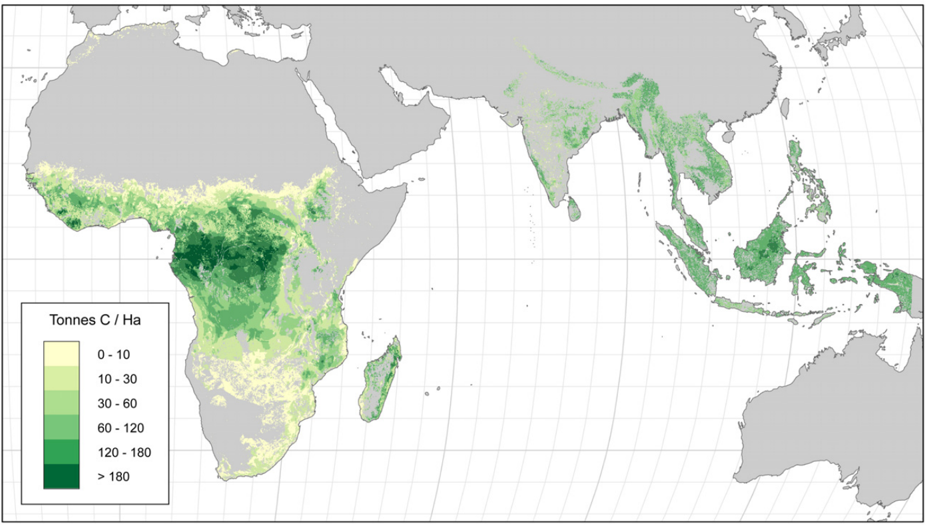
Reducing carbon emissions from deforestation and degradation in developing countries is of central importance in efforts to combat climate change. Key scientific challenges must be addressed to prevent any policy roadblocks. Foremost among the challenges is quantifying nations’ carbon emissions from deforestation and forest degradation, which requires information on forest clearing and carbon storage. Here we review a range of methods available to estimate national-level forest carbon stocks in developing countries. While there are no practical methods to directly measure all forest carbon stocks across a country, both ground-based and remote-sensing measurements of forest attributes can be converted into estimates of national carbon stocks using allometric relationships. Here we synthesize, map and update prominent forest biomass carbon databases to create the first complete set of national-level forest carbon stock estimates. These forest carbon estimates expand on the default values recommended by the Intergovernmental Panel on Climate Change’s National Greenhouse Gas Inventory Guidelines and provide a range of globally consistent estimates.
Overview
The claims and statistics of this paper haven’t been checked yet.
Free: it reads the open-access text and checks the first 5 claims that cite a source we can check. Create a free account to check every claim.
Integrity signals
Registry
Cites
Statistics
Figures
Verification
Claims the paper makes
The claims and statistics of this paper haven’t been checked yet.
Free: it reads the open-access text and checks the first 5 claims that cite a source we can check. Create a free account to check every claim.
Claims other papers make about this one
Each is checked against this paper’s own text: does it say what the citing paper says it does?
The source backs part of the claim, not all of it — or backs it for a different population, condition or comparison.
In the citing paper
“Tropical ecosystems store an enormous 340 billion tonnes of carbon (Gibbs et al 2007), equivalent to more than 40 times the total annual anthropogenic emissions from fossil fuel combustion (Canadell et al 2007).”
From Carbon payback times for crop-based biofuel expansion in the tropics: the effects of changing yield and technology (2008) · cites this paper as Gibbs et al 2007
Experimental — accuracy not yet measuredThe source backs part of the claim, not all of it — or backs it for a different population, condition or comparison.
In the citing paper
“However, estimating forest characteristics such as canopy height or biomass from optical images is a challenging task14, as the physical relationships between spectral signatures and vertical forest structure are complex and not well understood15.”
From A high-resolution canopy height model of the Earth (2023) · cites this paper as [14]
Experimental — accuracy not yet measuredThe cited source says what the claim attributes to it.
In the citing paper
“To estimate the potential carbon stocks that can accumulate in the long term in above-and belowground biomass after restoration, we used an approach commonly used in global estimates (for example, ref. 53 ).”
From Global priority areas for ecosystem restoration (2020) · cites this paper as [53]
In the citing paper
“However, with policies such as REDD in place, farmers and large-scale producers would have greater incentives to improve management of previously cleared land and receive carbon payments for avoiding carbon release from further deforestation (45,46).”
From Tropical forests were the primary sources of new agricultural land in the 1980s and 1990s (2010) · cites this paper as [45]
In the citing paper
“We assign biomass and soil organic carbon content values to each biome from the literature ([27](#r27)–[29](#r29)), and assume an uncertainty of ±20% in these values, reflective of regional differences”
From Greenhouse gas mitigation by agricultural intensification (2010) · cites this paper as [28]
Self-check
Percentages, sums and reported differences re-computed from the paper’s own numbers.
The self-check needs the paper’s full text.
Citations
Cites
Tree allometry and improved estimation of carbon stocks and balance in tropical forests
Chave, J., Andalo, C., Brown, S., Cairns, M. A., Chambers, J. Q., Eamus, D., Fölster, H., Fromard, F., Higuchi, N., Kira, T., et al. (2005) · Oecologia · doi:10.1007/s00442-005-0100-x · Cited by 3,533 · cited 1×
“example, none of the trees Chave et al (2005) used to develop”
MethodSelf-citationGood Practice Guidance for Land Use, Land-Use Change and Forestry
Penman, J., Gytarsky, M. L., Hiraishi, T., Krug, T., Kruger, D., Pipatti, R., Buendia, L. V., Miwa, K., Ngara, T., Tanabe, K., et al. (2003) · IIASA PURE (International Institute of Applied Systems Analysis) · Cited by 2,254
Determination of Deforestation Rates of the World's Humid Tropical Forests
Achard, F., Eva, H. D., Stibig, H.-J., Mayaux, P., Gallego, J., Richards, T., & Malingreau, J.-P. (2002) · Science · doi:10.1126/science.1070656 · Cited by 1,993 · cited 6×
“…of biome-average datasets where a single representative value of forest carbon per unit area (e.g. tonnes of C per hectare) is applied to broad forest categories or biomes (e.g. Fearnside 2000, Houghton 1999, Houghton et al 2001, DeFries et al 2002, Achard et al 2002, 2004, Ramankutty et al 2007).”
BackgroundInfluentialThe amount of carbon released from peat and forest fires in Indonesia during 1997
Page, S. E., Siegert, F., Rieley, J. O., Boehm, H.-D. V., Jaya, A., & Limin, S. (2002) · Nature · doi:10.1038/nature01131 · Cited by 1,885
Root biomass allocation in the world's upland forests
Cairns, M. A., Brown, S., Helmer, E. H., & Baumgardner, G. A. (1997) · Oecologia · doi:10.1007/s004420050201 · Cited by 1,622
Self-citationCritical analysis of root : shoot ratios in terrestrial biomes
MOKANY, K., RAISON, R. J., & PROKUSHKIN, A. S. (2006) · Global Change Biology · doi:10.1111/j.1365-2486.2005.001043.x · Cited by 1,588 · cited 1×
“For example, root biomass is typically estimated to be 20% of the aboveground forest carbon stocks (e.g. Houghton et al 2001, Achard et al 2002, Ramankutty et al 2007) based on a predictive relationship established from extensive literature reviews (Cairns et al 1997, Mokany et al 2006).”
BackgroundLand use, land use change and forestry
(2015) · Research Handbook on Climate Change Mitigation Law · doi:10.4337/9781849805834.00023 · Cited by 1,492
Estimating biomass and biomass change of tropical forests: A primer
Brown, S. (1997) · Medical Entomology and Zoology · Cited by 1,320
Self-citationBiomass Estimation Methods for Tropical Forests with Applications to Forest Inventory Data
Brown, S., Gillespie, A. J. R., & Lugo, A. E. (1989) · Forest Science · doi:10.1093/forestscience/35.4.881 · Cited by 1,279 · cited 1×
“…has gone into developing tools and models that can ‘scale up’ or extrapolate destructive harvest data points to larger scales based on proxies measured in the field or from remotesensing instruments (e.g. Brown et al, 1989, 1993, Waring et al 1995, Brown 1997, Chave et al 2005, Saatchi et al 2007).”
BackgroundSelf-citationMcGroddy, M. E., Daufresne, T., & Hedin, L. O. (2004) · Ecology · doi:10.1890/03-0351 · Cited by 1,124
Research works printed but not linked: 12
- Brown S, 1992, Interciencia, 17, 8
- Brown S Pearson T, 2005, Report to The Nature Conservancy
- IPCC, 2006, IPCC Guidelines for National Greenhouse Gas Inventories. Prepared by the National Greenhouse Gas Inventories Programme
- Mette T Papathanassiou K P Hajnsek I Zimmerman R, 2003, Proc. POLnSAR
- Olander L P, 2007, Environ. Res. Lett.
- Pearson T Brown S Petrova S Moore N Slaymaker D, 2005, Report to The Nature Conservancy
- Pearson T Walker S Brown S, 2005, Winrock International and the BioCarbon Fund of the World Bank, 57
- Penman J, 2003, IPCC National Greenhouse Gas Inventories Programme and Institute for Global Environmental Strategies, Kanagawa, Japan
- Post W M Izaurralde R C Mann L K Bliss N Rosenberg N J Izaurralde R C Malone E L, 1999, Proc. Symp. Carbon Sequestration in Soils Science, Monitoring and Beyond, 41
- Rosenqvist A Shimada M Igarashi T Watanabe M Tadono T Yamamoto H, 2003, Geoscience and Remote Sensing Symposium, 2003 Proc. 2003 IEEE International, 1471
- Shimada M Rosenqvist A Watanabe M Tadono T, 2005, Proc. POLinSAR 2005
- Watson R T Noble I R Bolin B Ravindranath N H Verardo D J Dokken D J, 2000, Special Report of the Intergovernmental Panel on Climate Change, 375
Cited by
Items 901–1,000 of 1,000
Wong, G., Darachanthara, S., & Soukkhamthat, T. (2014) · Land · doi:10.3390/land3031059 · Cited by 12
“The average stocks of aboveground carbon in the old fallow and secondary forests of northern Lao PDR is estimated at 52 tons of carbon per ha [20] and belowground carbon is typically 20% of the aboveground content [21].”
BackgroundBunting, D. P., Kurc, S. A., & Grabau, M. R. (2012) · River Research and Applications · doi:10.1002/rra.2613 · Cited by 14
“…suggests that allometry, popularly used in forest ecology to estimate biomass production, carbon stocks, fuel load, or simply to characterize trees at different life stages (e.g. Gibbs et al., 2007; Wolf et al., 2011), could also be a valuable tool for long-term riparian restoration management.”
BackgroundRanaivoson, T. N., Rakouth, B., Buerkert, A., & Brinkmann, K. (2017) · Journal of Arid Environments · doi:10.1016/j.jaridenv.2017.07.002 · Cited by 12
Assessing spatial patterns of forest degradation in dry Miombo woodland in Southern Tanzania
Bhattarai, S., Dons, K., & Pant, B. (2020) · Sustainable Environment · doi:10.1080/23311843.2020.1801218 · Cited by 12
Assessment of above ground biomass of Trees outside Forest (TOF) in the Context of Climate Change
Shrestha, H. L. (2020) · Journal of Ecology & Natural Resources · doi:10.23880/jenr-16000186 · Cited by 12
Bauwens, S., Ploton, P., Fayolle, A., Ligot, G., Loumeto, J., Lejeune, P., & Gourlet‐Fleury, S. (2021) · Ecological Applications · doi:10.1002/eap.2451 · Cited by 12
“…at the plot scale and the resulting plots biomass estimates are then upscaled to larger areas (e.g., a landscape, a region, a country) using design-or model-based inference approaches, with or without ancillary data (Gibbs et al. 2007, McRoberts 2010, McRoberts et al. 2010, Clark and Kellner 2012).”
Broderick, D. E., Frey, K. E., Rogan, J. S., Alexander, H. D., & Zimov, N. (2015) · GIScience & Remote Sensing · doi:10.1080/15481603.2015.1010434 · Cited by 12
“Aboveground biophysical proxy measurements, including land cover and vegetation types, are commonly employed to address this issue (Jones, Guch, and Vonder Haar 1998; Gould 2000; Done and Wooldridge 2004; Gibbs et al. 2007; Rocchini et al. 2014).”
MethodJemaneh, S. S. (2017) · American Journal of Biological and Environmental Statistics · doi:10.11648/j.ajbes.20170304.14 · Cited by 12
Mapfumo, R. B., Murwira, A., Masocha, M., & Andriani, R. (2016) · Geocarto International · doi:10.1080/10106049.2016.1161074 · Cited by 12
Goetz, S. J., Hansen, M. C., Houghton, R. A., Walker, W., Laporte, N. T., & Busch, J. (2015) · SSRN Electronic Journal · doi:10.2139/ssrn.2623076 · Cited by 12
Vatn, A., Vedeld, P., Pétursson, J. G., & Stenslie, E. (2009) · NORA - Norwegian Open Research Archives · Cited by 20
Biofuels Induced Land Use Change Emissions: The Role of Implemented Land Use Emission Factors
Taheripour, F., Mueller, S., Emery, I., Karami, O., Sajedinia, E., Zhuang, Q., & Wang, M. (2024) · Sustainability · doi:10.3390/su16072729 · Cited by 11
“Additional sources for critical background data on terrestrial carbon pools and associated GHG emissions during land-use transitions include individual studies such as Gibbs et al. [24], Saatchi et al. [25], and Batjes [26].”
Yamashita, N., Fishman, T., Kayo, C., & Tanikawa, H. (2024) · Sustainable Production and Consumption · doi:10.1016/j.spc.2024.11.003 · Cited by 13
Ji, Y., Li, M., Zhao, Q., Geng, J., Liu, J., & Yu, K. (2025) · Ecological Indicators · doi:10.1016/j.ecolind.2025.113668 · Cited by 11
Cicuzza, D., Nicola, C. M. P. D., Testi, A., Pignatti, S., & Zanella, A. (2014) · RENDICONTI LINCEI · doi:10.1007/s12210-014-0352-7 · Cited by 11
“The stock of carbon in forest and in soil has been studied for a long period in temperate areas (Curtis et al. 2002; Liski et al. 2002) as well as in tropics (Powers et al. 2009; Gibbs et al. 2007).”
BackgroundLe, A. V., Paull, D. J., & Griffin, A. L. (2018) · Remote Sensing · doi:10.3390/rs10091446 · Cited by 12
“Forests play a vital role in the global carbon cycle since their key indicator, known as biomass, contributes significantly to the mitigation of greenhouse gas emissions through carbon sequestration and storage [1].”
BackgroundBhan, M., Gingrich, S., Matej, S., Fritz, S., & Erb, K. (2021) · Land · doi:10.3390/land10111217 · Cited by 14
Belloli, T. F., Guasselli, L. A., Kuplich, T. M., Ruiz, L. F. C., de Arruda, D. C., Etchelar, C. B., & Simioni, J. P. D. (2022) · Journal of Applied Remote Sensing · doi:10.1117/1.jrs.16.034516 · Cited by 11
Solanki, J. K. B., Lele, N. V., Das, A. K., Maurya, P., & Kumari, R. (2022) · Environmental Monitoring and Assessment · doi:10.1007/s10661-022-10575-x · Cited by 11
“Forests sequester and store more carbon compared to any other terrestrial ecosystem, so there is one effective way to reduce the CO2 from the atmosphere by plants or autotrophs (Gibbs et al., 2007).”
BackgroundMachine Learning Based Modeling for Forest Aboveground Biomass Retrieval
Kumari, K., & Kumar, S. (2023) · International Conference on Machine Intelligence for GeoAnalytics and Remote Sensing (MIGARS) · doi:10.1109/migars57353.2023.10064607 · Cited by 15
“In the past few decades, remote sensing technology has developed into an important tool for measuring and monitoring forests [4], [5] in particular, Synthetic Aperture Radar (SAR) has demonstrated the highest sensitivity in the retrieval of forest biophysical parameters such as canopy height[6],…”
MethodChinembiri, T. S., Mutanga, O., & Dube, T. J. (2023) · Remote Sensing · doi:10.3390/rs15061649 · Cited by 12
“and agriculture for economic survival and expansion leads to significant increases in the supply of primary energy and greenhouse gas emissions [3].”
BackgroundMethodInfluentialEbissa, G., Fetene, A., & Desta, H. (2023) · Heliyon · doi:10.1016/j.heliyon.2023.e15151 · Cited by 13
Carbon stocks in the mud areas of the Chinese marginal seas
Ma, H., Xiao, X., Ding, Y., Feng, X., Chen, W., Sun, L., Bao, X., Duan, S., & Zhao, M. (2023) · Frontiers in Marine Science · doi:10.3389/fmars.2023.1282891 · Cited by 12
Heimpel, E., Ahrends, A., Dexter, K. G., Hall, J. S., Mamboueni, J. C., Medjibe, V. P., Morgan, D., Sanz, C., & Harris, D. J. (2024) · Plant Ecology and Evolution · doi:10.5091/plecevo.111539 · Cited by 13
“…tropical forests contain 40–50% of the carbon stored in terrestrial vegetation (Pan et al. 2011; Feldpausch et al. 2012), with accurate quantification of these stocks underpinning policies to mitigate CO 2 emissions such as IPCC recommendations and the UN-REDD+ program (Gibbs et al. 2007).”
BackgroundAhmed, S., & Lemessa, D. (2024) · Tropical Ecology · doi:10.1007/s42965-024-00334-z · Cited by 11
“The belowground carbon stock (BGC) is determined following destructive sampling system and is time consuming, and as a result it was estimated adapting the method used by Gibbs et al. (2007).”
Carbon Cycling in Teak Plantations in Comparison with Seasonally Dry Tropical Forests in Thailand
Takahashi, M., Marod, D., Panuthai, S., & Hirai, K. (2012) · InTech eBooks · doi:10.5772/30196 · Cited by 12
“Tropical deforestation has become a significant source of increased atmospheric CO2 concentration, hence efforts to promote several actions for reducing emissions from deforestation and forest degradation (REDD) in the international society, one important example of which is afforestation in deforested areas (Gibbs et…”
Estimating the Aboveground Biomass of Bornean Forest
Budiharta, S., Slik, F. J. W., Raes, N., Meijaard, E., Erskine, P. D., & Wilson, K. A. (2014) · Biotropica · doi:10.1111/btp.12132 · Cited by 11
Locke, H., & Mackey, B. (2009) · ANU Open Research (Australian National University) · Cited by 17
Analysis of anthropogenic impacts on forest biodiversity as a contribution to empirical theory
Newton, A. C., & Echeverría, C. (2014) · Cambridge University Press eBooks · doi:10.1017/cbo9781107323506.019 · Cited by 11
Gutiérrez-Vélez, V. H., & Pontius, R. G. (2012) · Environmental Conservation · doi:10.1017/s0376892912000173 · Cited by 11
“This approach assumes that, in absence of spatial information about deforestation, carbon emissions are estimated by multiplying the total amount of deforestation by the mean carbon values in the study area, as has been suggested elsewhere (Gibbs et al. 2007; Olander et al. 2008).”
BackgroundMethodPeck, M. R., Kaina, G. S., Hazell, R. J., Isua, B., Alok, C., Paul, L., & Stewart, A. J. A. (2017) · Austral Ecology · doi:10.1111/aec.12525 · Cited by 11
“Generating locally-derived allometric equations for tropical forest is time-consuming, logistically challenging, costly and rarely represents the full range of sizes and species found at a particular site (Gibbs et al. 2007).”
BackgroundResultMalakini, M., Makungwa, S., Mwase, W., & Maganga, A. M. (2020) · Trees Forests and People · doi:10.1016/j.tfp.2020.100024 · Cited by 11
Ardila, M. A. P., Andrade, H. J., & Segura, M. (2021) · Revista Cartográfica · doi:10.35424/rcarto.i102.821 · Cited by 15
“Generar cartografía de la distribución de los contenidos de AGB y C se hace necesario para ampliar las posibilidades de monitoreo a escala local y regional (Gibbs et al. , 2007; GOFC-GOLD, 2016; Rodríguez-Veiga et al. , 2016).”
BackgroundDelang, C. O., & Hang, Y. Y. (2010) · Open Environmental Sciences · doi:10.2174/1876325100903010097 · Cited by 11
Assessment of Forest Carbon Stocks in the Himalayas: Does Legal Protection Matter?
Suwal, A. L., Bhuju, D. R., & Måren, I. E. (2014) · Small-scale Forestry · doi:10.1007/s11842-014-9276-4 · Cited by 11
Reddy, M. C., Priya, R., & Madiwalar, S. L. (2014) · Current World Environment · doi:10.12944/cwe.9.3.27 · Cited by 11
Uncertainty in Estimates, Incentives, and Emission Reductions in REDD+ Projects
Sheng, J., Zhou, W., & de Sherbinin, A. (2018) · International Journal of Environmental Research and Public Health · doi:10.3390/ijerph15071544 · Cited by 11
Root growth dynamics during recovery of tropical mountain forest in North-east India
Lalnunzira, C., Brearley, F. Q., & Tripathi, S. K. (2019) · Journal of Mountain Science · doi:10.1007/s11629-018-5303-9 · Cited by 11
“…is through deforestation and forest Received: 04-Dec-2018 1st Revised: 04-Mar-2019 2nd Revised: 09-Jun-2019 Accepted: 09-Jul-2019 degradation (Gibbs et al. 2007), contributing about 12%-15% of the annual global fluxes (van der Werf et al. 2009), and reducing the future potential of forests…”
BackgroundSPECIES-SPECIFIC BIOMASS EQUATIONS FOR SMALL-SIZE TREE SPECIES IN SECONDARY TROPICAL FORESTS
Puc-Kauil, R., Ángeles–Pérez, G., Valdez‐Lazalde, J. R., Reyes-Hernández, V. J., Dupuy, J. M., Schneider, L. C., Pérez‐Rodríguez, P., & García-Cuevas, X. (2019) · Tropical and Subtropical Agroecosystems · doi:10.56369/tsaes.2961 · Cited by 13
Estimation of forest Carbon Stocks in Ba Be National Park, Bac Kan province, Vietnam
Dong, N. T. K., Tap, V. H., Phương, N. T. T., & Lien, N. T. H. (2020) · Forest and Society · doi:10.24259/fs.v4i1.7848 · Cited by 13
“Studies on the stock of carbon in shrub and litter layers are quite limited because the carbon stock is not large, the forecast of carbon fluctuations in these two layers is also complicated, so most of the studies on forest carbon inventories are often abandoned through the carbon stock in these 2 layer specially the…”
BackgroundMuñoz-López, J., García, J. C. C., & Romero-Ladino, C. (2020) · Caldasia · doi:10.15446/caldasia.v43n1.63297 · Cited by 11
The development of a forestry geodatabase for natural forest management plans in Costa Rica
Svob, S., Arroyo‐Mora, J. P., & Kalácska, M. (2014) · Forest Ecology and Management · doi:10.1016/j.foreco.2014.05.024 · Cited by 16
Svob, S., Arroyo‐Mora, J. P., & Kalácska, M. (2014) · Carbon Balance and Management · doi:10.1186/s13021-014-0009-y · Cited by 11
“established national baseline [7].”
Forest Carbon Stock and Fluxes: Distribution, Biogeochemical Cycles, and Measurement Techniques
Mukul, S. A., Halim, M. A., & Herbohn, J. (2020) · Encyclopedia of the UN sustainable development goals · doi:10.1007/978-3-319-95981-8_23 · Cited by 13
Pacheco, P., German, L., van Gelder, J. W., Weinberger, K., & Guariguata, M. R. (2011) · doi:10.17528/cifor/003511 · Cited by 15
“While there are some links between the impacts of forest regeneration on carbon sequestration (Gibbs et al. 2007), it is much more difficult to establish clear cause–effect linkages between forest conservation and watershed function (Bonell and Bruijnzeel 2004).”
BackgroundBae, J. S., Kim, C., Kim, Y. S., Latifah, S., Afifi, M., Fisher, L. A., Lee, S. M., I.-A., K., Kang, J., R, K. P., et al. (2014) · doi:10.17528/cifor/005041 · Cited by 14
“The selection of data sources depends upon the type of forest, coverage of the project area, existence of ground monitoring data, deforestation, the size of forest clearing and budget (Rosenqvist et al. 2003; DeFries et al. 2005; Gibbs et al. 2007).”
BackgroundHealth benefits of reduced deforestation in the Brazilian Amazon
Damm, Y., Börner, J., Gerber, N., & Soares-Filho, B. (2024) · Communications Earth & Environment · doi:10.1038/s43247-024-01840-7 · Cited by 10
Carbon stock variability of Setiu Lagoon mangroves and its relation to the environmental parameters
Sahari, M. S. I., Razali, N. A. M., Redzuan, N. S., Shah, A. M., Awang, N. A., Lee, L. H., Juahir, H., & Nor, S. M. M. (2024) · Global Ecology and Conservation · doi:10.1016/j.gecco.2024.e02994 · Cited by 14
Mashhadi, N., Sánchez-Azofeifa, A. G., & Valbuena, R. (2024) · Remote Sensing of Environment · doi:10.1016/j.rse.2024.114545 · Cited by 10
Heffner, J., Steenberg, J. W. N., & Leblon, B. (2021) · Forests · doi:10.3390/f12091235 · Cited by 10
de Oliveira, A. D. A., & Cabral, P. (2021) · Land Use Policy · doi:10.1016/j.landusepol.2021.105788 · Cited by 12
Toro-Garay, G. H., Otero, M. P., Clerici, N., Szantoi, Z., González-González, A., & Escobedo, F. J. (2022) · Frontiers in Environmental Science · doi:10.3389/fenvs.2022.937147 · Cited by 10
“Such approach and information are key to better informing local and regional policies and programs such as Reduced Emission from Deforestation and Degradation (REDD+) and Payments for ecosystem services (Gibbs et al., 2007).”
BackgroundIndividual tree segmentation and biomass estimation based on UAV Digital aerial photograph
Sun, Z., Wang, Y., Ding, Z., Liang, R., Xie, Y., Li, R., Li, H.-W., Pan, L., & Sun, Y. (2023) · Journal of Mountain Science · doi:10.1007/s11629-022-7563-7 · Cited by 12
“To a certain extent, it met the demand for efficient largescale forest inventories (Gibbs et al. 2007; Saatchi et al. 2011; Masek et al. 2015).”
BackgroundMeasuring uncertainty in ecosystem service correlations as a function of sample size
Shanafelt, D. W., Serra-Diaz, J. M., & Bocquého, G. (2023) · Ecosystem Services · doi:10.1016/j.ecoser.2023.101546 · Cited by 12
Remote Sensing for Restoration Change Monitoring in Tropical Peat Swamp Forests in Malaysia
Brown, C., Sjögersten, S., Ledger, M. J., Parish, F., & Boyd, D. S. (2024) · Remote Sensing · doi:10.3390/rs16152690 · Cited by 10
de Melo, A. W. F., Lima, A. J. N., d'Oliveira, M. V. N., dos SANTOS, J., Brown, F., do Amaral, E. F., da Silva, S. S., Oliveira, I., de Camargo, P. B., & Higuchi, N. (2024) · Forest Ecology and Management · doi:10.1016/j.foreco.2024.122195 · Cited by 13
How much carbon can shrubs store? Measurements and analyses from Finland
Tommila, T., Tahvonen, O., & Kuittinen, M. (2024) · Urban forestry & urban greening · doi:10.1016/j.ufug.2024.128560 · Cited by 12
Application of Semi-Automated Filter to Improve Waveform Lidar Sub-Canopy Elevation Model
Fricker, G. A., Saatchi, S. S., Meyer, V., Gillespie, T. W., & Sheng, Y. (2012) · Remote Sensing · doi:10.3390/rs4061494 · Cited by 11
“Lidar sensors are the best technique for assessing tropical forest structure and biomass at local to sub-national scales [3,4].”
MethodKashindye, A. M., Mtalo, E. G., Mpanda, M. M., Liwa, E., & Giliba, R. A. (2013) · African Journal of Environmental Science and Technology · doi:10.5897/ajest12.159 · Cited by 13
Securing Tenure Rights and Reducing Emissions from Deforestation and Degradation (REDD)
Hatcher, J. (2009) · Cited by 10
Tchiadje, S. N., Sonwa, D., Nkongmeneck, B., Cerbonney, L., & Kankeu, R. S. (2016) · Journal of Sustainable Forestry · doi:10.1080/10549811.2016.1190757 · Cited by 10
“Density and basal area were calculated based on the formulas of Henon and Mourisset (2006). For the estimation of aboveground biomass, the general biomass equations (Equation 4 and 5) for moist tropical rainforest of Chave et al.”
MethodPark, J.-H., Lee, D., Gan, J., Park, C., Kim, S., Sung, S., Jung, T., & Hong, S. (2018) · Forests · doi:10.3390/f9030112 · Cited by 10
“The model for estimating the net primary productivity can be divided into three categories: remote sensing-based models [38], correlative (biogeographical) models or process-based (biogeochemical) models, and empirical models [39].”
BackgroundThe Economics of REDD through an Incidence of Burdens and Benefits Lens
ROBINSON, E. J. Z., Somerville, S., & Albers, H. J. (2019) · International Review of Environmental and Resource Economics · doi:10.1561/101.00000108 · Cited by 10
“Much of the attention to carbon inventories can be found in the science literature, for example, Gibbs et al, 2007; Goetz et al., 2009; Keith et al., 2009; Saatchi et al., 2011).”
BackgroundMultidimensional analysis of landscape dynamics in a Central African forest‐savannah mosaic
Demichelis, C., Oszwald, J., Gasquet‐Blanchard, C., Narat, V., Bokika, J., Pennec, F., & Giles‐Vernick, T. (2020) · African Journal of Ecology · doi:10.1111/aje.12750 · Cited by 11
Height–diameter allometry in African monodominant forest close to mixed forest
Panzou, G. J. L., Bocko, Y. E., Mavoungou, A. Y., & Loumeto, J. J. (2021) · Journal of Tropical Ecology · doi:10.1017/s0266467421000183 · Cited by 10
“Forest monitoring programs require non-destructive methods for estimating plot and tree AGB (Gibbs et al. 2007).”
BackgroundMethodEstimation of above and belowground biomass for grass, herb, and fern species in Peninsula Malaysia
Kenzo, T., Yoneda, R., & Alias, M. A. (2022) · Tropical Ecology · doi:10.1007/s42965-022-00268-4 · Cited by 12
“The estimation of plant biomass in tropical regions is essential for evaluating ecosystem production and carbon storage capacity (Gibbs et al. 2007).”
BackgroundEvaluating the impacts of a carbon tax on imported forest products—evidence from Taiwan
Chen, P., Chen, B., Tsai, P.-H., & Chen, C. (2014) · Forest Policy and Economics · doi:10.1016/j.forpol.2014.07.012 · Cited by 10
Virah‐Sawmy, M., Stoklosa, J., & Ebeling, J. (2015) · Global Ecology and Conservation · doi:10.1016/j.gecco.2015.10.001 · Cited by 10
Fonseca, W. (2017) · Revista de Ciencias Ambientales · doi:10.15359/rca.51-2.5 · Cited by 20
Floristic Composition, Diversity, and Biomass of a Protected Tropical Evergreen Forest Belize
Luna-Kamyshev, N. M., López–Martínez, J. O., Vargas-Larreta, B., Islebe, G. A., Villalobos-Guerrero, T. F., de la Rosa, A. V., Reyes-Mendoza, O. F., & Garza, E. J. T. (2020) · Tropical Conservation Science · doi:10.1177/1940082920915433 · Cited by 11
“Previous studies have already shown that species specific equations are unnecessary in estimating forest biomass (Gibbs et al., 2007).”
BackgroundBalima, L. H., Gebrekirstos, A., Kouamé, F. N., Nacoulma, B. M. I., Thiombiano, A., & Bräuning, A. (2020) · Dendrochronologia · doi:10.1016/j.dendro.2020.125752 · Cited by 10
Kurien, V. T., Thomas, E. E., Narayanan, S. P., & Thomas, A. P. (2021) · Tropical Ecology · doi:10.1007/s42965-020-00137-y · Cited by 11
Issa, S. (2019) · World Journal of Agriculture and Soil Science · doi:10.33552/wjass.2019.04.000579 · Cited by 10
“1 AGB Destructive OR Non-destructive Methods [8]”
BackgroundSonwa, D., Nlom, J.-H., & Shu, G. N. (2016) · The International Forestry Review · doi:10.1505/146554816819683753 · Cited by 10
“On the other hand, Gibbs et al. (2007) provided a more cautious estimation within a confidence interval of 3 454 and 6138 million tons of carbon.”
BackgroundRakotomala, F. A. (2020) · Revue Française de Photogrammétrie et de Télédétection · doi:10.52638/rfpt.2015.537 · Cited by 11
Penman, J. M., Baltuck, M., Green, C., Olofsson, P., Raison, J., & Woodcock, C. E. (2014) · UCL Discovery (University College London) · Cited by 11
Singh, M., Arshad, A., Bijlwan, A., Tamang, M., Shahina, N. N., Biswas, A., Bhowmick, A., Vineeta, V., Banik, G. C., Nath, A. J., et al. (2024) · Physics and Chemistry of the Earth Parts A/B/C · doi:10.1016/j.pce.2024.103569 · Cited by 9
Otaviano, J. C. R., & Almeida, C. (2025) · Ecological Processes · doi:10.1186/s13717-025-00590-4 · Cited by 10
“In this study, AGB of trees, or simply “biomass”, is a key component for estimating carbon fluxes, as the carbon content of dry biomass is approximately 50% (Gibbs et al. 2007).”
Gizachew, B. (2026) · Remote Sensing · doi:10.3390/rs18081193 · Cited by 9
Zaki, N. A. M., Latif, Z. A., Zainal, M. Z., & Zainuddin, K. (2015) · International Conference on Space Science and Communication (IconSpace) · doi:10.1109/iconspace.2015.7283795 · Cited by 9
“The carbon kept in the above-ground living biomass of trees is typically the largest pool and the most directly impacted by deforestation and degradation [1].”
BackgroundChinembiri, T. S., Mutanga, O., & Dube, T. J. (2024) · GIScience & Remote Sensing · doi:10.1080/15481603.2024.2303868 · Cited by 9
“Gibbs et al. (2007) suggest that individual trees with DBH measurements less than 10 cm store insignificant amounts of C stock.”
Allometric Models For Biomass Estimation In Savanna Woodland Area, Niger State, Nigeria
Jibrin, A., & Abdulkadir, A. (2015) · Zenodo (CERN European Organization for Nuclear Research) · doi:10.5281/zenodo.1100125 · Cited by 9
Gerold, G., Jungkunst, H. F., Wantzen, K. M., Schönenberg, R., Amorim, R. S. S., Couto, E. G., Madari, B., & Hohnwald, S. (2014) · GRO · doi:10.17875/gup2014-741 · Cited by 11
Ngugi, M. R., Doley, D., Botkin, D. B., Cant, M., Neldner, V. J., & Kelley, J. (2014) · Australian Forestry · doi:10.1080/00049158.2014.979979 · Cited by 9
“It is widely accepted that forests sequester and store more carbon than any other terrestrial land cover type (Gibbs et al. 2007).”
BackgroundBhattarai, T., Skutsch, M., Midmore, D. J., & Shrestha, H. L. (2016) · Journal of Forest and Livelihood · doi:10.3126/jfl.v13i1.15367 · Cited by 9
“Until now, the use of the RS technologies has not only been expensive but also technically challenging for data analysis, and the error and uncertainty are not always well characterised (Gibbs et al. 2007).”
BackgroundMethodEstimation of Forest Biomass Patterns across Northeast China Based on Allometric Scale Relationship
Ni, X., Cao, C., Zhou, Y., Ding, L., Choi, S., Shi, Y., Park, T., Fu, X. N., Hu, H., & Wang, X. (2017) · Forests · doi:10.3390/f8080288 · Cited by 9
Ávila-Bello, C. H., Romero, Á. H. H., Vázquez‐Luna, D., Lara-Rodríguez, D. A., Martínez-Jerónimo, A., Meneses-García, B. N., & Sandoval, X. M. S. (2023) · Environment Development and Sustainability · doi:10.1007/s10668-023-03002-9 · Cited by 13
“…in the face of climate change, water crises, soil deterioration, migration, economic crises, and pandemics, which would allow reducing carbon emissions, deforestation, and the loss of soils and microorganisms, which are some of the biggest challenges in tropical countries (Gibbs et al., 2007).”
Estimating forest biomass by remote sensing radar data in Brazil
dos Santos, J. R., Gama, F. F., & Bispo, P. D. C. (2014) · Drewno Prace Naukowe Doniesienia Komunikaty = Wood Research Papers Reports Announcements · doi:10.12841/wood.1644-3985.s01.08 · Cited by 9
Social and Ecological Determinants of Land Clearing in the Brazilian Amazon: A Spatial Analysis
Hansen, W. D., & Naughton, H. T. (2013) · Land Economics · doi:10.3368/le.89.4.699 · Cited by 9
“Conversion of atmospheric carbon to plant biomass as a result of photosynthesis in tropical forests contributes to global climatic stability, moderating local hydrology and weather dynamics (Gibbs et al. 2007).”
BackgroundIntroducing 3-PG2Py, an open-source forest growth model in Python
Song, X., & Song, Y. (2022) · Environmental Modelling & Software · doi:10.1016/j.envsoft.2022.105358 · Cited by 11
Salt marsh-atmosphere CO2 exchanges in Patos Lagoon Estuary, Southern Brazil
de Souza, R. B., Copertino, M., Fisch, G., Santini, M. F., Pinaya, W. H. D., Furlan, F. M., Alves, R. D. C. M., Möller, O. O., & Pezzi, L. P. (2022) · Frontiers in Marine Science · doi:10.3389/fmars.2022.892857 · Cited by 9
“Additionally, efforts are emerging to use salt marsh conservation and restoration in carbon offset programs, like the “Reducing Emissions from Deforestation and Forest Degradation in Developing Countries (REDD)” initiative for tropical forests (Gibbs et al., 2007).”
BackgroundCarbon emissions from land acquisitions in Laos
Bauernschuster, S., Pichler, M., Nanhthavong, V., Bernhard, R., Epprecht, M., & Gingrich, S. (2022) · Ecology and Society · doi:10.5751/es-13395-270345 · Cited by 9
“…use of mean rotation periods instead of exact stand ages, (2) non-consideration of soil degradation in our data set, (3) lack of country-specific data for certain land use types (see Table 1), and (4) use of national averages, which ignored regional deviations (Gibbs et al. 2007, Hett et al. 2011).”
BackgroundCarbon Stocking in the Natural Forests - The Case of Malaysia
Ratnasingam, J., Ramasamy, G., Toong, W., Ioraş, F., Canja, C. M., Lupu, M. I., & Abrudan, I. V. (2015) · Notulae Botanicae Horti Agrobotanici Cluj-Napoca · doi:10.15835/nbha4319978 · Cited by 9
“The destructive method requires tree harvesting in the selected area, followed by the measurement of green and ovendry weight of tree components (trunk, leaves and branches) (Gibbs et al., 2007; Houghton, 2004).”
BackgroundMethodInfluentialGobernanza forestal y REDD+: Desafíos para las políticas y mercados en América Latina
Petkova, E., Larson, A. M., Pacheco, P., & eds. (2011) · Center for International Forestry Research (CIFOR) eBooks · doi:10.17528/cifor/003642 · Cited by 28
Houdet, J., Trommetter, M., & Weber, J. (2009) · Agritrop (Cirad) · Cited by 9
Participatory Carbon Estimation in Community Forest: Methodologies and Learnings
Rana, E. B., Shrestha, H. L., & Silwal, R. (1970) · The Initiation · doi:10.3126/init.v2i1.2528 · Cited by 9
Biofuels and Indirect Land Use Change
Chalmers, J., Kunen, E., Ford, S., Harris, N. L., & Kadyzewski, J. (2011) · Cited by 9
A review of carbon dynamics and assessment methods in the miombo woodlands
Handavu, F., Chirwa, P. W., Syampungani, S., & Mahamane, L. (2017) · Southern Forests a Journal of Forest Science · doi:10.2989/20702620.2016.1277643 · Cited by 9
Woortmann, C. P. I. B., Higuchi, N., dos SANTOS, J., & da Silva, R. P. (2018) · Acta Amazonica · doi:10.1590/1809-4392201700673 · Cited by 9
“Gibbs et al. (2007) discuss that the direct method is accurate to estimate specific local biomass, however, it is cost and labor demanding and prohibitive to use in large scale analysis.”
BackgroundMethod
Metadata
- Authors
- Gibbs, H. K., Brown, S., Niles, J. O., & Foley, J. A.
- Affiliations
- University of Wisconsin–Madison (US)
- Winrock International (United States) (US)
- ORCID
- Gibbs, Holly K
- Venue
- Environmental Research Letters
- Publisher
- IOP Publishing
- Published
- 2007-10
- Volume
- 2
- Issue
- 4
- Pages
- 045023
- ISSN
- 1748-9326 (ISSN-L)
- OpenAlex
- W2040120109
- Cited by
- 1,653
- References
- 86
- Citations by year
- 2026: 49 · 2025: 68 · 2024: 79 · 2023: 75 · 2022: 97 · 2021: 95 · 2020: 116 · 2019: 98 · 2018: 97 · 2017: 108 · 2016: 99 · 2015: 108 · 2014: 138 · 2013: 103 · 2012: 105
- FWCI
- 35.91
- Type
- journal article
- Language
- en
- Open access
- gold
- doi.org
- Licence
- cc-by
- Locations
- Environmental Research Letters (publishedVersion, cc-by)
- Funders
- U.S. Department of Energy
- National Aeronautics and Space Administration
- Topics
- Life Sciences › Agricultural and Biological Sciences › Forestry › Forest ecology and management
- Life Sciences › Agricultural and Biological Sciences › Forestry › Remote Sensing and LiDAR Applications
- Life Sciences › Agricultural and Biological Sciences › Forestry › Forest Management and Policy
- Keywords
- REDD+, deforestation, forest degradation, CO2 emissions, forest biomass carbon, allometric relationships, remote sensing, ground-based observations, developing countries
About these checks
Registry, retraction, Cites and statistics results are computed, not judged, with one exception: a printed reference that no index lists is read once by a model before it counts as a citation error. Claims are extracted by a model and kept only when their quote appears verbatim in the text; each cited source is then checked, with a model’s help, for whether it says what the claim relies on. Those verdicts can be wrong — read the claim’s quote and the cited source before relying on one.
Statistics and arithmetic are recomputed, not judged.
Confidence bands are shown only for fields calibrated on our annotated test set. None is calibrated yet, so no band is shown.
What counts as a claim ›How we measure confidence ›How we check this ›
Are you an author, or do you see a problem with this page? Request a review
Data sources
Bibliographic data: Semantic Scholar, OpenAlex, Crossref.
Contains information from the Semantic Scholar Academic Graph Datasets, made available under the ODC Attribution License (ODC-BY 1.0).
Semantic Scholar’s data is described in: Kinney, R., et al. (2023). The Semantic Scholar Open Data Platform. arXiv:2301.10140.
