

The DOI matches its Crossref record; 50 of the 51 references it cites were found in a registry or an index; none of the 44 sources its claims cite is checked for support yet.
Enhancement of Anandamide-Mediated Endocannabinoid Signaling Corrects Autism-Related Social Impairment
Open accessAbstract
Introduction: We recently uncovered a signaling mechanism by which the endocannabinoid anandamide mediates the action of oxytocin, a neuropeptide that is crucial for social behavior, to control social reward. Oxytocin signaling has been implicated in autism spectrum disorder (ASD), and social reward is a key aspect of social functioning that is thought to be disrupted in ASD. Therefore, as a proof of principle for the core component of ASD—social impairment—we tested an endocannabinoid-enhancing compound on two widely studied mouse models of ASD, the BTBR and fmr1−/− (model of Fragile X Syndrome). Methods: We used the established three-chambered social approach test. We specifically increased the activity of anandamide by administering the compound URB597, a selective inhibitor of fatty acid amide hydrolase (FAAH), the hydrolytic enzyme for anandamide. Results: Remarkably, we found that FAAH blockade completely reversed the social impairment in both mouse models. CB1 receptor blockade prevented the prosocial action of FAAH inhibition in BTBR mice. These results were likely independent of effects on anxiety, as FAAH inhibition did not alter the performance of BTBR mice in the elevated plus maze. Conclusions: The results suggest that increasing anandamide activity at CB1 receptors improves ASD-related social impairment and identify FAAH as a novel therapeutic target for ASD.
Overview
AI snapshot
Written from the paper’s full text.
TL;DR
In two mouse models of autism-related social impairment, pharmacological inhibition of FAAH with URB597 increased anandamide signaling and corrected social approach deficits; the effect in BTBR mice was blocked by CB1 antagonism and was not explained by reduced anxiety. These findings identify FAAH as a candidate therapeutic target for ASD-related social impairment.
Key findings
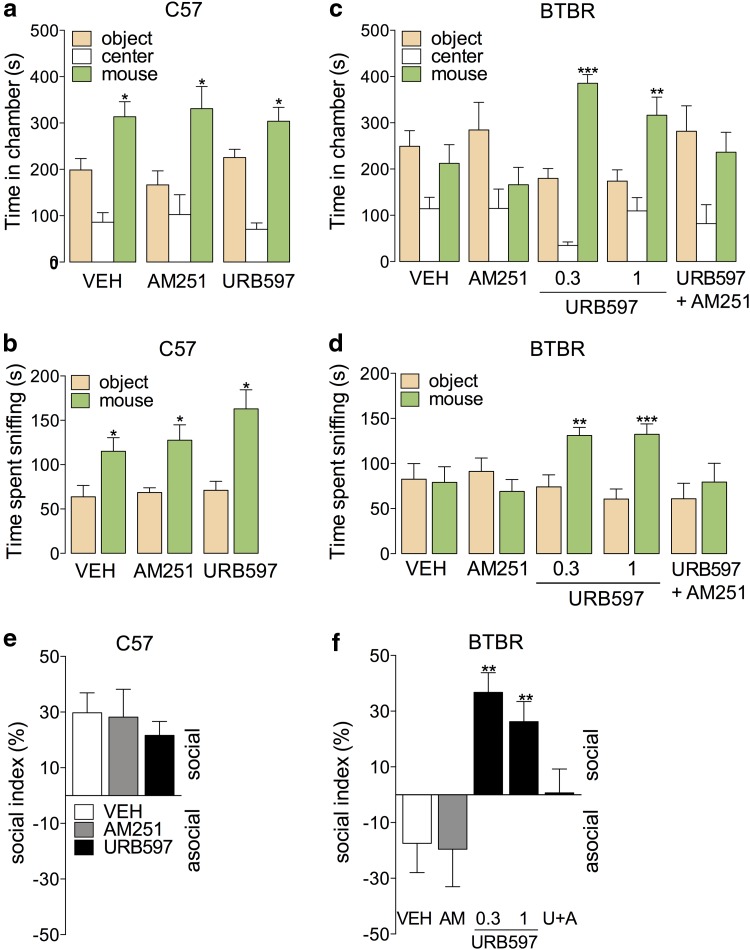
- URB597 (0.3 or 1 mg/kg i.p., 3 h before testing) significantly increased social chamber time and sniffing in BTBR mice to levels comparable to C57Bl6J controls; concomitant AM251 (2 mg/kg i.p.) prevented this prosocial effect (n=12–16).
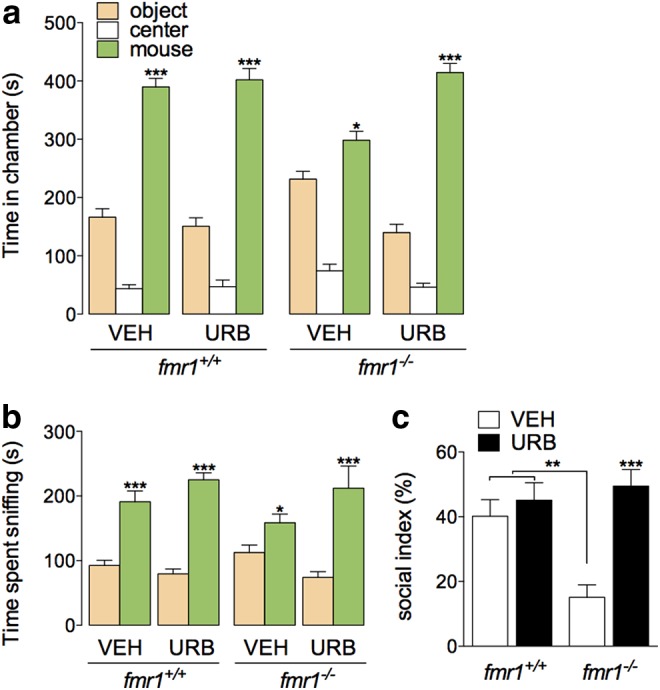
- In fmr1−/− mice, URB597 (0.3 mg/kg i.p.) increased social chamber time and sniffing to control levels, while no effect was seen in wild-type fmr1+/+ (FVB/NJ) mice; the baseline fmr1−/− social deficit was not statistically significant in this study (n=12–14 per group).
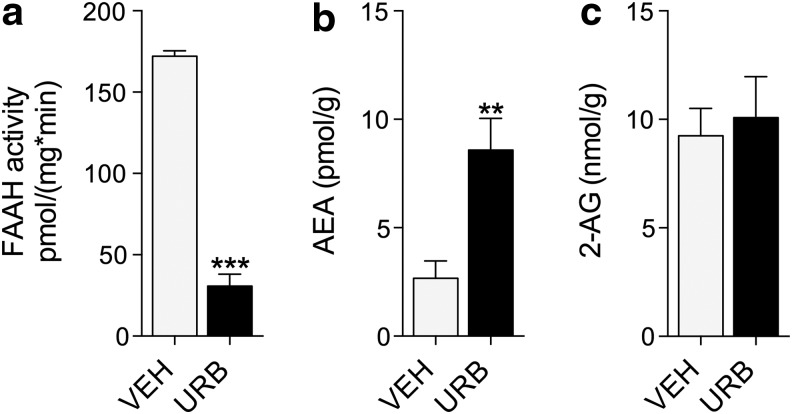
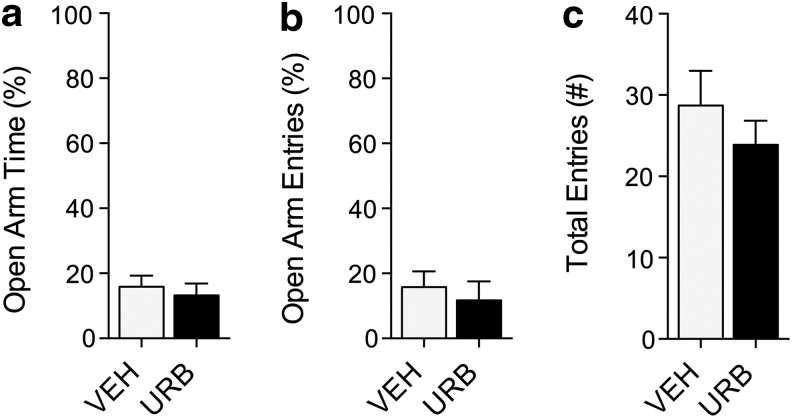
- URB597 inhibited FAAH and substantially increased forebrain anandamide in BTBR mice without affecting 2-AG. In the elevated plus maze, URB597 (1 mg/kg i.p.) did not alter open-arm time or entries in BTBR mice (n=10 per group), suggesting the prosocial effect was not due to general anxiolysis.
- In socially normal C57Bl6J mice, neither AM251 (2 mg/kg i.p.) nor URB597 (1 mg/kg i.p.) altered social chamber time or sniffing.
Methods
- Preclinical proof-of-principle study using male mice (8–10 weeks) bred at UC Irvine, group-housed and naive for each behavioral experiment. Models included BTBR, fmr1−/− (FVB/NJ), C57Bl6J, and wild-type fmr1+/+.
- Behavioral testing used the three-chamber social approach test (10-min test; choice between novel object and a sex-, age-, and weight-matched 129/SvImJ mouse; 5 lux lighting; automated chamber-time scoring and blinded sniffing scoring) and the elevated plus maze. Biochemical assays included a FAAH enzymatic activity assay and LC/MS lipid quantification.
- URB597 and AM251 were administered i.p. 3 h before testing. Statistical analysis used two-tailed Student’s t-test and one-way or two-way ANOVA with Tukey’s post hoc test; significance was p<0.05 (GraphPad Prism).
Limitations
- Stated in the paper: interpretation of BTBR data is limited by possible polygenetic contributions to this inbred strain’s phenotype; fmr1−/− mice were not tested in the elevated plus maze because they display an innate open-arm preference that could confound interpretation; the social approach test may have a ceiling effect and is typically a screening tool rather than a continuous measure of sociability.
- Evident from the text: only male mice were studied, drug treatment was acute, and no chronic dosing, safety, or human data are reported.
- Evident from the text: the fmr1−/− baseline social deficit was not statistically significant in this study, and the proposed oxytocin–anandamide reward mechanism was not directly tested in these ASD models.
Model-written summary. Check it against the paper before relying on it.
Integrity signals
Registry
Cites
Statistics
Figures
Verification
Claims the paper makes
36 Not checked yet · 9 Own interpretation · 7 Own result · 6 Own method
A result the paper reports from its own data — it cites no other source for it, so there is none to check. The quote shows it is in the paper.
In the paper
“Using an enzymatic activity assay and LC/MS, we confirmed that URB597 inhibited FAAH and substantially increased the levels of anandamide in the forebrain of BTBR mice (Fig. 2a, b), without affecting levels of the other endocannabinoid 2-arachidonoyl-sn-glycerol (2-AG) (Fig. 2c).”
§ Enhancement of Anandamide-Mediated Endocannabinoid Signaling Corrects Autism-Related Social Impairment > Results > FAAH inhibition corrects social impairment in BTBR mice
plaindirect- Asserted: passes — The authors put it forward as true.
- Checkable: passes — It can be checked against evidence.
- Load-bearing: passes — The paper’s conclusions depend on it.
- Based: passes — The paper gives a reason why it holds.
In the paper
“However, administration of URB597 (0.3 or 1 mg kg−1, i.p., 3 h before testing) significantly increased the time BTBR mice spent in the social chamber and sniffing, to levels that were comparable to those displayed by control, socially normal C57Bl6J mice (Fig. 1c, d).”
§ Enhancement of Anandamide-Mediated Endocannabinoid Signaling Corrects Autism-Related Social Impairment > Results > FAAH inhibition corrects social impairment in BTBR mice
What the sources say
- Not checked yetcites [25] source
plaindirect- Asserted: passes — The authors put it forward as true.
- Checkable: passes — It can be checked against evidence.
- Load-bearing: passes — The paper’s conclusions depend on it.
- Based: passes — The paper gives a reason why it holds.
A result the paper reports from its own data — it cites no other source for it, so there is none to check. The quote shows it is in the paper.
In the paper
“Using an enzymatic activity assay and LC/MS, we confirmed that URB597 inhibited FAAH and substantially increased the levels of anandamide in the forebrain of BTBR mice (Fig. 2a, b), without affecting levels of the other endocannabinoid 2-arachidonoyl-sn-glycerol (2-AG) (Fig. 2c).”
§ Enhancement of Anandamide-Mediated Endocannabinoid Signaling Corrects Autism-Related Social Impairment > Results > FAAH inhibition corrects social impairment in BTBR mice
plain- Asserted: passes — The authors put it forward as true.
- Checkable: passes — It can be checked against evidence.
- Load-bearing: passes — The paper’s conclusions depend on it.
- Based: passes — The paper gives a reason why it holds.
In the paper
“The effect of FAAH inhibition on social approach depended on CB1 receptors and, thus, presumably on anandamide accumulation, because it was prevented by concomitant administration of AM251 (2 mg kg−1, i.p.) (Fig. 1c, d).”
§ Enhancement of Anandamide-Mediated Endocannabinoid Signaling Corrects Autism-Related Social Impairment > Results > FAAH inhibition corrects social impairment in BTBR mice
What the sources say
- Not checked yetcites [29] source
plaindirect- Asserted: passes — The authors put it forward as true.
- Checkable: passes — It can be checked against evidence.
- Load-bearing: passes — The paper’s conclusions depend on it.
- Based: passes — The paper gives a reason why it holds.
None of the sources cited for this claim have been checked yet.
In the paper
“In contrast to C57Bl6J mice, BTBR mice show no social preference in the test (Fig. 1c, d).20,21”
§ Enhancement of Anandamide-Mediated Endocannabinoid Signaling Corrects Autism-Related Social Impairment > Results > FAAH inhibition corrects social impairment in BTBR mice
What the sources say
plain- Asserted: passes — The authors put it forward as true.
- Checkable: passes — It can be checked against evidence.
- Load-bearing: passes — The paper’s conclusions depend on it.
- Based: passes — The paper gives a reason why it holds.
A result the paper reports from its own data — it cites no other source for it, so there is none to check. The quote shows it is in the paper.
In the paper
“Using an enzymatic activity assay and LC/MS, we confirmed that URB597 inhibited FAAH and substantially increased the levels of anandamide in the forebrain of BTBR mice (Fig. 2a, b), without affecting levels of the other endocannabinoid 2-arachidonoyl-sn-glycerol (2-AG) (Fig. 2c).”
§ Enhancement of Anandamide-Mediated Endocannabinoid Signaling Corrects Autism-Related Social Impairment > Results > FAAH inhibition corrects social impairment in BTBR mice
plaindirect- Asserted: passes — The authors put it forward as true.
- Checkable: passes — It can be checked against evidence.
- Load-bearing: passes — The paper’s conclusions depend on it.
- Based: passes — The paper gives a reason why it holds.
A result the paper reports from its own data — it cites no other source for it, so there is none to check. The quote shows it is in the paper.
In the paper
“Fmr1−/− mutant mice bred on an FVB/NJ background have been reported to exhibit a deficit in social approach.22 In our hands, however, this deficit was not statistically significant (Fig. 4a, b).”
§ Enhancement of Anandamide-Mediated Endocannabinoid Signaling Corrects Autism-Related Social Impairment > Results > FAAH inhibition corrects social impairment in fmr1−/− mice
plain- Asserted: passes — The authors put it forward as true.
- Checkable: passes — It can be checked against evidence.
- Load-bearing: unclear — It is unclear whether the paper’s conclusions depend on it.
- Based: passes — The paper gives a reason why it holds.
A result the paper reports from its own data — it cites no other source for it, so there is none to check. The quote shows it is in the paper.
In the paper
“Nevertheless, we found that acute administration of URB597 (0.3 mg kg−1, i.p.), which did not alter the time spent in the social chamber or sniffing in wild-type fmr1+/+ (FVB/NJ) mice (Fig. 4a–c), increased the time spent by fmr1−/− mice in the social chamber and the time spent sniffing to levels to those displayed by control mice (Fig. 4a–c).”
§ Enhancement of Anandamide-Mediated Endocannabinoid Signaling Corrects Autism-Related Social Impairment > Results > FAAH inhibition corrects social impairment in fmr1−/− mice
plain- Asserted: passes — The authors put it forward as true.
- Checkable: passes — It can be checked against evidence.
- Load-bearing: passes — The paper’s conclusions depend on it.
- Based: passes — The paper gives a reason why it holds.
None of the sources cited for this claim have been checked yet.
In the paper
“A core feature across autism spectrum disorder (ASD) is impairment in social functioning.1,2”
§ Enhancement of Anandamide-Mediated Endocannabinoid Signaling Corrects Autism-Related Social Impairment > Introduction
What the sources say
plain- Asserted: passes — The authors put it forward as true.
- Checkable: passes — It can be checked against evidence.
- Load-bearing: passes — The paper’s conclusions depend on it.
- Based: passes — The paper gives a reason why it holds.
In the paper
“Conversely, in isolated male mice, specifically stimulating oxytocin neurons in the paraventricular nucleus of the hypothalamus drives anandamide mobilization in the NAc.”
§ Enhancement of Anandamide-Mediated Endocannabinoid Signaling Corrects Autism-Related Social Impairment > Introduction
What the sources say
- Not checked yetcites [15] source
plaindirect- Asserted: passes — The authors put it forward as true.
- Checkable: passes — It can be checked against evidence.
- Load-bearing: passes — The paper’s conclusions depend on it.
- Based: passes — The paper gives a reason why it holds.
- It may state two separate claims as one. 11
- Probably not a substantial claim. 25
A result the paper reports from its own data — it cites no other source for it, so there is none to check. The quote shows it is in the paper.
In the paper
“We found that URB597 (1 mg kg−1, i.p.) administered to BTBR mice did not alter the time spent in the open arms, or the number of open-arm entries (Fig. 3a–c), suggesting that the prosocial effect of this compound cannot be attributed to reduced anxiety.”
§ Enhancement of Anandamide-Mediated Endocannabinoid Signaling Corrects Autism-Related Social Impairment > Results > FAAH inhibition does not alter performance of BTBR mice in the elevated plus maze
plainn = 10- Asserted: passes — The authors put it forward as true.
- Checkable: passes — It can be checked against evidence.
- Load-bearing: passes — The paper’s conclusions depend on it.
- Based: passes — The paper gives a reason why it holds.
It may state two separate claims as one.
None of the sources cited for this claim have been checked yet.
In the paper
“We first evaluated maximally effective doses of AM251 (2 mg kg−1, i.p.)29 or URB597 (1 mg kg−1, i.p.)25 in socially normal C57Bl6J mice and found that neither drug altered the two outcome measures of the test, namely the time spent in the social chamber and the time spent sniffing the target mouse (Fig. 1a, b).”
§ Enhancement of Anandamide-Mediated Endocannabinoid Signaling Corrects Autism-Related Social Impairment > Results > FAAH inhibition corrects social impairment in BTBR mice
plain- Asserted: passes — The authors put it forward as true.
- Checkable: passes — It can be checked against evidence.
- Load-bearing: passes — The paper’s conclusions depend on it.
- Based: passes — The paper gives a reason why it holds.
It may state two separate claims as one.
A result the paper reports from its own data — it cites no other source for it, so there is none to check. The quote shows it is in the paper.
In the paper
“Nevertheless, we found that acute administration of URB597 (0.3 mg kg−1, i.p.), which did not alter the time spent in the social chamber or sniffing in wild-type fmr1+/+ (FVB/NJ) mice (Fig. 4a–c), increased the time spent by fmr1−/− mice in the social chamber and the time spent sniffing to levels to those displayed by control mice (Fig. 4a–c).”
§ Enhancement of Anandamide-Mediated Endocannabinoid Signaling Corrects Autism-Related Social Impairment > Results > FAAH inhibition corrects social impairment in fmr1−/− mice
plaindirect- Asserted: passes — The authors put it forward as true.
- Checkable: passes — It can be checked against evidence.
- Load-bearing: passes — The paper’s conclusions depend on it.
- Based: passes — The paper gives a reason why it holds.
It may state two separate claims as one.
None of the sources cited for this claim have been checked yet.
In the paper
“One theory—the social motivation theory—posits that the psychopathology of ASD is rooted in a decreased desire to be social.3,4”
§ Enhancement of Anandamide-Mediated Endocannabinoid Signaling Corrects Autism-Related Social Impairment > Introduction
plaindirect- Asserted: passes — The authors put it forward as true.
- Checkable: passes — It can be checked against evidence.
- Load-bearing: fails — The paper’s conclusions may not depend on it.
- Based: passes — The paper gives a reason why it holds.
Probably not a substantial claim. The paper’s conclusions may not depend on it.
In the paper
“People with ASD restrict themselves to repetitive behaviors and show deficits in social reciprocity and communication.1”
§ Enhancement of Anandamide-Mediated Endocannabinoid Signaling Corrects Autism-Related Social Impairment > Introduction
What the sources say
- Not checked yetcites [1] source
plain- Asserted: passes — The authors put it forward as true.
- Checkable: passes — It can be checked against evidence.
- Load-bearing: passes — The paper’s conclusions depend on it.
- Based: passes — The paper gives a reason why it holds.
Probably not a substantial claim. It may state two separate claims as one.
In the paper
“Consequent activation of CB1 receptors is necessary and sufficient to regulate social reward.”
§ Enhancement of Anandamide-Mediated Endocannabinoid Signaling Corrects Autism-Related Social Impairment > Introduction
What the sources say
- Not checked yetcites [15] source
plaindirect- Asserted: passes — The authors put it forward as true.
- Checkable: passes — It can be checked against evidence.
- Load-bearing: passes — The paper’s conclusions depend on it.
- Based: passes — The paper gives a reason why it holds.
It may state two separate claims as one.
None of the sources cited for this claim have been checked yet.
In the paper
“This neuropeptide is crucial in many aspects of social behavior, including affiliation6 and reward.7”
§ Enhancement of Anandamide-Mediated Endocannabinoid Signaling Corrects Autism-Related Social Impairment > Introduction
plaindirect- Asserted: passes — The authors put it forward as true.
- Checkable: passes — It can be checked against evidence.
- Load-bearing: fails — The paper’s conclusions may not depend on it.
- Based: passes — The paper gives a reason why it holds.
Probably not a substantial claim. The paper’s conclusions may not depend on it.
None of the sources cited for this claim have been checked yet.
In the paper
“Acutely intoxicated marijuana users enjoy interacting more and feel more connected and empathetic.16,17”
§ Enhancement of Anandamide-Mediated Endocannabinoid Signaling Corrects Autism-Related Social Impairment > Introduction
plaindirect- Asserted: passes — The authors put it forward as true.
- Checkable: passes — It can be checked against evidence.
- Load-bearing: fails — The paper’s conclusions may not depend on it.
- Based: passes — The paper gives a reason why it holds.
Probably not a substantial claim. The paper’s conclusions may not depend on it. It may state two separate claims as one.
None of the sources cited for this claim have been checked yet.
In the paper
“Fatty acid amide hydrolase (FAAH) catalyzes the intracellular hydrolysis of the endocannabinoid anandamide.”
§ Enhancement of Anandamide-Mediated Endocannabinoid Signaling Corrects Autism-Related Social Impairment > Introduction
plaindirect- Asserted: passes — The authors put it forward as true.
- Checkable: passes — It can be checked against evidence.
- Load-bearing: passes — The paper’s conclusions depend on it.
- Based: passes — The paper gives a reason why it holds.
Probably not a substantial claim.
In the paper
“Trezza et al. noted that pharmacological FAAH inhibition promotes social play in juvenile rats.14”
§ Enhancement of Anandamide-Mediated Endocannabinoid Signaling Corrects Autism-Related Social Impairment > Introduction
What the sources say
- Not checked yetcites [14] source
plaindirect- Asserted: passes — The authors put it forward as true.
- Checkable: passes — It can be checked against evidence.
- Load-bearing: passes — The paper’s conclusions depend on it.
- Based: passes — The paper gives a reason why it holds.
Probably not a substantial claim.
In the paper
“Chakrabarti and Baron-Cohen reported that a polymorphism in the CB1 cannabinoid receptor gene modulates social gaze.18”
§ Enhancement of Anandamide-Mediated Endocannabinoid Signaling Corrects Autism-Related Social Impairment > Introduction
What the sources say
- Not checked yetcites [18] source
plaindirect- Asserted: passes — The authors put it forward as true.
- Checkable: passes — It can be checked against evidence.
- Load-bearing: fails — The paper’s conclusions may not depend on it.
- Based: passes — The paper gives a reason why it holds.
Probably not a substantial claim. The paper’s conclusions may not depend on it.
In the paper
“This result is in line with previous reports showing that FAAH inhibition results in anxiolytic-like effects only under “high-light” conditions.42”
§ Enhancement of Anandamide-Mediated Endocannabinoid Signaling Corrects Autism-Related Social Impairment > Discussion
What the sources say
- Not checked yetcites [42] source
plaindirect- Asserted: passes — The authors put it forward as true.
- Checkable: passes — It can be checked against evidence.
- Load-bearing: passes — The paper’s conclusions depend on it.
- Based: passes — The paper gives a reason why it holds.
Probably not a substantial claim.
In the paper
“This view is consistent with the presence of CB1 receptors on presynaptic terminals of both glutamatergic projection neurons and GABAergic interneurons.11”
§ Enhancement of Anandamide-Mediated Endocannabinoid Signaling Corrects Autism-Related Social Impairment > Discussion
What the sources say
- Not checked yetcites [11] source
plain- Asserted: passes — The authors put it forward as true.
- Checkable: passes — It can be checked against evidence.
- Load-bearing: fails — The paper’s conclusions may not depend on it.
- Based: passes — The paper gives a reason why it holds.
Probably not a substantial claim. The paper’s conclusions may not depend on it.
A conclusion the paper draws from its own results — it cites no other source for it, so there is none to check. The quote shows it is in the paper.
In the paper
“We confirm that FAAH inhibition is an appropriate strategy to elevate levels of anandamide, and thus, anandamide signaling, in BTBR mice.”
§ Enhancement of Anandamide-Mediated Endocannabinoid Signaling Corrects Autism-Related Social Impairment > Discussion
plaindirect- Asserted: passes — The authors put it forward as true.
- Checkable: passes — It can be checked against evidence.
- Load-bearing: passes — The paper’s conclusions depend on it.
- Based: passes — The paper gives a reason why it holds.
It may state two separate claims as one.
A conclusion the paper draws from its own results — it cites no other source for it, so there is none to check. The quote shows it is in the paper.
In the paper
“These results suggest that the prosocial action of increased anandamide activity (through FAAH inhibition) is generalizable across at least two distinct models of ASD-related social impairment, without affecting socially normal animals.”
§ Enhancement of Anandamide-Mediated Endocannabinoid Signaling Corrects Autism-Related Social Impairment > Results > FAAH inhibition corrects social impairment in fmr1−/− mice
hedgeddirect- Asserted: passes — The authors put it forward as true.
- Checkable: passes — It can be checked against evidence.
- Load-bearing: passes — The paper’s conclusions depend on it.
- Based: passes — The paper gives a reason why it holds.
It may state two separate claims as one.
In the paper
“In line with this notion, CB1 overexpression in the medial prefrontal cortex alters social interactions without overtly changing the anxiety-related phenotype.43”
§ Enhancement of Anandamide-Mediated Endocannabinoid Signaling Corrects Autism-Related Social Impairment > Discussion
What the sources say
- Not checked yetcites [43] source
plaindirect- Asserted: passes — The authors put it forward as true.
- Checkable: passes — It can be checked against evidence.
- Load-bearing: passes — The paper’s conclusions depend on it.
- Based: passes — The paper gives a reason why it holds.
It may state two separate claims as one.
In the paper
“CB1 agonists impair social play in rats.39”
§ Enhancement of Anandamide-Mediated Endocannabinoid Signaling Corrects Autism-Related Social Impairment > Discussion
What the sources say
- Not checked yetcites [39] source
plaindirect- Asserted: passes — The authors put it forward as true.
- Checkable: passes — It can be checked against evidence.
- Load-bearing: fails — The paper’s conclusions may not depend on it.
- Based: passes — The paper gives a reason why it holds.
Probably not a substantial claim. The paper’s conclusions may not depend on it.
In the paper
“In a related example, we found that deletion of FMRP, the mRNA-trafficking protein missing in Fragile X Syndrome, impairs the formation of a key signaling complex that links metabotropic glutamate receptor-5 (mGluR5) and the 2-AG-synthesizing enzyme diacylglycerol lipase-α (DGL-α).28”
§ Enhancement of Anandamide-Mediated Endocannabinoid Signaling Corrects Autism-Related Social Impairment > Discussion
What the sources say
- Not checked yetcites [28] Jung K-M, 2012, Nat Commun
plaindirect- Asserted: passes — The authors put it forward as true.
- Checkable: passes — It can be checked against evidence.
- Load-bearing: fails — The paper’s conclusions may not depend on it.
- Based: passes — The paper gives a reason why it holds.
Probably not a substantial claim. The paper’s conclusions may not depend on it.
What the paper did — it cites no source for this, so there is none to check. The quote shows it is in the paper.
In the paper
“All procedures met the National Institute of Health guidelines for the care and use of laboratory animals and were approved by the Institutional Animal Care and Use Committee at the University of California, Irvine.”
§ Enhancement of Anandamide-Mediated Endocannabinoid Signaling Corrects Autism-Related Social Impairment > Materials and Methods > Animals
plain- Asserted: passes — The authors put it forward as true.
- Checkable: passes — It can be checked against evidence.
- Load-bearing: fails — The paper’s conclusions may not depend on it.
- Based: passes — The paper gives a reason why it holds.
Probably not a substantial claim. The paper’s conclusions may not depend on it. It may state two separate claims as one.
A conclusion the paper draws from its own results — it cites no other source for it, so there is none to check. The quote shows it is in the paper.
In the paper
“Thus, the bidirectional modulation of social behavior likely depends on the dose and the identity of the affected circuits.”
§ Enhancement of Anandamide-Mediated Endocannabinoid Signaling Corrects Autism-Related Social Impairment > Discussion
hedgedconditional- Asserted: passes — The authors put it forward as true.
- Checkable: passes — It can be checked against evidence.
- Load-bearing: fails — The paper’s conclusions may not depend on it.
- Based: passes — The paper gives a reason why it holds.
Probably not a substantial claim. The paper’s conclusions may not depend on it.
In the paper
“Genetic removal of CB1 receptors alters social interactions in mice in a context-dependent manner,32 which may be related to social anxiety and/or cognition.37,38”
§ Enhancement of Anandamide-Mediated Endocannabinoid Signaling Corrects Autism-Related Social Impairment > Discussion
What the sources say
- Not checked yetcites [32] source
plaindirect- Asserted: passes — The authors put it forward as true.
- Checkable: passes — It can be checked against evidence.
- Load-bearing: fails — The paper’s conclusions may not depend on it.
- Based: passes — The paper gives a reason why it holds.
Probably not a substantial claim. The paper’s conclusions may not depend on it.
What the paper did — it cites no source for this, so there is none to check. The quote shows it is in the paper.
In the paper
“Sniffing time was scored by trained assistants who were unaware of treatment conditions.”
§ Enhancement of Anandamide-Mediated Endocannabinoid Signaling Corrects Autism-Related Social Impairment > Materials and Methods > Three-chambered social approach task
plain- Asserted: passes — The authors put it forward as true.
- Checkable: passes — It can be checked against evidence.
- Load-bearing: passes — The paper’s conclusions depend on it.
- Based: passes — The paper gives a reason why it holds.
Probably not a substantial claim.
None of the sources cited for this claim have been checked yet.
In the paper
“In addition, human studies have found that marijuana may enhance sociability16,17 and a polymorphism in the CB1 cannabinoid receptor gene modulates social gaze.18”
§ Enhancement of Anandamide-Mediated Endocannabinoid Signaling Corrects Autism-Related Social Impairment > Discussion
hedgedconditional- Asserted: passes — The authors put it forward as true.
- Checkable: passes — It can be checked against evidence.
- Load-bearing: fails — The paper’s conclusions may not depend on it.
- Based: passes — The paper gives a reason why it holds.
Probably not a substantial claim. The paper’s conclusions may not depend on it.
In the paper
“For instance, we found that chronic isolation increases 2-AG in the prefrontal cortex, without affecting anandamide, and increases both 2-AG and anandamide in the piriform cortex.35”
§ Enhancement of Anandamide-Mediated Endocannabinoid Signaling Corrects Autism-Related Social Impairment > Discussion
What the sources say
- Not checked yetcites [35] source
plaindirect- Asserted: passes — The authors put it forward as true.
- Checkable: passes — It can be checked against evidence.
- Load-bearing: unclear — It is unclear whether the paper’s conclusions depend on it.
- Based: passes — The paper gives a reason why it holds.
It may state two separate claims as one.
What the paper did — it cites no source for this, so there is none to check. The quote shows it is in the paper.
In the paper
“Excluded were subjects with outlying inactivity.”
§ Enhancement of Anandamide-Mediated Endocannabinoid Signaling Corrects Autism-Related Social Impairment > Materials and Methods > Three-chambered social approach task
plain- Asserted: passes — The authors put it forward as true.
- Checkable: passes — It can be checked against evidence.
- Load-bearing: fails — The paper’s conclusions may not depend on it.
- Based: passes — The paper gives a reason why it holds.
Probably not a substantial claim. The paper’s conclusions may not depend on it.
What the paper did — it cites no source for this, so there is none to check. The quote shows it is in the paper.
In the paper
“Object/mouse side placement was counterbalanced between trials.”
§ Enhancement of Anandamide-Mediated Endocannabinoid Signaling Corrects Autism-Related Social Impairment > Materials and Methods > Three-chambered social approach task
plain- Asserted: passes — The authors put it forward as true.
- Checkable: passes — It can be checked against evidence.
- Load-bearing: fails — The paper’s conclusions may not depend on it.
- Based: passes — The paper gives a reason why it holds.
Probably not a substantial claim. The paper’s conclusions may not depend on it.
In the paper
“For example, mutations in neuroligins, a family of ASD-linked synaptic adhesion proteins, impair tonic endocannabinoid signaling.34”
§ Enhancement of Anandamide-Mediated Endocannabinoid Signaling Corrects Autism-Related Social Impairment > Discussion
What the sources say
- Not checked yetcites [34] source
plaindirect- Asserted: passes — The authors put it forward as true.
- Checkable: passes — It can be checked against evidence.
- Load-bearing: fails — The paper’s conclusions may not depend on it.
- Based: passes — The paper gives a reason why it holds.
Probably not a substantial claim. The paper’s conclusions may not depend on it.
In the paper
“Furthermore, developmental treatment with valproic acid reduces cerebellar mRNA levels of DGL-α and reduces hippocampal mRNA levels of the 2-AG-hydrolyzing enzyme monoacylglycerol lipase.36”
§ Enhancement of Anandamide-Mediated Endocannabinoid Signaling Corrects Autism-Related Social Impairment > Discussion
What the sources say
- Not checked yetcites [36] Kerr DM, 2013, Behav Brain Res
plaindirect- Asserted: passes — The authors put it forward as true.
- Checkable: passes — It can be checked against evidence.
- Load-bearing: fails — The paper’s conclusions may not depend on it.
- Based: passes — The paper gives a reason why it holds.
Probably not a substantial claim. The paper’s conclusions may not depend on it.
What the paper did — it cites no source for this, so there is none to check. The quote shows it is in the paper.
In the paper
“The apparatus was thoroughly cleaned with SCOE 10X odor eliminator (BioFOG) between trials to preclude olfactory confounders.”
§ Enhancement of Anandamide-Mediated Endocannabinoid Signaling Corrects Autism-Related Social Impairment > Materials and Methods > Three-chambered social approach task
plain- Asserted: passes — The authors put it forward as true.
- Checkable: passes — It can be checked against evidence.
- Load-bearing: fails — The paper’s conclusions may not depend on it.
- Based: passes — The paper gives a reason why it holds.
Probably not a substantial claim. The paper’s conclusions may not depend on it.
What the paper did — it cites no source for this, so there is none to check. The quote shows it is in the paper.
In the paper
“Naive mice were used for each behavioral experiment.”
§ Enhancement of Anandamide-Mediated Endocannabinoid Signaling Corrects Autism-Related Social Impairment > Materials and Methods > Animals
plain- Asserted: passes — The authors put it forward as true.
- Checkable: passes — It can be checked against evidence.
- Load-bearing: fails — The paper’s conclusions may not depend on it.
- Based: passes — The paper gives a reason why it holds.
Probably not a substantial claim. The paper’s conclusions may not depend on it.
In the paper
“Previously established methods were followed.21”
§ Enhancement of Anandamide-Mediated Endocannabinoid Signaling Corrects Autism-Related Social Impairment > Materials and Methods > Three-chambered social approach task
What the sources say
- Not checked yetcites [21] Silverman JL, 2012, Sci Transl Med source
plain- Asserted: passes — The authors put it forward as true.
- Checkable: passes — It can be checked against evidence.
- Load-bearing: fails — The paper’s conclusions may not depend on it.
- Based: passes — The paper gives a reason why it holds.
Probably not a substantial claim. The paper’s conclusions may not depend on it.
In the paper
“The procedure was based on previously published methods.28”
§ Enhancement of Anandamide-Mediated Endocannabinoid Signaling Corrects Autism-Related Social Impairment > Materials and Methods > Elevated plus maze
What the sources say
- Not checked yetcites [28] Jung K-M, 2012, Nat Commun
plain- Asserted: passes — The authors put it forward as true.
- Checkable: passes — It can be checked against evidence.
- Load-bearing: fails — The paper’s conclusions may not depend on it.
- Based: passes — The paper gives a reason why it holds.
Probably not a substantial claim. The paper’s conclusions may not depend on it.
The paper relies on this without support.
The underlying basis for social impairment in ASD is unknown, and no pharmacological treatment is available.
“The underlying basis for social impairment in ASD is unknown, and no pharmacological treatment is available.”
The paper relies on this without support.
Social reward is a key aspect of social functioning that is disrupted in ASD.
“social reward is a key aspect of social functioning that is thought to be disrupted in ASD.”
Claims other papers make about this one
Each is checked against this paper’s own text: does it say what the citing paper says it does?
In the citing paper
“Animal models of both FXS and ASD have shown benefits when treated with CBD [121, 122].”
From An Update on Psychopharmacological Treatment of Autism Spectrum Disorder (2022) · cites this paper as [122]
Citations
Cites
Diagnostic and Statistical Manual of Mental Disorders
American Psychiatric Association (2013) · doi:10.1176/appi.books.9780890425596 · Cited by 116,369
Neocortical excitation/inhibition balance in information processing and social dysfunction
Yizhar, O., Fenno, L. E., Prigge, M., Schneider, F., Davidson, T. J., O’Shea, D. J., Sohal, V. S., Goshen, I., Finkelstein, J., Paz, J. T., et al. (2011) · Nature · doi:10.1038/nature10360 · Cited by 2,454
The social motivation theory of autism
Chevallier, C., Kohls, G., Troiani, V., Brodkin, E. S., & Schultz, R. T. (2012) · Trends in Cognitive Sciences · doi:10.1016/j.tics.2012.02.007 · Cited by 2,072
The molecular logic of endocannabinoid signalling
Piomelli, D. (2003) · Nature Reviews Neuroscience · doi:10.1038/nrn1247 · Cited by 1,957
Self-citationCognitive neuroscience of human social behaviour
Adolphs, R. (2003) · Nature Reviews Neuroscience · doi:10.1038/nrn1056 · Cited by 1,657
Behavioural phenotyping assays for mouse models of autism
Silverman, J. L., Yang, M., Lord, C., & Crawley, J. N. (2010) · Nature Reviews Neuroscience · doi:10.1038/nrn2851 · Cited by 1,462
Modulation of anxiety through blockade of anandamide hydrolysis
Kathuria, S., Gaetani, S., Fegley, D., Valiño, F., Duranti, A., Tontini, A., Mor, M., Tarzia, G., Rana, G. L., Calignano, A., et al. (2003) · Nature Medicine · doi:10.1038/nm803 · Cited by 1,293
Self-citationSocial reward requires coordinated activity of nucleus accumbens oxytocin and serotonin
Dölen, G., Darvishzadeh, A., Huang, K. W., & Malenka, R. C. (2013) · Nature · doi:10.1038/nature12518 · Cited by 1,161
Insel, T. R. (2010) · Neuron · doi:10.1016/j.neuron.2010.03.005 · Cited by 1,044
Autism‐like behavioral phenotypes in BTBR T+tf/J mice
McFarlane, H. G., Kusek, G. K., Yang, M., Phoenix, J. L., Bolivar, V. J., & Crawley, J. N. (2008) · Genes, Brain and Behavior · doi:10.1111/j.1601-183x.2007.00330.x · Cited by 812
Research works printed but not linked: 2
- Jung K-M, 2012, Nat Commun, 3, 108
- Kerr DM, 2013, Behav Brain Res, 30, 680
Cited by
Sorted by citations
Uhl, G. R., Koob, G. F., & Cable, J. (2019) · Annals of the New York Academy of Sciences · doi:10.1111/nyas.13989 · Cited by 286
An Update on Psychopharmacological Treatment of Autism Spectrum Disorder
Aishworiya, R., Valica, T., Hagerman, R., & Restrepo, B. (2022) · Neurotherapeutics · doi:10.1007/s13311-022-01183-1 · Cited by 233
Lower circulating endocannabinoid levels in children with autism spectrum disorder
Aran, A. A., Eylon, M., Harel, M., Polianski, L., Nemirovski, A., Tepper, S., Schnapp, A., Cassuto, H., Wattad, N., & Tam, J. (2019) · Molecular Autism · doi:10.1186/s13229-019-0256-6 · Cited by 164
Plasma anandamide concentrations are lower in children with autism spectrum disorder
Karhson, D. S., Krasinska, K. M., Dallaire, J. A., Libove, R. A., Phillips, J. M., Chien, A., Garner, J. P., Hardan, A. Y., & Parker, K. J. (2018) · Molecular Autism · doi:10.1186/s13229-018-0203-y · Cited by 159
Servadio, M., Melancia, F., Manduca, A., di Masi, A., Schiavi, S., Cartocci, V., Pallottini, V., Campolongo, P., Ascenzi, P., & Trezza, V. (2016) · Translational Psychiatry · doi:10.1038/tp.2016.182 · Cited by 144
The Endocannabinoid System and Autism Spectrum Disorders: Insights from Animal Models
Zamberletti, E., Gabaglio, M., & Parolaro, D. (2017) · International Journal of Molecular Sciences · doi:10.3390/ijms18091916 · Cited by 129
An endocannabinoid-regulated basolateral amygdala–nucleus accumbens circuit modulates sociability
Folkes, O. M., Báldi, R., Kondev, V., Marcus, D. J., Hartley, N. D., Turner, B. D., Ayers, J. K., Baechle, J. J., Misra, M. P., Altemus, M., et al. (2020) · Journal of Clinical Investigation · doi:10.1172/jci131752 · Cited by 119
Endocannabinoid Signaling in the Control of Social Behavior
Don, W., Allsop, S. A., Tye, K. M., & Piomelli, D. (2017) · Trends in Neurosciences · doi:10.1016/j.tins.2017.04.005 · Cited by 120
Self-citationHeussler, H., Cohen, J., Silove, N., Tich, N., Bonn-Miller, M. O., Du, W., O’Neill, C., & Sebree, T. (2019) · Journal of Neurodevelopmental Disorders · doi:10.1186/s11689-019-9277-x · Cited by 106
Zamberletti, E., Gabaglio, M., Woolley-Roberts, M., Bingham, S., Rubino, T., & Parolaro, D. (2019) · Frontiers in Cellular Neuroscience · doi:10.3389/fncel.2019.00367 · Cited by 98
Marzo, V. D. (2020) · Dialogues in Clinical Neuroscience · doi:10.31887/dcns.2020.22.3/vdimarzo · Cited by 97
Doenni, V. M., Gray, J. M., Song, C. M., Patel, S., Hill, M. N., & Pittman, Q. J. (2016) · Brain Behavior and Immunity · doi:10.1016/j.bbi.2016.07.152 · Cited by 80
Biosynthesis and synthetic biology of psychoactive natural products
Jamieson, C. S., Misa, J., Tang, Y., & Billingsley, J. M. (2021) · Chemical Society Reviews · doi:10.1039/d1cs00065a · Cited by 74
Endocannabinoid signaling in social functioning: an RDoC perspective
Karhson, D. S., Hardan, A. Y., & Parker, K. J. (2016) · Translational Psychiatry · doi:10.1038/tp.2016.169 · Cited by 62
Manduca, A., Bara, A., Larrieu, T., Lassalle, O., Joffre, C., Layé, S., & Manzoni, O. J. (2017) · Journal of Neuroscience · doi:10.1523/jneurosci.3516-16.2017 · Cited by 69
Alterations of the endocannabinoid system and its therapeutic potential in autism spectrum disorder
Zou, M., Liu, Y., Xie, S. H., Wang, L., Li, D., Li, L., Wang, F., Zhang, Y., Xia, W. T., Sun, C., et al. (2021) · Open Biology · doi:10.1098/rsob.200306 · Cited by 58
Self-citationZamberletti, E., Gabaglio, M., Piscitelli, F., Brodie, J., Woolley-Roberts, M., Barbiero, I., Tramarin, M., Binelli, G., Landsberger, N., Kilstrup‐Nielsen, C., et al. (2019) · Journal of Psychopharmacology · doi:10.1177/0269881119844184 · Cited by 61
FMR1 and Autism, an Intriguing Connection Revisited
Fyke, W., & Velinov, M. T. (2021) · Genes · doi:10.3390/genes12081218 · Cited by 60
Tartaglia, N. R., Bonn‐Miller, M. O., & Hagerman, R. J. (2019) · Cannabis and Cannabinoid Research · doi:10.1089/can.2018.0053 · Cited by 57
Kuo, H., & Liu, F. (2018) · Frontiers in Cellular Neuroscience · doi:10.3389/fncel.2018.00422 · Cited by 48
Cannabidiol for the treatment of autism spectrum disorder: hope or hype?
Pedrazzi, J. F. C., Ferreira, F. R., Silva-Amaral, D., Lima, D. D. A., Hallak, J. E. C., Zuardi, A. W., Bel, E. A. D., Guimarães, F. S., Costa, K. C. M., Campos, A. C., et al. (2022) · Psychopharmacology · doi:10.1007/s00213-022-06196-4 · Cited by 53
Current state of evidence of cannabis utilization for treatment of autism spectrum disorders
Agarwal, R., Burke, S. L., & Maddux, M. (2019) · BMC Psychiatry · doi:10.1186/s12888-019-2259-4 · Cited by 46
Wu, H.-F., Lu, T.-Y., Chu, M.-C., Chen, P. S., Lee, C. J., & Lin, H. (2019) · Neuropharmacology · doi:10.1016/j.neuropharm.2019.107736 · Cited by 45
Polypharmacological Approaches for CNS Diseases: Focus on Endocannabinoid Degradation Inhibition
Papa, A., Pasquini, S., Contri, C., Gemma, S., Campiani, G., Butini, S., Varani, K., & Vincenzi, F. (2022) · Cells · doi:10.3390/cells11030471 · Cited by 49
Mesleh, A. G., Abdulla, S. A., & El‐Agnaf, O. M. A. (2021) · Journal of Personalized Medicine · doi:10.3390/jpm11010041 · Cited by 41
Hill, M. N., Haney, M., Hillard, C. J., Karhson, D. S., & Vecchiarelli, H. A. (2023) · Psychological Medicine · doi:10.1017/s0033291723002465 · Cited by 42
Cannabidiol and Neurodevelopmental Disorders in Children
Cheung, K. A. K., Mitchell, M. D., & Heussler, H. (2021) · Frontiers in Psychiatry · doi:10.3389/fpsyt.2021.643442 · Cited by 39
Uso da Cannabis medicinal e autismo
Lima, M. C. M., Valênça, M. M., Machado, C. E., Pereira, M. E. D. M., & Brant, P. K. (2020) · Jornal Memorial da Medicina · doi:10.37085/jmmv2.n1.2020.pp.5-14 · Cited by 37
Scheyer, A. F., Yasmin, F., Naskar, S., & Patel, S. (2022) · Neuropsychopharmacology · doi:10.1038/s41386-022-01438-7 · Cited by 37
Healing autism spectrum disorder with cannabinoids: a neuroinflammatory story
Carbone, E., Manduca, A., Cacchione, C., Vicari, S., & Trezza, V. (2020) · Neuroscience & Biobehavioral Reviews · doi:10.1016/j.neubiorev.2020.12.009 · Cited by 38
The neurochemistry of social reward during development: What have we learned from rodent models?
Manduca, A., Carbone, E., Schiavi, S., Cacchione, C., Buzzelli, V., Campolongo, P., & Trezza, V. (2021) · Journal of Neurochemistry · doi:10.1111/jnc.15321 · Cited by 34
Therapeutic potential of cannabidivarin for epilepsy and autism spectrum disorder
Zamberletti, E., Rubino, T., & Parolaro, D. (2021) · Pharmacology & Therapeutics · doi:10.1016/j.pharmthera.2021.107878 · Cited by 36
A systematic review of cannabidiol trials in neurodevelopmental disorders
Parrella, N.-F., Hill, A. T., Enticott, P. G., Barhoun, P., Bower, I. S., & Ford, T. C. (2023) · Pharmacology Biochemistry and Behavior · doi:10.1016/j.pbb.2023.173607 · Cited by 34
In the face of stress: Interpreting individual differences in stress-induced facial expressions
Mayo, L. M., & Heilig, M. A. (2019) · Neurobiology of Stress · doi:10.1016/j.ynstr.2019.100166 · Cited by 36
Ponton, J. A., Smyth, K. A., Soumbasis, E., Llanos, S. A., Lewis, M. H., Meerholz, W. A., & Tanguay, R. L. (2020) · Journal of Medical Case Reports · doi:10.1186/s13256-020-02478-7 · Cited by 39
Role of the endocannabinoid system in neurological disorders
Zou, M., Li, D., Li, L., Wu, L., & Sun, C. (2019) · International Journal of Developmental Neuroscience · doi:10.1016/j.ijdevneu.2019.03.002 · Cited by 27
Self-citationMouse models of fragile X-related disorders
Willemsen, R., & Kooy, R. F. (2023) · Disease Models & Mechanisms · doi:10.1242/dmm.049485 · Cited by 30
Annamneedi, A., Gora, C., Dudas, A., Leray, X., Bozon, V., Crépieux, P., & Pellissier, L. P. (2023) · British Journal of Pharmacology · doi:10.1111/bph.16216 · Cited by 29
Loss, C. M., Teodoro, L., Rodrigues, G. D., Moreira, L. R., Peres, F. F., Zuardi, A. W., Crippa, J. A. S., Hallak, J. E. C., & Abílio, V. C. (2021) · Frontiers in Pharmacology · doi:10.3389/fphar.2020.635763 · Cited by 27
Rice, L. J., Cannon, L., Dadlani, N., Cheung, M. M. Y., Einfeld, S., Efron, D., Dossetor, D. R., & Elliott, E. J. (2023) · European Child & Adolescent Psychiatry · doi:10.1007/s00787-023-02169-w · Cited by 33
Schiavi, S., Manduca, A., Carbone, E., Buzzelli, V., Rava, A., Feo, A., Ascone, F., Morena, M., Campolongo, P., Hill, M. N., et al. (2022) · Neuropsychopharmacology · doi:10.1038/s41386-022-01454-7 · Cited by 26
Holdman, R., Vigil, D., Robinson, K. J., Shah, P., & Contreras, A. E. (2021) · Cannabis and Cannabinoid Research · doi:10.1089/can.2020.0154 · Cited by 32
Pietropaolo, S., & Marsicano, G. (2021) · Neuroscience & Biobehavioral Reviews · doi:10.1016/j.neubiorev.2021.11.031 · Cited by 23
Neuhofer, D., Lassalle, O., & Manzoni, O. J. (2018) · ACS Chemical Neuroscience · doi:10.1021/acschemneuro.7b00398 · Cited by 23
The role of the endocannabinoid system in autism spectrum disorders: Evidence from mouse studies
Pietropaolo, S., Bellocchio, L., Bouzón‐Arnáiz, I., & Yee, B. K. (2020) · Progress in molecular biology and translational science · doi:10.1016/bs.pmbts.2020.04.016 · Cited by 24
Pirbhoy, P. S., Jonak, C. R., Syed, R., Argueta, D. A., Perez, P. A., Wiley, M. B., Hessamian, K., Lovelace, J. W., Razak, K. A., DiPatrizio, N. V., et al. (2021) · Journal of Neurodevelopmental Disorders · doi:10.1186/s11689-021-09394-x · Cited by 24
Cannabidiol in Treatment of Autism Spectrum Disorder: A Case Study
Ma, L. X., Platnick, S., & Platnick, H. (2022) · Cureus · doi:10.7759/cureus.28442 · Cited by 23
Crespi, B. J. (2019) · Evolution Medicine and Public Health · doi:10.1093/emph/eoz022 · Cited by 24
Medicinal cannabis in children and adolescents with autism spectrum disorder: A scoping review
Fletcher, S., Pawliuk, C., Ip, A., Huh, L. L., Rassekh, S. R., Oberlander, T. F., & Siden, H. B. (2021) · Child Care Health and Development · doi:10.1111/cch.12909 · Cited by 24
Autism and associated disorders: cannabis as a potential therapy
Babayeva, M., Assefa, H., Basu, P., & Loewy, Z. G. (2022) · Frontiers in Bioscience-Elite · doi:10.31083/j.fbe1401001 · Cited by 27
Staben, J., Koch, M., Reid, K., Muckerheide, J., Gilman, L., McGuinness, F., Kiesser, S., Oswald, I. W. H., Koby, K. A., Martin, T. J., et al. (2023) · Frontiers in Neuroscience · doi:10.3389/fnins.2023.1185737 · Cited by 23
Montagner, P. S. S., Medeiros, W., da Silva, L. C. R., Borges, C. N., Brasil-Neto, J. P., Barbosa, V. D. D. S., Caixeta, F. V., & Malcher‐Lopes, R. (2023) · Frontiers in Psychiatry · doi:10.3389/fpsyt.2023.1210155 · Cited by 21
Differential Adulthood Onset mGlu5Signaling Saves Prefrontal Function in the Fragile X Mouse
Martin, H. G. S., Lassalle, O., & Manzoni, O. J. (2016) · Cerebral Cortex · doi:10.1093/cercor/bhw328 · Cited by 21
Dallabrida, K. G., Bender, J. M. D. O., Chade, E. S., Rodrigues, N., & Sampaio, T. B. (2024) · Brain Sciences · doi:10.3390/brainsci14060592 · Cited by 21
Fyke, W., Alarcón, J. M., Velinov, M. T., & Chadman, K. K. (2021) · Autism Research · doi:10.1002/aur.2520 · Cited by 19
Pandina, G., Ring, R. H., Bangerter, A., & Ness, S. L. (2020) · Psychiatric Clinics of North America · doi:10.1016/j.psc.2020.08.003 · Cited by 19
Denucci, B. L., de Lima, L. S., Mota, I. F. L., Azevedo, J. R. M., Veras, L. G., Bicca, J. V. M. L., Santana, B. D. M., Pinheiro, G. B., Coelho, G. G., & Mortari, M. R. (2021) · Reproductive Toxicology · doi:10.1016/j.reprotox.2021.10.010 · Cited by 20
A Spectrum of Solutions: Unveiling Non-Pharmacological Approaches to Manage Autism Spectrum Disorder
Mondal, A., Sharma, R., Abiha, U., Ahmad, F., Karan, A., Jayaraj, R. L., & Sundar, V. (2023) · Medicina · doi:10.3390/medicina59091584 · Cited by 21
Klein, M. E., Bangerter, A., Halter, R. J., Cooper, K. L., Aguilar, Z., Canuso, C. M., Drevets, W. C., Schmidt, M. E., & Pandina, G. (2024) · Neuropsychopharmacology · doi:10.1038/s41386-024-02001-2 · Cited by 17
Schultz, S. T., Gould, G. G., Antonucci, N., Brigida, A. L., & Siniscalco, D. (2021) · Molecules · doi:10.3390/molecules26071845 · Cited by 17
SANTOS, R. G. D., Osório, F. D. L., Martín‐Santos, R., Zuardi, A. W., Hallak, J. E. C., & Crippa, J. A. S. (2019) · CNS Drugs · doi:10.1007/s40263-019-00669-5 · Cited by 17
Ahmed, M., Best, L. M., Pereira, C. F., Boileau, I., & Kloiber, S. M. (2022) · Neuroscience & Biobehavioral Reviews · doi:10.1016/j.neubiorev.2022.104680 · Cited by 14
A Review on the Bioactivity of Cannabinoids on Zebrafish Models: Emphasis on Neurodevelopment
Licitra, R., Marchese, M., Naef, V., Ogi, A., Martinelli, M., Kiferle, C., Fronte, B., & Santorelli, F. M. (2022) · Biomedicines · doi:10.3390/biomedicines10081820 · Cited by 17
Pandina, G., Ring, R. H., Bangerter, A., & Ness, S. L. (2020) · Child and Adolescent Psychiatric Clinics of North America · doi:10.1016/j.chc.2019.12.004 · Cited by 16
Potential of cannabinoids as treatments for autism spectrum disorders
Nezgovorova, V., Ferretti, C. J., Taylor, B. P., Shanahan, E. C., Uzunova, G., Hong, K., Devinsky, O., & Hollander, E. (2021) · Journal of Psychiatric Research · doi:10.1016/j.jpsychires.2021.02.048 · Cited by 16
Endocannabinoid markers in autism spectrum disorder: A scoping review of human studies
Pol, M. D., & Kolla, N. J. (2021) · Psychiatry Research · doi:10.1016/j.psychres.2021.114256 · Cited by 15
Endocannabinoid System Unlocks the Puzzle of Autism Treatment via Microglia
Su, T., Yan, Y., Li, Q., Ye, J., & Pei, L. (2021) · Frontiers in Psychiatry · doi:10.3389/fpsyt.2021.734837 · Cited by 14
Briones, B. A., Pitcher, M. N., Fleming, W., Libby, A., Diethorn, E. J., Haye, A. E., MacDowell, C. J., Zych, A. D., Waters, R. C., Buschman, T. J., et al. (2021) · Biological Psychiatry Global Open Science · doi:10.1016/j.bpsgos.2021.11.005 · Cited by 15
Disrupting the endocannabinoid system in early adolescence negatively impacts sociability
Cossio, D. M., Stadler, H., Michas, Z., Johnston, C. J., & López, H. H. (2019) · Pharmacology Biochemistry and Behavior · doi:10.1016/j.pbb.2019.172832 · Cited by 13
Matthiesen, M., Khlaifia, A., Steininger, C. F. D., Dadabhoy, M., Mumtaz, U., & Arruda-Carvalho, M. (2023) · Molecular Brain · doi:10.1186/s13041-023-01028-8 · Cited by 13
Oxytocin excites dorsal raphe serotonin neurons and bidirectionally gates their glutamate synapses
Oubraim, S., Shen, R., & Haj‐Dahmane, S. (2023) · iScience · doi:10.1016/j.isci.2023.106707 · Cited by 14
An Update on Psychopharmacological Treatment of Autism Spectrum Disorder
Aishworiya, R., Valica, T., Hagerman, R. J., & Restrepo, B. (2024) · FOCUS The Journal of Lifelong Learning in Psychiatry · doi:10.1176/appi.focus.24022006 · Cited by 16
Coccurello, R., Marrone, M. C., & Maccarrone, M. (2022) · Frontiers in Pharmacology · doi:10.3389/fphar.2022.869606 · Cited by 12
Jana, A., Nath, A., Sen, P., Kundu, S., Alghamdi, B. S. A., Abujamel, T. S., Saboor, M., Chan, W., Alexiou, A. T., Papadakis, M., et al. (2024) · NeuroMolecular Medicine · doi:10.1007/s12017-024-08781-6 · Cited by 11
Jawed, B., Esposito, J. E., Pulcini, R., Zakir, S. K., Botteghi, M., Gaudio, F., Savio, D., Martinotti, C., Martinotti, S., & Toniato, E. (2024) · International Journal of Molecular Sciences · doi:10.3390/ijms252212453 · Cited by 10
Campanale, A., Siniscalco, D., & Marzo, V. D. (2025) · Journal of Biomedical Science · doi:10.1186/s12929-025-01145-7 · Cited by 13
Friuli, M., Eramo, B., Sepe, C., Kiani, M., Casolini, P., & Zuena, A. R. (2025) · Physiology & Behavior · doi:10.1016/j.physbeh.2025.114929 · Cited by 11
Therapeutic potential of CBD in Autism Spectrum Disorder
Pedrazzi, J. F. C., Hassib, L., Ferreira, F. R., Hallak, J. E. C., Del-Bel, E., & Crippa, J. A. S. (2024) · International review of neurobiology · doi:10.1016/bs.irn.2024.05.002 · Cited by 12
Sabatini, G., Boccadoro, I., Prete, R., Battista, N., & Corsetti, A. (2025) · Nutrients · doi:10.3390/nu17152470 · Cited by 9
Parrella, N.-F., Hill, A. T., Enticott, P. G., Botha, T., Catchlove, S. J., Downey, L. A., & Ford, T. C. (2025) · Autism Research · doi:10.1002/aur.70159 · Cited by 9
Rava, A., Buzzelli, V., Feo, A., Ascone, F., Trapano, M. D., Schiavi, S., Carbone, E., Pasquadibisceglie, A., Polticelli, F., Manduca, A., et al. (2024) · Progress in Neuro-Psychopharmacology and Biological Psychiatry · doi:10.1016/j.pnpbp.2024.111234 · Cited by 8
Cherry, A. L., Wheeler, M. J., Mathisova, K., & Miceli, M. D. (2024) · Frontiers in Neuroinformatics · doi:10.3389/fninf.2024.1294939 · Cited by 7
Augmentation of Endogenous 2-Arachidonoylglycerol Mitigates Autistic Behaviors of BTBR Mice
Zou, M., Zhang, Y., Du, C., Yang, B., Guo, P., Liang, H., Zhang, Y., Tian, W., Yang, L., Liu, D., et al. (2024) · Molecular Neurobiology · doi:10.1007/s12035-024-04606-6 · Cited by 6
Premoli, M., Carone, M., Mastinu, A., Maccarinelli, G., Aria, F., Sweeney, E. M., Memo, M., & Bonini, S. A. (2024) · Cannabis and Cannabinoid Research · doi:10.1089/can.2024.0062 · Cited by 6
Effects of Cannabidiol Isolated or in Association With Risperidone in an Animal Model of Autism
da Costa, M. D. A., Fernandes, G. Z., Maiochi, E., Ebs, M. F. P., Darós, F. D. S., Bolan, S. J., Costa, R. R. N., de Rezende, V. L., da Silva, G. C., de Bitencourt, R. M., et al. (2024) · Developmental Neurobiology · doi:10.1002/dneu.22955 · Cited by 10
Daily oscillation of the excitation/inhibition ratio is disrupted in two mouse models of autism
Bridi, M., Luo, N., Kim, G., Menarchek, B. J., Lee, R. A., Rodríguez, B. A., Severín, D., Moreno, C., Contreras, A., Wesselborg, C., et al. (2024) · iScience · doi:10.1016/j.isci.2024.111494 · Cited by 6
Fletcher, S., Pawliuk, C., Ip, A., Oberlander, T. F., & Siden, H. B. (2020) · JBI Evidence Synthesis · doi:10.11124/jbies-20-00001 · Cited by 6
Combinatorial approaches for treating neuropsychiatric social impairment
Don, W., Tsheringla, S., McPartland, J. C., & Allsop, S. A. (2022) · Philosophical Transactions of the Royal Society B Biological Sciences · doi:10.1098/rstb.2021.0051 · Cited by 6
Behavioral and transcriptomic effects of a novel cannabinoid on a rat valproic acid model of autism
Loomis, S., Silva, D. G., Savopoulos, R., Cilia, J., Li, J. S. Y., Davis, M. D., Virley, D. J., Foley, A., Loro, E., & McCreary, A. C. (2025) · Neuropharmacology · doi:10.1016/j.neuropharm.2025.110450 · Cited by 5
Jia, X., Gao, S., Liu, X., Feng, Z., Wang, X. X., Lan, K., Lu, Y., Han, L., Wei, Y. B., & Liu, J. (2025) · European Archives of Psychiatry and Clinical Neuroscience · doi:10.1007/s00406-025-02031-x · Cited by 4
Safety and Efficacy of Cannabis in Autism Spectrum Disorder
Ganesh, A., & Shareef, S. (2020) · Pediatric Neurology Briefs · doi:10.15844/pedneurbriefs-34-25 · Cited by 4
Endocannabinoid contributions to the perception of socially relevant, affective touch in humans
Jones, M. R., Haggarty, C. J., Petrie, G. N., Lunge, A. R., Morrison, I., Hill, M. N., Heilig, M. A., & Mayo, L. M. (2025) · Neuropsychopharmacology · doi:10.1038/s41386-025-02053-y · Cited by 3
Potentiation of endocannabinoid signaling alleviates depressive-like behavior in diabetic mice
Kesharwani, A., Lahamge, D., Singh, S. K., Ravichandiran, V., & Parihar, V. K. (2025) · Pharmacological Research - Reports · doi:10.1016/j.prerep.2025.100037 · Cited by 3
Wang, F., Gao, Y., Liu, Z., Cheng, Z., Liu, S., Zhang, Y., Jiang, W., Zhang, M., Yang, X., Zou, M., et al. (2025) · Neuropharmacology · doi:10.1016/j.neuropharm.2025.110501 · Cited by 3
O’Brien, K., & Blair, P. (2021) · Springer eBooks · doi:10.1007/978-3-030-78559-8_10 · Cited by 4
Wang, H., Zhang, M., Yang, S., Jiang, Y. H., Wu, L., & Sun, C. (2025) · CNS Neuroscience & Therapeutics · doi:10.1111/cns.70591 · Cited by 2
Carbonell, A. U., Freire‐Cobo, C., Deyneko, I. V., Erdjument‐Bromage, H., Clipperton‐Allen, A. E., Rasmusson, R. L., Page, D. T., Neubert, T. A., & Jordan, B. A. (2021) · bioRxiv (Cold Spring Harbor Laboratory) · doi:10.1101/2021.02.02.429412 · Cited by 2
Cannabis Compounds: Potential Therapy for Neurological Disease
Babayeva, M., & Loewy, Z. G. (2024) · IntechOpen eBooks · doi:10.5772/intechopen.1005770 · Cited by 1
Endocannabinoid System Contributions to Psychiatric Risk
Lunge, A. R., Tansey, R. C., Elliott, G., Ferger, M. D., & Mayo, L. M. (2025) · Springer eBooks · doi:10.1007/978-3-031-87990-6_15 · Cited by 1
Endocannabinoids and social behavior
Trezza, V., Rava, A., & Feo, A. (2025) · Handbook of behavioral neuroscience · doi:10.1016/b978-0-443-13908-6.00019-0 · Cited by 1
Metadata
- Authors
- Wei, D., Dinh, D., Lee, D., Li, D., Anguren, A., Moreno-Sanz, G., Gall, C. M., & Piomelli, D.
- Affiliations
- Department of Anatomy and Neurobiology, University of California, Irvine, Irvine, California.
- University of California, Irvine (US)
- Harbin Medical University (CN)
- Corresponding author
- Piomelli, Daniele
- Venue
- Cannabis and Cannabinoid Research
- Publisher
- SAGE Publications
- Published
- 2016-12
- Volume
- 1
- Issue
- 1
- Pages
- 81-89
- ISSN
- 2378-8763 (ISSN-L)
- PMC
- PMC5549436
- OpenAlex
- W2293191501
- Cited by
- 122
- References
- 51
- Citations by year
- 2026: 4 · 2025: 17 · 2024: 15 · 2023: 14 · 2022: 11 · 2021: 25 · 2020: 11 · 2019: 14 · 2018: 3 · 2017: 4 · 2016: 4
- FWCI
- 6.75
- Type
- journal article
- Language
- en
- Open access
- hybrid
- doi.org
- Licence
- cc-by
- Locations
- Cannabis and Cannabinoid Research (publishedVersion, cc-by)
- PubMed Central (publishedVersion, cc-by)
- PubMed (publishedVersion)
- eScholarship (California Digital Library) (submittedVersion)
- Funders
- Autism Science Foundation
- National Institutes of Health
- University of California, Irvine
- Topics
- Health Sciences › Medicine › Pharmacology (medical) › Cannabis and Cannabinoid Research
- Life Sciences › Neuroscience › Cognitive Neuroscience › Autism Spectrum Disorder Research
- Life Sciences › Neuroscience › Endocrine and Autonomic Systems › Neuroendocrine regulation and behavior
- Keywords
- anandamide, endocannabinoid system, autism spectrum disorder, social dysfunction, oxytocin, social reward, fatty acid amide hydrolase, FAAH inhibition, URB597, CB1 receptor, BTBR mice, Fmr1 knockout mice, fragile X syndrome, therapeutic target
About these checks
Registry, retraction, Cites and statistics results are computed, not judged, with one exception: a printed reference that no index lists is read once by a model before it counts as a citation error. Claims are extracted by a model and kept only when their quote appears verbatim in the text; each cited source is then checked, with a model’s help, for whether it says what the claim relies on. Those verdicts can be wrong — read the claim’s quote and the cited source before relying on one.
A language model drew the claims from the paper on 2026-10-09, under version 3 of the claim definition (model deepseek-v4.1-flash, prompt extract-v3).
A second model labelled each claim on 2026-10-09 (model jev-1.13-20260917, definition revision gold-guideline-v0.2).
Statistics and arithmetic are recomputed, not judged.
Confidence bands are shown only for fields calibrated on our annotated test set. None is calibrated yet, so no band is shown.
What counts as a claim ›How we measure confidence ›How we check this ›
Are you an author, or do you see a problem with this page? Request a review
