

OlympiAD final overall survival and tolerability results: olaparib versus chemotherapy treatment of physician's choice in patients with a germline BRCA mutation and HER2-negative metastatic breast cancer
Open accessThe DOI matches its Crossref record; 8 of the 9 references it cites were found in a registry or an index.
Abstract
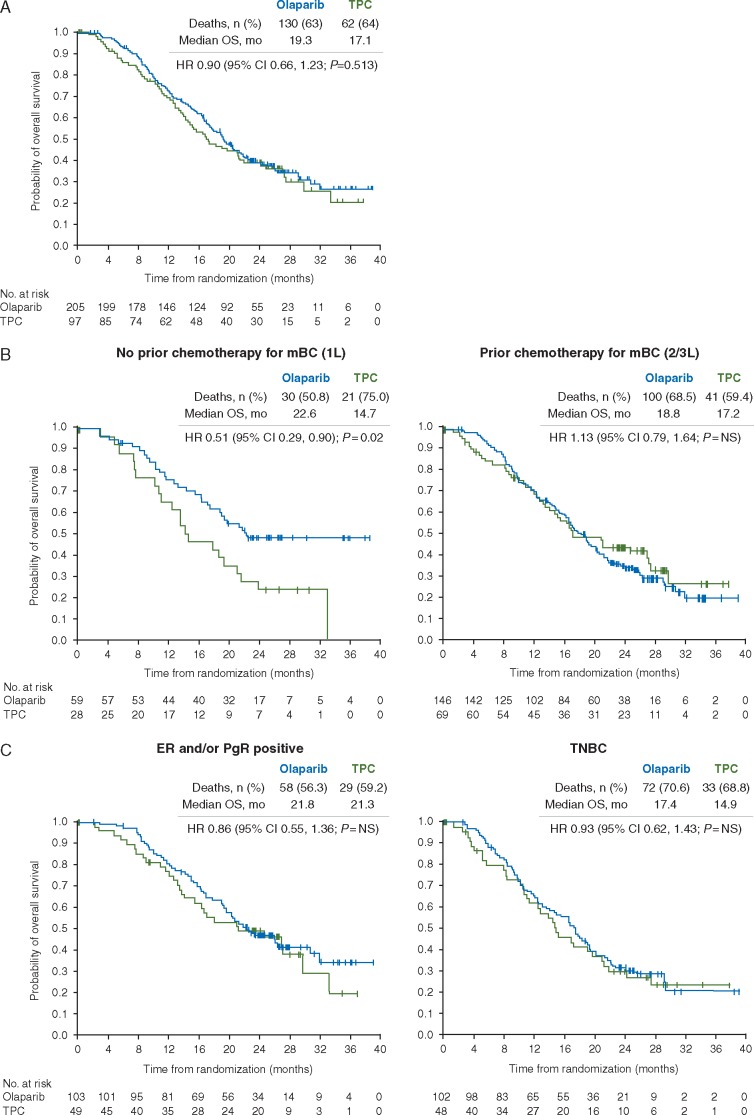
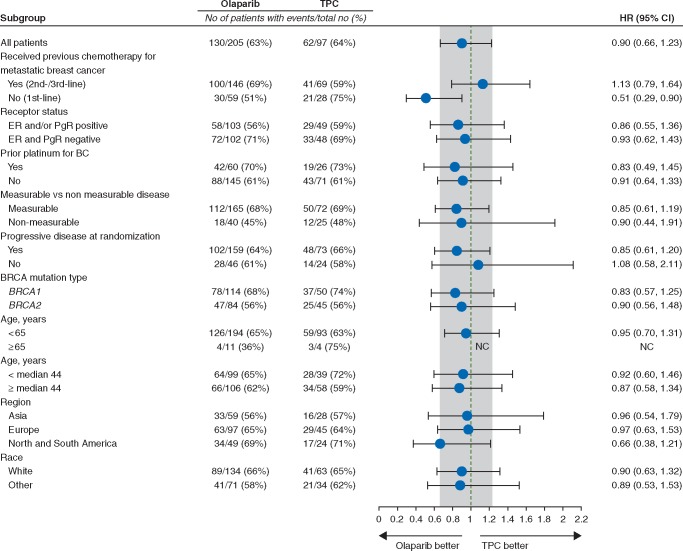
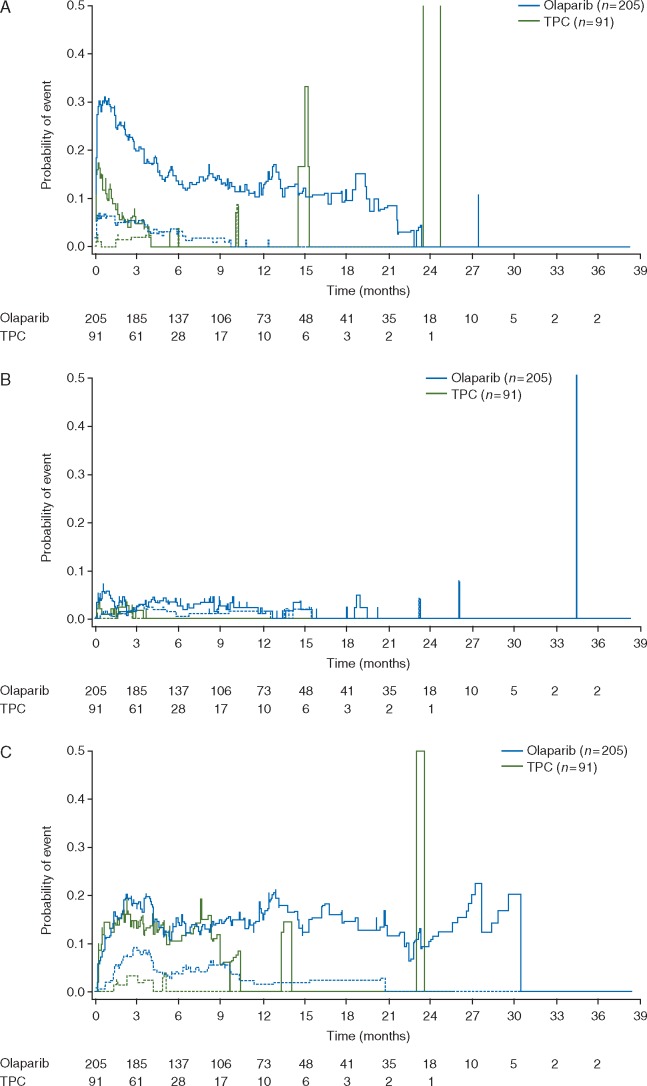
BACKGROUND: In the OlympiAD study, olaparib was shown to improve progression-free survival compared with chemotherapy treatment of physician's choice (TPC) in patients with a germline BRCA1 and/or BRCA2 mutation (BRCAm) and human epidermal growth factor receptor 2 (HER2)-negative metastatic breast cancer (mBC). We now report the planned final overall survival (OS) results, and describe the most common adverse events (AEs) to better understand olaparib tolerability in this population. PATIENTS AND METHODS: OlympiAD, a Phase III, randomized, controlled, open-label study (NCT02000622), enrolled patients with a germline BRCAm and HER2-negative mBC who had received ≤2 lines of chemotherapy for mBC. Patients were randomized to olaparib tablets (300 mg bid) or predeclared TPC (capecitabine, vinorelbine, or eribulin). OS and safety were secondary end points. RESULTS: A total of 205 patients were randomized to olaparib and 97 to TPC. At 64% data maturity, median OS was 19.3 months with olaparib versus 17.1 months with TPC (HR 0.90, 95% CI 0.66-1.23; P = 0.513); median follow-up was 25.3 and 26.3 months, respectively. HR for OS with olaparib versus TPC in prespecified subgroups were: prior chemotherapy for mBC [no (first-line setting): 0.51, 95% CI 0.29-0.90; yes (second/third-line): 1.13, 0.79-1.64]; receptor status (triple negative: 0.93, 0.62-1.43; hormone receptor positive: 0.86, 0.55-1.36); prior platinum (yes: 0.83, 0.49-1.45; no: 0.91, 0.64-1.33). Adverse events during olaparib treatment were generally low grade and manageable by supportive treatment or dose modification. There was a low rate of treatment discontinuation (4.9%), and the risk of developing anemia did not increase with extended olaparib exposure. CONCLUSIONS: While there was no statistically significant improvement in OS with olaparib compared to TPC, there was the possibility of meaningful OS benefit among patients who had not received chemotherapy for metastatic disease. Olaparib was generally well-tolerated, with no evidence of cumulative toxicity during extended exposure. Please see the article online for additional video content.
Overview
The claims and statistics of this paper haven’t been checked yet.
Free: it reads the open-access text and checks the first 5 claims that cite a source we can check. Create a free account to check every claim.
Integrity signals
Registry
Cites
Statistics
Figures
Verification
Claims the paper makes
The claims and statistics of this paper haven’t been checked yet.
Free: it reads the open-access text and checks the first 5 claims that cite a source we can check. Create a free account to check every claim.
Claims other papers make about this one
Each is checked against this paper’s own text: does it say what the citing paper says it does?
The source backs part of the claim, not all of it — or backs it for a different population, condition or comparison.
In the citing paper
“Since ABC 4, further data from the OlympiAD study suggested an OS benefit for olaparib when given in the first-line setting, with a median OS of 22.6 versus 14.7 months (HR 0.51; 95% CI 0.29-0.90, P = 0.02) in a subgroup analysis of predefined stratification subgroups,75”
From 5th ESO-ESMO international consensus guidelines for advanced breast cancer (ABC 5) (2020) · cites this paper as [75]
Experimental — accuracy not yet measured
Self-check
Percentages, sums and reported differences re-computed from the paper’s own numbers.
The self-check needs the paper’s full text.
Citations
Cites
Olaparib for Metastatic Breast Cancer in Patients with a Germline BRCA Mutation
Robson, M., Im, S.-A., Senkus, E., Xu, B., Domchek, S. M., Masuda, N., Delaloge, S., Li, W., Tung, N., Armstrong, A., et al. (2017) · New England Journal of Medicine · doi:10.1056/nejmoa1706450 · Cited by 3,294 · cited 4×
“The efficacy of the oral poly(ADP ribose) polymerase (PARP) inhibitor olaparib in patients with a germline BRCAm and HER2negative metastatic breast cancer (mBC) was confirmed in the Phase III OlympiAD study, with a statistically significant benefit in progression-free survival compared with chemotherapy treatment of p…”
BackgroundMethodResultSelf-citationTalazoparib in Patients with Advanced Breast Cancer and a Germline BRCA Mutation
Litton, J. K., Rugo, H. S., Ettl, J., Hurvitz, S. A., Gonçalves, A., Lee, K.-H., Fehrenbacher, L., Yerushalmi, R., Mina, L. A., Martin, M., et al. (2018) · New England Journal of Medicine · doi:10.1056/nejmoa1802905 · Cited by 2,175
Olaparib Monotherapy in Patients With Advanced Cancer and a Germline BRCA1/2 Mutation
Kaufman, B., Shapira-Frommer, R., Schmutzler, R. K., Audeh, M. W., Friedlander, M., Balmaña, J., Mitchell, G., Fried, G., Stemmer, S. M., Hubert, A., et al. (2015) · Journal of Clinical Oncology · doi:10.1200/jco.2014.56.2728 · Cited by 1,671
Self-citationCouch, F. J., Hart, S. N., Sharma, P., Toland, A. E., Wang, X., Miron, P., Olson, J. E., Godwin, A. K., Pankratz, V. S., Olswold, C., et al. (2015) · Journal of Clinical Oncology · doi:10.1200/jco.2014.57.1414 · Cited by 672 · cited 1×
“Germline BRCAm breast cancers tend to affect younger patients, those with a strong family history of breast cancer and Ashkenazi Jewish ancestry [1, 3].”
BackgroundMalone, K. E., Daling, J. R., Doody, D. R., Hsu, L., Bernstein, L., Coates, R. J., Marchbanks, P. A., Simon, M. S., McDonald, J. A., Norman, S. A., et al. (2006) · Cancer Research · doi:10.1158/0008-5472.can-06-0503 · Cited by 373 · cited 2×
“Germline BRCAm breast cancers tend to affect younger patients, those with a strong family history of breast cancer and Ashkenazi Jewish ancestry [1, 3].”
BackgroundKurian, A. W., Gong, G. D., John, E. M., Miron, A., Felberg, A., Phipps, A. I., West, D. W., & Whittemore, A. S. (2009) · Cancer Epidemiology, Biomarkers & Prevention · doi:10.1158/1055-9965.epi-08-1090 · Cited by 75 · cited 1×
“Approximately 5% of all breast cancer patients carry a germline deleterious mutation in BRCA1 and/or BRCA2 (BRCAm), with higher rates among those with human epidermal growth factor receptor 2 (HER2)-negative disease [1, 2].”
BackgroundKümmel, S., Jackisch, C., Müller, V., Schneeweiß, A., Klawitter, S., & Lux, M. P. (2017) · Annals of Oncology · doi:10.1093/annonc/mdx365.030 · Cited by 4
Kümmel, S., Jackisch, C., Müller, V., Schneeweiß, A., Klawitter, S., & Lux, M. P. (2018) · Cancer Management and Research · doi:10.2147/cmar.s177240 · Cited by 3
Cited by
Items 801–823 of 823
Lan, B., Xu, F., Sun, T., Qiu, F., Wang, Y., Wang, S., Li, W., Zhong, Y., Wu, X., Ouyang, Q., et al. (2026) · Signal Transduction and Targeted Therapy · doi:10.1038/s41392-026-02771-9 · Cited by 1
Self-citationZhang, T., Guo, Y., Li, X., & Xie, L. (2026) · Frontiers in Oncology · doi:10.3389/fonc.2026.1922118
ULBP1 is a prognostic biomarker associated with immune suppression in breast cancer
Mao, Q., Zheng, Y., Liu, S., Li, Y., Shen, Y., & Zhuang, H. (2026) · Frontiers in Oncology · doi:10.3389/fonc.2026.1788245
Hollinger, A.-M., & Bill, R. (2026) · Exploration of Targeted Anti-tumor Therapy · doi:10.37349/etat.2026.1002400
Sensitizing Colorectal Cancer to PARP Inhibitors: Biomarkers, Mechanisms, and Combination Strategies
Elesnawy, M., Masood, E., & Naik, A. (2026) · International Journal of Molecular Sciences · doi:10.3390/ijms27188127
“In addition, olaparib was better tolerated than the chemotherapy drugs, including capecitabine, vinorelbine or eribulin [47].”
Saltalamacchia, G., Gerosa, R., Canzian, J., Benvenuti, C., Giannitto, C., Jacobs, F., Gaudio, M., Tinterri, B., Miggiano, C., Masci, G., et al. (2026) · Frontiers in Oncology · doi:10.3389/fonc.2026.1753463
Myeza, N. (2025) · University of the Witwatersrand, Johannesburg Institutional Repository on DSpace (University of the Witwatersrand, Johannesburg)
Lynce, F. C., Shimada, K., Isaacs, C. J., Geng, X., Richardson, E. T., Nelson, A., Mainor, C. B., Wei, M., Collins, J. M., Pohlmann, P. R., et al. (2026) · bioRxiv (Cold Spring Harbor Laboratory) · doi:10.64898/2026.09.17.752386
Siripukdeekan, C., Seeherunwong, A., Vongsirimas, N., Lekdamrongkul, P., & Pithukpakorn, M. (2026) · Research Square · doi:10.21203/rs.3.rs-10616988/v1
CDKPredict: a clinicogenomic model for risk-adapted therapeutic intervention in breast cancerPreprint
Bielo, L. B., Sánchez-Vega, F., Nandakumar, S., Marra, A., Moiso, E., Ferraro, E., de Bruijn, I., Pichotta, K., Malagutti, B., Safonov, A., et al. (2026) · Research Square · doi:10.21203/rs.3.rs-10176871/v1
Self-citationLaini, L., Cosentini, D., Laganà, M., Grisanti, S., Scartabellati, G., Fogazzi, G., Strazzeri, S., Amoroso, V., Schivardi, G., Pedersini, R., et al. (2026) · Cancer Medicine · doi:10.1002/cam4.72325
Lopez, J. S., Im, S., Postel-Vinay, S. C., Campone, M., El-Khoueiry, A. B., Abida, W. M., Arkenau, H., Lee, K., Rha, S. Y., Jodrell, D. I., et al. (2026) · British Journal of Cancer · doi:10.1038/s41416-026-03601-z
Self-citationWalmsley, C. S., Rodriguez, A., Konstantinopoulos, P. A., Shapiro, G. I., Tolaney, S. M., Garber, J. E., & Lynce, F. C. (2026) · Journal of Clinical Investigation · doi:10.1172/jci207632
“Analysis of an expansion cohort confirmed sustained activity, with setting may be explained by underpowered OS analysis, subsequent postprogression therapies, and, particularly in EMBRACA, subsequent PARPi use in the chemotherapy arm (27, 29).”
The role of the calpain system in breast cancer progression and treatment response
Vasan, R. (2022) · Nottingham ePrints (University of Nottingham)
Xiao, Y., Yang, F., Qi, Y.-J., Chen, L., Zhang, H., Zhang, S.-W., Shan, R., Huang, L., Li, J.-J., Jiang, Y.-Z., et al. (2026) · Journal of Clinical Investigation · doi:10.1172/jci202305
“Unlike in TNBC, the efficacy of PARP inhibitors in BRCA1/2-mutat-ed HR + /HER2 – breast cancer remains poorly understood, high-lighting the need for further investigation into biomarkers to better predict PARP inhibitor response (33).”
Wu, J., Liu, X., & Wu, G. (2026) · Journal of Holistic Integrative Pharmacy · doi:10.1016/j.jhip.2026.09.001
Gökdere, Z. S., Şahin, T. K., Bilgetekin, İ., Baytemür, N. K., Seyyar, M., Yazıcı, M., Gumusburun, E., Akay, S., Günenç, D., Karaoglu, C., et al. (2026) · Targeted Oncology · doi:10.1007/s11523-026-01261-w
Small molecules targeting BRCA1 -deficient cancer cellsPreprint
Navaraj, A., Zhang, S., Egg-Krings, C., Si, K., Gallant, J., Gopal, J., Datla, S. S. P., Dicker, D. T., Ryspayeva, D., & El‐Deiry, W. S. (2026) · bioRxiv (Cold Spring Harbor Laboratory) · doi:10.64898/2026.10.21.760761
CDA-AMC (2026) · Canadian Journal of Health Technologies · doi:10.51731/cjht.2026.1550
По следам научно-практической конференции «Онкология будущего»
(n.d.) · CyberLeninK (CyberLeninka)
Zarański, B., Bachurski, P., Chmiel, G., Kalinowski, P., Międlar, M., Muda, M., Pacek, S., Pierzga, E., Wiśniewski, K. P., & Witkowski, P. (2026) · Quality in Sport · doi:10.12775/qs.2026.78.76517
Harinarayan, A. (2026) · Oxford Journal of Student Scholarship · doi:10.65161/recfgxajnntkfcsz6
Metadata
- Authors
- Robson, M. E., Tung, N., Conte, P., Im, S.-A., Senkus, E., Xu, B., Masuda, N., Delaloge, S., Li, W., Armstrong, A., Wu, W., Goessl, C., Runswick, S., & Domchek, S. M.
- Affiliations
- Memorial Sloan Kettering Cancer Center (US)
- Beth Israel Deaconess Medical Center (US)
- University of Padua (IT)
- Seoul National University (KR)
- Gdańsk Medical University (PL)
- Chinese Academy of Medical Sciences & Peking Union Medical College (CN)
- Osaka National Hospital (JP)
- Institut Gustave Roussy (FR)
- First Hospital of Jilin University (CN)
- The Christie Hospital (GB)
- AstraZeneca (United States) (US)
- AstraZeneca (United Kingdom) (GB)
- University of Pennsylvania (US)
- Corresponding author
- Robson, M.E.
- Runswick, S.
- ORCID
- Venue
- Annals of Oncology
- Publisher
- Elsevier BV
- Published
- 2019-04
- Volume
- 30
- Issue
- 4
- Pages
- 558-566
- ISSN
- 0923-7534 (ISSN-L)
- PMC
- PMC6503629
- OpenAlex
- W2913584903
- Cited by
- 779
- References
- 9
- Citations by year
- 2026: 76 · 2025: 84 · 2024: 108 · 2023: 144 · 2022: 133 · 2021: 118 · 2020: 83 · 2019: 33
- FWCI
- 38.45
- Type
- journal article
- Language
- en
- Open access
- hybrid
- doi.org
- Licence
- cc-by-nc
- www.elsevier.com/tdm/userlicense/1.0/ (tdm)
- creativecommons.org/licenses/by-nc/4.0/ (vor, 326 d)
- Locations
- Annals of Oncology (publishedVersion, cc-by-nc)
- PubMed Central (publishedVersion, cc-by-nc)
- PubMed (publishedVersion)
- Seoul National University Open Repository (Seoul National University) (submittedVersion)
- Padua Research Archive (University of Padova) (submittedVersion)
- Funders
- AstraZeneca
- AstraZeneca and Merck & Co.
- Inc.
- NIH/NCI Cancer Center
- Breast Cancer Research Foundation
- Mudskipper Business Ltd
- Topics
- Health Sciences › Medicine › Oncology › PARP inhibition in cancer therapy
- Life Sciences › Biochemistry, Genetics and Molecular Biology › Genetics › BRCA gene mutations in cancer
- Health Sciences › Medicine › Oncology › Advanced Breast Cancer Therapies
- Keywords
- olaparib, HER2-negative metastatic breast cancer, germline BRCA1 mutation, germline BRCA2 mutation, PARP inhibitors, overall survival, tolerability, adverse events, capecitabine, vinorelbine, eribulin, platinum-based chemotherapy, triple-negative breast cancer, hormone receptor-positive breast cancer, Olympiad
- MeSH terms
- Poly(ADP-ribose) Polymerase Inhibitors, Progression-Free Survival, Administration, Oral, Adult, Aged, Anemia, Antineoplastic Combined Chemotherapy Protocols, Breast Neoplasms, Female, Follow-Up Studies, Humans, Middle Aged, Phthalazines, Piperazines, Tablets, Germ-Line Mutation, Receptor, ErbB-2, Erb-b2 Receptor Tyrosine Kinases, BRCA1 Protein
About these checks
Registry, retraction, Cites and statistics results are computed, not judged, with one exception: a printed reference that no index lists is read once by a model before it counts as a citation error. Claims are extracted by a model and kept only when their quote appears verbatim in the text; each cited source is then checked, with a model’s help, for whether it says what the claim relies on. Those verdicts can be wrong — read the claim’s quote and the cited source before relying on one.
Statistics and arithmetic are recomputed, not judged.
Confidence bands are shown only for fields calibrated on our annotated test set. None is calibrated yet, so no band is shown.
What counts as a claim ›How we measure confidence ›How we check this ›
Are you an author, or do you see a problem with this page? Request a review
Data sources
Bibliographic data: Semantic Scholar, OpenAlex, Crossref.
Contains information from the Semantic Scholar Academic Graph Datasets, made available under the ODC Attribution License (ODC-BY 1.0).
Semantic Scholar’s data is described in: Kinney, R., et al. (2023). The Semantic Scholar Open Data Platform. arXiv:2301.10140.
