

REM Sleep, Prefrontal Theta, and the Consolidation of Human Emotional Memory
Open accessThe DOI matches its Crossref record; 69 of the 69 references it cites were found in a registry or an index.
Abstract
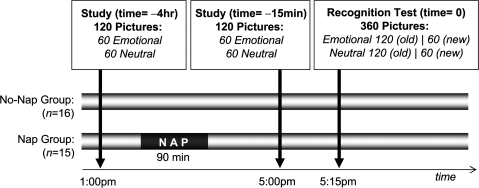
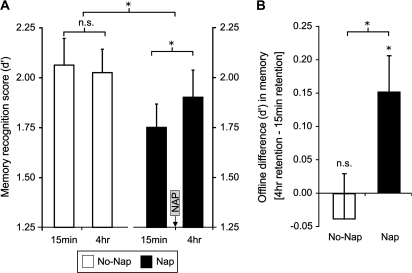
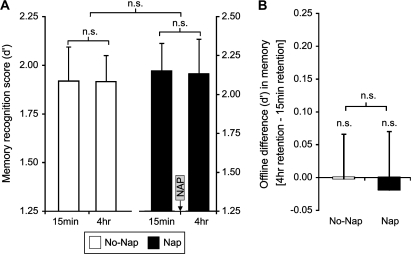
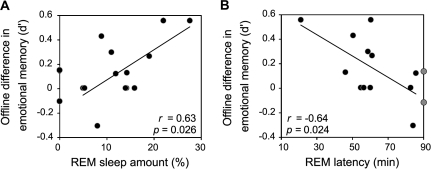
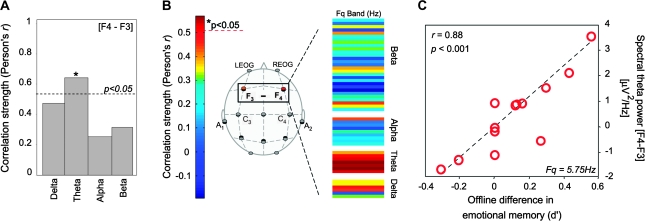
Both emotion and sleep are independently known to modulate declarative memory. Memory can be facilitated by emotion, leading to enhanced consolidation across increasing time delays. Sleep also facilitates offline memory processing, resulting in superior recall the next day. Here we explore whether rapid eye movement (REM) sleep, and aspects of its unique neurophysiology, underlie these convergent influences on memory. Using a nap paradigm, we measured the consolidation of neutral and negative emotional memories, and the association with REM-sleep electrophysiology. Subjects that napped showed a consolidation benefit for emotional but not neutral memories. The No-Nap control group showed no evidence of a consolidation benefit for either memory type. Within the Nap group, the extent of emotional memory facilitation was significantly correlated with the amount of REM sleep and also with right-dominant prefrontal theta power during REM. Together, these data support the role of REM-sleep neurobiology in the consolidation of emotional human memories, findings that have direct translational implications for affective psychiatric and mood disorders.
Overview
The claims and statistics of this paper haven’t been checked yet.
Free: it reads the open-access text and checks the first 5 claims that cite a source we can check. Create a free account to check every claim.
Integrity signals
Registry
Cites
Statistics
Figures
Verification
Claims the paper makes
The claims and statistics of this paper haven’t been checked yet.
Free: it reads the open-access text and checks the first 5 claims that cite a source we can check. Create a free account to check every claim.
Claims other papers make about this one
Each is checked against this paper’s own text: does it say what the citing paper says it does?
The source backs part of the claim, not all of it — or backs it for a different population, condition or comparison.
In the citing paper
“The integration of memories during sleep probably relies on an interleaved hippocampal reactivation of new and associated old memories and occurs in a fine-tuned interaction with cortical slow oscillations (< 1 Hz) and thalamocortical fast-spindle activity (13-15 Hz). 12”
From Effects of Sleep after Experimental Trauma on Intrusive Emotional Memories. (2016) · cites this paper as [12]
Experimental — accuracy not yet measuredThe source backs part of the claim, not all of it — or backs it for a different population, condition or comparison.
In the citing paper
“REM sleep plays a pivotal role in the processing of salient and emotional waking-life experiences, strongly contributing to the emotional memory consolidation”
From The Functional Role of Dreaming in Emotional Processes (2019) · cites this paper as Nishida et al., 2009
Experimental — accuracy not yet measuredThe source backs part of the claim, not all of it — or backs it for a different population, condition or comparison.
In the citing paper
“the results on EEG pattern related to the incorporated memories converged to assign a crucial role of REM theta oscillations in emotional re-processing”
From The Functional Role of Dreaming in Emotional Processes (2019) · cites this paper as Nishida et al., 2009
Experimental — accuracy not yet measuredThe source backs part of the claim, not all of it — or backs it for a different population, condition or comparison.
In the citing paper
“compelling evidence indicates that the potential EEG marker of emotional processes is the frontal theta activity (5–7 Hz) during REM sleep”
From The Functional Role of Dreaming in Emotional Processes (2019) · cites this paper as Nishida et al., 2009
Experimental — accuracy not yet measuredThe source backs part of the claim, not all of it — or backs it for a different population, condition or comparison.
In the citing paper
“The topographical changes of cortical oscillatory activity during sleep involve regions upon which relies a successful memory encoding in wakefulness.96”
From Spotlight on dream recall: the ages of dreams (2018) · cites this paper as [96]
Experimental — accuracy not yet measured
11 more claims about this paper
Create a free account to see every claim other papers make about this one.
Self-check
Percentages, sums and reported differences re-computed from the paper’s own numbers.
The self-check needs the paper’s full text.
Citations
Cites
Rechtschaffen, A. (1968) · Medical Entomology and Zoology · Cited by 12,654
Detection Theory: A User's Guide
Macmillan, N. A., & Creelman, C. D. (1991) · Cited by 5,415
Memory - A century of consolidation
McGaugh, J. L. (2000) · Science · doi:10.1126/science.287.5451.248 · Cited by 4,250
Theta oscillations in the hippocampus
Buzsáki, G. (2002) · Neuron · doi:10.1016/s0896-6273(02)00586-x · Cited by 3,332
International Affective Picture System (IAPS) : Technical Manual and Affective Ratings
Lang, P. J. (1995) · Medical Entomology and Zoology · Cited by 2,870
THE AMYGDALA MODULATES THE CONSOLIDATION OF MEMORIES OF EMOTIONALLY AROUSING EXPERIENCES
McGaugh, J. L. (2004) · Annual Review of Neuroscience · doi:10.1146/annurev.neuro.27.070203.144157 · Cited by 2,296
Huber, R., Felice Ghilardi, M., Massimini, M., & Tononi, G. (2004) · Nature · doi:10.1038/nature02663 · Cited by 1,854
Hemispheric encoding/retrieval asymmetry in episodic memory: positron emission tomography findings.
Tulving, E., Kapur, S., Craik, F. I., Moscovitch, M., & Houle, S. (1994) · Proceedings of the National Academy of Sciences · doi:10.1073/pnas.91.6.2016 · Cited by 1,595
Human emotion and memory: Interactions of the amygdala and hippocampal complex
Phelps, E. A. (2004) · Current Opinion in Neurobiology · doi:10.1016/j.conb.2004.03.015 · Cited by 1,577 · cited 5×
“Moreover, this behavioral benefit has been related to specific changes in neurochemical and neurophysiological states in certain subcortical and cortical networks (Cahill 2000; McGaugh 2000; Pare et al. 2002; McGaugh 2004; Phelps 2004).”
InfluentialAnxiety and affective style: role of prefrontal cortex and amygdala
Davidson, R. J. (2002) · Biological Psychiatry · doi:10.1016/s0006-3223(01)01328-2 · Cited by 1,135
Research works printed but not linked: 4
- Hoffmann, 1988, Brazilian journal of medical and biological research = Revista brasileira de pesquisas m dicas e biol gicas / Sociedade Brasileira de Biof sica ... [et al.], 21, 141
- 2005, PNAS, 102, 2626, 10.1073/pnas.0409848102 · DOI · Paper page
- Par, 2002, Trends in cognitive sciences, 6, 306, 10.1016/s1364-6613(02)01924-1 · DOI · Paper page
- 2006, Annual review of psychology, 10, 139
Cited by
Items 401–500 of 716
Functions and Circuits of REM Sleep
Gazea, M., Rio‐Bermudez, C. D., Nissen, C., & Adamantidis, A. (2019) · Handbook of behavioral neuroscience · doi:10.1016/b978-0-12-813743-7.00017-7 · Cited by 9
Validation of spectral sleep scoring with polysomnography using forehead EEG device
Onton, J., Simon, K. C., Morehouse, A. B., Shuster, A. E., Zhang, J., Pena, A., & Mednick, S. C. (2024) · Frontiers in Sleep · doi:10.3389/frsle.2024.1349537 · Cited by 9
iVAE: An Improved Deep Learning Structure for EEG Signal Characterization and Reconstruction
Chen, Z., Ono, N., Altaf‐Ul‐Amin, M., Kanaya, S., & Huang, M. (2020) · IEEE International Conference on Bioinformatics and Biomedicine (BIBM) · doi:10.1109/bibm49941.2020.9313107 · Cited by 9
Casaglia, E., & Luppi, P. (2022) · Journal of Sleep Research · doi:10.1111/jsr.13633 · Cited by 8
Denis, D., & Payne, J. D. (2024) · eNeuro · doi:10.1523/eneuro.0285-23.2024 · Cited by 8
A Neuro-Cognitive Model of Sleep Mentation & Memory
Murkar, A., Smith, C. T., Dale, A., & Miller, N. (2014) · International journal of dream research · doi:10.11588/ijodr.2014.1.10306 · Cited by 8
The Memory Function of Sleep Across the Life Span
Kurdziel, L. B. F. (2019) · Springer eBooks · doi:10.1007/978-981-13-2814-5_1 · Cited by 8
Bergman, N. (2016) · World Journal of Clinical Pediatrics · doi:10.5409/wjcp.v5.i3.330 · Cited by 8
Mordeniz, C. (2020) · IntechOpen eBooks · doi:10.5772/intechopen.83045 · Cited by 9
Investigation of apomorphine during sleep in Parkinson’s: Improvement in UPDRS Scores
Pieroni, M. A. (2019) · Neurology International · doi:10.4081/ni.2019.8207 · Cited by 8
Are sleep disturbances a cause or consequence of autism spectrum disorder?
Yamada, T., Watanabe, T., & Sasaki, Y. (2023) · Psychiatry and Clinical Neurosciences · doi:10.1111/pcn.13550 · Cited by 8
Lawrence, W. M., Ying, L. E. Y., Lam, Y. C., Rusak, B., Chia-huei, T., Chun, L. T. M., & Kwok, W. Y. (2020) · Social Cognitive and Affective Neuroscience · doi:10.1093/scan/nsaa140 · Cited by 8
Verbal emotional memory in a case with left amygdala damage
Mayor-Dubois, C., Sophie, D., Poloni, C. B., Philippe, M., & Roulet‐Perez, E. (2015) · Neurocase · doi:10.1080/13554794.2015.1037843 · Cited by 8
Laverdure-Dupont, D., Rainville, P., Montplaisir, J. Y., & Lavigne, G. J. (2010) · Reviews in the Neurosciences · doi:10.1515/revneuro.2010.21.5.381 · Cited by 8
Disarming emotional memories using targeted memory reactivation during rapid eye movement sleep
Greco, V., Foldes, A., Harrison, N. A., Murphy, K., Wawrzuta, M., Abdellahi, M. E. A., & Lewis, P. A. (2025) · Imaging Neuroscience · doi:10.1162/imag.a.924 · Cited by 8
Sleep Loss Immediately After Fear Memory Reactivation Attenuates Fear Memory Reconsolidation
Sharma, R., Sahota, P. K., & Thakkar, M. M. (2020) · Neuroscience · doi:10.1016/j.neuroscience.2019.12.024 · Cited by 8
Joshi, S., Sethi, M., Striz, M., Cole, N., Denegre, J. M., Ryan, J. L., Lhamon, M. E., Agarwal, A., Murray, S. A., Braun, R. E., et al. (2019) · bioRxiv (Cold Spring Harbor Laboratory) · doi:10.1101/517680 · Cited by 8
Lau, E. Y. Y., Wong, M. L., Lam, Y. C., Lau, K. N. T., Chung, K., & Rusak, B. (2021) · Psychosomatic Medicine · doi:10.1097/psy.0000000000000996 · Cited by 7
Circadian Rhythms and Sleep in Bipolar Disorder
Murray, G., & Harvey, A. G. (2010) · Wiley eBooks · doi:10.1002/9780470661277.ch20 · Cited by 7
Awe is characterized as an ambivalent affect in the human behavior and cortex
Lee, J., Han, D. D., Oh, S.-Y., & Cha, J. (2025) · Communications Psychology · doi:10.1038/s44271-025-00299-2 · Cited by 7
The Role of Sleep in Emotional Processing
Tempesta, D., Socci, V., Gennaro, L. D., & Ferrara, M. (2019) · Springer eBooks · doi:10.1007/978-981-13-2814-5_6 · Cited by 7
Mahadevappa, V., Patil, P. P., Moodnur, V., & Singh, D. (2012) · National Journal of Physiology Pharmacy and Pharmacology · doi:10.5455/njppp.2013.3.71-74 · Cited by 7
Malaekah, E. (2015) · Journal of Bioprocessing & Biotechniques · doi:10.4172/2155-9821.1000216 · Cited by 7
Dreaming Epiphenomena of Narcolepsy
Scrima, L. (2010) · Sleep Medicine Clinics · doi:10.1016/j.jsmc.2010.01.011 · Cited by 7
The Multifunctionality of Dreaming and the Oblivious Avatar
Dresler, M. (2015) · doi:10.15502/9783958570672 · Cited by 6
End-of-Life in Oncologic Patients’ Dream Content
Cicolin, A., Boffano, M., Beccuti, G., Piana, R., & Giordano, A. (2020) · Brain Sciences · doi:10.3390/brainsci10080505 · Cited by 6
Alger, S. E., & Payne, J. D. (2018) · Wiley eBooks · doi:10.1002/9781119170174.epcn104 · Cited by 6
Chambers, A. M., & Payne, J. D. (2015) · Wiley eBooks · doi:10.1002/9781118332634.ch11 · Cited by 6
Setting the alarm: Word emotional attributes require consolidation to be operational.
Dumay, N., Sharma, D., Kellen, N., & Abdelrahim, S. (2018) · Emotion · doi:10.1037/emo0000382 · Cited by 6
Fischmann, T., & Leuzinger‐Bohleber, M. (2018) · Springer eBooks · doi:10.1007/978-3-319-75112-2_8 · Cited by 6
Novel Electrophysiological Signatures of Learning and Forgetting in Human Rapid Eye Movement Sleep
Shuster, A. E., Chen, P., Niknazar, H., McDevitt, E. A., Lopour, B. A., & Mednick, S. C. (2024) · Journal of Neuroscience · doi:10.1523/jneurosci.1517-23.2024 · Cited by 6
Reicher, V., Kovács, T., Csibra, B., & Gácsi, M. (2024) · Scientific Reports · doi:10.1038/s41598-024-60166-8 · Cited by 6
Should you Sleep on it? The Effects of Overnight Sleep on Subjective Preference‐based Choice
Karmarkar, U. R., Shiv, B., & Spencer, R. M. C. (2015) · Journal of Behavioral Decision Making · doi:10.1002/bdm.1921 · Cited by 6
The Happiness Analyzer : a New Technique for Measuring Subjective Well-Being
Ludwigs, K. (2018) · EUR Research Repository (Erasmus University Rotterdam) · Cited by 5
Nightmares and the Cannabinoids
Mamelak, M. (2020) · Current Neuropharmacology · doi:10.2174/1570159x18666200114142321 · Cited by 5
Effects of a daytime nap on the recognition of neutral and emotional memories
Sawangjit, A., Siripornpanich, V., & Kotchabhakdi, N. (2013) · Asian Biomedicine · doi:10.5372/1905-7415.0705.225 · Cited by 5
Sleep, Synaptic Plasticity, and Memory
Golbert, D. C. F., Souza, A. C., Filho, D. A., & Ribeiro, S. T. G. (2017) · Elsevier eBooks · doi:10.1016/b978-0-12-809324-5.21118-8 · Cited by 5
The function of dreams and dreaming : moving towards an integrated understanding
Sayed, L. (2011) · NVA (Nasjonalt vitenarkiv) · Cited by 5
Tian, R., Tang, J., & Li, Z. (2025) · CHI Conference Extended Abstracts on Human Factors in Computing Systems (CHI EA) · doi:10.1145/3706599.3719850 · Cited by 5
Halonen, R., Luokkala, S., Kuula, L., Antila, M., & Pesonen, A. (2023) · Cognitive Affective & Behavioral Neuroscience · doi:10.3758/s13415-023-01113-4 · Cited by 5
Postsession Dreaming in Neurofeedback as an Indication of Nondeclarative Learning
Yonah, R. (2020) · NeuroRegulation · doi:10.15540/nr.7.1.2 · Cited by 5
Azizi, P., Najafi, A., Samizadeh, M., Mohamadian, M., Jabbari, A., Rezaie, M., & Vaseghi, S. (2025) · European Journal of Neuroscience · doi:10.1111/ejn.70216 · Cited by 5
Sleep, Emotional Memories, and Depression
Bovy, L., Tendolkar, I., Fernández, G., & Dresler, M. (2019) · Handbook of behavioral neuroscience · doi:10.1016/b978-0-12-813743-7.00034-7 · Cited by 5
Genetic and biological factors in sleep
Gentry, N. W., Ptáček, L. J., & Fu, Y. (2021) · Elsevier eBooks · doi:10.1016/b978-0-12-815501-1.00001-6 · Cited by 5
REM sleep and emotion regulation
Desseilles, M., Sterpenich, V., Dang‐Vu, T. T., & Schwartz, S. (2011) · Cambridge University Press eBooks · doi:10.1017/cbo9780511921179.044 · Cited by 5
Cheng, R. (2009) · The Chinese Journal of Physiology · doi:10.4077/cjp.2009.amh085 · Cited by 5
Vagal heart rate variability during rapid eye movement sleep reduces negative memory bias
Morehouse, A. B., Simon, K. C. N. S., Chen, P., & Mednick, S. C. (2025) · Frontiers in Behavioral Neuroscience · doi:10.3389/fnbeh.2025.1513655 · Cited by 5
The role of phasic and tonic rapid eye movement sleep in implicit memory consolidation
Alyssa, P., Baena, D., Viczko, J., Ray, L., & Fogel, S. M. (2025) · SLEEP · doi:10.1093/sleep/zsaf306 · Cited by 5
Neural dynamics of associative learning during human sleepPreprint
Canales‐Johnson, A., Merlo, E., Bekinschtein, T. A., & Arzi, A. (2018) · bioRxiv (Cold Spring Harbor Laboratory) · doi:10.1101/372037 · Cited by 5
The role of sleep and dreaming in the processing of episodic memory
Stenstrom, P. (2010) · doi:10.71781/18000 · Cited by 4
The Value of Sleep for Optimizing Health
Tucker, M. A. (2020) · Springer eBooks · doi:10.1007/978-3-030-30892-6_14 · Cited by 4
DREAMS, EMBODIED IMAGINATION AND THE CREATIVE MIND: A PILOT STUDY
Szuster, R. R. (2010) · Creativity Studies · doi:10.3846/cs.2018.2204 · Cited by 4
Halonen, R., Kuula, L., Lahti, J. M. T., Räikkönen, K., & Pesonen, A. (2020) · Neurobiology of Learning and Memory · doi:10.1016/j.nlm.2020.107353 · Cited by 4
The Cognitive Psychology of Sleep and Memory
Alger, S. E., Pardilla‐Delgado, E., Mattingly, S. M., Cunningham, T. J., & Payne, J. D. (2017) · Elsevier eBooks · doi:10.1016/b978-0-12-809324-5.21062-6 · Cited by 4
Cross, Z. R., Santamaria, A., Corcoran, A. W., Alday, P. M., Coussens, S. W., & Kohler, M. J. (2017) · bioRxiv (Cold Spring Harbor Laboratory) · doi:10.1101/202176 · Cited by 4
Rousseau, P. (2018) · theses.fr (ABES) · doi:10.70675/0e977ac2z4714z4c14zabaez066dfd929516 · Cited by 4
The modulation of emotional memory consolidation by dream affect
du Plessis, L., & Lipinska, G. (2023) · Frontiers in Sleep · doi:10.3389/frsle.2023.1239530 · Cited by 4
The Role of Sleep in Memory Consolidation: Active or Permissive?
Schönauer, M., & Born, J. (2017) · Elsevier eBooks · doi:10.1016/b978-0-12-809324-5.21034-1 · Cited by 4
Evolution of Psychoanalytic Interactions and Conflicts in Vertebrates
Cai, Z.-J. (2016) · Sleep and Hypnosis · doi:10.5350/sleep.hypn.2016.18.0128 · Cited by 4
Di, T., Liu, J., Liu, W., Guo, Y., Zheng, E., Yu, Z., Shi, L., Jia, T., Lü, L., Sun, Y., et al. (2025) · BMC Medicine · doi:10.1186/s12916-025-04411-5 · Cited by 4
Libourel, P., Arthaud, S., Bergel, A., Brescia, F. M., Dib, A., Massot, B., Vidal, É., & Weiss, W. (2025) · SLEEP Advances · doi:10.1093/sleepadvances/zpaf036 · Cited by 4
A Role for Neuronal Oscillations of Sleep in Memory and Cognition
Marshall, L. (2020) · Springer eBooks · doi:10.1007/978-1-0716-0653-7_7 · Cited by 4
Schechtman, E., Stickgold, R., & Paller, K. A. (2024) · Oxford University Press eBooks · doi:10.1093/oxfordhb/9780190917982.013.45 · Cited by 4
LaGoy, A. D., Kaskie, R. E., Connaboy, C., Germain, A., & Ferrarelli, F. (2021) · Biological Psychiatry Cognitive Neuroscience and Neuroimaging · doi:10.1016/j.bpsc.2020.12.013 · Cited by 4
Characterization, Conceptualization, and Treatment of Sleep Disturbances in PTSD
Pace-Schott, E. F., & Bottary, R. M. (2018) · Oxford University Press eBooks · doi:10.1093/med/9780190457136.003.0013 · Cited by 4
Functional aspects of the sleep EEG
Huber, R. (2009) · Zurich Open Repository and Archive (University of Zurich) · Cited by 4
Maski, K. P., & Heroux, T. (2016) · Current Sleep Medicine Reports · doi:10.1007/s40675-016-0032-5 · Cited by 4
Associations between sleep and cognitive-affective functioning in Posttraumatic Stress Disorder
Lipińska, M. (2017) · Open University of Cape Town (University of Cape Town) · Cited by 4
The effects of cognitive reappraisal and sleep on emotional memory formation
Martinez, B. S., Denis, D., Kim, S. Y., DiPietro, C., Stare, C., Kensinger, E. A., & Payne, J. D. (2023) · Cognition & Emotion · doi:10.1080/02699931.2023.2221843 · Cited by 3
Jiang, H., Weihs, A., Frenzel, S., Klinger-König, J., Ewert, R., Stubbe, B., Berger, K., Penzel, T., Fietze, I., Bülow, R., et al. (2025) · Journal of Affective Disorders · doi:10.1016/j.jad.2025.02.005 · Cited by 3
Pseudoreality and Technology: Smartphone-Related Factors Impacting Mental Health
Campbell, C. (2024) · Psychodynamic Psychiatry · doi:10.1521/pdps.2024.52.3.345 · Cited by 3
Schechtman, E., Stickgold, R., & Paller, K. A. (2024) · Elsevier eBooks · doi:10.1016/b978-0-12-820480-1.00126-1 · Cited by 3
Denis, D., Kim, S. Y., Kark, S. M., Daley, R. T., Kensinger, E. A., & Payne, J. D. (2020) · bioRxiv (Cold Spring Harbor Laboratory) · doi:10.1101/2020.06.08.140350 · Cited by 3
Neuropsychoanalytic Explorations: Linking Practice, Theory, and Research
Kessler, L., & Kessler, R. J. (2019) · Psychoanalytic Inquiry · doi:10.1080/07351690.2019.1671079 · Cited by 3
The role of REM sleep in memory consolidation, enhancement, and integration
Stickgold, R. (2011) · Cambridge University Press eBooks · doi:10.1017/cbo9780511921179.035 · Cited by 3
Varga, A. W., Mullins, A. E., & Kam, K. (2023) · Annals of the American Thoracic Society · doi:10.1513/annalsats.202211-933ed · Cited by 3
To “feel” better, sleep on it!
Aime, M. (2023) · Science · doi:10.1126/science.adk3894 · Cited by 3
McCreesh, S. (2017) · Open University of Cape Town (University of Cape Town) · Cited by 3
Kurkela, J., Pirttimäki, T., & Nokia, M. S. (2025) · Psykologia · doi:10.62443/psykologia.v58i2.112801 · Cited by 3
Influence of frequent nightmares on REM sleep-dependent emotional memory processing
Carr, M. (2016) · doi:10.71781/29727 · Cited by 3
Investigation of Sleep Neural Dynamics in Intracranial EEG Patients
Jain, S. (2021) · VTechWorks (Virginia Tech) · doi:10.13140/rg.2.2.23207.73129 · Cited by 3
Rehel, S. (2019) · theses.fr (ABES) · doi:10.70675/b600c245z51b5z41bbz9b4cze94f8bfd6a4a · Cited by 2
The role of REM sleep in emotional brain processing
Walker, M. P. (2011) · Cambridge University Press eBooks · doi:10.1017/cbo9780511921179.036 · Cited by 2
Self-citationLane, R. D. (2026) · Journal of the American Psychoanalytic Association · doi:10.1177/00030651261423147 · Cited by 2
Shi, S., Zuo, K., & Xu, W. (2021) · PsyCh Journal · doi:10.1002/pchj.474 · Cited by 2
Löffler‐Stastka, H. (2023) · Psychiatria Danubina · doi:10.24869/psyd.2023.295 · Cited by 2
Émotions et sommeil paradoxal : étude comportementale, fonctionnelle et anatomique chez la souris
Rosier, M. (2017) · theses.fr (ABES) · doi:10.70675/18fbbb85zbcdcz4c31zabe2zd1d91cdf4659 · Cited by 2
Friis, J., Sandahl, H., Mortensen, E. L., Svendsen, K. B., Jennum, P., & Carlsson, J. M. (2024) · Journal of Sleep Research · doi:10.1111/jsr.14407 · Cited by 2
Visual Perceptual Learning and Sleep
Sasaki, Y., & Watanabe, T. (2014) · Springer eBooks · doi:10.1007/978-4-431-55037-2_19 · Cited by 2
Memory for emotional images across sleep versus wake in school-aged children
Kohler, M. J., Sandiford, C., Schilds, L., & Payne, J. D. (2021) · Journal of Experimental Child Psychology · doi:10.1016/j.jecp.2021.105308 · Cited by 2
Niu, X., Sanders, K. E. G., Denis, D., Cunningham, T. J., Zhang, G., Kensinger, E. A., & Payne, J. D. (2025) · Behavioural Brain Research · doi:10.1016/j.bbr.2025.115932 · Cited by 2
Chappel-Farley, M. G., Goldstein, M. R., & Benca, R. M. (2021) · Elsevier eBooks · doi:10.1016/b978-0-12-822963-7.00085-2 · Cited by 2
Relationship Between Emotions, Sleep and Well-Being
Zaccaro, A., Conversano, C., Lai, E. Y., & Gemignani, A. (2019) · Springer eBooks · doi:10.1007/978-3-030-25816-0_8 · Cited by 2
Two types of REM sleep: The atonic and brain REM sleep
Cai, Z.-J. (2016) · Sleep and Hypnosis · doi:10.5350/sleep.hypn.2016.18.0113 · Cited by 2
Theta phase-locked memory reactivation during REM sleep reduces memories’ emotional tonePreprint
Patriota, J., Brouwer, T., Bergers, M., van Hattem, T., Wijers, K., Meulmeester, W. M., Juan, E., Olcese, U., & Talamini, L. M. (2026) · bioRxiv (Cold Spring Harbor Laboratory) · doi:10.64898/2026.06.05.730360 · Cited by 2
Memory Modulation by Offline Consolidation and Transcranial Direct Current Stimulation
Javadi, A. (2011) · UCL Discovery (University College London) · Cited by 2
As alterações do sono na perturbação de stress pós traumático
Moreira, C. A., & Afonso, P. (2017) · Revista Portuguesa de Psiquiatria e Saúde Mental · doi:10.51338/rppsm.2017.v1.i2.53 · Cited by 2
Cunningham, T. J., Denis, D., Zeng, S., Bottary, R. M., Kensinger, E. A., & Stickgold, R. (2025) · SLEEP Advances · doi:10.1093/sleepadvances/zpaf093 · Cited by 2
Does the brain sleep differently depending on intellectual abilities?
Thieux, M., Zhang, M., Guignard‐Perret, A., Mazza, S., Plancoulaine, S., Guyon, A., & Franco, P. (2023) · CNS Neuroscience & Therapeutics · doi:10.1111/cns.14378 · Cited by 2
Metadata
- Authors
- Nishida, M., Pearsall, J., Buckner, R. L., & Walker, M. P.
- Affiliations
- Tokyo Medical and Dental University (JP)
- Howard Hughes Medical Institute (US)
- University of California, Berkeley (US)
- Corresponding author
- Walker, M. P.
- Venue
- Cerebral Cortex
- Publisher
- Oxford University Press (OUP)
- Published
- 2008-10-01
- Volume
- 19
- Issue
- 5
- Pages
- 1158-1166
- ISSN
- 1047-3211 (ISSN-L)
- 1460-2199
- PMC
- PMC2665156
- OpenAlex
- W2139705940
- Semantic Scholar
- 327050a9b0af4acf6ce91b4688ef89fc9b8de013
- Cited by
- 603
- References
- 69
- Citations by year
- 2026: 21 · 2025: 37 · 2024: 26 · 2023: 33 · 2022: 26 · 2021: 37 · 2020: 43 · 2019: 51 · 2018: 44 · 2017: 38 · 2016: 33 · 2015: 50 · 2014: 38 · 2013: 39 · 2012: 23
- FWCI
- 10.88
- Type
- journal article
- Language
- en
- Open access
- hybrid
- doi.org
- Licence
- cc-by-nc
- Locations
- Cerebral Cortex (publishedVersion, cc-by-nc)
- PubMed Central (publishedVersion, cc-by-nc)
- PubMed (publishedVersion)
- Digital Access to Scholarship at Harvard (DASH) (Harvard University) (submittedVersion, cc-by)
- Funders
- Howard Hughes Medical Institute
- National Institute of Mental Health (R03MH069935, MH069935)
- Topics
- Life Sciences › Neuroscience › Cognitive Neuroscience › Sleep and Wakefulness Research
- Life Sciences › Neuroscience › Cognitive Neuroscience › Memory and Neural Mechanisms
- Life Sciences › Neuroscience › Cognitive Neuroscience › Memory Processes and Influences
- Keywords
- REM sleep, emotional memory consolidation, sleep-dependent memory consolidation, mood disorders
- MeSH terms
- Adolescent, Adult, Emotions, Female, Humans, Functional Laterality, Male, Reaction Time, Sleep, REM, Theta Rhythm, Prefrontal Cortex, Recognition, Psychology, Young Adult
About these checks
Registry, retraction, Cites and statistics results are computed, not judged, with one exception: a printed reference that no index lists is read once by a model before it counts as a citation error. Claims are extracted by a model and kept only when their quote appears verbatim in the text; each cited source is then checked, with a model’s help, for whether it says what the claim relies on. Those verdicts can be wrong — read the claim’s quote and the cited source before relying on one.
Statistics and arithmetic are recomputed, not judged.
Confidence bands are shown only for fields calibrated on our annotated test set. None is calibrated yet, so no band is shown.
What counts as a claim ›How we measure confidence ›How we check this ›
Are you an author, or do you see a problem with this page? Request a review
Data sources
Bibliographic data: Semantic Scholar, OpenAlex, Crossref.
Contains information from the Semantic Scholar Academic Graph Datasets, made available under the ODC Attribution License (ODC-BY 1.0).
Semantic Scholar’s data is described in: Kinney, R., et al. (2023). The Semantic Scholar Open Data Platform. arXiv:2301.10140.
