

REM Sleep, Prefrontal Theta, and the Consolidation of Human Emotional Memory
Open accessThe DOI matches its Crossref record; 69 of the 69 references it cites were found in a registry or an index.
Abstract
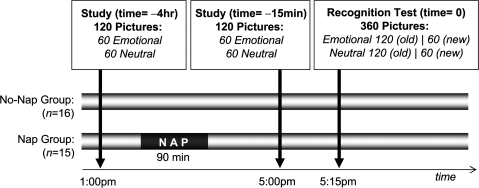
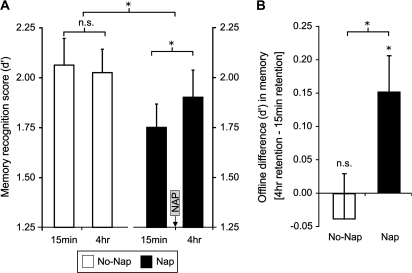
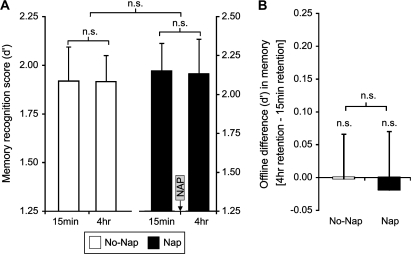
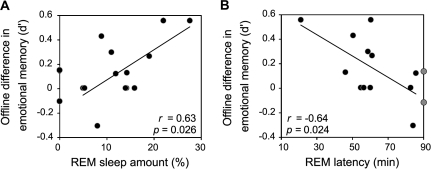
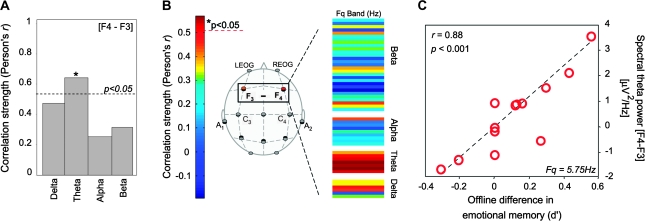
Both emotion and sleep are independently known to modulate declarative memory. Memory can be facilitated by emotion, leading to enhanced consolidation across increasing time delays. Sleep also facilitates offline memory processing, resulting in superior recall the next day. Here we explore whether rapid eye movement (REM) sleep, and aspects of its unique neurophysiology, underlie these convergent influences on memory. Using a nap paradigm, we measured the consolidation of neutral and negative emotional memories, and the association with REM-sleep electrophysiology. Subjects that napped showed a consolidation benefit for emotional but not neutral memories. The No-Nap control group showed no evidence of a consolidation benefit for either memory type. Within the Nap group, the extent of emotional memory facilitation was significantly correlated with the amount of REM sleep and also with right-dominant prefrontal theta power during REM. Together, these data support the role of REM-sleep neurobiology in the consolidation of emotional human memories, findings that have direct translational implications for affective psychiatric and mood disorders.
Overview
The claims and statistics of this paper haven’t been checked yet.
Free: it reads the open-access text and checks the first 5 claims that cite a source we can check. Create a free account to check every claim.
Integrity signals
Registry
Cites
Statistics
Figures
Verification
Claims the paper makes
The claims and statistics of this paper haven’t been checked yet.
Free: it reads the open-access text and checks the first 5 claims that cite a source we can check. Create a free account to check every claim.
Claims other papers make about this one
Each is checked against this paper’s own text: does it say what the citing paper says it does?
The source backs part of the claim, not all of it — or backs it for a different population, condition or comparison.
In the citing paper
“The integration of memories during sleep probably relies on an interleaved hippocampal reactivation of new and associated old memories and occurs in a fine-tuned interaction with cortical slow oscillations (< 1 Hz) and thalamocortical fast-spindle activity (13-15 Hz). 12”
From Effects of Sleep after Experimental Trauma on Intrusive Emotional Memories. (2016) · cites this paper as [12]
Experimental — accuracy not yet measuredThe source backs part of the claim, not all of it — or backs it for a different population, condition or comparison.
In the citing paper
“REM sleep plays a pivotal role in the processing of salient and emotional waking-life experiences, strongly contributing to the emotional memory consolidation”
From The Functional Role of Dreaming in Emotional Processes (2019) · cites this paper as Nishida et al., 2009
Experimental — accuracy not yet measuredThe source backs part of the claim, not all of it — or backs it for a different population, condition or comparison.
In the citing paper
“the results on EEG pattern related to the incorporated memories converged to assign a crucial role of REM theta oscillations in emotional re-processing”
From The Functional Role of Dreaming in Emotional Processes (2019) · cites this paper as Nishida et al., 2009
Experimental — accuracy not yet measuredThe source backs part of the claim, not all of it — or backs it for a different population, condition or comparison.
In the citing paper
“compelling evidence indicates that the potential EEG marker of emotional processes is the frontal theta activity (5–7 Hz) during REM sleep”
From The Functional Role of Dreaming in Emotional Processes (2019) · cites this paper as Nishida et al., 2009
Experimental — accuracy not yet measuredThe source backs part of the claim, not all of it — or backs it for a different population, condition or comparison.
In the citing paper
“The topographical changes of cortical oscillatory activity during sleep involve regions upon which relies a successful memory encoding in wakefulness.96”
From Spotlight on dream recall: the ages of dreams (2018) · cites this paper as [96]
Experimental — accuracy not yet measured
11 more claims about this paper
Create a free account to see every claim other papers make about this one.
Self-check
Percentages, sums and reported differences re-computed from the paper’s own numbers.
The self-check needs the paper’s full text.
Citations
Cites
Rechtschaffen, A. (1968) · Medical Entomology and Zoology · Cited by 12,654
Detection Theory: A User's Guide
Macmillan, N. A., & Creelman, C. D. (1991) · Cited by 5,415
Memory - A century of consolidation
McGaugh, J. L. (2000) · Science · doi:10.1126/science.287.5451.248 · Cited by 4,250
Theta oscillations in the hippocampus
Buzsáki, G. (2002) · Neuron · doi:10.1016/s0896-6273(02)00586-x · Cited by 3,332
International Affective Picture System (IAPS) : Technical Manual and Affective Ratings
Lang, P. J. (1995) · Medical Entomology and Zoology · Cited by 2,870
THE AMYGDALA MODULATES THE CONSOLIDATION OF MEMORIES OF EMOTIONALLY AROUSING EXPERIENCES
McGaugh, J. L. (2004) · Annual Review of Neuroscience · doi:10.1146/annurev.neuro.27.070203.144157 · Cited by 2,296
Huber, R., Felice Ghilardi, M., Massimini, M., & Tononi, G. (2004) · Nature · doi:10.1038/nature02663 · Cited by 1,854
Hemispheric encoding/retrieval asymmetry in episodic memory: positron emission tomography findings.
Tulving, E., Kapur, S., Craik, F. I., Moscovitch, M., & Houle, S. (1994) · Proceedings of the National Academy of Sciences · doi:10.1073/pnas.91.6.2016 · Cited by 1,595
Human emotion and memory: Interactions of the amygdala and hippocampal complex
Phelps, E. A. (2004) · Current Opinion in Neurobiology · doi:10.1016/j.conb.2004.03.015 · Cited by 1,577 · cited 5×
“Moreover, this behavioral benefit has been related to specific changes in neurochemical and neurophysiological states in certain subcortical and cortical networks (Cahill 2000; McGaugh 2000; Pare et al. 2002; McGaugh 2004; Phelps 2004).”
InfluentialAnxiety and affective style: role of prefrontal cortex and amygdala
Davidson, R. J. (2002) · Biological Psychiatry · doi:10.1016/s0006-3223(01)01328-2 · Cited by 1,135
Research works printed but not linked: 4
- Hoffmann, 1988, Brazilian journal of medical and biological research = Revista brasileira de pesquisas m dicas e biol gicas / Sociedade Brasileira de Biof sica ... [et al.], 21, 141
- 2005, PNAS, 102, 2626, 10.1073/pnas.0409848102 · DOI · Paper page
- Par, 2002, Trends in cognitive sciences, 6, 306, 10.1016/s1364-6613(02)01924-1 · DOI · Paper page
- 2006, Annual review of psychology, 10, 139
Cited by
Items 201–300 of 716
Bidirectional relationships between sleep and amyloid-beta in the hippocampus
Dufort‐Gervais, J., Mongrain, V., & Brouillette, J. (2018) · Neurobiology of Learning and Memory · doi:10.1016/j.nlm.2018.06.009 · Cited by 43
Evidence of an active role of dreaming in emotional memory processing shows that we dream to forget
Zhang, J., Pena, A., Delano, N., Sattari, N. S., Shuster, A. E., Baker, F. C., Simon, K. C. N. S., & Mednick, S. C. (2024) · Scientific Reports · doi:10.1038/s41598-024-58170-z · Cited by 43
Kirov, R., Brand, S., Banaschewski, T., & Rothenberger, A. (2017) · Frontiers in Psychology · doi:10.3389/fpsyg.2016.02059 · Cited by 43
Communication Through Coherence by Means of Cross-frequency Coupling
González, J., Cavelli, M., Mondino, A., Rubido, N., Tort, A. B. L., & Torterolo, P. (2020) · Neuroscience · doi:10.1016/j.neuroscience.2020.09.019 · Cited by 43
Daily Life Experiences in Dreams and Sleep-Dependent Memory Consolidation
Eichenlaub, J.-B., Cash, S. S., & Blagrove, M. (2017) · Studies in Neuroscience, Psychology and Behavioral Economics · doi:10.1007/978-3-319-45066-7_10 · Cited by 42
Exploring the Effect of Sleep and Reduced Interference on Different Forms of Declarative Memory
Schönauer, M., Pawlizki, A., Köck, C., & Gais, S. (2014) · Sleep · doi:10.5665/sleep.4258 · Cited by 42
Sleep divergently affects cognitive and automatic emotional response in children
Bolinger, E., Born, J., & Zinke, K. (2018) · Neuropsychologia · doi:10.1016/j.neuropsychologia.2018.05.015 · Cited by 42
What are emotions and how are they created in the brain?
Lindquist, K. A., Wager, T. D., Bliss‐Moreau, E., Kober, H., & Barrett, L. F. (2012) · Behavioral and Brain Sciences · doi:10.1017/s0140525x1100183x · Cited by 42
EEG oscillations during sleep and dream recall: state- or trait-like individual differences?
Scarpelli, S., D’Atri, A., Gorgoni, M., Ferrara, M., & Gennaro, L. D. (2015) · Frontiers in Psychology · doi:10.3389/fpsyg.2015.00605 · Cited by 41
Mental Sleep Activity and Disturbing Dreams in the Lifespan
Scarpelli, S., Bartolacci, C., D’Atri, A., Gorgoni, M., & De Gennaro, L. (2019) · International Journal of Environmental Research and Public Health · doi:10.3390/ijerph16193658 · Cited by 41
Bennion, K. A., Payne, J. D., & Kensinger, E. A. (2016) · Behavioral Neuroscience · doi:10.1037/bne0000142 · Cited by 41
Phase-based coordination of hippocampal and neocortical oscillations during human sleep
Cox, R., Rüber, T., Staresina, B. P., & Fell, J. (2020) · Communications Biology · doi:10.1038/s42003-020-0913-5 · Cited by 41
Spotlight on dream recall: the ages of dreams
Mangiaruga, A., Scarpelli, S., Bartolacci, C., & De Gennaro, L. (2018) · Nature and Science of Sleep · doi:10.2147/nss.s135762 · Cited by 39
“cortical oscillatory activity during sleep involve regions upon which relies a successful memory encoding in wakefulness.(96)”
BackgroundResultREM theta activity predicts re-experiencing symptoms after exposure to a traumatic film
Sopp, M. R., Brueckner, A. H., Schäfer, S. K., Lass‐Hennemann, J., & Michael, T. (2018) · Sleep Medicine · doi:10.1016/j.sleep.2018.10.030 · Cited by 39
Sleep spindles provide indirect support to the consolidation of emotional encoding contexts
Cairney, S. A., Durrant, S. J., Jackson, R., & Lewis, P. A. (2014) · Neuropsychologia · doi:10.1016/j.neuropsychologia.2014.09.016 · Cited by 39
Neurophysiological Basis of Sleep’s Function on Memory and Cognition
Spencer, R. M. C. (2013) · ISRN Physiology · doi:10.1155/2013/619319 · Cited by 39
Lipinska, G., & Thomas, K. G. F. (2019) · Frontiers in Psychology · doi:10.3389/fpsyg.2019.01766 · Cited by 39
Memory corticalization triggered by REM sleep: mechanisms of cellular and systems consolidation
Almeida-Filho, D. G., Queiroz, C. M., & Ribeiro, S. (2018) · Cellular and Molecular Life Sciences · doi:10.1007/s00018-018-2886-9 · Cited by 38
Phase-locked auditory stimulation of theta oscillations during rapid eye movement sleep
Harrington, M. O., Ashton, J. E., Ngo, H.-V. V., & Cairney, S. A. (2020) · SLEEP · doi:10.1093/sleep/zsaa227 · Cited by 38
Unveiling Fast Field Oscillations through Comodulation
Scheffer-Teixeira, R., & Tort, A. B. L. (2017) · eNeuro · doi:10.1523/eneuro.0079-17.2017 · Cited by 38
Morning REM Sleep Naps Facilitate Broad Access to Emotional Semantic Networks
Carr, M., & Nielsen, T. (2015) · Sleep · doi:10.5665/sleep.4504 · Cited by 38
Haghani, M., Abbasi, S., Abdoli, L., Shams, S. F., Zarandi, B. F. B. B., Shokrpour, N., Jahromizadeh, A., Mortazavi, S. A., & Mortazavi, S. M. J. (2023) · Journal of Biomedical Physics and Engineering · doi:10.31661/jbpe.v0i0.2106-1355 · Cited by 38
Investigation on Neurobiological Mechanisms of Dreaming in the New Decade
Scarpelli, S., Alfonsi, V., Gorgoni, M., Giannini, A. M., & Gennaro, L. D. (2021) · Brain Sciences · doi:10.3390/brainsci11020220 · Cited by 39
Ribeiro, S., & Stickgold, R. (2014) · Trends in Neuroscience and Education · doi:10.1016/j.tine.2014.02.004 · Cited by 37
Mendoza-Alvarez, M., Balthasar, Y., Verbraecken, J. A., Claes, L., Someren, E. J. W. V., van Marle, H. J. F., Vandekerckhove, M. M. P., & Picker, L. D. (2024) · Sleep Medicine · doi:10.1016/j.sleep.2024.12.037 · Cited by 38
Simor, P., & Horváth, K. (2013) · Scandinavian Journal of Psychology · doi:10.1111/sjop.12048 · Cited by 37
Sleep Strengthens but does Not Reorganize Memory Traces in a Verbal Creativity Task
Landmann, N., Kuhn, M., Maier, J.-G., Feige, B., Spiegelhalder, K., Riemann, D., & Nissen, C. (2016) · Sleep · doi:10.5665/sleep.5556 · Cited by 37
Harrington, M. O., Johnson, J. M., Croom, H. E., Pennington, K., & Durrant, S. J. (2018) · Cortex · doi:10.1016/j.cortex.2017.12.004 · Cited by 37
REM sleep and emotional face memory in typically-developing children and children with autism
Tessier, S., Lambert, A., Scherzer, P. B., Jemel, B., & Godbout, R. (2015) · Biological Psychology · doi:10.1016/j.biopsycho.2015.07.012 · Cited by 37
Neural correlates of sleep, stress, and selective memory consolidation
Kim, S. Y., & Payne, J. D. (2020) · Current Opinion in Behavioral Sciences · doi:10.1016/j.cobeha.2019.12.009 · Cited by 37
Emotional Memory Processing during REM Sleep with Implications for Post-Traumatic Stress Disorder
Rho, Y.-A., Sherfey, J. S., & Vijayan, S. (2022) · Journal of Neuroscience · doi:10.1523/jneurosci.1020-22.2022 · Cited by 37
Heib, D. P. J., Hoedlmoser, K., Anderer, P., Gruber, G., Zeitlhofer, J., & Schabus, M. (2015) · Journal of Cognitive Neuroscience · doi:10.1162/jocn_a_00804 · Cited by 36
Sleep unbinds memories from their emotional context
Deliens, G., Gilson, M., Schmitz, R., & Peigneux, P. (2012) · Cortex · doi:10.1016/j.cortex.2012.11.014 · Cited by 36
Effects of early morning nap sleep on associative memory for neutral and emotional stimuli
Sopp, M. R., Michael, T., & Mecklinger, A. (2018) · Brain Research · doi:10.1016/j.brainres.2018.06.020 · Cited by 36
Polta, S., Fenzl, T., Jakubcakova, V., Kimura, M., Yassouridis, A., & Wotjak, C. T. (2013) · Frontiers in Behavioral Neuroscience · doi:10.3389/fnbeh.2013.00060 · Cited by 36
Porcheret, K., der Kloet, D. V. H., Goodwin, G. M., Foster, F., Wulff, K., & Holmes, E. A. (2019) · Translational Psychiatry · doi:10.1038/s41398-019-0403-z · Cited by 35
Tempesta, D., Socci, V., Ioio, G. D., Gennaro, L. D., & Ferrara, M. (2017) · Experimental Brain Research · doi:10.1007/s00221-017-5043-z · Cited by 35
Nightmares and Nightmare Function
Nielsen, T., & Carr, M. (2016) · Elsevier eBooks · doi:10.1016/b978-0-323-24288-2.00053-2 · Cited by 35
Paradoxical sleep: A vigilance state to gate long-term brain plasticity?
Ravassard, P., Hamieh, A. M., Malleret, G., & Salin, P. A. (2014) · Neurobiology of Learning and Memory · doi:10.1016/j.nlm.2014.11.013 · Cited by 35
How Emotional Arousal Enhances Episodic Memory
Baraly, K. T. A., Hot, P., Davidson, P. S. R., & Talmi, D. (2017) · Elsevier eBooks · doi:10.1016/b978-0-12-809324-5.21051-1 · Cited by 35
Shah, N. J., Arrubla, J., Rajkumar, R., Farrher, E., Mauler, J., Kops, E. R., Tellmann, L., Scheins, J. J., Boers, F., Dammers, J., et al. (2017) · Scientific Reports · doi:10.1038/s41598-017-05484-w · Cited by 35
Cunningham, T. J., Stickgold, R., & Kensinger, E. A. (2022) · Frontiers in Behavioral Neuroscience · doi:10.3389/fnbeh.2022.910317 · Cited by 34
Sleep, cognition and cortisol in addison’s disease: a mechanistic relationship
Henry, M., Thomas, K. G. F., & Ross, I. L. (2021) · Frontiers in Endocrinology · doi:10.3389/fendo.2021.694046 · Cited by 34
Hegde, P., Jayakrishnan, H. R., Chattarji, S., Kutty, B. M., & Laxmi, T. R. (2011) · Brain Research · doi:10.1016/j.brainres.2011.01.055 · Cited by 34
Targeted memory reactivation in human REM sleep elicits detectable reactivation
Abdellahi, M. E. A., Koopman, A. C. M., Treder, M. S., & Lewis, P. A. (2023) · eLife · doi:10.7554/elife.84324 · Cited by 34
The role of the basolateral amygdala in dreaming
Blake, Y., Terburg, D., Balchin, R., van Honk, J., & Solms, M. (2019) · Cortex · doi:10.1016/j.cortex.2018.12.016 · Cited by 33
Sleep Preserves Physiological Arousal in Emotional Memory
Ashton, J. E., Harrington, M. O., Guttesen, A. Á. V., Smith, A. K., & Cairney, S. A. (2019) · Scientific Reports · doi:10.1038/s41598-019-42478-2 · Cited by 33
REM sleep estimation based on autonomic dynamics using R–R intervals
Yoon, H., Hwang, S. H., Choi, J., Lee, Y. J., Jeong, D. U., & Park, K. S. (2017) · Physiological Measurement · doi:10.1088/1361-6579/aa63c9 · Cited by 33
Exercising the Sleepy-ing Brain: Exercise, Sleep, and Sleep Loss on Memory
Roig, M., Cristini, J., Parwanta, Z., Ayotte, B., Rodrigues, L., Heras, B. D. L., Nepveu, J.-F., Huber, R., Carrier, J., Steib, S., et al. (2021) · Exercise and Sport Sciences Reviews · doi:10.1249/jes.0000000000000273 · Cited by 33
Sleep as a window to target traumatic memories
van der Heijden, A. C., van den Heuvel, O. A., van der Werf, Y. D., Talamini, L. M., & van Marle, H. J. F. (2022) · Neuroscience & Biobehavioral Reviews · doi:10.1016/j.neubiorev.2022.104765 · Cited by 32
Edwards, C. L., Malinowski, J., Rohner, S. L., Bennett, P. D., Ruby, P. M., & Blagrove, M. (2015) · Frontiers in Psychology · doi:10.3389/fpsyg.2015.00831 · Cited by 32
Acute sleep interventions as an avenue for treatment of trauma-associated disorders
Swift, K. M., Thomas, C. L., Balkin, T. J., Lowery‐Gionta, E. G., & Matson, L. M. (2022) · Journal of Clinical Sleep Medicine · doi:10.5664/jcsm.10074 · Cited by 31
To sleep or not to sleep – Effects on memory in normal aging and disease
Kroeger, D., & Vetrivelan, R. (2023) · Aging Brain · doi:10.1016/j.nbas.2023.100068 · Cited by 31
Samson, D. R. (2020) · American Journal of Human Biology · doi:10.1002/ajhb.23541 · Cited by 31
Dreaming correlates of alexithymia among sleep-disordered patients
Nielsen, T., Levrier, K., & Montplaisir, J. (2011) · Dreaming · doi:10.1037/a0022861 · Cited by 30
Cunningham, T. J., Chambers, A. M., & Payne, J. D. (2014) · Frontiers in Psychology · doi:10.3389/fpsyg.2014.00862 · Cited by 30
Hippocampal Contributions to Declarative Memory Consolidation During Sleep
Antony, J. W., & Paller, K. A. (2017) · Springer eBooks · doi:10.1007/978-3-319-50406-3_9 · Cited by 30
Harrington, M. O., Nedberge, K. M., & Durrant, S. J. (2018) · Neurobiology of Learning and Memory · doi:10.1016/j.nlm.2018.04.013 · Cited by 30
Sleep and Affective Brain Regulation
van der Helm, E., & Walker, M. P. (2012) · Social and Personality Psychology Compass · doi:10.1111/j.1751-9004.2012.00464.x · Cited by 30
Self-citationGoerke, M., Cohrs, S., Rodenbeck, A., Grittner, U., Sommer, W., & Kunz, D. (2012) · Psychoneuroendocrinology · doi:10.1016/j.psyneuen.2012.10.019 · Cited by 30
REM sleep theta changes in frequent nightmare recallers
Marquis, L.-P., Paquette, T., Blanchette-Carrière, C., Dumel, G., & Nielsen, T. (2017) · SLEEP · doi:10.1093/sleep/zsx110 · Cited by 29
Test Expectation Enhances Memory Consolidation across Both Sleep and Wake.
Wamsley, E. J., Hamilton, K., Graveline, Y., Manceor, S., & Parr, E. (2016) · PLoS ONE · doi:10.1371/journal.pone.0165141 · Cited by 29
Seeley, C. J., Smith, C. T., MacDonald, K. J., & Beninger, R. J. (2016) · Behavioral Neuroscience · doi:10.1037/bne0000123 · Cited by 29
REM sleep, dreams, and attachment themes across a single night of sleep: A pilot study.
McNamara, P., Ayala, R., & Minsky, A. (2014) · Dreaming · doi:10.1037/a0038234 · Cited by 29
Lau, E. Y. Y., Lau, K. N. T., Chan, C. S., Tseng, C., Lam, Y. C., Tse, D. M.-S., Cheng, W. Y., Chung, K., & Wing, Y. K. (2019) · Journal of Affective Disorders · doi:10.1016/j.jad.2019.09.058 · Cited by 29
Sounding it out: auditory stimulation and overnight memory processing
Harrington, M. O., & Cairney, S. A. (2021) · Current Sleep Medicine Reports · doi:10.1007/s40675-021-00207-0 · Cited by 28
Glosemeyer, R. W., Diekelmann, S., Cassel, W., Kesper, K., Koehler, U., Westermann, S., Steffen, A., Borgwardt, S., Wilhelm, I., Müller‐Pinzler, L., et al. (2020) · Scientific Reports · doi:10.1038/s41598-020-74169-8 · Cited by 28
Short-term total sleep deprivation alters delay-conditioned memory in the rat.
Tripathi, S., & Jha, S. K. (2016) · Behavioral Neuroscience · doi:10.1037/bne0000136 · Cited by 28
Harricharan, S., McKinnon, M. C., Tursich, M., Densmore, M., Frewen, P., Théberge, J., van der Kolk, B., & Lanius, R. A. (2019) · European Journal of Psychotraumatology · doi:10.1080/20008198.2019.1586265 · Cited by 18
Sleep deprivation and Pavlovian fear conditioning
Cai, D. J., Shuman, T., Harrison, E. M., Sage, J. R., & Anagnostaras, S. G. (2009) · Learning & Memory · doi:10.1101/lm.1515609 · Cited by 27
Offline consolidation of procedural skill learning is enhanced by negative emotional content
Javadi, A. H., Walsh, V., & Lewis, P. A. (2011) · Experimental Brain Research · doi:10.1007/s00221-010-2497-7 · Cited by 26
“Interestingly, within declarative memory, the emotional content of stimuli such as texts (Wagner et al. 2001) or scenes (Payne et al. 2008; Nishida et al. 2009 ) has been shown to interact with sleep-dependent consolidation such that emotional items are more strongly consolidated across sleep than neutral items (for r…”
BackgroundSleep benefits emotional and neutral associative memories equally
Lehmann, M., Seifritz, E., & Rasch, B. (2016) · Somnologie - Schlafforschung und Schlafmedizin · doi:10.1007/s11818-015-0034-4 · Cited by 26
Do different salience cues compete for dominance in memory over a daytime nap?
Alger, S. E., Chen, S., & Payne, J. D. (2018) · Neurobiology of Learning and Memory · doi:10.1016/j.nlm.2018.06.005 · Cited by 26
Peters, A. C., Blechert, J., Sämann, P. G., Eidner, I., Czisch, M., & Spoormaker, V. I. (2014) · Journal of Neurophysiology · doi:10.1152/jn.00657.2013 · Cited by 26
Denis, D., Kim, S. Y., Kark, S. M., Daley, R. T., Kensinger, E. A., & Payne, J. D. (2021) · European Journal of Neuroscience · doi:10.1111/ejn.15132 · Cited by 26
The Effect of Obstructive Sleep Apnea on Sleep-dependent Emotional Memory Consolidation
Cunningham, T. J., Kishore, D., Guo, M., Igue, M., Malhotra, A., Stickgold, R., & Djonlagic, I. E. (2023) · Annals of the American Thoracic Society · doi:10.1513/annalsats.202204-315oc · Cited by 26
Sharp Wave-Ripples in Human Amygdala and Their Coordination with Hippocampus during NREM Sleep
Cox, R., Rüber, T., Staresina, B. P., & Fell, J. (2020) · Cerebral Cortex Communications · doi:10.1093/texcom/tgaa051 · Cited by 26
Pereira, S. I. R., Tsimpanouli, M.-E., Hutchison, I. C., Schneider, J., Anderson, I. M., McFarquhar, M., Elliott, R., & Lewis, P. A. (2022) · NeuroImage · doi:10.1016/j.neuroimage.2022.119120 · Cited by 26
Richards, A. L., Inslicht, S. S., Yack, L. M., Metzler, T. J., Huie, J. R., Straus, L. D., Dukes, C., Hubachek, S. Q., Felmingham, K. L., Mathalon, D. H., et al. (2021) · SLEEP · doi:10.1093/sleep/zsab271 · Cited by 25
Transcranial Magnetic Stimulation of the Medial Prefrontal Cortex Decreases Emotional Memory Schemas
Bovy, L., Berkers, R. M. W. J., Pottkämper, J. C. M., Varatheeswaran, R., Fernández, G., Tendolkar, I., & Dresler, M. (2020) · Cerebral Cortex · doi:10.1093/cercor/bhz329 · Cited by 25
Cremone, A., Lugo-Candelas, C. I., Harvey, E. A., McDermott, J. M., & Spencer, R. M. C. (2017) · Experimental Brain Research · doi:10.1007/s00221-017-4906-7 · Cited by 24
The role of sleep in emotional memory processing in middle age
Jones, B. J., Mackay, A., Mantua, J., Schultz, K. S., & Spencer, R. M. C. (2018) · Neurobiology of Learning and Memory · doi:10.1016/j.nlm.2018.08.002 · Cited by 24
Balancing Prediction and Surprise: A Role for Active Sleep at the Dawn of Consciousness?
Poll, M. N. V. D., & van Swinderen, B. (2021) · Frontiers in Systems Neuroscience · doi:10.3389/fnsys.2021.768762 · Cited by 24
REM refines and rescues memory representations: a new theory
Shuster, A. E., Morehouse, A. B., McDevitt, E. A., Chen, P., Whitehurst, L. N., Zhang, J., Sattari, N. S., Uzoigwe, T., Ekhlasi, A., Cai, D. J., et al. (2025) · SLEEP Advances · doi:10.1093/sleepadvances/zpaf004 · Cited by 24
New directions in sleep and memory research: the role of autonomic activity
Whitehurst, L. N., Chen, P., Naji, M., & Mednick, S. C. (2019) · Current Opinion in Behavioral Sciences · doi:10.1016/j.cobeha.2019.11.001 · Cited by 24
Sleep influences cognitive performance in lemurs
Samson, D. R., Vining, A. Q., & Nunn, C. L. (2019) · Animal Cognition · doi:10.1007/s10071-019-01266-1 · Cited by 24
Zeng, S., Lin, X., Wang, J., & Hu, X. (2021) · Sleep · doi:10.1093/sleep/zsab155 · Cited by 23
Hacking the functions of sleep: noninvasive approaches to stimulate sleep neurophysiology
Krugliakova, E., Breuer, F., Adelhöfer, N., Alonso, A., Besedovsky, L., Murphy, K. R., Peters, E., Raczek, K., Rasch, B., Salvesen, L., et al. (2025) · Physiological Reviews · doi:10.1152/physrev.00007.2025 · Cited by 23
Investigating the effect of a nap following experimental trauma on analogue PTSD symptoms
Wilhelm, I., Azza, Y., Brennwald, K., Ehrt‐Schäfer, Y., Seifritz, E., & Kleim, B. (2021) · Scientific Reports · doi:10.1038/s41598-021-83838-1 · Cited by 23
Sanford, L. D., Wellman, L. L., Adkins, A. M., Guo, M., Zhang, Y., Ren, R., Yang, L., & Tang, X. (2023) · Neurobiology of Stress · doi:10.1016/j.ynstr.2023.100517 · Cited by 23
Johnson, J. M., & Durrant, S. J. (2018) · Royal Society Open Science · doi:10.1098/rsos.172353 · Cited by 23
Suppression-induced forgetting diminishes following a delay of either sleep or wake
Davidson, P., Hellerstedt, R., Jönsson, P., & Johansson, M. (2019) · Journal of Cognitive Psychology · doi:10.1080/20445911.2019.1705311 · Cited by 23
Zhang, M., Li, R., Wang, Y., & Huang, Z. (2017) · Neural Plasticity · doi:10.1155/2017/5870735 · Cited by 23
Rosier, M., Barillier, L. L., Meunier, D., Yacoubi, M. E., Malleret, G., & Salin, P. A. (2018) · SLEEP · doi:10.1093/sleep/zsy188 · Cited by 23
Residual effects of emotion are reflected in enhanced visual activity after sleep
Bennion, K. A., Payne, J. D., & Kensinger, E. A. (2016) · Cognitive Affective & Behavioral Neuroscience · doi:10.3758/s13415-016-0479-3 · Cited by 22
Insight from the consideration of REM dreams, non-REM dreams, and daydreams.
Blagrove, M., Edwards, C. J., van Rijn, E., Reid, A. M., Malinowski, J., Bennett, P. D., Carr, M., Eichenlaub, J., Rohner, S. L., Evans, K., et al. (2019) · Psychology of Consciousness Theory Research and Practice · doi:10.1037/cns0000167 · Cited by 22
Neural Dynamics of Emotional Salience Processing in Response to Voices during the Stages of Sleep
Chen, C., Sung, J., & Cheng, Y. (2016) · Frontiers in Behavioral Neuroscience · doi:10.3389/fnbeh.2016.00117 · Cited by 22
Baldini, V., Pasquino, F., Ronchi, D. D., Plazzi, G., Pelizza, L., & Menchetti, M. (2025) · Schizophrenia Research · doi:10.1016/j.schres.2025.06.008 · Cited by 22
Miller, L. A., Ricci, M., van Schalkwijk, F. J., Mohamed, A., & van der Werf, Y. D. (2016) · Behavioral Neuroscience · doi:10.1037/bne0000127 · Cited by 22
Motor Performance Is not Enhanced by Daytime Naps in Older Adults
Backhaus, W., Braaß, H., Renné, T., Gerloff, C. P., & Hummel, F. C. (2016) · Frontiers in Aging Neuroscience · doi:10.3389/fnagi.2016.00125 · Cited by 22
Metadata
- Authors
- Nishida, M., Pearsall, J., Buckner, R. L., & Walker, M. P.
- Affiliations
- Tokyo Medical and Dental University (JP)
- Howard Hughes Medical Institute (US)
- University of California, Berkeley (US)
- Corresponding author
- Walker, M. P.
- Venue
- Cerebral Cortex
- Publisher
- Oxford University Press (OUP)
- Published
- 2008-10-01
- Volume
- 19
- Issue
- 5
- Pages
- 1158-1166
- ISSN
- 1047-3211 (ISSN-L)
- 1460-2199
- PMC
- PMC2665156
- OpenAlex
- W2139705940
- Semantic Scholar
- 327050a9b0af4acf6ce91b4688ef89fc9b8de013
- Cited by
- 603
- References
- 69
- Citations by year
- 2026: 21 · 2025: 37 · 2024: 26 · 2023: 33 · 2022: 26 · 2021: 37 · 2020: 43 · 2019: 51 · 2018: 44 · 2017: 38 · 2016: 33 · 2015: 50 · 2014: 38 · 2013: 39 · 2012: 23
- FWCI
- 10.88
- Type
- journal article
- Language
- en
- Open access
- hybrid
- doi.org
- Licence
- cc-by-nc
- Locations
- Cerebral Cortex (publishedVersion, cc-by-nc)
- PubMed Central (publishedVersion, cc-by-nc)
- PubMed (publishedVersion)
- Digital Access to Scholarship at Harvard (DASH) (Harvard University) (submittedVersion, cc-by)
- Funders
- Howard Hughes Medical Institute
- National Institute of Mental Health (R03MH069935, MH069935)
- Topics
- Life Sciences › Neuroscience › Cognitive Neuroscience › Sleep and Wakefulness Research
- Life Sciences › Neuroscience › Cognitive Neuroscience › Memory and Neural Mechanisms
- Life Sciences › Neuroscience › Cognitive Neuroscience › Memory Processes and Influences
- Keywords
- REM sleep, emotional memory consolidation, sleep-dependent memory consolidation, mood disorders
- MeSH terms
- Adolescent, Adult, Emotions, Female, Humans, Functional Laterality, Male, Reaction Time, Sleep, REM, Theta Rhythm, Prefrontal Cortex, Recognition, Psychology, Young Adult
About these checks
Registry, retraction, Cites and statistics results are computed, not judged, with one exception: a printed reference that no index lists is read once by a model before it counts as a citation error. Claims are extracted by a model and kept only when their quote appears verbatim in the text; each cited source is then checked, with a model’s help, for whether it says what the claim relies on. Those verdicts can be wrong — read the claim’s quote and the cited source before relying on one.
Statistics and arithmetic are recomputed, not judged.
Confidence bands are shown only for fields calibrated on our annotated test set. None is calibrated yet, so no band is shown.
What counts as a claim ›How we measure confidence ›How we check this ›
Are you an author, or do you see a problem with this page? Request a review
Data sources
Bibliographic data: Semantic Scholar, OpenAlex, Crossref.
Contains information from the Semantic Scholar Academic Graph Datasets, made available under the ODC Attribution License (ODC-BY 1.0).
Semantic Scholar’s data is described in: Kinney, R., et al. (2023). The Semantic Scholar Open Data Platform. arXiv:2301.10140.
