

REM Sleep, Prefrontal Theta, and the Consolidation of Human Emotional Memory
Open accessThe DOI matches its Crossref record; 69 of the 69 references it cites were found in a registry or an index.
Abstract
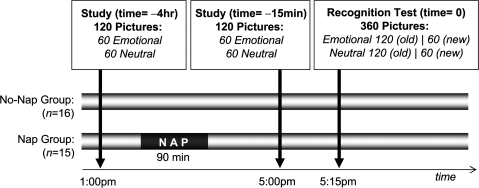
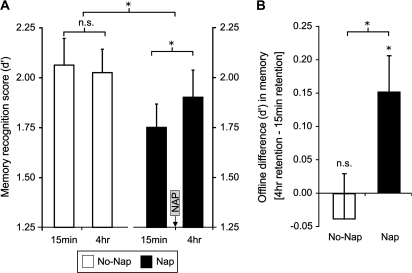
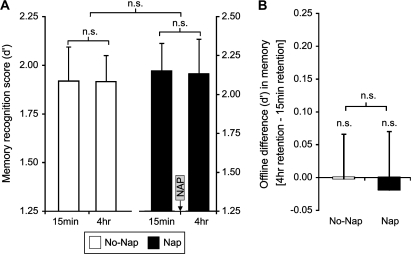
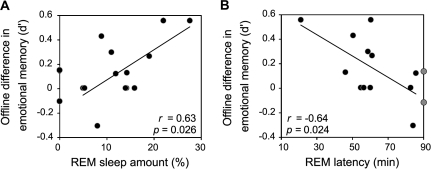
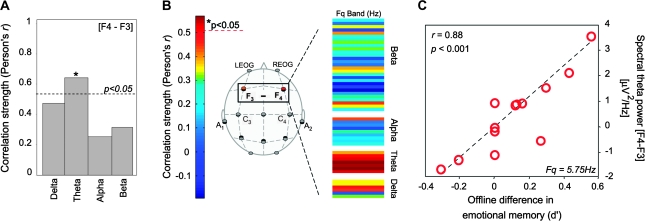
Both emotion and sleep are independently known to modulate declarative memory. Memory can be facilitated by emotion, leading to enhanced consolidation across increasing time delays. Sleep also facilitates offline memory processing, resulting in superior recall the next day. Here we explore whether rapid eye movement (REM) sleep, and aspects of its unique neurophysiology, underlie these convergent influences on memory. Using a nap paradigm, we measured the consolidation of neutral and negative emotional memories, and the association with REM-sleep electrophysiology. Subjects that napped showed a consolidation benefit for emotional but not neutral memories. The No-Nap control group showed no evidence of a consolidation benefit for either memory type. Within the Nap group, the extent of emotional memory facilitation was significantly correlated with the amount of REM sleep and also with right-dominant prefrontal theta power during REM. Together, these data support the role of REM-sleep neurobiology in the consolidation of emotional human memories, findings that have direct translational implications for affective psychiatric and mood disorders.
Overview
The claims and statistics of this paper haven’t been checked yet.
Free: it reads the open-access text and checks the first 5 claims that cite a source we can check. Create a free account to check every claim.
Integrity signals
Registry
Cites
Statistics
Figures
Verification
Claims the paper makes
The claims and statistics of this paper haven’t been checked yet.
Free: it reads the open-access text and checks the first 5 claims that cite a source we can check. Create a free account to check every claim.
Claims other papers make about this one
Each is checked against this paper’s own text: does it say what the citing paper says it does?
The source backs part of the claim, not all of it — or backs it for a different population, condition or comparison.
In the citing paper
“The integration of memories during sleep probably relies on an interleaved hippocampal reactivation of new and associated old memories and occurs in a fine-tuned interaction with cortical slow oscillations (< 1 Hz) and thalamocortical fast-spindle activity (13-15 Hz). 12”
From Effects of Sleep after Experimental Trauma on Intrusive Emotional Memories. (2016) · cites this paper as [12]
Experimental — accuracy not yet measuredThe source backs part of the claim, not all of it — or backs it for a different population, condition or comparison.
In the citing paper
“REM sleep plays a pivotal role in the processing of salient and emotional waking-life experiences, strongly contributing to the emotional memory consolidation”
From The Functional Role of Dreaming in Emotional Processes (2019) · cites this paper as Nishida et al., 2009
Experimental — accuracy not yet measuredThe source backs part of the claim, not all of it — or backs it for a different population, condition or comparison.
In the citing paper
“the results on EEG pattern related to the incorporated memories converged to assign a crucial role of REM theta oscillations in emotional re-processing”
From The Functional Role of Dreaming in Emotional Processes (2019) · cites this paper as Nishida et al., 2009
Experimental — accuracy not yet measuredThe source backs part of the claim, not all of it — or backs it for a different population, condition or comparison.
In the citing paper
“compelling evidence indicates that the potential EEG marker of emotional processes is the frontal theta activity (5–7 Hz) during REM sleep”
From The Functional Role of Dreaming in Emotional Processes (2019) · cites this paper as Nishida et al., 2009
Experimental — accuracy not yet measuredThe source backs part of the claim, not all of it — or backs it for a different population, condition or comparison.
In the citing paper
“The topographical changes of cortical oscillatory activity during sleep involve regions upon which relies a successful memory encoding in wakefulness.96”
From Spotlight on dream recall: the ages of dreams (2018) · cites this paper as [96]
Experimental — accuracy not yet measured
11 more claims about this paper
Create a free account to see every claim other papers make about this one.
Self-check
Percentages, sums and reported differences re-computed from the paper’s own numbers.
The self-check needs the paper’s full text.
Citations
Cites
Rechtschaffen, A. (1968) · Medical Entomology and Zoology · Cited by 12,654
Detection Theory: A User's Guide
Macmillan, N. A., & Creelman, C. D. (1991) · Cited by 5,415
Memory - A century of consolidation
McGaugh, J. L. (2000) · Science · doi:10.1126/science.287.5451.248 · Cited by 4,250
Theta oscillations in the hippocampus
Buzsáki, G. (2002) · Neuron · doi:10.1016/s0896-6273(02)00586-x · Cited by 3,332
International Affective Picture System (IAPS) : Technical Manual and Affective Ratings
Lang, P. J. (1995) · Medical Entomology and Zoology · Cited by 2,870
THE AMYGDALA MODULATES THE CONSOLIDATION OF MEMORIES OF EMOTIONALLY AROUSING EXPERIENCES
McGaugh, J. L. (2004) · Annual Review of Neuroscience · doi:10.1146/annurev.neuro.27.070203.144157 · Cited by 2,296
Huber, R., Felice Ghilardi, M., Massimini, M., & Tononi, G. (2004) · Nature · doi:10.1038/nature02663 · Cited by 1,854
Hemispheric encoding/retrieval asymmetry in episodic memory: positron emission tomography findings.
Tulving, E., Kapur, S., Craik, F. I., Moscovitch, M., & Houle, S. (1994) · Proceedings of the National Academy of Sciences · doi:10.1073/pnas.91.6.2016 · Cited by 1,595
Human emotion and memory: Interactions of the amygdala and hippocampal complex
Phelps, E. A. (2004) · Current Opinion in Neurobiology · doi:10.1016/j.conb.2004.03.015 · Cited by 1,577 · cited 5×
“Moreover, this behavioral benefit has been related to specific changes in neurochemical and neurophysiological states in certain subcortical and cortical networks (Cahill 2000; McGaugh 2000; Pare et al. 2002; McGaugh 2004; Phelps 2004).”
InfluentialAnxiety and affective style: role of prefrontal cortex and amygdala
Davidson, R. J. (2002) · Biological Psychiatry · doi:10.1016/s0006-3223(01)01328-2 · Cited by 1,135
Research works printed but not linked: 4
- Hoffmann, 1988, Brazilian journal of medical and biological research = Revista brasileira de pesquisas m dicas e biol gicas / Sociedade Brasileira de Biof sica ... [et al.], 21, 141
- 2005, PNAS, 102, 2626, 10.1073/pnas.0409848102 · DOI · Paper page
- Par, 2002, Trends in cognitive sciences, 6, 306, 10.1016/s1364-6613(02)01924-1 · DOI · Paper page
- 2006, Annual review of psychology, 10, 139
Cited by
Items 701–716 of 716
The twitcing eye : REM sleep and the emotional brain
Beck, T. M. (2012) · DSpace@MIT (Massachusetts Institute of Technology)
Schlafspindeln und kognitive Funktionen bei älteren Menschen
Fleck, C. (2009) · Universitätsbibliothek der FU Berlin Hochschulschriftenstelle u. Dokumentenserver · doi:10.17169/refubium-10572
Pillay, T. (2026) · Open University of Cape Town (University of Cape Town)
Schlafspindeln und Gedächtniskonsolidierung bei Patienten mit Schizophrenie und gesunden Kontrollen
Ballhausen, F. (2016) · MACAU: Open Access Repository of Kiel University (University Library Kiel)
studio longitudinale: relazione tra disturbi del sonno e del comportamento in età evolutiva
Guarguagli, E. (2016) · Electronic Theses and Dissertations Repository (University of Pisa)
A Review on Approaches and Assumptions in Human Neuroscience
Srilatha, B. (2017) · Zenodo (CERN European Organization for Nuclear Research) · doi:10.5281/zenodo.8275345
From Dusk to Dawn: On sleep, memory and bias in depression
Bovy, L. (2021) · Radboud Repository (Radboud University)
Ungdom i en digital verden – en studie om tid, søvn og dataspill
Helle, L. C. S. (2020) · NVA (Nasjonalt vitenarkiv)
Vienne, J. (2010) · SERVAL (Université de Lausanne)
Kerkeni, M., Suppiah, H. T., Tran, J., & Driller, M. W. (2026) · doi:10.51224/sportrxiv.1145
Pires, J. (2023) · Portuguese National Funding Agency for Science, Research and Technology (RCAAP Project by FCT)
L’impact du temps sur le contenu des rapports policiers à la suite d’une intervention critique
Labelle, M. (2021) · Papyrus : Institutional Repository (Université de Montréal)
Novel investigation of western lowland gorilla sleep architecture
Reyes, K. R., Teichroeb, J. A., Schillaci, M. A., Wilson, V. A. D., Zuberbühler, K., & Samson, D. R. (2026) · Folia Primatologica · doi:10.1163/14219980-bja10086
Стресс, тревога и расстройства сна у детей
Александрович, К. И. (n.d.) · Effective Pharmacotherapy
Provo, M., Brna, A., Brown, R., Aguilar, M., Jayaprakash, H., Renee, S., & Simons, S. (2026) · Frontiers in Network Physiology · doi:10.3389/fnetp.2026.1985469
Metadata
- Authors
- Nishida, M., Pearsall, J., Buckner, R. L., & Walker, M. P.
- Affiliations
- Tokyo Medical and Dental University (JP)
- Howard Hughes Medical Institute (US)
- University of California, Berkeley (US)
- Corresponding author
- Walker, M. P.
- Venue
- Cerebral Cortex
- Publisher
- Oxford University Press (OUP)
- Published
- 2008-10-01
- Volume
- 19
- Issue
- 5
- Pages
- 1158-1166
- ISSN
- 1047-3211 (ISSN-L)
- 1460-2199
- PMC
- PMC2665156
- OpenAlex
- W2139705940
- Semantic Scholar
- 327050a9b0af4acf6ce91b4688ef89fc9b8de013
- Cited by
- 603
- References
- 69
- Citations by year
- 2026: 21 · 2025: 37 · 2024: 26 · 2023: 33 · 2022: 26 · 2021: 37 · 2020: 43 · 2019: 51 · 2018: 44 · 2017: 38 · 2016: 33 · 2015: 50 · 2014: 38 · 2013: 39 · 2012: 23
- FWCI
- 10.88
- Type
- journal article
- Language
- en
- Open access
- hybrid
- doi.org
- Licence
- cc-by-nc
- Locations
- Cerebral Cortex (publishedVersion, cc-by-nc)
- PubMed Central (publishedVersion, cc-by-nc)
- PubMed (publishedVersion)
- Digital Access to Scholarship at Harvard (DASH) (Harvard University) (submittedVersion, cc-by)
- Funders
- Howard Hughes Medical Institute
- National Institute of Mental Health (R03MH069935, MH069935)
- Topics
- Life Sciences › Neuroscience › Cognitive Neuroscience › Sleep and Wakefulness Research
- Life Sciences › Neuroscience › Cognitive Neuroscience › Memory and Neural Mechanisms
- Life Sciences › Neuroscience › Cognitive Neuroscience › Memory Processes and Influences
- Keywords
- REM sleep, emotional memory consolidation, sleep-dependent memory consolidation, mood disorders
- MeSH terms
- Adolescent, Adult, Emotions, Female, Humans, Functional Laterality, Male, Reaction Time, Sleep, REM, Theta Rhythm, Prefrontal Cortex, Recognition, Psychology, Young Adult
About these checks
Registry, retraction, Cites and statistics results are computed, not judged, with one exception: a printed reference that no index lists is read once by a model before it counts as a citation error. Claims are extracted by a model and kept only when their quote appears verbatim in the text; each cited source is then checked, with a model’s help, for whether it says what the claim relies on. Those verdicts can be wrong — read the claim’s quote and the cited source before relying on one.
Statistics and arithmetic are recomputed, not judged.
Confidence bands are shown only for fields calibrated on our annotated test set. None is calibrated yet, so no band is shown.
What counts as a claim ›How we measure confidence ›How we check this ›
Are you an author, or do you see a problem with this page? Request a review
Data sources
Bibliographic data: Semantic Scholar, OpenAlex, Crossref.
Contains information from the Semantic Scholar Academic Graph Datasets, made available under the ODC Attribution License (ODC-BY 1.0).
Semantic Scholar’s data is described in: Kinney, R., et al. (2023). The Semantic Scholar Open Data Platform. arXiv:2301.10140.
