

REM Sleep, Prefrontal Theta, and the Consolidation of Human Emotional Memory
Open accessThe DOI matches its Crossref record; 69 of the 69 references it cites were found in a registry or an index.
Abstract
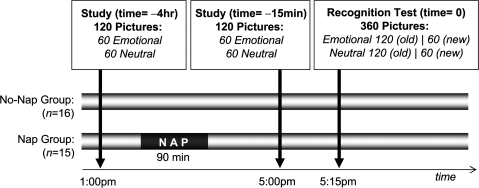
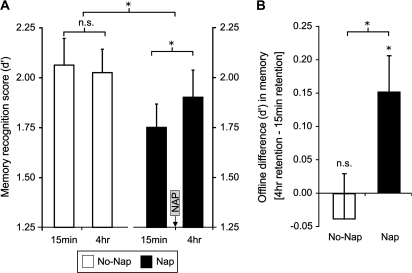
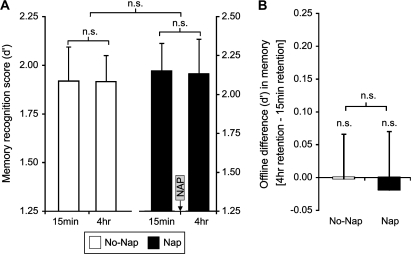
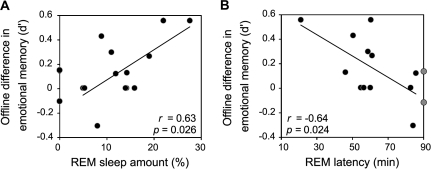
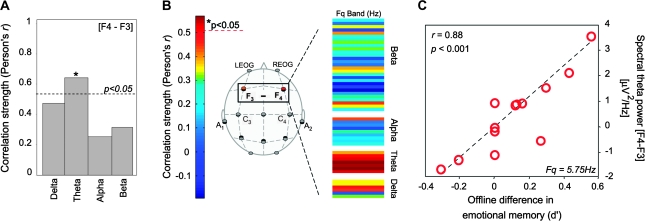
Both emotion and sleep are independently known to modulate declarative memory. Memory can be facilitated by emotion, leading to enhanced consolidation across increasing time delays. Sleep also facilitates offline memory processing, resulting in superior recall the next day. Here we explore whether rapid eye movement (REM) sleep, and aspects of its unique neurophysiology, underlie these convergent influences on memory. Using a nap paradigm, we measured the consolidation of neutral and negative emotional memories, and the association with REM-sleep electrophysiology. Subjects that napped showed a consolidation benefit for emotional but not neutral memories. The No-Nap control group showed no evidence of a consolidation benefit for either memory type. Within the Nap group, the extent of emotional memory facilitation was significantly correlated with the amount of REM sleep and also with right-dominant prefrontal theta power during REM. Together, these data support the role of REM-sleep neurobiology in the consolidation of emotional human memories, findings that have direct translational implications for affective psychiatric and mood disorders.
Overview
The claims and statistics of this paper haven’t been checked yet.
Free: it reads the open-access text and checks the first 5 claims that cite a source we can check. Create a free account to check every claim.
Integrity signals
Registry
Cites
Statistics
Figures
Verification
Claims the paper makes
The claims and statistics of this paper haven’t been checked yet.
Free: it reads the open-access text and checks the first 5 claims that cite a source we can check. Create a free account to check every claim.
Claims other papers make about this one
Each is checked against this paper’s own text: does it say what the citing paper says it does?
The source backs part of the claim, not all of it — or backs it for a different population, condition or comparison.
In the citing paper
“The integration of memories during sleep probably relies on an interleaved hippocampal reactivation of new and associated old memories and occurs in a fine-tuned interaction with cortical slow oscillations (< 1 Hz) and thalamocortical fast-spindle activity (13-15 Hz). 12”
From Effects of Sleep after Experimental Trauma on Intrusive Emotional Memories. (2016) · cites this paper as [12]
Experimental — accuracy not yet measuredThe source backs part of the claim, not all of it — or backs it for a different population, condition or comparison.
In the citing paper
“REM sleep plays a pivotal role in the processing of salient and emotional waking-life experiences, strongly contributing to the emotional memory consolidation”
From The Functional Role of Dreaming in Emotional Processes (2019) · cites this paper as Nishida et al., 2009
Experimental — accuracy not yet measuredThe source backs part of the claim, not all of it — or backs it for a different population, condition or comparison.
In the citing paper
“the results on EEG pattern related to the incorporated memories converged to assign a crucial role of REM theta oscillations in emotional re-processing”
From The Functional Role of Dreaming in Emotional Processes (2019) · cites this paper as Nishida et al., 2009
Experimental — accuracy not yet measuredThe source backs part of the claim, not all of it — or backs it for a different population, condition or comparison.
In the citing paper
“compelling evidence indicates that the potential EEG marker of emotional processes is the frontal theta activity (5–7 Hz) during REM sleep”
From The Functional Role of Dreaming in Emotional Processes (2019) · cites this paper as Nishida et al., 2009
Experimental — accuracy not yet measuredThe source backs part of the claim, not all of it — or backs it for a different population, condition or comparison.
In the citing paper
“The topographical changes of cortical oscillatory activity during sleep involve regions upon which relies a successful memory encoding in wakefulness.96”
From Spotlight on dream recall: the ages of dreams (2018) · cites this paper as [96]
Experimental — accuracy not yet measured
11 more claims about this paper
Create a free account to see every claim other papers make about this one.
Self-check
Percentages, sums and reported differences re-computed from the paper’s own numbers.
The self-check needs the paper’s full text.
Citations
Cites
Rechtschaffen, A. (1968) · Medical Entomology and Zoology · Cited by 12,654
Detection Theory: A User's Guide
Macmillan, N. A., & Creelman, C. D. (1991) · Cited by 5,415
Memory - A century of consolidation
McGaugh, J. L. (2000) · Science · doi:10.1126/science.287.5451.248 · Cited by 4,250
Theta oscillations in the hippocampus
Buzsáki, G. (2002) · Neuron · doi:10.1016/s0896-6273(02)00586-x · Cited by 3,332
International Affective Picture System (IAPS) : Technical Manual and Affective Ratings
Lang, P. J. (1995) · Medical Entomology and Zoology · Cited by 2,870
THE AMYGDALA MODULATES THE CONSOLIDATION OF MEMORIES OF EMOTIONALLY AROUSING EXPERIENCES
McGaugh, J. L. (2004) · Annual Review of Neuroscience · doi:10.1146/annurev.neuro.27.070203.144157 · Cited by 2,296
Huber, R., Felice Ghilardi, M., Massimini, M., & Tononi, G. (2004) · Nature · doi:10.1038/nature02663 · Cited by 1,854
Hemispheric encoding/retrieval asymmetry in episodic memory: positron emission tomography findings.
Tulving, E., Kapur, S., Craik, F. I., Moscovitch, M., & Houle, S. (1994) · Proceedings of the National Academy of Sciences · doi:10.1073/pnas.91.6.2016 · Cited by 1,595
Human emotion and memory: Interactions of the amygdala and hippocampal complex
Phelps, E. A. (2004) · Current Opinion in Neurobiology · doi:10.1016/j.conb.2004.03.015 · Cited by 1,577 · cited 5×
“Moreover, this behavioral benefit has been related to specific changes in neurochemical and neurophysiological states in certain subcortical and cortical networks (Cahill 2000; McGaugh 2000; Pare et al. 2002; McGaugh 2004; Phelps 2004).”
InfluentialAnxiety and affective style: role of prefrontal cortex and amygdala
Davidson, R. J. (2002) · Biological Psychiatry · doi:10.1016/s0006-3223(01)01328-2 · Cited by 1,135
Research works printed but not linked: 4
- Hoffmann, 1988, Brazilian journal of medical and biological research = Revista brasileira de pesquisas m dicas e biol gicas / Sociedade Brasileira de Biof sica ... [et al.], 21, 141
- 2005, PNAS, 102, 2626, 10.1073/pnas.0409848102 · DOI · Paper page
- Par, 2002, Trends in cognitive sciences, 6, 306, 10.1016/s1364-6613(02)01924-1 · DOI · Paper page
- 2006, Annual review of psychology, 10, 139
Cited by
Items 501–600 of 716
Kelmanson, I. A. (2021) · S S Korsakov Journal of Neurology and Psychiatry · doi:10.17116/jnevro202112111193 · Cited by 2
Li, S., Ru, T., He, M., Chen, Q., Luo, X., & Zhou, G. (2023) · Neurobiology of Learning and Memory · doi:10.1016/j.nlm.2023.107843 · Cited by 2
Murkar, A. (2013) · International journal of dream research · doi:10.11588/ijodr.2013.2.10546 · Cited by 2
Selective Enhancement of Processing of Negative Faces During Slow-Wave Sleep
(2020) · Sleep and Hypnosis · doi:10.37133/sleep.hypn.2019.21.0202 · Cited by 2
Lechinger, J., Hollandt, J. H., Albuschat, K., Geremek, N., Weinhold, S. L., Drews, H. J., Nilsson, A. K., Deutschmann, C. M., & Göder, R. (2024) · Somnologie - Schlafforschung und Schlafmedizin · doi:10.1007/s11818-024-00485-0 · Cited by 2
Localizing spontaneous memory reprocessing during human sleepPreprint
Himmer, L., Bürger, Z., Fresz, L., Maschke, J., Wagner, L., Brodt, S., Braun, C., Schönauer, M., & Gais, S. (2021) · bioRxiv (Cold Spring Harbor Laboratory) · doi:10.1101/2021.11.29.470230 · Cited by 2
Walker, J. (2018) · UEA Digital Repository (University of East Anglia) · Cited by 2
Sleep disturbances in posttraumatic stress disorder
Woodward, E. (2017) · Oxford University Research Archive (ORA) (University of Oxford) · doi:10.5287/ora-wxdxmy4zx · Cited by 2
Henry, M. (2019) · Open University of Cape Town (University of Cape Town) · Cited by 2
Delannoy, J. (2016) · theses.fr (ABES) · doi:10.70675/f02451e0zed13z431cz915bz36ee637405d1 · Cited by 2
The multifunctionality of dreaming and the oblivious avatar : a commentary on Revonsuo & colleagues
Dresler, M. (2015) · Gutenberg Open Science · doi:10.25358/openscience-80 · Cited by 2
Feasibility Analysis of Symbolic Representation for Single-Channel EEG-Based Sleep Stages
Chen, Z., Gao, P., Huang, M., Ono, N., Altaf-Ul-Amin, M., & Kanaya, S. (2021) · Annual International Conference of the IEEE Engineering in Medicine and Biology Society (EMBC) · doi:10.1109/embc46164.2021.9629652 · Cited by 2
Snyder, E. M., Son, Y. J., Li, L., Byun, K., West, C. P., & Mazurek, K. A. (2026) · Physiology International · doi:10.1556/2060.2026.00801 · Cited by 1
André, C. (2019) · theses.fr (ABES) · doi:10.70675/a6a04137zbf97z47aazaa36z0de2f4b90657 · Cited by 1
Jiang, P., & O’Hara, B. F. (2021) · Elsevier eBooks · doi:10.1016/b978-0-12-822963-7.00021-9 · Cited by 1
Scarpelli, S., Alfonsi, V., & Gennaro, L. D. (2025) · Oxford University Press eBooks · doi:10.1093/oxfordhb/9780197602751.013.21 · Cited by 1
Exploring Novel Treatment Approaches for Post-Traumatic Stress Disorder
Murkar, A. (2020) · uO Research (University of Ottawa) · doi:10.20381/ruor-24279 · Cited by 1
Foreword: Interrelationships between Sleep and Affect
Pace-Schott, E. F. (2015) · Elsevier eBooks · doi:10.1016/b978-0-12-417188-6.09997-7 · Cited by 1
Kumar, G., Naaz, S., Jabin, N., Sasidharan, A., Nagendra, R. P., Yadav, R., & Kutty, B. M. (2025) · Consciousness and Cognition · doi:10.1016/j.concog.2025.103869 · Cited by 1
The categorical effect of negative emotion on memory before and after sleep deprivation
Aney, P., Zeng, S., Kensinger, E. A., Song, S. H., & Cunningham, T. J. (2025) · Neuropsychologia · doi:10.1016/j.neuropsychologia.2025.109208 · Cited by 1
Boudrias, S. (2022) · Canadian Journal of Art Therapy · doi:10.1080/26907240.2022.2096837 · Cited by 1
Exploring the mechanisms and specificity of emotional memory consolidation over sleep
Cairney, S. A. (2012) · Research Explorer (The University of Manchester) · Cited by 1
Saguin, E. (2023) · theses.fr (ABES) · doi:10.70675/820b81b5zdd45z43a6zb36az8344c91402bd · Cited by 1
Does sleep change the emotional bias in memory in older adults?
Rodheim, K., Jones, B. J., Hollister, P. R., Vane, M. F., & Spencer, R. M. C. (2025) · Neuropsychologia · doi:10.1016/j.neuropsychologia.2025.109237 · Cited by 1
Sleep, Stress, and Traumatic Memory
Sanford, L. D., Wellman, L. L., Lónárt, G., & Ross, R. J. M. (2019) · Springer eBooks · doi:10.1007/978-981-13-2814-5_7 · Cited by 1
Azza, Y., Kammerer, M. K., Ngo, H.-V. V., Ehsanifard, M., Wick, A. Z., Junghanns, K., & Wilhelm, I. (2026) · Translational Psychiatry · doi:10.1038/s41398-026-03910-0 · Cited by 1
Sleep and long-term memory storage
Choi, J. H. K., & Abel, T. G. (2013) · Cambridge University Press eBooks · doi:10.1017/cbo9781139649469.022 · Cited by 1
Cognitive-Affective Processing, Sleep Quality, and Mood in Obstructive Sleep Apnea
Considine, C. M. (2015) · Scholarship at UWindsor (University of Windsor) · Cited by 1
Cross, Z. R., Santamaria, A., Coussens, S. W., & Kohler, M. J. (2025) · Neuropsychologia · doi:10.1016/j.neuropsychologia.2025.109270 · Cited by 1
Zhang, Y., Yao, Z., Chen, D., Xia, T., Zhang, L., Luo, A. F., & Hu, X. (2026) · bioRxiv (Cold Spring Harbor Laboratory) · doi:10.64898/2026.08.04.742295 · Cited by 1
Nightmare disorder in light of neuropsychological and polysomnographic investigations
Simor, P. (2013) · Cited by 1
Rola obszaru tylnego podwzgórza w generowaniu rytmu theta*
Staszelis, A., & Kowalczyk, T. (2021) · Postępy Higieny i Medycyny Doświadczalnej · doi:10.5604/01.3001.0014.9333 · Cited by 1
The Contributions of Child and Romantic Attachment to Sleep Quality
Estefane, K. (2017) · CUNY Academic Works (City University of New York) · Cited by 1
Goldstein, M. R., & Benca, R. M. (2013) · Elsevier eBooks · doi:10.1016/b978-0-12-378610-4.00054-1 · Cited by 1
Levrier, K. (2010) · doi:10.71781/17714 · Cited by 1
The Neural Circuitry of Sensory Processing in Post-traumatic Stress Disorder
Harricharan, S. (2019) · Scholarship@Western (Western University) · Cited by 1
A thalamic hub integrates brainstem and stress signals to dynamically regulate REM sleepPreprint
Magyar, A., Berki, P., Borbély, S., Barsy, B., Bakacsi, A. V., Lörincz, M. L., Liu, D., & Mátyás, F. (2025) · bioRxiv (Cold Spring Harbor Laboratory) · doi:10.1101/2025.07.22.665932 · Cited by 1
Lei, C., & Ghahramani, A. (2026) · Building and Environment · doi:10.1016/j.buildenv.2026.114983 · Cited by 1
Schlaf-Wach-Homöostase und circadiane Gesundheit
Wiater, A. H. (2024) · Elsevier eBooks · doi:10.1016/b978-3-437-21054-9.00004-5 · Cited by 1
A paradoxical effect of sleep for emotional reactivity in insomnia disorder?
Bottary, R. M., & Denis, D. (2020) · SLEEP · doi:10.1093/sleep/zsaa005 · Cited by 1
Impact of pediatric epilepsy on sleep architecture: A systematic review and meta-analysis
Du, R., Cao, W., Sheng, F., & Lu, G. (2026) · Epilepsy Research · doi:10.1016/j.eplepsyres.2026.107762 · Cited by 1
Nightmares and the Mood Regulatory Functions of Sleep
McNamara, P., Prunotto, U., Auerbach, S. H., & Gusev, A. A. (2015) · Elsevier eBooks · doi:10.1016/b978-0-12-417188-6.00008-6 · Cited by 1
Theta activity during REM and NREM sleep and predicting fear learning outcomes
Lynch, G. (2015) · D-Scholarship@Pitt (University of Pittsburgh) · Cited by 1
Sleep Mentation is Emotionally Significant to the Dreamer
Murkar, A., Smith, C. T., Dale, A., & Miller, N. (2014) · International journal of dream research · doi:10.11588/ijodr.2014.1.10949 · Cited by 1
Montebarocci, O., Surcinelli, P., & Giovagnoli, S. (2023) · American Journal of Applied Psychology · doi:10.11648/j.ajap.20231202.13 · Cited by 1
Cech, D. J., & Martin, S. “. (2011) · Elsevier eBooks · doi:10.1016/b978-1-4160-4978-4.00011-9 · Cited by 1
Choi, J., Carmichael, J. E., Williams, S., & Etter, G. (2024) · bioRxiv (Cold Spring Harbor Laboratory) · doi:10.1101/2024.09.05.611474 · Cited by 1
EEG Brain Rhythms During Resting‐State Wakefulness and Sleep in Elderly Expert Meditators
Champetier, P., Hamel, A., André, C., Ourry, V., Lacroix, T., Rehel, S., Chauveau, L., Haudry, S., Bertran, F., Sayette, V. D. L., et al. (2025) · Journal of Sleep Research · doi:10.1111/jsr.70161 · Cited by 1
The role of sleep in the psychological functioning of adolescents
Kalak, N. (2016) · edoc (University of Basel) · doi:10.5451/unibas-006617806 · Cited by 1
Neural Plasticity and Learning: The Consequences of Sleep
Chambers, A. M., & Payne, J. D. (2014) · AIMS neuroscience · doi:10.3934/neuroscience.2014.2.163 · Cited by 1
Are humans cathemeral? The diurnal activity model of Homo sapiens challenged
Samson, D. R. (2026) · Journal of Human Evolution · doi:10.1016/j.jhevol.2026.103875 · Cited by 1
Effect of Sleep-Disordered Breathing on Academic Achievement in Medical Students
Umetsu, T. N. M. (2014) · Journal of Sleep Disorders Treatment & Care · doi:10.4172/2325-9639.1000144 · Cited by 1
Cremone, A. (2017) · Scholarworks (University of Massachusetts Amherst) · doi:10.7275/10669770.0 · Cited by 1
MECHANISMS OF MEMORY CONSOLIDATION
Sobczak, J. M. (2017) · White Rose eTheses Online (University of Leeds, The University of Sheffield, University of York) · Cited by 1
Barillier, L. L. (2015) · theses.fr (ABES) · doi:10.70675/45158017z83b2z4a5fzae89z6b2d0396e218 · Cited by 1
Nazari-Ahangarkolaee, M. (2017) · Open ULeth Scholarship (OPUS) (University of Lethbridge) · Cited by 1
Strauss, M. (2015) · theses.fr (ABES) · doi:10.70675/d5727f4az79e8z467az96c7ze9734824e1a0 · Cited by 1
Pagan, C. (2012) · theses.fr (ABES) · doi:10.70675/4e6809efz2a3dz4c10z8883z1024656185fc · Cited by 1
The role of sleep in memory consolidation
Newbury, C. R. (2019) · Lancaster EPrints (Lancaster University) · doi:10.17635/lancaster/thesis/584 · Cited by 1
Interaction entre le sommeil et les fonctions cognitives chez les enfants autistes
Tessier, S. (2015) · Archipel (Université du Québec à Montréal) · Cited by 1
Böhmig, A. (2019) · MACAU: Open Access Repository of Kiel University · Cited by 1
Sleep procrastination: an exploratory study with high school students
Cruz, V. (2019) · Portuguese National Funding Agency for Science, Research and Technology (RCAAP Project by FCT) · Cited by 1
Nature's Brewery to Bedtime: The Role of Hops in GABAA Receptor Modulation and Sleep PromotionPreprint
Benkherouf, A. Y. (2024) · arXiv (Cornell University) · doi:10.48550/arxiv.2402.02129 · Cited by 1
Author response: Targeted memory reactivation in human REM sleep elicits detectable reactivation
Abdellahi, M. E. A., Koopman, A. C. M., Treder, M. S., & Lewis, P. A. (2023) · eLife · doi:10.7554/elife.84324.sa2 · Cited by 1
REM, The Final Frontier: Mechanisms Supporting Sleep-Dependent Cognition
Shuster, A. E. (2025) · eScholarship (California Digital Library) · Cited by 1
How Does The Dark Side Of Leadership Affect The Workers Emotions And Creativity
Khalid Jamal, D. M. U., Usman, M., Manzoor, S. R., Ayaz, M. Q., & Safi, A. Q. (2023) · Journal of Positive School Psychology · Cited by 1
Investigation of Non-Human Ape Sleep Architecture
Reyes, K. R. (2025) · TSpace (University of Toronto) · Cited by 1
Avian Sleep Architecture and Motor Replay
Canavan, S. V. (2019) · Knowledge@UChicago (University of Chicago) · doi:10.6082/6q2dz-rgz65 · Cited by 1
Satani, A., & Cunningham, J. (2025) · American Journal of Psychiatric Rehabilitation · doi:10.69980/ajpr.v28i5.381 · Cited by 1
Meng, L., Ji, J., Zhang, H., Cui, Z., & Yang, Y. (2026) · Frontiers in Psychiatry · doi:10.3389/fpsyt.2026.1889208
Role of the thalamic nucleus reuniens in the cortico-hippocampal coupling and memory consolidation
Ferraris, M. (2020) · theses.fr (ABES) · doi:10.70675/3f54f650z6692z45e7z89dfz4cd46a512b83
The Value of Sleep for Optimizing Health
Tucker, M. A. (2025) · Nutrition and health · doi:10.1007/978-3-031-87441-3_18
THE ROLE OF SLEEP IN THE ENHANCEMENT AND IMPEDANCE OF EPISODIC EMOTIONAL MEMORIES
Jesús, R. D. (2012) · CUNY Academic Works (City University of New York)
What's in sleep for memory and emotion?
Sullivan, E. C., Cairney, S. A., & Harrington, M. O. (2026) · Neuropsychologia · doi:10.1016/j.neuropsychologia.2026.109603
SLEEP ALTERATIONS IN MOUSE GENETIC MODELS OF HUMAN DISEASE
Sethi, M. (2016) · UKnowledge (University of Kentucky) · doi:10.13023/etd.2016.522
Kurdziel, L. B. F., Vance, A., Dunn, A. K., Santhanaraman, M., Cremone‐Caira, A., & Hilaire, M. A. S. (2026) · Behavioral Sciences · doi:10.3390/bs16091611
The influence of diet on glycaemic control, sleep, and cognition
Gaylor, C. M. (2024) · Cronfa (Swansea University) · doi:10.23889/suthesis.66038
Nishida, M., & Goro, A. (2025) · Creativity Studies · doi:10.3846/cs.2025.18095
Self-citationSilkis, I. G. (2021) · Neurochemical Journal · doi:10.1134/s1819712421020148
The distinctive characteristics of REM sleep and dreams in narcolepsy
Scarpelli, S., & Gennaro, L. D. (2025) · Elsevier eBooks · doi:10.1016/b978-0-443-30004-2.00020-1
Role of Rapid Eye Movement Sleep in Waking Emotional Processing
Abe, T. (2021) · Japanese Journal of Physiological Psychology and Psychophysiology · doi:10.5674/jjppp.2109si
Gordon, D., & Kidd, T. (2022) · PsyArXiv (OSF Preprints) · doi:10.31234/osf.io/c68we
Ewing, D. L. (2014) · Sussex Research Online (University of Sussex)
Brain Oscillations and Predictive Coding: What We Know and What We Should Learn
Scarpelli, S., D’Atri, A., Gorgoni, M., Gennaro, L. D., & Ferrara, M. (2017) · Frontiers research topics · doi:10.3389/978-2-88945-161-6
Mécanismes responsables de l'activation corticale pendant le sommeil paradoxal
Renouard, L. (2011) · theses.fr (ABES) · doi:10.70675/fb03b5cez134bz4527zb76cz110ad804221c
The Relationship between Sleep Quality and the Emotional Valence of Autobiographical Memories
Chambers, A. M. (2010) · Cardinal Scholar (Ball State University)
The Modulation of Memory by Sleep
Saletin, J., & Walker, M. P. (2013) · Elsevier eBooks · doi:10.1016/b978-0-12-378610-4.00333-8
Self-citationThe role of sleep in consolidation of multi-item bound representations
Shaw, J. J. (2018) · Lancaster EPrints (Lancaster University) · doi:10.17635/lancaster/thesis/454
Osterhage, B. (2015) · MACAU: Open Access Repository of Kiel University
Psychological Effect of an Analogue Traumatic Event Reduced by Sleep
Porcheret, K., Holmes, E. A., Foster, F., & Wulff, K. (2015)
Does Sleep Play a Role in the Consolidation of Novelty- or Curiosity-Driven Memory Enhancement?
Stare, C. (2017) · UA Campus Repository (The University of Arizona)
The facilitation of learning and memory by sleep
Yamada, T., Watanabe, T., & Sasaki, Y. (2022) · Elsevier eBooks · doi:10.1016/b978-0-12-822963-7.00293-0
Sugita, S. (2023) · PsyArXiv (OSF Preprints) · doi:10.31234/osf.io/druf3
The impacts of sleep and sleep deprivation on human brain and behavioral incentive processing
Greer, S. M. (2014) · eScholarship (California Digital Library)
Sergeeva, V. (2016) · Scholarship@Western (Western University)
Sleep, Neurocognitive Function, Learning, and Memory
Baena, D., Alyssa, P., Hordijk, J., Ray, L. B., & Fogel, S. M. (2025) · Oxford University Press eBooks · doi:10.1093/oxfordhb/9780197602751.013.2
Ruedisueli, I., Marienfeld, C. B., Tiefenthaler, C. M., Lee, A., Vera, A., Strathdee, S. A., & Friedman, J. R. (2026) · Harm Reduction Journal · doi:10.1186/s12954-026-01475-1
Grove, D. M., & McConnell, B. V. (2024) · Elsevier eBooks · doi:10.1016/b978-0-323-95702-1.00157-3
Metadata
- Authors
- Nishida, M., Pearsall, J., Buckner, R. L., & Walker, M. P.
- Affiliations
- Tokyo Medical and Dental University (JP)
- Howard Hughes Medical Institute (US)
- University of California, Berkeley (US)
- Corresponding author
- Walker, M. P.
- Venue
- Cerebral Cortex
- Publisher
- Oxford University Press (OUP)
- Published
- 2008-10-01
- Volume
- 19
- Issue
- 5
- Pages
- 1158-1166
- ISSN
- 1047-3211 (ISSN-L)
- 1460-2199
- PMC
- PMC2665156
- OpenAlex
- W2139705940
- Semantic Scholar
- 327050a9b0af4acf6ce91b4688ef89fc9b8de013
- Cited by
- 603
- References
- 69
- Citations by year
- 2026: 21 · 2025: 37 · 2024: 26 · 2023: 33 · 2022: 26 · 2021: 37 · 2020: 43 · 2019: 51 · 2018: 44 · 2017: 38 · 2016: 33 · 2015: 50 · 2014: 38 · 2013: 39 · 2012: 23
- FWCI
- 10.88
- Type
- journal article
- Language
- en
- Open access
- hybrid
- doi.org
- Licence
- cc-by-nc
- Locations
- Cerebral Cortex (publishedVersion, cc-by-nc)
- PubMed Central (publishedVersion, cc-by-nc)
- PubMed (publishedVersion)
- Digital Access to Scholarship at Harvard (DASH) (Harvard University) (submittedVersion, cc-by)
- Funders
- Howard Hughes Medical Institute
- National Institute of Mental Health (R03MH069935, MH069935)
- Topics
- Life Sciences › Neuroscience › Cognitive Neuroscience › Sleep and Wakefulness Research
- Life Sciences › Neuroscience › Cognitive Neuroscience › Memory and Neural Mechanisms
- Life Sciences › Neuroscience › Cognitive Neuroscience › Memory Processes and Influences
- Keywords
- REM sleep, emotional memory consolidation, sleep-dependent memory consolidation, mood disorders
- MeSH terms
- Adolescent, Adult, Emotions, Female, Humans, Functional Laterality, Male, Reaction Time, Sleep, REM, Theta Rhythm, Prefrontal Cortex, Recognition, Psychology, Young Adult
About these checks
Registry, retraction, Cites and statistics results are computed, not judged, with one exception: a printed reference that no index lists is read once by a model before it counts as a citation error. Claims are extracted by a model and kept only when their quote appears verbatim in the text; each cited source is then checked, with a model’s help, for whether it says what the claim relies on. Those verdicts can be wrong — read the claim’s quote and the cited source before relying on one.
Statistics and arithmetic are recomputed, not judged.
Confidence bands are shown only for fields calibrated on our annotated test set. None is calibrated yet, so no band is shown.
What counts as a claim ›How we measure confidence ›How we check this ›
Are you an author, or do you see a problem with this page? Request a review
Data sources
Bibliographic data: Semantic Scholar, OpenAlex, Crossref.
Contains information from the Semantic Scholar Academic Graph Datasets, made available under the ODC Attribution License (ODC-BY 1.0).
Semantic Scholar’s data is described in: Kinney, R., et al. (2023). The Semantic Scholar Open Data Platform. arXiv:2301.10140.
