

The DOI matches its Crossref record; 57 of the 57 references it cites were found in a registry or an index.
Database for mRNA Half-Life of 19 977 Genes Obtained by DNA Microarray Analysis of Pluripotent and Differentiating Mouse Embryonic Stem Cells
Open accessAbstract
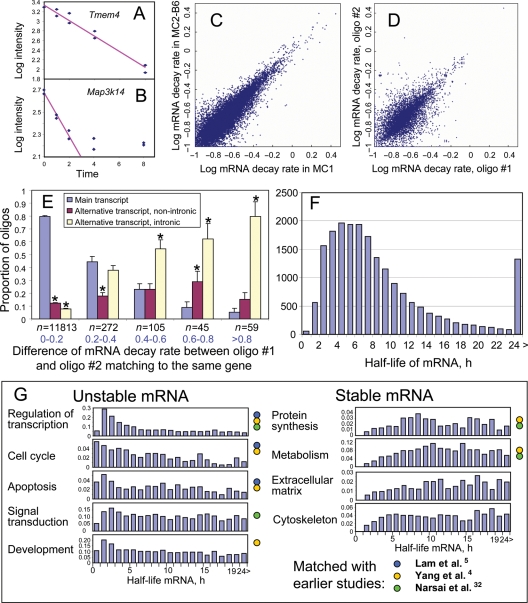
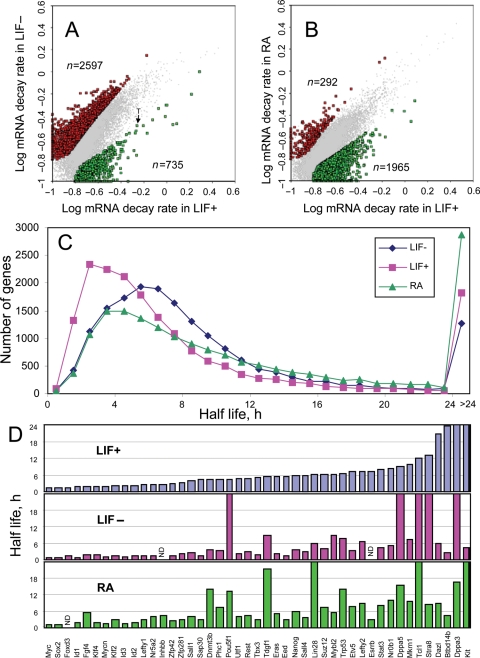
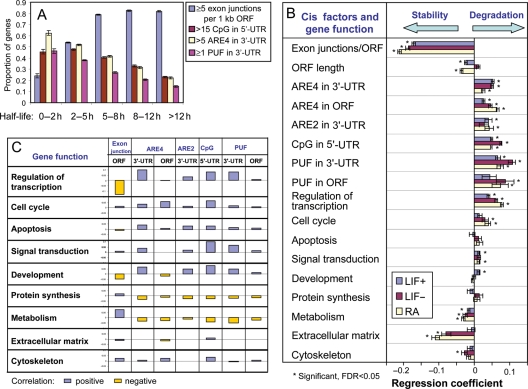
Degradation of mRNA is one of the key processes that control the steady-state level of gene expression. However, the rate of mRNA decay for the majority of genes is not known. We successfully obtained the rate of mRNA decay for 19 977 non-redundant genes by microarray analysis of RNA samples obtained from mouse embryonic stem (ES) cells. Median estimated half-life was 7.1 h and only <100 genes, including Prdm1, Myc, Gadd45 g, Foxa2, Hes5 and Trib1, showed half-life less than 1 h. In general, mRNA species with short half-life were enriched among genes with regulatory functions (transcription factors), whereas mRNA species with long half-life were enriched among genes related to metabolism and structure (extracellular matrix, cytoskeleton). The stability of mRNAs correlated more significantly with the structural features of genes than the function of genes: mRNA stability showed the most significant positive correlation with the number of exon junctions per open reading frame length, and negative correlation with the presence of PUF-binding motifs and AU-rich elements in 3'-untranslated region (UTR) and CpG di-nucleotides in the 5'-UTR. The mRNA decay rates presented in this report are the largest data set for mammals and the first for ES cells.
Overview
The claims and statistics of this paper haven’t been checked yet.
Run the check — free, no account needed. It reads the open-access text and checks the sources it cites.
Integrity signals
Registry
Cites
Statistics
Figures
Verification
Claims the paper makes
The claims and statistics of this paper haven’t been checked yet.
Run the check — free, no account needed. It reads the open-access text and checks the sources it cites.
Claims other papers make about this one
Each is checked against this paper’s own text: does it say what the citing paper says it does?
The source backs part of the claim, not all of it — or backs it for a different population, condition or comparison.
In the citing paper
“In silico analysis showed several ARE 1 (AUUUA) and ARE 4 (12-mer A/U, max.one mismatch) sites (33) as well as a potential miR-27a/b binding site.”
From MicroRNA-27b Contributes to Lipopolysaccharide-mediated Peroxisome Proliferator-activated Receptor γ (PPARγ) mRNA Destabilization (2010) · cites this paper as [33]
Experimental — accuracy not yet measuredIn the citing paper
“This result is in agreement with that previously observed in mESCs 54,55 , thus suggesting the bona fide of the experiment.”
From Intragenic DNA methylation prevents spurious transcription initiation (2017) · cites this paper as [54]
Self-check
Percentages, sums and reported differences re-computed from the paper’s own numbers.
The self-check needs the paper’s full text.
Citations
Cites
Controlling the False Discovery Rate: A Practical and Powerful Approach to Multiple Testing
Benjamini, Y., & Hochberg, Y. (1995) · Journal of the Royal Statistical Society Series B: Statistical Methodology · doi:10.1111/j.2517-6161.1995.tb02031.x · Cited by 109,482 · cited 1×
“FDR, which is necessary for multiple hypothesis testing, was estimated using the method of Benjamini and Hochberg.(35) In addition to FDR, we used the criterion of .”
MethodDatabase resources of the National Center for Biotechnology Information: update
Wheeler, D. L. (2003) · Nucleic Acids Research · doi:10.1093/nar/gkh073 · Cited by 10,695
Kinetics and kinematics for translational motions in microgravity during parabolic flight.
Stirling, L., Willcox, K., Ferguson, P., & Newman, D. (2009) · Aviation Space and Environmental Medicine · doi:10.3357/asem.2356.2009 · Cited by 5,455
Shaw, G. D., & Kamen, R. (1986) · Cell · doi:10.1016/0092-8674(86)90341-7 · Cited by 3,946
AU-rich elements: characterization and importance in mRNA degradation
Chen, C.-Y. A., & Shyu, A.-B. (1995) · Trends in Biochemical Sciences · doi:10.1016/s0968-0004(00)89102-1 · Cited by 1,948 · cited 1×
“multi-exon genes), which makes mRNA more stable;(44) and (ii) the presence of AREs in the 30UTR of genes, which makes mRNA less stable.(45,46) However, all the previous results have been obtained using single-factor analysis, which may easily lead to erroneous conclusions if factors are correlated.”
ResultXie, X., Lu, J., Kulbokas, E. J., Golub, T. R., Mootha, V., Lindblad-Toh, K., Lander, E. S., & Kellis, M. (2005) · Nature · doi:10.1038/nature03441 · Cited by 1,872 · cited 1×
“We used UGUANAUA as PUF consensus motifs.(29,48,49) CpG elements were added to the list after we unexpectedly found that they can affect mRNA stability.”
MethodThe Nonsense-Mediated Decay RNA Surveillance Pathway
Chang, Y.-F., Imam, J. S., & Wilkinson, M. (2007) · Annual Review of Biochemistry · doi:10.1146/annurev.biochem.76.050106.093909 · Cited by 1,326
The highways and byways of mRNA decay
Garneau, N. L., Wilusz, J., & Wilusz, C. J. (2007) · Nature Reviews Molecular Cell Biology · doi:10.1038/nrm2104 · Cited by 1,294 · cited 1×
“For example, ARE-binding proteins can recruit PARN or exosomes.(51) It is also known that the stability of mRNA can be modified by immune factors via AREs in 30-UTR.”
BackgroundA protein interaction network for pluripotency of embryonic stem cells
Wang, J., Rao, S., Chu, J., Shen, X., Levasseur, D. N., Theunissen, T. W., & Orkin, S. H. (2006) · Nature · doi:10.1038/nature05284 · Cited by 1,107
Database resources of the National Center for Biotechnology Information
Wheeler, D. L., Barrett, T., Benson, D. A., Bryant, S. H., Canese, K., Chetvernin, V., Church, D. M., DiCuccio, M., Edgar, R., Federhen, S., et al. (2007) · Nucleic Acids Research · doi:10.1093/nar/gkm1000 · Cited by 1,007
Research works printed but not linked: 3
- 2001, Genome biology, 2
- 2002, Molecular cell, 160, 951
- White, 2001, RNA, 7, 1855
Cited by
Sorted by citations
Insights into the regulation of protein abundance from proteomic and transcriptomic analyses
Vogel, C., & Marcotte, E. M. (2012) · Nature Reviews Genetics · doi:10.1038/nrg3185 · Cited by 4,195
Single-cell transcriptional diversity is a hallmark of developmental potential
Gulati, G. S., Sikandar, S. S., Wesche, D. J., Manjunath, A., Bharadwaj, A., Berger, M. J., Ilagan, F., Kuo, A. H., Hsieh, R. W., Cai, S., et al. (2020) · Science · doi:10.1126/science.aax0249 · Cited by 1,571
m 6 A mRNA methylation facilitates resolution of naïve pluripotency toward differentiation
Geula, S., Moshitch-Moshkovitz, S., Dominissini, D., Mansour, A. A., Kol, N., Salmon‐Divon, M., Hershkovitz, V., Peer, E., Mor, N., Manor, Y. S., et al. (2015) · Science · doi:10.1126/science.1261417 · Cited by 1,583
c-Myc Regulates Transcriptional Pause Release
Rahl, P. B., Lin, C. Y., Seila, A. C., Flynn, R. A., McCuine, S., Burge, C. B., Sharp, P. A., & Young, R. A. (2010) · Cell · doi:10.1016/j.cell.2010.03.030 · Cited by 1,279
m6A RNA Modification Controls Cell Fate Transition in Mammalian Embryonic Stem Cells
Batista, P. J., Molinié, B., Wang, J., Qu, K., Zhang, J., Li, L., Bouley, D. M., Lujan, E., Haddad, B., Daneshvar, K., et al. (2014) · Cell stem cell · doi:10.1016/j.stem.2014.09.019 · Cited by 1,276
“Mouse Pol II occupancy data, mRNA half life and Protein translation efficiency were obtained from (Ingolia et al., 2011; Rahl et al., 2010; Sharova et al., 2009).”
Method
Metadata
- Authors
- Sharova, L. V., Sharov, A. A., Nedorezov, T., Piao, Y., Shaik, N., & Ko, M. S. H.
- Affiliations
- National Institutes of Health (US)
- Corresponding author
- Ko, M. S.H.
- Venue
- DNA Research
- Publisher
- Oxford University Press (OUP)
- Published
- 2009-01-08
- Volume
- 16
- Issue
- 1
- Pages
- 45-58
- ISSN
- 1340-2838 (ISSN-L)
- 1756-1663
- PMC
- PMC2644350
- OpenAlex
- W2106014350
- Cited by
- 591
- References
- 57
- Citations by year
- 2026: 20 · 2025: 28 · 2024: 42 · 2023: 40 · 2022: 39 · 2021: 42 · 2020: 37 · 2019: 35 · 2018: 36 · 2017: 38 · 2016: 33 · 2015: 43 · 2014: 40 · 2013: 31 · 2012: 30
- FWCI
- 7.82
- Type
- journal article
- Language
- en
- Open access
- gold
- doi.org
- Locations
- DNA Research (publishedVersion)
- PubMed Central (publishedVersion)
- PubMed (publishedVersion)
- Funders
- National Institutes of Health
- National Institute on Aging (Z01AG000656)
- Topics
- Life Sciences › Biochemistry, Genetics and Molecular Biology › Molecular Biology › RNA Research and Splicing
- Life Sciences › Biochemistry, Genetics and Molecular Biology › Molecular Biology › Molecular Biology Techniques and Applications
- Life Sciences › Biochemistry, Genetics and Molecular Biology › Molecular Biology › RNA and protein synthesis mechanisms
- Keywords
- mRNA half-life, mRNA stability, mouse embryonic stem cells, pluripotency, cell differentiation, gene expression regulation, exon-exon junctions, AU-rich elements, 3' untranslated region, CpG, 5' untranslated region, transcription factors, steady-state mRNA levels
- MeSH terms
- Animals, Cell Differentiation, Cells, Cultured, Half-Life, Humans, Mice, Inbred C57BL, Mice, Inbred Strains, RNA, Messenger, Oligonucleotide Array Sequence Analysis, 3' Untranslated Regions, Gene Expression Profiling, RNA Stability, Databases, Genetic, Pluripotent Stem Cells, Mice, Embryonic Stem Cells
About these checks
Registry, retraction, Cites and statistics results are computed, not judged, with one exception: a printed reference that no index lists is read once by a model before it counts as a citation error. Claims are extracted by a model and kept only when their quote appears verbatim in the text; each cited source is then checked, with a model’s help, for whether it says what the claim relies on. Those verdicts can be wrong — read the claim’s quote and the cited source before relying on one.
Statistics and arithmetic are recomputed, not judged.
Confidence bands are shown only for fields calibrated on our annotated test set. None is calibrated yet, so no band is shown.
What counts as a claim ›How we measure confidence ›How we check this ›
Are you an author, or do you see a problem with this page? Request a review
