

The DOI matches its Crossref record; 57 of the 57 references it cites were found in a registry or an index.
Database for mRNA Half-Life of 19 977 Genes Obtained by DNA Microarray Analysis of Pluripotent and Differentiating Mouse Embryonic Stem Cells
Open accessAbstract
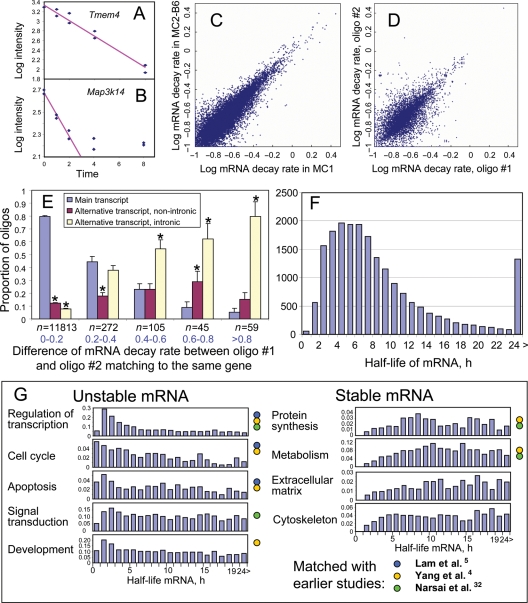
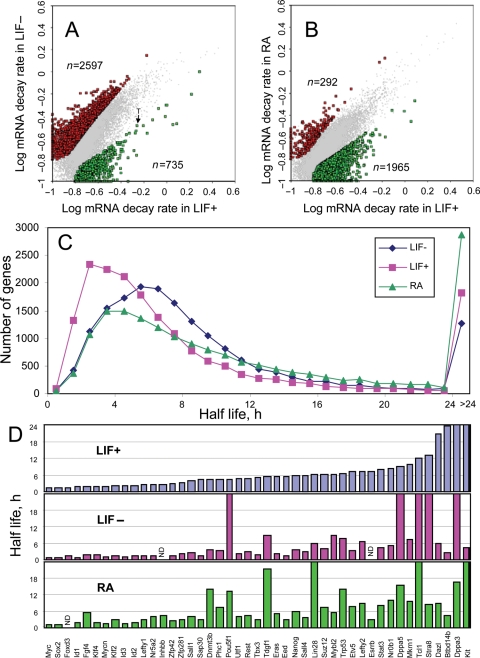
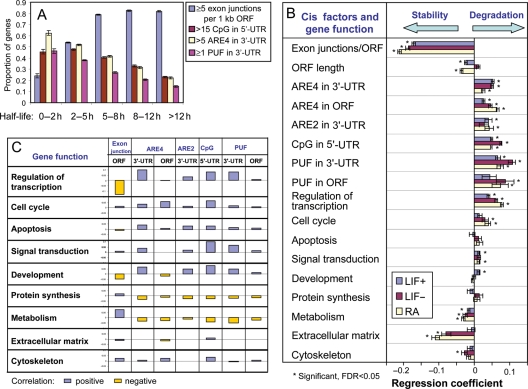
Degradation of mRNA is one of the key processes that control the steady-state level of gene expression. However, the rate of mRNA decay for the majority of genes is not known. We successfully obtained the rate of mRNA decay for 19 977 non-redundant genes by microarray analysis of RNA samples obtained from mouse embryonic stem (ES) cells. Median estimated half-life was 7.1 h and only <100 genes, including Prdm1, Myc, Gadd45 g, Foxa2, Hes5 and Trib1, showed half-life less than 1 h. In general, mRNA species with short half-life were enriched among genes with regulatory functions (transcription factors), whereas mRNA species with long half-life were enriched among genes related to metabolism and structure (extracellular matrix, cytoskeleton). The stability of mRNAs correlated more significantly with the structural features of genes than the function of genes: mRNA stability showed the most significant positive correlation with the number of exon junctions per open reading frame length, and negative correlation with the presence of PUF-binding motifs and AU-rich elements in 3'-untranslated region (UTR) and CpG di-nucleotides in the 5'-UTR. The mRNA decay rates presented in this report are the largest data set for mammals and the first for ES cells.
Overview
The claims and statistics of this paper haven’t been checked yet.
Run the check — free, no account needed. It reads the open-access text and checks the sources it cites.
Integrity signals
Registry
Cites
Statistics
Figures
Verification
Claims the paper makes
The claims and statistics of this paper haven’t been checked yet.
Run the check — free, no account needed. It reads the open-access text and checks the sources it cites.
Claims other papers make about this one
Each is checked against this paper’s own text: does it say what the citing paper says it does?
The source backs part of the claim, not all of it — or backs it for a different population, condition or comparison.
In the citing paper
“In silico analysis showed several ARE 1 (AUUUA) and ARE 4 (12-mer A/U, max.one mismatch) sites (33) as well as a potential miR-27a/b binding site.”
From MicroRNA-27b Contributes to Lipopolysaccharide-mediated Peroxisome Proliferator-activated Receptor γ (PPARγ) mRNA Destabilization (2010) · cites this paper as [33]
Experimental — accuracy not yet measuredIn the citing paper
“This result is in agreement with that previously observed in mESCs 54,55 , thus suggesting the bona fide of the experiment.”
From Intragenic DNA methylation prevents spurious transcription initiation (2017) · cites this paper as [54]
Self-check
Percentages, sums and reported differences re-computed from the paper’s own numbers.
The self-check needs the paper’s full text.
Citations
Cites
Controlling the False Discovery Rate: A Practical and Powerful Approach to Multiple Testing
Benjamini, Y., & Hochberg, Y. (1995) · Journal of the Royal Statistical Society Series B: Statistical Methodology · doi:10.1111/j.2517-6161.1995.tb02031.x · Cited by 109,482 · cited 1×
“FDR, which is necessary for multiple hypothesis testing, was estimated using the method of Benjamini and Hochberg.(35) In addition to FDR, we used the criterion of .”
MethodDatabase resources of the National Center for Biotechnology Information: update
Wheeler, D. L. (2003) · Nucleic Acids Research · doi:10.1093/nar/gkh073 · Cited by 10,695
Kinetics and kinematics for translational motions in microgravity during parabolic flight.
Stirling, L., Willcox, K., Ferguson, P., & Newman, D. (2009) · Aviation Space and Environmental Medicine · doi:10.3357/asem.2356.2009 · Cited by 5,455
Shaw, G. D., & Kamen, R. (1986) · Cell · doi:10.1016/0092-8674(86)90341-7 · Cited by 3,946
AU-rich elements: characterization and importance in mRNA degradation
Chen, C.-Y. A., & Shyu, A.-B. (1995) · Trends in Biochemical Sciences · doi:10.1016/s0968-0004(00)89102-1 · Cited by 1,948 · cited 1×
“multi-exon genes), which makes mRNA more stable;(44) and (ii) the presence of AREs in the 30UTR of genes, which makes mRNA less stable.(45,46) However, all the previous results have been obtained using single-factor analysis, which may easily lead to erroneous conclusions if factors are correlated.”
ResultXie, X., Lu, J., Kulbokas, E. J., Golub, T. R., Mootha, V., Lindblad-Toh, K., Lander, E. S., & Kellis, M. (2005) · Nature · doi:10.1038/nature03441 · Cited by 1,872 · cited 1×
“We used UGUANAUA as PUF consensus motifs.(29,48,49) CpG elements were added to the list after we unexpectedly found that they can affect mRNA stability.”
MethodThe Nonsense-Mediated Decay RNA Surveillance Pathway
Chang, Y.-F., Imam, J. S., & Wilkinson, M. (2007) · Annual Review of Biochemistry · doi:10.1146/annurev.biochem.76.050106.093909 · Cited by 1,326
The highways and byways of mRNA decay
Garneau, N. L., Wilusz, J., & Wilusz, C. J. (2007) · Nature Reviews Molecular Cell Biology · doi:10.1038/nrm2104 · Cited by 1,294 · cited 1×
“For example, ARE-binding proteins can recruit PARN or exosomes.(51) It is also known that the stability of mRNA can be modified by immune factors via AREs in 30-UTR.”
BackgroundA protein interaction network for pluripotency of embryonic stem cells
Wang, J., Rao, S., Chu, J., Shen, X., Levasseur, D. N., Theunissen, T. W., & Orkin, S. H. (2006) · Nature · doi:10.1038/nature05284 · Cited by 1,107
Database resources of the National Center for Biotechnology Information
Wheeler, D. L., Barrett, T., Benson, D. A., Bryant, S. H., Canese, K., Chetvernin, V., Church, D. M., DiCuccio, M., Edgar, R., Federhen, S., et al. (2007) · Nucleic Acids Research · doi:10.1093/nar/gkm1000 · Cited by 1,007
Research works printed but not linked: 3
- 2001, Genome biology, 2
- 2002, Molecular cell, 160, 951
- White, 2001, RNA, 7, 1855
Cited by
Sorted by citations
Insights into the regulation of protein abundance from proteomic and transcriptomic analyses
Vogel, C., & Marcotte, E. M. (2012) · Nature Reviews Genetics · doi:10.1038/nrg3185 · Cited by 4,195
Single-cell transcriptional diversity is a hallmark of developmental potential
Gulati, G. S., Sikandar, S. S., Wesche, D. J., Manjunath, A., Bharadwaj, A., Berger, M. J., Ilagan, F., Kuo, A. H., Hsieh, R. W., Cai, S., et al. (2020) · Science · doi:10.1126/science.aax0249 · Cited by 1,571
m 6 A mRNA methylation facilitates resolution of naïve pluripotency toward differentiation
Geula, S., Moshitch-Moshkovitz, S., Dominissini, D., Mansour, A. A., Kol, N., Salmon‐Divon, M., Hershkovitz, V., Peer, E., Mor, N., Manor, Y. S., et al. (2015) · Science · doi:10.1126/science.1261417 · Cited by 1,583
c-Myc Regulates Transcriptional Pause Release
Rahl, P. B., Lin, C. Y., Seila, A. C., Flynn, R. A., McCuine, S., Burge, C. B., Sharp, P. A., & Young, R. A. (2010) · Cell · doi:10.1016/j.cell.2010.03.030 · Cited by 1,279
m6A RNA Modification Controls Cell Fate Transition in Mammalian Embryonic Stem Cells
Batista, P. J., Molinié, B., Wang, J., Qu, K., Zhang, J., Li, L., Bouley, D. M., Lujan, E., Haddad, B., Daneshvar, K., et al. (2014) · Cell stem cell · doi:10.1016/j.stem.2014.09.019 · Cited by 1,276
“Mouse Pol II occupancy data, mRNA half life and Protein translation efficiency were obtained from (Ingolia et al., 2011; Rahl et al., 2010; Sharova et al., 2009).”
MethodIntragenic DNA methylation prevents spurious transcription initiation
Neri, F., Rapelli, S., Krepelova, A., Incarnato, D., Parlato, C., Basile, G., Maldotti, M., Anselmi, F., & Oliviero, S. (2017) · Nature · doi:10.1038/nature21373 · Cited by 739
Tools for translation: non-viral materials for therapeutic mRNA delivery
Hajj, K. A., & Whitehead, K. A. (2017) · Nature Reviews Materials · doi:10.1038/natrevmats.2017.56 · Cited by 799
Genome-wide analysis of long noncoding RNA stabilityPreprint
Clark, M. B., Johnston, R. L., Inostroza-Ponta, M., Fox, A. H., Fortini, E., Moscato, P., Dinger, M. E., & Mattick, J. S. (2012) · Genome Research · doi:10.1101/gr.131037.111 · Cited by 611
“2009) compared to previous transcriptional inhibition experiments in mammals that were continued to only 8 h (Raghavan et al. 2002; Yang et al. 2003; Sharova et al. 2009).”
BackgroundMethodResultInfluentialRegulation by 3′-Untranslated Regions
Mayr, C. (2017) · Annual Review of Genetics · doi:10.1146/annurev-genet-120116-024704 · Cited by 588
“These genes are rather special, as their mRNA half-lives are shorter than 30 min, compared to the median half-life of the transcriptome which is 7 h (113).”
BackgroundOpportunities and Challenges in the Delivery of mRNA-Based Vaccines
Wadhwa, A., Aljabbari, A., Lokras, A., Foged, C., & Thakur, A. (2020) · Pharmaceutics · doi:10.3390/pharmaceutics12020102 · Cited by 584
“It is well known that the absorption of mRNA in the absence of a delivery system is extremely low, and the half‐life of mRNA is approximately 7 h [72].”
BackgroundKe, S., Pandya‐Jones, A., Saito, Y., Fak, J. J., Vågbø, C. B., Geula, S., Hanna, J. H., Black, D. L., Darnell, J. E., Jr., & Darnell, R. B. (2017) · Genes & Development · doi:10.1101/gad.301036.117 · Cited by 537
“Extensive T 1/2 measurements for individual sequenced mammalian mRNAs that are available after actinomycin D treatment of cultured cells suggest a wide spectrum of T 1/2 s, from as little as ≤ 1 h to ≥ 10 h (Yang et al. 2003; Sharova et al. 2009; Tani et al. 2012).”
How introns enhance gene expression
Shaul, O. (2017) · The International Journal of Biochemistry & Cell Biology · doi:10.1016/j.biocel.2017.06.016 · Cited by 516
Synthetic recording and in situ readout of lineage information in single cells
Frieda, K. L., Linton, J. M., Hormoz, S., Choi, J., Chow, K.-H. K., Singer, Z. S., Budde, M. W., Elowitz, M. B., & Cai, L. (2017) · Nature · doi:10.1038/nature20777 · Cited by 440
Rey, G., Cesbron, F., Rougemont, J., Reinke, H., Brunner, M., & Naef, F. (2011) · PLoS Biology · doi:10.1371/journal.pbio.1000595 · Cited by 490
“(B) mRNA half-lives from mouse embryonic stem cells [61] and mouse fibroblasts [62] for the genes in Figure 7A–7C and (A).”
Tani, H., Onoguchi‐Mizutani, R., Salam, K. A., Tano, K., Ijiri, K., Wakamatsu, A., Isogai, T., Suzuki, Y., & Akimitsu, N. (2012) · Genome Research · doi:10.1101/gr.130559.111 · Cited by 461
“These results indicate that mRNA half-lives are correlated with the functions of genes, consistent with previous reports (Lam et al. 2001; Yang et al. 2003; Raghavan and Bohjanen 2004; Sharova et al. 2009; Rabani et al. 2011; Schwanhäusser et al. 2011).”
BackgroundResultInfluentialA transgenic mouse for in vivo detection of endogenous labeled mRNA
Lionnet, T., Czaplinski, K., Darzacq, X., Shav-Tal, Y., Wells, A. L., Chao, J., Park, H., de Turris, V., Lopez-Jones, M., & Singer, R. (2011) · Nature Methods · doi:10.1038/nmeth.1551 · Cited by 372
Targeted capture in evolutionary and ecological genomics
Jones, M. R., & Good, J. M. (2015) · Molecular Ecology · doi:10.1111/mec.13304 · Cited by 370
Dynamics and Spatial Genomics of the Nascent Transcriptome by Intron seqFISH
Shah, S., Takei, Y., Zhou, W., Lubeck, E., Yun, J., Eng, C.-H. L., Koulena, N., Cronin, C. J., Karp, C., Liaw, E. J., et al. (2018) · Cell · doi:10.1016/j.cell.2018.05.035 · Cited by 322
“Furthermore, the relatively short lifetimes of TASs compared to the longer lifetimes of mRNAs (Sharova et al., 2009) mean that intron seqFISH can capture fast dynamics in the nascent transcriptome that would otherwise be obscured in mRNAmeasurements.”
Nascent-Seq reveals novel features of mouse circadian transcriptional regulation
Menet, J. S., Rodriguez, J., Abruzzi, K. C., & Rosbash, M. (2012) · eLife · doi:10.7554/elife.00011 · Cited by 325
“Because these genes are associated with short or long mRNA half-lives, respectively, we compared the Nascent-Seq to RNA-Seq ratios of genes with their published mRNA half-lives (Sharova et al., 2009).”
BackgroundMethodInfluentialLi, J. J., Bickel, P. J., & Biggin, M. D. (2014) · PeerJ · doi:10.7717/peerj.270 · Cited by 279
“2011; Sharova et al. 2009; Yang et al. 2003).”
McKinlay, C. J., Vargas, J. R., Blake, T. R., Hardy, J. W., Kanada, M., Contag, C. H., Wender, P. A., & Waymouth, R. M. (2017) · Proceedings of the National Academy of Sciences · doi:10.1073/pnas.1614193114 · Cited by 288
“Moreover, it is also susceptible to rapid degradation by nucleases and so it must be protected during the delivery process (17).”
BackgroundSuper-Enhancer-Mediated RNA Processing Revealed by Integrative MicroRNA Network Analysis
Suzuki, H. I., Young, R. A., & Sharp, P. A. (2017) · Cell · doi:10.1016/j.cell.2017.02.015 · Cited by 284
“Genome-wide mRNA half-life data in mESCs was from (Sharova et al., 2009).”
Predicting mRNA Abundance Directly from Genomic Sequence Using Deep Convolutional Neural Networks
Agarwal, V., & Shendure, J. (2020) · Cell Reports · doi:10.1016/j.celrep.2020.107663 · Cited by 243
Tian, X., Zhang, H., & Xing, J. (2013) · Biophysical Journal · doi:10.1016/j.bpj.2013.07.011 · Cited by 280
Dynamic Heterogeneity and DNA Methylation in Embryonic Stem Cells
Singer, Z. S., Yong, J., Tischler, J., Hackett, J. A., Altınok, A., Surani, M. A., Cai, L., & Elowitz, M. B. (2014) · Molecular Cell · doi:10.1016/j.molcel.2014.06.029 · Cited by 275
“Static distributions suggested that 2i increased Nanog burst frequency 45% from 0.39 to 0.55 burst/hr using the Nanog mRNA half-life previously estimated (Table S1 in Sharova et al., 2009) and assuming no change between conditions.”
MethodInfluentialScotter, E. L., Vance, C. A., Nishimura, A. L., Lee, Y., Chen, H.-J., Urwin, H., Sardone, V., Mitchell, J. C., Rogelj, B., Rubinsztein, D. C., et al. (2014) · Journal of Cell Science · doi:10.1242/jcs.140087 · Cited by 282
“Published half- lives for the endogenous TDP-43 transcript in various cell types range from 1.9 h to 10.3 h (Ayala et al., 2011; Schwanhäusser et al., 2011; Sharova et al., 2009).”
BackgroundInfluentialActive transcription and essential role of RNA polymerase II at the centromere during mitosis
Chan, F. L., Marshall, O. J., Saffery, R., Kim, B. W., Earle, E., Choo, K. H. A., & Wong, L. H. (2012) · Proceedings of the National Academy of Sciences · doi:10.1073/pnas.1108705109 · Cited by 264
Atger, F., Gobet, C., Marquis, J., Martín, E., Wang, J., Weger, B. D., Lefebvre, G. C., Descombes, P., Naef, F., & Gachon, F. (2015) · Proceedings of the National Academy of Sciences · doi:10.1073/pnas.1515308112 · Cited by 254
“Correlations between mRNA stability and biological function are well-described in different animal cell models (39, 40).”
BackgroundTranscriptional profiling of quiescent muscle stem cells in vivo
van Velthoven, C. T. J., de Morree, A., Egner, I. M., Brett, J. O., & Rando, T. A. (2017) · Cell Reports · doi:10.1016/j.celrep.2017.10.037 · Cited by 235
Dynamics in protein translation sustaining T cell preparedness
Wolf, T., Jin, W., Zoppi, G., Vogel, I. A., Akhmedov, M., Bleck, C. K. E., Beltraminelli, T., Rieckmann, J. C., Ramirez, N. J., Benevento, M., et al. (2020) · Nature Immunology · doi:10.1038/s41590-020-0714-5 · Cited by 225
Jeong, M., Lee, Y., Park, J., Jung, H., & Lee, H. (2023) · Advanced Drug Delivery Reviews · doi:10.1016/j.addr.2023.114990 · Cited by 232
Astrocytes locally translate transcripts in their peripheral processes
Sakers, K., Lake, A. M., Khazanchi, R., Ouwenga, R., Vasek, M. J., Dani, A., & Dougherty, J. D. (2017) · Proceedings of the National Academy of Sciences · doi:10.1073/pnas.1617782114 · Cited by 202
“The higher median expression suggests one mechanism that prevents distal translation for some transcripts might be destabilizing elements that lead to a short half-life, and indeed many proteins with roles in transcription regulation have such elements (46).”
BackgroundSpies, N., Burge, C. B., & Bartel, D. P. (2013) · Genome Research · doi:10.1101/gr.156919.113 · Cited by 217
“As reported by an early study (Yang et al. 2003) but not a subsequent higher-resolution study (Sharova et al. 2009), 39 UTR length was negatively associated with stability.”
BackgroundMethodResultInfluentialBizuayehu, T. T., & Babiak, I. (2014) · Genome Biology and Evolution · doi:10.1093/gbe/evu151 · Cited by 219
“PGCs migrate to the future genital ridges and become gonocytes, then during sex differentiation, they transform to spermatogonia or oogonia (Lubzens et al. 2010; Schulz et al. 2010).”
BackgroundENO1 suppresses cancer cell ferroptosis by degrading the mRNA of iron regulatory protein 1
Zhang, T., Sun, L., Hao, Y., Suo, C., Shen, S., Wei, H., Ma, W., Zhang, P., Wang, T., Gu, X., et al. (2021) · Nature Cancer · doi:10.1038/s43018-021-00299-1 · Cited by 215
“More interestingly, consistent with a previous report that CpG dinucleotides located within the 5'UTR accelerated mRNA decay 36 , deletion of the CpG-rich region in the IRP1 5’UTR abolished the inhibitory effect of ENO1 on IRP1, indicating that the CpG-rich region of the IRP1 5'UTR is important for…”
Post-transcriptional Regulatory Functions of Mammalian Pumilio Proteins
Goldstrohm, A. C., Hall, T. M. T., & McKenney, K. M. (2018) · Trends in Genetics · doi:10.1016/j.tig.2018.09.006 · Cited by 198
Uzonyi, A., Dierks, D., Nir, R., Kwon, O. S., Toth, U., Barbosa, I., Burel, C., Brandis, A. S., Rossmanith, W., Hir, H. L., et al. (2023) · Molecular Cell · doi:10.1016/j.molcel.2022.12.026 · Cited by 209
Viral persistence, reactivation, and mechanisms of long COVID
Chen, B. K., Jülg, B. D., Mohandas, S., Bradfute, S. B., & RECOVER Mechanistic Pathways Task Force (2023) · eLife · doi:10.7554/elife.86015 · Cited by 211
“to hours rather than months or years, and there are not thought to be major exceptions for specific RNAs (Sharova et al., 2009).”
BackgroundInfluentialThe biology of DHX9 and its potential as a therapeutic target
Lee, T., & Pelletier, J. (2016) · Oncotarget · doi:10.18632/oncotarget.8446 · Cited by 198
“3 hours [80].”
Jennewein, C., von Knethen, A., Schmid, T., & Brüne, B. (2010) · Journal of Biological Chemistry · doi:10.1074/jbc.m109.066399 · Cited by 183
Dynamic profiling of mRNA turnover reveals gene-specific and system-wide regulation of mRNA decay
Munchel, S., Shultzaberger, R. K., Takizawa, N., & Weis, K. (2011) · Molecular Biology of the Cell · doi:10.1091/mbc.e11-01-0028 · Cited by 180
“inhibition of transcription (Wang et al., 2002; Grigull et al., 2004; Sharova et al., 2009).”
BackgroundVispé, S., DeVries, L., Créancier, L., Besse, J., Bréand, S., Hobson, D. J., Svejstrup, J. Q., Annereau, J., Cussac, D., Dumontet, C., et al. (2009) · Molecular Cancer Therapeutics · doi:10.1158/1535-7163.mct-09-0549 · Cited by 177
Polycarpou‐Schwarz, M., Groß, M., Mestdagh, P., Schott, J., Grund, S. E., Hildenbrand, C., Rom, J., Aulmann, S., Sinn, H., Vandesompele, J., et al. (2018) · Oncogene · doi:10.1038/s41388-018-0281-5 · Cited by 175
The RNA Degradation Pathway Regulates the Function of GAS5 a Non-Coding RNA in Mammalian Cells
Tani, H., Torimura, M., & Akimitsu, N. (2013) · PLoS ONE · doi:10.1371/journal.pone.0055684 · Cited by 176
Gadd45 proteins: Relevance to aging, longevity and age-related pathologies
Moskalev, A., Smit‐McBride, Z., Shaposhnikov, M. V., Proshkina, E., Zhavoronkov, A. A., Budovsky, A., Tăcutu, R., & Fraifeld, V. E. (2011) · Ageing Research Reviews · doi:10.1016/j.arr.2011.09.003 · Cited by 173
“Gadd45 mRNA is unusually short (less than 1 h), suggesting a regulatory rather than metabolic function for Gadd45 proteins (Sharova et al., 2009).”
BackgroundCircadian control of mRNA polyadenylation dynamics regulates rhythmic protein expressionPreprint
Kojima, S., Sher-Chen, E. L., & Green, C. B. (2012) · Genes & Development · doi:10.1101/gad.208306.112 · Cited by 170
“We also examined the halflives of the RESS and PAR mRNAs using a genome-wide database of mRNA half-life measurements from mouse embryonic stem cells (Sharova et al. 2009).”
MethodDetection and interpretation of 8-oxodG and 8-oxoGua in urine, plasma and cerebrospinal fluid
Poulsen, H. E., Llovera, L., Broedbaek, K., Nielsen, P. E., & Weimann, A. (2013) · Biochimica et Biophysica Acta (BBA) - General Subjects · doi:10.1016/j.bbagen.2013.06.009 · Cited by 165
Histone hyperacetylation disrupts core gene regulatory architecture in rhabdomyosarcoma
Gryder, B. E., Pomella, S., Sayers, C. M., Wu, X., Song, Y., Chiarella, A. M., Bagchi, S., Chou, H.-C., Sinniah, R., Walton, A., et al. (2019) · Nature Genetics · doi:10.1038/s41588-019-0534-4 · Cited by 164
Hopkins, T. G., Mura, M., Al-Ashtal, H. A., Lahr, R. M., Latip, N. A., Sweeney, K. G., Lu, H., Weir, J., El-Bahrawy, M. A., Steel, J. H., et al. (2015) · Nucleic Acids Research · doi:10.1093/nar/gkv1515 · Cited by 159
Rhythmic Degradation Explains and Unifies Circadian Transcriptome and Proteome Data
Lück, S., Thurley, K., Thaben, P. F., & Westermark, P. O. (2014) · Cell Reports · doi:10.1016/j.celrep.2014.09.021 · Cited by 160
“In these two studies, a technique based on labeling of newly synthesized mRNA was used, resulting in significantly more accurate half-life estimates than obtained by the older technique based on transcriptional arrest induced by actinomycin (Sharova et al., 2009).”
MethodModulation of transcriptional burst frequency by histone acetylation
Nicolas, D., Zoller, B., Suter, D. M., & Naef, F. (2018) · Proceedings of the National Academy of Sciences · doi:10.1073/pnas.1722330115 · Cited by 153
“For each gene, the burst size and frequency were inferred from the mRNA distributions and transcript half-lives (33).”
MethodReconstructing cell cycle pseudo time-series via single-cell transcriptome data
Liu, Z., Lou, H., Xie, K., Wang, H. E., Chen, N., Aparicio, O. M., Zhang, M. Q., Jiang, R., & Chen, T. (2017) · Nature Communications · doi:10.1038/s41467-017-00039-z · Cited by 160
“We can also observe decreased expression of cell cycle genes at the end of the cell cycle, which may be caused by degradation of mRNA molecules 38 .”
The genetic and biochemical determinants of mRNA degradation rates in mammals
Agarwal, V., & Kelley, D. R. (2022) · Genome Biology · doi:10.1186/s13059-022-02811-x · Cited by 155
“39) [6, 7] have severely lagged behind the performance of those in yeast (achieving r2=0.”
BackgroundResultInfluentialSingle-cell analysis of transcription kinetics across the cell cycle
Skinner, S. O., Xu, H., Nagarkar-Jaiswal, S., Freire, P. R., Zwaka, T. P., & Golding, I. (2016) · eLife · doi:10.7554/elife.12175 · Cited by 151
“In contrast, mature mRNA is subject to active degradation, with a typical halflife of a few hours (Sharova et al., 2009).”
BackgroundRNA components of the spliceosome regulate tissue- and cancer-specific alternative splicingPreprint
Dvinge, H., Guenthoer, J., Porter, P. L., & Bradley, R. K. (2019) · Genome Research · doi:10.1101/gr.246678.118 · Cited by 147
Synthetic multistability in mammalian cells
Zhu, R., del Rio-Salgado, J. M., Garcia-Ojalvo, J., & Elowitz, M. B. (2022) · Science · doi:10.1126/science.abg9765 · Cited by 144
Post-transcriptional control during chronic inflammation and cancer: a focus on AU-rich elements
Khabar, K. S. A. (2010) · Cellular and Molecular Life Sciences · doi:10.1007/s00018-010-0383-x · Cited by 157
Eukaryotic mRNA Decay: Methodologies, Pathways, and Links to Other Stages of Gene Expression
Pérez-Ortín, J. E., Alepuz, P. M., Chávez, S., & Choder, M. (2013) · Journal of Molecular Biology · doi:10.1016/j.jmb.2013.02.029 · Cited by 147
mRNA Regulation by RNA Modifications
Gilbert, W. V., & Nachtergaele, S. (2023) · Annual Review of Biochemistry · doi:10.1146/annurev-biochem-052521-035949 · Cited by 144
“But given that it renders transcripts resistant to DCP2-mediated degradation (Figure 3), it is possible that it represents a mechanism to stabilize transcripts beyond the typical mRNA half-life of minutes to a few hours (50).”
BackgroundBhattacharjee, S., Zhao, Y., Dua, P., Rogaev, E. I., & Lukiw, W. J. (2016) · PLOS ONE · doi:10.1371/journal.pone.0150211 · Cited by 147
“Lastly, using multiple interdependent techniques it should be mentioned that miRNA-34a has also been recently found to be significantly increased in limbic regions of the AD-affected brain, in AD monocytes and in several amyloid overexpressing transgenic murine models of AD (unpublished observations) [10,12,48,60,61,6…”
BackgroundMethodCorrelation of mRNA and protein abundance in the developing maize leaf
Ponnala, L., Wang, Y., Sun, Q., & van Wijk, K. J. (2014) · The Plant Journal · doi:10.1111/tpj.12482 · Cited by 133
Lee, J. E., Lee, J. Y., Wilusz, J., Tian, B., & Wilusz, C. J. (2010) · PLoS ONE · doi:10.1371/journal.pone.0011201 · Cited by 133
“Cis-element contributions vary between cell types To examine whether regulation of mRNA decay rate is cellspecific, we compared our half lives to those generated in a recent analysis of mRNA decay rates in mouse pluripotent and differentiating mouse ES cells [10].”
BackgroundResultInfluentialDOMINO: Using Machine Learning to Predict Genes Associated with Dominant Disorders
Quinodoz, M., Royer‐Bertrand, B., Cisarova, K. V., Gioia, S. A. D., Superti‐Furga, A., & Rivolta, C. (2017) · The American Journal of Human Genetics · doi:10.1016/j.ajhg.2017.09.001 · Cited by 133
“, number of variants at the donor splicing site, normalized to the number of synonymous variants in the coding sequence;(20) mRNA half-life, 0 if ≤ 10 hrs or 1 if > 10 hrs.(21)”
BackgroundMassively parallel functional annotation of 3′ untranslated regions
Zhao, W., Pollack, J. L., Blagev, D. P., Zaitlen, N., McManus, M. T., & Erle, D. J. (2014) · Nature Biotechnology · doi:10.1038/nbt.2851 · Cited by 125
“In total, these segments cover >450 kb (1.5% of all annotated human 3' UTR sequence) and we used fast-UTR libraries to analyze their effects (Supplementary Note 1 and Supplementary Data 3).”
InfluentialDelmans, M., & Hemberg, M. (2016) · BMC Bioinformatics · doi:10.1186/s12859-016-0944-6 · Cited by 111
“We calculated the three derived quantities for each condition for the 2105 genes where we were able to obtain degradation rates for both cell-types [31, 32].”
MethodConnections Underlying Translation and mRNA Stability
Radhakrishnan, A., & Green, R. (2016) · Journal of Molecular Biology · doi:10.1016/j.jmb.2016.05.025 · Cited by 132
Structure of silent transcription intervals and noise characteristics of mammalian genes
Zoller, B., Nicolas, D., Molina, N., & Naef, F. (2015) · Molecular Systems Biology · doi:10.15252/msb.20156257 · Cited by 115
“Gene-specific values of f are not known but estimated between 0.01 and 0.5, based on promoter cycle times in the range of 1 – 2 h (Fig 3) and half-lives in the range of 1 – 20 h (Sharova et al , 2009), which is at least consistent with the observed difference of 0.1 – 0.2.”
InfluentialGenome-wide technology for determining RNA stability in mammalian cells
Tani, H., & Akimitsu, N. (2012) · RNA Biology · doi:10.4161/rna.22036 · Cited by 120
“Genome-wide technologies for investigating mRNA stability have revealed that the specific half-life of each mRNA is closely related to its physiological function.(22,27,34,45) Genes with shortlived mRNAs are significantly enriched among regulatory genes, which encode proteins that are required for only a limited time…”
BackgroundA DNA repair pathway can regulate transcriptional noise to promote cell fate transitions
Desai, R. V., Chen, X., Martin, B., Chaturvedi, S., Hwang, D.-W., Li, W., Chen, Y., Ding, S., Thomson, M. W., Singer, R. H., et al. (2021) · Science · doi:10.1126/science.abc6506 · Cited by 116
Timing of circadian genes in mammalian tissues
Korenčič, A., Košir, R., Bordyugov, G., Lehmann, R., Rozman, D., & Herzel, H. (2014) · Scientific Reports · doi:10.1038/srep05782 · Cited by 119
mRNA turnover rate limits siRNA and microRNA efficacy
Larsson, E., Sander, C., & Marks, D. S. (2010) · Molecular Systems Biology · doi:10.1038/msb.2010.89 · Cited by 120
“We observed a similar trend using RT–qPCR and RT–PCR measurements from 87 si/shRNAs transfected into mouse embryonic stem cells (Ren et al, 2006), confirming these results in another cell type and using an independent set of turnover rate measurements (Sharova et al, 2009) (Supplementary Figure 1).”
A hyperactive transcriptional state marks genome reactivation at the mitosis–G1 transitionPreprint
Hsiung, C. C. ‐., Bartman, C., Huang, P., Ginart, P., Stonestrom, A. J., Keller, C. A., Face, C. J., Jahn, K. S., Evans, P., Sankaranarayanan, L., et al. (2016) · Genes & Development · doi:10.1101/gad.280859.116 · Cited by 105
“Myc and Gata2 encode for transcription factors that regulate stemness and self-renewal, and whose mature mRNA half-lives are relatively short (~15min-2h for Myc, (Dani et al. 1984; Watson 1988; Herrick and Ross 1994)~2.8h half-life for Gata2, (Sharova et al. 2009)).”
BackgroundInfluentialDelmans, M., & Hemberg, M. (2015) · doi:10.1101/020735 · Cited by 111
Treatment of neurological disorders by introducing mRNA in vivo using polyplex nanomicelles
Baba, M., Itaka, K., Kondo, K., Yamasoba, T., & Kataoka, K. (2015) · Journal of Controlled Release · doi:10.1016/j.jconrel.2015.01.017 · Cited by 109
“Although little is known about the mechanisms underlying translation control in individual cells, a few studies have reported that the half-lives of mRNA in the cytoplasm were generally in the range of hours [35-37], indicating the very transient manner of protein expression from a single mRNA molecule.”
BackgroundGalamb, O., Barták, B. K., Kalmár, A., Nagy, Z. B., Szigeti, K. A., Tulassay, Z., Igaz, P., & Molnar, B. A. (2019) · World Journal of Gastroenterology · doi:10.3748/wjg.v25.i34.5026 · Cited by 113
Pai, A. A., Cain, C. E., Mizrahi-Man, O., Leon, S. D., Lewellen, N., Veyrieras, J., Degner, J. F., Gaffney, D. J., Pickrell, J. K., Stephens, M., et al. (2012) · PLoS Genetics · doi:10.1371/journal.pgen.1003000 · Cited by 107
“Furthermore, the steadystate mRNA levels of the lowest or highest expressed genes are strongly correlated with mRNA decay rates [41,44,49,50], suggesting that in these cases, regulation of mRNA decay is likely an important determinant of gene expression levels.”
BackgroundResultGenome-wide kinetic properties of transcriptional bursting in mouse embryonic stem cells
Ochiai, H., Hayashi, T., Umeda, M., Yoshimura, M., Harada, A., Shimizu, Y., Nakano, K., Saitoh, N., Kimura, H., Liu, Z., et al. (2020) · Science Advances · doi:10.1126/sciadv.aaz6699 · Cited by 107
“The mRNA degradation rate in mESC has been genomewide analyzed (23).”
Deng, X., Berletch, J. B., Ma, W., Nguyen, D. K., Hiatt, J. B., Noble, W. S., Shendure, J., & Distèche, C. M. (2013) · Developmental Cell · doi:10.1016/j.devcel.2013.01.028 · Cited by 104
“Our results based on re-analyses of published measurements of RNA amounts following inhibition of transcription (Clark et al., 2012; Sharova et al., 2009; Tani et al., 2012) are in agreement with a longer half-life for Xlinked genes compared to autosomal genes.”
Cell‐to‐cell variability of alternative RNA splicing
Waks, Z., Klein, A. M., & Silver, P. A. (2011) · Molecular Systems Biology · doi:10.1038/msb.2011.32 · Cited by 105
“While there may be rapid fluctuations in the activity of regulatory splicing factors on the course of minutes, these would be biologically irrelevant as most mammalian mRNAs are typically stable for several hours (Yang et al, 2003; Sharova et al, 2009).”
BackgroundWang, C., Wang, H., Lieftink, C., du Chatinier, A., Gao, D., Jin, G., Jin, H., Beijersbergen, R. L., Qin, W., & Bernards, R. (2020) · Gut · doi:10.1136/gutjnl-2019-318506 · Cited by 107
Regulation of ABCA1 Protein Expression and Function in Hepatic and Pancreatic Islet Cells by miR-145
Kang, M. H., Zhang, L., Wijesekara, N., de Haan, W., Butland, S. L., Bhattacharjee, A., & Hayden, M. R. (2013) · Arteriosclerosis Thrombosis and Vascular Biology · doi:10.1161/atvbaha.113.302004 · Cited by 104
“In comparison, the average length of a 3′UTR in a study of 1500 human genes was only 755 bp.(29) This suggests that multiple miRNAs regulate ABCA1.”
BackgroundWang, Y., Arribas-Layton, M., Chen, Y., Lykke‐Andersen, J., & Sen, G. L. (2015) · Molecular Cell · doi:10.1016/j.molcel.2015.08.014 · Cited by 99
Sorting and packaging of RNA into extracellular vesicles shape intracellular transcript levels
O’Grady, T. M., Njock, M., Lion, M., Bruyr, J., Mariavelle, E., Galvan, B., Boeckx, A., Struman, I., & Dequiedt, F. (2022) · BMC Biology · doi:10.1186/s12915-022-01277-4 · Cited by 101
“Interestingly, we observe that EVs are enriched for shorter mRNA and lncRNA transcripts, transcripts that are more highly spliced, and mRNA transcripts coding for ribosomal proteins; all characteristics that are associated with more stable RNA [32, 33, 57].”
BackgroundZhao, C., Zhang, H., Wong, W., Sem, X., Han, H., Ong, S., Tan, Y., Yeap, W., Gan, C. S., Ng, K.-Q., et al. (2009) · Journal of Proteome Research · doi:10.1021/pr900364p · Cited by 99
Messenger RNA Delivery for Tissue Engineering and Regenerative Medicine Applications
Patel, S., Athirasala, A., Menezes, P. D. P., Ashwanikumar, N., Zou, T., Sahay, G., & Bertassoni, L. E. (2018) · Tissue Engineering Part A · doi:10.1089/ten.tea.2017.0444 · Cited by 101
Dicer-microRNA-Myc circuit promotes transcription of hundreds of long noncoding RNAs
Zheng, G. X. Y., Do, B. T., Webster, D. E., Khavari, P. A., & Chang, H. Y. (2014) · Nature Structural & Molecular Biology · doi:10.1038/nsmb.2842 · Cited by 98
Systematic Analysis of the Determinants of Gene Expression Noise in Embryonic Stem Cells
Faure, A. J., Schmiedel, J. M., & Lehner, B. (2017) · Cell Systems · doi:10.1016/j.cels.2017.10.003 · Cited by 92
“Combining data from four independent studies(Friedel et al., 2009; Schwanhäusser et al., 2011; Sharova et al., 2009; Tippmann et al., 2012) we could validate that X-chromosome transcripts have longer half-lives than those expressed from other chromosomes (Figure 6A, Figure S19A-D).”
BackgroundFeedback Loops of the Mammalian Circadian Clock Constitute Repressilator
Pett, J. P., Korenčič, A., Wesener, F., Kramer, A., & Herzel, H. (2016) · PLoS Computational Biology · doi:10.1371/journal.pcbi.1005266 · Cited by 87
Seiler, J., Breinig, M., Caudron‐Herger, M., Polycarpou‐Schwarz, M., Boutros, M., & Diederichs, S. (2017) · Nucleic Acids Research · doi:10.1093/nar/gkx076 · Cited by 89
Coordinated control of senescence by lncRNA and a novel T-box3 co-repressor complex
Pavan Kumar, P., Emechebe, U., Smith, R. A., Franklin, S., Moore, B., Yandell, M. D., Lessnick, S. L., & Moon, A. (2014) · eLife · doi:10.7554/elife.02805 · Cited by 87
“The results we obtained were also similar to those reported for MYC mRNA (Herrick and Ross, 1994; Sharova et al., 2009), CDKN1A mRNA in HT29-tsp53 cells (Melanson et al.”
BackgroundResultInfluentialKirby, T. J., Patel, R. M., McClintock, T. S., Dupont‐Versteegden, E. E., Peterson, C. A., & McCarthy, J. J. (2016) · Molecular Biology of the Cell · doi:10.1091/mbc.e15-08-0585 · Cited by 88
“To minimize the effect of transcript half-life on the enrichment analysis, cell type–specific transcripts were selected based on a narrow range of half-lives (Sharova et al., 2009).”
MethodBracken, C. P., Szubert, J. M., Mercer, T. R., Dinger, M. E., Thomson, D. W., Mattick, J. S., Michael, M., & Goodall, G. J. (2011) · Nucleic Acids Research · doi:10.1093/nar/gkr110 · Cited by 87
“However, the median half life reported in embryonic stem cells (26) of the 70 most represented mRNAs in the PARE library was not significantly different from the median half life of the 70 most abundant mRNAs that were not represented in the PARE library (Figure 3D).”
Leitch, A. E., Riley, N. A., Sheldrake, T. A., Festa, M., Fox, S., Duffin, R., Haslett, C., & Rossi, A. G. (2010) · European Journal of Immunology · doi:10.1002/eji.200939664 · Cited by 86
Plasma miRNA as Biomarkers for Assessment of Total-Body Radiation Exposure Dosimetry
Cui, W., Ma, J., Wang, Y., & Biswal, S. S. (2011) · PLoS ONE · doi:10.1371/journal.pone.0022988 · Cited by 90
“The expression of mRNA isolated from mononuclear cells has been used to predict radiation doses; however, mRNA is intrinsically unstable [21].”
MethodA new developing class of gene delivery: messenger RNA-based therapeutics
Zhao, M., Ahern, J. O., Lyu, J., Pierucci, L., Zhou, D., & Wang, W. (2017) · Biomaterials Science · doi:10.1039/c7bm00712d · Cited by 95
Duan, J., Shi, J., Ge, X., Dölken, L., Moy, W., S, D. H. B., Shi, S., Sanders, A. R., Ross, J., & Gejman, P. V. (2013) · Scientific Reports · doi:10.1038/srep01318 · Cited by 83
Characterization of circular RNA s landscape in multiple system atrophy brain
Chen, B. J., Mills, J. D., Takenaka, K., Bliim, N., Halliday, G. M., & Janitz, M. (2016) · Journal of Neurochemistry · doi:10.1111/jnc.13752 · Cited by 84
Turner-Bridger, B., Jakobs, M. A., Mureşan, L., Wong, H. H., Franze, K., Harris, W. A., & Holt, C. E. (2018) · Proceedings of the National Academy of Sciences · doi:10.1073/pnas.1806189115 · Cited by 84
“In addition, we used a consensus for the β-actin mRNA half-life of 8 h from previous publications (65, 66).”
MethodRoux, A. E., Zhang, C., Paw, J., Zavala-Solorio, J., Malahias, E., Vijay, T., Kolumam, G., Kenyon, C., & Kimmel, J. C. (2022) · Cell Systems · doi:10.1016/j.cels.2022.05.002 · Cited by 78
Dynamic lineage priming is driven via direct enhancer regulation by ERK
Hamilton, W. B., Mosesson, Y., Monteiro, R. S., Emdal, K. B., Knudsen, T. E., Francavilla, C., Barkai, N., Olsen, J. V., & Brickman, J. M. (2019) · Nature · doi:10.1038/s41586-019-1732-z · Cited by 80
Metadata
- Authors
- Sharova, L. V., Sharov, A. A., Nedorezov, T., Piao, Y., Shaik, N., & Ko, M. S. H.
- Affiliations
- National Institutes of Health (US)
- Corresponding author
- Ko, M. S.H.
- Venue
- DNA Research
- Publisher
- Oxford University Press (OUP)
- Published
- 2009-01-08
- Volume
- 16
- Issue
- 1
- Pages
- 45-58
- ISSN
- 1340-2838 (ISSN-L)
- 1756-1663
- PMC
- PMC2644350
- OpenAlex
- W2106014350
- Cited by
- 591
- References
- 57
- Citations by year
- 2026: 20 · 2025: 28 · 2024: 42 · 2023: 40 · 2022: 39 · 2021: 42 · 2020: 37 · 2019: 35 · 2018: 36 · 2017: 38 · 2016: 33 · 2015: 43 · 2014: 40 · 2013: 31 · 2012: 30
- FWCI
- 7.82
- Type
- journal article
- Language
- en
- Open access
- gold
- doi.org
- Locations
- DNA Research (publishedVersion)
- PubMed Central (publishedVersion)
- PubMed (publishedVersion)
- Funders
- National Institutes of Health
- National Institute on Aging (Z01AG000656)
- Topics
- Life Sciences › Biochemistry, Genetics and Molecular Biology › Molecular Biology › RNA Research and Splicing
- Life Sciences › Biochemistry, Genetics and Molecular Biology › Molecular Biology › Molecular Biology Techniques and Applications
- Life Sciences › Biochemistry, Genetics and Molecular Biology › Molecular Biology › RNA and protein synthesis mechanisms
- Keywords
- mRNA half-life, mRNA stability, mouse embryonic stem cells, pluripotency, cell differentiation, gene expression regulation, exon-exon junctions, AU-rich elements, 3' untranslated region, CpG, 5' untranslated region, transcription factors, steady-state mRNA levels
- MeSH terms
- Animals, Cell Differentiation, Cells, Cultured, Half-Life, Humans, Mice, Inbred C57BL, Mice, Inbred Strains, RNA, Messenger, Oligonucleotide Array Sequence Analysis, 3' Untranslated Regions, Gene Expression Profiling, RNA Stability, Databases, Genetic, Pluripotent Stem Cells, Mice, Embryonic Stem Cells
About these checks
Registry, retraction, Cites and statistics results are computed, not judged, with one exception: a printed reference that no index lists is read once by a model before it counts as a citation error. Claims are extracted by a model and kept only when their quote appears verbatim in the text; each cited source is then checked, with a model’s help, for whether it says what the claim relies on. Those verdicts can be wrong — read the claim’s quote and the cited source before relying on one.
Statistics and arithmetic are recomputed, not judged.
Confidence bands are shown only for fields calibrated on our annotated test set. None is calibrated yet, so no band is shown.
What counts as a claim ›How we measure confidence ›How we check this ›
Are you an author, or do you see a problem with this page? Request a review
