

The STRING database in 2021: customizable protein–protein networks, and functional characterization of user-uploaded gene/measurement sets
Open accessThe DOI matches its Crossref record; 64 of the 64 references it cites were found in a registry or an index.
Abstract
Cellular life depends on a complex web of functional associations between biomolecules. Among these associations, protein–protein interactions are particularly important due to their versatility, specificity and adaptability. The STRING database aims to integrate all known and predicted associations between proteins, including both physical interactions as well as functional associations. To achieve this, STRING collects and scores evidence from a number of sources: (i) automated text mining of the scientific literature, (ii) databases of interaction experiments and annotated complexes/pathways, (iii) computational interaction predictions from co-expression and from conserved genomic context and (iv) systematic transfers of interaction evidence from one organism to another. STRING aims for wide coverage; the upcoming version 11.5 of the resource will contain more than 14 000 organisms. In this update paper, we describe changes to the text-mining system, a new scoring-mode for physical interactions, as well as extensive user interface features for customizing, extending and sharing protein networks. In addition, we describe how to query STRING with genome-wide, experimental data, including the automated detection of enriched functionalities and potential biases in the user's query data. The STRING resource is available online, at https://string-db.org/.
Overview
The claims and statistics of this paper haven’t been checked yet.
Free: it reads the open-access text and checks the first 5 claims that cite a source we can check. Create a free account to check every claim.
Integrity signals
Registry
Cites
Statistics
Figures

Verification
Claims the paper makes
The claims and statistics of this paper haven’t been checked yet.
Free: it reads the open-access text and checks the first 5 claims that cite a source we can check. Create a free account to check every claim.
Claims other papers make about this one
Each is checked against this paper’s own text: does it say what the citing paper says it does?
The cited source says what the claim attributes to it.
In the citing paper
“Interactomics data, such as that presented in the SynWiki resource compilation of JCVI-syn3A-related data10 and deposited in the STRING database,46 is helpful in determining the function of a gene of unknown function when genes from a related cellular process or with known physical interactions are observed in its interactomic network.”
From Toward the Complete Functional Characterization of a Minimal Bacterial Proteome (2022) · cites this paper as [46]
The check wasn’t confident either way, so it gives no verdict — never disputed.
In the citing paper
“Important to note is that this resource takes the STRING data for a highly phylogentically related organism, Mycoplasma mycoides subsp. mycoides SC PG1, to populate data for JCVI-syn3A genes.”
From Toward the Complete Functional Characterization of a Minimal Bacterial Proteome (2022) · cites this paper as [46]
Experimental — accuracy not yet measured
Self-check
Percentages, sums and reported differences re-computed from the paper’s own numbers.
The self-check needs the paper’s full text.
Citations
Cites
Controlling the False Discovery Rate: A Practical and Powerful Approach to Multiple Testing
Benjamini, Y., & Hochberg, Y. (1995) · Journal of the Royal Statistical Society Series B: Statistical Methodology · doi:10.1111/j.2517-6161.1995.tb02031.x · Cited by 109,482 · cited 1×
“With more than 3 million publications available for testing, this requires strong correction for multiple testing (52), but has the advantage of covering newly reported or controversial protein groupings that may yet have to appear in pathway databases.”
BackgroundSTRING v10: protein–protein interaction networks, integrated over the tree of life
Szklarczyk, D., Franceschini, A., Wyder, S., Forslund, K., Heller, D., Huerta-Cepas, J., Simonovic, M., Roth, A., Santos, A., Tsafou, K. P., et al. (2015) · Nucleic Acids Research · doi:10.1093/nar/gku1003 · Cited by 10,436 · cited 2×
“All interaction evidence that contributes to a given network is benchmarked and scored (31,33–34), and the scores are integrated into a final ‘combined score’.”
BackgroundMethodSelf-citationNetwork biology: understanding the cell's functional organization
Barabási, A.-L., & Oltvai, Z. N. (2004) · Nature Reviews Genetics · doi:10.1038/nrg1272 · Cited by 7,903 · cited 1×
“Biomolecular networks are used pervasively in modern biology and medicine (1–3).”
BackgroundUniProt: a worldwide hub of protein knowledge
The UniProt Consortium (2019) · Nucleic Acids Research · doi:10.1093/nar/gky1049 · Cited by 7,698
KEGG as a reference resource for gene and protein annotation
Kanehisa, M., Sato, Y., Kawashima, M., Furumichi, M., & Tanabe, M. (2016) · Nucleic Acids Research · doi:10.1093/nar/gkv1070 · Cited by 7,387 · cited 2×
“These include pathways annotated in KEGG (41), Reactome (42) and MetaCyc (43), as well as protein complexes defined at the EBI Complex Portal (44) or by the Gene Ontology Consortium (45).”
BackgroundBioBERT: a pre-trained biomedical language representation model for biomedical text mining
Lee, J., Yoon, W., Kim, S., Kim, D., Kim, S., So, C. H., & Kang, J. (2020) · Bioinformatics · doi:10.1093/bioinformatics/btz682 · Cited by 7,218 · cited 3×
“BioBERT (57) served once again as the basis for the development of a deep learning-based relation D ow naded rom http/academ ic.”
BackgroundMethodInfluentialThe Reactome pathway Knowledgebase
Fabregat, A., Sidiropoulos, K., Garapati, P., Gillespie, M., Hausmann, K., Haw, R., Jassal, B., Jupe, S., Korninger, F., McKay, S., et al. (2016) · Nucleic Acids Research · doi:10.1093/nar/gkv1351 · Cited by 5,605
Warde-Farley, D., Donaldson, S. L., Comes, O., Zuberi, K., Badrawi, R., Chao, P., Franz, M., Grouios, C., Kazi, F., Lopes, C. T., et al. (2010) · Nucleic Acids Research · doi:10.1093/nar/gkq537 · Cited by 4,835 · cited 1×
“Frequently used resources include FunCoup (23), GeneMANIA (24), HumanBase / GIANT (25), IMP (26), IID (27), Consensus-PathDB (28) and HumanNet (29).”
MethodThe Gene Ontology Resource: 20 years and still GOing strong
The Gene Ontology Consortium (2019) · Nucleic Acids Research · doi:10.1093/nar/gky1055 · Cited by 4,747
Drug repurposing: progress, challenges and recommendations
Pushpakom, S., Iorio, F., Eyers, P. A., Escott, K. J., Hopper, S., Wells, A., Doig, A., Guilliams, T., Latimer, J., McNamee, C., et al. (2019) · Nature Reviews Drug Discovery · doi:10.1038/nrd.2018.168 · Cited by 4,718 · cited 1×
“They also support applications such as drug target discovery or drug repurposing (11,12), and can help in the interpretation of genomic variation (13).”
BackgroundThe Pfam protein families database in 2019
El-Gebali, S., Mistry, J., Bateman, A., Eddy, S. R., Luciani, A., Potter, S. C., Qureshi, M., Richardson, L. J., Salazar, G. A., Smart, A., et al. (2019) · Nucleic Acids Research · doi:10.1093/nar/gky995 · Cited by 4,602 · cited 1×
“The commonly available frameworks are: Gene Ontology annotations (all three GO domains) (45), KEGG pathways (41), UniProt keywords (48), Reactome pathways (42), Pfam (49) and SMART (50) protein domains and In-terPro protein features (51).”
BackgroundSTRING v9.1: protein-protein interaction networks, with increased coverage and integration
Franceschini, A., Szklarczyk, D., Frankild, S., Kuhn, M., Simonovic, M., Roth, A., Lin, J., Minguez, P., Bork, P., von Mering, C., et al. (2012) · Nucleic Acids Research · doi:10.1093/nar/gks1094 · Cited by 4,398 · cited 2×
“Pairs of proteins mentioned together in the same sentence, the same paragraph, or merely the same publication are assigned a benchmarked association score, the calculation of which is described in detail in (33).”
BackgroundSelf-citationCytoscape StringApp: Network Analysis and Visualization of Proteomics Data
Doncheva, N. T., Morris, J. H., Gorodkin, J., & Jensen, L. J. (2019) · Journal of Proteome Research · doi:10.1021/acs.jproteome.8b00702 · Cited by 2,306
Self-citationThe reactome pathway knowledgebase
Jassal, B., Matthews, L., Viteri, G., Gong, C., Lorente, P., Fabregat, A., Sidiropoulos, K., Cook, J., Gillespie, M., Haw, R., et al. (2019) · Nucleic Acids Research · doi:10.1093/nar/gkz1031 · Cited by 2,159
20 years of the SMART protein domain annotation resource
Letunic, I., & Bork, P. (2018) · Nucleic Acids Research · doi:10.1093/nar/gkx922 · Cited by 2,020 · cited 1×
“The commonly available frameworks are: Gene Ontology annotations (all three GO domains) (45), KEGG pathways (41), UniProt keywords (48), Reactome pathways (42), Pfam (49) and SMART (50) protein domains and InterPro protein features (51).”
BackgroundSelf-citationSaccharomyces Genome Database: the genomics resource of budding yeast
Cherry, J. M., Hong, E. L., Amundsen, C., Balakrishnan, R., Binkley, G., Chan, E. T., Christie, K. R., Costanzo, M. C., Dwight, S. S., Engel, S. R., et al. (2012) · Nucleic Acids Research · doi:10.1093/nar/gkr1029 · Cited by 1,796 · cited 2×
“As of version 11.5 of STRING, the text-mining channel is (46) and SGD (47) entry descriptions.”
MethodInfluentialvon Mering, C. (2004) · Nucleic Acids Research · doi:10.1093/nar/gki005 · Cited by 1,764 · cited 1×
“To score the physical interactions identified by evidence from the experiments channel, all interactions derived only from genetic interference methods are excluded as purely functional and the remaining interactions are benchmarked against the gold standard of protein complexes, similarly to the functional associatio…”
MethodSelf-citationThe BioGRID interaction database: 2019 update
Oughtred, R., Stark, C., Breitkreutz, B.-J., Rust, J., Boucher, L., Chang, C., Kolas, N., O’Donnell, L., Leung, G., McAdam, R., et al. (2019) · Nucleic Acids Research · doi:10.1093/nar/gky1079 · Cited by 1,473 · cited 1×
“This includes biochemical, bio-physical and genetic experiments; all such interaction evidence is imported from the curated interaction database organized in the iMEX consortium (39), plus BioGRID (40).”
BackgroundInterPro in 2019: improving coverage, classification and access to protein sequence annotations
Mitchell, A. L., Attwood, T. K., Babbitt, P. C., Blum, M., Bork, P., Bridge, A., Brown, S. D., Chang, H.-Y., El-Gebali, S., Fraser, M. I., et al. (2019) · Nucleic Acids Research · doi:10.1093/nar/gky1100 · Cited by 1,426 · cited 1×
“The commonly available frameworks are: Gene Ontology annotations (all three GO domains) (45), KEGG pathways (41), UniProt keywords (48), Reactome pathways (42), Pfam (49) and SMART (50) protein domains and In-terPro protein features (51).”
BackgroundSelf-citationThe MetaCyc database of metabolic pathways and enzymes - a 2019 update
Caspi, R., Billington, R., Keseler, I. M., Kothari, A., Krummenacker, M., Midford, P. E., Ong, W. K., Paley, S., Subhraveti, P., & Karp, P. D. (2020) · Nucleic Acids Research · doi:10.1093/nar/gkz862 · Cited by 1,395 · cited 1×
“These include pathways annotated in KEGG (41), Reactome (42) and Meta-Cyc (43), as well as protein complexes defined at the EBI Complex Portal (44) or by the Gene Ontology Consortium (45).”
BackgroundA Bayesian Networks Approach for Predicting Protein-Protein Interactions from Genomic Data
Jansen, R., Yu, H., Greenbaum, D., Kluger, Y., Krogan, N. J., Chung, S., Emili, A., Snyder, M., Greenblatt, J. F., & Gerstein, M. (2003) · Science · doi:10.1126/science.1087361 · Cited by 1,254 · cited 1×
“Data integration across different evidence sources is known to increase the overall network quality (18–21) and is also deemed necessary given the diverse modes by which proteins can be associated.”
BackgroundNext-Generation Machine Learning for Biological Networks
Camacho, D. M., Collins, K. M., Powers, R. K., Costello, J. C., & Collins, J. J. (2018) · Cell · doi:10.1016/j.cell.2018.05.015 · Cited by 976 · cited 1×
“They enable the inference of molecular functions through the ‘guilt-by-association’ principle (4,5), allow the characterization of modularity in biological processes (6–8) and serve as substrates for deep learning (9,10).”
BackgroundUnderstanding multicellular function and disease with human tissue-specific networks
Greene, C. S., Krishnan, A., Wong, A. K., Ricciotti, E., Zelaya, R. A., Himmelstein, D. S., Zhang, R., Hartmann, B. M., Zaslavsky, E., Sealfon, S. C., et al. (2015) · Nature Genetics · doi:10.1038/ng.3259 · Cited by 832 · cited 1×
“Frequently used resources include FunCoup (23), GeneMANIA (24), HumanBase / GIANT (25), IMP (26), IID (27), Consensus-PathDB (28) and HumanNet (29).”
MethodThe ConsensusPathDB interaction database: 2013 update
Kamburov, A., Stelzl, U., Lehrach, H., & Herwig, R. (2013) · Nucleic Acids Research · doi:10.1093/nar/gks1055 · Cited by 807 · cited 1×
“Frequently used resources include FunCoup (23), GeneMANIA (24), HumanBase / GIANT (25), IMP (26), IID (27), Consensus-PathDB (28) and HumanNet (29).”
MethodMcKusick, V. (1998) · Johns Hopkins University Press eBooks · doi:10.56021/9780801857423 · Cited by 764
A combined algorithm for genome-wide prediction of protein function
Marcotte, E. M., Pellegrini, M., Thompson, M. J., Yeates, T. O., & Eisenberg, D. (1999) · Nature · doi:10.1038/47048 · Cited by 682
Mendelian Inheritance in Man: A Catalog of Human Genes and Genetic Disorders
McKusick, V. A. (1998) · DigitalGeorgetown (Georgetown University Library) · Cited by 681
Network propagation: a universal amplifier of genetic associations
Cowen, L., Ideker, T., Raphael, B. J., & Sharan, R. (2017) · Nature Reviews Genetics · doi:10.1038/nrg.2017.38 · Cited by 657 · cited 1×
“They enable the inference of molecular functions through the ‘guilt-by-association’ principle (4,5), allow the characterization of modularity in biological processes (6–8) and serve as substrates for deep learning (9,10).”
BackgroundPubTator: a web-based text mining tool for assisting biocuration
Wei, C.-H., Kao, H.-Y., & Lu, Z. (2013) · Nucleic Acids Research · doi:10.1093/nar/gkt441 · Cited by 566 · cited 1×
“Specifically, we have created a high-confidence dataset consisting of millions of protein and non-protein text spans, which three widely adopted protein name recognition systems (54–56) agreed on tagging as such.”
MethodWang, M., Herrmann, C. J., Simonovic, M., Szklarczyk, D., & von Mering, C. (2015) · PROTEOMICS · doi:10.1002/pmic.201400441 · Cited by 537 · cited 1×
“Protein abundance is taken from PaxDB (60), expressed in parts-per-million (log-scale).”
MethodSelf-citationProtein interaction data curation: the International Molecular Exchange (IMEx) consortium
Orchard, S., Kerrien, S., Abbani, S., Aranda, B., Bhate, J., Bidwell, S., Bridge, A., Briganti, L., Brinkman, F. S. L., Cesareni, G., et al. (2012) · Nature Methods · doi:10.1038/nmeth.1931 · Cited by 537 · cited 1×
“This includes biochemical, bio-physical and genetic experiments; all such interaction evidence is imported from the curated interaction database organized in the iMEX consortium (39), plus BioGRID (40).”
BackgroundPredicting Protein Function by Genomic Context: Quantitative Evaluation and Qualitative Inferences
Huynen, M., Snel, B., Lathe, W., & Bork, P. (2000) · Genome Research · doi:10.1101/gr.10.8.1204 · Cited by 495
Self-citationA review of network-based approaches to drug repositioning
Lotfi Shahreza, M., Ghadiri, N., Mousavi, S. R., Varshosaz, J., & Green, J. R. (2018) · Briefings in Bioinformatics · doi:10.1093/bib/bbx017 · Cited by 330 · cited 1×
“They also support applications such as drug target discovery or drug repurposing (11,12), and can help in the interpretation of genomic variation (13).”
BackgroundNetwork biology concepts in complex disease comorbidities
Hu, J. X., Thomas, C. E., & Brunak, S. (2016) · Nature Reviews Genetics · doi:10.1038/nrg.2016.87 · Cited by 328
Assessment of network module identification across complex diseases
The DREAM Module Identification Challenge Consortium, Choobdar, S., Ahsen, M. E., Crawford, J., Tomasoni, M., Fang, T., Lamparter, D., Lin, J., Hescott, B., Hu, X., et al. (2019) · Nature Methods · doi:10.1038/s41592-019-0509-5 · Cited by 294 · cited 1×
“They enable the inference of molecular functions through the ‘guilt-by-association’ principle (4,5), allow the characterization of modularity in biological processes (6–8) and serve as substrates for deep learning (9,10).”
BackgroundSelf-citationSystematic Evaluation of Molecular Networks for Discovery of Disease Genes
Huang, J. K., Carlin, D. E., Yu, M. K., Zhang, W., Kreisberg, J. F., Tamayo, P., & Ideker, T. (2018) · Cell Systems · doi:10.1016/j.cels.2018.03.001 · Cited by 289 · cited 1×
“The field has been recently reviewed in (14,22).”
BackgrounddeepNF: deep network fusion for protein function prediction
Gligorijević, V., Barot, M., & Bonneau, R. (2018) · Bioinformatics · doi:10.1093/bioinformatics/bty440 · Cited by 236
HumanNet v2: human gene networks for disease research
Hwang, S., Kim, C. Y., Yang, S., Kim, E., Hart, T., Marcotte, E. M., & Lee, I. (2019) · Nucleic Acids Research · doi:10.1093/nar/gky1126 · Cited by 210 · cited 1×
“Frequently used resources include FunCoup (23), GeneMANIA (24), HumanBase / GIANT (25), IMP (26), IID (27), Consensus-PathDB (28) and HumanNet (29).”
MethodAssessing the limits of genomic data integration for predicting protein networks
Lu, L. J., Xia, Y., Paccanaro, A., Yu, H., & Gerstein, M. (2005) · Genome Research · doi:10.1101/gr.3610305 · Cited by 206
Kotlyar, M., Pastrello, C., Malik, Z., & Jurisica, I. (2019) · Nucleic Acids Research · doi:10.1093/nar/gky1037 · Cited by 192 · cited 1×
“Frequently used resources include FunCoup (23), GeneMANIA (24), HumanBase/GIANT (25), IMP (26), IID (27), ConsensusPathDB (28) and HumanNet (29).”
MethodMultiple sources of bias confound functional enrichment analysis of global -omics data
Timmons, J. A., Szkop, K. J., & Gallagher, I. J. (2015) · Genome Biology · doi:10.1186/s13059-015-0761-7 · Cited by 180 · cited 1×
“Functional enrichment analysis in such genome-scale experiments can be influenced by inherent biases––which can be either technical or biological in origin (58).”
BackgroundModular organization of protein interaction networks
Luo, F., Yang, Y., Chen, C.-F., Chang, R., Zhou, J., & Scheuermann, R. H. (2007) · Bioinformatics · doi:10.1093/bioinformatics/btl562 · Cited by 167
Co-regulation map of the human proteome enables identification of protein functions
Kustatscher, G., Grabowski, P., Schrader, T. A., Passmore, J. B., Schrader, M., & Rappsilber, J. (2019) · Nature Biotechnology · doi:10.1038/s41587-019-0298-5 · Cited by 158 · cited 1×
“Pairs of genes that show consistent similarities between their expression profiles are assigned association scores; the majority of the expression data is RNA-based, but we also import proteome expression data, from the ProteomeHD database (38).”
BackgroundEnright, A. J., & Ouzounis, C. A. (2001) · Genome Biology · doi:10.1186/gb-2001-2-9-research0034 · Cited by 139 · cited 1×
“…any two proteins that jointly contribute toward a specific cellular process are deemed to be functionally as-* D606 Nucleic Acids Research, 2021, Vol. 49, Database issue sociated (14–17); this definition even includes pairs of proteins that act antagonistically within the same process.”
BackgroundComplex Portal 2018: extended content and enhanced visualization tools for macromolecular complexes
Meldal, B. H. M., Bye-A-Jee, H., Gajdoš, L., Hammerová, Z., Horáčková, A., Melicher, F., Perfetto, L., Pokorný, D., Lopez, M. R., Türková, A., et al. (2019) · Nucleic Acids Research · doi:10.1093/nar/gky1001 · Cited by 134 · cited 3×
“These include pathways annotated in KEGG (41), Reactome (42) and Meta-Cyc (43), as well as protein complexes defined at the EBI Complex Portal (44) or by the Gene Ontology Consortium (45).”
BackgroundWong, A. K., Park, C. Y., Greene, C. S., Bongo, L. A., Guan, Y., & Troyanskaya, O. G. (2012) · Nucleic Acids Research · doi:10.1093/nar/gks458 · Cited by 126
MitoMiner v4.0: an updated database of mitochondrial localization evidence, phenotypes and diseases
Smith, A. C., & Robinson, A. J. (2019) · Nucleic Acids Research · doi:10.1093/nar/gky1072 · Cited by 125 · cited 1×
“…be developed to extract physical interaction information Here, STRING was queried with a large set of human proteins, whereby each protein was entered together with its approximate likelihood of being targeted toward the mitochondrion (‘Mito Evidence IMPI score’, from the MitoMiner database (59)).”
MethodLarge-Scale Event Extraction from Literature with Multi-Level Gene Normalization
Van Landeghem, S., Björne, J., Wei, C.-H., Hakala, K., Pyysalo, S., Ananiadou, S., Kao, H.-Y., Lu, Z., Salakoski, T., Van de Peer, Y., et al. (2013) · PLoS ONE · doi:10.1371/journal.pone.0055814 · Cited by 121
Self-citationFranceschini, A., Lin, J., von Mering, C., & Jensen, L. J. (2016) · Bioinformatics · doi:10.1093/bioinformatics/btv696 · Cited by 112 · cited 1×
“For implementation details of this channel, refer to (37).”
BackgroundSelf-citationA paradigm shift in medicine: A comprehensive review of network-based approaches
Conte, F., Fiscon, G., Licursi, V., Bizzarri, D., D'Antò, T., Farina, L., & Paci, P. (2019) · Biochimica et Biophysica Acta (BBA) - Gene Regulatory Mechanisms · doi:10.1016/j.bbagrm.2019.194416 · Cited by 104 · cited 1×
“Biomolecular networks are used pervasively in modern biology and medicine (1–3).”
BackgroundTian, W., Zhang, L. V., Taşan, M., Gibbons, F. D., King, O. D., Park, J., Wunderlich, Z., Cherry, J. M., & Roth, F. P. (2008) · Genome Biology · doi:10.1186/gb-2008-9-s1-s7 · Cited by 91 · cited 1×
“They enable the inference of molecular functions through the ‘guilt-by-association’ principle (4,5), allow the characterization of modularity in biological processes (6–8) and serve as substrates for deep learning (9,10).”
BackgroundThe ELIXIR Core Data Resources: fundamental infrastructure for the life sciences
Drysdale, R., Cook, C. E., Petryszak, R., Baillie-Gerritsen, V., Barlow, M., Gasteiger, E., Gruhl, F., Haas, J., Lanfear, J., Lopez, R., et al. (2020) · Bioinformatics · doi:10.1093/bioinformatics/btz959 · Cited by 71 · cited 1×
“STRING has been selected as one of the European Core Data Resources by the ELIXIR consortium (32), is heavily cross-linked with other resources both within and outside of ELIXIR and is currently used by about 5000 distinct users per day.”
MethodExploring modularity in biological networks
Şerban, M. (2020) · Philosophical Transactions of the Royal Society B Biological Sciences · doi:10.1098/rstb.2019.0316 · Cited by 60 · cited 1×
“They enable the inference of molecular functions through the ‘guilt-by-association’ principle (4,5), allow the characterization of modularity in biological processes (6–8) and serve as substrates for deep learning (9,10).”
BackgroundGenome-wide CRISPR screen reveals host genes that regulate SARS-CoV-2 infection
Wei, J., Alfajaro, M. M., Hanna, R. E., DeWeirdt, P. C., Strine, M. S., Lu-Culligan, W. J., Zhang, S.-M., Graziano, V. R., Schmitz, C. O., Chen, J. S., et al. (2020) · bioRxiv (Cold Spring Harbor Laboratory) · doi:10.1101/2020.06.16.155101 · Cited by 59 · cited 3×
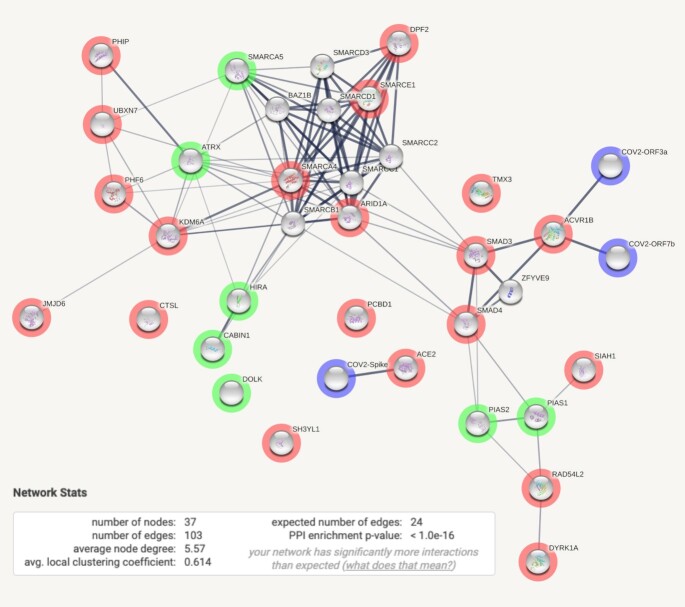
“…addition, host proteins whose expression appears to control SARS-CoV-2 virion entry into cells, as determined in a recent genome-wide CRISPR-screen (36), are highlighted: proteins whose removal causes a drop in virus entry efficiency are highlighted in red; green highlights indicate proteins whose…”
BackgroundMethodWong, A. K., Krishnan, A., Yao, V., Tadych, A., & Troyanskaya, O. G. (2015) · Nucleic Acids Research · doi:10.1093/nar/gkv486 · Cited by 55 · cited 2×
“For the text-mining channel, a dedicated pipeline had to be developed to extract physical interaction information Here, STRING was queried with a large set of human proteins, whereby each protein was entered together with its approximate likelihood of being targeted toward the mitochondrion (‘Mito Evidence IMPI score’…”
MethodZhang, W., Sun, F., & Jiang, R. (2011) · BMC Bioinformatics · doi:10.1186/1471-2105-12-s1-s11 · Cited by 53 · cited 1×
“Data integration across different evidence sources is known to increase the overall network quality (18–21) and is also deemed necessary given the diverse modes by which proteins can be associated.”
BackgroundA strategy for evaluating pathway analysis methods
Yu, C., Woo, H. J., Yu, X., Oyama, T., Wallqvist, A., & Reifman, J. (2017) · BMC Bioinformatics · doi:10.1186/s12859-017-1866-7 · Cited by 50 · cited 1×
“Kolmogorov–Smirnov testing is used to detect significant pathways, followed by Aggregate Fold-Change testing (53) where computationally feasible.”
MethodFunCoup 4: new species, data, and visualization
Ogris, C., Guala, D., Kaduk, M., & Sonnhammer, E. L. L. (2018) · Nucleic Acids Research · doi:10.1093/nar/gkx1138 · Cited by 49 · cited 1×
“Frequently used resources include FunCoup (23), GeneMANIA (24), HumanBase / GIANT (25), IMP (26), IID (27), Consensus-PathDB (28) and HumanNet (29).”
MethodGenome-wide functional association networks: background, data & state-of-the-art resources
Guala, D., Ogris, C., Müller, N. S., & Sonnhammer, E. L. L. (2019) · Briefings in Bioinformatics · doi:10.1093/bib/bbz064 · Cited by 42 · cited 2×
“The field has been recently reviewed in (14,22).”
BackgroundThe IMEx coronavirus interactome: an evolving map of Coronaviridae –host molecular interactions
Perfetto, L., Pastrello, C., del-Toro, N., Duesbury, M., Iannuccelli, M., Kotlyar, M., Licata, L., Meldal, B., Panneerselvam, K., Panni, S., et al. (2020) · Database · doi:10.1093/database/baaa096 · Cited by 40
Wu, M., Zeng, W., Liu, W., Lv, H., Chen, T., & Jiang, R. (2018) · Methods · doi:10.1016/j.ymeth.2018.06.002 · Cited by 21 · cited 1×
“They also support applications such as drug target discovery or drug repurposing (11,12), and can help in the interpretation of genomic variation (13).”
BackgroundAssessment of network module identification across complex diseases
Choobdar, S., Ahsen, M. E., Crawford, J., et al. (2019) · PubMed · doi:10.18154/rwth-2020-02980 · Cited by 17
Jensen, L. J. (2016) · bioRxiv (Cold Spring Harbor Laboratory) · doi:10.1101/067132 · Cited by 15
Self-citationXing, C., & Dunson, D. B. (2011) · PLoS Computational Biology · doi:10.1371/journal.pcbi.1002110 · Cited by 15
Cited by
Szklarczyk, D., Kirsch, R., Koutrouli, M., Nastou, K., Mehryary, F., Hachilif, R., Gable, A. L., Fang, T., Doncheva, N. T., Pyysalo, S., et al. (2023) · Nucleic Acids Research · doi:10.1093/nar/gkac1000 · Cited by 9,726
Self-citationImproved prediction of protein-protein interactions using AlphaFold2
Bryant, P., Pozzati, G., & Elofsson, A. (2021) · doi:10.1101/2021.09.15.460468 · Cited by 1,022
Zhao, J. H., Stacey, D., Eriksson, N., Macdonald-Dunlop, E., Hedman, Å. K., Kalnapenkis, A., Enroth, S., Cozzetto, D., Digby-Bell, J., Marten, J., et al. (2023) · Nature Immunology · doi:10.1038/s41590-023-01588-w · Cited by 747
The STRING database in 2025: protein networks with directionality of regulation
Szklarczyk, D., Nastou, K., Koutrouli, M., Kirsch, R., Mehryary, F., Hachilif, R., Hu, D., Peluso, M. E., Huang, Q., Fang, T., et al. (2025) · Nucleic Acids Research · doi:10.1093/nar/gkae1113 · Cited by 668
Self-citationOrgan aging signatures in the plasma proteome track health and disease
Oh, H. S.-H., Rutledge, J., Nachun, D., Pálovics, R., Abiose, O., Moran-Losada, P., Channappa, D., Urey, D. Y., Kim, K., Sung, Y. J., et al. (2023) · Nature · doi:10.1038/s41586-023-06802-1 · Cited by 634
“Protein–protein interaction networks were generated using the STRING database 74 .”
Method
Metadata
- Authors
- Szklarczyk, D., Gable, A. L., Nastou, K. C., Lyon, D., Kirsch, R., Pyysalo, S., Doncheva, N. T., Legeay, M., Fang, T., Bork, P., Jensen, L. J., & von Mering, C.
- Affiliations
- SIB Swiss Institute of Bioinformatics (CH)
- University of Copenhagen (DK)
- University of Turku (FI)
- Structural and Computational Biology Unit, European Molecular Biology Laboratory, 69117 Heidelberg, Germany
- Corresponding author
- Jensen, Lars J
- von Mering, Christian
- ORCID
- Venue
- Nucleic Acids Research
- Publisher
- Oxford University Press (OUP)
- Published
- 2020-11-25
- Volume
- 49
- Issue
- D1
- Pages
- D605-D612
- ISSN
- 0305-1048 (ISSN-L)
- 1362-4962
- PMC
- PMC7779004
- OpenAlex
- W3107527779
- Cited by
- 8,056
- References
- 64
- Citations by year
- 2026: 697 · 2025: 1205 · 2024: 1834 · 2023: 2286 · 2022: 1785 · 2021: 240 · 2020: 5
- FWCI
- 356.58
- Type
- journal article
- Language
- en
- Open access
- gold
- doi.org
- Licence
- Locations
- Nucleic Acids Research (publishedVersion, cc-by)
- PubMed Central (publishedVersion, cc-by)
- PubMed (publishedVersion)
- Research at the University of Copenhagen (University of Copenhagen) (publishedVersion, cc-by)
- MDC Repository (Max-Delbrueck-Center for Molecular Medicine) (acceptedVersion)
- Zurich Open Repository and Archive (University of Zurich) (acceptedVersion, cc-by)
- Zurich Open Repository and Archive (University of Zurich) (submittedVersion, cc-by)
- Zurich Open Repository and Archive (University of Zurich)
- Funders
- Novo Nordisk Foundation (NNF14CC0001)
- Academy of Finland (332844)
- Topics
- Life Sciences › Biochemistry, Genetics and Molecular Biology › Molecular Biology › Bioinformatics and Genomic Networks
- Health Sciences › Medicine › Health Informatics › Biomedical Text Mining and Ontologies
- Life Sciences › Biochemistry, Genetics and Molecular Biology › Molecular Biology › Genomics and Phylogenetic Studies
- Keywords
- STRING database, protein-protein interaction, protein-protein interaction network, functional association, literature mining, physical interaction, co-expression, interaction prediction, protein complexes, pathway annotation
- MeSH terms
- Proteins, User-Computer Interface, Protein Interaction Mapping, Databases, Protein
About these checks
Registry, retraction, Cites and statistics results are computed, not judged, with one exception: a printed reference that no index lists is read once by a model before it counts as a citation error. Claims are extracted by a model and kept only when their quote appears verbatim in the text; each cited source is then checked, with a model’s help, for whether it says what the claim relies on. Those verdicts can be wrong — read the claim’s quote and the cited source before relying on one.
Statistics and arithmetic are recomputed, not judged.
Confidence bands are shown only for fields calibrated on our annotated test set. None is calibrated yet, so no band is shown.
What counts as a claim ›How we measure confidence ›How we check this ›
Are you an author, or do you see a problem with this page? Request a review
Data sources
Bibliographic data: Semantic Scholar, OpenAlex, Crossref.
Contains information from the Semantic Scholar Academic Graph Datasets, made available under the ODC Attribution License (ODC-BY 1.0).
Semantic Scholar’s data is described in: Kinney, R., et al. (2023). The Semantic Scholar Open Data Platform. arXiv:2301.10140.
