

The DOI matches its Crossref record; 22 of the 24 references it cites were found in a registry or an index; 1 of the 24 sources its claims cite were checked for support.
AlphaFold Protein Structure Database: massively expanding the structural coverage of protein-sequence space with high-accuracy models
Open accessAbstract
The AlphaFold Protein Structure Database (AlphaFold DB, https://alphafold.ebi.ac.uk) is an openly accessible, extensive database of high-accuracy protein-structure predictions. Powered by AlphaFold v2.0 of DeepMind, it has enabled an unprecedented expansion of the structural coverage of the known protein-sequence space. AlphaFold DB provides programmatic access to and interactive visualization of predicted atomic coordinates, per-residue and pairwise model-confidence estimates and predicted aligned errors. The initial release of AlphaFold DB contains over 360,000 predicted structures across 21 model-organism proteomes, which will soon be expanded to cover most of the (over 100 million) representative sequences from the UniRef90 data set.
Overview
AI snapshot
Written from the paper’s full text.
TL;DR
AlphaFold DB is an openly accessible database of high-accuracy protein-structure predictions generated by AlphaFold v2.0, initially containing over 360,000 predicted structures across 21 model-organism proteomes. It provides atomic coordinates, per-residue pLDDT confidence, and pairwise predicted aligned errors through FTP, API, and interactive web pages, with planned expansion to >100 million UniRef90 representative sequences.
Key findings
- The initial release contains over 360,000 predicted structures across 21 model-organism proteomes, including 23,391 human, 55,799 soybean, 43,649 Asian rice, 39,299 maize, 27,434 Arabidopsis, 24,664 zebrafish, 21,615 mouse, and 21,272 rat structures.
- Predictions include atomic coordinates, per-residue confidence pLDDT on a 0–100 scale, and pairwise Predicted Aligned Error (PAE) in Ångströms capped at 31.75 Å; pLDDT bands are ≥90 very high, 90 > pLDDT ≥ 70 confident, 70 > pLDDT ≥ 50 low, and <50 very low.
- Data are available via bulk FTP downloads, a public API keyed on UniProt accessions, and protein-specific web pages with interactive visualization using Mol*; metadata are indexed with Apache Solr.
- Planned expansions aim to exceed 1 million structures, including SwissProt and neglected-disease proteomes, followed by >100 million structures for most UniRef90 representative sequences.
Methods
- Database/resource paper describing AlphaFold DB, created by DeepMind and EMBL-EBI, using AlphaFold v2.0 predictions.
- Initial version predicted most sequences in UniProt reference proteomes for 21 organisms in the 16–2700 amino-acid length range, plus 1400-residue fragments for longer human proteins; sequences with non-standard amino acids were excluded, and multiple isoforms were not provided.
- Data archival includes PDB and mmCIF coordinate files, PAE JSON files, and metadata JSON files; access is through FTP, API, and web pages, with confidence metrics stored in B-factor fields and used for coloring in the 3D viewer.
Limitations
- Stated: the initial release excludes isoforms and sequences with unknown or non-standard amino acids, and predictions are limited to 16–2700 amino acids, with 1400-residue fragments for longer human proteins.
- Stated: PAE is asymmetric and capped at 31.75 Å; high PAE values indicate unreliable relative domain positions/orientations, and pLDDT reflects local confidence rather than global accuracy.
- Evident: this is a database/resource description, not an experimental validation study; initial coverage is limited to 21 proteomes, and the paper does not report new accuracy benchmarks beyond citing AlphaFold/CASP14 and prior human-proteome analyses.
Model-written summary. Check it against the paper before relying on it.
Integrity signals
Registry
Cites
Statistics
Figures
Verification
Claims the paper makes
15 No basis given · 12 Not checked yet · 5 Own interpretation · 2 Own result · 1 Partly supported · accuracy not yet measured
A result the paper reports from its own data — it cites no other source for it, so there is none to check. The quote shows it is in the paper.
In the paper
“The initial release of AlphaFold DB contains over 360,000 predicted structures across 21 model-organism proteomes”
- Also stated in: § IMPLEMENTATION · plain
“The initial version of AlphaFold DB contains over 360 000 predicted structures, corresponding meta-information and confidence metrics.”
- Also stated in: § CONCLUSION AND OUTLOOK · plain
“The first release of AlphaFold DB contains over 360 000 predicted structures from 21 model-organism proteomes.”
§ AlphaFold Protein Structure Database: massively expanding the structural coverage of protein-sequence space with high-accuracy models > Abstract
plain- Asserted: passes — The authors put it forward as true.
- Checkable: passes — It can be checked against evidence.
- Load-bearing: passes — The paper’s conclusions depend on it.
- Based: passes — The paper gives a reason why it holds.
- Also stated in: § IMPLEMENTATION · plain
A result the paper reports from its own data — it cites no other source for it, so there is none to check. The quote shows it is in the paper.
In the paper
“The first release described here covers the human proteome and those of 20 other model organisms (Table 1).”
§ AlphaFold Protein Structure Database: massively expanding the structural coverage of protein-sequence space with high-accuracy models > INTRODUCTION
plain- Asserted: passes — The authors put it forward as true.
- Checkable: passes — It can be checked against evidence.
- Load-bearing: unclear — It is unclear whether the paper’s conclusions depend on it.
- Based: passes — The paper gives a reason why it holds.
The paper states this without a source or data behind it here, so there is nothing to check it against. The quote shows it is in the paper.
In the paper
“Model confidence can vary significantly along a chain, making it essential to analyse the confidence measures before interpreting structural features.”
§ AlphaFold Protein Structure Database: massively expanding the structural coverage of protein-sequence space with high-accuracy models > IMPLEMENTATION > AlphaFold DB web pages
plain- Asserted: passes — The authors put it forward as true.
- Checkable: passes — It can be checked against evidence.
- Load-bearing: unclear — It is unclear whether the paper’s conclusions depend on it.
- Based: passes — The paper gives a reason why it holds.
None of the sources cited for this claim have been checked yet.
In the paper
“However, while the Universal Protein Resource (UniProt) archives almost 220 million unique protein sequences, the Protein Data Bank (PDB) holds only just over 180 000 3D structures for over 55 000 distinct proteins, thus severely limiting the coverage of the sequence space to support biomolecular research globally (5–7).”
§ AlphaFold Protein Structure Database: massively expanding the structural coverage of protein-sequence space with high-accuracy models > INTRODUCTION
What the sources say
- Not checked yetcites [5] Bateman, 2021, UniProt: the universal protein knowledgebase in 2021, Nucleic Acids Res. source
- Not checked yetcites [6] Armstrong, 2019, PDBe: improved findability of macromolecular structure data in the PDB, Nucleic Acids Res.
- Not checked yetcites [7] Varadi, 2019, PDBe-KB: a community-driven resource for structural and functional annotations, Nucleic Acids Res.
plain- Asserted: passes — The authors put it forward as true.
- Checkable: passes — It can be checked against evidence.
- Load-bearing: passes — The paper’s conclusions depend on it.
- Based: passes — The paper gives a reason why it holds.
A conclusion the paper draws from its own results — it cites no other source for it, so there is none to check. The quote shows it is in the paper.
In the paper
“Powered by AlphaFold v2.0 of DeepMind, it has enabled an unprecedented expansion of the structural coverage of the known protein-sequence space.”
§ AlphaFold Protein Structure Database: massively expanding the structural coverage of protein-sequence space with high-accuracy models > Abstract
boosteddirect- Asserted: passes — The authors put it forward as true.
- Checkable: passes — It can be checked against evidence.
- Load-bearing: passes — The paper’s conclusions depend on it.
- Based: passes — The paper gives a reason why it holds.
A conclusion the paper draws from its own results — it cites no other source for it, so there is none to check. The quote shows it is in the paper.
In the paper
“The unprecedented accuracy and speed of AlphaFold allowed the creation of an extensive database of structure predictions at a large scale.”
§ AlphaFold Protein Structure Database: massively expanding the structural coverage of protein-sequence space with high-accuracy models > INTRODUCTION
plaindirect- Asserted: passes — The authors put it forward as true.
- Checkable: passes — It can be checked against evidence.
- Load-bearing: passes — The paper’s conclusions depend on it.
- Based: passes — The paper gives a reason why it holds.
In the paper
“In 2020, the organizers of the CASP14 benchmark recognized AlphaFold as a solution to the protein–structure–prediction problem (12).”
§ AlphaFold Protein Structure Database: massively expanding the structural coverage of protein-sequence space with high-accuracy models > INTRODUCTION
What the sources say
- Not checked yetcites [12] Pereira, 2021, High-accuracy protein structure prediction in CASP14, Proteins Struct. Funct. Bioinf. source
plain- Asserted: passes — The authors put it forward as true.
- Checkable: passes — It can be checked against evidence.
- Load-bearing: unclear — It is unclear whether the paper’s conclusions depend on it.
- Based: passes — The paper gives a reason why it holds.
None of the sources cited for this claim have been checked yet.
In the paper
“Although recent advances in the field of electron cryo-microscopy and hybrid and integrative methods (I/HM) for structure determination have accelerated the pace of structure determination, the gap between known protein sequences and experimental protein structures continues to expand (6,8).”
§ AlphaFold Protein Structure Database: massively expanding the structural coverage of protein-sequence space with high-accuracy models > INTRODUCTION
What the sources say
- Not checked yetcites [6] Armstrong, 2019, PDBe: improved findability of macromolecular structure data in the PDB, Nucleic Acids Res.
- Not checked yetcites [8] de Oliveira, 2021, Cryo-EM: the resolution revolution and drug discovery, SLAS Discov. source
plaindirect- Asserted: passes — The authors put it forward as true.
- Checkable: passes — It can be checked against evidence.
- Load-bearing: unclear — It is unclear whether the paper’s conclusions depend on it.
- Based: passes — The paper gives a reason why it holds.
None of the sources cited for this claim have been checked yet.
In the paper
“thus severely limiting the coverage of the sequence space to support biomolecular research globally (5–7).”
§ AlphaFold Protein Structure Database: massively expanding the structural coverage of protein-sequence space with high-accuracy models > INTRODUCTION
What the sources say
- Not checked yetcites [5] Bateman, 2021, UniProt: the universal protein knowledgebase in 2021, Nucleic Acids Res. source
- Not checked yetcites [6] Armstrong, 2019, PDBe: improved findability of macromolecular structure data in the PDB, Nucleic Acids Res.
- Not checked yetcites [7] Varadi, 2019, PDBe-KB: a community-driven resource for structural and functional annotations, Nucleic Acids Res.
boosted- Asserted: passes — The authors put it forward as true.
- Checkable: passes — It can be checked against evidence.
- Load-bearing: passes — The paper’s conclusions depend on it.
- Based: passes — The paper gives a reason why it holds.
None of the sources cited for this claim have been checked yet.
In the paper
“Although recent advances in the field of electron cryo-microscopy and hybrid and integrative methods (I/HM) for structure determination have accelerated the pace of structure determination, the gap between known protein sequences and experimental protein structures continues to expand (6,8).”
§ AlphaFold Protein Structure Database: massively expanding the structural coverage of protein-sequence space with high-accuracy models > INTRODUCTION
What the sources say
- Not checked yetcites [6] Armstrong, 2019, PDBe: improved findability of macromolecular structure data in the PDB, Nucleic Acids Res.
- Not checked yetcites [8] de Oliveira, 2021, Cryo-EM: the resolution revolution and drug discovery, SLAS Discov. source
plaincorrelational- Asserted: passes — The authors put it forward as true.
- Checkable: passes — It can be checked against evidence.
- Load-bearing: passes — The paper’s conclusions depend on it.
- Based: passes — The paper gives a reason why it holds.
- Probably not a substantial claim. 19
- It may state two separate claims as one. 10
The cited sources support only part of this claim — read each source’s verdict below.
In the paper
“As a confidence metric based on lDDT, pLDDT also reflects local confidence in the structure, and should be used, for example, to assess confidence within a single domain.”
§ AlphaFold Protein Structure Database: massively expanding the structural coverage of protein-sequence space with high-accuracy models > IMPLEMENTATION
What the sources say
- Partly supportedcites [14] Mariani, 2013, lDDT: a local superposition-free score for comparing protein structures and models using distance difference tests, Bioinformatics sourceExperimental — accuracy not yet measured
Section 3.3 says per-residue lDDT scores reflect the accuracy of a model’s local atomic environment, including within individual domains. The paper describes lDDT as a comparison with a reference structure; it does not address pLDDT or establish that pLDDT measures predicted local confidence. (LLM, conf=0.85)
plaincorrelational- Asserted: passes — The authors put it forward as true.
- Checkable: passes — It can be checked against evidence.
- Load-bearing: fails — The paper’s conclusions may not depend on it.
- Based: passes — The paper gives a reason why it holds.
Probably not a substantial claim. The paper’s conclusions may not depend on it.
- Partly supported
The paper states this without a source or data behind it here, so there is nothing to check it against. The quote shows it is in the paper.
In the paper
“The AlphaFold Protein Structure Database (AlphaFold DB, https://alphafold.ebi.ac.uk) is an openly accessible, extensive database of high-accuracy protein-structure predictions.”
§ AlphaFold Protein Structure Database: massively expanding the structural coverage of protein-sequence space with high-accuracy models > Abstract
plain- Asserted: passes — The authors put it forward as true.
- Checkable: passes — It can be checked against evidence.
- Load-bearing: passes — The paper’s conclusions depend on it.
- Based: passes — The paper gives a reason why it holds.
It may state two separate claims as one.
The paper states this without a source or data behind it here, so there is nothing to check it against. The quote shows it is in the paper.
In the paper
“The predicted structures contain atomic coordinates and per-residue confidence estimates on a scale from 0 to 100, with higher scores corresponding to higher confidence.”
§ AlphaFold Protein Structure Database: massively expanding the structural coverage of protein-sequence space with high-accuracy models > IMPLEMENTATION
plaincorrelational- Asserted: passes — The authors put it forward as true.
- Checkable: passes — It can be checked against evidence.
- Load-bearing: fails — The paper’s conclusions may not depend on it.
- Based: passes — The paper gives a reason why it holds.
Probably not a substantial claim. The paper’s conclusions may not depend on it. It may state two separate claims as one.
The paper states this without a source or data behind it here, so there is nothing to check it against. The quote shows it is in the paper.
In the paper
“Powered by AlphaFold v2.0 of DeepMind”
§ AlphaFold Protein Structure Database: massively expanding the structural coverage of protein-sequence space with high-accuracy models > Abstract
plaindirect- Asserted: passes — The authors put it forward as true.
- Checkable: passes — It can be checked against evidence.
- Load-bearing: passes — The paper’s conclusions depend on it.
- Based: passes — The paper gives a reason why it holds.
Probably not a substantial claim.
The paper states this without a source or data behind it here, so there is nothing to check it against. The quote shows it is in the paper.
In the paper
“AlphaFold DB provides programmatic access to and interactive visualization of predicted atomic coordinates, per-residue and pairwise model-confidence estimates and predicted aligned errors.”
§ AlphaFold Protein Structure Database: massively expanding the structural coverage of protein-sequence space with high-accuracy models > Abstract
plain- Asserted: passes — The authors put it forward as true.
- Checkable: passes — It can be checked against evidence.
- Load-bearing: fails — The paper’s conclusions may not depend on it.
- Based: passes — The paper gives a reason why it holds.
Probably not a substantial claim. The paper’s conclusions may not depend on it. It may state two separate claims as one.
The paper states this without a source or data behind it here, so there is nothing to check it against. The quote shows it is in the paper.
In the paper
“All the data are publicly accessible through a cloud-based infrastructure.”
§ AlphaFold Protein Structure Database: massively expanding the structural coverage of protein-sequence space with high-accuracy models > IMPLEMENTATION
plain- Asserted: passes — The authors put it forward as true.
- Checkable: passes — It can be checked against evidence.
- Load-bearing: fails — The paper’s conclusions may not depend on it.
- Based: passes — The paper gives a reason why it holds.
Probably not a substantial claim. The paper’s conclusions may not depend on it.
The paper states this without a source or data behind it here, so there is nothing to check it against. The quote shows it is in the paper.
In the paper
“We provide access to all entries through a public API endpoint, keyed on a UniProt accession.”
§ AlphaFold Protein Structure Database: massively expanding the structural coverage of protein-sequence space with high-accuracy models > IMPLEMENTATION > Data access
plain- Asserted: passes — The authors put it forward as true.
- Checkable: passes — It can be checked against evidence.
- Load-bearing: fails — The paper’s conclusions may not depend on it.
- Based: passes — The paper gives a reason why it holds.
Probably not a substantial claim. The paper’s conclusions may not depend on it.
The paper states this without a source or data behind it here, so there is nothing to check it against. The quote shows it is in the paper.
In the paper
“AlphaFold DB archives and provides access to the atomic coordinates in PDB and mmCIF formats, PAEs in JSON format and corresponding metadata in JSON format.”
§ AlphaFold Protein Structure Database: massively expanding the structural coverage of protein-sequence space with high-accuracy models > IMPLEMENTATION > Data archival
plain- Asserted: passes — The authors put it forward as true.
- Checkable: passes — It can be checked against evidence.
- Load-bearing: fails — The paper’s conclusions may not depend on it.
- Based: passes — The paper gives a reason why it holds.
Probably not a substantial claim. The paper’s conclusions may not depend on it. It may state two separate claims as one.
None of the sources cited for this claim have been checked yet.
In the paper
“Each protein has a dedicated structure page that shows basic information (drawn from UniProt (5) and PDBe (6)) and three separate outputs of the AlphaFold model.”
§ AlphaFold Protein Structure Database: massively expanding the structural coverage of protein-sequence space with high-accuracy models > IMPLEMENTATION > AlphaFold DB web pages
What the sources say
- Not checked yetcites [5] Bateman, 2021, UniProt: the universal protein knowledgebase in 2021, Nucleic Acids Res. source
- Not checked yetcites [6] Armstrong, 2019, PDBe: improved findability of macromolecular structure data in the PDB, Nucleic Acids Res.
plain- Asserted: passes — The authors put it forward as true.
- Checkable: passes — It can be checked against evidence.
- Load-bearing: fails — The paper’s conclusions may not depend on it.
- Based: passes — The paper gives a reason why it holds.
Probably not a substantial claim. The paper’s conclusions may not depend on it. It may state two separate claims as one.
The paper states this without a source or data behind it here, so there is nothing to check it against. The quote shows it is in the paper.
In the paper
“The data files in the archive are versioned, and previous snapshots of the data will be available via FTP, but the web pages will always display the latest version.”
§ AlphaFold Protein Structure Database: massively expanding the structural coverage of protein-sequence space with high-accuracy models > IMPLEMENTATION > Data archival
plain- Asserted: passes — The authors put it forward as true.
- Checkable: passes — It can be checked against evidence.
- Load-bearing: fails — The paper’s conclusions may not depend on it.
- Based: passes — The paper gives a reason why it holds.
Probably not a substantial claim. The paper’s conclusions may not depend on it. It may state two separate claims as one.
The paper states this without a source or data behind it here, so there is nothing to check it against. The quote shows it is in the paper.
In the paper
“AlphaFold DB provides graphical access to and interactive visualization of all the predictions and meta-information for the broader scientific community through web pages.”
§ AlphaFold Protein Structure Database: massively expanding the structural coverage of protein-sequence space with high-accuracy models > IMPLEMENTATION > Data access
plain- Asserted: passes — The authors put it forward as true.
- Checkable: passes — It can be checked against evidence.
- Load-bearing: fails — The paper’s conclusions may not depend on it.
- Based: passes — The paper gives a reason why it holds.
Probably not a substantial claim. The paper’s conclusions may not depend on it.
The paper states this without a source or data behind it here, so there is nothing to check it against. The quote shows it is in the paper.
In the paper
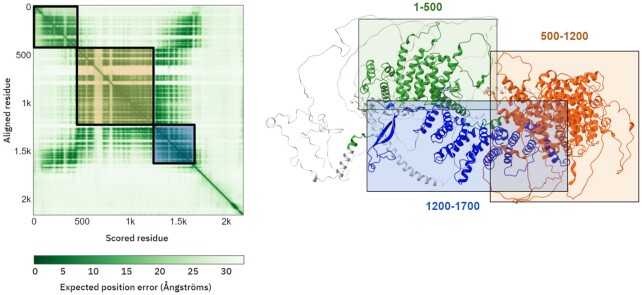
“The third output is a pairwise confidence prediction, which helps to assess the reliability of relative domain positions and orientations as well as the global topology of the protein (Figure 3).”
§ AlphaFold Protein Structure Database: massively expanding the structural coverage of protein-sequence space with high-accuracy models > IMPLEMENTATION > AlphaFold DB web pages
plaindirect- Asserted: passes — The authors put it forward as true.
- Checkable: passes — It can be checked against evidence.
- Load-bearing: fails — The paper’s conclusions may not depend on it.
- Based: passes — The paper gives a reason why it holds.
Probably not a substantial claim. The paper’s conclusions may not depend on it.
The paper states this without a source or data behind it here, so there is nothing to check it against. The quote shows it is in the paper.
In the paper
“The data set contains proteins with sequence lengths of 16–2700 and excludes isoforms and sequences with unknown or non-standard amino acids.”
§ AlphaFold Protein Structure Database: massively expanding the structural coverage of protein-sequence space with high-accuracy models > INTRODUCTION
plain- Asserted: passes — The authors put it forward as true.
- Checkable: passes — It can be checked against evidence.
- Load-bearing: unclear — It is unclear whether the paper’s conclusions depend on it.
- Based: passes — The paper gives a reason why it holds.
It may state two separate claims as one.
None of the sources cited for this claim have been checked yet.
In the paper
“UniProt (5), Pfam (18), InterPro (19) and PDBe-KB (7) use this API to display AlphaFold models on their web pages.”
§ AlphaFold Protein Structure Database: massively expanding the structural coverage of protein-sequence space with high-accuracy models > IMPLEMENTATION > Data access
What the sources say
- Not checked yetcites [5] Bateman, 2021, UniProt: the universal protein knowledgebase in 2021, Nucleic Acids Res. source
- Not checked yetcites [18] Mistry, 2021, Pfam: The protein families database in 2021, Nucleic Acids Res. source
- Not checked yetcites [19] Blum, 2021, The InterPro protein families and domains database: 20 years on, Nucleic Acids Res. source
plaindirect- Asserted: passes — The authors put it forward as true.
- Checkable: passes — It can be checked against evidence.
- Load-bearing: fails — The paper’s conclusions may not depend on it.
- Based: passes — The paper gives a reason why it holds.
Probably not a substantial claim. The paper’s conclusions may not depend on it.
The paper states this without a source or data behind it here, so there is nothing to check it against. The quote shows it is in the paper.
In the paper
“AlphaFold DB provides predictions through several data-access mechanisms: (i) bulk downloads via FTP; (ii) programmatic access via an application programming interface (API); (iii) download and interactive visualization of individual predictions on protein-specific web pages keyed on UniProt accessions.”
§ AlphaFold Protein Structure Database: massively expanding the structural coverage of protein-sequence space with high-accuracy models > IMPLEMENTATION > Data access
plain- Asserted: passes — The authors put it forward as true.
- Checkable: passes — It can be checked against evidence.
- Load-bearing: fails — The paper’s conclusions may not depend on it.
- Based: passes — The paper gives a reason why it holds.
Probably not a substantial claim. The paper’s conclusions may not depend on it. It may state two separate claims as one.
A conclusion the paper draws from its own results — it cites no other source for it, so there is none to check. The quote shows it is in the paper.
In the paper
“For residues x and y in two different domains, if the PAE values (x, y) are low, AlphaFold predicts the domains to have well-defined relative positions and orientations.”
§ AlphaFold Protein Structure Database: massively expanding the structural coverage of protein-sequence space with high-accuracy models > IMPLEMENTATION
plainconditional- Asserted: passes — The authors put it forward as true.
- Checkable: passes — It can be checked against evidence.
- Load-bearing: fails — The paper’s conclusions may not depend on it.
- Based: passes — The paper gives a reason why it holds.
Probably not a substantial claim. The paper’s conclusions may not depend on it.
In the paper
“AlphaFold is an AI system developed by DeepMind that makes state-of-the-art predictions of protein structures from their amino-acid sequences (9).”
§ AlphaFold Protein Structure Database: massively expanding the structural coverage of protein-sequence space with high-accuracy models > INTRODUCTION
What the sources say
- Not checked yetcites [9] Jumper, 2021, Highly accurate protein structure prediction with AlphaFold, Nature source
plaindirect- Asserted: passes — The authors put it forward as true.
- Checkable: passes — It can be checked against evidence.
- Load-bearing: passes — The paper’s conclusions depend on it.
- Based: passes — The paper gives a reason why it holds.
It may state two separate claims as one.
None of the sources cited for this claim have been checked yet.
In the paper
“However, while the Universal Protein Resource (UniProt) archives almost 220 million unique protein sequences, the Protein Data Bank (PDB) holds only just over 180 000 3D structures for over 55 000 distinct proteins, thus severely limiting the coverage of the sequence space to support biomolecular research globally (5–7).”
§ AlphaFold Protein Structure Database: massively expanding the structural coverage of protein-sequence space with high-accuracy models > INTRODUCTION
What the sources say
- Not checked yetcites [5] Bateman, 2021, UniProt: the universal protein knowledgebase in 2021, Nucleic Acids Res. source
- Not checked yetcites [6] Armstrong, 2019, PDBe: improved findability of macromolecular structure data in the PDB, Nucleic Acids Res.
- Not checked yetcites [7] Varadi, 2019, PDBe-KB: a community-driven resource for structural and functional annotations, Nucleic Acids Res.
plain- Asserted: passes — The authors put it forward as true.
- Checkable: passes — It can be checked against evidence.
- Load-bearing: passes — The paper’s conclusions depend on it.
- Based: passes — The paper gives a reason why it holds.
It may state two separate claims as one.
In the paper
“It was recently described that very low confidence pLDDT scores correlate with high propensities for intrinsic disorder (17).”
§ AlphaFold Protein Structure Database: massively expanding the structural coverage of protein-sequence space with high-accuracy models > IMPLEMENTATION
What the sources say
- Not checked yetcites [17] Akdel, 2021, A structural biology community assessment of AlphaFold 2 applications Biophysics
plaincorrelational- Asserted: passes — The authors put it forward as true.
- Checkable: passes — It can be checked against evidence.
- Load-bearing: fails — The paper’s conclusions may not depend on it.
- Based: passes — The paper gives a reason why it holds.
Probably not a substantial claim. The paper’s conclusions may not depend on it.
A conclusion the paper draws from its own results — it cites no other source for it, so there is none to check. The quote shows it is in the paper.
In the paper
“If the PAE values are high, then the relative position and orientation of the two domains are unreliable, and users should not attach biological or structural relevance to these.”
§ AlphaFold Protein Structure Database: massively expanding the structural coverage of protein-sequence space with high-accuracy models > IMPLEMENTATION
plaindirect- Asserted: passes — The authors put it forward as true.
- Checkable: passes — It can be checked against evidence.
- Load-bearing: fails — The paper’s conclusions may not depend on it.
- Based: passes — The paper gives a reason why it holds.
Probably not a substantial claim. The paper’s conclusions may not depend on it.
The paper states this without a source or data behind it here, so there is nothing to check it against. The quote shows it is in the paper.
In the paper
“However, figuring out the exact structure of a protein remains an expensive and often time-consuming process.”
§ AlphaFold Protein Structure Database: massively expanding the structural coverage of protein-sequence space with high-accuracy models > CONCLUSION AND OUTLOOK
plain- Asserted: passes — The authors put it forward as true.
- Checkable: passes — It can be checked against evidence.
- Load-bearing: passes — The paper’s conclusions depend on it.
- Based: fails — The paper may give no reason why it holds.
Probably not a substantial claim. The paper may give no reason why it holds.
In the paper
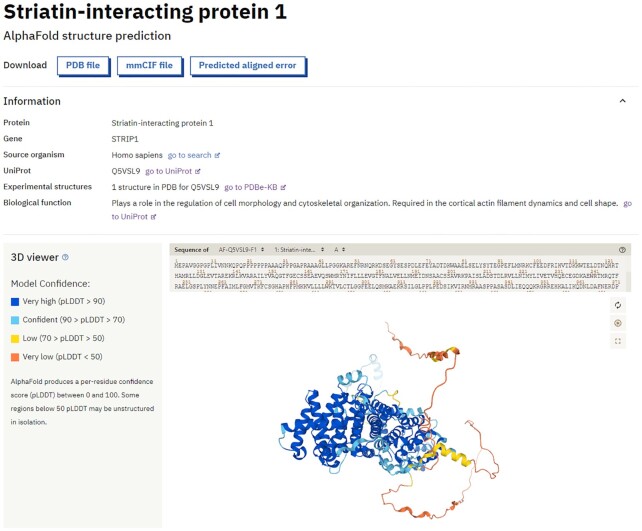
“The lower confidence bands appear to correlate well with backbone flexibility and intrinsic disorder (13) (Figure 2).”
§ AlphaFold Protein Structure Database: massively expanding the structural coverage of protein-sequence space with high-accuracy models > IMPLEMENTATION > AlphaFold DB web pages
What the sources say
- Not checked yetcites [13] Tunyasuvunakool, 2021, Highly accurate protein structure prediction for the human proteome, Nature source
hedgedcorrelational- Asserted: passes — The authors put it forward as true.
- Checkable: passes — It can be checked against evidence.
- Load-bearing: fails — The paper’s conclusions may not depend on it.
- Based: passes — The paper gives a reason why it holds.
Probably not a substantial claim. The paper’s conclusions may not depend on it.
In the paper
“Since the mid-1950s, the scientific community has been using ever-more advanced experimental methods to determine over 180 000 structures of proteins, nucleic acids, and complexes in atomic detail, and archive them in the PDB, the single worldwide archive of experimental macromolecular structure data managed by the wwPDB consortium (21).”
§ AlphaFold Protein Structure Database: massively expanding the structural coverage of protein-sequence space with high-accuracy models > CONCLUSION AND OUTLOOK
What the sources say
- Not checked yetcites [21] wwPDB consortium, 2018, Protein Data Bank: the single global archive for 3D macromolecular structure data, Nucleic Acids Res. source
plain- Asserted: passes — The authors put it forward as true.
- Checkable: passes — It can be checked against evidence.
- Load-bearing: fails — The paper’s conclusions may not depend on it.
- Based: passes — The paper gives a reason why it holds.
Probably not a substantial claim. The paper’s conclusions may not depend on it.
Claims other papers make about this one
Each is checked against this paper’s own text: does it say what the citing paper says it does?
The source backs part of the claim, not all of it — or backs it for a different population, condition or comparison.
In the citing paper
“The new CC+ database includes both experimentally derived CCs from the RCSB PDB (Bittrich et al., 2022) and predicted AlphaFold2 models for 48 proteomes (https://alphafold.ebi.ac.uk/; Varadi et al., 2022).”
From CC + : A searchable database of validated coiled coils in PDB structures and AlphaFold2 models (2023) · cites this paper as Varadi et al., 2022
Experimental — accuracy not yet measuredThe source backs part of the claim, not all of it — or backs it for a different population, condition or comparison.
In the citing paper
“we posit that AlphaFold (Jumper et al., 2021;Varadi et al., 2021) is a Level 5 Narrow AI (“Superhuman Narrow AI”) since it performs a single task (predicting a protein's 3D structure from an amino acid sequence) above the level of the world's top scientists.”
From Levels of AGI for Operationalizing Progress on the Path to AGI (2023) · cites this paper as Varadi et al., 2021
Experimental — accuracy not yet measuredIn the citing paper
“houses over 200 million pre-run AF2 predictions”
From The power and pitfalls of AlphaFold2 for structure prediction beyond rigid globular proteins (2024) · cites this paper as [6]
In the citing paper
“AF2 also generates a Predicted Aligned Error (PAE) matrix, which evaluates the relative orientation and position of different parts (i.e., domains) of the model6”
From The power and pitfalls of AlphaFold2 for structure prediction beyond rigid globular proteins (2024) · cites this paper as [6]
In the citing paper
“Likewise, AlphaFold2 provides a per-residue confidence measure that allows researchers to judge the quality of the predicted structure.281”
From Advancing Targeted Protein Degradation via Multiomics Profiling and Artificial Intelligence (2023) · cites this paper as [281]
In the citing paper
“over 214 million predicted structures are available in the AlphaFold database2”
From Clustering predicted structures at the scale of the known protein universe (2023) · cites this paper as [2]
In the citing paper
“The European Bioinformatics Institute already holds over 214 million structures predicted by AlphaFold2 (ref. 3)”
From Fast and accurate protein structure search with Foldseek (2024) · cites this paper as [3]
Citations
Cites
Highly accurate protein structure prediction with AlphaFold
Jumper, J., Evans, R., Pritzel, A., Green, T., Figurnov, M., Ronneberger, O., Tunyasuvunakool, K., Bates, R., Žídek, A., Potapenko, A., et al. (2021) · Nature · doi:10.1038/s41586-021-03819-2 · Cited by 43,764
Self-citationPfam: The protein families database in 2021
Mistry, J., Chuguransky, S., Williams, L., Qureshi, M., Salazar, G. A., Sonnhammer, E. L. L., Tosatto, S. C. E., Paladin, L., Raj, S., Richardson, L. J., et al. (2021) · Nucleic Acids Research · doi:10.1093/nar/gkaa913 · Cited by 7,452
UniProt: the universal protein knowledgebase in 2021
The UniProt Consortium, Bateman, A., Martin, M.-J., Orchard, S., Magrane, M., Agivetova, R., Ahmad, S., Alpi, E., Bowler-Barnett, E. H., Britto, R., et al. (2021) · Nucleic Acids Research · doi:10.1093/nar/gkaa1100 · Cited by 6,372
Accurate prediction of protein structures and interactions using a 3-track network
Baek, M., DiMaio, F., Anishchenko, I., Dauparas, J., Ovchinnikov, S., Lee, G. R., Wang, J., Cong, Q., Kinch, L. N., Schaeffer, R. D., et al. (2021) · doi:10.1101/2021.06.14.448402 · Cited by 5,549
Highly accurate protein structure prediction for the human proteome
Tunyasuvunakool, K., Adler, J., Wu, Z., Green, T., Zielinski, M., Žídek, A., Bridgland, A., Cowie, A., Meyer, C., Laydon, A., et al. (2021) · Nature · doi:10.1038/s41586-021-03828-1 · Cited by 3,025 · cited 4×
“The methodology of AlphaFold and insights gained from the predictions for the complete human proteome have been described recently (9,13).”
BackgroundMethodInfluentialSelf-citationThe InterPro protein families and domains database: 20 years on
Blum, M., Chang, H.-Y., Chuguransky, S., Grego, T., Kandasaamy, S., Mitchell, A., Nuka, G., Paysan-Lafosse, T., Qureshi, M., Raj, S., et al. (2021) · Nucleic Acids Research · doi:10.1093/nar/gkaa977 · Cited by 2,231
Protein Data Bank: the single global archive for 3D macromolecular structure data
wwPDB consortium, Burley, S. K., Berman, H. M., Bhikadiya, C., Bi, C., Chen, L., Costanzo, L. D., Christie, C., Duarte, J. M., Dutta, S., et al. (2019) · Nucleic Acids Research · doi:10.1093/nar/gky949 · Cited by 1,163
Self-citationMol* Viewer: modern web app for 3D visualization and analysis of large biomolecular structures
Sehnal, D., Bittrich, S., Deshpande, M., Svobodová, R., Berka, K., Bazgier, V., Velankar, S., Burley, S. K., Koča, J., & Rose, A. S. (2021) · Nucleic Acids Research · doi:10.1093/nar/gkab314 · Cited by 1,154
Self-citationMariani, V., Biasini, M., Barbato, A., & Schwede, T. (2013) · Bioinformatics · doi:10.1093/bioinformatics/btt473 · Cited by 1,138
QMEANDisCo—distance constraints applied on model quality estimation
Studer, G., Rempfer, C., Waterhouse, A. M., Gumienny, R., Haas, J., & Schwede, T. F. (2019) · Bioinformatics · doi:10.1093/bioinformatics/btz828 · Cited by 1,082
Cited by
Sorted by citations
Items 401–500 of 1,065
Whole-organism phenotypic screening methods used in early-phase anthelmintic drug discovery
Herath, H. M. P. D., Taki, A. C., Rostami, A., et al. (2022) · Biotechnology Advances · doi:10.1016/j.biotechadv.2022.107937 · Cited by 46
GPC3-Unc5 receptor complex structure and role in cell migration
Akkermans, O., Delloye‐Bourgeois, C., Peregrina, C., Carrasquero, M., Kokolaki, M. C., Berbeira-Santana, M., Chavent, M. G., Reynaud, F., Raj, R., Agirre, J., et al. (2022) · Cell · doi:10.1016/j.cell.2022.09.025 · Cited by 52
Protein amyloid aggregate: Structure and function
Xu, Q., Ma, Y., Sun, Y., Li, D., Zhang, X., & Liu, C. (2023) · Aggregate · doi:10.1002/agt2.333 · Cited by 57
Ishimura, R., Ito, S., Mao, G., Komatsu‐Hirota, S., Inada, T., Noda, N. N., & Komatsu, M. (2023) · Science Advances · doi:10.1126/sciadv.adh3635 · Cited by 53
piRNA processing by a trimeric Schlafen-domain nuclease
Podvalnaya, N., Bronkhorst, A. W., Lichtenberger, R., Hellmann, S., Nischwitz, E., Falk, T., Karaulanov, E., Butter, F., Falk, S., & Ketting, R. F. (2023) · Nature · doi:10.1038/s41586-023-06588-2 · Cited by 47
Mirror-image ligand discovery enabled by single-shot fast-flow synthesis of D-proteins
Callahan, A. J., Gandhesiri, S., Travaline, T. L., Reja, R. M., Salazar, L. L., Hanna, S., Lee, Y., Li, K., Tokareva, O. S., Swiecicki, J., et al. (2024) · Nature Communications · doi:10.1038/s41467-024-45634-z · Cited by 50
Hou, S., Hu, J., Yu, Z., Li, D., Liu, C., & Zhang, Y. (2024) · Nature Communications · doi:10.1038/s41467-024-46445-y · Cited by 54
Overview of AlphaFold2 and breakthroughs in overcoming its limitations
Wang, L., Wen, Z., Liu, S.-W., Zhang, L., Finley, C., Lee, H., & Fan, H. (2024) · Computers in Biology and Medicine · doi:10.1016/j.compbiomed.2024.108620 · Cited by 56
TEX264 drives selective autophagy of DNA lesions to promote DNA repair and cell survival
Lascaux, P., Hoslett, G., Tribble, S., Trugenberger, C., Antičević, I., Otten, C., Torrecilla, I., Koukouravas, S., Zhao, Y., Yang, H., et al. (2024) · Cell · doi:10.1016/j.cell.2024.08.020 · Cited by 59
Comparative evaluation of methods for the prediction of protein–ligand binding sites
Utgés, J. S., & Barton, G. J. (2024) · Journal of Cheminformatics · doi:10.1186/s13321-024-00923-z · Cited by 51
Cryo-EM structures reveal high-resolution mechanism of a DNA polymerase sliding clamp loader
Gaubitz, C., Liu, X., Pajak, J., Stone, N. P., Hayes, J. A., Demo, G., & Kelch, B. A. (2022) · eLife · doi:10.7554/elife.74175 · Cited by 50
Barbarin-Bocahu, I., & Graille, M. (2022) · Acta Crystallographica Section D Structural Biology · doi:10.1107/s2059798322002157 · Cited by 52
An analysis of protein language model embeddings for fold prediction
Villegas-Morcillo, A., Gomez, A. M., & Sanchez, V. (2022) · Briefings in Bioinformatics · doi:10.1093/bib/bbac142 · Cited by 46
Nitric Oxide, Nitric Oxide Formers and Their Physiological Impacts in Bacteria
Chen, J., Liu, L., Wang, W., & Gao, H. (2022) · International Journal of Molecular Sciences · doi:10.3390/ijms231810778 · Cited by 54
Structure-guided isoform identification for the human transcriptome
Sommer, M. J., Cha, S., Varabyou, A., Rincon, N., Park, S., Minkin, I., Pertea, M., Steinegger, M., & Salzberg, S. L. (2022) · eLife · doi:10.7554/elife.82556 · Cited by 40
KK-LC-1 as a therapeutic target to eliminate ALDH+ stem cells in triple negative breast cancer
Bu, J., Zhang, Y., Wu, S., Li, H., Sun, L., Liu, Y., Zhu, X., Qiao, X., Ma, Q., Liu, C., et al. (2023) · Nature Communications · doi:10.1038/s41467-023-38097-1 · Cited by 51
Microproteins—Discovery, structure, and function
Mohsen, J. J., Martel, A. A., & Slavoff, S. A. (2023) · PROTEOMICS · doi:10.1002/pmic.202100211 · Cited by 60
N-glycosylation as a eukaryotic protective mechanism against protein aggregation
Duran-Romaña, R., Houben, B., De Vleeschouwer, M., Louros, N., Wilson, M. P., Matthijs, G., Schymkowitz, J., & Rousseau, F. (2024) · Science Advances · doi:10.1126/sciadv.adk8173 · Cited by 52
Code to complex: AI-driven de novo binder design
Fox, D., Taveneau, C., Clement, J., Grinter, R., & Knott, G. J. (2025) · Structure · doi:10.1016/j.str.2025.08.007 · Cited by 62
AlphaFold predicts the most complex protein knot and composite protein knots
Brems, M. A., Runkel, R., Yeates, T. O., & Virnau, P. (2022) · Protein Science · doi:10.1002/pro.4380 · Cited by 49
Rodríguez, F. C., Peraro, M. D., & Abriata, L. A. (2022) · Journal of Molecular Graphics and Modelling · doi:10.1016/j.jmgm.2022.108164 · Cited by 59
Composition and organization of kinetochores show plasticity in apicomplexan chromosome segregation
Brusini, L., Pacheco, N. D. S., Tromer, E. C., Soldati‐Favre, D., & Brochet, M. (2022) · The Journal of Cell Biology · doi:10.1083/jcb.202111084 · Cited by 40
Assessing PDB macromolecular crystal structure confidence at the individual amino acid residue level
Shao, C., Bittrich, S., Wang, S., & Burley, S. K. (2022) · Structure · doi:10.1016/j.str.2022.08.004 · Cited by 45
Peptide‐based covalent inhibitors of protein–protein interactions
Paulussen, F. M., & Grossmann, T. N. (2022) · Journal of Peptide Science · doi:10.1002/psc.3457 · Cited by 54
Advancing Targeted Protein Degradation via Multiomics Profiling and Artificial Intelligence
Duran-Frigola, M., Cigler, M., & Winter, G. E. (2023) · Journal of the American Chemical Society · doi:10.1021/jacs.2c11098 · Cited by 50
Cell Surface Labeling and Detection of Protein Tyrosine Kinase 7 via Covalent Aptamers
Albright, S., Cacace, M., Tivon, Y., & Deiters, A. (2023) · Journal of the American Chemical Society · doi:10.1021/jacs.3c02752 · Cited by 54
Nix interacts with WIPI2 to induce mitophagy
Bunker, E. N., Guerroué, F. L., Wang, C., Strub, M., Werner, A. A., Tjandra, N., & Youle, R. J. (2023) · The EMBO Journal · doi:10.15252/embj.2023113491 · Cited by 57
Ozden, B., Kryshtafovych, A., & Karaca, E. (2023) · Proteins: Structure, Function, and Bioinformatics · doi:10.1002/prot.26598 · Cited by 51
Autophagy in Plant Health and Disease
Gross, A. S., Raffeiner, M., Zeng, Y., Üstün, Ş., & Dagdas, Y. (2025) · Annual Review of Plant Biology · doi:10.1146/annurev-arplant-060324-094912 · Cited by 49
Wu, B., Zhong, B., Zheng, L., Huang, R., Jiang, S., Li, M., Hong, L., & Tan, P. (2025) · Nature Communications · doi:10.1038/s41467-025-61599-z · Cited by 50
Allosteric drugs: New principles and design approaches
Tee, W.-V., & Berezovsky, I. N. (2024) · Current Opinion in Structural Biology · doi:10.1016/j.sbi.2023.102758 · Cited by 54
CLDN6: From Traditional Barrier Function to Emerging Roles in Cancers
Qu, H., Qiu, J., & Quan, C. (2021) · International Journal of Molecular Sciences · doi:10.3390/ijms222413416 · Cited by 48
Deep Learning in RNA Structure Studies
Yu, H., Qi, Y., & Ding, Y. (2022) · Frontiers in Molecular Biosciences · doi:10.3389/fmolb.2022.869601 · Cited by 43
Generation and Physiology of Hydrogen Sulfide and Reactive Sulfur Species in Bacteria
Han, S., Li, Y., & Gao, H. (2022) · Antioxidants · doi:10.3390/antiox11122487 · Cited by 54
Zheng, C., Wei, Y., Zhang, P., Xu, L., Zhang, Z., Lin, K., Hou, J., Lv, X., Ding, Y., Chiu, Y., et al. (2023) · Journal of Clinical Investigation · doi:10.1172/jci159940 · Cited by 50
Kurgan, L., Hu, G., Wang, K., Ghadermarzi, S., Zhao, B., Malhis, N., Erdős, G., Gsponer, J. A., Uversky, V. N., & Dosztányi, Z. (2023) · Nature Protocols · doi:10.1038/s41596-023-00876-x · Cited by 49
Tertiary structure assessment at CASP15
Simpkin, A. J., Mesdaghi, S., Rodríguez, F. S., Elliott, L. G., Murphy, D., Kryshtafovych, A., Keegan, R. M., & Rigden, D. J. (2023) · Proteins Structure Function and Bioinformatics · doi:10.1002/prot.26593 · Cited by 46
Enzyme function and evolution through the lens of bioinformatics
Ribeiro, A. J. M., Riziotis, I. G., Borkakoti, N., & Thornton, J. M. (2023) · Biochemical Journal · doi:10.1042/bcj20220405 · Cited by 51
Lu, W., Kaplan, D. L., & Buehler, M. J. (2023) · Advanced Functional Materials · doi:10.1002/adfm.202311324 · Cited by 53
Pruś, G., Satpathy, S., Weinert, B. T., Narita, T., & Choudhary, C. (2024) · Cell · doi:10.1016/j.cell.2024.03.024 · Cited by 55
Chainsaw: protein domain segmentation with fully convolutional neural networks
Wells, J., Hawkins-Hooker, A., Bordin, N., Sillitoe, I., Paige, B., & Orengo, C. (2024) · Bioinformatics · doi:10.1093/bioinformatics/btae296 · Cited by 53
Circadian Rhythms in Anticancer Immunity: Mechanisms and Treatment Opportunities
Pick, R., Wang, C., Zeng, Q., Gül, Z. M., & Scheiermann, C. (2024) · Annual Review of Immunology · doi:10.1146/annurev-immunol-090122-050842 · Cited by 50
AlphaFold 3: an unprecedent opportunity for fundamental research and drug development
Fang, Z., Ran, H., Zhang, Y., Chen, C., Ping, L., Zhang, X., & Wu, M. (2025) · Precision Clinical Medicine · doi:10.1093/pcmedi/pbaf015 · Cited by 67
Moreau, T., Gautron, J., Hincke, M. T., Monget, P., Réhault‐Godbert, S., & Guyot, N. (2022) · Frontiers in Immunology · doi:10.3389/fimmu.2022.946428 · Cited by 51
Mabanglo, M. F., Wong, K. S., Barghash, M. M., et al. (2022) · Structure · doi:10.1016/j.str.2022.12.002 · Cited by 45
Goldtzvik, Y., Sen, N., Lam, S. D., & Orengo, C. A. (2023) · Current Opinion in Structural Biology · doi:10.1016/j.sbi.2023.102640 · Cited by 48
Xia, Y., Zhao, K., Liu, D., Zhou, X., & Zhang, G. (2023) · Communications Biology · doi:10.1038/s42003-023-05610-7 · Cited by 48
Rong, Y., Jensen, S. I., Lindorff‐Larsen, K., & Nielsen, A. T. (2022) · Biotechnology Advances · doi:10.1016/j.biotechadv.2022.108079 · Cited by 47
A phosphate-sensing organelle regulates phosphate and tissue homeostasis
Xu, C., Xu, J. Q., Tang, H.-W., Ericsson, M., Weng, J., DiRusso, J., Hu, Y., Ma, W., Asara, J. M., & Perrimon, N. (2023) · Nature · doi:10.1038/s41586-023-06039-y · Cited by 44
Pipercevic, J., Kohl, B., Gerasimaitė, R., Comte‐Miserez, V., Hostachy, S., Müntener, T., Agustoni, E., Jessen, H. J., Fiedler, D., Mayer, A., et al. (2023) · Nature Communications · doi:10.1038/s41467-023-38315-w · Cited by 36
Recent Developments in Ultralarge and Structure-Based Virtual Screening Approaches
Gorgulla, C. (2023) · Annual Review of Biomedical Data Science · doi:10.1146/annurev-biodatasci-020222-025013 · Cited by 58
Allosteric activation of cell wall synthesis during bacterial growth
Shlosman, I., Fivenson, E. M., Gilman, M. S. A., Sisley, T. A., Walker, S., Bernhardt, T. G., Kruse, A. C., & Loparo, J. J. (2023) · Nature Communications · doi:10.1038/s41467-023-39037-9 · Cited by 45
Zheng, X., Liu, L., Liu, J., Zhang, C., Zhang, J., Qi, Y., Xie, L., Zhang, C., Yao, G., & Bu, P. (2023) · Advanced Science · doi:10.1002/advs.202207631 · Cited by 40
Regulatory sites in the Mon1–Ccz1 complex control Rab5 to Rab7 transition and endosome maturation
Borchers, A.-C., Janz, M., Schäfer, J.-H., Moeller, A., Kümmel, D., Paululat, A., Ungermann, C., & Langemeyer, L. (2023) · Proceedings of the National Academy of Sciences · doi:10.1073/pnas.2303750120 · Cited by 43
Xia, Y., Sonneville, R., Jenkyn-Bedford, M., Ji, L., Alabert, C., Hong, Y., Yeeles, J. T. P., & Labib, K. P. M. (2023) · Science · doi:10.1126/science.adi4932 · Cited by 41
Chabert, V., Kim, G.-D., Qiu, D., et al. (2023) · eLife · doi:10.7554/elife.87956.3 · Cited by 47
Structural mechanism of angiogenin activation by the ribosome
(2024) · doi:10.1038/s41586-024-07508-8 · Cited by 51
SEMA 2.0: web-platform for B-cell conformational epitopes prediction using artificial intelligence
Ivanisenko, N. V., Shashkova, T., Shevtsov, A., Sindeeva, M., Umerenkov, D., & Kardymon, O. L. (2024) · Nucleic Acids Research · doi:10.1093/nar/gkae386 · Cited by 47
Zhai, Y., Zhang, X., Chen, Z., Yan, D., Zhu, L. F., Zhang, Z., Wang, X., Tian, K., Huang, Y. X., Yang, X., et al. (2024) · Nature Chemistry · doi:10.1038/s41557-024-01545-6 · Cited by 53
Structure-Based Drug Design with a Deep Hierarchical Generative Model
Weller, J. A., & Rohs, R. (2024) · Journal of Chemical Information and Modeling · doi:10.1021/acs.jcim.4c01193 · Cited by 47
Structural basis for lipid transfer by the ATG2A–ATG9A complex
(2024) · doi:10.1038/s41594-024-01376-6 · Cited by 50
A new framework for Subti Wiki, the database for the model organism Bacillus subtilis
Elfmann, C., Dumann, V., van den Berg, T., & Stülke, J. (2025) · Nucleic Acids Research · doi:10.1093/nar/gkae957 · Cited by 47
Molledo, M. M., Nji, E., & Reyes, N. (2022) · Nature Structural & Molecular Biology · doi:10.1038/s41594-022-00786-8 · Cited by 41
Redesigning Enzymes for Biocatalysis: Exploiting Structural Understanding for Improved Selectivity
Ding, Y., Pérez-Ortíz, G., Peate, J., & Barry, S. M. (2022) · Frontiers in Molecular Biosciences · doi:10.3389/fmolb.2022.908285 · Cited by 48
Illuminating the dark protein-protein interactome
Tabar, M. S., Parsania, C., Chen, H., Su, X., Bailey, C. G., & Rasko, J. E. J. (2022) · Cell Reports Methods · doi:10.1016/j.crmeth.2022.100275 · Cited by 45
Pandiyan, V. P., Nguyen, P. T., Pugh, E. N., & Sabesan, R. (2022) · Proceedings of the National Academy of Sciences · doi:10.1073/pnas.2202485119 · Cited by 41
Human IFT-A complex structures provide molecular insights into ciliary transport
Jiang, M., Palicharla, V. R., Miller, D. J., Hwang, S., Zhu, H., Hixson, P. M., Mukhopadhyay, S., & Sun, J. (2023) · Cell Research · doi:10.1038/s41422-023-00778-3 · Cited by 48
Effective Molecular Dynamics from Neural Network-Based Structure Prediction Models
Jussupow, A., & Kaila, V. R. I. (2023) · Journal of Chemical Theory and Computation · doi:10.1021/acs.jctc.2c01027 · Cited by 42
FRA-1 as a Regulator of EMT and Metastasis in Breast Cancer
Casalino, L., Talotta, F., Matino, I., & Verde, P. (2023) · International Journal of Molecular Sciences · doi:10.3390/ijms24098307 · Cited by 45
Chabert, V., Kim, G.-D., Qiu, D., Liu, G., Mayer, L. M., Muhammed Jamsheer, K., Jessen, H. J., & Mayer, A. (2023) · eLife · doi:10.7554/elife.87956 · Cited by 72
Silva, K. P. T., Sundar, G., & Khare, A. (2023) · Nature Communications · doi:10.1038/s41467-023-38507-4 · Cited by 44
pLDDT Values in AlphaFold2 Protein Models Are Unrelated to Globular Protein Local Flexibility
Carugo, O. (2023) · Crystals · doi:10.3390/cryst13111560 · Cited by 46
Phenotypic profiling of solute carriers characterizes serine transport in cancer
Papalazarou, V., Newman, A. C., Uribe, A. H., Legrave, N. M., Falcone, M., Zhang, T., McGarry, L., Athineos, D., Shanks, E. J., Blyth, K., et al. (2023) · Nature Metabolism · doi:10.1038/s42255-023-00936-2 · Cited by 53
Allosteric communication and signal transduction in proteins
Wu, N., Barahona, M., & Yaliraki, S. N. (2024) · Current Opinion in Structural Biology · doi:10.1016/j.sbi.2023.102737 · Cited by 51
Molecular mechanism of actin filament elongation by formins
Oosterheert, W., Sanders, M. B., Funk, J., et al. (2024) · Science · doi:10.1126/science.adn9560 · Cited by 45
Hadarovich, A., Singh, H. R., Ghosh, S., Scheremetjew, M., Rostam, N., Hyman, A. A., & Tóth-Petróczy, Á. (2024) · Nature Communications · doi:10.1038/s41467-024-55089-x · Cited by 49
Burley, S. K., Berman, H. M., Chiu, W., Dai, W., Flatt, J. W., Hudson, B. P., Kaelber, J. T., Khare, S. D., Kulczyk, A., Lawson, C. L., et al. (2022) · Biophysical Reviews · doi:10.1007/s12551-022-01013-w · Cited by 44
Reciprocal best structure hits: using AlphaFold models to discover distant homologues
Monzon, V., Paysan-Lafosse, T., Wood, V., & Bateman, A. (2022) · Bioinformatics Advances · doi:10.1093/bioadv/vbac072 · Cited by 46
An end-to-end framework for the prediction of protein structure and fitness from single sequence
Chen, Y., Xu, Y., Liu, D., Xing, Y., & Gong, H. (2024) · Nature Communications · doi:10.1038/s41467-024-51776-x · Cited by 45
Artificial intelligence (AI) in drug design and discovery: A comprehensive review
Bhat, A. R., & Ahmed, S. (2025) · In Silico Research in Biomedicine · doi:10.1016/j.insi.2025.100049 · Cited by 68
A central CRMP complex essential for invasion in Toxoplasma gondii
Singer, M., Simon, K., Forné, I., & Meissner, M. (2023) · PLoS Biology · doi:10.1371/journal.pbio.3001937 · Cited by 41
Zhang, X., Peng, J., Wu, M., Sun, A., Wu, X., Zheng, J., Shi, W., & Gao, G. (2023) · Nature Communications · doi:10.1038/s41467-023-38357-0 · Cited by 44
Lau, H. H., Krentz, N. A. J., Abaitua, F., Perez‐Alcantara, M., Chan, J. W., Ajeian, J., Ghosh, S., Lee, Y., Yang, J., Thaman, S., et al. (2023) · Nature Communications · doi:10.1038/s41467-023-41860-z · Cited by 46
Erkanli, M. E., El‐Halabi, K., & Kim, J. R. (2023) · Enzyme and Microbial Technology · doi:10.1016/j.enzmictec.2023.110363 · Cited by 47
Recent Advances on Targeting Proteases for Antiviral Development
Borges, P. H. O., Ferreira, S. B., & Silva, F. P. (2024) · Viruses · doi:10.3390/v16030366 · Cited by 45
Alkylamine-tethered molecules recruit FBXO22 for targeted protein degradation
Kagiou, C., Cisneros, J. A., Farnung, J., Liwocha, J., Offensperger, F., Dong, K. D., Yang, K., Tin, G., Horstmann, C. S., Hinterndorfer, M., et al. (2024) · Nature Communications · doi:10.1038/s41467-024-49739-3 · Cited by 46
The Nobel Prize in Chemistry: past, present, and future of AI in biology
Abriata, L. A. (2024) · Communications Biology · doi:10.1038/s42003-024-07113-5 · Cited by 49
Biophysics-based protein language models for protein engineering
Gelman, S., Johnson, B., Freschlin, C. R., Sharma, A., D’Costa, S., Peters, J., Gitter, A., & Romero, P. A. (2025) · Nature Methods · doi:10.1038/s41592-025-02776-2 · Cited by 77
Membranome 3.0: Database of single‐pass membrane proteins with AlphaFold models
Lomize, A. L., Schnitzer, K. A., Todd, S. C., Cherepanov, S., Outeiral, C., Deane, C. M., & Pogozheva, I. D. (2022) · Protein Science · doi:10.1002/pro.4318 · Cited by 38
Nallapareddy, V., Bordin, N., Sillitoe, I., Heinzinger, M., Littmann, M., Waman, V. P., Sen, N., Rost, B., & Orengo, C. (2023) · Bioinformatics · doi:10.1093/bioinformatics/btad029 · Cited by 47
Autotaxin facilitates selective LPA receptor signaling
Salgado-Polo, F., Borza, R., Matsoukas, M.-T., Marsais, F., Jagerschmidt, C., Waeckel, L., Moolenaar, W. H., Ford, P., Heckmann, B., & Perrakis, A. (2023) · Cell Chemical Biology · doi:10.1016/j.chembiol.2022.12.006 · Cited by 45
SWORD2: hierarchical analysis of protein 3D structures
Cretin, G., Galochkina, T. V., Meersche, Y. V., de Brevern, A. G., Postic, G., & Gelly, J. (2022) · Nucleic Acids Research · doi:10.1093/nar/gkac370 · Cited by 35
He, X., Zhou, Y., Chen, W., Zhao, X., Duan, L., Zhou, H., Li, M., Yin, Y., Zhao, J., Guo, Y., et al. (2023) · Oncogene · doi:10.1038/s41388-023-02636-3 · Cited by 38
Prediction of protein assemblies by structure sampling followed by interface‐focused scoring
Olechnovič, K., Valančauskas, L., Dapkūnas, J., & Venclovas, Č. (2023) · Proteins: Structure, Function, and Bioinformatics · doi:10.1002/prot.26569 · Cited by 40
Claus, L. R., Chen, C., Stallworth, J. L., Turner, J. L., Slaats, G. G. G., Hawks, A. L., Mabillard, H. R., Senum, S. R., Srikanth, S., Flanagan‐Steet, H. R., et al. (2023) · Kidney International · doi:10.1016/j.kint.2023.07.021 · Cited by 43
Peltner, L. K., Gluthmann, L., Börner, F., Pace, S., Hofstetter, R. K., Kretzer, C., Bilancia, R., Pollastro, F., Koeberle, A., Appendino, G., et al. (2023) · Cell chemical biology · doi:10.1016/j.chembiol.2023.08.001 · Cited by 47
Machin, J. M., Kalli, A. C., Ranson, N. A., & Radford, S. E. (2023) · Nature Chemistry · doi:10.1038/s41557-023-01319-6 · Cited by 45
Metadata
- Authors
- Varadi, M., Anyango, S., Deshpande, M., Nair, S., Natassia, C., Yordanova, G., Yuan, D., Stroe, O., Wood, G., Laydon, A., Žídek, A., Green, T., Tunyasuvunakool, K., Petersen, S., Jumper, J., Clancy, E., Green, R., Vora, A., Lutfi, M., Figurnov, M., Cowie, A., Hobbs, N., Kohli, P., Kleywegt, G., Birney, E., Hassabis, D., & Velankar, S.
- Affiliations
- European Molecular Biology Laboratory, European Bioinformatics Institute, Hinxton, UK
- European Bioinformatics Institute (GB)
- Google DeepMind (United Kingdom) (GB)
- Corresponding author
- Hassabis, Demis
- Velankar, Sameer
- ORCID
- Varadi, Mihaly
- Anyango, Stephen
- Deshpande, Mandar
- Nair, Sreenath
- Yordanova, Galabina
- Yuan, David
- Stroe, Oana
- Laydon, Agata
- Žídek, Augustin
- Green, Tim
- Tunyasuvunakool, Kathryn
- Petersen, Stig
- Jumper, John
- Clancy, Ellen
- Green, Richard
- Vora, Ankur
- Figurnov, Michael
- Kohli, Pushmeet
- Kleywegt, Gerard
- Birney, Ewan
- Hassabis, Demis
- Velankar, Sameer
- Venue
- Nucleic Acids Research
- Publisher
- Oxford University Press (OUP)
- Published
- 2021-11-17
- Volume
- 50
- Issue
- D1
- Pages
- D439-D444
- ISSN
- 0305-1048 (ISSN-L)
- 1362-4962
- PMC
- PMC8728224
- OpenAlex
- W3211795435
- Semantic Scholar
- 86c048c4d91066610beba9099b7d23bdae29caab
- Cited by
- 7,850
- References
- 24
- Citations by year
- 2026: 1070 · 2025: 1540 · 2024: 2150 · 2023: 2142 · 2022: 925 · 2021: 13
- FWCI
- 416.00
- Type
- journal article
- Language
- en
- Open access
- gold
- doi.org
- Licence
- Locations
- Nucleic Acids Research (publishedVersion, cc-by)
- PubMed Central (publishedVersion, cc-by)
- PubMed (publishedVersion)
- Funders
- DeepMind
- Topics
- Life Sciences › Biochemistry, Genetics and Molecular Biology › Molecular Biology › Protein Structure and Dynamics
- Life Sciences › Biochemistry, Genetics and Molecular Biology › Structural Biology › Enzyme Structure and Function
- Life Sciences › Biochemistry, Genetics and Molecular Biology › Molecular Biology › Machine Learning in Bioinformatics
- Keywords
- AlphaFold, protein structure prediction, protein sequence space, structural coverage, model confidence, atomic coordinates, proteome, DeepMind
- MeSH terms
- Protein Conformation, alpha-Helical, Protein Conformation, beta-Strand, Amino Acid Sequence, Animals, Bacteria, Dictyostelium, Fungi, Humans, Models, Molecular, Plants, Proteins, Software, Trypanosoma cruzi, Protein Folding, Internet, Databases, Protein, Datasets as Topic
About these checks
Registry, retraction, Cites and statistics results are computed, not judged, with one exception: a printed reference that no index lists is read once by a model before it counts as a citation error. Claims are extracted by a model and kept only when their quote appears verbatim in the text; each cited source is then checked, with a model’s help, for whether it says what the claim relies on. Those verdicts can be wrong — read the claim’s quote and the cited source before relying on one.
A language model drew the claims from the paper on 2026-10-07, under version 3 of the claim definition (model deepseek-v4.1-flash, prompt extract-v3).
A second model labelled each claim on 2026-10-07 (model jev-1.13-20260917, definition revision gold-guideline-v0.2).
Cited sources are checked with a language model’s help (gpt-6-sol).
Statistics and arithmetic are recomputed, not judged.
Confidence bands are shown only for fields calibrated on our annotated test set. None is calibrated yet, so no band is shown.
What counts as a claim ›How we measure confidence ›How we check this ›
Are you an author, or do you see a problem with this page? Request a review
