

The DOI matches its Crossref record; 22 of the 24 references it cites were found in a registry or an index; 1 of the 24 sources its claims cite were checked for support.
AlphaFold Protein Structure Database: massively expanding the structural coverage of protein-sequence space with high-accuracy models
Open accessAbstract
The AlphaFold Protein Structure Database (AlphaFold DB, https://alphafold.ebi.ac.uk) is an openly accessible, extensive database of high-accuracy protein-structure predictions. Powered by AlphaFold v2.0 of DeepMind, it has enabled an unprecedented expansion of the structural coverage of the known protein-sequence space. AlphaFold DB provides programmatic access to and interactive visualization of predicted atomic coordinates, per-residue and pairwise model-confidence estimates and predicted aligned errors. The initial release of AlphaFold DB contains over 360,000 predicted structures across 21 model-organism proteomes, which will soon be expanded to cover most of the (over 100 million) representative sequences from the UniRef90 data set.
Overview
AI snapshot
Written from the paper’s full text.
TL;DR
AlphaFold DB is an openly accessible database of high-accuracy protein-structure predictions generated by AlphaFold v2.0, initially containing over 360,000 predicted structures across 21 model-organism proteomes. It provides atomic coordinates, per-residue pLDDT confidence, and pairwise predicted aligned errors through FTP, API, and interactive web pages, with planned expansion to >100 million UniRef90 representative sequences.
Key findings
- The initial release contains over 360,000 predicted structures across 21 model-organism proteomes, including 23,391 human, 55,799 soybean, 43,649 Asian rice, 39,299 maize, 27,434 Arabidopsis, 24,664 zebrafish, 21,615 mouse, and 21,272 rat structures.
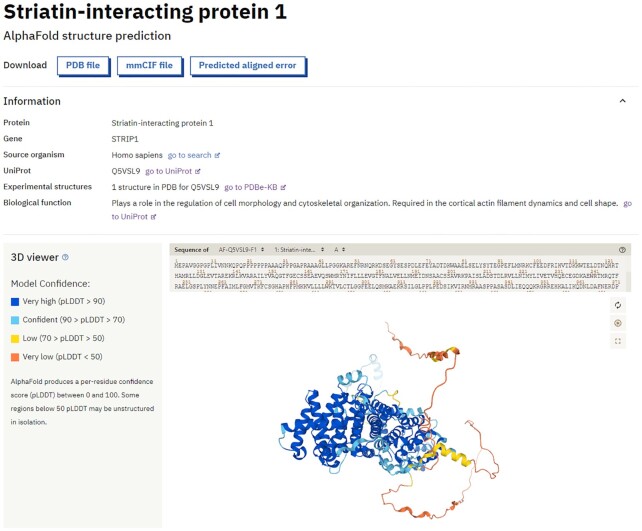
- Predictions include atomic coordinates, per-residue confidence pLDDT on a 0–100 scale, and pairwise Predicted Aligned Error (PAE) in Ångströms capped at 31.75 Å; pLDDT bands are ≥90 very high, 90 > pLDDT ≥ 70 confident, 70 > pLDDT ≥ 50 low, and <50 very low.
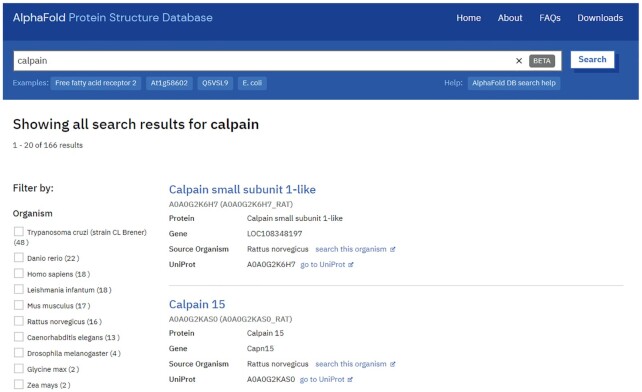
- Data are available via bulk FTP downloads, a public API keyed on UniProt accessions, and protein-specific web pages with interactive visualization using Mol*; metadata are indexed with Apache Solr.
- Planned expansions aim to exceed 1 million structures, including SwissProt and neglected-disease proteomes, followed by >100 million structures for most UniRef90 representative sequences.
Methods
- Database/resource paper describing AlphaFold DB, created by DeepMind and EMBL-EBI, using AlphaFold v2.0 predictions.
- Initial version predicted most sequences in UniProt reference proteomes for 21 organisms in the 16–2700 amino-acid length range, plus 1400-residue fragments for longer human proteins; sequences with non-standard amino acids were excluded, and multiple isoforms were not provided.
- Data archival includes PDB and mmCIF coordinate files, PAE JSON files, and metadata JSON files; access is through FTP, API, and web pages, with confidence metrics stored in B-factor fields and used for coloring in the 3D viewer.
Limitations
- Stated: the initial release excludes isoforms and sequences with unknown or non-standard amino acids, and predictions are limited to 16–2700 amino acids, with 1400-residue fragments for longer human proteins.
- Stated: PAE is asymmetric and capped at 31.75 Å; high PAE values indicate unreliable relative domain positions/orientations, and pLDDT reflects local confidence rather than global accuracy.
- Evident: this is a database/resource description, not an experimental validation study; initial coverage is limited to 21 proteomes, and the paper does not report new accuracy benchmarks beyond citing AlphaFold/CASP14 and prior human-proteome analyses.
Model-written summary. Check it against the paper before relying on it.
Integrity signals
Registry
Cites
Statistics
Figures
Verification
Claims the paper makes
15 No basis given · 12 Not checked yet · 5 Own interpretation · 2 Own result · 1 Partly supported · accuracy not yet measured
A result the paper reports from its own data — it cites no other source for it, so there is none to check. The quote shows it is in the paper.
In the paper
“The initial release of AlphaFold DB contains over 360,000 predicted structures across 21 model-organism proteomes”
- Also stated in: § IMPLEMENTATION · plain
“The initial version of AlphaFold DB contains over 360 000 predicted structures, corresponding meta-information and confidence metrics.”
- Also stated in: § CONCLUSION AND OUTLOOK · plain
“The first release of AlphaFold DB contains over 360 000 predicted structures from 21 model-organism proteomes.”
§ AlphaFold Protein Structure Database: massively expanding the structural coverage of protein-sequence space with high-accuracy models > Abstract
plain- Asserted: passes — The authors put it forward as true.
- Checkable: passes — It can be checked against evidence.
- Load-bearing: passes — The paper’s conclusions depend on it.
- Based: passes — The paper gives a reason why it holds.
- Also stated in: § IMPLEMENTATION · plain
A result the paper reports from its own data — it cites no other source for it, so there is none to check. The quote shows it is in the paper.
In the paper
“The first release described here covers the human proteome and those of 20 other model organisms (Table 1).”
§ AlphaFold Protein Structure Database: massively expanding the structural coverage of protein-sequence space with high-accuracy models > INTRODUCTION
plain- Asserted: passes — The authors put it forward as true.
- Checkable: passes — It can be checked against evidence.
- Load-bearing: unclear — It is unclear whether the paper’s conclusions depend on it.
- Based: passes — The paper gives a reason why it holds.
The paper states this without a source or data behind it here, so there is nothing to check it against. The quote shows it is in the paper.
In the paper
“Model confidence can vary significantly along a chain, making it essential to analyse the confidence measures before interpreting structural features.”
§ AlphaFold Protein Structure Database: massively expanding the structural coverage of protein-sequence space with high-accuracy models > IMPLEMENTATION > AlphaFold DB web pages
plain- Asserted: passes — The authors put it forward as true.
- Checkable: passes — It can be checked against evidence.
- Load-bearing: unclear — It is unclear whether the paper’s conclusions depend on it.
- Based: passes — The paper gives a reason why it holds.
None of the sources cited for this claim have been checked yet.
In the paper
“However, while the Universal Protein Resource (UniProt) archives almost 220 million unique protein sequences, the Protein Data Bank (PDB) holds only just over 180 000 3D structures for over 55 000 distinct proteins, thus severely limiting the coverage of the sequence space to support biomolecular research globally (5–7).”
§ AlphaFold Protein Structure Database: massively expanding the structural coverage of protein-sequence space with high-accuracy models > INTRODUCTION
What the sources say
- Not checked yetcites [5] Bateman, 2021, UniProt: the universal protein knowledgebase in 2021, Nucleic Acids Res. source
- Not checked yetcites [6] Armstrong, 2019, PDBe: improved findability of macromolecular structure data in the PDB, Nucleic Acids Res.
- Not checked yetcites [7] Varadi, 2019, PDBe-KB: a community-driven resource for structural and functional annotations, Nucleic Acids Res.
plain- Asserted: passes — The authors put it forward as true.
- Checkable: passes — It can be checked against evidence.
- Load-bearing: passes — The paper’s conclusions depend on it.
- Based: passes — The paper gives a reason why it holds.
A conclusion the paper draws from its own results — it cites no other source for it, so there is none to check. The quote shows it is in the paper.
In the paper
“Powered by AlphaFold v2.0 of DeepMind, it has enabled an unprecedented expansion of the structural coverage of the known protein-sequence space.”
§ AlphaFold Protein Structure Database: massively expanding the structural coverage of protein-sequence space with high-accuracy models > Abstract
boosteddirect- Asserted: passes — The authors put it forward as true.
- Checkable: passes — It can be checked against evidence.
- Load-bearing: passes — The paper’s conclusions depend on it.
- Based: passes — The paper gives a reason why it holds.
A conclusion the paper draws from its own results — it cites no other source for it, so there is none to check. The quote shows it is in the paper.
In the paper
“The unprecedented accuracy and speed of AlphaFold allowed the creation of an extensive database of structure predictions at a large scale.”
§ AlphaFold Protein Structure Database: massively expanding the structural coverage of protein-sequence space with high-accuracy models > INTRODUCTION
plaindirect- Asserted: passes — The authors put it forward as true.
- Checkable: passes — It can be checked against evidence.
- Load-bearing: passes — The paper’s conclusions depend on it.
- Based: passes — The paper gives a reason why it holds.
In the paper
“In 2020, the organizers of the CASP14 benchmark recognized AlphaFold as a solution to the protein–structure–prediction problem (12).”
§ AlphaFold Protein Structure Database: massively expanding the structural coverage of protein-sequence space with high-accuracy models > INTRODUCTION
What the sources say
- Not checked yetcites [12] Pereira, 2021, High-accuracy protein structure prediction in CASP14, Proteins Struct. Funct. Bioinf. source
plain- Asserted: passes — The authors put it forward as true.
- Checkable: passes — It can be checked against evidence.
- Load-bearing: unclear — It is unclear whether the paper’s conclusions depend on it.
- Based: passes — The paper gives a reason why it holds.
None of the sources cited for this claim have been checked yet.
In the paper
“Although recent advances in the field of electron cryo-microscopy and hybrid and integrative methods (I/HM) for structure determination have accelerated the pace of structure determination, the gap between known protein sequences and experimental protein structures continues to expand (6,8).”
§ AlphaFold Protein Structure Database: massively expanding the structural coverage of protein-sequence space with high-accuracy models > INTRODUCTION
What the sources say
- Not checked yetcites [6] Armstrong, 2019, PDBe: improved findability of macromolecular structure data in the PDB, Nucleic Acids Res.
- Not checked yetcites [8] de Oliveira, 2021, Cryo-EM: the resolution revolution and drug discovery, SLAS Discov. source
plaindirect- Asserted: passes — The authors put it forward as true.
- Checkable: passes — It can be checked against evidence.
- Load-bearing: unclear — It is unclear whether the paper’s conclusions depend on it.
- Based: passes — The paper gives a reason why it holds.
None of the sources cited for this claim have been checked yet.
In the paper
“thus severely limiting the coverage of the sequence space to support biomolecular research globally (5–7).”
§ AlphaFold Protein Structure Database: massively expanding the structural coverage of protein-sequence space with high-accuracy models > INTRODUCTION
What the sources say
- Not checked yetcites [5] Bateman, 2021, UniProt: the universal protein knowledgebase in 2021, Nucleic Acids Res. source
- Not checked yetcites [6] Armstrong, 2019, PDBe: improved findability of macromolecular structure data in the PDB, Nucleic Acids Res.
- Not checked yetcites [7] Varadi, 2019, PDBe-KB: a community-driven resource for structural and functional annotations, Nucleic Acids Res.
boosted- Asserted: passes — The authors put it forward as true.
- Checkable: passes — It can be checked against evidence.
- Load-bearing: passes — The paper’s conclusions depend on it.
- Based: passes — The paper gives a reason why it holds.
None of the sources cited for this claim have been checked yet.
In the paper
“Although recent advances in the field of electron cryo-microscopy and hybrid and integrative methods (I/HM) for structure determination have accelerated the pace of structure determination, the gap between known protein sequences and experimental protein structures continues to expand (6,8).”
§ AlphaFold Protein Structure Database: massively expanding the structural coverage of protein-sequence space with high-accuracy models > INTRODUCTION
What the sources say
- Not checked yetcites [6] Armstrong, 2019, PDBe: improved findability of macromolecular structure data in the PDB, Nucleic Acids Res.
- Not checked yetcites [8] de Oliveira, 2021, Cryo-EM: the resolution revolution and drug discovery, SLAS Discov. source
plaincorrelational- Asserted: passes — The authors put it forward as true.
- Checkable: passes — It can be checked against evidence.
- Load-bearing: passes — The paper’s conclusions depend on it.
- Based: passes — The paper gives a reason why it holds.
- Probably not a substantial claim. 19
- It may state two separate claims as one. 10
The cited sources support only part of this claim — read each source’s verdict below.
In the paper
“As a confidence metric based on lDDT, pLDDT also reflects local confidence in the structure, and should be used, for example, to assess confidence within a single domain.”
§ AlphaFold Protein Structure Database: massively expanding the structural coverage of protein-sequence space with high-accuracy models > IMPLEMENTATION
What the sources say
- Partly supportedcites [14] Mariani, 2013, lDDT: a local superposition-free score for comparing protein structures and models using distance difference tests, Bioinformatics sourceExperimental — accuracy not yet measured
Section 3.3 says per-residue lDDT scores reflect the accuracy of a model’s local atomic environment, including within individual domains. The paper describes lDDT as a comparison with a reference structure; it does not address pLDDT or establish that pLDDT measures predicted local confidence. (LLM, conf=0.85)
plaincorrelational- Asserted: passes — The authors put it forward as true.
- Checkable: passes — It can be checked against evidence.
- Load-bearing: fails — The paper’s conclusions may not depend on it.
- Based: passes — The paper gives a reason why it holds.
Probably not a substantial claim. The paper’s conclusions may not depend on it.
- Partly supported
The paper states this without a source or data behind it here, so there is nothing to check it against. The quote shows it is in the paper.
In the paper
“The AlphaFold Protein Structure Database (AlphaFold DB, https://alphafold.ebi.ac.uk) is an openly accessible, extensive database of high-accuracy protein-structure predictions.”
§ AlphaFold Protein Structure Database: massively expanding the structural coverage of protein-sequence space with high-accuracy models > Abstract
plain- Asserted: passes — The authors put it forward as true.
- Checkable: passes — It can be checked against evidence.
- Load-bearing: passes — The paper’s conclusions depend on it.
- Based: passes — The paper gives a reason why it holds.
It may state two separate claims as one.
The paper states this without a source or data behind it here, so there is nothing to check it against. The quote shows it is in the paper.
In the paper
“The predicted structures contain atomic coordinates and per-residue confidence estimates on a scale from 0 to 100, with higher scores corresponding to higher confidence.”
§ AlphaFold Protein Structure Database: massively expanding the structural coverage of protein-sequence space with high-accuracy models > IMPLEMENTATION
plaincorrelational- Asserted: passes — The authors put it forward as true.
- Checkable: passes — It can be checked against evidence.
- Load-bearing: fails — The paper’s conclusions may not depend on it.
- Based: passes — The paper gives a reason why it holds.
Probably not a substantial claim. The paper’s conclusions may not depend on it. It may state two separate claims as one.
The paper states this without a source or data behind it here, so there is nothing to check it against. The quote shows it is in the paper.
In the paper
“Powered by AlphaFold v2.0 of DeepMind”
§ AlphaFold Protein Structure Database: massively expanding the structural coverage of protein-sequence space with high-accuracy models > Abstract
plaindirect- Asserted: passes — The authors put it forward as true.
- Checkable: passes — It can be checked against evidence.
- Load-bearing: passes — The paper’s conclusions depend on it.
- Based: passes — The paper gives a reason why it holds.
Probably not a substantial claim.
The paper states this without a source or data behind it here, so there is nothing to check it against. The quote shows it is in the paper.
In the paper
“AlphaFold DB provides programmatic access to and interactive visualization of predicted atomic coordinates, per-residue and pairwise model-confidence estimates and predicted aligned errors.”
§ AlphaFold Protein Structure Database: massively expanding the structural coverage of protein-sequence space with high-accuracy models > Abstract
plain- Asserted: passes — The authors put it forward as true.
- Checkable: passes — It can be checked against evidence.
- Load-bearing: fails — The paper’s conclusions may not depend on it.
- Based: passes — The paper gives a reason why it holds.
Probably not a substantial claim. The paper’s conclusions may not depend on it. It may state two separate claims as one.
The paper states this without a source or data behind it here, so there is nothing to check it against. The quote shows it is in the paper.
In the paper
“All the data are publicly accessible through a cloud-based infrastructure.”
§ AlphaFold Protein Structure Database: massively expanding the structural coverage of protein-sequence space with high-accuracy models > IMPLEMENTATION
plain- Asserted: passes — The authors put it forward as true.
- Checkable: passes — It can be checked against evidence.
- Load-bearing: fails — The paper’s conclusions may not depend on it.
- Based: passes — The paper gives a reason why it holds.
Probably not a substantial claim. The paper’s conclusions may not depend on it.
The paper states this without a source or data behind it here, so there is nothing to check it against. The quote shows it is in the paper.
In the paper
“We provide access to all entries through a public API endpoint, keyed on a UniProt accession.”
§ AlphaFold Protein Structure Database: massively expanding the structural coverage of protein-sequence space with high-accuracy models > IMPLEMENTATION > Data access
plain- Asserted: passes — The authors put it forward as true.
- Checkable: passes — It can be checked against evidence.
- Load-bearing: fails — The paper’s conclusions may not depend on it.
- Based: passes — The paper gives a reason why it holds.
Probably not a substantial claim. The paper’s conclusions may not depend on it.
The paper states this without a source or data behind it here, so there is nothing to check it against. The quote shows it is in the paper.
In the paper
“AlphaFold DB archives and provides access to the atomic coordinates in PDB and mmCIF formats, PAEs in JSON format and corresponding metadata in JSON format.”
§ AlphaFold Protein Structure Database: massively expanding the structural coverage of protein-sequence space with high-accuracy models > IMPLEMENTATION > Data archival
plain- Asserted: passes — The authors put it forward as true.
- Checkable: passes — It can be checked against evidence.
- Load-bearing: fails — The paper’s conclusions may not depend on it.
- Based: passes — The paper gives a reason why it holds.
Probably not a substantial claim. The paper’s conclusions may not depend on it. It may state two separate claims as one.
None of the sources cited for this claim have been checked yet.
In the paper
“Each protein has a dedicated structure page that shows basic information (drawn from UniProt (5) and PDBe (6)) and three separate outputs of the AlphaFold model.”
§ AlphaFold Protein Structure Database: massively expanding the structural coverage of protein-sequence space with high-accuracy models > IMPLEMENTATION > AlphaFold DB web pages
What the sources say
- Not checked yetcites [5] Bateman, 2021, UniProt: the universal protein knowledgebase in 2021, Nucleic Acids Res. source
- Not checked yetcites [6] Armstrong, 2019, PDBe: improved findability of macromolecular structure data in the PDB, Nucleic Acids Res.
plain- Asserted: passes — The authors put it forward as true.
- Checkable: passes — It can be checked against evidence.
- Load-bearing: fails — The paper’s conclusions may not depend on it.
- Based: passes — The paper gives a reason why it holds.
Probably not a substantial claim. The paper’s conclusions may not depend on it. It may state two separate claims as one.
The paper states this without a source or data behind it here, so there is nothing to check it against. The quote shows it is in the paper.
In the paper
“The data files in the archive are versioned, and previous snapshots of the data will be available via FTP, but the web pages will always display the latest version.”
§ AlphaFold Protein Structure Database: massively expanding the structural coverage of protein-sequence space with high-accuracy models > IMPLEMENTATION > Data archival
plain- Asserted: passes — The authors put it forward as true.
- Checkable: passes — It can be checked against evidence.
- Load-bearing: fails — The paper’s conclusions may not depend on it.
- Based: passes — The paper gives a reason why it holds.
Probably not a substantial claim. The paper’s conclusions may not depend on it. It may state two separate claims as one.
The paper states this without a source or data behind it here, so there is nothing to check it against. The quote shows it is in the paper.
In the paper
“AlphaFold DB provides graphical access to and interactive visualization of all the predictions and meta-information for the broader scientific community through web pages.”
§ AlphaFold Protein Structure Database: massively expanding the structural coverage of protein-sequence space with high-accuracy models > IMPLEMENTATION > Data access
plain- Asserted: passes — The authors put it forward as true.
- Checkable: passes — It can be checked against evidence.
- Load-bearing: fails — The paper’s conclusions may not depend on it.
- Based: passes — The paper gives a reason why it holds.
Probably not a substantial claim. The paper’s conclusions may not depend on it.
The paper states this without a source or data behind it here, so there is nothing to check it against. The quote shows it is in the paper.
In the paper
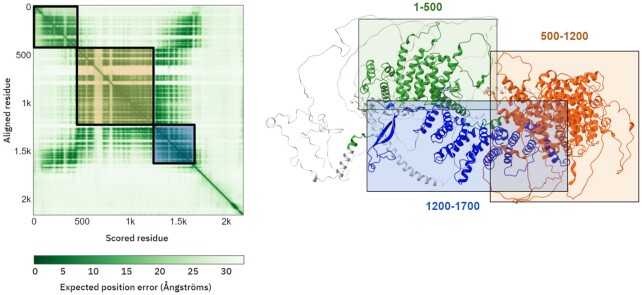
“The third output is a pairwise confidence prediction, which helps to assess the reliability of relative domain positions and orientations as well as the global topology of the protein (Figure 3).”
§ AlphaFold Protein Structure Database: massively expanding the structural coverage of protein-sequence space with high-accuracy models > IMPLEMENTATION > AlphaFold DB web pages
plaindirect- Asserted: passes — The authors put it forward as true.
- Checkable: passes — It can be checked against evidence.
- Load-bearing: fails — The paper’s conclusions may not depend on it.
- Based: passes — The paper gives a reason why it holds.
Probably not a substantial claim. The paper’s conclusions may not depend on it.
The paper states this without a source or data behind it here, so there is nothing to check it against. The quote shows it is in the paper.
In the paper
“The data set contains proteins with sequence lengths of 16–2700 and excludes isoforms and sequences with unknown or non-standard amino acids.”
§ AlphaFold Protein Structure Database: massively expanding the structural coverage of protein-sequence space with high-accuracy models > INTRODUCTION
plain- Asserted: passes — The authors put it forward as true.
- Checkable: passes — It can be checked against evidence.
- Load-bearing: unclear — It is unclear whether the paper’s conclusions depend on it.
- Based: passes — The paper gives a reason why it holds.
It may state two separate claims as one.
None of the sources cited for this claim have been checked yet.
In the paper
“UniProt (5), Pfam (18), InterPro (19) and PDBe-KB (7) use this API to display AlphaFold models on their web pages.”
§ AlphaFold Protein Structure Database: massively expanding the structural coverage of protein-sequence space with high-accuracy models > IMPLEMENTATION > Data access
What the sources say
- Not checked yetcites [5] Bateman, 2021, UniProt: the universal protein knowledgebase in 2021, Nucleic Acids Res. source
- Not checked yetcites [18] Mistry, 2021, Pfam: The protein families database in 2021, Nucleic Acids Res. source
- Not checked yetcites [19] Blum, 2021, The InterPro protein families and domains database: 20 years on, Nucleic Acids Res. source
plaindirect- Asserted: passes — The authors put it forward as true.
- Checkable: passes — It can be checked against evidence.
- Load-bearing: fails — The paper’s conclusions may not depend on it.
- Based: passes — The paper gives a reason why it holds.
Probably not a substantial claim. The paper’s conclusions may not depend on it.
The paper states this without a source or data behind it here, so there is nothing to check it against. The quote shows it is in the paper.
In the paper
“AlphaFold DB provides predictions through several data-access mechanisms: (i) bulk downloads via FTP; (ii) programmatic access via an application programming interface (API); (iii) download and interactive visualization of individual predictions on protein-specific web pages keyed on UniProt accessions.”
§ AlphaFold Protein Structure Database: massively expanding the structural coverage of protein-sequence space with high-accuracy models > IMPLEMENTATION > Data access
plain- Asserted: passes — The authors put it forward as true.
- Checkable: passes — It can be checked against evidence.
- Load-bearing: fails — The paper’s conclusions may not depend on it.
- Based: passes — The paper gives a reason why it holds.
Probably not a substantial claim. The paper’s conclusions may not depend on it. It may state two separate claims as one.
A conclusion the paper draws from its own results — it cites no other source for it, so there is none to check. The quote shows it is in the paper.
In the paper
“For residues x and y in two different domains, if the PAE values (x, y) are low, AlphaFold predicts the domains to have well-defined relative positions and orientations.”
§ AlphaFold Protein Structure Database: massively expanding the structural coverage of protein-sequence space with high-accuracy models > IMPLEMENTATION
plainconditional- Asserted: passes — The authors put it forward as true.
- Checkable: passes — It can be checked against evidence.
- Load-bearing: fails — The paper’s conclusions may not depend on it.
- Based: passes — The paper gives a reason why it holds.
Probably not a substantial claim. The paper’s conclusions may not depend on it.
In the paper
“AlphaFold is an AI system developed by DeepMind that makes state-of-the-art predictions of protein structures from their amino-acid sequences (9).”
§ AlphaFold Protein Structure Database: massively expanding the structural coverage of protein-sequence space with high-accuracy models > INTRODUCTION
What the sources say
- Not checked yetcites [9] Jumper, 2021, Highly accurate protein structure prediction with AlphaFold, Nature source
plaindirect- Asserted: passes — The authors put it forward as true.
- Checkable: passes — It can be checked against evidence.
- Load-bearing: passes — The paper’s conclusions depend on it.
- Based: passes — The paper gives a reason why it holds.
It may state two separate claims as one.
None of the sources cited for this claim have been checked yet.
In the paper
“However, while the Universal Protein Resource (UniProt) archives almost 220 million unique protein sequences, the Protein Data Bank (PDB) holds only just over 180 000 3D structures for over 55 000 distinct proteins, thus severely limiting the coverage of the sequence space to support biomolecular research globally (5–7).”
§ AlphaFold Protein Structure Database: massively expanding the structural coverage of protein-sequence space with high-accuracy models > INTRODUCTION
What the sources say
- Not checked yetcites [5] Bateman, 2021, UniProt: the universal protein knowledgebase in 2021, Nucleic Acids Res. source
- Not checked yetcites [6] Armstrong, 2019, PDBe: improved findability of macromolecular structure data in the PDB, Nucleic Acids Res.
- Not checked yetcites [7] Varadi, 2019, PDBe-KB: a community-driven resource for structural and functional annotations, Nucleic Acids Res.
plain- Asserted: passes — The authors put it forward as true.
- Checkable: passes — It can be checked against evidence.
- Load-bearing: passes — The paper’s conclusions depend on it.
- Based: passes — The paper gives a reason why it holds.
It may state two separate claims as one.
In the paper
“It was recently described that very low confidence pLDDT scores correlate with high propensities for intrinsic disorder (17).”
§ AlphaFold Protein Structure Database: massively expanding the structural coverage of protein-sequence space with high-accuracy models > IMPLEMENTATION
What the sources say
- Not checked yetcites [17] Akdel, 2021, A structural biology community assessment of AlphaFold 2 applications Biophysics
plaincorrelational- Asserted: passes — The authors put it forward as true.
- Checkable: passes — It can be checked against evidence.
- Load-bearing: fails — The paper’s conclusions may not depend on it.
- Based: passes — The paper gives a reason why it holds.
Probably not a substantial claim. The paper’s conclusions may not depend on it.
A conclusion the paper draws from its own results — it cites no other source for it, so there is none to check. The quote shows it is in the paper.
In the paper
“If the PAE values are high, then the relative position and orientation of the two domains are unreliable, and users should not attach biological or structural relevance to these.”
§ AlphaFold Protein Structure Database: massively expanding the structural coverage of protein-sequence space with high-accuracy models > IMPLEMENTATION
plaindirect- Asserted: passes — The authors put it forward as true.
- Checkable: passes — It can be checked against evidence.
- Load-bearing: fails — The paper’s conclusions may not depend on it.
- Based: passes — The paper gives a reason why it holds.
Probably not a substantial claim. The paper’s conclusions may not depend on it.
The paper states this without a source or data behind it here, so there is nothing to check it against. The quote shows it is in the paper.
In the paper
“However, figuring out the exact structure of a protein remains an expensive and often time-consuming process.”
§ AlphaFold Protein Structure Database: massively expanding the structural coverage of protein-sequence space with high-accuracy models > CONCLUSION AND OUTLOOK
plain- Asserted: passes — The authors put it forward as true.
- Checkable: passes — It can be checked against evidence.
- Load-bearing: passes — The paper’s conclusions depend on it.
- Based: fails — The paper may give no reason why it holds.
Probably not a substantial claim. The paper may give no reason why it holds.
In the paper
“The lower confidence bands appear to correlate well with backbone flexibility and intrinsic disorder (13) (Figure 2).”
§ AlphaFold Protein Structure Database: massively expanding the structural coverage of protein-sequence space with high-accuracy models > IMPLEMENTATION > AlphaFold DB web pages
What the sources say
- Not checked yetcites [13] Tunyasuvunakool, 2021, Highly accurate protein structure prediction for the human proteome, Nature source
hedgedcorrelational- Asserted: passes — The authors put it forward as true.
- Checkable: passes — It can be checked against evidence.
- Load-bearing: fails — The paper’s conclusions may not depend on it.
- Based: passes — The paper gives a reason why it holds.
Probably not a substantial claim. The paper’s conclusions may not depend on it.
In the paper
“Since the mid-1950s, the scientific community has been using ever-more advanced experimental methods to determine over 180 000 structures of proteins, nucleic acids, and complexes in atomic detail, and archive them in the PDB, the single worldwide archive of experimental macromolecular structure data managed by the wwPDB consortium (21).”
§ AlphaFold Protein Structure Database: massively expanding the structural coverage of protein-sequence space with high-accuracy models > CONCLUSION AND OUTLOOK
What the sources say
- Not checked yetcites [21] wwPDB consortium, 2018, Protein Data Bank: the single global archive for 3D macromolecular structure data, Nucleic Acids Res. source
plain- Asserted: passes — The authors put it forward as true.
- Checkable: passes — It can be checked against evidence.
- Load-bearing: fails — The paper’s conclusions may not depend on it.
- Based: passes — The paper gives a reason why it holds.
Probably not a substantial claim. The paper’s conclusions may not depend on it.
Claims other papers make about this one
Each is checked against this paper’s own text: does it say what the citing paper says it does?
The source backs part of the claim, not all of it — or backs it for a different population, condition or comparison.
In the citing paper
“The new CC+ database includes both experimentally derived CCs from the RCSB PDB (Bittrich et al., 2022) and predicted AlphaFold2 models for 48 proteomes (https://alphafold.ebi.ac.uk/; Varadi et al., 2022).”
From CC + : A searchable database of validated coiled coils in PDB structures and AlphaFold2 models (2023) · cites this paper as Varadi et al., 2022
Experimental — accuracy not yet measuredThe source backs part of the claim, not all of it — or backs it for a different population, condition or comparison.
In the citing paper
“we posit that AlphaFold (Jumper et al., 2021;Varadi et al., 2021) is a Level 5 Narrow AI (“Superhuman Narrow AI”) since it performs a single task (predicting a protein's 3D structure from an amino acid sequence) above the level of the world's top scientists.”
From Levels of AGI for Operationalizing Progress on the Path to AGI (2023) · cites this paper as Varadi et al., 2021
Experimental — accuracy not yet measuredIn the citing paper
“houses over 200 million pre-run AF2 predictions”
From The power and pitfalls of AlphaFold2 for structure prediction beyond rigid globular proteins (2024) · cites this paper as [6]
In the citing paper
“AF2 also generates a Predicted Aligned Error (PAE) matrix, which evaluates the relative orientation and position of different parts (i.e., domains) of the model6”
From The power and pitfalls of AlphaFold2 for structure prediction beyond rigid globular proteins (2024) · cites this paper as [6]
In the citing paper
“Likewise, AlphaFold2 provides a per-residue confidence measure that allows researchers to judge the quality of the predicted structure.281”
From Advancing Targeted Protein Degradation via Multiomics Profiling and Artificial Intelligence (2023) · cites this paper as [281]
In the citing paper
“over 214 million predicted structures are available in the AlphaFold database2”
From Clustering predicted structures at the scale of the known protein universe (2023) · cites this paper as [2]
In the citing paper
“The European Bioinformatics Institute already holds over 214 million structures predicted by AlphaFold2 (ref. 3)”
From Fast and accurate protein structure search with Foldseek (2024) · cites this paper as [3]
Citations
Cites
Highly accurate protein structure prediction with AlphaFold
Jumper, J., Evans, R., Pritzel, A., Green, T., Figurnov, M., Ronneberger, O., Tunyasuvunakool, K., Bates, R., Žídek, A., Potapenko, A., et al. (2021) · Nature · doi:10.1038/s41586-021-03819-2 · Cited by 43,764
Self-citationPfam: The protein families database in 2021
Mistry, J., Chuguransky, S., Williams, L., Qureshi, M., Salazar, G. A., Sonnhammer, E. L. L., Tosatto, S. C. E., Paladin, L., Raj, S., Richardson, L. J., et al. (2021) · Nucleic Acids Research · doi:10.1093/nar/gkaa913 · Cited by 7,452
UniProt: the universal protein knowledgebase in 2021
The UniProt Consortium, Bateman, A., Martin, M.-J., Orchard, S., Magrane, M., Agivetova, R., Ahmad, S., Alpi, E., Bowler-Barnett, E. H., Britto, R., et al. (2021) · Nucleic Acids Research · doi:10.1093/nar/gkaa1100 · Cited by 6,372
Accurate prediction of protein structures and interactions using a 3-track network
Baek, M., DiMaio, F., Anishchenko, I., Dauparas, J., Ovchinnikov, S., Lee, G. R., Wang, J., Cong, Q., Kinch, L. N., Schaeffer, R. D., et al. (2021) · doi:10.1101/2021.06.14.448402 · Cited by 5,549
Highly accurate protein structure prediction for the human proteome
Tunyasuvunakool, K., Adler, J., Wu, Z., Green, T., Zielinski, M., Žídek, A., Bridgland, A., Cowie, A., Meyer, C., Laydon, A., et al. (2021) · Nature · doi:10.1038/s41586-021-03828-1 · Cited by 3,025 · cited 4×
“The methodology of AlphaFold and insights gained from the predictions for the complete human proteome have been described recently (9,13).”
BackgroundMethodInfluentialSelf-citationThe InterPro protein families and domains database: 20 years on
Blum, M., Chang, H.-Y., Chuguransky, S., Grego, T., Kandasaamy, S., Mitchell, A., Nuka, G., Paysan-Lafosse, T., Qureshi, M., Raj, S., et al. (2021) · Nucleic Acids Research · doi:10.1093/nar/gkaa977 · Cited by 2,231
Protein Data Bank: the single global archive for 3D macromolecular structure data
wwPDB consortium, Burley, S. K., Berman, H. M., Bhikadiya, C., Bi, C., Chen, L., Costanzo, L. D., Christie, C., Duarte, J. M., Dutta, S., et al. (2019) · Nucleic Acids Research · doi:10.1093/nar/gky949 · Cited by 1,163
Self-citationMol* Viewer: modern web app for 3D visualization and analysis of large biomolecular structures
Sehnal, D., Bittrich, S., Deshpande, M., Svobodová, R., Berka, K., Bazgier, V., Velankar, S., Burley, S. K., Koča, J., & Rose, A. S. (2021) · Nucleic Acids Research · doi:10.1093/nar/gkab314 · Cited by 1,154
Self-citationMariani, V., Biasini, M., Barbato, A., & Schwede, T. (2013) · Bioinformatics · doi:10.1093/bioinformatics/btt473 · Cited by 1,138
QMEANDisCo—distance constraints applied on model quality estimation
Studer, G., Rempfer, C., Waterhouse, A. M., Gumienny, R., Haas, J., & Schwede, T. F. (2019) · Bioinformatics · doi:10.1093/bioinformatics/btz828 · Cited by 1,082
Cited by
Sorted by citations
Items 801–900 of 1,065
Wallner, E., Mair, A., Handler, D., McWhite, C. D., Xu, S., Dolan, L., & Bergmann, D. C. (2024) · Developmental Cell · doi:10.1016/j.devcel.2024.03.001 · Cited by 29
Zhao, F., Qiu, J., Xiang, D., Jiao, P., Cao, Y., Xu, Q., Qiao, D., Xu, H., & Cao, Y. (2024) · PeerJ · doi:10.7717/peerj.17729 · Cited by 31
Deciphering 3'UTR Mediated Gene Regulation Using Interpretable Deep Representation Learning
Yang, Y., Li, G. L., Pang, K., Cao, W., Zhang, Z., & Li, X. (2024) · Advanced Science · doi:10.1002/advs.202407013 · Cited by 42
Systematic in vitro evolution in Plasmodium falciparum reveals key determinants of drug resistance
Luth, M. R., Godinez‐Macias, K. P., Chen, D., Okombo, J., Thathy, V., Cheng, X., Daggupati, S., Davies, H. M., Dhingra, S. K., Economy, J. M., et al. (2024) · Science · doi:10.1126/science.adk9893 · Cited by 27
In situ analysis reveals the TRiC duty cycle and PDCD5 as an open-state cofactor
Xing, H., Rosenkranz, R. R. E., Rodriguez-Aliaga, P., Lee, T.-T., Majtner, T., Böhm, S., Turoňová, B., Frydman, J., & Beck, M. (2024) · Nature · doi:10.1038/s41586-024-08321-z · Cited by 30
Dominguez-Gortaire, J. A., Ruiz, A., Porto-Pazos, A. B., Rodríguez, S., & Cedrón, F. (2025) · International Journal of Molecular Sciences · doi:10.3390/ijms26031004 · Cited by 35
Tagirdzhanova, G. M., Scharnagl, K., Sahu, N., Xia, Y., Bucknell, A., Bentham, A. R., Jégousse, C., Ament‐Velásquez, S. L., Brännström, I. O., Johannesson, H., et al. (2025) · Current Biology · doi:10.1016/j.cub.2024.12.041 · Cited by 31
Gaia: An AI-enabled genomic context–aware platform for protein sequence annotation
Jha, N., Kravitz, J., West-Roberts, J., Lu, C., Camargo, A. P., Roux, S., Cornman, A., & Hwang, Y. (2025) · Science Advances · doi:10.1126/sciadv.adv5109 · Cited by 36
Principles of cotranslational mitochondrial protein import
Zhu, Z., Mallik, S., Stevens, T. A., Huang, R., Levy, E. D., & Shan, S. (2025) · Cell · doi:10.1016/j.cell.2025.07.021 · Cited by 36
Characterization and application of a thermophilic Argonaute from archaeon Thermococcus thioreducens
Fang, M., Xu, Z., Xu, Z., et al. (2022) · Biotechnology and Bioengineering · doi:10.1002/bit.28153 · Cited by 30
Dihydrouridine in the Transcriptome: New Life for This Ancient RNA Chemical Modification
Brégeon, D., Pecqueur, L., Toubdji, S., Sudol, C., Lombard, M., Fontecave, M., de Crécy‐Lagard, V., Motorin, Y., Helm, M., & Hamdane, D. (2022) · ACS Chemical Biology · doi:10.1021/acschembio.2c00307 · Cited by 26
Structural insights into GABA transport inhibition using an engineered neurotransmitter transporter
Joseph, D., Nayak, S. R., & Penmatsa, A. (2022) · The EMBO Journal · doi:10.15252/embj.2022110735 · Cited by 30
Prokaryotic Na+/H+ Exchangers—Transport Mechanism and Essential Residues
Patiño-Ruiz, M., Ganea, C., & Călinescu, O. (2022) · International Journal of Molecular Sciences · doi:10.3390/ijms23169156 · Cited by 23
Phosphoregulation of the septin cytoskeleton in neuronal development and disease
Werner, B., & Yadav, S. (2022) · Cytoskeleton · doi:10.1002/cm.21728 · Cited by 28
Calvani, N. E. D., Veríssimo, C. D. M., Jewhurst, H., Cwiklinski, K., Flaus, A., & Dalton, J. P. (2022) · Antioxidants · doi:10.3390/antiox11101968 · Cited by 30
BRCA1 deficiency in triple-negative breast cancer: Protein stability as a basis for therapy
Choi, E. A., Mun, G., Lee, J., Lee, H., Cho, J., & Lee, Y. (2022) · Biomedicine & Pharmacotherapy · doi:10.1016/j.biopha.2022.114090 · Cited by 34
Wachter, J., Cheff, B., Hillman, C., et al. (2023) · Nature Communications · doi:10.1038/s41467-023-35897-3 · Cited by 28
CCPG1 recognizes endoplasmic reticulum luminal proteins for selective ER-phagy
Ishii, S., Chino, H., Ode, K. L., Kurikawa, Y., Ueda, H. R., Matsuura, A., Mizushima, N., & Itakura, E. (2023) · Molecular Biology of the Cell · doi:10.1091/mbc.e22-09-0432 · Cited by 29
Varadi, M., Bordin, N., Orengo, C., & Velankar, S. (2023) · Current Opinion in Structural Biology · doi:10.1016/j.sbi.2023.102543 · Cited by 29
Self-citationThe role of demethylase AlkB homologs in cancer
Li, Q., & Zhu, Q. (2023) · Frontiers in Oncology · doi:10.3389/fonc.2023.1153463 · Cited by 31
Li, J., Ahmad, M. Z., Sang, L., Zhan, Y., Wang, Y., Yan, Y., Liu, Y., Mi, W., Lu, M., Dai, Y., et al. (2023) · Journal of Biological Chemistry · doi:10.1016/j.jbc.2023.104738 · Cited by 30
Infection leaves a genetic and functional mark on the gut population of a commensal bacterium
Tawk, C., Lim, B., Bencivenga-Barry, N. A., Lees, H., Ramos, R. J. F., Cross, J. R., & Goodman, A. L. (2023) · Cell Host & Microbe · doi:10.1016/j.chom.2023.04.005 · Cited by 26
Co-translational binding of importins to nascent proteins
Seidel, M., Romanov, N., Obarska-Kosińska, A., Becker, A., de Azevedo, N. T. D., Provaznik, J., Nagaraja, S. R., Landry, J. J. M., Beneš, V., & Beck, M. (2023) · Nature Communications · doi:10.1038/s41467-023-39150-9 · Cited by 27
PyInteraph2 and PyInKnife2 to Analyze Networks in Protein Structural Ensembles
Sora, V., Tiberti, M., Beltrame, L., Doğan, D., Robbani, S. M., Rubin, J. B., & Papaleo, E. (2023) · Journal of Chemical Information and Modeling · doi:10.1021/acs.jcim.3c00574 · Cited by 29
Barrett, J. R., Pipini, D., Wright, N. D., Cooper, A. J. R., Gorini, G., Quinkert, D., Lias, A. M., Davies, H. D., Rigby, C. A., Aleshnick, M., et al. (2024) · Cell · doi:10.1016/j.cell.2024.06.015 · Cited by 30
Martinize2 and Vermouth: Unified Framework for Topology GenerationPreprint
Kroon, P., Grunewald, F., Barnoud, J., van Tilburg, M., Souza, P., Wassenaar, T. A., & Marrink, . J. (2024) · eLife · doi:10.7554/elife.90627.2 · Cited by 31
Computing the Human InteractomePreprint
Zhang, J., Humphreys, I. R., Pei, J., Kim, J., Choi, C., Yuan, R., Durham, J., Liu, S., Choi, H., Baek, M., et al. (2024) · bioRxiv (Cold Spring Harbor Laboratory) · doi:10.1101/2024.10.01.615885 · Cited by 27
Robust proteome profiling of cysteine-reactive fragments using label-free chemoproteomics
Biggs, G. S., Cawood, E. E., Vuorinen, A., McCarthy, W. J., Wilders, H., Riziotis, I. G., van der Zouwen, A. J., Pettinger, J., Nightingale, L., Chen, P., et al. (2025) · Nature Communications · doi:10.1038/s41467-024-55057-5 · Cited by 36
Liu, S., Xia, X., Zhen, J., Li, Z., & Zhou, Z. H. (2022) · Cell Discovery · doi:10.1038/s41421-022-00487-y · Cited by 29
Gestuveo, R. J., Parry, R. H., Dickson, L. B., et al. (2022) · PLoS Pathogens · doi:10.1371/journal.ppat.1010202 · Cited by 28
Wu, J., McAuliffe, O. E., & O'Byrne, C. P. (2023) · International Journal of Food Microbiology · doi:10.1016/j.ijfoodmicro.2023.110165 · Cited by 27
Yeast PIC-mediator structure with RNA polymerase II C-terminal domain
Schilbach, S., Wang, H., Dienemann, C., & Cramer, P. (2023) · Proceedings of the National Academy of Sciences · doi:10.1073/pnas.2220542120 · Cited by 26
Zelnik, I. D., Mestre, B., Weinstein, J. J., Dingjan, T., Izrailov, S., Ben‐Dor, S., Fleishman, S. J., & Futerman, A. H. (2023) · Nature Communications · doi:10.1038/s41467-023-38047-x · Cited by 28
Enzyme Databases in the Era of Omics and Artificial Intelligence
Prešern, U., & Goličnik, M. (2023) · International Journal of Molecular Sciences · doi:10.3390/ijms242316918 · Cited by 32
Active DHEA uptake in the prostate gland correlates with aggressive prostate cancer
Zhang, X., Wang, Z., Huang, S., He, D., Yan, W., Zhuang, Q., Wang, Z., Wang, C., Tan, Q., Liu, Z., et al. (2023) · Journal of Clinical Investigation · doi:10.1172/jci171199 · Cited by 28
Intrinsically disordered proteins studied by NMR spectroscopy
Schiavina, M., Bracaglia, L., Bolognesi, T., Rodella, M. A., Tagliaferro, G., Tino, A. S., Pierattelli, R., & Felli, I. C. (2023) · Journal of Magnetic Resonance Open · doi:10.1016/j.jmro.2023.100143 · Cited by 30
Nourbakhsh, M., Degn, K., Saksager, A. B., Tiberti, M., & Papaleo, E. (2023) · Briefings in Bioinformatics · doi:10.1093/bib/bbad519 · Cited by 33
Structural basis of U12-type intron engagement by the fully assembled human minor spliceosome
Bai, R., Yuan, M., Zhang, P., Luo, T., Shi, Y., & Wan, R. (2024) · Science · doi:10.1126/science.adn7272 · Cited by 31
Yang, H., Liu, C., Lin, X., Li, X., Zeng, S., Gong, Z., Xu, Q., Li, D., & Li, N. (2024) · Archives of Biochemistry and Biophysics · doi:10.1016/j.abb.2024.109965 · Cited by 29
Functional and structural insights into activation of TRPV2 by weak acids
Haug, F. M., Pumroy, R. A., Sridhar, A., et al. (2024) · The EMBO Journal · doi:10.1038/s44318-024-00106-4 · Cited by 29
Chaperone regulation of biomolecular condensates
Bard, J. A. M., & Drummond, D. A. (2024) · Frontiers in Biophysics · doi:10.3389/frbis.2024.1342506 · Cited by 25
Aggrescan4D: structure-informed analysis of pH-dependent protein aggregation
Bárcenas, O., Kuriata, A., Zalewski, M., Iglesias, V., Pintado‐Grima, C., Firlik, G., Burdukiewicz, M. J., Kmiecik, S., & Ventura, S. (2024) · Nucleic Acids Research · doi:10.1093/nar/gkae382 · Cited by 28
Camilo, N. M., Liu, J., Ramírez, M. J., Canales-Salgado, P., Alegría, J. J., Liu, X., Ong, H. T., Barrera, N. P., Fierro, A., Toyama, Y., et al. (2024) · Nature Communications · doi:10.1038/s41467-024-49850-5 · Cited by 28
Rots, D., Choufani, S., Faùndes, V., Dingemans, A. J. M., Joss, S. K., Foulds, N. C., Jones, E. A., Stewart, S., Vasudevan, P. C., Dabir, T. A., et al. (2024) · The American Journal of Human Genetics · doi:10.1016/j.ajhg.2024.06.009 · Cited by 30
Self-citationDeep learning methods for protein structure prediction
Qin, Y., Chen, Z., Ye, P., Xiao, Y., Zhong, T., & Yu, X. (2024) · MedComm – Future Medicine · doi:10.1002/mef2.96 · Cited by 33
Protein language models are performant in structure-free virtual screening
Lam, H. Y. I., Guan, J. S., Ong, X. E., Pincket, R., & Mu, Y. (2024) · Briefings in Bioinformatics · doi:10.1093/bib/bbae480 · Cited by 31
Conceição, C. J. F., Moe, E., Ribeiro, P. A., & Raposo, M. (2025) · Biochimica et Biophysica Acta (BBA) - Reviews on Cancer · doi:10.1016/j.bbcan.2025.189282 · Cited by 32
Bacterial reverse transcriptase synthesizes long poly(A)-rich cDNA for antiphage defense
Song, X.-Y., Xia, Y., Zhang, J., Liu, Y.-J., Qi, H., Wei, X.-Y., Hu, H., Ma, Y., Liu, X., Ma, Y., et al. (2025) · Science · doi:10.1126/science.ads4639 · Cited by 31
Krawczyk, H. E., Sun, S., Doner, N. M., Yan, Q., Lim, M. S. S., Scholz, P., Niemeyer, P. W., Schmitt, K., Valerius, O., Pleskot, R., et al. (2022) · The Plant Cell · doi:10.1093/plcell/koac095 · Cited by 31
Regulation of Leaderless mRNA Translation in Bacteria
Leiva, L. E., & Katz, A. (2022) · Microorganisms · doi:10.3390/microorganisms10040723 · Cited by 31
Jenness, M. K., Tayengwa, R., Bate, G. A., Tapken, W., Zhang, Y., Pang, C., & Murphy, A. S. (2022) · Frontiers in Plant Science · doi:10.3389/fpls.2022.840260 · Cited by 27
Structure and evolution of neuronal wiring receptors and ligands
Cortés, E. C., Pak, J. S., & Özkan, E. (2022) · Developmental Dynamics · doi:10.1002/dvdy.512 · Cited by 25
Insights into the Structure and Function of the Pex1/Pex6 AAA-ATPase in Peroxisome Homeostasis
Judy, R. M., Sheedy, C. J., & Gardner, B. M. (2022) · Cells · doi:10.3390/cells11132067 · Cited by 24
Du, K., Sun, S., Jiang, T., Liu, T., Zuo, X., Xia, X., Liu, X., Wang, Y., & Bu, Y. (2022) · International Journal of Biological Sciences · doi:10.7150/ijbs.72386 · Cited by 29
Kremer, P. G., & Barb, A. W. (2022) · Journal of Biological Chemistry · doi:10.1016/j.jbc.2022.102329 · Cited by 29
Two cooperative binding sites sensitize PI(4,5)P 2 recognition by the tubby domain
Thallmair, V., Schultz, L., Zhao, W., Marrink, . J., Oliver, D., & Thallmair, S. (2022) · Science Advances · doi:10.1126/sciadv.abp9471 · Cited by 32
Molecular architecture of the augmin complex
Gabel, C. A., Li, Z., DeMarco, A. G., Zhang, Z., Yang, J., Hall, M. C., Barford, D., & Chang, L. (2022) · Nature Communications · doi:10.1038/s41467-022-33227-7 · Cited by 28
Lu, S., Ma, M., Mao, X. O., Bacino, C. A., Jankovic, J. J., Sutton, V. R., Bartley, J. A., Wang, X., Rosenfeld, J. A., Beleza‐Meireles, A., et al. (2022) · The American Journal of Human Genetics · doi:10.1016/j.ajhg.2022.09.005 · Cited by 24
Miyazaki, R., Ai, M., Tanaka, N., Suzuki, T., Dhomae, N., Tsukazaki, T., Akiyama, Y., & Mori, H. (2022) · Journal of Biological Chemistry · doi:10.1016/j.jbc.2022.102572 · Cited by 25
NLRscape: an atlas of plant NLR proteins
Martin, E. C., Ion, C.-F., Ifrimescu, F., Spiridon, L. N., Bakker, J., Goverse, A., & Petrescu, A. (2022) · Nucleic Acids Research · doi:10.1093/nar/gkac1014 · Cited by 28
Yuan, H., Liu, G., Chen, Y., Yi, Z., Jin, W., & Zhang, G. (2022) · International Journal of Biological Macromolecules · doi:10.1016/j.ijbiomac.2022.11.126 · Cited by 30
Protein Crystallography: Achievements and Challenges
Timofeev, V. I., & Самыгина, В. Р. (2023) · Crystals · doi:10.3390/cryst13010071 · Cited by 34
Robinson, L. A., Collins, A. C. Z., Murphy, R. A., Davies, J. C., & Allsopp, L. P. (2023) · Frontiers in Microbiology · doi:10.3389/fmicb.2022.1042505 · Cited by 29
HDAC4 in cancer: A multitasking platform to drive not only epigenetic modifications
Cuttini, E., Goi, C., Pellarin, E., Vida, R., & Brancolini, C. (2023) · Frontiers in Molecular Biosciences · doi:10.3389/fmolb.2023.1116660 · Cited by 28
Vibrio parahaemolyticus T6SS2 effector repertoires
(2023) · doi:10.1080/19490976.2023.2178795 · Cited by 24
Zhou, C., Chen, X., Lv, T., et al. (2023) · ACS Catalysis · doi:10.1021/acscatal.2c06417 · Cited by 27
Structural basis of substrate recognition by human tRNA splicing endonuclease TSEN
Sekulovski, S., Sušac, L., Stelzl, L. S., Tampé, R., & Trowitzsch, S. (2023) · Nature Structural & Molecular Biology · doi:10.1038/s41594-023-00992-y · Cited by 27
d-amino acids signal a stress-dependent run-away response in Vibrio cholerae
Irazoki, O., ter Beek, J., Álvarez, L., Mateus, A., Colin, R., Typas, A., Savitski, M. M., Sourjik, V., Berntsson, R. P. ‐., & Cava, F. (2023) · Nature Microbiology · doi:10.1038/s41564-023-01419-6 · Cited by 32
Conformational restriction shapes the inhibition of a multidrug efflux adaptor protein
Lewis, B. R., Uddin, M. R., Moniruzzaman, M., Kuo, K. M., Higgins, A. J., Shah, L. M. N., Sobott, F., Parks, J. M., Hammerschmid, D., Gumbart, J. C., et al. (2023) · Nature Communications · doi:10.1038/s41467-023-39615-x · Cited by 27
A periplasmic phospholipase that maintains outer membrane lipid asymmetry in Pseudomonas aeruginosa
Guest, R. L., Lee, M. J. Y., Wang, W., & Silhavy, T. J. (2023) · Proceedings of the National Academy of Sciences · doi:10.1073/pnas.2302546120 · Cited by 28
Butterworth, S. W., Kordova, K., Chandrasekaran, S., Thomas, K. K., Torelli, F., Lockyer, E. J., Edwards, A., Goldstone, R. J., Koshy, A. A., & Treeck, M. (2023) · Cell Host & Microbe · doi:10.1016/j.chom.2023.09.003 · Cited by 30
The assembly of the Mitochondrial Complex I Assembly complex uncovers a redox pathway coordination
McGregor, L., Acajjaoui, S., Desfosses, A., Saïdi, M., Bacia‐Verloop, M., Schwarz, J., Juyoux, P., von Velsen, J., Bowler, M. W., McCarthy, A. A., et al. (2023) · Nature Communications · doi:10.1038/s41467-023-43865-0 · Cited by 36
Masked Inverse Folding with Sequence Transfer for Protein Representation Learning
Yang, K. K., Yeh, H., & Zanichelli, N. (2022) · doi:10.1101/2022.05.25.493516 · Cited by 110
Tesson, F., Planel, R., Egorov, A. A., Georjon, H., Vaysset, H., Brancotte, B., Neron, B., Mordret, E., Atkinson, G. C., Bernheim, A., et al. (2024) · doi:10.1101/2024.01.25.577194 · Cited by 120
Biophysics-based protein language models for protein engineeringPreprint
Gelman, S., Johnson, B., Freschlin, C. R., D'Costa, S., Gitter, A., & Romero, P. (2024) · bioRxiv · doi:10.1101/2024.03.15.585128 · Cited by 2
PINDER: The protein interaction dataset and evaluation resourcePreprint
Kovtun, D., Akdel, M., Goncearenco, A., Zhou, G., Holt, G. T., Baugher, D., Lin, D., Adeshina, Y. O., Castiglione, T., Wang, X., et al. (2024) · bioRxiv (Cold Spring Harbor Laboratory) · doi:10.1101/2024.07.17.603980 · Cited by 37
PSAURON: a tool for assessing protein annotation across a broad range of species
Sommer, M. J., Zimin, A. V., & Salzberg, S. L. (2025) · NAR Genomics and Bioinformatics · doi:10.1093/nargab/lqae189 · Cited by 29
Protein multiple conformations prediction using multi-objective evolution algorithm
Hou, M.-H., Jin, S.-R., Cui, X.-Y., Peng, C.-X., Zhao, K.-L., Song, L., & Zhang, G.-J. (2023) · doi:10.1101/2023.04.21.537776 · Cited by 29
Modeling the Orthosteric Binding Site of the G Protein-Coupled Odorant Receptor OR5K1
Nicoli, A., Haag, F., Marcinek, P., He, R., Kreißl, J., Stein, J., Marchetto, A., Dunkel, A., Hofmann, T., Krautwurst, D., et al. (2023) · Journal of Chemical Information and Modeling · doi:10.1021/acs.jcim.2c00752 · Cited by 28
Mehta, N., Mondal, S., Watson, E. T., Cui, Q., & Chapman, E. R. (2024) · Nature Communications · doi:10.1038/s41467-023-44414-5 · Cited by 28
He, R., Liu, F., Wang, H., Huang, S., Xu, K., Zhang, C., Liu, Y., & Yu, H. (2023) · Cellular and Molecular Life Sciences · doi:10.1007/s00018-023-04728-5 · Cited by 25
Dou, Z., Sun, Y., Jiang, X., Wu, X., Li, Y., Gong, B., & Wang, L. (2023) · Acta Biochimica et Biophysica Sinica · doi:10.3724/abbs.2023033 · Cited by 30
Awakening the natural capability of psicose production in Escherichia coli
Taylor, J. E., Palur, D. S. K., Zhang, A., Gonzales, J. N., Arredondo, A., Coulther, T. A., Lechner, A. B. J., Rodríguez, E. P., Fiehn, O., Didzbalis, J., et al. (2023) · npj Science of Food · doi:10.1038/s41538-023-00231-0 · Cited by 26
Zhang, C., Zhang, H., Cotto, H. A. M., Boyer, T. L., Warren, M. R., Wang, C.-M., Luchan, J., Dhal, P. K., Carrier, R. L., & Bajpayee, A. G. (2023) · Biomaterials Science · doi:10.1039/d3bm01089a · Cited by 29
Dual membrane-spanning anti-sigma factors regulate vesiculation in Bacteroides thetaiotaomicron
Pardue, E. J., Sartorio, M. G., Jana, B., Scott, N. E., Beatty, W. L., Ortiz-Marquez, J. C. F., van Opijnen, T., Hsu, F., Potter, R. F., & Feldman, M. F. (2024) · Proceedings of the National Academy of Sciences · doi:10.1073/pnas.2321910121 · Cited by 26
Targeting Fks1 proteins for novel antifungal drug discovery
Kumar, V., Huang, J., Dong, Y., & Hao, G. (2024) · Trends in Pharmacological Sciences · doi:10.1016/j.tips.2024.02.007 · Cited by 30
RAB3 phosphorylation by pathogenic LRRK2 impairs trafficking of synaptic vesicle precursors
Dou, D., Aiken, J., & Holzbaur, E. L. F. (2024) · Journal of Cell Biology · doi:10.1083/jcb.202307092 · Cited by 29
CHARMM‐GUI Membrane Builder for Lipid Droplet Modeling and Simulation
Gee, S. E., Glover, K. J., Wittenberg, N. J., & Im, W. (2024) · ChemPlusChem · doi:10.1002/cplu.202400013 · Cited by 29
MolModa: accessible and secure molecular docking in a web browser
Kochnev, Y., Ahmed, M., Maldonado, A. M., & Durrant, J. D. (2024) · Nucleic Acids Research · doi:10.1093/nar/gkae406 · Cited by 28
Batachari, L. E., Dai, A. Y., & Troemel, E. R. (2024) · Proceedings of the National Academy of Sciences · doi:10.1073/pnas.2402126121 · Cited by 24
Structural insights into the chloroplast protein import in land plants
Liang, K., Jin, Z., Zhan, X., Li, Y., Xu, Q., Xie, Y., Yang, Y., Wang, S., Wu, J., & Zhen, Y. (2024) · Cell · doi:10.1016/j.cell.2024.08.003 · Cited by 29
Mc Larney, B. E., Sonay, A. Y., Apfelbaum, E., Mostafa, N., Monette, S., Goerzen, D., Aguirre, N., Exner, R. M., Habjan, C., Isaac, E., et al. (2024) · Nature Biomedical Engineering · doi:10.1038/s41551-024-01248-w · Cited by 28
Targeting NAT10 inhibits osteosarcoma progression via ATF4/ASNS-mediated asparagine biosynthesis
Zou, Y., Guo, S., Wen, L., Lv, D., Tu, J., Liao, Y., Chen, W., Chen, Z., Li, H., Chen, J., et al. (2024) · Cell Reports Medicine · doi:10.1016/j.xcrm.2024.101728 · Cited by 32
Tufail, M. A., Jordan, B., Hadjeras, L., Gelhausen, R., Cassidy, L., Habenicht, T., Gutt, M., Hellwig, L., Backofen, R., Tholey, A., et al. (2024) · Nature Communications · doi:10.1038/s41467-024-53008-8 · Cited by 26
Sun, J., Zhu, T., Cui, Y., & Wu, B. (2025) · The Innovation · doi:10.1016/j.xinn.2024.100750 · Cited by 45
ProLLaMA: A Protein Large Language Model for Multitask Protein Language Processing
Lv, L., Lin, Z., Li, H., Liu, Y., Cui, J., Chen, C. Y., Yuan, L., & Tian, Y. (2025) · IEEE Transactions on Artificial Intelligence · doi:10.1109/tai.2025.3564914 · Cited by 93
Fan, C., & Rees, D. C. (2022) · eLife · doi:10.7554/elife.76140 · Cited by 27
Identification of Functional Spo0A Residues Critical for Sporulation in Clostridioides difficile
DiCandia, M. A., Edwards, A. N., Jones, J. B., Swaim, G. L., Mills, B. D., & McBride, S. M. (2022) · Journal of Molecular Biology · doi:10.1016/j.jmb.2022.167641 · Cited by 25
Metadata
- Authors
- Varadi, M., Anyango, S., Deshpande, M., Nair, S., Natassia, C., Yordanova, G., Yuan, D., Stroe, O., Wood, G., Laydon, A., Žídek, A., Green, T., Tunyasuvunakool, K., Petersen, S., Jumper, J., Clancy, E., Green, R., Vora, A., Lutfi, M., Figurnov, M., Cowie, A., Hobbs, N., Kohli, P., Kleywegt, G., Birney, E., Hassabis, D., & Velankar, S.
- Affiliations
- European Molecular Biology Laboratory, European Bioinformatics Institute, Hinxton, UK
- European Bioinformatics Institute (GB)
- Google DeepMind (United Kingdom) (GB)
- Corresponding author
- Hassabis, Demis
- Velankar, Sameer
- ORCID
- Varadi, Mihaly
- Anyango, Stephen
- Deshpande, Mandar
- Nair, Sreenath
- Yordanova, Galabina
- Yuan, David
- Stroe, Oana
- Laydon, Agata
- Žídek, Augustin
- Green, Tim
- Tunyasuvunakool, Kathryn
- Petersen, Stig
- Jumper, John
- Clancy, Ellen
- Green, Richard
- Vora, Ankur
- Figurnov, Michael
- Kohli, Pushmeet
- Kleywegt, Gerard
- Birney, Ewan
- Hassabis, Demis
- Velankar, Sameer
- Venue
- Nucleic Acids Research
- Publisher
- Oxford University Press (OUP)
- Published
- 2021-11-17
- Volume
- 50
- Issue
- D1
- Pages
- D439-D444
- ISSN
- 0305-1048 (ISSN-L)
- 1362-4962
- PMC
- PMC8728224
- OpenAlex
- W3211795435
- Semantic Scholar
- 86c048c4d91066610beba9099b7d23bdae29caab
- Cited by
- 7,850
- References
- 24
- Citations by year
- 2026: 1070 · 2025: 1540 · 2024: 2150 · 2023: 2142 · 2022: 925 · 2021: 13
- FWCI
- 416.00
- Type
- journal article
- Language
- en
- Open access
- gold
- doi.org
- Licence
- Locations
- Nucleic Acids Research (publishedVersion, cc-by)
- PubMed Central (publishedVersion, cc-by)
- PubMed (publishedVersion)
- Funders
- DeepMind
- Topics
- Life Sciences › Biochemistry, Genetics and Molecular Biology › Molecular Biology › Protein Structure and Dynamics
- Life Sciences › Biochemistry, Genetics and Molecular Biology › Structural Biology › Enzyme Structure and Function
- Life Sciences › Biochemistry, Genetics and Molecular Biology › Molecular Biology › Machine Learning in Bioinformatics
- Keywords
- AlphaFold, protein structure prediction, protein sequence space, structural coverage, model confidence, atomic coordinates, proteome, DeepMind
- MeSH terms
- Protein Conformation, alpha-Helical, Protein Conformation, beta-Strand, Amino Acid Sequence, Animals, Bacteria, Dictyostelium, Fungi, Humans, Models, Molecular, Plants, Proteins, Software, Trypanosoma cruzi, Protein Folding, Internet, Databases, Protein, Datasets as Topic
About these checks
Registry, retraction, Cites and statistics results are computed, not judged, with one exception: a printed reference that no index lists is read once by a model before it counts as a citation error. Claims are extracted by a model and kept only when their quote appears verbatim in the text; each cited source is then checked, with a model’s help, for whether it says what the claim relies on. Those verdicts can be wrong — read the claim’s quote and the cited source before relying on one.
A language model drew the claims from the paper on 2026-10-07, under version 3 of the claim definition (model deepseek-v4.1-flash, prompt extract-v3).
A second model labelled each claim on 2026-10-07 (model jev-1.13-20260917, definition revision gold-guideline-v0.2).
Cited sources are checked with a language model’s help (gpt-6-sol).
Statistics and arithmetic are recomputed, not judged.
Confidence bands are shown only for fields calibrated on our annotated test set. None is calibrated yet, so no band is shown.
What counts as a claim ›How we measure confidence ›How we check this ›
Are you an author, or do you see a problem with this page? Request a review
