

The DOI matches its Crossref record; 22 of the 24 references it cites were found in a registry or an index; 1 of the 24 sources its claims cite were checked for support.
AlphaFold Protein Structure Database: massively expanding the structural coverage of protein-sequence space with high-accuracy models
Open accessAbstract
The AlphaFold Protein Structure Database (AlphaFold DB, https://alphafold.ebi.ac.uk) is an openly accessible, extensive database of high-accuracy protein-structure predictions. Powered by AlphaFold v2.0 of DeepMind, it has enabled an unprecedented expansion of the structural coverage of the known protein-sequence space. AlphaFold DB provides programmatic access to and interactive visualization of predicted atomic coordinates, per-residue and pairwise model-confidence estimates and predicted aligned errors. The initial release of AlphaFold DB contains over 360,000 predicted structures across 21 model-organism proteomes, which will soon be expanded to cover most of the (over 100 million) representative sequences from the UniRef90 data set.
Overview
AI snapshot
Written from the paper’s full text.
TL;DR
AlphaFold DB is an openly accessible database of high-accuracy protein-structure predictions generated by AlphaFold v2.0, initially containing over 360,000 predicted structures across 21 model-organism proteomes. It provides atomic coordinates, per-residue pLDDT confidence, and pairwise predicted aligned errors through FTP, API, and interactive web pages, with planned expansion to >100 million UniRef90 representative sequences.
Key findings
- The initial release contains over 360,000 predicted structures across 21 model-organism proteomes, including 23,391 human, 55,799 soybean, 43,649 Asian rice, 39,299 maize, 27,434 Arabidopsis, 24,664 zebrafish, 21,615 mouse, and 21,272 rat structures.
- Predictions include atomic coordinates, per-residue confidence pLDDT on a 0–100 scale, and pairwise Predicted Aligned Error (PAE) in Ångströms capped at 31.75 Å; pLDDT bands are ≥90 very high, 90 > pLDDT ≥ 70 confident, 70 > pLDDT ≥ 50 low, and <50 very low.
- Data are available via bulk FTP downloads, a public API keyed on UniProt accessions, and protein-specific web pages with interactive visualization using Mol*; metadata are indexed with Apache Solr.
- Planned expansions aim to exceed 1 million structures, including SwissProt and neglected-disease proteomes, followed by >100 million structures for most UniRef90 representative sequences.
Methods
- Database/resource paper describing AlphaFold DB, created by DeepMind and EMBL-EBI, using AlphaFold v2.0 predictions.
- Initial version predicted most sequences in UniProt reference proteomes for 21 organisms in the 16–2700 amino-acid length range, plus 1400-residue fragments for longer human proteins; sequences with non-standard amino acids were excluded, and multiple isoforms were not provided.
- Data archival includes PDB and mmCIF coordinate files, PAE JSON files, and metadata JSON files; access is through FTP, API, and web pages, with confidence metrics stored in B-factor fields and used for coloring in the 3D viewer.
Limitations
- Stated: the initial release excludes isoforms and sequences with unknown or non-standard amino acids, and predictions are limited to 16–2700 amino acids, with 1400-residue fragments for longer human proteins.
- Stated: PAE is asymmetric and capped at 31.75 Å; high PAE values indicate unreliable relative domain positions/orientations, and pLDDT reflects local confidence rather than global accuracy.
- Evident: this is a database/resource description, not an experimental validation study; initial coverage is limited to 21 proteomes, and the paper does not report new accuracy benchmarks beyond citing AlphaFold/CASP14 and prior human-proteome analyses.
Model-written summary. Check it against the paper before relying on it.
Integrity signals
Registry
Cites
Statistics
Figures
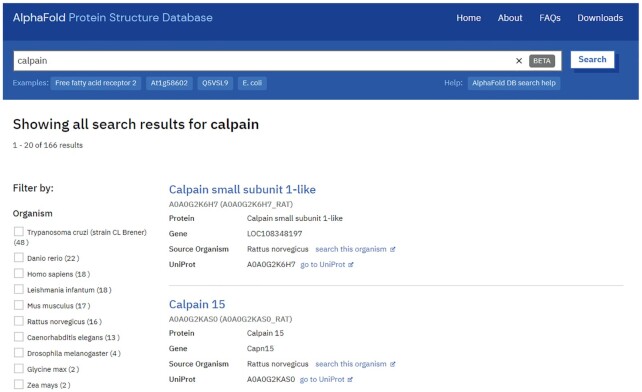
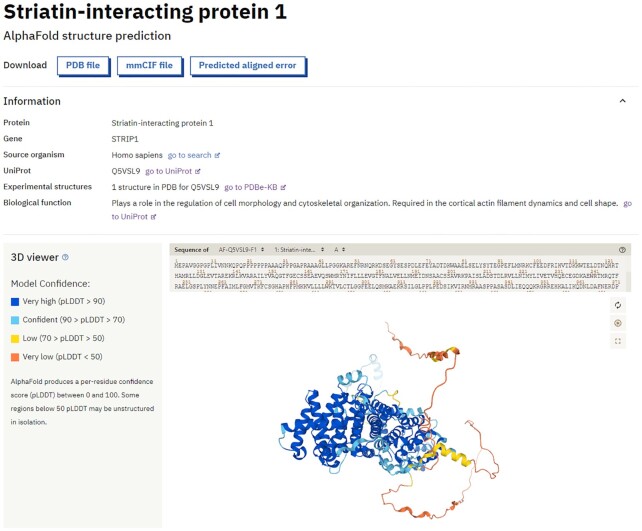
Verification
Claims the paper makes
15 No basis given · 12 Not checked yet · 5 Own interpretation · 2 Own result · 1 Partly supported · accuracy not yet measured
A result the paper reports from its own data — it cites no other source for it, so there is none to check. The quote shows it is in the paper.
In the paper
“The initial release of AlphaFold DB contains over 360,000 predicted structures across 21 model-organism proteomes”
- Also stated in: § IMPLEMENTATION · plain
“The initial version of AlphaFold DB contains over 360 000 predicted structures, corresponding meta-information and confidence metrics.”
- Also stated in: § CONCLUSION AND OUTLOOK · plain
“The first release of AlphaFold DB contains over 360 000 predicted structures from 21 model-organism proteomes.”
§ AlphaFold Protein Structure Database: massively expanding the structural coverage of protein-sequence space with high-accuracy models > Abstract
plain- Asserted: passes — The authors put it forward as true.
- Checkable: passes — It can be checked against evidence.
- Load-bearing: passes — The paper’s conclusions depend on it.
- Based: passes — The paper gives a reason why it holds.
- Also stated in: § IMPLEMENTATION · plain
A result the paper reports from its own data — it cites no other source for it, so there is none to check. The quote shows it is in the paper.
In the paper
“The first release described here covers the human proteome and those of 20 other model organisms (Table 1).”
§ AlphaFold Protein Structure Database: massively expanding the structural coverage of protein-sequence space with high-accuracy models > INTRODUCTION
plain- Asserted: passes — The authors put it forward as true.
- Checkable: passes — It can be checked against evidence.
- Load-bearing: unclear — It is unclear whether the paper’s conclusions depend on it.
- Based: passes — The paper gives a reason why it holds.
The paper states this without a source or data behind it here, so there is nothing to check it against. The quote shows it is in the paper.
In the paper
“Model confidence can vary significantly along a chain, making it essential to analyse the confidence measures before interpreting structural features.”
§ AlphaFold Protein Structure Database: massively expanding the structural coverage of protein-sequence space with high-accuracy models > IMPLEMENTATION > AlphaFold DB web pages
plain- Asserted: passes — The authors put it forward as true.
- Checkable: passes — It can be checked against evidence.
- Load-bearing: unclear — It is unclear whether the paper’s conclusions depend on it.
- Based: passes — The paper gives a reason why it holds.
None of the sources cited for this claim have been checked yet.
In the paper
“However, while the Universal Protein Resource (UniProt) archives almost 220 million unique protein sequences, the Protein Data Bank (PDB) holds only just over 180 000 3D structures for over 55 000 distinct proteins, thus severely limiting the coverage of the sequence space to support biomolecular research globally (5–7).”
§ AlphaFold Protein Structure Database: massively expanding the structural coverage of protein-sequence space with high-accuracy models > INTRODUCTION
What the sources say
- Not checked yetcites [5] Bateman, 2021, UniProt: the universal protein knowledgebase in 2021, Nucleic Acids Res. source
- Not checked yetcites [6] Armstrong, 2019, PDBe: improved findability of macromolecular structure data in the PDB, Nucleic Acids Res.
- Not checked yetcites [7] Varadi, 2019, PDBe-KB: a community-driven resource for structural and functional annotations, Nucleic Acids Res.
plain- Asserted: passes — The authors put it forward as true.
- Checkable: passes — It can be checked against evidence.
- Load-bearing: passes — The paper’s conclusions depend on it.
- Based: passes — The paper gives a reason why it holds.
A conclusion the paper draws from its own results — it cites no other source for it, so there is none to check. The quote shows it is in the paper.
In the paper
“Powered by AlphaFold v2.0 of DeepMind, it has enabled an unprecedented expansion of the structural coverage of the known protein-sequence space.”
§ AlphaFold Protein Structure Database: massively expanding the structural coverage of protein-sequence space with high-accuracy models > Abstract
boosteddirect- Asserted: passes — The authors put it forward as true.
- Checkable: passes — It can be checked against evidence.
- Load-bearing: passes — The paper’s conclusions depend on it.
- Based: passes — The paper gives a reason why it holds.
A conclusion the paper draws from its own results — it cites no other source for it, so there is none to check. The quote shows it is in the paper.
In the paper
“The unprecedented accuracy and speed of AlphaFold allowed the creation of an extensive database of structure predictions at a large scale.”
§ AlphaFold Protein Structure Database: massively expanding the structural coverage of protein-sequence space with high-accuracy models > INTRODUCTION
plaindirect- Asserted: passes — The authors put it forward as true.
- Checkable: passes — It can be checked against evidence.
- Load-bearing: passes — The paper’s conclusions depend on it.
- Based: passes — The paper gives a reason why it holds.
In the paper
“In 2020, the organizers of the CASP14 benchmark recognized AlphaFold as a solution to the protein–structure–prediction problem (12).”
§ AlphaFold Protein Structure Database: massively expanding the structural coverage of protein-sequence space with high-accuracy models > INTRODUCTION
What the sources say
- Not checked yetcites [12] Pereira, 2021, High-accuracy protein structure prediction in CASP14, Proteins Struct. Funct. Bioinf. source
plain- Asserted: passes — The authors put it forward as true.
- Checkable: passes — It can be checked against evidence.
- Load-bearing: unclear — It is unclear whether the paper’s conclusions depend on it.
- Based: passes — The paper gives a reason why it holds.
None of the sources cited for this claim have been checked yet.
In the paper
“Although recent advances in the field of electron cryo-microscopy and hybrid and integrative methods (I/HM) for structure determination have accelerated the pace of structure determination, the gap between known protein sequences and experimental protein structures continues to expand (6,8).”
§ AlphaFold Protein Structure Database: massively expanding the structural coverage of protein-sequence space with high-accuracy models > INTRODUCTION
What the sources say
- Not checked yetcites [6] Armstrong, 2019, PDBe: improved findability of macromolecular structure data in the PDB, Nucleic Acids Res.
- Not checked yetcites [8] de Oliveira, 2021, Cryo-EM: the resolution revolution and drug discovery, SLAS Discov. source
plaindirect- Asserted: passes — The authors put it forward as true.
- Checkable: passes — It can be checked against evidence.
- Load-bearing: unclear — It is unclear whether the paper’s conclusions depend on it.
- Based: passes — The paper gives a reason why it holds.
None of the sources cited for this claim have been checked yet.
In the paper
“thus severely limiting the coverage of the sequence space to support biomolecular research globally (5–7).”
§ AlphaFold Protein Structure Database: massively expanding the structural coverage of protein-sequence space with high-accuracy models > INTRODUCTION
What the sources say
- Not checked yetcites [5] Bateman, 2021, UniProt: the universal protein knowledgebase in 2021, Nucleic Acids Res. source
- Not checked yetcites [6] Armstrong, 2019, PDBe: improved findability of macromolecular structure data in the PDB, Nucleic Acids Res.
- Not checked yetcites [7] Varadi, 2019, PDBe-KB: a community-driven resource for structural and functional annotations, Nucleic Acids Res.
boosted- Asserted: passes — The authors put it forward as true.
- Checkable: passes — It can be checked against evidence.
- Load-bearing: passes — The paper’s conclusions depend on it.
- Based: passes — The paper gives a reason why it holds.
None of the sources cited for this claim have been checked yet.
In the paper
“Although recent advances in the field of electron cryo-microscopy and hybrid and integrative methods (I/HM) for structure determination have accelerated the pace of structure determination, the gap between known protein sequences and experimental protein structures continues to expand (6,8).”
§ AlphaFold Protein Structure Database: massively expanding the structural coverage of protein-sequence space with high-accuracy models > INTRODUCTION
What the sources say
- Not checked yetcites [6] Armstrong, 2019, PDBe: improved findability of macromolecular structure data in the PDB, Nucleic Acids Res.
- Not checked yetcites [8] de Oliveira, 2021, Cryo-EM: the resolution revolution and drug discovery, SLAS Discov. source
plaincorrelational- Asserted: passes — The authors put it forward as true.
- Checkable: passes — It can be checked against evidence.
- Load-bearing: passes — The paper’s conclusions depend on it.
- Based: passes — The paper gives a reason why it holds.
- Probably not a substantial claim. 19
- It may state two separate claims as one. 10
The cited sources support only part of this claim — read each source’s verdict below.
In the paper
“As a confidence metric based on lDDT, pLDDT also reflects local confidence in the structure, and should be used, for example, to assess confidence within a single domain.”
§ AlphaFold Protein Structure Database: massively expanding the structural coverage of protein-sequence space with high-accuracy models > IMPLEMENTATION
What the sources say
- Partly supportedcites [14] Mariani, 2013, lDDT: a local superposition-free score for comparing protein structures and models using distance difference tests, Bioinformatics sourceExperimental — accuracy not yet measured
Section 3.3 says per-residue lDDT scores reflect the accuracy of a model’s local atomic environment, including within individual domains. The paper describes lDDT as a comparison with a reference structure; it does not address pLDDT or establish that pLDDT measures predicted local confidence. (LLM, conf=0.85)
plaincorrelational- Asserted: passes — The authors put it forward as true.
- Checkable: passes — It can be checked against evidence.
- Load-bearing: fails — The paper’s conclusions may not depend on it.
- Based: passes — The paper gives a reason why it holds.
Probably not a substantial claim. The paper’s conclusions may not depend on it.
- Partly supported
The paper states this without a source or data behind it here, so there is nothing to check it against. The quote shows it is in the paper.
In the paper
“The AlphaFold Protein Structure Database (AlphaFold DB, https://alphafold.ebi.ac.uk) is an openly accessible, extensive database of high-accuracy protein-structure predictions.”
§ AlphaFold Protein Structure Database: massively expanding the structural coverage of protein-sequence space with high-accuracy models > Abstract
plain- Asserted: passes — The authors put it forward as true.
- Checkable: passes — It can be checked against evidence.
- Load-bearing: passes — The paper’s conclusions depend on it.
- Based: passes — The paper gives a reason why it holds.
It may state two separate claims as one.
The paper states this without a source or data behind it here, so there is nothing to check it against. The quote shows it is in the paper.
In the paper
“The predicted structures contain atomic coordinates and per-residue confidence estimates on a scale from 0 to 100, with higher scores corresponding to higher confidence.”
§ AlphaFold Protein Structure Database: massively expanding the structural coverage of protein-sequence space with high-accuracy models > IMPLEMENTATION
plaincorrelational- Asserted: passes — The authors put it forward as true.
- Checkable: passes — It can be checked against evidence.
- Load-bearing: fails — The paper’s conclusions may not depend on it.
- Based: passes — The paper gives a reason why it holds.
Probably not a substantial claim. The paper’s conclusions may not depend on it. It may state two separate claims as one.
The paper states this without a source or data behind it here, so there is nothing to check it against. The quote shows it is in the paper.
In the paper
“Powered by AlphaFold v2.0 of DeepMind”
§ AlphaFold Protein Structure Database: massively expanding the structural coverage of protein-sequence space with high-accuracy models > Abstract
plaindirect- Asserted: passes — The authors put it forward as true.
- Checkable: passes — It can be checked against evidence.
- Load-bearing: passes — The paper’s conclusions depend on it.
- Based: passes — The paper gives a reason why it holds.
Probably not a substantial claim.
The paper states this without a source or data behind it here, so there is nothing to check it against. The quote shows it is in the paper.
In the paper
“AlphaFold DB provides programmatic access to and interactive visualization of predicted atomic coordinates, per-residue and pairwise model-confidence estimates and predicted aligned errors.”
§ AlphaFold Protein Structure Database: massively expanding the structural coverage of protein-sequence space with high-accuracy models > Abstract
plain- Asserted: passes — The authors put it forward as true.
- Checkable: passes — It can be checked against evidence.
- Load-bearing: fails — The paper’s conclusions may not depend on it.
- Based: passes — The paper gives a reason why it holds.
Probably not a substantial claim. The paper’s conclusions may not depend on it. It may state two separate claims as one.
The paper states this without a source or data behind it here, so there is nothing to check it against. The quote shows it is in the paper.
In the paper
“All the data are publicly accessible through a cloud-based infrastructure.”
§ AlphaFold Protein Structure Database: massively expanding the structural coverage of protein-sequence space with high-accuracy models > IMPLEMENTATION
plain- Asserted: passes — The authors put it forward as true.
- Checkable: passes — It can be checked against evidence.
- Load-bearing: fails — The paper’s conclusions may not depend on it.
- Based: passes — The paper gives a reason why it holds.
Probably not a substantial claim. The paper’s conclusions may not depend on it.
The paper states this without a source or data behind it here, so there is nothing to check it against. The quote shows it is in the paper.
In the paper
“We provide access to all entries through a public API endpoint, keyed on a UniProt accession.”
§ AlphaFold Protein Structure Database: massively expanding the structural coverage of protein-sequence space with high-accuracy models > IMPLEMENTATION > Data access
plain- Asserted: passes — The authors put it forward as true.
- Checkable: passes — It can be checked against evidence.
- Load-bearing: fails — The paper’s conclusions may not depend on it.
- Based: passes — The paper gives a reason why it holds.
Probably not a substantial claim. The paper’s conclusions may not depend on it.
The paper states this without a source or data behind it here, so there is nothing to check it against. The quote shows it is in the paper.
In the paper
“AlphaFold DB archives and provides access to the atomic coordinates in PDB and mmCIF formats, PAEs in JSON format and corresponding metadata in JSON format.”
§ AlphaFold Protein Structure Database: massively expanding the structural coverage of protein-sequence space with high-accuracy models > IMPLEMENTATION > Data archival
plain- Asserted: passes — The authors put it forward as true.
- Checkable: passes — It can be checked against evidence.
- Load-bearing: fails — The paper’s conclusions may not depend on it.
- Based: passes — The paper gives a reason why it holds.
Probably not a substantial claim. The paper’s conclusions may not depend on it. It may state two separate claims as one.
None of the sources cited for this claim have been checked yet.
In the paper
“Each protein has a dedicated structure page that shows basic information (drawn from UniProt (5) and PDBe (6)) and three separate outputs of the AlphaFold model.”
§ AlphaFold Protein Structure Database: massively expanding the structural coverage of protein-sequence space with high-accuracy models > IMPLEMENTATION > AlphaFold DB web pages
What the sources say
- Not checked yetcites [5] Bateman, 2021, UniProt: the universal protein knowledgebase in 2021, Nucleic Acids Res. source
- Not checked yetcites [6] Armstrong, 2019, PDBe: improved findability of macromolecular structure data in the PDB, Nucleic Acids Res.
plain- Asserted: passes — The authors put it forward as true.
- Checkable: passes — It can be checked against evidence.
- Load-bearing: fails — The paper’s conclusions may not depend on it.
- Based: passes — The paper gives a reason why it holds.
Probably not a substantial claim. The paper’s conclusions may not depend on it. It may state two separate claims as one.
The paper states this without a source or data behind it here, so there is nothing to check it against. The quote shows it is in the paper.
In the paper
“The data files in the archive are versioned, and previous snapshots of the data will be available via FTP, but the web pages will always display the latest version.”
§ AlphaFold Protein Structure Database: massively expanding the structural coverage of protein-sequence space with high-accuracy models > IMPLEMENTATION > Data archival
plain- Asserted: passes — The authors put it forward as true.
- Checkable: passes — It can be checked against evidence.
- Load-bearing: fails — The paper’s conclusions may not depend on it.
- Based: passes — The paper gives a reason why it holds.
Probably not a substantial claim. The paper’s conclusions may not depend on it. It may state two separate claims as one.
The paper states this without a source or data behind it here, so there is nothing to check it against. The quote shows it is in the paper.
In the paper
“AlphaFold DB provides graphical access to and interactive visualization of all the predictions and meta-information for the broader scientific community through web pages.”
§ AlphaFold Protein Structure Database: massively expanding the structural coverage of protein-sequence space with high-accuracy models > IMPLEMENTATION > Data access
plain- Asserted: passes — The authors put it forward as true.
- Checkable: passes — It can be checked against evidence.
- Load-bearing: fails — The paper’s conclusions may not depend on it.
- Based: passes — The paper gives a reason why it holds.
Probably not a substantial claim. The paper’s conclusions may not depend on it.
The paper states this without a source or data behind it here, so there is nothing to check it against. The quote shows it is in the paper.
In the paper
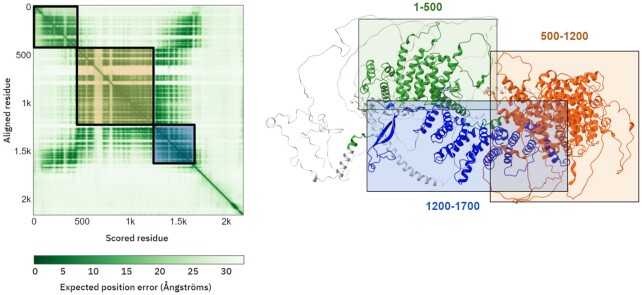
“The third output is a pairwise confidence prediction, which helps to assess the reliability of relative domain positions and orientations as well as the global topology of the protein (Figure 3).”
§ AlphaFold Protein Structure Database: massively expanding the structural coverage of protein-sequence space with high-accuracy models > IMPLEMENTATION > AlphaFold DB web pages
plaindirect- Asserted: passes — The authors put it forward as true.
- Checkable: passes — It can be checked against evidence.
- Load-bearing: fails — The paper’s conclusions may not depend on it.
- Based: passes — The paper gives a reason why it holds.
Probably not a substantial claim. The paper’s conclusions may not depend on it.
The paper states this without a source or data behind it here, so there is nothing to check it against. The quote shows it is in the paper.
In the paper
“The data set contains proteins with sequence lengths of 16–2700 and excludes isoforms and sequences with unknown or non-standard amino acids.”
§ AlphaFold Protein Structure Database: massively expanding the structural coverage of protein-sequence space with high-accuracy models > INTRODUCTION
plain- Asserted: passes — The authors put it forward as true.
- Checkable: passes — It can be checked against evidence.
- Load-bearing: unclear — It is unclear whether the paper’s conclusions depend on it.
- Based: passes — The paper gives a reason why it holds.
It may state two separate claims as one.
None of the sources cited for this claim have been checked yet.
In the paper
“UniProt (5), Pfam (18), InterPro (19) and PDBe-KB (7) use this API to display AlphaFold models on their web pages.”
§ AlphaFold Protein Structure Database: massively expanding the structural coverage of protein-sequence space with high-accuracy models > IMPLEMENTATION > Data access
What the sources say
- Not checked yetcites [5] Bateman, 2021, UniProt: the universal protein knowledgebase in 2021, Nucleic Acids Res. source
- Not checked yetcites [18] Mistry, 2021, Pfam: The protein families database in 2021, Nucleic Acids Res. source
- Not checked yetcites [19] Blum, 2021, The InterPro protein families and domains database: 20 years on, Nucleic Acids Res. source
plaindirect- Asserted: passes — The authors put it forward as true.
- Checkable: passes — It can be checked against evidence.
- Load-bearing: fails — The paper’s conclusions may not depend on it.
- Based: passes — The paper gives a reason why it holds.
Probably not a substantial claim. The paper’s conclusions may not depend on it.
The paper states this without a source or data behind it here, so there is nothing to check it against. The quote shows it is in the paper.
In the paper
“AlphaFold DB provides predictions through several data-access mechanisms: (i) bulk downloads via FTP; (ii) programmatic access via an application programming interface (API); (iii) download and interactive visualization of individual predictions on protein-specific web pages keyed on UniProt accessions.”
§ AlphaFold Protein Structure Database: massively expanding the structural coverage of protein-sequence space with high-accuracy models > IMPLEMENTATION > Data access
plain- Asserted: passes — The authors put it forward as true.
- Checkable: passes — It can be checked against evidence.
- Load-bearing: fails — The paper’s conclusions may not depend on it.
- Based: passes — The paper gives a reason why it holds.
Probably not a substantial claim. The paper’s conclusions may not depend on it. It may state two separate claims as one.
A conclusion the paper draws from its own results — it cites no other source for it, so there is none to check. The quote shows it is in the paper.
In the paper
“For residues x and y in two different domains, if the PAE values (x, y) are low, AlphaFold predicts the domains to have well-defined relative positions and orientations.”
§ AlphaFold Protein Structure Database: massively expanding the structural coverage of protein-sequence space with high-accuracy models > IMPLEMENTATION
plainconditional- Asserted: passes — The authors put it forward as true.
- Checkable: passes — It can be checked against evidence.
- Load-bearing: fails — The paper’s conclusions may not depend on it.
- Based: passes — The paper gives a reason why it holds.
Probably not a substantial claim. The paper’s conclusions may not depend on it.
In the paper
“AlphaFold is an AI system developed by DeepMind that makes state-of-the-art predictions of protein structures from their amino-acid sequences (9).”
§ AlphaFold Protein Structure Database: massively expanding the structural coverage of protein-sequence space with high-accuracy models > INTRODUCTION
What the sources say
- Not checked yetcites [9] Jumper, 2021, Highly accurate protein structure prediction with AlphaFold, Nature source
plaindirect- Asserted: passes — The authors put it forward as true.
- Checkable: passes — It can be checked against evidence.
- Load-bearing: passes — The paper’s conclusions depend on it.
- Based: passes — The paper gives a reason why it holds.
It may state two separate claims as one.
None of the sources cited for this claim have been checked yet.
In the paper
“However, while the Universal Protein Resource (UniProt) archives almost 220 million unique protein sequences, the Protein Data Bank (PDB) holds only just over 180 000 3D structures for over 55 000 distinct proteins, thus severely limiting the coverage of the sequence space to support biomolecular research globally (5–7).”
§ AlphaFold Protein Structure Database: massively expanding the structural coverage of protein-sequence space with high-accuracy models > INTRODUCTION
What the sources say
- Not checked yetcites [5] Bateman, 2021, UniProt: the universal protein knowledgebase in 2021, Nucleic Acids Res. source
- Not checked yetcites [6] Armstrong, 2019, PDBe: improved findability of macromolecular structure data in the PDB, Nucleic Acids Res.
- Not checked yetcites [7] Varadi, 2019, PDBe-KB: a community-driven resource for structural and functional annotations, Nucleic Acids Res.
plain- Asserted: passes — The authors put it forward as true.
- Checkable: passes — It can be checked against evidence.
- Load-bearing: passes — The paper’s conclusions depend on it.
- Based: passes — The paper gives a reason why it holds.
It may state two separate claims as one.
In the paper
“It was recently described that very low confidence pLDDT scores correlate with high propensities for intrinsic disorder (17).”
§ AlphaFold Protein Structure Database: massively expanding the structural coverage of protein-sequence space with high-accuracy models > IMPLEMENTATION
What the sources say
- Not checked yetcites [17] Akdel, 2021, A structural biology community assessment of AlphaFold 2 applications Biophysics
plaincorrelational- Asserted: passes — The authors put it forward as true.
- Checkable: passes — It can be checked against evidence.
- Load-bearing: fails — The paper’s conclusions may not depend on it.
- Based: passes — The paper gives a reason why it holds.
Probably not a substantial claim. The paper’s conclusions may not depend on it.
A conclusion the paper draws from its own results — it cites no other source for it, so there is none to check. The quote shows it is in the paper.
In the paper
“If the PAE values are high, then the relative position and orientation of the two domains are unreliable, and users should not attach biological or structural relevance to these.”
§ AlphaFold Protein Structure Database: massively expanding the structural coverage of protein-sequence space with high-accuracy models > IMPLEMENTATION
plaindirect- Asserted: passes — The authors put it forward as true.
- Checkable: passes — It can be checked against evidence.
- Load-bearing: fails — The paper’s conclusions may not depend on it.
- Based: passes — The paper gives a reason why it holds.
Probably not a substantial claim. The paper’s conclusions may not depend on it.
The paper states this without a source or data behind it here, so there is nothing to check it against. The quote shows it is in the paper.
In the paper
“However, figuring out the exact structure of a protein remains an expensive and often time-consuming process.”
§ AlphaFold Protein Structure Database: massively expanding the structural coverage of protein-sequence space with high-accuracy models > CONCLUSION AND OUTLOOK
plain- Asserted: passes — The authors put it forward as true.
- Checkable: passes — It can be checked against evidence.
- Load-bearing: passes — The paper’s conclusions depend on it.
- Based: fails — The paper may give no reason why it holds.
Probably not a substantial claim. The paper may give no reason why it holds.
In the paper
“The lower confidence bands appear to correlate well with backbone flexibility and intrinsic disorder (13) (Figure 2).”
§ AlphaFold Protein Structure Database: massively expanding the structural coverage of protein-sequence space with high-accuracy models > IMPLEMENTATION > AlphaFold DB web pages
What the sources say
- Not checked yetcites [13] Tunyasuvunakool, 2021, Highly accurate protein structure prediction for the human proteome, Nature source
hedgedcorrelational- Asserted: passes — The authors put it forward as true.
- Checkable: passes — It can be checked against evidence.
- Load-bearing: fails — The paper’s conclusions may not depend on it.
- Based: passes — The paper gives a reason why it holds.
Probably not a substantial claim. The paper’s conclusions may not depend on it.
In the paper
“Since the mid-1950s, the scientific community has been using ever-more advanced experimental methods to determine over 180 000 structures of proteins, nucleic acids, and complexes in atomic detail, and archive them in the PDB, the single worldwide archive of experimental macromolecular structure data managed by the wwPDB consortium (21).”
§ AlphaFold Protein Structure Database: massively expanding the structural coverage of protein-sequence space with high-accuracy models > CONCLUSION AND OUTLOOK
What the sources say
- Not checked yetcites [21] wwPDB consortium, 2018, Protein Data Bank: the single global archive for 3D macromolecular structure data, Nucleic Acids Res. source
plain- Asserted: passes — The authors put it forward as true.
- Checkable: passes — It can be checked against evidence.
- Load-bearing: fails — The paper’s conclusions may not depend on it.
- Based: passes — The paper gives a reason why it holds.
Probably not a substantial claim. The paper’s conclusions may not depend on it.
Claims other papers make about this one
Each is checked against this paper’s own text: does it say what the citing paper says it does?
The source backs part of the claim, not all of it — or backs it for a different population, condition or comparison.
In the citing paper
“The new CC+ database includes both experimentally derived CCs from the RCSB PDB (Bittrich et al., 2022) and predicted AlphaFold2 models for 48 proteomes (https://alphafold.ebi.ac.uk/; Varadi et al., 2022).”
From CC + : A searchable database of validated coiled coils in PDB structures and AlphaFold2 models (2023) · cites this paper as Varadi et al., 2022
Experimental — accuracy not yet measuredThe source backs part of the claim, not all of it — or backs it for a different population, condition or comparison.
In the citing paper
“we posit that AlphaFold (Jumper et al., 2021;Varadi et al., 2021) is a Level 5 Narrow AI (“Superhuman Narrow AI”) since it performs a single task (predicting a protein's 3D structure from an amino acid sequence) above the level of the world's top scientists.”
From Levels of AGI for Operationalizing Progress on the Path to AGI (2023) · cites this paper as Varadi et al., 2021
Experimental — accuracy not yet measuredIn the citing paper
“houses over 200 million pre-run AF2 predictions”
From The power and pitfalls of AlphaFold2 for structure prediction beyond rigid globular proteins (2024) · cites this paper as [6]
In the citing paper
“AF2 also generates a Predicted Aligned Error (PAE) matrix, which evaluates the relative orientation and position of different parts (i.e., domains) of the model6”
From The power and pitfalls of AlphaFold2 for structure prediction beyond rigid globular proteins (2024) · cites this paper as [6]
In the citing paper
“Likewise, AlphaFold2 provides a per-residue confidence measure that allows researchers to judge the quality of the predicted structure.281”
From Advancing Targeted Protein Degradation via Multiomics Profiling and Artificial Intelligence (2023) · cites this paper as [281]
In the citing paper
“over 214 million predicted structures are available in the AlphaFold database2”
From Clustering predicted structures at the scale of the known protein universe (2023) · cites this paper as [2]
In the citing paper
“The European Bioinformatics Institute already holds over 214 million structures predicted by AlphaFold2 (ref. 3)”
From Fast and accurate protein structure search with Foldseek (2024) · cites this paper as [3]
Citations
Cites
Highly accurate protein structure prediction with AlphaFold
Jumper, J., Evans, R., Pritzel, A., Green, T., Figurnov, M., Ronneberger, O., Tunyasuvunakool, K., Bates, R., Žídek, A., Potapenko, A., et al. (2021) · Nature · doi:10.1038/s41586-021-03819-2 · Cited by 43,764
Self-citationPfam: The protein families database in 2021
Mistry, J., Chuguransky, S., Williams, L., Qureshi, M., Salazar, G. A., Sonnhammer, E. L. L., Tosatto, S. C. E., Paladin, L., Raj, S., Richardson, L. J., et al. (2021) · Nucleic Acids Research · doi:10.1093/nar/gkaa913 · Cited by 7,452
UniProt: the universal protein knowledgebase in 2021
The UniProt Consortium, Bateman, A., Martin, M.-J., Orchard, S., Magrane, M., Agivetova, R., Ahmad, S., Alpi, E., Bowler-Barnett, E. H., Britto, R., et al. (2021) · Nucleic Acids Research · doi:10.1093/nar/gkaa1100 · Cited by 6,372
Accurate prediction of protein structures and interactions using a 3-track network
Baek, M., DiMaio, F., Anishchenko, I., Dauparas, J., Ovchinnikov, S., Lee, G. R., Wang, J., Cong, Q., Kinch, L. N., Schaeffer, R. D., et al. (2021) · doi:10.1101/2021.06.14.448402 · Cited by 5,549
Highly accurate protein structure prediction for the human proteome
Tunyasuvunakool, K., Adler, J., Wu, Z., Green, T., Zielinski, M., Žídek, A., Bridgland, A., Cowie, A., Meyer, C., Laydon, A., et al. (2021) · Nature · doi:10.1038/s41586-021-03828-1 · Cited by 3,025 · cited 4×
“The methodology of AlphaFold and insights gained from the predictions for the complete human proteome have been described recently (9,13).”
BackgroundMethodInfluentialSelf-citationThe InterPro protein families and domains database: 20 years on
Blum, M., Chang, H.-Y., Chuguransky, S., Grego, T., Kandasaamy, S., Mitchell, A., Nuka, G., Paysan-Lafosse, T., Qureshi, M., Raj, S., et al. (2021) · Nucleic Acids Research · doi:10.1093/nar/gkaa977 · Cited by 2,231
Protein Data Bank: the single global archive for 3D macromolecular structure data
wwPDB consortium, Burley, S. K., Berman, H. M., Bhikadiya, C., Bi, C., Chen, L., Costanzo, L. D., Christie, C., Duarte, J. M., Dutta, S., et al. (2019) · Nucleic Acids Research · doi:10.1093/nar/gky949 · Cited by 1,163
Self-citationMol* Viewer: modern web app for 3D visualization and analysis of large biomolecular structures
Sehnal, D., Bittrich, S., Deshpande, M., Svobodová, R., Berka, K., Bazgier, V., Velankar, S., Burley, S. K., Koča, J., & Rose, A. S. (2021) · Nucleic Acids Research · doi:10.1093/nar/gkab314 · Cited by 1,154
Self-citationMariani, V., Biasini, M., Barbato, A., & Schwede, T. (2013) · Bioinformatics · doi:10.1093/bioinformatics/btt473 · Cited by 1,138
QMEANDisCo—distance constraints applied on model quality estimation
Studer, G., Rempfer, C., Waterhouse, A. M., Gumienny, R., Haas, J., & Schwede, T. F. (2019) · Bioinformatics · doi:10.1093/bioinformatics/btz828 · Cited by 1,082
Cited by
Sorted by citations
UniProt: the Universal Protein Knowledgebase in 2023
The UniProt Consortium, Bateman, A., Martin, M.-J., Orchard, S., Magrane, M., Ahmad, S., Alpi, E., Bowler-Barnett, E. H., Britto, R., Bye-A-Jee, H., et al. (2023) · Nucleic Acids Research · doi:10.1093/nar/gkac1052 · Cited by 7,210
“Over 85% of UniProt entries now contain a predicted protein structure, provided by AlphaFold, an artificial intelligence system developed by DeepMind that makes predictions of protein structures from their amino-acid sequences (1).”
BackgroundEvolutionary-scale prediction of atomic level protein structure with a language model
Lin, Z., Akin, H., Rao, R., Hie, B., Zhu, Z., Lu, W., Smetanin, N., Verkuil, R., Kabeli, O., Shmueli, Y., et al. (2022) · doi:10.1101/2022.07.20.500902 · Cited by 5,990
UCSF ChimeraX : Tools for structure building and analysis
Meng, E. C., Goddard, T. D., Pettersen, E. F., Couch, G. S., Pearson, Z., Morris, J. H., & Ferrin, T. E. (2023) · Protein Science · doi:10.1002/pro.4792 · Cited by 4,706
“ChimeraX has tools to run new AlphaFold predictions, find existing predictions in the EBI AlphaFold Database (Varadi et al., 2022), and plot error metrics for evaluating model quality.”
MethodPaysan‐Lafosse, T., Blum, M., Chuguransky, S., Grego, T., Pinto, B. L., Salazar, G. A., Bileschi, M. L., Bork, P., Bridge, A. J., Colwell, L. J., et al. (2022) · Nucleic Acids Research · doi:10.1093/nar/gkac993 · Cited by 2,457
“DeepMind and EMBL’s European Bioinformatics Institute (EMBL-EBI) have launched the AlphaFold Protein Structure Database (AlphaFold DB) (27), a joint project to openly and freely share millions of AlphaFold protein structure predictions with the scientific community.”
Fast and accurate protein structure search with Foldseek
van Kempen, M., Kim, S. S., Tumescheit, C., Mirdita, M., Lee, J., Gilchrist, C. L. M., Söding, J., & Steinegger, M. (2022) · doi:10.1101/2022.02.07.479398 · Cited by 2,598
Fast and accurate protein structure search with Foldseek
van Kempen, M., Kim, S. S., Tumescheit, C., Mirdita, M., Lee, J., Gilchrist, C. L. M., Söding, J., & Steinegger, M. (2024) · Nature Biotechnology · doi:10.1038/s41587-023-01773-0 · Cited by 2,596
Search and sequence analysis tools services from EMBL-EBI in 2022
Madeira, F., Pearce, M., Tivey, A. R., Basutkar, P., Lee, J., Edbali, O., Madhusoodanan, N., Kolesnikov, A., & López, R. (2022) · Nucleic Acids Research · doi:10.1093/nar/gkac240 · Cited by 2,263
“IPD-NHKIR (23) coding and genomic sequences, as well as sequences from the AlphaFold DB (24), EMDB (25) and PDBe-KB, have also been made available for sequence similarity search in the JD tools framework and retrieval via Dbfetch.”
Accurate proteome-wide missense variant effect prediction with AlphaMissense
Cheng, J., Novati, G., Pan, J., Bycroft, C., Žemgulytė, A., Applebaum, T., Pritzel, A., Wong, L. H., Zielinski, M., Sargeant, T., et al. (2023) · Science · doi:10.1126/science.adg7492 · Cited by 2,163
Self-citationMartin, F. J., Amode, M. R., Aneja, A., Austine-Orimoloye, O., Azov, A. G., Barnes, I., Becker, A., Bennett, R., Berry, A. E., Bhai, J. N. N. T., et al. (2022) · Nucleic Acids Research · doi:10.1093/nar/gkac958 · Cited by 1,041
“Structures from AlphaFold DB (25) for 19 013 human protein-coding genes are now viewable through our new AlphaFold browser widget, accessible via the ‘AlphaFold predicted model’ link in the left-hand menu of any transcript page.”
MethodDali server: structural unification of protein families
Holm, L. (2022) · Nucleic Acids Research · doi:10.1093/nar/gkac387 · Cited by 934
“The publically available AlphaFold Database version 1 (AF-DB) covers the Uniprot reference proteomes of human and 20 other key organisms (9).”
Generalized biomolecular modeling and design with RoseTTAFold All-Atom
Krishna, R., Wang, J., Ahern, W., Sturmfels, P., Venkatesh, P., Kalvet, I., Lee, G. R., Morey-Burrows, F. S., Anishchenko, I., Humphreys, I. R., et al. (2024) · Science · doi:10.1126/science.adl2528 · Cited by 978
The CCP 4 suite: integrative software for macromolecular crystallography
Agirre, J., Atanasova, M., Bagdonas, H., Ballard, C. C., Baslé, A., Beilsten‐Edmands, J., Borges, R. J., Brown, D. G., Burgos-Mármol, J. J., Berrisford, J. M., et al. (2023) · Acta Crystallographica Section D Structural Biology · doi:10.1107/s2059798323003595 · Cited by 952
Self-citationBurley, S. K., Bhikadiya, C., Bi, C., Bittrich, S., Chao, H., Chen, L., Craig, P., Crichlow, G. V., Dalenberg, K., Duarte, J. M., et al. (2022) · Nucleic Acids Research · doi:10.1093/nar/gkac1077 · Cited by 926
“At the time of writing, CSMs for nearly every protein sequence represented in UniProt (43) are publicly accessible from AlphaFold DB (41,44,45).”
BackgroundMethodSelf-citationDALI shines a light on remote homologs: One hundred discoveries
Holm, L., Laiho, A., Törönen, P., & Salgado, M. G. (2022) · Protein Science · doi:10.1002/pro.4519 · Cited by 723
“A total of 59% of the Pfam families are represented in AlphaFold Database version 1 (AFDB1), which covers the human proteome as well as the proteomes of other important model organisms (Varadi et al., 2022).”
BackgroundMethodInfluentialA structural biology community assessment of AlphaFold2 applications
Akdel, M., Pires, D. E. V., Pardo, E. P., Jänes, J., Zalevsky, A. O., Mészáros, B., Bryant, P., Good, L. L., Laskowski, R. A., Pozzati, G., et al. (2022) · Nature Structural & Molecular Biology · doi:10.1038/s41594-022-00849-w · Cited by 675
Self-citationAutomated model building and protein identification in cryo-EM maps
Jamali, K., Käll, L., Zhang, R., Brown, A., Kimanius, D., & Scheres, S. H. W. (2024) · Nature · doi:10.1038/s41586-024-07215-4 · Cited by 686
Automated model building and protein identification in cryo-EM maps
Jamali, K., Käll, L., Zhang, R., Brown, A., Kimanius, D., & Scheres, S. H. W. (2023) · doi:10.1101/2023.05.16.541002 · Cited by 686
Boltz-2: Towards Accurate and Efficient Binding Affinity PredictionPreprint
Passaro, S., Corso, G., Wohlwend, J., Reveiz, M., Thaler, S., Somnath, V. R., Getz, N., Portnoi, T., Roy, J., Stark, H., et al. (2025) · bioRxiv (Cold Spring Harbor Laboratory) · doi:10.1101/2025.06.14.659707 · Cited by 940
The protein corona from nanomedicine to environmental science
Mahmoudi, M., Landry, M. P., Moore, A. V., & Coreas, R. (2023) · Nature Reviews Materials · doi:10.1038/s41578-023-00552-2 · Cited by 674
The HADDOCK2.4 web server for integrative modeling of biomolecular complexes
Honorato, R. V., Trellet, M. E., Jiménez‐García, B., Schaarschmidt, J., Giulini, M., Reys, V., Koukos, P. I., Rodrigues, J., Karaca, E., van Zundert, G. C. P., et al. (2024) · Nature Protocols · doi:10.1038/s41596-024-01011-0 · Cited by 666
AlphaFold2 and its applications in the fields of biology and medicine
Yang, Z., Zeng, X., Zhao, Y. C., & Chen, R. (2023) · Signal Transduction and Targeted Therapy · doi:10.1038/s41392-023-01381-z · Cited by 655
Bugnon, M., Röhrig, U. F., Goullieux, M., Perez, M. A. S., Daina, A., Michielin, O. A., & Zoete, V. (2024) · Nucleic Acids Research · doi:10.1093/nar/gkae300 · Cited by 639
“SwissDock 2024 also provides an advanced target search option in three different structural databases: PDBe ( 26 ), SWISS-MODEL ( 29 ), and the AlphaFold protein structure database ( 28 ,37 ).”
BackgroundMethodPredicting multiple conformations via sequence clustering and AlphaFold2
Wayment-Steele, H. K., Ojoawo, A., Otten, R., Apitz, J. M., Pitsawong, W., Hömberger, M., Ovchinnikov, S., Colwell, L., & Kern, D. (2024) · Nature · doi:10.1038/s41586-023-06832-9 · Cited by 545
Genenames.org: the HGNC resources in 2023
Seal, R. L., Braschi, B., Gray, K. A., Jones, T. E. M., Tweedie, S., Haim-Vilmovsky, L., & Bruford, E. A. (2022) · Nucleic Acids Research · doi:10.1093/nar/gkac888 · Cited by 555
Zhou, N., Yuan, X., Du, Q., Zhang, Z., Shi, X., Bao, J., Ning, Y., & Peng, L. (2022) · Nucleic Acids Research · doi:10.1093/nar/gkac935 · Cited by 514
The next-generation Open Targets Platform: reimagined, redesigned, rebuilt
Ochoa, D., Hercules, A., Carmona, M., Suveges, D., Baker, J., Malangone, C., Lopez, I., Miranda, A., Cruz-Castillo, C., Fumis, L., et al. (2023) · Nucleic Acids Research · doi:10.1093/nar/gkac1046 · Cited by 432
“The recent inclusion of the Al-phaFold protein structure predictions in the target profile page allows the identification of potential druggable pock-ets in previously unresolved 3D models (34).”
BackgroundLearning inverse folding from millions of predicted structuresPreprint
Hsu, C., Verkuil, R., Liu, J. J., Lin, Z., Hie, B., Sercu, T., Lerer, A. K., & Rives, A. W. (2022) · bioRxiv (Cold Spring Harbor Laboratory) · doi:10.1101/2022.04.10.487779 · Cited by 492
FlyBase: updates to the Drosophila genes and genomes database
Öztürk‐Çolak, A., Marygold, S. J., Antonazzo, G., Attrill, H. L., Goutte-Gattat, D., Jenkins, V. K., Matthews, B. B., Millburn, G., dos Santos, G., Tabone, C. J., et al. (2024) · Genetics · doi:10.1093/genetics/iyad211 · Cited by 417
“To this end, we have added images of 3D protein structures predicted by AlphaFold (Varadi et al .”
MODOMICS: a database of RNA modifications and related information. 2023 update
Cappannini, A., Ray, A., Purta, E., Mukherjee, S., Boccaletto, P., Moafinejad, S. N., Lechner, A., Barchet, C., Klaholz, B. P., Stefaniak, F., et al. (2023) · Nucleic Acids Research · doi:10.1093/nar/gkad1083 · Cited by 412
“Whenever available, we linked the MODOMICS entries to 3D structural predictions from the Al-phaFold database ( 25 ).”
MethodAhdritz, G., Bouatta, N., Floristean, C., Kadyan, S., Xia, Q., Gerecke, W., O’Donnell, T. J., Berenberg, D., Fisk, I., Zanichelli, N., et al. (2024) · Nature Methods · doi:10.1038/s41592-024-02272-z · Cited by 439
Chai-1: Decoding the molecular interactions of life
Discovery, C., Boitreaud, J., Dent, J., McPartlon, M., Meier, J., Reis, V., Rogozhnikov, A., & Wu, K. (2024) · doi:10.1101/2024.10.10.615955 · Cited by 517
A phosphoinositide signalling pathway mediates rapid lysosomal repair
Tan, J. X., & Finkel, T. (2022) · Nature · doi:10.1038/s41586-022-05164-4 · Cited by 375
Høie, M. H., Kiehl, E. N., Petersen, B., Nielsen, M., Winther, O., Nielsen, H., Hallgren, J., & Marcatili, P. (2022) · Nucleic Acids Research · doi:10.1093/nar/gkac439 · Cited by 374
Benchmarking AlphaFold for protein complex modeling reveals accuracy determinants
Yin, R., Feng, B. Y., Varshney, A., & Pierce, B. G. (2022) · Protein Science · doi:10.1002/pro.4379 · Cited by 335
Ren, F., Ding, X., Zheng, M., Korzinkin, M., Cai, X., Zhu, W., Mantsyzov, A., Aliper, A., Aladinskiy, V., Cao, Z., et al. (2023) · Chemical Science · doi:10.1039/d2sc05709c · Cited by 365
The Pfam protein families database: embracing AI/ML
Paysan-Lafosse, T., Andreeva, A., Blum, M., Chuguransky, S., Grego, T., Pinto, B. L., Salazar, G. A., Bileschi, M. L., Llinares-López, F., Meng-Papaxanthos, L., et al. (2024) · Nucleic Acids Research · doi:10.1093/nar/gkae997 · Cited by 382
“High-accuracy structure predictions, particularly those generated by tools such as AlphaFold ( 5 ), have significantly enhanced our ability to identify and characterize protein families.”
Clustering predicted structures at the scale of the known protein universe
Barrio-Hernandez, I., Yeo, J., Jänes, J., Mirdita, M., Gilchrist, C. L. M., Wein, T., Varadi, M., Velankar, S., Beltrao, P., & Steinegger, M. (2023) · Nature · doi:10.1038/s41586-023-06510-w · Cited by 362
“(4) Structural alignment is performed in two stages: first an ungapped alignment based on shared diagonal information is performed, hits are pre-clustered and second the remaining sequences are aligned using Foldseek's structural smithwaterman .”
BackgroundSelf-citationConformational ensembles of the human intrinsically disordered proteome
Tesei, G., Trolle, A. I., Jonsson, N., Betz, J., Knudsen, F. E., Pesce, F., Johansson, K. E., & Lindorff‐Larsen, K. (2024) · Nature · doi:10.1038/s41586-023-07004-5 · Cited by 331
Annotation of biologically relevant ligands in UniProtKB using ChEBI
Coudert, E., Gehant, S., de Castro, E., Pozzato, M., Baratin, D., Neto, T., Sigrist, C. J. A., Redaschi, N., Bridge, A., The UniProt Consortium, et al. (2023) · Bioinformatics · doi:10.1093/bioinformatics/btac793 · Cited by 350
Benchmarking AlphaFold for protein complex modeling reveals accuracy determinants
Yin, R., Feng, B. Y., Varshney, A., & Pierce, B. G. (2021) · doi:10.1101/2021.10.23.465575 · Cited by 335
AI-powered therapeutic target discovery
Pun, F. W., Ozerov, I. V., & Zhavoronkov, A. (2023) · Trends in Pharmacological Sciences · doi:10.1016/j.tips.2023.06.010 · Cited by 341
Before and after AlphaFold2: An overview of protein structure prediction
Bertoline, L. M. F., Lima, A. N., Krieger, J. E., & Teixeira, S. K. (2023) · Frontiers in Bioinformatics · doi:10.3389/fbinf.2023.1120370 · Cited by 330
Empowering biomedical discovery with AI agents
Gao, S., Fang, A., Huang, Y., Giunchiglia, V., Noori, A., Schwarz, J. R., Ektefaie, Y., Kondic, J., & Zitnik, M. (2024) · Cell · doi:10.1016/j.cell.2024.09.022 · Cited by 315
Benchmarking AlphaFold‐enabled molecular docking predictions for antibiotic discovery
Wong, F., Krishnan, A., Zheng, E. J., Stärk, H., Manson, A. L., Earl, A. M., Jaakkola, T., & Collins, J. J. (2022) · Molecular Systems Biology · doi:10.15252/msb.202211081 · Cited by 284
“As shown in the workflow here, in order to leverage AlphaFold 2 for docking, we first downloaded all 296 AlphaFold 2 -predicted E. coli essential protein structures from the AlphaFold Protein Structure Database (Jumper et al , 2021 ; Varadi et al , 2022 ).”
InfluentialVEuPathDB: the eukaryotic pathogen, vector and host bioinformatics resource center in 2023
Álvarez-Jarreta, J., Amos, B., Aurrecoechea, C., Bah, S. Y., Barba, M., Barreto, A., Basenko, E. Y., Belnap, R., Blevins, A. S., Böhme, U., et al. (2023) · Nucleic Acids Research · doi:10.1093/nar/gkad1003 · Cited by 269
Levels of AGI for Operationalizing Progress on the Path to AGI
Morris, M. R., Sohl-Dickstein, J., Fiedel, N., Warkentin, T., Dafoe, A., Faust, A., Farabet, C., & Legg, S. (2023) · arXiv · doi:10.48550/arxiv.2311.02462 · Cited by 274
AlphaFold Protein Structure Database and 3D-Beacons: New Data and Capabilities
Fleming, J., Magaña, P., Nair, S. S., Tsenkov, M. I., Bertoni, D., Pidruchna, I., Afonso, M. Q. L., Midlik, A., Paramval, U., Žídek, A., et al. (2025) · Journal of Molecular Biology · doi:10.1016/j.jmb.2025.168967 · Cited by 326
Self-citationIntrinsically Disordered Proteins: An Overview
Trivedi, R., & Nagarajaram, H. A. (2022) · International Journal of Molecular Sciences · doi:10.3390/ijms232214050 · Cited by 277
AlphaFold2 models indicate that protein sequence determines both structure and dynamics
Guo, H.-B., Perminov, A., Bekele, S., Kedziora, G., Farajollahi, S., Varaljay, V., Hinkle, K., Molinero, V., Meister, K., Hung, C., et al. (2022) · Scientific Reports · doi:10.1038/s41598-022-14382-9 · Cited by 248
SaProt: Protein Language Modeling with Structure-aware VocabularyPreprint
Su, J., Han, C., Zhou, Y., Shan, J., Zhou, X., & Yuan, F. (2023) · bioRxiv (Cold Spring Harbor Laboratory) · doi:10.1101/2023.10.01.560349 · Cited by 264
“Following ESM-2 and BERT, during training, 15% of the SA tokens in each batch are masked.”
BackgroundMethodA Guide to In Silico Drug Design
Chang, Y., Hawkins, B. A., Du, J. J., Groundwater, P. W., Hibbs, D. E., & Lai, F. (2022) · Pharmaceutics · doi:10.3390/pharmaceutics15010049 · Cited by 296
De novo design of protein interactions with learned surface fingerprints
Gaínza, P., Wehrle, S., Hall‐Beauvais, A. V., Marchand, A., Scheck, A., Harteveld, Z., Buckley, S., Ni, D., Tan, S., Sverrisson, F., et al. (2023) · Nature · doi:10.1038/s41586-023-05993-x · Cited by 266
Discovery of deaminase functions by structure-based protein clustering
(2023) · doi:10.1016/j.cell.2023.05.041 · Cited by 240
“5,6 9 These protein structure prediction methods should thus enable large-scale mining and classifications of proteins with specific functions.”
BackgroundSystematic identification of conditionally folded intrinsically disordered regions by AlphaFold2
Alderson, T. R., Pritišanac, I., Kolarić, Đ., Moses, A. M., & Forman-Kay, J. D. (2023) · Proceedings of the National Academy of Sciences · doi:10.1073/pnas.2304302120 · Cited by 240
“For each structure, the pLDDT scores in the regions of secondary structure range from “high” to “very high” (Figure 2B), suggestive of atomic-level accuracy and an overall high level of confidence in the structural models (Jumper et al. 2021a; Varadi et al. 2021).”
Structural and mechanistic insights into fungal β-1,3-glucan synthase FKS1
Hu, X., Yang, P., Chai, C., Liu, J., Sun, H., Wu, Y., Zhang, M., Zhang, M., Liu, X., & Yu, H. (2023) · Nature · doi:10.1038/s41586-023-05856-5 · Cited by 213
Fanzor is a eukaryotic programmable RNA-guided endonuclease
Saito, M., Xu, P., Faure, G., Maguire, S., Kannan, S., Altae-Tran, H., Vo, C.-D.-T., Desimone, A., Macrae, R. K., & Zhang, F. (2023) · Nature · doi:10.1038/s41586-023-06356-2 · Cited by 227
New insights into protein–protein interaction modulators in drug discovery and therapeutic advance
Nada, H., Choi, Y., Kim, S.-D., Jeong, K. S., Meanwell, N. A., & Lee, K. (2024) · Signal Transduction and Targeted Therapy · doi:10.1038/s41392-024-02036-3 · Cited by 241
Open Targets Platform: facilitating therapeutic hypotheses building in drug discovery
Buniello, A., Süveges, D., Cruz-Castillo, C., Llinares, M. B., Cornu, H., López, I., Tsukanov, K., Roldán‐Romero, J. M., Mehta, C., Fumis, L., et al. (2024) · Nucleic Acids Research · doi:10.1093/nar/gkae1128 · Cited by 251
“This new resource, funded through an Open Targets project ( 35 ) (Figure 2 A), includes predicted effects of missense variation based on AlphaMissense ( 36 ), interaction interfaces derived from AlphaFold ( 37 ) and protein abundance and stability based on protein structures using FoldX ( 38 ).”
GPCRdb in 2023: state-specific structure models using AlphaFold2 and new ligand resources
Pándy‐Szekeres, G., Caroli, J., Mamyrbekov, A., Kermani, A. A., Keserű, G. M., Kooistra, A. J., & Gloriam, D. E. I. (2022) · Nucleic Acids Research · doi:10.1093/nar/gkac1013 · Cited by 207
How good are AlphaFold models for docking-based virtual screening?
Scardino, V., Di Filippo, J. I., & Cavasotto, C. N. (2023) · iScience · doi:10.1016/j.isci.2022.105920 · Cited by 207
“AF-modeled structures were obtained from the AlphaFold Protein Structure Database.(30) Four docking programs were used, AutoDock 4, ICM, rDock, and PLANTS, which have different search algorithms and scoring functions.”
MethodInfluentialMachine Learning-Guided Protein Engineering
Kouba, P., Kohout, P., Haddadi, F., Bushuiev, A., Samusevich, R., Sedlář, J., Damborský, J., Pluskal, T., Šivic, J., & Mazurenko, S. (2023) · ACS Catalysis · doi:10.1021/acscatal.3c02743 · Cited by 218
Elfmann, C., & Stülke, J. (2023) · Nucleic Acids Research · doi:10.1093/nar/gkad350 · Cited by 198
Jakubec, D., Škoda, P., Krivák, R., Novotný, M., & Hoksza, D. (2022) · Nucleic Acids Research · doi:10.1093/nar/gkac389 · Cited by 203
Visualization of translation and protein biogenesis at the ER membrane
Gemmer, M., Chaillet, M. L., van Loenhout, J., Arenas, R. C., Vismpas, D., Gröllers‐Mulderij, M., Koh, F., Albanese, P., Scheltema, R. A., Howes, S. C., et al. (2023) · Nature · doi:10.1038/s41586-022-05638-5 · Cited by 176
ELM—the Eukaryotic Linear Motif resource—2024 update
Kumar, M., Michael, S., Alvarado-Valverde, J., Zeke, A., Lázár, T., Glavina, J., Nagy‐Kanta, E., Donagh, J. M., Kálmán, Z. E., Pascarelli, S., et al. (2023) · Nucleic Acids Research · doi:10.1093/nar/gkad1058 · Cited by 185
“ELM annotators now routinely use available structure predictions from the AlphaFold database ( 108 ,109 ) as they aid assessing SLiM instance plausibility, taking advantage of properties such as estimated disorderliness (a low pLDDT score) ( 109 ).”
MethodTransformer-based deep learning for predicting protein properties in the life sciences
Chandra, A. A., Tünnermann, L., Löfstedt, T., & Gratz, R. (2023) · eLife · doi:10.7554/elife.82819 · Cited by 202
Modeling conformational states of proteins with AlphaFold
Sala, D., Engelberger, F., Mchaourab, H. S., & Meiler, J. (2023) · Current Opinion in Structural Biology · doi:10.1016/j.sbi.2023.102645 · Cited by 182
DHODH inhibitors sensitize to ferroptosis by FSP1 inhibition
Mishima, E., Nakamura, T., Zheng, J., Zhang, W., Mourão, A., Sennhenn, P., & Conrad, M. (2023) · Nature · doi:10.1038/s41586-023-06269-0 · Cited by 205
Protein–Ligand Docking in the Machine-Learning Era
Yang, C., Chen, E. A., & Zhang, Y. (2022) · Molecules · doi:10.3390/molecules27144568 · Cited by 229
Expanding PROTACtable genome universe of E3 ligases
Liu, Y., Yang, J., Wang, T., Luo, M., Chen, Y., Chen, C., Ronai, Z. A., Zhou, Y., Ruppin, E., & Han, L. (2023) · Nature Communications · doi:10.1038/s41467-023-42233-2 · Cited by 210
Emerging Roles of β-Glucanases in Plant Development and Adaptative Responses
Perrot, T., Pauly, M., & Ramírez, V. (2022) · Plants · doi:10.3390/plants11091119 · Cited by 185
BacPROTACs mediate targeted protein degradation in bacteria
Morreale, F. E., Kleine, S., Leodolter, J., Junker, S., Hoi, D. M., Ovchinnikov, S., Okun, A., Kley, J., Kurzbauer, R., Junk, L., et al. (2022) · Cell · doi:10.1016/j.cell.2022.05.009 · Cited by 196
Recent Advances in Machine Learning‐Assisted Multiscale Design of Energy Materials
Mortazavi, B. (2024) · Advanced Energy Materials · doi:10.1002/aenm.202403876 · Cited by 202
AlphaFold, Artificial Intelligence (AI), and Allostery
Nussinov, R., Zhang, M., Liu, Y., & Jang, H. (2022) · The Journal of Physical Chemistry B · doi:10.1021/acs.jpcb.2c04346 · Cited by 190
The landscape of tolerated genetic variation in humans and primates
(2023) · doi:10.1126/science.abn8197 · Cited by 182
“PrimateAI-3D can use protein structures from either experimental sources or computational prediction (72–76); we used AlphaFold DB (72, 73) and HHpred (74) predicted structures for the broadest coverage across human genes.”
Language models generalize beyond natural proteins
Verkuil, R., Kabeli, O., Du, Y., Wicky, B. I. M., Milles, L. F., Dauparas, J., Baker, D., Ovchinnikov, S., Sercu, T., & Rives, A. (2022) · doi:10.1101/2022.12.21.521521 · Cited by 181
“[37] Mihaly Varadi, Stephen Anyango, Mandar Deshpande, Sreenath Nair, Cindy Natassia, Galabina Yordanova, David Yuan, Oana Stroe, Gemma Wood, Agata Laydon, Augustin Žı́dek, Tim Green, Kathryn Tunyasuvunakool, Stig Petersen, John Jumper, Ellen Clancy, Richard Green, Ankur Vora, Mira Lutfi, Michael Figurnov, Andrew Cowi…”
BackgroundRapid protein stability prediction using deep learning representations
Blaabjerg, L. M., Kassem, M. M., Good, L. L., Jonsson, N., Cagiada, M., Johansson, K. E., Boomsma, W., Stein, A., & Lindorff-Larsen, K. (2023) · eLife · doi:10.7554/elife.82593 · Cited by 177
PeSTo: parameter-free geometric deep learning for accurate prediction of protein binding interfaces
Krapp, L. F., Abriata, L. A., Rodríguez, F. C., & Peraro, M. D. (2023) · Nature Communications · doi:10.1038/s41467-023-37701-8 · Cited by 181
Uncovering new families and folds in the natural protein universe
Durairaj, J., Waterhouse, A. M., Mets, T., Brodiazhenko, T., Abdullah, M., Studer, G., Tauriello, G., Akdel, M., Andreeva, A. E., Bateman, A. G., et al. (2023) · Nature · doi:10.1038/s41586-023-06622-3 · Cited by 159
Cheng, J., Yan, J., Liu, Y., Shi, J., Wang, H., Zhou, H., Zhou, Y., Zhang, T., Zhao, L., Meng, X., et al. (2023) · Cell Metabolism · doi:10.1016/j.cmet.2023.04.017 · Cited by 189
MobiDB: 10 years of intrinsically disordered proteins
Piovesan, D., Conte, A. D., Clementel, D., Monzón, A. M., Bevilacqua, M., Aspromonte, M. C., Iserte, J., Orti, F., Marino‐Buslje, C., & Tosatto, S. C. E. (2022) · Nucleic Acids Research · doi:10.1093/nar/gkac1065 · Cited by 158
Hatos, A., Tosatto, S. C. E., Vendruscolo, M., & Fuxreiter, M. (2022) · Nucleic Acids Research · doi:10.1093/nar/gkac386 · Cited by 158
Application of Computational Biology and Artificial Intelligence in Drug Design
Zhang, Y., Luo, M., Wu, P., Wu, S., Lee, T.-Y., & Bai, C. (2022) · International Journal of Molecular Sciences · doi:10.3390/ijms232113568 · Cited by 167
Wu, H., Liu, J., Jiang, T., Zou, Q., Qi, S., Cui, Z., Tiwari, P., & Ding, Y. (2023) · Neural Networks · doi:10.1016/j.neunet.2023.11.018 · Cited by 190
Intrinsic protein disorder and conditional folding in AlphaFoldDB
Piovesan, D., Monzon, A. M., & Tosatto, S. C. E. (2022) · Protein Science · doi:10.1002/pro.4466 · Cited by 160
“6 AlphaFold-pLDDT uses 1 - pLDDT as output.”
BackgroundA fluid biomarker reveals loss of TDP-43 splicing repression in presymptomatic ALS–FTD
Irwin, K. E., Jasin, P., Braunstein, K. E., Sinha, I. R., Garret, M. A., Bowden, K. D., Chang, K., Troncoso, J. C., Moghekar, A., Oh, E. S., et al. (2024) · Nature Medicine · doi:10.1038/s41591-023-02788-5 · Cited by 200
AlphaFold2 structures guide prospective ligand discovery
Lyu, J., Kapolka, N. J., Gumpper, R. H., Alon, A., Wang, L., Jain, M. K., Barros-Álvarez, X., Sakamoto, K., Kim, Y., DiBerto, J. F., et al. (2024) · Science · doi:10.1126/science.adn6354 · Cited by 192
Beyond PI3Ks: targeting phosphoinositide kinases in disease
Burke, J. E., Triscott, J., Emerling, B. M., & Hammond, G. R. V. (2023) · Nature Reviews Drug Discovery · doi:10.1038/s41573-022-00582-5 · Cited by 156
EMDB—the Electron Microscopy Data Bank
Turner, J., Abbott, S., Fonseca, N., Pye, R., de Oliveira, L. C., Duraisamy, A. K., Salih, O., Wang, Z., Kleywegt, G. J., Morris, K. L., et al. (2023) · Nucleic Acids Research · doi:10.1093/nar/gkad1019 · Cited by 154
“In addition to the aforementioned structural archives, entries in EMDB can also be associated with entries in the AlphaFold Protein Structure Database ( 28 ), Small Angle Scattering Biological Data Bank (SASBDB) ( 29 ), PDB-Dev ( 30 ) and EMPIAR ( 18 ).”
BackgroundSelf-citationProtein remote homology detection and structural alignment using deep learning
Hamamsy, T., Morton, J. T., Blackwell, R., Berenberg, D., Carriero, N. J., Gligorijević, V., Strauss, C. E. M., Leman, J. K., Cho, K., & Bonneau, R. (2023) · Nature Biotechnology · doi:10.1038/s41587-023-01917-2 · Cited by 157
An atlas of protein homo-oligomerization across domains of life
Schweke, H., Pacesa, M., Levin, T., Goverde, C. A., Kumar, P., Duhoo, Y., Dornfeld, L. J., Dubreuil, B., Georgeon, S., Ovchinnikov, S., et al. (2024) · Cell · doi:10.1016/j.cell.2024.01.022 · Cited by 144
DisProt in 2024: improving function annotation of intrinsically disordered proteins
Aspromonte, M. C., Nugnes, M. V., Quaglia, F., Bouharoua, A., Sagris, V., Promponas, V. J., Chasapi, A., Fichó, E., Balatti, G. E., Parisi, G. D., et al. (2023) · Nucleic Acids Research · doi:10.1093/nar/gkad928 · Cited by 147
MIB2: metal ion-binding site prediction and modeling server
Lu, C., Chen, C.-C., Yu, C., et al. (2022) · Bioinformatics · doi:10.1093/bioinformatics/btac534 · Cited by 157
Artificial Intelligence in Regenerative Medicine: Applications and Implications
Nosrati, H., & Nosrati, M. (2023) · Biomimetics · doi:10.3390/biomimetics8050442 · Cited by 158
Artificial Intelligence in Point-of-Care Biosensing: Challenges and Opportunities
Flynn, C. D., & Chang, D. (2024) · Diagnostics · doi:10.3390/diagnostics14111100 · Cited by 180
BioLiP2: an updated structure database for biologically relevant ligand–protein interactions
Zhang, C., Zhang, X., Freddolino, L., & Zhang, Y. (2023) · Nucleic Acids Research · doi:10.1093/nar/gkad630 · Cited by 152
“…only contains search through protein and ligand IDs which limit the search capacity, BioLiP2 extends the search to both protein / ligand sequence and structure search by the integration of the quick structure alignment algorithms ( 36 ,37 ) and a new AI-based protein structure library ( 38 ).”
Protein complexes in cells by AI‐assisted structural proteomics
(2023) · doi:10.15252/msb.202311544 · Cited by 147
“Bacillus subtilis is a model Gram-positive bacterium, with extensive genetic data (Michalik et al , 2021) and its protein structures modeled to a high degree of accuracy (Varadi et al , 2022).”
The power and pitfalls of AlphaFold2 for structure prediction beyond rigid globular proteins
Agarwal, V., & McShan, A. C. (2024) · Nature Chemical Biology · doi:10.1038/s41589-024-01638-w · Cited by 155
“Several efforts have alleviated these limitations, including the Alpha-Fold Protein Structure Database 6,7 , which houses over 200 million pre-run AF2 predictions, as well as ColabFold 8 and OpenFold 9 , which allow users to run a modified AF2 protocol on open-access servers in minutes.”
Background
Metadata
- Authors
- Varadi, M., Anyango, S., Deshpande, M., Nair, S., Natassia, C., Yordanova, G., Yuan, D., Stroe, O., Wood, G., Laydon, A., Žídek, A., Green, T., Tunyasuvunakool, K., Petersen, S., Jumper, J., Clancy, E., Green, R., Vora, A., Lutfi, M., Figurnov, M., Cowie, A., Hobbs, N., Kohli, P., Kleywegt, G., Birney, E., Hassabis, D., & Velankar, S.
- Affiliations
- European Molecular Biology Laboratory, European Bioinformatics Institute, Hinxton, UK
- European Bioinformatics Institute (GB)
- Google DeepMind (United Kingdom) (GB)
- Corresponding author
- Hassabis, Demis
- Velankar, Sameer
- ORCID
- Varadi, Mihaly
- Anyango, Stephen
- Deshpande, Mandar
- Nair, Sreenath
- Yordanova, Galabina
- Yuan, David
- Stroe, Oana
- Laydon, Agata
- Žídek, Augustin
- Green, Tim
- Tunyasuvunakool, Kathryn
- Petersen, Stig
- Jumper, John
- Clancy, Ellen
- Green, Richard
- Vora, Ankur
- Figurnov, Michael
- Kohli, Pushmeet
- Kleywegt, Gerard
- Birney, Ewan
- Hassabis, Demis
- Velankar, Sameer
- Venue
- Nucleic Acids Research
- Publisher
- Oxford University Press (OUP)
- Published
- 2021-11-17
- Volume
- 50
- Issue
- D1
- Pages
- D439-D444
- ISSN
- 0305-1048 (ISSN-L)
- 1362-4962
- PMC
- PMC8728224
- OpenAlex
- W3211795435
- Semantic Scholar
- 86c048c4d91066610beba9099b7d23bdae29caab
- Cited by
- 7,850
- References
- 24
- Citations by year
- 2026: 1070 · 2025: 1540 · 2024: 2150 · 2023: 2142 · 2022: 925 · 2021: 13
- FWCI
- 416.00
- Type
- journal article
- Language
- en
- Open access
- gold
- doi.org
- Licence
- Locations
- Nucleic Acids Research (publishedVersion, cc-by)
- PubMed Central (publishedVersion, cc-by)
- PubMed (publishedVersion)
- Funders
- DeepMind
- Topics
- Life Sciences › Biochemistry, Genetics and Molecular Biology › Molecular Biology › Protein Structure and Dynamics
- Life Sciences › Biochemistry, Genetics and Molecular Biology › Structural Biology › Enzyme Structure and Function
- Life Sciences › Biochemistry, Genetics and Molecular Biology › Molecular Biology › Machine Learning in Bioinformatics
- Keywords
- AlphaFold, protein structure prediction, protein sequence space, structural coverage, model confidence, atomic coordinates, proteome, DeepMind
- MeSH terms
- Protein Conformation, alpha-Helical, Protein Conformation, beta-Strand, Amino Acid Sequence, Animals, Bacteria, Dictyostelium, Fungi, Humans, Models, Molecular, Plants, Proteins, Software, Trypanosoma cruzi, Protein Folding, Internet, Databases, Protein, Datasets as Topic
About these checks
Registry, retraction, Cites and statistics results are computed, not judged, with one exception: a printed reference that no index lists is read once by a model before it counts as a citation error. Claims are extracted by a model and kept only when their quote appears verbatim in the text; each cited source is then checked, with a model’s help, for whether it says what the claim relies on. Those verdicts can be wrong — read the claim’s quote and the cited source before relying on one.
A language model drew the claims from the paper on 2026-10-07, under version 3 of the claim definition (model deepseek-v4.1-flash, prompt extract-v3).
A second model labelled each claim on 2026-10-07 (model jev-1.13-20260917, definition revision gold-guideline-v0.2).
Cited sources are checked with a language model’s help (gpt-6-sol).
Statistics and arithmetic are recomputed, not judged.
Confidence bands are shown only for fields calibrated on our annotated test set. None is calibrated yet, so no band is shown.
What counts as a claim ›How we measure confidence ›How we check this ›
Are you an author, or do you see a problem with this page? Request a review
