

STRING v9.1: protein-protein interaction networks, with increased coverage and integration
Open accessThe DOI matches its Crossref record; 61 of the 61 references it cites were found in a registry or an index.
Abstract
Complete knowledge of all direct and indirect interactions between proteins in a given cell would represent an important milestone towards a comprehensive description of cellular mechanisms and functions. Although this goal is still elusive, considerable progress has been made-particularly for certain model organisms and functional systems. Currently, protein interactions and associations are annotated at various levels of detail in online resources, ranging from raw data repositories to highly formalized pathway databases. For many applications, a global view of all the available interaction data is desirable, including lower-quality data and/or computational predictions. The STRING database (http://string-db.org/) aims to provide such a global perspective for as many organisms as feasible. Known and predicted associations are scored and integrated, resulting in comprehensive protein networks covering >1100 organisms. Here, we describe the update to version 9.1 of STRING, introducing several improvements: (i) we extend the automated mining of scientific texts for interaction information, to now also include full-text articles; (ii) we entirely re-designed the algorithm for transferring interactions from one model organism to the other; and (iii) we provide users with statistical information on any functional enrichment observed in their networks.
Overview
The claims and statistics of this paper haven’t been checked yet.
Free: it reads the open-access text and checks the first 5 claims that cite a source we can check. Create a free account to check every claim.
Integrity signals
Registry
Cites
Statistics
Figures

Verification
Claims the paper makes
The claims and statistics of this paper haven’t been checked yet.
Free: it reads the open-access text and checks the first 5 claims that cite a source we can check. Create a free account to check every claim.
Claims other papers make about this one
Each is checked against this paper’s own text: does it say what the citing paper says it does?
The source backs part of the claim, not all of it — or backs it for a different population, condition or comparison.
In the citing paper
“One approach is to treat the multiple datasets as different “features” annotated to each edge in a single unified network; these multiple features are combined to estimate a single interaction likelihood score for each node pair using supervised machine learning (Kramer et al., 2017) or Bayesian inference (Franceschini et al., 2013; Wong et al., 2004).”
From Mapping the multiscale structure of biological systems (2021) · cites this paper as Franceschini et al., 2013
Experimental — accuracy not yet measuredIn the citing paper
“Bioinformatic network tools, including STRING and GeneMania (93, 94), can score direct and indirect protein functional relationships using public database repositories, such as IntAct and Reactome (95, 96).”
From The Impact of Mass Spectrometry–Based Proteomics on Fundamental Discoveries in Virology (2014) · cites this paper as [94]
Self-check
Percentages, sums and reported differences re-computed from the paper’s own numbers.
The self-check needs the paper’s full text.
Citations
Cites
Controlling the False Discovery Rate: A Practical and Powerful Approach to Multiple Testing
Benjamini, Y., & Hochberg, Y. (1995) · Journal of the Royal Statistical Society Series B: Statistical Methodology · doi:10.1111/j.2517-6161.1995.tb02031.x · Cited by 109,482 · cited 1×
“The P -values are corrected for multiple testing using the method of Benjamini and Hochberg (54), but we also provide options to either disable that correction or to select a more stringent statistical test (Bonferroni).”
MethodSystematic and integrative analysis of large gene lists using DAVID bioinformatics resources
Huang, D. W., Sherman, B. T., & Lempicki, R. A. (2009) · Nature Protocols · doi:10.1038/nprot.2008.211 · Cited by 35,890 · cited 1×
“To address this question, a variety of dedicated online resources are already available (49,50), most notably the DAVID resource (51).”
BackgroundHuang, D. W., Sherman, B. T., & Lempicki, R. A. (2009) · Nucleic Acids Research · doi:10.1093/nar/gkn923 · Cited by 14,108 · cited 1×
“To address this question, a variety of dedicated online resources are already available (49,50), most notably the DAVID resource (51).”
BackgroundWarde-Farley, D., Donaldson, S. L., Comes, O., Zuberi, K., Badrawi, R., Chao, P., Franz, M., Grouios, C., Kazi, F., Lopes, C. T., et al. (2010) · Nucleic Acids Research · doi:10.1093/nar/gkq537 · Cited by 4,835 · cited 1×
“These include GeneMANIA (23), Consensus-PathDB (24), I2D (25), VisANT (26) and, more recently, hPRINT (27), HitPredict (28), IMID (29) and IMP (30).”
BackgroundThe COG database: a tool for genome-scale analysis of protein functions and evolution
Tatusov, R. L. (2000) · Nucleic Acids Research · doi:10.1093/nar/28.1.33 · Cited by 4,520 · cited 1×
“In the past, STRING has therefore used two distinct heuristic options: either to substitute homology for orthology (46) or to use pre-defined orthology relations described at high-level taxonomic groups, from the COG database (47).”
MethodSzklarczyk, D., Franceschini, A., Kuhn, M., Simonovic, M., Roth, A., Minguez, P., Doerks, T., Stark, M., Muller, J., Bork, P., et al. (2011) · Nucleic Acids Research · doi:10.1093/nar/gkq973 · Cited by 3,460 · cited 2×
“We have already discussed many aspects of the STRING resource previously, e.g. (31,32), including its data-sources, prediction algorithms and user-interface.”
BackgroundSelf-citationCaspi, R., Billington, R., Ferrer, L., Foerster, H., Fulcher, C. A., Keseler, I. M., Kothari, A., Krummenacker, M., Latendresse, M., Mueller, L. A., et al. (2016) · Nucleic Acids Research · doi:10.1093/nar/gkv1164 · Cited by 3,395
Specificity and Stability in Topology of Protein Networks
Maslov, S., & Sneppen, K. (2002) · Science · doi:10.1126/science.1065103 · Cited by 3,051
STRING 8--a global view on proteins and their functional interactions in 630 organisms
Jensen, L. J., Kuhn, M., Stark, M., Chaffron, S., Creevey, C., Muller, J., Doerks, T., Julien, P., Roth, A., Simonovic, M., et al. (2009) · Nucleic Acids Research · doi:10.1093/nar/gkn760 · Cited by 2,474 · cited 1×
“We have already discussed many aspects of the STRING resource previously, e.g. (31,32), including its data-sources, prediction algorithms and user-interface.”
BackgroundSelf-citationCOSMIC: mining complete cancer genomes in the Catalogue of Somatic Mutations in Cancer
Forbes, S. A., Bindal, N., Bamford, S., Cole, C., Kok, C. Y., Beare, D., Jia, M., Shepherd, R., Leung, K., Menzies, A., et al. (2011) · Nucleic Acids Research · doi:10.1093/nar/gkq929 · Cited by 2,278 · cited 1×
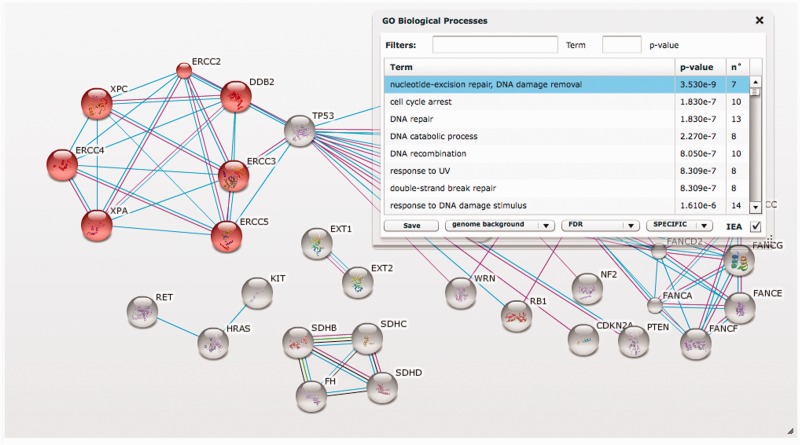
“The STRING screenshot shows a user-supplied set of genes, here a selection of cancer genes as annotated at the COSMIC database (52).”
The Database of Interacting Proteins: 2004 update
Salwinski, L. (2004) · Nucleic Acids Research · doi:10.1093/nar/gkh086 · Cited by 2,271
The SWISS-MODEL Repository and associated resources
Kiefer, F., Arnold, K., Kunzli, M., Bordoli, L., & Schwede, T. (2009) · Nucleic Acids Research · doi:10.1093/nar/gkn750 · Cited by 2,012 · cited 2×
“Each protein node in the network shows a preview to 3D structural information, if available, and can be clicked to reveal a pop-up window with more information about the protein [including its annotation (58), SMART domain-structure (59), structure homology models from SWISS-MODEL Repository (60), etc.].”
Backgroundvon Mering, C. (2004) · Nucleic Acids Research · doi:10.1093/nar/gki005 · Cited by 1,764 · cited 2×
“In the past, STRING has therefore used two distinct heuristic options: either to substitute homology for orthology (46) or to use pre-defined orthology relations described at high-level taxonomic groups, from the COG database (47).”
BackgroundMethodSelf-citationReactome: a database of reactions, pathways and biological processes
Croft, D., O'Kelly, G., Wu, G., Haw, R., Gillespie, M., Matthews, L., Caudy, M., Garapati, P., Gopinath, G., Jassal, B., et al. (2011) · Nucleic Acids Research · doi:10.1093/nar/gkq1018 · Cited by 1,751 · cited 1×
“Apart from the primary databases that hold the experimental data in this field (16–20) and hand-curated databases serving expert annotations (21,22), a number of resources take a meta-analysis approach, similar to STRING.”
SMART 7: recent updates to the protein domain annotation resource
Letunic, I., Doerks, T., & Bork, P. (2012) · Nucleic Acids Research · doi:10.1093/nar/gkr931 · Cited by 1,721 · cited 1×
“…node in the network shows a preview to 3D structural information, if available, and can be clicked to reveal a pop-up window with more information about the protein [including its annotation (58), SMART domain-structure (59), structure homology models from SWISS-MODEL Repository (60), etc.].”
BackgroundSelf-citationToward Automatic Reconstruction of a Highly Resolved Tree of Life
Ciccarelli, F. D., Doerks, T., von Mering, C., Creevey, C. J., Snel, B., & Bork, P. (2006) · Science · doi:10.1126/science.1123061 · Cited by 1,663
Self-citationTen Years of Pathway Analysis: Current Approaches and Outstanding Challenges
Khatri, P., Sirota, M., & Butte, A. J. (2012) · PLoS Computational Biology · doi:10.1371/journal.pcbi.1002375 · Cited by 1,566 · cited 1×
“To address this question, a variety of dedicated online resources are already available (49,50), most notably the DAVID resource (51).”
BackgroundOrthologs, Paralogs, and Evolutionary Genomics
Koonin, E. V. (2005) · Annual Review of Genetics · doi:10.1146/annurev.genet.39.073003.114725 · Cited by 1,323
Turning a hobby into a job: How duplicated genes find new functions
Conant, G. C., & Wolfe, K. H. (2008) · Nature Reviews Genetics · doi:10.1038/nrg2482 · Cited by 1,281
The IntAct molecular interaction database in 2012
Kerrien, S., Aranda, B., Breuza, L., Bridge, A., Broackes-Carter, F., Chen, C., Duesbury, M., Dumousseau, M., Feuermann, M., Hinz, U., et al. (2012) · Nucleic Acids Research · doi:10.1093/nar/gkr1088 · Cited by 1,150
MINT, the molecular interaction database: 2012 update
Licata, L., Briganti, L., Peluso, D., Perfetto, L., Iannuccelli, M., Galeota, E., Sacco, F., Palma, A., Nardozza, A. P., Santonico, E., et al. (2012) · Nucleic Acids Research · doi:10.1093/nar/gkr930 · Cited by 1,061
One thousand families for the molecular biologist
Chothia, C. (1992) · Nature · doi:10.1038/357543a0 · Cited by 1,018
The BioGRID Interaction Database: 2011 update
Stark, C., Breitkreutz, B.-J., Chatr-aryamontri, A., Boucher, L., Oughtred, R., Livstone, M. S., Nixon, J., Van Auken, K., Wang, X., Shi, X., et al. (2011) · Nucleic Acids Research · doi:10.1093/nar/gkq1116 · Cited by 854 · cited 1×
“Apart from the primary databases that hold the experimental data in this field (16–20) and hand-curated databases serving expert annotations (21,22), a number of resources take a meta-analysis approach, similar to STRING.”
Protein Interaction Mapping in C. elegans Using Proteins Involved in Vulval Development
Walhout, A. J. M., Sordella, R., Lu, X., Hartley, J. L., Temple, G. F., Brasch, M. A., Thierry-Mieg, N., & Vidal, M. (2000) · Science · doi:10.1126/science.287.5450.116 · Cited by 757 · cited 1×
“The term ‘interologs’ was coined for such pairs, a combination of the words ‘inter-action’ and ‘ortholog’ (40).”
Protein function in the post-genomic era
Eisenberg, D., Marcotte, E. M., Xenarios, I., & Yeates, T. O. (2000) · Nature · doi:10.1038/35015694 · Cited by 749 · cited 1×
“Together with direct, physical interactions, such indirect interactions constitute the larger superset of ‘functional protein–protein associations’ or ‘functional protein linkages’ (4,5).”
BackgroundOngoing and future developments at the Universal Protein Resource
The UniProt Consortium (2011) · Nucleic Acids Research · doi:10.1093/nar/gkq1020 · Cited by 729
Enrichment or depletion of a GO category within a class of genes: which test?
Rivals, I., Personnaz, L., Taing, L., & Potier, M.-C. (2007) · Bioinformatics · doi:10.1093/bioinformatics/btl633 · Cited by 718 · cited 1×
“The terms are sorted by their enrichment P-value, which we compute using a Hypergeometric test, as explained in (53).”
MethodPrioritizing candidate disease genes by network-based boosting of genome-wide association data
Lee, I., Blom, U. M., Wang, P. I., Shim, J. E., & Marcotte, E. M. (2011) · Genome Research · doi:10.1101/gr.118992.110 · Cited by 686 · cited 1×
“(iii) Protein association networks have also proven surprisingly useful for the elucidation of disease genes, both for Mendelian and for complex diseases (13–15).”
BackgroundConsensusPathDB: toward a more complete picture of cell biology
Kamburov, A., Pentchev, K., Galicka, H., Wierling, C., Lehrach, H., & Herwig, R. (2011) · Nucleic Acids Research · doi:10.1093/nar/gkq1156 · Cited by 671 · cited 1×
“These include GeneMANIA (23), Consensus-PathDB (24), I2D (25), VisANT (26) and, more recently, hPRINT (27), HitPredict (28), IMID (29) and IMP (30).”
BackgroundCaspi, R., Foerster, H., Fulcher, C. A., Kaipa, P., Krummenacker, M., Latendresse, M., Paley, S., Rhee, S. Y., Shearer, A. G., Tissier, C., et al. (2007) · Nucleic Acids Research · doi:10.1093/nar/gkm900 · Cited by 582
eggNOG v3.0: orthologous groups covering 1133 organisms at 41 different taxonomic ranges
Powell, S., Szklarczyk, D., Trachana, K., Roth, A., Kuhn, M., Muller, J., Arnold, R., Rattei, T., Letunic, I., Doerks, T., et al. (2012) · Nucleic Acids Research · doi:10.1093/nar/gkr1060 · Cited by 574 · cited 4×
“In particular, we will describe how STRING increasingly makes use of externally provided orthology information [from the eggNOG database (33)] to better integrate evidence across distinct organisms.”
MethodInfluentialSelf-citationThe structure of the protein universe and genome evolution
Koonin, E. V., Wolf, Y. I., & Karev, G. P. (2002) · Nature · doi:10.1038/nature01256 · Cited by 553
Predicting Protein Function by Genomic Context: Quantitative Evaluation and Qualitative Inferences
Huynen, M., Snel, B., Lathe, W., & Bork, P. (2000) · Genome Research · doi:10.1101/gr.10.8.1204 · Cited by 495 · cited 1×
“Together with direct, physical interactions, such indirect interactions constitute the larger superset of ‘functional protein–protein associations’ or ‘functional protein linkages’ (4,5).”
BackgroundSelf-citationComputational tools for prioritizing candidate genes: boosting disease gene discovery
Moreau, Y., & Tranchevent, L.-C. (2012) · Nature Reviews Genetics · doi:10.1038/nrg3253 · Cited by 417
Altenhoff, A. M., Studer, R. A., Robinson-Rechavi, M., & Dessimoz, C. (2012) · PLoS Computational Biology · doi:10.1371/journal.pcbi.1002514 · Cited by 248
Deciphering a global network of functionally associated post‐translational modifications
Minguez, P., Parca, L., Diella, F., Mende, D. R., Kumar, R., Helmer‐Citterich, M., Gavin, A., van Noort, V., & Bork, P. (2012) · Molecular Systems Biology · doi:10.1038/msb.2012.31 · Cited by 233 · cited 1×
“The natural language processing part of the pipeline has also been standardized, to make use of an ontology that describes possible molecular modes of action by which proteins can influence each other (35).”
MethodSelf-citationHuman Protein Reference Database and Human Proteinpedia as resources for phosphoproteome analysis
Goel, R., Harsha, H. C., Pandey, A., & Prasad, T. S. K. (2011) · Molecular BioSystems · doi:10.1039/c1mb05340j · Cited by 211 · cited 1×
“Apart from the primary databases that hold the experimental data in this field (16–20) and hand-curated databases serving expert annotations (21,22), a number of resources take a meta-analysis approach, similar to STRING.”
Ten thousand interactions for the molecular biologist
Aloy, P., & Russell, R. B. (2004) · Nature Biotechnology · doi:10.1038/nbt1018 · Cited by 191 · cited 1×
“This functional web of protein–protein links extends well beyond direct physical interactions only; indeed, physical interactions might also be rather limited, covering perhaps < 1% of the theoretically possible interaction space (3).”
BackgroundSimpson, J. C., Joggerst, B., Laketa, V., Verissimo, F., Cetin, C., Erfle, H., Bexiga, M. G., Singan, V. R., Hériché, J.-K., Neumann, B., et al. (2012) · Nature Cell Biology · doi:10.1038/ncb2510 · Cited by 186
VisANT 3.5: multi-scale network visualization, analysis and inference based on the gene ontology
Hu, Z., Hung, J.-H., Wang, Y., Chang, Y.-C., Huang, C.-L., Huyck, M., & DeLisi, C. (2009) · Nucleic Acids Research · doi:10.1093/nar/gkp406 · Cited by 185 · cited 1×
“These include GeneMANIA (23), Consensus-PathDB (24), I2D (25), VisANT (26) and, more recently, hPRINT (27), HitPredict (28), IMID (29) and IMP (30).”
BackgroundProtein folds, functions and evolution
Thornton, J. M., Orengo, C. A., Todd, A. E., & Pearl, F. M. G. (1999) · Journal of Molecular Biology · doi:10.1006/jmbi.1999.3054 · Cited by 182 · cited 1×
“Evolutionarily related proteins are known to usually maintain their three-dimensional structure, even when they have become so diverged over time that there is hardly any detectable sequence similarity left between them (36,37).”
BackgroundWolf, Y. I., Grishin, N. V., & Koonin, E. V. (2000) · Journal of Molecular Biology · doi:10.1006/jmbi.2000.3786 · Cited by 174 · cited 1×
“Highly complex organisms and behaviors can arise from a surprisingly restricted set of existing gene families (1,2), by a tightly regulated network of interactions among the proteins encoded by the genes.”
BackgroundExtraction of regulatory gene/protein networks from Medline
Šarić, J., Jensen, L. J., Ouzounova, R., Rojas, I., & Bork, P. (2005) · Bioinformatics · doi:10.1093/bioinformatics/bti597 · Cited by 161 · cited 1×
“The latter combines part-of-speech tagging, semantic tagging and a chunking grammar to achieve rule-based extraction of physical and regulatory interactions, as described previously (34).”
MethodSelf-citationComputational approaches to disease‐gene prediction: rationale, classification and successes
Piro, R. M., & Di Cunto, F. (2012) · The FEBS Journal · doi:10.1111/j.1742-4658.2012.08471.x · Cited by 157
Protein interface conservation across structure space
Zhang, Q. C., Petrey, D., Norel, R., & Honig, B. H. (2010) · Proceedings of the National Academy of Sciences · doi:10.1073/pnas.1005894107 · Cited by 156 · cited 1×
“Similarly, most protein–protein interaction interfaces remain well-conserved over time, at least for the case of stably bound protein partners located next to each other in protein complexes (38,39).”
BackgroundHitPredict: a database of quality assessed protein–protein interactions in nine species
Patil, A., Nakai, K., & Nakamura, H. (2011) · Nucleic Acids Research · doi:10.1093/nar/gkq897 · Cited by 146 · cited 1×
“These include GeneMANIA (23), Consensus-PathDB (24), I2D (25), VisANT (26) and, more recently, hPRINT (27), HitPredict (28), IMID (29) and IMP (30).”
BackgroundMPIDB: the microbial protein interaction database
Goll, J., Rajagopala, S. V., Shiau, S. C., Wu, H., Lamb, B. T., & Uetz, P. (2008) · Bioinformatics · doi:10.1093/bioinformatics/btn285 · Cited by 139
Wong, A. K., Park, C. Y., Greene, C. S., Bongo, L. A., Guan, Y., & Troyanskaya, O. G. (2012) · Nucleic Acids Research · doi:10.1093/nar/gks458 · Cited by 126 · cited 1×
“These include GeneMANIA (23), Consensus-PathDB (24), I2D (25), VisANT (26) and, more recently, hPRINT (27), HitPredict (28), IMID (29) and IMP (30).”
BackgroundThe evolution and structural anatomy of the small molecule metabolic pathways in Escherichia coli
Teichmann, S. A., Rison, S., Thornton, J. M., Riley, M., Gough, J., & Chothia, C. (2001) · Journal of Molecular Biology · doi:10.1006/jmbi.2001.4912 · Cited by 113 · cited 1×
“Whether this high degree of interaction conservation is true also for other, more indirect or transient types of protein–protein associations is less clear—although at least one such type, namely joint metabolic pathway membership, has also been shown to be generally well-conserved (41,42).”
BackgroundGenome-Wide RNAi Screens Identify Genes Required for Ricin and PE Intoxications
Moreau, D., Kumar, P., Wang, S. C., Chaumet, A., Chew, S. Y., Chevalley, H., & Bard, F. (2011) · Developmental Cell · doi:10.1016/j.devcel.2011.06.014 · Cited by 85
Niu, Y., Otasek, D., & Jurisica, I. (2010) · Bioinformatics · doi:10.1093/bioinformatics/btp602 · Cited by 78
How advancement in biological network analysis methods empowers proteomics
Goh, W. W. B., Lee, Y. H., Chung, M. C. M., & Wong, L. (2012) · PROTEOMICS · doi:10.1002/pmic.201100321 · Cited by 69 · cited 1×
“(ii) Protein network information can aid in the interpretation of functional genomics data, e.g. in systematic proteomics surveys (10–12).”
BackgroundOppermann, F. S., Grundner‐Culemann, K., Kumar, C., Gruß, O. J., Jallepalli, P. V., & Daub, H. (2011) · Molecular & Cellular Proteomics · doi:10.1074/mcp.o111.012351 · Cited by 65
Measuring the evolutionary rate of protein–protein interaction
Qian, W., He, X., Chan, E., Xu, H., & Zhang, J. (2011) · Proceedings of the National Academy of Sciences · doi:10.1073/pnas.1104695108 · Cited by 64 · cited 1×
“Similarly, most protein–protein interaction interfaces remain well-conserved over time, at least for the case of stably bound protein partners located next to each other in protein complexes (38,39).”
BackgroundLarge-scale De Novo Prediction of Physical Protein-Protein Association
Elefsinioti, A. L., Saraç, Ö. S., Hegele, A., Plake, C., Hubner, N. C., Poser, I., Sarov, M., Hyman, A. A., Mann, M., Schroeder, M., et al. (2011) · Molecular & Cellular Proteomics · doi:10.1074/mcp.m111.010629 · Cited by 57 · cited 1×
“These include GeneMANIA (23), Consensus-PathDB (24), I2D (25), VisANT (26) and, more recently, hPRINT (27), HitPredict (28), IMID (29) and IMP (30).”
BackgroundSNOW, a web-based tool for the statistical analysis of protein–protein interaction networks
Mínguez, P., Götz, S., Montaner, D. A., Al‐Shahrour, F., & Dopazo, J. (2009) · Nucleic Acids Research · doi:10.1093/nar/gkp402 · Cited by 54
RNAiCut: automated detection of significant genes from functional genomic screens
Kaplow, I. M., Singh, R., Friedman, A. A., Bakal, C., Perrimon, N., & Berger, B. (2009) · Nature Methods · doi:10.1038/nmeth0709-476 · Cited by 37
Olsson, N., James, P., Borrebaeck, C. A. K., & Wingren, C. (2012) · Molecular & Cellular Proteomics · doi:10.1074/mcp.m111.016238 · Cited by 25
Pradines, J., Farutin, V., Rowley, S. C., & Dančík, V. (2005) · Journal of Computational Biology · doi:10.1089/cmb.2005.12.113 · Cited by 20 · cited 2×
“We chose a random background model that preserves the degree distribution of the proteins in a given list: the Random Graph with Given Degree Sequence (RGGDS), similar to references (55,57).”
BackgroundMethodIMID: integrated molecular interaction database
Balaji, S., Mcclendon, C., Chowdhary, R., Liu, J. S., & Zhang, J. (2012) · Bioinformatics · doi:10.1093/bioinformatics/bts010 · Cited by 16
Contextual analysis of RNAi-based functional screens using interaction networks
Gonzalez, O., & Zimmer, R. (2011) · Bioinformatics · doi:10.1093/bioinformatics/btr469 · Cited by 11
Cited by
Szklarczyk, D., Gable, A. L., Lyon, D., Junge, A., Wyder, S., Huerta-Cepas, J., Simonovic, M., Doncheva, N. T., Morris, J. H., Bork, P., et al. (2019) · Nucleic Acids Research · doi:10.1093/nar/gky1131 · Cited by 17,749
“…particular network (counts denote how many records covered at least two of the proteins in the network; not all of these records contributed high-scoring links after score calibration). defined in eggNOG (32), in order to transfer associations between organisms where applicable (described in (29)).”
BackgroundMethodSelf-citationSTRING v10: protein–protein interaction networks, integrated over the tree of life
Szklarczyk, D., Franceschini, A., Wyder, S., Forslund, K., Heller, D., Huerta-Cepas, J., Simonovic, M., Roth, A., Santos, A., Tsafou, K. P., et al. (2015) · Nucleic Acids Research · doi:10.1093/nar/gku1003 · Cited by 10,436
Self-citationSzklarczyk, D., Kirsch, R., Koutrouli, M., Nastou, K., Mehryary, F., Hachilif, R., Gable, A. L., Fang, T., Doncheva, N. T., Pyysalo, S., et al. (2023) · Nucleic Acids Research · doi:10.1093/nar/gkac1000 · Cited by 9,726
“These texts are all parsed for co-mentions of protein pairs and assessed against the frequencies of all separate mentions of the respective proteins, as described in (46).”
BackgroundMethodInfluentialSelf-citationSzklarczyk, D., Gable, A. L., Nastou, K. C., Lyon, D., Kirsch, R., Pyysalo, S., Doncheva, N. T., Legeay, M., Fang, T., Bork, P., et al. (2021) · Nucleic Acids Research · doi:10.1093/nar/gkaa1074 · Cited by 8,056
“Pairs of proteins mentioned together in the same sentence, the same paragraph, or merely the same publication are assigned a benchmarked association score, the calculation of which is described in detail in (33).”
BackgroundSelf-citationSzklarczyk, D., Morris, J. H., Cook, H., Kuhn, M., Wyder, S., Simonovic, M., Santos, A., Doncheva, N. T., Roth, A., Bork, P., et al. (2017) · Nucleic Acids Research · doi:10.1093/nar/gkw937 · Cited by 6,980
Self-citation
Metadata
- Authors
- Franceschini, A., Szklarczyk, D., Frankild, S., Kuhn, M., Simonovic, M., Roth, A., Lin, J., Minguez, P., Bork, P., von Mering, C., & Jensen, L. J.
- Affiliations
- SIB Swiss Institute of Bioinformatics (CH)
- University of Copenhagen (DK)
- Venue
- Nucleic Acids Research
- Publisher
- Oxford University Press (OUP)
- Published
- 2012-11-29
- Volume
- 41
- Issue
- D1
- Pages
- D808-D815
- ISSN
- 0305-1048 (ISSN-L)
- 1362-4962
- PMC
- PMC3531103
- OpenAlex
- W2105924489
- Cited by
- 4,398
- References
- 61
- Citations by year
- 2026: 77 · 2025: 153 · 2024: 201 · 2023: 247 · 2022: 325 · 2021: 335 · 2020: 366 · 2019: 281 · 2018: 291 · 2017: 371 · 2016: 476 · 2015: 675 · 2014: 457 · 2013: 134 · 2012: 3
- FWCI
- 163.15
- Type
- journal article
- Language
- en
- Open access
- gold
- doi.org
- Licence
- Locations
- Nucleic Acids Research (publishedVersion, cc-by-nc)
- Europe PMC (PubMed Central) (publishedVersion, cc-by-nc)
- PubMed Central (publishedVersion, cc-by-nc)
- PubMed (publishedVersion)
- MDC Repository (Max-Delbrueck-Center for Molecular Medicine) (acceptedVersion)
- Zurich Open Repository and Archive (University of Zurich) (acceptedVersion, other-oa)
- reroDoc Digital Library (submittedVersion)
- Archivio Istituzionale della Ricerca (Universita Degli Studi Di Milano) (submittedVersion, cc-by-nc)
- Research at the University of Copenhagen (University of Copenhagen) (submittedVersion)
- Zurich Open Repository and Archive (University of Zurich) (submittedVersion, other-oa)
- Zurich Open Repository and Archive (University of Zurich)
- Funders
- European Molecular Biology Laboratory
- Novo Nordisk
- Universität Zürich
- Topics
- Life Sciences › Biochemistry, Genetics and Molecular Biology › Molecular Biology › Bioinformatics and Genomic Networks
- Health Sciences › Medicine › Health Informatics › Biomedical Text Mining and Ontologies
- Life Sciences › Biochemistry, Genetics and Molecular Biology › Molecular Biology › Genomics and Phylogenetic Studies
- Keywords
- STRING database, protein-protein interaction network, interaction prediction, literature mining, functional enrichment, biological pathway databases
- MeSH terms
- Algorithms, Data Interpretation, Statistical, User-Computer Interface, Systems Integration, Internet, Protein Interaction Mapping, Databases, Protein, Data Mining
About these checks
Registry, retraction, Cites and statistics results are computed, not judged, with one exception: a printed reference that no index lists is read once by a model before it counts as a citation error. Claims are extracted by a model and kept only when their quote appears verbatim in the text; each cited source is then checked, with a model’s help, for whether it says what the claim relies on. Those verdicts can be wrong — read the claim’s quote and the cited source before relying on one.
Statistics and arithmetic are recomputed, not judged.
Confidence bands are shown only for fields calibrated on our annotated test set. None is calibrated yet, so no band is shown.
What counts as a claim ›How we measure confidence ›How we check this ›
Are you an author, or do you see a problem with this page? Request a review
Data sources
Bibliographic data: Semantic Scholar, OpenAlex, Crossref.
Contains information from the Semantic Scholar Academic Graph Datasets, made available under the ODC Attribution License (ODC-BY 1.0).
Semantic Scholar’s data is described in: Kinney, R., et al. (2023). The Semantic Scholar Open Data Platform. arXiv:2301.10140.
