

STRING v9.1: protein-protein interaction networks, with increased coverage and integration
Open accessThe DOI matches its Crossref record; 61 of the 61 references it cites were found in a registry or an index.
Abstract
Complete knowledge of all direct and indirect interactions between proteins in a given cell would represent an important milestone towards a comprehensive description of cellular mechanisms and functions. Although this goal is still elusive, considerable progress has been made-particularly for certain model organisms and functional systems. Currently, protein interactions and associations are annotated at various levels of detail in online resources, ranging from raw data repositories to highly formalized pathway databases. For many applications, a global view of all the available interaction data is desirable, including lower-quality data and/or computational predictions. The STRING database (http://string-db.org/) aims to provide such a global perspective for as many organisms as feasible. Known and predicted associations are scored and integrated, resulting in comprehensive protein networks covering >1100 organisms. Here, we describe the update to version 9.1 of STRING, introducing several improvements: (i) we extend the automated mining of scientific texts for interaction information, to now also include full-text articles; (ii) we entirely re-designed the algorithm for transferring interactions from one model organism to the other; and (iii) we provide users with statistical information on any functional enrichment observed in their networks.
Overview
The claims and statistics of this paper haven’t been checked yet.
Free: it reads the open-access text and checks the first 5 claims that cite a source we can check. Create a free account to check every claim.
Integrity signals
Registry
Cites
Statistics
Figures

Verification
Claims the paper makes
The claims and statistics of this paper haven’t been checked yet.
Free: it reads the open-access text and checks the first 5 claims that cite a source we can check. Create a free account to check every claim.
Claims other papers make about this one
Each is checked against this paper’s own text: does it say what the citing paper says it does?
The source backs part of the claim, not all of it — or backs it for a different population, condition or comparison.
In the citing paper
“One approach is to treat the multiple datasets as different “features” annotated to each edge in a single unified network; these multiple features are combined to estimate a single interaction likelihood score for each node pair using supervised machine learning (Kramer et al., 2017) or Bayesian inference (Franceschini et al., 2013; Wong et al., 2004).”
From Mapping the multiscale structure of biological systems (2021) · cites this paper as Franceschini et al., 2013
Experimental — accuracy not yet measuredIn the citing paper
“Bioinformatic network tools, including STRING and GeneMania (93, 94), can score direct and indirect protein functional relationships using public database repositories, such as IntAct and Reactome (95, 96).”
From The Impact of Mass Spectrometry–Based Proteomics on Fundamental Discoveries in Virology (2014) · cites this paper as [94]
Self-check
Percentages, sums and reported differences re-computed from the paper’s own numbers.
The self-check needs the paper’s full text.
Citations
Cites
Controlling the False Discovery Rate: A Practical and Powerful Approach to Multiple Testing
Benjamini, Y., & Hochberg, Y. (1995) · Journal of the Royal Statistical Society Series B: Statistical Methodology · doi:10.1111/j.2517-6161.1995.tb02031.x · Cited by 109,482 · cited 1×
“The P -values are corrected for multiple testing using the method of Benjamini and Hochberg (54), but we also provide options to either disable that correction or to select a more stringent statistical test (Bonferroni).”
MethodSystematic and integrative analysis of large gene lists using DAVID bioinformatics resources
Huang, D. W., Sherman, B. T., & Lempicki, R. A. (2009) · Nature Protocols · doi:10.1038/nprot.2008.211 · Cited by 35,890 · cited 1×
“To address this question, a variety of dedicated online resources are already available (49,50), most notably the DAVID resource (51).”
BackgroundHuang, D. W., Sherman, B. T., & Lempicki, R. A. (2009) · Nucleic Acids Research · doi:10.1093/nar/gkn923 · Cited by 14,108 · cited 1×
“To address this question, a variety of dedicated online resources are already available (49,50), most notably the DAVID resource (51).”
BackgroundWarde-Farley, D., Donaldson, S. L., Comes, O., Zuberi, K., Badrawi, R., Chao, P., Franz, M., Grouios, C., Kazi, F., Lopes, C. T., et al. (2010) · Nucleic Acids Research · doi:10.1093/nar/gkq537 · Cited by 4,835 · cited 1×
“These include GeneMANIA (23), Consensus-PathDB (24), I2D (25), VisANT (26) and, more recently, hPRINT (27), HitPredict (28), IMID (29) and IMP (30).”
BackgroundThe COG database: a tool for genome-scale analysis of protein functions and evolution
Tatusov, R. L. (2000) · Nucleic Acids Research · doi:10.1093/nar/28.1.33 · Cited by 4,520 · cited 1×
“In the past, STRING has therefore used two distinct heuristic options: either to substitute homology for orthology (46) or to use pre-defined orthology relations described at high-level taxonomic groups, from the COG database (47).”
MethodSzklarczyk, D., Franceschini, A., Kuhn, M., Simonovic, M., Roth, A., Minguez, P., Doerks, T., Stark, M., Muller, J., Bork, P., et al. (2011) · Nucleic Acids Research · doi:10.1093/nar/gkq973 · Cited by 3,460 · cited 2×
“We have already discussed many aspects of the STRING resource previously, e.g. (31,32), including its data-sources, prediction algorithms and user-interface.”
BackgroundSelf-citationCaspi, R., Billington, R., Ferrer, L., Foerster, H., Fulcher, C. A., Keseler, I. M., Kothari, A., Krummenacker, M., Latendresse, M., Mueller, L. A., et al. (2016) · Nucleic Acids Research · doi:10.1093/nar/gkv1164 · Cited by 3,395
Specificity and Stability in Topology of Protein Networks
Maslov, S., & Sneppen, K. (2002) · Science · doi:10.1126/science.1065103 · Cited by 3,051
STRING 8--a global view on proteins and their functional interactions in 630 organisms
Jensen, L. J., Kuhn, M., Stark, M., Chaffron, S., Creevey, C., Muller, J., Doerks, T., Julien, P., Roth, A., Simonovic, M., et al. (2009) · Nucleic Acids Research · doi:10.1093/nar/gkn760 · Cited by 2,474 · cited 1×
“We have already discussed many aspects of the STRING resource previously, e.g. (31,32), including its data-sources, prediction algorithms and user-interface.”
BackgroundSelf-citationCOSMIC: mining complete cancer genomes in the Catalogue of Somatic Mutations in Cancer
Forbes, S. A., Bindal, N., Bamford, S., Cole, C., Kok, C. Y., Beare, D., Jia, M., Shepherd, R., Leung, K., Menzies, A., et al. (2011) · Nucleic Acids Research · doi:10.1093/nar/gkq929 · Cited by 2,278 · cited 1×
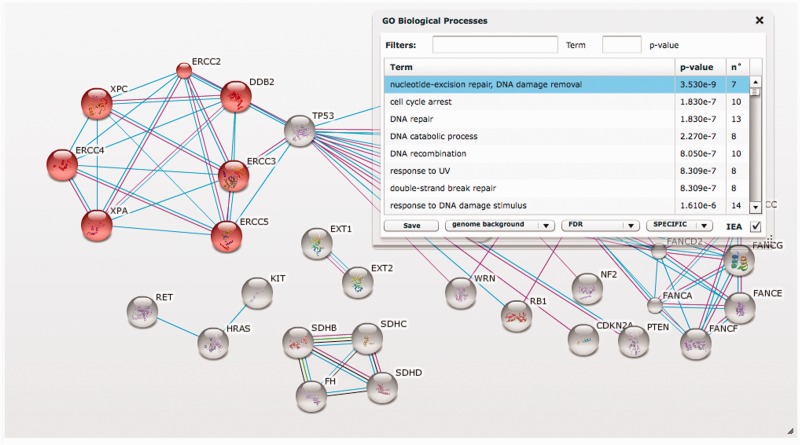
“The STRING screenshot shows a user-supplied set of genes, here a selection of cancer genes as annotated at the COSMIC database (52).”
Cited by
Szklarczyk, D., Gable, A. L., Lyon, D., Junge, A., Wyder, S., Huerta-Cepas, J., Simonovic, M., Doncheva, N. T., Morris, J. H., Bork, P., et al. (2019) · Nucleic Acids Research · doi:10.1093/nar/gky1131 · Cited by 17,749
“…particular network (counts denote how many records covered at least two of the proteins in the network; not all of these records contributed high-scoring links after score calibration). defined in eggNOG (32), in order to transfer associations between organisms where applicable (described in (29)).”
BackgroundMethodSelf-citationSTRING v10: protein–protein interaction networks, integrated over the tree of life
Szklarczyk, D., Franceschini, A., Wyder, S., Forslund, K., Heller, D., Huerta-Cepas, J., Simonovic, M., Roth, A., Santos, A., Tsafou, K. P., et al. (2015) · Nucleic Acids Research · doi:10.1093/nar/gku1003 · Cited by 10,436
Self-citationSzklarczyk, D., Kirsch, R., Koutrouli, M., Nastou, K., Mehryary, F., Hachilif, R., Gable, A. L., Fang, T., Doncheva, N. T., Pyysalo, S., et al. (2023) · Nucleic Acids Research · doi:10.1093/nar/gkac1000 · Cited by 9,726
“These texts are all parsed for co-mentions of protein pairs and assessed against the frequencies of all separate mentions of the respective proteins, as described in (46).”
BackgroundMethodInfluentialSelf-citationSzklarczyk, D., Gable, A. L., Nastou, K. C., Lyon, D., Kirsch, R., Pyysalo, S., Doncheva, N. T., Legeay, M., Fang, T., Bork, P., et al. (2021) · Nucleic Acids Research · doi:10.1093/nar/gkaa1074 · Cited by 8,056
“Pairs of proteins mentioned together in the same sentence, the same paragraph, or merely the same publication are assigned a benchmarked association score, the calculation of which is described in detail in (33).”
BackgroundSelf-citationSzklarczyk, D., Morris, J. H., Cook, H., Kuhn, M., Wyder, S., Simonovic, M., Santos, A., Doncheva, N. T., Roth, A., Bork, P., et al. (2017) · Nucleic Acids Research · doi:10.1093/nar/gkw937 · Cited by 6,980
Self-citationGenomic atlas of the human plasma proteome
Sun, B. B., Maranville, J. C., Peters, J. E., Stacey, D., Staley, J. R., Blackshaw, J., Burgess, S., Jiang, T., Paige, E., Surendran, P., et al. (2018) · Nature · doi:10.1038/s41586-018-0175-2 · Cited by 2,268
Lloyd-Price, J., Abu-Ali, G., & Huttenhower, C. (2016) · Genome Medicine · doi:10.1186/s13073-016-0307-y · Cited by 1,891
“Likewise microbial communities provide a new source of guilt-by-association information that can be used computationally to generate predictions of gene function [127, 128].”
BackgroundSMART: recent updates, new developments and status in 2015
Letunic, I., Doerks, T., & Bork, P. (2015) · Nucleic Acids Research · doi:10.1093/nar/gku949 · Cited by 1,715
Self-citationSTITCH 5: augmenting protein–chemical interaction networks with tissue and affinity data
Szklarczyk, D., Santos, A., von Mering, C., Jensen, L. J., Bork, P., & Kuhn, M. (2016) · Nucleic Acids Research · doi:10.1093/nar/gkv1277 · Cited by 1,687
Self-citationWu, H., Esteve, E., Tremaroli, V., Khan, M. T., Caesar, R., Mannerås-Holm, L., Ståhlman, M., Olsson, L. M., Serino, M., Planas-Fèlix, M., et al. (2017) · Nature Medicine · doi:10.1038/nm.4345 · Cited by 1,632
Rouillard, A. D., Gundersen, G. W., Fernandez, N. F., Wang, Z., Monteiro, C. D., McDermott, M. G., & Ma’ayan, A. (2016) · Database · doi:10.1093/database/baw100 · Cited by 1,515
The SIDER database of drugs and side effects
Kuhn, M., Letunic, I., Jensen, L. J., & Bork, P. (2016) · Nucleic Acids Research · doi:10.1093/nar/gkv1075 · Cited by 1,451
Self-citationArchitecture of the human interactome defines protein communities and disease networks
Huttlin, E. L., Bruckner, R. J., Paulo, J. A., Cannon, J. R., Ting, L., Baltier, K., Colby, G., Gebreab, F., Gygi, M. P., Parzen, H., et al. (2017) · Nature · doi:10.1038/nature22366 · Cited by 1,437
The BioPlex network: a systematic exploration of the human interactome
Huttlin, E. L., Ting, L., Bruckner, R. J., Gebreab, F., Gygi, M. P., Szpyt, J., Tam, S., Zarraga, G., Colby, G., Baltier, K., et al. (2015) · Cell · doi:10.1016/j.cell.2015.06.043 · Cited by 1,425
“To enable more extensive comparison, we compiled all human physical interactions reported in CORUM, BioGRID (Stark et al., 2011), GeneMania, STRING, and MINT (Licata et al., 2012).”
InfluentialTraditional Chinese medicine network pharmacology: theory, methodology and application
LI, S., & ZHANG, B. (2013) · Chinese Journal of Natural Medicines · doi:10.1016/s1875-5364(13)60037-0 · Cited by 1,329
“Meanwhile, with the availability of various databases and data resources related to TCM and biological systems [52-64] (Table 2), many researchers have continued to modernize TCM in the context of network pharmacology.”
BackgroundBiological Network Exploration with Cytoscape 3
Su, G., Morris, J. H., Demchak, B., & Bader, G. D. (2014) · Current Protocols in Bioinformatics · doi:10.1002/0471250953.bi0813s47 · Cited by 1,031
Proteomics: Technologies and Their Applications
Aslam, B., Basit, M., Nisar, M. A., Khurshid, M., & Rasool, M. H. (2017) · Journal of Chromatographic Science · doi:10.1093/chromsci/bmw167 · Cited by 1,000
“Furthermore, protein networks can be drawn based on the list of genes provided and the available interactions using STRING database (138, 151, 152) (Table 1).”
MethodThe evolution of lncRNA repertoires and expression patterns in tetrapods
Necsulea, A., Soumillon, M., Warnefors, M., Liechti, A., Daish, T., Zeller, U., Baker, J. C., Grützner, F., & Kaessmann, H. (2014) · Nature · doi:10.1038/nature12943 · Cited by 984
iRegulon: From a Gene List to a Gene Regulatory Network Using Large Motif and Track Collections
Janky, R., Verfaillie, A., Imrichová, H., Van de Sande, B., Standaert, L., Christiaens, V., Hulselmans, G., Herten, K., Naval Sanchez, M., Potier, D., et al. (2014) · PLoS Computational Biology · doi:10.1371/journal.pcbi.1003731 · Cited by 900
Correlating chemical sensitivity and basal gene expression reveals mechanism of action
Rees, M. G., Seashore-Ludlow, B., Cheah, J. H., Adams, D. J., Price, E. V., Gill, S., Javaid, S., Coletti, M. E., Jones, V. L., Bodycombe, N. E., et al. (2016) · Nature Chemical Biology · doi:10.1038/nchembio.1986 · Cited by 898
Pan-viral specificity of IFN-induced genes reveals new roles for cGAS in innate immunity
Schoggins, J. W., MacDuff, D. A., Imanaka, N., Gainey, M. D., Shrestha, B., Eitson, J. L., Mar, K. B., Richardson, R. B., Ratushny, A. V., Litvak, V., et al. (2014) · Nature · doi:10.1038/nature12862 · Cited by 896
The BioGRID interaction database: 2015 update
Chatr-aryamontri, A., Breitkreutz, B.-J., Oughtred, R., Boucher, L., Heinicke, S., Chen, D., Stark, C., Breitkreutz, A., Kolas, N., O'Donnell, L., et al. (2015) · Nucleic Acids Research · doi:10.1093/nar/gku1204 · Cited by 890
A draft network of ligand–receptor-mediated multicellular signalling in human
Ramilowski, J. A., Goldberg, T., Harshbarger, J., Kloppmann, E., Lizio, M., Satagopam, V. P., Itoh, M., Kawaji, H., Carninci, P., Rost, B., et al. (2015) · Nature Communications · doi:10.1038/ncomms8866 · Cited by 887
Bertoni, M., Kiefer, F., Biasini, M., Bordoli, L., & Schwede, T. (2017) · Scientific Reports · doi:10.1038/s41598-017-09654-8 · Cited by 866
A Highly Conserved Program of Neuronal Microexons Is Misregulated in Autistic Brains
Irimia, M., Weatheritt, R. J., Ellis, J. D., Parikshak, N. N., Gonatopoulos-Pournatzis, T., Babor, M., Quesnel-Vallières, M., Tapial, J., Raj, B., O’Hanlon, D., et al. (2014) · Cell · doi:10.1016/j.cell.2014.11.035 · Cited by 693
“, 2013) databases with the dashed lines representing indirect interactions that are either between proteins found within same protein complex but not interacting directly or predicted interactions based on paralogs (Franceschini et al., 2013).”
BackgroundCOMPARTMENTS: unification and visualization of protein subcellular localization evidence
Binder, J. X., Pletscher-Frankild, S., Tsafou, K., Stolte, C., O'Donoghue, S. I., Schneider, R., & Jensen, L. J. (2014) · Database · doi:10.1093/database/bau012 · Cited by 668
“To provide a unified overview as described above, we map protein identifiers from the source databases to their corresponding identifiers in the STRING (Search Tool for the Retrieval of Interacting Genes) database (30), which for organisms in question come from Ensembl (31).”
BackgroundMethodInfluentialSelf-citationThe STRING database in 2025: protein networks with directionality of regulation
Szklarczyk, D., Nastou, K., Koutrouli, M., Kirsch, R., Mehryary, F., Hachilif, R., Hu, D., Peluso, M. E., Huang, Q., Fang, T., et al. (2025) · Nucleic Acids Research · doi:10.1093/nar/gkae1113 · Cited by 668
Self-citationIdentification and consequences of miRNA–target interactions — beyond repression of gene expression
Hausser, J., & Zavolan, M. (2014) · Nature Reviews Genetics · doi:10.1038/nrg3765 · Cited by 628
Network-based in silico drug efficacy screening
Guney, E., Menche, J., Vidal, M., & Barábasi, A.-L. (2016) · Nature Communications · doi:10.1038/ncomms10331 · Cited by 625
DISEASES: Text mining and data integration of disease–gene associations
Pletscher-Frankild, S., Pallejà, A., Tsafou, K., Binder, J. X., & Jensen, L. J. (2015) · Methods · doi:10.1016/j.ymeth.2014.11.020 · Cited by 591
Self-citationStatus of Large-scale Analysis of Post-translational Modifications by Mass Spectrometry
Olsen, J. V., & Mann, M. (2013) · Molecular & Cellular Proteomics · doi:10.1074/mcp.o113.034181 · Cited by 591
“The NetWorKIN software (69, 70) combines protein–protein information from STRING (67) with information on linear kinase motifs (62) to provide likely kinase–substrate relationships in largescale data.”
BackgroundMethodTherapeutic opportunities within the DNA damage response
Pearl, L. H., Schierz, A. C., Ward, S. E., Al-Lazikani, B., & Pearl, F. M. G. (2015) · Nature Reviews Cancer · doi:10.1038/nrc3891 · Cited by 587
Liu, Z.-P., Wu, C., Miao, H., & Wu, H. (2015) · Database · doi:10.1093/database/bav095 · Cited by 555
Distributional Semantics Resources for Biomedical Text Processing
Pyysalo, S., Ginter, F., Moen, H., Salakoski, T., & Ananiadou, S. (2013) · Research Explorer (The University of Manchester) · Cited by 548
Panorama of ancient metazoan macromolecular complexes
Wan, C., Borgeson, B., Phanse, S., Tu, F., Drew, K., Clark, G., Xiong, X., Kagan, O., Kwan, J., Bezginov, A., et al. (2015) · Nature · doi:10.1038/nature14877 · Cited by 546
Sun, Z., Harris, H. M. B., McCann, A., Guo, C., Argimón, S., Zhang, W., Yang, X., Jeffery, I. B., Cooney, J. C., Kagawa, T. F., et al. (2015) · Nature Communications · doi:10.1038/ncomms9322 · Cited by 543
“Types I, II and III CRISPR-Cas systems were all detected (66, 68, and 3 systems, respectively; Supplementary Table 7).”
Exome Sequencing Links Corticospinal Motor Neuron Disease to Common Neurodegenerative Disorders
Novarino, G., Fenstermaker, A. G., Zaki, M. S., Hofree, M., Silhavy, J. L., Heiberg, A. D., Abdellateef, M., Rosti, B., Scott, E., Mansour, L., et al. (2014) · Science · doi:10.1126/science.1247363 · Cited by 536
The outer mucus layer hosts a distinct intestinal microbial niche
Li, H., Limenitakis, J. P., Fuhrer, T., Geuking, M. B., Lawson, M. A., Wyss, M., Brugiroux, S., Keller, I., Macpherson, J. A., Rupp, S., et al. (2015) · Nature Communications · doi:10.1038/ncomms9292 · Cited by 511
STITCH 4: integration of protein–chemical interactions with user data
Kuhn, M., Szklarczyk, D., Pletscher-Frankild, S., Blicher, T. H., von Mering, C., Jensen, L. J., & Bork, P. (2014) · Nucleic Acids Research · doi:10.1093/nar/gkt1207 · Cited by 487
Self-citationThe UCSC Genome Browser database: 2018 update
Casper, J., Zweig, A. S., Villarreal, C., Tyner, C., Speir, M. L., Rosenbloom, K. R., Raney, B. J., Lee, C. M., Lee, B. T., Karolchik, D., et al. (2018) · Nucleic Acids Research · doi:10.1093/nar/gkx1020 · Cited by 475
“1 (21,22), WikiPathways (23,24), the OpenBEL large corpus (https://github.”
A Quantitative Proteome Map of the Human Body
Jiang, L., Wang, M., Lin, S., Jian, R., Li, X., Chan, J., Dong, G., Fang, H., Robinson, A. E., Aguet, F., et al. (2020) · Cell · doi:10.1016/j.cell.2020.08.036 · Cited by 458
“We performed an enrichment analysis using the Kyoto Encyclopedia of Genes and Genomes (KEGG) and Gene Ontology (GO) (Gene Ontology Consortium, 2015) terms based on R package “STRINGdb” (Franceschini et al., 2013).”
Enhancer-promoter interactions are encoded by complex genomic signatures on looping chromatin
Whalen, S., Truty, R. M., & Pollard, K. S. (2016) · Nature Genetics · doi:10.1038/ng.3539 · Cited by 456
Xia, J., Benner, M. J., & Hancock, R. E. W. (2014) · Nucleic Acids Research · doi:10.1093/nar/gku443 · Cited by 450
Szklarczyk, D., Gable, A. L., Nastou, K. C., Lyon, D., Kirsch, R., Pyysalo, S., Doncheva, N. T., Legeay, M., Fang, T., Bork, P., et al. (2021) · Nucleic Acids Research · doi:10.1093/nar/gkab835 · Cited by 446
Self-citationNext-generation diagnostics and disease-gene discovery with the Exomiser
Smedley, D., Jacobsen, J. O. B., Jäger, M., Köhler, S., Holtgrewe, M., Schubach, M., Siragusa, E., Zemojtel, T., Buske, O. J., Washington, N. L., et al. (2015) · Nature Protocols · doi:10.1038/nprot.2015.124 · Cited by 445
Direct cell reprogramming: approaches, mechanisms and progress
Wang, H., Yang, Y., Liu, J., & Qian, L. (2021) · Nature Reviews Molecular Cell Biology · doi:10.1038/s41580-021-00335-z · Cited by 444
Quantitative and logic modelling of molecular and gene networks
Le Novère, N. (2015) · Nature Reviews Genetics · doi:10.1038/nrg3885 · Cited by 430
“In addition to physical molecular interactions, Search Tool for the Retrieval of Interacting Genes/Proteins (STRING) (54) distributes functional interactions inferred from various sources, such as coexpression and text mining.”
BackgroundThe Roles of Post-translational Modifications in the Context of Protein Interaction Networks
Duan, G., & Walther, D. (2015) · PLOS Computational Biology · doi:10.1371/journal.pcbi.1004049 · Cited by 430
Analyzing and interpreting genome data at the network level with ConsensusPathDB
Herwig, R., Hardt, C., Lienhard, M., & Kamburov, A. (2016) · Nature Protocols · doi:10.1038/nprot.2016.117 · Cited by 424
Jin, G., & Wong, S. T. C. (2014) · Drug Discovery Today · doi:10.1016/j.drudis.2013.11.005 · Cited by 416
Multidimensional proteomics for cell biology
Larance, M., & Lamond, A. I. (2015) · Nature Reviews Molecular Cell Biology · doi:10.1038/nrm3970 · Cited by 411
“…include protein–protein interaction networks, as exemplified by the search tool for the retrieval of interacting genes/proteins (STRING) database 120 ( , and tissue-specific protein expression patterns in humans (see Supplementary information S2 (figure)), as determined both by mass…”
MethodMertins, P., Yang, F., Liu, T., Mani, D. R., Petyuk, V. A., Gillette, M. A., Clauser, K. R., Qiao, J. W., Gritsenko, M. A., Moore, R. J., et al. (2014) · Molecular & Cellular Proteomics · doi:10.1074/mcp.m113.036392 · Cited by 400
“Using curated protein–protein interaction information from the STRING database (26) and site-specific kinase–substrate relationship information from the PhosphoSitePlus database (27), we were able to group 30 of these ischemia-regulated phosphoproteins into a functional protein network (Fig.”
MethodGeneMANIA Prediction Server 2013 Update
Zuberi, K., Franz, M., Rodriguez, H., Montojo, J., Lopes, C. T., Bader, G. D., & Morris, Q. (2013) · Nucleic Acids Research · doi:10.1093/nar/gkt533 · Cited by 396
“These tools include: STRING (9), N-browse (31), IMP (32), FunctionalNet (33) and FunCoup (34).”
MethodDistinct brain transcriptome profiles in C9orf72-associated and sporadic ALS
Prudencio, M., Belzil, V. V., Batra, R., Ross, C. A., Gendron, T. F., Pregent, L. J., Murray, M. E., Overstreet, K. K., Piazza-Johnston, A. E., Desaro, P., et al. (2015) · Nature Neuroscience · doi:10.1038/nn.4065 · Cited by 390
Active medulloblastoma enhancers reveal subgroup-specific cellular origins
Lin, C. Y., Erkek, S., Tong, Y., Yin, L., Federation, A. J., Zapatka, M., Haldipur, P., Kawauchi, D., Risch, T., Warnatz, H.-J., et al. (2016) · Nature · doi:10.1038/nature16546 · Cited by 380
Proteomics: Concepts and applications in human medicine
Al-Amrani, S., Al-Jabri, Z., Al-Zaabi, A., Alshekaili, J., & Al-Khabori, M. (2021) · World Journal of Biological Chemistry · doi:10.4331/wjbc.v12.i5.57 · Cited by 374
Bajrami, I., Frankum, J. R., Konde, A., Miller, R. E., Rehman, F. L., Brough, R., Campbell, J., Sims, D., Rafiq, R., Hooper, S., et al. (2014) · Cancer Research · doi:10.1158/0008-5472.can-13-2541 · Cited by 373
“Network diagramswere created fromdata in Supplementary Table S2 using STRING (41).”
Predicting Protein–Protein Interactions from the Molecular to the Proteome Level
Keskin, O., Tuncbag, N., & Gursoy, A. (2016) · Chemical Reviews · doi:10.1021/acs.chemrev.5b00683 · Cited by 369
A Systems-Level Analysis of the Peripheral Nerve Intrinsic Axonal Growth Program
Chandran, V., Coppola, G., Nawabi, H., Omura, T., Versano, R., Huebner, E. A., Zhang, A., Costigan, M., Yekkirala, A., Barrett, L., et al. (2016) · Neuron · doi:10.1016/j.neuron.2016.01.034 · Cited by 366
“…gene pairs present in these coexpression networks and identified all experimentally verified interaction data (in human, mouse, or rat dataset) for their corresponding proteins in the STRING database (Franceschini et al., 2013), constructing the protein network by force-directed layout (Figure 4A).”
Improving compound–protein interaction prediction by building up highly credible negative samples
Liu, H., Sun, J., Guan, J., Zheng, J., & Zhou, S. (2015) · Bioinformatics · doi:10.1093/bioinformatics/btv256 · Cited by 359
“…such as the PubChem (Wheeler et al ., 2006), DrugBank (Wishart et al ., 2008), SIDER (Kuhn et al ., 2010), STITCH (Kuhn et al ., 2014), STRING (Franceschini et al ., 2013) and Gene Ontology (GO) (Ashburner et al ., 2013), various kinds of resources, including drug features such as…”
Elucidating Compound Mechanism of Action by Network Perturbation Analysis
Woo, J. H., Shimoni, Y., Yang, W. S., Subramaniam, P., Iyer, A., Nicoletti, P., Rodríguez Martínez, M., López, G., Mattioli, M., Realubit, R., et al. (2015) · Cell · doi:10.1016/j.cell.2015.05.056 · Cited by 351
“It is also important to highlight that DeMAND analysis of the DP14 and DP92 datasets, using a high quality context-free network from the STRING database (Franceschini et al., 2013), was still able to identify ubiquitous targets and effectors (e.”
Computational solutions for omics data
Berger, B., Peng, J., & Singh, M. (2013) · Nature Reviews Genetics · doi:10.1038/nrg3433 · Cited by 346
“Although far from complete, large-scale networks have been determined for numerous organisms, including humans and other model organisms 110–114 .”
BackgroundThe Circadian Protein BMAL1 Regulates Translation in Response to S6K1-Mediated Phosphorylation
Lipton, J. O., Yuan, E. D., Boyle, L. M., Ebrahimi-Fakhari, D., Kwiatkowski, E., Nathan, A., Güttler, T., Davis, F., Asara, J. M., & Sahin, M. (2015) · Cell · doi:10.1016/j.cell.2015.04.002 · Cited by 342
Ray, P., Torck, A., Quigley, L., Wangzhou, A., Neiman, M., Rao, C., Lam, T., Kim, J.-Y., Kim, T. H., Zhang, M. Q., et al. (2018) · Pain · doi:10.1097/j.pain.0000000000001217 · Cited by 342
Pathway and network analysis of cancer genomes
the Mutation Consequences and Pathway Analysis working group of the International Cancer Genome Consortium (2015) · Nature Methods · doi:10.1038/nmeth.3440 · Cited by 325
“Examples of recommended network construction algorithms include GeneMANIA 39 , ReactomeFIViz 40 , STRING 38 , ResponseNet 41 , NetBox 42 , MEMo 43 , and EnrichNet 44 ( Supplementary Table 2 ).”
du Plessis, J., van Pelt, J., Korf, H., Mathieu, C., van der Schueren, B., Lannoo, M., Oyen, T., Topal, B., Fetter, G., Nayler, S., et al. (2015) · Gastroenterology · doi:10.1053/j.gastro.2015.05.044 · Cited by 325
Dy, R. L., Przybilski, R., Semeijn, K., Salmond, G. P. C., & Fineran, P. C. (2014) · Nucleic Acids Research · doi:10.1093/nar/gkt1419 · Cited by 311
“Specifically, COG5340 is associated with COG2253 and COG4861 is linked to COG4849 with STRING protein-association scores of 82% and 99%, respectively (52).”
BackgroundChen, L.-X., Hu, M., Huang, L.-N., Hua, Z.-S., Kuang, J.-L., Li, S.-J., & Shu, W.-S. (2015) · The ISME Journal · doi:10.1038/ismej.2014.245 · Cited by 308
“For functional annotation, the protein-coding sequences were compared against the extended Clusters of Orthologous Groups of proteins (COGs) database (STRING; Franceschini et al., 2013) and the Kyoto Encyclopedia of Genes and Genomes (KEGG) database, and 64.”
MethodInfluentialConstructing knowledge graphs and their biomedical applications
Nicholson, D. N., & Greene, C. S. (2020) · Computational and Structural Biotechnology Journal · doi:10.1016/j.csbj.2020.05.017 · Cited by 299
Single-molecule sequencing of the desiccation-tolerant grass Oropetium thomaeum
VanBuren, R., Bryant, D., Edger, P. P., Tang, H., Burgess, D., Challabathula, D., Spittle, K., Hall, R., Gu, J., Lyons, E., et al. (2015) · Nature · doi:10.1038/nature15714 · Cited by 296
A predictive computational framework for direct reprogramming between human cell types
The FANTOM Consortium, Rackham, O. J. L., Firas, J., Fang, H., Oates, M. E., Holmes, M. L., Knaupp, A. S., Suzuki, H., Nefzger, C. M., Daub, C. O., et al. (2016) · Nature Genetics · doi:10.1038/ng.3487 · Cited by 290
Systematic Evaluation of Molecular Networks for Discovery of Disease Genes
Huang, J. K., Carlin, D. E., Yu, M. K., Zhang, W., Kreisberg, J. F., Tamayo, P., & Ideker, T. (2018) · Cell Systems · doi:10.1016/j.cels.2018.03.001 · Cited by 289
Cancer Suppression by the Chromosome Custodians, BRCA1 and BRCA2
Venkitaraman, A. R. (2014) · Science · doi:10.1126/science.1252230 · Cited by 289
Kinome screen of ferroptosis reveals a novel role of ATM in regulating iron metabolism
Chen, P.-H., Wu, J., Ding, C.-K. C., Lin, C.-C., Pan, S., Bossa, N., Xu, Y., Yang, W.-H., Mathey-Prevot, B., & Chi, J.-T. (2020) · Cell Death & Differentiation · doi:10.1038/s41418-019-0393-7 · Cited by 287
Methods for biological data integration: perspectives and challenges
Gligorijević, V., & Pržulj, N. (2015) · Journal of The Royal Society Interface · doi:10.1098/rsif.2015.0571 · Cited by 275
“FLN has demonstrated its potential in studying human diseases and predicting novel gene functions and interactions [35,50].”
MethodInfluentialSwissPalm: Protein Palmitoylation database
Blanc, M., David, F., Abrami, L., Migliozzi, D., Armand, F., Bürgi, J., & van der Goot, F. G. (2015) · F1000Research · doi:10.12688/f1000research.6464.1 · Cited by 274
“Uniprot IDs corresponding to the human and mouse palmitoyl proteomes were searched against the STRING database version 9.1 59 for protein-protein interactions.”
MethodInfluentialMeta-analysis of shared genetic architecture across ten pediatric autoimmune diseases
Li, Y. R., Li, J., Zhao, S. D., Bradfield, J. P., Mentch, F. D., Maggadottir, S. M., Hou, C., Abrams, D. J., Chang, D., Gao, F., et al. (2015) · Nature Medicine · doi:10.1038/nm.3933 · Cited by 265
A Guide to Conquer the Biological Network Era Using Graph Theory
Koutrouli, M., Karatzas, E., Paez-Espino, D., & Pavlopoulos, G. A. (2020) · Frontiers in Bioengineering and Biotechnology · doi:10.3389/fbioe.2020.00034 · Cited by 264
“STRING contains known and predicted protein-protein interactions for various organisms, whereas STITCH contains known and predicted interactions between chemical compounds and proteins.”
MethodInfluentialTrans-Omics: How To Reconstruct Biochemical Networks Across Multiple ‘Omic’ Layers
Yugi, K., Kubota, H., Hatano, A., & Kuroda, S. (2016) · Trends in Biotechnology · doi:10.1016/j.tibtech.2015.12.013 · Cited by 258
“Experimental PPI data accumulated in public databases such as STRING [79] are incorporated into NetworKIN to filter out inferred pairs of kinases and substrates that do not interact with each other.”
MethodPartial exhaustion of CD8 T cells and clinical response to teplizumab in new-onset type 1 diabetes
Long, S. A., Thorpe, J., DeBerg, H. A., Gersuk, V., Eddy, J. A., Harris, K. M., Ehlers, M., Herold, K. C., Nepom, G. T., & Linsley, P. S. (2016) · Science Immunology · doi:10.1126/sciimmunol.aai7793 · Cited by 250
NDEx, the Network Data Exchange
Pratt, D., Chen, J., Welker, D., Rivas, R., Pillich, R., Rynkov, V., Ono, K., Miello, C., Hicks, L., Szalma, S., et al. (2015) · Cell Systems · doi:10.1016/j.cels.2015.10.001 · Cited by 250
“The emergence of repositories of large networks of molecular relationships (Franceschini et al., 2013; Orchard et al., 2014; Stark et al., 2011; Warde-Farley et al., 2010) in both simple and complex formats (Demir et al., 2010; Le Novè re et al., 2006; Mi et al., 2010; OpenBEL, 2011) condensed…”
BackgroundMessenger RNA Degradation in Bacterial Cells
Hui, M. P., Foley, P. L., & Belasco, J. G. (2014) · Annual Review of Genetics · doi:10.1146/annurev-genet-120213-092340 · Cited by 248
Compact integration of multi-network topology for functional analysis of genes
Cho, H., Berger, B., & Peng, J. (2016) · Cell Systems · doi:10.1016/j.cels.2016.10.017 · Cited by 241
“1 (Franceschini et al., 2013), which is based on a variety of data sources, including high-throughput interaction assays, curated PPI databases, and conserved co-expression.”
InfluentialDiversity and evolution of membrane intrinsic proteins
Abascal, F., Irisarri, I., & Zardoya, R. (2014) · Biochimica et Biophysica Acta (BBA) - General Subjects · doi:10.1016/j.bbagen.2013.12.001 · Cited by 239
Towards revealing the functions of all genes in plants
Rhee, S. Y., & Mutwil, M. (2014) · Trends in Plant Science · doi:10.1016/j.tplants.2013.10.006 · Cited by 238
Spatial colocalization and functional link of purinosomes with mitochondria
French, J. B., Jones, S. A., Deng, H., Pedley, A. M., Kim, D., Chan, C. Y., Hu, H., Pugh, R. J., Zhao, H., Zhang, Y., et al. (2016) · Science · doi:10.1126/science.aac6054 · Cited by 237
Gene Duplicability of Core Genes Is Highly Consistent across All Angiosperms
Li, Z., Defoort, J., Tasdighian, S., Maere, S., Van de Peer, Y., & De Smet, R. (2016) · The Plant Cell · doi:10.1105/tpc.15.00877 · Cited by 236
deepNF: deep network fusion for protein function prediction
Gligorijević, V., Barot, M., & Bonneau, R. (2018) · Bioinformatics · doi:10.1093/bioinformatics/bty440 · Cited by 236
Identification of prostate cancer biomarkers in urinary exosomes
Øverbye, A., Skotland, T., Koehler, C. J., Thiede, B., Seierstad, T., Berge, V., Sandvig, K., & Llorente, A. (2015) · Oncotarget · doi:10.18632/oncotarget.4851 · Cited by 230
“org/) were utilized for network analysis [80, 81].”
A Dynamic Unfolded Protein Response Contributes to the Control of Cortical Neurogenesis
Laguesse, S., Creppe, C., Nedialkova, D. D., Prévot, P.-P., Borgs, L., Huysseune, S., Franco, B., Duysens, G., Krusy, N., Lee, G., et al. (2015) · Developmental Cell · doi:10.1016/j.devcel.2015.11.005 · Cited by 228
Ultrasensitive single-cell proteomics workflow identifies >1000 protein groups per mammalian cell
Cong, Y., Motamedchaboki, K., Misal, S. A., Liang, Y., Guise, A. J., Truong, T., Huguet, R., Plowey, E. D., Zhu, Y., Lopez-Ferrer, D., et al. (2021) · Chemical Science · doi:10.1039/d0sc03636f · Cited by 228
Genomics of Rapid Incipient Speciation in Sympatric Threespine Stickleback
Marques, D. A., Lucek, K., Meier, J. I., Mwaiko, S., Wagner, C. E., Excoffier, L., & Seehausen, O. (2016) · PLOS Genetics · doi:10.1371/journal.pgen.1005887 · Cited by 226
“1 database [170], applying a Bonferroni-corrected alpha level of 0.”
MethodLeday, G. G. R., Vértes, P. E., Richardson, S., Greene, J. R., Regan, T., Khan, S., Henderson, R., Freeman, T. C., Pariante, C. M., Harrison, N. A., et al. (2018) · Biological Psychiatry · doi:10.1016/j.biopsych.2017.01.021 · Cited by 222
Raphael, B. J., Dobson, J. R., Oesper, L., & Vandin, F. (2014) · Genome Medicine · doi:10.1186/gm524 · Cited by 218
“Examples of such networks are HPRD [97], BioGrid [98], Reactome [99], STRING [100], and iRefIndex [101].”
BackgroundA draft map of the mouse pluripotent stem cell spatial proteome
Christoforou, A., Mulvey, C. M., Breckels, L. M., Geladaki, A., Hurrell, T., Hayward, P. C., Naake, T., Gatto, L., Viner, R., Arias, A. M., et al. (2016) · Nature Communications · doi:10.1038/ncomms9992 · Cited by 218
Wang, H., Wang, M., Xu, X., Gao, P., Xu, Z., Zhang, Q., Li, H., Yan, A., Kao, R. Y.-T., & Sun, H. (2021) · Nature Communications · doi:10.1038/s41467-021-23659-y · Cited by 212
Monoclonal 1- and 3-Phosphohistidine Antibodies: New Tools to Study Histidine Phosphorylation
Fuhs, S. R., Meisenhelder, J., Aslanian, A., Ma, L., Zagorska, A., Stankova, M., Binnie, A., Al-Obeidi, F., Mauger, J., Lemke, G., et al. (2015) · Cell · doi:10.1016/j.cell.2015.05.046 · Cited by 211
Unexpected features of the dark proteome
Perdigão, N., Heinrich, J., Stolte, C., Sabir, K. S., Buckley, M. J., Tabor, B., Signal, B., Gloss, B. S., Hammang, C. J., Rost, B., et al. (2015) · Proceedings of the National Academy of Sciences · doi:10.1073/pnas.1508380112 · Cited by 208
“Franceschini A, et al. (2013) STRING v9.”
BackgroundMethodInfluentialLinsley, P. S., Speake, C., Whalen, E., & Chaussabel, D. (2014) · PLoS ONE · doi:10.1371/journal.pone.0109760 · Cited by 208
Antimicrobial peptides: an alternative for innovative medicines?
da Costa, J. P., Cova, M., Ferreira, R., & Vitorino, R. (2015) · Applied Microbiology and Biotechnology · doi:10.1007/s00253-015-6375-x · Cited by 206
“These predictions were made using the STRING online database (Franceschini et al. 2013) 2030 Appl Microbiol Biotechnol (2015) 99:2023–2040”
BackgroundMethod
Metadata
- Authors
- Franceschini, A., Szklarczyk, D., Frankild, S., Kuhn, M., Simonovic, M., Roth, A., Lin, J., Minguez, P., Bork, P., von Mering, C., & Jensen, L. J.
- Affiliations
- SIB Swiss Institute of Bioinformatics (CH)
- University of Copenhagen (DK)
- Venue
- Nucleic Acids Research
- Publisher
- Oxford University Press (OUP)
- Published
- 2012-11-29
- Volume
- 41
- Issue
- D1
- Pages
- D808-D815
- ISSN
- 0305-1048 (ISSN-L)
- 1362-4962
- PMC
- PMC3531103
- OpenAlex
- W2105924489
- Cited by
- 4,398
- References
- 61
- Citations by year
- 2026: 77 · 2025: 153 · 2024: 201 · 2023: 247 · 2022: 325 · 2021: 335 · 2020: 366 · 2019: 281 · 2018: 291 · 2017: 371 · 2016: 476 · 2015: 675 · 2014: 457 · 2013: 134 · 2012: 3
- FWCI
- 163.15
- Type
- journal article
- Language
- en
- Open access
- gold
- doi.org
- Licence
- Locations
- Nucleic Acids Research (publishedVersion, cc-by-nc)
- Europe PMC (PubMed Central) (publishedVersion, cc-by-nc)
- PubMed Central (publishedVersion, cc-by-nc)
- PubMed (publishedVersion)
- MDC Repository (Max-Delbrueck-Center for Molecular Medicine) (acceptedVersion)
- Zurich Open Repository and Archive (University of Zurich) (acceptedVersion, other-oa)
- reroDoc Digital Library (submittedVersion)
- Archivio Istituzionale della Ricerca (Universita Degli Studi Di Milano) (submittedVersion, cc-by-nc)
- Research at the University of Copenhagen (University of Copenhagen) (submittedVersion)
- Zurich Open Repository and Archive (University of Zurich) (submittedVersion, other-oa)
- Zurich Open Repository and Archive (University of Zurich)
- Funders
- European Molecular Biology Laboratory
- Novo Nordisk
- Universität Zürich
- Topics
- Life Sciences › Biochemistry, Genetics and Molecular Biology › Molecular Biology › Bioinformatics and Genomic Networks
- Health Sciences › Medicine › Health Informatics › Biomedical Text Mining and Ontologies
- Life Sciences › Biochemistry, Genetics and Molecular Biology › Molecular Biology › Genomics and Phylogenetic Studies
- Keywords
- STRING database, protein-protein interaction network, interaction prediction, literature mining, functional enrichment, biological pathway databases
- MeSH terms
- Algorithms, Data Interpretation, Statistical, User-Computer Interface, Systems Integration, Internet, Protein Interaction Mapping, Databases, Protein, Data Mining
About these checks
Registry, retraction, Cites and statistics results are computed, not judged, with one exception: a printed reference that no index lists is read once by a model before it counts as a citation error. Claims are extracted by a model and kept only when their quote appears verbatim in the text; each cited source is then checked, with a model’s help, for whether it says what the claim relies on. Those verdicts can be wrong — read the claim’s quote and the cited source before relying on one.
Statistics and arithmetic are recomputed, not judged.
Confidence bands are shown only for fields calibrated on our annotated test set. None is calibrated yet, so no band is shown.
What counts as a claim ›How we measure confidence ›How we check this ›
Are you an author, or do you see a problem with this page? Request a review
Data sources
Bibliographic data: Semantic Scholar, OpenAlex, Crossref.
Contains information from the Semantic Scholar Academic Graph Datasets, made available under the ODC Attribution License (ODC-BY 1.0).
Semantic Scholar’s data is described in: Kinney, R., et al. (2023). The Semantic Scholar Open Data Platform. arXiv:2301.10140.
