

Gene Ontology Consortium: going forward
Open accessThe DOI matches its Crossref record; 25 of the 25 references it cites were found in a registry or an index.
Abstract
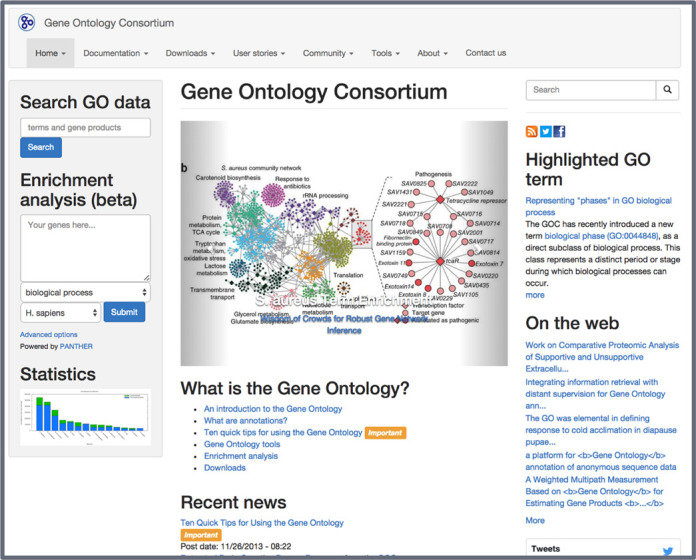
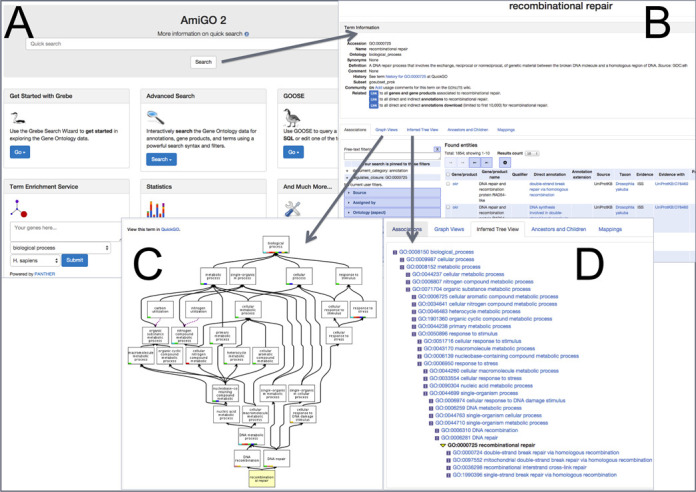
The Gene Ontology (GO; http://www.geneontology.org) is a community-based bioinformatics resource that supplies information about gene product function using ontologies to represent biological knowledge. Here we describe improvements and expansions to several branches of the ontology, as well as updates that have allowed us to more efficiently disseminate the GO and capture feedback from the research community. The Gene Ontology Consortium (GOC) has expanded areas of the ontology such as cilia-related terms, cell-cycle terms and multicellular organism processes. We have also implemented new tools for generating ontology terms based on a set of logical rules making use of templates, and we have made efforts to increase our use of logical definitions. The GOC has a new and improved web site summarizing new developments and documentation, serving as a portal to GO data. Users can perform GO enrichment analysis, and search the GO for terms, annotations to gene products, and associated metadata across multiple species using the all-new AmiGO 2 browser. We encourage and welcome the input of the research community in all biological areas in our continued effort to improve the Gene Ontology.
Overview
The claims and statistics of this paper haven’t been checked yet.
Free: it reads the open-access text and checks the first 5 claims that cite a source we can check. Create a free account to check every claim.
Integrity signals
Registry
Cites
Statistics
Figures
Verification
Claims the paper makes
The claims and statistics of this paper haven’t been checked yet.
Free: it reads the open-access text and checks the first 5 claims that cite a source we can check. Create a free account to check every claim.
Claims other papers make about this one
Each is checked against this paper’s own text: does it say what the citing paper says it does?
The cited source says what the claim attributes to it.
In the citing paper
“We performed a gene ontology (41) enrichment analysis on the human-specific haplotype regions that accounted for the lengths of candidate genes (see Supplementary Methods) and found these regions to be heavily enriched for genes related to neuron growth, synapse assembly and function, and cell adhesion (table S5).”
From An ancestral recombination graph of human, Neanderthal, and Denisovan genomes (2021) · cites this paper as [41]
Self-check
Percentages, sums and reported differences re-computed from the paper’s own numbers.
The self-check needs the paper’s full text.
Citations
Cites
Gene Ontology: tool for the unification of biology
Ashburner, M., Ball, C. A., Blake, J. A., Botstein, D., Butler, H., Cherry, J. M., Davis, A. P., Dolinski, K., Dwight, S. S., Eppig, J. T., et al. (2000) · Nature Genetics · doi:10.1038/75556 · Cited by 43,206
Mi, H., Muruganujan, A., & Thomas, P. D. (2012) · Nucleic Acids Research · doi:10.1093/nar/gks1118 · Cited by 1,733
Phylogenetic-based propagation of functional annotations within the Gene Ontology consortium
Gaudet, P., Livstone, M. S., Lewis, S. E., & Thomas, P. D. (2011) · Briefings in Bioinformatics · doi:10.1093/bib/bbr042 · Cited by 901
The Sequence Ontology: a tool for the unification of genome annotations
Eilbeck, K., Lewis, S. E., Mungall, C. J., Yandell, M., Stein, L., Durbin, R., & Ashburner, M. (2005) · Genome Biology · doi:10.1186/gb-2005-6-5-r44 · Cited by 806
Uberon, an integrative multi-species anatomy ontology
Mungall, C. J., Torniai, C., Gkoutos, G. V., Lewis, S. E., & Haendel, M. A. (2012) · Genome biology · doi:10.1186/gb-2012-13-1-r5 · Cited by 732 · cited 1×
“…phase of apoptosis’ A version of the ontology containing all relationships, including information from the Uberon anatomy (or stage) ontology (7), the Chemical Entities of Biological Inter-est ontology (ChEBI; (8)), the Plant Ontology for plant structure / stage (PO; (9)), the Phenotypic…”
The ChEBI reference database and ontology for biologically relevant chemistry: enhancements for 2013
Hastings, J., de Matos, P., Dekker, A., Ennis, M., Harsha, B., Kale, N., Muthukrishnan, V., Owen, G., Turner, S., Williams, M., et al. (2012) · Nucleic Acids Research · doi:10.1093/nar/gks1146 · Cited by 591
Gene Ontology Annotations and Resources
The Gene Ontology Consortium (2012) · Nucleic Acids Research · doi:10.1093/nar/gks1050 · Cited by 553
Self-citationThe UniProt-GO Annotation database in 2011
Dimmer, E. C., Huntley, R. P., Alam-Faruque, Y., Sawford, T., O'Donovan, C., Martin, M. J., Bely, B., Browne, P., Mun Chan, W., Eberhardt, R., et al. (2012) · Nucleic Acids Research · doi:10.1093/nar/gkr1048 · Cited by 430
Bard, J., Rhee, S. Y., & Ashburner, M. (2005) · Genome biology · doi:10.1186/gb-2005-6-2-r21 · Cited by 416
Using ontologies to describe mouse phenotypes
Gkoutos, G. V., Green, E. C., Mallon, A.-M., Hancock, J. M., & Davidson, D. (2004) · Genome Biology · doi:10.1186/gb-2004-6-1-r8 · Cited by 234
Research works printed but not linked: 2
- Ashburner, 2000, Nature genetics, 25, 25, 10.1038/75556 · DOI · Paper page
- 2011, Briefings in Bioinformatics, 12, 449, 10.1093/bib/bbr042 · DOI · Paper page
Cited by
Items 1,001–1,017 of 1,017
A systems biology pipeline identifies regulatory networks for stem cell engineering
Kinney, M. A., Vo, L. T., Frame, J. M., Barragan, J., Conway, A. J., Li, S., Wong, K., Collins, J. J., Cahan, P., North, T. E., et al. (2019) · Nature Biotechnology · doi:10.1038/s41587-019-0159-2 · Cited by 28
He, L., Wen, S., Zhong, Z., Weng, S., Jiang, Q., Mi, H., & Liu, F. (2021) · Frontiers in Pharmacology · doi:10.3389/fphar.2021.625543 · Cited by 28
Mathiomica: an integrative platform for dynamic omics
Mias, G. I., Yusufaly, T., Roushangar, R., Brooks, L. R. K., Singh, V. V., & Christou, C. (2016) · Scientific Reports · doi:10.1038/srep37237 · Cited by 27
Yue, Z., Zheng, Q., Neylon, M. T., Yoo, M., Shin, J., Zhao, Z., Tan, A. C., & Chen, J. Y. (2018) · Nucleic Acids Research · doi:10.1093/nar/gkx1040 · Cited by 27
Alloza, I., Goikuria, H., Idro, J. L., Triviño, J. C., Fernández Velasco, J. M., Elizagaray, E., García-Barcina, M., Montoya-Murillo, G., Sarasola, E., Vega Manrique, R., et al. (2017) · Scientific Reports · doi:10.1038/s41598-017-03687-9 · Cited by 25
DNA methylation in adolescents with anxiety disorder: A longitudinal study
Bortoluzzi, A., Salum, G. A., da Rosa, E. D., Chagas, V. D. S., Castro, M. A. A., & Manfro, G. G. (2018) · Scientific Reports · doi:10.1038/s41598-018-32090-1 · Cited by 16
Systematic elucidation of genetic mechanisms underlying cholesterol uptake
Hamilton, M. C., Fife, J. D., Akinci, E., Yu, T., Khowpinitchai, B., Cha, M., Barkal, S., Thi, T. T., Yeo, G. H. T., Ramos Barroso, J. P., et al. (2023) · Cell Genomics · doi:10.1016/j.xgen.2023.100304 · Cited by 16
Large language models transform biological research: from architecture to utilization
Wang, T., & Luo, Z. (2025) · Science China Information Sciences · doi:10.1007/s11432-024-4466-3 · Cited by 14
Yu, C., Zong, H., Chen, Y., Zhou, Y., Liu, X., Lin, Y., Li, J., Zheng, X., Min, H., & Shen, B. (2024) · Briefings in Bioinformatics · doi:10.1093/bib/bbae136 · Cited by 13
“Since its establishment in 1998, GO has rapidly emerged as a crucial method and tool for bioinformatics studies [25].”
MethodGene and protein expression in human megakaryocytes derived from induced pluripotent stem cells
Kammers, K., Taub, M. A., Mathias, R. A., Yanek, L. R., Kanchan, K., Venkatraman, V., Sundararaman, N., Martin, J., Liu, S., Hoyle, D., et al. (2021) · Journal of Thrombosis and Haemostasis · doi:10.1111/jth.15334 · Cited by 10
Epigenome overlap measure (EPOM) for comparing tissue/cell types based on chromatin states
Li, W. V., Razaee, Z. S., & Li, J. J. (2016) · BMC Genomics · doi:10.1186/s12864-015-2303-9 · Cited by 10
(2020) · Database · doi:10.1093/database/baaa086 · Cited by 5
Highly variable biological effects of statins on cancer, non-cancer, and stem cells in vitro
Gbelcová, H., Rimpelová, S., Jariabková, A., Macášek, P., Priščáková, P., Ruml, T., Šáchová, J., Kubovčiak, J., Kolář, M., & Vítek, L. (2024) · Scientific Reports · doi:10.1038/s41598-024-62615-w · Cited by 4
Transcription factor prediction using protein 3D secondary structures
(2024) · doi:10.1093/bioinformatics/btae762 · Cited by 4
Transcription factor prediction using protein 3D secondary structures
Liebold, J., Neuhaus, F., Geiser, J., Kurtz, S., Baumbach, J., & Newaz, K. (2024) · doi:10.1101/2024.03.14.585054 · Cited by 4
Wang, Y., & Li, Q. (2025) · Scientific Reports · doi:10.1038/s41598-025-97269-9 · Cited by 1
Zhao, H., Yin, X., Wang, S., Yu, W., Geng, Z., Sun, Y., Jiao, W., Yu, H., Zhang, Y., Wang, P., et al. (2026) · Nucleic Acids Research · doi:10.1093/nar/gkag1027
Metadata
- Authors
- The Gene Ontology Consortium
- Corresponding author
- The Gene Ontology Consortium
- Venue
- Nucleic Acids Research
- Publisher
- Oxford University Press (OUP)
- Published
- 2014-11-26
- Volume
- 43
- Issue
- D1
- Pages
- D1049-D1056
- ISSN
- 0305-1048 (ISSN-L)
- 1362-4962
- PMC
- PMC4383973
- OpenAlex
- W1490161904
- Cited by
- 3,492
- References
- 25
- Citations by year
- 2026: 153 · 2025: 284 · 2024: 367 · 2023: 286 · 2022: 265 · 2021: 234 · 2020: 263 · 2019: 279 · 2018: 418 · 2017: 471 · 2016: 353 · 2015: 114
- FWCI
- 128.79
- Type
- journal article
- Language
- en
- Open access
- gold
- doi.org
- Licence
- Locations
- Nucleic Acids Research (publishedVersion, cc-by-nc)
- Europe PMC (PubMed Central) (publishedVersion, cc-by-nc)
- PubMed Central (publishedVersion, cc-by-nc)
- PubMed (publishedVersion)
- Archive ouverte UNIGE (University of Geneva) (publishedVersion, other-oa)
- CaltechAUTHORS (California Institute of Technology) (submittedVersion, cc-by-nc)
- UCL Discovery (University College London) (submittedVersion)
- The Mouseion at the JAXlibrary (Jackson Laboratory) (submittedVersion)
- Archive ouverte UNIGE (University of Geneva) (submittedVersion, cc-by)
- Apollo (University of Cambridge) (submittedVersion, cc-by-nc)
- Apollo
- Funders
- Oregon State University
- Wellcome Trust (092096, 104967/Z/14/Z)
- European Bioinformatics Institute
- European Molecular Biology Laboratory
- British Heart Foundation (RG/13/5/30112)
- Parkinson's UK (G-1307)
- National Institutes of Health (HG002273)
- Biotechnology and Biological Sciences Research Council (BB/L024136/1)
- National Heart, Lung, and Blood Institute (R01HL064541)
- National Human Genome Research Institute (P41HG000739, U41HG002273, HG 002273, U41HG000739)
- Lawrence Berkeley National Laboratory
- Topics
- Health Sciences › Medicine › Health Informatics › Biomedical Text Mining and Ontologies
- Life Sciences › Biochemistry, Genetics and Molecular Biology › Molecular Biology › Bioinformatics and Genomic Networks
- Physical Sciences › Computer Science › Artificial Intelligence › Semantic Web and Ontologies
- Keywords
- Gene Ontology, biological ontologies, logical definitions, gene ontology enrichment, community feedback
- MeSH terms
- Cell Cycle, Internet, Databases, Genetic, Molecular Sequence Annotation, Gene Ontology
About these checks
Registry, retraction, Cites and statistics results are computed, not judged, with one exception: a printed reference that no index lists is read once by a model before it counts as a citation error. Claims are extracted by a model and kept only when their quote appears verbatim in the text; each cited source is then checked, with a model’s help, for whether it says what the claim relies on. Those verdicts can be wrong — read the claim’s quote and the cited source before relying on one.
Statistics and arithmetic are recomputed, not judged.
Confidence bands are shown only for fields calibrated on our annotated test set. None is calibrated yet, so no band is shown.
What counts as a claim ›How we measure confidence ›How we check this ›
Are you an author, or do you see a problem with this page? Request a review
Data sources
Bibliographic data: Semantic Scholar, OpenAlex, Crossref.
Contains information from the Semantic Scholar Academic Graph Datasets, made available under the ODC Attribution License (ODC-BY 1.0).
Semantic Scholar’s data is described in: Kinney, R., et al. (2023). The Semantic Scholar Open Data Platform. arXiv:2301.10140.
