

An academic survey on theoretical foundations, common assumptions and the current state of consciousness science
Open accessPublished version of a preprint
The DOI matches its Crossref record; 115 of the 117 references it cites were found in a registry or an index, and 1 are not checked yet; 12 of the 42 sources its claims cite were checked for support.
Abstract
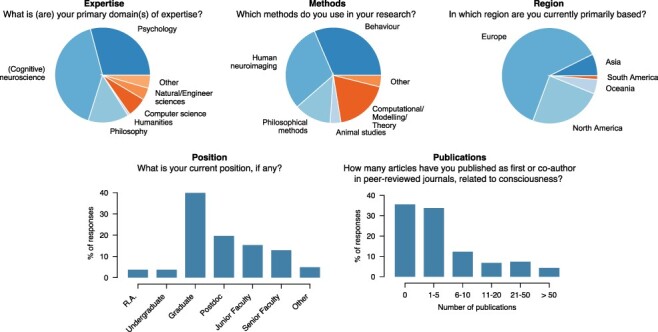
We report the results of an academic survey into the theoretical and methodological foundations, common assumptions, and the current state of the field of consciousness research. The survey consisted of 22 questions and was distributed on two different occasions of the annual meeting of the Association of the Scientific Study of Consciousness (2018 and 2019). We examined responses from 166 consciousness researchers with different backgrounds (e.g. philosophy, neuroscience, psychology, and computer science) and at various stages of their careers (e.g. junior/senior faculty and graduate/undergraduate students). The results reveal that there remains considerable discussion and debate between the surveyed researchers about the definition of consciousness and the way it should be studied. To highlight a few observations, a majority of respondents believe that machines could have consciousness, that consciousness is a gradual phenomenon in the animal kingdom, and that unconscious processing is extensive, encompassing both low-level and high-level cognitive functions. Further, we show which theories of consciousness are currently considered most promising by respondents and how supposedly different theories cluster together, which dependent measures are considered best to index the presence or absence of consciousness, and which neural measures are thought to be the most likely signatures of consciousness. These findings provide us with a snapshot of the current views of researchers in the field and may therefore help prioritize research and theoretical approaches to foster progress.
Verified 2026-11-22 · 1 reference not checked yet
Overview
CoChat Summary
## TL;DR
The paper reports a survey of 166 consciousness researchers at ASSC 2018/2019 about definitions, theories, methods, and broader assumptions in consciousness science. It finds substantial disagreement on core concepts, but some common preferences: subjective report is favored as a dependent measure, predictive processing theory is rated most promising, and most respondents endorse machines, animal continuity, and extensive unconscious processing as possible.
## Key findings
- The survey analyzed responses from 166 consciousness researchers; the questionnaire had 22 main questions and was administered between June 2018 and August 2019.
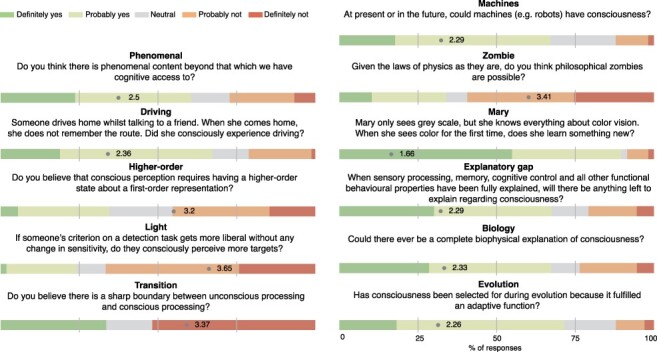
- On definitions, there was no consensus on key issues: 60.6% endorsed phenomenal content beyond cognitive access, 34.5% said consciousness requires higher-order states, 24.2% said response bias is part of conscious experience, and 33.5% endorsed a sharp boundary between unconscious and conscious processing.
- On explanatory claims, 67.5% endorsed an explanatory gap, 67.3% endorsed a complete biophysical explanation of consciousness, and 71.5% endorsed the idea that consciousness evolved because it has an adaptive function.
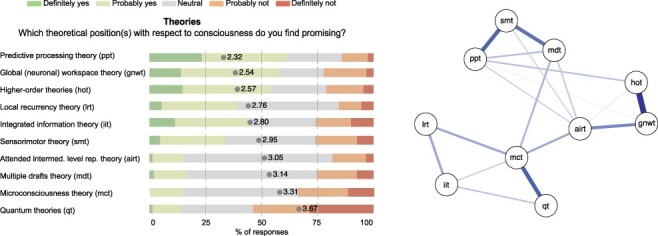
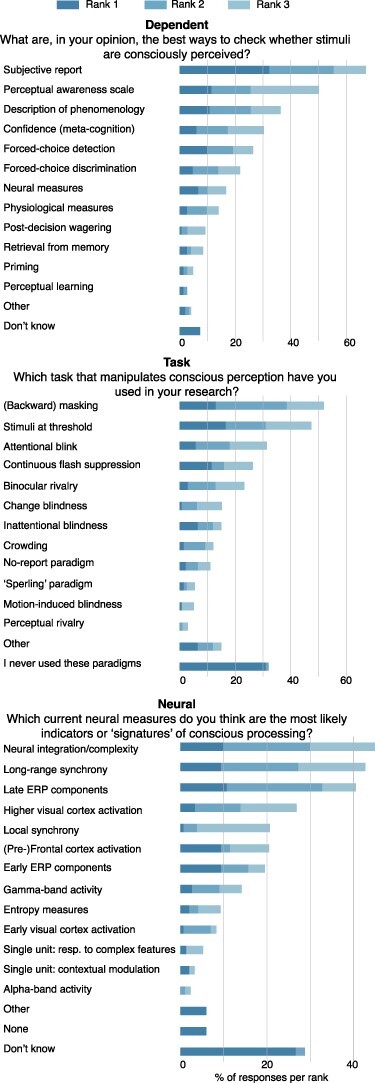
- On theory and method, Predictive processing theory was rated most promising (61.3% promising), followed by global workspace theory (58.0%) and higher-order theories (53.8%); for measurement, respondents preferred subjective report (“whether the stimulus is seen”) over objective measures, and for neural signatures they most often chose neural integration/complexity measures, late ERP components, and long-range synchrony.
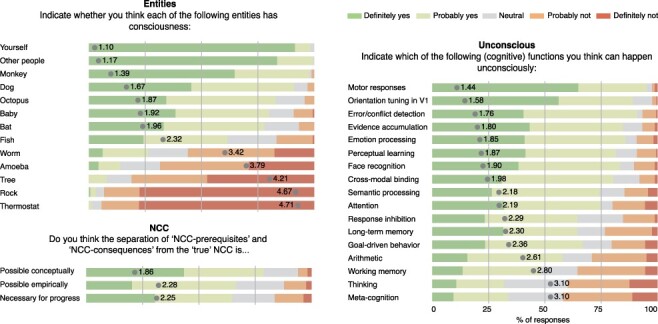
- On broader beliefs, 67.1% thought machines could have consciousness, 89.6% thought Mary learns something new, and most respondents judged consciousness to be a gradual phenomenon in the animal kingdom; for unconscious processing, a majority believed many functions can occur unconsciously, including some higher-level ones, though working memory (47.9% yes), thinking (31.9% yes), and metacognition (33.8% yes) were more contested.
## Methods
- Design: An online/paper survey of consciousness researchers and philosophers, focused on theoretical foundations, methodological preferences, and core issues in consciousness science.
- Sample/data: 307 total responses were received; the main analysis reported the 166 respondents who attended ASSC 2018/2019 and self-identified as consciousness researchers. The sample was a self-selected convenience sample drawn mainly from ASSC attendees.
- Analysis: The authors calculated frequencies, percentages, means, and standard deviations for Likert items; used Spearman correlations for relationships among responses; used ordinal regression to compare junior vs. senior researchers; and ran a network analysis of theory evaluations using EBICglasso plus a principal component analysis to check clustering.
## Limitations
- The paper explicitly states that the sample was a self-selected convenience sample of ASSC attendees and that it was not formally established to be representative of consciousness scientists and philosophers at large.
- The authors note that the questionnaire was shortened to limit completion time, so some potentially informative questions were omitted; they specifically mention not asking respondents about their commitments to the mind–brain relationship or asking for an explicit working definition of consciousness.
- Evident from the text: the survey mainly targeted ASSC attendees in 2018 and 2019 and thus may overrepresent people already engaged in that conference community; the paper also notes that some questions may have been ambiguous (for example, “explanatory gap” and “promising”).
Model-written summary. Check it against the paper before relying on it.
Integrity signals
Registry
Cites
Statistics
Figures
Verification
Claims the paper makes
9 Valid · 2 Not valid · 12 Not checked · 127 Own results and interpretations
The sources with a verdict support this claim; the rest weren’t checked yet, have no full text we could read, or their verdicts aren’t rated yet.
In the paper
“conceptual choices and assumptions about the nature of the phenomenon under study have a significant influence on which experiments are conducted and how their outcomes are interpreted (Barrett 2009; Irvine 2013; Francken and Slors 2014; Abend 2017).”
§ An academic survey on theoretical foundations, common assumptions and the current state of consciousness science > Introduction
What the sources say
- Supportedcites Barrett 2009 matched to “The Future of Psychology: Connecting Mind to Brain” (2009) source
The Conclusions section states that the categories used to investigate mind and behavior influence the questions researchers ask, the experiments they design, and their interpretation of data. This directly supports the paraphrase; page numbers are not supplied in our copy. (LLM, conf=0.94)
- Not checked — no full text of the sourcecites Irvine 2013 matched to “Consciousness as a Scientific Concept: A Philosophy of Science Perspective” (2013) source
- Supportedcites Francken and Slors 2014 matched to “From commonsense to science, and back: the use of cognitive concepts in neuroscience” (2014) source
Section 2.2 (p. 4) explains that cognitive concepts are operationalised through experimental tasks, shaping what researchers investigate. Section 4.4 (pp. 9–10) explains that interpreting those operationalisations as concepts such as attention or consciousness changes what conclusions are drawn from an experiment. (LLM, conf=0.89)
plainstates a cause- Asserted: passes — The authors put it forward as true.
- Checkable: passes — It can be checked against evidence.
- Load-bearing: passes — The paper’s conclusions depend on it.
- Based: passes — The paper gives a reason why it holds.
- Supported
The cited sources support only part of this claim — read each source’s verdict below.
In the paper
“Interestingly, ‘Predictive processing theory’ (PPT) was in fact not an elaborate, existing theory in the scientific community of consciousness researchers when we surveyed our respondents (Williford et al. 2018; Hohwy and Seth 2020).”
§ An academic survey on theoretical foundations, common assumptions and the current state of consciousness science > Results > General questions
What the sources say
- Could not verifycites Williford et al. 2018 matched to “The Projective Consciousness Model and Phenomenal Selfhood” (2018) sourceExperimental — accuracy not yet measured
The ‘PCM and the Functional Features—Active Inference and FE Minimization’ section discusses existing predictive-coding, active-inference, and Bayesian-brain approaches, but does not establish whether a theory called ‘Predictive processing theory’ was elaborated or recognized among consciousness researchers when the survey was conducted. I searched for the theory’s name and the claim about its status; the cited paper does not address that survey-time claim. (LLM, conf=0.73)
- Partly supportedcites Hohwy and Seth 2020 matched to “Predictive processing as a systematic basis for identifying the neural correlates of consciousness” (2020) sourceExperimental — accuracy not yet measured
Section 4 says predictive processing was not first and foremost a theory of consciousness, and Section 6 describes formulations directed at consciousness as emerging and basic. These passages support the distinction from an established, elaborate consciousness theory, but do not establish its status when the respondents were surveyed. (LLM, conf=0.82)
plain- Asserted: passes — The authors put it forward as true.
- Checkable: passes — It can be checked against evidence.
- Load-bearing: unclear — It is unclear whether the paper’s conclusions depend on it.
- Based: passes — The paper gives a reason why it holds.
- Could not verify
The sources with a verdict support this claim; the rest weren’t checked yet, have no full text we could read, or their verdicts aren’t rated yet.
In the paper
“As a consequence, by starting off with different conceptualizations of consciousness, researchers may not be investigating the same phenomenon even though the same overarching label is used (‘consciousness’) (Figdor 2013; Irvine 2013; Francken and Slors 2014).”
§ An academic survey on theoretical foundations, common assumptions and the current state of consciousness science > Discussion
What the sources say
- Not checked — no full text of the sourcecites Figdor 2013 matched to “What is the “cognitive” in cognitive neuroscience?” (2013) source
- Not checked — no full text of the sourcecites Irvine 2013 matched to “Consciousness as a Scientific Concept: A Philosophy of Science Perspective” (2013) source
- Supportedcites Francken and Slors 2014 matched to “From commonsense to science, and back: the use of cognitive concepts in neuroscience” (2014) source
The Introduction (p. 3) says that researchers can arrive at incompatible operationalisations of ‘the same’ cognitive concept. The Conclusion (p. 11) specifically identifies consciousness as a broad concept whose experimental operationalisations capture only parts of it. Together, these passages support the claim that studies using the same label may investigate different aspects of consciousness. (LLM, conf=0.92)
hedgedstates a possible cause- Asserted: passes — The authors put it forward as true.
- Checkable: passes — It can be checked against evidence.
- Load-bearing: passes — The paper’s conclusions depend on it.
- Based: passes — The paper gives a reason why it holds.
The cited sources support only part of this claim — read each source’s verdict below.
In the paper
“despite the fact that—at the time the survey was conducted—most varieties of PPT were not first and foremost theories of consciousness (Seth and Tsakiris 2018; Williford et al. 2018; Hohwy and Seth 2020)”
§ An academic survey on theoretical foundations, common assumptions and the current state of consciousness science > Discussion
What the sources say
- Not checked yetcites Seth and Tsakiris 2018 matched to “Being a Beast Machine: The Somatic Basis of Selfhood” (2018) source
Checked before — its earlier verdict is held back until a new check runs.
- Could not verifycites Williford et al. 2018 matched to “The Projective Consciousness Model and Phenomenal Selfhood” (2018) sourceExperimental — accuracy not yet measured
The Methodology section describes this paper’s Projective Consciousness Model as, above all, a theory of consciousness. Our copy does not assess whether most varieties of PPT were primarily theories of consciousness when the survey was conducted; searches for that broader comparison found no such passage. (LLM, conf=0.72)
- Partly supportedcites Hohwy and Seth 2020 matched to “Predictive processing as a systematic basis for identifying the neural correlates of consciousness” (2020) sourceExperimental — accuracy not yet measured
Section 4, “Theories of consciousness” (page unavailable), explicitly says predictive processing is “not first and foremost a theory of consciousness.” It does not assess how many varieties of PPT fit that description or relate the point to when the survey was conducted. (LLM, conf=0.82)
plain- Asserted: passes — The authors put it forward as true.
- Checkable: passes — It can be checked against evidence.
- Load-bearing: passes — The paper’s conclusions depend on it.
- Based: passes — The paper gives a reason why it holds.
- Not checked yet
A result the paper reports from its own data — it cites no other source for it, so there is none to check. The quote shows it is in the paper.
In the paper
“Interestingly, the senior researchers that we surveyed are more inclined to think of the transition between conscious and unconscious processing as a sharp boundary as compared to our sample of junior researchers, once more demonstrating a lack of consensus (senior: mean: 3.26, SD: 1.76, ‘sharp boundary’ responses: 32.6%; junior: mean: 3.75, SD: 1.67, ‘sharp boundary’ responses: 22.8%; Wald χ2 = 6”
§ An academic survey on theoretical foundations, common assumptions and the current state of consciousness science > Results > General questions
boostedstates an association- Asserted: passes — The authors put it forward as true.
- Checkable: passes — It can be checked against evidence.
- Load-bearing: unclear — It is unclear whether the paper’s conclusions depend on it.
- Based: passes — The paper gives a reason why it holds.
86 more claims
Create a free account to see all 150 claims and to verify the 3 references still open.
- Probably not a substantial claim. 40
- It may state two separate claims as one. 34
Claims other papers make about this one
Each is checked against this paper’s own text: does it say what the citing paper says it does?
The cited source says what the claim attributes to it.
In the citing paper
“Re fi ning these theories, which are among the most in fl uential in the fi eld [12,13,35], has driven signi fi cant methodological progress [36].”
From Identifying indicators of consciousness in AI systems (2026) · cites this paper as [35]
The cited source says what the claim attributes to it.
In the citing paper
“In humans, analogous subjective reports, that is to say reports in which a subject describes their own experiences, are often considered by researchers to be a gold-standard marker of consciousness (Francken et al., 2022;Overgaard and Sorensen, 2004), notwithstanding their susceptibility to error (Schwitzgebel, 2008).”
From Does It Make Sense to Speak of Introspection in Large Language Models? (2025) · cites this paper as Francken et al., 2022
The cited source says what the claim attributes to it.
In the citing paper
“Such advantages may be particularly apt for driving progress in a field such as consciousness science (Corcoran et al., 2023), where there is widespread disagreement about the way consciousness should be operationalised and the kinds of data that are relevant for theory development and critique (Francken et al., 2022; Irvine, 2017; Yaron et al., 2022).”
From Integrated information and predictive processing theories of consciousness: An adversarial collaborative review (2026) · cites this paper as Francken et al., 2022
Statistics recomputed
Every reported test result, recomputed from its test statistic and degrees of freedom. A result shows as not adding up only once an independent check has confirmed it.
- Consistentr(52) = 0.96reported p < .001 · recomputed p < .001
“r(52) = 0.96, p < .001”
- Consistentr(52) = 0.93reported p < .001 · recomputed p < .001
“r(52) = 0.93, p < .001”
- Consistentr(52) = 0.92reported p < .001 · recomputed p < .001
“r(52) = 0.92, p < .001”
Self-check
Percentages, sums and reported differences re-computed from the paper’s own numbers.
Self-check results appear here once an independent check has confirmed them.
Citations
Cites
(1988) · Cited by 3,656
On a confusion about a function of consciousness
Block, N. (1995) · Behavioral and Brain Sciences · doi:10.1017/s0140525x00038188 · Cited by 3,364 · cited 3×
“To illustrate, it is currently debated whether conscious states, by definition, need to be reportable (Block 1995; Lamme 2006; Tsuchiya et al. 2015a; Pitts et al. 2018).”
BackgroundA sensorimotor account of vision and visual consciousness
O'Regan, J. K., & Noë, A. (2001) · Behavioral and Brain Sciences · doi:10.1017/s0140525x01000115 · Cited by 3,126
A tutorial on regularized partial correlation networks
Epskamp, S., & Fried, E. I. (2018) · Psychological Methods · doi:10.1037/met0000167 · Cited by 2,918 · cited 1×
“The EBICglasso estimator was used to fit a Graphical Gaussian model to the partial polychoric correlation matrix of the data (Foygel and Drton 2010; Epskamp and Fried 2018).”
MethodLycan, W. G., & Dennett, D. C. (1993) · The Philosophical Review · doi:10.2307/2185913 · Cited by 2,638
Experimental and theoretical approaches to conscious processing
Dehaene, S., & Changeux, J.-P. (2011) · Neuron · doi:10.1016/j.neuron.2011.03.018 · Cited by 2,573
Towards a cognitive neuroscience of consciousness: basic evidence and a workspace framework
Dehaene, S. (2001) · Cognition · doi:10.1016/s0010-0277(00)00123-2 · Cited by 2,498 · cited 6×
“how it should be operationalized), what would constitute an explanation, and how valid experiments should be designed (Block 1995; Chalmers 1995, 2000; Dehaene and Naccache 2001; Dennett 2001; Lamme 2006; Tononi 2008; Dehaene and Changeux 2011; Doerig et al. 2020; Hohwy and Seth 2020); see Seth and Bayne (2022) for a…”
BackgroundInfluentialJackson, F. (1982) · The Philosophical Quarterly · doi:10.2307/2960077 · Cited by 2,477
The Egyptian Labor Market in an Era of Revolution
Assaad, R. A., & Krafft, C. (2015) · RePEc: Research Papers in Economics · doi:10.1093/acprof · Cited by 2,442
The distinct modes of vision offered by feedforward and recurrent processing
Lamme, V. A. F., & Roelfsema, P. R. (2000) · Trends in Neurosciences · doi:10.1016/s0166-2236(00)01657-x · Cited by 2,338
Research works printed but not linked: 3
- Edelman DB, Seth AK. Animal consciousness: a synthetic approach. Trends Neurosci 2009b; 32: 476– 84. 19716185 · DOI · Paper page
- Kirk R Zombies. In: Zalta EN (ed.), The Stanford Encyclopedia of Philosophy, 2019.
- Tsuchiya N, Wilke M, Frässle S et al. No-report paradigms: extracting the true neural correlates of consciousness. Trends Cogn Sci 2015b; 19: 757– 70. 26585549 · DOI · Paper page
Cited by
Consciousness in Artificial Intelligence: Insights from the Science of Consciousness
Butlin, P., Long, R., Elmoznino, E., Bengio, Y., Birch, J., Constant, A., Deane, G., Fleming, S. M., Frith, C., Ji, X., et al. (2023) · arXiv · doi:10.48550/arxiv.2308.08708 · Cited by 196
Tests for consciousness in humans and beyond
Bayne, T., Seth, A. K., Massimini, M., Shepherd, J., Cleeremans, A., Fleming, S. M., Malach, R., Mattingley, J. B., Menon, D. K., Owen, A. M., et al. (2024) · Trends in Cognitive Sciences · doi:10.1016/j.tics.2024.01.010 · Cited by 198
Self-citationMelloni, L., Mudrik, L., Pitts, M., Bendtz, K., Ferrante, O., Gorska, U., Hirschhorn, R., Khalaf, A., Kozma, C., Lepauvre, A., et al. (2023) · PLoS ONE · doi:10.1371/journal.pone.0268577 · Cited by 113
Consciousness in the cradle: on the emergence of infant experience
Bayne, T., Frohlich, J., Cusack, R., Moser, J., & Naci, L. (2023) · Trends in Cognitive Sciences · doi:10.1016/j.tics.2023.08.018 · Cited by 106
“This failure of theoretical convergence would not be problematic if the field were moving towards consensus, but that does not appear to be the case [22,23].”
The Integrated Information Theory of Consciousness as Pseudoscience
IIT-Concerned, Fleming, S. M., Frith, C. D., Goodale, M., Lau, H., LeDoux, J. E., Lee, A. L. F., Michel, M., Owen, A. M., Peters, M. A. K., et al. (2023) · doi:10.31234/osf.io/zsr78 · Cited by 81
Moral consideration for AI systems by 2030
Sebo, J., & Long, R. (2025) · AI and Ethics · doi:10.1007/s43681-023-00379-1 · Cited by 80
“%) of respondents think that machines such as robots either “definitely” or “prob-ably” could have consciousness in future [74].”
The AI risk repository: A meta-review, database, and taxonomy of risks from artificial intelligence
Slattery, P., Saeri, A. K., Grundy, E. A. C., Graham, J., Noetel, M., Uuk, R., Dao, J., Pour, S., Casper, S., & Thompson, N. (2024) · arXiv · doi:10.48550/arxiv.2408.12622 · Cited by 51
Are we really unconscious in “unconscious” states? Common assumptions revisited
Sevenius Nilsen, A., Juel, B. E., Thürer, B., Aamodt, A., & Storm, J. F. (2022) · Frontiers in Human Neuroscience · doi:10.3389/fnhum.2022.987051 · Cited by 49
“While this may be a step in the right direction, it depends on the field agreeing on definitions and operationalizations to avoid confusion, which still seems some ways off (Francken et al., 2022).”
BackgroundPredictive Neuronal Adaptation as a Basis for Consciousness
Luczak, A., & Kubo, Y. (2022) · Frontiers in Systems Neuroscience · doi:10.3389/fnsys.2021.767461 · Cited by 51
Canales‐Johnson, A., Beerendonk, L., Chennu, S., Davidson, M., Ince, R. A. A., & van Gaal, S. (2023) · PLoS Biology · doi:10.1371/journal.pbio.3002120 · Cited by 44
Self-citationIdentifying indicators of consciousness in AI systems
Butlin, P., Long, R., Bayne, T., Bengio, Y., Birch, J., Chalmers, D., Constant, A., Deane, G., Elmoznino, E., Fleming, S. M., et al. (2026) · Trends in Cognitive Sciences · doi:10.1016/j.tics.2025.10.011 · Cited by 56
Frohlich, J., Chiang, J. N., Mediano, P. A. M., Nespeca, M., Saravanapandian, V., Toker, D., Dell’Italia, J., Hipp, J. F., Jeste, S., Chu, C. J., et al. (2022) · Communications Biology · doi:10.1038/s42003-022-04331-7 · Cited by 38
Piecing together the puzzle of emotional consciousness
Engelen, T., & Mennella, R. (2023) · Neuroscience of Consciousness · doi:10.1093/nc/niad005 · Cited by 35
Predictions and rewards affect decision-making but not subjective experience
Sánchez-Fuenzalida, N., van Gaal, S., Fleming, S. M., Haaf, J. M., & Fahrenfort, J. J. (2023) · Proceedings of the National Academy of Sciences · doi:10.1073/pnas.2220749120 · Cited by 46
“When asked this question, two thirds of a group of attendees of the Association of Scientific Studies of Consciousness (ASSC) conference answered that the observer was not experiencing the light more often (Q2, Francken et al., 2022).”
Self-citationConsciousness science: where are we, where are we going, and what if we get there?
Cleeremans, A., Mudrik, L., & Seth, A. K. (2025) · Frontiers in Science · doi:10.3389/fsci.2025.1546279 · Cited by 51
“De fi ning key questions that are worth pursuing can be taken up by the community at large (163) or by a joint process involving multiple researchers and scholars.”
Self-citationAccelerating scientific progress through Bayesian adversarial collaboration
Corcoran, A. W., Hohwy, J., & Friston, K. J. (2023) · Neuron · doi:10.1016/j.neuron.2023.08.027 · Cited by 26
Kirkeby-Hinrup, A., Stephens, A., Sjöstrand, A. B., & Overgaard, M. S. (2025) · Frontiers in Psychology · doi:10.3389/fpsyg.2025.1633907 · Cited by 25
Negro, N. (2024) · Neuroscience of Consciousness · doi:10.1093/nc/niae012 · Cited by 21
“Thinking seriously about the nature of this relationship is important because the neuroscience of consciousness is seeing a proliferation of theories (Del Pin et al. 2021, Signorelli et al. 2021, Seth and Bayne 2022), and consensus is far from near (Francken et al. 2022, Yaron et al. 2022).”
BackgroundUnconscious integration: Current evidence for integrative processing under subliminal conditions
Zher‐Wen, & Yu, R. (2023) · British Journal of Psychology · doi:10.1111/bjop.12631 · Cited by 32
Prettyman, A. (2026) · Inquiry · doi:10.1080/0020174x.2024.2439989 · Cited by 18
“The survey showed that ‘ there is no single theory that the majority of the respondents currently endorse ’ (Francken et al. 2022, 9).”
Cell consciousness: a dissenting opinion
Robinson, D. G., Mallatt, J. M., Peer, W. A., Sourjik, V., & Taiz, L. (2024) · EMBO Reports · doi:10.1038/s44319-024-00127-4 · Cited by 20
“All the standard theories of consciousness stipulate that it is limited to multicellular organisms possessing neurons and a brain of threshold complexity (Francken et al, 2022).”
First-person experience cannot rescue causal structure theories from the unfolding argument
Herzog, M. H., Schurger, A., & Doerig, A. (2022) · Consciousness and Cognition · doi:10.1016/j.concog.2021.103261 · Cited by 14
The fundamental tension in integrated information theory 4.0’s realist idealism
Cea, I., Negro, N., & Signorelli, C. M. (2023) · Entropy · doi:10.3390/e25101453 · Cited by 13
Current Understanding of the “Insight” Phenomenon Across Disciplines
Osuna‐Mascaró, A. J., & Auersperg, A. M. I. (2021) · Frontiers in Psychology · doi:10.3389/fpsyg.2021.791398 · Cited by 19
Perception-action Dissociations as a Window into Consciousness
Carrasco, M., & Spering, M. (2024) · Journal of Cognitive Neuroscience · doi:10.1162/jocn_a_02122 · Cited by 15
Criterion placement threatens the construct validity of neural measures of consciousnessPreprint
Fahrenfort, J. J., Johnson, P. A., Kloosterman, N. A., Stein, T., & van Gaal, S. (2025) · eLife · doi:10.7554/elife.102335 · Cited by 25
Self-citationEveryone knows what behavior is but they just don’t agree on it
Calhoun, A. J., & Hady, A. E. (2021) · iScience · doi:10.1016/j.isci.2023.108210 · Cited by 29
Predictions and rewards affect decision-making but not subjective experiencePreprint
Sánchez-Fuenzalida, N., van Gaal, S., Fleming, S. M., et al. (2022) · doi:10.31234/osf.io/5v8dh · Cited by 10
Self-citationCriterion placement threatens the construct validity of neural measures of consciousness
Fahrenfort, J. J., Johnson, P. A., Kloosterman, N. A., Stein, T., & van Gaal, S. (2025) · eLife · doi:10.1101/2024.02.22.581517 · Cited by 16
Self-citationA biphasic relational approach to the evolution of human consciousness
Hayes, S. C., & Hofmann, S. G. (2023) · International Journal of Clinical and Health Psychology · doi:10.1016/j.ijchp.2023.100380 · Cited by 10
When philosophical nuance matters: safeguarding consciousness research from restrictive assumptions
Usher, M., Negro, N., Jacobson, H., & Tsuchiya, N. (2023) · Frontiers in Psychology · doi:10.3389/fpsyg.2023.1306023 · Cited by 11
Against willing servitude: Autonomy in the ethics of advanced artificial intelligence
Bales, A. (2025) · The Philosophical Quarterly · doi:10.1093/pq/pqaf031 · Cited by 7
Conscious artificial intelligence in service
Breidbach, C. F., Ferm, L. C., Maglio, P. P., Beverungen, D., Wirtz, J., & Twigg, A. (2025) · Journal of service management · doi:10.1108/josm-12-2024-0536 · Cited by 10
The mind-brain problem: Ethical and clinical implications for psychiatry
Costa, M. D. A., & Moreira‐Almeida, A. (2025) · International Review of Psychiatry · doi:10.1080/09540261.2025.2474965 · Cited by 8
“For example, despite 67.5% endorsing an unsolvable explanatory gap 3 , 67.3% endorsed that there could ever be “a complete biophysical explanation of consciousness” (Francken et al., 2022).”
InfluentialExtrapolating Other Consciousnesses: The Prospects and Limits of Analogical Abduction
Negro, N., & Mudrik, L. (2025) · Philosophy of Science · doi:10.1017/psa.2025.10104 · Cited by 8
“However, the current status of consciousness science does not provide us with good knowledge of either the functional profile of consciousness or its neural mechanisms (see, e.g., Francken et al. 2022; Yaron et al. 2022).”
Growing Confidence and Remaining Uncertainty About Animal ConsciousnessPreprint
Irwin, L. N. (2024) · Qeios · doi:10.32388/kovd1z · Cited by 6
Barrett, M. (2024) · OSF Preprints (OSF Preprints) · doi:10.31219/osf.io/qem7f · Cited by 7
How to Live in the Moment: The Methodology and Limitations of Evolutionary Research on Consciousness
de Weerd, C. R., & Dung, L. (2025) · Cognitive Science · doi:10.1111/cogs.70053 · Cited by 5
“While this assumption is by no means uncontroversial (see, e.g., Robinson, Maley, & Piccinini, 2015), it is shared by most consciousness researchers (Francken et al., 2022, Fig.”
What is a Pseudoscience of Consciousness? Lessons from Recent Adversarial CollaborationsPreprint
Lau, H. C. (2023) · PsyArXiv (OSF Preprints) · doi:10.31234/osf.io/28z3y · Cited by 6
What current theories of consciousness are missing.
Department of Biological Sciences, U. O. T. A. E. P., & Irwin, L. N. (2023) · Neurology and Neuroscience · doi:10.33425/2692-7918.1059 · Cited by 4
Growing Confidence and Remaining Uncertainty About Animal ConsciousnessPreprint
Irwin, L. N. (2024) · Qeios · doi:10.32388/kovd1z.3 · Cited by 3
Does It Make Sense to Speak of Introspection in Large Language Models?
Comsa, I. M., & Shanahan, M. (2025) · arXiv · doi:10.48550/arxiv.2506.05068 · Cited by 3
“…subjective reports, that is to say reports in which a subject describes their own experiences, are often considered by researchers to be a gold-standard marker of consciousness (Francken et al., 2022; Overgaard and Sorensen, 2004), notwithstanding their susceptibility to error (Schwitzgebel, 2008).”
Gaillard, M. (2024) · Neuroethics · doi:10.1007/s12152-024-09544-7 · Cited by 3
Jurchiș, R., Costea, A. R., & Opre, A. N. (2023) · Motivation and Emotion · doi:10.1007/s11031-023-10022-5 · Cited by 3
Functionalist Emergentist Materialism: A Pragmatic Framework for Consciousness
D’Angiulli, A., & Sidhu, K. (2025) · Imagination Cognition and Personality · doi:10.1177/02762366251316255 · Cited by 3
“There are now over 50 contemporary de fi nitions or theories of consciousness (Sattin et al., 2021) along with signs suggesting this fi eld is moving away from consensus (Francken et al., 2022; Yaron et al., 2022).”
Corcoran, A. W., Haun, A. M., Dorman, R., Tononi, G., Friston, K. J., & Pennartz, C. M. A. (2026) · Neuroscience & Biobehavioral Reviews · doi:10.1016/j.neubiorev.2026.106742 · Cited by 2
A comprehensive taxonomy of machine consciousness
Qin, R., Zhou, C., & He, M. (2025) · Information Fusion · doi:10.1016/j.inffus.2025.102994 · Cited by 5
What are memories made of? A survey of neuroscientists on the structural basis of long-term memory
Zeleznikow-Johnston, A., Kendziorra, E., & McKenzie, A. T. (2025) · PLoS ONE · doi:10.1371/journal.pone.0326920 · Cited by 5
“Expert surveys in other disciplines, such as philosophy [18,19] and artificial intelligence [20], have proven instrumental in ascertaining what is and is not consensus within an academic community.”
AI Alignment Versus AI Ethical Treatment: 10 Challenges
Bradley, A., & Saad, B. (2025) · Analytic Philosophy · doi:10.1111/phib.12380 · Cited by 7
Emerging Questions in AI Welfare
Keeling, G., & Street, W. (2026) · Cambridge University Press eBooks · doi:10.1017/9781009732000 · Cited by 14
Editorial: The Depth and Complexity of Unconscious Processing
Tu, S., Jou, J., Zhao, G. W., & Jiang, J. (2021) · Frontiers in Human Neuroscience · doi:10.3389/fnhum.2021.791589 · Cited by 2
The Ethical Spectrum of Consciousness
Farisco, M. (2023) · AJOB Neuroscience · doi:10.1080/21507740.2023.2188312 · Cited by 1
“…is still an open question, despite some recent attempts to identify shared theoretical features (Michel et al. 2019; Northoff and Lamme 2020; Wiese 2020; Francken et al. 2022; Seth and Bayne 2022) and even to implement an “adversarial collaboration” between concurrent theories (Yaron et al. 2022).”
BackgroundPrasad, S. G., Puri, S., Kapiley, K., Rafeekh, R., & Mishra, R. K. (2025) · Languages · doi:10.3390/languages10020032 · Cited by 1
A More Ordinary Ordinary View of the “What it is Like”-Talk
Wyrwa, M. (2025) · Philosophia · doi:10.1007/s11406-025-00865-2 · Cited by 1
Language and/or memory: How to slice the domain-cake?
Piai, V., Madan, C. R., & Francken, J. C. (2025) · Cognitive Neuropsychology · doi:10.1080/02643294.2025.2535037 · Cited by 4
“To show that the conceptual point of Francken et al. (2022b) is actually relevant for empirical research and the interpretation of neuroscientific data—in particular to determine to what extent language and memory are related domains—we surveyed the audience about the Abstraction problem: At which…”
InfluentialSelf-citationWen, X., Chang, Y., Li, S., Wang, J., Li, X., Li, D., Wei, C., & Liang, Z. (2025) · NeuroImage · doi:10.1016/j.neuroimage.2025.121384 · Cited by 1
There can be more to consciousness research than theory testing
Overgaard, M. S., Fazekas, P., Kirkeby-Hinrup, A., et al. (2025) · Communications Psychology · doi:10.1038/s44271-025-00357-9 · Cited by 1
Replicating the unconscious working memory effect: a multisite Registered Report
Franco-Martínez, A., Rey-Sáez, R., Adrián‐Ventura, J., Amerio, P., Baciero, A., Bennis, A., Bergström, F., Cleeremans, A., Contu, L., Dell’Acqua, R., et al. (2026) · Neuroscience of Consciousness · doi:10.1093/nc/niaf046 · Cited by 4
“The current evidence suggests that processes including perception, attention, and memory—or at least some of their subcom-ponents—may operate on the basis of information that is not consciously represented (Francken et al. 2022).”
Boyd, J. L., Jensen, E., Jensen, A. M., & Lipshitz, N. (2026) · Neuroscience of Consciousness · doi:10.1093/nc/niag023 · Cited by 1
“These results indicate that most individuals are willing to attribute non-negligible levels of consciousness to entities beyond paradigmatic humans, which is consistent with prior academic surveys that investigated the attribution of consciousness ( Francken et al. 2022).”
Untangling a taxonomy of living from the science of the continuum of life
Buchman, A. S. (2024) · Current Opinion in Behavioral Sciences · doi:10.1016/j.cobeha.2023.101345 · Cited by 1
Costa, M. D. A., & Moreira‐Almeida, A. (2025) · Consciousness and Cognition · doi:10.1016/j.concog.2025.103855 · Cited by 3
On the Hard Problem: Revisited, Re-Evaluated, RecastPreprint
Herzog, D. J., & Herzog, N. J. (2025) · Qeios · doi:10.32388/l7ssua · Cited by 2
Criterion placement threatens the construct validity of neural measures of consciousnessPreprint
Fahrenfort, J. J., Johnson, P. A., Kloosterman, N. A., Stein, T., & van Gaal, S. (2024) · eLife · doi:10.7554/elife.102335.1 · Cited by 3
Self-citationMind in the Machine? Cross-Disciplinary Perceptions of Consciousness in Artificial Intelligence
Moradi, H., Avellino, I., Krauß, P., Zanca, D., Hein, I., Eskofier, B. M., & Flaucher, M. (2026) · CHI Conference on Human Factors in Computing Systems · doi:10.1145/3772318.3790699
“Although there is a central consensus that consciousness is fundamentally about “subjective experience” or “subjective aware-ness” [15, 34], different theories of consciousness diverge in how they define and structure the attributes that constitute local and global states of consciousness.”
InfluentialFutures with Digital Minds: Expert Forecasts in 2025
Caviola, L., & Saad, B. (2025) · arXiv · doi:10.48550/arxiv.2508.00536 · Cited by 8
Cavanna, A. E., & Seri, S. (2022) · Cognitive Neuropsychiatry · doi:10.1080/13546805.2022.2158795
“…results of an academic survey into the theoretical and methodological foundations, common assumptions, and current state of consciousness research revealed that there remains considerable disagreement about the definition of consciousness and the way it should be studied (Francken et al., 2022).”
Background(2023) · AD ALTA Journal of Interdisciplinary Research · doi:10.33543/130236
Exploring Relationship of Mind Wandering and Neuroeconomics with Yoga
Bhagat, A., Gautam, M., & Mahajan, K. (2024) · Springer eBooks · doi:10.1007/978-981-97-2855-8_11
de Morais, G. L., Pinho, T. O. R., Crespim, L., & Neto, O. P. (2024) · Neurology International · doi:10.3390/neurolint16050071 · Cited by 1
“Advances in neuroimaging techniques, such as fMRI and EEG, could provide deeper insights into the brain regions and networks involved in these transitions [21,23].”
BackgroundCriterion placement threatens the construct validity of neural measures of consciousnessPreprint
Fahrenfort, J. J., Johnson, P. A., Kloosterman, N. A., Stein, T., & van Gaal, S. (2025) · eLife · doi:10.7554/elife.102335.2 · Cited by 4
Self-citationLeaky evidence accumulation accounts for perceptual confidence and subjective durationPreprint
Msheik, R., Sirouet, E., Kelly, S. P., Faivre, N., & Pereira, M. (2025) · bioRxiv (Cold Spring Harbor Laboratory) · doi:10.1101/2025.03.17.643717 · Cited by 6
“As subjective experience is intrinsically private, most researchers rely on subjective reports (Francken et al., 2022) to assess its presence or absence (e.g. for weak stimuli).”
Criterion placement threatens the construct validity of neural measures of consciousnessPreprint
Fahrenfort, J. J., Johnson, P. A., Kloosterman, N. A., Stein, T., & van Gaal, S. (2025) · eLife · doi:10.7554/elife.102335.3 · Cited by 1
Self-citationبررسی in vitro اثر میدانهای شعوری(ط) بر ترمیم زخم از طریق تست خراش
طاهری, م., ترابی, س., & سمسارها, ف. (2025) · ژورنال علمی کازمواینتل · doi:10.61450/joci.fa.v4i16.205
Fahrenfort, J. J., Johnson, P. A., Kloosterman, N. A., Stein, T., & van Gaal, S. (2025) · eLife · doi:10.7554/elife.107622
“…our manuscript, although we would like to note that a relatively recent survey has shown that most consciousness researchers believe that subjective measures - and the PAS specifically - are the best measures to check whether a stimulus is consciously perceived ( Francken et al., 2022 , Figure 4).”
Self-citationReporting and Subjectivity Traps: A Brief Opinion Article on Consciousness as BeliefPreprint
Martín, A., Streicher, J., & O'Dea, M. (2025) · Qeios · doi:10.32388/ccfty8.3
Reporting and Subjectivity Traps: A Brief Opinion Article on Consciousness as BeliefPreprint
Martin, A., Streicher, J., & O'Dea, M. (2025) · Qeios · doi:10.32388/ccfty8.4 · Cited by 1
Stockart, F. (2024) · theses.fr (ABES) · doi:10.70675/c4f62883zfadez4797z9c4ezc049226f96a4 · Cited by 1
Keppler, J. (2026) · Frontiers in Human Neuroscience · doi:10.3389/fnhum.2026.1815678 · Cited by 2
“Uncovering the mechanism underlying conscious systems is regarded as the main goal of a TOC and widely recognized as one of the central ambitions of consciousness research (Fahrenfort and van Gaal, 2021; Francken et al., 2022; Seth and Bayne, 2022; Mudrik et al., 2025).”
Temporal and Spectral Neural Complexity Reveal Graded Auditory AwarenessPreprint
Liardi, A., Bor, D., Rosas, F. E., & Mediano, P. A. M. (2026) · bioRxiv (Cold Spring Harbor Laboratory) · doi:10.64898/2026.04.20.719685
“Among the many approaches to finding NCCs, one of the most successful has been the analysis of neural complexity [9– 12], making complexity measures a central tool for probing different levels of consciousness across a wide range of conditions [13].”
The act of detecting a stimulus contaminates measures of conscious experience with decision biases
Sánchez-Fuenzalida, N., Jungerius, C., Fleming, S. M., van Gaal, S., & Fahrenfort, J. J. (2026) · Nature Communications · doi:10.1038/s41467-026-72567-6
“…a detection task with a contrast reproduction task in the same experimental block induces strong non-perceptual effects on reproduction responses (Experiment 1 and 2), while removing the detection task also removes these non-perceptual effects on reproduction (Experiment 3).”
Self-citationA survey of views about infant consciousness
Passos-Ferreira, C., & Chalmers, D. J. (2026) · Neuroscience of Consciousness · doi:10.1093/nc/niag014 · Cited by 1
“Previous survey work has surveyed consciousness researchers’ views of consciousness ( Francken et al. 2022) and academic philosophers’ views on philosophical questions including questions about consciousness ( Bourget and Chalmers 2023).”
A Bundle of Mysteries: Approaching Phenomenal Consciousness
Kammerer, F. (2026) · Oxford University Press eBooks · doi:10.1093/9780197840283.003.0002
Losing Your Religion: Ethics After Illusionism
Kammerer, F. (2026) · Oxford University Press eBooks · doi:10.1093/9780197840283.003.0010
House of Mirrors: The Illusion of Phenomenal Consciousness
Kammerer, F. (2026) · doi:10.1093/9780197840283.001.0001 · Cited by 8
Kammerer, F. (2026) · Oxford University Press eBooks · doi:10.1093/9780197840283.003.0001
Approaching the House of Mirrors: The Illusion Problem
Kammerer, F. (2026) · Oxford University Press eBooks · doi:10.1093/9780197840283.003.0005
Mapping the House of Mirrors: Introducing Meta-Cartesianism
Kammerer, F. (2026) · Oxford University Press eBooks · doi:10.1093/9780197840283.003.0006
Kammerer, F. (2026) · Oxford University Press eBooks · doi:10.1093/9780197840283.003.0004
The Science of Sirens: Illusionism and Consciousness Science
Kammerer, F. (2026) · Oxford University Press eBooks · doi:10.1093/9780197840283.003.0009
Kammerer, F. (2026) · Oxford University Press eBooks · doi:10.1093/9780197840283.002.0006
Kammerer, F. (2026) · Oxford University Press eBooks · doi:10.1093/9780197840283.003.0008
Leaving the House of Mirrors: Solving the Illusion Problem
Kammerer, F. (2026) · Oxford University Press eBooks · doi:10.1093/9780197840283.003.0007
Coda: Consciousness, Illusion, and Reality
Kammerer, F. (2026) · Oxford University Press eBooks · doi:10.1093/9780197840283.003.0012
Illusionism About Phenomenal Consciousness
Kammerer, F. (2026) · Oxford University Press eBooks · doi:10.1093/9780197840283.003.0003
Shedding Our Cartesian Scales: Illusionism and Epistemology
Kammerer, F. (2026) · Oxford University Press eBooks · doi:10.1093/9780197840283.003.0011
Woźniak, P. W., Niess, J., Dominiak, J., Scott, A. E., Sienkiewicz, B., Strömel, K. R., Walczak, A., & Woźniak, M. P. (2026) · Designing Interactive Systems Conference · doi:10.1145/3800645.3812982
“A survey by Francken et al. [17] collected responses from over 150 active researchers in the field of consciousness science and found that there is broad agreement on some assumptions, e.g. that consciousness may be gradual across the animal kingdom and that unconscious processing can involve both…”
Mindlessly Motivated – a Critical Review of Subliminal Motivation
Lange, L., & Cleeremans, A. (2026) · Affective Science · doi:10.1007/s42761-026-00380-x
Guest editorial: Service transformation: key forces, challenges and implications
McColl‐Kennedy, J. R., Wirtz, J., & Breidbach, C. F. (2026) · Journal of service management · doi:10.1108/josm-07-2026-618
Jurchiș, R., Preda, A., Costea, A. R., & Skora, L. I. (2026) · Cortex · doi:10.1016/j.cortex.2026.06.025
Substratism: Conceptualizing and measuring moral bias against AI
Ladak, A., Pauketat, J. V. T., Anthis, J. R., Loughnan, S., & Wilks, M. (2026) · Computers in Human Behavior · doi:10.1016/j.chb.2026.109120 · Cited by 3
Metadata
- Authors
- Francken, J. C., Beerendonk, L., Molenaar, D., Fahrenfort, J. J., Kiverstein, J. D., Seth, A. K., & van Gaal, S.
- Affiliations
- Radboud University Nijmegen (NL)
- University of Amsterdam (NL)
- Vrije Universiteit Amsterdam (NL)
- Amsterdam UMC Location University of Amsterdam (NL)
- Canadian Institute for Advanced Research (CA)
- Corresponding author
- Francken, Jolien C
- van Gaal, Simon
- ORCID
- Venue
- Neuroscience of Consciousness
- Publisher
- Oxford University Press (OUP)
- Published
- 2022-01-01
- Volume
- 2022
- Issue
- 1
- Pages
- niac011-niac011
- ISSN
- 2057-2107 (ISSN-L)
- PMC
- PMC9374479
- OpenAlex
- W4291127700
- Cited by
- 136
- References
- 117
- Citations by year
- 2026: 41 · 2025: 37 · 2024: 23 · 2023: 20 · 2022: 10
- FWCI
- 87.30
- Type
- journal article
- Language
- en
- Open access
- gold
- doi.org
- Licence
- Locations
- Neuroscience of Consciousness (publishedVersion, cc-by-nc)
- PsyArXiv (OSF Preprints) (submittedVersion, cc-by)
- PubMed Central (publishedVersion, cc-by-nc)
- PubMed (publishedVersion)
- UvA-DARE (University of Amsterdam) (submittedVersion, cc-by-nc)
- Sussex Research Online (University of Sussex) (submittedVersion, cc-by-nc)
- Figshare (submittedVersion, cc-by-nc)
- Radboud Repository (Radboud University) (submittedVersion)
- VU Research Portal (submittedVersion, other-oa)
- PsyArXiv (OSF Preprints) (submittedVersion)
- Data Archiving and Networked Services (DANS) (submittedVersion, other-oa)
- Funders
- Nederlandse Organisatie voor Wetenschappelijk Onderzoek (Research Talent Grant 406.17.109)
- Universiteit van Amsterdam (Amsterdam Brain and Cognition Talent Grant)
- European Research Council (ERC Starting Grant 715605)
- Topics
- Social Sciences › Arts and Humanities › Philosophy › Philosophy and Theoretical Science
- Social Sciences › Arts and Humanities › Philosophy › Free Will and Agency
- Social Sciences › Psychology › Social Psychology › Paranormal Experiences and Beliefs
- Keywords
- consciousness studies, theory of consciousness, definition of consciousness, artificial consciousness, unconscious processes, consciousness assessment, researcher attitudes
About these checks
Registry, retraction, Cites and statistics results are computed, not judged, with one exception: a printed reference that no index lists is read once by a model before it counts as a citation error. Claims are extracted by a model and kept only when their quote appears verbatim in the text; each cited source is then checked, with a model’s help, for whether it says what the claim relies on. Those verdicts can be wrong — read the claim’s quote and the cited source before relying on one.
The claim verdicts this report counts are experimental: their accuracy is not yet measured.
A language model drew the claims from the paper on 2026-10-01, under version 3 of the claim definition (model deepseek-v4.1-flash, prompt extract-v3).
A second model labelled each claim on 2026-10-01 (model jev-1.13-20260917, definition revision gold-guideline-v0.2).
Cited sources are checked with a language model’s help (gpt-6-sol).
Statistics and arithmetic are recomputed, not judged.
Confidence bands are shown only for fields calibrated on our annotated test set. None is calibrated yet, so no band is shown.
What counts as a claim ›How we measure confidence ›How we check this ›
Are you an author, or do you see a problem with this page? Request a review
Data sources
Bibliographic data: Semantic Scholar, OpenAlex, Crossref.
Contains information from the Semantic Scholar Academic Graph Datasets, made available under the ODC Attribution License (ODC-BY 1.0).
Semantic Scholar’s data is described in: Kinney, R., et al. (2023). The Semantic Scholar Open Data Platform. arXiv:2301.10140.
