

Folk psychological attributions of consciousness to large language models
Open accessThe DOI matches its Crossref record; 43 of the 45 references it cites were found in a registry or an index; 10 of the 26 sources its claims cite were checked for support.
Abstract
Abstract Technological advances raise new puzzles and challenges for cognitive science and the study of how humans think about and interact with artificial intelligence (AI). For example, the advent of large language models and their human-like linguistic abilities has raised substantial debate regarding whether or not AI could be conscious. Here, we consider the question of whether AI could have subjective experiences such as feelings and sensations (‘phenomenal consciousness’). While experts from many fields have weighed in on this issue in academic and public discourse, it remains unknown whether and how the general population attributes phenomenal consciousness to AI. We surveyed a sample of US residents (n = 300) and found that a majority of participants were willing to attribute some possibility of phenomenal consciousness to large language models. These attributions were robust, as they predicted attributions of mental states typically associated with phenomenality—but also flexible, as they were sensitive to individual differences such as usage frequency. Overall, these results show how folk intuitions about AI consciousness can diverge from expert intuitions—with potential implications for the legal and ethical status of AI.
Overview
CoChat Summary
TL;DR
A survey of 300 US adults found that 67% attributed some possibility of phenomenal consciousness to ChatGPT, and these attributions increased with usage frequency. Folk attributions were driven by mental states related to “Experience” rather than “Intelligence,” and participants overestimated how conscious others would judge ChatGPT to be.
Key findings
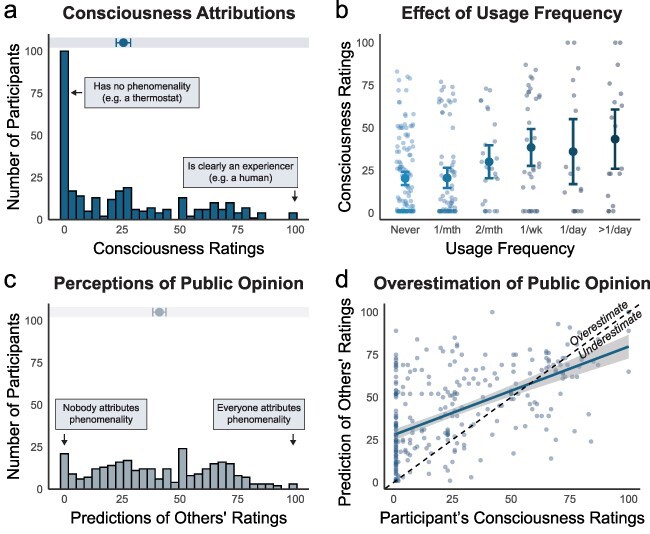
- 67% of participants attributed some possibility of phenomenal consciousness to ChatGPT, while 33% said it was definitely not an experiencer; consciousness ratings had M = 25.56, median = 16.00, SD = 27.36, range = 1–100.
- Familiarity mattered: participants who had used ChatGPT attributed higher consciousness (M = 29.59) than those who never used it (M = 19.37; t(287) = 3.33, P < .001), with a linear increase across usage frequency (B = 4.94, SE = 0.99, t = 4.99, P < .001).
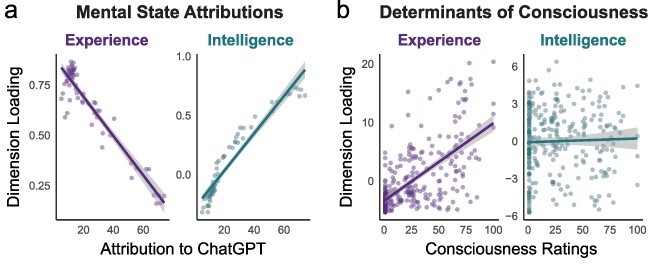
- Ratings of 65 mental states reduced to two dimensions—Experience and Intelligence—explaining 58% of variance. ChatGPT was seen as more capable of Intelligence than Experience (r = 0.95 and r = −0.94, respectively), but only Experience-related states predicted consciousness attributions (r = 0.65, P < .001) and not Intelligence-related states (r = 0.03, P = .596).
- Participants predicted others would attribute more consciousness to ChatGPT than they themselves did (predicted M = 41.11, median = 39.50, SD = 25.28 vs. own M = 25.56; t(299) = 10.90, P < .001), though own and predicted ratings correlated (r = 0.56, P < .001).
Methods
- Nationally representative sample of 300 US residents recruited via Prolific Academic in July 2023 using proportional stratified random sampling with age and gender quotas based on US Census Bureau data (female = 152; male = 142; non-binary = 2; did not answer = 4; mean age = 46.13 years).
- Participants read a description of ChatGPT and a description of phenomenal experience adapted from Peressini (2014), then rated ChatGPT’s capacity for conscious experience on a 1–100 scale, confidence in that judgment, predicted others’ judgments, and rated ChatGPT on 65 mental-state attributes from 1–100.
- Analyses included principal component analysis of the 65 mental-state ratings, correlations, t-tests, and regression models; materials, anonymized raw data, and analysis code are available on OSF.
Limitations
- The paper states that consciousness was measured via a single question, which may be sensitive to different measures and prompts; if the scale was interpreted as credence rather than degree, 23% of participants considered it more likely than not that ChatGPT has human-like experience.
- The paper states that self-report may not fully capture intuitions about others’ mental states compared with indirect behavioral markers, and that it remains unclear how folk conceptions of phenomenality map onto philosophical constructs; the preceding explanation of phenomenality may have induced a concept participants would not otherwise spontaneously consider.
- The paper states that the stratified US sample may not generalize across cultures, that online participants likely use computers daily, and that attitudes reflect a specific moment; the usage–consciousness link is correlational, so causal direction remains unclear.
Model-written summary. Check it against the paper before relying on it.
Integrity signals
Registry
Cites
Statistics
Figures
Verification
Claims the paper makes
7 Valid · 0 Not valid · 8 Not checked · 24 Own results and interpretations
Every source the paper cites for this claim was checked and supports it.
In the paper
“The relatively high rates of consciousness attributions in this sample are somewhat surprising, given that experts in neuroscience and consciousness science currently estimate that LLMs are highly unlikely to be conscious (Butlin et al. 2023, LeDoux et al. 2023).”
§ Folk psychological attributions of consciousness to large language models > Conclusions
What the sources say
- Supportedcites Butlin et al. 2023 matched to “Consciousness in Artificial Intelligence: Insights from the Science of Consciousness” (2023) source
The Abstract says the authors’ analysis suggests that no current AI systems are conscious. The Executive Summary explicitly includes Transformer-based LLMs among the systems assessed and says no existing system is a strong candidate for consciousness. These passages support the claim about current LLMs, though the paper does not give a numerical likelihood estimate. (LLM, conf=0.89)
- Supportedcites LeDoux et al. 2023 matched to “Consciousness beyond the human case” (2023) source
In “Two levels of consciousness” (p. 1), Frith states that LLMs lack the lower levels associated with sentience and concludes, “In this case they are not conscious.” This supports the cited claim that LLM consciousness is considered highly unlikely. (LLM, conf=0.90)
hedged- Asserted: passes — The authors put it forward as true.
- Checkable: passes — It can be checked against evidence.
- Load-bearing: passes — The paper’s conclusions depend on it.
- Based: passes — The paper gives a reason why it holds.
- Supported
Every source the paper cites for this claim was checked and supports it.
In the paper
“Thus, independent of ongoing academic discussions about the potential for and possibility of artificial consciousness (e.g. Butlin et al. 2023, Chalmers 2023), the recent emergence and widespread uptake of powerful LLMs may be associated with a majority of people perceiving some degree of consciousness in these systems.”
§ Folk psychological attributions of consciousness to large language models > Discussion
What the sources say
- Supportedcites Butlin et al. 2023 matched to “Consciousness in Artificial Intelligence: Insights from the Science of Consciousness” (2023) source
The citation identifies an example of the ongoing academic discussion about whether AI could be conscious; it is not attached to the citing authors’ statement about what a majority of people may perceive. The Executive Summary and section 3 examine consciousness in current and near-future AI systems, including LLMs, so the paper is an example of the discussion cited. (LLM, conf=0.93)
- Supportedcites Chalmers 2023 matched to “Could a Large Language Model be Conscious?” (2023) source
The citation is attached to the phrase about academic discussions of the possibility of artificial consciousness, not to the subsequent claim about what a majority of people perceive. The introduction (p. 1) and Conclusions (pp. 14–15) discuss whether current or future LLMs could be conscious. The source therefore supports the point for which it is cited. (LLM, conf=0.93)
hedgedstates an association- Asserted: passes — The authors put it forward as true.
- Checkable: passes — It can be checked against evidence.
- Load-bearing: passes — The paper’s conclusions depend on it.
- Based: passes — The paper gives a reason why it holds.
- Rests on 2 assumptions not shown here.
- Supported
The cited sources support only part of this claim — read each source’s verdict below.
In the paper
“First, folk psychological attributions of consciousness may mediate future moral concern towards AI, regardless of whether or not they are actually conscious (Shepherd 2018, Mazor et al. 2023).”
§ Folk psychological attributions of consciousness to large language models > Introduction
What the sources say
- Not checked — no full text of the sourcecites Shepherd 2018 matched to “Consciousness and Moral Status” (2018) source
- Partly supportedcites Mazor et al. 2023 matched to “The scientific study of consciousness cannot and should not be morally neutral” (2023) sourceExperimental — accuracy not yet measured
The paper says that beliefs about consciousness shape ethics (Scientific Attribution of Consciousness, p. 3), and its Figure 1 describes conjectures about an entity’s conscious experience affecting applied ethics (p. 4). That supports the proposed link between attributed consciousness and moral concern, but the passages do not address AI specifically or establish the claim’s ‘regardless of whether AI is actually conscious’ qualification. (LLM, conf=0.82)
hedgedstates a possible cause- Asserted: passes — The authors put it forward as true.
- Checkable: passes — It can be checked against evidence.
- Load-bearing: passes — The paper’s conclusions depend on it.
- Based: passes — The paper gives a reason why it holds.
Every source the paper cites for this claim was checked and supports it.
In the paper
“The relatively high rates of consciousness attributions in this sample are somewhat surprising, given that experts in neuroscience and consciousness science currently estimate that LLMs are highly unlikely to be conscious (Butlin et al. 2023, LeDoux et al. 2023).”
§ Folk psychological attributions of consciousness to large language models > Conclusions
What the sources say
- Supportedcites Butlin et al. 2023 matched to “Consciousness in Artificial Intelligence: Insights from the Science of Consciousness” (2023) source
The Executive Summary says the authors’ analysis does not identify any existing AI system as a strong candidate for consciousness, explicitly including Transformer-based LLMs among the systems assessed. Section 3.2.1 adds that the case for those LLMs possessing consciousness-related indicators is relatively weak. The citing authors’ description of their sample as surprising is their own framing, not a finding attributed to this source. (LLM, conf=0.88)
- Supportedcites LeDoux et al. 2023 matched to “Consciousness beyond the human case” (2023) source
In “Two levels of consciousness” (p. 1), Frith states that LLMs “are not conscious” because they lack a sentient level. That supports the cited point that an expert considers LLM consciousness highly unlikely; the surprise about this sample’s attribution rates is the citing authors’ own framing. (LLM, conf=0.91)
hedged- Asserted: passes — The authors put it forward as true.
- Checkable: passes — It can be checked against evidence.
- Load-bearing: passes — The paper’s conclusions depend on it.
- Based: passes — The paper gives a reason why it holds.
- Supported
The cited sources support only part of this claim — read each source’s verdict below.
In the paper
“Second, any current or future scientific determination of phenomenal consciousness in AI is likely to be ‘theory-heavy’ and therefore deal in probabilities or credences rather than definite statements (Butlin et al. 2023).”
§ Folk psychological attributions of consciousness to large language models > Introduction
What the sources say
- Partly supportedcites Butlin et al. 2023 matched to “Consciousness in Artificial Intelligence: Insights from the Science of Consciousness” (2023) sourceExperimental — accuracy not yet measured
Section 1.2.3 describes a theory-heavy assessment in terms of confidence in a system’s consciousness, and Box 1 recommends credences because uncertainty is currently unavoidable. But the claim extends this approach to any future scientific determination. Section 4.3 says behavioural tests may be developed as an alternative, so the paper does not support that universal prediction. (LLM, conf=0.88)
hedged- Asserted: passes — The authors put it forward as true.
- Checkable: unclear — It is unclear whether it could be checked against evidence.
- Load-bearing: passes — The paper’s conclusions depend on it.
- Based: passes — The paper gives a reason why it holds.
- Partly supported
9 more claims
Create a free account to see all 39 claims and to verify the 2 references still open.
- It may state two separate claims as one. 16
- Probably not a substantial claim. 16
- The quote only partly states this claim. 1
Claims other papers make about this one
Each is checked against this paper’s own text: does it say what the citing paper says it does?
The source backs part of the claim, not all of it — or backs it for a different population, condition or comparison.
In the citing paper
“Furthermore, modern AI systems are likely to give users the impression that they are conscious.”
From Identifying indicators of consciousness in AI systems (2026) · cites this paper as [6]
Experimental — accuracy not yet measuredThe source backs part of the claim, not all of it — or backs it for a different population, condition or comparison.
In the citing paper
“most respondents considered LLMs more conscious than a toaster”
From There is no such thing as conscious artificial intelligence (2025) · cites this paper as Colombatto and Fleming (2024)
Experimental — accuracy not yet measuredThe source backs part of the claim, not all of it — or backs it for a different population, condition or comparison.
In the citing paper
“Some studies even suggest that users believe LLMs have memories, feelings, or consciousness (33).”
From The benefits and dangers of anthropomorphic conversational agents (2025) · cites this paper as [33]
Experimental — accuracy not yet measuredThe source backs part of the claim, not all of it — or backs it for a different population, condition or comparison.
In the citing paper
“This brings with it the potential for deception and manipulation at scale and for mistaken beliefs by users that these machines understand human experience and existence in ways they cannot (16, 33).”
From The benefits and dangers of anthropomorphic conversational agents (2025) · cites this paper as [33]
Experimental — accuracy not yet measuredThe source backs part of the claim, not all of it — or backs it for a different population, condition or comparison.
In the citing paper
“Next, they were shown a series of 20 mental states, chosen from prior work6 to represent dimensions of ‘intelligence’ (attention, choosing, communication, considering, deciding, intelligence, knowing, memory, planning, and reasoning) or ‘experience’ (admiration, enjoyment, fear, guilt, happiness, hope, passion, pleasure, relief, and resentment).”
From The influence of mental state attributions on trust in large language models (2025) · cites this paper as [6]
Experimental — accuracy not yet measured
7 more claims about this paper
Create a free account to see every claim other papers make about this one.
Statistics recomputed
Every reported test result, recomputed from its test statistic and degrees of freedom. A result shows as not adding up only once an independent check has confirmed it.
- ConsistentF(1, 297) = 53.24reported p < .001 · recomputed p < .001
“F(1, 297) = 53.24, p < .001”
- Consistentt(287) = 3.33reported p < .001 · recomputed p < .001
“t(287) = 3.33, p < .001”
- Consistentt(299) = 10.9reported p < .001 · recomputed p < .001
“t(299) = 10.90, p < .001”
Self-check
Percentages, sums and reported differences re-computed from the paper’s own numbers.
Self-check results appear here once an independent check has confirmed them.
Citations
Cites
Nagel, T. (1974) · The Philosophical Review · doi:10.2307/2183914 · Cited by 7,440
On a confusion about a function of consciousness
Block, N. (1995) · Behavioral and Brain Sciences · doi:10.1017/s0140525x00038188 · Cited by 3,364 · cited 1×
“Phenomenal consciousness is typically defined as a state in which there is ‘something it is like’ for a system to be the subject of that experience (Nagel 1974; Block 1995).”
BackgroundGray, H. M., Gray, K., & Wegner, D. M. (2007) · Science · doi:10.1126/science.1134475 · Cited by 2,342 · cited 2×
“…‘Experience’ (i.e. the capacity to feel pain, fear, joy, or pride) and ‘Agency’ (i.e. the capacity to have self-control, morality, planning, or communication) that is reminiscent of the distinction between phenomenal and non-phenomenal states (Gray et al. 2007; for a review, see Waytz et al. 2010).”
BackgroundChalmers, D. J. (1996) · Cited by 1,998
Causes and consequences of mind perception
Waytz, A., Gray, K., Epley, N., & Wegner, D. M. (2010) · Trends in Cognitive Sciences · doi:10.1016/j.tics.2010.05.006 · Cited by 759 · cited 1×
“…‘Experience’ (i.e. the capacity to feel pain, fear, joy, or pride) and ‘Agency’ (i.e. the capacity to have self-control, morality, planning, or communication) that is reminiscent of the distinction between phenomenal and non-phenomenal states (Gray et al. 2007; for a review, see Waytz et al. 2010).”
BackgroundMoral typecasting: Divergent perceptions of moral agents and moral patients.
Gray, K., & Wegner, D. M. (2009) · Journal of Personality and Social Psychology · doi:10.1037/a0013748 · Cited by 535
The Benefits of Interactions with Physically Present Robots over Video-Displayed Agents
Bainbridge, W. A., Hart, J. W., Kim, E. S., & Scassellati, B. (2011) · International Journal of Social Robotics · doi:10.1007/s12369-010-0082-7 · Cited by 478 · cited 1×
“For example, attributions of mental states may depend on superficial appearance (Bainbridge et al. 2011) as well as observed behavioural profiles (Colombatto and Fleming 2023).”
BackgroundMore than a body: Mind perception and the nature of objectification.
Gray, K., Knobe, J., Sheskin, M., Bloom, P., & Barrett, L. F. (2011) · Journal of Personality and Social Psychology · doi:10.1037/a0025883 · Cited by 277
Subhuman, Inhuman, and Superhuman: Contrasting Humans with Nonhumans in Three Cultures
Haslam, N., Kashima, Y., Loughnan, S., Shi, J., & Suitner, C. (2008) · Social Cognition · doi:10.1521/soco.2008.26.2.248 · Cited by 247
Intuitions about consciousness: experimental studies
Knobe, J., & Prinz, J. (2008) · Phenomenology and the Cognitive Sciences · doi:10.1007/s11097-007-9066-y · Cited by 227 · cited 1×
“For example, initial work in this domain examined attributions of mental states that involve phenomenality (e.g. feeling joy or getting depressed) and those that do not (e.g. making a decision or forming a belief; Knobe and Prinz 2008; for a review, see Sytsma 2014).”
Background
Research works printed but not linked: 1
- Wiese W. 2023 Could large language models be conscious? A perspective from the free energy principle. Preprint at Philpapers, https://philpapers.org/rec/WIECLL
Cited by
The benefits and dangers of anthropomorphic conversational agents
Peter, S., Riemer, K., & West, J. D. (2025) · Proceedings of the National Academy of Sciences · doi:10.1073/pnas.2415898122 · Cited by 110
Identifying indicators of consciousness in AI systems
Butlin, P., Long, R., Bayne, T., Bengio, Y., Birch, J., Chalmers, D., Constant, A., Deane, G., Elmoznino, E., Fleming, S. M., et al. (2026) · Trends in Cognitive Sciences · doi:10.1016/j.tics.2025.10.011 · Cited by 56
Self-citationCompanionship in code: AI's role in the future of human connection
Andersson, M. (2025) · Humanities and Social Sciences Communications · doi:10.1057/s41599-025-05536-x · Cited by 39
“…may be, at least in part, an attribution — a projection of one ’ s own mental states onto others (Graziano, 2013), which may help explain users ’ reported tendency to ascribe all sorts of mental properties to AI (Colombatto and Fleming, 2024; Guingrich and Graziano, 2025; Laestadius et al., 2022).”
The influence of mental state attributions on trust in large language models
Colombatto, C., Birch, J., & Fleming, S. M. (2025) · Communications Psychology · doi:10.1038/s44271-025-00262-1 · Cited by 34
“First, they were asked to rate ChatGPT ’ s capacity for phenomenal consciousness, on a scale from 1 ( ‘ clearly does not have conscious experiences ’ ) to 100 ( ‘ clearly has conscious experiences ’ 6 ).”
InfluentialSelf-citationGuingrich, R. E., & Graziano, M. S. A. (2025) · Oxford Intersections: AI in Society · doi:10.1093/9780198945215.003.0011 · Cited by 28
Consciousness science: where are we, where are we going, and what if we get there?
Cleeremans, A., Mudrik, L., & Seth, A. K. (2025) · Frontiers in Science · doi:10.3389/fsci.2025.1546279 · Cited by 51
Simulacra as conscious exotica
Shanahan, M. (2026) · Inquiry · doi:10.1080/0020174x.2024.2434860 · Cited by 25
“So it is perhaps unsurprising that some users who have spent lots of time interacting with these agents will start to think of them as fellow conscious beings and to speak of them in such terms (Colombatto and Fleming, 2023; Tiku, 2022).”
There is no such thing as conscious artificial intelligence
Porębski, A., & Figura, J. (2025) · Humanities and Social Sciences Communications · doi:10.1057/s41599-025-05868-8 · Cited by 20
“Colombatto and Fleming (2024) reported that only one-third of respondents (adults in the US, n = 300, data collection in July 2023) fi rmly rule out any form of consciousness of large language models (LLMs; for a comprehensive overview, see Naveed et al., 2025; for an accessible introduction, see…”
The Double-Edged Sword of Anthropomorphism in LLMs
Reinecke, M. G., Ting, F., Savulescu, J., & Singh, I. (2025) · Proceedings · doi:10.3390/proceedings2025114004 · Cited by 47
“Emerging research suggests that people do anthropomorphize ChatGPT [20], particularly with increased exposure [21].”
Chatbot-fictionalism and empathetic AI: Should we worry about AI when AI worries about us?
Friend, S., & Goffin, K. (2025) · Philosophical Psychology · doi:10.1080/09515089.2025.2525320 · Cited by 24
“Agreement with such statements looks like evidence of explicit belief rather than implicit fictionalization, a conclusion that seems to be supported by a more recent survey (Colombatto & Fleming, 2024).”
Sheehy, L., Bouchard, S., Kakkar, A., El Hakim, R., Lhoest, J., & Frank, A. (2024) · Journal of Clinical Medicine · doi:10.3390/jcm13185574 · Cited by 16
“Furthermore, recent developments in large language model generative artificial intelligence (AI) now permit the interpretation of spoken inputs from a user, and the generation of emotionally appropriate responses [20].”
BackgroundAnthropomorphism, False Beliefs, and Conversational AIs : How Chatbots Undermine Users' Autonomy
Marchegiani, B. (2025) · Journal of Applied Philosophy · doi:10.1111/japp.70008 · Cited by 29
Six Fallacies in Substituting Large Language Models for Human Participants
Lin, Z. (2025) · Advances in Methods and Practices in Psychological Science · doi:10.1177/25152459251357566 · Cited by 66
“When reporting alignments between LLM and human responses, acknowledge the limitations of inferring shared mechanisms, noting their distinct architecture and learning history (Abdurahman et al., 2025).”
Dual-process theory and decision-making in large language models
Brady, O., Nulty, P., Zhang, L., Ward, T. E., & McGovern, D. P. (2025) · Nature Reviews Psychology · doi:10.1038/s44159-025-00506-1 · Cited by 33
“When machines can write persuasively, match emotional tone and mimic human-like conversation, the potential for deception, manipulation and misplaced trust rises rapidly, with evidence to suggest that many users already attribute some possibility of consciousness to LLMs 167 .”
The need for an empirical research program regarding human–AI relational norms
Reinecke, M. G., Kappes, A., Mann, S. P., Savulescu, J., & Earp, B. D. (2025) · AI and Ethics · doi:10.1007/s43681-024-00631-2 · Cited by 23
Voultsiou, E., & Moussiades, L. (2026) · Electronics · doi:10.3390/electronics15030524 · Cited by 13
Preliminaries to artificial consciousness: A multidimensional heuristic approach
Evers, K., Farisco, M., Chatila, R., Earp, B. D., Freire, I. T., Hamker, F. H., Németh, E., Verschure, P. F. M. J., & Khamassi, M. (2025) · Physics of Life Reviews · doi:10.1016/j.plrev.2025.01.002 · Cited by 28
“…which is a highly sensitive issue: as the long discussion about animal consciousness illustrates [25 – 27], misunderstandings can cause disproportionate reactions, which may arise from passionate and ideologically driven positions rather than from empirically informed, rational reflection [22].”
Bengio, Y., & Elmoznino, E. (2025) · Science · doi:10.1126/science.adn4935 · Cited by 17
A clarification of the conditions under which Large language Models could be conscious
Overgaard, M., & Kirkeby-Hinrup, A. (2024) · Humanities and Social Sciences Communications · doi:10.1057/s41599-024-03553-w · Cited by 12
AI Consciousness: A Centrist Manifesto
Birch, J. (2025) · doi:10.31234/osf.io/af7c9_v1 · Cited by 10
Privacy and Human-AI Relationships
Register, C., Khan, M. A., Giubilini, A., Earp, B. D., & Savulescu, J. (2025) · Philosophy & Technology · doi:10.1007/s13347-025-00978-2 · Cited by 19
“Humans tend to anthropomorphize AI agents, such as by attributing consciousness or feelings to them (Colombatto & Fleming, 2024; Fetterolf & Hertog, 2023; Guingrich & Graziano, 2023) and such tendencies will likely increase as AI agents become more anthropomorphic (Geiselmann et al., 2023).”
The psychology of LLM interactions: the uncanny valley and other minds
Kirkeby-Hinrup, A., & Stenseke, J. (2025) · Journal of Psychology and AI · doi:10.1080/29974100.2025.2457627 · Cited by 12
Kitchens, M. B., & Meier, B. P. (2025) · The Journal of Social Psychology · doi:10.1080/00224545.2025.2503006 · Cited by 12
“Because AI is thought to have features of consciousness (Colombatto & Fleming, 2024), people process their response to AI as if it was another mind.”
InfluentialIndividuating artificial moral patients
Register, C. (2025) · Philosophical Studies · doi:10.1007/s11098-025-02409-6 · Cited by 22
“Because of the behavioral sophistication of LLMs, many people–including both lay and expert–have started to wonder if AI are conscious or when they may become conscious (Colombatto & Fleming, 2024 ; Chalmers, 2023 ).”
Agnosticism about artificial consciousness
McClelland, T. (2026) · Mind & Language · doi:10.1111/mila.70010 · Cited by 7
“In particular, the advancement of large language models (LLMs) has given us AI that can sometimes appear to users to be conscious (Colombatto & Fleming, 2024).”
Kang, B., Kim, J., Yun, T., Bae, H., & Kim, C.-E. (2026) · Computers in Human Behavior Reports · doi:10.1016/j.chbr.2025.100901 · Cited by 6
“The perception that AI possesses consciousness is not limited to a few peculiar individuals; according to a recent survey, 67% of respondents believed there is a possibility that ChatGPT has consciousness [4].”
Kang, B., Kim, J., Yun, T.-R., Bae, H., & Kim, C.-E. (2025) · arXiv · doi:10.48550/arxiv.2502.15365 · Cited by 6
“The perception that AI possesses consciousness is not limited to a few peculiar individuals; according to a recent survey, 67% of respondents believed there is a possibility that ChatGPT has consciousness [4].”
A multidimensional approach to the self in non-human animals through the Pattern Theory of Self
Laurenzi, M., Raffone, A., Gallagher, S., & Chiarella, S. G. (2025) · Frontiers in Psychology · doi:10.3389/fpsyg.2025.1561420 · Cited by 6
“…ability to simulate human communication is so compelling that recent studies have shown that people often ascribe a genuine form of self-awareness to LLMs (e.g., Colombatto and Fleming, 2024; Floridi and Chiriatti, 2020; Guingrich and Graziano, 2024; LeDoux et al., 2023; Shanahan et al., 2023).”
Chen, A., Kim, S. S. Y., Dharmasiri, A., Russakovsky, O., & Fan, J. E. (2025) · CHI Conference Extended Abstracts on Human Factors in Computing Systems (CHI EA) · doi:10.1145/3706599.3719710 · Cited by 14
Corradi, G. B., Theirs, C., Martínez‐Martí, M. L., Isern‐Mas, C., & Villar, S. (2025) · Scandinavian Journal of Psychology · doi:10.1111/sjop.70037 · Cited by 10
AI for translation and interpreting: A roadmap for users and policymakers
Peeters, K., Daems, J., Plieseis, C., Ginel, M. I. R., & Şahin, M. (2026) · Interpreting and Society · doi:10.1177/27523810251409377 · Cited by 11
“…Bennett, 2024), and by the anthropomorphic terminology used by tech companies and taken over by the public, such as saying the tools ‘understand’, ‘know’, ‘communicate’, or ‘translate’, as if they were conscious beings endowed with intentionality, knowledge, and skills (Colombatto & Fleming, 2024).”
Into the black box: Laypeople's folk theories about generative artificial intelligence chatbots
Li, Z., Kim, N., & Chen, L. (2026) · Big Data & Society · doi:10.1177/20539517261447838 · Cited by 6
“Research in this stream, for example, fi nds that users attribute varying degrees of consciousness to large language models (LLMs), with these attributions strengthening through increased usage (Colombatto and Fleming, 2024).”
InfluentialSuperintelligence Revisited in Times of ChatGPT
Șușnea, I., Pecheanu, E., Cocu, A., & Susnea, S. (2024) · BRAIN BROAD RESEARCH IN ARTIFICIAL INTELLIGENCE AND NEUROSCIENCE · doi:10.18662/brain/15.2/579 · Cited by 11
Does It Make Sense to Speak of Introspection in Large Language Models?
Comsa, I. M., & Shanahan, M. (2025) · arXiv · doi:10.48550/arxiv.2506.05068 · Cited by 3
“…on the possibility of consciousness in AI systems (Aru et al., 2023; Butlin et al., 2023; Overgaard and Kirkeby-Hinrup, 2024), in practice, many people already assign some degree of consciousness to existing LLMs (Colombatto and Fleming, 2024; Guingrich and Graziano, 2024; Scott et al., 2023).”
Does neural computation feel like something?
Gidon, A., Aru, J., & Larkum, M. E. (2025) · Frontiers in Neuroscience · doi:10.3389/fnins.2025.1511972 · Cited by 8
“However, the common sense that prevailed in the case of animals makes humans vulnerable to computer programs specifically designed to outsmart and (mis)use our intuitions (Shevlin, 2024; Colombatto and Fleming, 2024).”
When Personality Meets Platform: The Moderating Role of Human-Likeness in AI User Evaluations
Lee, S., & Choi, Y. K. (2025) · International Journal of Human-Computer Interaction · doi:10.1080/10447318.2025.2604629 · Cited by 4
“Moreover, research on folk-psychological reasoning demonstrates that people spontaneously infer varying degrees of phenomenal consciousness in systems like ChatGPT, even when they rationally acknowledge that such models are unlikely to be conscious (Colombatto & Fleming, 2024).”
Hu, P., Wang, L., Chang, D., Zhu, Z., Chen, Y., Ren, Z., & Dumayi, H. (2026) · International Journal of Human-Computer Interaction · doi:10.1080/10447318.2025.2605181 · Cited by 6
“Colombatto and Fleming (2024), for instance, demonstrated that many users attribute some degree of subjective experience to ChatGPT, primarily along the experience rather than intelligence dimension of mind perception.”
The Moral Status of Artificial Intelligence: in Search of a Sociological Perspective
Aganova, A., & Katerny, I. V. (2025) · Sociological Journal · doi:10.19181/socjour.2025.31.1.5 · Cited by 10
Sharing the World—A Social Aspect of Consciousness
Frith, C. (2025) · Open Mind · doi:10.1162/opmi.a.5 · Cited by 9
Can LLMs make trade-offs involving stipulated pain and pleasure states?
Keeling, G., Street, W., Stachaczyk, M., Zakharova, D., Comsa, I. M., Sakovych, A., Logothetis, I., Zhang, Z., Arcas, B. A. Y., & Birch, J. (2024) · arXiv · doi:10.48550/arxiv.2411.02432 · Cited by 3
“…and other mental phenomena to LLMs are subject to a debunking explanation in which the human tendency to anthropomorphise undermines the justification for attributing sentience to LLMs on the basis of behavioural evidence (Colombatto and Fleming, 2024; LeDoux et al., 2023; Butlin et al., 2023).”
BackgroundConscious artificial intelligence and biological naturalism
Seth, A. (2025) · doi:10.31234/osf.io/tz6an_v2 · Cited by 3
Beyond computational equivalence: the behavioral inference principle for machine consciousness
Palminteri, S., & Wu, C. M. (2026) · Neuroscience of Consciousness · doi:10.1093/nc/niag002 · Cited by 7
“Indeed, everyone from journalists, to politicians, to Aunt Mary now has anecdotal evidence of the conversational abilities of LLMs and have begun to form their own opinions about how we should evaluate the consciousness of these systems (Colombatto & Fleming, 2024) .”
Mind perception of artificial intelligence: A systematic review
Li, Y., Qin, X., Yam, K. C., Gray, K. J., Cheng, X., Wen, J., & Lai, X. (2026) · Information Processing & Management · doi:10.1016/j.ipm.2026.104820 · Cited by 6
Emerging Questions in AI Welfare
Keeling, G., & Street, W. (2026) · Cambridge University Press eBooks · doi:10.1017/9781009732000 · Cited by 14
Users’ mental models within human–AI interaction: a systematic scoping review
Bodamer, W. G., Schoenmakers, S., Castellar, E. N., & IJsselsteijn, W. A. (2026) · AI & Society · doi:10.1007/s00146-026-03038-1 · Cited by 6
“…shows that humans readily attribute mental states, such as agency, consciousness, or intentionality, to AI through Theory of Mind attributions (Colombatto and Fleming 2024; De Graaf and Malle 2019; Eyssel and Pfundmair 2015; Ladak et al. 2024) indicating that AI systems are viewed as more…”
The Philosophy of Language Models
Millière, R., & Buckner, C. J. (2026) · Philosophy Compass · doi:10.1111/phc3.70095 · Cited by 10
“A survey of US adults found that 67% already attributed some degree of phenomenal consciousness to ChatGPT, with these attributions being positively correlated with usage frequency (Colombatto and Fleming 2024).”
Pseudo-Consciousness in AI: Bridging the Gap Between Narrow AI and True AGIPreprint
Prestes, J. A. D. L. (2025) · SSRN Electronic Journal · doi:10.2139/ssrn.5147424 · Cited by 5
Zebrowski, R. L. (2025) · Oxford University Press eBooks · doi:10.1093/9780198945215.003.0071 · Cited by 4
Anthropomorphism in AI-Driven Marketing
Uddin, S. M. F., Hameed, H., & Siddiqui, F. (2026) · Springer eBooks · doi:10.1007/978-3-031-75316-9_50-1 · Cited by 3
The meaning of prompts: a semiotic approach to human–machine communication
Thellefsen, M., Dewi, A. N., & Sørensen, B. M. (2026) · Journal of Documentation · doi:10.1108/jd-03-2026-0140 · Cited by 6
Student Perception of LLM Chatbot Anthropomorphism in the Context of Politeness Theory
Алексеевна, Ф. А., & Li, A. A. (2025) · Science almanac of Black sea region countries · doi:10.23947/2414-1143-2025-11-4-19-28 · Cited by 1
Three frameworks for AI mentality
Shevlin, H. (2026) · Frontiers in Psychology · doi:10.3389/fpsyg.2026.1715835 · Cited by 2
Anthropomorphisme : des animaux aux machines
Nahon, M., Khamassi, M., Freire, I. T., Paternotte, C., & Chatila, R. (2025) · Socio-anthropologie · doi:10.4000/15qdj · Cited by 1
“Cette tendance à anthropo-morphiser les systèmes à base d’Intelligence Artificielle est très répandue et touche une grande partie de ces utilisateurs (Colombatto et Fleming, 2024 ; Scott et al., 2023).”
Attribution of consciousness to non-human animals: insights from AI and multidimensional frameworks
Chiarella, S. G., Laurenzi, M., D'Onofrio, M., Gallagher, S., & Raffone, A. (2026) · Frontiers in Psychology · doi:10.3389/fpsyg.2026.1716363 · Cited by 2
“On the other side, disembodied AI systems, particularly LLMs, frequently receive high folk attributions, sometimes extending to phenomenological experience, based on linguistic fluency and apparent metacognition alone (Colombatto and Fleming, 2024; Kang et al., 2025; Stuart, 2024).”
Wu, Y., & Shen, F. (2026) · Journal of Computer-Mediated Communication · doi:10.1093/jcmc/zmag009 · Cited by 6
Palminteri, S., & Pistilli, G. (2026) · Current Opinion in Behavioral Sciences · doi:10.1016/j.cobeha.2026.101670 · Cited by 1
Bariach, B., Schoenegger, P., Bhaskar, M., & Suleyman, M. (2026) · AI and Ethics · doi:10.1007/s43681-026-01294-x · Cited by 6
“Colombatto & Fleming [14 ] provide evidence of this in the context of large lan - guage models, finding that perceived capacity for experi - ence predicts consciousness attributions more strongly than perceived intelligence, defined in that work as “knowing things or making choices”.”
Attributing Mental States to Non-Embodied Autonomous Systems: A Systematic Review
Wischnewski, M. (2025) · CHI Conference Extended Abstracts on Human Factors in Computing Systems (CHI EA) · doi:10.1145/3706599.3719988 · Cited by 9
Deference, development, and large language models: Issues at the edge of sentience
Bayne, T. (2025) · Mind & Language · doi:10.1111/mila.12537 · Cited by 1
“In fact, as Birch himself notes (p. 306), we may already have such cases, for there is evidence that as many as two-thirds of adults are willing to ascribe some kind of consciousness to large language models (LLMs) (Colombatto & Fleming, 2024).”
Emotional Cues and Misplaced Trust in Artificial Agents
Masotti, J. (2025) · Oxford University Press eBooks · doi:10.1093/9780198945215.003.0062 · Cited by 1
Mind in the Machine? Cross-Disciplinary Perceptions of Consciousness in Artificial Intelligence
Moradi, H., Avellino, I., Krauß, P., Zanca, D., Hein, I., Eskofier, B. M., & Flaucher, M. (2026) · CHI Conference on Human Factors in Computing Systems · doi:10.1145/3772318.3790699
Large language models as linguistic simulators and cognitive models in human researchPreprint
Lin, Z. (2024) · PsyArXiv (OSF Preprints) · doi:10.31234/osf.io/uqxcb
The Hard Problems of AIPreprint
Tiuninas, O. A. (2025) · Qeios · doi:10.32388/13b814 · Cited by 1
Life and Completeness in Complex Systems
Ochoa, J. G. D. (2025) · Understanding complex systems · doi:10.1007/978-3-031-84709-7_6
The Hard Problems of AIPreprint
Tiuninas, O. A. (2025) · Qeios · doi:10.32388/13b814.2
The Hard Problems of AIPreprint
Tiuninas, O. A. (2025) · Qeios · doi:10.32388/13b814.3
How Do Humans Perceive AI-Generated Action?Preprint
Manova, A., & Bach, P. (2025) · Thesis Commons (OSF Preprints) · doi:10.31237/osf.io/j5cxs_v1
Tiuninas, O. A. (2025) · Philosophical Investigations · doi:10.1111/phin.70004
Scenes from a Marriage: How We Found Our Way from Experimental Psychology to Social Neuroscience
Frith, U., & Frith, C. (2025) · Annual Review of Psychology · doi:10.1146/annurev-psych-012425-033822 · Cited by 1
Reappraising Intuitions About ConsciousnessPreprint
Kim, C., & Chong, S. C. (2025) · SSRN Electronic Journal · doi:10.2139/ssrn.5420626
The Emotional Alignment Design Policy
Schwitzgebel, E., & Sebo, J. (2026) · Topoi · doi:10.1007/s11245-025-10363-5 · Cited by 4
Reappraising intuitions about consciousness
Kim, C., & Chong, S. C. (2026) · Frontiers in Psychology · doi:10.3389/fpsyg.2026.1747924
“Since previous studies have used the term intuitions about consciousness in various ways (Colombatto and Fleming, 2024; Fischer and Sytsma, 2021; Knobe and Prinz, 2008), this article seeks to clarify its scope and to discuss intuition about consciousness within the following boundaries.”
Wischnewski, M., & Nguyen, D. (2026) · CHI Conference Extended Abstracts on Human Factors in Computing Systems (CHI EA) · doi:10.1145/3772363.3798547 · Cited by 2
‘Turing Animism’ and the Disenchantment of Social Cognition: Why Humans Ensoul Large Language Models
Skinner, A. S. (2026) · Religions · doi:10.3390/rel17050577 · Cited by 1
The Homily in the Algorithmic Age: Mediation, Delegation, and the Irreducibility of the Subject
Freitas, T. A. F. (2026) · Religions · doi:10.3390/rel17060630 · Cited by 1
The exploitation argument against artificial companionship
VandenHombergh, J. (2026) · AI and Ethics · doi:10.1007/s43681-026-01064-9
Clarifying Anthropomorphism for Robots and AI: A Critical Review
Coghlan, S., & Antonellos, M. (2026) · International Journal of Social Robotics · doi:10.1007/s12369-026-01419-6
Varypaiev, O. (2026) · Philosophies · doi:10.3390/philosophies11040115
“Studies of such attributions document this tendency [21,52].”
Not Touched by Human Hands: Misattributed AI Sentience and the Power of Images
Ralske, K. (2026) · Springer eBooks · doi:10.1007/978-3-032-21685-4_5
Are Attributions of Consciousness to AI Chatbots Epistemically Innocent?
Peters, U. (2026) · Minds and Machines · doi:10.1007/s11023-026-09795-8
“In fact, recent surveys found that the majority of participants claimed that ChatGPT was conscious, i.e., had subjective experience (Colombatto & Fleming, 2024; Kang et al., 2025).”
Gossip and Mental State Attributions of Autonomous Intelligent Agents
Slavchev, B., & Hutchinson, Z. (2026) · International Conference on Human-AI Interaction and Experience Design (HAXD) · doi:10.1109/haxd70072.2026.11620655
“In [10], the authors show that human attributions of consciousness to LLMs are positively correlated to usage.”
When AI Talks Back: Behavioral Consequences of AI-Generated Social Interaction on PlatformsPreprint
Li, B., & Lin, Z. (2026) · SSRN Electronic Journal · doi:10.2139/ssrn.7041298
Making emotional transparency transparent
Facchin, M., & Zanotti, G. (2026) · Phenomenology and the Cognitive Sciences · doi:10.1007/s11097-026-10188-6
Attribution of consciousness: Infants, animals, and artificial intelligence
Chiarella, S. G., Gallagher, S., & Raffone, A. (2026) · Elsevier eBooks · doi:10.1016/b978-0-443-29258-3.00086-0
The Embodied Hijack: when Pleistocene minds meet disembodied artificial intelligence
Macrine, S. L. (2026) · Frontiers in Psychology · doi:10.3389/fpsyg.2026.1889386
“Colombatto and Fleming (2024) report that participants readily attribute phenomenal consciousness to ChatGPT, that these attributions are robust rather than fleeting, and that they scale with frequency of use.”
Spatola, N., & Cohen, L. (2026) · AI & Society · doi:10.1007/s00146-026-03314-0
AI models as consciousness attributors: how LLMs ascribe consciousness to other agents
Kang, B., & Kim, C.-E. (2026) · Frontiers in Psychology · doi:10.3389/fpsyg.2026.1926286
Seeing humans in technology: The antecedents, boundaries and consequences of AI anthropomorphism
Kim, S., & Liu, J. (2026) · Current Opinion in Psychology · doi:10.1016/j.copsyc.2026.102397 · Cited by 1
Digital Avatars and the Ruist Ontology of Selfhood
Martin, J. B. (2026) · International Confucian Studies · doi:10.1515/icos-2026-0023
“1 There are many companies developing proprietary interfaces between commercial end users and the LLMs which generate the avatars, and I don ’ t fi nd it presumptuous to declare that such avatars will be in widespread use within the coming decade or two.”
InfluentialBehind the screen: laypersons' mental models about ChatGPT
Schneller, M., Seier, J., Huber, S. E., Loi, I., & Albert, D. (2026) · Frontiers in Computer Science · doi:10.3389/fcomp.2026.1915035
The stuff matters: Consciousness, computation, and biology
Seth, A. K. (2026) · Behavioral and Brain Sciences · doi:10.1017/s0140525x26106906 · Cited by 3
Siebertz, K. (2026) · Springer eBooks · doi:10.1007/978-3-662-74590-8_4
Large language model attributes and perceived moral agency of artificial moral advisors
Liew, T. W., Tan, S.-M., Lee, Y. Y., Gan, C. L., & Chan, T. J. (2026) · Frontiers in Artificial Intelligence · doi:10.3389/frai.2026.1901532
“…capacity is typically attributed to these systems, although platforms such as Replika may elicit slightly higher perceptions of experience due to their emphasis on emotional expressiveness and relational interaction (Colombatto and Fleming, 2024; Scott et al., 2023; Ladak et al., 2025).”
AI is not as conscious as humans: Essentialism in mental state attributions to artificial systems
Longin, L., Karpus, J., Meertens, N., Bahrami, B., & Deroy, O. D. (2026) · Cognition · doi:10.1016/j.cognition.2026.106733
Metadata
- Authors
- Colombatto, C., & Fleming, S. M.
- Affiliations
- University of Waterloo (CA)
- Wellcome Centre for Human Neuroimaging (GB)
- Corresponding author
- Colombatto, Clara
- Venue
- Neuroscience of Consciousness
- Publisher
- Oxford University Press (OUP)
- Published
- 2024-01-01
- Volume
- 2024
- Issue
- 1
- Pages
- niae013-niae013
- ISSN
- 2057-2107 (ISSN-L)
- PMC
- PMC11008499
- OpenAlex
- W4394716098
- Semantic Scholar
- 9ac555b04def2a13ff62edf6e22906310261a501
- Cited by
- 96
- References
- 31
- Citations by year
- 2026: 47 · 2025: 44 · 2024: 5
- FWCI
- 39.06
- Type
- journal article
- Language
- en
- Open access
- gold
- doi.org
- Licence
- Locations
- Neuroscience of Consciousness (publishedVersion, cc-by-nc)
- PubMed Central (publishedVersion, cc-by-nc)
- PubMed (publishedVersion)
- UCL Discovery (University College London) (submittedVersion)
- MPG.PuRe (Max Planck Society) (submittedVersion)
- PsyArXiv (OSF Preprints) (submittedVersion, public-domain)
- Funders
- Engineering and Physical Sciences Research Council (EP/V000748/1)
- Erc (Consolidator Award 'ConsciousComputation')
- Topics
- Social Sciences › Arts and Humanities › Philosophy › Philosophy and Theoretical Science
- Social Sciences › Arts and Humanities › History and Philosophy of Science › Cybernetics and Technology in Society
- Life Sciences › Neuroscience › Cognitive Neuroscience › Embodied and Extended Cognition
- Keywords
- phenomenal consciousness, large language models, folk psychology, artificial intelligence, subjective experience, public attitudes toward AI, individual differences, usage frequency
About these checks
Registry, retraction, Cites and statistics results are computed, not judged, with one exception: a printed reference that no index lists is read once by a model before it counts as a citation error. Claims are extracted by a model and kept only when their quote appears verbatim in the text; each cited source is then checked, with a model’s help, for whether it says what the claim relies on. Those verdicts can be wrong — read the claim’s quote and the cited source before relying on one.
The claim verdicts this report counts are experimental: their accuracy is not yet measured.
A language model drew the claims from the paper on 2026-10-10, under version 3 of the claim definition (model deepseek-v4.1-flash, prompt extract-v3).
A second model labelled each claim on 2026-10-10 (model jev-1.13-20260917, definition revision gold-guideline-v0.2).
Cited sources are checked with a language model’s help (gpt-6-sol).
Statistics and arithmetic are recomputed, not judged.
Confidence bands are shown only for fields calibrated on our annotated test set. None is calibrated yet, so no band is shown.
What counts as a claim ›How we measure confidence ›How we check this ›
Are you an author, or do you see a problem with this page? Request a review
Data sources
Bibliographic data: Semantic Scholar, OpenAlex, Crossref.
Contains information from the Semantic Scholar Academic Graph Datasets, made available under the ODC Attribution License (ODC-BY 1.0).
Semantic Scholar’s data is described in: Kinney, R., et al. (2023). The Semantic Scholar Open Data Platform. arXiv:2301.10140.
