

Folk psychological attributions of consciousness to large language models
Open accessThe DOI matches its Crossref record; 43 of the 45 references it cites were found in a registry or an index; 10 of the 26 sources its claims cite were checked for support.
Abstract
Abstract Technological advances raise new puzzles and challenges for cognitive science and the study of how humans think about and interact with artificial intelligence (AI). For example, the advent of large language models and their human-like linguistic abilities has raised substantial debate regarding whether or not AI could be conscious. Here, we consider the question of whether AI could have subjective experiences such as feelings and sensations (‘phenomenal consciousness’). While experts from many fields have weighed in on this issue in academic and public discourse, it remains unknown whether and how the general population attributes phenomenal consciousness to AI. We surveyed a sample of US residents (n = 300) and found that a majority of participants were willing to attribute some possibility of phenomenal consciousness to large language models. These attributions were robust, as they predicted attributions of mental states typically associated with phenomenality—but also flexible, as they were sensitive to individual differences such as usage frequency. Overall, these results show how folk intuitions about AI consciousness can diverge from expert intuitions—with potential implications for the legal and ethical status of AI.
Overview
CoChat Summary
TL;DR
A survey of 300 US adults found that 67% attributed some possibility of phenomenal consciousness to ChatGPT, and these attributions increased with usage frequency. Folk attributions were driven by mental states related to “Experience” rather than “Intelligence,” and participants overestimated how conscious others would judge ChatGPT to be.
Key findings
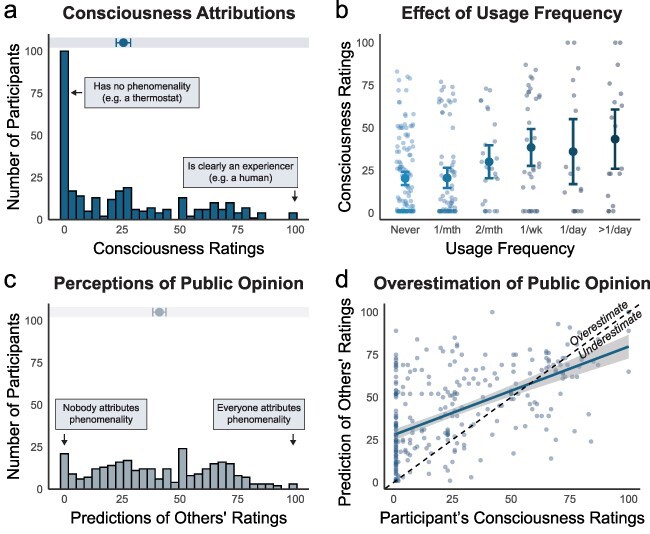
- 67% of participants attributed some possibility of phenomenal consciousness to ChatGPT, while 33% said it was definitely not an experiencer; consciousness ratings had M = 25.56, median = 16.00, SD = 27.36, range = 1–100.
- Familiarity mattered: participants who had used ChatGPT attributed higher consciousness (M = 29.59) than those who never used it (M = 19.37; t(287) = 3.33, P < .001), with a linear increase across usage frequency (B = 4.94, SE = 0.99, t = 4.99, P < .001).
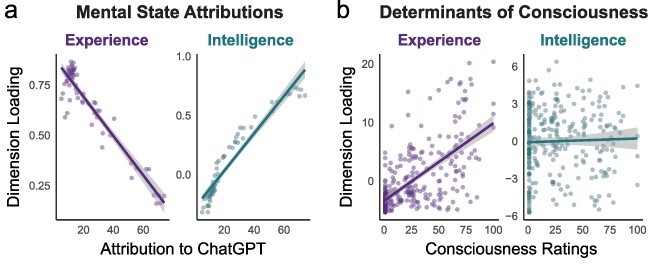
- Ratings of 65 mental states reduced to two dimensions—Experience and Intelligence—explaining 58% of variance. ChatGPT was seen as more capable of Intelligence than Experience (r = 0.95 and r = −0.94, respectively), but only Experience-related states predicted consciousness attributions (r = 0.65, P < .001) and not Intelligence-related states (r = 0.03, P = .596).
- Participants predicted others would attribute more consciousness to ChatGPT than they themselves did (predicted M = 41.11, median = 39.50, SD = 25.28 vs. own M = 25.56; t(299) = 10.90, P < .001), though own and predicted ratings correlated (r = 0.56, P < .001).
Methods
- Nationally representative sample of 300 US residents recruited via Prolific Academic in July 2023 using proportional stratified random sampling with age and gender quotas based on US Census Bureau data (female = 152; male = 142; non-binary = 2; did not answer = 4; mean age = 46.13 years).
- Participants read a description of ChatGPT and a description of phenomenal experience adapted from Peressini (2014), then rated ChatGPT’s capacity for conscious experience on a 1–100 scale, confidence in that judgment, predicted others’ judgments, and rated ChatGPT on 65 mental-state attributes from 1–100.
- Analyses included principal component analysis of the 65 mental-state ratings, correlations, t-tests, and regression models; materials, anonymized raw data, and analysis code are available on OSF.
Limitations
- The paper states that consciousness was measured via a single question, which may be sensitive to different measures and prompts; if the scale was interpreted as credence rather than degree, 23% of participants considered it more likely than not that ChatGPT has human-like experience.
- The paper states that self-report may not fully capture intuitions about others’ mental states compared with indirect behavioral markers, and that it remains unclear how folk conceptions of phenomenality map onto philosophical constructs; the preceding explanation of phenomenality may have induced a concept participants would not otherwise spontaneously consider.
- The paper states that the stratified US sample may not generalize across cultures, that online participants likely use computers daily, and that attitudes reflect a specific moment; the usage–consciousness link is correlational, so causal direction remains unclear.
Model-written summary. Check it against the paper before relying on it.
Integrity signals
Registry
Cites
Statistics
Figures
Verification
Claims the paper makes
7 Valid · 0 Not valid · 8 Not checked · 24 Own results and interpretations
Every source the paper cites for this claim was checked and supports it.
In the paper
“The relatively high rates of consciousness attributions in this sample are somewhat surprising, given that experts in neuroscience and consciousness science currently estimate that LLMs are highly unlikely to be conscious (Butlin et al. 2023, LeDoux et al. 2023).”
§ Folk psychological attributions of consciousness to large language models > Conclusions
What the sources say
- Supportedcites Butlin et al. 2023 matched to “Consciousness in Artificial Intelligence: Insights from the Science of Consciousness” (2023) source
The Abstract says the authors’ analysis suggests that no current AI systems are conscious. The Executive Summary explicitly includes Transformer-based LLMs among the systems assessed and says no existing system is a strong candidate for consciousness. These passages support the claim about current LLMs, though the paper does not give a numerical likelihood estimate. (LLM, conf=0.89)
- Supportedcites LeDoux et al. 2023 matched to “Consciousness beyond the human case” (2023) source
In “Two levels of consciousness” (p. 1), Frith states that LLMs lack the lower levels associated with sentience and concludes, “In this case they are not conscious.” This supports the cited claim that LLM consciousness is considered highly unlikely. (LLM, conf=0.90)
hedged- Asserted: passes — The authors put it forward as true.
- Checkable: passes — It can be checked against evidence.
- Load-bearing: passes — The paper’s conclusions depend on it.
- Based: passes — The paper gives a reason why it holds.
- Supported
Every source the paper cites for this claim was checked and supports it.
In the paper
“Thus, independent of ongoing academic discussions about the potential for and possibility of artificial consciousness (e.g. Butlin et al. 2023, Chalmers 2023), the recent emergence and widespread uptake of powerful LLMs may be associated with a majority of people perceiving some degree of consciousness in these systems.”
§ Folk psychological attributions of consciousness to large language models > Discussion
What the sources say
- Supportedcites Butlin et al. 2023 matched to “Consciousness in Artificial Intelligence: Insights from the Science of Consciousness” (2023) source
The citation identifies an example of the ongoing academic discussion about whether AI could be conscious; it is not attached to the citing authors’ statement about what a majority of people may perceive. The Executive Summary and section 3 examine consciousness in current and near-future AI systems, including LLMs, so the paper is an example of the discussion cited. (LLM, conf=0.93)
- Supportedcites Chalmers 2023 matched to “Could a Large Language Model be Conscious?” (2023) source
The citation is attached to the phrase about academic discussions of the possibility of artificial consciousness, not to the subsequent claim about what a majority of people perceive. The introduction (p. 1) and Conclusions (pp. 14–15) discuss whether current or future LLMs could be conscious. The source therefore supports the point for which it is cited. (LLM, conf=0.93)
hedgedstates an association- Asserted: passes — The authors put it forward as true.
- Checkable: passes — It can be checked against evidence.
- Load-bearing: passes — The paper’s conclusions depend on it.
- Based: passes — The paper gives a reason why it holds.
- Rests on 2 assumptions not shown here.
- Supported
The cited sources support only part of this claim — read each source’s verdict below.
In the paper
“First, folk psychological attributions of consciousness may mediate future moral concern towards AI, regardless of whether or not they are actually conscious (Shepherd 2018, Mazor et al. 2023).”
§ Folk psychological attributions of consciousness to large language models > Introduction
What the sources say
- Not checked — no full text of the sourcecites Shepherd 2018 matched to “Consciousness and Moral Status” (2018) source
- Partly supportedcites Mazor et al. 2023 matched to “The scientific study of consciousness cannot and should not be morally neutral” (2023) sourceExperimental — accuracy not yet measured
The paper says that beliefs about consciousness shape ethics (Scientific Attribution of Consciousness, p. 3), and its Figure 1 describes conjectures about an entity’s conscious experience affecting applied ethics (p. 4). That supports the proposed link between attributed consciousness and moral concern, but the passages do not address AI specifically or establish the claim’s ‘regardless of whether AI is actually conscious’ qualification. (LLM, conf=0.82)
hedgedstates a possible cause- Asserted: passes — The authors put it forward as true.
- Checkable: passes — It can be checked against evidence.
- Load-bearing: passes — The paper’s conclusions depend on it.
- Based: passes — The paper gives a reason why it holds.
Every source the paper cites for this claim was checked and supports it.
In the paper
“The relatively high rates of consciousness attributions in this sample are somewhat surprising, given that experts in neuroscience and consciousness science currently estimate that LLMs are highly unlikely to be conscious (Butlin et al. 2023, LeDoux et al. 2023).”
§ Folk psychological attributions of consciousness to large language models > Conclusions
What the sources say
- Supportedcites Butlin et al. 2023 matched to “Consciousness in Artificial Intelligence: Insights from the Science of Consciousness” (2023) source
The Executive Summary says the authors’ analysis does not identify any existing AI system as a strong candidate for consciousness, explicitly including Transformer-based LLMs among the systems assessed. Section 3.2.1 adds that the case for those LLMs possessing consciousness-related indicators is relatively weak. The citing authors’ description of their sample as surprising is their own framing, not a finding attributed to this source. (LLM, conf=0.88)
- Supportedcites LeDoux et al. 2023 matched to “Consciousness beyond the human case” (2023) source
In “Two levels of consciousness” (p. 1), Frith states that LLMs “are not conscious” because they lack a sentient level. That supports the cited point that an expert considers LLM consciousness highly unlikely; the surprise about this sample’s attribution rates is the citing authors’ own framing. (LLM, conf=0.91)
hedged- Asserted: passes — The authors put it forward as true.
- Checkable: passes — It can be checked against evidence.
- Load-bearing: passes — The paper’s conclusions depend on it.
- Based: passes — The paper gives a reason why it holds.
- Supported
The cited sources support only part of this claim — read each source’s verdict below.
In the paper
“Second, any current or future scientific determination of phenomenal consciousness in AI is likely to be ‘theory-heavy’ and therefore deal in probabilities or credences rather than definite statements (Butlin et al. 2023).”
§ Folk psychological attributions of consciousness to large language models > Introduction
What the sources say
- Partly supportedcites Butlin et al. 2023 matched to “Consciousness in Artificial Intelligence: Insights from the Science of Consciousness” (2023) sourceExperimental — accuracy not yet measured
Section 1.2.3 describes a theory-heavy assessment in terms of confidence in a system’s consciousness, and Box 1 recommends credences because uncertainty is currently unavoidable. But the claim extends this approach to any future scientific determination. Section 4.3 says behavioural tests may be developed as an alternative, so the paper does not support that universal prediction. (LLM, conf=0.88)
hedged- Asserted: passes — The authors put it forward as true.
- Checkable: unclear — It is unclear whether it could be checked against evidence.
- Load-bearing: passes — The paper’s conclusions depend on it.
- Based: passes — The paper gives a reason why it holds.
- Partly supported
9 more claims
Create a free account to see all 39 claims and to verify the 2 references still open.
- It may state two separate claims as one. 16
- Probably not a substantial claim. 16
- The quote only partly states this claim. 1
Claims other papers make about this one
Each is checked against this paper’s own text: does it say what the citing paper says it does?
The source backs part of the claim, not all of it — or backs it for a different population, condition or comparison.
In the citing paper
“Furthermore, modern AI systems are likely to give users the impression that they are conscious.”
From Identifying indicators of consciousness in AI systems (2026) · cites this paper as [6]
Experimental — accuracy not yet measuredThe source backs part of the claim, not all of it — or backs it for a different population, condition or comparison.
In the citing paper
“most respondents considered LLMs more conscious than a toaster”
From There is no such thing as conscious artificial intelligence (2025) · cites this paper as Colombatto and Fleming (2024)
Experimental — accuracy not yet measuredThe source backs part of the claim, not all of it — or backs it for a different population, condition or comparison.
In the citing paper
“Some studies even suggest that users believe LLMs have memories, feelings, or consciousness (33).”
From The benefits and dangers of anthropomorphic conversational agents (2025) · cites this paper as [33]
Experimental — accuracy not yet measuredThe source backs part of the claim, not all of it — or backs it for a different population, condition or comparison.
In the citing paper
“This brings with it the potential for deception and manipulation at scale and for mistaken beliefs by users that these machines understand human experience and existence in ways they cannot (16, 33).”
From The benefits and dangers of anthropomorphic conversational agents (2025) · cites this paper as [33]
Experimental — accuracy not yet measuredThe source backs part of the claim, not all of it — or backs it for a different population, condition or comparison.
In the citing paper
“Next, they were shown a series of 20 mental states, chosen from prior work6 to represent dimensions of ‘intelligence’ (attention, choosing, communication, considering, deciding, intelligence, knowing, memory, planning, and reasoning) or ‘experience’ (admiration, enjoyment, fear, guilt, happiness, hope, passion, pleasure, relief, and resentment).”
From The influence of mental state attributions on trust in large language models (2025) · cites this paper as [6]
Experimental — accuracy not yet measured
7 more claims about this paper
Create a free account to see every claim other papers make about this one.
Statistics recomputed
Every reported test result, recomputed from its test statistic and degrees of freedom. A result shows as not adding up only once an independent check has confirmed it.
- ConsistentF(1, 297) = 53.24reported p < .001 · recomputed p < .001
“F(1, 297) = 53.24, p < .001”
- Consistentt(287) = 3.33reported p < .001 · recomputed p < .001
“t(287) = 3.33, p < .001”
- Consistentt(299) = 10.9reported p < .001 · recomputed p < .001
“t(299) = 10.90, p < .001”
Self-check
Percentages, sums and reported differences re-computed from the paper’s own numbers.
Self-check results appear here once an independent check has confirmed them.
Citations
Cites
Nagel, T. (1974) · The Philosophical Review · doi:10.2307/2183914 · Cited by 7,440
On a confusion about a function of consciousness
Block, N. (1995) · Behavioral and Brain Sciences · doi:10.1017/s0140525x00038188 · Cited by 3,364 · cited 1×
“Phenomenal consciousness is typically defined as a state in which there is ‘something it is like’ for a system to be the subject of that experience (Nagel 1974; Block 1995).”
BackgroundGray, H. M., Gray, K., & Wegner, D. M. (2007) · Science · doi:10.1126/science.1134475 · Cited by 2,342 · cited 2×
“…‘Experience’ (i.e. the capacity to feel pain, fear, joy, or pride) and ‘Agency’ (i.e. the capacity to have self-control, morality, planning, or communication) that is reminiscent of the distinction between phenomenal and non-phenomenal states (Gray et al. 2007; for a review, see Waytz et al. 2010).”
BackgroundChalmers, D. J. (1996) · Cited by 1,998
Causes and consequences of mind perception
Waytz, A., Gray, K., Epley, N., & Wegner, D. M. (2010) · Trends in Cognitive Sciences · doi:10.1016/j.tics.2010.05.006 · Cited by 759 · cited 1×
“…‘Experience’ (i.e. the capacity to feel pain, fear, joy, or pride) and ‘Agency’ (i.e. the capacity to have self-control, morality, planning, or communication) that is reminiscent of the distinction between phenomenal and non-phenomenal states (Gray et al. 2007; for a review, see Waytz et al. 2010).”
BackgroundMoral typecasting: Divergent perceptions of moral agents and moral patients.
Gray, K., & Wegner, D. M. (2009) · Journal of Personality and Social Psychology · doi:10.1037/a0013748 · Cited by 535
The Benefits of Interactions with Physically Present Robots over Video-Displayed Agents
Bainbridge, W. A., Hart, J. W., Kim, E. S., & Scassellati, B. (2011) · International Journal of Social Robotics · doi:10.1007/s12369-010-0082-7 · Cited by 478 · cited 1×
“For example, attributions of mental states may depend on superficial appearance (Bainbridge et al. 2011) as well as observed behavioural profiles (Colombatto and Fleming 2023).”
BackgroundMore than a body: Mind perception and the nature of objectification.
Gray, K., Knobe, J., Sheskin, M., Bloom, P., & Barrett, L. F. (2011) · Journal of Personality and Social Psychology · doi:10.1037/a0025883 · Cited by 277
Subhuman, Inhuman, and Superhuman: Contrasting Humans with Nonhumans in Three Cultures
Haslam, N., Kashima, Y., Loughnan, S., Shi, J., & Suitner, C. (2008) · Social Cognition · doi:10.1521/soco.2008.26.2.248 · Cited by 247
Intuitions about consciousness: experimental studies
Knobe, J., & Prinz, J. (2008) · Phenomenology and the Cognitive Sciences · doi:10.1007/s11097-007-9066-y · Cited by 227 · cited 1×
“For example, initial work in this domain examined attributions of mental states that involve phenomenality (e.g. feeling joy or getting depressed) and those that do not (e.g. making a decision or forming a belief; Knobe and Prinz 2008; for a review, see Sytsma 2014).”
BackgroundTwo conceptions of subjective experience
Sytsma, J., & Machery, E. (2010) · Philosophical Studies · doi:10.1007/s11098-009-9439-x · Cited by 213
Distortions of mind perception in psychopathology
Gray, K., Jenkins, A. C., Heberlein, A. S., & Wegner, D. M. (2011) · Proceedings of the National Academy of Sciences · doi:10.1073/pnas.1015493108 · Cited by 205
Consciousness in Artificial Intelligence: Insights from the Science of Consciousness
Butlin, P., Long, R., Elmoznino, E., Bengio, Y., Birch, J., Constant, A., Deane, G., Fleming, S. M., Frith, C., Ji, X., et al. (2023) · arXiv · doi:10.48550/arxiv.2308.08708 · Cited by 196 · cited 3×
“Second, any current or future scientific determination of phenomenal consciousness in AI is likely to be ‘theory-heavy’ and therefore deal in probabilities or credences rather than definite statements (Butlin et al. 2023).”
BackgroundSelf-citationRethinking people’s conceptions of mental life
Weisman, K., Dweck, C. S., & Markman, E. M. (2017) · Proceedings of the National Academy of Sciences · doi:10.1073/pnas.1704347114 · Cited by 182 · cited 1×
“However, the correspondence between these dimensions and phenomenality is not clear (Sytsma 2014) and more recent work has found evidence for alternative structures that cut across this distinction (e.g. Weisman et al. 2017, Malle 2019).”
BackgroundConsciousness and Moral Status
Shepherd, J. (2018) · doi:10.4324/9781315396347 · Cited by 161 · cited 1×
“First, folk psychological attributions of consciousness may mediate future moral concern towards AI, regardless of whether or not they are actually conscious (Shepherd 2018, Mazor et al. 2023).”
BackgroundPerceiving Animacy and Intentionality
Scholl, B. J., & Gao, T. (2013) · Social Perception · doi:10.7551/mitpress/9780262019279.003.0009 · Cited by 160 · cited 1×
“Besides the interpretation of the scale, it is unclear whether self-reported measures fully capture intuitions about others’ mental states as opposed to more indirect behavioural markers which may be less subject to response biases (Scholl and Gao 2013).”
BackgroundCould a Large Language Model be Conscious?
Chalmers, D. J. (2023) · arXiv · doi:10.48550/arxiv.2303.07103 · Cited by 143
To escape blame, don't be a hero—Be a victim
Gray, K. J., & Wegner, D. M. (2010) · Journal of Experimental Social Psychology · doi:10.1016/j.jesp.2010.12.012 · Cited by 124
The Folk Psychology of Consciousness*
ARICO, A., FIALA, B., GOLDBERG, R. F., & NICHOLS, S. (2011) · Mind & Language · doi:10.1111/j.1468-0017.2011.01420.x · Cited by 102
What Does the Nation of China Think About Phenomenal States?
Huebner, B., Bruno, M. G., & Sarkissian, H. (2009) · Review of Philosophy and Psychology · doi:10.1007/s13164-009-0009-0 · Cited by 85
The Phenomenal Stance Revisited
Jack, A. I., & Robbins, P. (2012) · Review of Philosophy and Psychology · doi:10.1007/s13164-012-0104-5 · Cited by 84
Commonsense concepts of phenomenal consciousness: does anyone care about functional zombies?
Huebner, B. (2010) · Phenomenology and the Cognitive Sciences · doi:10.1007/s11097-009-9126-6 · Cited by 72 · cited 1×
“Beyond issues of measurement, it remains unclear how folk conceptions of phenomenality correspond to the relevant philosophical constructs (Huebner 2010, Talbot 2012, Peressini 2014).”
BackgroundConsciousness beyond the human case
LeDoux, J., Birch, J., Andrews, K., Clayton, N. S., Daw, N. D., Frith, C., Lau, H., Peters, M. A. K., Schneider, S., Seth, A., et al. (2023) · Current Biology · doi:10.1016/j.cub.2023.06.067 · Cited by 67 · cited 2×
“This debate on consciousness in AI has been at the forefront of mainstream media and academic discourse across cognitive science (Shardlow and Przybyła 2022, Chalmers 2023, LeDoux et al. 2023, Wiese 2023).”
BackgroundHow to study folk intuitions about phenomenal consciousness1
Sytsma, J. M., & Machery, E. (2009) · Philosophical Psychology · doi:10.1080/09515080802703653 · Cited by 63
Folk Psychology, Consciousness, and Context Effects
Arico, A. J. (2010) · Review of Philosophy and Psychology · doi:10.1007/s13164-010-0029-9 · Cited by 55
(2019) · eScholarship (California Digital Library) · Cited by 50
No problem: Evidence that the concept of phenomenal consciousness is not widespread
Sytsma, J. M., & Ozdemir, E. (2022) · PhilSci-Archive (University of Pittsburgh) · doi:10.25455/wgtn.21136159 · Cited by 48
Function and feeling machines: a defense of the philosophical conception of subjective experience
Buckwalter, W., & Phelan, M. (2012) · Philosophical Studies · doi:10.1007/s11098-012-0039-9 · Cited by 47
Thinking things and feeling things: on an alleged discontinuity in folk metaphysics of mind
Phelan, M., Arico, A. J., & Nichols, S. (2012) · Phenomenology and the Cognitive Sciences · doi:10.1007/s11097-012-9278-7 · Cited by 47
Do You Mind? User Perceptions of Machine Consciousness
Scott, A. E., Neumann, D., Niess, J., & Woźniak, P. W. (2023) · Proceedings of the 2023 CHI Conference on Human Factors in Computing Systems · doi:10.1145/3544548.3581296 · Cited by 46 · cited 1×
“However, we note converging evidence from studies employing different materials and measures (Scott et al. 2023).”
BackgroundBlurring two conceptions of subjective experience: folk versus philosophical phenomenality
Peressini, A. (2014) · Philosophical Psychology · doi:10.1080/09515089.2013.793150 · Cited by 32 · cited 3×
“They were then introduced to the concept of phenomenal experience via a short description adapted from a study of folk phenomenality (Peressini 2014): As we all know, each of us as conscious human beings have an ‘inner life.’”
BackgroundMethodThe scientific study of consciousness cannot, and should not, be morally neutralPreprint
Mazor, M., Brown, S. A. B., Ciaunica, A., Athena Demertzi, A., Fahrenfort, J. J., Faivre, N., Francken, J. C., Lamy, D., Lenggenhager, B., Moutoussis, M., et al. (2021) · doi:10.31234/osf.io/8nb2c · Cited by 26
The Robots of the Dawn of Experimental Philosophy of Mind
Sytsma, J. M. (2014) · Routledge eBooks · doi:10.4324/9780203122884-4 · Cited by 21
Sytsma, J. (2014) · WIREs Cognitive Science · doi:10.1002/wcs.1320 · Cited by 20 · cited 6×
“In the current study, the main question about ChatGPT’s capacity for phenomenal experience was preceded by an explanation of the concept of phenomenality—which may have induced participants to consider a concept they would not otherwise consider spontaneously (Sytsma 2014).”
BackgroundMethodInfluentialThe irrelevance of folk intuitions to the “hard problem” of consciousness
Talbot, B. (2012) · Consciousness and Cognition · doi:10.1016/j.concog.2010.12.005 · Cited by 20 · cited 1×
“Beyond issues of measurement, it remains unclear how folk conceptions of phenomenality correspond to the relevant philosophical constructs (Huebner 2010, Talbot 2012, Peressini 2014).”
BackgroundThe scientific study of consciousness cannot and should not be morally neutral
Mazor, M., Brown, S., Ciaunica, A., Demertzi, A., Fahrenfort, J., Faivre, N., Francken, J. C., Lamy, D., Lenggenhager, B., Moutoussis, M., et al. (2023) · Perspectives on Psychological Science · doi:10.1177/17456916221110222 · Cited by 17 · cited 1×
“First, folk psychological attributions of consciousness may mediate future moral concern towards AI, regardless of whether or not they are actually conscious (Shepherd 2018, Mazor et al. 2023).”
BackgroundDeanthropomorphising NLP: Can a language model be conscious?
Shardlow, M., & Przybyła, P. (2024) · PLoS ONE · doi:10.1371/journal.pone.0307521 · Cited by 16
Illusions of Confidence in Artificial SystemsPreprint
Colombatto, C., & Fleming, S. M. (2023) · PsyArXiv (OSF Preprints) · doi:10.31234/osf.io/mjx2v · Cited by 9
Self-citationPhenomenal Consciousness Disembodied
(2014) · Bloomsbury Academic eBooks · doi:10.5040/9781472594136.ch-003 · Cited by 7
Experimental Philosophy of Consciousness
Reuter, K. (2024) · Oxford University Press eBooks · doi:10.1093/9780198918905.003.0017 · Cited by 7
Deanthropomorphising NLP: Can a Language Model Be Conscious?
Shardlow, M., & Przybyła, P. (2022) · e-space (Manchester Metropolitan University) · doi:10.48550/arxiv.2211.11483 · Cited by 6
On the Relevance of Folk Intuitions: A Reply to TalbotPreprint
Sytsma, J. M., & Machery, É. (2011) · PhilSci-Archive (University of Pittsburgh) · Cited by 6
Illusions of Confidence in Artificial SystemsPreprint
Colombatto, C., & Fleming, S. M. (2023) · PsyArXiv (OSF Preprints) · doi:10.31234/osf.io/mjx2v_v1 · Cited by 5
Self-citationExperimental Philosophy of Mind: Conscious State Attribution
Phelan, M. (2023) · De Gruyter eBooks · doi:10.1515/9783110716931-012 · Cited by 4
Can A Language Model Be Conscious?
Shardlow, M. (2023) · ITNOW · doi:10.1093/itnow/bwad100
Research works printed but not linked: 1
- Wiese W. 2023 Could large language models be conscious? A perspective from the free energy principle. Preprint at Philpapers, https://philpapers.org/rec/WIECLL
Cited by
The benefits and dangers of anthropomorphic conversational agents
Peter, S., Riemer, K., & West, J. D. (2025) · Proceedings of the National Academy of Sciences · doi:10.1073/pnas.2415898122 · Cited by 110
Identifying indicators of consciousness in AI systems
Butlin, P., Long, R., Bayne, T., Bengio, Y., Birch, J., Chalmers, D., Constant, A., Deane, G., Elmoznino, E., Fleming, S. M., et al. (2026) · Trends in Cognitive Sciences · doi:10.1016/j.tics.2025.10.011 · Cited by 56
Self-citationCompanionship in code: AI's role in the future of human connection
Andersson, M. (2025) · Humanities and Social Sciences Communications · doi:10.1057/s41599-025-05536-x · Cited by 39
“…may be, at least in part, an attribution — a projection of one ’ s own mental states onto others (Graziano, 2013), which may help explain users ’ reported tendency to ascribe all sorts of mental properties to AI (Colombatto and Fleming, 2024; Guingrich and Graziano, 2025; Laestadius et al., 2022).”
The influence of mental state attributions on trust in large language models
Colombatto, C., Birch, J., & Fleming, S. M. (2025) · Communications Psychology · doi:10.1038/s44271-025-00262-1 · Cited by 34
“First, they were asked to rate ChatGPT ’ s capacity for phenomenal consciousness, on a scale from 1 ( ‘ clearly does not have conscious experiences ’ ) to 100 ( ‘ clearly has conscious experiences ’ 6 ).”
InfluentialSelf-citationGuingrich, R. E., & Graziano, M. S. A. (2025) · Oxford Intersections: AI in Society · doi:10.1093/9780198945215.003.0011 · Cited by 28
Metadata
- Authors
- Colombatto, C., & Fleming, S. M.
- Affiliations
- University of Waterloo (CA)
- Wellcome Centre for Human Neuroimaging (GB)
- Corresponding author
- Colombatto, Clara
- Venue
- Neuroscience of Consciousness
- Publisher
- Oxford University Press (OUP)
- Published
- 2024-01-01
- Volume
- 2024
- Issue
- 1
- Pages
- niae013-niae013
- ISSN
- 2057-2107 (ISSN-L)
- PMC
- PMC11008499
- OpenAlex
- W4394716098
- Semantic Scholar
- 9ac555b04def2a13ff62edf6e22906310261a501
- Cited by
- 96
- References
- 31
- Citations by year
- 2026: 47 · 2025: 44 · 2024: 5
- FWCI
- 39.06
- Type
- journal article
- Language
- en
- Open access
- gold
- doi.org
- Licence
- Locations
- Neuroscience of Consciousness (publishedVersion, cc-by-nc)
- PubMed Central (publishedVersion, cc-by-nc)
- PubMed (publishedVersion)
- UCL Discovery (University College London) (submittedVersion)
- MPG.PuRe (Max Planck Society) (submittedVersion)
- PsyArXiv (OSF Preprints) (submittedVersion, public-domain)
- Funders
- Engineering and Physical Sciences Research Council (EP/V000748/1)
- Erc (Consolidator Award 'ConsciousComputation')
- Topics
- Social Sciences › Arts and Humanities › Philosophy › Philosophy and Theoretical Science
- Social Sciences › Arts and Humanities › History and Philosophy of Science › Cybernetics and Technology in Society
- Life Sciences › Neuroscience › Cognitive Neuroscience › Embodied and Extended Cognition
- Keywords
- phenomenal consciousness, large language models, folk psychology, artificial intelligence, subjective experience, public attitudes toward AI, individual differences, usage frequency
About these checks
Registry, retraction, Cites and statistics results are computed, not judged, with one exception: a printed reference that no index lists is read once by a model before it counts as a citation error. Claims are extracted by a model and kept only when their quote appears verbatim in the text; each cited source is then checked, with a model’s help, for whether it says what the claim relies on. Those verdicts can be wrong — read the claim’s quote and the cited source before relying on one.
The claim verdicts this report counts are experimental: their accuracy is not yet measured.
A language model drew the claims from the paper on 2026-10-10, under version 3 of the claim definition (model deepseek-v4.1-flash, prompt extract-v3).
A second model labelled each claim on 2026-10-10 (model jev-1.13-20260917, definition revision gold-guideline-v0.2).
Cited sources are checked with a language model’s help (gpt-6-sol).
Statistics and arithmetic are recomputed, not judged.
Confidence bands are shown only for fields calibrated on our annotated test set. None is calibrated yet, so no band is shown.
What counts as a claim ›How we measure confidence ›How we check this ›
Are you an author, or do you see a problem with this page? Request a review
Data sources
Bibliographic data: Semantic Scholar, OpenAlex, Crossref.
Contains information from the Semantic Scholar Academic Graph Datasets, made available under the ODC Attribution License (ODC-BY 1.0).
Semantic Scholar’s data is described in: Kinney, R., et al. (2023). The Semantic Scholar Open Data Platform. arXiv:2301.10140.
