

Affective Polarization in Comparative and Longitudinal Perspective
Open accessThe DOI matches its Crossref record; 21 of the 21 references it cites were found in a registry or an index; 4 of the 34 sources its claims cite were checked for support.
Abstract
Existent research shows that affective polarization has been intensifying in some publics, diminishing in others, and remaining stable in most. We contribute to this debate by providing the most encompassing comparative and longitudinal account of affective polarization so far. We resort to a newly assembled dataset able to track partisan affect, with varying time series, in eighteen democracies over the last six decades. We present results based on two different operational measures of affective polarization: Reiljan's Affective Polarization Index, based on reported partisans only, and Wagner's weighted distance from the most liked party, based on the whole electorate. Our reassessment of affective polarization among partisans confirms that an intensifying trend is observable in a number of countries but it is, by no means, generalizable to all established democracies. Regarding the longitudinal assessment of affective polarization among the electorate, we confirm that US citizens have become more affectively polarized over time.
Overview
CoChat Summary
## TL;DR
This paper assembles a comparative-longitudinal dataset on affective polarization in 18 democracies over 1961–2020 and shows that trends are highly country-specific among partisans. Using a whole-electorate measure, the authors find that rising affective polarization is, with some minor exceptions, mainly an American story.
## Key findings
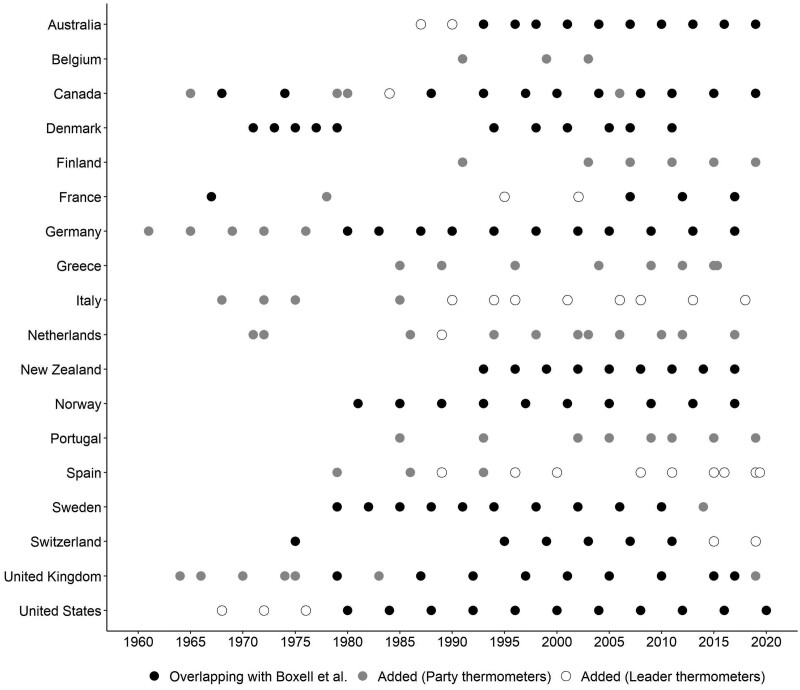
- The dataset covers 191 election studies from 18 democracies over 1961–2020, adding 7 countries and 27 data points to prior work.
- Among partisans (Reiljan’s API), the trend is positive in 11 countries and negative in 6 countries; statistically significant linear trends appear in 7 of 17 countries, with positive slopes in Canada, Denmark, Netherlands, New Zealand, United Kingdom, and the United States, and a negative slope in Australia.
- Among the whole electorate (Wagner’s measure), the data show little indication of a cross-national trend; statistically significant increases appear most noticeably in the United States and Germany, while Sweden decreases markedly.
- The paper’s main conclusion is that US citizens have become more affectively polarized over time.
## Methods
- The study uses a newly assembled comparative-longitudinal dataset of national election studies with feeling thermometer questions, drawing on the West European Voter project for 14 West European democracies and national election study programs for Australia, Canada, New Zealand, and the United States.
- It operationalizes affective polarization with two measures: Reiljan’s Affective Polarization Index (API) for reported partisans only, and Wagner’s weighted mean distance from the most liked party for the whole electorate.
- Thermometer scores are rescaled to 0–10, and the analysis examines country-specific longitudinal trends, using regression fit lines / estimates to assess significance.
## Limitations
- The paper explicitly notes that conceptualization matters and that results depend on whether affective polarization is defined for partisans only or for the whole electorate.
- It also makes clear that the available measures depend on the presence of feeling thermometer questions, which were not available in all election studies; the authors substituted party-leader thermometers when party thermometers were unavailable (N = 26). This is a limitation evident from the text.
- The paper describes the cross-national pattern among partisans as idiosyncratic, and for some countries it cannot compare trends with prior work due to differences in underlying data sources and sample definitions (e.g., Germany); this is evident from the text.
Model-written summary. Check it against the paper before relying on it.
Integrity signals
Registry
Cites
Statistics
Figures


Verification
Claims the paper makes
4 Valid · 0 Not valid · 17 Not checked · 17 Own results and interpretations
A result the paper reports from its own data — it cites no other source for it, so there is none to check. The quote shows it is in the paper.
In the paper
“Regarding the longitudinal assessment of affective polarization among the electorate, we confirm that US citizens have become more affectively polarized over time.”
- Also stated in: § Conclusions · boosted
“US citizens have indeed become more affectively polarized over time.”
§ Affective Polarization in Comparative and Longitudinal Perspective > Abstract
boostedstates a cause- Asserted: passes — The authors put it forward as true.
- Checkable: passes — It can be checked against evidence.
- Load-bearing: passes — The paper’s conclusions depend on it.
- Based: passes — The paper gives a reason why it holds.
- Rests on an assumption not shown here.
- Also stated in: § Conclusions · boosted
In the paper
“Through this dataset, we are able to expand upon Boxell, Gentzkow, and Shapiro’s (2021) most encompassing comparative longitudinal account of affective polarization to date in terms of both geographical scope (seven added countries: Belgium, Finland, Greece, Italy, Netherlands, Portugal, Spain) and time span (twenty-seven data points added to the countries already featured in Boxell et al.’s study”
§ Affective Polarization in Comparative and Longitudinal Perspective > Data and Measures
What the sources say
- Not matchedcites Boxell, Gentzkow, and Shapiro 2021
Couldn’t be matched to a paper in Crossref, so it can’t be checked.
plain- Asserted: passes — The authors put it forward as true.
- Checkable: passes — It can be checked against evidence.
- Load-bearing: passes — The paper’s conclusions depend on it.
- Based: passes — The paper gives a reason why it holds.
- Rests on an assumption not shown here.
- Not matched
A result the paper reports from its own data — it cites no other source for it, so there is none to check. The quote shows it is in the paper.
In the paper
“When it comes to the linearity of these trends, the regression fit lines (see table 1) report conventional levels of statistical significance in seven out of the seventeen countries under analysis”
§ Affective Polarization in Comparative and Longitudinal Perspective > Trends in Affective Polarization among Partisans
plain- Asserted: passes — The authors put it forward as true.
- Checkable: passes — It can be checked against evidence.
- Load-bearing: unclear — It is unclear whether the paper’s conclusions depend on it.
- Based: passes — The paper gives a reason why it holds.
A result the paper reports from its own data — it cites no other source for it, so there is none to check. The quote shows it is in the paper.
In the paper
“six of them have positive slopes (Canada, Denmark, Netherlands, New Zealand, United Kingdom and the United States)”
§ Affective Polarization in Comparative and Longitudinal Perspective > Trends in Affective Polarization among Partisans
plain- Asserted: passes — The authors put it forward as true.
- Checkable: passes — It can be checked against evidence.
- Load-bearing: unclear — It is unclear whether the paper’s conclusions depend on it.
- Based: passes — The paper gives a reason why it holds.
A result the paper states — it cites no source for it, so there is none to check. The quote shows it is in the paper.
In the paper
“This lends a total of 191 election studies from eighteen democracies.”
§ Affective Polarization in Comparative and Longitudinal Perspective > Data and Measures
plain- Asserted: passes — The authors put it forward as true.
- Checkable: passes — It can be checked against evidence.
- Load-bearing: passes — The paper’s conclusions depend on it.
- Based: passes — The paper gives a reason why it holds.
18 more claims
Create a free account to see all 38 claims and every source verdict.
- It may state two separate claims as one. 7
- Probably not a substantial claim. 8
- The quote only partly states this claim. 2
Claims other papers make about this one
Each is checked against this paper’s own text: does it say what the citing paper says it does?
The cited source says what the claim attributes to it.
In the citing paper
“Measuring affective polarization, however, becomes significantly more complex in multiparty contexts (Garzia et al., 2023;Harteveld, 2021;Reiljan, 2020;Tichelbaecker et al., 2023;Wagner, 2021).”
From Measuring affective polarization: Matching concepts to measures (2026) · cites this paper as Garzia et al., 2023
The cited source says what the claim attributes to it.
In the citing paper
“Scholars consequently have suggested weighting each party's measure of affect based on its relative size within the electoral systemfor example, by vote share (Garzia et al., 2023;Reiljan, 2020;Reiljan et al., 2024;Wagner, 2021).This approach is also beneficial in cases where researchers want to measure affective polarization in a comparative perspective (e.g.Reiljan et al., 2024).”
From Measuring affective polarization: Matching concepts to measures (2026) · cites this paper as Garzia et al., 2023
Citations
Cites
The Origins and Consequences of Affective Polarization in the United States
Iyengar, S., Lelkes, Y., Levendusky, M., Malhotra, N., & Westwood, S. J. (2019) · Annual Review of Political Science · doi:10.1146/annurev-polisci-051117-073034 · Cited by 3,603 · cited 1×
“The terms “affective polarization” (Iyengar et al. 2019; Wagner 2021), “partisan polarization” (Stoker and Jennings 2008; Levendusky and Malhotra 2016), or “partisan affective polarization” (Robison and Moskowitz 2019; Stoetzer et al.”
BackgroundIyengar, S., Sood, G., & Lelkes, Y. (2012) · Public Opinion Quarterly · doi:10.1093/poq/nfs038 · Cited by 2,996
Uncivil Agreement: How Politics Became Our Identity
Mason, L. (2018) · doi:10.7208/chicago/9780226524689.001.0001 · Cited by 1,985
Mason, L. (2015) · American Journal of Political Science · doi:10.1111/ajps.12089 · Cited by 1,458 · cited 1×
“…trends in the United States could be ascribed to the country’s differential effects of partisan sorting on social and issue polarization (Mason 2015, 2018; Harteveld 2021).8 Our findings invite a deeper reflection on the bases upon which affective polarization is conceptualized and…”
BackgroundThe rise of negative partisanship and the nationalization of U.S. elections in the 21st century
Abramowitz, A. I., & Webster, S. (2016) · Electoral Studies · doi:10.1016/j.electstud.2015.11.001 · Cited by 978
Political Sectarianism in America
Finkel, E. J., Bail, C. A., Cikara, M., Ditto, P. H., Iyengar, S., Klar, S., Mason, L., McGrath, M. C., Nyhan, B., Rand, D. G., et al. (2020) · Science · doi:10.1126/science.abe1715 · Cited by 931 · cited 3×
“15; Finkel et al. 2020, p. 534). Comparative research going beyond American affective polarization has emerged in recent years (Gidron, Adams, and Horne 2020; Reiljan 2020; Boxell, Gentzkow, and Shapiro 2021; Garzia and Ferreira da Silva 2021; Wagner 2021). These studies converge on the finding that levels of affectiv…”
BackgroundInfluentialAffective Polarization in Multiparty Systems
Wagner, M. (2021) · Electoral Studies · doi:10.1016/j.electstud.2020.102199 · Cited by 593
Reiljan, A. (2020) · European Journal of Political Research · doi:10.1111/1475-6765.12351 · Cited by 592 · cited 2×
“The Affective Polarization Index (API) for multiparty systems was developed by Reiljan (2020).”
BackgroundMethodAmerican Affective Polarization in Comparative Perspective
Gidron, N., Adams, J., & Horne, W. (2020) · doi:10.1017/9781108914123 · Cited by 481
(Mis)perceptions of Partisan Polarization in the American Public
Levendusky, M. S., & Malhotra, N. (2016) · Public Opinion Quarterly · doi:10.1093/poq/nfv045 · Cited by 356
Research works printed but not linked: 1
- Garzia, 2021, Leaders without Partisans: Dealignment, Media Change, and the Personalization of Politics
Cited by
Patterns of affective polarization toward parties and leaders across the democratic world
REILJAN, A., GARZIA, D., FERREIRA DA SILVA, F., & TRECHSEL, A. H. (2024) · American Political Science Review · doi:10.1017/s0003055423000485 · Cited by 98
“Most of the comparative literature has so far relied on an equivalent of the feeling ther-mometer, that is, the party like – dislike scale (Boxell, Gentzkow, and Shapiro 2022; Garzia, Ferreira da Silva, and Maye 2023; Gidron, Adams, and Horne 2020; Reiljan 2020; Wagner 2021).”
BackgroundSelf-citationAffective polarization in Europe
Wagner, M. (2024) · European Political Science Review · doi:10.1017/s1755773923000383 · Cited by 80
Comellas, J. M., & Torcal, M. (2023) · Electoral Studies · doi:10.1016/j.electstud.2023.102615 · Cited by 57
Putting the affect into affective polarisation
Bakker, B. N., & Lelkes, Y. (2024) · Cognition and Emotion · doi:10.1080/02699931.2024.2362366 · Cited by 43
“…a ff ective polarisation outside the United States (e.g. Bassan-Nygate & Weiss, 2022; Bäck et al., 2023; Boxell et al., 2024; Garrett & Bankert, 2020; Garzia et al., 2023; Gidron et al., 2020; Harteveld, 2021; Hobolt et al., 2021; Hobolt et al., 2023; Janssen, 2024; Kekkonen & Ylä-Anttila, 2021;…”
BackgroundDeepening the rift: Negative campaigning fosters affective polarization in multiparty elections
Martin, D., & Nai, A. (2024) · Electoral Studies · doi:10.1016/j.electstud.2024.102745 · Cited by 37
Metadata
- Authors
- Garzia, D., Ferreira da Silva, F., & Maye, S.
- Affiliations
- University of Lausanne (CH)
- Senior Researcher, Institute of Political Studies, University of Lausanne , Lausanne, Switzerland
- Corresponding author
- Garzia, Diego
- Venue
- Public Opinion Quarterly
- Publisher
- Oxford University Press (OUP)
- Published
- 2023-02-01
- Volume
- 87
- Issue
- 1
- Pages
- 219-231
- ISSN
- 0033-362X (ISSN-L)
- 1537-5331
- PMC
- PMC10127533
- OpenAlex
- W4321787097
- Semantic Scholar
- e894926f593684c74ba066a80d70f36e8489268f
- Cited by
- 137
- References
- 17
- Citations by year
- 2026: 56 · 2025: 48 · 2024: 27 · 2023: 6
- FWCI
- 134.05
- Type
- journal article
- Language
- en
- Open access
- hybrid
- doi.org
- Licence
- Locations
- Public Opinion Quarterly (publishedVersion, cc-by)
- PubMed Central (publishedVersion, cc-by)
- PubMed (publishedVersion)
- SERVAL (Université de Lausanne) (submittedVersion, cc-by)
- Archivio istituzionale della ricerca (Alma Mater Studiorum Università di Bologna) (submittedVersion)
- IRIS (submittedVersion, cc-by)
- Funders
- Swiss National Science Foundation (PCEFP1_186898)
- Topics
- Social Sciences › Political Science and International Relations › Electoral Systems and Political Participation
- Social Sciences › Sociology and Political Science › Media Influence and Politics
- Social Sciences › Political Science and International Relations › Political Theory and Democracy
- Keywords
- affective polarization, partisan affect, political attitudes, democracy, longitudinal trends, cross-national comparison
About these checks
Registry, retraction, Cites and statistics results are computed, not judged, with one exception: a printed reference that no index lists is read once by a model before it counts as a citation error. Claims are extracted by a model and kept only when their quote appears verbatim in the text; each cited source is then checked, with a model’s help, for whether it says what the claim relies on. Those verdicts can be wrong — read the claim’s quote and the cited source before relying on one.
The claim verdicts this report counts are experimental: their accuracy is not yet measured.
A language model drew the claims from the paper on 2026-10-10, under version 3 of the claim definition (model deepseek-v4.1-flash, prompt extract-v3).
A second model labelled each claim on 2026-10-10 (model jev-1.13-20260917, definition revision gold-guideline-v0.2).
Statistics and arithmetic are recomputed, not judged.
Confidence bands are shown only for fields calibrated on our annotated test set. None is calibrated yet, so no band is shown.
What counts as a claim ›How we measure confidence ›How we check this ›
Are you an author, or do you see a problem with this page? Request a review
How to cite
Cite CoChat for the checks on this page, and the paper for its own findings.
- This page
- CoChat. (2026). Citation check: Affective Polarization in Comparative and Longitudinal Perspective. https://app.cochat.ai/papers/10.1093/poq/nfad004
- The paper
- Garzia, D., Ferreira da Silva, F., & Maye, S. (2023). Affective Polarization in Comparative and Longitudinal Perspective. Public Opinion Quarterly. https://doi.org/10.1093/poq/nfad004
Data sources
Bibliographic data: Semantic Scholar, OpenAlex, Crossref.
Contains information from the Semantic Scholar Academic Graph Datasets, made available under the ODC Attribution License (ODC-BY 1.0).
Semantic Scholar’s data is described in: Kinney, R., et al. (2023). The Semantic Scholar Open Data Platform. arXiv:2301.10140.
