

Workplace Heterogeneity and the Rise of West German Wage Inequality*
The DOI matches its Crossref record; 144 of the 147 references it cites were found in a registry or an index, and 1 are not checked yet; none of the 8 sources its claims cite is checked for support yet.
Abstract
We study the role of establishment-specific wage premiums in generating recent increases in West German wage inequality. Models with additive fixed effects for workers and establishments are fit into four subintervals spanning the period from 1985 to 2009. We show that these models provide a good approximation to the wage structure and can explain nearly all of the dramatic rise in West German wage inequality. Our estimates suggest that the increasing dispersion of West German wages has arisen from a combination of rising heterogeneity between workers, rising dispersion in the wage premiums at different establishments, and increasing assortativeness in the assignment of workers to plants. In contrast, the idiosyncratic job-match component of wage variation is small and stable over time. Decomposing changes in mean wages between different education groups, occupations, and industries, we find that increasing plant-level heterogeneity and rising assortativeness in the assignment of workers to establishments explain a large share of the rise in inequality along all three dimensions.
Checked 2026-11-19 · 1 reference not checked yet
Overview
CoChat Summary
TL;DR
Using West German administrative data from 1985–2009, the paper shows that models with additive person and establishment fixed effects explain nearly all of the rise in wage inequality. The increase is driven by rising worker-effect variance, rising establishment-premium variance, and increased assortative matching of high-wage workers to high-wage plants.
Key findings
- In the AKM variance decomposition, total log-wage variance rose from 0.137 in interval 1 (1985–1991) to 0.249 in interval 4 (2002–2009). The variance of person effects rose from 0.084 to 0.127 and contributed 39% of the total rise; establishment-effect variance rose from 0.025 to 0.053 and contributed 25%; the covariance term rose from 0.003 to 0.041 and contributed 34%.
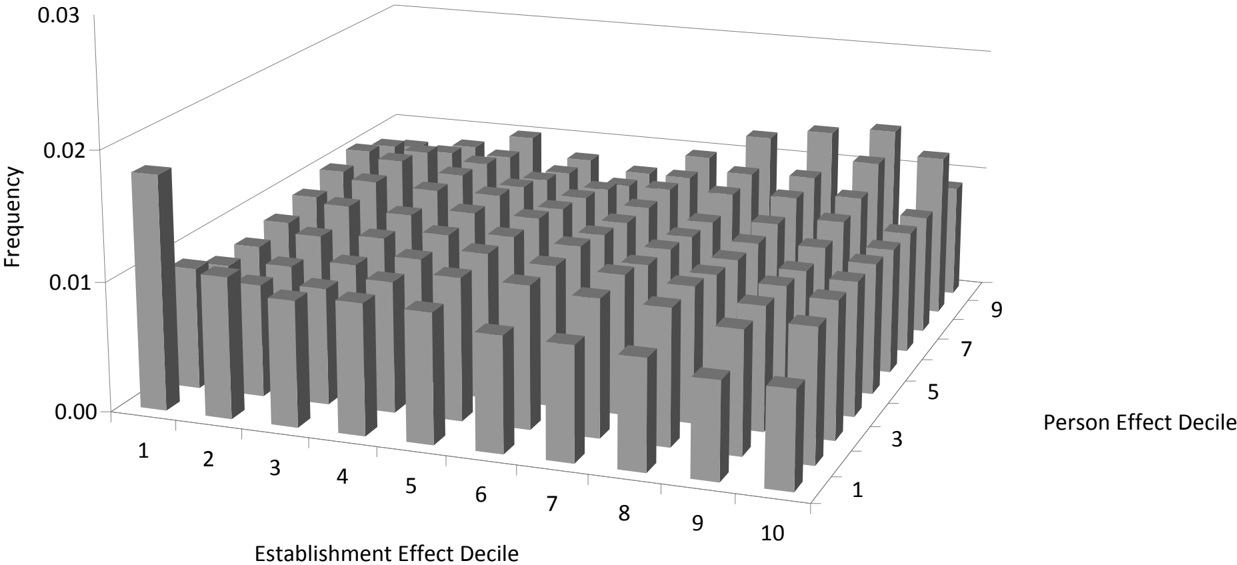
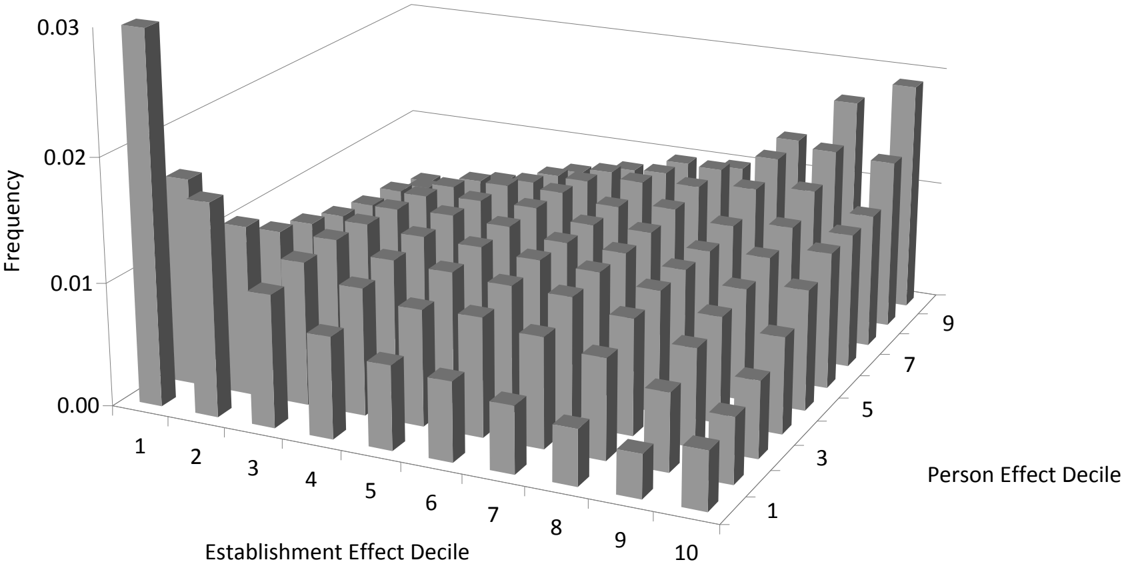
- Assortative matching increased: the correlation between person and establishment effects rose from 0.034 in interval 1 to 0.249 in interval 4. Counterfactuals imply that holding sorting constant would have produced 69% of the actual variance rise, while holding establishment-effect variance constant would have produced 64%.
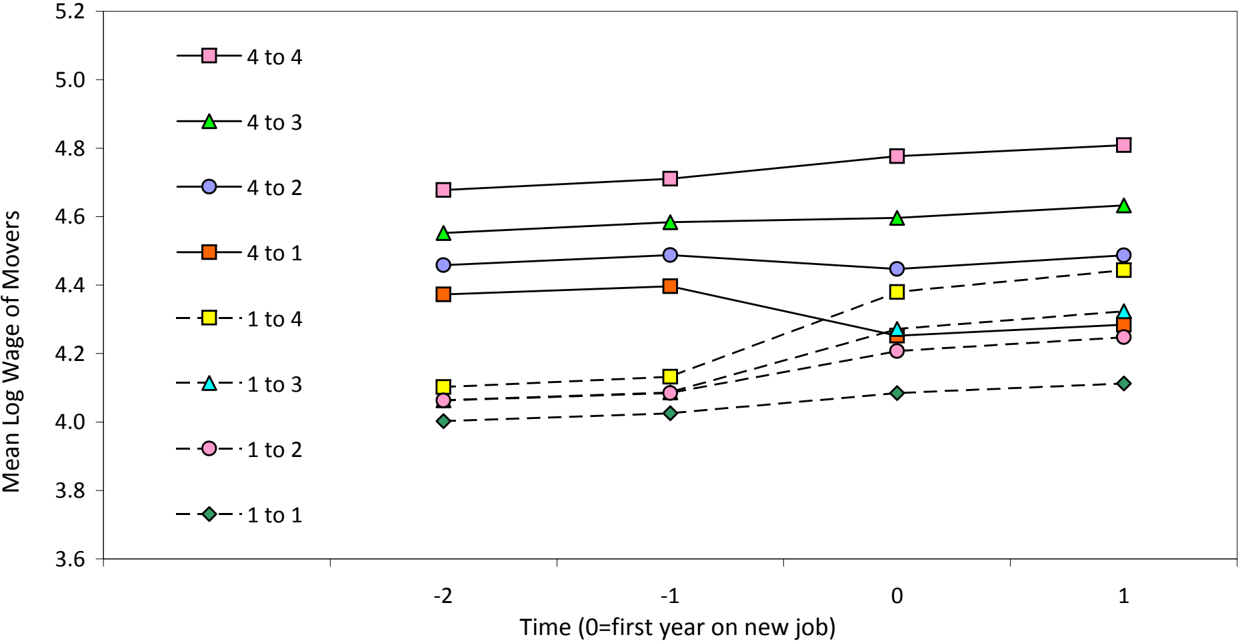
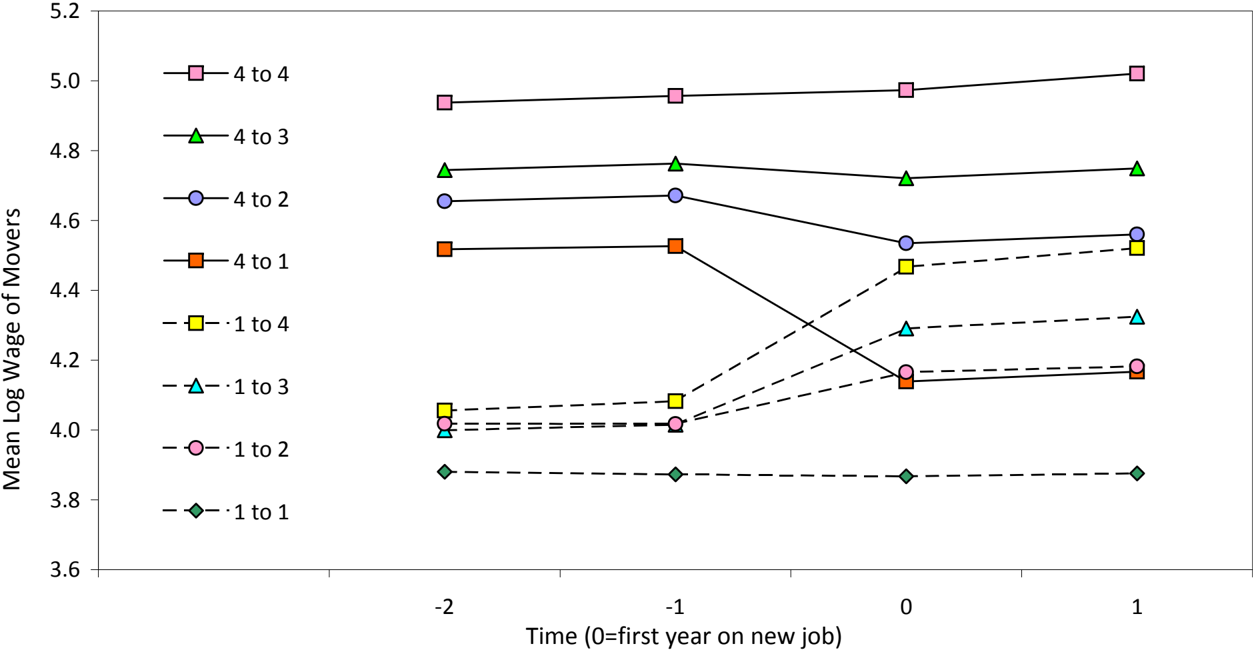
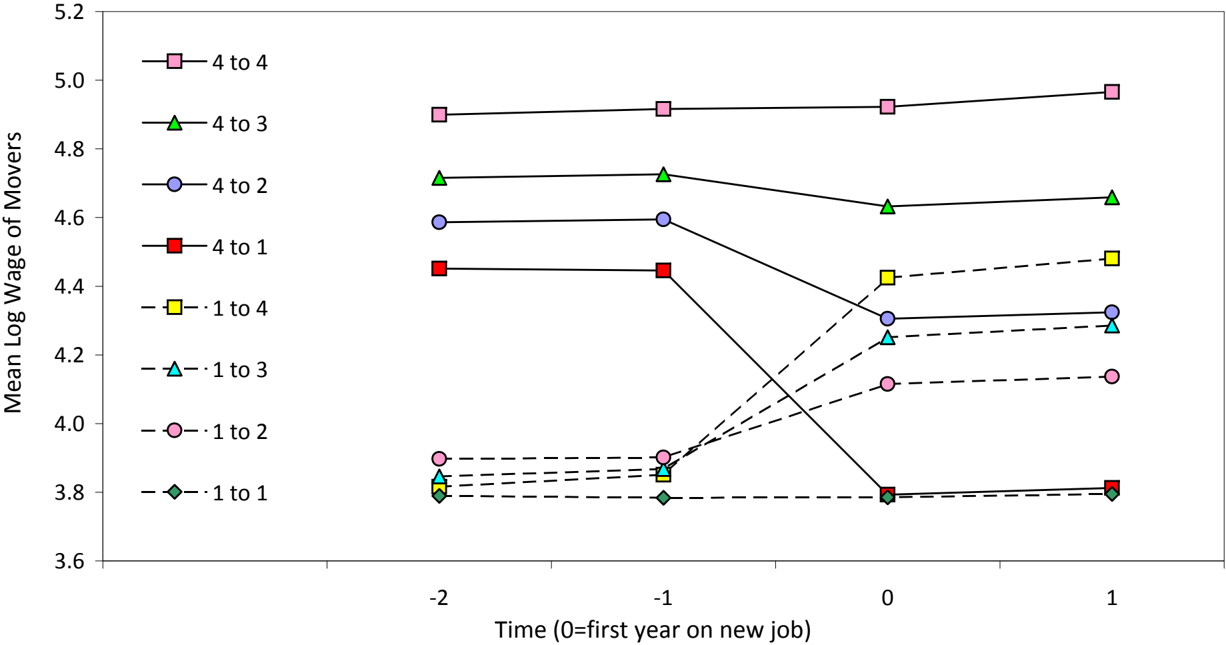
- Job-mobility event studies show growing establishment premia: a trend-adjusted move from quartile 1 to quartile 4 co-worker-wage establishments was associated with a 23 log-point gain in 1985–1991 versus 47 log points in 2002–2009; the reverse move yielded losses of 22 versus 43 log points.
- Between-group decompositions attribute 70% of the relative rise in university-educated men’s wages and 80% of the relative fall for workers with no/missing qualifications to establishment effects. For occupations, 42% of the rise in between-occupation variance is from person–establishment covariance, 28% from establishment variance, and about 30% from person variance; for industries, 44% is person variance, 19% establishment variance, and 42% sorting.
Methods
- Data: German Social Security records from the IEB, focusing on full-time West German men age 20–60 from 1985–2009, with parallel analyses for full-time women. The main sample has 85–90 million person-year observations per interval and about 17 million individual workers.
- Model: AKM-style log daily wage equation with additive person fixed effects, establishment fixed effects, time-varying covariates, and an error component; estimated by OLS on the largest connected set of establishments linked by worker mobility. Censored earnings are imputed using Tobit models.
- Analyses: variance decompositions and counterfactuals across four overlapping intervals (1985–1991, 1990–1996, 1996–2002, 2002–2009); event studies of job changers; decompositions of between-group wage gaps by education, occupation, and industry; and establishment cohort/collective-bargaining analyses.
Limitations
- The paper states that earnings are censored at the Social Security maximum (10–12% of male observations and 1–3% of female observations per year), so it uses Tobit imputation and checks robustness using apprentice-trained men, who have lower censoring rates.
- The paper states that establishment identifiers are administrative: ownership changes can create new establishment IDs, and only about half of EID births/deaths are estimated to be true plant openings/closings. It also states that sampling errors bias estimated variances upward and the covariance downward, and it does not construct bias-corrected estimates, assuming biases are similar across intervals.
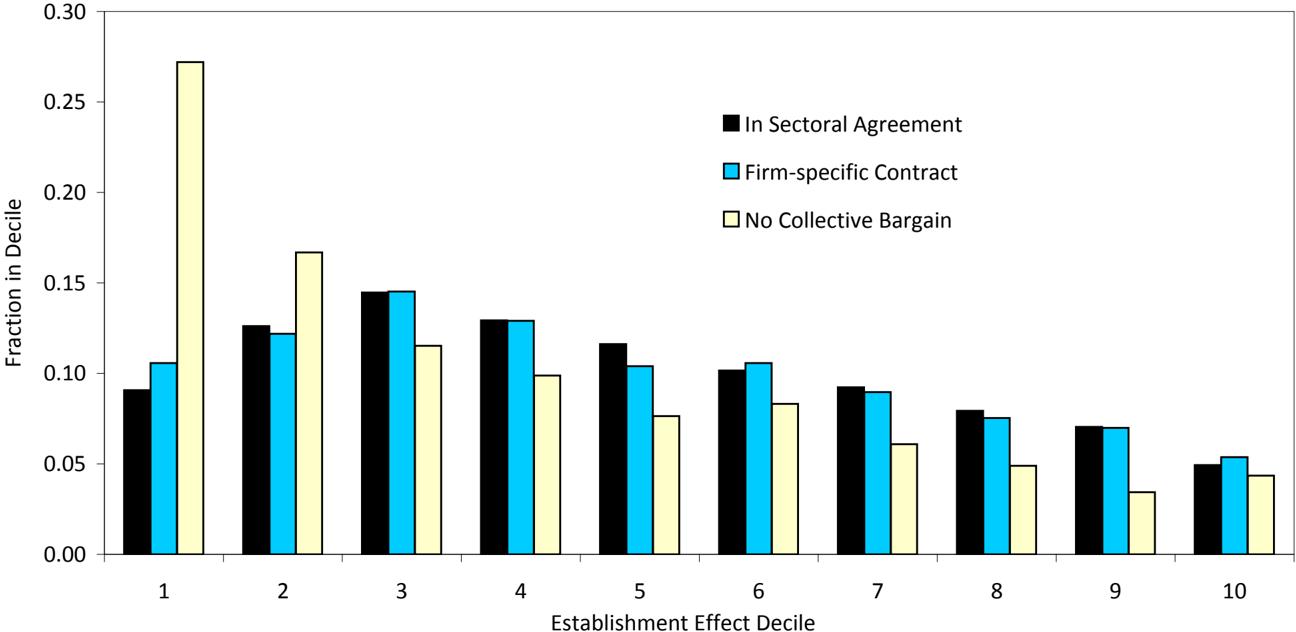
- The paper states that collective bargaining cannot be assigned a causal role because firms choose coverage, and that female estimates may have more negatively biased covariance terms due to fewer observed matches per plant/worker. Evident from the text: the main analysis is restricted to full-time workers in West Germany, excluding civil servants, self-employed, and many part-time/mini-job workers, which limits generalizability.
Model-written summary. Check it against the paper before relying on it.
Integrity signals
Registry
Cites
Statistics
Figures


Verification
Claims the paper makes
0 Valid · 0 Not valid · 8 Not checked · 191 Own results and interpretations
A result the paper reports from its own data — it cites no other source for it, so there is none to check. The quote shows it is in the paper.
In the paper
“In particular, generalized non-separable models with xed e/ects for each job yield only a small improvement in explanatory power relative to the AKM speci cation, both within narrow time intervals and between intervals.”
plain- Asserted: passes — The authors put it forward as true.
- Checkable: passes — It can be checked against evidence.
- Load-bearing: passes — The paper’s conclusions depend on it.
- Based: passes — The paper gives a reason why it holds.
A result the paper reports from its own data — it cites no other source for it, so there is none to check. The quote shows it is in the paper.
In the paper
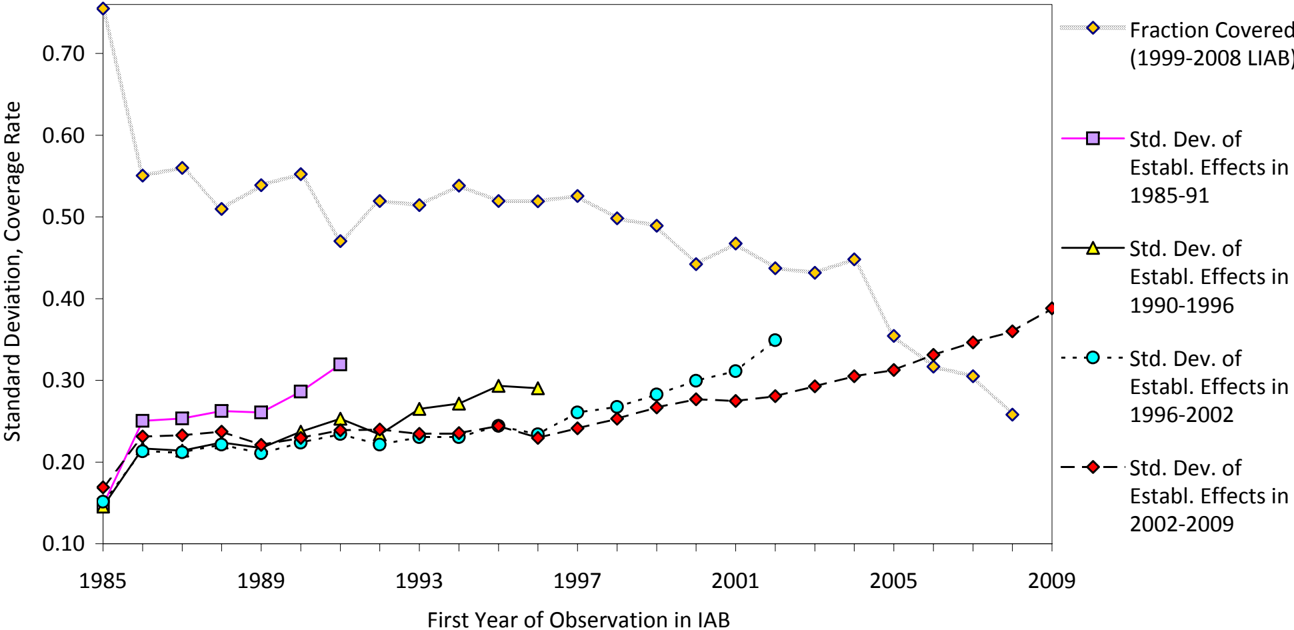
“Classifying establishments by entry year, we nd a trend toward increasing heterogeneity among establishments that entered the labor market after the mid-1990s, coupled with relatively small changes in the variability of the premiums paid by continuing establishments.”
plain- Asserted: passes — The authors put it forward as true.
- Checkable: passes — It can be checked against evidence.
- Load-bearing: passes — The paper’s conclusions depend on it.
- Based: passes — The paper gives a reason why it holds.
A result the paper reports from its own data — it cites no other source for it, so there is none to check. The quote shows it is in the paper.
In the paper
“We nd that two-thirds of the increase in the pay gap between higher and lower-educated workers is attributable to a widening in the average workplace pay premiums received by di/erent education groups.”
plainstates a cause- Asserted: passes — The authors put it forward as true.
- Checkable: passes — It can be checked against evidence.
- Load-bearing: passes — The paper’s conclusions depend on it.
- Based: passes — The paper gives a reason why it holds.
A result the paper reports from its own data — it cites no other source for it, so there is none to check. The quote shows it is in the paper.
In the paper
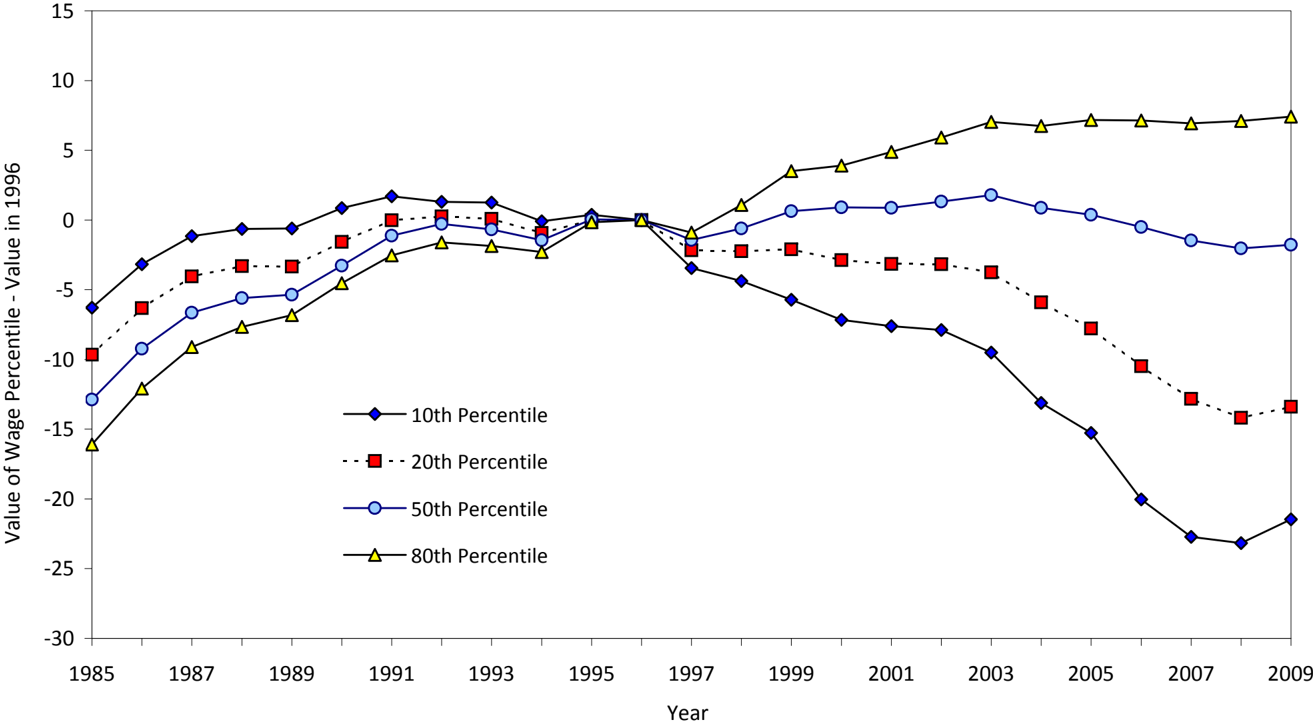
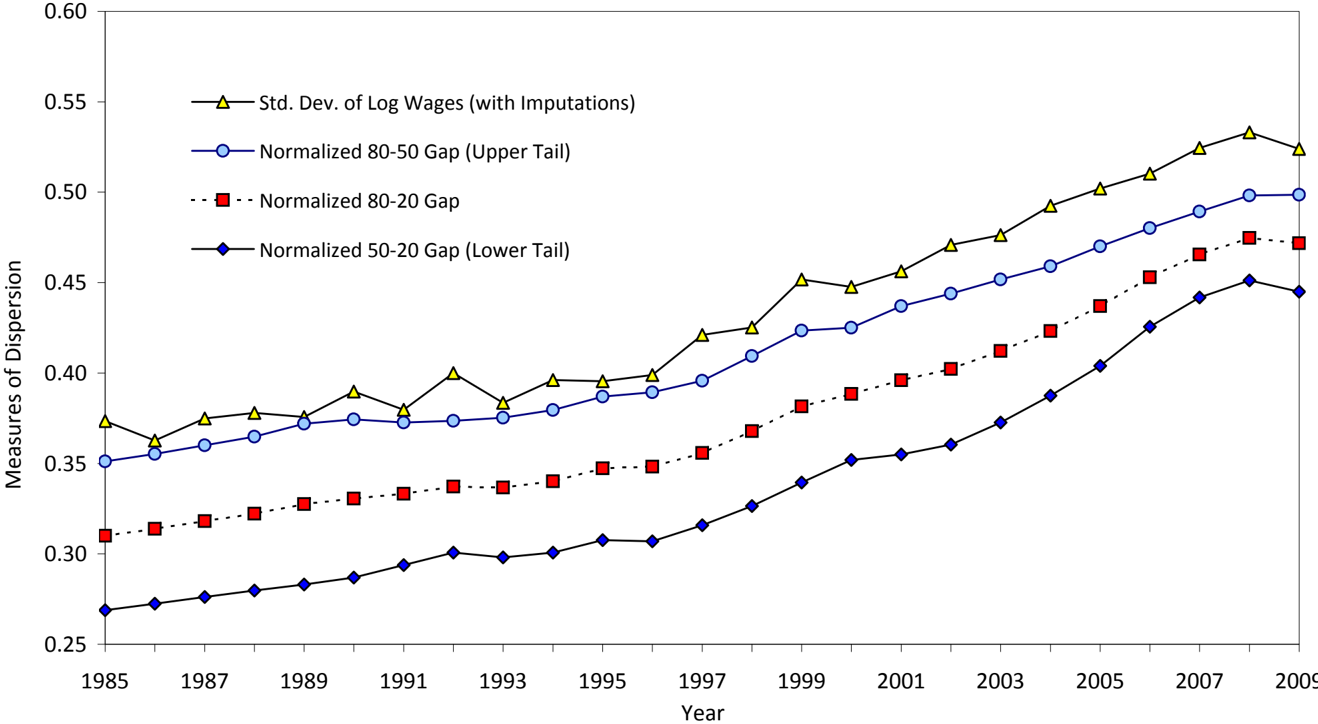
“In particular, the standard deviation rose by 15 log points from 1985 to 2009, the (normalized) 80-20 gap rose by 16 log points, the 80-50 gap rose by 15 log points, and the 50-20 gap rose by 18 log points.”
plain- Asserted: passes — The authors put it forward as true.
- Checkable: passes — It can be checked against evidence.
- Load-bearing: unclear — It is unclear whether the paper’s conclusions depend on it.
- Based: passes — The paper gives a reason why it holds.
118 more claims
Create a free account to see all 199 claims and to verify the 4 references still open.
- It may state two separate claims as one. 61
- Probably not a substantial claim. 17
- The quote only partly states this claim. 3
Claims other papers make about this one
Each is checked against this paper’s own text: does it say what the citing paper says it does?
The check wasn’t confident either way, so it gives no verdict — never disputed.
In the citing paper
“We estimate below that 75% is labor income.16”
From “Capitalists in the Twenty-First Century” (2019) · cites this paper as [16]
Experimental — accuracy not yet measured
Citations
Cites
A heteroskedasticity-consistent covariance matrix estimator and a direct test for heteroskedasticity
White, H. (1980) · Econometrica · doi:10.2307/1912934 · Cited by 25,861
The Skill Content of Recent Technological Change: An Empirical Exploration
Autor, D. H., Levy, F., & Murnane, R. J. (2003) · The Quarterly Journal of Economics · doi:10.1162/003355303322552801 · Cited by 6,205
On the Pooling of Time Series and Cross Section Data
Mundlak, Y. (1978) · Econometrica · doi:10.2307/1913646 · Cited by 5,412
Changes in Relative Wages, 1963-1987: Supply and Demand Factors
Katz, L. F., & Murphy, K. M. (1992) · The Quarterly Journal of Economics · doi:10.2307/2118323 · Cited by 4,793
Equilibrium Unemployment as a Worker Discipline Device
Shapiro, C., & Stiglitz, J. E. (1986) · Efficiency Wage Models of the Labor Market · doi:10.1017/cbo9780511559594.004 · Cited by 4,652
Misallocation and Manufacturing TFP in China and India*
Hsieh, C.-T., & Klenow, P. J. (2009) · Quarterly Journal of Economics · doi:10.1162/qjec.2009.124.4.1403 · Cited by 4,175
Job Creation and Job Destruction in the Theory of Unemployment
Mortensen, D. T., & Pissarides, C. A. (1994) · The Review of Economic Studies · doi:10.2307/2297896 · Cited by 3,840
Hybrid Corn: An Exploration in the Economics of Technological Change
Griliches, Z. (1957) · Econometrica · doi:10.2307/1905380 · Cited by 3,330
Labor Contracts as Partial Gift Exchange
Akerlof, G. A. (1982) · The Quarterly Journal of Economics · doi:10.2307/1885099 · Cited by 3,210
Plants and Productivity in International Trade
Bernard, A. B., Eaton, J., Jensen, J. B., & Kortum, S. (2003) · American Economic Review · doi:10.1257/000282803769206296 · Cited by 2,980
Research works printed but not linked: 1
- 70. Rees, Albert and George Schultz. 1970. Workers in an Urban Labor Market. Chicago: University of Chicago Press.
Cited by
Items 1,401–1,500 of 1,904
Neubäumer, R., & Müller, S. (2015) · RePEc: Research Papers in Economics
Neubäumer, R. (2016) · SSRN Electronic Journal · doi:10.2139/ssrn.2750296
Müller, S., & Neubäumer, R. (2016) · RePEc: Research Papers in Economics
The impact of international trade on firms and workers - empirical evidence from Germany
Hesse, G. (2014) · OPen Access Repositorium der Universität Ulm (OPARU) (Ulm University) · doi:10.18725/oparu-2565
Wage Changes in the Irish Labour Market: Within- and Between-Firm Effects
Doris, A., O’Neill, D., & Sweetman, O. (2016) · Maynooth University ePrints and eTheses Archive (Maynooth University)
Essays in Labor Economics and International Trade
Yi, M. (2016) · eScholarship (California Digital Library)
Essays in Economics on Liberalization and Reallocation
Bellon, M. (2016) · Columbia Academic Commons (Columbia University) · doi:10.7916/d82z15s2
Ranking Firms Using Revealed Preference and Other Essays about Labor Markets
Sorkin, I. (2016) · Deep Blue (University of Michigan)
Essays on long-term labor market developments and retirement in Germany
Lüthen, H. (2016) · Universitätsbibliothek der FU Berlin Hochschulschriftenstelle u. Dokumentenserver · doi:10.17169/refubium-18047
Productivity, Impatience and Efficiency in Dynamic MarketsPreprint
Talamms, E. (2017) · SSRN Electronic Journal · doi:10.2139/ssrn.2892109
Interacting Productand Labor MarketRegulation and theImpact of Immigrationon Native Wages
Prantl, S., & Spitz‐Oener, A. (2014) · edoc Publication server (Humboldt University of Berlin) · doi:10.18452/4505
Gulyas, A. (2017) · eScholarship (California Digital Library)
Essays in development and organizations
Xu, G. (2017) · London School of Economics and Political Science Theses Online (London School of Economics and Political Science) · doi:10.21953/lse.0vz0npmnc8fg
Sorting when firms have sizePreprint
Goryunov, M. (2017) · RePEc: Research Papers in Economics
Hagemann, H., Seiter, S., & Pyka, A. (2015)
Essays in labor and public economics
Labanca, C. (2017) · eScholarship (California Digital Library)
Sorensen, J. T. (2017) · eScholarship (California Digital Library)
Internationalisation and firm performance
Theodorakopoulos, A. (2017) · Ghent University Academic Bibliography (Ghent University)
Hull, P. (2017) · DSpace@MIT (Massachusetts Institute of Technology)
Wage inequality, productivity, peer effects and assortative matching
de Carvalho, A. M. R. (2017) · Portuguese National Funding Agency for Science, Research and Technology (RCAAP Project by FCT)
Essays in the Economics of Innovation
Jaravel, X. (2016) · Digital Access to Scholarship at Harvard (DASH) (Harvard University)
Essays in development, banking and organisations
Limodio, N. (2017) · London School of Economics and Political Science Theses Online (London School of Economics and Political Science) · doi:10.21953/lse.dm49k2bfnjxq
Empirical Essays on Inventors, Workers and Firms
Kuegler, A. (2016) · Apollo (University of Cambridge) · doi:10.17863/cam.13763
Empirical essays on recent patterns in the British labour market
Singleton, C. (2017) · ERA
Essays in applied microeconomics : job mobility and social networks
Nimczik, J. S. (2017) · MADOC (University of Mannheim)
Essays in applied macroeconomics
Rossi, F. (2017) · London School of Economics and Political Science Theses Online (London School of Economics and Political Science) · doi:10.21953/lse.ctr30i8m5kmu
Essays on Public Policies and Uncertainty
Schmitz, S. (2018) · doi:10.17169/refubium-11912
Three Essays on Socio-economic Transitions : The Case of East and West Germany
Deutschmann, F. (2018) · KOPS (University of Konstanz)
Essays in Idiosyncratic Income Risk
Madera, R. (2017) · University of Minnesota Digital Conservancy (University of Minnesota)
Conclusions and Policy Reflections
Messina, J., & Silva, J. (2017) · World Bank, Washington, DC eBooks · doi:10.1596/978-1-4648-1039-8_ch6
Returns to Vocational Education and Training: Retention, Mobility, and Wages
Rinawi, M. (2016) · Zurich Open Repository and Archive (University of Zurich) · doi:10.5167/uzh-150062
Catela, E. Y. D. S., & Bessa, D. D. C. (2018) · Estudos Econômicos (São Paulo) · doi:10.1590/0101-41614822ecdb
Geographic frictions, ICT access, and firm organization
Steimer, H. (2018) · doi:10.5282/edoc.22537
The Uptick in Income Segregation: Real Trend or Random Sampling Variance
LOGAN, J. R., Foster, A., Ke, J., & Li, F. (2017) · National Bureau of Economic Research · doi:10.3386/w23656
Essays on Wage Inequality Using the Search Framework
Kantenga, K. (2018) · ScholarlyCommons (University of Pennsylvania)
Essays in applied econometrics
Schwartz, J. (2018) · cIRcle (University of British Columbia) · doi:10.14288/1.0371941
Immigrants’ changing position in Germany’s labor market institutions
Demakis, C. G. (2018) · Texas ScholarWorks (Texas Digital Library) · doi:10.15781/t2qv3cp39
Canry, N. (2018) · Evolutionary economics and social complexity science · doi:10.1007/978-4-431-55001-3_7
Saggio, R. (2018) · Upjohn Research (W.E. Upjohn Institute for Employment Research)
The rise and fall of the middle class: technology, skills, and inequality
Rivera, L. V. (2016) · Oxford University Research Archive (ORA) (University of Oxford) · doi:10.5287/ora-jbob4jz2y
The Impact of Temporary Contracts on Jobs, Firms and Workers: Evidence from Italy
Saggio, R. (2018) · eScholarship (California Digital Library)
Job Displacement, Family Dynamics, and Spousal Labor Supply, CEPR Discussion Papers, No. 13247
Halla, M., Schmieder, J., & Weber, A. M. (2018) · ePubWU Institutional Repository (Wirtschaftsuniversität Wien)
Declining Migration wihin the US: The Role of the Labor MarketPreprint
Molloy, R. S., Smith, C. L., & Wozniak, A. K. (2013) · RePEc: Research Papers in Economics
Falling Labor Share and Rising Inequality: The Role of Wage ContractsPreprint
Doniger, C. L. (2018) · RePEc: Research Papers in Economics
On the Concentration of Talent: A General Result on Superstar Effects and MatchingPreprint
Schetter, U., & Tejada, O. (2018) · SSRN Electronic Journal · doi:10.2139/ssrn.3239342
Sorting on Unobserved Skills into New FirmsPreprint
Knutsson, P. (2018) · RePEc: Research Papers in Economics
Shocks cambiarios y competitivos en países en desarrollo
César, A. (2018) · El Servicio de Difusión de la Creación Intelectual (National University of La Plata) · doi:10.35537/10915/72672
Laliberté, J.-W. P. (2018) · TSpace (University of Toronto)
Three essays on the causes and consequences of spatial inequality
Henkel, M. (2017) · DuEPublico (University of Duisburg-Essen)
Felbermayr, G. J., Gröschl, J., Köhler, W., Brändle, T., & Koch, A. (2018) · ifo Forschungsberichte
Essays on the Gender- and the Part-Time Wage Gap
Granados, P. G. (2018) · Universitätsbibliothek der FU Berlin Hochschulschriftenstelle u. Dokumentenserver · doi:10.17169/refubium-5147 · Cited by 1
Unternehmensinsolvenzen: Welche Folgen haben sie für Arbeitnehmer?
Fackler, D. (2019) · Wirtschaftsdienst · doi:10.1007/s10273-019-2471-3
Three Essays on Vulnerable Workers
Bana, S. (2019) · Upjohn Research (W.E. Upjohn Institute for Employment Research)
Vv., A., Stirati, A., Meloni, W. P., & Pariboni, R. (2019) · Iris (Roma Tre University)
Bester, H., Lang, M., & Li, J. (2021) · Open access LMU (Ludwid Maxmilian's Universitat Munchen) · doi:10.5282/ubm/epub.77852
Essays on Workplace Consolidation and Labor Markets
Todd, K. (2019) · eScholarship (California Digital Library)
Three Essays on Taxes, Public Policy and the Distribution of Income
Risch, M. (2019) · Deep Blue (University of Michigan)
Kwok, J. (2019) · eScholarship (California Digital Library)
The influence of the use of the more prevalent technology on the wages of older employees in Germany
Weller, S. I. (2013) · Eurasian Journal of Social Sciences
Three Essays in Employee Mobility
Chang, J. W. (2018) · Deep Blue (University of Michigan)
Educational supply policies: distortions and labor market performance
Benegas, M., & Corrêa, M. V. (2020) · Journal of Economics · doi:10.1007/s00712-019-00686-4
Essays on migration and productivity
Özgüzel, C. (2019) · theses.fr (ABES) · doi:10.70675/b726d585z9b62z498bzacf6z1cb8fea5f451
Estimating the Gains from Trade in Frictional Local Labor MarketsPreprint
Pupato, G., Sand, B., & Tschopp, J. (2022) · SSRN Electronic Journal · doi:10.2139/ssrn.4100905
Essays in labor and organizational economics
Henriques, I. B. (2018) · LA Referencia (Red Federada de Repositorios Institucionales de Publicaciones Científicas)
Human Capital, Firm Capabilities, and InnovationPreprint
Bhaskarabhatla, A., Hegde, D., & Peeters, T. L. P. R. (2017) · SSRN Electronic Journal · doi:10.2139/ssrn.3081933 · Cited by 1
Essays on Worker Self Selection and Wage Inequality
Schran, F. (2019) · bonndoc (University of Bonn)
Efectos heterogéneos del comercio internacional : ¿Qué nos enseña la literatura?
César, A. (2019) · Americanae (AECID Library)
Hedtrich, C. (2019) · Repositori digital de la UPF (Universitat Pompeu Fabra)
Malleability of Alcohol Consumption: Evidence from MigrantsPreprint
Hinnosaar, M., & Liu, E. (2020) · SSRN Electronic Journal · doi:10.2139/ssrn.3569603
New Imported Inputs, Wages and Worker Mobility
Colantone, I., Matano, A., & Naticchioni, P. (2019) · Industrial and Corporate Change · doi:10.2139/ssrn.3483953
Essays in semiparametric and high dimensional methods
Qiu, C. (2020) · London School of Economics and Political Science Theses Online (London School of Economics and Political Science)
Heimisch, A. (2018) · Electronic Theses of LMU Munich (Ludwig-Maximilians-Universität München) · doi:10.5282/edoc.26073
Essays On Trade And Productivity
Chan, M. (2018) · University of Minnesota Digital Conservancy (University of Minnesota)
Status and Economic Rent: Experimental Evidence on the Matthew EffectPreprint
Clingingsmith, D. L., & Sheremeta, R. M. (2017) · SocArXiv (OSF Preprints) · doi:10.31235/osf.io/evwpa
Kahn, L. M. (2020) · Industrial and Labor Relations Review · doi:10.1177/0019793920937959
New Imported Inputs, Wages and Worker Mobility [WP]
Colantone, I., Matano, A., & Naticchioni, P. (2018) · Dipòsit Digital de la Universitat de Barcelona (Universitat de Barcelona)
Essays in Interpersonal Economics
Devereux, K. (2018) · TSpace (University of Toronto)
Essays in public finance and family economics
Obermeier, T. (2019) · MADOC (University of Mannheim)
Three Essays on Finance and Labor
Bias, D. (2020) · mediaTUM (Technical University of Munich)
Introduction to the Thematic Section on Population Projections
Toulemon, L., Pison, G., & Robert-Bobée, I. (2020) · Economie et Statistique / Economics and Statistics · doi:10.24187/ecostat.2020.520d.2028
Dimensions in Global Projections: An Overview
Goujon, A. (2020) · Economie et Statistique / Economics and Statistics · doi:10.24187/ecostat.2020.520d.2032 · Cited by 2
Fixed-effect regressions on network data
Jochmans, K., & Weidner, M. (2019) · doi:10.1920/wp.cem.2019.1619
A Theory of Intra-Firm Group DesignPreprint
Tümen, S. (2015) · RePEc: Research Papers in Economics
Labour Market Polarisation, Job Tasks and Monopsony PowerPreprint
Bachmann, R., Demir, G., & Frings, H. (2021) · RePEc: Research Papers in Economics · doi:10.4419/96973029
Sandner, M. (2016) · RePEc: Research Papers in Economics · doi:10.17185/duepublico/70962
Baumann, F., & Brändle, T. (2015) · RePEc: Research Papers in Economics · doi:10.1111/bjir.2017.55.issue-3
The Morale Effects of Pay InequalityPreprint
Breza, E., Kaur, S., & Shamdasani, Y. (2016) · RePEc: Research Papers in Economics
Size of Training Firms: The Role of Firms, Luck, and Ability in Young Workers' CareersPreprint
Müller, S., & Neubäumer, R. (2016) · RePEc: Research Papers in Economics · doi:10.1108/ijm-07-2016-0155.html?utm_source=repec&utm_medium=feed&utm_campaign=repec
Augmenting the Human Capital Earnings Equation with Measures of Where People WorkPreprint
Barth, E., Davis, J. C., & Freeman, R. B. (2016) · RePEc: Research Papers in Economics
Estimating the Gains From Trade in Frictional Labor MarketsPreprint
Pupato, G., Sand, B., & Tschopp, J. (2019) · SSRN Electronic Journal · doi:10.2139/ssrn.3357662
Cheng, S., Massa, M., & Zhang, H. (2020) · SSRN Electronic Journal · doi:10.2139/ssrn.3668048
Practical Correlation Bias Correction in Two-way Fixed Effects Linear RegressionPreprint
Gaure, S. (2014) · RePEc: Research Papers in Economics
Essays on International Trade and Market Power
MacKenzie, G. (2020) · TSpace (University of Toronto)
Bank Competition and Local Labor MarketsPreprint
Mann, R. (2021) · SSRN Electronic Journal · doi:10.2139/ssrn.3810774
Marriage Dynamics, Earnings Dynamics, and Lifetime Family IncomePreprint
Altonji, J. G., Paez, D. G., Hynsjö, D., & Vidangos, I. (n.d.) · RePEc: Research Papers in Economics
Firm Level Drivers of Productivity Growth
Bräuer, R. (2021) · Data Archiving and Networked Services (DANS)
Essays on Migration and Labor Markets
Durayalage, P., & Arunasiri, D. (2020)
Lees, J. M., Tang, S., & Sidanius, J. (2021) · PsyArXiv (OSF Preprints) · doi:10.31234/osf.io/t4bgp
Mahajan, P. (2020) · Deep Blue (University of Michigan)
Metadata
- Authors
- Card, D., Heining, J., & Kline, P.
- Affiliations
- University of California, Berkeley (US)
- Corresponding author
- Kline, Patrick
- ORCID
- Card, David
- Venue
- The Quarterly Journal of Economics
- Publisher
- Oxford University Press (OUP)
- Published
- 2013-05-02
- Volume
- 128
- Issue
- 3
- Pages
- 967-1015
- ISSN
- 0033-5533 (ISSN-L)
- 1531-4650
- OpenAlex
- W2141295263
- Cited by
- 1,904
- References
- 146
- Citations by year
- 2026: 153 · 2025: 204 · 2024: 228 · 2023: 156 · 2022: 185 · 2021: 178 · 2020: 143 · 2019: 125 · 2018: 156 · 2017: 113 · 2016: 105 · 2015: 71 · 2014: 58 · 2013: 22
- FWCI
- 118.40
- Type
- journal article
- Language
- en
- Open access
- closed
- Locations
- The Quarterly Journal of Economics (publishedVersion)
- RePEc: Research Papers in Economics (submittedVersion)
- Econstor (Econstor) (submittedVersion)
- Funders
- Washington Center for Equitable Growth
- Topics
- Social Sciences › Economics, Econometrics and Finance › Economics and Econometrics › Labor market dynamics and wage inequality
- Social Sciences › Economics, Econometrics and Finance › Economics and Econometrics › Historical Economic and Social Studies
- Social Sciences › Sociology and Political Science › Income, Poverty, and Inequality
- Keywords
- wage inequality, job matching, fixed effects model, education and wages
About these checks
Registry, retraction, Cites and statistics results are computed, not judged, with one exception: a printed reference that no index lists is read once by a model before it counts as a citation error. Claims are extracted by a model and kept only when their quote appears verbatim in the text; each cited source is then checked, with a model’s help, for whether it says what the claim relies on. Those verdicts can be wrong — read the claim’s quote and the cited source before relying on one.
A language model drew the claims from the paper on 2026-11-17, under version 3 of the claim definition (model deepseek-v4.1-flash, prompt extract-v3).
A second model labelled each claim on 2026-11-17 (model jev-1.13-20260917, definition revision gold-guideline-v0.2).
Statistics and arithmetic are recomputed, not judged.
Confidence bands are shown only for fields calibrated on our annotated test set. None is calibrated yet, so no band is shown.
What counts as a claim ›How we measure confidence ›How we check this ›
Are you an author, or do you see a problem with this page? Request a review
Data sources
Bibliographic data: Semantic Scholar, OpenAlex, Crossref.
Contains information from the Semantic Scholar Academic Graph Datasets, made available under the ODC Attribution License (ODC-BY 1.0).
Semantic Scholar’s data is described in: Kinney, R., et al. (2023). The Semantic Scholar Open Data Platform. arXiv:2301.10140.
