

The DOI matches its Crossref record; 97 of the 97 references it cites were found in a registry or an index; none of the 66 sources its claims cite is checked for support yet.
The thing that should not be: predictive coding and the uncanny valley in perceiving human and humanoid robot actions
Open accessAbstract
Using functional magnetic resonance imaging (fMRI) repetition suppression, we explored the selectivity of the human action perception system (APS), which consists of temporal, parietal and frontal areas, for the appearance and/or motion of the perceived agent. Participants watched body movements of a human (biological appearance and movement), a robot (mechanical appearance and movement) or an android (biological appearance, mechanical movement). With the exception of extrastriate body area, which showed more suppression for human like appearance, the APS was not selective for appearance or motion per se. Instead, distinctive responses were found to the mismatch between appearance and motion: whereas suppression effects for the human and robot were similar to each other, they were stronger for the android, notably in bilateral anterior intraparietal sulcus, a key node in the APS. These results could reflect increased prediction error as the brain negotiates an agent that appears human, but does not move biologically, and help explain the 'uncanny valley' phenomenon.
Overview
AI snapshot
Written from the paper’s full text.
TL;DR
Using fMRI repetition suppression, this study tested whether the human action perception system is selective for biological appearance or motion by comparing responses to a human, a humanoid android, and the same robot with mechanical appearance. The android—human-like appearance with mechanical movement—produced distinctive repetition suppression, especially in bilateral anterior intraparietal sulcus, which the authors interpret as prediction error relevant to the uncanny valley.
Key findings
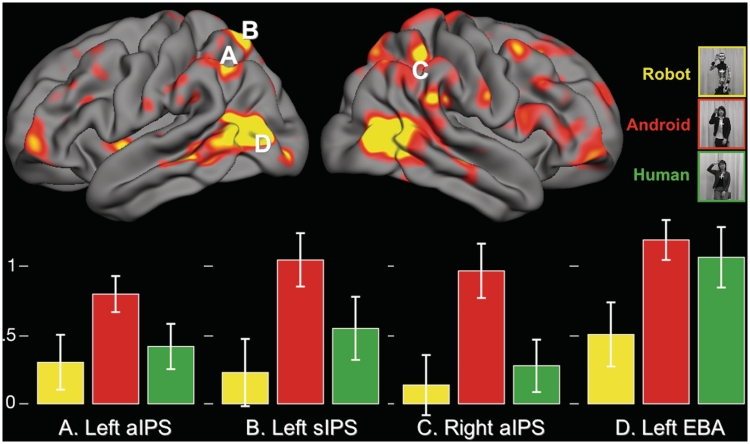
- The action perception system was largely not selective for appearance or motion per se; the main exception was left extrastriate body area (EBA), which showed more suppression for human-like appearance (Agent × Repetition, P = 0.03; Android > Robot, P = 0.02; Human > Robot, P = 0.07).
- The Android condition produced stronger repetition suppression than both Human and Robot in bilateral anterior intraparietal sulcus (aIPS): left aIPS Agent × Repetition P = 0.002, Android > Robot P = 0.002, Android > Human P = 0.004; right aIPS Agent × Repetition P = 0.002, Android > Robot P = 0.003, Android > Human P = 0.02.
- Left superior intraparietal sulcus (sIPS) also showed an Agent × Repetition interaction (P = 0.04), with Android > Robot (P = 0.01).
- Behavioral accuracy on comprehension questions was 0.84 (s.d. = 0.28) and did not differ between conditions; eye movement measures also did not differ between conditions (P > 0.1 for all pairwise comparisons).
Methods
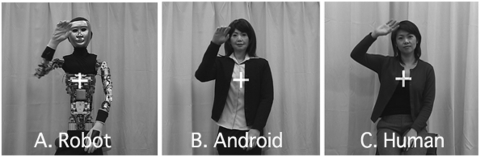
- Twenty healthy right-handed adults aged 20–36 participated; data from one participant were excluded due to excessive head movement. Participants watched 2-s grayscale video clips of eight actions performed by Human, Android (Repliee Q2 with human-like appearance and mechanical movement), and Robot (same robot stripped of human-like surface appearance, with identical mechanical movement).
- fMRI was performed on a 3 T Siemens Allegra scanner across 6 runs of 12 blocks; each block contained 12 videos, and each clip was equiprobably a repeat or nonrepeat of the previous clip.
- Data were analyzed with SPM5 using whole-brain random-effects repetition suppression (Nonrepeat > Repeat, t ≥ 8.86, P < 0.05 FDR-corrected, cluster ≥ 30 voxels), followed by ROI analyses using 5-mm spheres and repeated-measures ANOVA on Agent × Repetition.
Limitations
- The authors state that the experiment was not designed optimally to “explain” the uncanny valley and can make only a modest contribution to defining its neural basis; they also state that a conclusive or causal link between prediction error and the uncanny valley cannot be made from these data.
- The authors note there is no agreed-upon localizer for the action perception system, and ventral premotor cortex did not show significant repetition suppression despite being a key node of the APS.
- Evident from the text: the sample was small (20 recruited, 19 analyzed), and the Android and Robot conditions used the same robot with identical programmed kinematics, so appearance and motion were manipulated in a constrained, non-parametric way rather than independently across many agents.
Model-written summary. Check it against the paper before relying on it.
Integrity signals
Registry
Cites
Statistics
Figures
Verification
Claims the paper makes
35 Not checked yet · 30 Own result · 10 Own interpretation · 3 Own method · 2 No basis given
A result the paper reports from its own data — it cites no other source for it, so there is none to check. The quote shows it is in the paper.
In the paper
“With the exception of extrastriate body area, which showed more suppression for human like appearance, the APS was not selective for appearance or motion per se.”
§ The thing that should not be: predictive coding and the uncanny valley in perceiving human and humanoid robot actions > Abstract
plain- Asserted: passes — The authors put it forward as true.
- Checkable: passes — It can be checked against evidence.
- Load-bearing: passes — The paper’s conclusions depend on it.
- Based: passes — The paper gives a reason why it holds.
A result the paper reports from its own data — it cites no other source for it, so there is none to check. The quote shows it is in the paper.
In the paper
“they were stronger for the android, notably in bilateral anterior intraparietal sulcus, a key node in the APS.”
- Also stated in: § Experimental procedures and data analysis · plain
“aIPS | 40 | −42 | −38 | 42 | 3.96 | 0.30 | 0.81 | 0.42 | Agent × repetition (P = 0.002)”
§ The thing that should not be: predictive coding and the uncanny valley in perceiving human and humanoid robot actions > Abstract
plaincorrelational- Asserted: passes — The authors put it forward as true.
- Checkable: passes — It can be checked against evidence.
- Load-bearing: passes — The paper’s conclusions depend on it.
- Based: passes — The paper gives a reason why it holds.
- Also stated in: § Experimental procedures and data analysis · plain
A result the paper reports from its own data — it cites no other source for it, so there is none to check. The quote shows it is in the paper.
In the paper
“whereas suppression effects for the human and robot were similar to each other”
- Also stated in: § FMRI data · plain
“with the Human and Robot conditions leading to similar patterns of suppression”
§ The thing that should not be: predictive coding and the uncanny valley in perceiving human and humanoid robot actions > Abstract
plain- Asserted: passes — The authors put it forward as true.
- Checkable: passes — It can be checked against evidence.
- Load-bearing: passes — The paper’s conclusions depend on it.
- Based: passes — The paper gives a reason why it holds.
- Also stated in: § FMRI data · plain
None of the sources cited for this claim have been checked yet.
In the paper
“There was a significant Agent by Repetition interaction in the anterior portion of the intraparietal sulcus bilaterally, corresponding to area aIPS, the putative human homologue of macaque area AIP (Grefkes and Fink, 2005; Culham and Valyear, 2006; Grafton and Hamilton, 2007).”
§ The thing that should not be: predictive coding and the uncanny valley in perceiving human and humanoid robot actions > DISCUSSION > Summary of study and findings
What the sources say
- Not checked yetcites Grefkes and Fink, 2005
- Not checked yetcites Culham and Valyear, 2006
- Not checked yetcites Grafton and Hamilton, 2007
plaincorrelational- Asserted: passes — The authors put it forward as true.
- Checkable: passes — It can be checked against evidence.
- Load-bearing: passes — The paper’s conclusions depend on it.
- Based: passes — The paper gives a reason why it holds.
A result the paper reports from its own data — it cites no other source for it, so there is none to check. The quote shows it is in the paper.
In the paper
“We explored with a repeated measures analysis of variance (ANOVA) whether accuracy varied across conditions (it did not).”
- Also stated in: § Behavioral and eye movement data · plain
“Accuracy did not differ between conditions (P > 0.1 for all pair-wise comparisons).”
§ The thing that should not be: predictive coding and the uncanny valley in perceiving human and humanoid robot actions > METHODS > Experimental procedures and data analysis
plain- Asserted: passes — The authors put it forward as true.
- Checkable: passes — It can be checked against evidence.
- Load-bearing: passes — The paper’s conclusions depend on it.
- Based: passes — The paper gives a reason why it holds.
- Also stated in: § Behavioral and eye movement data · plain
A result the paper reports from its own data — it cites no other source for it, so there is none to check. The quote shows it is in the paper.
In the paper
“sIPS | | −20 | −70 | 60 | 4.57 | 0.23 | 1.06 | 0.55 | Agent × repetition (P = 0.04)”
- Also stated in: § Experimental procedures and data analysis · plain
“A > R (P = 0.01)”
§ The thing that should not be: predictive coding and the uncanny valley in perceiving human and humanoid robot actions > METHODS > Experimental procedures and data analysis
plaincorrelational- Asserted: passes — The authors put it forward as true.
- Checkable: passes — It can be checked against evidence.
- Load-bearing: passes — The paper’s conclusions depend on it.
- Based: passes — The paper gives a reason why it holds.
- Also stated in: § Experimental procedures and data analysis · plain
A result the paper reports from its own data — it cites no other source for it, so there is none to check. The quote shows it is in the paper.
In the paper
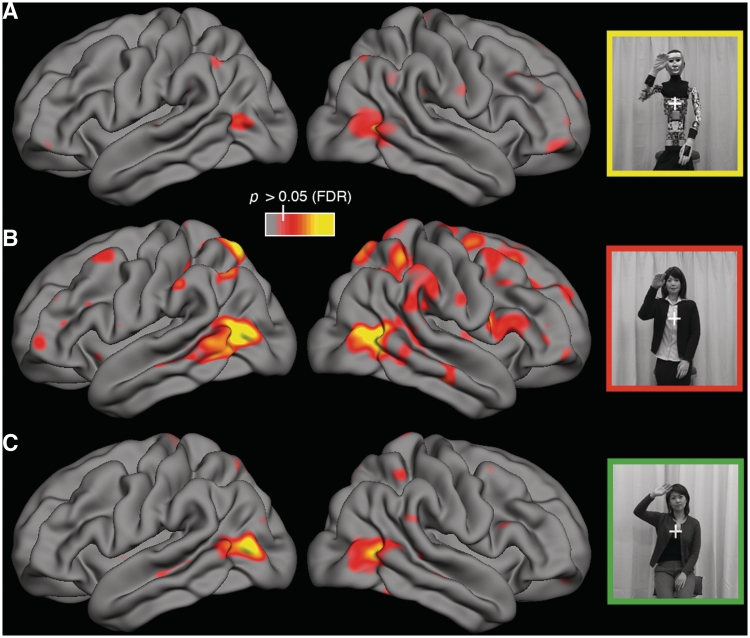
“the Android condition being distinctive, and leading to repetition suppression in a wider network”
§ The thing that should not be: predictive coding and the uncanny valley in perceiving human and humanoid robot actions > RESULTS > FMRI data
plaindirect- Asserted: passes — The authors put it forward as true.
- Checkable: passes — It can be checked against evidence.
- Load-bearing: passes — The paper’s conclusions depend on it.
- Based: passes — The paper gives a reason why it holds.
A result the paper reports from its own data — it cites no other source for it, so there is none to check. The quote shows it is in the paper.
In the paper
“We used an MR-compatible eye tracker (see Supplementary Data) to check whether eye movements differed between conditions (they did not).”
- Also stated in: § Behavioral and eye movement data · plain
“None of the eye movement measures (Mean and s.d. of x and y position, Pupil size) differed between conditions (P > 0.1 for all pair-wise comparisons).”
§ The thing that should not be: predictive coding and the uncanny valley in perceiving human and humanoid robot actions > METHODS > Experimental procedures and data analysis
plain- Asserted: passes — The authors put it forward as true.
- Checkable: passes — It can be checked against evidence.
- Load-bearing: passes — The paper’s conclusions depend on it.
- Based: passes — The paper gives a reason why it holds.
- Also stated in: § Behavioral and eye movement data · plain
A result the paper reports from its own data — it cites no other source for it, so there is none to check. The quote shows it is in the paper.
In the paper
“Broadly consistent with previous repetition suppression studies of action perception, the main effect of Repetition revealed a network of areas, including occipital, lateral and ventral temporal, parietal, frontal, parahippocampal and cerebellar regions (Figure 3 and Table 1).”
§ The thing that should not be: predictive coding and the uncanny valley in perceiving human and humanoid robot actions > RESULTS > FMRI data
plaincorrelational- Asserted: passes — The authors put it forward as true.
- Checkable: passes — It can be checked against evidence.
- Load-bearing: unclear — It is unclear whether the paper’s conclusions depend on it.
- Based: passes — The paper gives a reason why it holds.
In the paper
“There was a large swathe of suppression covering multiple functional visual areas, but the interaction was present only in one subpeak, the coordinates of which corresponded to the previously reported location of the extrastriate body area (EBA) (Peelen and Downing, 2007), a region that responds more strongly to images of bodies and body parts compared with other kinds of stimuli.”
§ The thing that should not be: predictive coding and the uncanny valley in perceiving human and humanoid robot actions > RESULTS > FMRI data
What the sources say
- Not checked yetcites Peelen and Downing, 2007
plain- Asserted: passes — The authors put it forward as true.
- Checkable: passes — It can be checked against evidence.
- Load-bearing: passes — The paper’s conclusions depend on it.
- Based: passes — The paper gives a reason why it holds.
- It may state two separate claims as one. 12
- The quote only partly states this claim. 2
- Probably not a substantial claim. 22
A result the paper reports from its own data — it cites no other source for it, so there is none to check. The quote shows it is in the paper.
In the paper
“Even though there was qualitatively more suppression for the Android condition compared with the others in a widespread network (Figure 2), the Agent by Repetition interaction reached significance in only a subset of these regions (Table 1).”
§ The thing that should not be: predictive coding and the uncanny valley in perceiving human and humanoid robot actions > RESULTS > FMRI data
plain- Asserted: passes — The authors put it forward as true.
- Checkable: passes — It can be checked against evidence.
- Load-bearing: unclear — It is unclear whether the paper’s conclusions depend on it.
- Based: passes — The paper gives a reason why it holds.
It may state two separate claims as one.
A result the paper reports from its own data — it cites no other source for it, so there is none to check. The quote shows it is in the paper.
In the paper
“Fusiform gyrus | | 46 | −44 | −16 | 4.02 | 0.22 | 0.87 | 0.41 | Agent × repetition (P = 0.075)”
- Also stated in: § Experimental procedures and data analysis · plain
“A > R (P = 0.01)”
- Also stated in: § Experimental procedures and data analysis · plain
“A > H (P = 0.05)”
§ The thing that should not be: predictive coding and the uncanny valley in perceiving human and humanoid robot actions > METHODS > Experimental procedures and data analysis
plaincorrelational- Asserted: passes — The authors put it forward as true.
- Checkable: passes — It can be checked against evidence.
- Load-bearing: passes — The paper’s conclusions depend on it.
- Based: passes — The paper gives a reason why it holds.
It may state two separate claims as one.
- Also stated in: § Experimental procedures and data analysis · plain
A result the paper reports from its own data — it cites no other source for it, so there is none to check. The quote shows it is in the paper.
In the paper
“aIPS | 40 | −42 | −38 | 42 | 3.96 | 0.30 | 0.81 | 0.42 | Agent × repetition (P = 0.002)”
- Also stated in: § Experimental procedures and data analysis · plain
“A > R (P = 0.002)”
§ The thing that should not be: predictive coding and the uncanny valley in perceiving human and humanoid robot actions > METHODS > Experimental procedures and data analysis
plaincorrelational- Asserted: passes — The authors put it forward as true.
- Checkable: passes — It can be checked against evidence.
- Load-bearing: passes — The paper’s conclusions depend on it.
- Based: passes — The paper gives a reason why it holds.
The quote only partly states this claim.
- Also stated in: § Experimental procedures and data analysis · plain
A result the paper reports from its own data — it cites no other source for it, so there is none to check. The quote shows it is in the paper.
In the paper
“For completeness, we also report the main effect of Agent: this effect was found in visual cortex bilaterally (with peaks in MNI coordinates −30, −92, 2 and 38, −80, −16), and was driven by a stronger response for the Robot condition compared with the other agents.”
§ The thing that should not be: predictive coding and the uncanny valley in perceiving human and humanoid robot actions > RESULTS > FMRI data
plaindirect- Asserted: passes — The authors put it forward as true.
- Checkable: passes — It can be checked against evidence.
- Load-bearing: fails — The paper’s conclusions may not depend on it.
- Based: passes — The paper gives a reason why it holds.
Probably not a substantial claim. The paper’s conclusions may not depend on it. It may state two separate claims as one.
A result the paper reports from its own data — it cites no other source for it, so there is none to check. The quote shows it is in the paper.
In the paper
“There were other repetition suppression foci in frontal cortex, including one that extended into dorsal premotor cortex.”
§ The thing that should not be: predictive coding and the uncanny valley in perceiving human and humanoid robot actions > RESULTS > FMRI data
plain- Asserted: passes — The authors put it forward as true.
- Checkable: passes — It can be checked against evidence.
- Load-bearing: fails — The paper’s conclusions may not depend on it.
- Based: passes — The paper gives a reason why it holds.
Probably not a substantial claim. The paper’s conclusions may not depend on it.
A result the paper reports from its own data — it cites no other source for it, so there is none to check. The quote shows it is in the paper.
In the paper
“The right hemisphere peak, and a more dorsal subpeak of the left hemisphere cluster, did not show significant differences between agents.”
§ The thing that should not be: predictive coding and the uncanny valley in perceiving human and humanoid robot actions > RESULTS > FMRI data
plain- Asserted: passes — The authors put it forward as true.
- Checkable: passes — It can be checked against evidence.
- Load-bearing: unclear — It is unclear whether the paper’s conclusions depend on it.
- Based: passes — The paper gives a reason why it holds.
It may state two separate claims as one.
A result the paper reports from its own data — it cites no other source for it, so there is none to check. The quote shows it is in the paper.
In the paper
“Repetition suppression was found in the parietal and temporal nodes of the APS, but despite being a key node of the APS, ventral premotor cortex did not show significant repetition suppression (cf Chong et al., 2008; Lestou et al., 2008; Grossman et al., 2010).”
§ The thing that should not be: predictive coding and the uncanny valley in perceiving human and humanoid robot actions > RESULTS > FMRI data
plain- Asserted: passes — The authors put it forward as true.
- Checkable: passes — It can be checked against evidence.
- Load-bearing: unclear — It is unclear whether the paper’s conclusions depend on it.
- Based: passes — The paper gives a reason why it holds.
It may state two separate claims as one.
A result the paper reports from its own data — it cites no other source for it, so there is none to check. The quote shows it is in the paper.
In the paper
“Middle Frontal Gyrus | 46 | 50 | 48 | 10 | 3.93 | 0.58 | 0.80 | 0.22 | A > H (P = 0.07)”
§ The thing that should not be: predictive coding and the uncanny valley in perceiving human and humanoid robot actions > METHODS > Experimental procedures and data analysis
plaincorrelational- Asserted: passes — The authors put it forward as true.
- Checkable: passes — It can be checked against evidence.
- Load-bearing: fails — The paper’s conclusions may not depend on it.
- Based: passes — The paper gives a reason why it holds.
Probably not a substantial claim. The paper’s conclusions may not depend on it.
A result the paper reports from its own data — it cites no other source for it, so there is none to check. The quote shows it is in the paper.
In the paper
“Parahippocampal/Amygdala | | 26 | −4 | −18 | 3.99 | 0.10 | 0.68 | 0.75 | A > R (P = 0.09)”
- Also stated in: § Experimental procedures and data analysis · plain
“H > R (P = 0.08)”
§ The thing that should not be: predictive coding and the uncanny valley in perceiving human and humanoid robot actions > METHODS > Experimental procedures and data analysis
plaincorrelational- Asserted: passes — The authors put it forward as true.
- Checkable: passes — It can be checked against evidence.
- Load-bearing: unclear — It is unclear whether the paper’s conclusions depend on it.
- Based: passes — The paper gives a reason why it holds.
It may state two separate claims as one. The quote only partly states this claim.
- Also stated in: § Experimental procedures and data analysis · plain
A result the paper reports from its own data — it cites no other source for it, so there is none to check. The quote shows it is in the paper.
In the paper
“All showed reduced responses to the repeated stimuli, with the exception of primary visual cortex, which showed repetition enhancement.”
§ The thing that should not be: predictive coding and the uncanny valley in perceiving human and humanoid robot actions > RESULTS > FMRI data
plaindirect- Asserted: passes — The authors put it forward as true.
- Checkable: passes — It can be checked against evidence.
- Load-bearing: unclear — It is unclear whether the paper’s conclusions depend on it.
- Based: passes — The paper gives a reason why it holds.
It may state two separate claims as one.
A result the paper reports from its own data — it cites no other source for it, so there is none to check. The quote shows it is in the paper.
In the paper
“H > R (P = 0.07)”
§ The thing that should not be: predictive coding and the uncanny valley in perceiving human and humanoid robot actions > METHODS > Experimental procedures and data analysis
plaincorrelational- Asserted: passes — The authors put it forward as true.
- Checkable: passes — It can be checked against evidence.
- Load-bearing: fails — The paper’s conclusions may not depend on it.
- Based: passes — The paper gives a reason why it holds.
Probably not a substantial claim. The paper’s conclusions may not depend on it.
In the paper
“In non-human primates, at least two of these regions have been reported to contain ‘mirror neurons’, which fire during the execution as well as the observation of specific movements”
§ The thing that should not be: predictive coding and the uncanny valley in perceiving human and humanoid robot actions > INTRODUCTION
What the sources say
- Not checked yetcites Rizzolatti and Craighero, 2004
hedged- Asserted: passes — The authors put it forward as true.
- Checkable: passes — It can be checked against evidence.
- Load-bearing: fails — The paper’s conclusions may not depend on it.
- Based: passes — The paper gives a reason why it holds.
Probably not a substantial claim. The paper’s conclusions may not depend on it.
In the paper
“In primates, perception of body movements is thought to be supported by a network including lateral superior temporal, inferior parietal and inferior frontal brain areas.”
§ The thing that should not be: predictive coding and the uncanny valley in perceiving human and humanoid robot actions > INTRODUCTION
What the sources say
- Not checked yetcites Blake and Shiffrar, 2007
hedgedcorrelational- Asserted: passes — The authors put it forward as true.
- Checkable: passes — It can be checked against evidence.
- Load-bearing: fails — The paper’s conclusions may not depend on it.
- Based: passes — The paper gives a reason why it holds.
Probably not a substantial claim. The paper’s conclusions may not depend on it.
None of the sources cited for this claim have been checked yet.
In the paper
“Some studies have reported that artificial agents’ actions apparently affect the observers’ own motor processing, or activity within the APS, whereas others have argued that the APS either does not respond, or responds weakly if the perceived actor is not human”
§ The thing that should not be: predictive coding and the uncanny valley in perceiving human and humanoid robot actions > INTRODUCTION
What the sources say
- Not checked yetcites Kilner et al., 2003
- Not checked yetcites Tai et al., 2004
- Not checked yetcites Chaminade and Hodgins, 2006
hedgedconditional- Asserted: passes — The authors put it forward as true.
- Checkable: passes — It can be checked against evidence.
- Load-bearing: passes — The paper’s conclusions depend on it.
- Based: passes — The paper gives a reason why it holds.
Probably not a substantial claim. It may state two separate claims as one.
None of the sources cited for this claim have been checked yet.
In the paper
“Neuroimaging studies have shown responses in these areas during observation of actions”
§ The thing that should not be: predictive coding and the uncanny valley in perceiving human and humanoid robot actions > INTRODUCTION
What the sources say
- Not checked yetcites Saygin et al., 2004a
- Not checked yetcites Pobric and Hamilton, 2006
- Not checked yetcites Grafton and Hamilton, 2007
plaincorrelational- Asserted: passes — The authors put it forward as true.
- Checkable: passes — It can be checked against evidence.
- Load-bearing: fails — The paper’s conclusions may not depend on it.
- Based: passes — The paper gives a reason why it holds.
Probably not a substantial claim. The paper’s conclusions may not depend on it.
None of the sources cited for this claim have been checked yet.
In the paper
“neuropsychological patient and transcranial magnetic stimulation (TMS) studies have shown that damage or disruption of these areas can affect action processing”
§ The thing that should not be: predictive coding and the uncanny valley in perceiving human and humanoid robot actions > INTRODUCTION
What the sources say
- Not checked yetcites Saygin et al., 2004a
- Not checked yetcites Pobric and Hamilton, 2006
- Not checked yetcites Grafton and Hamilton, 2007
plainconditional- Asserted: passes — The authors put it forward as true.
- Checkable: passes — It can be checked against evidence.
- Load-bearing: fails — The paper’s conclusions may not depend on it.
- Based: passes — The paper gives a reason why it holds.
Probably not a substantial claim. The paper’s conclusions may not depend on it.
None of the sources cited for this claim have been checked yet.
In the paper
“The appearance of the observed agent may also be important”
§ The thing that should not be: predictive coding and the uncanny valley in perceiving human and humanoid robot actions > INTRODUCTION
What the sources say
- Not checked yetcites Buccino et al., 2004
- Not checked yetcites Chaminade et al., 2007
hedgedconditional- Asserted: passes — The authors put it forward as true.
- Checkable: passes — It can be checked against evidence.
- Load-bearing: passes — The paper’s conclusions depend on it.
- Based: passes — The paper gives a reason why it holds.
Probably not a substantial claim.
None of the sources cited for this claim have been checked yet.
In the paper
“there are links between activity within the APS and whether the observer can perform the seen movement”
§ The thing that should not be: predictive coding and the uncanny valley in perceiving human and humanoid robot actions > INTRODUCTION
What the sources say
- Not checked yetcites Calvo-Merino et al., 2006
- Not checked yetcites Cross et al., 2006
- Not checked yetcites Candidi et al., 2008
plaincorrelational- Asserted: passes — The authors put it forward as true.
- Checkable: passes — It can be checked against evidence.
- Load-bearing: fails — The paper’s conclusions may not depend on it.
- Based: passes — The paper gives a reason why it holds.
Probably not a substantial claim. The paper’s conclusions may not depend on it.
In the paper
“Most modern androids, including Repliee Q2 used here, are also thought to fall into the uncanny valley”
§ The thing that should not be: predictive coding and the uncanny valley in perceiving human and humanoid robot actions > INTRODUCTION
What the sources say
- Not checked yetcites Ishiguro, 2006
hedged- Asserted: passes — The authors put it forward as true.
- Checkable: passes — It can be checked against evidence.
- Load-bearing: fails — The paper’s conclusions may not depend on it.
- Based: passes — The paper gives a reason why it holds.
Probably not a substantial claim. The paper’s conclusions may not depend on it.
In the paper
“Repetition suppression effects are thought to reflect stimulus processing rather than task demands”
§ The thing that should not be: predictive coding and the uncanny valley in perceiving human and humanoid robot actions > INTRODUCTION
What the sources say
- Not checked yetcites Xu et al., 2007
hedged- Asserted: passes — The authors put it forward as true.
- Checkable: passes — It can be checked against evidence.
- Load-bearing: passes — The paper’s conclusions depend on it.
- Based: passes — The paper gives a reason why it holds.
Probably not a substantial claim.
None of the sources cited for this claim have been checked yet.
In the paper
“These predictions can be used to correct for unanticipated events, and to account for sensory noise and delays.”
§ The thing that should not be: predictive coding and the uncanny valley in perceiving human and humanoid robot actions > INTRODUCTION
What the sources say
- Not checked yetcites Wolpert et al., 1995
- Not checked yetcites Wolpert and Miall, 1996
plaindirect- Asserted: passes — The authors put it forward as true.
- Checkable: passes — It can be checked against evidence.
- Load-bearing: fails — The paper’s conclusions may not depend on it.
- Based: passes — The paper gives a reason why it holds.
Probably not a substantial claim. The paper’s conclusions may not depend on it. It may state two separate claims as one.
None of the sources cited for this claim have been checked yet.
In the paper
“Repetition is thought to lead to such reduced responses only in neurons selective for the repeated properties”
§ The thing that should not be: predictive coding and the uncanny valley in perceiving human and humanoid robot actions > INTRODUCTION
What the sources say
- Not checked yetcites Henson and Rugg, 2003
- Not checked yetcites Grill-Spector et al., 2006
- Not checked yetcites Krekelberg et al., 2006
hedgeddirect- Asserted: passes — The authors put it forward as true.
- Checkable: passes — It can be checked against evidence.
- Load-bearing: passes — The paper’s conclusions depend on it.
- Based: passes — The paper gives a reason why it holds.
Probably not a substantial claim.
In the paper
“The models can be recruited to infer the meaning of a perceived action given the sensory information”
§ The thing that should not be: predictive coding and the uncanny valley in perceiving human and humanoid robot actions > INTRODUCTION
What the sources say
- Not checked yetcites Wolpert et al., 2003
plaindirect- Asserted: passes — The authors put it forward as true.
- Checkable: passes — It can be checked against evidence.
- Load-bearing: passes — The paper’s conclusions depend on it.
- Based: passes — The paper gives a reason why it holds.
Probably not a substantial claim.
What the paper did — it cites no source for this, so there is none to check. The quote shows it is in the paper.
In the paper
“They were not uncertain about the identity of the android by the time scanning took place.”
§ The thing that should not be: predictive coding and the uncanny valley in perceiving human and humanoid robot actions > METHODS > Experimental procedures and data analysis
plain- Asserted: passes — The authors put it forward as true.
- Checkable: passes — It can be checked against evidence.
- Load-bearing: passes — The paper’s conclusions depend on it.
- Based: passes — The paper gives a reason why it holds.
Probably not a substantial claim.
In the paper
“During perception, the error between the prediction coming from internal models and incoming visual information can be minimized by selecting models yielding accurate predictions, that therefore correspond to the observed action”
§ The thing that should not be: predictive coding and the uncanny valley in perceiving human and humanoid robot actions > INTRODUCTION
What the sources say
- Not checked yetcites Kilner et al., 2007
plaindirect- Asserted: passes — The authors put it forward as true.
- Checkable: passes — It can be checked against evidence.
- Load-bearing: passes — The paper’s conclusions depend on it.
- Based: passes — The paper gives a reason why it holds.
Probably not a substantial claim.
What the paper did — it cites no source for this, so there is none to check. The quote shows it is in the paper.
In the paper
“Data from one participant could not be used due to excessive head movement.”
§ The thing that should not be: predictive coding and the uncanny valley in perceiving human and humanoid robot actions > METHODS > Participants
hedgeddirectSingle case- Asserted: passes — The authors put it forward as true.
- Checkable: passes — It can be checked against evidence.
- Load-bearing: fails — The paper’s conclusions may not depend on it.
- Based: passes — The paper gives a reason why it holds.
Probably not a substantial claim. The paper’s conclusions may not depend on it.
The paper states this without a source or data behind it here, so there is nothing to check it against. The quote shows it is in the paper.
In the paper
“BOLD differences for the experimental conditions (e.g. a main effect of Agent) can arise due to a number of low-level stimulus factors such as differences in illumination, spatial frequency, color, or contrast that have little or nothing to do with action processing, as well as nonspecific attention or arousal effects.”
§ The thing that should not be: predictive coding and the uncanny valley in perceiving human and humanoid robot actions > INTRODUCTION
plaindirect- Asserted: passes — The authors put it forward as true.
- Checkable: passes — It can be checked against evidence.
- Load-bearing: passes — The paper’s conclusions depend on it.
- Based: fails — The paper may give no reason why it holds.
Probably not a substantial claim. The paper may give no reason why it holds.
In the paper
“While the android used in our study is often mistaken for a human at first sight, longer exposure and dynamic viewing has been linked to the uncanny valley (Ishiguro, 2006).”
§ The thing that should not be: predictive coding and the uncanny valley in perceiving human and humanoid robot actions > DISCUSSION > Contribution to the understanding of the uncanny valley
What the sources say
- Not checked yetcites Ishiguro, 2006
plaincorrelational- Asserted: passes — The authors put it forward as true.
- Checkable: passes — It can be checked against evidence.
- Load-bearing: passes — The paper’s conclusions depend on it.
- Based: passes — The paper gives a reason why it holds.
It may state two separate claims as one.
A conclusion the paper draws from its own results — it cites no other source for it, so there is none to check. The quote shows it is in the paper.
In the paper
“For the Android, however, there was a mismatch between the human-like appearance and the mechanical motion, leading to a larger prediction error, manifest as activity in relevant brain regions.”
§ The thing that should not be: predictive coding and the uncanny valley in perceiving human and humanoid robot actions > DISCUSSION > Predictive coding
plaindirect- Asserted: passes — The authors put it forward as true.
- Checkable: passes — It can be checked against evidence.
- Load-bearing: passes — The paper’s conclusions depend on it.
- Based: passes — The paper gives a reason why it holds.
It may state two separate claims as one.
- Rests on an assumption: We have a lifetime of experience that associates human appearance with biological motion, and machines (such as robots) with mechanical motion.
- Rests on an assumption: For both the Human and Robot conditions, the observed motion kinematics was congruent with what would be predicted from the appearance of the agent.
In the paper
“Our experiments and similar studies (e.g. Steckenfinger and Ghazanfar, 2009) were not designed in an optimum fashion to ‘explain’ the uncanny valley and as such can only make a modest contribution to defining its neural basis.”
§ The thing that should not be: predictive coding and the uncanny valley in perceiving human and humanoid robot actions > DISCUSSION > Contribution to the understanding of the uncanny valley
What the sources say
- Not checked yetcites Steckenfinger and Ghazanfar, 2009
plain- Asserted: passes — The authors put it forward as true.
- Checkable: unclear — It is unclear whether it could be checked against evidence.
- Load-bearing: passes — The paper’s conclusions depend on it.
- Based: passes — The paper gives a reason why it holds.
It may state two separate claims as one.
In the paper
“It has also long been acknowledged that violating perceptual expectations can have striking effects, compellingly illustrated by perceptual illusions (e.g. Gregory, 1980).”
§ The thing that should not be: predictive coding and the uncanny valley in perceiving human and humanoid robot actions > DISCUSSION > Toward an interdisciplinary science of social perception
What the sources say
- Not checked yetcites Gregory, 1980
boosteddirect- Asserted: passes — The authors put it forward as true.
- Checkable: passes — It can be checked against evidence.
- Load-bearing: fails — The paper’s conclusions may not depend on it.
- Based: passes — The paper gives a reason why it holds.
Probably not a substantial claim. The paper’s conclusions may not depend on it.
None of the sources cited for this claim have been checked yet.
In the paper
“The prediction error would be smaller when a stimulus was preceded by the same stimulus, consistent with neural models of repetition suppression (Desimone and Duncan, 1995; Friston, 2005; Grill-Spector et al., 2006).”
§ The thing that should not be: predictive coding and the uncanny valley in perceiving human and humanoid robot actions > DISCUSSION > Predictive coding
What the sources say
- Not checked yetcites Desimone and Duncan, 1995
- Not checked yetcites Friston, 2005
- Not checked yetcites Grill-Spector et al., 2006
hedgeddirect- Asserted: passes — The authors put it forward as true.
- Checkable: passes — It can be checked against evidence.
- Load-bearing: fails — The paper’s conclusions may not depend on it.
- Based: passes — The paper gives a reason why it holds.
Probably not a substantial claim. The paper’s conclusions may not depend on it.
The paper relies on this without support.
Robots can have appearance or movement kinematics that are not biological, but can nevertheless be perceived as carrying out recognizable actions.
“robots can have appearance or movement kinematics that are not biological, but can nevertheless be perceived as carrying out recognizable actions.”
The paper relies on this without support.
We have a lifetime of experience that associates human appearance with biological motion, and machines (such as robots) with mechanical motion.
“We have a lifetime of experience that associates human appearance with biological motion, and machines (such as robots) with mechanical motion.”
The paper relies on this without support.
For both the Human and Robot conditions, the observed motion kinematics was congruent with what would be predicted from the appearance of the agent.
“For both our Human condition and our Robot condition, the observed motion kinematics was congruent with what would be predicted from the appearance of the agent.”
Claims other papers make about this one
Each is checked against this paper’s own text: does it say what the citing paper says it does?
In the citing paper
“Another consequence is that we have omitted several relevant studies that have used physiological and behavioral measures, such as gaze tracking (e.g., Shimada et al., 2006) and haemodynamic response measurements in the brain (e.g., Chaminade et al., 2007; Saygin et al., 2012).”
From A review of empirical evidence on different uncanny valley hypotheses: support for perceptual mismatch as one road to the valley of eeriness (2015) · cites this paper as Saygin et al., 2012
Self-check
Percentages, sums and reported differences re-computed from the paper’s own numbers.
Each contradiction between two passages listed here was confirmed by an independent check.
Rated major: it would touch a result — a value a result rests on, reported and recomputed p-values on opposite sides of the significance level, two passages that conflict with no sign which is right, or a cited work retracted before this paper was published.
In the paper
§ The thing that should not be: predictive coding and the uncanny valley in perceiving human and humanoid robot actions > DISCUSSION > Summary of study and findings
“We found one region in left posterior lateral temporal cortex, where suppression for the Robot condition was significantly less than that for the human and the android, the two agents with human-like surface appearance.”
§ The thing that should not be: predictive coding and the uncanny valley in perceiving human and humanoid robot actions > METHODS > Experimental procedures and data analysis
“Lateral temporal cortex (EBA) | 37, 22 | −48 | −72 | 6 | 7.47 | 0.51 | 1.20 | 1.08 | H > R (P = 0.07) |”
Rated minor: it would not touch a result — a value no result rests on, a p-value that stays on the same side of the significance level, or a conflict that is clerical, resolved elsewhere in the paper, or outside its own findings.
In the paper
§ The thing that should not be: predictive coding and the uncanny valley in perceiving human and humanoid robot actions > METHODS > Experimental procedures and data analysis
“We identified regions showing repetition suppression (Nonrepeat > Repeat) at t ≥ 8.86; P < 0.05 false discovery rate (FDR) corrected, with a cluster size of at least 30 voxels (Table 1)”
§ The thing that should not be: predictive coding and the uncanny valley in perceiving human and humanoid robot actions > METHODS > Experimental procedures and data analysis
“V1/V2 | 17, 18 | 16 | −88 | 2 | 5.86 | −0.79 | −0.88 | −0.73 | None |”
Citations
Cites
The Ecological Approach to Visual Perception
Bornstein, M. H., & Gibson, J. J. (1980) · The Journal of Aesthetics and Art Criticism · doi:10.2307/429816 · Cited by 22,935
Neural Mechanisms of Selective Visual Attention
Desimone, R., & Duncan, J. (1995) · Annual Review of Neuroscience · doi:10.1146/annurev.ne.18.030195.001205 · Cited by 8,388
The free-energy principle: a unified brain theory?
Friston, K. (2010) · Nature Reviews Neuroscience · doi:10.1038/nrn2787 · Cited by 8,120 · cited 4×
“…effects for the Android condition, can be reconciled with the ‘predictive coding’ framework of neural processing (e.g. Rao and Ballard, 1999; Friston, 2005, 2010; Kilner et al., 2007; Jakobs et al., 2009), which is based on minimization of prediction error among the levels of a cortical…”
BackgroundInfluentialRizzolatti, G., & Craighero, L. (2004) · Annual Review of Neuroscience · doi:10.1146/annurev.neuro.27.070203.144230 · Cited by 7,433
Rao, R. P. N., & Ballard, D. H. (1999) · Nature Neuroscience · doi:10.1038/4580 · Cited by 5,483 · cited 4×
“When the behavior of the agent violates the prediction, an error is generated (see ‘Discussion’ section; Rao and Ballard, 1999; Friston, 2010); although to be clear, prediction error is not the same thing as consciously experienced surprise (Friston, 2005; Kiebel et al., 2009).”
BackgroundInfluentialA theory of cortical responses.
Friston, K. (2005) · Philosophical Transactions of the Royal Society B: Biological Sciences · doi:10.1098/rstb.2005.1622 · Cited by 4,578
An internal model for sensorimotor integration
Wolpert, D. M., Ghahramani, Z., & Jordan, M. I. (1995) · Science · doi:10.1126/science.7569931 · Cited by 3,553
Neurophysiological mechanisms underlying the understanding and imitation of action
Rizzolatti, G., Fogassi, L., & Gallese, V. (2001) · Nature Reviews Neuroscience · doi:10.1038/35090060 · Cited by 3,302
Cattaneo, L., & Rizzolatti, G. (2009) · Archives of Neurology · doi:10.1001/archneurol.2009.41 · Cited by 3,137
Circular analysis in systems neuroscience: the dangers of double dipping
Kriegeskorte, N., Simmons, W. K., Bellgowan, P. S. F., & Baker, C. I. (2009) · Nature Neuroscience · doi:10.1038/nn.2303 · Cited by 2,696
Research works printed but not linked: 2
- Levi, 2004, Why Tom Hanks is less than human: While sensors cannot capture how humans act, humans can give life to digital characters, Newsweek, 650, 305
- Mori, 1970, The uncanny valley, Energy, 7, 33
Cited by
Sorted by citations
Feeling robots and human zombies: Mind perception and the uncanny valley
Gray, K., & Wegner, D. M. (2012) · Cognition · doi:10.1016/j.cognition.2012.06.007 · Cited by 941
Pan, X., & Hamilton, A. F. D. C. (2018) · British Journal of Psychology · doi:10.1111/bjop.12290 · Cited by 801
Mirror neurons: from origin to function
Cook, R., Bird, G., Catmur, C., Press, C., & Heyes, C. (2014) · Behavioral and Brain Sciences · doi:10.1017/s0140525x13000903 · Cited by 647
Anthropomorphism: Opportunities and Challenges in Human–Robot Interaction
Złotowski, J. A., Proudfoot, D., Yogeeswaran, K., & Bartneck, C. (2014) · International Journal of Social Robotics · doi:10.1007/s12369-014-0267-6 · Cited by 603
Interactions with robots: the truths we reveal about ourselves
Broadbent, E. (2017) · Annual Review of Psychology · doi:10.1146/annurev-psych-010416-043958 · Cited by 547
Theory of Mind: A Neural Prediction Problem
Koster-Hale, J., & Saxe, R. (2013) · Neuron · doi:10.1016/j.neuron.2013.08.020 · Cited by 513
Kätsyri, J., Förger, K., Mäkäräinen, M., & Takala, T. (2015) · Frontiers in Psychology · doi:10.3389/fpsyg.2015.00390 · Cited by 500
Social cognition and the cerebellum: A meta-analysis of over 350 fMRI studies
Overwalle, F. V., Baetens, K., Mariën, P., & Vandekerckhove, M. M. P. (2013) · NeuroImage · doi:10.1016/j.neuroimage.2013.09.033 · Cited by 484
Köbis, N., & Mossink, L. D. (2021) · Computers in Human Behavior · doi:10.1016/j.chb.2020.106553 · Cited by 406
The Uncanny Valley: Existence and Explanations
Wang, S., Lilienfeld, S. O., & Rochat, P. (2015) · Review of General Psychology · doi:10.1037/gpr0000056 · Cited by 357
Digital transformation, for better or worse: a critical multi‐level research agenda
Dąbrowska, J., Almpanopoulou, A., Brem, A., Chesbrough, H. W., Cucino, V., Minin, A. D., Giones, F., Hakala, H., Marullo, C., Mention, A., et al. (2022) · R and D Management · doi:10.1111/radm.12531 · Cited by 442
Measurement of trust in automation: A narrative review and reference guide
Kohn, S. C., de Visser, E. J., Wiese, E., Lee, Y.-C., & Shaw, T. H. (2021) · Frontiers in Psychology · doi:10.3389/fpsyg.2021.604977 · Cited by 315
Ferrari, F., Paladino, M. P., & Jetten, J. (2016) · International Journal of Social Robotics · doi:10.1007/s12369-016-0338-y · Cited by 316
Stein, J., & Ohler, P. (2016) · Cognition · doi:10.1016/j.cognition.2016.12.010 · Cited by 297
Modeling the Predictive Social Mind
Tamir, D., & Thornton, M. A. (2018) · Trends in Cognitive Sciences · doi:10.1016/j.tics.2017.12.005 · Cited by 304
Robots As Intentional Agents: Using Neuroscientific Methods to Make Robots Appear More Social
Wiese, E., Giorgio Metta, B., & Wykowska, A. (2017) · Frontiers in Psychology · doi:10.3389/fpsyg.2017.01663 · Cited by 307
McDonnell, R., Breidt, M., & Bülthoff, H. H. (2012) · ACM Transactions on Graphics · doi:10.1145/2185520.2185587 · Cited by 286
Chatbots, Humbots, and the Quest for Artificial General Intelligence
Grudin, J., & Jacques, R. (2019) · Proceedings of the 2019 CHI Conference on Human Factors in Computing Systems · doi:10.1145/3290605.3300439 · Cited by 275
Broadbent, E., Kumar, V., Li, X., Sollers, J. J., Stafford, R. Q., MacDonald, B. A., & Wegner, D. M. (2013) · PLoS ONE · doi:10.1371/journal.pone.0072589 · Cited by 290
MacDorman, K. F., & Chattopadhyay, D. (2015) · Cognition · doi:10.1016/j.cognition.2015.09.019 · Cited by 266
Song, S. W., & Shin, M. (2024) · International Journal of Human–Computer Interaction · doi:10.1080/10447318.2022.2121038 · Cited by 244
Burleigh, T. J., Schoenherr, J. R., & Lacroix, G. L. (2013) · Computers in Human Behavior · doi:10.1016/j.chb.2012.11.021 · Cited by 231
Moriuchi, E. (2020) · Psychology and Marketing · doi:10.1002/mar.21407 · Cited by 238
A Bayesian explanation of the ‘Uncanny Valley’ effect and related psychological phenomena
Moore, R. K. (2012) · Scientific Reports · doi:10.1038/srep00864 · Cited by 210
Texting with Humanlike Conversational Agents: Designing for Anthropomorphism
Seeger, A.-M., University of Mannheim, G., Pfeiffer, J., Justus Liebig University Giessen, G., Heinzl, A., & University of Mannheim, G. (2021) · Journal of the Association for Information Systems · doi:10.17705/1jais.00685 · Cited by 200
Yogeeswaran, K., Złotowski, J. A., Livingstone, M., Bartneck, C., Sumioka, H., & Ishiguro, H. (2016) · Journal of Human-Robot Interaction · doi:10.5898/jhri.5.2.yogeeswaran · Cited by 191
Self-citationThe role of prediction in social neuroscience
Brown, E. C., & Brüne, M. (2012) · Frontiers in Human Neuroscience · doi:10.3389/fnhum.2012.00147 · Cited by 190
Lindner, P., Miloff, A., Hamilton, W., Reuterskiöld, L., Andersson, G., Powers, M. B., & Carlbring, P. (2017) · Cognitive Behaviour Therapy · doi:10.1080/16506073.2017.1280843 · Cited by 187
Conceptual Metaphors Impact Perceptions of Human-AI Collaboration
Khadpe, P., Krishna, R., Fei-Fei, L., Hancock, J. T., & Bernstein, M. S. (2020) · Proceedings of the ACM on Human-Computer Interaction · doi:10.1145/3415234 · Cited by 183
How design characteristics of robots determine evaluation and uncanny valley related responses
Pütten, A. M. R.-V. D., & Krämer, N. C. (2014) · Computers in Human Behavior · doi:10.1016/j.chb.2014.03.066 · Cited by 196
Generation and Evaluation of Communicative Robot Gesture
Salem, M., Kopp, S., Wachsmuth, I., Rohlfing, K. J., & Joublin, F. (2012) · International Journal of Social Robotics · doi:10.1007/s12369-011-0124-9 · Cited by 182
Cheetham, M. (2011) · Frontiers in Human Neuroscience · doi:10.3389/fnhum.2011.00126 · Cited by 176
de Borst, A. W., & de Gelder, B. (2015) · Frontiers in Psychology · doi:10.3389/fpsyg.2015.00576 · Cited by 191
Embodied artificial agents for understanding human social cognition
Wykowska, A., Chaminade, T., & Cheng, G. (2016) · Philosophical Transactions of the Royal Society B Biological Sciences · doi:10.1098/rstb.2015.0375 · Cited by 176
Self-citationJiang, K., Zheng, J., & Luo, S. (2023) · Journal of Retailing and Consumer Services · doi:10.1016/j.jretconser.2023.103660 · Cited by 175
The Cognitive Bases of Anthropomorphism: From Relatedness to Empathy
Airenti, G. (2015) · International Journal of Social Robotics · doi:10.1007/s12369-014-0263-x · Cited by 181
Individual differences predict sensitivity to the uncanny valley
MacDorman, K. F., & Entezari, S. O. (2015) · Interaction Studies Social Behaviour and Communication in Biological and Artificial Systems · doi:10.1075/is.16.2.01mac · Cited by 172
Spatola, N., Kühnlenz, B., & Cheng, G. (2021) · International Journal of Social Robotics · doi:10.1007/s12369-020-00667-4 · Cited by 167
Kim, S. K., Kirchner, E. A., Stefes, A., & Kirchner, F. (2017) · Scientific Reports · doi:10.1038/s41598-017-17682-7 · Cited by 146
Anthropomorphic Information Systems
Pfeuffer, N., Benlian, A., Gimpel, H., & Hinz, O. F. (2019) · Business & Information Systems Engineering · doi:10.1007/s12599-019-00599-y · Cited by 161
Abubshait, A., & Wiese, E. (2017) · Frontiers in Psychology · doi:10.3389/fpsyg.2017.01393 · Cited by 164
Hand Tracking for Immersive Virtual Reality: Opportunities and Challenges
Buckingham, G. (2021) · Frontiers in Virtual Reality · doi:10.3389/frvir.2021.728461 · Cited by 140
Seymour, M., Yuan, L., Dennis, A. R., & Riemer, K. (2021) · Journal of the Association for Information Systems · doi:10.17705/1jais.00674 · Cited by 155
Castro‐González, Á., Admoni, H., & Scassellati, B. M. (2016) · International Journal of Human-Computer Studies · doi:10.1016/j.ijhcs.2016.02.004 · Cited by 142
Sundar, S. S., Jung, E. H., Waddell, T. F., & Kim, K. J. (2016) · International Journal of Human-Computer Studies · doi:10.1016/j.ijhcs.2016.08.006 · Cited by 139
Zell, E., Aliaga, C., Jarabo, A., Zibrek, K., Gutiérrez, D., McDonnell, R., & Botsch, M. (2015) · ACM Transactions on Graphics · doi:10.1145/2816795.2818126 · Cited by 128
Georgescu, A. L., Kuzmanovic, B., Roth, D., Bente, G., & Vogeley, K. (2014) · Frontiers in Human Neuroscience · doi:10.3389/fnhum.2014.00807 · Cited by 123
How do we think machines think? An fMRI study of alleged competition with an artificial intelligence
Chaminade, T., Rosset, D. B., Fonséca, D. D., Nazarian, B., Lutscher, E., Cheng, G., & Deruelle, C. (2012) · Frontiers in Human Neuroscience · doi:10.3389/fnhum.2012.00103 · Cited by 119
Self-citationStein, J., Liebold, B., & Ohler, P. (2019) · Computers in Human Behavior · doi:10.1016/j.chb.2019.01.021 · Cited by 119
Huang, H.-L., Cheng, L., Sun, P., & Chou, S.-J. (2021) · International Journal of Social Robotics · doi:10.1007/s12369-021-00752-2 · Cited by 118
Ivaldi, S., Lefort, S., Peters, J., Chétouani, M., Provasi, J., & Zibetti, E. (2016) · International Journal of Social Robotics · doi:10.1007/s12369-016-0357-8 · Cited by 114
The uncanny valley: No need for any further judgments when an avatar looks eerie
Shin, M., Kim, S. J., & Biocca, F. A. (2019) · Computers in Human Behavior · doi:10.1016/j.chb.2019.01.016 · Cited by 113
Sartorato, F., Przybylowski, L. F., & Sarko, D. K. (2017) · Journal of Psychiatric Research · doi:10.1016/j.jpsychires.2017.02.004 · Cited by 115
Złotowski, J. A., Sumioka, H., Nishio, S., Glas, D. F., Bartneck, C., & Ishiguro, H. (2015) · Frontiers in Psychology · doi:10.3389/fpsyg.2015.00883 · Cited by 121
Self-citationEffects of TMS over Premotor and Superior Temporal Cortices on Biological Motion Perception
van Kemenade, B. M., Muggleton, N. G., Walsh, V., & Saygın, A. P. (2012) · Journal of Cognitive Neuroscience · doi:10.1162/jocn_a_00194 · Cited by 109
Ferrey, A. E., Burleigh, T. J., & Fenske, M. J. (2015) · Frontiers in Psychology · doi:10.3389/fpsyg.2015.00249 · Cited by 113
From automata to animate beings: the scope and limits of attributing socialness to artificial agents
Hortensius, R., & Cross, E. S. (2018) · Annals of the New York Academy of Sciences · doi:10.1111/nyas.13727 · Cited by 118
Steuwe, C., Daniels, J. K., Frewen, P. A., Densmore, M., Pannasch, S., Beblo, T., Reiss, J., & Lanius, R. A. (2014) · Social Cognitive and Affective Neuroscience · doi:10.1093/scan/nss105 · Cited by 107
Piwek, L., McKay, L. S., & Pollick, F. E. (2014) · Cognition · doi:10.1016/j.cognition.2013.11.001 · Cited by 106
What modulates the Mirror Neuron System during action observation?
Kemmerer, D. L. (2021) · Progress in Neurobiology · doi:10.1016/j.pneurobio.2021.102128 · Cited by 112
EEG theta and Mu oscillations during perception of human and robot actions
Ürgen, B. A., Plank, M., Ishiguro, H., Howard Poizner, A., & Saygın, A. P. (2013) · Frontiers in Neurorobotics · doi:10.3389/fnbot.2013.00019 · Cited by 100
Self-citationA Meta-analysis of the Uncanny Valley's Independent and Dependent Variables
Diel, A., Weigelt, S., & MacDorman, K. F. (2021) · ACM Transactions on Human-Robot Interaction · doi:10.1145/3470742 · Cited by 102
Synchrony and Reciprocity: Key Mechanisms for Social Companion Robots in Therapy and Care
Lorenz, T., Weiss, A., & Hirche, S. (2015) · International Journal of Social Robotics · doi:10.1007/s12369-015-0325-8 · Cited by 96
The Tactile Ethics of Soft Robotics: Designing Wisely for Human–Robot Interaction
Arnold, T., & Scheutz, M. J. (2017) · Soft Robotics · doi:10.1089/soro.2017.0032 · Cited by 93
The extrastriate body area is involved in illusory limb ownership
Limanowski, J., Lutti, A., & Blankenburg, F. (2013) · NeuroImage · doi:10.1016/j.neuroimage.2013.10.035 · Cited by 101
Introducing and Testing the Creepiness of Situation Scale (CRoSS)
Langer, M., & König, C. J. (2018) · Frontiers in Psychology · doi:10.3389/fpsyg.2018.02220 · Cited by 100
Singh, S., Olson, E. D., & Tsai, C.-H. K. (2021) · Journal of Hospitality and Tourism Management · doi:10.1016/j.jhtm.2021.10.014 · Cited by 95
Konok, V., Korcsok, B., Miklósi, Á., & Gácsi, M. (2018) · Computers in Human Behavior · doi:10.1016/j.chb.2017.11.002 · Cited by 88
Kätsyri, J., Mäkäräinen, M., & Takala, T. (2016) · International Journal of Human-Computer Studies · doi:10.1016/j.ijhcs.2016.09.010 · Cited by 91
Kim, B., de Visser, E. J., & Phillips, E. K. (2022) · Computers in Human Behavior · doi:10.1016/j.chb.2022.107340 · Cited by 83
Destephe, M., Brandão, M., Kishi, T., Zecca, M., Hashimoto, K., & Takanishi, A. (2015) · Frontiers in Psychology · doi:10.3389/fpsyg.2015.00204 · Cited by 82
Higgins, D., Zibrek, K., Cabral, J. P., Egan, D., & McDonnell, R. (2022) · Computers & Graphics · doi:10.1016/j.cag.2022.03.009 · Cited by 82
Ethorobotics: A New Approach to Human-Robot Relationship
Miklósi, Á., Köröndi, P., Olivera, V. M., & Gácsi, M. (2017) · Frontiers in Psychology · doi:10.3389/fpsyg.2017.00958 · Cited by 78
Parkinson, C. M., & Wheatley, T. P. (2015) · Trends in Cognitive Sciences · doi:10.1016/j.tics.2015.01.003 · Cited by 81
Social Robots to Test Flexibility of Human Social Cognition
Wykowska, A. (2020) · International Journal of Social Robotics · doi:10.1007/s12369-020-00674-5 · Cited by 79
Spatola, N., & Wykowska, A. (2021) · Computers in Human Behavior · doi:10.1016/j.chb.2021.106841 · Cited by 83
Cheetham, M., Pavlovic, I., Jordan, N., Suter, P., & Jäncke, L. (2013) · Frontiers in Psychology · doi:10.3389/fpsyg.2013.00108 · Cited by 75
Moral Uncanny Valley: A Robot’s Appearance Moderates How its Decisions are Judged
Laakasuo, M., Palomäki, J., & Köbis, N. (2021) · International Journal of Social Robotics · doi:10.1007/s12369-020-00738-6 · Cited by 69
Seeing More Than Human: Autism and Anthropomorphic Theory of Mind
Atherton, G., & Cross, L. (2018) · Frontiers in Psychology · doi:10.3389/fpsyg.2018.00528 · Cited by 87
Uncanny valley as a window into predictive processing in the social brain
Ürgen, B. A., Marta Kutas, A., & Saygın, A. P. (2018) · Neuropsychologia · doi:10.1016/j.neuropsychologia.2018.04.027 · Cited by 83
I, Robot: How Human Appearance and Mind Attribution Relate to the Perceived Danger of Robots
Müller, B. C. N., Gao, X., Nijssen, S. R. R., & Damen, T. G. E. (2020) · International Journal of Social Robotics · doi:10.1007/s12369-020-00663-8 · Cited by 75
The Influence of robot personality on the development of uncanny feelings
Paetzel, M., Perugia, G., & Castellano, G. (2021) · Computers in Human Behavior · doi:10.1016/j.chb.2021.106756 · Cited by 75
Behavioral Objects: The Rise of the Evocative Machines
Levillain, F., & Zibetti, E. (2017) · Journal of Human-Robot Interaction · doi:10.5898/jhri.6.1.levillain · Cited by 81
Cheetham, M., Suter, P., & Jancke, L. (2014) · Frontiers in Psychology · doi:10.3389/fpsyg.2014.01219 · Cited by 72
Levels of naturalism in social neuroscience research
Fan, S., Monte, O. D., & Chang, S. W. C. (2021) · iScience · doi:10.1016/j.isci.2021.102702 · Cited by 71
Hu, P., Gong, Y. Y., Lu, Y., & Ding, A. W. (2022) · International Journal of Research in Marketing · doi:10.1016/j.ijresmar.2022.04.006 · Cited by 85
Richert, A., Müller, S. I., Schröder, S., & Jeschke, S. (2017) · AI & Society · doi:10.1007/s00146-017-0756-x · Cited by 70
Safety Concerns Emerging from Robots Navigating in Crowded Pedestrian Areas
Salvini, P., GRANADOS, D. F. P., & Billard, A. (2021) · International Journal of Social Robotics · doi:10.1007/s12369-021-00796-4 · Cited by 70
Familiar faces rendered strange: Why inconsistent realism drives characters into the uncanny valley
Chattopadhyay, D., & MacDorman, K. F. (2016) · Journal of Vision · doi:10.1167/16.11.7 · Cited by 67
Wang, Y., & Susanne Quadflieg, A. (2015) · Social Cognitive and Affective Neuroscience · doi:10.1093/scan/nsv043 · Cited by 73
Cognitive Human–Robot Interaction
Mutlu, B., Roy, N., & Šabanović, S. (2016) · Springer handbooks · doi:10.1007/978-3-319-32552-1_71 · Cited by 65
Improved Cognitive Control in Presence of Anthropomorphized Robots
Spatola, N., Belletier, C., Chaussé, P., Augustinova, M., Normand, A., Barra, V., Ferrand, L., & Huguet, P. (2019) · International Journal of Social Robotics · doi:10.1007/s12369-018-00511-w · Cited by 67
A reappraisal of the uncanny valley: categorical perception or frequency-based sensitization?
Burleigh, T. J., & Schoenherr, J. R. (2015) · Frontiers in Psychology · doi:10.3389/fpsyg.2014.01488 · Cited by 74
Bridging the Mechanical and the Human Mind: Spontaneous Mimicry of a Physically Present Android
Hofree, G., Ruvolo, P., Bartlett, M. S., & Winkielman, P. (2014) · PLoS ONE · doi:10.1371/journal.pone.0099934 · Cited by 65
Emotion Attribution to a Non-Humanoid Robot in Different Social Situations
Lakatos, G., Gácsi, M., Konok, V., Brúder, I., Bereczky, B. M., Köröndi, P., & Miklósi, Á. (2014) · PLoS ONE · doi:10.1371/journal.pone.0114207 · Cited by 67
Georgescu, A. L., Kuzmanovic, B., Santos, N. S., Tepest, R., Bente, G., Tittgemeyer, M., & Vogeley, K. T. (2013) · Human Brain Mapping · doi:10.1002/hbm.22259 · Cited by 59
A Literature Review of the Research on the Uncanny Valley
Zhang, J., Li, S., Zhang, J., Du, F., Qi, Y., & Liu, X. (2020) · Lecture notes in computer science · doi:10.1007/978-3-030-49788-0_19 · Cited by 59
Anthropomorphize service robots: the role of human nature traits
Lv, L., Huang, M., & Huang, R. (2022) · Service Industries Journal · doi:10.1080/02642069.2022.2048821 · Cited by 63
Aljaroodi, H. M., Adam, M. T. P., Chiong, R., & Teubner, T. (2019) · AJIS. Australasian journal of information systems/AJIS. Australian journal of information systems/Australian journal of information systems · doi:10.3127/ajis.v23i0.1841 · Cited by 61
Visual Appearance Modulates Prediction Error in Virtual Reality
Singh, A. K., Chen, H., Cheng, Y.-F., King, J., Ko, L., Gramann, K., & Lin, C. (2018) · IEEE Access · doi:10.1109/access.2018.2832089 · Cited by 58
Metadata
- Authors
- Saygin, A. P., Chaminade, T., Ishiguro, H., Driver, J., & Frith, C.
- Affiliations
- Centre National de la Recherche Scientifique (FR)
- Venue
- Social Cognitive and Affective Neuroscience
- Publisher
- Oxford University Press (OUP)
- Published
- 2011-04-22
- Volume
- 7
- Issue
- 4
- Pages
- 413-422
- ISSN
- 1749-5016 (ISSN-L)
- 1749-5024
- PMC
- PMC3324571
- OpenAlex
- W2121184995
- Semantic Scholar
- 1f4837fed1a33b282c135609ad8322c867ab9412
- Cited by
- 452
- References
- 97
- Citations by year
- 2026: 36 · 2025: 34 · 2024: 27 · 2023: 22 · 2022: 30 · 2021: 35 · 2020: 24 · 2019: 36 · 2018: 35 · 2017: 34 · 2016: 29 · 2015: 38 · 2014: 27 · 2013: 22 · 2012: 20
- FWCI
- 30.89
- Type
- journal article
- Language
- en
- Open access
- hybrid
- doi.org
- Licence
- cc-by-nc
- Locations
- Social Cognitive and Affective Neuroscience (publishedVersion, cc-by-nc)
- Europe PMC (PubMed Central) (publishedVersion, cc-by-nc)
- PubMed Central (publishedVersion, cc-by-nc)
- PubMed (publishedVersion)
- HAL (submittedVersion, cc-by-nc)
- UCL Discovery (University College London) (submittedVersion)
- Funders
- Royal Society
- National Research Foundation
- Danmarks Grundforskningsfond
- University of California, San Diego
- Japan Society for the Promotion of Science
- Kavli Institute for Brain and Mind, University of California, San Diego
- Topics
- Social Sciences › Psychology › Social Psychology › Action Observation and Synchronization
- Social Sciences › Psychology › Social Psychology › Social Robot Interaction and HRI
- Life Sciences › Neuroscience › Cognitive Neuroscience › Face Recognition and Perception
- Keywords
- predictive coding, uncanny valley, action perception, humanoid robots, Android, prediction error, intraparietal sulcus, extrastriate body area, human-robot interaction
- MeSH terms
- Adult, Biomechanical Phenomena, Brain Mapping, Cerebral Cortex, Eye Movements, Female, Gestures, Humans, Image Processing, Computer-Assisted, Magnetic Resonance Imaging, Male, Motion, Motion Perception, Oxygen, Photic Stimulation, Predictive Value of Tests, Random Allocation, Robotics, Young Adult
About these checks
Registry, retraction, Cites and statistics results are computed, not judged, with one exception: a printed reference that no index lists is read once by a model before it counts as a citation error. Claims are extracted by a model and kept only when their quote appears verbatim in the text; each cited source is then checked, with a model’s help, for whether it says what the claim relies on. Those verdicts can be wrong — read the claim’s quote and the cited source before relying on one.
A language model drew the claims from the paper on 2026-10-09, under version 3 of the claim definition (model deepseek-v4.1-flash, prompt extract-v3).
A second model labelled each claim on 2026-10-09 (model jev-1.13-20260917, definition revision gold-guideline-v0.2).
Statistics and arithmetic are recomputed, not judged.
Confidence bands are shown only for fields calibrated on our annotated test set. None is calibrated yet, so no band is shown.
What counts as a claim ›How we measure confidence ›How we check this ›
Are you an author, or do you see a problem with this page? Request a review
