

The DOI matches its Crossref record; 97 of the 97 references it cites were found in a registry or an index; none of the 66 sources its claims cite is checked for support yet.
The thing that should not be: predictive coding and the uncanny valley in perceiving human and humanoid robot actions
Open accessAbstract
Using functional magnetic resonance imaging (fMRI) repetition suppression, we explored the selectivity of the human action perception system (APS), which consists of temporal, parietal and frontal areas, for the appearance and/or motion of the perceived agent. Participants watched body movements of a human (biological appearance and movement), a robot (mechanical appearance and movement) or an android (biological appearance, mechanical movement). With the exception of extrastriate body area, which showed more suppression for human like appearance, the APS was not selective for appearance or motion per se. Instead, distinctive responses were found to the mismatch between appearance and motion: whereas suppression effects for the human and robot were similar to each other, they were stronger for the android, notably in bilateral anterior intraparietal sulcus, a key node in the APS. These results could reflect increased prediction error as the brain negotiates an agent that appears human, but does not move biologically, and help explain the 'uncanny valley' phenomenon.
Overview
AI snapshot
Written from the paper’s full text.
TL;DR
Using fMRI repetition suppression, this study tested whether the human action perception system is selective for biological appearance or motion by comparing responses to a human, a humanoid android, and the same robot with mechanical appearance. The android—human-like appearance with mechanical movement—produced distinctive repetition suppression, especially in bilateral anterior intraparietal sulcus, which the authors interpret as prediction error relevant to the uncanny valley.
Key findings
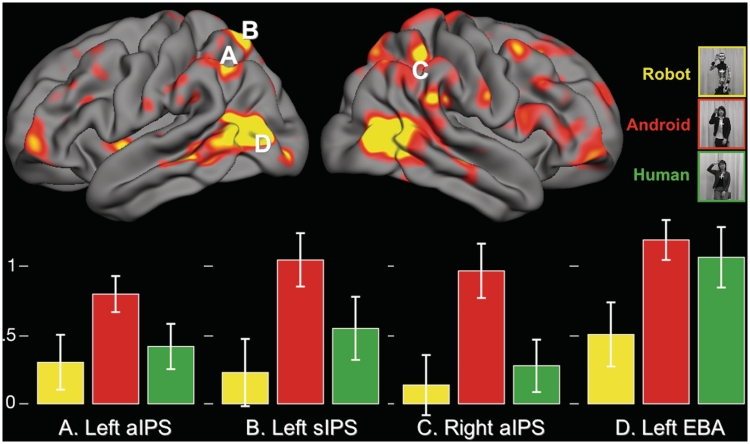
- The action perception system was largely not selective for appearance or motion per se; the main exception was left extrastriate body area (EBA), which showed more suppression for human-like appearance (Agent × Repetition, P = 0.03; Android > Robot, P = 0.02; Human > Robot, P = 0.07).
- The Android condition produced stronger repetition suppression than both Human and Robot in bilateral anterior intraparietal sulcus (aIPS): left aIPS Agent × Repetition P = 0.002, Android > Robot P = 0.002, Android > Human P = 0.004; right aIPS Agent × Repetition P = 0.002, Android > Robot P = 0.003, Android > Human P = 0.02.
- Left superior intraparietal sulcus (sIPS) also showed an Agent × Repetition interaction (P = 0.04), with Android > Robot (P = 0.01).
- Behavioral accuracy on comprehension questions was 0.84 (s.d. = 0.28) and did not differ between conditions; eye movement measures also did not differ between conditions (P > 0.1 for all pairwise comparisons).
Methods
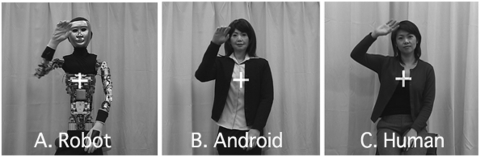
- Twenty healthy right-handed adults aged 20–36 participated; data from one participant were excluded due to excessive head movement. Participants watched 2-s grayscale video clips of eight actions performed by Human, Android (Repliee Q2 with human-like appearance and mechanical movement), and Robot (same robot stripped of human-like surface appearance, with identical mechanical movement).
- fMRI was performed on a 3 T Siemens Allegra scanner across 6 runs of 12 blocks; each block contained 12 videos, and each clip was equiprobably a repeat or nonrepeat of the previous clip.
- Data were analyzed with SPM5 using whole-brain random-effects repetition suppression (Nonrepeat > Repeat, t ≥ 8.86, P < 0.05 FDR-corrected, cluster ≥ 30 voxels), followed by ROI analyses using 5-mm spheres and repeated-measures ANOVA on Agent × Repetition.
Limitations
- The authors state that the experiment was not designed optimally to “explain” the uncanny valley and can make only a modest contribution to defining its neural basis; they also state that a conclusive or causal link between prediction error and the uncanny valley cannot be made from these data.
- The authors note there is no agreed-upon localizer for the action perception system, and ventral premotor cortex did not show significant repetition suppression despite being a key node of the APS.
- Evident from the text: the sample was small (20 recruited, 19 analyzed), and the Android and Robot conditions used the same robot with identical programmed kinematics, so appearance and motion were manipulated in a constrained, non-parametric way rather than independently across many agents.
Model-written summary. Check it against the paper before relying on it.
Integrity signals
Registry
Cites
Statistics
Figures
Verification
Claims the paper makes
35 Not checked yet · 30 Own result · 10 Own interpretation · 3 Own method · 2 No basis given
A result the paper reports from its own data — it cites no other source for it, so there is none to check. The quote shows it is in the paper.
In the paper
“With the exception of extrastriate body area, which showed more suppression for human like appearance, the APS was not selective for appearance or motion per se.”
§ The thing that should not be: predictive coding and the uncanny valley in perceiving human and humanoid robot actions > Abstract
plain- Asserted: passes — The authors put it forward as true.
- Checkable: passes — It can be checked against evidence.
- Load-bearing: passes — The paper’s conclusions depend on it.
- Based: passes — The paper gives a reason why it holds.
A result the paper reports from its own data — it cites no other source for it, so there is none to check. The quote shows it is in the paper.
In the paper
“they were stronger for the android, notably in bilateral anterior intraparietal sulcus, a key node in the APS.”
- Also stated in: § Experimental procedures and data analysis · plain
“aIPS | 40 | −42 | −38 | 42 | 3.96 | 0.30 | 0.81 | 0.42 | Agent × repetition (P = 0.002)”
§ The thing that should not be: predictive coding and the uncanny valley in perceiving human and humanoid robot actions > Abstract
plaincorrelational- Asserted: passes — The authors put it forward as true.
- Checkable: passes — It can be checked against evidence.
- Load-bearing: passes — The paper’s conclusions depend on it.
- Based: passes — The paper gives a reason why it holds.
- Also stated in: § Experimental procedures and data analysis · plain
A result the paper reports from its own data — it cites no other source for it, so there is none to check. The quote shows it is in the paper.
In the paper
“whereas suppression effects for the human and robot were similar to each other”
- Also stated in: § FMRI data · plain
“with the Human and Robot conditions leading to similar patterns of suppression”
§ The thing that should not be: predictive coding and the uncanny valley in perceiving human and humanoid robot actions > Abstract
plain- Asserted: passes — The authors put it forward as true.
- Checkable: passes — It can be checked against evidence.
- Load-bearing: passes — The paper’s conclusions depend on it.
- Based: passes — The paper gives a reason why it holds.
- Also stated in: § FMRI data · plain
None of the sources cited for this claim have been checked yet.
In the paper
“There was a significant Agent by Repetition interaction in the anterior portion of the intraparietal sulcus bilaterally, corresponding to area aIPS, the putative human homologue of macaque area AIP (Grefkes and Fink, 2005; Culham and Valyear, 2006; Grafton and Hamilton, 2007).”
§ The thing that should not be: predictive coding and the uncanny valley in perceiving human and humanoid robot actions > DISCUSSION > Summary of study and findings
What the sources say
- Not checked yetcites Grefkes and Fink, 2005
- Not checked yetcites Culham and Valyear, 2006
- Not checked yetcites Grafton and Hamilton, 2007
plaincorrelational- Asserted: passes — The authors put it forward as true.
- Checkable: passes — It can be checked against evidence.
- Load-bearing: passes — The paper’s conclusions depend on it.
- Based: passes — The paper gives a reason why it holds.
A result the paper reports from its own data — it cites no other source for it, so there is none to check. The quote shows it is in the paper.
In the paper
“We explored with a repeated measures analysis of variance (ANOVA) whether accuracy varied across conditions (it did not).”
- Also stated in: § Behavioral and eye movement data · plain
“Accuracy did not differ between conditions (P > 0.1 for all pair-wise comparisons).”
§ The thing that should not be: predictive coding and the uncanny valley in perceiving human and humanoid robot actions > METHODS > Experimental procedures and data analysis
plain- Asserted: passes — The authors put it forward as true.
- Checkable: passes — It can be checked against evidence.
- Load-bearing: passes — The paper’s conclusions depend on it.
- Based: passes — The paper gives a reason why it holds.
- Also stated in: § Behavioral and eye movement data · plain
A result the paper reports from its own data — it cites no other source for it, so there is none to check. The quote shows it is in the paper.
In the paper
“sIPS | | −20 | −70 | 60 | 4.57 | 0.23 | 1.06 | 0.55 | Agent × repetition (P = 0.04)”
- Also stated in: § Experimental procedures and data analysis · plain
“A > R (P = 0.01)”
§ The thing that should not be: predictive coding and the uncanny valley in perceiving human and humanoid robot actions > METHODS > Experimental procedures and data analysis
plaincorrelational- Asserted: passes — The authors put it forward as true.
- Checkable: passes — It can be checked against evidence.
- Load-bearing: passes — The paper’s conclusions depend on it.
- Based: passes — The paper gives a reason why it holds.
- Also stated in: § Experimental procedures and data analysis · plain
A result the paper reports from its own data — it cites no other source for it, so there is none to check. The quote shows it is in the paper.
In the paper
“the Android condition being distinctive, and leading to repetition suppression in a wider network”
§ The thing that should not be: predictive coding and the uncanny valley in perceiving human and humanoid robot actions > RESULTS > FMRI data
plaindirect- Asserted: passes — The authors put it forward as true.
- Checkable: passes — It can be checked against evidence.
- Load-bearing: passes — The paper’s conclusions depend on it.
- Based: passes — The paper gives a reason why it holds.
A result the paper reports from its own data — it cites no other source for it, so there is none to check. The quote shows it is in the paper.
In the paper
“We used an MR-compatible eye tracker (see Supplementary Data) to check whether eye movements differed between conditions (they did not).”
- Also stated in: § Behavioral and eye movement data · plain
“None of the eye movement measures (Mean and s.d. of x and y position, Pupil size) differed between conditions (P > 0.1 for all pair-wise comparisons).”
§ The thing that should not be: predictive coding and the uncanny valley in perceiving human and humanoid robot actions > METHODS > Experimental procedures and data analysis
plain- Asserted: passes — The authors put it forward as true.
- Checkable: passes — It can be checked against evidence.
- Load-bearing: passes — The paper’s conclusions depend on it.
- Based: passes — The paper gives a reason why it holds.
- Also stated in: § Behavioral and eye movement data · plain
A result the paper reports from its own data — it cites no other source for it, so there is none to check. The quote shows it is in the paper.
In the paper
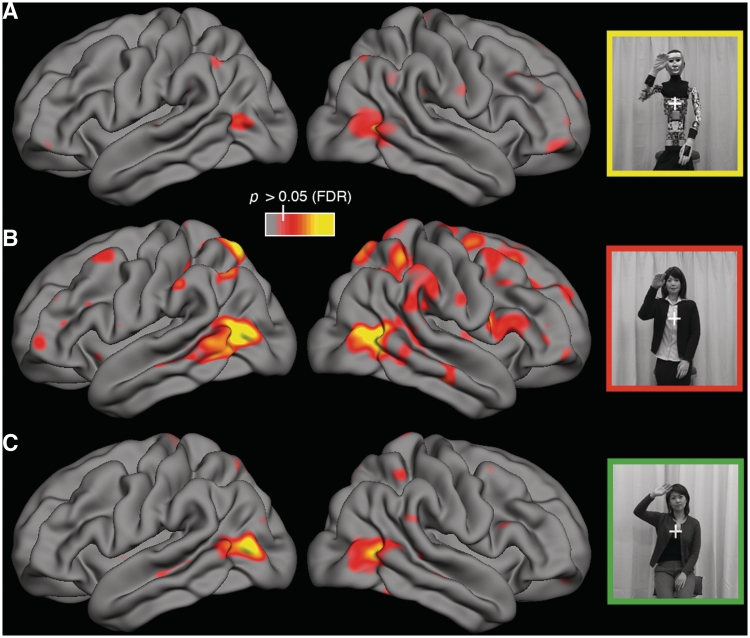
“Broadly consistent with previous repetition suppression studies of action perception, the main effect of Repetition revealed a network of areas, including occipital, lateral and ventral temporal, parietal, frontal, parahippocampal and cerebellar regions (Figure 3 and Table 1).”
§ The thing that should not be: predictive coding and the uncanny valley in perceiving human and humanoid robot actions > RESULTS > FMRI data
plaincorrelational- Asserted: passes — The authors put it forward as true.
- Checkable: passes — It can be checked against evidence.
- Load-bearing: unclear — It is unclear whether the paper’s conclusions depend on it.
- Based: passes — The paper gives a reason why it holds.
In the paper
“There was a large swathe of suppression covering multiple functional visual areas, but the interaction was present only in one subpeak, the coordinates of which corresponded to the previously reported location of the extrastriate body area (EBA) (Peelen and Downing, 2007), a region that responds more strongly to images of bodies and body parts compared with other kinds of stimuli.”
§ The thing that should not be: predictive coding and the uncanny valley in perceiving human and humanoid robot actions > RESULTS > FMRI data
What the sources say
- Not checked yetcites Peelen and Downing, 2007
plain- Asserted: passes — The authors put it forward as true.
- Checkable: passes — It can be checked against evidence.
- Load-bearing: passes — The paper’s conclusions depend on it.
- Based: passes — The paper gives a reason why it holds.
- It may state two separate claims as one. 12
- The quote only partly states this claim. 2
- Probably not a substantial claim. 22
A result the paper reports from its own data — it cites no other source for it, so there is none to check. The quote shows it is in the paper.
In the paper
“Even though there was qualitatively more suppression for the Android condition compared with the others in a widespread network (Figure 2), the Agent by Repetition interaction reached significance in only a subset of these regions (Table 1).”
§ The thing that should not be: predictive coding and the uncanny valley in perceiving human and humanoid robot actions > RESULTS > FMRI data
plain- Asserted: passes — The authors put it forward as true.
- Checkable: passes — It can be checked against evidence.
- Load-bearing: unclear — It is unclear whether the paper’s conclusions depend on it.
- Based: passes — The paper gives a reason why it holds.
It may state two separate claims as one.
A result the paper reports from its own data — it cites no other source for it, so there is none to check. The quote shows it is in the paper.
In the paper
“Fusiform gyrus | | 46 | −44 | −16 | 4.02 | 0.22 | 0.87 | 0.41 | Agent × repetition (P = 0.075)”
- Also stated in: § Experimental procedures and data analysis · plain
“A > R (P = 0.01)”
- Also stated in: § Experimental procedures and data analysis · plain
“A > H (P = 0.05)”
§ The thing that should not be: predictive coding and the uncanny valley in perceiving human and humanoid robot actions > METHODS > Experimental procedures and data analysis
plaincorrelational- Asserted: passes — The authors put it forward as true.
- Checkable: passes — It can be checked against evidence.
- Load-bearing: passes — The paper’s conclusions depend on it.
- Based: passes — The paper gives a reason why it holds.
It may state two separate claims as one.
- Also stated in: § Experimental procedures and data analysis · plain
A result the paper reports from its own data — it cites no other source for it, so there is none to check. The quote shows it is in the paper.
In the paper
“aIPS | 40 | −42 | −38 | 42 | 3.96 | 0.30 | 0.81 | 0.42 | Agent × repetition (P = 0.002)”
- Also stated in: § Experimental procedures and data analysis · plain
“A > R (P = 0.002)”
§ The thing that should not be: predictive coding and the uncanny valley in perceiving human and humanoid robot actions > METHODS > Experimental procedures and data analysis
plaincorrelational- Asserted: passes — The authors put it forward as true.
- Checkable: passes — It can be checked against evidence.
- Load-bearing: passes — The paper’s conclusions depend on it.
- Based: passes — The paper gives a reason why it holds.
The quote only partly states this claim.
- Also stated in: § Experimental procedures and data analysis · plain
A result the paper reports from its own data — it cites no other source for it, so there is none to check. The quote shows it is in the paper.
In the paper
“For completeness, we also report the main effect of Agent: this effect was found in visual cortex bilaterally (with peaks in MNI coordinates −30, −92, 2 and 38, −80, −16), and was driven by a stronger response for the Robot condition compared with the other agents.”
§ The thing that should not be: predictive coding and the uncanny valley in perceiving human and humanoid robot actions > RESULTS > FMRI data
plaindirect- Asserted: passes — The authors put it forward as true.
- Checkable: passes — It can be checked against evidence.
- Load-bearing: fails — The paper’s conclusions may not depend on it.
- Based: passes — The paper gives a reason why it holds.
Probably not a substantial claim. The paper’s conclusions may not depend on it. It may state two separate claims as one.
A result the paper reports from its own data — it cites no other source for it, so there is none to check. The quote shows it is in the paper.
In the paper
“There were other repetition suppression foci in frontal cortex, including one that extended into dorsal premotor cortex.”
§ The thing that should not be: predictive coding and the uncanny valley in perceiving human and humanoid robot actions > RESULTS > FMRI data
plain- Asserted: passes — The authors put it forward as true.
- Checkable: passes — It can be checked against evidence.
- Load-bearing: fails — The paper’s conclusions may not depend on it.
- Based: passes — The paper gives a reason why it holds.
Probably not a substantial claim. The paper’s conclusions may not depend on it.
A result the paper reports from its own data — it cites no other source for it, so there is none to check. The quote shows it is in the paper.
In the paper
“The right hemisphere peak, and a more dorsal subpeak of the left hemisphere cluster, did not show significant differences between agents.”
§ The thing that should not be: predictive coding and the uncanny valley in perceiving human and humanoid robot actions > RESULTS > FMRI data
plain- Asserted: passes — The authors put it forward as true.
- Checkable: passes — It can be checked against evidence.
- Load-bearing: unclear — It is unclear whether the paper’s conclusions depend on it.
- Based: passes — The paper gives a reason why it holds.
It may state two separate claims as one.
A result the paper reports from its own data — it cites no other source for it, so there is none to check. The quote shows it is in the paper.
In the paper
“Repetition suppression was found in the parietal and temporal nodes of the APS, but despite being a key node of the APS, ventral premotor cortex did not show significant repetition suppression (cf Chong et al., 2008; Lestou et al., 2008; Grossman et al., 2010).”
§ The thing that should not be: predictive coding and the uncanny valley in perceiving human and humanoid robot actions > RESULTS > FMRI data
plain- Asserted: passes — The authors put it forward as true.
- Checkable: passes — It can be checked against evidence.
- Load-bearing: unclear — It is unclear whether the paper’s conclusions depend on it.
- Based: passes — The paper gives a reason why it holds.
It may state two separate claims as one.
A result the paper reports from its own data — it cites no other source for it, so there is none to check. The quote shows it is in the paper.
In the paper
“Middle Frontal Gyrus | 46 | 50 | 48 | 10 | 3.93 | 0.58 | 0.80 | 0.22 | A > H (P = 0.07)”
§ The thing that should not be: predictive coding and the uncanny valley in perceiving human and humanoid robot actions > METHODS > Experimental procedures and data analysis
plaincorrelational- Asserted: passes — The authors put it forward as true.
- Checkable: passes — It can be checked against evidence.
- Load-bearing: fails — The paper’s conclusions may not depend on it.
- Based: passes — The paper gives a reason why it holds.
Probably not a substantial claim. The paper’s conclusions may not depend on it.
A result the paper reports from its own data — it cites no other source for it, so there is none to check. The quote shows it is in the paper.
In the paper
“Parahippocampal/Amygdala | | 26 | −4 | −18 | 3.99 | 0.10 | 0.68 | 0.75 | A > R (P = 0.09)”
- Also stated in: § Experimental procedures and data analysis · plain
“H > R (P = 0.08)”
§ The thing that should not be: predictive coding and the uncanny valley in perceiving human and humanoid robot actions > METHODS > Experimental procedures and data analysis
plaincorrelational- Asserted: passes — The authors put it forward as true.
- Checkable: passes — It can be checked against evidence.
- Load-bearing: unclear — It is unclear whether the paper’s conclusions depend on it.
- Based: passes — The paper gives a reason why it holds.
It may state two separate claims as one. The quote only partly states this claim.
- Also stated in: § Experimental procedures and data analysis · plain
A result the paper reports from its own data — it cites no other source for it, so there is none to check. The quote shows it is in the paper.
In the paper
“All showed reduced responses to the repeated stimuli, with the exception of primary visual cortex, which showed repetition enhancement.”
§ The thing that should not be: predictive coding and the uncanny valley in perceiving human and humanoid robot actions > RESULTS > FMRI data
plaindirect- Asserted: passes — The authors put it forward as true.
- Checkable: passes — It can be checked against evidence.
- Load-bearing: unclear — It is unclear whether the paper’s conclusions depend on it.
- Based: passes — The paper gives a reason why it holds.
It may state two separate claims as one.
A result the paper reports from its own data — it cites no other source for it, so there is none to check. The quote shows it is in the paper.
In the paper
“H > R (P = 0.07)”
§ The thing that should not be: predictive coding and the uncanny valley in perceiving human and humanoid robot actions > METHODS > Experimental procedures and data analysis
plaincorrelational- Asserted: passes — The authors put it forward as true.
- Checkable: passes — It can be checked against evidence.
- Load-bearing: fails — The paper’s conclusions may not depend on it.
- Based: passes — The paper gives a reason why it holds.
Probably not a substantial claim. The paper’s conclusions may not depend on it.
In the paper
“In non-human primates, at least two of these regions have been reported to contain ‘mirror neurons’, which fire during the execution as well as the observation of specific movements”
§ The thing that should not be: predictive coding and the uncanny valley in perceiving human and humanoid robot actions > INTRODUCTION
What the sources say
- Not checked yetcites Rizzolatti and Craighero, 2004
hedged- Asserted: passes — The authors put it forward as true.
- Checkable: passes — It can be checked against evidence.
- Load-bearing: fails — The paper’s conclusions may not depend on it.
- Based: passes — The paper gives a reason why it holds.
Probably not a substantial claim. The paper’s conclusions may not depend on it.
In the paper
“In primates, perception of body movements is thought to be supported by a network including lateral superior temporal, inferior parietal and inferior frontal brain areas.”
§ The thing that should not be: predictive coding and the uncanny valley in perceiving human and humanoid robot actions > INTRODUCTION
What the sources say
- Not checked yetcites Blake and Shiffrar, 2007
hedgedcorrelational- Asserted: passes — The authors put it forward as true.
- Checkable: passes — It can be checked against evidence.
- Load-bearing: fails — The paper’s conclusions may not depend on it.
- Based: passes — The paper gives a reason why it holds.
Probably not a substantial claim. The paper’s conclusions may not depend on it.
None of the sources cited for this claim have been checked yet.
In the paper
“Some studies have reported that artificial agents’ actions apparently affect the observers’ own motor processing, or activity within the APS, whereas others have argued that the APS either does not respond, or responds weakly if the perceived actor is not human”
§ The thing that should not be: predictive coding and the uncanny valley in perceiving human and humanoid robot actions > INTRODUCTION
What the sources say
- Not checked yetcites Kilner et al., 2003
- Not checked yetcites Tai et al., 2004
- Not checked yetcites Chaminade and Hodgins, 2006
hedgedconditional- Asserted: passes — The authors put it forward as true.
- Checkable: passes — It can be checked against evidence.
- Load-bearing: passes — The paper’s conclusions depend on it.
- Based: passes — The paper gives a reason why it holds.
Probably not a substantial claim. It may state two separate claims as one.
None of the sources cited for this claim have been checked yet.
In the paper
“Neuroimaging studies have shown responses in these areas during observation of actions”
§ The thing that should not be: predictive coding and the uncanny valley in perceiving human and humanoid robot actions > INTRODUCTION
What the sources say
- Not checked yetcites Saygin et al., 2004a
- Not checked yetcites Pobric and Hamilton, 2006
- Not checked yetcites Grafton and Hamilton, 2007
plaincorrelational- Asserted: passes — The authors put it forward as true.
- Checkable: passes — It can be checked against evidence.
- Load-bearing: fails — The paper’s conclusions may not depend on it.
- Based: passes — The paper gives a reason why it holds.
Probably not a substantial claim. The paper’s conclusions may not depend on it.
None of the sources cited for this claim have been checked yet.
In the paper
“neuropsychological patient and transcranial magnetic stimulation (TMS) studies have shown that damage or disruption of these areas can affect action processing”
§ The thing that should not be: predictive coding and the uncanny valley in perceiving human and humanoid robot actions > INTRODUCTION
What the sources say
- Not checked yetcites Saygin et al., 2004a
- Not checked yetcites Pobric and Hamilton, 2006
- Not checked yetcites Grafton and Hamilton, 2007
plainconditional- Asserted: passes — The authors put it forward as true.
- Checkable: passes — It can be checked against evidence.
- Load-bearing: fails — The paper’s conclusions may not depend on it.
- Based: passes — The paper gives a reason why it holds.
Probably not a substantial claim. The paper’s conclusions may not depend on it.
None of the sources cited for this claim have been checked yet.
In the paper
“The appearance of the observed agent may also be important”
§ The thing that should not be: predictive coding and the uncanny valley in perceiving human and humanoid robot actions > INTRODUCTION
What the sources say
- Not checked yetcites Buccino et al., 2004
- Not checked yetcites Chaminade et al., 2007
hedgedconditional- Asserted: passes — The authors put it forward as true.
- Checkable: passes — It can be checked against evidence.
- Load-bearing: passes — The paper’s conclusions depend on it.
- Based: passes — The paper gives a reason why it holds.
Probably not a substantial claim.
None of the sources cited for this claim have been checked yet.
In the paper
“there are links between activity within the APS and whether the observer can perform the seen movement”
§ The thing that should not be: predictive coding and the uncanny valley in perceiving human and humanoid robot actions > INTRODUCTION
What the sources say
- Not checked yetcites Calvo-Merino et al., 2006
- Not checked yetcites Cross et al., 2006
- Not checked yetcites Candidi et al., 2008
plaincorrelational- Asserted: passes — The authors put it forward as true.
- Checkable: passes — It can be checked against evidence.
- Load-bearing: fails — The paper’s conclusions may not depend on it.
- Based: passes — The paper gives a reason why it holds.
Probably not a substantial claim. The paper’s conclusions may not depend on it.
In the paper
“Most modern androids, including Repliee Q2 used here, are also thought to fall into the uncanny valley”
§ The thing that should not be: predictive coding and the uncanny valley in perceiving human and humanoid robot actions > INTRODUCTION
What the sources say
- Not checked yetcites Ishiguro, 2006
hedged- Asserted: passes — The authors put it forward as true.
- Checkable: passes — It can be checked against evidence.
- Load-bearing: fails — The paper’s conclusions may not depend on it.
- Based: passes — The paper gives a reason why it holds.
Probably not a substantial claim. The paper’s conclusions may not depend on it.
In the paper
“Repetition suppression effects are thought to reflect stimulus processing rather than task demands”
§ The thing that should not be: predictive coding and the uncanny valley in perceiving human and humanoid robot actions > INTRODUCTION
What the sources say
- Not checked yetcites Xu et al., 2007
hedged- Asserted: passes — The authors put it forward as true.
- Checkable: passes — It can be checked against evidence.
- Load-bearing: passes — The paper’s conclusions depend on it.
- Based: passes — The paper gives a reason why it holds.
Probably not a substantial claim.
None of the sources cited for this claim have been checked yet.
In the paper
“These predictions can be used to correct for unanticipated events, and to account for sensory noise and delays.”
§ The thing that should not be: predictive coding and the uncanny valley in perceiving human and humanoid robot actions > INTRODUCTION
What the sources say
- Not checked yetcites Wolpert et al., 1995
- Not checked yetcites Wolpert and Miall, 1996
plaindirect- Asserted: passes — The authors put it forward as true.
- Checkable: passes — It can be checked against evidence.
- Load-bearing: fails — The paper’s conclusions may not depend on it.
- Based: passes — The paper gives a reason why it holds.
Probably not a substantial claim. The paper’s conclusions may not depend on it. It may state two separate claims as one.
None of the sources cited for this claim have been checked yet.
In the paper
“Repetition is thought to lead to such reduced responses only in neurons selective for the repeated properties”
§ The thing that should not be: predictive coding and the uncanny valley in perceiving human and humanoid robot actions > INTRODUCTION
What the sources say
- Not checked yetcites Henson and Rugg, 2003
- Not checked yetcites Grill-Spector et al., 2006
- Not checked yetcites Krekelberg et al., 2006
hedgeddirect- Asserted: passes — The authors put it forward as true.
- Checkable: passes — It can be checked against evidence.
- Load-bearing: passes — The paper’s conclusions depend on it.
- Based: passes — The paper gives a reason why it holds.
Probably not a substantial claim.
In the paper
“The models can be recruited to infer the meaning of a perceived action given the sensory information”
§ The thing that should not be: predictive coding and the uncanny valley in perceiving human and humanoid robot actions > INTRODUCTION
What the sources say
- Not checked yetcites Wolpert et al., 2003
plaindirect- Asserted: passes — The authors put it forward as true.
- Checkable: passes — It can be checked against evidence.
- Load-bearing: passes — The paper’s conclusions depend on it.
- Based: passes — The paper gives a reason why it holds.
Probably not a substantial claim.
What the paper did — it cites no source for this, so there is none to check. The quote shows it is in the paper.
In the paper
“They were not uncertain about the identity of the android by the time scanning took place.”
§ The thing that should not be: predictive coding and the uncanny valley in perceiving human and humanoid robot actions > METHODS > Experimental procedures and data analysis
plain- Asserted: passes — The authors put it forward as true.
- Checkable: passes — It can be checked against evidence.
- Load-bearing: passes — The paper’s conclusions depend on it.
- Based: passes — The paper gives a reason why it holds.
Probably not a substantial claim.
In the paper
“During perception, the error between the prediction coming from internal models and incoming visual information can be minimized by selecting models yielding accurate predictions, that therefore correspond to the observed action”
§ The thing that should not be: predictive coding and the uncanny valley in perceiving human and humanoid robot actions > INTRODUCTION
What the sources say
- Not checked yetcites Kilner et al., 2007
plaindirect- Asserted: passes — The authors put it forward as true.
- Checkable: passes — It can be checked against evidence.
- Load-bearing: passes — The paper’s conclusions depend on it.
- Based: passes — The paper gives a reason why it holds.
Probably not a substantial claim.
What the paper did — it cites no source for this, so there is none to check. The quote shows it is in the paper.
In the paper
“Data from one participant could not be used due to excessive head movement.”
§ The thing that should not be: predictive coding and the uncanny valley in perceiving human and humanoid robot actions > METHODS > Participants
hedgeddirectSingle case- Asserted: passes — The authors put it forward as true.
- Checkable: passes — It can be checked against evidence.
- Load-bearing: fails — The paper’s conclusions may not depend on it.
- Based: passes — The paper gives a reason why it holds.
Probably not a substantial claim. The paper’s conclusions may not depend on it.
The paper states this without a source or data behind it here, so there is nothing to check it against. The quote shows it is in the paper.
In the paper
“BOLD differences for the experimental conditions (e.g. a main effect of Agent) can arise due to a number of low-level stimulus factors such as differences in illumination, spatial frequency, color, or contrast that have little or nothing to do with action processing, as well as nonspecific attention or arousal effects.”
§ The thing that should not be: predictive coding and the uncanny valley in perceiving human and humanoid robot actions > INTRODUCTION
plaindirect- Asserted: passes — The authors put it forward as true.
- Checkable: passes — It can be checked against evidence.
- Load-bearing: passes — The paper’s conclusions depend on it.
- Based: fails — The paper may give no reason why it holds.
Probably not a substantial claim. The paper may give no reason why it holds.
In the paper
“While the android used in our study is often mistaken for a human at first sight, longer exposure and dynamic viewing has been linked to the uncanny valley (Ishiguro, 2006).”
§ The thing that should not be: predictive coding and the uncanny valley in perceiving human and humanoid robot actions > DISCUSSION > Contribution to the understanding of the uncanny valley
What the sources say
- Not checked yetcites Ishiguro, 2006
plaincorrelational- Asserted: passes — The authors put it forward as true.
- Checkable: passes — It can be checked against evidence.
- Load-bearing: passes — The paper’s conclusions depend on it.
- Based: passes — The paper gives a reason why it holds.
It may state two separate claims as one.
A conclusion the paper draws from its own results — it cites no other source for it, so there is none to check. The quote shows it is in the paper.
In the paper
“For the Android, however, there was a mismatch between the human-like appearance and the mechanical motion, leading to a larger prediction error, manifest as activity in relevant brain regions.”
§ The thing that should not be: predictive coding and the uncanny valley in perceiving human and humanoid robot actions > DISCUSSION > Predictive coding
plaindirect- Asserted: passes — The authors put it forward as true.
- Checkable: passes — It can be checked against evidence.
- Load-bearing: passes — The paper’s conclusions depend on it.
- Based: passes — The paper gives a reason why it holds.
It may state two separate claims as one.
- Rests on an assumption: We have a lifetime of experience that associates human appearance with biological motion, and machines (such as robots) with mechanical motion.
- Rests on an assumption: For both the Human and Robot conditions, the observed motion kinematics was congruent with what would be predicted from the appearance of the agent.
In the paper
“Our experiments and similar studies (e.g. Steckenfinger and Ghazanfar, 2009) were not designed in an optimum fashion to ‘explain’ the uncanny valley and as such can only make a modest contribution to defining its neural basis.”
§ The thing that should not be: predictive coding and the uncanny valley in perceiving human and humanoid robot actions > DISCUSSION > Contribution to the understanding of the uncanny valley
What the sources say
- Not checked yetcites Steckenfinger and Ghazanfar, 2009
plain- Asserted: passes — The authors put it forward as true.
- Checkable: unclear — It is unclear whether it could be checked against evidence.
- Load-bearing: passes — The paper’s conclusions depend on it.
- Based: passes — The paper gives a reason why it holds.
It may state two separate claims as one.
In the paper
“It has also long been acknowledged that violating perceptual expectations can have striking effects, compellingly illustrated by perceptual illusions (e.g. Gregory, 1980).”
§ The thing that should not be: predictive coding and the uncanny valley in perceiving human and humanoid robot actions > DISCUSSION > Toward an interdisciplinary science of social perception
What the sources say
- Not checked yetcites Gregory, 1980
boosteddirect- Asserted: passes — The authors put it forward as true.
- Checkable: passes — It can be checked against evidence.
- Load-bearing: fails — The paper’s conclusions may not depend on it.
- Based: passes — The paper gives a reason why it holds.
Probably not a substantial claim. The paper’s conclusions may not depend on it.
None of the sources cited for this claim have been checked yet.
In the paper
“The prediction error would be smaller when a stimulus was preceded by the same stimulus, consistent with neural models of repetition suppression (Desimone and Duncan, 1995; Friston, 2005; Grill-Spector et al., 2006).”
§ The thing that should not be: predictive coding and the uncanny valley in perceiving human and humanoid robot actions > DISCUSSION > Predictive coding
What the sources say
- Not checked yetcites Desimone and Duncan, 1995
- Not checked yetcites Friston, 2005
- Not checked yetcites Grill-Spector et al., 2006
hedgeddirect- Asserted: passes — The authors put it forward as true.
- Checkable: passes — It can be checked against evidence.
- Load-bearing: fails — The paper’s conclusions may not depend on it.
- Based: passes — The paper gives a reason why it holds.
Probably not a substantial claim. The paper’s conclusions may not depend on it.
The paper relies on this without support.
Robots can have appearance or movement kinematics that are not biological, but can nevertheless be perceived as carrying out recognizable actions.
“robots can have appearance or movement kinematics that are not biological, but can nevertheless be perceived as carrying out recognizable actions.”
The paper relies on this without support.
We have a lifetime of experience that associates human appearance with biological motion, and machines (such as robots) with mechanical motion.
“We have a lifetime of experience that associates human appearance with biological motion, and machines (such as robots) with mechanical motion.”
The paper relies on this without support.
For both the Human and Robot conditions, the observed motion kinematics was congruent with what would be predicted from the appearance of the agent.
“For both our Human condition and our Robot condition, the observed motion kinematics was congruent with what would be predicted from the appearance of the agent.”
Claims other papers make about this one
Each is checked against this paper’s own text: does it say what the citing paper says it does?
In the citing paper
“Another consequence is that we have omitted several relevant studies that have used physiological and behavioral measures, such as gaze tracking (e.g., Shimada et al., 2006) and haemodynamic response measurements in the brain (e.g., Chaminade et al., 2007; Saygin et al., 2012).”
From A review of empirical evidence on different uncanny valley hypotheses: support for perceptual mismatch as one road to the valley of eeriness (2015) · cites this paper as Saygin et al., 2012
Self-check
Percentages, sums and reported differences re-computed from the paper’s own numbers.
Each contradiction between two passages listed here was confirmed by an independent check.
Rated major: it would touch a result — a value a result rests on, reported and recomputed p-values on opposite sides of the significance level, two passages that conflict with no sign which is right, or a cited work retracted before this paper was published.
In the paper
§ The thing that should not be: predictive coding and the uncanny valley in perceiving human and humanoid robot actions > DISCUSSION > Summary of study and findings
“We found one region in left posterior lateral temporal cortex, where suppression for the Robot condition was significantly less than that for the human and the android, the two agents with human-like surface appearance.”
§ The thing that should not be: predictive coding and the uncanny valley in perceiving human and humanoid robot actions > METHODS > Experimental procedures and data analysis
“Lateral temporal cortex (EBA) | 37, 22 | −48 | −72 | 6 | 7.47 | 0.51 | 1.20 | 1.08 | H > R (P = 0.07) |”
Rated minor: it would not touch a result — a value no result rests on, a p-value that stays on the same side of the significance level, or a conflict that is clerical, resolved elsewhere in the paper, or outside its own findings.
In the paper
§ The thing that should not be: predictive coding and the uncanny valley in perceiving human and humanoid robot actions > METHODS > Experimental procedures and data analysis
“We identified regions showing repetition suppression (Nonrepeat > Repeat) at t ≥ 8.86; P < 0.05 false discovery rate (FDR) corrected, with a cluster size of at least 30 voxels (Table 1)”
§ The thing that should not be: predictive coding and the uncanny valley in perceiving human and humanoid robot actions > METHODS > Experimental procedures and data analysis
“V1/V2 | 17, 18 | 16 | −88 | 2 | 5.86 | −0.79 | −0.88 | −0.73 | None |”
Citations
Cites
The Ecological Approach to Visual Perception
Bornstein, M. H., & Gibson, J. J. (1980) · The Journal of Aesthetics and Art Criticism · doi:10.2307/429816 · Cited by 22,935
Neural Mechanisms of Selective Visual Attention
Desimone, R., & Duncan, J. (1995) · Annual Review of Neuroscience · doi:10.1146/annurev.ne.18.030195.001205 · Cited by 8,388
The free-energy principle: a unified brain theory?
Friston, K. (2010) · Nature Reviews Neuroscience · doi:10.1038/nrn2787 · Cited by 8,120 · cited 4×
“…effects for the Android condition, can be reconciled with the ‘predictive coding’ framework of neural processing (e.g. Rao and Ballard, 1999; Friston, 2005, 2010; Kilner et al., 2007; Jakobs et al., 2009), which is based on minimization of prediction error among the levels of a cortical…”
BackgroundInfluentialRizzolatti, G., & Craighero, L. (2004) · Annual Review of Neuroscience · doi:10.1146/annurev.neuro.27.070203.144230 · Cited by 7,433
Rao, R. P. N., & Ballard, D. H. (1999) · Nature Neuroscience · doi:10.1038/4580 · Cited by 5,483 · cited 4×
“When the behavior of the agent violates the prediction, an error is generated (see ‘Discussion’ section; Rao and Ballard, 1999; Friston, 2010); although to be clear, prediction error is not the same thing as consciously experienced surprise (Friston, 2005; Kiebel et al., 2009).”
BackgroundInfluentialA theory of cortical responses.
Friston, K. (2005) · Philosophical Transactions of the Royal Society B: Biological Sciences · doi:10.1098/rstb.2005.1622 · Cited by 4,578
An internal model for sensorimotor integration
Wolpert, D. M., Ghahramani, Z., & Jordan, M. I. (1995) · Science · doi:10.1126/science.7569931 · Cited by 3,553
Neurophysiological mechanisms underlying the understanding and imitation of action
Rizzolatti, G., Fogassi, L., & Gallese, V. (2001) · Nature Reviews Neuroscience · doi:10.1038/35090060 · Cited by 3,302
Cattaneo, L., & Rizzolatti, G. (2009) · Archives of Neurology · doi:10.1001/archneurol.2009.41 · Cited by 3,137
Circular analysis in systems neuroscience: the dangers of double dipping
Kriegeskorte, N., Simmons, W. K., Bellgowan, P. S. F., & Baker, C. I. (2009) · Nature Neuroscience · doi:10.1038/nn.2303 · Cited by 2,696
Internal models for motor control and trajectory planning.
Kawato, M. (1999) · Current Opinion in Neurobiology · doi:10.1016/s0959-4388(99)00028-8 · Cited by 2,685
Forward Models for Physiological Motor Control
Miall, R. C., & Wolpert, D. M. (1996) · Neural Networks · doi:10.1016/s0893-6080(96)00035-4 · Cited by 2,260
Repetition and the brain: neural models of stimulus-specific effects
Grill-Spector, K., Henson, R., & Martin, A. (2006) · Trends in Cognitive Sciences · doi:10.1016/j.tics.2005.11.006 · Cited by 2,256
From presence to consciousness through virtual reality.
Sanchez-Vives, M. V., & Slater, M. (2005) · Nature reviews. Neuroscience · doi:10.1038/nrn1651 · Cited by 1,831
Bukimi no tani [the uncanny valley]
Mori, M. (1970) · Energy · Cited by 1,485
A unifying computational framework for motor control and social interaction
Wolpert, D. M., Doya, K., & Kawato, M. (2003) · Philosophical Transactions of the Royal Society of London. Series B: Biological Sciences · doi:10.1098/rstb.2002.1238 · Cited by 1,228
Socially intelligent robots: Dimensions of human-robot interaction
Dautenhahn, K. (2007) · Philosophical Transactions of the Royal Society B: Biological Sciences · doi:10.1098/rstb.2006.2004 · Cited by 1,210 · cited 4×
“Humanoid robots and artificial agents are increasingly part of our daily lives (Kanda et al., 2004; Dautenhahn, 2007; Tapus et al., 2007).”
BackgroundMethodInfluentialSeeing or Doing? Influence of Visual and Motor Familiarity in Action Observation
Calvo‐Merino, B., Grèzes, J., Glaser, D. E., Passingham, R. E., & Haggard, P. (2006) · Current Biology · doi:10.1016/j.cub.2006.07.065 · Cited by 1,186
Single-Neuron Responses in Humans during Execution and Observation of Actions
Mukamel, R., Ekstrom, A. D., Kaplan, J., Iacoboni, M., & Fried, I. (2010) · Current Biology · doi:10.1016/j.cub.2010.02.045 · Cited by 1,178 · cited 1×
“The exact relationship between mirror neurons and brain areas that support action perception in the human brain remains a topic of debate (e.g. Dinstein et al., 2007; Chong et al., 2008; Kilner et al., 2009; Mukamel et al., 2010).”
BackgroundSimulation, situated conceptualization, and prediction
Barsalou, L. W. (2009) · Philosophical Transactions of the Royal Society B: Biological Sciences · doi:10.1098/rstb.2008.0319 · Cited by 1,017
Blake, R., & Shiffrar, M. (2006) · Annual Review of Psychology · doi:10.1146/annurev.psych.57.102904.190152 · Cited by 1,017
Vision as Bayesian inference: analysis by synthesis?
Yuille, A., & Kersten, D. (2006) · Trends in Cognitive Sciences · doi:10.1016/j.tics.2006.05.002 · Cited by 849
An Interference Effect of Observed Biological Movement on Action
Kilner, J. M., Paulignan, Y., & Blakemore, S. J. (2003) · Current Biology · doi:10.1016/s0960-9822(03)00165-9 · Cited by 844
Building a motor simulation de novo: Observation of dance by dancers
Cross, E. S., Hamilton, A. F. D. C., & Grafton, S. T. (2006) · NeuroImage · doi:10.1016/j.neuroimage.2006.01.033 · Cited by 807
Gregory, R. L. (1980) · Philosophical Transactions of the Royal Society of London. B, Biological Sciences · doi:10.1098/rstb.1980.0090 · Cited by 789
REVIEW: The functional organization of the intraparietal sulcus in humans and monkeys
Grefkes, C., & Fink, G. R. (2005) · Journal of Anatomy · doi:10.1111/j.1469-7580.2005.00426.x · Cited by 788
Neural Circuits Involved in the Recognition of Actions Performed by Nonconspecifics: An fMRI Study
Buccino, G., Lui, F., Canessa, N., Patteri, I., Lagravinese, G., Benuzzi, F., Porro, C. A., & Rizzolatti, G. (2004) · Journal of Cognitive Neuroscience · doi:10.1162/089892904322755601 · Cited by 762
The anthropomorphic brain: The mirror neuron system responds to human and robotic actions
Gazzola, V., Rizzolatti, G., Wicker, B., & Keysers, C. (2007) · NeuroImage · doi:10.1016/j.neuroimage.2007.02.003 · Cited by 748
The neural basis of visual body perception
Peelen, M. V., & Downing, P. E. (2007) · Nature reviews. Neuroscience · doi:10.1038/nrn2195 · Cited by 718
The uncanny advantage of using androids in cognitive and social science research
MacDorman, K. F., & Ishiguro, H. (2006) · Interaction Studies Social Behaviour and Communication in Biological and Artificial Systems · doi:10.1075/is.7.3.03mac · Cited by 658
Self-citationHuman parietal cortex in action
Culham, J. C., & Valyear, K. F. (2006) · Current Opinion in Neurobiology · doi:10.1016/j.conb.2006.03.005 · Cited by 654
The Uncanny Valley: Effect of Realism on the Impression of Artificial Human Faces
Seyama, J., & Nagayama, R. S. (2007) · PRESENCE Virtual and Augmented Reality · doi:10.1162/pres.16.4.337 · Cited by 583
Sensorimotor learning configures the human mirror system
Catmur, C., Walsh, V., & Heyes, C. (2007) · Current Biology · doi:10.1016/j.cub.2007.08.006 · Cited by 564
Socially assistive robotics [Grand Challenges of Robotics]
Tapus, A., Mataric, M., & Scassellati, B. (2007) · IEEE Robotics & Automation Magazine · doi:10.1109/mra.2007.339605 · Cited by 547
Petrides, M., & Pandya, D. Ν. (1988) · The Journal of Comparative Neurology · doi:10.1002/cne.902730106 · Cited by 547
Balas, B., Nelson, C. A., Westerlund, A., Vogel‐Farley, V. K., Riggins, T., & Kuefner, D. (2010) · Frontiers in Human Neuroscience · doi:10.3389/neuro.09.001.2010 · Cited by 544
Evidence of Mirror Neurons in Human Inferior Frontal Gyrus
Kilner, J. M., Neal, A., Weiskopf, N., Friston, K. J., & Frith, C. (2009) · Journal of Neuroscience · doi:10.1523/jneurosci.2668-09.2009 · Cited by 537
Self-citationToo real for comfort? Uncanny responses to computer generated faces
MacDorman, K. F., Green, R. D., Ho, C.-C., & Koch, C. T. (2009) · Computers in Human Behavior · doi:10.1016/j.chb.2008.12.026 · Cited by 533
Ho, C.-C., & MacDorman, K. F. (2010) · Computers in Human Behavior · doi:10.1016/j.chb.2010.05.015 · Cited by 532
Evidence for a distributed hierarchy of action representation in the brain
Grafton, S. T., & de C. Hamilton, A. F. (2007) · Human Movement Science · doi:10.1016/j.humov.2007.05.009 · Cited by 503
Adaptation: from single cells to BOLD signals
Krekelberg, B., Boynton, G. M., & Wezel, R. J. A. V. (2006) · Trends in Neurosciences · doi:10.1016/j.tins.2006.02.008 · Cited by 496
Goal Representation in Human Anterior Intraparietal Sulcus
Hamilton, A. F. D. C., & Grafton, S. T. (2006) · Journal of Neuroscience · doi:10.1523/jneurosci.4551-05.2006 · Cited by 478
Neural response suppression, haemodynamic repetition effects, and behavioural priming
Henson, R. N., & Rugg, M. D. (2002) · Neuropsychologia · doi:10.1016/s0028-3932(02)00159-8 · Cited by 444
Cortical connections of the inferior parietal cortical convexity of the macaque monkey.
Rozzi, S., Calzavara, R., Belmalih, A., Borra, E., Gregoriou, G., Matelli, M., & Luppino, G. (2006) · Cerebral Cortex · doi:10.1093/cercor/bhj076 · Cited by 419
Point-Light Biological Motion Perception Activates Human Premotor Cortex
Saygın, A. P., Wilson, S. M., Hagler, D. J., Bates, E. A., & Sereno, M. I. (2004) · Journal of Neuroscience · doi:10.1523/jneurosci.0504-04.2004 · Cited by 410
The Human Premotor Cortex Is 'Mirror' Only for Biological Actions
Tai, Y., Scherfler, C., Brooks, D. J., Sawamoto, N., & Castiello, U. (2004) · Current Biology · doi:10.1016/j.cub.2004.01.005 · Cited by 352
fMRI Adaptation Reveals Mirror Neurons in Human Inferior Parietal Cortex
Chong, T. T. ‐., Cunnington, R., Williams, M., Kanwisher, N., & Mattingley, J. B. (2008) · Current Biology · doi:10.1016/j.cub.2008.08.068 · Cited by 344
Superior temporal and premotor brain areas necessary for biological motion perception
Saygın, A. P. (2007) · Brain · doi:10.1093/brain/awm162 · Cited by 341
Seltzer, B., & Pandya, D. Ν. (1994) · The Journal of Comparative Neurology · doi:10.1002/cne.903430308 · Cited by 332
Does Japan really have robot mania? Comparing attitudes by implicit and explicit measures
MacDorman, K. F., Vasudevan, S. K., & Ho, C.-C. (2008) · AI & Society · doi:10.1007/s00146-008-0181-2 · Cited by 322
Brain activity evoked by the perception of human walking: controlling for meaningful coherent motion
Pelphrey, K. A., Mitchell, T. V., McKeown, M. J., Goldstein, J., Allison, T., & McCarthy, G. (2003) · The Journal of Neuroscience · doi:10.1523/jneurosci.23-17-06819.2003 · Cited by 314
Different Brain Correlates for Watching Real and Virtual Hand Actions
Perani, D., Fazio, F., Borghese, N. A., Tettamanti, M., Ferrari, S., Decety, J., & Gilardi, M. C. (2001) · NeuroImage · doi:10.1006/nimg.2001.0872 · Cited by 307
The mirror-neuron system: a Bayesian perspective
Kilner, J. M., Friston, K. J., & Frith, C. (2007) · Neuroreport · doi:10.1097/wnr.0b013e3281139ed0 · Cited by 291
Self-citationBrain areas selective for both observed and executed movements
Dinstein, I., Hasson, U., Rubin, N., & Heeger, D. J. (2007) · Journal of Neurophysiology · doi:10.1152/jn.00238.2007 · Cited by 290
Development and evaluation of interactive humanoid robots
Kanda, T., Ishiguro, H., Imai, M., & Ono, T. (2004) · Proceedings of the IEEE · doi:10.1109/jproc.2004.835359 · Cited by 266
Self-citationOn the psychology of the uncanny (1906)
Jentsch, E. (1997) · Angelaki · doi:10.1080/09697259708571910 · Cited by 258
Action Outcomes Are Represented in Human Inferior Frontoparietal Cortex
Hamilton, A. F. D. C., & Grafton, S. T. (2007) · Cerebral Cortex · doi:10.1093/cercor/bhm150 · Cited by 257
Oberman, L. M., McCleery, J. P., Ramachandran, V. S., & Pineda, J. A. (2007) · Neurocomputing · doi:10.1016/j.neucom.2006.02.024 · Cited by 248
Action Understanding Requires the Left Inferior Frontal Cortex
Pobric, G., & Hamilton, A. F. D. C. (2006) · Current Biology · doi:10.1016/j.cub.2006.01.033 · Cited by 224
Jastorff, J., & Orban, G. A. (2009) · Journal of Neuroscience · doi:10.1523/jneurosci.4870-08.2009 · Cited by 223
A Model of Biological Motion Perception from Configural Form Cues
Lange, J., & Lappe, M. (2006) · Journal of Neuroscience · doi:10.1523/jneurosci.4915-05.2006 · Cited by 218
Perceptual-cognitive universals as reflections of the world
Shepard, R. N. (2001) · Behavioral and Brain Sciences · doi:10.1017/s0140525x01000012 · Cited by 217
The Grand Challenges in Socially Assistive Robotics
Tapus, A., Matarić, M. J., & Scassellati, B. M. (2007) · HAL · Cited by 213
Parietofrontal Circuits for Action and Space Perception in the Macaque Monkey
Matelli, M., & Luppino, G. (2001) · NeuroImage · doi:10.1006/nimg.2001.0835 · Cited by 204
Analysis of Humanoid Appearances in Human–Robot Interaction
Kanda, T., Miyashita, T., Osada, T., Haikawa, Y., & Ishiguro, H. (2008) · IEEE Transactions on Robotics · doi:10.1109/tro.2008.921566 · Cited by 185
Self-citationAnthropomorphism influences perception of computer-animated characters' actions
Chaminade, T., Hodgins, J., & Kawato, M. (2007) · Social Cognitive and Affective Neuroscience · doi:10.1093/scan/nsm017 · Cited by 181
Self-citationMonkey visual behavior falls into the uncanny valley
Steckenfinger, S. A., & Ghazanfar, A. A. (2009) · Proceedings of the National Academy of Sciences · doi:10.1073/pnas.0910063106 · Cited by 180
Action comprehension in aphasia: linguistic and non-linguistic deficits and their lesion correlates
Saygın, A. P., Wilson, S. M., Dronkers, N. F., & Bates, E. A. (2004) · Neuropsychologia · doi:10.1016/j.neuropsychologia.2004.04.016 · Cited by 168
Sensorimotor experience enhances automatic imitation of robotic action
Press, C., Gillmeister, H., & Heyes, C. (2007) · Proceedings of the Royal Society of London. Biological Sciences · doi:10.1098/rspb.2007.0774 · Cited by 163
What is a Human? - Toward Psychological Benchmarks in the Field of Human-Robot Interaction
Kahn, P. H., Ishiguro, H., Friedman, B., & Kanda, T. (2006) · IEEE RO-MAN · doi:10.1109/roman.2006.314461 · Cited by 157
Self-citationfMRI and its interpretations: an illustration on directional selectivity in area V5/MT
Bartels, A., Logothetis, N. K., & Moutoussis, K. (2008) · Trends in Neurosciences · doi:10.1016/j.tins.2008.06.004 · Cited by 150
Brain Response to a Humanoid Robot in Areas Implicated in the Perception of Human Emotional Gestures
Chaminade, T., Zecca, M., Blakemore, S., Takanishi, A., Frith, C., Micera, S., Dario, P., Rizzolatti, G., Gallese, V., & Umiltà, M. A. (2010) · PLoS ONE · doi:10.1371/journal.pone.0011577 · Cited by 145
Self-citationKahn, P. H., Ishiguro, H., Friedman, B., Kanda, T., Freier, N. G., Severson, R. L., & Miller, J. (2007) · Interaction Studies Social Behaviour and Communication in Biological and Artificial Systems · doi:10.1075/is.8.3.04kah · Cited by 143
Self-citationThe exploitation of regularities in the environment by the brain
Barlow, H. B. (2001) · Behavioral and Brain Sciences · doi:10.1017/s0140525x01000024 · Cited by 139
Predictions: a universal principle in the operation of the human brain
Bar, M. (2009) · Philosophical Transactions of the Royal Society B Biological Sciences · doi:10.1098/rstb.2008.0321 · Cited by 139
Candidi, M., Urgesi, C., Ionta, S., & Aglioti, S. M. (2008) · Social Neuroscience · doi:10.1080/17470910701676269 · Cited by 134
Jakobs, O., Wang, L. E., Dafotakis, M., Grefkes, C., Zilles, K., & Eickhoff, S. B. (2009) · NeuroImage · doi:10.1016/j.neuroimage.2009.04.065 · Cited by 117
Perception and hierarchical dynamics
Kiebel, S. J. (2009) · Frontiers in Neuroinformatics · doi:10.3389/neuro.11.020.2009 · Cited by 106
Neural Substrates for Action Understanding at Different Description Levels in the Human Brain
Lestou, V., Pollick, F., & Kourtzi, Z. (2008) · Journal of Cognitive Neuroscience · doi:10.1162/jocn.2008.20021 · Cited by 104
The mirror-neurons system: data and models
Craighero, L., Giorgio Metta, B., Sandini, G., & Fadiga, L. (2007) · Progress in brain research · doi:10.1016/s0079-6123(07)64003-5 · Cited by 98
In search of the uncanny valley
Pollick, F. E. (2010) · Lecture notes of the Institute for Computer Sciences, Social Informatics and Telecommunications Engineering · doi:10.1007/978-3-642-12630-7_8 · Cited by 91
Neural Substrates for Action Understanding at Different Description Levels in the Human Brain
Lestou, V., Pollick, F. E., & Kourtzi, Z. (2007) · Journal of Cognitive Neuroscience · doi:10.1162/jocn.2008.20.2.324 · Cited by 89
fMR-adaptation reveals invariant coding of biological motion on human STS
Grossman, E. D. (2010) · Frontiers in Human Neuroscience · doi:10.3389/neuro.09.015.2010 · Cited by 85
Android science: conscious and subconscious recognition
Ishiguro, H. (2006) · Connection Science · doi:10.1080/09540090600873953 · Cited by 82
Self-citationA Unifying Computational Framework for Motor Control and Social Interaction
Wolpert, D. M., Doya, K., & Kawato, M. (2004) · doi:10.1093/oso/9780198529255.003.0014 · Cited by 81
Dissociating Task Performance from fMRI Repetition Attenuation in Ventral Visual Cortex
Xu, Y., Turk‐Browne, N. B., & Chun, M. M. (2007) · Journal of Neuroscience · doi:10.1523/jneurosci.5527-06.2007 · Cited by 72
Coradeschi, S., Ishiguro, H., Asada, M., Shapiro, S. C., Thielscher, M., Breazeal, C., Matarić, M. J., & Ishida, H. (2006) · IEEE Intelligent Systems · doi:10.1109/mis.2006.72 · Cited by 66
Self-citationPragmatics in human-computer conversations
Saygın, A. P., & Cicekli, I. (2002) · Journal of Pragmatics · doi:10.1016/s0378-2166(02)80001-7 · Cited by 65
Social cognition in premotor and parietal cortex
Fujii, N., Hihara, S., & Iriki, A. (2008) · Social Neuroscience · doi:10.1080/17470910701434610 · Cited by 55
Deactivation in the sensorimotor area during observation of a human agent performing robotic actions
Shimada, S. (2009) · Brain and Cognition · doi:10.1016/j.bandc.2009.11.005 · Cited by 47
Attentional modulation of stimulus representation in human fronto-parietal cortex
Thompson, R., & Duncan, J. (2009) · NeuroImage · doi:10.1016/j.neuroimage.2009.06.066 · Cited by 27
Lovecraft, H. P., Derleth, A. W., & Joshi, S. T. (1963) · Medical Entomology and Zoology · Cited by 20
The Perception of Humans and Robots: Uncanny Hills in Parietal Cortex
Saygın, A. P., Chaminade, T., & Ishiguro, H. (2010) · eScholarship (California Digital Library) · Cited by 20
Self-citationPERCEPTION OF HUMANOID MOVEMENT
Pollick, F. E., Hale, J. G., & Tzoneva-Hadjigeorgieva, M. (2005) · International Journal of Humanoid Robotics · doi:10.1142/s021984360500048x · Cited by 18
Artificial agents in social cognitive sciences
Chaminade, T., & Hodgins, J. K. (2006) · Interaction Studies Social Behaviour and Communication in Biological and Artificial Systems · doi:10.1075/is.7.3.07cha · Cited by 11
Self-citationLovecraft, H. P. (1936) · Cited by 11
The state of play in machine/environment interactions
Aitkenhead, M. J., & McDonald, A. J. S. (2006) · Artificial Intelligence Review · doi:10.1007/s10462-007-9063-0 · Cited by 9
Research works printed but not linked: 2
- Levi, 2004, Why Tom Hanks is less than human: While sensors cannot capture how humans act, humans can give life to digital characters, Newsweek, 650, 305
- Mori, 1970, The uncanny valley, Energy, 7, 33
Cited by
Sorted by citations
Feeling robots and human zombies: Mind perception and the uncanny valley
Gray, K., & Wegner, D. M. (2012) · Cognition · doi:10.1016/j.cognition.2012.06.007 · Cited by 941
Pan, X., & Hamilton, A. F. D. C. (2018) · British Journal of Psychology · doi:10.1111/bjop.12290 · Cited by 801
Mirror neurons: from origin to function
Cook, R., Bird, G., Catmur, C., Press, C., & Heyes, C. (2014) · Behavioral and Brain Sciences · doi:10.1017/s0140525x13000903 · Cited by 647
Anthropomorphism: Opportunities and Challenges in Human–Robot Interaction
Złotowski, J. A., Proudfoot, D., Yogeeswaran, K., & Bartneck, C. (2014) · International Journal of Social Robotics · doi:10.1007/s12369-014-0267-6 · Cited by 603
Interactions with robots: the truths we reveal about ourselves
Broadbent, E. (2017) · Annual Review of Psychology · doi:10.1146/annurev-psych-010416-043958 · Cited by 547
Metadata
- Authors
- Saygin, A. P., Chaminade, T., Ishiguro, H., Driver, J., & Frith, C.
- Affiliations
- Centre National de la Recherche Scientifique (FR)
- Venue
- Social Cognitive and Affective Neuroscience
- Publisher
- Oxford University Press (OUP)
- Published
- 2011-04-22
- Volume
- 7
- Issue
- 4
- Pages
- 413-422
- ISSN
- 1749-5016 (ISSN-L)
- 1749-5024
- PMC
- PMC3324571
- OpenAlex
- W2121184995
- Semantic Scholar
- 1f4837fed1a33b282c135609ad8322c867ab9412
- Cited by
- 452
- References
- 97
- Citations by year
- 2026: 36 · 2025: 34 · 2024: 27 · 2023: 22 · 2022: 30 · 2021: 35 · 2020: 24 · 2019: 36 · 2018: 35 · 2017: 34 · 2016: 29 · 2015: 38 · 2014: 27 · 2013: 22 · 2012: 20
- FWCI
- 30.89
- Type
- journal article
- Language
- en
- Open access
- hybrid
- doi.org
- Licence
- cc-by-nc
- Locations
- Social Cognitive and Affective Neuroscience (publishedVersion, cc-by-nc)
- Europe PMC (PubMed Central) (publishedVersion, cc-by-nc)
- PubMed Central (publishedVersion, cc-by-nc)
- PubMed (publishedVersion)
- HAL (submittedVersion, cc-by-nc)
- UCL Discovery (University College London) (submittedVersion)
- Funders
- Royal Society
- National Research Foundation
- Danmarks Grundforskningsfond
- University of California, San Diego
- Japan Society for the Promotion of Science
- Kavli Institute for Brain and Mind, University of California, San Diego
- Topics
- Social Sciences › Psychology › Social Psychology › Action Observation and Synchronization
- Social Sciences › Psychology › Social Psychology › Social Robot Interaction and HRI
- Life Sciences › Neuroscience › Cognitive Neuroscience › Face Recognition and Perception
- Keywords
- predictive coding, uncanny valley, action perception, humanoid robots, Android, prediction error, intraparietal sulcus, extrastriate body area, human-robot interaction
- MeSH terms
- Adult, Biomechanical Phenomena, Brain Mapping, Cerebral Cortex, Eye Movements, Female, Gestures, Humans, Image Processing, Computer-Assisted, Magnetic Resonance Imaging, Male, Motion, Motion Perception, Oxygen, Photic Stimulation, Predictive Value of Tests, Random Allocation, Robotics, Young Adult
About these checks
Registry, retraction, Cites and statistics results are computed, not judged, with one exception: a printed reference that no index lists is read once by a model before it counts as a citation error. Claims are extracted by a model and kept only when their quote appears verbatim in the text; each cited source is then checked, with a model’s help, for whether it says what the claim relies on. Those verdicts can be wrong — read the claim’s quote and the cited source before relying on one.
A language model drew the claims from the paper on 2026-10-09, under version 3 of the claim definition (model deepseek-v4.1-flash, prompt extract-v3).
A second model labelled each claim on 2026-10-09 (model jev-1.13-20260917, definition revision gold-guideline-v0.2).
Statistics and arithmetic are recomputed, not judged.
Confidence bands are shown only for fields calibrated on our annotated test set. None is calibrated yet, so no band is shown.
What counts as a claim ›How we measure confidence ›How we check this ›
Are you an author, or do you see a problem with this page? Request a review
