

The DOI matches its Crossref record; 58 of the 58 references it cites were found in a registry or an index.
Negative Cognition, Depressed Mood, and Paranoia: A Longitudinal Pathway Analysis Using Structural Equation Modeling
Open accessAbstract
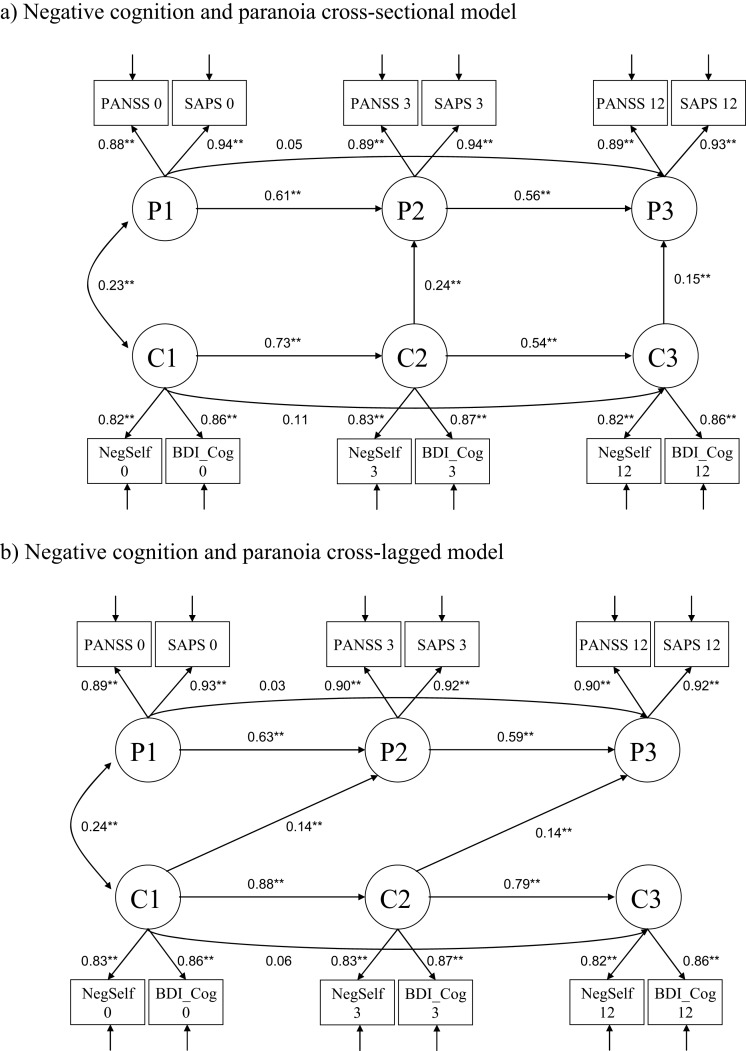
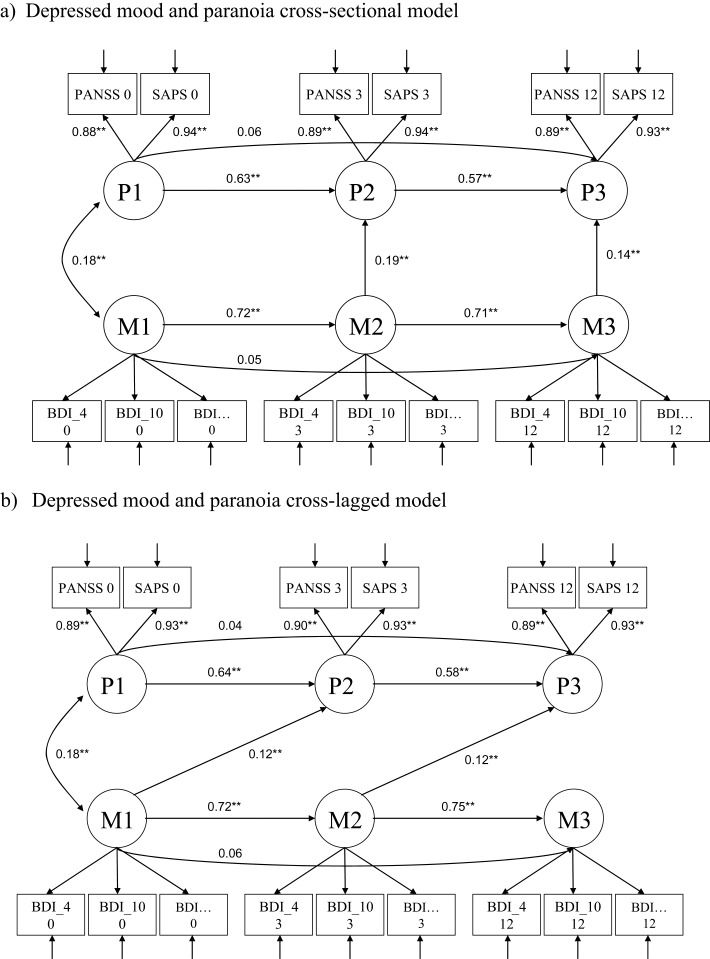
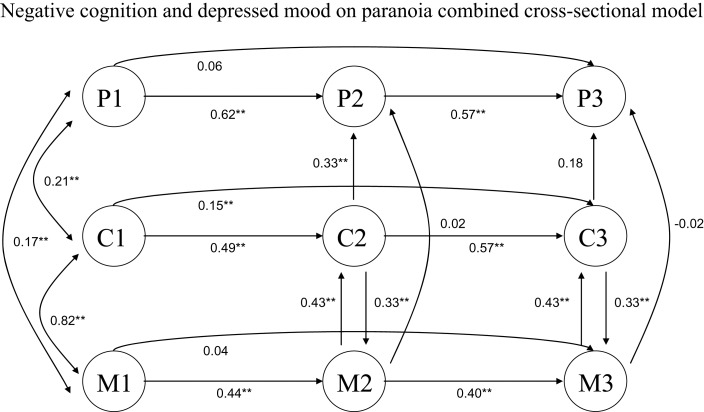
The role of negative cognition and effect in maintaining psychotic symptoms is increasingly recognized but has yet to be substantiated though longitudinal analysis. Based on an a priori theoretical model, we hypothesized that negative cognition and depressed mood play a direct causal role in maintaining paranoia in people with psychosis and that the effect of mood is mediated by negative cognition. We used data from the 301 patients in the Prevention of Relapse in Psychosis Trial of cognitive behavior therapy. They were recruited from consecutive Community Mental Health Team clients presenting with a recent relapse of psychosis. The teams were located in inner and outer London and the rural county of Norfolk, England. The study followed a longitudinal cohort design, with initial measures repeated at 3 and 12 months. Structural equation modeling was used to investigate the direction of effect between negative cognition, depressed mood, and paranoia. Overall fit was ambiguous in some analyses and confounding by unidentified variables cannot be ruled out. Nevertheless, the most plausible models were those incorporating pathways from negative cognition and depressed mood to paranoid symptoms: There was no evidence whatsoever for pathways in the reverse direction. The link between depressed mood and paranoia appeared to be mediated by negative cognition. Our hypotheses were thus corroborated. This study provides evidence for the role of negative cognition in the maintenance of paranoia, a role of central relevance, both to the design of psychological interventions and to the conceptualizations of psychosis.
Overview
The claims and statistics of this paper haven’t been checked yet.
Run the check — free, no account needed. It reads the open-access text and checks the sources it cites.
Integrity signals
Registry
Cites
Statistics
Figures
Verification
Claims the paper makes
The claims and statistics of this paper haven’t been checked yet.
Run the check — free, no account needed. It reads the open-access text and checks the sources it cites.
Claims other papers make about this one
Each is checked against this paper’s own text: does it say what the citing paper says it does?
The cited source says what the claim attributes to it.
In the citing paper
“whether they are the consequences of, or contributors to, PEs [81][82][83]”
From Clinical, socio‐demographic and psychological characteristics in individuals with persistent psychotic experiences with and without a “need for care” (2016) · cites this paper as [82]
In the citing paper
“Finally, structural equation modelling of longitudinal data has found that depressed mood is causally related to paranoid thoughts; an effect that is mediated by negative cognition [37].”
From A structural equation model of the relationship between insomnia, negative affect, and paranoid thinking (2017) · cites this paper as [37]
Self-check
Percentages, sums and reported differences re-computed from the paper’s own numbers.
The self-check needs the paper’s full text.
Citations
Cites
Structural model evaluation and modification: An interval estimation approach
Steiger, J. H. (1990) · Multivariate Behavioral Research · doi:10.1207/s15327906mbr2502_4 · Cited by 7,408
Writing about structural equation models.
Hoyle, R. H., & Panter, A. T. (1995) · Cited by 1,708
A cognitive model of the positive symptoms of psychosis
GARETY, P. A., KUIPERS, E., FOWLER, D., FREEMAN, D., & BEBBINGTON, P. E. (2001) · Psychological Medicine · doi:10.1017/s0033291701003312 · Cited by 1,546
Self-citationAssessing Depression in Schizophrenia: The Calgary Depression Scale
Addington, D. E., Addington, J., & Maticka‐Tyndale, E. (1993) · The British Journal of Psychiatry · doi:10.1192/s0007125000292581 · Cited by 1,177
Tanaka, J. S. (1987) · Child Development · doi:10.2307/1130296 · Cited by 982
A cognitive model of persecutory delusions
Freeman, D., Garety, P. A., Kuipers, E., Fowler, D., & Bebbington, P. E. (2002) · British Journal of Clinical Psychology · doi:10.1348/014466502760387461 · Cited by 888
Self-citationPERSECUTORY DELUSIONS: A REVIEW AND THEORETICAL INTEGRATION
Bentall, R. P., Corcoran, R., Howard, R. J., Blackwood, N., & Kinderman, P. (2001) · Clinical Psychology Review · doi:10.1016/s0272-7358(01)00106-4 · Cited by 876
Stress-reactivity in psychosis: Evidence for an affective pathway to psychosis
Myin-Germeys, I., & van Os, J. (2007) · Clinical Psychology Review · doi:10.1016/j.cpr.2006.09.005 · Cited by 719
Crises and Life Changes and the Onset of Schizophrenia
Brown, G. W., & Birley, J. L. T. (1968) · Journal of Health and Social Behavior · doi:10.2307/2948405 · Cited by 680
Morrison, A. P. (2001) · Behavioural and Cognitive Psychotherapy · doi:10.1017/s1352465801003010 · Cited by 673
Emotional Reactivity to Daily Life Stress in Psychosis
Myin-Germeys, I., van Os, J., Schwartz, J. E., Stone, A. A., & Delespaul, P. A. (2001) · Archives of General Psychiatry · doi:10.1001/archpsyc.58.12.1137 · Cited by 653
Fit Indexes, Lagrange Multipliers, Constraint Changes and Incomplete Data in Structural Models
Bentler, P. M. (1990) · Multivariate Behavioral Research · doi:10.1207/s15327906mbr2502_3 · Cited by 512 · cited 1×
“The comparison of goodness of fit was examined by chi-square tests, the root mean square error of approximation (RMSEA),(37) and the comparative fit index (CFI).(38)”
MethodConnecting neurosis and psychosis: the direct influence of emotion on delusions and hallucinations
Freeman, D. H., & Garety, P. A. (2003) · Behaviour Research and Therapy · doi:10.1016/s0005-7967(02)00104-3 · Cited by 485
FOWLER, D., FREEMAN, D., SMITH, B., KUIPERS, E., BEBBINGTON, P., BASHFORTH, H., COKER, S., HODGEKINS, J., GRACIE, A., DUNN, G., et al. (2006) · Psychological Medicine · doi:10.1017/s0033291706007355 · Cited by 476
Self-citationSmith, B., Fowler, D. G., Freeman, D. H., Bebbington, P., Bashforth, H., Garety, P. A., Dunn, G., & Kuipers, E. (2006) · Schizophrenia Research · doi:10.1016/j.schres.2006.06.018 · Cited by 443
Self-citationThe predictive utility of expressed emotion in schizophrenia: an aggregate analysis
Bebbington, P., & Kuipers, L. (1994) · Psychological Medicine · doi:10.1017/s0033291700027860 · Cited by 437
Implications for neurobiological research of cognitive models of psychosis: a theoretical paper
GARETY, P. A., BEBBINGTON, P., FOWLER, D., FREEMAN, D., & KUIPERS, E. (2007) · Psychological Medicine · doi:10.1017/s003329170700013x · Cited by 347
Self-citationBirchwood, M., Iqbal, Z., Chadwick, P., & Trower, P. (2000) · British Journal of Psychiatry · doi:10.1192/bjp.177.6.516 · Cited by 315
Virtual reality study of paranoid thinking in the general population
Freeman, D. H., Pugh, K., Antley, A., Slater, M., Bebbington, P., Gittins, M., Dunn, G., Kuipers, E., Fowler, D. G., & Garety, P. A. (2008) · The British Journal of Psychiatry · doi:10.1192/bjp.bp.107.044677 · Cited by 315
Self-citationHäfner, H., Maurer, K., Trendler, G., der Heiden, W. A., Schmidt, M. H., & Könnecke, R. (2005) · Schizophrenia Research · doi:10.1016/j.schres.2005.01.004 · Cited by 309
Pathways to emotional dysfunction in first-episode psychosis
Birchwood, M. (2003) · British Journal of Psychiatry · doi:10.1192/bjp.182.5.373 · Cited by 297
Garety, P. A., Fowler, D. G., Freeman, D., Bebbington, P., Dunn, G., & Kuipers, E. (2008) · British Journal of Psychiatry · doi:10.1192/bjp.bp.107.043570 · Cited by 296
Self-citationBentall, R. P., Rowse, G., Shryane, N., Kinderman, P., Howard, R., Blackwood, N., Moore, R., & Corcoran, R. (2009) · Archives of General Psychiatry · doi:10.1001/archgenpsychiatry.2009.1 · Cited by 295
Behavioural sensitization to daily life stress in psychosis
MYIN-GERMEYS, I., DELESPAUL, P., & VAN OS, J. (2005) · Psychological Medicine · doi:10.1017/s0033291704004179 · Cited by 292
Barrowclough, C., Tarrier, N., Humphreys, L., Ward, J., Gregg, L., & Andrews, B. (2003) · Journal of Abnormal Psychology · doi:10.1037/0021-843x.112.1.92 · Cited by 265
Neuroticism and low self-esteem as risk factors for psychosis
Krabbendam, L., Janssen, I., Bak, M., Bijl, R. V., de Graaf, R., & van Os, J. (2002) · Social Psychiatry and Psychiatric Epidemiology · doi:10.1007/s127-002-8207-y · Cited by 263
Wiles, N. J., Zammit, S., Bebbington, P., Singleton, N., Meltzer, H., & Lewis, G. (2006) · British Journal of Psychiatry · doi:10.1192/bjp.bp.105.012179 · Cited by 245
Birchwood, M. J., Gilbert, P., Gilbert, J., Trower, P., Meaden, A., HAY, J., MURRAY, E., & Miles, J. N. V. (2004) · Psychological Medicine · doi:10.1017/s0033291704002636 · Cited by 239
Iqbal, Z., Birchwood, M., Chadwick, P., & Trower, P. (2000) · British Journal of Psychiatry · doi:10.1192/bjp.177.6.522 · Cited by 226
Pathways to defense of the self: A theory of two types of paranoia.
Trower, P., & Chadwick, P. (1995) · Clinical Psychology Science and Practice · doi:10.1111/j.1468-2850.1995.tb00044.x · Cited by 206
The evolution of insight, paranoia and depression during early schizophrenia
DRAKE, R. J., PICKLES, A., BENTALL, R. P., KINDERMAN, P., HADDOCK, G., TARRIER, N., & LEWIS, S. W. (2004) · Psychological Medicine · doi:10.1017/s0033291703008821 · Cited by 204
Testing the continuum of delusional beliefs: An experimental study using virtual reality.
Freeman, D. H., Pugh, K., Vorontsova, N., Antley, A., & Slater, M. (2010) · Journal of Abnormal Psychology · doi:10.1037/a0017514 · Cited by 198
Early intervention in psychosis
Singh, S. P. (2010) · The British Journal of Psychiatry · doi:10.1192/bjp.bp.109.075804 · Cited by 195
The cognitive-behavioural treatment of low self-esteem in psychotic patients: A pilot study
Hall, P. L., & Tarrier, N. (2003) · Behaviour Research and Therapy · doi:10.1016/s0005-7967(02)00013-x · Cited by 194
Freeman, D. H., Garety, P. A., Fowler, D., Kuipers, E., Dunn, G., Bebbington, P., & Hadley, C. (1998) · British Journal of Clinical Psychology · doi:10.1111/j.2044-8260.1998.tb01399.x · Cited by 189
Self-citationPositive and negative syndromes in schizophrenia: Assessment and research.
Kay, S. R. (1991) · Medical Entomology and Zoology · Cited by 185
Studying and Treating Schizophrenia Using Virtual Reality: A New Paradigm
Freeman, D. H. (2007) · Schizophrenia Bulletin · doi:10.1093/schbul/sbn020 · Cited by 183
Bodily Reactions to People and Events in Schizophrenics
Tarrier, N. (1979) · Archives of General Psychiatry · doi:10.1001/archpsyc.1979.01780030077007 · Cited by 182
The future of cognitive-behavioural therapy for psychosis: not a quasi-neuroleptic
Birchwood, M., & Trower, P. (2006) · British Journal of Psychiatry · doi:10.1192/bjp.bp.105.014985 · Cited by 175
Cognitive and emotional predictors of predisposition to hallucinations in non‐patients
Morrison, A. P., Adrian Wells, A., & Nothard, S. (2002) · British Journal of Clinical Psychology · doi:10.1348/014466502760379127 · Cited by 174
Social cognition and subclinical paranoid ideation
Martin, J. A., & Penn, D. L. (2001) · British Journal of Clinical Psychology · doi:10.1348/014466501163670 · Cited by 173
A, L. K. M., Myin‐Germeys, I., Hanssen, M., de Graaf, R., Vollebergh, W., Bak, M., & van Os, J. (2005) · British Journal of Clinical Psychology · doi:10.1348/014466504x19767 · Cited by 162
Fialko, L., Freeman, D. H., Bebbington, P., Kuipers, E., Garety, P. A., Dunn, G., & Fowler, D. G. (2006) · Acta Psychiatrica Scandinavica · doi:10.1111/j.1600-0447.2006.00849.x · Cited by 156
Self-citationCan Virtual Reality be Used to Investigate Persecutory Ideation?
Freeman, D. H., Slater, M., Bebbington, P., Garety, P. A., Kuipers, E., Fowler, D. G., Met, A., Read, C. M., Jordan, J., & Vinayagamoorthy, V. (2003) · The Journal of Nervous and Mental Disease · doi:10.1097/01.nmd.0000082212.83842.fe · Cited by 141
Self-citationCognitive assessment of voices: Further developments in understanding the emotional impact of voices
Close, H. J., & Garety, P. A. (1998) · British Journal of Clinical Psychology · doi:10.1111/j.2044-8260.1998.tb01292.x · Cited by 129
Virtual reality and paranoid ideations in people with an ‘at-risk mental state’ for psychosis
Valmaggia, L., Freeman, D. H., Green, C., Garety, P. A., Swapp, D., Antley, A., Prescott, C., Fowler, D. G., Kuipers, E., Bebbington, P., et al. (2007) · The British Journal of Psychiatry · doi:10.1192/bjp.191.51.s63 · Cited by 106
Self-citationInfluence of carer expressed emotion and affect on relapse in non-affective psychosis
Kuipers, E., Bebbington, P., Dunn, G., Fowler, D., Freeman, D., Watson, P., Hardy, A., & Garety, P. (2006) · British Journal of Psychiatry · doi:10.1192/bjp.bp.104.007294 · Cited by 102
Self-citationPerceptions of disadvantage, ethnicity and psychosis
Cooper, C., Morgan, C., Byrne, M., Dazzan, P., Morgan, K. D., Hutchinson, G. A., Doody, G. A., Harrison, G. L., Leff, J., Jones, P. B., et al. (2008) · The British Journal of Psychiatry · doi:10.1192/bjp.bp.107.042291 · Cited by 91
Cognitive behaviour therapy for psychosis
Kuipers, E., & Bebbington, P. (2006) · Epidemiology and Psychiatric Sciences · doi:10.1017/s1121189x00002153 · Cited by 80
Krabbendam, L., Myin‐Germeys, I., Hanssen, M., Bijl, R. V., de Graaf, R., Vollebergh, W., Bak, M., & van Os, J. (2004) · Acta Psychiatrica Scandinavica · doi:10.1111/j.1600-0447.2004.00343.x · Cited by 79
Explaining Transitions Over the Hypothesized Psychosis Continuum
Krabbendam, L., Myin‐Germeys, I., Bak, M., & van Os, J. (2005) · Australian & New Zealand Journal of Psychiatry · doi:10.1080/j.1440-1614.2005.01541.x · Cited by 75
Bowins, B. E., & Shugar, G. (1998) · The Canadian Journal of Psychiatry · doi:10.1177/070674379804300204 · Cited by 64
Williams, T., Daglish, M., Lingford-Hughes, A., Taylor, L., Hammers, A., Brooks, D., Grasby, P., Myles, J., & Nutt, D. (2007) · The British journal of psychiatry : the journal of mental science · doi:10.1192/bjp.bp.106.031120 · Cited by 54
Role of distress in delusion formation
Hanssen, M., Krabbendam, L., de Graaf, R., Vollebergh, W., & van Os, J. (2005) · The British Journal of Psychiatry · doi:10.1192/bjp.187.48.s55 · Cited by 49
Brief report Social cognition and subclinical paranoid ideation
Martin, J. A., & Penn, D. L. (2001) · Cited by 34
FOWLER, D., Freeman, D. H., Steel, C., & Hardy, A. (2007) · Routledge eBooks · doi:10.4324/9780203966013-13 · Cited by 33
Self-citationDaly, O. (2009) · Psychiatry · doi:10.1016/j.mppsy.2009.04.013 · Cited by 26
The relationships between symptom dimensions and dysphoria in schizophrenia
Guillem, F., Pampoulova, T., Stip, É., Lalonde, P., & Todorov, C. (2004) · Schizophrenia Research · doi:10.1016/j.schres.2004.06.018 · Cited by 25
Research works printed but not linked: 2
- 1993, The British Journal of Psychiatry, 22, S39
- 2005, The British Journal of Psychiatry, 48, s55
Cited by
Sorted by citations
Advances in understanding and treating persecutory delusions: a review
Freeman, D., & Garety, P. (2014) · Social Psychiatry and Psychiatric Epidemiology · doi:10.1007/s00127-014-0928-7 · Cited by 348
The past and future of delusions research: from the inexplicable to the treatable
Garety, P. A., & Freeman, D. H. (2013) · The British Journal of Psychiatry · doi:10.1192/bjp.bp.113.126953 · Cited by 345
The structure of paranoia in the general population
Bebbington, P. E., McBride, O., Steel, C., Kuipers, E., Radovanoviĉ, M., Brugha, T., Jenkins, R., Meltzer, H. I., & Freeman, D. (2013) · British Journal of Psychiatry · doi:10.1192/bjp.bp.112.119032 · Cited by 302
Childhood adversities and psychosis: evidence, challenges, implications
Morgan, C., & Gayer-Anderson, C. E. (2016) · World Psychiatry · doi:10.1002/wps.20330 · Cited by 278
Hardy, A. (2017) · Frontiers in Psychology · doi:10.3389/fpsyg.2017.00697 · Cited by 224
Metadata
- Authors
- Fowler, D., Hodgekins, J., Garety, P., Freeman, D., Kuipers, E., Dunn, G., Smith, B., & Bebbington, P. E.
- Affiliations
- University of East Anglia (GB)
- King's College London (GB)
- Warneford Hospital (GB)
- University of Manchester (GB)
- University College London (GB)
- Corresponding author
- Fowler, D.
- Venue
- Schizophrenia Bulletin
- Publisher
- Oxford University Press (OUP)
- Published
- 2011-04-07
- Volume
- 38
- Issue
- 5
- Pages
- 1063-1073
- ISSN
- 0586-7614 (ISSN-L)
- 1745-1701
- PMC
- PMC3446231
- OpenAlex
- W2131974041
- Cited by
- 184
- References
- 58
- Citations by year
- 2026: 3 · 2025: 7 · 2024: 7 · 2023: 12 · 2022: 16 · 2021: 12 · 2020: 9 · 2019: 14 · 2018: 20 · 2017: 18 · 2016: 13 · 2015: 14 · 2014: 15 · 2013: 16 · 2012: 6
- FWCI
- 8.53
- Type
- journal article
- Language
- en
- Open access
- hybrid
- doi.org
- Licence
- cc-by-nc
- Locations
- Schizophrenia Bulletin (publishedVersion, cc-by-nc)
- PubMed Central (publishedVersion, cc-by-nc)
- PubMed (publishedVersion)
- UCL Discovery (University College London) (submittedVersion)
- Figshare (submittedVersion, cc-by)
- Research Portal (King's College London) (submittedVersion, other-oa)
- Research Explorer (The University of Manchester) (submittedVersion)
- UEA Digital Repository (University of East Anglia) (submittedVersion)
- Funders
- South London and Maudsley NHS Foundation Trust
- Wellcome Trust (062452)
- National Institute for Health and Care Research
- Menzies Centre for Australian Studies, King's College London, University of London
- Topics
- Health Sciences › Medicine › Psychiatry and Mental health › Schizophrenia research and treatment
- Social Sciences › Arts and Humanities › Philosophy › Mental Health and Psychiatry
- Social Sciences › Psychology › Experimental and Cognitive Psychology › Anxiety, Depression, Psychometrics, Treatment, Cognitive Processes
- Keywords
- negative thinking, depressive mood
- MeSH terms
- Adult, Affect, Attitude, Cognition Disorders, Culture, Delusions, Depressive Disorder, Female, Humans, Longitudinal Studies, Male, Models, Psychological, Prognosis, Psychiatric Status Rating Scales, Psychotic Disorders, Schizophrenia, Paranoid, Statistics as Topic, Models, Statistical
About these checks
Registry, retraction, Cites and statistics results are computed, not judged, with one exception: a printed reference that no index lists is read once by a model before it counts as a citation error. Claims are extracted by a model and kept only when their quote appears verbatim in the text; each cited source is then checked, with a model’s help, for whether it says what the claim relies on. Those verdicts can be wrong — read the claim’s quote and the cited source before relying on one.
Statistics and arithmetic are recomputed, not judged.
Confidence bands are shown only for fields calibrated on our annotated test set. None is calibrated yet, so no band is shown.
What counts as a claim ›How we measure confidence ›How we check this ›
Are you an author, or do you see a problem with this page? Request a review
