

Fear and the Defense Cascade
Open accessThe DOI matches its Crossref record; 198 of the 210 references it cites were found in a registry or an index; 38 of the 262 sources its claims cite were checked for support.
Abstract
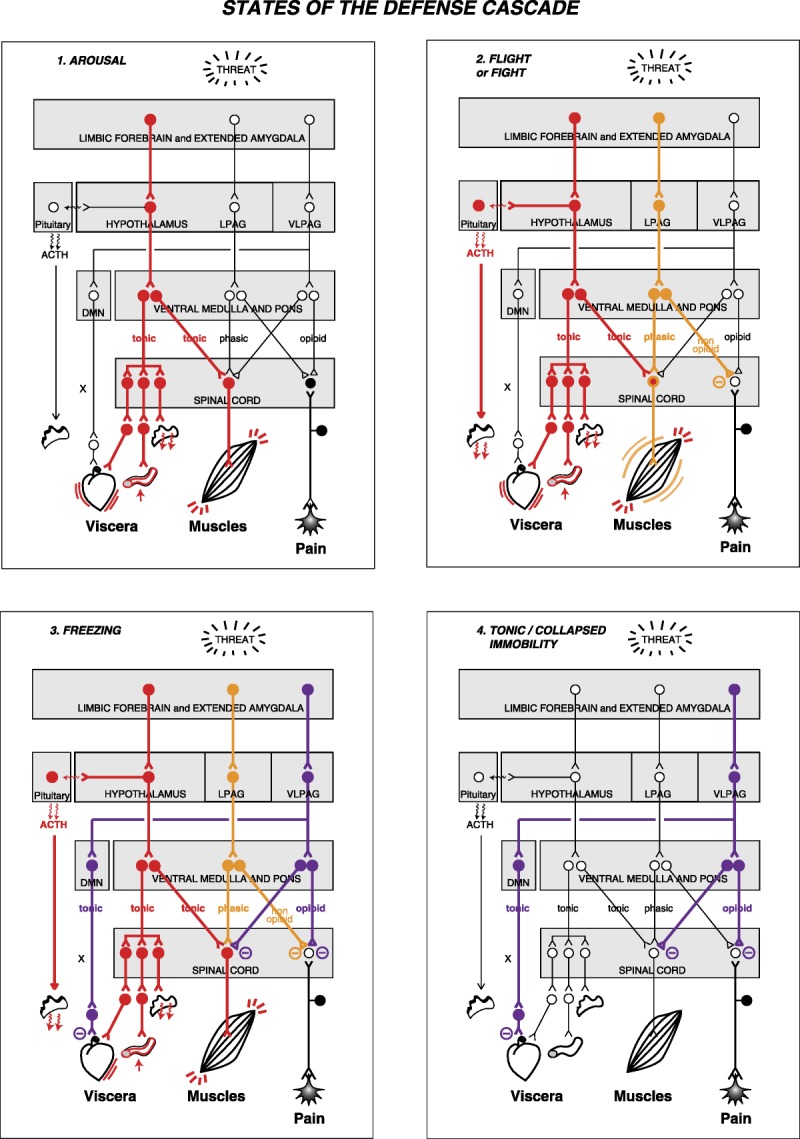
Evolution has endowed all humans with a continuum of innate, hard-wired, automatically activated defense behaviors, termed the defense cascade. Arousal is the first step in activating the defense cascade; flight or fight is an active defense response for dealing with threat; freezing is a flight-or-fight response put on hold; tonic immobility and collapsed immobility are responses of last resort to inescapable threat, when active defense responses have failed; and quiescent immobility is a state of quiescence that promotes rest and healing. Each of these defense reactions has a distinctive neural pattern mediated by a common neural pathway: activation and inhibition of particular functional components in the amygdala, hypothalamus, periaqueductal gray, and sympathetic and vagal nuclei. Unlike animals, which generally are able to restore their standard mode of functioning once the danger is past, humans often are not, and they may find themselves locked into the same, recurring pattern of response tied in with the original danger or trauma. Understanding the signature patterns of these innate responses--the particular components that combine to yield the given pattern of defense-is important for developing treatment interventions. Effective interventions aim to activate or deactivate one or more components of the signature neural pattern, thereby producing a shift in the neural pattern and, with it, in mind-body state. The process of shifting the neural pattern is the necessary first step in unlocking the patient's trauma response, in breaking the cycle of suffering, and in helping the patient to adapt to, and overcome, past trauma.
Overview
CoChat Summary
## TL;DR
This paper proposes a neuroscience-based model of the human defense cascade, organizing threat responses from arousal through flight/fight, freezing, tonic immobility, collapsed immobility, and quiescent immobility. It also maps these states to clinical interventions, emphasizing somatic, mindfulness-based, and trauma-processing approaches.
## Key findings
- The authors define the human defense cascade as six states: (1) arousal, (2) flight or fight, (3) freezing, (4) tonic immobility, (5) collapsed immobility, and (6) quiescent immobility.
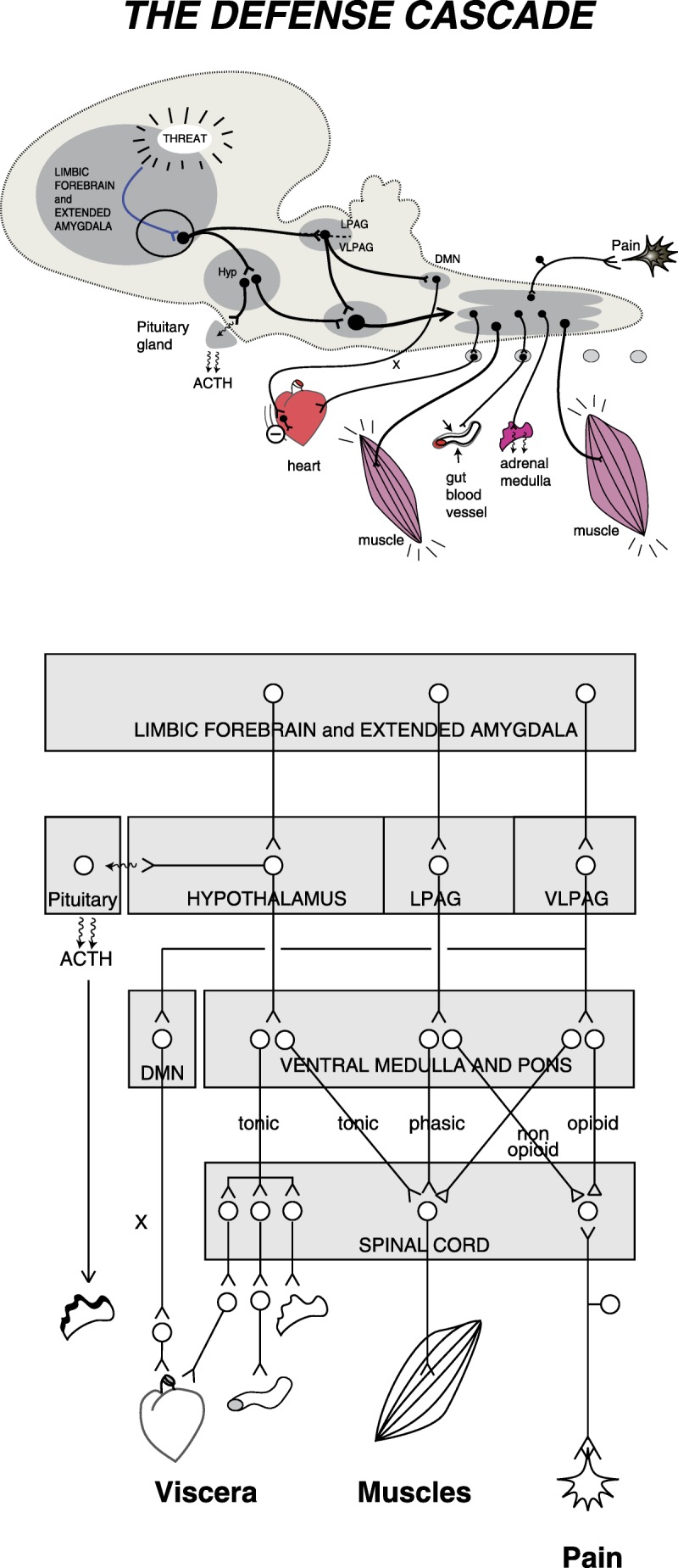
- They argue that these responses are mediated by descending neural circuits involving the extended amygdala, hypothalamus, PAG, ventral pontine tegmentum, ventral and dorsal medulla, and spinal cord, with separate somatomotor, autonomic/visceromotor, and pain-processing components.
- The paper reports that in humans freezing is typically short-lived, often lasting only a few seconds, and that in laboratory/animal observations freezing has been reported for up to 20 minutes in rats and up to 60 minutes in wild rodents.
- It states that a third of patients in one imaging study showed both reexperiencing and dissociative responses in a single experimental session to different scripts.
## Methods
- Narrative review and integrative clinical-neuroscience synthesis; the authors state they conducted wide-ranging searches on PubMed, communicated with laboratories and clinical groups, and tracked seminal historical references.
- The paper combines animal-model evidence, human clinical vignettes, and neurophysiological/imaging studies to build and illustrate the defense-cascade framework.
- Main analysis is conceptual: the authors relate specific defense states to neural circuits and then infer corresponding clinical management strategies for arousal reduction and trauma processing.
## Limitations
- The paper itself states that for quiescent immobility in humans, “it is not possible to explore this subject further at this time” because of the dearth of literature.
- It also states that the mechanisms underpinning EMDR and tapping have yet to be identified, and that further outcome studies are needed for tapping.
- Evident from the text: much of the article is an integrative model built from heterogeneous animal and human studies plus clinical vignettes, rather than a single empirical study with a new sample or controlled primary data.
Model-written summary. Check it against the paper before relying on it.
Integrity signals
Registry
Cites
Statistics
Figures
Verification
Claims the paper makes
22 Valid · 18 Not valid · 87 Not checked · 64 Own results and interpretations
The cited sources support only part of this claim — read each source’s verdict below.
In the paper
“All defense responses in the animal model of the defense cascade—arousal, freezing, flight or fight, tonic immobility, collapsed immobility, and quiescent immobility—are responses to threat mediated by neural circuits involving the extended amygdala, hypothalamus, periaqueductal gray (PAG), ventral pontine tegmentum, ventral and dorsal medulla, and spinal cord.22–25”
§ Fear and the Defense Cascade: Clinical Implications and Management > Abstract
What the sources say
- Partly supportedcites [22] Choi JS Cain CK LeDoux JE The role of amygdala nuclei in the expression of auditory signaled two-way active avoidance in rats. Learn Mem 2010; 17: 139– 47. 20189958 PMC2832923 sourceExperimental — accuracy not yet measured
Split into 2 atoms — 0 confirmed, 2 partially supported, 0 disputed, 0 misattributed, 0 unverifiable. Expand the claim to see per-atom verdicts.
- Not checked — no full text of the sourcecites [23] Gozzi A Jain A Giovanelli A A neural switch for active and passive fear. Neuron 2010; 67: 656– 66. 20797541 source
- Partly supportedcites [24] LeDoux JE Iwata J Cicchetti P Reis DJ Different projections of the central amygdaloid nucleus mediate autonomic and behavioral correlates of conditioned fear. J Neurosci 1988; 8: 2517– 29. 2854842 PMC6569498 sourceExperimental — accuracy not yet measured
Split into 2 atoms — 0 confirmed, 2 partially supported, 0 disputed, 0 misattributed, 0 unverifiable. Expand the claim to see per-atom verdicts.
- Not checked — no full text of the sourcecites [25] Bandler R Shipley MT Columnar organization in the midbrain periaqueductal gray: modules for emotional expression? Trends Neurosci 1994; 17: 379– 89. 7817403 source
plainstates a cause- Asserted: passes — The authors put it forward as true.
- Checkable: passes — It can be checked against evidence.
- Load-bearing: passes — The paper’s conclusions depend on it.
- Based: passes — The paper gives a reason why it holds.
- Partly supported
The cited sources support only part of this claim — read each source’s verdict below.
In the paper
“Studies suggest that flight or fight is the sum total of distinct components activated concurrently: a somatomotor (skeletal muscle) component, a visceromotor (autonomic) component, and a pain-modulation component (see Figures 1 and 2).24,45,46”
§ Fear and the Defense Cascade: Clinical Implications and Management > FLIGHT OR FIGHT: THE ANIMAL MODEL
What the sources say
- Partly supportedcites [24] LeDoux JE Iwata J Cicchetti P Reis DJ Different projections of the central amygdaloid nucleus mediate autonomic and behavioral correlates of conditioned fear. J Neurosci 1988; 8: 2517– 29. 2854842 PMC6569498 sourceExperimental — accuracy not yet measured
The section on conditioned fear-response pathways (page unavailable) describes defensive behavior accompanied by autonomic changes and distinguishes freezing from cardiovascular responses. It does not establish a pain-modulation component of the response or say that all three components are activated concurrently; its discussion of pain sensitivity concerns whether that could explain a lesion result. (LLM, conf=0.86)
- Partly supportedcites [45] Fanselow MS Neural organisation of defensive behavioural system responsible for fear. Psychon Bull Rev 1994; 1: 429– 38. 24203551 sourceExperimental — accuracy not yet measured
Fanselow's CIRCA-STRIKE DEFENSE and NEURAL CIRCUITRY MEDIATING POST-ENCOUNTER DEFENSES sections do state that the actions making up a defensive mode are 'physically compatible, so that they can occur simultaneously,' and enumerate exactly the three kinds of component the claim names: somatomotor (freezing, muscle-tone adjustment, escape locomotion, jump attack), visceromotor (tachycardia, hypertension, 'redirection of blood flow from viscera and skin to skeletal muscle'), and pain modulation (opioid and nonopioid analgesia). What the source does not support is the packaging: it does not treat 'flight or fight' as one sum total, but splits active defense into distinct, mutually inhibited modes (amygdala/vPAG-driven post-encounter freezing vs. dlPAG-driven circa-strike escape/attack), and it lists further concurrent components beyond the three cited (enhanced arousal, potentiated startle, vocalization). The evidence is also specific to the rat antipredator defensive behavior system, not a general fight-or-flight account. So the concurrent multi-component core is in the paper, while the unitary tripartite framing overstates and flattens it. (LLM, conf=0.72)
- Not checked — no full text of the sourcecites [46] Walker P Carrive P Role of ventrolateral periaqueductal gray neurons in the behavioral and cardiovascular responses to contextual conditioned fear and poststress recovery. Neuroscience 2003; 116: 897– 912. 12573728 source
hedged- Asserted: passes — The authors put it forward as true.
- Checkable: passes — It can be checked against evidence.
- Load-bearing: passes — The paper’s conclusions depend on it.
- Based: passes — The paper gives a reason why it holds.
- Partly supported
In the paper
“This order differs from conceptualizations based on the distance of the predatory threat—in which freezing is discussed before flight or fight.2,8,9,17”
§ Fear and the Defense Cascade: Clinical Implications and Management > Abstract
What the sources say
- Not matchedcites [2] Lang PJ Simons RF Balaban MT Attention and orienting: sensory and motivational processes. Mahwah, NJ: Erlbaum, 1997.
Its entry has no title and year that we can search by.
- Not matchedcites [8] Ratner SC Comparative aspects of hypnosis. In: Gordon JE, ed. Handbook of clinical experimental hypnosis. New York: Macmillan, 1967.
We searched by its title and found no matching paper.
- Could not verifycites [9] Fanselow MS Lester LS A functional behavioristic approach to aversely motivated behavior: predatory imminence as a determinate of the topology of defensive behavior. In: Bolles RC Beecher MD, eds. Evolution and learning. Hillsdale, NJ: Erlbaum, 1988: 185– 211. sourceExperimental — accuracy not yet measured
The Discussion describes freezing as interfering with active avoidance in rats, but it does not describe a defense cascade ordered by distance from a predator. Searches for predatory-threat distance and freezing before flight or fight found no passage addressing that ordering; the cited claim cannot be verified from our copy. (LLM, conf=0.74)
- Check pendingcites [17] Blanchard DC Blanchard RJ Ethoexperimental approaches to the biology of emotion. Ann Rev Psychol 1988; 39: 43– 68. 2894198 source
plain- Asserted: passes — The authors put it forward as true.
- Checkable: passes — It can be checked against evidence.
- Load-bearing: passes — The paper’s conclusions depend on it.
- Based: passes — The paper gives a reason why it holds.
- Not matched
The cited sources support only part of this claim — read each source’s verdict below.
In the paper
“Subsequent research with animals determined that, depending on the degree of threat and the distance between the predator and prey, distinct responses—freezing, flight or fight, tonic immobility, and quiescent immobility—proceed sequentially along a continuum, termed the defense cascade.”
§ Fear and the Defense Cascade: Clinical Implications and Management > Abstract
What the sources say
- Not matchedcites [2] Lang PJ Simons RF Balaban MT Attention and orienting: sensory and motivational processes. Mahwah, NJ: Erlbaum, 1997.
Its entry has no title and year that we can search by.
- Not matchedcites [8] Ratner SC Comparative aspects of hypnosis. In: Gordon JE, ed. Handbook of clinical experimental hypnosis. New York: Macmillan, 1967.
We searched by its title and found no matching paper.
- Partly supportedcites [9] Fanselow MS Lester LS A functional behavioristic approach to aversely motivated behavior: predatory imminence as a determinate of the topology of defensive behavior. In: Bolles RC Beecher MD, eds. Evolution and learning. Hillsdale, NJ: Erlbaum, 1988: 185– 211. sourceExperimental — accuracy not yet measured
Split into 2 atoms — 0 confirmed, 1 partially supported, 0 disputed, 0 misattributed, 1 unverifiable. Expand the claim to see per-atom verdicts.
- Check pendingcites [17] Blanchard DC Blanchard RJ Ethoexperimental approaches to the biology of emotion. Ann Rev Psychol 1988; 39: 43– 68. 2894198 source
plainstates a cause- Asserted: passes — The authors put it forward as true.
- Checkable: passes — It can be checked against evidence.
- Load-bearing: passes — The paper’s conclusions depend on it.
- Based: passes — The paper gives a reason why it holds.
- Not matched
The cited sources support only part of this claim — read each source’s verdict below.
In the paper
“Flight or fight is mediated through the lateral periaqueductal gray (LPAG), which activates the basic, stereotypical motor patterns of flight or fight—for example, attack, running, treading, burying (see Figures 1 and 2).24,28,47,48”
§ Fear and the Defense Cascade: Clinical Implications and Management > FLIGHT OR FIGHT: THE ANIMAL MODEL > Skeletal Muscle (Somatomotor) Activation
What the sources say
- Partly supportedcites [24] LeDoux JE Iwata J Cicchetti P Reis DJ Different projections of the central amygdaloid nucleus mediate autonomic and behavioral correlates of conditioned fear. J Neurosci 1988; 8: 2517– 29. 2854842 PMC6569498 sourceExperimental — accuracy not yet measured
The discussion of defense-response pathways says the central gray is involved in defensive behavior, and the discussion of conditioned fear describes it as a possible link to motor systems. The paper does not identify the lateral periaqueductal gray as mediating flight or fight or attribute attack, running, treading, or burying to it; its lesion findings concern conditioned freezing. (LLM, conf=0.76)
- Not checked — no full text of the sourcecites [28] Keay KA Bandler R Parallel circuits mediating distinct emotional coping reactions to different types of stress. Neurosci Biobehav Rev 2001; 25: 669– 78. 11801292 source
- Not checked — no full text of the sourcecites [47] Carrive P The periaqueductal gray and defensive behavior: functional representation and neuronal organization. Behav Brain Res 1993; 58: 27– 47. 8136048 source
- Not checked — no full text of the sourcecites [48] Rizvi TA Ennis M Behbehani MM Shipley MT Connections between the central nucleus of the amygdala and the midbrain periaqueductal gray: topography and reciprocity. J Comp Neurol 1991; 303: 121– 31. 1706363 source
plainstates a cause- Asserted: passes — The authors put it forward as true.
- Checkable: passes — It can be checked against evidence.
- Load-bearing: passes — The paper’s conclusions depend on it.
- Based: passes — The paper gives a reason why it holds.
- Partly supported
97 more claims · 12 with their cited sources checked
Create a free account to see all 191 claims and to verify the 65 references still open.
- It may state two separate claims as one. 69
- Probably not a substantial claim. 32
- The quote only partly states this claim. 1
Claims other papers make about this one
Each is checked against this paper’s own text: does it say what the citing paper says it does?
The source backs part of the claim, not all of it — or backs it for a different population, condition or comparison.
In the citing paper
“The parasympathetic system may now activate defensive programsfear-induced bradycardia in the heart; nausea, vomiting, or diarrhea programs in the gut; expulsion of urine by the bladder -that work alongside the sympathetic system to defend the body from danger (Kozlowska et al., 2015;Wood et al., 1999).”
From Physiological feelings (2019) · cites this paper as Kozlowska et al., 2015
Experimental — accuracy not yet measuredThe source backs part of the claim, not all of it — or backs it for a different population, condition or comparison.
In the citing paper
“At the same time, cortical loops in the basal ganglia and cerebellum are activated to modulate basic motor patterns consistent with context and defence strategies (Kozlowska et al., 2015;Lanius et al., 2014).”
From A review of the relation between dissociation, memory, executive functioning and social cognition in military members and civilians with neuropsychiatric conditions (2016) · cites this paper as Kozlowska et al., 2015
Experimental — accuracy not yet measuredThe source backs part of the claim, not all of it — or backs it for a different population, condition or comparison.
In the citing paper
“Notably, the fight or flight response involves non-opioid (endocannabinoid-mediated) analgesia evoked by the lateral PAG (Keay and Bandler, 2001;Kozlowska et al., 2015).”
From A review of the relation between dissociation, memory, executive functioning and social cognition in military members and civilians with neuropsychiatric conditions (2016) · cites this paper as Kozlowska et al., 2015
Experimental — accuracy not yet measuredThe source backs part of the claim, not all of it — or backs it for a different population, condition or comparison.
In the citing paper
“Critically, in cases where the organism determines it has little to no chance of survival, unresponsive immobility or death feigning may occur in an attempt to decrease predator interest, which may lead to tonic or collapsed immobility (Kozlowska et al., 2015;Schauer and Elbert, 2010).”
From A review of the relation between dissociation, memory, executive functioning and social cognition in military members and civilians with neuropsychiatric conditions (2016) · cites this paper as Kozlowska et al., 2015
Experimental — accuracy not yet measuredThe source backs part of the claim, not all of it — or backs it for a different population, condition or comparison.
In the citing paper
“Here, Kozlowska et al. (2015) described defensive mind-body states as fixed action patterns that are repeated or reactivated by environmental triggers, including motor patterns, autonomic responses and opioid mediated analgesia (e.g., van der Kolk, 2001).”
From A review of the relation between dissociation, memory, executive functioning and social cognition in military members and civilians with neuropsychiatric conditions (2016) · cites this paper as Kozlowska et al., 2015
Experimental — accuracy not yet measured
8 more claims about this paper
Create a free account to see every claim other papers make about this one.
Citations
Cites
The expression of the emotions in man and animals.
Darwin, C. (1872) · J. Murray eBooks · doi:10.1037/10001-000 · Cited by 11,657
(1982) · Trends in Neurosciences · doi:10.1016/0166-2236(82)90076-5 · Cited by 9,089
Mindfulness-based interventions in context: Past, present, and future
Kabat-Zinn, J. (2003) · Clinical Psychology: Science and Practice · doi:10.1093/clipsy.bpg016 · Cited by 8,615
Mindfulness-based interventions in context: Past, present, and future.
Kabat-Zinn, J. (2003) · Clinical Psychology: Science and Practice · doi:10.1093/clipsy/bpg016 · Cited by 8,612
The feeling of what happens: body and emotion in the making of consciousness
(2000) · Choice Reviews Online · doi:10.5860/choice.37-6553 · Cited by 5,998
(2001) · Cited by 3,666
Etkin, A., & Wager, T. D. (2007) · American Journal of Psychiatry · doi:10.1176/appi.ajp.2007.07030504 · Cited by 3,391
Stress and disorders of the stress system
Chrousos, G. P. (2009) · Nature Reviews Endocrinology · doi:10.1038/nrendo.2009.106 · Cited by 3,215 · cited 1×
“system interact reciprocally as part of a larger stress-regulation system, downregulation of one system will have a correlative impact on the functioning of the other systems.(41,181)”
BackgroundAlterations in brain and immune function produced by mindfulness meditation
Davidson, R. J., Kabat-Zinn, J., Schumacher, J., Rosenkranz, M., Muller, D., Santorelli, S. F., Urbanowski, F., Harrington, A., Bonus, K., & Sheridan, J. F. (2003) · Psychosomatic Medicine · doi:10.1097/01.psy.0000077505.67574.e3 · Cited by 2,925 · cited 1×
“or that induce and maintain a mind state of optimism, compassion, hope, and expectancy (as in spiritual beliefs in a loving and protective Other) may function to reduce arousal by downregulating the HPA axis,(178) downregulating sympathetic activation,(172) and modulating immune function to respond in more adaptive wa…”
BackgroundA Multidimensional Meta-Analysis of Psychotherapy for PTSD
Bradley, R., Greene, J., Russ, E., Dutra, L., & Westen, D. (2005) · American Journal of Psychiatry · doi:10.1176/appi.ajp.162.2.214 · Cited by 1,938
Research works printed but not linked: 5
- Rivers WHR The danger-instincts. In: Instinct and the unconscious: a contribution to a biological theory of the psycho-neuroses. London: Cambridge University Press, 1920: 52– 60.
- Gowers WR A lecture on vaso-vagal attacks. Lancet 1907; 1: 1551– 4.
- Ramos C Leite-Panissi R Monassi R Menescal-De-Oliveira L Role of the amygdaloid nuclei in the modulation of tonic immobility in guinea pigs. Physiol Behav 1999; 67: 717– 24. 10604843 · DOI · Paper page
- Gevirtz R Resonant frequency training to restore homeostasis for treatment of psychophysiological disorders. Biofeedback 2000; 27: 7– 9.
- Posner MI Attention in cognitive neuroscience: an overview. In: Gazzaniga MS Bizzi E, eds. The cognitive neurosciences. Cambridge, MA: MIT Press, 1995: 615– 24.
Cited by
Items 101–200 of 463
Jørgensen, F., Bish, A. J., Sanders, K., & Nguyen, P. T. (2023) · Human Resource Management Review · doi:10.1016/j.hrmr.2023.100999 · Cited by 32
Can the way pigs are handled alter behavioural and physiological measures of affective state?
Carreras, R., Arroyo, L., Mainau, E., Valent, D., Bassols, A., Dalmau, A., Faucitano, L., Manteca, X., & Velarde, A. (2017) · Behavioural Processes · doi:10.1016/j.beproc.2017.06.005 · Cited by 25
“The term “defence cascade response” has been defined as a continuum of innate, hard-wired, automatically activated defence behaviours (Kozlowska et al., 2015).”
Psychogenic non-epileptic seizures in children – psychophysiology & dissociative characteristics
Sawchuk, T., Buchhalter, J., & Senft, B. (2020) · Psychiatry Research · doi:10.1016/j.psychres.2020.113544 · Cited by 19
Baraniuk, J. N. (2022) · Brain Sciences · doi:10.3390/brainsci12020132 · Cited by 24
“Landscape of Stress” for Sheep Owners in the Swedish Wolf Region
Flykt, A., Eklund, A., Frank, J., & Johansson, M. V. (2022) · Frontiers in Ecology and Evolution · doi:10.3389/fevo.2022.783035 · Cited by 22
Coimbra, B. M., Hoeboer, C. M., van Zuiden, M., Williamson, R. E., D'Elia, A. T., Mello, A. F., Mello, M. F., & Olff, M. (2023) · Journal of Anxiety Disorders · doi:10.1016/j.janxdis.2023.102730 · Cited by 25
Statham, P., Hannuna, S., Jones, S., Campbell, N., Colborne, G., Browne, W. J., Paul, E. S., & Mendl, M. (2020) · Scientific Reports · doi:10.1038/s41598-020-65954-6 · Cited by 20
“One potentially promising measure is the ‘Defence Cascade’ (DC) response shown to sudden, unexpected stimuli 20–23 .”
BackgroundMy Body Protests: Childhood Sexual Abuse and the Body
Daphna‐Tekoah, S. (2019) · Journal of Loss and Trauma · doi:10.1080/15325024.2018.1549179 · Cited by 20
Clarke, M., McEwan, K., Ness, J., Waters, K., Basran, J. K., & Gilbert, P. (2016) · Frontiers in Psychiatry · doi:10.3389/fpsyt.2016.00155 · Cited by 20
“The degree to which the fight/flight systems (linked to the amygdala and hypothalamic–pituitary–adrenal systems) are activated offers different insights to that of hopelessness (23).”
BackgroundNiermann, H. C. M., Figner, B., Tyborowska, A., Cillessen, A. H. N., & Roelofs, K. (2018) · Frontiers in Behavioral Neuroscience · doi:10.3389/fnbeh.2018.00097 · Cited by 22
“…affect (Fox et al., 2005), the assessment of freezing as a separate type of behavior enables a specific exploration of a parasympathetically dominated state relevant for stress coping (Hermans et al., 2013; Hagenaars et al., 2014; Kozlowska et al., 2015; Lojowska et al., 2015; Roelofs, 2017).”
BackgroundInfluentialWilker, S., Kleim, B., Geiling, A., Pfeiffer, A., Elbert, T., & Kolassa, I.-T. (2017) · Clinical Psychological Science · doi:10.1177/2167702617719946 · Cited by 17
“Finally, from a neurobiological perspective, the peritraumatic reactions to traumatic stress can be described by the defense cascade model (Schauer & Elbert, 2010; see also Hagenaars et al., 2014; Kozlowska et al., 2015; Lang et al., 1998).”
BackgroundWelfare Considerations for Horses in Therapy and Education Services
Fry, N. E. (2021) · Springer eBooks · doi:10.1007/978-3-030-69587-3_9 · Cited by 21
Dynamics of Defensive Response Mobilization to Approaching External Versus Interoceptive Threat
Krause, E., Benke, C., Koenig, J., Thayer, J. F., Hamm, A. O., & Pané‐Farré, C. A. (2017) · Biological Psychiatry Cognitive Neuroscience and Neuroimaging · doi:10.1016/j.bpsc.2017.12.002 · Cited by 22
Niermann, H. C. M., Tyborowska, A., Cillessen, A. H. N., van Donkelaar, M. M. J., Lammertink, F., Gunnar, M. R., Franke, B., Figner, B., & Roelofs, K. (2018) · Developmental Science · doi:10.1111/desc.12763 · Cited by 23
Kozlowska, K., Cruz, C., Davies, F., Brown, K. J., Palmer, D. M., McLean, L., Scher, S., & Williams, L. M. (2016) · Australian and New Zealand Journal of Family Therapy · doi:10.1002/anzf.1187 · Cited by 16
Self-citationHelplessness: The inability to know-that you don’t know-how
Arieli, A., & Ataria, Y. (2018) · Philosophical Psychology · doi:10.1080/09515089.2018.1468559 · Cited by 18
Vibration-induced Behavioral Responses and Response Threshold in Female C57BL/6 Mice
Garner, A. M., Norton, J. N., Kinard, W. L., Kissling, G. E., & Reynolds, R. P. (2018) · Journal of the American Association for Laboratory Animal Science · doi:10.30802/aalas-jaalas-17-00092 · Cited by 19
Calvin, O. L., Erickson, M. T., Walters, C. J., & Redish, A. D. (2025) · PLoS Biology · doi:10.1371/journal.pbio.3002954 · Cited by 26
“To what extent on-track pauses relate to freezing seen during active fear [18,95–98] or whether they relate to tonic immobility [99,100] remains unclear and will likely require further study.”
Gbahabo, D. D., & Duma, S. E. (2021) · Heliyon · doi:10.1016/j.heliyon.2021.e07471 · Cited by 29
“The phenomenon of TI among humans is an emerging area of research, having been studied and published in the last decade outside sub-Saharan Africa (Coxell and King, 2010; Kozlowska et al., 2015; M€ oller et al., 2017).”
BackgroundInfluentialSilence and related symptoms in children and adolescents: a network approach to selective mutism
Vogel, F., Reichert, J., & Schwenck, C. (2022) · BMC Psychology · doi:10.1186/s40359-022-00956-9 · Cited by 17
“The fear response of freezing, which is known to be mediated by the autonomic nervous system [25], is considered to affect motor activity such as movement of body parts as well as motor activity which is necessary for vocalization [56].”
BackgroundLloyd, C., Lanius, R. A., Brown, M. F. D., Neufeld, R. J., Frewen, P., & McKinnon, M. C. (2019) · Chronic Stress · doi:10.1177/2470547018822492 · Cited by 20
Krámská, L., Hrešková, L., Vojtěch, Z., Krámský, D., & Myers, L. (2020) · Seizure · doi:10.1016/j.seizure.2020.02.009 · Cited by 18
An ethologically based view into human fear
Coelho, C. M., Araújo, A. S., Suttiwan, P., & Zsido, A. N. (2022) · Neuroscience & Biobehavioral Reviews · doi:10.1016/j.neubiorev.2022.105017 · Cited by 19
An Emotion-Enriched Context Influences the Effect of Action Observation on Cortical Excitability
Lagravinese, G., Bisio, A., Ferrari, A. R. D., Pelosin, E., Ruggeri, P., Bove, M., & Avanzino, L. (2017) · Frontiers in Human Neuroscience · doi:10.3389/fnhum.2017.00504 · Cited by 16
“This result is in line with the idea that arousal is the first, necessary step in activating defense behavior in both animals and humans (for a review see Kozlowska et al., 2015).”
ResultUliana, D. L., Antero, L. S., Borges‐Assis, A. B., Rosa, J., Vila-Verde, C., Lisboa, S. F. D. S., & Resstel, L. B. M. (2020) · Journal of Psychopharmacology · doi:10.1177/0269881120928201 · Cited by 17
“The exacerbation of autonomic response during aversive situations, as re-exposure to the conditioned context, corroborates the alert state of the animal (Dielenberg et al., 2001; Kozlowska et al., 2015).”
Backgroundvan Stralen, D., & Mercer, J. T. A. (2020) · Neonatology Today · doi:10.51362/neonatology.today/2020111511113124 · Cited by 14
Expanding the Traumatic Stress Framework to Incorporate a Socioecological Family Systems Perspective
Kelley, A. N., Curtis, M. G., & Wieling, E. A. (2021) · Family Process · doi:10.1111/famp.12682 · Cited by 24
Teaching Simple Strategies to Foster Emotional Well-Being
Iovino, E. A., Koslouski, J. B., & Chafouleas, S. M. (2021) · Frontiers in Psychology · doi:10.3389/fpsyg.2021.772260 · Cited by 24
Wannemueller, A., Adolph, D., Jöhren, H.-P., Blackwell, S. E., & Margraf, J. (2016) · Behaviour Research and Therapy · doi:10.1016/j.brat.2016.12.009 · Cited by 16
Young, K., Chessell, Z. J., Chisholm, A., Brady, F., Akbar, S., Vann, M., Rouf, K., & Dixon, L. (2021) · The Cognitive Behaviour Therapist · doi:10.1017/s1754470x21000192 · Cited by 22
Danböck, S. K., Rattel, J. A., Franke, L. K., Liedlgruber, M., Miedl, S. F., & Wilhelm, F. H. (2021) · European Journal of Psychotraumatology · doi:10.1080/20008198.2021.1991609 · Cited by 19
Zarean, F., Damirchi, E. S., & Sheykholeslami, A. (2022) · American Journal of Family Therapy · doi:10.1080/01926187.2022.2042865 · Cited by 18
“Increased rate of domestic violence against wives severely reduces the sense of security and excessively accelerates the activation of destructive cellular memories, reducing the woman’s ability to manage life and interact with her husband and children (Kozlowska et al., 2015; Sarson et al., 2020).”
BackgroundTheory of Mind: Towards an Evolutionary Theory
Tsoukalas, I. (2017) · Evolutionary Psychological Science · doi:10.1007/s40806-017-0112-x · Cited by 20
“Tonic immobility is the main inhibitory reflex of the mammalian defensive cascade and is predicated on cholinergic neurotransmission instead of aminergic neurotransmission (Thompson 1977; Klemm 2001; Kozlowska et al. 2015; Löw et al. 2015).”
BackgroundDefensive freezing and its relation to approach-avoidance decision-making under threatPreprint
Klaassen, F. H., Held, L. K., Figner, B., O’Reilly, J. X., Klumpers, F., de Voogd, L. D., & Karin Roelofs, A. (2021) · bioRxiv (Cold Spring Harbor Laboratory) · doi:10.1101/2021.01.29.428809 · Cited by 14
Enhancing Agency in Posttraumatic Stress Disorder Therapies Through Sensorimotor Technologies
Adrien, V., Bosc, N., Peccia-Galletto, C., Diot, T., Claverie, D., Reggente, N., Trousselard, M., Bui, É., Baubet, T., & Schoeller, F. (2024) · Journal of Medical Internet Research · doi:10.2196/58390 · Cited by 16
“Hence, the breakdown of the SA automatically triggers a hardwired sensorimotor response, sometimes referred to as the defense cascade [88].”
Gecse, K., Dobos, D., Aranyi, C., Galambos, A., Baksa, D., Kocsel, N., Szabó, E., Pap, D., Virág, D., Ludányi, K., et al. (2022) · Scientific Reports · doi:10.1038/s41598-021-04647-0 · Cited by 14
Serotonin distinctly controls behavioral states in restrained and freely moving Drosophila
Gowda, S. B. M., Banu, A., Salim, S., Claridge‐Chang, A., Peker, K. A., & Mohammad, F. (2022) · iScience · doi:10.1016/j.isci.2022.105886 · Cited by 16
Kozlowska, K. (2016) · Australian and New Zealand Journal of Family Therapy · doi:10.1002/anzf.1133 · Cited by 18
Self-citationVogel, F., & Schwenck, C. (2021) · Child and Adolescent Psychiatry and Mental Health · doi:10.1186/s13034-021-00430-1 · Cited by 16
“Freezing is a fear response that is characterized by a pattern of different physiological responses such as motor inhibition, including voice production and a decrease in heart rate [55, 56].”
BackgroundDanböck, S. K., Franke, L. K., Miedl, S. F., Liedlgruber, M., Bürkner, P., & Wilhelm, F. H. (2023) · Behaviour Research and Therapy · doi:10.1016/j.brat.2023.104289 · Cited by 16
“…arises during traumatic events which are characterized by close proximity to a superior perpetrator and violation of one ’ s own physical integrity (Kozlowska et al., 2015; Schauer & Elbert, 2010), hence during traumatic events happening directly to oneself and including painful stimulation.”
Tonic Immobility as a Defensive Trauma Response to Rape: Bridging Public Health and Law
de Heer, B. A., & Jones, L. C. (2023) · Violence Against Women · doi:10.1177/10778012231174347 · Cited by 19
“Extreme stress induces excessive hormone changes in terms of inhibition and release, namely for cortisol, adrenalin, and opioid analgesia, which then cause parts of the body not essential to survival to shut down (Kozlowska et al., 2015; Russo, 2017).”
A review of the phenomenology, aetiology and treatment of animal phobia and insights for biophobia
Norberg, M. M., Visvalingam, S., Stevenson, R. J., & Saluja, S. (2023) · People and Nature · doi:10.1002/pan3.10514 · Cited by 17
Dawud, L. M., Loetz, E. C., Lloyd, B. A., Beam, R., Tran, S., Cowie, K., Browne, K., Khan, T., Montoya, R., Greenwood, B. N., et al. (2020) · Developmental Psychobiology · doi:10.1002/dev.22001 · Cited by 10
“Freezing has been described as a “flight-or-fight response put on hold” (Kozlowska et al., 2015) and may not be the most adaptive strategy when danger is imminent.”
BackgroundBehavioural reactions of rabbits during AAI sessions
Součková, M., Přibylová, L., Jurčová, L., & Chaloupková, H. (2023) · Applied Animal Behaviour Science · doi:10.1016/j.applanim.2023.105908 · Cited by 15
Stoffels, M., Nijs, M., Spinhoven, P., Mesbah, R., & Hagenaars, M. A. (2017) · Journal of Behavior Therapy and Experimental Psychiatry · doi:10.1016/j.jbtep.2017.02.001 · Cited by 14
Acute stress affects peripersonal space representation in cortisol stress responders
Ellena, G., Bertoni, T., Durand-Ruel, M., Thoresen, J. C., Sandi, C., & Serino, A. (2022) · Psychoneuroendocrinology · doi:10.1016/j.psyneuen.2022.105790 · Cited by 18
Frozen with Fear? Attentional Mechanisms in Children with Selective Mutism
Vogel, F., Gensthaler, A., & Schwenck, C. (2022) · Cognitive Therapy and Research · doi:10.1007/s10608-021-10289-3 · Cited by 13
A cerebellar-prepontine circuit for tonic immobility triggered by an inescapable threat
Bhandiwad, A. A., Chu, N., Semenova, S. A., Holmes, G., & Burgess, H. A. (2022) · Science Advances · doi:10.1126/sciadv.abo0549 · Cited by 17
“We note that tonic immobility is often accompanied by other behavioral and physiological correlates that we did not measure, including decreased heart rate, increased respiration, tremor, and changes in correlated neural activity ( 7 , 19 ).”
InfluentialThe Reality of Tonic Immobility in Victims of Sexual Violence: “I was Paralyzed, I Couldn’t Move”
Laso, J. D. L. T. (2023) · Trauma Violence & Abuse · doi:10.1177/15248380231191232 · Cited by 19
“It is composed of two con-ditions—fear and physical restraint—(Heidt et al., 2005; Kozlowska et al., 2015) and consists of different symptoms such as pronounced physical and verbal immobility, trem-bling, muscle stiffness, intermittent eye closure, sensations of coldness and numbness, and…”
BackgroundThe Black experience: The entanglement among African American males and law enforcement
Singletary, G. (2021) · Journal of Community Psychology · doi:10.1002/jcop.22556 · Cited by 15
Riaz, B., Eskelin, J. J., Lundblad, L. C., Wallin, B. G., Karlsson, T., Starck, G., Lundqvist, D., Oostenveld, R., Schneiderman, J. F., & Elam, M. (2022) · Scientific Reports · doi:10.1038/s41598-022-05910-8 · Cited by 11
Miki, K., Ikegame, S., & Yoshimoto, M. (2022) · Frontiers in Physiology · doi:10.3389/fphys.2022.858654 · Cited by 14
“The freezing behavior is one of the innate responses of animals and can be classified as a preparatory reflex for threats and potential danger (Dampney, 2015; Kozlowska et al., 2015).”
BackgroundCleary, M. L., West, S., McLean, L., Kezelman, C., Karacsony, S., & Kornhaber, R. A. (2018) · International Journal of Mental Health Nursing · doi:10.1111/inm.12495 · Cited by 11
Self-citationSilva, C. C., & Fontes, M. A. P. (2019) · Physiology & Behavior · doi:10.1016/j.physbeh.2019.05.014 · Cited by 15
deMello, R. A. F., Coimbra, B. M., Pedro, B. D. M., Benvenutti, I. M., Yeh, M. S. L., Mello, A. F., Mello, M. F., & Poyares, D. R. (2022) · Journal of Interpersonal Violence · doi:10.1177/08862605221114151 · Cited by 20
“Although PTD has been extensively researched, TI remains largely understudied in psychopathology literature and only recently has become a more prominent topic of study (Bovin, Ratchford, et al., 2014; Kozlowska et al., 2015).”
BackgroundThe Prophetic Body: Embodiment and Mediation in Biblical Prophetic Literature
Portier-Young, A. E. (2024) · doi:10.1093/9780197604991.001.0001 · Cited by 14
Moraes, W., Laske, T. G., Leimgruber, P., Stabach, J. A., Marinari, P. E., Horning, M., Laske, N. R., Rodriguez, J. V., Eye, G. N., Kordell, J. E., et al. (2021) · Conservation Physiology · doi:10.1093/conphys/coab044 · Cited by 13
“restraint), arousal can be followed by ‘freezing’ of flight response and parasympathetic activation (Kozlowska et al., 2015).”
BackgroundRubin, D. C., & Bell, C. F. (2023) · Memory · doi:10.1080/09658211.2023.2188642 · Cited by 11
A review of tonic immobility as an adaptive behavior in sharks
Miranda-Páez, A., Hoyos-Padilla, E. M., & Klimley, A. P. (2023) · Environmental Biology of Fishes · doi:10.1007/s10641-023-01413-1 · Cited by 13
“This form of immobility resembles “freezing,” e.g., the immobility of a deer when illuminated with a car headlights or in rats by applying an electric shock to their feet (Klemm 2001; Kozlowska et al. 2015).”
Exercise therapy for chronic pain: How does exercise change the limbic brain function?
Senba, E., & Kami, K. (2023) · Neurobiology of Pain · doi:10.1016/j.ynpai.2023.100143 · Cited by 17
“Chronic pain such as complex regional pain syndrome type I may represent this type of immobility (Kozlowska et al., 2015).”
BackgroundCorasaniti, M. T., Lawrence, G. W., Bagetta, G., Iannacchero, R., Tarsitano, A., Monteleone, A., Pagliaro, M., Tonin, P., Sandrini, G., Nicotera, P., et al. (2023) · Frontiers in Pharmacology · doi:10.3389/fphar.2023.1296577 · Cited by 12
Atkinson, L., Doyle, R. E., & Jongman, E. C. (2024) · Animals · doi:10.3390/ani14010155 · Cited by 10
Dissociative Symptoms and Interoceptive Integration
Woelk, S. P., & Garfinkel, S. N. (2024) · Current topics in behavioral neurosciences · doi:10.1007/7854_2024_480 · Cited by 12
Dream On International, A. A. T. U. S., & Millett-Barrett, J. (2019) · Dignity A Journal of Analysis of Exploitation and Violence · doi:10.23860/dignity.2019.04.03.03 · Cited by 13
The influence of aggressive exercise on responses to self-perceived and others’ pain
Wei, Z., Huang, Y., Li, X., Shao, M., Qian, H., He, B., & Meng, J. (2023) · Cerebral Cortex · doi:10.1093/cercor/bhad324 · Cited by 10
“More specifically, when these defense mechanisms are activated, individuals redirect their attention from internal bodily sensations and instead remain vigilant toward their exter-nal surroundings in order to respond appropriately to potential hazards (Kozlowska et al. 2015).”
BackgroundInfluentialEmotion regulation from an action-control perspective
Bramson, B., Toni, I., & Roelofs, K. (2023) · Neuroscience & Biobehavioral Reviews · doi:10.1016/j.neubiorev.2023.105397 · Cited by 19
“…central amygdala and pregenual ACC; areas involved in prediction (and eliciting) of upcoming autonomic and physiological requirements that are necessary to cope with the situation (e.g. increased blood flow to muscles and decrease of blood flow to digestive organs (Kozlowska et al., 2015)).”
Klaassen, F. H., de Voogd, L. D., Hulsman, A. M., O’Reilly, J. X., Klumpers, F., Figner, B., & Roelofs, K. (2024) · Communications Biology · doi:10.1038/s42003-024-06267-6 · Cited by 14
“While over the past decades the decision sciences and computational psychiatry have made signi fi cant progress in modeling those value-based decisions in healthy and patientpopulations,theroleofthethreat-inducedpsychophysiologicalstate oftheorganismhasbeenlargelyoverlooked 8,9 .”
InfluentialMonterrosa-Castro, Á. D. J., Buelvas-de-la-Rosa, C., & Ordosgoitia-Parra, E. (2021) · Duazary · doi:10.21676/2389783x.3890 · Cited by 23
“Sentirse protegido por su empleador 52 (17,7) [13,5-22,5] 242 (82,3) [77,4-86,5]”
BackgroundInfluentialLinguistic features of postpartum depression using Linguistic Inquiry and Word Count text analysis
Landoni, M., Silverio, S. A., Ciuffo, G., Daccò, M., Petrovic, M., Blasio, P. D., & Ionio, C. (2022) · Journal of Neonatal Nursing · doi:10.1016/j.jnn.2022.04.001 · Cited by 12
Manjila, S. B., Betty, R., & Kim, Y. (2022) · Frontiers in Neuroscience · doi:10.3389/fnins.2022.1044736 · Cited by 13
“The NTS and DMX are very closely situated brain regions that regulate cardiovascular activity.”
BackgroundInfluentialRibeiro, A. B., Filho, P. C. G. D. B., Franci, C. R., Menescal-de-Oliveira, L., & Saia, R. S. (2016) · Acta Physiologica · doi:10.1111/apha.12729 · Cited by 10
“The PAG is one essential structure of the CNS related to behavioural responses to stress, threat, anxiety, pain and TI, which has been considered the final pathway where descending neural networks converge in the defence cascade (Kozlowska et al. 2015).”
BackgroundInfluentialBook Review: The Body Keeps the Score: Brain, Mind, and Body in the Healing of Trauma
Ho, J. M. C., Chan, A. S. W., Luk, C. Y., & Tang, P. M. (2021) · Frontiers in Psychology · doi:10.3389/fpsyg.2021.704974 · Cited by 17
“This biochemical reaction is termed as the “fight-or-flight” mechanism, which temporarily protects people against danger (Kozlowska et al., 2015).”
BackgroundA five domains assessment of sow welfare in a novel free farrowing system
Plush, K. J., Lines, D. S., Staveley, L. M., D’Souza, D. N., & van Barneveld, R. J. (2024) · Frontiers in Veterinary Science · doi:10.3389/fvets.2024.1339947 · Cited by 12
“The defence cascade is the response of an animal to sudden, unexpected stimuli and involves initial detection and immediate response (startle) to a stimulus such as an unexpected noise (18–20), monitoring and evaluation of the stimulus accompanied by freezing/immobility (21, 22).”
BackgroundImmobility Behaviors in Fish: A Comparison with Other Vertebrates
Yoshida, M. (2021) · Entomology monographs · doi:10.1007/978-981-33-6598-8_11 · Cited by 9
Košir, T., Sajovic, J., Grošelj, M., Fidler, A., Drevenšek, G., & Selič, P. (2021) · PLoS ONE · doi:10.1371/journal.pone.0252128 · Cited by 12
Neurochemical anatomy of dorsal and tonic immobility responses
Lalonde, R., & Strazielle, C. (2022) · Pharmacology Biochemistry and Behavior · doi:10.1016/j.pbb.2022.173334 · Cited by 12
Norweg, A. M., Hofferber, B., Oh, C., Spinner, M., Stavrolakes, K., Pavol, M. A., DiMango, A. M., Raveis, V. H., Murphy, C., Allegrante, J. P., et al. (2023) · Contemporary Clinical Trials · doi:10.1016/j.cct.2023.107340 · Cited by 9
Rocha, A. D. D. L., Menescal-de-Oliveira, L., & da Silva, L. F. S. (2017) · Applied Animal Behaviour Science · doi:10.1016/j.applanim.2017.02.001 · Cited by 9
Fear-conditioned alterations of motor cortex excitability: The role of amygdala
Gökdemir, S., Gündüz, A., Özkara, Ç., & Kızıltan, M. E. (2017) · Neuroscience Letters · doi:10.1016/j.neulet.2017.10.059 · Cited by 9
Ratnamohan, L., MacKinnon, L. K., Lim, M., Webster, R., Waters, K. A., Kozlowska, K., Silberg, J. L., Greenwald, R., & Ribeiro, M. (2018) · Harvard Review of Psychiatry · doi:10.1097/hrp.0000000000000195 · Cited by 10
Self-citationFiskum, C., Riiber, Å., & Eik‐Nes, T. T. (2022) · Frontiers in Psychiatry · doi:10.3389/fpsyt.2022.895781 · Cited by 11
Feeney, H., Campbell, R., & Cain, D. (2018) · Victims & Offenders · doi:10.1080/15564886.2018.1426668 · Cited by 13
“As mentioned, inconsistencies in memories of sexual violence are somewhat common and have neurobiological and psychological underpinnings (Diamond et al., 2007; Hopper & Van der Kolk, 2001; Kozlowska et al., 2015).”
BackgroundGladwin, T. E., Möbius, M., & Vink, M. (2019) · Consciousness and Cognition · doi:10.1016/j.concog.2019.102795 · Cited by 9
The dopaminergic system mediates the lateral habenula-induced autonomic cardiovascular responses
Sato, Y., Matsumoto, M., & Koganezawa, T. (2024) · Frontiers in Physiology · doi:10.3389/fphys.2024.1496726 · Cited by 11
Surgical treatment and management of the severely burn patient: Review and update
Gacto-Sánchez, P. (2017) · Medicina Intensiva (English Edition) · doi:10.1016/j.medine.2017.02.015 · Cited by 13
Effect of phobic visual stimulation on spinal nociception
Fragiotta, G., Pierelli, F., Coppola, G., Conte, C., Perrotta, A., & Serrao, M. (2019) · Physiology & Behavior · doi:10.1016/j.physbeh.2019.03.021 · Cited by 8
Meeker, T. J., Emerson, N. M., Chien, J., Saffer, M., Bienvenu, O. J., Korzeniewska, A., Greenspan, J. D., & Lenz, F. A. (2020) · Journal of Neurophysiology · doi:10.1152/jn.00492.2020 · Cited by 10
Berg, K. A., Francis, M. W., Ross, K. R., & Spilsbury, J. C. (2021) · Children and Youth Services Review · doi:10.1016/j.childyouth.2021.106082 · Cited by 9
Thermography as a Method to Detect Dental Anxiety in Oral Surgery
Gasparro, R., Leonetti, G., Riccio, M., Irace, A., Sammartino, G., Blasi, A., Scandurra, C., Maldonato, M. N., Sammartino, P., & Marenzi, G. (2021) · Applied Sciences · doi:10.3390/app11125421 · Cited by 9
Kelley, A. N. (2022) · Journal of Feminist Family Therapy · doi:10.1080/08952833.2022.2026034 · Cited by 10
“For example, among Japanese Americans, silence and shame surrounding incarceration, coupled with heightened activation of the neurobiological defense cascade in response to traumatic stimuli, produced symptoms of avoidance and hypervigilance that correspond to PTSD criteria as outlined in the DSM-5 (Kozlowska et al.,…”
BackgroundInfluentialHeart Rate Changes in Pet and Lab Dogs as Response to Human Facial Expressions
(2017) · ARC Journal of Animal and Veterinary Sciences · doi:10.20431/2455-2518.0302005 · Cited by 14
Cognitive Behavior Therapy (CBT) for dissociative subtype PTSD: A case study
Vancappel, A., Réveillère, C., & El‐Hage, W. (2022) · European Journal of Trauma & Dissociation · doi:10.1016/j.ejtd.2022.100290 · Cited by 10
Zsido, A. N., Inhóf, O., Kiss, B. L., Bali, C., & March, D. S. (2023) · People and Nature · doi:10.1002/pan3.10500 · Cited by 10
Kondo, N., Yoshimoto, M., Ikegame, S., & Miki, K. (2021) · Experimental Physiology · doi:10.1113/ep089742 · Cited by 9
Bjerke, R. (2024) · Administrative Sciences · doi:10.3390/admsci14090211 · Cited by 18
“Human stress management, facilitated by the “social nervous system”, can be enhanced through group relaxation sessions, mindfulness exercises, physical sessions with Pilates and tai chi, and access to healthy food (Kozlowska 2013; Kozlowska et al. 2015; Porges 2001).”
BackgroundHutahaean, B. S. H., Stutterheim, S. E., & Jonas, K. J. (2024) · AIDS Care · doi:10.1080/09540121.2024.2414080 · Cited by 10
“During this time, participants needed to balance their mind and body to reduce the overwhelming nature of anticipated negative outcomes of ART initiation, and could have been supported in doing this through, for example, guidance on modifying mind – body states (Kozlowska et al., 2015).”
InfluentialDo, M. S. P., Kemanji, K. V., Nguyen, D. V. M., Vu, T. A., & Meixner, G. (2023) · Sustainability · doi:10.3390/su15129642 · Cited by 7
Jovanović, V., Rudnev, M., Abdelrahman, M., Kadir, N. B. A., Adebayo, D., Akaliyski, P., Alaseel, R., Alkamali, Y. A., Palacio, L. M. A., Amin, A., et al. (2024) · Psychological Assessment · doi:10.1037/pas0001270 · Cited by 7
Feeney, H., Chiaramonte, D. M., Campbell, R., Greeson, M. R., & Fehler‐Cabral, G. (2017) · Journal of Forensic Nursing · doi:10.1097/jfn.0000000000000148 · Cited by 10
Etude éthologique des premières interactions enfant-parents lors de la naissance
Rousseau, P. V., Matton, F., Lécuyer, R., Batita, I., & Lahaye, W. (2019) · Devenir · doi:10.3917/dev.191.0005 · Cited by 8
Metadata
- Authors
- Kozlowska, K., Walker, P., McLean, L., & Carrive, P.
- Affiliations
- The University of Sydney (AU)
- Corresponding author
- Kozlowska, Kasia
- Venue
- Harvard Review of Psychiatry
- Published
- 2015-07
- Volume
- 23
- Issue
- 4
- Pages
- 263-287
- ISSN
- 1067-3229 (ISSN-L)
- PMC
- PMC4495877
- OpenAlex
- W2405345309
- Cited by
- 468
- References
- 210
- Citations by year
- 2026: 53 · 2025: 40 · 2024: 83 · 2023: 52 · 2022: 55 · 2021: 40 · 2020: 33 · 2019: 39 · 2018: 28 · 2017: 29 · 2016: 14 · 2015: 2
- FWCI
- 3.49
- Type
- journal article
- Language
- en
- Open access
- hybrid
- doi.org
- Licence
- cc-by-nc-nd
- Locations
- Harvard Review of Psychiatry (publishedVersion, cc-by-nc-nd)
- PubMed Central (publishedVersion, cc-by-nc-nd)
- PubMed (publishedVersion)
- Topics
- Social Sciences › Psychology › Clinical Psychology › Posttraumatic Stress Disorder Research
- Social Sciences › Psychology › Clinical Psychology › Psychoanalysis and Psychopathology Research
- Life Sciences › Neuroscience › Behavioral Neuroscience › Stress Responses and Cortisol
- Keywords
- fear, fight-or-flight response, freezing response, tonic immobility, amygdala, hypothalamus, periaqueductal gray, neural pathways, trauma response, post-traumatic stress disorder
- MeSH terms
- Animals, Arousal, Dogs, Fear, Humans, Perceptual Defense, Psychophysiology, Models, Animal, Freezing Reaction, Cataleptic, Immobility Response, Tonic, Rats
About these checks
Registry, retraction, Cites and statistics results are computed, not judged, with one exception: a printed reference that no index lists is read once by a model before it counts as a citation error. Claims are extracted by a model and kept only when their quote appears verbatim in the text; each cited source is then checked, with a model’s help, for whether it says what the claim relies on. Those verdicts can be wrong — read the claim’s quote and the cited source before relying on one.
The claim verdicts this report counts are experimental: their accuracy is not yet measured.
A language model drew the claims from the paper on 2026-10-09, under version 3 of the claim definition (model deepseek-v4.1-flash, prompt extract-v3).
A second model labelled each claim on 2026-10-09 (model jev-1.13-20260917, definition revision gold-guideline-v0.2).
Cited sources are checked with a language model’s help (gpt-6-sol and qwen3.8-omni-flash).
Statistics and arithmetic are recomputed, not judged.
Confidence bands are shown only for fields calibrated on our annotated test set. None is calibrated yet, so no band is shown.
What counts as a claim ›How we measure confidence ›How we check this ›
Are you an author, or do you see a problem with this page? Request a review
Data sources
Bibliographic data: Semantic Scholar, OpenAlex, Crossref.
Contains information from the Semantic Scholar Academic Graph Datasets, made available under the ODC Attribution License (ODC-BY 1.0).
Semantic Scholar’s data is described in: Kinney, R., et al. (2023). The Semantic Scholar Open Data Platform. arXiv:2301.10140.
