

Fear and the Defense Cascade
Open accessThe DOI matches its Crossref record; 198 of the 210 references it cites were found in a registry or an index; 38 of the 262 sources its claims cite were checked for support.
Abstract
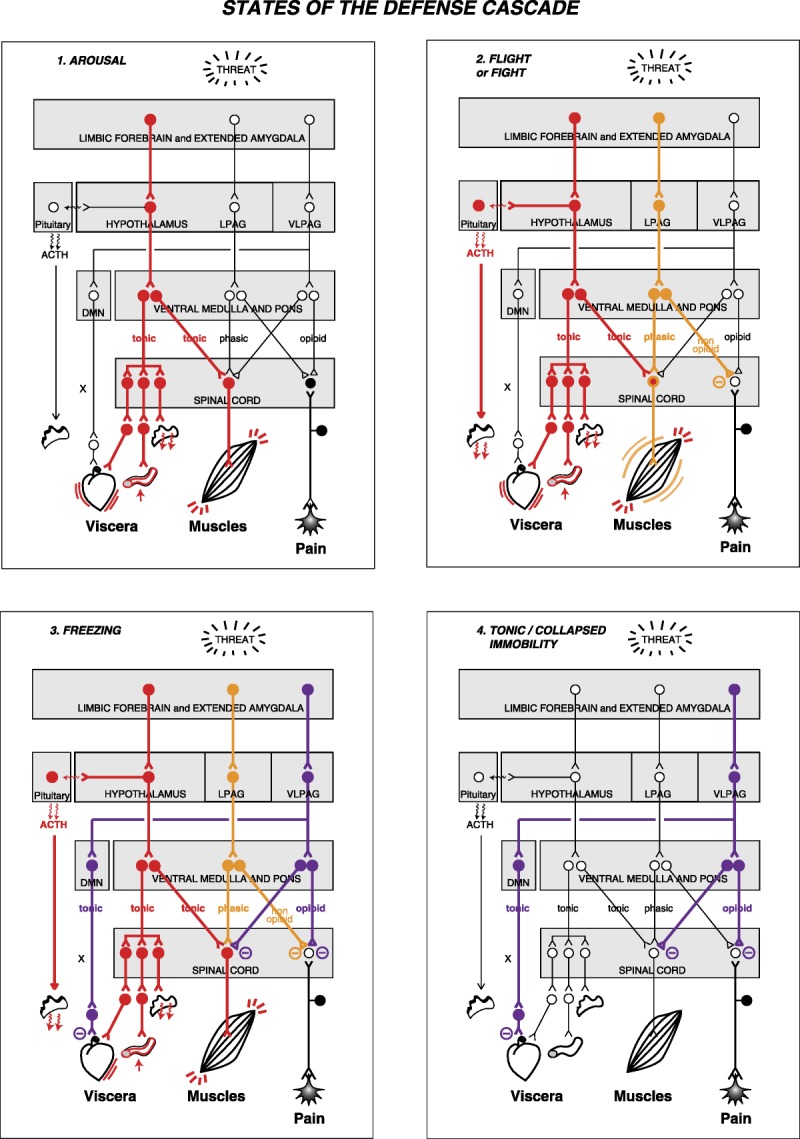
Evolution has endowed all humans with a continuum of innate, hard-wired, automatically activated defense behaviors, termed the defense cascade. Arousal is the first step in activating the defense cascade; flight or fight is an active defense response for dealing with threat; freezing is a flight-or-fight response put on hold; tonic immobility and collapsed immobility are responses of last resort to inescapable threat, when active defense responses have failed; and quiescent immobility is a state of quiescence that promotes rest and healing. Each of these defense reactions has a distinctive neural pattern mediated by a common neural pathway: activation and inhibition of particular functional components in the amygdala, hypothalamus, periaqueductal gray, and sympathetic and vagal nuclei. Unlike animals, which generally are able to restore their standard mode of functioning once the danger is past, humans often are not, and they may find themselves locked into the same, recurring pattern of response tied in with the original danger or trauma. Understanding the signature patterns of these innate responses--the particular components that combine to yield the given pattern of defense-is important for developing treatment interventions. Effective interventions aim to activate or deactivate one or more components of the signature neural pattern, thereby producing a shift in the neural pattern and, with it, in mind-body state. The process of shifting the neural pattern is the necessary first step in unlocking the patient's trauma response, in breaking the cycle of suffering, and in helping the patient to adapt to, and overcome, past trauma.
Overview
CoChat Summary
## TL;DR
This paper proposes a neuroscience-based model of the human defense cascade, organizing threat responses from arousal through flight/fight, freezing, tonic immobility, collapsed immobility, and quiescent immobility. It also maps these states to clinical interventions, emphasizing somatic, mindfulness-based, and trauma-processing approaches.
## Key findings
- The authors define the human defense cascade as six states: (1) arousal, (2) flight or fight, (3) freezing, (4) tonic immobility, (5) collapsed immobility, and (6) quiescent immobility.
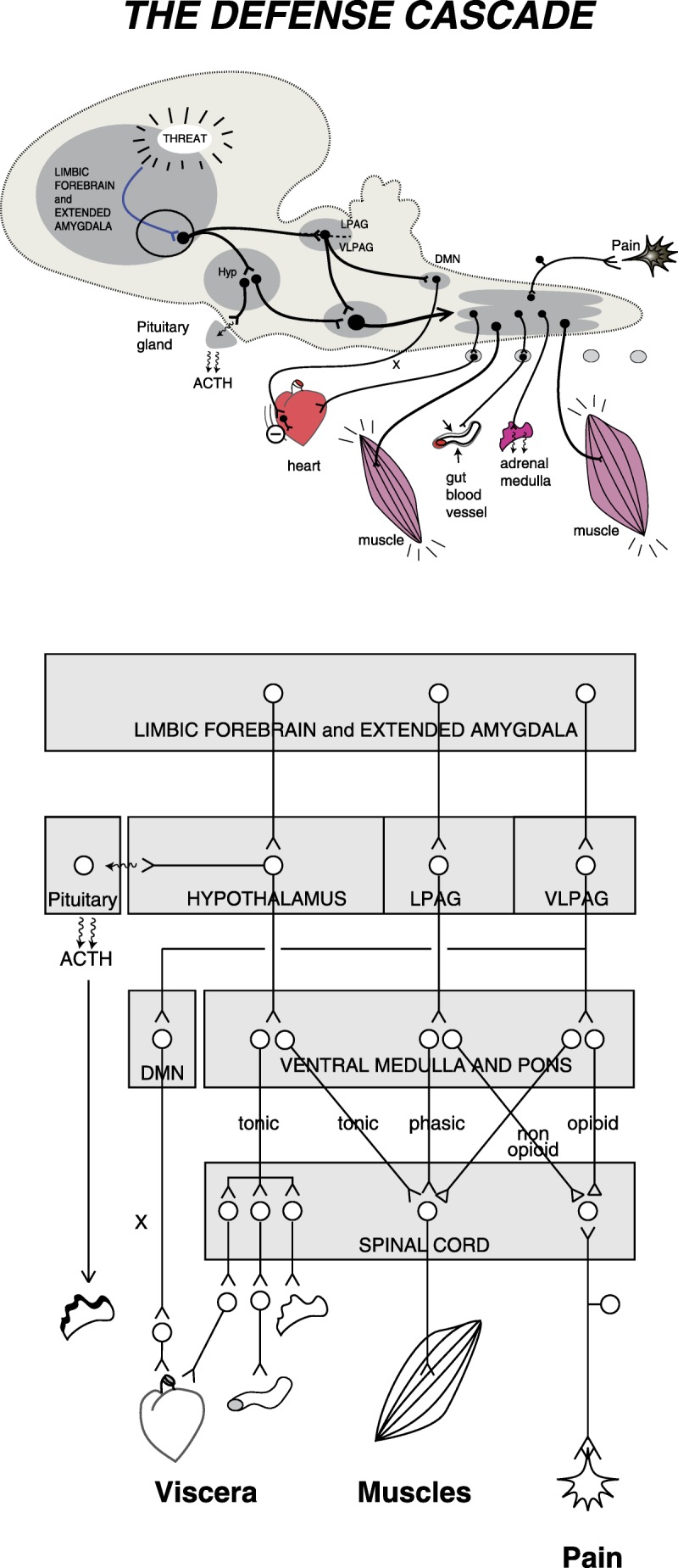
- They argue that these responses are mediated by descending neural circuits involving the extended amygdala, hypothalamus, PAG, ventral pontine tegmentum, ventral and dorsal medulla, and spinal cord, with separate somatomotor, autonomic/visceromotor, and pain-processing components.
- The paper reports that in humans freezing is typically short-lived, often lasting only a few seconds, and that in laboratory/animal observations freezing has been reported for up to 20 minutes in rats and up to 60 minutes in wild rodents.
- It states that a third of patients in one imaging study showed both reexperiencing and dissociative responses in a single experimental session to different scripts.
## Methods
- Narrative review and integrative clinical-neuroscience synthesis; the authors state they conducted wide-ranging searches on PubMed, communicated with laboratories and clinical groups, and tracked seminal historical references.
- The paper combines animal-model evidence, human clinical vignettes, and neurophysiological/imaging studies to build and illustrate the defense-cascade framework.
- Main analysis is conceptual: the authors relate specific defense states to neural circuits and then infer corresponding clinical management strategies for arousal reduction and trauma processing.
## Limitations
- The paper itself states that for quiescent immobility in humans, “it is not possible to explore this subject further at this time” because of the dearth of literature.
- It also states that the mechanisms underpinning EMDR and tapping have yet to be identified, and that further outcome studies are needed for tapping.
- Evident from the text: much of the article is an integrative model built from heterogeneous animal and human studies plus clinical vignettes, rather than a single empirical study with a new sample or controlled primary data.
Model-written summary. Check it against the paper before relying on it.
Integrity signals
Registry
Cites
Statistics
Figures
Verification
Claims the paper makes
22 Valid · 18 Not valid · 87 Not checked · 64 Own results and interpretations
The cited sources support only part of this claim — read each source’s verdict below.
In the paper
“All defense responses in the animal model of the defense cascade—arousal, freezing, flight or fight, tonic immobility, collapsed immobility, and quiescent immobility—are responses to threat mediated by neural circuits involving the extended amygdala, hypothalamus, periaqueductal gray (PAG), ventral pontine tegmentum, ventral and dorsal medulla, and spinal cord.22–25”
§ Fear and the Defense Cascade: Clinical Implications and Management > Abstract
What the sources say
- Partly supportedcites [22] Choi JS Cain CK LeDoux JE The role of amygdala nuclei in the expression of auditory signaled two-way active avoidance in rats. Learn Mem 2010; 17: 139– 47. 20189958 PMC2832923 sourceExperimental — accuracy not yet measured
Split into 2 atoms — 0 confirmed, 2 partially supported, 0 disputed, 0 misattributed, 0 unverifiable. Expand the claim to see per-atom verdicts.
- Not checked — no full text of the sourcecites [23] Gozzi A Jain A Giovanelli A A neural switch for active and passive fear. Neuron 2010; 67: 656– 66. 20797541 source
- Partly supportedcites [24] LeDoux JE Iwata J Cicchetti P Reis DJ Different projections of the central amygdaloid nucleus mediate autonomic and behavioral correlates of conditioned fear. J Neurosci 1988; 8: 2517– 29. 2854842 PMC6569498 sourceExperimental — accuracy not yet measured
Split into 2 atoms — 0 confirmed, 2 partially supported, 0 disputed, 0 misattributed, 0 unverifiable. Expand the claim to see per-atom verdicts.
- Not checked — no full text of the sourcecites [25] Bandler R Shipley MT Columnar organization in the midbrain periaqueductal gray: modules for emotional expression? Trends Neurosci 1994; 17: 379– 89. 7817403 source
plainstates a cause- Asserted: passes — The authors put it forward as true.
- Checkable: passes — It can be checked against evidence.
- Load-bearing: passes — The paper’s conclusions depend on it.
- Based: passes — The paper gives a reason why it holds.
- Partly supported
The cited sources support only part of this claim — read each source’s verdict below.
In the paper
“Studies suggest that flight or fight is the sum total of distinct components activated concurrently: a somatomotor (skeletal muscle) component, a visceromotor (autonomic) component, and a pain-modulation component (see Figures 1 and 2).24,45,46”
§ Fear and the Defense Cascade: Clinical Implications and Management > FLIGHT OR FIGHT: THE ANIMAL MODEL
What the sources say
- Partly supportedcites [24] LeDoux JE Iwata J Cicchetti P Reis DJ Different projections of the central amygdaloid nucleus mediate autonomic and behavioral correlates of conditioned fear. J Neurosci 1988; 8: 2517– 29. 2854842 PMC6569498 sourceExperimental — accuracy not yet measured
The section on conditioned fear-response pathways (page unavailable) describes defensive behavior accompanied by autonomic changes and distinguishes freezing from cardiovascular responses. It does not establish a pain-modulation component of the response or say that all three components are activated concurrently; its discussion of pain sensitivity concerns whether that could explain a lesion result. (LLM, conf=0.86)
- Partly supportedcites [45] Fanselow MS Neural organisation of defensive behavioural system responsible for fear. Psychon Bull Rev 1994; 1: 429– 38. 24203551 sourceExperimental — accuracy not yet measured
Fanselow's CIRCA-STRIKE DEFENSE and NEURAL CIRCUITRY MEDIATING POST-ENCOUNTER DEFENSES sections do state that the actions making up a defensive mode are 'physically compatible, so that they can occur simultaneously,' and enumerate exactly the three kinds of component the claim names: somatomotor (freezing, muscle-tone adjustment, escape locomotion, jump attack), visceromotor (tachycardia, hypertension, 'redirection of blood flow from viscera and skin to skeletal muscle'), and pain modulation (opioid and nonopioid analgesia). What the source does not support is the packaging: it does not treat 'flight or fight' as one sum total, but splits active defense into distinct, mutually inhibited modes (amygdala/vPAG-driven post-encounter freezing vs. dlPAG-driven circa-strike escape/attack), and it lists further concurrent components beyond the three cited (enhanced arousal, potentiated startle, vocalization). The evidence is also specific to the rat antipredator defensive behavior system, not a general fight-or-flight account. So the concurrent multi-component core is in the paper, while the unitary tripartite framing overstates and flattens it. (LLM, conf=0.72)
- Not checked — no full text of the sourcecites [46] Walker P Carrive P Role of ventrolateral periaqueductal gray neurons in the behavioral and cardiovascular responses to contextual conditioned fear and poststress recovery. Neuroscience 2003; 116: 897– 912. 12573728 source
hedged- Asserted: passes — The authors put it forward as true.
- Checkable: passes — It can be checked against evidence.
- Load-bearing: passes — The paper’s conclusions depend on it.
- Based: passes — The paper gives a reason why it holds.
- Partly supported
In the paper
“This order differs from conceptualizations based on the distance of the predatory threat—in which freezing is discussed before flight or fight.2,8,9,17”
§ Fear and the Defense Cascade: Clinical Implications and Management > Abstract
What the sources say
- Not matchedcites [2] Lang PJ Simons RF Balaban MT Attention and orienting: sensory and motivational processes. Mahwah, NJ: Erlbaum, 1997.
Its entry has no title and year that we can search by.
- Not matchedcites [8] Ratner SC Comparative aspects of hypnosis. In: Gordon JE, ed. Handbook of clinical experimental hypnosis. New York: Macmillan, 1967.
We searched by its title and found no matching paper.
- Could not verifycites [9] Fanselow MS Lester LS A functional behavioristic approach to aversely motivated behavior: predatory imminence as a determinate of the topology of defensive behavior. In: Bolles RC Beecher MD, eds. Evolution and learning. Hillsdale, NJ: Erlbaum, 1988: 185– 211. sourceExperimental — accuracy not yet measured
The Discussion describes freezing as interfering with active avoidance in rats, but it does not describe a defense cascade ordered by distance from a predator. Searches for predatory-threat distance and freezing before flight or fight found no passage addressing that ordering; the cited claim cannot be verified from our copy. (LLM, conf=0.74)
- Check pendingcites [17] Blanchard DC Blanchard RJ Ethoexperimental approaches to the biology of emotion. Ann Rev Psychol 1988; 39: 43– 68. 2894198 source
plain- Asserted: passes — The authors put it forward as true.
- Checkable: passes — It can be checked against evidence.
- Load-bearing: passes — The paper’s conclusions depend on it.
- Based: passes — The paper gives a reason why it holds.
- Not matched
The cited sources support only part of this claim — read each source’s verdict below.
In the paper
“Subsequent research with animals determined that, depending on the degree of threat and the distance between the predator and prey, distinct responses—freezing, flight or fight, tonic immobility, and quiescent immobility—proceed sequentially along a continuum, termed the defense cascade.”
§ Fear and the Defense Cascade: Clinical Implications and Management > Abstract
What the sources say
- Not matchedcites [2] Lang PJ Simons RF Balaban MT Attention and orienting: sensory and motivational processes. Mahwah, NJ: Erlbaum, 1997.
Its entry has no title and year that we can search by.
- Not matchedcites [8] Ratner SC Comparative aspects of hypnosis. In: Gordon JE, ed. Handbook of clinical experimental hypnosis. New York: Macmillan, 1967.
We searched by its title and found no matching paper.
- Partly supportedcites [9] Fanselow MS Lester LS A functional behavioristic approach to aversely motivated behavior: predatory imminence as a determinate of the topology of defensive behavior. In: Bolles RC Beecher MD, eds. Evolution and learning. Hillsdale, NJ: Erlbaum, 1988: 185– 211. sourceExperimental — accuracy not yet measured
Split into 2 atoms — 0 confirmed, 1 partially supported, 0 disputed, 0 misattributed, 1 unverifiable. Expand the claim to see per-atom verdicts.
- Check pendingcites [17] Blanchard DC Blanchard RJ Ethoexperimental approaches to the biology of emotion. Ann Rev Psychol 1988; 39: 43– 68. 2894198 source
plainstates a cause- Asserted: passes — The authors put it forward as true.
- Checkable: passes — It can be checked against evidence.
- Load-bearing: passes — The paper’s conclusions depend on it.
- Based: passes — The paper gives a reason why it holds.
- Not matched
The cited sources support only part of this claim — read each source’s verdict below.
In the paper
“Flight or fight is mediated through the lateral periaqueductal gray (LPAG), which activates the basic, stereotypical motor patterns of flight or fight—for example, attack, running, treading, burying (see Figures 1 and 2).24,28,47,48”
§ Fear and the Defense Cascade: Clinical Implications and Management > FLIGHT OR FIGHT: THE ANIMAL MODEL > Skeletal Muscle (Somatomotor) Activation
What the sources say
- Partly supportedcites [24] LeDoux JE Iwata J Cicchetti P Reis DJ Different projections of the central amygdaloid nucleus mediate autonomic and behavioral correlates of conditioned fear. J Neurosci 1988; 8: 2517– 29. 2854842 PMC6569498 sourceExperimental — accuracy not yet measured
The discussion of defense-response pathways says the central gray is involved in defensive behavior, and the discussion of conditioned fear describes it as a possible link to motor systems. The paper does not identify the lateral periaqueductal gray as mediating flight or fight or attribute attack, running, treading, or burying to it; its lesion findings concern conditioned freezing. (LLM, conf=0.76)
- Not checked — no full text of the sourcecites [28] Keay KA Bandler R Parallel circuits mediating distinct emotional coping reactions to different types of stress. Neurosci Biobehav Rev 2001; 25: 669– 78. 11801292 source
- Not checked — no full text of the sourcecites [47] Carrive P The periaqueductal gray and defensive behavior: functional representation and neuronal organization. Behav Brain Res 1993; 58: 27– 47. 8136048 source
- Not checked — no full text of the sourcecites [48] Rizvi TA Ennis M Behbehani MM Shipley MT Connections between the central nucleus of the amygdala and the midbrain periaqueductal gray: topography and reciprocity. J Comp Neurol 1991; 303: 121– 31. 1706363 source
plainstates a cause- Asserted: passes — The authors put it forward as true.
- Checkable: passes — It can be checked against evidence.
- Load-bearing: passes — The paper’s conclusions depend on it.
- Based: passes — The paper gives a reason why it holds.
- Partly supported
97 more claims · 12 with their cited sources checked
Create a free account to see all 191 claims and to verify the 65 references still open.
- It may state two separate claims as one. 69
- Probably not a substantial claim. 32
- The quote only partly states this claim. 1
Claims other papers make about this one
Each is checked against this paper’s own text: does it say what the citing paper says it does?
The source backs part of the claim, not all of it — or backs it for a different population, condition or comparison.
In the citing paper
“The parasympathetic system may now activate defensive programsfear-induced bradycardia in the heart; nausea, vomiting, or diarrhea programs in the gut; expulsion of urine by the bladder -that work alongside the sympathetic system to defend the body from danger (Kozlowska et al., 2015;Wood et al., 1999).”
From Physiological feelings (2019) · cites this paper as Kozlowska et al., 2015
Experimental — accuracy not yet measuredThe source backs part of the claim, not all of it — or backs it for a different population, condition or comparison.
In the citing paper
“At the same time, cortical loops in the basal ganglia and cerebellum are activated to modulate basic motor patterns consistent with context and defence strategies (Kozlowska et al., 2015;Lanius et al., 2014).”
From A review of the relation between dissociation, memory, executive functioning and social cognition in military members and civilians with neuropsychiatric conditions (2016) · cites this paper as Kozlowska et al., 2015
Experimental — accuracy not yet measuredThe source backs part of the claim, not all of it — or backs it for a different population, condition or comparison.
In the citing paper
“Notably, the fight or flight response involves non-opioid (endocannabinoid-mediated) analgesia evoked by the lateral PAG (Keay and Bandler, 2001;Kozlowska et al., 2015).”
From A review of the relation between dissociation, memory, executive functioning and social cognition in military members and civilians with neuropsychiatric conditions (2016) · cites this paper as Kozlowska et al., 2015
Experimental — accuracy not yet measuredThe source backs part of the claim, not all of it — or backs it for a different population, condition or comparison.
In the citing paper
“Critically, in cases where the organism determines it has little to no chance of survival, unresponsive immobility or death feigning may occur in an attempt to decrease predator interest, which may lead to tonic or collapsed immobility (Kozlowska et al., 2015;Schauer and Elbert, 2010).”
From A review of the relation between dissociation, memory, executive functioning and social cognition in military members and civilians with neuropsychiatric conditions (2016) · cites this paper as Kozlowska et al., 2015
Experimental — accuracy not yet measuredThe source backs part of the claim, not all of it — or backs it for a different population, condition or comparison.
In the citing paper
“Here, Kozlowska et al. (2015) described defensive mind-body states as fixed action patterns that are repeated or reactivated by environmental triggers, including motor patterns, autonomic responses and opioid mediated analgesia (e.g., van der Kolk, 2001).”
From A review of the relation between dissociation, memory, executive functioning and social cognition in military members and civilians with neuropsychiatric conditions (2016) · cites this paper as Kozlowska et al., 2015
Experimental — accuracy not yet measured
8 more claims about this paper
Create a free account to see every claim other papers make about this one.
Citations
Cites
The expression of the emotions in man and animals.
Darwin, C. (1872) · J. Murray eBooks · doi:10.1037/10001-000 · Cited by 11,657
(1982) · Trends in Neurosciences · doi:10.1016/0166-2236(82)90076-5 · Cited by 9,089
Mindfulness-based interventions in context: Past, present, and future
Kabat-Zinn, J. (2003) · Clinical Psychology: Science and Practice · doi:10.1093/clipsy.bpg016 · Cited by 8,615
Mindfulness-based interventions in context: Past, present, and future.
Kabat-Zinn, J. (2003) · Clinical Psychology: Science and Practice · doi:10.1093/clipsy/bpg016 · Cited by 8,612
The feeling of what happens: body and emotion in the making of consciousness
(2000) · Choice Reviews Online · doi:10.5860/choice.37-6553 · Cited by 5,998
(2001) · Cited by 3,666
Etkin, A., & Wager, T. D. (2007) · American Journal of Psychiatry · doi:10.1176/appi.ajp.2007.07030504 · Cited by 3,391
Stress and disorders of the stress system
Chrousos, G. P. (2009) · Nature Reviews Endocrinology · doi:10.1038/nrendo.2009.106 · Cited by 3,215 · cited 1×
“system interact reciprocally as part of a larger stress-regulation system, downregulation of one system will have a correlative impact on the functioning of the other systems.(41,181)”
BackgroundAlterations in brain and immune function produced by mindfulness meditation
Davidson, R. J., Kabat-Zinn, J., Schumacher, J., Rosenkranz, M., Muller, D., Santorelli, S. F., Urbanowski, F., Harrington, A., Bonus, K., & Sheridan, J. F. (2003) · Psychosomatic Medicine · doi:10.1097/01.psy.0000077505.67574.e3 · Cited by 2,925 · cited 1×
“or that induce and maintain a mind state of optimism, compassion, hope, and expectancy (as in spiritual beliefs in a loving and protective Other) may function to reduce arousal by downregulating the HPA axis,(178) downregulating sympathetic activation,(172) and modulating immune function to respond in more adaptive wa…”
BackgroundA Multidimensional Meta-Analysis of Psychotherapy for PTSD
Bradley, R., Greene, J., Russ, E., Dutra, L., & Westen, D. (2005) · American Journal of Psychiatry · doi:10.1176/appi.ajp.162.2.214 · Cited by 1,938
Research works printed but not linked: 5
- Rivers WHR The danger-instincts. In: Instinct and the unconscious: a contribution to a biological theory of the psycho-neuroses. London: Cambridge University Press, 1920: 52– 60.
- Gowers WR A lecture on vaso-vagal attacks. Lancet 1907; 1: 1551– 4.
- Ramos C Leite-Panissi R Monassi R Menescal-De-Oliveira L Role of the amygdaloid nuclei in the modulation of tonic immobility in guinea pigs. Physiol Behav 1999; 67: 717– 24. 10604843 · DOI · Paper page
- Gevirtz R Resonant frequency training to restore homeostasis for treatment of psychophysiological disorders. Biofeedback 2000; 27: 7– 9.
- Posner MI Attention in cognitive neuroscience: an overview. In: Gazzaniga MS Bizzi E, eds. The cognitive neurosciences. Cambridge, MA: MIT Press, 1995: 615– 24.
Cited by
Items 401–463 of 463
Dissociation in Borderline Personality Disorder
Salavati, M., & Selby, E. A. (2024) · Springer eBooks · doi:10.1007/978-3-031-75503-3_10 · Cited by 1
Captari, L. E. (2020) · University of North Texas Digital Library (University of North Texas) · doi:10.12794/metadc1707247
Groeneveld, M., & Harper, T. (2024) · PsyArXiv (OSF Preprints) · doi:10.31234/osf.io/aps5g_v1
Scher, S., & Kozlowska, K. (2025) · Springer eBooks · doi:10.1007/978-3-031-78475-0_6
Self-citationSimon, D., Aden, M., Greene, S., O’Brien-Teengs, D., Loutfy, M. R., & Benoit, A. C. (2025) · Wellbeing Space and Society · doi:10.1016/j.wss.2025.100249 · Cited by 1
Groeneveld, M., & Harper, T. (2025) · PsyArXiv (OSF Preprints) · doi:10.31234/osf.io/aps5g_v3
Vancappel, A., Chami, L., Leroy, A., Kerbage, H., & El‐Hage, W. (2025) · European Journal of Trauma & Dissociation · doi:10.1016/j.ejtd.2025.100536 · Cited by 1
Nonverbal correlates of paranoid ideation – a systematic literature review
Haarms, R., Jongsma, H. E., Geraets, C. N. W., & Veling, W. (2025) · Psychological Medicine · doi:10.1017/s0033291725001230
Weissfeld, R. K. (2026) · Clinical and Translational Neuroscience · doi:10.3390/ctn10020009
Groeneveld, M., & Harper, T. (2025) · PsyArXiv (OSF Preprints) · doi:10.31234/osf.io/aps5g_v4 · Cited by 1
Montesinos, A. M. P. (2025) · Behavior & Law Journal · doi:10.47442/blj.2025.132
Análisis de los Efectos Producidos por FFF en Profesionales de la Seguridad.
Montesinos, A. M. P. (2025) · Behavior & Law Journal · doi:10.47442/blj.2025.131
Metacognitive Implications on Physiological Disorders
Florea, G.-P. (2025) · New paradigms in healthcare · doi:10.1007/978-3-032-01070-4_9 · Cited by 1
Berlin, Y. (2025) · Journal of Modern Jewish Studies · doi:10.1080/14725886.2025.2545789
Embodied Performance: A Case for Somatic Experiencing ® in Sport Psychology
Goldman, A. (2025) · Journal of Sport Psychology in Action · doi:10.1080/21520704.2025.2570211
The effects of exergaming on empathy for pain: Evidence from an event-related potential study
Wang, B., Yu, S., Cheng, G., Si, Y., & Guo, W. (2025) · Acta Psychologica · doi:10.1016/j.actpsy.2025.105830
Kuylenstierna, A., Enebrink, P., Kreicbergs, U. C., Ljungman, G., Lövgren, M., Sörensdotter, R., Wikman, A., & Ljungman, L. (2025) · European Journal of Oncology Nursing · doi:10.1016/j.ejon.2025.103064
“Parents ’ unforeseen different reactions to their child ’ s cancer can be understood through the concept of evolutionarily rooted threat responses, specifically the fight, flight, or freeze responses (Kozlowska et al., 2015).”
Integrating the Gestalt Model of Self With Psychedelic‐Assisted Psychotherapy
Fox, T. R. (2025) · The Journal of Humanistic Counseling · doi:10.1002/johc.70026
Waligórska, A. (2025) · Man – Disability – Society · doi:10.71358/cns.2081
Vogel, F., Reichert, J., & Schwenck, C. (2022) · Figshare · doi:10.6084/m9.figshare.21582500
Hatcher, S., Frye, L., & Herk, K. V. (2025) · Springer eBooks · doi:10.1007/978-3-032-00663-9_1
Davey, E. G. (2025) · Mental Health and Social Inclusion · doi:10.1108/mhsi-10-2025-0269
Courtney, R. (2025) · Perspectives of the ASHA Special Interest Groups · doi:10.1044/2025_persp-24-00305 · Cited by 2
Conceptualization and Measurement of Anxious Freezing
Marder, M. A., Richier, C., Miller, G. A., & Heller, W. (2025) · Assessment · doi:10.1177/10731911251401405
Cui, W., & Guo, T. (2026) · International Journal of Social Psychology Revista de Psicología Social · doi:10.1177/02134748251405090
“Generally speaking, positive emotions increase approach tendency, whereas negative emotions elicit inhibition tendency, preparing the organism for defence (Kozlowska et al., 2015).”
Between Consciousness and Silence: Lived Experiences of Anesthesia
Jacobs, C. M. (2026) · IntechOpen eBooks · doi:10.5772/intechopen.1014272
Noradrenaline prolongs the state of motor arrest via cerebrospinal fluid signalingPreprint
Dhanasekar, M., Fidelin, K., Greco, M., Lunsford, E. T., Tano, M. C., Deleuze, C., Moisan, L., Mora, T., Walczak, A. M., & Wyart, C. (2026) · bioRxiv (Cold Spring Harbor Laboratory) · doi:10.64898/2026.02.06.704024
“In humans, severe threat can trigger vagal-mediated collapse with motor paralysis, bradycardia, and nausea 11,26 .”
Péculier, S., & Évrard, R. (2025) · Perspectives Psy · doi:10.1051/ppsy/2025056
Defining Adversity and Toxic Stress
(2025) · American Academy of PediatricsItasca, IL eBooks · doi:10.1542/9781610028196-ch2
R, B. R. A. (2026) · SSRN Electronic Journal · doi:10.2139/ssrn.6249279
Schielke, H. J., Kumar, S. A., Brand, B. L., & Lanius, R. A. (2026) · Journal of Trauma & Dissociation · doi:10.1080/15299732.2026.2641649
“Dissociation is linked with emotional overwhelm and trauma-related distress (Briere et al., 2010; Kozlowska et al., 2015) and is present in a wide range of diagnostic categories.”
Cianchetti, C., Carta, M. G., & Perra, A. (2026) · Clinical Practice and Epidemiology in Mental Health · doi:10.2174/0117450179455271260220082810
Altered states under coercion: Peri-traumatic dissociative coping in Nazi concentration camps
Somer, E. (2026) · European Journal of Trauma & Dissociation · doi:10.1016/j.ejtd.2026.100677
Stimulation of the human periaqueductal gray induces threat bradycardia: a case report
Klaassen, F. H., de Voogd, L. D., Hulsman, A. M., Klumpers, F., Farrell, S., Green, A. L., van den Munckhof, P., & Roelofs, K. (2026) · Neurocase · doi:10.1080/13554794.2026.2640909
“It is possible that threat bradycardia due to dPAG stimulation could occur through stimulation of dmPAG circuits that are innervated by the central nucleus of the amygdala (CeA; Carrive, 1993; Kozlowska et al., 2015; Linnman et al., 2012).”
Apport des simulations immersives pour l’étude du comportement dynamique des occupants d’un véhicule
Loreto, C. D. (2020) · theses.fr (ABES) · doi:10.70675/3c949416zc54fz4890zb0d5z3469dbc3ee3d
Vancappel, A. (2021) · theses.fr (ABES) · doi:10.70675/dea8e3d7zeecaz44d6za3e9z95ed7c42b45e · Cited by 5
Sensory approaches and recovery-oriented practice
Sutton, D., & Argentzell, E. (2026) · Elsevier eBooks · doi:10.1016/b978-0-443-40596-9.00006-3 · Cited by 3
Sensory approaches for anxiety and depression
Sutton, D., & Argentzell, E. (2026) · Elsevier eBooks · doi:10.1016/b978-0-443-40596-9.00009-9
The role of tonic immobility in trauma treatment
Matthijssen, S. J. M. A., & de Boer, M. (2026) · Acta Psychologica · doi:10.1016/j.actpsy.2026.106858
Joint latent profiles of death anxiety and treatment adherence in HCC patients
Sheng, S., Bai, L., Yundan, Z., Chen, H., ZhaXi, B., Duoji, L., Shu, Y., & Cao, X. (2026) · Frontiers in Psychiatry · doi:10.3389/fpsyt.2026.1792371
Lucre, K., Clapton, N., Gilbert, P., Jones, C., & Copello, A. G. (2026) · OBM Integrative and Complementary Medicine · doi:10.21926/obm.icm.2602016
Autonomy Sensitivity Theory: A Proposed Mechanistic Account of the Demand Avoidance SpectrumPreprint
Maynard, M. L. (2026) · SSRN Electronic Journal · doi:10.2139/ssrn.6907498
Raffa, R. B., Fink, W., & Tripathi, A. (2026) · Cureus · doi:10.7759/cureus.111311
“Despite subsequent expanded versions [2], in essence, the fight-or-flight response consists of automatically activated defensive behaviors for dealing with threat [3].”
Zaccari, B., Moonaz, S., & Sullivan, M. B. (2026) · Frontiers in Public Health · doi:10.3389/fpubh.2026.1786419
“The defense cascade model defines a continuum of responses to subconsciously perceived threat, including arousal, fight, flight, freeze, collapse, and immobility (124).”
Kozlowska, K., Fitzgibbon, C. E., O'Sullivan, J. S., Scher, S., & Carrive, P. (2026) · Human Systems Therapy Culture and Attachments · doi:10.1177/26344041261462371
Self-citationEmotional Valence as A Control Variable in A Generic Valence-Arousal-Dominance Dynamical System
Noël, Y., & Noel-Fevrier, F. (2026) · Affective Science · doi:10.1007/s42761-026-00383-8
Análisis de estereotipos victimológicos y de género en el juicio social a víctimas
Gaitán, E. G., Peralta, M. P., Arias, L. V., & Iglesias, M. I. L. (2026) · Derecho y género · doi:10.5565/rev/derechoygenero.56
Neary, J. P., Carleton, R. N., & Guzik, P. (2026) · Neuroscience · doi:10.1016/j.neuroscience.2026.07.003
Alpha 2 Agonists: Clonidine and Guanfacine
Carle, K. J. (2026) · Springer eBooks · doi:10.1007/978-981-95-7244-1_4
The Neurobiology of Trauma: From Threat Detection to Somatic Dysregulation
Bellman, V. (2026) · IntechOpen eBooks · doi:10.5772/intechopen.1015782
Intercultural Mismatches: New Zealand Perspectives on Transnational Design Teaching in China
Saris, B., Moore, A., & Smith, L. (2026) · New Zealand Journal of Educational Studies · doi:10.1007/s40841-026-00473-y
Balancing Stress Through Emotion Regulation and Coping Strategies
Khati, A., Das, A., Bhutia, T. O., & Saha, S. (2026) · IGI Global eBooks · doi:10.4018/979-8-3373-6294-6.ch003
Masola, F., & Bipath, K. (2026) · E-Journal of Humanities Arts and Social Sciences · doi:10.38159/ehass.20267710
“25 Therefore, fear, as an emotional response to a situation, does not need to be based on a real threat; it can be imagined or expected.”
Vecchi, M. (2023) · Ciências Policiais em Revista · doi:10.67940/yac6jv02
Randall, M. (2026) · The International Journal of Evidence & Proof · doi:10.1177/13657127261477233
Tomasi, J., Tiwari, A. K., Zai, C. C. H., Zai, G. C., Richter, M. A., Sanches, M., Lachman, R., Gaspar, C., Cella, M., Greer, B., et al. (2026) · Journal of Affective Disorders · doi:10.1016/j.jad.2026.122508
Dissociation in fibromyalgia: a systematic review with meta-analysis
Mesce, M., Scalzeri, M., Galvez-Sánchez, C. M., Caruso, A., Cavicchioli, M., Sarzi‐Puttini, P., & Galli, F. (2026) · General Hospital Psychiatry · doi:10.1016/j.genhosppsych.2026.09.006
Adapting the Cognitive Interview for Victims of Sexual Assault
Fisher, R. P., Hopper, J. W., Bibeau, L., Chez, J., & Viau‐Quesnel, C. (2026) · Springer eBooks · doi:10.1007/978-3-032-15938-0_15
A transtheoretical model of polypsychic defence: A hypothesis-generating integrative framework
Zammit, N., Klockner, K., & Browne, M. (2026) · European Journal of Trauma & Dissociation · doi:10.1016/j.ejtd.2026.100757
Chabbouh, A., Abbas, R., Frenn, Y. E., Shamseddeen, W., Saab, M., Saab, L., Harati, H., Ahmar, E. A., & Estephan, E. (2026) · Progress in Neuro-Psychopharmacology and Biological Psychiatry · doi:10.1016/j.pnpbp.2026.111953
Stretch‐Induced Muscle Responses Under Threat Versus Safety
Visser, Y. F., Bramson, B., Medendorp, W. P., Roelofs, K., & Selen, L. P. J. (2026) · European Journal of Neuroscience · doi:10.1111/ejn.70693
Physical Attack and Out-of-Body Experiences: An Advantageous Dissociation
King, R. A. (2026) · Journal of Anomalous Experience and Cognition · doi:10.31156/jaex.28213
“The human threat response system is an adaptive mechanism that can be automatically activated by an arousal related to an awareness of a presumed threat to one’s survival, initiating a cascade of defense behaviors (Kozlowska et al., 2015; Schauer & Elbert, 2010).”
Davids, J., de Moore, G., Brown, M., & Murphy, M. (2026) · Frontiers in Psychiatry · doi:10.3389/fpsyt.2026.1952758
Metadata
- Authors
- Kozlowska, K., Walker, P., McLean, L., & Carrive, P.
- Affiliations
- The University of Sydney (AU)
- Corresponding author
- Kozlowska, Kasia
- Venue
- Harvard Review of Psychiatry
- Published
- 2015-07
- Volume
- 23
- Issue
- 4
- Pages
- 263-287
- ISSN
- 1067-3229 (ISSN-L)
- PMC
- PMC4495877
- OpenAlex
- W2405345309
- Cited by
- 468
- References
- 210
- Citations by year
- 2026: 53 · 2025: 40 · 2024: 83 · 2023: 52 · 2022: 55 · 2021: 40 · 2020: 33 · 2019: 39 · 2018: 28 · 2017: 29 · 2016: 14 · 2015: 2
- FWCI
- 3.49
- Type
- journal article
- Language
- en
- Open access
- hybrid
- doi.org
- Licence
- cc-by-nc-nd
- Locations
- Harvard Review of Psychiatry (publishedVersion, cc-by-nc-nd)
- PubMed Central (publishedVersion, cc-by-nc-nd)
- PubMed (publishedVersion)
- Topics
- Social Sciences › Psychology › Clinical Psychology › Posttraumatic Stress Disorder Research
- Social Sciences › Psychology › Clinical Psychology › Psychoanalysis and Psychopathology Research
- Life Sciences › Neuroscience › Behavioral Neuroscience › Stress Responses and Cortisol
- Keywords
- fear, fight-or-flight response, freezing response, tonic immobility, amygdala, hypothalamus, periaqueductal gray, neural pathways, trauma response, post-traumatic stress disorder
- MeSH terms
- Animals, Arousal, Dogs, Fear, Humans, Perceptual Defense, Psychophysiology, Models, Animal, Freezing Reaction, Cataleptic, Immobility Response, Tonic, Rats
About these checks
Registry, retraction, Cites and statistics results are computed, not judged, with one exception: a printed reference that no index lists is read once by a model before it counts as a citation error. Claims are extracted by a model and kept only when their quote appears verbatim in the text; each cited source is then checked, with a model’s help, for whether it says what the claim relies on. Those verdicts can be wrong — read the claim’s quote and the cited source before relying on one.
The claim verdicts this report counts are experimental: their accuracy is not yet measured.
A language model drew the claims from the paper on 2026-10-09, under version 3 of the claim definition (model deepseek-v4.1-flash, prompt extract-v3).
A second model labelled each claim on 2026-10-09 (model jev-1.13-20260917, definition revision gold-guideline-v0.2).
Cited sources are checked with a language model’s help (gpt-6-sol and qwen3.8-omni-flash).
Statistics and arithmetic are recomputed, not judged.
Confidence bands are shown only for fields calibrated on our annotated test set. None is calibrated yet, so no band is shown.
What counts as a claim ›How we measure confidence ›How we check this ›
Are you an author, or do you see a problem with this page? Request a review
Data sources
Bibliographic data: Semantic Scholar, OpenAlex, Crossref.
Contains information from the Semantic Scholar Academic Graph Datasets, made available under the ODC Attribution License (ODC-BY 1.0).
Semantic Scholar’s data is described in: Kinney, R., et al. (2023). The Semantic Scholar Open Data Platform. arXiv:2301.10140.
