

Fear and the Defense Cascade
Open accessThe DOI matches its Crossref record; 198 of the 210 references it cites were found in a registry or an index; 38 of the 262 sources its claims cite were checked for support.
Abstract
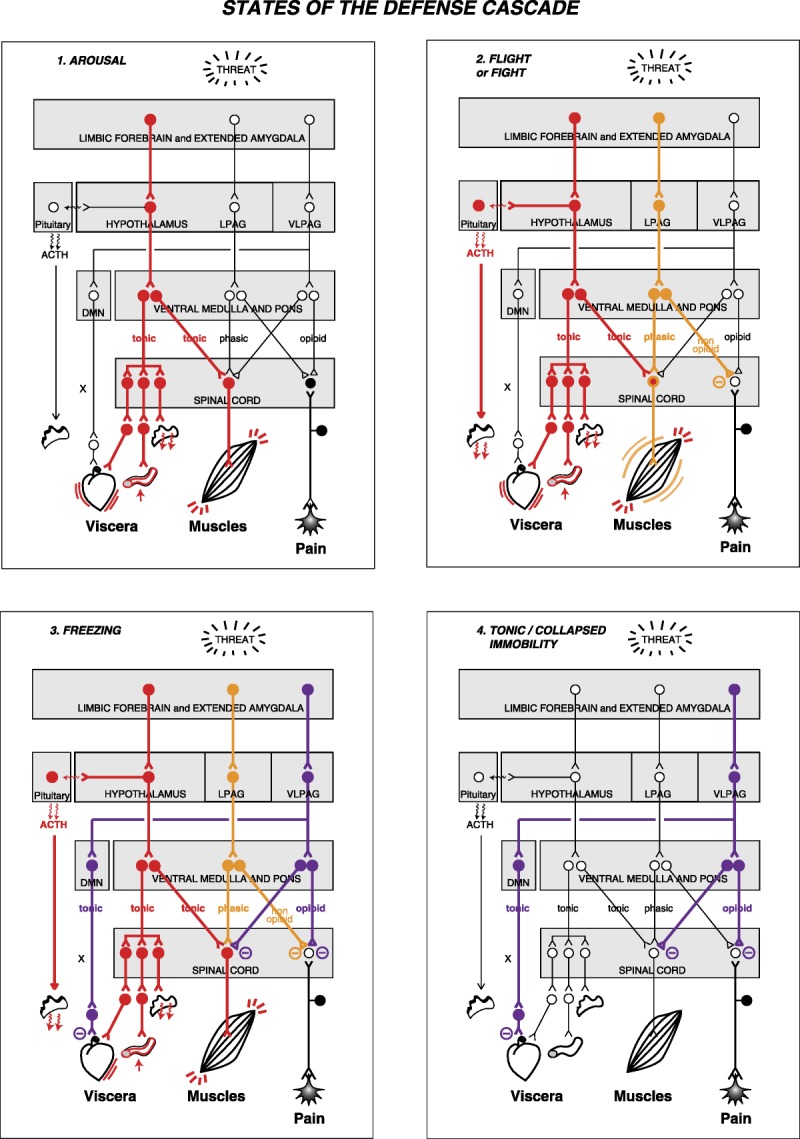
Evolution has endowed all humans with a continuum of innate, hard-wired, automatically activated defense behaviors, termed the defense cascade. Arousal is the first step in activating the defense cascade; flight or fight is an active defense response for dealing with threat; freezing is a flight-or-fight response put on hold; tonic immobility and collapsed immobility are responses of last resort to inescapable threat, when active defense responses have failed; and quiescent immobility is a state of quiescence that promotes rest and healing. Each of these defense reactions has a distinctive neural pattern mediated by a common neural pathway: activation and inhibition of particular functional components in the amygdala, hypothalamus, periaqueductal gray, and sympathetic and vagal nuclei. Unlike animals, which generally are able to restore their standard mode of functioning once the danger is past, humans often are not, and they may find themselves locked into the same, recurring pattern of response tied in with the original danger or trauma. Understanding the signature patterns of these innate responses--the particular components that combine to yield the given pattern of defense-is important for developing treatment interventions. Effective interventions aim to activate or deactivate one or more components of the signature neural pattern, thereby producing a shift in the neural pattern and, with it, in mind-body state. The process of shifting the neural pattern is the necessary first step in unlocking the patient's trauma response, in breaking the cycle of suffering, and in helping the patient to adapt to, and overcome, past trauma.
Overview
CoChat Summary
## TL;DR
This paper proposes a neuroscience-based model of the human defense cascade, organizing threat responses from arousal through flight/fight, freezing, tonic immobility, collapsed immobility, and quiescent immobility. It also maps these states to clinical interventions, emphasizing somatic, mindfulness-based, and trauma-processing approaches.
## Key findings
- The authors define the human defense cascade as six states: (1) arousal, (2) flight or fight, (3) freezing, (4) tonic immobility, (5) collapsed immobility, and (6) quiescent immobility.
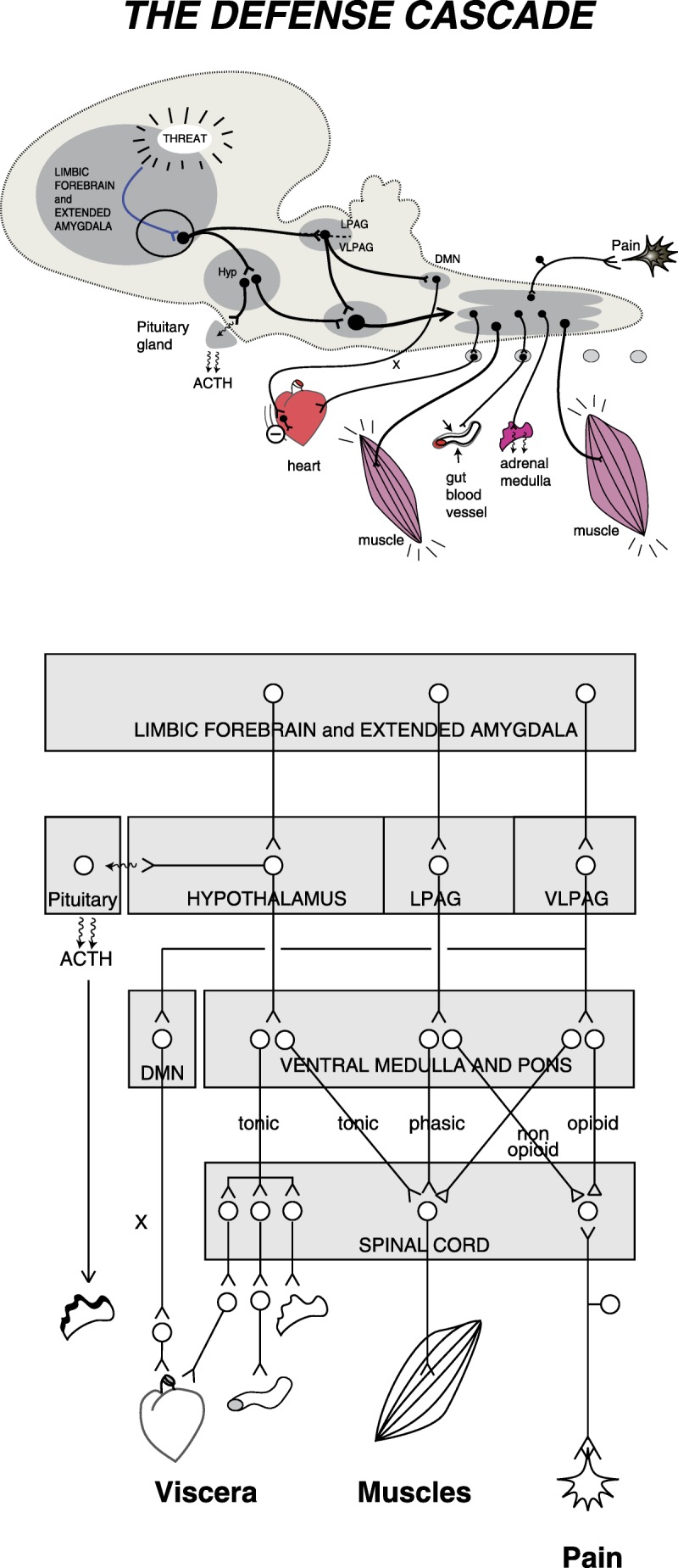
- They argue that these responses are mediated by descending neural circuits involving the extended amygdala, hypothalamus, PAG, ventral pontine tegmentum, ventral and dorsal medulla, and spinal cord, with separate somatomotor, autonomic/visceromotor, and pain-processing components.
- The paper reports that in humans freezing is typically short-lived, often lasting only a few seconds, and that in laboratory/animal observations freezing has been reported for up to 20 minutes in rats and up to 60 minutes in wild rodents.
- It states that a third of patients in one imaging study showed both reexperiencing and dissociative responses in a single experimental session to different scripts.
## Methods
- Narrative review and integrative clinical-neuroscience synthesis; the authors state they conducted wide-ranging searches on PubMed, communicated with laboratories and clinical groups, and tracked seminal historical references.
- The paper combines animal-model evidence, human clinical vignettes, and neurophysiological/imaging studies to build and illustrate the defense-cascade framework.
- Main analysis is conceptual: the authors relate specific defense states to neural circuits and then infer corresponding clinical management strategies for arousal reduction and trauma processing.
## Limitations
- The paper itself states that for quiescent immobility in humans, “it is not possible to explore this subject further at this time” because of the dearth of literature.
- It also states that the mechanisms underpinning EMDR and tapping have yet to be identified, and that further outcome studies are needed for tapping.
- Evident from the text: much of the article is an integrative model built from heterogeneous animal and human studies plus clinical vignettes, rather than a single empirical study with a new sample or controlled primary data.
Model-written summary. Check it against the paper before relying on it.
Integrity signals
Registry
Cites
Statistics
Figures
Verification
Claims the paper makes
22 Valid · 18 Not valid · 87 Not checked · 64 Own results and interpretations
The cited sources support only part of this claim — read each source’s verdict below.
In the paper
“All defense responses in the animal model of the defense cascade—arousal, freezing, flight or fight, tonic immobility, collapsed immobility, and quiescent immobility—are responses to threat mediated by neural circuits involving the extended amygdala, hypothalamus, periaqueductal gray (PAG), ventral pontine tegmentum, ventral and dorsal medulla, and spinal cord.22–25”
§ Fear and the Defense Cascade: Clinical Implications and Management > Abstract
What the sources say
- Partly supportedcites [22] Choi JS Cain CK LeDoux JE The role of amygdala nuclei in the expression of auditory signaled two-way active avoidance in rats. Learn Mem 2010; 17: 139– 47. 20189958 PMC2832923 sourceExperimental — accuracy not yet measured
Split into 2 atoms — 0 confirmed, 2 partially supported, 0 disputed, 0 misattributed, 0 unverifiable. Expand the claim to see per-atom verdicts.
- Not checked — no full text of the sourcecites [23] Gozzi A Jain A Giovanelli A A neural switch for active and passive fear. Neuron 2010; 67: 656– 66. 20797541 source
- Partly supportedcites [24] LeDoux JE Iwata J Cicchetti P Reis DJ Different projections of the central amygdaloid nucleus mediate autonomic and behavioral correlates of conditioned fear. J Neurosci 1988; 8: 2517– 29. 2854842 PMC6569498 sourceExperimental — accuracy not yet measured
Split into 2 atoms — 0 confirmed, 2 partially supported, 0 disputed, 0 misattributed, 0 unverifiable. Expand the claim to see per-atom verdicts.
- Not checked — no full text of the sourcecites [25] Bandler R Shipley MT Columnar organization in the midbrain periaqueductal gray: modules for emotional expression? Trends Neurosci 1994; 17: 379– 89. 7817403 source
plainstates a cause- Asserted: passes — The authors put it forward as true.
- Checkable: passes — It can be checked against evidence.
- Load-bearing: passes — The paper’s conclusions depend on it.
- Based: passes — The paper gives a reason why it holds.
- Partly supported
The cited sources support only part of this claim — read each source’s verdict below.
In the paper
“Studies suggest that flight or fight is the sum total of distinct components activated concurrently: a somatomotor (skeletal muscle) component, a visceromotor (autonomic) component, and a pain-modulation component (see Figures 1 and 2).24,45,46”
§ Fear and the Defense Cascade: Clinical Implications and Management > FLIGHT OR FIGHT: THE ANIMAL MODEL
What the sources say
- Partly supportedcites [24] LeDoux JE Iwata J Cicchetti P Reis DJ Different projections of the central amygdaloid nucleus mediate autonomic and behavioral correlates of conditioned fear. J Neurosci 1988; 8: 2517– 29. 2854842 PMC6569498 sourceExperimental — accuracy not yet measured
The section on conditioned fear-response pathways (page unavailable) describes defensive behavior accompanied by autonomic changes and distinguishes freezing from cardiovascular responses. It does not establish a pain-modulation component of the response or say that all three components are activated concurrently; its discussion of pain sensitivity concerns whether that could explain a lesion result. (LLM, conf=0.86)
- Partly supportedcites [45] Fanselow MS Neural organisation of defensive behavioural system responsible for fear. Psychon Bull Rev 1994; 1: 429– 38. 24203551 sourceExperimental — accuracy not yet measured
Fanselow's CIRCA-STRIKE DEFENSE and NEURAL CIRCUITRY MEDIATING POST-ENCOUNTER DEFENSES sections do state that the actions making up a defensive mode are 'physically compatible, so that they can occur simultaneously,' and enumerate exactly the three kinds of component the claim names: somatomotor (freezing, muscle-tone adjustment, escape locomotion, jump attack), visceromotor (tachycardia, hypertension, 'redirection of blood flow from viscera and skin to skeletal muscle'), and pain modulation (opioid and nonopioid analgesia). What the source does not support is the packaging: it does not treat 'flight or fight' as one sum total, but splits active defense into distinct, mutually inhibited modes (amygdala/vPAG-driven post-encounter freezing vs. dlPAG-driven circa-strike escape/attack), and it lists further concurrent components beyond the three cited (enhanced arousal, potentiated startle, vocalization). The evidence is also specific to the rat antipredator defensive behavior system, not a general fight-or-flight account. So the concurrent multi-component core is in the paper, while the unitary tripartite framing overstates and flattens it. (LLM, conf=0.72)
- Not checked — no full text of the sourcecites [46] Walker P Carrive P Role of ventrolateral periaqueductal gray neurons in the behavioral and cardiovascular responses to contextual conditioned fear and poststress recovery. Neuroscience 2003; 116: 897– 912. 12573728 source
hedged- Asserted: passes — The authors put it forward as true.
- Checkable: passes — It can be checked against evidence.
- Load-bearing: passes — The paper’s conclusions depend on it.
- Based: passes — The paper gives a reason why it holds.
- Partly supported
In the paper
“This order differs from conceptualizations based on the distance of the predatory threat—in which freezing is discussed before flight or fight.2,8,9,17”
§ Fear and the Defense Cascade: Clinical Implications and Management > Abstract
What the sources say
- Not matchedcites [2] Lang PJ Simons RF Balaban MT Attention and orienting: sensory and motivational processes. Mahwah, NJ: Erlbaum, 1997.
Its entry has no title and year that we can search by.
- Not matchedcites [8] Ratner SC Comparative aspects of hypnosis. In: Gordon JE, ed. Handbook of clinical experimental hypnosis. New York: Macmillan, 1967.
We searched by its title and found no matching paper.
- Could not verifycites [9] Fanselow MS Lester LS A functional behavioristic approach to aversely motivated behavior: predatory imminence as a determinate of the topology of defensive behavior. In: Bolles RC Beecher MD, eds. Evolution and learning. Hillsdale, NJ: Erlbaum, 1988: 185– 211. sourceExperimental — accuracy not yet measured
The Discussion describes freezing as interfering with active avoidance in rats, but it does not describe a defense cascade ordered by distance from a predator. Searches for predatory-threat distance and freezing before flight or fight found no passage addressing that ordering; the cited claim cannot be verified from our copy. (LLM, conf=0.74)
- Check pendingcites [17] Blanchard DC Blanchard RJ Ethoexperimental approaches to the biology of emotion. Ann Rev Psychol 1988; 39: 43– 68. 2894198 source
plain- Asserted: passes — The authors put it forward as true.
- Checkable: passes — It can be checked against evidence.
- Load-bearing: passes — The paper’s conclusions depend on it.
- Based: passes — The paper gives a reason why it holds.
- Not matched
The cited sources support only part of this claim — read each source’s verdict below.
In the paper
“Subsequent research with animals determined that, depending on the degree of threat and the distance between the predator and prey, distinct responses—freezing, flight or fight, tonic immobility, and quiescent immobility—proceed sequentially along a continuum, termed the defense cascade.”
§ Fear and the Defense Cascade: Clinical Implications and Management > Abstract
What the sources say
- Not matchedcites [2] Lang PJ Simons RF Balaban MT Attention and orienting: sensory and motivational processes. Mahwah, NJ: Erlbaum, 1997.
Its entry has no title and year that we can search by.
- Not matchedcites [8] Ratner SC Comparative aspects of hypnosis. In: Gordon JE, ed. Handbook of clinical experimental hypnosis. New York: Macmillan, 1967.
We searched by its title and found no matching paper.
- Partly supportedcites [9] Fanselow MS Lester LS A functional behavioristic approach to aversely motivated behavior: predatory imminence as a determinate of the topology of defensive behavior. In: Bolles RC Beecher MD, eds. Evolution and learning. Hillsdale, NJ: Erlbaum, 1988: 185– 211. sourceExperimental — accuracy not yet measured
Split into 2 atoms — 0 confirmed, 1 partially supported, 0 disputed, 0 misattributed, 1 unverifiable. Expand the claim to see per-atom verdicts.
- Check pendingcites [17] Blanchard DC Blanchard RJ Ethoexperimental approaches to the biology of emotion. Ann Rev Psychol 1988; 39: 43– 68. 2894198 source
plainstates a cause- Asserted: passes — The authors put it forward as true.
- Checkable: passes — It can be checked against evidence.
- Load-bearing: passes — The paper’s conclusions depend on it.
- Based: passes — The paper gives a reason why it holds.
- Not matched
The cited sources support only part of this claim — read each source’s verdict below.
In the paper
“Flight or fight is mediated through the lateral periaqueductal gray (LPAG), which activates the basic, stereotypical motor patterns of flight or fight—for example, attack, running, treading, burying (see Figures 1 and 2).24,28,47,48”
§ Fear and the Defense Cascade: Clinical Implications and Management > FLIGHT OR FIGHT: THE ANIMAL MODEL > Skeletal Muscle (Somatomotor) Activation
What the sources say
- Partly supportedcites [24] LeDoux JE Iwata J Cicchetti P Reis DJ Different projections of the central amygdaloid nucleus mediate autonomic and behavioral correlates of conditioned fear. J Neurosci 1988; 8: 2517– 29. 2854842 PMC6569498 sourceExperimental — accuracy not yet measured
The discussion of defense-response pathways says the central gray is involved in defensive behavior, and the discussion of conditioned fear describes it as a possible link to motor systems. The paper does not identify the lateral periaqueductal gray as mediating flight or fight or attribute attack, running, treading, or burying to it; its lesion findings concern conditioned freezing. (LLM, conf=0.76)
- Not checked — no full text of the sourcecites [28] Keay KA Bandler R Parallel circuits mediating distinct emotional coping reactions to different types of stress. Neurosci Biobehav Rev 2001; 25: 669– 78. 11801292 source
- Not checked — no full text of the sourcecites [47] Carrive P The periaqueductal gray and defensive behavior: functional representation and neuronal organization. Behav Brain Res 1993; 58: 27– 47. 8136048 source
- Not checked — no full text of the sourcecites [48] Rizvi TA Ennis M Behbehani MM Shipley MT Connections between the central nucleus of the amygdala and the midbrain periaqueductal gray: topography and reciprocity. J Comp Neurol 1991; 303: 121– 31. 1706363 source
plainstates a cause- Asserted: passes — The authors put it forward as true.
- Checkable: passes — It can be checked against evidence.
- Load-bearing: passes — The paper’s conclusions depend on it.
- Based: passes — The paper gives a reason why it holds.
- Partly supported
97 more claims · 12 with their cited sources checked
Create a free account to see all 191 claims and to verify the 65 references still open.
- It may state two separate claims as one. 69
- Probably not a substantial claim. 32
- The quote only partly states this claim. 1
Claims other papers make about this one
Each is checked against this paper’s own text: does it say what the citing paper says it does?
The source backs part of the claim, not all of it — or backs it for a different population, condition or comparison.
In the citing paper
“The parasympathetic system may now activate defensive programsfear-induced bradycardia in the heart; nausea, vomiting, or diarrhea programs in the gut; expulsion of urine by the bladder -that work alongside the sympathetic system to defend the body from danger (Kozlowska et al., 2015;Wood et al., 1999).”
From Physiological feelings (2019) · cites this paper as Kozlowska et al., 2015
Experimental — accuracy not yet measuredThe source backs part of the claim, not all of it — or backs it for a different population, condition or comparison.
In the citing paper
“At the same time, cortical loops in the basal ganglia and cerebellum are activated to modulate basic motor patterns consistent with context and defence strategies (Kozlowska et al., 2015;Lanius et al., 2014).”
From A review of the relation between dissociation, memory, executive functioning and social cognition in military members and civilians with neuropsychiatric conditions (2016) · cites this paper as Kozlowska et al., 2015
Experimental — accuracy not yet measuredThe source backs part of the claim, not all of it — or backs it for a different population, condition or comparison.
In the citing paper
“Notably, the fight or flight response involves non-opioid (endocannabinoid-mediated) analgesia evoked by the lateral PAG (Keay and Bandler, 2001;Kozlowska et al., 2015).”
From A review of the relation between dissociation, memory, executive functioning and social cognition in military members and civilians with neuropsychiatric conditions (2016) · cites this paper as Kozlowska et al., 2015
Experimental — accuracy not yet measuredThe source backs part of the claim, not all of it — or backs it for a different population, condition or comparison.
In the citing paper
“Critically, in cases where the organism determines it has little to no chance of survival, unresponsive immobility or death feigning may occur in an attempt to decrease predator interest, which may lead to tonic or collapsed immobility (Kozlowska et al., 2015;Schauer and Elbert, 2010).”
From A review of the relation between dissociation, memory, executive functioning and social cognition in military members and civilians with neuropsychiatric conditions (2016) · cites this paper as Kozlowska et al., 2015
Experimental — accuracy not yet measuredThe source backs part of the claim, not all of it — or backs it for a different population, condition or comparison.
In the citing paper
“Here, Kozlowska et al. (2015) described defensive mind-body states as fixed action patterns that are repeated or reactivated by environmental triggers, including motor patterns, autonomic responses and opioid mediated analgesia (e.g., van der Kolk, 2001).”
From A review of the relation between dissociation, memory, executive functioning and social cognition in military members and civilians with neuropsychiatric conditions (2016) · cites this paper as Kozlowska et al., 2015
Experimental — accuracy not yet measured
8 more claims about this paper
Create a free account to see every claim other papers make about this one.
Citations
Cites
The expression of the emotions in man and animals.
Darwin, C. (1872) · J. Murray eBooks · doi:10.1037/10001-000 · Cited by 11,657
(1982) · Trends in Neurosciences · doi:10.1016/0166-2236(82)90076-5 · Cited by 9,089
Mindfulness-based interventions in context: Past, present, and future
Kabat-Zinn, J. (2003) · Clinical Psychology: Science and Practice · doi:10.1093/clipsy.bpg016 · Cited by 8,615
Mindfulness-based interventions in context: Past, present, and future.
Kabat-Zinn, J. (2003) · Clinical Psychology: Science and Practice · doi:10.1093/clipsy/bpg016 · Cited by 8,612
The feeling of what happens: body and emotion in the making of consciousness
(2000) · Choice Reviews Online · doi:10.5860/choice.37-6553 · Cited by 5,998
(2001) · Cited by 3,666
Etkin, A., & Wager, T. D. (2007) · American Journal of Psychiatry · doi:10.1176/appi.ajp.2007.07030504 · Cited by 3,391
Stress and disorders of the stress system
Chrousos, G. P. (2009) · Nature Reviews Endocrinology · doi:10.1038/nrendo.2009.106 · Cited by 3,215 · cited 1×
“system interact reciprocally as part of a larger stress-regulation system, downregulation of one system will have a correlative impact on the functioning of the other systems.(41,181)”
BackgroundAlterations in brain and immune function produced by mindfulness meditation
Davidson, R. J., Kabat-Zinn, J., Schumacher, J., Rosenkranz, M., Muller, D., Santorelli, S. F., Urbanowski, F., Harrington, A., Bonus, K., & Sheridan, J. F. (2003) · Psychosomatic Medicine · doi:10.1097/01.psy.0000077505.67574.e3 · Cited by 2,925 · cited 1×
“or that induce and maintain a mind state of optimism, compassion, hope, and expectancy (as in spiritual beliefs in a loving and protective Other) may function to reduce arousal by downregulating the HPA axis,(178) downregulating sympathetic activation,(172) and modulating immune function to respond in more adaptive wa…”
BackgroundA Multidimensional Meta-Analysis of Psychotherapy for PTSD
Bradley, R., Greene, J., Russ, E., Dutra, L., & Westen, D. (2005) · American Journal of Psychiatry · doi:10.1176/appi.ajp.162.2.214 · Cited by 1,938
Research works printed but not linked: 5
- Rivers WHR The danger-instincts. In: Instinct and the unconscious: a contribution to a biological theory of the psycho-neuroses. London: Cambridge University Press, 1920: 52– 60.
- Gowers WR A lecture on vaso-vagal attacks. Lancet 1907; 1: 1551– 4.
- Ramos C Leite-Panissi R Monassi R Menescal-De-Oliveira L Role of the amygdaloid nuclei in the modulation of tonic immobility in guinea pigs. Physiol Behav 1999; 67: 717– 24. 10604843 · DOI · Paper page
- Gevirtz R Resonant frequency training to restore homeostasis for treatment of psychophysiological disorders. Biofeedback 2000; 27: 7– 9.
- Posner MI Attention in cognitive neuroscience: an overview. In: Gazzaniga MS Bizzi E, eds. The cognitive neurosciences. Cambridge, MA: MIT Press, 1995: 615– 24.
Cited by
Freeze for action: neurobiological mechanisms in animal and human freezing
Roelofs, K. (2017) · Philosophical Transactions of the Royal Society B: Biological Sciences · doi:10.1098/rstb.2016.0206 · Cited by 653
Boyd, J. E., Lanius, R. A., & McKinnon, M. C. (2018) · Journal of Psychiatry and Neuroscience · doi:10.1503/jpn.170021 · Cited by 407
Dolcos, F., Katsumi, Y., Moore, M., Berggren, N., de Gelder, B., Derakshan, N., Hamm, A. O., Koster, E. H. W., Ladouceur, C. D., Okon-Singer, H., et al. (2020) · Neuroscience & Biobehavioral Reviews · doi:10.1016/j.neubiorev.2019.08.017 · Cited by 221
Pace-Schott, E. F., Amole, M. C., Aue, T., Balconi, M., Bylsma, L. M., Critchley, H., Demaree, H. A., Friedman, B. H., Gooding, A. E. K., Gosseries, O., et al. (2019) · Neuroscience & Biobehavioral Reviews · doi:10.1016/j.neubiorev.2019.05.002 · Cited by 221
“(Kozlowska et al., 2015) that co-occur along with “feelings of fear”.”
Self-citationA Trauma-Informed Approach to Sexual Violence Research Ethics and Open Science
Campbell, R., Goodman-Williams, R., & Javorka, M. (2019) · Journal of Interpersonal Violence · doi:10.1177/0886260519871530 · Cited by 175
Lanius, R. A., Terpou, B. A., & McKinnon, M. C. (2020) · European Journal of Psychotraumatology · doi:10.1080/20008198.2020.1807703 · Cited by 164
Nicholson, A. A., Friston, K. J., Zeidman, P., Harricharan, S., McKinnon, M. C., Densmore, M., Neufeld, R. W. J., Théberge, J., Corrigan, F., Jetly, R., et al. (2017) · Human Brain Mapping · doi:10.1002/hbm.23748 · Cited by 159
The brain-body disconnect: A somatic sensory basis for trauma-related disorders
Kearney, B. E., & Lanius, R. A. (2022) · Frontiers in Neuroscience · doi:10.3389/fnins.2022.1015749 · Cited by 154
“This response is mediated by somatosensory and vestibular feedback (Klemm, 1971; Gallup, 1977; Fleischmann and Urca, 1988), and is hypothesized to deter predators who are wired to detect motion in their prey and enable the animal to monitor its environment and flee if necessary (Kozlowska et al., 2015).”
BackgroundStress and functional neurological disorders: mechanistic insights
Keynejad, R. C., Frodl, T., Kanaan, R., Pariante, C., Reuber, M., & Nicholson, T. R. (2019) · Journal of Neurology, Neurosurgery & Psychiatry · doi:10.1136/jnnp-2018-318297 · Cited by 151
Lanius, R. A., Boyd, J. E., McKinnon, M. C., Nicholson, A. A., Frewen, P., Vermetten, E., Jetly, R., & Spiegel, D. (2018) · Current Psychiatry Reports · doi:10.1007/s11920-018-0983-y · Cited by 138
Freezing revisited: coordinated autonomic and central optimization of threat coping
Roelofs, K., & Dayan, P. (2022) · Nature reviews. Neuroscience · doi:10.1038/s41583-022-00608-2 · Cited by 174
Peng, J., Liu, Y., Umpierre, A. D., Xie, M., Tian, D.-S., Richardson, J. R., & Wu, L.-J. (2019) · Molecular Brain · doi:10.1186/s13041-019-0492-x · Cited by 130
fMRI functional connectivity of the periaqueductal gray in PTSD and its dissociative subtype
Harricharan, S., Rabellino, D., Frewen, P. A., Densmore, M., Théberge, J., McKinnon, M. C., Schore, A. N., & Lanius, R. A. (2016) · Brain and Behavior · doi:10.1002/brb3.579 · Cited by 127
The innate alarm system in PTSD: conscious and subconscious processing of threat.
Lanius, R. A., Rabellino, D., Boyd, J. E., Harricharan, S., Frewen, P. A., & McKinnon, M. C. (2017) · Current Opinion in Psychology · doi:10.1016/j.copsyc.2016.11.006 · Cited by 120
Neuroendocrine Regulation of Air Pollution Health Effects: Emerging Insights
Snow, S. J., Henriquez, A. R., Costa, D. L., & Kodavanti, U. P. (2018) · Toxicological Sciences · doi:10.1093/toxsci/kfy129 · Cited by 113
Neural contributors to trauma resilience: a review of longitudinal neuroimaging studies
Roeckner, A. R., Oliver, K. I., Lebois, L. A. M., van Rooij, S. J. H., & Stevens, J. S. (2021) · Translational Psychiatry · doi:10.1038/s41398-021-01633-y · Cited by 103
Surgical treatment and management of the severely burn patient: Review and update
Gacto-Sánchez, P. (2017) · Medicina Intensiva · doi:10.1016/j.medin.2017.02.008 · Cited by 126
“These patients usually present a hyperaroused state that augments the probability of defence programs activation.(55) Recent publications report unacceptably high pain ratings for procedural and chronic pain 4 months after injury.”
BackgroundMcKinnon, M. C., Boyd, J. E., Frewen, P. A., Lanius, U. F., Jetly, R., Richardson, J. D., & Lanius, R. A. (2016) · Neuropsychologia · doi:10.1016/j.neuropsychologia.2016.07.017 · Cited by 94
“Critically, in cases where the organism determines it has little to no chance of survival, unresponsive immobility or death feigning may occur in an attempt to decrease predator interest, which may lead to tonic or collapsed immobility (Kozlowska et al., 2015; Schauer and Elbert, 2010).”
InfluentialApproach-Avoidance Decisions Under Threat: The Role of Autonomic Psychophysiological States
Livermore, J. J. A., Klaassen, F. H., Bramson, B., Hulsman, A. M., Meijer, S. W., Held, L. K., Klumpers, F., de Voogd, L. D., & Roelofs, K. (2021) · Frontiers in Neuroscience · doi:10.3389/fnins.2021.621517 · Cited by 112
“, 2016): a bodily state referred to as threatanticipatory freezing (Kozlowska et al., 2015; Roelofs, 2017).”
BackgroundInfluentialMcCauley, H. L., Campbell, R., Buchanan, N. T., & Moylan, C. A. (2019) · Violence Against Women · doi:10.1177/1077801219875823 · Cited by 109
“Sexual violence might prompt a neurobiological “fight or flight” response, but “freeze” responses are far more common, as they are evolutionarily adaptive to protect survival (Kozlowska et al., 2015).”
BackgroundRole of anterior cingulate cortex inputs to periaqueductal gray for pain avoidance
Lee, J.-Y., You, T., Lee, C.-H., Im, G. H., Seo, H., Woo, C., & Kim, S. (2022) · Current Biology · doi:10.1016/j.cub.2022.04.090 · Cited by 96
Nicholson, A. A., Ros, T., Frewen, P. A., Densmore, M., Théberge, J., Kluetsch, R. C., Jetly, R., & Lanius, R. A. (2016) · NeuroImage: Clinical · doi:10.1016/j.nicl.2016.07.006 · Cited by 83
“…to lower order brain regions (Roy et al., 2009) such as the periaqueductal gray (PAG), in order to orchestrate defense, and fear related processing (Kozlowska et al., 2015), which are heavily implicated in PTSD (Lanius et al., 2014; Panksepp and Biven, 2012) andmay be activated recurrently after…”
InfluentialThe effects of trauma on brain and body: A unifying role for the midbrain periaqueductal gray
Terpou, B. A., Harricharan, S., McKinnon, M. C., Frewen, P., Jetly, R., & Lanius, R. A. (2019) · Journal of Neuroscience Research · doi:10.1002/jnr.24447 · Cited by 82
“Emotional shutdown is considered the last response in the defense cascade and is thought to involve the complete detachment from one's sense of self from their body state (Feeny, Zoellner, Fitzgibbons, & Foa, 2000; Kozlowska et al., 2015; Schauer & Elbert, 2010).”
BackgroundInfluentialWorkplace violence perpetrated by clients of health care: A need for safety and trauma‐informed care
Beattie, J., Griffiths, D., Innes, K., & Morphet, J. (2018) · Journal of Clinical Nursing · doi:10.1111/jocn.14683 · Cited by 76
The role of hedonics in the Human Affectome
Becker, S., Bräscher, A., Bannister, S., Bensafi, M., Calma‐Birling, D., Chan, R. C. K., Eerola, T., Ellingsen, D., Ferdenzi, C., Hanson, J. L., et al. (2019) · Neuroscience & Biobehavioral Reviews · doi:10.1016/j.neubiorev.2019.05.003 · Cited by 103
Nicholson, A. A., Densmore, M., McKinnon, M. C., Neufeld, R. W. J., Frewen, P. A., Théberge, J., Jetly, R., Richardson, J. D., & Lanius, R. A. (2019) · Psychological Medicine · doi:10.1017/s0033291718002866 · Cited by 79
Cognition and Cognitive Impairment in Migraine
Gil‐Gouveia, R., & Martins, I. P. (2019) · Current Pain and Headache Reports · doi:10.1007/s11916-019-0824-7 · Cited by 77
Defensive responses: behaviour, the brain and the body
Tseng, Y.-T., Schaefke, B., Wei, P., & Wang, L. (2023) · Nature reviews. Neuroscience · doi:10.1038/s41583-023-00736-3 · Cited by 98
Rabellino, D., Frewen, P. A., McKinnon, M. C., & Lanius, R. A. (2020) · Frontiers in Neuroscience · doi:10.3389/fnins.2020.586605 · Cited by 69
“…as not responsive to one’s intentions, an experience defined as a freezing/tonic immobility state, where the body feels frozen and unable to move (Kozlowska et al., 2015; Volchan et al., 2017) or, alternatively, may experience extreme helplessness when the event itself involves the…”
BackgroundAversive stimuli exacerbate defensive motor behaviour in motor conversion disorder
Blakemore, R. L., Sinanaj, I., Galli, S., Aybek, S., & Vuilleumier, P. O. (2016) · Neuropsychologia · doi:10.1016/j.neuropsychologia.2016.11.005 · Cited by 80
Changing the culture of care for children and adolescents with functional neurological disorder
Kozlowska, K., Sawchuk, T., Waugh, J. L., Helgeland, H., Baker, J., Scher, S., & Fobian, A. D. (2021) · Epilepsy & Behavior Reports · doi:10.1016/j.ebr.2021.100486 · Cited by 63
“, mammalian threat responses, stress-system activation, integrated cognitive theory) linking FND presentation and course with central and peripheral nervous system findings [23,82,83].”
BackgroundSelf-citationRaber, J., Arzy, S., Bertolus, J. B., Depue, B., Haas, H. E., Hofmann, S. G., Kangas, M., Kensinger, E., Lowry, C. A., Marusak, H. A., et al. (2019) · Neuroscience & Biobehavioral Reviews · doi:10.1016/j.neubiorev.2019.03.015 · Cited by 62
Psychogenic non-epileptic seizures in children and adolescents: Part I – Diagnostic formulations
Kozlowska, K., Chudleigh, C., Cruz, C., Lim, M., McClure, G., Savage, B., Shah, U., Cook, A., Scher, S., Carrive, P., et al. (2018) · Clinical Child Psychology and Psychiatry · doi:10.1177/1359104517732118 · Cited by 61
Self-citationChamberlain, C., Gray, P., Bennet, D., Elliott, A., Jackomos, M., Krakouer, J., Marriott, R., O'Dea, B., Andrews, J., Andrews, S., et al. (2022) · Australian Journal of Social Issues · doi:10.1002/ajs4.200 · Cited by 75
Functional pain disorders – more than nociplastic pain
Popkirov, S., Enax‐Krumova, E., Mainka, T., Hoheisel, M., & Hausteiner‐Wiehle, C. (2020) · Neurorehabilitation · doi:10.3233/nre-208007 · Cited by 68
“Under extreme distress (e.g. in life-threatening situations), self-perception can completely shut off nociceptive inputs and lead to dissociative analgesia, a useful biopsychological mechanism that increases the likelihood of survival (Kozlowska, Walker, McLean, & Carrive, 2015).”
Leau, S.-A., Lete, C., & Lupu, S. (2023) · Chemosensors · doi:10.3390/chemosensors11030179 · Cited by 61
Gonçalves, Ó. F., Carvalho, S., Leite, J., Fernandes-Gonçalves, A., Carracedo, A., & Sampaio, A. (2016) · Porto Biomedical Journal · doi:10.1016/j.pbj.2016.07.005 · Cited by 55
Rabellino, D., Burin, D., Harricharan, S., Lloyd, C., Frewen, P. A., McKinnon, M. C., & Lanius, R. A. (2018) · Frontiers in Human Neuroscience · doi:10.3389/fnhum.2018.00163 · Cited by 53
“…feigning in order to protect the individual from a predator during the traumatic event, the individual experiences extreme fear, muscle tension, and an inability to move, with dual activation of the sympathetic and parasympathetic nervous system (Schauer and Elbert, 2010; Kozlowska et al., 2015).”
BackgroundKalaf, J., Coutinho, E. S. F., Vilete, L. M. P., Luz, M. P., Berger, W., Mendlowicz, M. V., Volchan, E., Andreoli, S. B., Quintana, M. I., Mari, J. D. J., et al. (2017) · Journal of Affective Disorders · doi:10.1016/j.jad.2017.03.009 · Cited by 76
The evolutionary origin of near-death experiences: a systematic investigation
Peinkhofer, C., Martial, C., Cassol, H., Laureys, S., & Kondziella, D. (2021) · Brain Communications · doi:10.1093/braincomms/fcab132 · Cited by 60
Defensive freezing and its relation to approach–avoidance decision-making under threat
Klaassen, F. H., Held, L. K., Figner, B., O’Reilly, J. X., Klumpers, F., de Voogd, L. D., & Roelofs, K. (2021) · Scientific Reports · doi:10.1038/s41598-021-90968-z · Cited by 74
Freezing of gaze during action preparation under threat imminence
Rösler, L., & Gamer, M. (2019) · Scientific Reports · doi:10.1038/s41598-019-53683-4 · Cited by 62
Borghini, G., Flumeri, G. D., Aricò, P., Sciaraffa, N., Bonelli, S., Ragosta, M., Tomasello, P., Drogoul, F., Turhan, U., Açıkel, B. Y., et al. (2020) · Scientific Reports · doi:10.1038/s41598-020-65610-z · Cited by 58
Processing of emotion in functional neurological disorder
Sojka, P., Bareš, M., Kašpárek, T., & Světlák, M. (2018) · Frontiers in Psychiatry · doi:10.3389/fpsyt.2018.00479 · Cited by 46
“Moreover, defensive behaviors are highly stereotyped reactions (120), on the other hand conversion motor symptoms vary greatly among patients spanning convulsions, paralysis, dystonias, gait and speech abnormalities, and othermotor impairments so symptoms do not always appear to have analogs in defense behaviors.”
BackgroundSchipper, P., Hiemstra, M., Bosch, K., Nieuwenhuis, D., Adinolfi, A., Glotzbach, S., Borghans, B., Lopresto, D., Fernández, G., Klumpers, F., et al. (2019) · Proceedings of the National Academy of Sciences · doi:10.1073/pnas.1904843116 · Cited by 51
“Thus, our observations of exaggerated freezing and bradycardia in individuals with inherited 5-HTT down-regulation suggest enhanced threat anticipation, which may predispose them to stress-related mental disorders (49).”
BackgroundThe fear-defense system, emotions, and oxidative stress
Kerahrodi, J. G., & Michal, M. (2020) · Redox Biology · doi:10.1016/j.redox.2020.101588 · Cited by 56
“The patterns of defensive responses can be categorized as follows [24]: Fight or flight represent active responses (in humans, e.”
BackgroundInfluentialOlivé, I., Densmore, M., Harricharan, S., Théberge, J., McKinnon, M. C., & Lanius, R. (2018) · Human Brain Mapping · doi:10.1002/hbm.23865 · Cited by 42
“Ultimately, a real external threat will be detected thus eliciting a defensive response associated with the actual individual defense response a survivor has experienced during the traumatic event [Kozlowska et al., 2015].”
BackgroundResultInfluentialRoy, N., Dietrich, M., Blomgren, M., Heller, A., Houtz, D. R., & Lee, J. S. (2017) · Journal of Voice · doi:10.1016/j.jvoice.2017.11.009 · Cited by 46
“This type of conditioned laryngeal motor inhibition in the context of threat or punishment cues is interpreted as part of a defensive cascade in pMTD, which includes a variant of the “freeze” response often observed in other animals in response to threat.(23) The authors argued that this conflict between laryngeal inh…”
BackgroundMethodGait initiation is influenced by emotion processing in Parkinson's disease patients with freezing
Lagravinese, G., Pelosin, E., Bonassi, G., Carbone, F., Abbruzzese, G., & Avanzino, L. (2018) · Movement Disorders · doi:10.1002/mds.27312 · Cited by 46
“This behavior has been interpreted in view of the defense cascade enacted by animals and humans when facing threat.(15) Taking into consideration the possible role of emotional inputs in triggering FOG in PD, we can hypothesize that PD patients with FOG would show differences on gait initiation parameters in response…”
BackgroundMapping the structural connectivity between the periaqueductal gray and the cerebellum in humans
Cacciola, A., Bertino, S., Basile, G. A., Di Mauro, D., Calamuneri, A., Chillemi, G., Duca, A., Bruschetta, D., Flace, P., Favaloro, A., et al. (2019) · Brain Structure and Function · doi:10.1007/s00429-019-01893-x · Cited by 42
Individual differences in defensive stress-responses: the potential relevance for psychopathology
Niermann, H. C., Figner, B., & Roelofs, K. (2017) · Current Opinion in Behavioral Sciences · doi:10.1016/j.cobeha.2017.01.002 · Cited by 44
“, attacking or avoiding the predator) [3 ,4 ,5].”
BackgroundBrain angiotensin-(1–7)/Mas axis: A new target to reduce the cardiovascular risk to emotional stress
Fontes, M. A. P., Lima, A. M., & Santos, R. A. S. (2015) · Neuropeptides · doi:10.1016/j.npep.2015.10.003 · Cited by 42
Reduced Freezing in Posttraumatic Stress Disorder Patients while Watching Affective Pictures
Fragkaki, I., Roelofs, K., Stins, J. F., Jongedijk, R. A., & Hagenaars, M. A. (2017) · Frontiers in Psychiatry · doi:10.3389/fpsyt.2017.00039 · Cited by 56
“These models propose distinct functions for each defense response as well as distinct physiological and neurobiological features (10, 11).”
BackgroundSchröder, J., Nick, S., Richter‐Appelt, H., & Briken, P. (2018) · International Journal of Environmental Research and Public Health · doi:10.3390/ijerph15112417 · Cited by 51
“the original trauma, and are reactivated in contexts of high arousal, even if the danger has already passed [35].”
BackgroundTerpou, B. A., Densmore, M., Thome, J., Frewen, P., McKinnon, M. C., & Lanius, R. A. (2019) · Chronic Stress · doi:10.1177/2470547018821496 · Cited by 39
Freezing in response to social threat: a replication
Noordewier, M. K., Scheepers, D. T., & Hilbert, L. P. (2019) · Psychological Research · doi:10.1007/s00426-019-01203-4 · Cited by 44
Resting‐state pulvinar‐posterior parietal decoupling in PTSD and its dissociative subtype
Terpou, B. A., Densmore, M., Théberge, J., Frewen, P., McKinnon, M. C., & Lanius, R. A. (2018) · Human Brain Mapping · doi:10.1002/hbm.24242 · Cited by 36
Visuocortical changes during a freezing-like state in humans
Lojowska, M., Ling, S., Roelofs, K., & Hermans, E. J. (2018) · NeuroImage · doi:10.1016/j.neuroimage.2018.06.013 · Cited by 37
Beyond PTSD: Black Male Fragility in the Context of Trauma
Singletary, G. (2019) · Journal of Aggression Maltreatment & Trauma · doi:10.1080/10926771.2019.1600091 · Cited by 39
“As is evident in this research, Black males experience a range of trauma symptoms beyond the scope of PTSD, to include racial (Carter, 2007), vicarious (Kozlowska et al., 2015) and cumulative trauma (Ogle et al., 2014).”
BackgroundBenke, C., Hamm, A. O., & Pané‐Farré, C. A. (2017) · Psychophysiology · doi:10.1111/psyp.12881 · Cited by 40
The dynamic experience of pain in burn patients: A phenomenological study
Boluda, M. T. P., Morales‐Asencio, J. M., Vela, A. C., Mayor, S. G., León‐Campos, Á., Leiva, I. L., Díaz, C. R., & Kaknani‐Uttumchandani, S. (2016) · Burns · doi:10.1016/j.burns.2016.03.008 · Cited by 38
“Additionally, from a trauma perspective, these patients usually present a hyperaroused state, with an increased amygdalar activation that augments the probability that defense programs will be activated [31].”
BackgroundMoving the lenses of trauma — Trauma-informed care in the burns care setting
Cleary, M. L., West, S., Kornhaber, R. A., Visentin, D. C., Neil, A. L., Haik, J., Kezelman, C., & McLean, L. (2020) · Burns · doi:10.1016/j.burns.2020.01.011 · Cited by 38
Self-citationSupporting School Engagement and High School Completion Through Trauma-Informed School Counseling
Rumsey, A. D., & Milsom, A. S. (2018) · Professional School Counseling · doi:10.1177/2156759x19867254 · Cited by 45
Rabellino, D., Densmore, M., Frewen, P., Théberge, J., McKinnon, M. C., & Lanius, R. A. (2016) · PLoS ONE · doi:10.1371/journal.pone.0163097 · Cited by 38
Posterior subthalamic nucleus (PSTh) mediates innate fear-associated hypothermia in mice
Liu, C., Lee, C.-Y., Asher, G. D., Cao, L., Terakoshi, Y., Cao, P., Kobayakawa, R., Kobayakawa, K., Sakurai, K., & Liu, Q. (2021) · Nature Communications · doi:10.1038/s41467-021-22914-6 · Cited by 34
Before, during and after: Trauma-informed care in burns settings
Cleary, M. L., Kornhaber, R. A., Visentin, D. C., West, S., Neil, A. L., Kezelman, C., & McLean, L. (2020) · Burns · doi:10.1016/j.burns.2019.12.003 · Cited by 37
Self-citationTerpou, B. A., Densmore, M., Théberge, J., Frewen, P., McKinnon, M. C., Nicholson, A. A., & Lanius, R. A. (2020) · NeuroImage: Clinical · doi:10.1016/j.nicl.2020.102345 · Cited by 29
“…as compared to controls during subliminal, trauma-related stimulus conditions (Terpou et al., 2019b; Rabellino et al., 2016; Felmingham et al., 2008), where the PAG is thought to mediate, in part, threat-evoked physiological changes (for a review, see Kozlowska et al., 2015; Terpou et al., 2019c).”
BackgroundHaeyen, S. (2024) · Frontiers in Psychology · doi:10.3389/fpsyg.2024.1382007 · Cited by 28
Tonic immobility during re-experiencing the traumatic event in posttraumatic stress disorder
de Kleine, R. A., Hagenaars, M. A., & van Minnen, A. (2018) · Psychiatry Research · doi:10.1016/j.psychres.2018.06.051 · Cited by 28
Biophobia: What it is, how it works and why it matters
Soga, M., & Evans, M. J. (2024) · People and Nature · doi:10.1002/pan3.10647 · Cited by 44
Herzog, S., Fogle, B. M., Harpaz‐Rotem, I., Tsai, J., & Pietrzak, R. H. (2020) · Journal of Affective Disorders · doi:10.1016/j.jad.2020.03.177 · Cited by 31
Janković, M., Bogaerts, S., Tuente, S. K., Garofalo, C., Veling, W., & Boxtel, G. J. M. V. (2021) · International Journal of Offender Therapy and Comparative Criminology · doi:10.1177/0306624x20986537 · Cited by 33
“Defensive stress-responses were frequently detected in traumatized patients and patients with anxiety disorders (Kozlowska et al., 2015), while aggression was associated with the absence of avoidance behavior to social threats (von Borries et al., 2012).”
BackgroundSchwenck, C., Gensthaler, A., Vogel, F., Pfeffermann, A., Laerum, S., & Stahl, J. (2021) · European Child & Adolescent Psychiatry · doi:10.1007/s00787-021-01777-8 · Cited by 36
Niermann, H. C. M., Figner, B., Tyborowska, A., van Peer, J. M., Cillessen, A. H. N., & Roelofs, K. (2017) · Psychoneuroendocrinology · doi:10.1016/j.psyneuen.2017.05.001 · Cited by 32
“Although immediate freezing is generally considered adaptive, reduced freezing recovery may reflect individuals’ reduced flexibility to adequately cope with the immediate stressor (Buss and Larson, 2000; Hagenaars et al., 2014; Kozlowska et al., 2015).”
BackgroundInfluentialTonic immobility predicts poorer recovery from posttraumatic stress disorder
Hagenaars, M. A., & Hagenaars, J. A. P. (2019) · Journal of Affective Disorders · doi:10.1016/j.jad.2019.11.027 · Cited by 29
Terpou, B. A., Densmore, M., Théberge, J., Thome, J., Frewen, P., McKinnon, M. C., & Lanius, R. A. (2019) · Chronic Stress · doi:10.1177/2470547019871369 · Cited by 26
Human defensive freezing: Associations with hair cortisol and trait anxiety
Hashemi, M. M., Zhang, W., Kaldewaij, R., Koch, S. B. J., Smit, A. S., Figner, B., Jonker, R., Klumpers, F., & Roelofs, K. (2021) · Psychoneuroendocrinology · doi:10.1016/j.psyneuen.2021.105417 · Cited by 45
From ‘Refrigerator Mothers’ to Empowered Advocates: The Evolution of the Autism Parent
Cleary, M. L., West, S., & McLean, L. (2022) · Issues in Mental Health Nursing · doi:10.1080/01612840.2022.2115594 · Cited by 39
“…have emerged proposing the importance of co-regulation, not just to infant development, but to a social regulatory concept of human beings helping each other to manage emotions and stress (Evans & Porter, 2009; Gulsrud et al., 2010; Kozlowska et al., 2015; Maunder & Hunter, 2021; Porges, 2001).”
BackgroundSelf-citationBeattie, J., Innes, K., Griffiths, D., & Morphet, J. (2018) · Applied Nursing Research · doi:10.1016/j.apnr.2018.06.019 · Cited by 24
Photobiomodulation prevents PTSD-like memory impairments in rats
Li, Y., Dong, Y., Yang, L., Tucker, L. D., Zong, X., Brann, D. W., Hamblin, M. R., Vazdarjanova, A. I., & Zhang, Q. (2021) · Molecular Psychiatry · doi:10.1038/s41380-021-01088-z · Cited by 29
Trauma and Black Male Adolescents: A Critical Link
Singletary, G. (2019) · Adolescent Psychiatry · doi:10.2174/2210676609666190617143509 · Cited by 25
Recent advances in understanding the neurobiology of pediatric functional neurological disorder
Kozlowska, K., & Scher, S. (2024) · Expert Review of Neurotherapeutics · doi:10.1080/14737175.2024.2333390 · Cited by 30
“…symptoms (tunnel vision and changes in auditory processing) during states of high arousal, coupled with changes in pain processing (analgesia) and threat-related autonomic responses (expulsion of urine or feces) [15], are common occurrences and are the subject of the training process [16].”
BackgroundSelf-citationAnger, fear, and frozenness: Exploring the emotive aspect of anti-police sentiment
Davenport‐Klunder, K., Hine, K., & McKillop, N. (2024) · Journal of Criminal Justice · doi:10.1016/j.jcrimjus.2024.102269 · Cited by 27
Koch, S. B. J., Klumpers, F., Zhang, W., Hashemi, M. M., Kaldewaij, R., van Ast, V. A., Smit, A. S., & Roelofs, K. (2017) · European Journal of Psychotraumatology · doi:10.1080/20008198.2017.1412226 · Cited by 33
“Moreover, difficulties controlling automatic defensive responses may not only affect split-second decisions under acute threat, but also increase the risk for development and persistence of posttraumatic stress disorder (PTSD) symptoms (Kozlowska, Walker, McLean, & Carrive, 2015).”
Mental Health and Well-Being in the Health Workplace
Cleary, M. L., Schafer, C., McLean, L., & Visentin, D. C. (2020) · Issues in Mental Health Nursing · doi:10.1080/01612840.2019.1701937 · Cited by 38
“Similarly, a classroom or clinic that has moments that use the group as a regulator and support, are optimizing the human capacity to manage stress with our ‘social nervous system’ (Kozlowska, 2013; Kozlowska et al., 2015; Porges, 2001).”
BackgroundSelf-citationMental disorders and cardiovascular disease: what should we be looking out for?
Michal, M., & Beutel, M. E. (2021) · Heart · doi:10.1136/heartjnl-2019-316379 · Cited by 27
Tseng, Y.-T., Zhao, B., Ding, H., Liang, L., Schaefke, B., & Wang, L. (2023) · Translational Psychiatry · doi:10.1038/s41398-023-02481-8 · Cited by 29
Kearney, B. E., Corrigan, F. M., Frewen, P. A., Nevill, S., Harricharan, S., Andrews, K., Jetly, R., McKinnon, M. C., & Lanius, R. A. (2023) · European Journal of Psychotraumatology · doi:10.1080/20008066.2023.2240691 · Cited by 23
“…with a ff ective information from limbic cortical and subcortical structures to evaluate an event ’ s emotional signi fi cance and e ff ect the appropriate motoric defense or approach response (Kozlowska et al., 2015; Lanius et al., 2018; Li et al., 2018; Mobbs et al., 2007; Schauer & Elbert, 2015).”
BackgroundVancappel, A., Suzan, L., Bailly, S., Fraigneau, M., Réveillère, C., & El‐Hage, W. (2021) · European Journal of Trauma & Dissociation · doi:10.1016/j.ejtd.2021.100235 · Cited by 24
Are memories of sexual trauma fragmented?
McNally, R. J. (2022) · Memory · doi:10.1080/09658211.2020.1871023 · Cited by 22
“TI is a response of last resort in a prey animal’s sequence of defensive survival maneuvers triggered by detection of a predator (Kozlowska et al., 2015).”
BackgroundWhen things get complicated: At-risk attachment in children and adolescents with chronic pain
Ratnamohan, L., & Kozlowska, K. (2017) · Clinical Child Psychology and Psychiatry · doi:10.1177/1359104517692850 · Cited by 26
Self-citationA Systematic Review of Evidence-Based Family Interventions for Trauma-Affected Refugees
Mak, C., & Wieling, E. A. (2022) · International Journal of Environmental Research and Public Health · doi:10.3390/ijerph19159361 · Cited by 32
van Stralen, D., & Mercer, J. T. A. (2020) · Neonatology Today · doi:10.51362/neonatology.today/2020101510126134 · Cited by 21
Vancappel, A., & El‐Hage, W. (2023) · Journal of Behavioral and Cognitive Therapy · doi:10.1016/j.jbct.2023.05.003 · Cited by 28
Solomon, J., Duschinsky, R., Bakkum, L., & Schuengel, C. (2017) · Clinical Child Psychology and Psychiatry · doi:10.1177/1359104517721959 · Cited by 51
“This behavior is probably closest to “tonic immobility,” a phylogenetically more ancient defense strategy that “appears to activate only when newer structures such as the amygdala are deactivated and when freezing and flight or fight are switched off” (Kozlowska et al., 2015, p. 9).”
BackgroundAssessing and responding to anxiety and panic in the Emergency Department
Derrick, K., Green, T., & Wand, T. (2019) · Australasian Emergency Care · doi:10.1016/j.auec.2019.08.002 · Cited by 26
Berg, M., Goldkuhl, L., Nilsson, C., Wijk, H., Gyllensten, H., Lindahl, G., Moberg, K. U., & Begley, C. (2019) · Trials · doi:10.1186/s13063-019-3765-x · Cited by 26
Gilgoff, R., Mengelkoch, S., Elbers, J. M., Kotz, K. J., Radin, A. S., Pasumarthi, I., Murthy, R., Sindher, S., Harris, N. B., & Slavich, G. M. (2024) · Stress · doi:10.1080/10253890.2024.2327333 · Cited by 24
“Sensory information is brought to the amygdala, which detects threat and further signals ANS and HPA-axis activation (Kozlowska et al., 2015; teicher et al., 2016).”
InfluentialA non-canonical GABAergic pathway to the VTA promotes unconditioned freezing
Broussot, L., Contesse, T., Campos, R. C., Glangetas, C., Royon, L., Fofo, H., Lorivel, T., Georges, F. E., Fernández, S. P., & Barik, J. (2022) · Molecular Psychiatry · doi:10.1038/s41380-022-01765-7 · Cited by 22
“This latter in fl uences the activity of PAG and hypothalamic pathways to subsequently in fl uence the activity of the medulla and pons resulting in changes in viscera function, muscle contraction and pain sensitivity [12].”
Backgroundde Paula, A. L. D., Lourenç�ão, M., Giraldi, J. D. M. E., & de Oliveira, J. H. C. (2022) · European Journal of Marketing · doi:10.1108/ejm-06-2021-0448 · Cited by 26
Metadata
- Authors
- Kozlowska, K., Walker, P., McLean, L., & Carrive, P.
- Affiliations
- The University of Sydney (AU)
- Corresponding author
- Kozlowska, Kasia
- Venue
- Harvard Review of Psychiatry
- Published
- 2015-07
- Volume
- 23
- Issue
- 4
- Pages
- 263-287
- ISSN
- 1067-3229 (ISSN-L)
- PMC
- PMC4495877
- OpenAlex
- W2405345309
- Cited by
- 468
- References
- 210
- Citations by year
- 2026: 53 · 2025: 40 · 2024: 83 · 2023: 52 · 2022: 55 · 2021: 40 · 2020: 33 · 2019: 39 · 2018: 28 · 2017: 29 · 2016: 14 · 2015: 2
- FWCI
- 3.49
- Type
- journal article
- Language
- en
- Open access
- hybrid
- doi.org
- Licence
- cc-by-nc-nd
- Locations
- Harvard Review of Psychiatry (publishedVersion, cc-by-nc-nd)
- PubMed Central (publishedVersion, cc-by-nc-nd)
- PubMed (publishedVersion)
- Topics
- Social Sciences › Psychology › Clinical Psychology › Posttraumatic Stress Disorder Research
- Social Sciences › Psychology › Clinical Psychology › Psychoanalysis and Psychopathology Research
- Life Sciences › Neuroscience › Behavioral Neuroscience › Stress Responses and Cortisol
- Keywords
- fear, fight-or-flight response, freezing response, tonic immobility, amygdala, hypothalamus, periaqueductal gray, neural pathways, trauma response, post-traumatic stress disorder
- MeSH terms
- Animals, Arousal, Dogs, Fear, Humans, Perceptual Defense, Psychophysiology, Models, Animal, Freezing Reaction, Cataleptic, Immobility Response, Tonic, Rats
About these checks
Registry, retraction, Cites and statistics results are computed, not judged, with one exception: a printed reference that no index lists is read once by a model before it counts as a citation error. Claims are extracted by a model and kept only when their quote appears verbatim in the text; each cited source is then checked, with a model’s help, for whether it says what the claim relies on. Those verdicts can be wrong — read the claim’s quote and the cited source before relying on one.
The claim verdicts this report counts are experimental: their accuracy is not yet measured.
A language model drew the claims from the paper on 2026-10-09, under version 3 of the claim definition (model deepseek-v4.1-flash, prompt extract-v3).
A second model labelled each claim on 2026-10-09 (model jev-1.13-20260917, definition revision gold-guideline-v0.2).
Cited sources are checked with a language model’s help (gpt-6-sol and qwen3.8-omni-flash).
Statistics and arithmetic are recomputed, not judged.
Confidence bands are shown only for fields calibrated on our annotated test set. None is calibrated yet, so no band is shown.
What counts as a claim ›How we measure confidence ›How we check this ›
Are you an author, or do you see a problem with this page? Request a review
Data sources
Bibliographic data: Semantic Scholar, OpenAlex, Crossref.
Contains information from the Semantic Scholar Academic Graph Datasets, made available under the ODC Attribution License (ODC-BY 1.0).
Semantic Scholar’s data is described in: Kinney, R., et al. (2023). The Semantic Scholar Open Data Platform. arXiv:2301.10140.
