

Fear and the Defense Cascade
Open accessThe DOI matches its Crossref record; 198 of the 210 references it cites were found in a registry or an index; 38 of the 262 sources its claims cite were checked for support.
Abstract
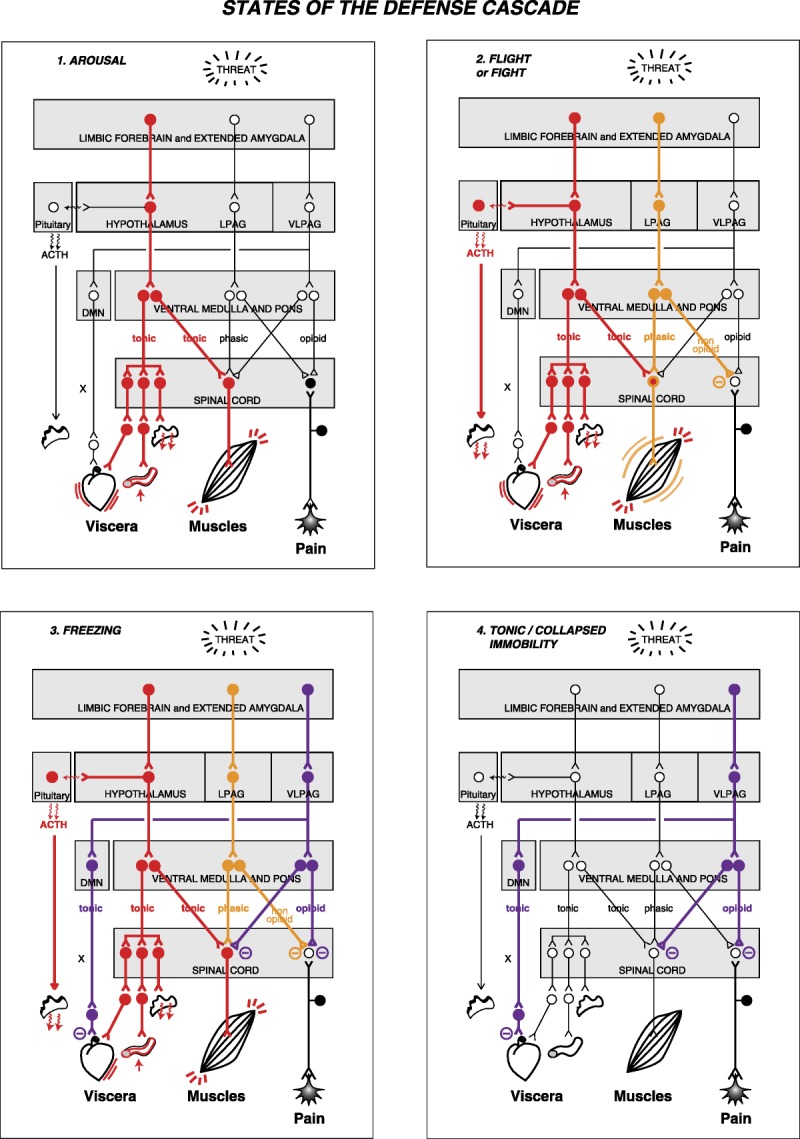
Evolution has endowed all humans with a continuum of innate, hard-wired, automatically activated defense behaviors, termed the defense cascade. Arousal is the first step in activating the defense cascade; flight or fight is an active defense response for dealing with threat; freezing is a flight-or-fight response put on hold; tonic immobility and collapsed immobility are responses of last resort to inescapable threat, when active defense responses have failed; and quiescent immobility is a state of quiescence that promotes rest and healing. Each of these defense reactions has a distinctive neural pattern mediated by a common neural pathway: activation and inhibition of particular functional components in the amygdala, hypothalamus, periaqueductal gray, and sympathetic and vagal nuclei. Unlike animals, which generally are able to restore their standard mode of functioning once the danger is past, humans often are not, and they may find themselves locked into the same, recurring pattern of response tied in with the original danger or trauma. Understanding the signature patterns of these innate responses--the particular components that combine to yield the given pattern of defense-is important for developing treatment interventions. Effective interventions aim to activate or deactivate one or more components of the signature neural pattern, thereby producing a shift in the neural pattern and, with it, in mind-body state. The process of shifting the neural pattern is the necessary first step in unlocking the patient's trauma response, in breaking the cycle of suffering, and in helping the patient to adapt to, and overcome, past trauma.
Overview
CoChat Summary
## TL;DR
This paper proposes a neuroscience-based model of the human defense cascade, organizing threat responses from arousal through flight/fight, freezing, tonic immobility, collapsed immobility, and quiescent immobility. It also maps these states to clinical interventions, emphasizing somatic, mindfulness-based, and trauma-processing approaches.
## Key findings
- The authors define the human defense cascade as six states: (1) arousal, (2) flight or fight, (3) freezing, (4) tonic immobility, (5) collapsed immobility, and (6) quiescent immobility.
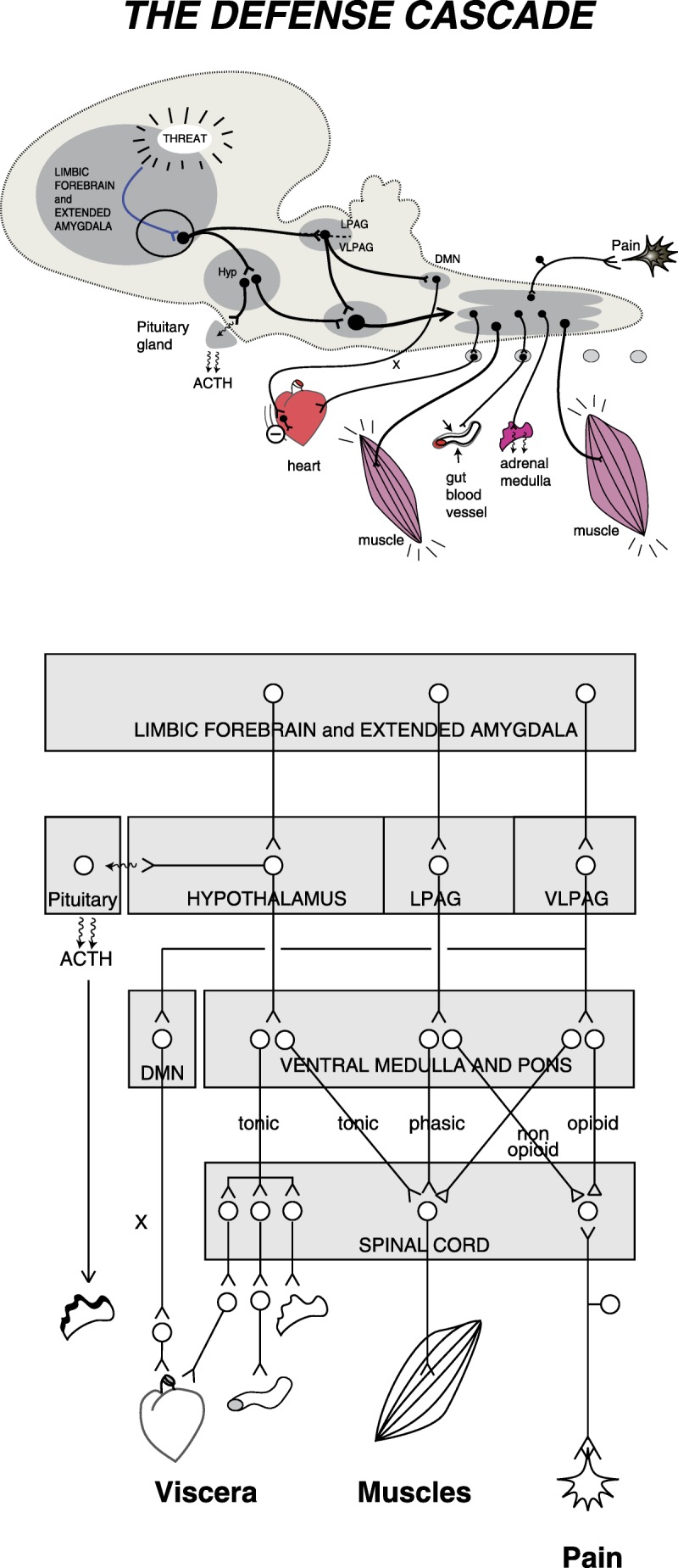
- They argue that these responses are mediated by descending neural circuits involving the extended amygdala, hypothalamus, PAG, ventral pontine tegmentum, ventral and dorsal medulla, and spinal cord, with separate somatomotor, autonomic/visceromotor, and pain-processing components.
- The paper reports that in humans freezing is typically short-lived, often lasting only a few seconds, and that in laboratory/animal observations freezing has been reported for up to 20 minutes in rats and up to 60 minutes in wild rodents.
- It states that a third of patients in one imaging study showed both reexperiencing and dissociative responses in a single experimental session to different scripts.
## Methods
- Narrative review and integrative clinical-neuroscience synthesis; the authors state they conducted wide-ranging searches on PubMed, communicated with laboratories and clinical groups, and tracked seminal historical references.
- The paper combines animal-model evidence, human clinical vignettes, and neurophysiological/imaging studies to build and illustrate the defense-cascade framework.
- Main analysis is conceptual: the authors relate specific defense states to neural circuits and then infer corresponding clinical management strategies for arousal reduction and trauma processing.
## Limitations
- The paper itself states that for quiescent immobility in humans, “it is not possible to explore this subject further at this time” because of the dearth of literature.
- It also states that the mechanisms underpinning EMDR and tapping have yet to be identified, and that further outcome studies are needed for tapping.
- Evident from the text: much of the article is an integrative model built from heterogeneous animal and human studies plus clinical vignettes, rather than a single empirical study with a new sample or controlled primary data.
Model-written summary. Check it against the paper before relying on it.
Integrity signals
Registry
Cites
Statistics
Figures
Verification
Claims the paper makes
22 Valid · 18 Not valid · 87 Not checked · 64 Own results and interpretations
The cited sources support only part of this claim — read each source’s verdict below.
In the paper
“All defense responses in the animal model of the defense cascade—arousal, freezing, flight or fight, tonic immobility, collapsed immobility, and quiescent immobility—are responses to threat mediated by neural circuits involving the extended amygdala, hypothalamus, periaqueductal gray (PAG), ventral pontine tegmentum, ventral and dorsal medulla, and spinal cord.22–25”
§ Fear and the Defense Cascade: Clinical Implications and Management > Abstract
What the sources say
- Partly supportedcites [22] Choi JS Cain CK LeDoux JE The role of amygdala nuclei in the expression of auditory signaled two-way active avoidance in rats. Learn Mem 2010; 17: 139– 47. 20189958 PMC2832923 sourceExperimental — accuracy not yet measured
Split into 2 atoms — 0 confirmed, 2 partially supported, 0 disputed, 0 misattributed, 0 unverifiable. Expand the claim to see per-atom verdicts.
- Not checked — no full text of the sourcecites [23] Gozzi A Jain A Giovanelli A A neural switch for active and passive fear. Neuron 2010; 67: 656– 66. 20797541 source
- Partly supportedcites [24] LeDoux JE Iwata J Cicchetti P Reis DJ Different projections of the central amygdaloid nucleus mediate autonomic and behavioral correlates of conditioned fear. J Neurosci 1988; 8: 2517– 29. 2854842 PMC6569498 sourceExperimental — accuracy not yet measured
Split into 2 atoms — 0 confirmed, 2 partially supported, 0 disputed, 0 misattributed, 0 unverifiable. Expand the claim to see per-atom verdicts.
- Not checked — no full text of the sourcecites [25] Bandler R Shipley MT Columnar organization in the midbrain periaqueductal gray: modules for emotional expression? Trends Neurosci 1994; 17: 379– 89. 7817403 source
plainstates a cause- Asserted: passes — The authors put it forward as true.
- Checkable: passes — It can be checked against evidence.
- Load-bearing: passes — The paper’s conclusions depend on it.
- Based: passes — The paper gives a reason why it holds.
- Partly supported
The cited sources support only part of this claim — read each source’s verdict below.
In the paper
“Studies suggest that flight or fight is the sum total of distinct components activated concurrently: a somatomotor (skeletal muscle) component, a visceromotor (autonomic) component, and a pain-modulation component (see Figures 1 and 2).24,45,46”
§ Fear and the Defense Cascade: Clinical Implications and Management > FLIGHT OR FIGHT: THE ANIMAL MODEL
What the sources say
- Partly supportedcites [24] LeDoux JE Iwata J Cicchetti P Reis DJ Different projections of the central amygdaloid nucleus mediate autonomic and behavioral correlates of conditioned fear. J Neurosci 1988; 8: 2517– 29. 2854842 PMC6569498 sourceExperimental — accuracy not yet measured
The section on conditioned fear-response pathways (page unavailable) describes defensive behavior accompanied by autonomic changes and distinguishes freezing from cardiovascular responses. It does not establish a pain-modulation component of the response or say that all three components are activated concurrently; its discussion of pain sensitivity concerns whether that could explain a lesion result. (LLM, conf=0.86)
- Partly supportedcites [45] Fanselow MS Neural organisation of defensive behavioural system responsible for fear. Psychon Bull Rev 1994; 1: 429– 38. 24203551 sourceExperimental — accuracy not yet measured
Fanselow's CIRCA-STRIKE DEFENSE and NEURAL CIRCUITRY MEDIATING POST-ENCOUNTER DEFENSES sections do state that the actions making up a defensive mode are 'physically compatible, so that they can occur simultaneously,' and enumerate exactly the three kinds of component the claim names: somatomotor (freezing, muscle-tone adjustment, escape locomotion, jump attack), visceromotor (tachycardia, hypertension, 'redirection of blood flow from viscera and skin to skeletal muscle'), and pain modulation (opioid and nonopioid analgesia). What the source does not support is the packaging: it does not treat 'flight or fight' as one sum total, but splits active defense into distinct, mutually inhibited modes (amygdala/vPAG-driven post-encounter freezing vs. dlPAG-driven circa-strike escape/attack), and it lists further concurrent components beyond the three cited (enhanced arousal, potentiated startle, vocalization). The evidence is also specific to the rat antipredator defensive behavior system, not a general fight-or-flight account. So the concurrent multi-component core is in the paper, while the unitary tripartite framing overstates and flattens it. (LLM, conf=0.72)
- Not checked — no full text of the sourcecites [46] Walker P Carrive P Role of ventrolateral periaqueductal gray neurons in the behavioral and cardiovascular responses to contextual conditioned fear and poststress recovery. Neuroscience 2003; 116: 897– 912. 12573728 source
hedged- Asserted: passes — The authors put it forward as true.
- Checkable: passes — It can be checked against evidence.
- Load-bearing: passes — The paper’s conclusions depend on it.
- Based: passes — The paper gives a reason why it holds.
- Partly supported
In the paper
“This order differs from conceptualizations based on the distance of the predatory threat—in which freezing is discussed before flight or fight.2,8,9,17”
§ Fear and the Defense Cascade: Clinical Implications and Management > Abstract
What the sources say
- Not matchedcites [2] Lang PJ Simons RF Balaban MT Attention and orienting: sensory and motivational processes. Mahwah, NJ: Erlbaum, 1997.
Its entry has no title and year that we can search by.
- Not matchedcites [8] Ratner SC Comparative aspects of hypnosis. In: Gordon JE, ed. Handbook of clinical experimental hypnosis. New York: Macmillan, 1967.
We searched by its title and found no matching paper.
- Could not verifycites [9] Fanselow MS Lester LS A functional behavioristic approach to aversely motivated behavior: predatory imminence as a determinate of the topology of defensive behavior. In: Bolles RC Beecher MD, eds. Evolution and learning. Hillsdale, NJ: Erlbaum, 1988: 185– 211. sourceExperimental — accuracy not yet measured
The Discussion describes freezing as interfering with active avoidance in rats, but it does not describe a defense cascade ordered by distance from a predator. Searches for predatory-threat distance and freezing before flight or fight found no passage addressing that ordering; the cited claim cannot be verified from our copy. (LLM, conf=0.74)
- Check pendingcites [17] Blanchard DC Blanchard RJ Ethoexperimental approaches to the biology of emotion. Ann Rev Psychol 1988; 39: 43– 68. 2894198 source
plain- Asserted: passes — The authors put it forward as true.
- Checkable: passes — It can be checked against evidence.
- Load-bearing: passes — The paper’s conclusions depend on it.
- Based: passes — The paper gives a reason why it holds.
- Not matched
The cited sources support only part of this claim — read each source’s verdict below.
In the paper
“Subsequent research with animals determined that, depending on the degree of threat and the distance between the predator and prey, distinct responses—freezing, flight or fight, tonic immobility, and quiescent immobility—proceed sequentially along a continuum, termed the defense cascade.”
§ Fear and the Defense Cascade: Clinical Implications and Management > Abstract
What the sources say
- Not matchedcites [2] Lang PJ Simons RF Balaban MT Attention and orienting: sensory and motivational processes. Mahwah, NJ: Erlbaum, 1997.
Its entry has no title and year that we can search by.
- Not matchedcites [8] Ratner SC Comparative aspects of hypnosis. In: Gordon JE, ed. Handbook of clinical experimental hypnosis. New York: Macmillan, 1967.
We searched by its title and found no matching paper.
- Partly supportedcites [9] Fanselow MS Lester LS A functional behavioristic approach to aversely motivated behavior: predatory imminence as a determinate of the topology of defensive behavior. In: Bolles RC Beecher MD, eds. Evolution and learning. Hillsdale, NJ: Erlbaum, 1988: 185– 211. sourceExperimental — accuracy not yet measured
Split into 2 atoms — 0 confirmed, 1 partially supported, 0 disputed, 0 misattributed, 1 unverifiable. Expand the claim to see per-atom verdicts.
- Check pendingcites [17] Blanchard DC Blanchard RJ Ethoexperimental approaches to the biology of emotion. Ann Rev Psychol 1988; 39: 43– 68. 2894198 source
plainstates a cause- Asserted: passes — The authors put it forward as true.
- Checkable: passes — It can be checked against evidence.
- Load-bearing: passes — The paper’s conclusions depend on it.
- Based: passes — The paper gives a reason why it holds.
- Not matched
The cited sources support only part of this claim — read each source’s verdict below.
In the paper
“Flight or fight is mediated through the lateral periaqueductal gray (LPAG), which activates the basic, stereotypical motor patterns of flight or fight—for example, attack, running, treading, burying (see Figures 1 and 2).24,28,47,48”
§ Fear and the Defense Cascade: Clinical Implications and Management > FLIGHT OR FIGHT: THE ANIMAL MODEL > Skeletal Muscle (Somatomotor) Activation
What the sources say
- Partly supportedcites [24] LeDoux JE Iwata J Cicchetti P Reis DJ Different projections of the central amygdaloid nucleus mediate autonomic and behavioral correlates of conditioned fear. J Neurosci 1988; 8: 2517– 29. 2854842 PMC6569498 sourceExperimental — accuracy not yet measured
The discussion of defense-response pathways says the central gray is involved in defensive behavior, and the discussion of conditioned fear describes it as a possible link to motor systems. The paper does not identify the lateral periaqueductal gray as mediating flight or fight or attribute attack, running, treading, or burying to it; its lesion findings concern conditioned freezing. (LLM, conf=0.76)
- Not checked — no full text of the sourcecites [28] Keay KA Bandler R Parallel circuits mediating distinct emotional coping reactions to different types of stress. Neurosci Biobehav Rev 2001; 25: 669– 78. 11801292 source
- Not checked — no full text of the sourcecites [47] Carrive P The periaqueductal gray and defensive behavior: functional representation and neuronal organization. Behav Brain Res 1993; 58: 27– 47. 8136048 source
- Not checked — no full text of the sourcecites [48] Rizvi TA Ennis M Behbehani MM Shipley MT Connections between the central nucleus of the amygdala and the midbrain periaqueductal gray: topography and reciprocity. J Comp Neurol 1991; 303: 121– 31. 1706363 source
plainstates a cause- Asserted: passes — The authors put it forward as true.
- Checkable: passes — It can be checked against evidence.
- Load-bearing: passes — The paper’s conclusions depend on it.
- Based: passes — The paper gives a reason why it holds.
- Partly supported
97 more claims · 12 with their cited sources checked
Create a free account to see all 191 claims and to verify the 65 references still open.
- It may state two separate claims as one. 69
- Probably not a substantial claim. 32
- The quote only partly states this claim. 1
Claims other papers make about this one
Each is checked against this paper’s own text: does it say what the citing paper says it does?
The source backs part of the claim, not all of it — or backs it for a different population, condition or comparison.
In the citing paper
“The parasympathetic system may now activate defensive programsfear-induced bradycardia in the heart; nausea, vomiting, or diarrhea programs in the gut; expulsion of urine by the bladder -that work alongside the sympathetic system to defend the body from danger (Kozlowska et al., 2015;Wood et al., 1999).”
From Physiological feelings (2019) · cites this paper as Kozlowska et al., 2015
Experimental — accuracy not yet measuredThe source backs part of the claim, not all of it — or backs it for a different population, condition or comparison.
In the citing paper
“At the same time, cortical loops in the basal ganglia and cerebellum are activated to modulate basic motor patterns consistent with context and defence strategies (Kozlowska et al., 2015;Lanius et al., 2014).”
From A review of the relation between dissociation, memory, executive functioning and social cognition in military members and civilians with neuropsychiatric conditions (2016) · cites this paper as Kozlowska et al., 2015
Experimental — accuracy not yet measuredThe source backs part of the claim, not all of it — or backs it for a different population, condition or comparison.
In the citing paper
“Notably, the fight or flight response involves non-opioid (endocannabinoid-mediated) analgesia evoked by the lateral PAG (Keay and Bandler, 2001;Kozlowska et al., 2015).”
From A review of the relation between dissociation, memory, executive functioning and social cognition in military members and civilians with neuropsychiatric conditions (2016) · cites this paper as Kozlowska et al., 2015
Experimental — accuracy not yet measuredThe source backs part of the claim, not all of it — or backs it for a different population, condition or comparison.
In the citing paper
“Critically, in cases where the organism determines it has little to no chance of survival, unresponsive immobility or death feigning may occur in an attempt to decrease predator interest, which may lead to tonic or collapsed immobility (Kozlowska et al., 2015;Schauer and Elbert, 2010).”
From A review of the relation between dissociation, memory, executive functioning and social cognition in military members and civilians with neuropsychiatric conditions (2016) · cites this paper as Kozlowska et al., 2015
Experimental — accuracy not yet measuredThe source backs part of the claim, not all of it — or backs it for a different population, condition or comparison.
In the citing paper
“Here, Kozlowska et al. (2015) described defensive mind-body states as fixed action patterns that are repeated or reactivated by environmental triggers, including motor patterns, autonomic responses and opioid mediated analgesia (e.g., van der Kolk, 2001).”
From A review of the relation between dissociation, memory, executive functioning and social cognition in military members and civilians with neuropsychiatric conditions (2016) · cites this paper as Kozlowska et al., 2015
Experimental — accuracy not yet measured
8 more claims about this paper
Create a free account to see every claim other papers make about this one.
Citations
Cites
The expression of the emotions in man and animals.
Darwin, C. (1872) · J. Murray eBooks · doi:10.1037/10001-000 · Cited by 11,657
(1982) · Trends in Neurosciences · doi:10.1016/0166-2236(82)90076-5 · Cited by 9,089
Mindfulness-based interventions in context: Past, present, and future
Kabat-Zinn, J. (2003) · Clinical Psychology: Science and Practice · doi:10.1093/clipsy.bpg016 · Cited by 8,615
Mindfulness-based interventions in context: Past, present, and future.
Kabat-Zinn, J. (2003) · Clinical Psychology: Science and Practice · doi:10.1093/clipsy/bpg016 · Cited by 8,612
The feeling of what happens: body and emotion in the making of consciousness
(2000) · Choice Reviews Online · doi:10.5860/choice.37-6553 · Cited by 5,998
(2001) · Cited by 3,666
Etkin, A., & Wager, T. D. (2007) · American Journal of Psychiatry · doi:10.1176/appi.ajp.2007.07030504 · Cited by 3,391
Stress and disorders of the stress system
Chrousos, G. P. (2009) · Nature Reviews Endocrinology · doi:10.1038/nrendo.2009.106 · Cited by 3,215 · cited 1×
“system interact reciprocally as part of a larger stress-regulation system, downregulation of one system will have a correlative impact on the functioning of the other systems.(41,181)”
BackgroundAlterations in brain and immune function produced by mindfulness meditation
Davidson, R. J., Kabat-Zinn, J., Schumacher, J., Rosenkranz, M., Muller, D., Santorelli, S. F., Urbanowski, F., Harrington, A., Bonus, K., & Sheridan, J. F. (2003) · Psychosomatic Medicine · doi:10.1097/01.psy.0000077505.67574.e3 · Cited by 2,925 · cited 1×
“or that induce and maintain a mind state of optimism, compassion, hope, and expectancy (as in spiritual beliefs in a loving and protective Other) may function to reduce arousal by downregulating the HPA axis,(178) downregulating sympathetic activation,(172) and modulating immune function to respond in more adaptive wa…”
BackgroundA Multidimensional Meta-Analysis of Psychotherapy for PTSD
Bradley, R., Greene, J., Russ, E., Dutra, L., & Westen, D. (2005) · American Journal of Psychiatry · doi:10.1176/appi.ajp.162.2.214 · Cited by 1,938
Research works printed but not linked: 5
- Rivers WHR The danger-instincts. In: Instinct and the unconscious: a contribution to a biological theory of the psycho-neuroses. London: Cambridge University Press, 1920: 52– 60.
- Gowers WR A lecture on vaso-vagal attacks. Lancet 1907; 1: 1551– 4.
- Ramos C Leite-Panissi R Monassi R Menescal-De-Oliveira L Role of the amygdaloid nuclei in the modulation of tonic immobility in guinea pigs. Physiol Behav 1999; 67: 717– 24. 10604843 · DOI · Paper page
- Gevirtz R Resonant frequency training to restore homeostasis for treatment of psychophysiological disorders. Biofeedback 2000; 27: 7– 9.
- Posner MI Attention in cognitive neuroscience: an overview. In: Gazzaniga MS Bizzi E, eds. The cognitive neurosciences. Cambridge, MA: MIT Press, 1995: 615– 24.
Cited by
Items 201–300 of 463
Campbell, R., Fehler‐Cabral, G., & Horsford, S. R. (2017) · Journal of Forensic Nursing · doi:10.1097/jfn.0000000000000139 · Cited by 8
Zhang, Y., Moore, M., Jennings, J. S., Clark, J. D., Bayley, P. J., Ashford, J. W., & Furst, A. J. (2024) · Frontiers in Molecular Neuroscience · doi:10.3389/fnmol.2023.1266408 · Cited by 7
“PAG subdivisions also activate high general attention, causing hyperarousal symptoms and difficulty in falling sleep (Kozlowska et al., 2015).”
BackgroundIdentity Revised: A Clinician’s Perspective on What an Identity-Based Model of Mind Looks Like
Şar, V. (2017) · Springer eBooks · doi:10.1007/978-3-319-55658-1_17 · Cited by 9
Acting out and enactment: An effort at clarity
Bettelheim, E. C. (2022) · Neuropsychoanalysis · doi:10.1080/15294145.2022.2053190 · Cited by 8
“The amygdala is fundamental to fast motor reactions to threat congruent with these emotions including flight, fight, and freezing (Kozlowska et al., 2015).”
BackgroundBalters, S., Schlichting, M. R., Foland‐Ross, L. C., Brigadoi, S., Miller, J. G., Kochenderfer, M. J., Garrett, A. S., & Reiss, A. L. (2022) · Cerebral Cortex · doi:10.1093/cercor/bhac320 · Cited by 11
Anticipatory Threat Mitigates the Breakdown of Group Cooperation
Lojowska, M., Gross, J., & Dreu, C. K. W. D. (2022) · Psychological Science · doi:10.1177/09567976221104037 · Cited by 7
“In conditions of anticipatory threat, humans and animals display a freezing response (Fanselow & Lester, 1988; Kozlowska et al., 2015; Roelofs, 2017).”
BackgroundDefinition and attributes of the emotional memory images underlying psychophysiological dis-ease
Hudson, M., & Johnson, M. I. (2022) · Frontiers in Psychology · doi:10.3389/fpsyg.2022.947952 · Cited by 12
“When all else fails, the last recourse may be collapsed immobility (Kozlowska et al., 2015).”
BackgroundSegelcke, D., Linnemann, J., Pradier, B., Kronenberg, D., Stange, R., Richter, S. H., Görlich, D., Baldini, N., Pompo, G. D., Verri, W. A., Jr., et al. (2023) · Cancers · doi:10.3390/cancers15051565 · Cited by 8
Knipschild, R., Klip, H., Winkelhorst, K., Stutterheim, T., & van Minnen, A. (2024) · European Journal of Psychotraumatology · doi:10.1080/20008066.2024.2315794 · Cited by 8
Kreidie, L. H., Sakhi, S., Wardani, F., Sabah, I. A., & Anbar, K. (2024) · Journal of Social Service Research · doi:10.1080/01488376.2024.2349236 · Cited by 7
“Hyperarousal, one of the main symptom clusters of PTSD, is a result of a heightened response to stress which triggers the fight, flight or freeze response causing either an overt psy-chobiological response or “freezing” which could include tonic immobility (Kozlowska et al., 2015).”
Kim, D. J., Lee, A. S., Yttredahl, A. A., Gómez-Rodríguez, R., & Anderson, B. J. (2017) · Neuroscience · doi:10.1016/j.neuroscience.2017.04.012 · Cited by 7
A Possible Link between Anxiety and Schizophrenia and a Possible Role of Anhedonia
Grillo, L. (2018) · Schizophrenia Research and Treatment · doi:10.1155/2018/5917475 · Cited by 10
“In fact, in man it is sufficient to feel cornered and with no possibility of escape for extreme defence reflexes to be triggered that occur when one is seized by a predator [69], and a deformed environment not only can be felt hostile but takes away any possibility of finding a refuge; in addition any loss of the abil…”
BackgroundConnectivity differences between Gulf War Illness (GWI) phenotypes during a test of attention
Clarke, T., Jamieson, J. D., Malone, P., Rayhan, R. U., Washington, S. D., VanMeter, J. W., & Baraniuk, J. N. (2019) · PLoS ONE · doi:10.1371/journal.pone.0226481 · Cited by 8
Portier-Young, A. E. (2024) · Oxford University Press eBooks · doi:10.1093/9780197604991.003.0006 · Cited by 6
Dickins, K. A. (2023) · Issues in Mental Health Nursing · doi:10.1080/01612840.2023.2238091 · Cited by 6
“Participants endorsed receiving NET while incarcerated or homeless, describing how NET aided in alleviating stress associated with a loss of control within trau-matogenic circumstances, which may aid in reducing the likelihood of cascading, compound traumatic stress (Kozlowska et al., 2015).”
BackgroundFear in action: Fear conditioning and alleviation through body movements
Alemany-González, M., Wokke, M. E., Chiba, T., Narumi, T., Kaneko, N., Yokoyama, H., Watanabe, K., Nakazawa, K., Imamizu, H., & Koizumi, A. (2024) · iScience · doi:10.1016/j.isci.2024.109099 · Cited by 5
Zukerman, G., Pinhas, M., & Icht, M. (2023) · Experimental Brain Research · doi:10.1007/s00221-023-06578-w · Cited by 8
Lathan, E. C., Guelfo, A., Barrie, D. L. L., Teer, A. P., Powers, A. D., Siegle, G. J., & Fani, N. (2023) · Journal of Psychiatric Research · doi:10.1016/j.jpsychires.2023.05.028 · Cited by 7
Neuroscience evidence counters a rape myth
Dhawan, E., & Haggard, P. (2023) · Nature Human Behaviour · doi:10.1038/s41562-023-01598-6 · Cited by 6
Nakić, M., Koričan, M., & Oblaković, G. (2024) · International Journal of Emerging Markets · doi:10.1108/ijoem-09-2022-1407 · Cited by 6
Brantbjerg, M. H. (2021) · Body Movement and Dance in Psychotherapy · doi:10.1080/17432979.2021.1876768 · Cited by 5
“hyper-tonicity, whereas collapsed immobility or hypo-arousal includes loss of muscle tone (Kozlowska et al., 2015).”
BackgroundMethodInfluentialHeld, L. K., Vink, J. M., Vitaro, F., Brendgen, M. R., Dionne, G., Provost, L., Boivin, M., Ouellet‐Morin, I., & Roelofs, K. (2022) · EBioMedicine · doi:10.1016/j.ebiom.2022.104094 · Cited by 8
Niederlohmann, E. (2026) · Frontiers in Psychiatry · doi:10.3389/fpsyt.2026.1717734 · Cited by 4
Beutler, S., & Croy, I. (2023) · European Journal of Psychotraumatology · doi:10.1080/20008066.2023.2281753 · Cited by 5
“This coactivation describes that fi ght or fl ight is put on hold until an opportunity arises to escape the situation (Kozlowska et al., 2015).”
BackgroundMethodInfluentialPharmacological diacylglycerol lipase inhibition impairs contextual fear extinction in mice
Ramos-Medina, L., Rosas-Vidal, L. E., & Patel, S. (2024) · Psychopharmacology · doi:10.1007/s00213-023-06523-3 · Cited by 5
“This process is termed associative learning and it enables organisms to acquire information about relationships between various environmental events (Takehara-Nishiuchi 2022) and facilitates appropriate selection of fear responses (Kozlowska et al. 2015).”
BackgroundRabellino, D., Boyd, J. E., McKinnon, M. C., & Lanius, R. A. (2019) · Elsevier eBooks · doi:10.1016/b978-0-12-813146-6.00017-5 · Cited by 7
Compare dissociative induction, hypnosis and listening to a neutral story on inducing dissociation
Vancappel, A., & El‐Hage, W. (2022) · European Journal of Trauma & Dissociation · doi:10.1016/j.ejtd.2022.100287 · Cited by 4
Gerge, A., Rudstam, G., & Söndergaard, H. P. (2025) · Frontiers in Psychology · doi:10.3389/fpsyg.2025.1454483 · Cited by 8
How-To Study Dissociative Symptoms in a Broad Range of Mental Disorders: A Methodological Primer
Danböck, S. K., Mertens, Y. L., Kulla, P., Seitz, K. I., & Schalinski, I. (2025) · Journal of Trauma & Dissociation · doi:10.1080/15299732.2025.2481474 · Cited by 4
Liu, N., Huang, K., Wei, P., Liu, X., & Wang, L. (2021) · Neuroscience Bulletin · doi:10.1007/s12264-021-00767-9 · Cited by 4
Integrating Compassion into EMDR for PTSD
Whalley, M. G., & Lee, D. (2023) · OBM Integrative and Complementary Medicine · doi:10.21926/obm.icm.2304058 · Cited by 7
The mental health plight of unaccompanied asylum‐seeking children in detention
Foong, A. L. S., Arthur, D. G., West, S., Kornhaber, R. A., McLean, L., & Cleary, M. L. (2018) · Journal of Advanced Nursing · doi:10.1111/jan.13782 · Cited by 4
Self-citationThe Immune-Inflammatory System and Functional Somatic Symptoms
Kozlowska, K., Scher, S., & Helgeland, H. (2020) · Palgrave texts in counselling and psychotherapy · doi:10.1007/978-3-030-46184-3_9 · Cited by 5
“…[in animals] is a reaction to “deep or inescapable” pain, chronic injury, injury by a predator, or defeat by a conspecific, and to states of exhaustion (where recuperation is needed) after a period of acute stress, once the animal has returned to a safe environment’ (Kozlowska et al. 2015, p. 275).”
BackgroundSelf-citationAsylum-seeking children in shutdown: Neurobiological models
Kozlowska, K., Scher, S., Helgeland, H., & Carrive, P. (2021) · Developmental Child Welfare · doi:10.1177/25161032211036162 · Cited by 4
“But many traumatized individuals cycle between active and shutdown responses to trauma, between different components of the defence cascade, and between hypervigilant PTSD (an active response that may include episodes of flight and fight) and dissociative PTSD (a shutdown response that may include motor immobility) (H…”
BackgroundMethodInfluentialSelf-citationHow Can Social Mentality Theory Help Us Understand Eating Disorder Presentations? A Scoping Review
Mullen, G., & O’Reilly, G. (2018) · Journal of Relationships Research · doi:10.1017/jrr.2018.17 · Cited by 4
Mental Health of Refugee Children: A Discursive Look at Causes, Considerations and Interventions
Cleary, M. L., West, S., Foong, A. L. S., McLean, L., & Kornhaber, R. A. (2019) · Issues in Mental Health Nursing · doi:10.1080/01612840.2019.1585494 · Cited by 5
Self-citationLindgren, H. E., Rådestad, I. J., Pettersson, K., Skokic, V., & Akselsson, A. (2021) · Midwifery · doi:10.1016/j.midw.2021.103156 · Cited by 5
“Thus, during periods of stress, a woman’s levels of catecholamines increase, which activates the sympathetic system and the body prepares for fight or flight ( Kozlowska et al., 2015 ; Uvnäs-Moberg et al., 2005 ).”
BackgroundRole of Anterior Cingulate Cortex Inputs to Periaqueductal Gray for Pain AvoidancePreprint
Lee, J.-Y., You, T., Lee, C.-H., et al. (2021) · SSRN Electronic Journal · doi:10.2139/ssrn.3991070 · Cited by 4
McCarthy, B., Henderson, L. A., & Macefield, V. G. (2023) · Comprehensive physiology · doi:10.1002/cphy.c220021 · Cited by 9
“In times of physical stress (whether that be due to emergencies, exercise, or the like) the SNS will prioritize survival of the body over other bodily tasks of less time-sensitive importance (114, 204).”
Putica, A., Agathos, J. A., & Felmingham, K. L. (2025) · Nature Reviews Psychology · doi:10.1038/s44159-025-00479-1 · Cited by 8
“Emerging evidence indicates shared stress-related mechanisms underlying FND and PTSD, characterized by alterations in the physiological threat detection and stress-response systems (including the activation of the ‘fight or flight’ response) owing to repeated or severe stress exposure 108 .”
Petrenchik, T. M. (2025) · Child Protection and Practice · doi:10.1016/j.chipro.2025.100244 · Cited by 4
Dissouky, N., Kochs, K., Nass, R. D., Baumgartner, T. R., Rácz, Á., Surges, R., Reuber, M., Witt, J., & Helmstaedter, C. (2026) · Epilepsia · doi:10.1002/epi.70107 · Cited by 3
“This understanding aligns with the defense cascade model, which, according to Kozlowska et al., 20 can manifest in five automatic defense states triggered by high arousal, ranging from more active to more passive reactions: arousal, fight or flight, freeze, tonic immobility, and collapsed…”
Holt, R., & McLean, L. (2019) · Neuroethics · doi:10.1007/s12152-019-09398-4 · Cited by 4
Self-citationZhao, S., Zhou, J., & Wang, T. (2023) · PLoS ONE · doi:10.1371/journal.pone.0294681 · Cited by 3
Effects of intensity on emotion regulation strategy preferences are emotion-specific
Bockstaele, B. V., Clarke, P., Todd, J., Meeten, F., Ji, J. L., Basanovic, J., Chen, N. T. M., Rudaizky, D., & Notebaert, L. (2024) · Motivation and Emotion · doi:10.1007/s11031-024-10093-y · Cited by 5
On Including Pain as an Integral Part of the Fight-or-Flight Response
Raffa, R. B., Fink, W., & Tripathi, A. (2024) · Journal of Pain Research · doi:10.2147/jpr.s500847 · Cited by 4
Racial Discrimination–Related Interoceptive Network Disruptions: A Pathway to Disconnection
Elbasheir, A., Bond, R., Harnett, N. G., Guelfo, A., Karkare, M. C., Fulton, T. M., Ely, T. D., McDermott, T. J., Lanius, R. A., Ahluwalia, V., et al. (2024) · Biological Psychiatry Cognitive Neuroscience and Neuroimaging · doi:10.1016/j.bpsc.2024.12.011 · Cited by 6
The modeling of the interaction of pulsed 5G/6G signals and the fine structure of human skin
Betzalel, N., Feldman, Y. D., & Ishai, P. B. (2025) · Scientific Reports · doi:10.1038/s41598-025-13777-8 · Cited by 5
“48 .”
Evolutionary game model of migraine based on the human brain hypersensitivity
Han, D.-G. (2023) · Frontiers in Neurology · doi:10.3389/fneur.2023.1123978 · Cited by 4
“Stimulation of the vlPAG leads to the transmission of signals to the rostral ventromedial medulla and spinal cord, causing combined reflexive responses (motor quiescence, decreased reactivity, hypotension, and bradycardia) (64).”
BackgroundObserved Somatic Continuance During Spontaneous Out-of-Body Experiences
King, R. A. (2022) · The Journal of near-death studies · doi:10.17514/jnds-2021-40-1-p12-46 · Cited by 3
We cannot find peace in restlessness. How the neuroscience supports psychotherapeutic practice
Vetere, A. (2023) · Human Systems Therapy Culture and Attachments · doi:10.1177/26344041231203378 · Cited by 3
“But now we are all in a position to understand many of the neural mechanisms that govern and support self-regulation, re fl ective functioning, transformational learning and relational co-regulation (Kozlowska et al., 2015; Kozlowska et al., 2020; Vetere, 2023).”
BackgroundGraham, K., Bernards, S., Abbey, A., Banyard, V. L., Donnelly, P., Dumas, T. M., McMahon, S., Senn, C. Y., Swartout, K. M., Trudell, A., et al. (2024) · Feminist Criminology · doi:10.1177/15570851241236739 · Cited by 5
“In fact, participants asserted the need for targets to clearly communicate “ no, ” an expectation that has been shown to be impossible when SA activates a fear response that prevents targets from responding at all (Kozlowska et al., 2015).”
Conversations of Care: A Narrative Review of Collaborative Care Systems for Foster and Kinship Care
Balu, D., & McLean, L. (2019) · Australian and New Zealand Journal of Family Therapy · doi:10.1002/anzf.1362 · Cited by 3
Self-citationHudson, M., & Johnson, M. I. (2023) · Frontiers in Pain Research · doi:10.3389/fpain.2023.1244390 · Cited by 5
“Central to our proposal was the concept of Emotional Memory Images (EMIs) coupled to the hypothalamic-pituitary-adrenal (HPA) axis and stress like responses, e.g., fl ight, fi ght, freeze, tonic immobility, and quiescent immobility (38, 39).”
BackgroundCentral Mechanisms Generating Cardiovascular and Respiratory Responses to Emotional Stress
Dampney, R. A. L. (2019) · Elsevier eBooks · doi:10.1016/b978-0-12-813146-6.00028-x · Cited by 8
Kinematic changes in goal-directed movements in a fear-conditioning paradigm
Nishi, Y., Osumi, M., Sumitani, M., Yozu, A., & Morioka, S. (2021) · Scientific Reports · doi:10.1038/s41598-021-90518-7 · Cited by 4
Dissociation as a Distinct Peritraumatic Coping Response: A Preliminary Analysis
Kecala, N. M., Goodman, B. F., & Griffin, M. G. (2022) · Journal of Trauma & Dissociation · doi:10.1080/15299732.2022.2117262 · Cited by 4
“It has been argued that dissociation may occur at least partially due to bradycardia-induced cerebral hypoxia (Kozlowska et al., 2015).”
BackgroundMeerschman, I., D’haeseleer, E., Vanderhasselt, M., Claeys, S., Vonck, K. E. J., Vergauwe, R., Nuffelen, G. V., Desuter, G., Roy, N., & Lierde, K. M. V. (2024) · International Journal of Language & Communication Disorders · doi:10.1111/1460-6984.13111 · Cited by 3
Knippenberg, A. R., Yavari, S., & Strauss, G. P. (2024) · Schizophrenia Research Cognition · doi:10.1016/j.scog.2024.100334 · Cited by 2
“In nonhuman animals, defensive responses include freezing to escape predator detection (Kozlowska et al., 2015).”
BackgroundGoldfinger, M. S., Fobian, A. D., Latzer, I. T., & Albert, D. V. F. (2025) · Seminars in Neurology · doi:10.1055/a-2769-6597 · Cited by 3
Does Dissociation Have an Emotion-Regulation Function? Evidence From Daily Life and the Laboratory
Heekerens, J. B., Gross, J. J., Kreibig, S. D., Ober, H., Eichentopf, R., Dittrich, T., Lebovitz, J. G., Hellmann‐Regen, J., Wingenfeld, K., & Roepke, S. (2026) · Clinical Psychological Science · doi:10.1177/21677026251396803 · Cited by 4
Stanisławska–Kubiak, M., Wiśniewska-Szeplewicz, D., Andrusiewicz, M., Katolyk, H. V., Stanisławska, M., Malak, R. E., Stelcer, B., Czarnecka-Iwańczuk, M., Teusz, G., & Mojs, E. H. (2026) · Preventive Medicine Reports · doi:10.1016/j.pmedr.2026.103422 · Cited by 6
“Previous literature has described partially distinct neuropsychological correlates of PTSD and depression (Kozlowska et al., 2015; Liu et al., 2017).”
Fight, Flight, Fawn, Freeze: Rethinking Substance Use Through a Stress Response Lens
Algarin, A. B., Lee, J.-Y., & Zhan, X. (2026) · Current Addiction Reports · doi:10.1007/s40429-026-00723-5 · Cited by 2
“…increased the 4Fs Model informs our specification of how individuals respond to these stressors at the level of threat appraisal and behavioral regulation, including response patterns such as avoidance, hyperarousal, or dissociation that may increase reliance on substances as coping strategies [9].”
Defining the concept of psychological trauma
Engelhard, I. M., Krypotos, A., McNally, R. J., Mertens, G., & van Zuiden, M. (2026) · Nature Reviews Psychology · doi:10.1038/s44159-026-00557-y · Cited by 5
“The defence cascade is one neurocognitive mechanism that can explain this variation in stress responses to different stressors 132 .”
Susko, M., Armstrong, V. L., Brian, J. A., Bryson, S. E., Kushki, A., Sacrey, L.-A. R., Zwaigenbaum, L., & Smith, I. M. (2023) · Infant Behavior and Development · doi:10.1016/j.infbeh.2023.101848 · Cited by 4
Pierce, Z. P., & Black, J. M. (2024) · Advances in Social Work · doi:10.18060/26331 · Cited by 4
“…activity is concentrated on emotion processing centers in the limbic system—principally, the amygdala—which produce concomitant neurotransmitter impulses that trigger the body to fight, run away, or freeze in a manner similar to the traumatic event (Kozlowska et al., 2015; Morey et al., 2012).”
BackgroundGbahabo, D. D., & Duma, S. E. (2024) · PLoS ONE · doi:10.1371/journal.pone.0278810 · Cited by 2
Associations between resilience to weaning stress and startle response in nursery age gilts
Lee, B., Luttman, A. M., Ernst, C. W., Steibel, J. P., Raney, N. E., & Siegford, J. M. (2024) · Applied Animal Behaviour Science · doi:10.1016/j.applanim.2024.106243 · Cited by 4
Gomes‐de‐Souza, L., Busnardo, C., Santos, A. D. S., Paz, H. S., Resstel, L. B. M., Planeta, C. S., Nunes‐de‐Souza, R. L., & Crestani, C. C. (2024) · Progress in Neuro-Psychopharmacology and Biological Psychiatry · doi:10.1016/j.pnpbp.2024.111015 · Cited by 3
Didn’t Even Blink: Dissociation, Complex Trauma Exposure and Decreased Startle Reactivity
D'Andrea, W. M., Freed, S., DePierro, J. M., Nelson, B. D., Seemann, C., McKernan, S. M., Wilson, T. E., & Pole, N. (2024) · Journal of Trauma & Dissociation · doi:10.1080/15299732.2024.2429445 · Cited by 4
“Rapid decreases in startle reactivity may represent a withdrawal of resources while environmental stressors are perceived unlikely to change and fight/flight remains untenable (e.g., Kozlowska et al., 2015).”
Le « spirituel mais non religieux » en santé : sacré sauvage et domestication scientifique
Évrard, R. (2024) · Théorèmes · doi:10.4000/12z8x · Cited by 2
Zsido, A. N., & Kiss, B. L. (2024) · Frontiers in Psychiatry · doi:10.3389/fpsyt.2024.1498709 · Cited by 3
Wang, T. G., & Bailey, R. L. (2025) · Journal of Advertising · doi:10.1080/00913367.2025.2534376 · Cited by 2
“Such a two-step response pattern following threatening stimuli is consistent with the progressive defense responses in humans proposed by the defense cascade model (see Kozlowska et al. 2015 for a review).”
Maclennan, R. (2019) · Journal of Systemic Therapies · doi:10.1521/jsyt.2019.38.3.11 · Cited by 2
Cardiorespiratory and Emotional Responses During Balance Exercises
Farias, S. G., Rodrigues, M. V., da Costa, S. D., de Macedo, A. R., Nogueira‐Campos, A. A., Garcia, M. A. C., & Imbiriba, L. A. (2022) · Research Quarterly for Exercise and Sport · doi:10.1080/02701367.2021.1953691 · Cited by 3
“…*Significant difference among all conditions; #Significant difference only BOSU and the other conditions. ªwith Greenhouse-Geisser correction. to “fight or flight” responses (Sibley et al., 2014), and vagal withdrawn, which increases both the heart rate and cardiac output (Kozlowska et al., 2015).”
BackgroundThe Affective Nature of Horror
Contesi, F. (2022) · Routledge eBooks · doi:10.4324/9781003205364-5 · Cited by 2
Adjustment to Transitions: Definitions of Terms
Israelashvili, M. (2023) · Advances in prevention science · doi:10.1007/978-3-031-26700-0_2 · Cited by 2
Eskelin, J. J., Lundblad, L. C., Wallin, B. G., Karlsson, T., Riaz, B., Lundqvist, D., Schneiderman, J. F., & Elam, M. (2023) · Scientific Reports · doi:10.1038/s41598-023-36753-6 · Cited by 3
Shakes, P., Cashin, A. J., & Hurley, J. (2023) · Social Science & Medicine · doi:10.1016/j.socscimed.2023.116391 · Cited by 5
The Immune System as a Sensor and Regulator of Stress: Implications in Human Development and Disease
Marino, J. H., & Teague, T. K. (2019) · Emerging issues in family and individual resilience · doi:10.1007/978-3-030-05952-1_1 · Cited by 3
Health Professionals in the Disaster Recovery Space
Schafer, C., Kornhaber, R. A., McLean, L., Ingham, V., & Cleary, M. L. (2020) · Issues in Mental Health Nursing · doi:10.1080/01612840.2020.1789789 · Cited by 2
“…of human beings, which demonstrates the importance of efficiently soothing and settling people in social ways, to achieve a rich social parasympathetic reregulation and transitioning from heightened sympathetic states or states of complex immobilisation with fear (Kozlowska et al., 2015).”
BackgroundSelf-citationRudstam, G. (2023) · VBN Forskningsportal (Aalborg Universitet) · doi:10.54337/aau611841551 · Cited by 6
Calvin, O. L., Erickson, M. T., Walters, C. J., & Redish, A. D. (2024) · bioRxiv (Cold Spring Harbor Laboratory) · doi:10.1101/2024.03.10.584295 · Cited by 2
“To what extent, on-track pauses relate to freezing seen during active fear [18,93 – 96] or whether they relate to tonic immobility [97,98] remains unclear and will likely require further study.”
BackgroundPringle, G., Dubon, S., Mater, J., Keech, C., Danylchuk, L. S., & Dobud, W. W. (2024) · doi:10.31235/osf.io/qta5p · Cited by 2
Action-Shapers and Their Neuro-Immunological Foundations
Paans, O., & Ehlen, B. (2022) · Frontiers in Psychology · doi:10.3389/fpsyg.2022.917876 · Cited by 1
Tyndall, E. (2022) · Journal of Intelligence History · doi:10.1080/16161262.2022.2121901 · Cited by 2
“20 This ingraining of a neurological response changes the stimulus from unconditioned to conditioned.”
BackgroundMelani, M., Paiva, J. M., Jannuzzi, I., Perozo, R., Ventura, P. R., & Berger, W. (2023) · Jornal Brasileiro de Psiquiatria · doi:10.1590/0047-2085000000406 · Cited by 1
“Além disso, a paciente relatou sintomas peritraumáticos de desperso-nalização, o que está de acordo com estudos sobre IT em humanos que indicam que não é incomum que reações de dissociação aconteçam simultaneamente 11 .”
Cleary, M. L., West, S., Kornhaber, R. A., Johnston‐Devin, C., Thapa, D. K., McLean, L., & Hungerford, C. L. (2024) · Issues in Mental Health Nursing · doi:10.1080/01612840.2024.2367156 · Cited by 7
“We know that many aspects of social regulation are mammalian, with functional social behaviour fundamental to successful relationships and communities (Kozlowska et al., 2015).”
Self-citationLinguistic agentivity as a marker of traumatic discourse
Gayraud, F., & Auxéméry, Y. (2025) · European Journal of Trauma & Dissociation · doi:10.1016/j.ejtd.2025.100501 · Cited by 5
Scott, T. M., & Dickson, J. M. (2025) · Journal of Affective Disorders Reports · doi:10.1016/j.jadr.2025.100917 · Cited by 2
D’Antoni, F., Matiz, A., & Crescentini, C. (2025) · European Journal of Trauma & Dissociation · doi:10.1016/j.ejtd.2025.100564 · Cited by 1
Klein, E. R., & Ruiz, C. E. (2025) · Behavioral Sciences · doi:10.3390/bs15081013 · Cited by 4
“The fear response of freezing, mediated by the autonomic nervous system, is understood to affect motor activity, such as the movement of body parts and motor activity required for vocalization (Kozlowska et al., 2015).”
Chabbouh, A., Abbas, R., Kurdi, M. A., Daou, L., Frenn, Y. E., Koleilat, R., Makki, M. H., Tamim, H., & Khoury, R. (2025) · BMC Psychiatry · doi:10.1186/s12888-025-07646-x · Cited by 1
“It shares the same core akinetic features with catatonia [34], which led researchers to suggest that hypokinetic catatonia is an aberrant activation of the freeze response [49–51].”
Reconceptualizing human fear memory through the defense cascade
Alemany-González, M., & Koizumi, A. (2025) · Neurobiology of Learning and Memory · doi:10.1016/j.nlm.2025.108126 · Cited by 1
Lombart, B., Andreu-Gallien, J., Thoraud, S., Gaudinot, L., Reiter, F., & Boutih, N. (2025) · European Journal of Pediatrics · doi:10.1007/s00431-025-06541-7 · Cited by 2
O'Sullivan, J. S., Fitzgibbon, C. E., Carrive, P., & Kozlowska, K. (2026) · Human Systems Therapy Culture and Attachments · doi:10.1177/26344041251411521 · Cited by 1
“In the animal and human literature, a ‘ collapsed ’ version of tonic immobility – involving a loss of muscle tone – is described (Bracha, 2004; Kozlowska et al., 2015; Rivers, 1920).”
InfluentialSelf-citationFink, W., & Raffa, R. B. (2026) · Journal of Pain Research · doi:10.2147/jpr.s561278 · Cited by 1
Physical Freezing in Children and Adolescents with Selective Mutism
Landrock-White, S. A., Lenton-Maughan, L., Roe, J. V. J., & Rogers, C. A. (2026) · Behavioral Sciences · doi:10.3390/bs16010152 · Cited by 1
“These symptoms potentially fit with the freezing or tonic immobility stages of the Defense Cascade theory (which also includes the fight or flight response) when a person is exposed to a perceived threat (Kozlowska et al., 2015).”
Jia, W.-B., Wang, X.-Y., Xia, X., Tang, L., Liang, Y., Lei, X.-L., Liu, X.-Q., Hu, W., & Zhang, Y. (2026) · Nature Communications · doi:10.1038/s41467-026-70580-3 · Cited by 2
“Upon threat detection, the brain orchestrates a suite of physiological and psychological reactions termed the fear response 37 .”
The heart of the self: An interoceptive perspective on the psychotherapeutic process
Hauke, G., & Critchley, H. (2026) · Consciousness and Cognition · doi:10.1016/j.concog.2026.104032 · Cited by 3
Metadata
- Authors
- Kozlowska, K., Walker, P., McLean, L., & Carrive, P.
- Affiliations
- The University of Sydney (AU)
- Corresponding author
- Kozlowska, Kasia
- Venue
- Harvard Review of Psychiatry
- Published
- 2015-07
- Volume
- 23
- Issue
- 4
- Pages
- 263-287
- ISSN
- 1067-3229 (ISSN-L)
- PMC
- PMC4495877
- OpenAlex
- W2405345309
- Cited by
- 468
- References
- 210
- Citations by year
- 2026: 53 · 2025: 40 · 2024: 83 · 2023: 52 · 2022: 55 · 2021: 40 · 2020: 33 · 2019: 39 · 2018: 28 · 2017: 29 · 2016: 14 · 2015: 2
- FWCI
- 3.49
- Type
- journal article
- Language
- en
- Open access
- hybrid
- doi.org
- Licence
- cc-by-nc-nd
- Locations
- Harvard Review of Psychiatry (publishedVersion, cc-by-nc-nd)
- PubMed Central (publishedVersion, cc-by-nc-nd)
- PubMed (publishedVersion)
- Topics
- Social Sciences › Psychology › Clinical Psychology › Posttraumatic Stress Disorder Research
- Social Sciences › Psychology › Clinical Psychology › Psychoanalysis and Psychopathology Research
- Life Sciences › Neuroscience › Behavioral Neuroscience › Stress Responses and Cortisol
- Keywords
- fear, fight-or-flight response, freezing response, tonic immobility, amygdala, hypothalamus, periaqueductal gray, neural pathways, trauma response, post-traumatic stress disorder
- MeSH terms
- Animals, Arousal, Dogs, Fear, Humans, Perceptual Defense, Psychophysiology, Models, Animal, Freezing Reaction, Cataleptic, Immobility Response, Tonic, Rats
About these checks
Registry, retraction, Cites and statistics results are computed, not judged, with one exception: a printed reference that no index lists is read once by a model before it counts as a citation error. Claims are extracted by a model and kept only when their quote appears verbatim in the text; each cited source is then checked, with a model’s help, for whether it says what the claim relies on. Those verdicts can be wrong — read the claim’s quote and the cited source before relying on one.
The claim verdicts this report counts are experimental: their accuracy is not yet measured.
A language model drew the claims from the paper on 2026-10-09, under version 3 of the claim definition (model deepseek-v4.1-flash, prompt extract-v3).
A second model labelled each claim on 2026-10-09 (model jev-1.13-20260917, definition revision gold-guideline-v0.2).
Cited sources are checked with a language model’s help (gpt-6-sol and qwen3.8-omni-flash).
Statistics and arithmetic are recomputed, not judged.
Confidence bands are shown only for fields calibrated on our annotated test set. None is calibrated yet, so no band is shown.
What counts as a claim ›How we measure confidence ›How we check this ›
Are you an author, or do you see a problem with this page? Request a review
Data sources
Bibliographic data: Semantic Scholar, OpenAlex, Crossref.
Contains information from the Semantic Scholar Academic Graph Datasets, made available under the ODC Attribution License (ODC-BY 1.0).
Semantic Scholar’s data is described in: Kinney, R., et al. (2023). The Semantic Scholar Open Data Platform. arXiv:2301.10140.
