

Mindfulness and Behavior Change
Open accessThe DOI matches its Crossref record; 465 of the 466 references it cites were found in a registry or an index.
Abstract
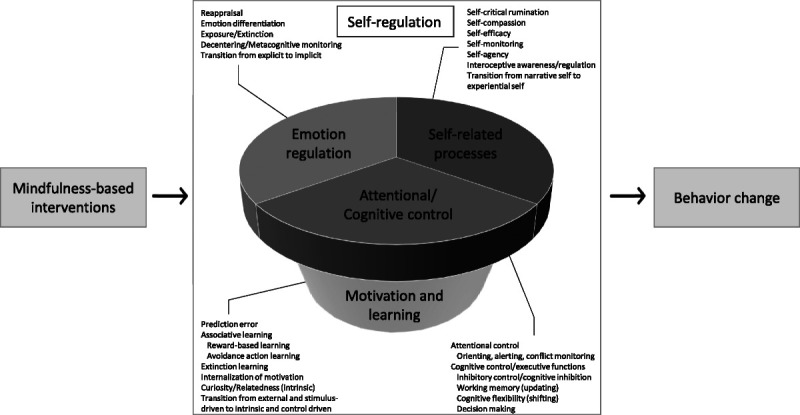
Initiating and maintaining behavior change is key to the prevention and treatment of most preventable chronic medical and psychiatric illnesses. The cultivation of mindfulness, involving acceptance and nonjudgment of present-moment experience, often results in transformative health behavior change. Neural systems involved in motivation and learning have an important role to play. A theoretical model of mindfulness that integrates these mechanisms with the cognitive, emotional, and self-related processes commonly described, while applying an integrated model to health behavior change, is needed. This integrative review (1) defines mindfulness and describes the mindfulness-based intervention movement, (2) synthesizes the neuroscience of mindfulness and integrates motivation and learning mechanisms within a mindful self-regulation model for understanding the complex effects of mindfulness on behavior change, and (3) synthesizes current clinical research evaluating the effects of mindfulness-based interventions targeting health behaviors relevant to psychiatric care. The review provides insight into the limitations of current research and proposes potential mechanisms to be tested in future research and targeted in clinical practice to enhance the impact of mindfulness on behavior change.
Overview
The claims and statistics of this paper haven’t been checked yet.
Free: it reads the open-access text and checks the first 5 claims that cite a source we can check. Create a free account to check every claim.
Integrity signals
Registry
Cites
Statistics
Figures
Verification
Claims the paper makes
The claims and statistics of this paper haven’t been checked yet.
Free: it reads the open-access text and checks the first 5 claims that cite a source we can check. Create a free account to check every claim.
Claims other papers make about this one
Each is checked against this paper’s own text: does it say what the citing paper says it does?
The source backs part of the claim, not all of it — or backs it for a different population, condition or comparison.
In the citing paper
“This study’s findings support and extend the existing literature regarding the impact and mechanisms of mindfulness on health, emotional wellness, relationships, and healthy behaviors.25–30”
From Mechanisms of mindfulness in patients with migraine: Results of a qualitative study. (2023) · cites this paper as [27]
Experimental — accuracy not yet measuredThe source backs part of the claim, not all of it — or backs it for a different population, condition or comparison.
In the citing paper
“Both the MTPC curriculum and Carina’s GLs were trauma-informed and conducive to integrating choice points, supporting individual autonomy, and developing skillful responses to trauma-related symptoms”
From Integrating choice points into mindfulness training for the dissociative subtype of PTSD: A case report (2024) · cites this paper as Schuman-Olivier et al., 2020
Experimental — accuracy not yet measuredThe source backs part of the claim, not all of it — or backs it for a different population, condition or comparison.
In the citing paper
“Contemplative practices including meditation and other mind-body techniques have been shown to yield a wide range of benefits on cardiopulmonary health, immune and physical functions, and mental health.38”
From Brief structured respiration practices enhance mood and reduce physiological arousal (2023) · cites this paper as [38]
Experimental — accuracy not yet measuredThe source backs part of the claim, not all of it — or backs it for a different population, condition or comparison.
In the citing paper
“All interventions included were group-based and utilised core mindfulness theory and practice including mindful meditation, focused thought attention, open monitoring of thoughts, and relaxation techniques (Schuman-Olivier et al., 2020).”
From Group-based mindfulness interventions in prisons: a selective critical review (2024) · cites this paper as Schuman-Olivier et al., 2020
Experimental — accuracy not yet measuredThe source backs part of the claim, not all of it — or backs it for a different population, condition or comparison.
In the citing paper
“For those with greater dysregulation, such as in chronic pain, it may be essential to achieve some measure of body-mind regulation as a beginning step for mindfulness practices and for finding cues of safety taught in PNE. 47”
From Remotely Delivered Psychologically Informed Mindful Movement Physical Therapy for Pain Care: A Framework for Operationalization (2023) · cites this paper as [47]
Experimental — accuracy not yet measured
5 more claims about this paper
Create a free account to see every claim other papers make about this one.
Self-check
Percentages, sums and reported differences re-computed from the paper’s own numbers.
The self-check needs the paper’s full text.
Citations
Cites
The theory of planned behavior
Ajzen, I. (1991) · Organizational Behavior and Human Decision Processes · doi:10.1016/0749-5978(91)90020-t · Cited by 90,587
Self-efficacy: Toward a unifying theory of behavioral change
Bandura, A. (1977) · Psychological Review · doi:10.1037/0033-295x.84.2.191 · Cited by 43,925
The "what" and "why" of goal pursuits: Human needs and the self-determination of behavior
Deci, E. L., & Ryan, R. M. (2000) · Psychological Inquiry · doi:10.1207/s15327965pli1104_01 · Cited by 34,210
Miyake, A., Friedman, N. P., Emerson, M. J., Witzki, A. H., Howerter, A., & Wager, T. D. (2000) · Cognitive Psychology · doi:10.1006/cogp.1999.0734 · Cited by 15,798
Social Cognitive Theory: An Agentic Perspective
Bandura, A. (2001) · Annual Review of Psychology · doi:10.1146/annurev.psych.52.1.1 · Cited by 15,510
The benefits of being present: Mindfulness and its role in psychological well-being
Brown, K. W., & Ryan, R. M. (2003) · Journal of Personality and Social Psychology · doi:10.1037/0022-3514.84.4.822 · Cited by 13,448
Diamond, A. (2013) · Annual Review of Psychology · doi:10.1146/annurev-psych-113011-143750 · Cited by 13,268
A default mode of brain function
Raichle, M. E., MacLeod, A. M., Snyder, A. Z., Powers, W. J., Gusnard, D. A., & Shulman, G. L. (2001) · Proceedings of the National Academy of Sciences · doi:10.1073/pnas.98.2.676 · Cited by 12,190
Gross, J. J., & John, O. P. (2003) · Journal of Personality and Social Psychology · doi:10.1037/0022-3514.85.2.348 · Cited by 11,929
Metacognition and cognitive monitoring: A new area of cognitive–developmental inquiry
Flavell, J. H. (1979) · American Psychologist · doi:10.1037/0003-066x.34.10.906 · Cited by 11,282
Research works printed but not linked: 8
- Brewer JA Elwafi HM Davis JH Craving to quit: psychological models and neurobiological mechanisms of mindfulness training as treatment for addictions. Psychol Addict Behav 2013; 27: 366– 79. 22642859 PMC3434285 · DOI · Paper page
- Cannon WB The wisdom of the body. 2nd ed. Oxford: Norton, 1939.
- Farb N Daubenmier J Price CJ, Interoception, contemplative practice, and health. Front Psychol 2015; 6: 763. 26106345 PMC4460802
- Schultz P Ryan R The “why,” “what,” and “how” of healthy self-regulation: mindfulness and well-being from a self-determination theory perspective. In: Ostafin BD Robinson MD Meier BP, eds. Handbook of mindfulness and self-regulation. New York: Springer, 2015.
- Bowen S Witkiewitz K Clifasefi SL, Relative efficacy of mindfulness-based relapse prevention, standard relapse prevention, and treatment as usual for substance use disorders: a randomized clinical trial. JAMA Psychiatry 2014; 71: 547– 56. 24647726 PMC4489711
- Bowen S Witkiewitz K Dillworth TM Marlatt GA The role of thought suppression in the relationship between mindfulness meditation and alcohol use. Addict Behav 2007; 32: 2324– 8. 17300875 PMC1989113 · DOI · Paper page
- Geller S Cultivation of therapeutic presence: therapeutic drumming and mindfulness practices. Tijdschr Clientgerichte Psychother 2009; 47: 273– 87.
- Afifi T Asmundson G Sareen J Epidemiology of traumatic events and posttraumatic stress disorder. In: Nutt DJ Stein MB Zohar J, eds. Post traumatic stress disorder: diagnosis, management and treatment. Boca Raton, FL: Taylor & Francis, 2009.
Cited by
Items 401–435 of 435
Mindful Eating in a Globalized World: The Psychology Behind Emerging Food Trends
Suhag, N., & Kumar, S. (2026) · IGI Global eBooks · doi:10.4018/979-8-3373-4047-0.ch001
Reangsing, C., Punsuwun, S., Pitchalard, K., & Oerther, S. E. (2026) · Diabetes Research and Clinical Practice · doi:10.1016/j.diabres.2026.113322 · Cited by 2
The Role of Emotional Well-Being in Diabetes Prevention and Management
Qin, W., Allen, J. O., Mannor, K., Rodríguez-Putnam, A., Kalesnikava, V. A., & Mezuk, B. R. (2026) · Annual Review of Nutrition · doi:10.1146/annurev-nutr-061824-063618
“Indeed, interventions that leverage principles of stress management, such as mindfulness training, are being evaluated as part of person-centered diabetes care (23, 95).”
Mental stress: A novel cardiovascular risk factor
Abrignani, M. G., Renda, N., Abrignani, V., Lombardo, A., & Lucà, F. (2026) · World Journal of Cardiology · doi:10.4330/wjc.v18.i5.119108
Hinkel, N. L., & Treur, J. (2026) · Studies in systems, decision and control · doi:10.1007/978-3-032-17029-3_9 · Cited by 1
Kocarslan, B., Genç, H. A., Yorgancıgil, E., Yükselen, G., Albayrak, Z. S., Aydın, G., Erdoğan, S. B., Akın, A., & Demirtaş-Tatlıdede, A. (2026) · Brain Sciences · doi:10.3390/brainsci16060564
“…such as ACT and other mindfulness-based approaches, whose proposed neural mechanisms involve enhanced prefrontal regulation of limbic reactivity, increased meta-awareness mediated by medial and dorsolateral prefrontal networks, and modulation of default-mode and salience-network engagement [58–60].”
Hamdoyo, A., Antonio, F., & Tengor, J. R. S. (2026) · International Journal of Environmental Research and Public Health · doi:10.3390/ijerph23060718
“This behavioral strategy is hypothesized to operate in parallel with DBT-informed mindfulness speed bumps designed to help manage emotional arousal before the presentation of complex medical data [120].”
Shoushtari-Moghaddam, E., Kaveh, M. H., Karimi, M., Tarrahi, M. J., & Soltani, E. (2026) · BMC Public Health · doi:10.1186/s12889-026-27764-9
“Other study findings show that programs focused on self-management and stress control lead to more positive emotional outcomes in individuals [45].”
Laurent, J. S., Limond, J., & Karl, A. (2026) · European Journal of Trauma & Dissociation · doi:10.1016/j.ejtd.2026.100715 · Cited by 2
Semphuet, T., Thaweechat, T., Thosakul, P., Awae, M., Kaewsikhao, Y., Mauger, A. R., & Piya-amornphan, N. (2026) · Mindfulness · doi:10.1007/s12671-026-02910-x
Effects of Yoga on Experimental Dyspnea and Pain in Healthy Adults: A Randomized Crossover Study
Miura, H., Okazaki, T., Miura, T., Miyagi, M., Wu, X., Park, U., Katsumata, T., & Ebihara, S. (2026) · Integrative Medicine Reports · doi:10.1177/27683222261446168
Complementary and integrative medicine and women’s health
Edwards, E., Belfer, I., Kelly, B., Sekai, C., & Jean‐Francois, B. (2026) · Elsevier eBooks · doi:10.1016/b978-0-443-45863-7.00005-6
Emotional Valence as A Control Variable in A Generic Valence-Arousal-Dominance Dynamical System
Noël, Y., & Noel-Fevrier, F. (2026) · Affective Science · doi:10.1007/s42761-026-00383-8
Mindful Exploration of the Vulva: A Response to Gregori-Labarta et al. (2026)
Sharp, G. (2026) · Mindfulness · doi:10.1007/s12671-026-02915-6
“This integrated interpretation is consistent with contemporary accounts of mindfulness-related emotion regulation that incorporate exposure and extinction processes within mindfulness itself (e.g. Desbordes et al., 2015; Hölzel et al., 2011; Schuman-Olivier et al., 2020).”
Lucas‐Thompson, R. G., Moran, M. J., Krause, J. T., Rzonca, A. J., Rigsby, B. A., Grossklaus, O., Najman, J. I., & Prince, M. A. (2026) · Psychological Reports · doi:10.1177/00332941261464056
Addai, P. (2026) · The Educational and Developmental Psychologist · doi:10.1080/20590776.2026.2696362
Faria, M. N., Atanes, A. C., da Silva, B. I., Santos, J. S., Saletti, L. C., Noto, A. R., & de Mello, C. B. (2026) · Estudos de Psicologia (Campinas) · doi:10.1590/1982-0275202643e230093
Creating a Personal Leadership Toolkit for Positive Impact
Reddy, K. J., & Devassy, V. P. (2026) · Springer eBooks · doi:10.1007/978-3-032-25498-6_20
The Toothbrushing Boost Toolbox: competence-building behavioral strategies for oral health
Anand, S., Claassen, M. A., Riedy, C. A., & Hertwig, R. (2026) · Frontiers in Public Health · doi:10.3389/fpubh.2026.1834743
“The mindful brushing boost, which asks people to focus on the activity of brushing, may be especially useful because it can strengthen procedural learning and may support motivational processes such as intrinsic engagement and self-efficacy that are relevant to sustained behavior change (50).”
Healthy living journey: Attitudes, information-seeking tendencies and metacognitive beliefs
KUŞCU, F. N. (2026) · Health Sciences Quarterly · doi:10.26900/hsq.3123
Trait Mindfulness Facets and Adaptive Decision-Making Patterns
Dorais, S., Gutiérrez, D., Hughes, K. L., & Poandl, M. M. (2026) · Journal of Mental Health Counseling · doi:10.17744/mehc.48.3.02
Tekutienė, M., & Jakavonytė-Staškuvienė, D. (2026) · Societies · doi:10.3390/soc16080269
Diniz, C. G., Bento-Torres, N. V. O., da Costa, E. R., Magalhães, N. G. D. M., de Melo, M. A. D., Pereira, P. D. C., Carvalho, J. P. R., Magno, G. M., Bento‐Torres, J., Sosthenes, M. C. K., et al. (2026) · Neuroscience & Biobehavioral Reviews · doi:10.1016/j.neubiorev.2026.106922
Songsri, C., Aryuwat, P., Sukontawat, W., Turakawin, K., & Nuangchalerm, P. (2026) · International Journal of ADVANCED AND APPLIED SCIENCES · doi:10.21833/ijaas.2026.07.017
Behavior change: from neurobiology to behavioral change theories and back – part 2
de Moraes, F. M., Borges, C. R., Blood, M. R. Y., Barros, F. C. D., Huang, N., & Lange, M. C. (2026) · Arquivos de Neuro-Psiquiatria · doi:10.1055/s-0046-1827212
“…and health behavior change, and improving physical and mental health outcomes, whether alone or combined with other techniques such as CBT. 8,43,44 Positive psychology (PP) The positive psychology movement emerged in the wake of psychology ’ s emphasis on mental disorders while ignoring…”
Multisensory Foundations of Dance Learning and Perception
Martins, S. A. (2026) · Global perspectives in applied sport and performance psychology. · doi:10.1007/978-3-032-24615-8_4
Duong, L. H., Joo, D., & Lee, C. (2026) · Journal of Destination Marketing & Management · doi:10.1016/j.jdmm.2026.101150
Joss, D. (2026) · Current Treatment Options in Psychiatry · doi:10.1007/s40501-026-00395-y
“Elevated awareness for body sensations and self-care can also lead to long-lasting lifestyle and health behavior changes, likely through motivation and reward-based learning mechanisms [45].”
Al-Khalidi, A. H. (2026) · Research Square · doi:10.21203/rs.3.rs-10529947/v1
Chen, S., Zhao, W., Ma, L., Liu, L., & Li, L. (2026) · Journal of Psychosocial Oncology · doi:10.1080/07347332.2026.2731453
Mindfulness and Posttraumatic Stress Symptoms in Mothers of Children With Pediatric Cancer
Benedict, E., & Mitchell, H. (2026) · Clinical Practice in Pediatric Psychology · doi:10.1177/21694826261484571
Cheung, S., Kuriakose, A., & Kwok, G. (2026) · Frontiers in Adolescent Medicine · doi:10.3389/fradm.2026.1922383
“Consistency is essential for effective mindfulness practice, with habit formation typically occurring after approximately four weeks of repeated practice (32).”
Terzi, E. G., Baran, Ö., & Dağ, A. (2026) · Clinical Epidemiology and Global Health · doi:10.1016/j.cegh.2026.102507
Balbino, K. P., Cândido, F. G., Coelho, O. G. L., & Hermsdorff, H. H. M. (2026) · Nutrition Reviews · doi:10.1093/nutrit/nuag145
Building an Academic Center for Integrative Health: Lessons Learned From the UC San Diego Experience
Kallenberg, G., MacElhern, L., Beck, E., Fiorella, M., Saxe, G. A., Vicario, D., & Vieten, C. (2026) · Global Advances in Integrative Medicine and Health · doi:10.1177/27536130261501165
Metadata
- Authors
- Schuman-Olivier, Z., Trombka, M., Lovas, D. A., Brewer, J. A., Vago, D. R., Gawande, R., Dunne, J. P., Lazar, S. W., Loucks, E. B., & Fulwiler, C.
- Affiliations
- Boston College (US)
- ORCID
- Venue
- Harvard Review of Psychiatry
- Published
- 2020-11
- Volume
- 28
- Issue
- 6
- Pages
- 371-394
- ISSN
- 1067-3229 (ISSN-L)
- 1465-7309
- PMC
- PMC7647439
- OpenAlex
- W3097790734
- Cited by
- 435
- References
- 466
- Citations by year
- 2026: 81 · 2025: 123 · 2024: 97 · 2023: 63 · 2022: 52 · 2021: 17 · 2020: 1
- FWCI
- 2.60
- Type
- journal article
- Language
- en
- Open access
- hybrid
- doi.org
- Licence
- Locations
- Harvard Review of Psychiatry (publishedVersion, cc-by-nc-nd)
- PubMed Central (publishedVersion, cc-by-nc-nd)
- PubMed (publishedVersion)
- eScholarship@UMassChan (submittedVersion, cc-by-nc-nd)
- Funders
- National Institute on Aging (R01AG048351)
- National Center for Complementary and Integrative Health (UH2AT009145, R33AT010125, UH3AT009145, R21AT010125, R01AT006344)
- Topics
- Social Sciences › Psychology › Clinical Psychology › Mindfulness and Compassion Interventions
- Social Sciences › Psychology › Applied Psychology › Behavioral Health and Interventions
- Social Sciences › Psychology › Developmental and Educational Psychology › Behavioral and Psychological Studies
- Keywords
- mindfulness, behavior change, mindfulness-based interventions, motivation, learning, self-regulation, health behavior change, psychiatric nursing, chronic disease prevention, mechanisms of change
- MeSH terms
- Self-Control, Self-Management, Mental Disorders, Humans, Motivation, Health Behavior, Mindfulness
About these checks
Registry, retraction, Cites and statistics results are computed, not judged, with one exception: a printed reference that no index lists is read once by a model before it counts as a citation error. Claims are extracted by a model and kept only when their quote appears verbatim in the text; each cited source is then checked, with a model’s help, for whether it says what the claim relies on. Those verdicts can be wrong — read the claim’s quote and the cited source before relying on one.
Statistics and arithmetic are recomputed, not judged.
Confidence bands are shown only for fields calibrated on our annotated test set. None is calibrated yet, so no band is shown.
What counts as a claim ›How we measure confidence ›How we check this ›
Are you an author, or do you see a problem with this page? Request a review
Data sources
Bibliographic data: Semantic Scholar, OpenAlex, Crossref.
Contains information from the Semantic Scholar Academic Graph Datasets, made available under the ODC Attribution License (ODC-BY 1.0).
Semantic Scholar’s data is described in: Kinney, R., et al. (2023). The Semantic Scholar Open Data Platform. arXiv:2301.10140.
