

Resilience and meaning-centered coping as mediators in the relationship between life satisfaction and posttraumatic outcomes among earthquake survivors in Turkey
Open accessThe DOI matches its Crossref record; 66 of the 70 references it cites were found in a registry or an index.
Abstract
This study aimed to examine the mediating roles of resilience and meaning-centered coping in the relationships between life satisfaction and posttraumatic growth and depreciation. The sample consisted of 255 participants (70% females, Mage = 23.35), who directly experienced the earthquakes that occurred in Turkey on February 6, 2023. Using an online survey, participants answered self-reported questions about their perceived life satisfaction, posttraumatic growth, depreciation, resilience, and meaning-centered coping. Findings showed that life satisfaction significantly predicted resilience, meaning-centered coping, and posttraumatic depreciation. Resilience and meaning-centered coping significantly predicted both posttraumatic growth and depreciation. Importantly, resilience and meaning-centered coping significantly mediated the association of life satisfaction with posttraumatic growth and depreciation. In conclusion, the findings of this study have important implications for customizing interventions designed to enhance the resilience and coping mechanisms of individuals dealing with traumas, including those with posttraumatic stress disorder.
Overview
CoChat Summary
TL;DR
In 255 survivors of the February 6, 2023 Turkey earthquakes, life satisfaction was associated with posttraumatic growth and depreciation indirectly through resilience and meaning-centered coping. Both mediators significantly mediated these associations, with meaning-centered coping showing stronger indirect effects on posttraumatic growth.
Key findings
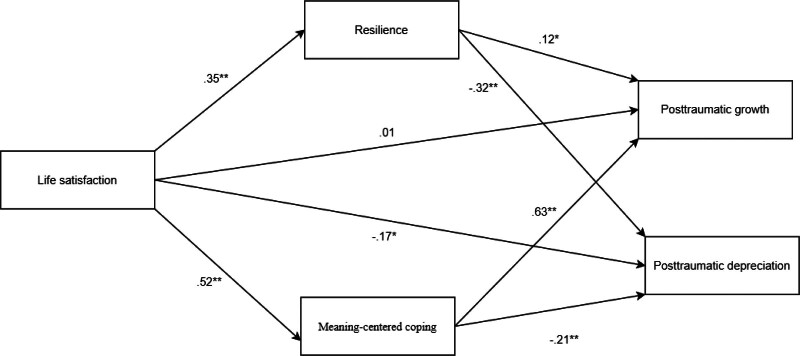
- Life satisfaction significantly predicted resilience (β = 0.35, P < .001) and meaning-centered coping (β = 0.52, P < .001), accounting for 12% and 27% of their variance, respectively.
- Resilience (β = 0.12, P < .05) and meaning-centered coping (β = 0.53, P < .001) significantly predicted posttraumatic growth, explaining 46% of its variance; life satisfaction had no significant direct effect on posttraumatic growth (β = 0.01, P = .94).
- Life satisfaction (β = −0.17, P < .05), resilience (β = −0.32, P < .001), and meaning-centered coping (β = −0.21, P < .001) significantly predicted posttraumatic depreciation, explaining 30% of its variance.
- Significant indirect effects were found for life satisfaction → resilience → posttraumatic growth (0.08, 95% CI 0.00–0.17), life satisfaction → meaning-centered coping → posttraumatic growth (0.64, 95% CI 0.46–0.85), life satisfaction → resilience → posttraumatic depreciation (−0.25, 95% CI −0.41 to −0.13), and life satisfaction → meaning-centered coping → posttraumatic depreciation (−0.26, 95% CI −0.45 to −0.09).
Methods
- Descriptive cross-sectional study using a relational screening model with nonprobability convenience sampling; participants completed an online survey via Google Forms distributed through social media and messaging platforms.
- The sample comprised 255 participants (76 males, 179 females) who directly experienced the February 6, 2023 earthquakes in 11 affected Turkish provinces; ages ranged from 15 to 58 years (M = 23.35, SD = 6.68). Data collection occurred approximately 5 months after the earthquakes, from June to August 2023.
- Measures included the Posttraumatic Growth and Posttraumatic Depreciation Inventory–Expanded Version Short Form, Meaning-Centered Coping Scale, Satisfaction With Life Scale, and Brief Resilience Scale; analyses used SPSS 26 and AMOS 24, including factor analyses and mediation analysis.
Limitations
- Stated: self-report measures were used; data collection was limited by individuals not wanting to answer questionnaires due to recent family deaths from the earthquake (n = 225); the cross-sectional design measured perceptions at a single time point; the sample was mostly young undergraduate students; self-selection bias was present; participants were not asked whether they were already receiving psychotherapy or counseling; and PTSD was not measured.
- Evident from the text: nonprobability convenience sampling and online recruitment through social networks may further restrict generalizability beyond the sampled earthquake survivors.
Model-written summary. Check it against the paper before relying on it.
Integrity signals
Registry
Cites
Statistics
Figures
Verification
Claims the paper makes
0 Valid · 0 Not valid · 0 Not checked · 38 Own results and interpretations
A result the paper reports from its own data — it cites no other source for it, so there is none to check. The quote shows it is in the paper.
In the paper
“life satisfaction had a significant predictive effect on both resilience (β = 0.35, P < .001) and meaning-centered coping (β = 0.52, P < .001).”
§ Resilience and meaning-centered coping as mediators in the relationship between life satisfaction and posttraumatic outcomes among earthquake survivors in Turkey > 4. Results > 4.3. Mediation analysis
plainstates a cause- Asserted: passes — The authors put it forward as true.
- Checkable: passes — It can be checked against evidence.
- Load-bearing: passes — The paper’s conclusions depend on it.
- Based: passes — The paper gives a reason why it holds.
A result the paper reports from its own data — it cites no other source for it, so there is none to check. The quote shows it is in the paper.
In the paper
“Life satisfaction accounted for 12% and 27% of the variance in resilience and meaning-centered coping, respectively.”
§ Resilience and meaning-centered coping as mediators in the relationship between life satisfaction and posttraumatic outcomes among earthquake survivors in Turkey > 4. Results > 4.3. Mediation analysis
plainstates an association- Asserted: passes — The authors put it forward as true.
- Checkable: passes — It can be checked against evidence.
- Load-bearing: unclear — It is unclear whether the paper’s conclusions depend on it.
- Based: passes — The paper gives a reason why it holds.
A result the paper reports from its own data — it cites no other source for it, so there is none to check. The quote shows it is in the paper.
In the paper
“resilience (β = 0.12, P < .05) and meaning-centered coping (β = 0.53, P < .001) were found to significantly predict posttraumatic growth, explaining 46% of the variance in this outcome”
§ Resilience and meaning-centered coping as mediators in the relationship between life satisfaction and posttraumatic outcomes among earthquake survivors in Turkey > 4. Results > 4.3. Mediation analysis
plainstates a cause- Asserted: passes — The authors put it forward as true.
- Checkable: passes — It can be checked against evidence.
- Load-bearing: passes — The paper’s conclusions depend on it.
- Based: passes — The paper gives a reason why it holds.
25 more claims
Create a free account to see all 38 claims and every source verdict.
- Probably not a substantial claim. 5
- The quote only partly states this claim. 1
- It may state two separate claims as one. 3
Claims other papers make about this one
Each is checked against this paper’s own text: does it say what the citing paper says it does?
The source backs part of the claim, not all of it — or backs it for a different population, condition or comparison.
In the citing paper
“for example, one study reported a strong association between meaning-centered coping and posttraumatic growth (r ≈ 0.67), suggesting a potentially important meaning-making pathway that warrants cautious interpretation and further replication (36).”
From Coping strategies and psychological outcomes following the 2023 Kahramanmaraş earthquakes: a systematic review with meta-analytic synthesis (2026) · cites this paper as [36]
Experimental — accuracy not yet measuredThe source backs part of the claim, not all of it — or backs it for a different population, condition or comparison.
In the citing paper
“The reviewed studies included diverse survivor groups, ranging from young adults and university students [e.g., (31, 36)] to general community samples and individuals residing in temporary shelter settings after extensive loss (34).”
From Coping strategies and psychological outcomes following the 2023 Kahramanmaraş earthquakes: a systematic review with meta-analytic synthesis (2026) · cites this paper as [36]
Experimental — accuracy not yet measuredThe cited source says what the claim attributes to it.
In the citing paper
“Evidence from individual studies in the current review suggests that meaning-centered coping and self-compassion may be particularly relevant for growth-related outcomes (32, 36).”
From Coping strategies and psychological outcomes following the 2023 Kahramanmaraş earthquakes: a systematic review with meta-analytic synthesis (2026) · cites this paper as [36]
Self-check
Percentages, sums and reported differences re-computed from the paper’s own numbers.
Each contradiction between two passages listed here was confirmed by an independent check.
Rated minor: it would not touch a result — a value no result rests on, a p-value that stays on the same side of the significance level, or a conflict that is clerical, resolved elsewhere in the paper, or outside its own findings.
In the paper
§ Resilience and meaning-centered coping as mediators in the relationship between life satisfaction and posttraumatic outcomes among earthquake survivors in Turkey > 3. Method > 3.8. Satisfaction with life scale
“The 5-item Satisfaction With Life Scale,[32] Turkish version,[56] was used to assess meaning in life.”
§ Resilience and meaning-centered coping as mediators in the relationship between life satisfaction and posttraumatic outcomes among earthquake survivors in Turkey > 3. Method > 3.8. Satisfaction with life scale
“The higher the score, the higher the satisfaction with life.”
Citations
Cites
The satisfaction with life scale
Diener, E., Emmons, R. A., Larsen, R. J., & Griffin, S. (1985) · Journal of Personality Assessment · doi:10.1207/s15327752jpa4901_13 · Cited by 31,768
Diagnostic and Statistical Manual of Mental Disorders
Siegel, L. J., & Fletcher‐Janzem, E. (2008) · Encyclopedia of Special Education · doi:10.1002/9780470373699.speced0655 · Cited by 8,477
Protective and Damaging Effects of Stress Mediators
McEwen, B. S. (1998) · New England Journal of Medicine · doi:10.1056/nejm199801153380307 · Cited by 6,733 · cited 1×
“[71] Reviewing the negative consequences of the earthquake trauma on the perceived value of life and discovering new ways to maintain psychological well-being after the trauma may be one of the meaning-centered coping strategies.”
The brief resilience scale: Assessing the ability to bounce back
Smith, B. W., Dalen, J., Wiggins, K., Tooley, E., Christopher, P., & Bernard, J. (2008) · International Journal of Behavioral Medicine · doi:10.1080/10705500802222972 · Cited by 6,439 · cited 1×
“The Brief Resilience Scale (Smith et al, [57] Turkish version [58] ) was developed to measure the ability of individuals to recover, bounce back, return to functioning, and readjust.”
Jackson, D., Firtko, A., & Edenborough, M. (2007) · Journal of Advanced Nursing · doi:10.1111/j.1365-2648.2007.04412.x · Cited by 1,175 · cited 1×
“[39,40] While traumatic experiences can increase the resilience of the individual, on the other hand, resilience can play a protective role in preventing post-traumatic stress.”
Making sense of loss and benefiting from the experience: two construals of meaning.
Davis, C. G., Nolen-Hoeksema, S., & Larson, J. (1998) · Journal of Personality and Social Psychology · doi:10.1037/0022-3514.75.2.561 · Cited by 1,168
Positive Adjustment to Threatening Events: An Organismic Valuing Theory of Growth through Adversity
Joseph, S., & Linley, P. A. (2005) · Review of General Psychology · doi:10.1037/1089-2680.9.3.262 · Cited by 892
Loneliness, isolation, and social support factors in post-COVID-19 mental health.
Saltzman, L. Y., Hansel, T. C., & Bordnick, P. S. (2020) · Psychological Trauma: Theory, Research, Practice, and Policy · doi:10.1037/tra0000703 · Cited by 618
Post–traumatic growth as positive personality change: Evidence, controversies and future directions
Jayawickreme, E., & Blackie, L. E. R. (2014) · European Journal of Personality · doi:10.1002/per.1963 · Cited by 555 · cited 1×
“[28] The support resources (social, psychological, etc) to be offered to individuals after trauma are as important as the type and severity of the traumatic experience.”
Shakespeare-Finch, J., & Lurie-Beck, J. (2014) · Journal of Anxiety Disorders · doi:10.1016/j.janxdis.2013.10.005 · Cited by 504
Posttraumatic growth, meaning in life, and life satisfaction in response to trauma
Triplett, K. N., Tedeschi, R. G., Cann, A., Calhoun, L. G., & Reeve, C. L. (2012) · Psychological Trauma: Theory, Research, Practice, and Policy · doi:10.1037/a0024204 · Cited by 449
The prevalence of moderate-to-high posttraumatic growth: A systematic review and meta-analysis
Wu, X., Kaminga, A. C., Dai, W., Deng, J., Wang, Z., Pan, X., & Liu, A. (2019) · Journal of Affective Disorders · doi:10.1016/j.jad.2018.09.023 · Cited by 314 · cited 1×
“[15] Additionally, studies in the literature highlighted that earthquakes can lead to positive outcomes such as PTG. [16,17] PTG manifests uniquely for each individual, influenced by their internal resources, support systems, and the nature of the trauma.”
Stress, coping, and health behavior.
Glanz, K., & Schwartz, M. D. (2008) · Cited by 290
Fixing the Growth Illusion: New Directions for Research in Resilience and Posttraumatic Growth
Infurna, F. J., & Jayawickreme, E. (2019) · Current Directions in Psychological Science · doi:10.1177/0963721419827017 · Cited by 206
Wang, Q., Sun, W., & Wu, H. (2022) · BMC Medical Education · doi:10.1186/s12909-022-03326-6 · Cited by 198
Itzhaki, M., Peles‐Bortz, A., Kostistky, H., Barnoy, D., Filshtinsky, V., & Bluvstein, I. (2015) · International Journal of Mental Health Nursing · doi:10.1111/inm.12151 · Cited by 194
Posttraumatic Growth Among HIV/AIDS Patients1
Milam, J. E. (2004) · Journal of Applied Social Psychology · doi:10.1111/j.1559-1816.2004.tb01981.x · Cited by 167
Handbook of posttraumatic growth research and practice
Calhoun, L. G. (2006) · Cited by 162
Teodorescu, D.-S., Siqveland, J., Heir, T., Hauff, E., Wentzel-Larsen, T., & Lien, L. (2012) · Health and Quality of Life Outcomes · doi:10.1186/1477-7525-10-84 · Cited by 159
(2004) · Cited by 148
An Examination of Posttraumatic Growth and Posttraumatic Depreciation: Two Exploratory Studies
Baker, J. M., Kelly, C., Calhoun, L. G., Cann, A., & Tedeschi, R. G. (2008) · Journal of Loss and Trauma · doi:10.1080/15325020802171367 · Cited by 136
Taku, K., Tedeschi, R. G., Shakespeare-Finch, J., Krosch, D., David, G., Kehl, D., Grunwald, S., Romeo, A., Di Tella, M., Kamibeppu, K., et al. (2021) · Personality and Individual Differences · doi:10.1016/j.paid.2020.110222 · Cited by 135 · cited 1×
“[22] PTD is the development of certain responses to traumas like PTG, independent of posttraumatic stress disorder.”
Post-Traumatic Growth and Resilience in Adolescent and Young Adult Cancer Patients: An Overview
Greup, S. R., Kaal, S. E. J., Jansen, R., Manten-Horst, E., Thong, M. S. Y., van der Graaf, W. T. A., Prins, J. B., & Husson, O. (2018) · Journal of Adolescent and Young Adult Oncology · doi:10.1089/jayao.2017.0040 · Cited by 126
Tomaszek, K., & Muchacka-Cymerman, A. (2020) · International Journal of Environmental Research and Public Health · doi:10.3390/ijerph17197062 · Cited by 117
Eisenbeck, N., Carreno, D. F., Wong, P. T. P., Hicks, J. A., María, R.-R. G., Puga, J. L., Greville, J., Testoni, I., Biancalani, G., López, A. C. C., et al. (2022) · International Journal of Clinical and Health Psychology · doi:10.1016/j.ijchp.2021.100256 · Cited by 108 · cited 2×
“The Meaning-Centered Coping Scale [45] was used to evaluate participants’ meaning-centered coping.”
Self-citationPosttraumatic Growth, Resilience, and Posttraumatic Stress Disorder (PTSD) among Refugees
Ssenyonga, J., Owens, V., & Olema, D. K. (2013) · Procedia - Social and Behavioral Sciences · doi:10.1016/j.sbspro.2013.06.238 · Cited by 105
Core beliefs shaken by an earthquake correlate with posttraumatic growth.
Taku, K., Cann, A., Tedeschi, R. G., & Calhoun, L. G. (2015) · Psychological Trauma: Theory, Research, Practice, and Policy · doi:10.1037/tra0000054 · Cited by 102
Life After Facing Cancer: Posttraumatic Growth, Meaning in Life and Life Satisfaction
Mostarac, I., & Brajković, L. (2021) · Journal of Clinical Psychology in Medical Settings · doi:10.1007/s10880-021-09786-0 · Cited by 89
Ando, S., Kuwabara, H., Araki, T., Kanehara, A., Tanaka, S., Morishima, R., Kondo, S., & Kasai, K. (2017) · Harvard Review of Psychiatry · doi:10.1097/hrp.0000000000000124 · Cited by 88 · cited 1×
“[9] Chronic PTSD, persisting for at least 3 months following a traumatic event, has been extensively studied in earthquake research.”
Almeida, M., Ramos, C., Maciel, L., Basto-Pereira, M., & Leal, I. (2022) · Frontiers in Psychology · doi:10.3389/fpsyg.2022.995981 · Cited by 81 · cited 1×
“[49,50] Moreover, it is known that the presence of meaning in life has a positive significant relationship with PTG. [51,52] As a result, it can be said that both the individual’s having meaning in life before trauma and the posttraumatic meaning-making process can be predictors of PTG and PTD. [53]”
Arslan, G., & Yıldırım, M. (2021) · Frontiers in Psychology · doi:10.3389/fpsyg.2021.646572 · Cited by 75 · cited 1×
“[46,47] The core beliefs of individuals exposed to negative life events may be shaken and they may face a deep loss of meaning.”
Self-citationZięba, M., Wiecheć, K., Biegańska-Banaś, J., & Mieleszczenko-Kowszewicz, W. (2019) · Frontiers in Psychology · doi:10.3389/fpsyg.2019.00687 · Cited by 69 · cited 1×
“[20] Baker [21] introduced the concept of PTD as the counterpart to PTG, aiming to study adverse changes perceived by individuals following traumatic experiences.”
Post-traumatic stress, growth, and depreciation during the COVID-19 pandemic: evidence from Turkey
Ikizer, G., Karanci, A. N., Gul, E., & Dilekler, I. (2021) · European Journal of Psychotraumatology · doi:10.1080/20008198.2021.1872966 · Cited by 68
Shared trauma, resilience, and growth: A roadmap toward transcultural conceptualization.
Ali, D. A., Figley, C. R., Tedeschi, R. G., et al. (2021) · Psychological Trauma Theory Research Practice and Policy · doi:10.1037/tra0001044 · Cited by 64
(2023) · doi:10.1038/s41598-023-31863-7 · Cited by 62
Weber, M. C., Pavlacic, J. M., Gawlik, E. A., Schulenberg, S. E., & Buchanan, E. M. (2020) · Traumatology · doi:10.1037/trm0000210 · Cited by 62 · cited 1×
“[49,50] Moreover, it is known that the presence of meaning in life has a positive significant relationship with PTG. [51,52] As a result, it can be said that both the individual’s having meaning in life before trauma and the posttraumatic meaning-making process can be predictors of PTG and PTD. [53]”
Walsh, D. M. J., Morrison, T. G., Conway, R. J., Rogers, E. T., Sullivan, F. J., & Groarke, A. (2018) · Frontiers in Psychology · doi:10.3389/fpsyg.2018.00136 · Cited by 52
Danhauer, S. C., Carlson, C. R., & Andrykowski, M. A. (2005) · Journal of Applied Gerontology · doi:10.1177/0733464805277754 · Cited by 51
Tamarit, A., de la Barrera, U., Schoeps, K., Castro‐Calvo, J., & Montoya‐Castilla, I. (2022) · Journal of Community Psychology · doi:10.1002/jcop.22900 · Cited by 51
Posttraumatic Growth and Posttraumatic Depreciation as Predictors of Psychological Adjustment
Barrington, A., & Shakespeare-Finch, J. (2013) · Journal of Loss and Trauma · doi:10.1080/15325024.2012.714210 · Cited by 49
Refining our ability to measure posttraumatic growth.
Johnson, S. F., & Boals, A. (2015) · Psychological Trauma: Theory, Research, Practice, and Policy · doi:10.1037/tra0000013 · Cited by 46
Wan, X., Huang, H., Peng, Q., Yu, N. X., Zhang, Y., Ding, Y., Wu, H., Hao, J., Lu, G., & Chen, C. (2022) · Nursing Open · doi:10.1002/nop2.1540 · Cited by 43
Jung, H.-O., & Han, S.-W. (2023) · Frontiers in Psychiatry · doi:10.3389/fpsyt.2022.1070681 · Cited by 41
Posttraumatic Growth in Trauma Survivors: Meaning Making and Locus of Control
Zeligman, M. R., Grossman, L., & Tanzosh, A. (2019) · Journal of Counselor Practice · doi:10.22229/ptg1022019 · Cited by 41
Kim, J., Kim, M., & Park, S.-H. (2016) · Psychological Reports · doi:10.1177/0033294116653954 · Cited by 38
Near-death experiences, posttraumatic growth, and life satisfaction among burn survivors
Royse, D. D., & Badger, K. (2017) · Social Work in Health Care · doi:10.1080/00981389.2016.1265627 · Cited by 36
Buffering and direct effect of posttraumatic growth in predicting distress following cancer.
Wang, A. W.-T., Chang, C.-S., Chen, S.-T., Chen, D.-R., Fan, F., Carver, C. S., & Hsu, W.-Y. (2017) · Health Psychology · doi:10.1037/hea0000490 · Cited by 35
Posttraumatic growth and adjustment to spinal cord injury: moderated by posttraumatic depreciation?
Kunz, S., Joseph, S., Geyh, S., & Peter, C. (2017) · Psychological Trauma: Theory, Research, Practice, and Policy · doi:10.1037/tra0000164 · Cited by 34 · cited 1×
“Hence it is known that PTG, PTD, and life satisfaction have positive and negative significant relationships [25,26] and PTG is a predictor of life satisfaction.”
Early Aftermath of February 6 Earthquakes in Turkey: PTSD, PTG, and Resilience
Bilge, Y., Emiral, E., & Demirci, H. (2024) · Journal of Loss and Trauma · doi:10.1080/15325024.2023.2254216 · Cited by 32 · cited 1×
“[44] Therefore, it was thought that resilience could be a predictor for PTD and PTG in this study.”
Batmaz, H., Türk, N., & DOĞRUSEVER, C. (2021) · Anemon Muş Alparslan Üniversitesi Sosyal Bilimler Dergisi · doi:10.18506/anemon.895199 · Cited by 31
Self-citationCyberbullying and cyber victimization: examining mediating roles of empathy and resilience
Batmaz, H., Türk, N., Kaya, A., & Yıldırım, M. (2023) · Current Psychology · doi:10.1007/s12144-022-04134-3 · Cited by 31
Self-citationLife satisfaction during temporary housing after an earthquake: comparing three cases in Italy.
Di Bucci, D., Del Missier, F., Dolce, M., Galvagni, A., Giordano, F., Patacca, A., Pezzi, E., Scurci, G., & Savadori, L. (2023) · International Journal of Disaster Risk Reduction · doi:10.1016/j.ijdrr.2023.103697 · Cited by 25
Kyutoku, Y., Dan, I., Yamashina, M., Komiyama, R., & Dougall, A. L. (2020) · Journal of Traumatic Stress · doi:10.1002/jts.22628 · Cited by 24
Satisfaction with life and posttraumatic growth in persons after myocardial infarction
Ogińska-Bulik, N. J. (2014) · Health Psychology Report · doi:10.5114/hpr.2014.43917 · Cited by 23
DOĞRUSEVER, C., Türk, N., & Batmaz, H. (2022) · İnönü Üniversitesi Eğitim Fakültesi Dergisi · doi:10.17679/inuefd.1029866 · Cited by 22
Self-citationTürk, N., Arslan, G., Kaya, A., Güç, E., & Turan, M. E. (2024) · Child Abuse & Neglect · doi:10.1016/j.chiabu.2024.106735 · Cited by 20 · cited 1×
“[46,47] The core beliefs of individuals exposed to negative life events may be shaken and they may face a deep loss of meaning.”
Self-citationXie, J., Zhang, H., Zhang, X., Yin, M.-Z., Yang, J., Chen, K. G., Xiong, J.-R., & Chen, Y. (2022) · Frontiers in Psychology · doi:10.3389/fpsyg.2022.926375 · Cited by 18
Posttraumatic Growth and Resilience: Assessment and Clinical Implications
Jeon, S. W., Han, C., Choi, J., Pae, C., Chae, J., Ko, Y., Yoon, H., & Han, C. (2015) · 신경정신의학 · doi:10.4306/jknpa.2015.54.1.32 · Cited by 17
Ma, Z., Wang, D., Fu, X., Tao, Y., Zhang, Y., Liu, W., & Fan, F. (2023) · Journal of Anxiety Disorders · doi:10.1016/j.janxdis.2023.102767 · Cited by 14 · cited 1×
“[10] This temporal delay in research is grounded in the belief that individuals can provide more accurate and realistic reports after some time has passed since the trauma.”
Platte, S., Wiesmann, U., Tedeschi, R. G., Taku, K., & Kehl, D. (2023) · Psychological Trauma: Theory, Research, Practice, and Policy · doi:10.1037/tra0001378 · Cited by 14
Editorial: Post-traumatic growth
Şenol-Durak, E., Tella, M. D., & Romeo, A. (2023) · Frontiers in Psychology · doi:10.3389/fpsyg.2023.1227892 · Cited by 14
Başcıllar, M., Güre, M. D. P., & Sakarya, H. (2023) · Archives of Psychiatric Nursing · doi:10.1016/j.apnu.2023.10.006 · Cited by 9
Ye, H., Wang, D., Chen, X., Chen, M., Ouyang, H., Chen, C., Chen, S., Ding, J., & Fan, F. (2023) · Journal of Public Health · doi:10.1007/s10389-023-01881-w · Cited by 8
Moghadam, A. H. (2021) · Journal of Holistic Nursing and Midwifery · doi:10.32598/jhnm.31.4.2102 · Cited by 5
Şenol-Durak, E., Tella, M. D., & Romeo, A. (2023) · Frontiers research topics · doi:10.3389/978-2-8325-3200-3 · Cited by 2
Research works printed but not linked: 12
- Erten R Kocakaya R. Post-traumatic growth and meaning: a sample case. Mehmet Akif Ersoy Univ J Soc Sci Inst. 2020; 31: 189– 204.
- Afet TIB Presidency ADY. Press release on earthquakes in Kahramanmaraş. Date Access. 2023; 7: 2023.
- Çağiş Z Akçe I Aziz IA. The mediating role of peritraumatic stress in the relationship between childhood psychological maltreatment and optimism and pessimism among earthquake survivors in Turkey. J Health Soc Sci. 2023; 8: 121– 31.
- Yildirim M. The psychological impact of the devastating earthquake in Türkiye. J Concurr Disord. 2023; 1: 1– 3.
- Mangelsdorf J. Does Growth Require Suffering? Positive Personality Changes Following Major Life Events with High Emotional Valence [doctoral dissertation]. Berlin: Freie Universität Berlin; 2017.
- Calhoun LG Tedeschi RG. Handbook of Posttraumatic Growth: Research and Practice. Routledge; 2014.
- Tedeschi RG Shakespeare-Finch J Taku K. Posttraumatic Growth: Theory, Research, and Applications. Routledge; 2018.
- Kardaş F Tanhan F. Investigating posttraumatic stress, posttraumatic growth and hopelessness levels of university students exposed to the Van earthquake. Van Yüzüncü Yil Univ J Educ. 2018; 15: 1– 36.
- Büyüköztürk Ş. Data Analysis Handbook for Social Sciences. Pegem; 2018: 001– 214.
- Dağli A Baysal N. Adaptation of the satisfaction with life scale into Turkish: the study of validity and reliability. Electron J Soc Sci. 2016; 15: 1250– 62.
- Doğan T. Adaptation of the brief resilience scale into Turkish: a validity and reliability study. J Happiness Well Being. 2015; 3: 93– 102.
- Halama P. Meaning in life and coping: sense of meaning as a buffer against stress. In: Batthyany A Russo-Netzer P, eds. Meaning in Positive and Existential Psychology. Springer; 2014: 239– 50.
Cited by
Karababa, B., Aydın, G., Yilmaz, O., Akkuş, Y., Bayram, E., & Aydın, G. (2025) · Frontiers in Psychology · doi:10.3389/fpsyg.2025.1697876 · Cited by 9
Dinlenmeye Tahammülsüzlük Ölçeği Kısa Formu Türkçe Versiyonu’nun Psikometrik Özellikleri
Türk, N., Batmaz, H., & DOĞRUSEVER, C. (2025) · Siirt Eğitim Dergisi · doi:10.58667/sedder.1712764 · Cited by 3
Self-citationEşer, A. K., Işık, S. A., & Ercivan, S. (2026) · European Journal of Oncology Nursing · doi:10.1016/j.ejon.2026.103151 · Cited by 2
DOĞRUSEVER, C., KURTULUŞ, H. Y., Kaya, A., Türk, N., & Yıldırım, M. (2026) · Brain and Behavior · doi:10.1002/brb3.71163 · Cited by 3
Self-citationKovan, A. (2026) · OMEGA - Journal of Death and Dying · doi:10.1177/00302228261455423 · Cited by 1
Metadata
- Authors
- Türk, N., Yildirim, M., Batmaz, H., Aziz, I. A., & Gómez-Salgado, J.
- Affiliations
- Siirt Üniversitesi (TR)
- Department of Psychology, Faculty of Science and Letters, Ağri İbrahim Çeçen University, Ağri, Turkey
- Karabük University (TR)
- Bayan University (IQ)
- Universidad Espíritu Santo (EC)
- Corresponding author
- Gómez-Salgado, Juan
- Venue
- Medicine
- Published
- 2025-03-07
- Volume
- 104
- Issue
- 10
- Pages
- e41712
- ISSN
- 0025-7974 (ISSN-L)
- 1536-5964
- PMC
- PMC11902989
- OpenAlex
- W4408387723
- Semantic Scholar
- b317cc6e9be573b8899c778900f2ef0888b47230
- Cited by
- 25
- References
- 70
- Citations by year
- 2026: 20 · 2025: 5
- FWCI
- 29.42
- Type
- journal article
- Language
- en
- Open access
- gold
- doi.org
- Licence
- Locations
- Medicine (publishedVersion, cc-by-nc)
- PubMed Central (publishedVersion, cc-by-nc)
- PubMed (publishedVersion)
- Repositorio Institucional de la Universidad de Huelva (Universidad de Huelva) (submittedVersion)
- Hispana (submittedVersion, cc-by-nc-nd)
- Repositorio Institucional de la Universidad de Huelva (Universidad de Huelva) (submittedVersion, cc-by-nc-nd)
- Topics
- Social Sciences › Psychology › Clinical Psychology › Resilience and Mental Health
- Social Sciences › Psychology › Clinical Psychology › Posttraumatic Stress Disorder Research
- Social Sciences › Psychology › Clinical Psychology › Grief, Bereavement, and Mental Health
- Keywords
- resilience, life satisfaction, posttraumatic growth, earthquake survivors, 2023 Kahramanmaraş earthquakes, mediation, post-traumatic stress disorder, disaster trauma
- MeSH terms
- Posttraumatic Growth, Psychological, Adaptation, Psychological, Adult, Female, Humans, Male, Middle Aged, Personal Satisfaction, Surveys and Questionnaires, Stress Disorders, Post-Traumatic, Turkey, Survivors, Resilience, Psychological, Young Adult, Earthquakes
About these checks
Registry, retraction, Cites and statistics results are computed, not judged, with one exception: a printed reference that no index lists is read once by a model before it counts as a citation error. Claims are extracted by a model and kept only when their quote appears verbatim in the text; each cited source is then checked, with a model’s help, for whether it says what the claim relies on. Those verdicts can be wrong — read the claim’s quote and the cited source before relying on one.
A language model drew the claims from the paper on 2026-10-10, under version 3 of the claim definition (model deepseek-v4.1-flash, prompt extract-v3).
A second model labelled each claim on 2026-10-10 (model jev-1.13-20260917, definition revision gold-guideline-v0.2).
Statistics and arithmetic are recomputed, not judged.
Confidence bands are shown only for fields calibrated on our annotated test set. None is calibrated yet, so no band is shown.
What counts as a claim ›How we measure confidence ›How we check this ›
Are you an author, or do you see a problem with this page? Request a review
Data sources
Bibliographic data: Semantic Scholar, OpenAlex, Crossref.
Contains information from the Semantic Scholar Academic Graph Datasets, made available under the ODC Attribution License (ODC-BY 1.0).
Semantic Scholar’s data is described in: Kinney, R., et al. (2023). The Semantic Scholar Open Data Platform. arXiv:2301.10140.
