

The Effects of Dietary Improvement on Symptoms of Depression and Anxiety: A Meta-Analysis of Randomized Controlled Trials
Open accessThe DOI matches its Crossref record; 59 of the 59 references it cites were found in a registry or an index.
Abstract
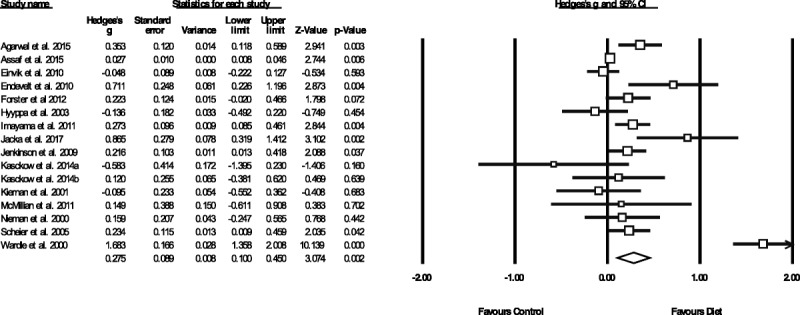
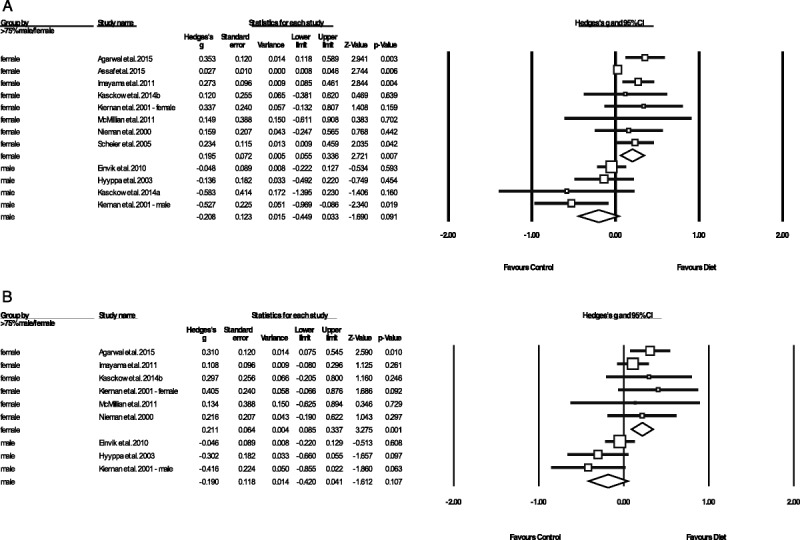
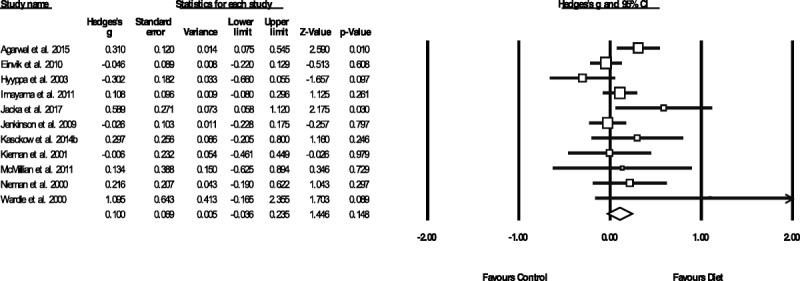
Objective: Poor diet can be detrimental to mental health. However, the overall evidence for the effects of dietary interventions on mood and mental well-being has yet to be assessed. We conducted a systematic review and meta-analysis examining effects of dietary interventions on symptoms of depression and anxiety. Methods: Major electronic databases were searched through March 2018 for all randomized controlled trials of dietary interventions reporting changes in symptoms of depression and/or anxiety in clinical and nonclinical populations. Random-effects meta-analyses were conducted to determine effect sizes (Hedges' g with 95% confidence intervals [CI]) for dietary interventions compared with control conditions. Potential sources of heterogeneity were explored using subgroups and meta-regression analyses. Results: Sixteen eligible randomized controlled trials (published in English) with outcome data for 45,826 participants were included; the majority of which examined samples with nonclinical depression ( n = 15 studies). Nonetheless, dietary interventions significantly reduced depressive symptoms ( g = 0.275, 95% CI = 0.10 to 0.45, p = .002). Similar effects were observed among high-quality trials ( g = 0.321, 95% CI = 0.12 to 0.53, p = .002) and when compared with both inactive ( g = 0.308, 95% CI = 0.02 to 0.60, p = .038) and active controls ( g = 0.174, 95% CI = 0.01 to 0.34, p = .035). No effect of dietary interventions was observed for anxiety ( k = 11, n = 2270, g = 0.100, 95% CI = −0.04 to 0.24, p = .148). Studies with female samples observed significantly greater benefits from dietary interventions, for symptoms of both depression and anxiety. Conclusions: Dietary interventions hold promise as a novel intervention for reducing symptoms of depression across the population. Future research is required to determine the specific components of dietary interventions that improve mental health, explore underlying mechanisms, and establish effective schemes for delivering these interventions in clinical and public health settings. Registration: PROSPERO Online Protocol: CRD42018091256.
Overview
The claims and statistics of this paper haven’t been checked yet.
Free: it reads the open-access text and checks the first 5 claims that cite a source we can check. Create a free account to check every claim.
Integrity signals
Registry
Cites
Statistics
Figures
Verification
Claims the paper makes
The claims and statistics of this paper haven’t been checked yet.
Free: it reads the open-access text and checks the first 5 claims that cite a source we can check. Create a free account to check every claim.
Claims other papers make about this one
Each is checked against this paper’s own text: does it say what the citing paper says it does?
The cited source says what the claim attributes to it.
In the citing paper
“while emerging trial data show that improving dietary habits can improve depressive symptoms (301).”
From Diet and the Microbiota–Gut–Brain Axis: Sowing the Seeds of Good Mental Health (2021) · cites this paper as [301]
In the citing paper
“Probiotics can increase microbiota diversity and therefore maximize the production of neuroactive compounds derived from fiber fermentation, such as short-chain fatty acids (SCFA), e.g., butyrate and acetate, therefore allowing the established dietary patterns to exert significant beneficial effect on brain function [11,75], as has been shown in previous interventional research [76].”
From Psychobiotic effects on anxiety are modulated by lifestyle behaviors: a randomized placebo-controlled trial on healthy adults (2023) · cites this paper as [76]
In the citing paper
“However, a recent meta-analysis of RCTs concluded that no effect of dietary interventions is observed for anxiety [162].”
From Separating the Signal from the Noise: How Psychiatric Diagnoses Can Help Discern Food Addiction from Dietary Restraint (2020) · cites this paper as [162]
Self-check
Percentages, sums and reported differences re-computed from the paper’s own numbers.
The self-check needs the paper’s full text.
Citations
Cites
Preferred Reporting Items for Systematic Reviews and Meta-Analyses: the PRISMA statement
Moher, D., Liberati, A., Tetzlaff, J., Altman, D. G., & for the PRISMA Group (2009) · BMJ · doi:10.1136/bmj.b2535 · Cited by 83,823
Preferred Reporting Items for Systematic Reviews and Meta-Analyses: The PRISMA Statement
Moher, D., Liberati, A., Tetzlaff, J., Altman, D. G., & The PRISMA Group (2009) · PLoS Medicine · doi:10.1371/journal.pmed.1000097 · Cited by 64,042
The CES-D Scale: A Self-Report Depression Scale for Research in the General Population
Radloff, L. S. (1977) · Applied Psychological Measurement · doi:10.1177/014662167700100306 · Cited by 53,267
The Hospital Anxiety and Depression Scale
Zigmond, A. S., & Snaith, R. P. (1983) · Acta Psychiatrica Scandinavica · doi:10.1111/j.1600-0447.1983.tb09716.x · Cited by 47,139
(1992) · PubMed · Cited by 33,716
Hamilton, M. (1960) · Journal of Neurology, Neurosurgery & Psychiatry · doi:10.1136/jnnp.23.1.56 · Cited by 32,817
A new depression scale designed to be sensitive to change
Montgomery, S. A., & Åsberg, M. (1979) · British Journal of Psychiatry · doi:10.1192/bjp.134.4.382 · Cited by 13,962
Overweight, Obesity, and Depression: A Systematic Review and Meta-analysis of Longitudinal Studies
Luppino, F. S., de Wit, L. M., Bouvy, P. F., Stijnen, T., Cuijpers, P., Penninx, B. W. J. H., & Zitman, F. G. (2010) · Archives of General Psychiatry · doi:10.1001/archgenpsychiatry.2010.2 · Cited by 4,322
Adipocytokines: mediators linking adipose tissue, inflammation and immunity
Tilg, H., & Moschen, A. R. (2006) · Nature Reviews Immunology · doi:10.1038/nri1937 · Cited by 3,188
The global prevalence of common mental disorders: a systematic review and meta-analysis 1980–2013
Steel, Z., Marnane, C., Iranpour, C., Chey, T., Jackson, J. W., Patel, V., & Silove, D. (2014) · International Journal of Epidemiology · doi:10.1093/ije/dyu038 · Cited by 2,846
Research works printed but not linked: 4
- Borenstein M Hedges L Higgins J Rothstein H Comprehensive Meta-Analysis Version 2. Englewood, NJ: Biostat; 2005: 104.
- Beck AT Steer RA Brown GK Beck Depression Inventory-II. San Antonio 1996; 78: 490– 8.
- Sheikh JI Yesavage JA Geriatric Depression Scale (GDS): recent evidence and development of a shorter version. J Aging Mental Health 1986; 5: 165– 73.
- Derogatis LR Spencer P Brief symptom inventory: BSI. Upper Saddle River, NJ: Pearson; 1993.
Cited by
Items 201–300 of 619
The Relationship between Diet, Depression, and Alzheimer's Disease: A Narrative Review
Shamsi, H. S. S. A., Rainey‐Smith, S. R., Gardener, S. L., Sohrabi, H. R., Cánovas, R., Martins, R. N., & Fernando, W. M. A. D. B. (2024) · Molecular Nutrition & Food Research · doi:10.1002/mnfr.202300419 · Cited by 17
Nutrient patterns and depressive symptoms among Australian adults
Shakya, P. R., Melaku, Y. A., Page, A. J., & Gill, T. K. (2020) · European Journal of Nutrition · doi:10.1007/s00394-020-02243-y · Cited by 19
Chen, Y., Li, Z., Peng, J. W., Shen, L., & Shi, J. (2020) · Evidence-based Complementary and Alternative Medicine · doi:10.1155/2020/7836024 · Cited by 21
Opie, R. S., Jacka, F. N., Marx, W., Rocks, T., Young, C., & O’Neil, A. (2021) · Nutrients · doi:10.3390/nu13113766 · Cited by 16
“The past decade has seen the emergence of compelling top tier meta-analytic level data for the use of lifestyle-based programs for management of mental disorders [5,6].”
BackgroundResultSelf-citationBui, T. A., O’Croinin, B. R., Dennett, L., Winship, I. R., & Greenshaw, A. J. (2025) · Microbiology · doi:10.1099/mic.0.001568 · Cited by 16
“Dietary interventions may help enhance responses to drug therapy [262, 263] and address metabolic side effects caused by the medications [86, 89].”
Influence of Grit on Physical Activity, Sitting Time and Dietary Behaviors: A Multi-Study Analysis
Martin, J. R., Toczko, M., Locke, E., McCarthy, R., Milani, I., Barrios, N., Koutoubi, S., Ambegaonkar, J. P., Dhokai, N., & Boolani, A. (2022) · Sustainability · doi:10.3390/su15010211 · Cited by 17
Dudley, L. M., Saluja, S., Stevenson, R. J., Francis, H., & Case, T. I. (2025) · Food Quality and Preference · doi:10.1016/j.foodqual.2025.105517 · Cited by 16
Jahrami, H., Bragazzi, N. L., Grant, W. B., AlFarra, H. S. M., AlFara, W. S. M., Mashalla, S., & Saif, Z. (2020) · Nutrients · doi:10.3390/nu12092587 · Cited by 19
“Dietary and lifestyle approaches hold potential as a novel intervention for the management of symptoms of depression [9].”
BackgroundNeuroprotective potential of Argan oil in neuropsychiatric disorders in rats: A review
Mostafi, H. E., Bahbiti, Y., Elhessni, A., Bousalham, R., Doumar, H., Ouichou, A., Benmhammed, H., Touil, T., & Mesfioui, A. (2020) · Journal of Functional Foods · doi:10.1016/j.jff.2020.104233 · Cited by 17
Chen, W. L., Faris, M. E., Bragazzi, N. L., Algahtani, H. M., Saif, Z., Jahrami, A., Shivappa, N., Hébert, J. R., & Jahrami, H. (2021) · Journal of Inflammation Research · doi:10.2147/jir.s306315 · Cited by 19
“Our findings are consistent with the hypothesis that increasing the consumption of low-DII, anti-inflammatory foods and reducing the intake of high-DII, pro-inflammatory dietary components would decrease the risk of depression and could serve as the basis for an effective supportive therapy for patients with depressio…”
ResultYoung, C., Mohebbi, M., Staudacher, H. M., Berk, M., Jacka, F. N., & O'Neil, A. E. (2021) · International Review of Psychiatry · doi:10.1080/09540261.2020.1854193 · Cited by 20
Self-citationIbáñez, N. C., Serra‐Majem, L., Martín‐Peláez, S., Martínez‐González, M. Á., Salas‐Salvadó, J., Corella, D., Lassale, C. M., Martínez, J. A., Alonso‐Gómez, Á. M., Wärnberǵ, J., et al. (2022) · Public Health Nutrition · doi:10.1017/s1368980022001525 · Cited by 17
“Either way, recent meta-analyses have indicated that dietary interventions based on adherence to healthy dietary patterns produce not only a reduction in depressive symptoms but also a lower risk of developing depressive symptoms in non-clinical populations(48).”
Shiri, R., Väänänen, A., Mattila‐Holappa, P., Kauppi, K., & Borg, P. T. (2022) · International Journal of Environmental Research and Public Health · doi:10.3390/ijerph192013206 · Cited by 18
“Lifestyle coaching consisting of a comprehensive nutrition and health education program for individuals diagnosed as prediabetic or at risk of diabetes reduced body mass index and waist circumference but did not change systolic or diastolic blood pressure, glucose, cholesterol, or triglycerides [6].”
BackgroundSkinner, J. A., Leary, M., Whatnall, M. C., Collins, R. A., Pursey, K., Verdejo‐García, A., Hay, P., Baker, A., Hides, L. M., Paxton, S. J., et al. (2024) · Appetite · doi:10.1016/j.appet.2024.107211 · Cited by 17
“Research suggests better effects on clinical outcomes are achieved when dietary interventions are led by a dietitian, compared to those without professional involvement (Firth J et al., 2019; Rocks T et al., 2022).”
Lifestyle-based mental health care in psychiatry: Translating evidence into practice
Marx, W., Jacka, F. N., & O'Neil, A. E. (2021) · Australian & New Zealand Journal of Psychiatry · doi:10.1177/00048674211011250 · Cited by 18
“This is concomitant with the increasing focus on mitigating the substantial mortality gap arising from the cardiometabolic conditions so prevalent in people living with mental disorders (Firth et al., 2019b).”
BackgroundSelf-citationA Narrative Review of the Association Between Healthy Dietary Patterns and Depression
Apostolakopoulou, X. A., Petinaki, E., Kapsoritakis, A. N., & Bonotis, K. S. (2024) · Cureus · doi:10.7759/cureus.60920 · Cited by 17
“After analyzing all dietary patterns in meta-analyses [25-29], they were found to be consistent with the studies [4,8,44,46].”
BackgroundResultDrew, R. J., Morgan, P. J., Collins, C. E., Callister, R., KAY‐LAMBKIN, F. J., Kelly, B. J., & Young, M. D. (2021) · Annals of Behavioral Medicine · doi:10.1093/abm/kaab109 · Cited by 16
Young, L. M., Moylan, S., John, T., Turner, M., Opie, R., Hockey, M., Saunders, D., Bruscella, C., Jacka, F. N., Teychenne, M. J., et al. (2022) · BMC Psychiatry · doi:10.1186/s12888-022-03840-3 · Cited by 16
“These studies—backed up by level 1 evidence for dietary support to reduce depressive symptoms for a range of health conditions [10]—point to the potential of lifestyle therapies for producing large health benefits and cost savings in people with mental illness.”
Self-citationBrandley, E. T., Kirkland, A. E., Baron, M. I., Baraniuk, J. N., & Holton, K. F. (2022) · Frontiers in Psychiatry · doi:10.3389/fpsyt.2022.926688 · Cited by 16
Zhang, S., Limei, E., Lu, Z., Yu, Y., Yang, X., Chen, Y., & Jiang, X. (2023) · Nutrients · doi:10.3390/nu15030629 · Cited by 16
“A meta-analysis of randomized controlled studies demonstrated a causal relationship between diet quality and depressive symptoms [37].”
BackgroundBaxter, D. A., & Lovell, G. P. (2021) · Australian Psychologist · doi:10.1080/00050067.2021.1893597 · Cited by 15
Tang, W.-K., & Lee, J. C. (2024) · Nutrients · doi:10.3390/nu16193317 · Cited by 16
“One meta-analysis of sixteen randomized controlled trials revealed significant reduction of subclinical depressive symptoms through dietary intervention [20] by restricting high-fat and high-sugar food intake and replacing them with high-fiber and nutrient-dense food [20].”
BackgroundMarx, W., Visser, M., Wallace, C., Jacka, F. N., Bayes, J., Francis, H., Opie, R., Hockey, M., Teasdale, S. B., Sánchez‐Villegas, A., et al. (2024) · British Journal Of Nutrition · doi:10.1017/s0007114524001946 · Cited by 19
Self-citationTavakoly, R., Moosburner, A., Anheyer, D., & Cramer, H. (2025) · Nutrients · doi:10.3390/nu17030563 · Cited by 15
Wilson, J. J., McMullan, I., Blackburn, N. E., Klempel, N., Yakkundi, A., Armstrong, N., Brolly, C., Butler, L., Barnett, Y., Jacob, L., et al. (2021) · Journal of Public Health · doi:10.1093/pubmed/fdab009 · Cited by 14
Young, C., Mohebbi, M., Staudacher, H. M., KAY‐LAMBKIN, F. J., Berk, M., Jacka, F. N., & O'Neil, A. E. (2021) · JMIR Mental Health · doi:10.2196/24871 · Cited by 18
“Two systematic reviews, one with meta-analysis [13,14], reported that dietary interventions are efficacious adjunctive treatments for reducing depressive symptoms.”
Self-citationPedroso, I., Kumbhare, S. V., Joshi, B., Saravanan, S. K., Mongad, D., Singh-Rambiritch, S., Uday, T., Muthukumar, K., Irudayanathan, C., Reddy-Sinha, C., et al. (2022) · Journal of Personalized Medicine · doi:10.3390/jpm12081237 · Cited by 15
Bahadorpour, S., Hajhashemy, Z., Mohammadi, S., Mokhtari, E., Heidari, Z., & Saneei, P. (2023) · Scientific Reports · doi:10.1038/s41598-023-32510-x · Cited by 14
The association between nutrition and behavioural health in a US Army population
Forys, K. L., Brooks, R. D., Beymer, M. R., & Pecko, J. A. (2020) · Public Health Nutrition · doi:10.1017/s1368980020001238 · Cited by 17
“n-3 fatty acids, EPA and DHA found in fish and commercial fish oils have antidepressant(15,16,22) Table 2 χ2 differences in depression and anxiety by food intake (n 7043)”
BackgroundVreijling, S. R., Penninx, B. W. J. H., Bot, M., Watkins, E. R., Owens, M., Kohls, E., Hegerl, U., Roca, M., Gili, M., Brouwer, I. A., et al. (2021) · Psychological Medicine · doi:10.1017/s0033291721000337 · Cited by 15
“…stated earlier, the outcome of Bot et al. (2019) is contrary to that of a meta-analysis which concluded that overall a beneficial effect of whole-diet interventions on the reduction of depressive symptoms can be found, although large heterogeneity in effect sizes was observed (Firth et al., 2019a).”
InfluentialPrvulović, M., Todorovic, S. T., Milanović, D., Jović, M., Vujovic, P. Z., Kanazir, S., & Mladenović, A. (2022) · Mechanisms of Ageing and Development · doi:10.1016/j.mad.2022.111666 · Cited by 15
Martin, J. R., Estep, A., Tozcko, M., Hartzel, B., & Boolani, A. (2022) · Journal of American College Health · doi:10.1080/07448481.2022.2052078 · Cited by 15
Wang, Y.-L., Wang, Y., Leung, D. K. Y., Wong, G. H. Y., & Lum, T. Y. S. (2024) · BMC Geriatrics · doi:10.1186/s12877-024-05392-5 · Cited by 13
“Recent research suggests that dietary interventions have a small positive effect on improving depressive symptoms in clinical and nonclinical adults [59].”
BackgroundMinamino, H., Katsushima, M., Hashimoto, M., Fujita, Y., Torii, M., Ikeda, K., Isomura, N., Oguri, Y., Yamamoto, W., Watanabe, R., et al. (2021) · PLoS ONE · doi:10.1371/journal.pone.0255526 · Cited by 14
“Although in the general population, but not in RA patients, meta-analyses and RCT studies have proven the effectiveness of dietary interventions [17, 18, 43], there remains the possibility of reverse causation as depression itself could promote unfavorable lifestyle choices such as unhealthy eating habits.”
BackgroundLiu, S., Jiang, H., Zhang, D., Luo, J., & Zhang, H. (2022) · Nutrients · doi:10.3390/nu14153047 · Cited by 14
“Randomized controlled studies have confirmed a causal relationship between dietary quality and depressive symptoms [26,27].”
BackgroundPlant-based dietary patterns and their association with mood in healthy individuals
Ma, X., Li, Y., Xu, Y., Gibson, R., Williams, C. M., Lawrence, A. J., Nosarti, C., Dazzan, P., & Rodriguez‐Mateos, A. (2022) · Food & Function · doi:10.1039/d2fo02951k · Cited by 16
Liao, X., Ye, H., & Si, T. (2021) · Neuropsychiatric Disease and Treatment · doi:10.2147/ndt.s294521 · Cited by 15
“It is generally believed that lifestyle interventions from the beginning of antipsychotic treatment as a preventive strategy may reduce metabolic risks such as obesity in patients with schizophrenia and provide more benefits.(51,52) Multiple studies have suggested that combination treatments can help control weight an…”
BackgroundOwens, M., Watkins, E. R., Bot, M., Brouwer, I. A., Roca, M., Kohls, E., Penninx, B. W. J. H., van Grootheest, G., Hegerl, U., Gili, M., et al. (2020) · Nutrition Bulletin · doi:10.1111/nbu.12447 · Cited by 15
“…by publication bias (Bloch & Hannestad 2012) or that effects are only small and unlikely to be clinically meaningful (Appleton et al. 2016), others have shown more substantial beneficial treatment effects (Grosso 2014a; Mocking et al. 2016; Bai et al. 2018; Firth et al. 2019a; Liao et al. 2019).”
BackgroundInfluentialPrescott, S. L., Holton, K. F., Lowry, C. A., Nicholson, J. J., & Logan, A. C. (2024) · NeuroSci · doi:10.3390/neurosci5030028 · Cited by 14
Cheng, L., Chen, Y., He, J., Cheng, X., Wang, Y., Lin, X., Huang, Z., Miao, X., & Xia, S. (2025) · Nutrients · doi:10.3390/nu17060957 · Cited by 12
“A meta-analysis that included 16 randomized controlled trials (RCTs) found that dietary interventions such as individualized dietary counseling, group dietary classes, and standardized dietary prescription were effective in improving DepS across the population [18].”
Cheng, Y., Huang, W., Chen, W.-Y., Huang, Y., Kuo, P., & Tu, Y. (2022) · Psychological Medicine · doi:10.1017/s0033291725000996 · Cited by 12
“Therefore, nutraceuticals are a common alternative (with or without standard ADTs) for patients experiencing emotional disturbances (Firth et al., 2019a).”
Pan, J., Lin, S. J., Qian, Q., Fu, S., & Liu, X. (2025) · Frontiers in Pharmacology · doi:10.3389/fphar.2025.1621678 · Cited by 13
The Immune Mind: Linking Dietary Patterns, Microbiota, and Psychological Health
Marano, G., Traversi, G., Mazza, O., Caroppo, E., Capristo, E., Gaetani, E., & Mazza, M. (2025) · Nutrients · doi:10.3390/nu18010096 · Cited by 13
“Recent randomized trials and meta-analyses indicate that Mediterranean-style dietary interventions can reduce depressive symptoms [1,23,50], that higher consumption of UPF is associated with poorer psychological outcomes [12,33], and that microbiota-targeted strategies such as psychobiotics may…”
Beyond the neuro-immune interplay in depression: Could gut microbes be the missing link?
Audet, M. (2021) · Brain Behavior & Immunity - Health · doi:10.1016/j.bbih.2021.100308 · Cited by 12
“Although targeting gut microbes using dietary supplementation has shown mitigated efficacy in improving depressive symptoms (Firth et al., 2019; Goh et al., 2019; Schefft et al., 2017), the use of whole-diet approaches appears promising in reducing symptoms of mental illnesses (Berding et al.,…”
BackgroundBizzozero‐Peroni, B., Fernández‐Rodríguez, R., Martínez‐Vizcaíno, V., Garrido‐Miguel, M., Medrano, M., Jiménez‐López, E., & Mesas, A. E. (2023) · Clinical Nutrition · doi:10.1016/j.clnu.2023.07.020 · Cited by 14
Using lifestyle interventions and the gut microbiota to improve PTSD symptoms
Sugden, S. G., & Merlo, G. (2024) · Frontiers in Neuroscience · doi:10.3389/fnins.2024.1488841 · Cited by 12
Vogtschmidt, Y. D., Nefs, G., Speight, J., Bot, M., Pouwer, F., & Soedamah‐Muthu, S. S. (2020) · Journal of Psychosomatic Research · doi:10.1016/j.jpsychores.2020.110160 · Cited by 11
Swann, O. G., Breslin, M. C., Kilpatrick, M., O’Sullivan, T. A., Mori, T. A., Beilin, L. J., Lin, A. P., & Oddy, W. H. (2020) · British Journal Of Nutrition · doi:10.1017/s0007114520003426 · Cited by 11
“Meta-analysis of randomised controlled trials consisting of whole of diet interventions has shown significantly reduced depressive symptoms with dietary intervention(10).”
MethodCampisi, S. C., Zasowski, C., Shah, S., Bradley-Ridout, G., Madigan, S. L., Szatmári, P., & Korczak, D. J. (2021) · Advances in Nutrition · doi:10.1093/advances/nmab088 · Cited by 12
Martínez‐Fierro, M. L., Ayala-Haro, A. E., Pinedo-Hurtado, M. E., Solís-Galván, J. A., Veloz, I. G., Velazquez-Lopez, Z. Y., Camacho-Martinez, A. G., Ávila-Carrasco, L., Vázquez-Reyes, S., Velasco-Elizondo, P., et al. (2022) · Brain Sciences · doi:10.3390/brainsci12091223 · Cited by 12
“These pathophysiological changes are also associated with increased suicidal thoughts [58–60]; conversely, dietary intervention appears to be a promising therapy to treat these disorders [61,62].”
BackgroundGerber, M., Jakowski, S., Kellmann, M., Cody, R., Gygax, B., Ludyga, S., Müller, C., Ramseyer, S., & Beckmann, J. (2023) · Psychology of sport and exercise · doi:10.1016/j.psychsport.2023.102387 · Cited by 12
Blampied, M., Tylianakis, J. M., Bell, C., Gilbert, C., & Rucklidge, J. J. (2023) · Journal of Affective Disorders · doi:10.1016/j.jad.2023.05.077 · Cited by 13
Zainordin, N. H., Talib, R. A., Shahril, M. R., Sulaiman, S., & Karim, N. A. (2020) · Asian Pacific Journal of Cancer Prevention · doi:10.31557/apjcp.2020.21.12.3689 · Cited by 11
“Healthy food intake provides vitamin, minerals and fibre which contains a variety of polyphenols and bioactive compound that help reduce stress and protect against mental illness (Firth et al., 2019).”
BackgroundBurrows, T. L., Teasdale, S. B., Rocks, T., Whatnall, M. C., Schindlmayr, J., Plain, J., Roberton, M., Latimer, G., Harris, D. M., & Forsyth, A. K. (2021) · Nutrition & Dietetics · doi:10.1111/1747-0080.12703 · Cited by 11
Self-citationDietary quality and nutrient intake in adults with obsessive–compulsive disorder
Nguyen, T. P., Cribb, L., Ng, C. H., Byrne, G. J., Castle, D. J., Brakoulias, V., Blair‐West, S., Oliver, G., Ee, C., Dean, O. M., et al. (2021) · BJPsych Open · doi:10.1192/bjo.2021.1039 · Cited by 12
Self-citationHockey, M., Mohebbi, M., Tolmunen, T., Hantunen, S., Tuomainen, T., Macpherson, H., Jacka, F. N., Virtanen, J. K., Rocks, T., & Ruusunen, A. A. (2022) · European Journal of Nutrition · doi:10.1007/s00394-022-02950-8 · Cited by 11
“While overall diet quality is increasingly recognised as an important modifiable risk factor in the prevention and management of depression [7, 8], the role of commonly consumed foods, such as dairy products, is less clear.”
BackgroundSelf-citationInflammation as a mediator of stress-related psychiatric disorders
Flux, M. C., & Lowry, C. A. (2022) · Elsevier eBooks · doi:10.1016/b978-0-323-85654-6.00052-6 · Cited by 15
Nutrition and schizophrenia: associations worthy of continued revaluation
Tang, M., Zhao, T., Liu, T. C., Dang, R., Cai, H., & Wang, Y. (2023) · Nutritional Neuroscience · doi:10.1080/1028415x.2023.2233176 · Cited by 10
Healthy and Unhealthy Dietary Patterns of Depressive Symptoms in Middle-Aged Women
Choi, J., Park, S., & Lee, H. (2024) · Nutrients · doi:10.3390/nu16060776 · Cited by 11
“…of dietary interventions, such as limiting the intake of fat, red meat, refined sugar, and excess calories, or adopting a Mediterranean diet, found that adherence to a healthy diet was associated with a significant reduction in depression symptoms (Hedges’ g = 0.275, 95% CI: 0.10–0.45) [34].”
BackgroundInfluentialGomes‐da‐Costa, S., Pérez, I. F., Borràs, R., López, N., Rivas, Y., Ruíz, V., Pons-Cabrera, M. T., Giménez‐Palomo, A., Anmella, G., Valentí, M., et al. (2024) · Acta Psychiatrica Scandinavica · doi:10.1111/acps.13733 · Cited by 11
“54 Most of studies were initially centered on individual nutrients or well-defined dietary patterns as Mediterranean diet impact.”
D'Cunha, N. M., Foscolou, A., Tyrovolas, S., Chrysohoou, C. A., Rallidis, L. S., Polychronopoulos, E., Matalas, A., Sidossis, L. S., Naumovski, N., & Panagiotakos, D. B. (2020) · Nutrition and Healthy Aging · doi:10.3233/nha-190079 · Cited by 10
“Depression affects over 300 million people worldwide and just under 10% of the global population experience anxiety, posing a considerable financial, economic and health burden on society [2, 3].”
BackgroundInfluentialAnxiety and stress over COVID‐19 pandemic associated with increased eating
Himmelstein, M. S., Beaver, J. N., & Gilman, T. L. (2021) · Obesity Science & Practice · doi:10.1002/osp4.576 · Cited by 11
Vaiciurgis, V. T., Charlton, K. E., Clancy, A. K., & Beck, E. J. (2022) · Public Health Nutrition · doi:10.1017/s1368980022000969 · Cited by 10
Mikkonen, U., Voutilainen, A., Mikola, T., Roponen, J., Rajapolvi, S., Lehto, S. M., Ruusunen, A. A., & Mäntyselkä, P. T. (2023) · Preventive Medicine Reports · doi:10.1016/j.pmedr.2023.102431 · Cited by 10
Sociodemographic and cultural determinants of mood disorders
Dcruz, M. M., & Chaturvedi, S. K. (2021) · Current Opinion in Psychiatry · doi:10.1097/yco.0000000000000766 · Cited by 11
“This study is notable for including both clinical and nonclinical populations, including several where the symptoms did not meet the threshold for a syndromal diagnosis [47].”
BackgroundPhysical Activity, Nutritional Behaviours and Depressive Symptoms in Women with Hashimoto’s Disease
Gacek, M. K., Wójtowicz, A., & Kędzior, J. (2025) · Healthcare · doi:10.3390/healthcare13060620 · Cited by 11
“In further studies, a correlation has also been noted between diet and depression, indicating a reduction in subclinical symptoms of depression along with more rational dietary choices [64,65], which corresponds to the results of the present research.”
Hockey, M., Hoare, E., Mohebbi, M., Tolmunen, T., Hantunen, S., Tuomainen, T., Macpherson, H., Staudacher, H. M., Jacka, F. N., Virtanen, J. K., et al. (2022) · Journal of Nutrition · doi:10.1093/jn/nxac128 · Cited by 9
“Although overall diet quality has been identified as an important modifiable risk factor in both the prevention (4) and treatment of depression (5), the role of specific dietary components (i.”
BackgroundSelf-citationThe Relationship between Lifestyle Behaviors and Mental Illness in Women in College
Armstrong, N., Fu, Z., & Woolf, K. (2024) · Nutrients · doi:10.3390/nu16142211 · Cited by 10
“Emerging research into complementary and alternative treatment meth-ods suggests that targeting lifestyle behaviors is safer and more effective than medication at reducing symptom burden in the long term, especially for college students [68–71].”
BackgroundMörkl, S., Varnagy, A., Wagner‐Skacel, J., Lahousen, T., Brodtrager, D., Sallmutter, K., Bengesser, S., Painold, A., Narrath, M., Pieter, L., et al. (2024) · Nutrients · doi:10.3390/nu16223973 · Cited by 11
“Recent meta-analyses have shown that dietary improvement has a significant impact on psychiatric symptoms [2,3].”
The relationship between unhealthy lifestyle behaviors and depression: Evidence from NHANES
Tian, Q., Guo, J., Ding, J., & Zhu, Y. (2025) · Journal of Affective Disorders · doi:10.1016/j.jad.2025.04.086 · Cited by 10
Haddad, C., Zakhour, M., Sacre, H., Eid, N., Wehbé, G., Farha, J., Azar, J., Obeïd, S., & Hallit, S. R. (2021) · BMC Psychology · doi:10.1186/s40359-021-00691-7 · Cited by 10
“The association between mood disorders and diet remains controversial where some studies found no overall effect of diet on anxiety [12], while other research suggested positive effects of dietary interventions on subclinical depression and anxiety [13].”
ResultDietary Patterns of Treatment–Resistant Depression Patients
Mechlińska, A., Włodarczyk, A., Gruchała‐Niedoszytko, M., Małgorzewicz, S., & Cubała, W. J. (2022) · Nutrients · doi:10.3390/nu14183766 · Cited by 10
“The role of vitamins, minerals, and macronutrients is emphasized during the disease [69,70].”
BackgroundNourishing the brain on deep space missions: nutritional psychiatry in promoting resilience
Pathare, N. N., Fayet‐Moore, F., Fogarty, J. A., Jacka, F. N., Strandwitz, P., Strangman, G. E., & Donoviel, D. B. (2023) · Frontiers in Neural Circuits · doi:10.3389/fncir.2023.1170395 · Cited by 9
Self-citationO’Neill, S., Minehan, M., Knight-Agarwal, C. R., & Pyne, D. B. (2024) · Frontiers in Nutrition · doi:10.3389/fnut.2023.1303405 · Cited by 11
Errisuriz, V. L., Delfausse, L. A., Villatoro, A. P., McDaniel, M. D., Esparza, L., & Parra-Medina, D. M. (2019) · Nutrients · doi:10.3390/nu11061254 · Cited by 11
“Additionally, improving the diets of depressed individuals is associated with improved clinical outcomes, with the association strongest in females [41].”
Owens, M., Watkins, E. R., Bot, M., Brouwer, I. A., Roca, M., Kohls, E., Penninx, B. W. J. H., van Grootheest, G., Cabout, M., Hegerl, U., et al. (2020) · BMJ Open · doi:10.1136/bmjopen-2019-034025 · Cited by 9
Collins, S., Lotfalian, M., Marx, W., Lane, M. M., Allender, S. E., Jacka, F. N., & Hoare, E. (2021) · Mental Health & Prevention · doi:10.1016/j.mhp.2021.200220 · Cited by 10
Self-citationWerneck, A. O., Vancampfort, D., Oyeyemi, A. L., Szwarcwald, C. L., Stubbs, B., & da Silva, D. R. P. (2020) · Brazilian Journal of Psychiatry · doi:10.1590/1516-4446-2019-0621 · Cited by 9
Self-citationChehadi, A. C., Pereira de Lima, E., Detregiachi, C. R. P., Santos de Argollo Haber, R., Catharin, V. M. C. S., Fornari Laurindo, L., Engracia Valenti, V., Machado Galhardi, C., Tanaka, M., & Maria Barbalho, S. (2026) · International Journal of Molecular Sciences · doi:10.3390/ijms27010465 · Cited by 8
“Emerging evidence shows that personalized diets can reduce depressive symptoms, alter microbial composition, and improve quality of life in both older adults and adolescents [393,399,427].”
Mastrogiovanni, C., Rosenbaum, S., Delbaere, K., Tiedemann, A., Teasdale, S. B., Sherrington, C., Ambrens, M., Kurt, G., & McKeon, G. (2025) · Age and Ageing · doi:10.1093/ageing/afaf190 · Cited by 8
Self-citationFood, Quality of Life and Mental Health: A Cross-Sectional Study with Federal Education Workers
Jesus, J. I. F. S., Monfort-Pañego, M., Santos, G. V. A., Monteiro, Y. C., Nogueira, S. M., Noll, P. R. E. S., & Noll, M. A. (2025) · Nutrients · doi:10.3390/nu17152519 · Cited by 8
Merlo, G., Sugden, S. G., Rosenfeld, R. M., Baron, D. A., Karlsen, M. C., Keyes, S., McHugh, J., Miller, L. A., Nemeroff, C. B., Ramas, M.-E., et al. (2026) · American Journal of Lifestyle Medicine · doi:10.1177/15598276251408353 · Cited by 8
Nakamura, K., Hatakeyama, J., Liu, K., Yamakawa, K., Nishida, T., Ohshimo, S., Inoue, S., Hashimoto, S., Maruyama, S., Kawakami, D., et al. (2023) · Journal of Clinical Biochemistry and Nutrition · doi:10.3164/jcbn.23-66 · Cited by 8
“(35,36) Although difficulties are associated with achieving these aims in critical care nutrition, inappropriate nutrition therapy may negatively impact critical care.”
BackgroundWei, K., Lin, S., Yang, J., & Li, C. (2024) · Nutrients · doi:10.3390/nu16050740 · Cited by 8
“This is because the composition, structure, and function of the brain depend on the availability of essential nutrients [3,31,32].”
BackgroundGawlik-Kotelnicka, O., Rogalski, J. K., Czarnecka, K. H., Burzyński, J., Jakubowska, P., Skowrońska, A., & Strzelecki, D. (2024) · Nutrients · doi:10.3390/nu16234024 · Cited by 8
Future Pharmacotherapy for Bipolar Disorders: Emerging Trends and Personalized Approaches
Marano, G., Lisci, F. M., Boggio, G., Marzo, E. M., Abate, F., Sfratta, G., Traversi, G., Mazza, O., Pola, R., Sani, G., et al. (2025) · Future Pharmacology · doi:10.3390/futurepharmacol5030042 · Cited by 8
“Nutritional psychiatry remains a useful complement with the strongest symptoms of inflammation and immune response depression arising from certain diets having anti-inflammatory and neuroprotective properties rich in omega-3, polyphenol, and B vitamins [224].”
Roponen, J., Ruusunen, A. A., Absetz, P., Partonen, T., Kuvaja-Köllner, V., Hujo, M., & Nuutinen, O. (2021) · Trials · doi:10.1186/s13063-021-05279-5 · Cited by 9
“A significant inverse association between adherence to the Mediterranean diet and the probability of depression was found in an analysis of cross-sectional studies [26], and according to the most recent meta-analysis, an improvement in diet quality can significantly reduce the symptoms of depression [27].”
Smith, E., Stevenson, R. J., Dudley, L., & Francis, H. (2021) · British Food Journal · doi:10.1108/bfj-03-2021-0289 · Cited by 8
Hyman, M. A., & Bradley, E. (2022) · Physical Medicine and Rehabilitation Clinics of North America · doi:10.1016/j.pmr.2022.04.001 · Cited by 8
McCabe, D., Bednarz, J., Lockwood, C. S., & Barker, T. H. (2020) · Women s Health Reports · doi:10.1089/whr.2020.0035 · Cited by 8
“A recent systematic review and meta-analysis found women reported significantly greater benefits from dietary interventions for symptoms of depression and anxiety compared with men 35 and a year-long multivita-min and mineral (MVM) intervention was linked with mood improvement among women only.”
Bradley, T., Hansen, V., Wye, P. M., Campbell, E. M., Bartlem, K. M., Reid, K., & Bowman, J. (2021) · BMC Health Services Research · doi:10.1186/s12913-021-07126-4 · Cited by 9
“Systematic reviews have indicated that improvements in dietary intake [44] and physical activity [45] can lead to improvements in mental health.”
BackgroundChildhood stress and midlife depression in women: the influence of diet quality
Chiu, D. T., Hamlat, E. J., Leung, C. W., Epel, E. S., & Laraia, B. A. (2021) · Nutritional Neuroscience · doi:10.1080/1028415x.2021.2005994 · Cited by 8
“as interventions or randomized controlled trials (RCTs)[19,36].”
Toczko, M., Merrigan, J. J., Boolani, A., Guempel, B., Milani, I., & Martin, J. R. (2022) · Health Promotion Perspectives · doi:10.34172/hpp.2022.10 · Cited by 9
Broad spectrum micronutrients: a potential key player to address emotional dysregulation
Villagomez, A., Cross, M., & Ranjbar, N. E. (2023) · Frontiers in Child and Adolescent Psychiatry · doi:10.3389/frcha.2023.1295635 · Cited by 9
Quality of Life in Patients with Obesity: The Role of Multidisciplinary Rehabilitation Medicine
Kouidrat, Y., Louhou, R., Mondot, C., Daami, I., Amad, A., & Diouf, M. (2024) · Obesities · doi:10.3390/obesities4020015 · Cited by 7
“There are also consistent positive effects of dietary interventions on anxiety and depression symptoms [23].”
BackgroundLiu, Y., Tong, J., Chen, L., Chen, W. J., & Yang, Y. (2025) · Clinical Nutrition · doi:10.1016/j.clnu.2025.04.032 · Cited by 7
Galbally, M., Watson, S., Boyce, P. M., Anglin, R., McKinnon, E., & Lewis, A. J. (2021) · Journal of Affective Disorders · doi:10.1016/j.jad.2021.03.047 · Cited by 8
Reigada, L. C., Buchanan, E. M., Hazeltine, D., Shakil, H., & Polokowski, A. R. (2021) · Journal of Affective Disorders Reports · doi:10.1016/j.jadr.2021.100141 · Cited by 10
Mental health is EVERY dietitian's business!
Burrows, T. L. (2022) · Nutrition & Dietetics · doi:10.1111/1747-0080.12753 · Cited by 7
Asbjornsdottir, B., Miranda-Ribera, A., Fiorentino, M. R., Konno, T., Çetinbaş, M., Lan, J., Sadreyev, R. I., Gudmundsson, L. S., Gottfreðsson, M., Lauth, B., et al. (2022) · Biomedicines · doi:10.3390/biomedicines11010091 · Cited by 8
Metadata
- Authors
- Firth, J., Marx, W., Dash, S., Carney, R., Teasdale, S. B., Solmi, M., Stubbs, B., Schuch, F. B., Carvalho, A. F., Jacka, F., & Sarris, J.
- Affiliations
- Barwon Health (AU)
- Western Sydney University (AU)
- University of Manchester (GB)
- Corresponding author
- Firth, Joseph
- ORCID
- Venue
- Psychosomatic Medicine
- Published
- 2019-04
- Volume
- 81
- Issue
- 3
- Pages
- 265-280
- ISSN
- 0033-3174 (ISSN-L)
- 1534-7796
- PMC
- PMC6455094
- OpenAlex
- W2932483450
- Semantic Scholar
- c1c88e8751c33ee5bfdbee79057029d2b6266717
- Cited by
- 566
- References
- 59
- Citations by year
- 2026: 73 · 2025: 87 · 2024: 80 · 2023: 82 · 2022: 77 · 2021: 81 · 2020: 61 · 2019: 24
- FWCI
- 9.93
- Type
- journal article
- Language
- en
- Update notices
- correction (2021-02-01)
- Open access
- hybrid
- doi.org
- Licence
- Locations
- Psychosomatic Medicine (publishedVersion, cc-by-nc-nd)
- Europe PMC (PubMed Central) (publishedVersion, cc-by-nc-nd)
- PubMed Central (publishedVersion, cc-by-nc-nd)
- PubMed (publishedVersion)
- Research Explorer (The University of Manchester) (publishedVersion, other-oa)
- Victoria University Research Repository (Victoria University) (submittedVersion, cc-by-nc-nd)
- Minerva Access (University of Melbourne) (submittedVersion, cc-by-nc-nd)
- Deakin Research Online (Deakin University) (submittedVersion)
- Figshare (submittedVersion, cc-by-nc-nd)
- Padua Research Archive (University of Padova) (submittedVersion)
- Funders
- Wilson Foundation
- Eli Lilly and Company
- Pfizer
- Sanofi
- Geelong Region Medical Research Foundation
- David and Elaine Potter Foundation
- South Eastern Sydney Local Health District
- National Institute for Health and Care Research (APP1125000, ICA-CL-2017-03-001, NIHR-INF-0685)
- Department of Health and Social Care
- Australian Rotary Health
- Meat and Livestock Australia
- Deakin University
- University of Melbourne
- Servier
- Fernwood Foundation
- Medical Research Council
- National Health and Medical Research Council (1125000, 1108125)
- Brain and Behaviour Research Institute, University of Wollongong
- Cilag
- Topics
- Health Sciences › Medicine › Public Health, Environmental and Occupational Health › Nutritional Studies and Diet
- Health Sciences › Medicine › Psychiatry and Mental health › Mental Health Treatment and Access
- Health Sciences › Nursing › Nutrition and Dietetics › Nutrition, Health and Food Behavior
- Keywords
- dietary intervention, depression, anxiety, depressive symptoms, mental health, diet and mood, sex differences
- MeSH terms
- Anxiety Disorders, Depressive Disorder, Humans, Randomized Controlled Trials as Topic
About these checks
Registry, retraction, Cites and statistics results are computed, not judged, with one exception: a printed reference that no index lists is read once by a model before it counts as a citation error. Claims are extracted by a model and kept only when their quote appears verbatim in the text; each cited source is then checked, with a model’s help, for whether it says what the claim relies on. Those verdicts can be wrong — read the claim’s quote and the cited source before relying on one.
Statistics and arithmetic are recomputed, not judged.
Confidence bands are shown only for fields calibrated on our annotated test set. None is calibrated yet, so no band is shown.
What counts as a claim ›How we measure confidence ›How we check this ›
Are you an author, or do you see a problem with this page? Request a review
Data sources
Bibliographic data: Semantic Scholar, OpenAlex, Crossref.
Contains information from the Semantic Scholar Academic Graph Datasets, made available under the ODC Attribution License (ODC-BY 1.0).
Semantic Scholar’s data is described in: Kinney, R., et al. (2023). The Semantic Scholar Open Data Platform. arXiv:2301.10140.
