

The Effects of Dietary Improvement on Symptoms of Depression and Anxiety: A Meta-Analysis of Randomized Controlled Trials
Open accessThe DOI matches its Crossref record; 59 of the 59 references it cites were found in a registry or an index.
Abstract
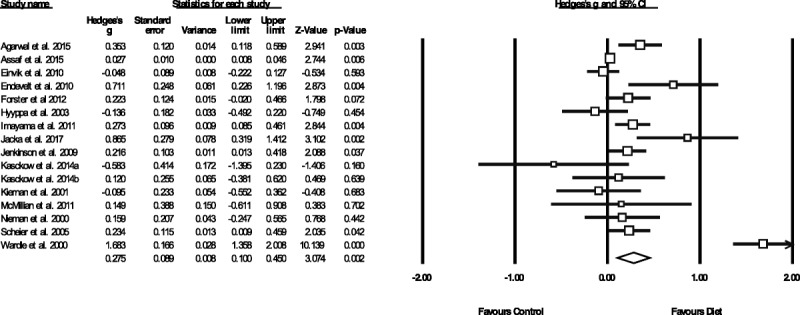
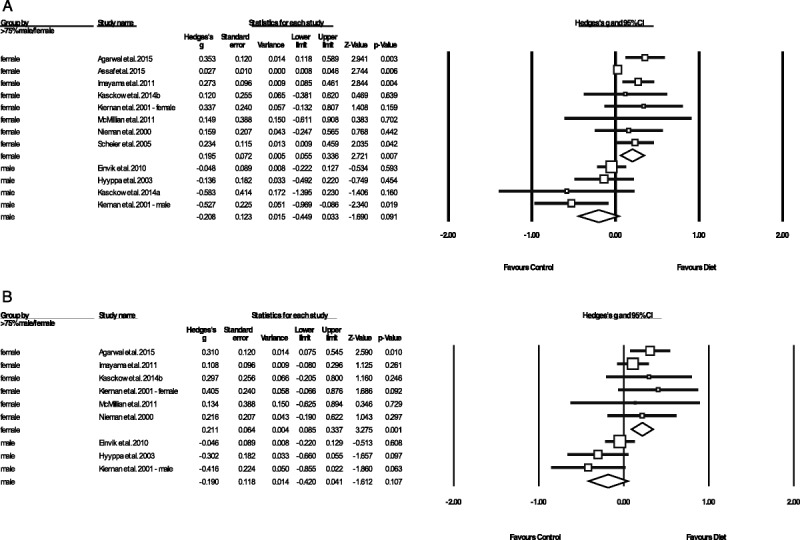
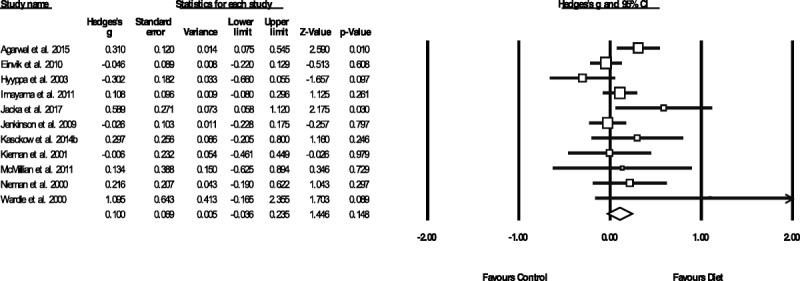
Objective: Poor diet can be detrimental to mental health. However, the overall evidence for the effects of dietary interventions on mood and mental well-being has yet to be assessed. We conducted a systematic review and meta-analysis examining effects of dietary interventions on symptoms of depression and anxiety. Methods: Major electronic databases were searched through March 2018 for all randomized controlled trials of dietary interventions reporting changes in symptoms of depression and/or anxiety in clinical and nonclinical populations. Random-effects meta-analyses were conducted to determine effect sizes (Hedges' g with 95% confidence intervals [CI]) for dietary interventions compared with control conditions. Potential sources of heterogeneity were explored using subgroups and meta-regression analyses. Results: Sixteen eligible randomized controlled trials (published in English) with outcome data for 45,826 participants were included; the majority of which examined samples with nonclinical depression ( n = 15 studies). Nonetheless, dietary interventions significantly reduced depressive symptoms ( g = 0.275, 95% CI = 0.10 to 0.45, p = .002). Similar effects were observed among high-quality trials ( g = 0.321, 95% CI = 0.12 to 0.53, p = .002) and when compared with both inactive ( g = 0.308, 95% CI = 0.02 to 0.60, p = .038) and active controls ( g = 0.174, 95% CI = 0.01 to 0.34, p = .035). No effect of dietary interventions was observed for anxiety ( k = 11, n = 2270, g = 0.100, 95% CI = −0.04 to 0.24, p = .148). Studies with female samples observed significantly greater benefits from dietary interventions, for symptoms of both depression and anxiety. Conclusions: Dietary interventions hold promise as a novel intervention for reducing symptoms of depression across the population. Future research is required to determine the specific components of dietary interventions that improve mental health, explore underlying mechanisms, and establish effective schemes for delivering these interventions in clinical and public health settings. Registration: PROSPERO Online Protocol: CRD42018091256.
Overview
The claims and statistics of this paper haven’t been checked yet.
Free: it reads the open-access text and checks the first 5 claims that cite a source we can check. Create a free account to check every claim.
Integrity signals
Registry
Cites
Statistics
Figures
Verification
Claims the paper makes
The claims and statistics of this paper haven’t been checked yet.
Free: it reads the open-access text and checks the first 5 claims that cite a source we can check. Create a free account to check every claim.
Claims other papers make about this one
Each is checked against this paper’s own text: does it say what the citing paper says it does?
The cited source says what the claim attributes to it.
In the citing paper
“while emerging trial data show that improving dietary habits can improve depressive symptoms (301).”
From Diet and the Microbiota–Gut–Brain Axis: Sowing the Seeds of Good Mental Health (2021) · cites this paper as [301]
In the citing paper
“Probiotics can increase microbiota diversity and therefore maximize the production of neuroactive compounds derived from fiber fermentation, such as short-chain fatty acids (SCFA), e.g., butyrate and acetate, therefore allowing the established dietary patterns to exert significant beneficial effect on brain function [11,75], as has been shown in previous interventional research [76].”
From Psychobiotic effects on anxiety are modulated by lifestyle behaviors: a randomized placebo-controlled trial on healthy adults (2023) · cites this paper as [76]
In the citing paper
“However, a recent meta-analysis of RCTs concluded that no effect of dietary interventions is observed for anxiety [162].”
From Separating the Signal from the Noise: How Psychiatric Diagnoses Can Help Discern Food Addiction from Dietary Restraint (2020) · cites this paper as [162]
Self-check
Percentages, sums and reported differences re-computed from the paper’s own numbers.
The self-check needs the paper’s full text.
Citations
Cites
Preferred Reporting Items for Systematic Reviews and Meta-Analyses: the PRISMA statement
Moher, D., Liberati, A., Tetzlaff, J., Altman, D. G., & for the PRISMA Group (2009) · BMJ · doi:10.1136/bmj.b2535 · Cited by 83,823
Preferred Reporting Items for Systematic Reviews and Meta-Analyses: The PRISMA Statement
Moher, D., Liberati, A., Tetzlaff, J., Altman, D. G., & The PRISMA Group (2009) · PLoS Medicine · doi:10.1371/journal.pmed.1000097 · Cited by 64,042
The CES-D Scale: A Self-Report Depression Scale for Research in the General Population
Radloff, L. S. (1977) · Applied Psychological Measurement · doi:10.1177/014662167700100306 · Cited by 53,267
The Hospital Anxiety and Depression Scale
Zigmond, A. S., & Snaith, R. P. (1983) · Acta Psychiatrica Scandinavica · doi:10.1111/j.1600-0447.1983.tb09716.x · Cited by 47,139
(1992) · PubMed · Cited by 33,716
Hamilton, M. (1960) · Journal of Neurology, Neurosurgery & Psychiatry · doi:10.1136/jnnp.23.1.56 · Cited by 32,817
A new depression scale designed to be sensitive to change
Montgomery, S. A., & Åsberg, M. (1979) · British Journal of Psychiatry · doi:10.1192/bjp.134.4.382 · Cited by 13,962
Overweight, Obesity, and Depression: A Systematic Review and Meta-analysis of Longitudinal Studies
Luppino, F. S., de Wit, L. M., Bouvy, P. F., Stijnen, T., Cuijpers, P., Penninx, B. W. J. H., & Zitman, F. G. (2010) · Archives of General Psychiatry · doi:10.1001/archgenpsychiatry.2010.2 · Cited by 4,322
Adipocytokines: mediators linking adipose tissue, inflammation and immunity
Tilg, H., & Moschen, A. R. (2006) · Nature Reviews Immunology · doi:10.1038/nri1937 · Cited by 3,188
The global prevalence of common mental disorders: a systematic review and meta-analysis 1980–2013
Steel, Z., Marnane, C., Iranpour, C., Chey, T., Jackson, J. W., Patel, V., & Silove, D. (2014) · International Journal of Epidemiology · doi:10.1093/ije/dyu038 · Cited by 2,846
Research works printed but not linked: 4
- Borenstein M Hedges L Higgins J Rothstein H Comprehensive Meta-Analysis Version 2. Englewood, NJ: Biostat; 2005: 104.
- Beck AT Steer RA Brown GK Beck Depression Inventory-II. San Antonio 1996; 78: 490– 8.
- Sheikh JI Yesavage JA Geriatric Depression Scale (GDS): recent evidence and development of a shorter version. J Aging Mental Health 1986; 5: 165– 73.
- Derogatis LR Spencer P Brief symptom inventory: BSI. Upper Saddle River, NJ: Pearson; 1993.
Cited by
Items 301–400 of 619
Staff-perceived barriers to nutrition intervention in substance use disorder treatment
Wiss, D. A., Russell, L., & Prelip, M. L. (2020) · Public Health Nutrition · doi:10.1017/s1368980020003882 · Cited by 8
“A recent systematic review and meta-analysis has shown that dietary improvement can reduce depressive symptoms, likely modulated by gastrointestinal microbiota(43).”
BackgroundTobaruela-Resola, A. L., Riezu‐Boj, J. I., Milagro, F. I., Mogna-Peláez, P., Herrero, J. I., Elorz, M., Benito, A., Tur, J. A., Martínez, J. A., Abete, I., et al. (2024) · Nutrients · doi:10.3390/nu16111547 · Cited by 8
“Several studies showed a reduction in depressive symptoms after following a balanced dietary intervention [63], sustained physical activity, and adherence to the MedDiet [64].”
BackgroundNutrition and Mental Health: Advances in Nutritional Cognitive Neuroscience
Wu, J., & Barbey, A. K. (2026) · Annual Review of Food Science and Technology · doi:10.1146/annurev-food-052824-043906 · Cited by 7
Perinatal dietary patterns and symptomatic depression: A prospective cohort study
Chan, L., Wang, H., Wahlqvist, M. L., Liu, C., Liu, J., & Lee, M.-S. (2023) · Maternal and Child Nutrition · doi:10.1111/mcn.13561 · Cited by 6
“Diet interventions can also reduce symptoms of depression and anxiety (Firth et al., 2019).”
BackgroundMoinul, D., Hao, C., Dimitropoulos, G., & Taylor, V. H. (2024) · The Canadian Journal of Psychiatry · doi:10.1177/07067437241234954 · Cited by 7
“10,11 Given the growing focus on the GBA, an ascertainment of the current level of knowledge around these therapies, and the way in which they are perceived by those with mental illness is important.”
BackgroundMyrissa, K., Court, C., & Kelaiditi, E. (2024) · Nutrition Bulletin · doi:10.1111/nbu.12694 · Cited by 8
Indirect Interventions: Lifestyle Options to Treat Mental Disorders
Kazdin, A. E. (2025) · Healthcare · doi:10.3390/healthcare13050505 · Cited by 6
“Many controlled trials have shown the impact of diverse healthful diets as well as multicomponent supplements on reduction in depression [57–59].”
Gacek, M. K., Wójtowicz, A., & Kędzior, J. (2025) · European Journal of Investigation in Health Psychology and Education · doi:10.3390/ejihpe15060097 · Cited by 8
“…of nutrition and diet quality for mental health (Aucoin et al., 2021; Borges-Vieira & Cardoso, 2023; Chen et al., 2023; Ekinci & Sanlier, 2023; Firth et al., 2019; Gł ˛abska et al., 2020; Ramón-Arbués et al., 2019; Tang & Lee, 2024; Wang et al., 2023; Yun et al., 2021; Zieli´nska et al.,…”
de Miguel, A., Esteban, J. Á. A., & Semper, J. V. O. (2025) · Nutrients · doi:10.3390/nu17142318 · Cited by 6
Sasaki, H., Masutomi, H., Yamauchi, Y., Ishihara, K., & Fukuda, S. (2025) · Frontiers in Microbiology · doi:10.3389/fmicb.2025.1607918 · Cited by 6
Lycett, K., Wijayawickrama, D. J., Liu, M., Grobler, A. C., Burgner, D. P., Baur, L. A., Liu, R., Lange, K., Wake, M. A., & Kerr, J. A. (2021) · British Journal Of Nutrition · doi:10.1017/s0007114521001616 · Cited by 8
“However, given that randomised controlled trials show that reducing inflammatory diets can reduce mental illness, such as depression(2), we have assumed directionality from diet to mental well-being and used the best possible causal modelling approaches to assess this.”
BackgroundMethodResultInfluentialDunn, S. B., Orchard, T., Andridge, R., Rymut, S. M., Slesnick, N., & Hatsu, I. E. (2023) · British Journal Of Nutrition · doi:10.1017/s000711452300212x · Cited by 7
“Current evidence continues to emphasise the importance of a healthy diet and nutrition in preventing metal health conditions and/or ameliorating the effects of these conditions (64 – 67) .”
Banariu, G. M., Tica, I., Rus, M., Stanca, I., Onuc, S., Neagoe, G., & Tica, V. (2021) · Acta Endocrinologica (Bucharest) · doi:10.4183/aeb.2021.486 · Cited by 6
The clustering of lifestyle behaviors in U.S. college students: a network approach
Anderson, A. R., & Ostermiller, L. (2023) · Journal of American College Health · doi:10.1080/07448481.2023.2283740 · Cited by 7
Yu, Y. H., Ma, Q., Hollenbach, S. J., Zhu, Y., & Groth, S. W. (2022) · Obesity Surgery · doi:10.1007/s11695-022-06283-7 · Cited by 9
“, essential amino acids, polyunsaturated fatty acids, vitamins, and minerals) intensify, while supplements alleviate the severity of depressive symptoms [11, 12].”
BackgroundEvidence review: The primary prevention of mental health conditions
VicHealth (2020) · doi:10.37309/2020.po906 · Cited by 13
A clinician and service user's perspective on managing ms: pleasure, purpose, practice
Hunter, R. (2020) · Frontiers in Psychology · doi:10.3389/fpsyg.2020.00709 · Cited by 5
“These findings are in keeping with meta-analyses on health behaviors which have emphasized the central role of diet (Firth et al., 2019) and physical activity (Chekroud et al.”
ResultExploration of dietary interventions to treat mitochondrial fatty acid disorders in a mouse model
Autio, K. J., Koivisto, H., Schmitz, W., Puronurmi, A., Tanila, H., & Kastaniotis, A. J. (2024) · The Journal of Nutritional Biochemistry · doi:10.1016/j.jnutbio.2024.109692 · Cited by 6
McGuinness, A. J., O’Hely, M., Stupart, D. A., Watters, D. A., Dawson, S. L., Hair, C., Berk, M., Mohebbi, M., Loughman, A., Guest, G. D., et al. (2024) · Microorganisms · doi:10.3390/microorganisms12101960 · Cited by 5
“This finding is somewhat concordant with studies of other microbiome-modulating interventions that report improvements in depressive symptoms, including probiotics [9], faecal microbiota transplant [49,50], and diet [6,8].”
BackgroundResultSelf-citationSukhbaatar, S., Sun, S., Scarpaci, M. M., Neves, V. V., Sheridan, M. A., & Loucks, E. B. (2026) · Health Psychology · doi:10.1037/hea0001568 · Cited by 5
Jonsson, K. R., Taylor-Robinson, D. C., Straatmann, V. S., Melis, G., & Adjei, N. K. (2023) · Frontiers in Public Health · doi:10.3389/fpubh.2022.1064677 · Cited by 7
Soltani, S., Sangsefidi, Z. S., Asoudeh, F., Torabynasab, K., Zeraattalab-Motlagh, S., Hejazi, M., Sikaroudi, M. K., Meshkini, F., Razmpoosh, E., & Abdollahi, S. (2024) · Nutrition Reviews · doi:10.1093/nutrit/nuae069 · Cited by 6
Physical Activity and Dietary Interventions for Mental Health in Ageing and Longevity
Lakhman, S. S., Murzello, A., & Gueits, P. G. (2024) · Healthy ageing and longevity · doi:10.1007/978-3-031-68513-2_5 · Cited by 5
Koshimoto, S., 久保木奈々絵, 郡司千尋, Fujiwara, M., Hayashi, H. D., Moriya, H., Oyake, Y., Murata, I., Takeuchi, T., Matsushima, E., et al. (2023) · International Journal of Social Psychiatry · doi:10.1177/00207640231174366 · Cited by 5
“Dietary interventions are promising as novel interventions for reducing depression symptoms (Firth et al., 2019).”
BackgroundThe Bahraini food based dietary guidelines: a holistic perspective to health and wellbeing
Naja, F., Khaleel, S., Alhajeri, M., Ajlan, B. Y., Abulfateh, N. M., Alawadhi, A. G., Bowah, M. H. J., & Al‐Jawaldeh, A. (2023) · Frontiers in Public Health · doi:10.3389/fpubh.2023.1182075 · Cited by 6
la Cruz-Góngora, V. V. D., Manrique-Espinoza, B. S., Salinas‐Rodríguez, A., Martínez‐Tapia, B., Flores, M., & Shamah‐Levy, T. (2024) · Archives of Medical Research · doi:10.1016/j.arcmed.2024.103044 · Cited by 6
Zhang, R., Shi, P., Chou, Y., Liu, W., & Zhang, C. (2024) · Psychogeriatrics · doi:10.1111/psyg.13182 · Cited by 5
“41,42 Gut microbiota dysbiosis has also been implicated, with emerging research demonstrating the involvement of the microbiome in modulating stress response, immune function, neurotransmission, and neurogenesis.”
Buczkowska, M., & Iob, E. (2024) · Translational Psychiatry · doi:10.1038/s41398-024-03089-2 · Cited by 6
“For example, a meta-analysis of randomised clinical trials found that dietary interventions are potentially contributing to reduction of symptoms of depression across the population [5].”
MethodDiet and Depression During Peri- and Post-Menopause: A Scoping Review
Bodnaruc, A. M., Duquet, M., Prud’homme, D., & Giroux, I. (2025) · Nutrients · doi:10.3390/nu17172846 · Cited by 5
“…with mounting evidence associating high-quality diets, such as the Mediterranean diet and anti-inflammatory diets, with a reduced depression risk [29–33], and low-quality diets, characterized by high intakes of refined sugars and ultra-processed foods, with an increased depression risk [34–37].”
Psychiatric morbidities of female obesity before and after dieting: an Egyptian sample
Shalaby, A. S., Sadik, S. A.-M., & Mahmoud, D. A. M. (2020) · Middle East Current Psychiatry · doi:10.1186/s43045-020-00068-3 · Cited by 5
“On the other hand, dietary interventions for weight loss had a significant impact on reducing the magnitude of obesity, depression, and anxiety symptoms [43] because of their antiinflammatory, neuroprotective, and prebiotic properties [44, 45].”
BackgroundWiss, D. A., Javanbakht, M., Li, M. J., Prelip, M. L., Bolan, R., SHOPTAW, S. J., & Gorbach, P. M. (2021) · Public Health Nutrition · doi:10.1017/s1368980021002494 · Cited by 5
Dietary intake of persons with depressive and psychotic disorders in Singapore
Lee, Y. Y., Lau, J. H., Seet, V. A. L., Whitton, C., Asharani, P. V., Devi, F., Wang, P., Roystonn, K., Cetty, L., Teh, W. L., et al. (2021) · Annals of the Academy of Medicine Singapore · doi:10.47102/annals-acadmedsg.2020585 · Cited by 7
Chapman, J., Malacova, E., Patterson, S., Reavley, N. J., Wyder, M., Brown, W. J., Hielscher, E., Childs, S., & Scott, J. G. (2021) · Australasian Psychiatry · doi:10.1177/10398562211025040 · Cited by 5
Qiao, J., Han, A., Qu, Y., & Zhang, L. (2025) · Frontiers in Nutrition · doi:10.3389/fnut.2025.1681491 · Cited by 4
Manidis, A., Ayala-Aldana, N., Bernardo-Castro, S., Pinar-Martí, A., Galkina, P. А., Fernández‐Barrés, S., Ramírez-Carrasco, P., Lamuela-Raventós, R. M., Papandreou, C., & Júlvez, J. (2026) · BMC Medicine · doi:10.1186/s12916-026-04658-6 · Cited by 6
“This aligns with meta-analytic evidence indicating that females may be more responsive to dietary interventions for depression and anxiety [76], potentially due to distinct hormonal sensitivities.”
Nutraceutical Potential of Fermented Foods: A Perspective on Health and Wellness
Shahni, K., Haobam, B., Singh, O. I., Devi, K. S., Devi, S. T., Sharma, N., & Singh, K. B. (2026) · Fermentation · doi:10.3390/fermentation12050211 · Cited by 5
The risk of incident depression when assessed with the Lifestyle and Well-Being Index
Pano, O., Sayón-Orea, C., Hershey, M. S., Víctor de la, O., Fernandez-Lazaro, C. I., Bes‐Rastrollo, M., Martin-Moreno, J. M., Sánchez‐Villegas, A., & Martínez, J. A. (2023) · Public Health · doi:10.1016/j.puhe.2023.05.002 · Cited by 4
The impact of carbohydrate quality on gut health: Insights from the NHANES
Hu, L., Huang, X., Liu, S., Fang, L., Zhang, J., & Tang, X. (2025) · PLoS ONE · doi:10.1371/journal.pone.0315795 · Cited by 4
“Side effects of certain antidepressants such as sertraline and citalopram include constipation [48,49].”
Abukmail, E., Pradeep, N. K., Ahmed, S., & Albarqouni, L. (2025) · Annals of Internal Medicine · doi:10.7326/annals-24-03016 · Cited by 4
Coxon, C., Rufeger, M., Hollamby, G., Ashtree, D. N., Orr, R., Lane, M. M., & Hepsomali, P. (2025) · Health Science Reports · doi:10.1002/hsr2.71666 · Cited by 4
“Diet is a leading risk factor for non ‐ communicable diseases, as acknowledged by the Global Burden of Diseases, Injuries, and Risk Factors Study (GBD) [5], and may be protective against depression and anxiety outcomes [6, 7].”
Neuroprotection induced by ascorbic acid
Onaolapo, A. Y., & Onaolapo, O. J. (2024) · Elsevier eBooks · doi:10.1016/b978-0-443-23763-8.00026-9 · Cited by 5
Targeting maternal gut microbiome to improve mental health outcomes—a pilot feasibility trial
Gallant, F., Cooley, K., Grigoriadis, S., & Ebrahimi, N. (2024) · Frontiers in Psychiatry · doi:10.3389/fpsyt.2024.1414291 · Cited by 4
Wu, S., Yacub, Z., & Shasha, D. E. (2024) · Applied Sciences · doi:10.3390/app14199021 · Cited by 4
Wang, Q., Ou, Z., Chen, J., Li, L., Chen, Y., & Ye, D. (2024) · Public Health Nutrition · doi:10.1017/s1368980024001691 · Cited by 5
“depressive symptoms (9) .”
Luhaste, V., Travis, F. T., Gorini, C. A., Marković, G., & Schneider, R. H. (2025) · Journal of Integrative and Complementary Medicine · doi:10.1089/jicm.2024.0489 · Cited by 5
“12 16 – 20 However, most CAM trials have focused on single-treatment methods.”
Nutritional Regulation of Aging and Longevity
Moskalev, A. (2021) · Healthy ageing and longevity · doi:10.1007/978-3-030-83017-5_21 · Cited by 5
Sterrett, J. D., Andersen, N. D., & Lowry, C. A. (2022) · Progress in inflammation research · doi:10.1007/978-3-030-91051-8_10 · Cited by 4
Asbjornsdottir, B., Lauth, B., Fasano, A., Þórsdóttir, I., Karlsdottir, I., Gudmundsson, L. S., Gottfreðsson, M., Smárason, O., SIGURDARDOTTIR, S. T., Halldorsson, T. I., et al. (2022) · PLoS ONE · doi:10.1371/journal.pone.0273855 · Cited by 4
The A, B, C, D’s of dietary trials
Staudacher, H. M., Rocks, T., & Jacka, F. N. (2022) · American Journal of Clinical Nutrition · doi:10.1093/ajcn/nqac274 · Cited by 4
“Involvement of a trained, accredited dietitian or nutritionist in diet delivery is key to efficacy for improving mental health in individuals with mental illness (10).”
BackgroundSelf-citationElsner, F., Matthiessen, L. E., Średnicka-Tober, D., Marx, W., O'Neil, A. E., Welch, A. A., Hayhoe, R. P. G., Higgs, S., van Vliet, M., Morphew-Lu, E., et al. (2022) · International Journal of Environmental Research and Public Health · doi:10.3390/ijerph20010669 · Cited by 5
Self-citationAdherence to the Mediterranean Diet and Depression: A Systematic Review of Recent Studies
Liu, L. (2023) · SHS Web of Conferences · doi:10.1051/shsconf/202315704003 · Cited by 5
Fijałkowska, A., Rychlik, M., Krakowska, A., & Muszyńska, B. (2023) · International journal of medicinal mushrooms · doi:10.1615/intjmedmushrooms.2023047830 · Cited by 5
Gerber, M., Jakowski, S., Kellmann, M., Cody, R., Gygax, B., Ludyga, S., Müller, C., Ramseyer, S., & Beckmann, J. (2023) · Psychology of sport and exercise · doi:10.1016/j.psychsport.2023.102442 · Cited by 4
Majumdar, P., Adán, A., & Sahu, S. (2023) · Sleep and Vigilance · doi:10.1007/s41782-023-00246-3 · Cited by 4
“This might be since meal timings and in turn, nutritional input may impair mental health [48].”
Fletcher, B. D., Haszard, J. J., Vissers, M. C. M., & Conner, T. S. (2023) · British Journal Of Nutrition · doi:10.1017/s0007114523002787 · Cited by 5
Kingsley, K., Mulder, A., Camacho, D., & Arango‐Lasprilla, J. C. (2024) · Medical Research Archives · doi:10.18103/mra.v12i4.5289 · Cited by 4
(2020) · Psychosomatic Medicine · doi:10.1097/psy.0000000000000807 · Cited by 4
Editorial: Exercise and diet: strategies and prescriptions to improve mental and cognitive health
Sun, S., Armada-da-Silva, P. A. S., & Shao, Y. (2024) · Frontiers in Psychiatry · doi:10.3389/fpsyt.2023.1347233 · Cited by 5
Lee, S., Park, H., Kim, C. H., & Park, B. (2025) · SSM - Population Health · doi:10.1016/j.ssmph.2025.101856 · Cited by 3
“…Lee & Shin, 2021; Lidfeldt et al., 2005), which can harm physical and mental health (Adan et al., 2019; Du et al., 2024; Ekinci & Sanlier, 2023; Firth et al., 2019; Gibson-Smith et al., 2020; Kim et al., 2023; Lai et al., 2014; Lim & Lee, 2019; Opie et al., 2015; Pano et al., 2021; Zhang et…”
Jafari, A., Momenan, M., Tehrani, A. N., Behrouz, V., & Yari, Z. (2026) · BMC Public Health · doi:10.1186/s12889-025-26167-6 · Cited by 4
Role of Gut Microbiota in Psychiatric Disorders: From Mechanistic Insights to Therapeutic Strategies
Kim, Y. S., Woo, S., Ha, E., Ahn, S., Kim, E., Kim, S. I., Lim, W., & Kim, S. (2026) · Journal of Korean Medical Science · doi:10.3346/jkms.2026.41.e78 · Cited by 3
“112,175,176 Future studies may benefit from adopting a personalized medicine framework grounded in individual gut microbiota profiling.”
Almaghrabi, M. A., Bawajeeh, A. O., Shatwan, I. M., Malibary, M., Alzhrani, S., Alamoudi, N., Almadani, J., & Albar, S. A. (2026) · Nutrients · doi:10.3390/nu18040631 · Cited by 3
Sindiani, M., & Korman, M. (2026) · Scientific Reports · doi:10.1038/s41598-026-39211-1 · Cited by 3
Lee, J., Hsu, Y.-Y., Geng, J., Lo, Y., Chen, S., & Chen, C. (2026) · Nutrients · doi:10.3390/nu18050819 · Cited by 3
“Dietary patterns high in ultra-processed foods and added sugars are associated with cardiometabolic risk, and emerging evidence links healthier dietary patterns (e.g., higher intake of fiber, fruits/vegetables, and unsaturated fats) with a lower depressive symptom burden [38–41].”
Inflammatory potential of diet in mental disorders and psychosocial stress
Davis, J. A., Aslam, H., Jacka, F. N., & Marx, W. (2022) · Elsevier eBooks · doi:10.1016/b978-0-12-822130-3.00010-7 · Cited by 3
Self-citationKemp, T., Lopez, N. V., Ward, S., Sherzai, D., Sherzai, A. Z., & Sutliffe, J. T. (2022) · American Journal of Lifestyle Medicine · doi:10.1177/15598276221120227 · Cited by 4
“16,32 For instance, those in the intervention group consumed more fi ber, less saturated fat, less sodium, less added sugar, and more whole grains — all of which are dietary components associated with a reduction in depressive symptoms, and some of which have been associated with a reduction in…”
Stress and Disordered Eating Patterns
Tsofliou, F., Casey, C., & Hughes, C. (2022) · Springer eBooks · doi:10.1007/978-3-030-67929-3_3-1 · Cited by 3
Stress and Disordered Eating Patterns
Tsofliou, F., Casey, C., & Hughes, C. (2023) · Springer eBooks · doi:10.1007/978-3-031-16691-4_3 · Cited by 3
The role of olive oil and its constituents in mental health: a scoping review
Eedy, V., & Aucoin, M. (2024) · British Journal Of Nutrition · doi:10.1017/s000711452400299x · Cited by 3
Çiftçi, S., Yalçın, T., & Öztürk, E. E. (2025) · BMC Psychology · doi:10.1186/s40359-025-02663-7 · Cited by 4
“This supports the notion that better DQ can enhance mental outcomes, as reflected in higher MCS [45].”
Salamanca-Sanabria, A., Chooi, Y. C., Loo, E. X. L., Lai, X., Volchanskaya, V. S. B., Chong, Y. S., & Eriksson, J. G. (2025) · Frontiers in Nutrition · doi:10.3389/fnut.2025.1589412 · Cited by 4
Neurosteroids, Microbiota, and Neuroinflammation: Mechanistic Insights and Therapeutic Perspectives
Tahri, A., Niccolai, E., & Amedei, A. (2025) · International Journal of Molecular Sciences · doi:10.3390/ijms26147023 · Cited by 3
Girchenko, P. V., Lahti‐Pulkkinen, M., & Räikkönen, K. (2021) · Biological Psychiatry · doi:10.1016/j.biopsych.2020.12.005 · Cited by 3
Mitochondrial dysfunction and affective disorders: Focus on diet, exercise, and aging
Allen, J., Kalynchuk, L. E., & Caruncho, H. J. (2021) · Elsevier eBooks · doi:10.1016/b978-0-323-85666-9.00017-6 · Cited by 3
Supporting Maternal and Child Mental Health Through Dietary Changes Focused on the Gut Microbiota
Dawson, S. L., Finlay‐jones, A. L., Ball, L., Rocks, T., & Jacka, F. N. (2022) · Psychiatric Annals · doi:10.3928/00485713-20220126-01 · Cited by 3
Self-citationPsychobiotics: Biotherapeutics for Positive Mental Health
Mörkl, S., Butler, M., Cichini, F., Cryan, J. F., & Dinan, T. G. (2020) · Oxford University Press eBooks · doi:10.1093/oxfordhb/9780190931544.013.7 · Cited by 3
Ekeanyanwu, R. C., Chikezie, P. C., & Chile-Agada, A. B. (2022) · Scientific African · doi:10.1016/j.sciaf.2022.e01397 · Cited by 4
Effect of Diet on Depression: A Review of Nutritional Solutions
Ahmadnia, H., Bahrami, H., & Mohamadzadeh, S. (2023) · World Nutrition · doi:10.26596/wn.202314128-57 · Cited by 4
de Camargo, É. M., López‐Gil, J. F., Piola, T. S., dos Santos, L. P., de Borba, E. F., de Campos, W., & da Silva, S. G. (2023) · Nutrients · doi:10.3390/nu15081926 · Cited by 3
“According to researchers, social distancing can trigger sleeping problems, further increasing eating patterns [19,20,31,34].”
BackgroundInfluentialImpact of obesity on immune function and depressive disorder: integrative review
Bezerra, T. P. T., dos Santos, R. M., Minervino, A. J., & Dejani, N. N. (2023) · Debates em Psiquiatria · doi:10.25118/2763-9037.2023.v13.631 · Cited by 3
Adolescent nonpharmacological interventions for early-life stress and their mechanisms
Li, Y., Shi, D., & Wang, Z. (2023) · Behavioural Brain Research · doi:10.1016/j.bbr.2023.114580 · Cited by 5
Okada, M., Pehlivan, M. J., Miskovic-Wheatley, J., Barakat, S., Griffiths, K., Touyz, S., Simpson, S. J., Maguire, S., & Holmes, A. (2023) · Frontiers in Public Health · doi:10.3389/fpubh.2023.1281855 · Cited by 2
Probiotics and Fecal Microbiota Transplantation in Major Depression: Doxa or Episteme?
Evrensel, A. (2024) · Advances in experimental medicine and biology · doi:10.1007/978-981-97-4402-2_4 · Cited by 3
Forlico, S., Baillie, A., Keys, K., Woollett, P., Frydman, G., & Simpson, A. (2024) · Discover Mental Health · doi:10.1007/s44192-024-00110-4 · Cited by 3
Dragomanova, S., Tancheva, L. P., Abarova, S., Grigorova, V., Gavazova, V., Stanciu, D., Tsonev, S., Prandjev, V., & Kalfin, R. E. (2025) · Current Issues in Molecular Biology · doi:10.3390/cimb47070556 · Cited by 3
“Evidence suggests that following a nutritious diet, characterized by a high consumption of spices, vegetables, fruits, fish, nuts, and whole grains—similar to the Mediterranean diet—can have positive effects, protect mental health, and reduce the risk of depression [50–53].”
InfluentialFreitas, F. D. F., Santos, J. C. C., de Medeiros, A. C. Q., & Lopes, F. D. A. (2021) · Revista Brasileira de Extensão Universitária · doi:10.36661/2358-0399.2021v12i2.12306 · Cited by 7
“Existem algumas evidências científicas apoiando que os efeitos de um padrão alimentar saudável vão além dos benefícios físicos, pois causam também um impacto positivo na saúde mental, como a redução de sintomas ansiosos, por exemplo (Firth et al. 2019; Kris-Etherton et al., 2021).”
BackgroundInfluentialGłąbska, D., Kołota, A., Lachowicz, K., Skolmowska, D., Stachoń, M., & Guzek, D. (2023) · Nutrients · doi:10.3390/nu15040971 · Cited by 4
“Except for the other methods of psychological treatment and drugs, which must be applied if needed [9], recent studies indicate that for mental health problems, dietary interventions may be also applied as supportive therapies which allow the reduction of mental health symptoms [10].”
MethodBerk, M., Agustini, B., Forbes, M., Jacka, F. N., Narayanaswamy, J. C., & Penninx, B. W. J. H. (2024) · The Canadian Journal of Psychiatry · doi:10.1177/07067437241248087 · Cited by 3
Self-citationBehavior Modification after a Heart Attack: Insights from Patients and Healthcare Professionals
Yaqoob, A., Barolia, R., Ladak, L., & Khan, A. (2024) · doi:10.48047/hom.10.2.2024.1724-1743 · Cited by 3
Qiu, D., Song, R., Cao, X., Tian, Y., Cheng, X., Sun, D., Cai, S., Wang, Z., & Zhang, W. (2024) · Scientific Reports · doi:10.1038/s41598-024-80330-4 · Cited by 2
Rethorst, C. D., Demment, M. M., Ha, S., Folta, S. C., Graham, M. L., Eldridge, G. D., & Seguin‐Fowler, R. A. (2024) · Nutrients · doi:10.3390/nu16244353 · Cited by 2
“0 intervention may have positive health impacts beyond those evaluated in the current analysis (i.e., mental health improvements) that can be evaluated in future studies.”
Carnevalli, S. V. B., Cláudino, R., de Almeida, L. S. N., Sarmento, T., Gaia, J. W. P., & Matias, T. S. (2025) · Mental health and physical activity · doi:10.1016/j.mhpa.2025.100672 · Cited by 2
Kipfer, A., Kahala, M., Kyhä, H., Nurmi, K., Puustinen, J., Korkeila, J. A., Ruusunen, A. A., & Kunvik, S. (2025) · Nutrition and Health · doi:10.1177/02601060251332358 · Cited by 2
“Other intervention studies are predominantly based on secondary analyses and are heterogeneous regarding depression de fi nition and methods (Firth et al., 2019; O ’ Neill et al., 2022).”
Li, Y., Yuan, Z., & Pan, Q. (2025) · BMC Public Health · doi:10.1186/s12889-025-23511-8 · Cited by 2
“Clinical trials have shown that dietary and exercise interventions could mitigate depressive symptoms in the general population [24–26].”
Liu, Z., Shi, S., Zhang, X., Wu, C., Yang, Q. Z., Ren, S., Shan, Y., & Na, G. (2025) · Food Science & Nutrition · doi:10.1002/fsn3.70628 · Cited by 2
Mozaffarian, D. (2025) · JAMA · doi:10.1001/jama.2025.20943 · Cited by 2
Pedroso, I., Saravanan, S. K., Kumbhare, S. V., Sharma, G., Almonacid, D. E., & Sinha, R. (2025) · Healthcare · doi:10.3390/healthcare13233147 · Cited by 2
“This heterogeneity mirrors prior evidence that dietary interventions may have stronger effects on anxiety-predominant conditions or subclinical mental distress [66].”
Sex differences in nutritional psychiatry: Are omega-3 fatty acids more effective in women with MDD?
Smolensky, I. V., Inta, D., Su, K. P., & Marx, W. (2025) · Nutritional Psychiatry · doi:10.1016/j.nupsyc.2025.100003 · Cited by 2
Self-citationDietary flavonoid intake and psychological well-being – A bidirectional relationship
Thompson, A. S., Bondonno, N. P., Liu, Y. L., Qureshi, F., Kubzansky, L. D., Trudel‐Fitzgerald, C., Boehm, J. K., Rimm, E. B., & Cassidy, A. (2026) · Clinical Nutrition · doi:10.1016/j.clnu.2026.106579 · Cited by 2
“However, both observational and interventional studies have examined the broader impact of diet on mental health outcomes [52,53].”
Winsper, C., Tuomainen, H., Jilka, S., Goutham, S., Morroni, D., Akpan, U. U., Giacco, D., Gill, P. S., Iyer, S. N., Lohumi, I., et al. (2026) · Clinical Psychology Review · doi:10.1016/j.cpr.2026.102727 · Cited by 3
Metadata
- Authors
- Firth, J., Marx, W., Dash, S., Carney, R., Teasdale, S. B., Solmi, M., Stubbs, B., Schuch, F. B., Carvalho, A. F., Jacka, F., & Sarris, J.
- Affiliations
- Barwon Health (AU)
- Western Sydney University (AU)
- University of Manchester (GB)
- Corresponding author
- Firth, Joseph
- ORCID
- Venue
- Psychosomatic Medicine
- Published
- 2019-04
- Volume
- 81
- Issue
- 3
- Pages
- 265-280
- ISSN
- 0033-3174 (ISSN-L)
- 1534-7796
- PMC
- PMC6455094
- OpenAlex
- W2932483450
- Semantic Scholar
- c1c88e8751c33ee5bfdbee79057029d2b6266717
- Cited by
- 566
- References
- 59
- Citations by year
- 2026: 73 · 2025: 87 · 2024: 80 · 2023: 82 · 2022: 77 · 2021: 81 · 2020: 61 · 2019: 24
- FWCI
- 9.93
- Type
- journal article
- Language
- en
- Update notices
- correction (2021-02-01)
- Open access
- hybrid
- doi.org
- Licence
- Locations
- Psychosomatic Medicine (publishedVersion, cc-by-nc-nd)
- Europe PMC (PubMed Central) (publishedVersion, cc-by-nc-nd)
- PubMed Central (publishedVersion, cc-by-nc-nd)
- PubMed (publishedVersion)
- Research Explorer (The University of Manchester) (publishedVersion, other-oa)
- Victoria University Research Repository (Victoria University) (submittedVersion, cc-by-nc-nd)
- Minerva Access (University of Melbourne) (submittedVersion, cc-by-nc-nd)
- Deakin Research Online (Deakin University) (submittedVersion)
- Figshare (submittedVersion, cc-by-nc-nd)
- Padua Research Archive (University of Padova) (submittedVersion)
- Funders
- Wilson Foundation
- Eli Lilly and Company
- Pfizer
- Sanofi
- Geelong Region Medical Research Foundation
- David and Elaine Potter Foundation
- South Eastern Sydney Local Health District
- National Institute for Health and Care Research (APP1125000, ICA-CL-2017-03-001, NIHR-INF-0685)
- Department of Health and Social Care
- Australian Rotary Health
- Meat and Livestock Australia
- Deakin University
- University of Melbourne
- Servier
- Fernwood Foundation
- Medical Research Council
- National Health and Medical Research Council (1125000, 1108125)
- Brain and Behaviour Research Institute, University of Wollongong
- Cilag
- Topics
- Health Sciences › Medicine › Public Health, Environmental and Occupational Health › Nutritional Studies and Diet
- Health Sciences › Medicine › Psychiatry and Mental health › Mental Health Treatment and Access
- Health Sciences › Nursing › Nutrition and Dietetics › Nutrition, Health and Food Behavior
- Keywords
- dietary intervention, depression, anxiety, depressive symptoms, mental health, diet and mood, sex differences
- MeSH terms
- Anxiety Disorders, Depressive Disorder, Humans, Randomized Controlled Trials as Topic
About these checks
Registry, retraction, Cites and statistics results are computed, not judged, with one exception: a printed reference that no index lists is read once by a model before it counts as a citation error. Claims are extracted by a model and kept only when their quote appears verbatim in the text; each cited source is then checked, with a model’s help, for whether it says what the claim relies on. Those verdicts can be wrong — read the claim’s quote and the cited source before relying on one.
Statistics and arithmetic are recomputed, not judged.
Confidence bands are shown only for fields calibrated on our annotated test set. None is calibrated yet, so no band is shown.
What counts as a claim ›How we measure confidence ›How we check this ›
Are you an author, or do you see a problem with this page? Request a review
Data sources
Bibliographic data: Semantic Scholar, OpenAlex, Crossref.
Contains information from the Semantic Scholar Academic Graph Datasets, made available under the ODC Attribution License (ODC-BY 1.0).
Semantic Scholar’s data is described in: Kinney, R., et al. (2023). The Semantic Scholar Open Data Platform. arXiv:2301.10140.
