

The Effects of Dietary Improvement on Symptoms of Depression and Anxiety: A Meta-Analysis of Randomized Controlled Trials
Open accessThe DOI matches its Crossref record; 59 of the 59 references it cites were found in a registry or an index.
Abstract
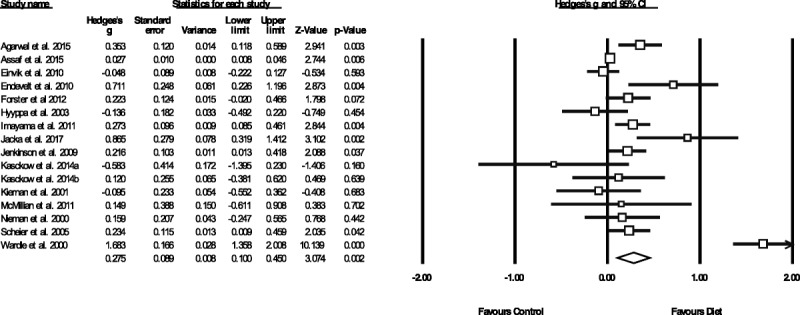
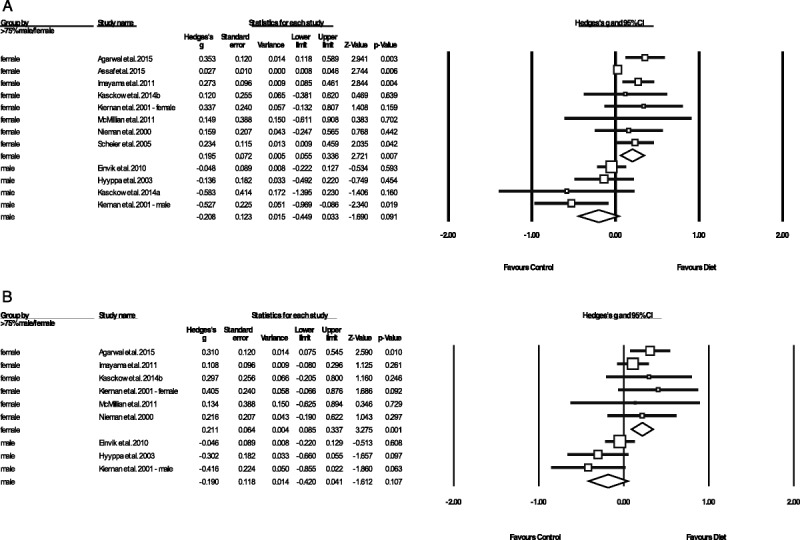
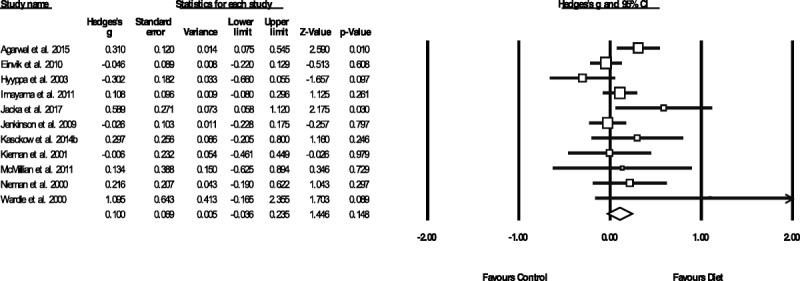
Objective: Poor diet can be detrimental to mental health. However, the overall evidence for the effects of dietary interventions on mood and mental well-being has yet to be assessed. We conducted a systematic review and meta-analysis examining effects of dietary interventions on symptoms of depression and anxiety. Methods: Major electronic databases were searched through March 2018 for all randomized controlled trials of dietary interventions reporting changes in symptoms of depression and/or anxiety in clinical and nonclinical populations. Random-effects meta-analyses were conducted to determine effect sizes (Hedges' g with 95% confidence intervals [CI]) for dietary interventions compared with control conditions. Potential sources of heterogeneity were explored using subgroups and meta-regression analyses. Results: Sixteen eligible randomized controlled trials (published in English) with outcome data for 45,826 participants were included; the majority of which examined samples with nonclinical depression ( n = 15 studies). Nonetheless, dietary interventions significantly reduced depressive symptoms ( g = 0.275, 95% CI = 0.10 to 0.45, p = .002). Similar effects were observed among high-quality trials ( g = 0.321, 95% CI = 0.12 to 0.53, p = .002) and when compared with both inactive ( g = 0.308, 95% CI = 0.02 to 0.60, p = .038) and active controls ( g = 0.174, 95% CI = 0.01 to 0.34, p = .035). No effect of dietary interventions was observed for anxiety ( k = 11, n = 2270, g = 0.100, 95% CI = −0.04 to 0.24, p = .148). Studies with female samples observed significantly greater benefits from dietary interventions, for symptoms of both depression and anxiety. Conclusions: Dietary interventions hold promise as a novel intervention for reducing symptoms of depression across the population. Future research is required to determine the specific components of dietary interventions that improve mental health, explore underlying mechanisms, and establish effective schemes for delivering these interventions in clinical and public health settings. Registration: PROSPERO Online Protocol: CRD42018091256.
Overview
The claims and statistics of this paper haven’t been checked yet.
Free: it reads the open-access text and checks the first 5 claims that cite a source we can check. Create a free account to check every claim.
Integrity signals
Registry
Cites
Statistics
Figures
Verification
Claims the paper makes
The claims and statistics of this paper haven’t been checked yet.
Free: it reads the open-access text and checks the first 5 claims that cite a source we can check. Create a free account to check every claim.
Claims other papers make about this one
Each is checked against this paper’s own text: does it say what the citing paper says it does?
The cited source says what the claim attributes to it.
In the citing paper
“while emerging trial data show that improving dietary habits can improve depressive symptoms (301).”
From Diet and the Microbiota–Gut–Brain Axis: Sowing the Seeds of Good Mental Health (2021) · cites this paper as [301]
In the citing paper
“Probiotics can increase microbiota diversity and therefore maximize the production of neuroactive compounds derived from fiber fermentation, such as short-chain fatty acids (SCFA), e.g., butyrate and acetate, therefore allowing the established dietary patterns to exert significant beneficial effect on brain function [11,75], as has been shown in previous interventional research [76].”
From Psychobiotic effects on anxiety are modulated by lifestyle behaviors: a randomized placebo-controlled trial on healthy adults (2023) · cites this paper as [76]
In the citing paper
“However, a recent meta-analysis of RCTs concluded that no effect of dietary interventions is observed for anxiety [162].”
From Separating the Signal from the Noise: How Psychiatric Diagnoses Can Help Discern Food Addiction from Dietary Restraint (2020) · cites this paper as [162]
Self-check
Percentages, sums and reported differences re-computed from the paper’s own numbers.
The self-check needs the paper’s full text.
Citations
Cites
Preferred Reporting Items for Systematic Reviews and Meta-Analyses: the PRISMA statement
Moher, D., Liberati, A., Tetzlaff, J., Altman, D. G., & for the PRISMA Group (2009) · BMJ · doi:10.1136/bmj.b2535 · Cited by 83,823
Preferred Reporting Items for Systematic Reviews and Meta-Analyses: The PRISMA Statement
Moher, D., Liberati, A., Tetzlaff, J., Altman, D. G., & The PRISMA Group (2009) · PLoS Medicine · doi:10.1371/journal.pmed.1000097 · Cited by 64,042
The CES-D Scale: A Self-Report Depression Scale for Research in the General Population
Radloff, L. S. (1977) · Applied Psychological Measurement · doi:10.1177/014662167700100306 · Cited by 53,267
The Hospital Anxiety and Depression Scale
Zigmond, A. S., & Snaith, R. P. (1983) · Acta Psychiatrica Scandinavica · doi:10.1111/j.1600-0447.1983.tb09716.x · Cited by 47,139
(1992) · PubMed · Cited by 33,716
Hamilton, M. (1960) · Journal of Neurology, Neurosurgery & Psychiatry · doi:10.1136/jnnp.23.1.56 · Cited by 32,817
A new depression scale designed to be sensitive to change
Montgomery, S. A., & Åsberg, M. (1979) · British Journal of Psychiatry · doi:10.1192/bjp.134.4.382 · Cited by 13,962
Overweight, Obesity, and Depression: A Systematic Review and Meta-analysis of Longitudinal Studies
Luppino, F. S., de Wit, L. M., Bouvy, P. F., Stijnen, T., Cuijpers, P., Penninx, B. W. J. H., & Zitman, F. G. (2010) · Archives of General Psychiatry · doi:10.1001/archgenpsychiatry.2010.2 · Cited by 4,322
Adipocytokines: mediators linking adipose tissue, inflammation and immunity
Tilg, H., & Moschen, A. R. (2006) · Nature Reviews Immunology · doi:10.1038/nri1937 · Cited by 3,188
The global prevalence of common mental disorders: a systematic review and meta-analysis 1980–2013
Steel, Z., Marnane, C., Iranpour, C., Chey, T., Jackson, J. W., Patel, V., & Silove, D. (2014) · International Journal of Epidemiology · doi:10.1093/ije/dyu038 · Cited by 2,846
Research works printed but not linked: 4
- Borenstein M Hedges L Higgins J Rothstein H Comprehensive Meta-Analysis Version 2. Englewood, NJ: Biostat; 2005: 104.
- Beck AT Steer RA Brown GK Beck Depression Inventory-II. San Antonio 1996; 78: 490– 8.
- Sheikh JI Yesavage JA Geriatric Depression Scale (GDS): recent evidence and development of a shorter version. J Aging Mental Health 1986; 5: 165– 73.
- Derogatis LR Spencer P Brief symptom inventory: BSI. Upper Saddle River, NJ: Pearson; 1993.
Cited by
Items 501–600 of 619
Molero, P., Lorenzi, F. D., Gędek, A., Strater, C., Popescu, E., Ortuño, F., van der Does, W. A. J., Martínez‐González, M. Á., & Molendijk, M. L. (2024) · SSRN Electronic Journal · doi:10.2139/ssrn.4997927
Experiencing transformation: Emerging adults, food, and mood—A phenomenological analysis
Owsley, N., Anderson, J. G., & Thomas, S. P. (2024) · Archives of Psychiatric Nursing · doi:10.1016/j.apnu.2024.11.001 · Cited by 1
Pediatrik Kronik Kritik Hastalık: Tanımı, Klinik Özellikleri, Epidemiyolojisi ve Önleme Stratejileri
Demirkıran, H. (2024) · Özgür Yayınları eBooks · doi:10.58830/ozgur.pub566.c2294
Ruh Sağlığı vee Beslenme Arasındaki İlişki
Gökmen, B. D., & Cengiz, M. (2024) · Özgür Yayınları eBooks · doi:10.58830/ozgur.pub566.c2289
Pelvik Taban Disfonksiyonu ve Sağlıklı Yaşam Biçimi Davranışları
Yücel, Y., Doğan, E. K., & Alparslan, Ö. (2024) · Özgür Yayınları eBooks · doi:10.58830/ozgur.pub566.c2702
Kaleci, A. O., & Kapancık, S. (2024) · Özgür Yayınları eBooks · doi:10.58830/ozgur.pub566.c2768
The role of dietary interventions in the prevention of noncommunicable diseases
Амлаев, К. Р., Atoeva, M., & Жарылкасынова, Г. Ж. (2025) · Vrach · doi:10.29296/25877305-2025-02-03
The Management of Comorbidities: The Role of Psychosocial Interventions
Sampogna, G., Vincenzo, M. D., Catapano, P., Luciano, M., & Fiorillo, A. (2025) · Springer eBooks · doi:10.1007/978-3-031-81802-8_19
ALIMENTAÇÃO E TRANSTORNOS MENTAIS MAIS PREVALENTES
MELATI, M. E. G., Schuster, A. L., GRECO, M. A. S., GRILLO, M. F. R., FERNANDES, J. G. B., & PITTHAN, B. D. N. (2025) · doi:10.59290/978-65-6029-211-6.16
de Freitas, G. B. L., Fernandes, M. A., de Amaral, M. P. D. M., & da Silva, R. (2025) · doi:10.59290/978-65-6029-211-6
The Efficacy of Multi‐Behavior Interventions
Dai, W., & Albarracín, D. (2025) · Wiley eBooks · doi:10.1002/9781394179909.ch30
O PAPEL DA TCC NA RELAÇÃO ENTRE ALIMENTAÇÃO E SAÚDE MENTAL
dos Santos, T. I. R., & Prado, C. C. (2025) · Psicologia e Saúde em Debate · doi:10.22289/2446-922x.v11a1a41
Hosoda, C., Ochiai, R., Hosokawa, K., Nakamura, Y., Matsuhashi, T., & Okanoya, K. (2025) · Scientific Reports · doi:10.1038/s41598-025-98655-z
“This aligns with existing research which suggests that targeted dietary interventions can have beneficial effects on mental health by reducing anxiety 47,48 .”
O’Connor, E. J., Ryan, M., Brindal, E., Zajac, I. T., & Kakoschke, N. (2025) · International Journal of Wellbeing · doi:10.5502/ijw.v15i2.4537
Roponen, J., Ruusunen, A. A., Nuutinen, O., Partonen, T., & Absetz, P. (2025) · British Journal Of Nutrition · doi:10.1017/s0007114525103565
Dietary and Nutritional Influence on Mental Health Outcomes: A Review
Isaconi, I. V., Mara, G., Cristina-Maria, P., Dragoș, G., & Maria, P. (2025) · Asian Journal of Advanced Research and Reports · doi:10.9734/ajarr/2025/v19i61040
Mind/Body Interventions in Brief Existential Psychotherapy
Biondi, M. (2025) · Springer eBooks · doi:10.1007/978-3-031-87144-3_7
Atuação do nutricionista em neurociência nutricional
Moreira, J. D., Ceolin, G., Ribeiro, L. C., Antunes, L. D. C., & Rieger, D. K. (2025) · Revista de Nutrição · doi:10.1590/1678-9865202538e240184pt
Nutrition practice and research in the age of nutritional neuroscience
Moreira, J. D., Ceolin, G., Ribeiro, L. C., Antunes, L. D. C., & Rieger, D. K. (2025) · Revista de Nutrição · doi:10.1590/1678-9865202538e240184en
Kahl, K., Ceolin, G., d’Orsi, E., & Moreira, J. D. (2025) · Aging & Mental Health · doi:10.1080/13607863.2025.2519620 · Cited by 1
“…dietary pattern has been considered one of the possible strategies in prevention and/or adjuvant treatment due to its varied and balanced content of nutrients that have been related to depressive symptoms (Ceolin, Breda, et al. 2022; Firth et al., 2019; Matison et al., 2021; Shafiei et al., 2019).”
Six Ways to Well-Being (6W-WeB)
Basarkod, G., Ciarrochi, J., & Sahdra, B. K. (2025) · Springer eBooks · doi:10.1007/978-3-031-47219-0_67
Motallaei, M., Rostampour, K., Shams‐Rad, S., Nadjarzadeh, A., Khayyatzadeh, S. S., Mirzaei, M., & Salehi‐Abargouei, A. (2025) · Scientific Reports · doi:10.1038/s41598-025-08326-2
Lifestyle interventions for treatment-resistant depression
Toups, M. S. P. (2022) · Elsevier eBooks · doi:10.1016/b978-0-12-824067-0.00038-4
Angel, J. (2025) · PsyArXiv (OSF Preprints) · doi:10.31234/osf.io/4tmde_v1
Fatima, R., & Shah, A. (2025) · Research Square · doi:10.21203/rs.3.rs-7441175/v1
Do I Eat Healthy, Consciously, and Sustainably? A Preliminary Study on Food-Centric Relationships
Bölz, F., Asmaro, F. K. A., Garali, I., Bertrand, A., Nurbakova, D., & Serna, A. (2025) · Nutrition and Metabolic Insights · doi:10.1177/11786388251364306
“18 The SMILE trial demonstrated that a Mediterranean diet with personalised nutritional advice significantly improved depressive symptoms.”
Mehmood, D., Mehmood, M., Qadri, M., Saddique, M. N., Farooq, U., Nawaz, H., Afzal, S., & Tariq, S. (2025) · Research Square · doi:10.21203/rs.3.rs-8014786/v1
Orysiak, J., Łach, P., Sumińska, S., & Mazur–Różycka, J. (2025) · Medycyna Pracy · doi:10.13075/mp.5893.01627
Lu, C. (. (2024) · Carolina Digital Repository (University of North Carolina at Chapel Hill) · doi:10.17615/55at-fq95
Dietary intake, Cognition, and Psychological Health
Tuck, N.-J. (2023) · Aston Publications Explorer (Aston University) · doi:10.48780/publications.aston.ac.uk.00046010
Roponen, J., Ruusunen, A. A., Absetz, P., Partonen, T., Kuvaja-Köllner, V., Hujo, M., & Nuutinen, O. (2021) · Figshare · doi:10.6084/m9.figshare.14608894
Jonsson, K. R., Bailey, C. K., Corell, M., Löfstedt, P., & Adjei, N. K. (2024) · Figshare · doi:10.6084/m9.figshare.25513754
The association between diet quality and mental health of university students
Solomou, S. (2024) · Lancaster EPrints (Lancaster University) · doi:10.17635/lancaster/thesis/2426
Lee, M. (2021) · Cross Connect (Southern Cross University) · doi:10.25918/thesis.305 · Cited by 1
Estrés laboral y ansiedad en colaboradores de una municipalidad de la región de Lambayeque, 2023
Suclupe Castro, L. A., & Yajahuanca Ramos, Z. (2023) · renati
Evaluation of Food Matters Inside & Out Prison-based Programme
Farrier, A., Baybutt, M., & Benedetto, V. (2023) · CLOK (University of Central Lancashire)
Greene, T. (2025) · ScholarWorks at University of Montana
Vilamala-Orra, M. (2021) · Tesis Doctorals en Xarxa (Consorci de Serveis Universitaris de Catalunya)
Ting, M., Low, J. H. M., Lee, D. P. S., Fam, J., Mahendran, R., Kua, E. H., & Kim, J. E. (2025) · Nutrition Metabolism and Cardiovascular Diseases · doi:10.1016/j.numecd.2025.104536
Deslippe, A. L., Lavoie, K., Bacon, S., Cohen, T. R., & Platform, O. B. O. T. I. (2025) · PLoS ONE · doi:10.1371/journal.pone.0339274
“As it is established that increased physical activity and consumption of a healthy diet can have positive impacts on depressive and anxiety symptoms [51,52], we are limited in assessing this relationship unidirectionally in our analyses.”
Nutrition: women’s health and ageing
Mohapatra, L., Singh, A., Mishra, D., Tripathi, A., Parida, S. K., Pingale, P. L., & Nandave, M. (2026) · Elsevier eBooks · doi:10.1016/b978-0-443-34003-1.00015-8
Khizar, M., Zaib, M. S., Karimi, H., & Aminpoor, H. (2026) · Translational Psychiatry · doi:10.1038/s41398-026-03809-w
Joy, I., Onwuegbusi, L. S., Okoh, O. F., & Ojochogwu, S. E. (2025) · Malaysian Mental Health Journal · doi:10.26480/mmhj.01.2025.40.48
Lee, S. Y., Lee, H. S., Chang, S. J., Emang, D., Liu, J., Wong, L. S., & Ng, H. H. (2025) · Malaysian Journal of Medicine and Health Sciences · doi:10.47836/mjmhs.21.3.50
Psychiatry and nutrition–The role of diet in mental health disorders: A review
Adeyemi-Benson, O. S., Ajayi, R. O., Adeyemi-Benson, O. A., & Ogunjobi, T. T. (2026) · Journal of Contemporary Studies in Epidemiology and Public Health · doi:10.29333/jconseph/17859
“Evidence suggests that combining dietary modifications with medications may optimize symptom control and prevent unwanted side effects [32].”
Mesas, A. E., Peral-Martinez, F., de Passos, T. O. M., Jiménez‐López, E., Beneit, N., Martínez-Ortega, I. A., Goñi, V. D., Herráiz-Garrote, S., Martínez‐García, I., Casanova‐Rodríguez, D., et al. (2026) · Healthcare · doi:10.3390/healthcare14040435
Menon, D. N. M., Islam, M. R., Bouadjenek, M. R., Jameel, S., Segal, E., & Razzak, I. (2026) · medRxiv · doi:10.64898/2026.02.09.26345884
Can We Help Adolescents Improve Their Mental Health with a Healthy Diet? A Formative Study
Wardle, C. M. (2023) · Tuwhera (Auckland University of Technology)
Marvila, Á. A. S., Marvila, M. D. S., Hambrich, Y. M., & Ferriani, L. O. (2026) · Editora Científica Digital eBooks · doi:10.37885/260121005
Li, W., Wang, J., Ji, G., Li, H., Wang, M., Xi, Y., Mu, Z., & Liu, X. (2026) · Food Science and Human Wellness · doi:10.26599/fshw.2026.9250955
Majchrowicz, B., Kowalczuk, K., & Tomaszewska, K. (2026) · Frontiers in Psychiatry · doi:10.3389/fpsyt.2026.1753827
“Moreover, meta-analyses emphasize that improvements in nutritional status can substantially reduce depressive symptoms in older adults (25).”
InfluentialFan, M., Jin, G., Gao, Y., Jia, Y., Zeng, J., Chen, B., You, Q., Tian, Q., & Xu, S. (2026) · Journal of Affective Disorders · doi:10.1016/j.jad.2026.121645
Impact of microbiota related foods on mental health in young adults
Ucar, M. A., & Falakacılar, Ç. P. (2026) · British Food Journal · doi:10.1108/bfj-09-2025-1194
Cholila, N. (2026) · Jurnal Ilmiah Kedokteran Wijaya Kusuma · doi:10.30742/jikw.v15i1.4922
“Previous research has also consistently shown that nutritional status, reduce the risk of anemia, and improve maternal mental health (Firth et al., 2019; Lanyumba et al., 2024; Kamaruddin et al., 2019).”
Etude étiologique des associations entre alimentation et symptômes dépressifs
Arshad, H. (2023) · theses.fr (ABES) · doi:10.70675/755c89eazd19fz41eazab6dz23d6d428ceb1
Ismeurt, C. (2021) · theses.fr (ABES) · doi:10.70675/159d4638zb5f8z4580zb26fzd0419dba4d37 · Cited by 1
Unraveling the Associations Between Diet and Mental Health
(2026) · Frontiers research topics · doi:10.3389/978-2-8325-7806-3
Nutrient patterns associated with depression: evidence from the CUME+ study
Moraes-Santos, J. V., Bressan, J., Pimenta, A. M., Hermsdorff, H. H. M., Grili, P. P. D. F., Guandalini, V. R., Vidigal, F. D. C., & Marques-Rocha, J. L. (2026) · International Journal of Food Sciences and Nutrition · doi:10.1080/09637486.2026.2654461
“Depression is considered a multifactorial disorder treated through pharmacological interventions or changes in lifestyle, such as performing physical exercise and altering one’s diet (Firth et al. 2019; Houminer-Klepar and Dopelt 2025).”
From run-to-failure to condition-based care: a multi-domain framework for preventive psychiatry
Alaoui, S. E. (2026) · Frontiers in Psychiatry · doi:10.3389/fpsyt.2026.1821471
“…vary considerably across contexts: the pooled dietary improvement effect on depression is modest in predominantly non-clinical samples ( g = 0.162) (21), while individual trials in clinically depressed populations show substantially larger effects ( d = 1.16) (18), underscoring the importance of…”
InfluentialSaber, N., Farhadnejad, H., Tehrani, A. N., Teymoori, F., Teymouri, H., & Mirmiran, P. (2026) · Nutrition & Food Science · doi:10.1108/nfs-09-2025-0331
Chavarro-Melo, D. M., & Tamayo-Bustamante, D. C. (2025) · Re-Unir (International University of La Rioja)
Rethinking Health: Radical Implications from Contemporary Interdisciplinary Research
Scollon, C. N. (2026) · Routledge eBooks · doi:10.4324/9781003023272
Mörkl, S., Obermayer, A. M., Mötteli, S., Hotzy, F., Esfahani-Bayerl, N., Lackner, S., & Wagner‐Skacel, J. (2026) · Der Nervenarzt · doi:10.1007/s00115-026-01976-1
Mind–Body and Body–Mind Interventions in Coaching
Anstiss, T. (2026) · Wiley eBooks · doi:10.1002/9781394292806.ch27
Zhu, S., Yu, Q., Jiang, Y., Zu, Q., & Pang, W. (2026) · Frontiers in Nutrition · doi:10.3389/fnut.2026.1725745
Zhang, L., Li, R., Li, X., & Shu, L. (2026) · European Archives of Psychiatry and Clinical Neuroscience · doi:10.1007/s00406-026-02268-0
Jagtenberg, E. M., Ligthart, S. A., Muilwijk, O. G., Akkermans, R., Spoelder, M., Burger, H., Maarsingh, O. R., Assendelft, W. J., & Hartman, T. O. (2026) · Trials · doi:10.1186/s13063-026-09786-1
Psychological and Inflammatory Ties to Diet in Breast Cancer Survivors
Johal, S. K. (2026) · Aquila Digital Community (University of Southern Mississippi)
Menon, D. N. M., Islam, M. R., Bouadjenek, M. R., Jameel, S., Segal, E., & Razzak, I. (2026) · International World Wide Web Conference (WWW) · doi:10.1145/3774905.3795464
“Nutritional interventions show modest improvements in depressive symptoms from diets rich in omega-3 and vitamins, but heterogeneity and publication bias persist [1, 4, 10, 14].”
Sparling, T. M., Cornejo, C., Cheng, B., Troy, L. M., & Kadiyala, S. (2026) · BMC Global and Public Health · doi:10.1186/s44263-026-00283-w
“…causal evidence for impacts on mental health: one meta-analysis on all dietary interventions found impacts on depression (especially for women), although no overall effect on anxiety [50], while Mediterranean Diet trials among those already with depression showed reduced depressive symptoms [51].”
Hester, M. (2026) · arXiv (Cornell University) · doi:10.48550/arxiv.2606.01428
The Grounded Minds Consortium: Researching the soil, gut, brain, and mind connection
Robinson, J. M., Fernández‐Rodríguez, R., Enez, A., Martin, A. M., Keating, D. J., Cavagnaro, T. R., Liddicoat, C., Marx, W., Breed, M. F., Ryan, F. J., et al. (2026) · Nutritional Psychiatry · doi:10.1016/j.nupsyc.2026.100023 · Cited by 1
Self-citationEmotional eating, anxiety, and body satisfaction: examining their linkages in adults
KARLI, K., & YILMAZ, H. Ö. (2026) · Current Psychology · doi:10.1007/s12144-026-09611-7
“A comprehensive meta-anal - ysis conducted with large samples has demonstrated that dietary interventions delivered with dietitian involvement result in significant reductions in anxiety symptoms (Firth et al., 2019 ; Sarris et al., 2012).”
Fat, L. N., West, R., & Jackson, S. E. (2026) · BMJ Public Health · doi:10.1136/bmjph-2025-004301
“Specifically, stopping cigarette smoking, 14–17 reducing alcohol consumption from high-risk levels, 18–22 moving from an unhealthy to a healthy diet 23–27 and from a low to at least moderate level of physical activity 11 28–31 have been found to result in relatively rapid overall increases in…”
dos Santos, B. S. M., Malinovski, J., & Barreto, K. A. C. (2026) · RCMOS - Revista Científica Multidisciplinar O Saber · doi:10.51473/rcmos.v1i1.2026.2539
The gut-brain axis: Exploring the bidirectional relationship between diet and mental health
Sasidharan, S., & Dhillon, H. S. (2026) · Annals of the National Academy of Medical Sciences (India) · doi:10.25259/anams_194_2025
Sochacka, K., Kotowska, A., & Lachowicz, S. (2026) · Nutrients · doi:10.3390/nu18122022
“This interpretation is consistent with broader methodological concerns in observational nutrition research, where current diet quality may partly reflect responses to existing health status rather than its original cause [5,9].”
Plant-Based Diet Indices and Depression in University Students: The Nuts4Brain-Z Study
Goñi, V. D., Peral-Martinez, F., de Passos, T. O. M., Visier‐Alfonso, M. E., Beneit, N., Jiménez‐López, E., Mesas, A. E., & Bizzozero‐Peroni, B. (2026) · Nutrients · doi:10.3390/nu18122018
“…these findings should be interpreted within the broader body of evidence, including prospective cohort studies [53] and randomized controlled trials [78], which have suggested that higher-quality dietary patterns may contribute to better mental health outcomes and a lower risk of depression.”
Özyurt, G., Tanıgör, E. K., Mercanoğlu, İ., Kurt, G., Aydemir, N., Öztürk, Y., Tufan, A. E., Baykara, B., & İnal, N. (2026) · Applied Neuropsychology Child · doi:10.1080/21622965.2026.2690220
Advances in non-pharmacological therapies for depressive disorders: A systematic review
Liu, H., Cai, J., Mao, L., Dai, B., Wang, Y., Gao, Y., Gu, Q., Liu, Y., Jing, R., Zhou, X., et al. (2026) · Brain Behavior and Immunity Integrative · doi:10.1016/j.bbii.2026.100177 · Cited by 2
Huang, Y., & Yao, K. (2026) · European Archives of Psychiatry and Clinical Neuroscience · doi:10.1007/s00406-026-02304-z
“Previous randomized controlled trials have indicated the potential benefits of healthy diet pat - terns, such as the Mediterranean-style diet, in the management of depression [ 2, 3].”
Correlation Between Emotional Well-being, Dietary Habits, and Sleep Consistency in College Students
Sagar, B. (2025) · Journal of Nutrition Research · doi:10.55289/jnutres/v13i2.25.78
Dinas, P. C., Zalagkitis, C., Karaventza, M., Ntelis, N., Papagianni, M., Veskoukis, A. S., & Metsios, G. S. (2026) · American Journal of Lifestyle Medicine · doi:10.1177/15598276261453892
Aydemir, Ö., Akdeniz, F., Özbaran, B., Özgündüz, C. M., Karaş, H., Özgüven, H. D., Yılancıoğlu, H. Y., Alkan, M., Uygur, Ö. F., Eker, Ö., et al. (2026) · Turkish Journal of Psychiatry · doi:10.5080/u27872
Qamar, A., Sarfaraz, A., Khalid, A., Mufti, S. Z., Khan, W. A., & Yasin, S. A. (2026) · BMC Women s Health · doi:10.1186/s12905-026-04635-4
“Although the underlying biological pathways are not directly measured in the current study, they provide the necessary grounding for conceptualizing eating patterns as variables associated with psychological distress [24, 25].”
Sartori, L., Argomaniz, N., Farsi, D. N., Bajka, B. H., Chrysostomou, D., Marchesi, J. R., Chilcot, J., Whelan, K., & Dimidi, E. (2026) · Journal of Nutrition · doi:10.1016/j.tjnut.2026.101732
Boyang, D., Jiazhen, C., Liu, Y., Xuelian, C., Mahemuti, N., Wei, W., & Yumei, M. (2026) · Brain Behavior and Immunity Integrative · doi:10.1016/j.bbii.2026.100181 · Cited by 1
Beni, M. A., Fahimi, M., & Mirzarezaei, B. (2026) · Journal of Exercise Therapy and Rehabilitation · doi:10.15437/jetr.1733896
Lian, K., Han, M., & Pan, R. (2026) · Research Square · doi:10.21203/rs.3.rs-10466396/v1
Youssef, I. M., Omar, A. H., & El-Hack, M. E. A. (2026) · Elsevier eBooks · doi:10.1016/b978-0-443-45446-2.00017-x
Psychology students’ intention to use nutrition interventions in future practice
Bush, J., Freer, C. L., & Thomson-Casey, C. (2026) · Australian Psychologist · doi:10.1080/00050067.2026.2709350
“Firth et al.’s (2019) meta-analysis of 16 randomised controlled trials (RCTs) suggested that dietary interventions (including any “whole-of-diet” intervention intended to improve nutritional status, support weight loss and/or reduce unhealthy foods) were associated with reductions in depressive…”
Kozłowski, R., Wiak, B., Racki, E., Raczek, W., Motaouakkil, Y., Wywiał, A., Spaczyńska, K., Kropiwnicka, A., Godlewska, A., Kocik, A., et al. (2026) · African Journal of Biomedical Research · doi:10.69980/1yj5zf03
Poomadam, A., Sheela, A. J., Raj, B. B., & THOMAS, C. C. (2026) · doi:10.5005/jhbr-11046-0004
Basauri-Delgado, M., Ricra, D. P., Espinoza, M. N. M., Yapo‐Esteban, R. G., & Saintila, J. (2026) · Lifestyle Medicine · doi:10.1002/lim2.70071
“Although our network model cannot test biological mechanisms, prior literature has linked depression with imbalanced diets characterized by higher levels of inflammation, insulin resistance, elevated homocysteine, and increased production of inflammatory cytokines [ 44 ].”
Alcock, S., Leal, M., Beukes, J., Thompson, U., & Norris, S. A. (2026) · South African Journal of Psychology · doi:10.1177/00812463261478422
Śnieżek, J., & Polak-Szczybyło, E. (2026) · Nutrients · doi:10.3390/nu18182940
“These benefits are thought to result from multiple mechanisms, including reduced systemic inflammation, improved insulin sensitivity, and potential modulation of the gut–brain axis [86].”
Liu, X., Leng, H., Li, Z., Deng, X., Tian, B., Xiao, X., & Sun, Y. (2026) · Frontiers in Nutrition · doi:10.3389/fnut.2026.1925415
“Randomized controlled trials and meta-analyses suggest that improving diet quality may help reduce depressive symptoms, although the evidence for anxiety outcomes remains less consistent (41, 42).”
Fukuti, P., Santi, T. D., Nascimento, A. G., de Oliveira, L. C., Garcia, L. A. Z., Konieczniak, E. M. M., Cabrelon, V., Carrijo, L. D. F., de Oliveira, M. C., Brañas, M. J. A. A., et al. (2026) · BMC Psychology · doi:10.1186/s40359-026-05391-8
Metadata
- Authors
- Firth, J., Marx, W., Dash, S., Carney, R., Teasdale, S. B., Solmi, M., Stubbs, B., Schuch, F. B., Carvalho, A. F., Jacka, F., & Sarris, J.
- Affiliations
- Barwon Health (AU)
- Western Sydney University (AU)
- University of Manchester (GB)
- Corresponding author
- Firth, Joseph
- ORCID
- Venue
- Psychosomatic Medicine
- Published
- 2019-04
- Volume
- 81
- Issue
- 3
- Pages
- 265-280
- ISSN
- 0033-3174 (ISSN-L)
- 1534-7796
- PMC
- PMC6455094
- OpenAlex
- W2932483450
- Semantic Scholar
- c1c88e8751c33ee5bfdbee79057029d2b6266717
- Cited by
- 566
- References
- 59
- Citations by year
- 2026: 73 · 2025: 87 · 2024: 80 · 2023: 82 · 2022: 77 · 2021: 81 · 2020: 61 · 2019: 24
- FWCI
- 9.93
- Type
- journal article
- Language
- en
- Update notices
- correction (2021-02-01)
- Open access
- hybrid
- doi.org
- Licence
- Locations
- Psychosomatic Medicine (publishedVersion, cc-by-nc-nd)
- Europe PMC (PubMed Central) (publishedVersion, cc-by-nc-nd)
- PubMed Central (publishedVersion, cc-by-nc-nd)
- PubMed (publishedVersion)
- Research Explorer (The University of Manchester) (publishedVersion, other-oa)
- Victoria University Research Repository (Victoria University) (submittedVersion, cc-by-nc-nd)
- Minerva Access (University of Melbourne) (submittedVersion, cc-by-nc-nd)
- Deakin Research Online (Deakin University) (submittedVersion)
- Figshare (submittedVersion, cc-by-nc-nd)
- Padua Research Archive (University of Padova) (submittedVersion)
- Funders
- Wilson Foundation
- Eli Lilly and Company
- Pfizer
- Sanofi
- Geelong Region Medical Research Foundation
- David and Elaine Potter Foundation
- South Eastern Sydney Local Health District
- National Institute for Health and Care Research (APP1125000, ICA-CL-2017-03-001, NIHR-INF-0685)
- Department of Health and Social Care
- Australian Rotary Health
- Meat and Livestock Australia
- Deakin University
- University of Melbourne
- Servier
- Fernwood Foundation
- Medical Research Council
- National Health and Medical Research Council (1125000, 1108125)
- Brain and Behaviour Research Institute, University of Wollongong
- Cilag
- Topics
- Health Sciences › Medicine › Public Health, Environmental and Occupational Health › Nutritional Studies and Diet
- Health Sciences › Medicine › Psychiatry and Mental health › Mental Health Treatment and Access
- Health Sciences › Nursing › Nutrition and Dietetics › Nutrition, Health and Food Behavior
- Keywords
- dietary intervention, depression, anxiety, depressive symptoms, mental health, diet and mood, sex differences
- MeSH terms
- Anxiety Disorders, Depressive Disorder, Humans, Randomized Controlled Trials as Topic
About these checks
Registry, retraction, Cites and statistics results are computed, not judged, with one exception: a printed reference that no index lists is read once by a model before it counts as a citation error. Claims are extracted by a model and kept only when their quote appears verbatim in the text; each cited source is then checked, with a model’s help, for whether it says what the claim relies on. Those verdicts can be wrong — read the claim’s quote and the cited source before relying on one.
Statistics and arithmetic are recomputed, not judged.
Confidence bands are shown only for fields calibrated on our annotated test set. None is calibrated yet, so no band is shown.
What counts as a claim ›How we measure confidence ›How we check this ›
Are you an author, or do you see a problem with this page? Request a review
Data sources
Bibliographic data: Semantic Scholar, OpenAlex, Crossref.
Contains information from the Semantic Scholar Academic Graph Datasets, made available under the ODC Attribution License (ODC-BY 1.0).
Semantic Scholar’s data is described in: Kinney, R., et al. (2023). The Semantic Scholar Open Data Platform. arXiv:2301.10140.
