

Complications of Cartilage Sparing Otoplasty: A Systematic Review and Meta-Analysis
Open accessThe DOI matches its Crossref record; 40 of the 41 references it cites were found in a registry or an index; 3 of the 8 sources its claims cite were checked for support.
Abstract
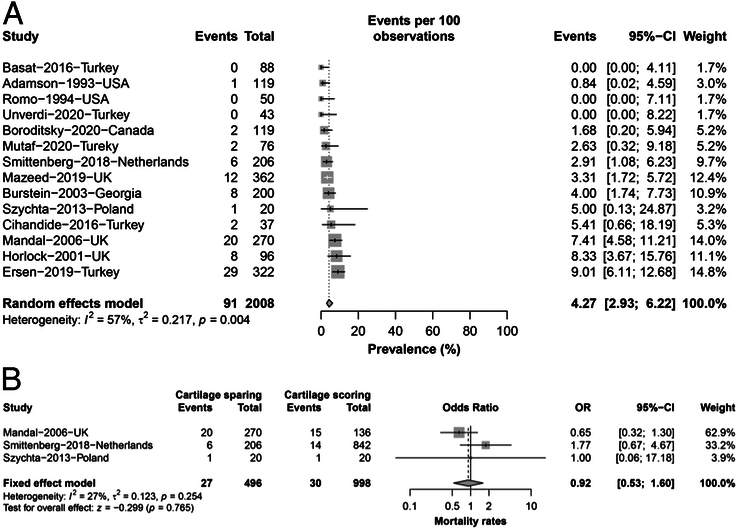
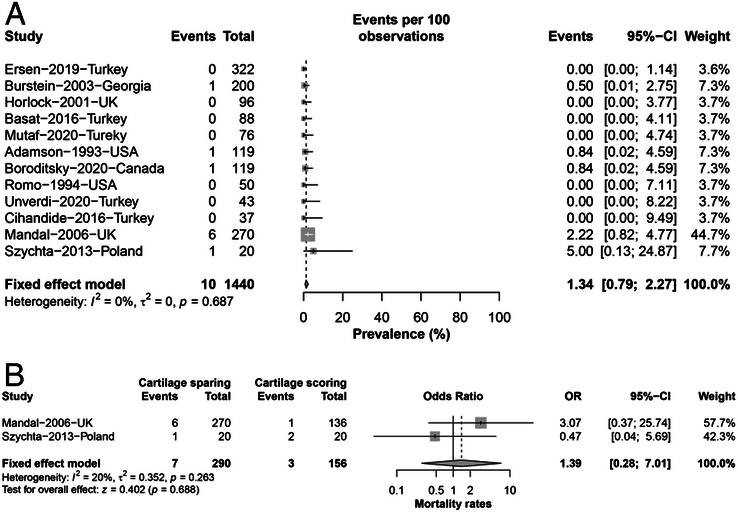
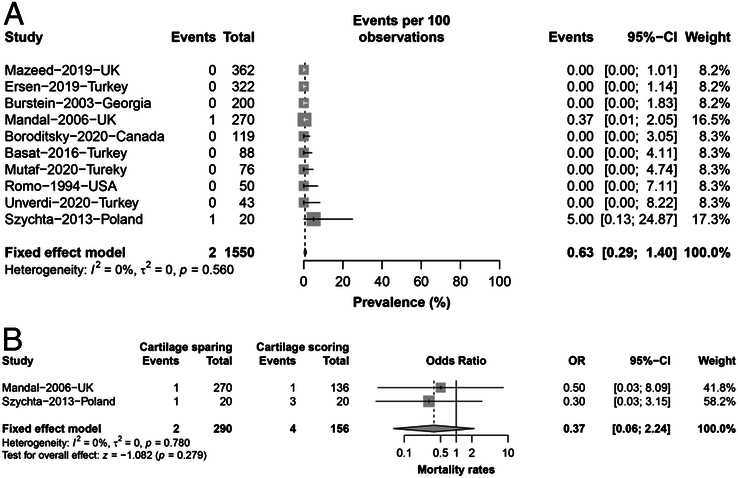
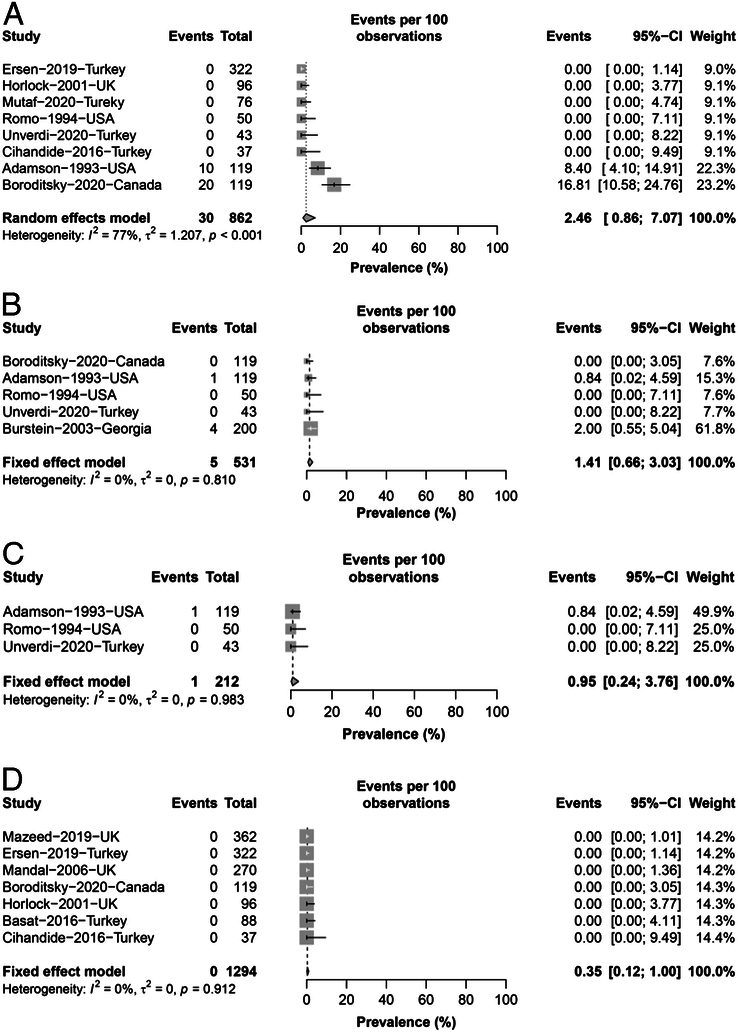
OBJECTIVE: To study the prevalence of complications in patients who have undergone cartilage sparing otoplasty. METHODS: On December 26, 2021, the authors searched 8 databases using the search term "(otoplasty) AND (cartilage sparing OR cartilage sparing)" for collecting the most appropriate studies. The authors used R software version 4.1.2 for conducting the meta-analysis. RESULTS: Of the 414 records screened, the authors included 14 studies. Recurrence/reoperation was the most common reported complication with a prevalence of 4.27% (95% CI: 2.93-6.22), followed by suture erosion 2.46% (95% CI: 0.86-7.07) and hematoma/hemorrhage 1.34% (95% CI: 0.79-2.27). The authors did not find any significant difference between cartilage sparing and cartilage scoring in terms of recurrence/reoperation [odds ratio (OR): 0.92; 95% CI: 0.53-1.60; P = 0.766], hematoma/hemorrhage (OR: 1.39; 95% CI: 0.28-7.01; P = 0.688), and wound infection (OR: 0.37; 95% CI: 0.06-2.24; P = 0.279). CONCLUSION: Various complications have been reported, including recurrence and reoperation, hematoma, wound infections, suture erosions, keloid formation, and skin necrosis. However, the prevalence of these events is not high, although significant heterogeneity was reported for some outcomes. Therefore, it can be concluded that cartilage sparing otoplasty is a safe and reproducible technique.
Overview
CoChat Summary
TL;DR
This systematic review and meta-analysis pooled 14 studies to estimate complication rates after cartilage sparing otoplasty. It concludes the technique is safe and reproducible, with recurrence/reoperation the most common complication at 4.27%, and no significant differences versus cartilage scoring for recurrence, hematoma/hemorrhage, or wound infection.
Key findings
- Among 14 studies, recurrence/reoperation had a pooled prevalence of 4.27% (95% CI: 2.93–6.22) across 2008 ears, with individual study rates from 0% to 9.01% and significant heterogeneity (I² = 57%; P = 0.004); trim-and-fill adjusted prevalence was 5.72% (95% CI: 3.90–8.40).
- Other pooled prevalences were suture erosion 2.46% (95% CI: 0.86–7.07; 8 studies, 862 ears), hematoma/hemorrhage 1.34% (95% CI: 0.79–2.27; 12 studies, 1440 ears), wound infection 0.63% (95% CI: 0.29–1.40; 10 studies, 1550 ears), scarring 1.14% (95% CI: 0.66–3.03), keloid formation 0.95% (95% CI: 0.24–3.76), and skin necrosis 0.35% (95% CI: 0.12–1.00).
- No significant differences were found between cartilage sparing and cartilage scoring for recurrence/reoperation (OR: 0.92; 95% CI: 0.53–1.60; P = 0.766), hematoma/hemorrhage (OR: 1.39; 95% CI: 0.28–7.01; P = 0.688), or wound infection (OR: 0.37; 95% CI: 0.06–2.24; P = 0.279).
- The authors conclude that cartilage sparing otoplasty is a safe and reproducible technique, though significant heterogeneity was reported for some outcomes.
Methods
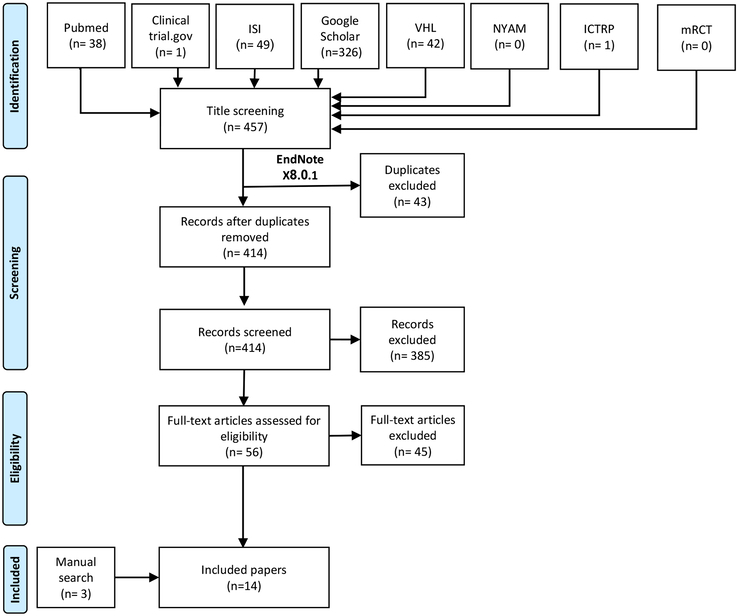
- PRISMA-guided systematic review and meta-analysis searching 8 databases on December 26, 2021, using the term “(otoplasty) AND (cartilage sparing OR cartilage sparing),” plus manual searching; 414 records were screened and 14 studies included (9 prospective cohort, 5 retrospective cohort).
- The sample included 1295 patients who underwent cartilage sparing otoplasty and 998 who underwent cartilage scoring otoplasty; follow-up was reported in 12 studies and ranged from 8 weeks to 4.5 years.
- Pooled prevalence rates and odds ratios with 95% CIs were calculated in R version 4.1.2; heterogeneity was assessed with Q statistics and I², using a random model, and publication bias/meta-regression were tested when 10 or more studies were available.
Limitations
- Stated by the paper: the major limitation is the limited number of included studies, which had variable numbers of patients, and the significant heterogeneity among included studies.
- Evident from the text: the search was conducted on December 26, 2021, so later studies are not captured; publication bias was detected for recurrence/reoperation (Egger P = 0.002) and hematoma/hemorrhage (Egger P = 0.019), requiring trim-and-fill adjustment.
- Evident from the text: heterogeneity was significant for recurrence/reoperation (I² = 57%) and suture erosion (I² = 77%), which limits certainty for those pooled estimates.
Model-written summary. Check it against the paper before relying on it.
Integrity signals
Registry
Cites
Statistics
Figures
Verification
Claims the paper makes
3 Valid · 0 Not valid · 5 Not checked · 55 Own results and interpretations
The cited sources support only part of this claim — read each source’s verdict below.
In the paper
“Moreover, the great diversity in the sample size of included studies and different epidemiological data of included populations might also be another reason for this heterogeneity.39”
§ Complications of Cartilage Sparing Otoplasty: A Systematic Review and Meta-Analysis > DISCUSSION
What the sources say
- Partly supportedcites [39] Binet A El Ezzi O De Buys Roessingh A. A retrospective analysis of complications and surgical outcome of 1380 ears: experience review of paediatric otoplasty. Int J Pediatr Otorhinolaryngol 2020; 138: 110302 32819719 sourceExperimental — accuracy not yet measured
Our copy supports the general idea of heterogeneity arising from differing populations and from a diverse literature: the Discussion (p. n/a, §4) states 'The great diversity of otoplasty techniques leads to numerous variations in post-operative outcomes, both in terms of complications and recurrence rates,' and notes unilateral rates of 0-21% 'depending on the difference in populations' (Kajosaari et al.), while the Introduction (§1) stresses the 'great diversity in reports of postoperative outcome after otoplasty' making real incidences hard to elicit. However, the specific element attributed here — diversity in the SAMPLE SIZE of included studies as a reason for heterogeneity — is not stated in our copy; the paper only remarks that few comprehensive reports exist and that the large number of patients in its own series (705 patients, 1380 ears) makes its findings significant. The source also frames variation as driven by technique diversity, not by epidemiological differences per se, and it is a single-centre retrospective series rather than a pooled review. (LLM, conf=0.72)
hedgedstates a possible cause- Asserted: passes — The authors put it forward as true.
- Checkable: passes — It can be checked against evidence.
- Load-bearing: unclear — It is unclear whether the paper’s conclusions depend on it.
- Based: passes — The paper gives a reason why it holds.
- Partly supported
A result the paper reports from its own data — it cites no other source for it, so there is none to check. The quote shows it is in the paper.
In the paper
“In total, we included 14 papers for this systematic review and meta-analysis (Supplemental Digital Content, Table 1, http://links.lww.com/SCS/F804, Fig. 1).24–37”
§ Complications of Cartilage Sparing Otoplasty: A Systematic Review and Meta-Analysis > RESULTS > Search Results and Study Selection
plain- Asserted: passes — The authors put it forward as true.
- Checkable: passes — It can be checked against evidence.
- Load-bearing: passes — The paper’s conclusions depend on it.
- Based: passes — The paper gives a reason why it holds.
A result the paper reports from its own data — it cites no other source for it, so there is none to check. The quote shows it is in the paper.
In the paper
“Noteworthy, 6 of these studies reported a 0% prevalence, which might explain the high heterogeneity found among different studies (I 2 = 77%; P < 0.001; Fig. 5A).”
§ Complications of Cartilage Sparing Otoplasty: A Systematic Review and Meta-Analysis > RESULTS > Other Complications
plain- Asserted: passes — The authors put it forward as true.
- Checkable: passes — It can be checked against evidence.
- Load-bearing: passes — The paper’s conclusions depend on it.
- Based: passes — The paper gives a reason why it holds.
A result the paper reports from its own data — it cites no other source for it, so there is none to check. The quote shows it is in the paper.
In the paper
“The prevalence reported among individual studies was <1% in almost all of the included studies, with no heterogeneity detected (I 2 = 0%; P = 0.560; Fig. 4A).”
§ Complications of Cartilage Sparing Otoplasty: A Systematic Review and Meta-Analysis > RESULTS > Wound Infection
plain- Asserted: passes — The authors put it forward as true.
- Checkable: passes — It can be checked against evidence.
- Load-bearing: unclear — It is unclear whether the paper’s conclusions depend on it.
- Based: passes — The paper gives a reason why it holds.
33 more claims
Create a free account to see all 63 claims and to verify the 2 references still open.
- Probably not a substantial claim. 18
- It may state two separate claims as one. 12
Claims other papers make about this one
Each is checked against this paper’s own text: does it say what the citing paper says it does?
The source backs part of the claim, not all of it — or backs it for a different population, condition or comparison.
In the citing paper
“Many studies and prior meta-analyses confirmed otoplasty’s safety, though incisionless techniques had higher blistering (22.6%) and suture extrusion (21.9%).104–108”
From Otoplasty Surgical Techniques and Clinical Outcomes: A Practical Review (2026) · cites this paper as [105]
Experimental — accuracy not yet measuredThe source backs part of the claim, not all of it — or backs it for a different population, condition or comparison.
In the citing paper
“Many studies and prior meta-analyses confirmed otoplasty’s safety, though incisionless techniques had higher blistering (22.6%) and suture extrusion (21.9%).104–108”
From Otoplasty Surgical Techniques and Clinical Outcomes: A Practical Review (2026) · cites this paper as [105]
Experimental — accuracy not yet measuredThe check wasn’t confident either way, so it gives no verdict — never disputed.
In the citing paper
“Many studies and prior meta-analyses confirmed otoplasty’s safety, though incisionless techniques had higher blistering (22.6%) and suture extrusion (21.9%).104–108”
From Otoplasty Surgical Techniques and Clinical Outcomes: A Practical Review (2026) · cites this paper as [105]
Experimental — accuracy not yet measured
Self-check
Percentages, sums and reported differences re-computed from the paper’s own numbers.
Each contradiction between two passages listed here was confirmed by an independent check.
Rated major: it would touch a result — a value a result rests on, reported and recomputed p-values on opposite sides of the significance level, two passages that conflict with no sign which is right, or a cited work retracted before this paper was published.
In the paper
“The systematic search through the 8 databases yielded 414 records after removing duplicate records. Title and abstract screening and full-text screening resulted in an exclusion of 385 and 45 records, respectively. Manual search trials yielded another 3 papers. In total, we included 14 papers”
§ Complications of Cartilage Sparing Otoplasty: A Systematic Review and Meta-Analysis > RESULTS > Search Results and Study Selection
Reported 45 · recomputed 29
Rated minor: it would not touch a result — a value no result rests on, a p-value that stays on the same side of the significance level, or a conflict that is clerical, resolved elsewhere in the paper, or outside its own findings.
In the paper
§ Complications of Cartilage Sparing Otoplasty: A Systematic Review and Meta-Analysis > DISCUSSION
“The significant heterogeneity estimated for recurrence rates and rates of hematomas among the different studies is probably attributed to the wide variations in otoplasty techniques, which can remarkably affect postoperative outcomes.38”
§ Complications of Cartilage Sparing Otoplasty: A Systematic Review and Meta-Analysis > RESULTS > Hematoma or Hemorrhage
“with no heterogeneity detected (I 2 = 0%; P = 0.687; Fig. 3A).”
Citations
Cites
Bias in meta-analysis detected by a simple, graphical test
Egger, M., Smith, G. D., Schneider, M., & Minder, C. (1997) · BMJ · doi:10.1136/bmj.315.7109.629 · Cited by 56,722
Liberati, A., Altman, D. G., Tetzlaff, J., Mulrow, C., Gøtzsche, P. C., Ioannidis, J. P. A., Clarke, M., Devereaux, P. J., Kleijnen, J., & Moher, D. (2009) · PLoS Medicine · doi:10.1371/journal.pmed.1000100 · Cited by 28,164
Bayat, A., McGrouther, D. A., & Ferguson, M. W. J. (2003) · BMJ · doi:10.1136/bmj.326.7380.88 · Cited by 608
A “NATURAL” TECHNIQUE FOR CORRECTION OF CONGENITALLY PROMINENT EARS
STENSTRÖM, S. J. (1963) · Plastic and Reconstructive Surgery · doi:10.1097/00006534-196311000-00003 · Cited by 328
A method of antihelix reconstruction
Chongchet, V. (1963) · British Journal of Plastic Surgery · doi:10.1016/s0007-1226(63)80120-4 · Cited by 219
The Treatment of Prominent Ears by Buried Mattress Sutures: A Ten-Year Survey
MUSTARDÉE, J. C. (1967) · Plastic and Reconstructive Surgery · doi:10.1097/00006534-196704000-00008 · Cited by 162
The postauricular fascial flap as an adjunct to Mustardé and Furnas type otoplasty.
Horlock, N., Misra, A., & Gault, D. T. (2001) · Plastic and Reconstructive Surgery · doi:10.1097/00006534-200111000-00005 · Cited by 102
Otoplasty: Critical review of clinical results
Adamson, P. A., Mcgraw, B. L., & Tropper, G. J. (1991) · The Laryngoscope · doi:10.1288/00005537-199108000-00013 · Cited by 99
Comparison of cartilage scoring and cartilage sparing otoplasty: a study of 203 cases.
Mandal, A., Bahia, H., Ahmad, T., & Stewart, K. J. (2006) · Journal of Plastic, Reconstructive & Aesthetic Surgery · doi:10.1016/j.bjps.2006.01.055 · Cited by 83
Correction of the protruding deformed EAR
Becker, O. J. (1952) · British Journal of Plastic Surgery · doi:10.1016/s0007-1226(52)80019-0 · Cited by 73
Complications in the treatment of prominent ears
Elliott, R. A. (1978) · Clinics in Plastic Surgery · doi:10.1016/s0094-1298(20)32154-4 · Cited by 73 · cited 1×
“42,43 Moreover, prophylactic regimens of antibiotics are usually administered perioperatively, which can dramatically provide adequate protection against these events.”
BackgroundCorrection of Prominent Ears with Multiple Sutures
Furnas, D. W. (1978) · Clinics in Plastic Surgery · doi:10.1016/s0094-1298(20)32155-6 · Cited by 51
Otoplasty for the Protruded Ear
Nazarian, R., & Eshraghi, A. (2011) · Seminars in Plastic Surgery · doi:10.1055/s-0031-1288921 · Cited by 47
Bauer, B. S., Song, D. H., & Aitken, M. E. (2002) · Plastic and Reconstructive Surgery · doi:10.1097/00006534-200209150-00004 · Cited by 46
Scar Treatment Variations by Skin Type
Visscher, M. O., Bailey, J. K., & Hom, D. B. (2014) · Facial Plastic Surgery Clinics of North America · doi:10.1016/j.fsc.2014.04.010 · Cited by 44
Cartilage-sparing otoplasty: a review with long-term results
Vuyk, H. D. (1997) · The Journal of Laryngology & Otology · doi:10.1017/s0022215100137545 · Cited by 40
Complications after prominent ear correction: a systematic review of the literature.
Sadhra, S. S., Motahariasl, S., & Hardwicke, J. T. (2017) · Journal of Plastic, Reconstructive & Aesthetic Surgery · doi:10.1016/j.bjps.2017.05.033 · Cited by 40 · cited 2×
“38 Moreover, the great diversity in the sample size of included studies and different epidemiological data of included populations might also be another reason for this heterogeneity.”
BackgroundMustardé's otoplasty—evaluation of correlation between clinical and statistical findings
Minderjahn, A., Hüttl, W.-R., & Hildmann, H. (1980) · Journal of Maxillofacial Surgery · doi:10.1016/s0301-0503(80)80107-x · Cited by 35
Smittenberg, M. N., Marsman, M., Veeger, N. J. G. M., & Moues, C. M. (2018) · Plastic & Reconstructive Surgery · doi:10.1097/prs.0000000000004241 · Cited by 33 · cited 1×
“15 Therefore, cumulative evidence from the current analysis and results of previous investigations show that the incidence of these complications after cartilage sparing otoplasty is a signi fi cant indication for performing postoperative follow-up of patients to provide early management of the…”
BackgroundGhozy, S., Nam, N. H., Radwan, I., Karimzadeh, S., Tieu, T. M., Hashan, M. R., Abbas, A. S., Eid, P. S., Vuong, N. L., Khang, N. V., et al. (2020) · Reviews in Medical Virology · doi:10.1002/rmv.2089 · Cited by 32
The Unfavorable Result in Plastic Surgery
Goldwyn, R. M., & Fisher, J. C. (1985) · Plastic & Reconstructive Surgery · doi:10.1097/00006534-198508000-00031 · Cited by 32
Boroditsky, M. L., Van Slyke, A. C., & Arneja, J. S. (2020) · Plastic and Reconstructive Surgery - Global Open · doi:10.1097/gox.0000000000003103 · Cited by 30
Health-related quality of life outcome of children with prominent ears after otoplasty.
Songu, M., & Kutlu, A. (2014) · European Archives of Oto-Rhino-Laryngology · doi:10.1007/s00405-014-2989-3 · Cited by 29
Cihandide, E., Kayiran, O., Aydin, E. E., & Uzunismail, A. (2016) · Journal of Craniofacial Surgery · doi:10.1097/scs.0000000000002607 · Cited by 25
Effect of dermal thickness on scars in women with type III-IV fitzpatrick skin
Ince, B., Dadaci, M., Oltulu, P., Altuntas, Z., & Bilgen, F. (2015) · Aesthetic Plastic Surgery · doi:10.1007/s00266-015-0466-z · Cited by 23 · cited 1×
“39 46 Moreover, it has been evidenced that the type of surgical technique might be another potential for developing these events.”
BackgroundDouble triangular cartilage excision otoplasty.
Gualdi, A., Cambiaso-Daniel, J., Gatti, J., Wurzer, P., Sljivich, M., Scherer, S. S., Pietramaggiori, G., Bertossi, D., Botti, C., & Botti, G. (2018) · Plastic & Reconstructive Surgery · doi:10.1097/prs.0000000000004175 · Cited by 23
Management of the prominent ear
Gantous, A., Tasman, A.-J., & Neves, J. C. (2018) · Facial Plastic Surgery Clinics of North America · doi:10.1016/j.fsc.2017.12.010 · Cited by 20
Cartilage-Sparing Complete Otoplasty Technique: A 10-Year Experience in 100 Patients
Burstein, F. D. (2003) · Journal of Craniofacial Surgery · doi:10.1097/00001665-200307000-00024 · Cited by 19
Mazeed, A. S., & Bulstrode, N. W. (2019) · Plastic & Reconstructive Surgery · doi:10.1097/prs.0000000000005704 · Cited by 18
Pre- and Postoperative Management in Otoplasty
Kotler, H. S., Robertson, K., & Tardy, M. (1994) · Facial Plastic Surgery · doi:10.1055/s-2008-1064575 · Cited by 17
History of Auricular Reconstruction
Weerda, H. (2010) · Advances in oto-rhino-laryngology · doi:10.1159/000314560 · Cited by 16
Szychta, P., & Stewart, K. J. (2013) · Annals of Plastic Surgery · doi:10.1097/sap.0b013e3182503c38 · Cited by 16
Basat, S. O., Ceran, F., Askeroglu, U., Aksan, T., Orman, C., Yazar, M., Uscetin, I., Akan, M., & Bozkurt, M. (2016) · Journal of Craniofacial Surgery · doi:10.1097/scs.0000000000002832 · Cited by 15
Binet, A., El Ezzi, O., & De Buys Roessingh, A. (2020) · International Journal of Pediatric Otorhinolaryngology · doi:10.1016/j.ijporl.2020.110302 · Cited by 15 · cited 4×
“39 46 Moreover, it has been evidenced that the type of surgical technique might be another potential for developing these events.”
BackgroundResultInfluentialOtoplasty Using the Postauricular Skin Flap Technique
Romo, T., Sclafani, A. P., & Shapiro, A. L. (1994) · Archives of Otolaryngology - Head and Neck Surgery · doi:10.1001/archotol.1994.01880340086015 · Cited by 14
Helix free otoplasty for correction of prominent ear
Ahmed, M., Alkhalaf, H., & Ibrahim, E. (2018) · Asian Journal of Surgery · doi:10.1016/j.asjsur.2018.08.005 · Cited by 12
Ersen, B. (2019) · Annals of Plastic Surgery · doi:10.1097/sap.0000000000002025 · Cited by 8
Ünverdi, Ö. F., & Demir, A. (2020) · Journal of Craniofacial Surgery · doi:10.1097/scs.0000000000006651 · Cited by 5
Minimally invasive technique for correction of prominent ear
Teaima, A. A., Hasaballah, M. S., & Mady, O. M. (2020) · The Journal of International Advanced Otology · doi:10.5152/iao.2020.7942 · Cited by 4
Mutaf, M., & Temel, M. (2020) · Annals of Plastic Surgery · doi:10.1097/sap.0000000000002257 · Cited by 2
Research works printed but not linked: 5
- Higgins JP Green S. Cochrane Handbook for Systematic Reviews of Interventions, Version 5.0.1. John Wiley & Sons Ltd. 2008.
- Cihandide E Kayiran O Aydin EE. A new approach for the correction of prominent ear deformity: the distally based perichondrio-adipo-dermal flap technique. J Craniofac Surg 2016; 27: 892– 897 27171968 · DOI · Paper page
- Mandal A Bahia H Ahmad T. Comparison of cartilage scoring and cartilage sparing otoplasty—a study of 203 cases. J Plast Reconstr Aesthet Surg 2006; 59: 1170– 1176 17046626 · DOI · Paper page
- Smittenberg MN Marsman M Veeger NJ. Comparison of cartilage-scoring and cartilage-sparing otoplasty: a retrospective analysis of complications and aesthetic outcome of 1060 ears. Plast Reconstr Surg 2018; 141: 500e– 506e 29595722 · DOI · Paper page
- Horlock N Misra A Gault DT. The postauricular fascial flap as an adjunct to Mustardé and Furnas type otoplasty. Plast Reconstr Surg 2001; 108: 1487– 1490; discussion 1491 11711914 · DOI · Paper page
Cited by
Modified Anterior Scoring Otoplasty Without Sutures: Description and Case Series
Grella, R., Molle, M., Crisci, E., Grella, E., Nicoletti, M. M., & Pieretti, G. (2025) · Aesthetic Plastic Surgery · doi:10.1007/s00266-025-04763-6 · Cited by 3
“Using sutures can potentially lead to complications such as granuloma formation, knot extrusion, and loss of correction due to suture memory loss [12].”
A New Guiding Suturing Technique for Reshaping of the Antihelix in Patients with Prominent Ears
Altramsy, A. A.-M., Dahy, A. A., Gad, A. A., Abu‐Elsoud, A., Khattab, R. F., Nafeh, A. M., Azzam, R., & Elameen, A. M. (2024) · Aesthetic Plastic Surgery · doi:10.1007/s00266-024-04478-0 · Cited by 3
“Alanazi et al., 2024 reported Abbreviations; SD : Standard deviation a risk of recurrence and reoperation of 4.27% after carti-lage-sparing otoplasty, being the most common complication [30].”
InfluentialDouble Triangular Cartilage Excision in Otoplasty Revisited
Gualdi, A., Cambiaso‐Daniel, J., Negrini, F. C., & Giordano, S. A. (2024) · Facial Plastic Surgery · doi:10.1055/a-2447-8589 · Cited by 2
Otoplasty Surgical Techniques and Clinical Outcomes: A Practical Review
Kaleeny, J. D., & Janis, J. E. (2026) · Plastic and Reconstructive Surgery - Global Open · doi:10.1097/gox.0000000000007404
Vlahovic, A. M., & Haxhija, E. Q. (2026) · Springer eBooks · doi:10.1007/978-3-032-16616-6_2
Metadata
- Authors
- Alanazi, H.
- Affiliations
- Majmaah University (SA)
- Corresponding author
- Alanazi, Hani
- Venue
- Journal of Craniofacial Surgery
- Published
- 2024-02-16
- Volume
- 35
- Issue
- 3
- Pages
- 874-878
- ISSN
- 1049-2275 (ISSN-L)
- PMC
- PMC11045554
- OpenAlex
- W4391878784
- Semantic Scholar
- d7728e236faaeb7fcced1b1d98331b04b0dbffe5
- Cited by
- 6
- References
- 41
- Citations by year
- 2026: 3 · 2025: 1 · 2024: 2
- FWCI
- 0.52
- Type
- journal article
- Language
- en
- Open access
- hybrid
- doi.org
- Licence
- Locations
- Journal of Craniofacial Surgery (publishedVersion, cc-by-nc-nd)
- PubMed Central (publishedVersion, cc-by-nc-nd)
- PubMed (publishedVersion)
- Topics
- Health Sciences › Medicine › Surgery › Reconstructive Facial Surgery Techniques
- Health Sciences › Medicine › Surgery › Nasal Surgery and Airway Studies
- Health Sciences › Medicine › Genetics (clinical) › Congenital Ear and Nasal Anomalies
- Keywords
- recurrence, reoperation, suture erosion, hematoma, wound infection, keloid formation, skin necrosis
About these checks
Registry, retraction, Cites and statistics results are computed, not judged, with one exception: a printed reference that no index lists is read once by a model before it counts as a citation error. Claims are extracted by a model and kept only when their quote appears verbatim in the text; each cited source is then checked, with a model’s help, for whether it says what the claim relies on. Those verdicts can be wrong — read the claim’s quote and the cited source before relying on one.
The claim verdicts this report counts are experimental: their accuracy is not yet measured.
A language model drew the claims from the paper on 2026-10-10, under version 3 of the claim definition (model deepseek-v4.1-flash, prompt extract-v3).
A second model labelled each claim on 2026-10-10 (model jev-1.13-20260917, definition revision gold-guideline-v0.2).
Cited sources are checked with a language model’s help (qwen3.8-omni-flash).
Statistics and arithmetic are recomputed, not judged.
Confidence bands are shown only for fields calibrated on our annotated test set. None is calibrated yet, so no band is shown.
What counts as a claim ›How we measure confidence ›How we check this ›
Are you an author, or do you see a problem with this page? Request a review
Data sources
Bibliographic data: Semantic Scholar, OpenAlex, Crossref.
Contains information from the Semantic Scholar Academic Graph Datasets, made available under the ODC Attribution License (ODC-BY 1.0).
Semantic Scholar’s data is described in: Kinney, R., et al. (2023). The Semantic Scholar Open Data Platform. arXiv:2301.10140.
