

The DOI matches its Crossref record; 172 of the 178 references it cites were found in a registry or an index, and 3 are not checked yet; none of the 125 sources its claims cite is checked for support yet.
Gastric pouches and the mucociliary sole: setting the stage for nervous system evolution
Open accessAbstract
Prerequisite for tracing nervous system evolution is understanding of the body plan, feeding behaviour and locomotion of the first animals in which neurons evolved. Here, a comprehensive scenario is presented for the diversification of cell types in early metazoans, which enhanced feeding efficiency and led to the emergence of larger animals that were able to move. Starting from cup-shaped, gastraea-like animals with outer and inner choanoflagellate-like cells, two major innovations are discussed that set the stage for nervous system evolution. First, the invention of a mucociliary sole entailed a switch from intra- to extracellular digestion and increased the concentration of nutrients flowing into the gastric cavity. In these animals, an initial nerve net may have evolved via division of labour from mechanosensory-contractile cells in the lateral body wall, enabling coordinated movement of the growing body that involved both mucociliary creeping and changes of body shape. Second, the inner surface of the animals folded into metameric series of gastric pouches, which optimized nutrient resorption and allowed larger body sizes. The concomitant acquisition of bilateral symmetry may have allowed more directed locomotion and, with more demanding coordinative tasks, triggered the evolution of specialized nervous subsystems. Animals of this organizational state would have resembled Ediacarian fossils such as Dickinsonia and may have been close to the cnidarian–bilaterian ancestor. In the bilaterian lineage, the mucociliary sole was used mostly for creeping, or frequently lost. One possible remnant is the enigmatic Reissner's fibre in the ventral neural tube of cephalochordates and vertebrates.
Checked 2026-10-06 · 3 references not checked yet
Overview
AI snapshot
Written from the paper’s full text.
TL;DR
This review proposes a cell-type–based scenario for early metazoan evolution in which a mucociliary sole for external digestion and metameric gastric pouches set the stage for nervous system evolution. It argues that the first nerve net arose by division of labour from mechanosensory-contractile ectochoanocytes, and that animals of this grade resembled Ediacaran *Dickinsonia* and were close to the cnidarian–bilaterian ancestor.
Key findings
- Two major innovations are proposed as prerequisites for nervous system evolution: a mucociliary sole, which switched feeding from intra- to extracellular digestion and increased nutrient concentration in the gastric cavity, and metameric gastric pouches, which expanded resorptive surface and allowed larger body sizes.
- The first nerve net is hypothesized to have evolved by division of labour from mechanosensory-contractile cells in the lateral body wall, enabling coordinated movement involving mucociliary creeping and body-shape changes; glutamate is proposed as the first excitatory transmitter and GABA as inhibitory.
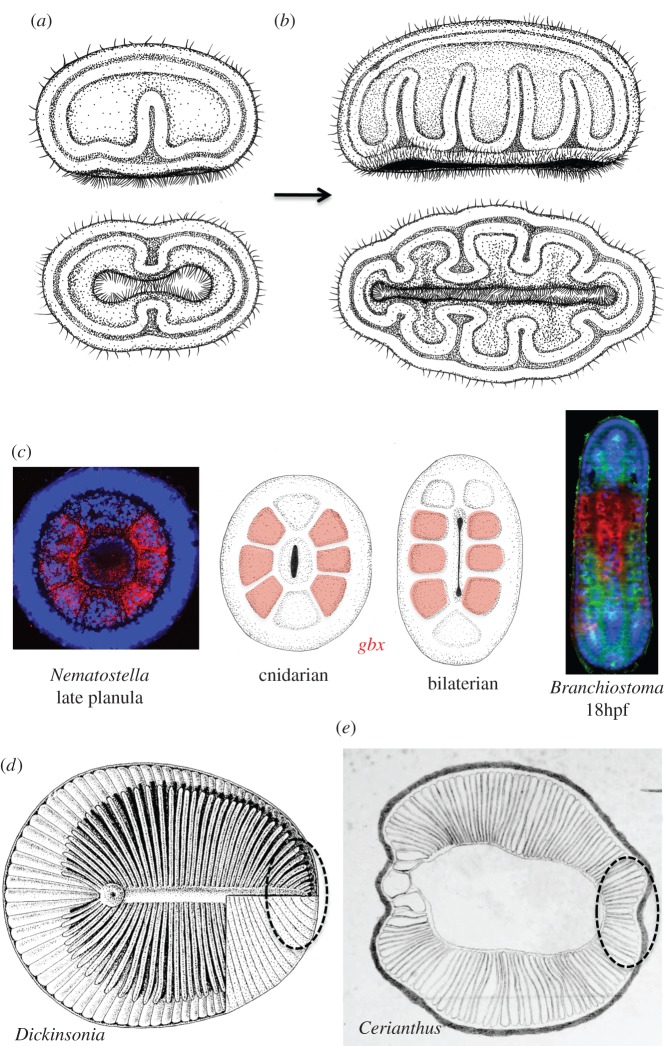
- Gastric pouches are proposed as homologous to bilaterian coelomic cavities, supported by *gbx* expression in all but the first pair of pouches in sea anemone and amphioxus, staggered/collinear *hox* expression, and expression of somitic musculature genes such as *mox* and *twist*.
- The organizational grade is compared to Ediacaran *Dickinsonia*, with its metameric digestive diverticula, and placed close to the cnidarian–bilaterian ancestor; Reissner’s fibre in cephalochordates and vertebrates is suggested as a possible remnant of the mucociliary sole.
Methods
- This is a review and synthetic evolutionary scenario, not a primary data paper; it integrates comparative structural and ultrastructural data, molecular studies on basal metazoans and choanoflagellates, developmental biology, and palaeontology.
- The main analytical framework is cell-type diversification via the sister cell-type concept and division of labour, used to infer ancestral cell types such as ectochoanocytes, endochoanocytes, kopeocytes, mucocytes, zymocytes, enterocytes, and nerve net neurons.
- Homology arguments draw on gene expression data, including *gbx*, *hox*, *mox*, *twist*, *foxj*, *foxA*, *atonal*, and *achaete-scute* family genes, alongside fossil comparisons such as *Dickinsonia*.
Limitations
- The paper states that in the absence of comparative molecular data for most cell types discussed, the postulated sequence of cell-type diversification remains tentative.
- The paper notes that the early metazoan tree remains unsolved, the placement of ctenophores is uncertain, and the existence of a “Neuralia” grouping excluding sponges and placozoans remains unsettled.
- The paper states it cannot explain why Reissner’s fibre is so persistent in extant vertebrates; more broadly, the text makes evident that many proposed cell types and transitions are hypothetical and not yet directly tested by comparative single-cell profiling.
Model-written summary. Check it against the paper before relying on it.
Integrity signals
Registry
Cites
Statistics
Figures
Verification
Claims the paper makes
63 Not checked yet · 52 Own interpretation · 2 No basis given · 1 Own method
A conclusion the paper draws from its own results — it cites no other source for it, so there is none to check. The quote shows it is in the paper.
In the paper
“In these animals, an initial nerve net may have evolved via division of labour from mechanosensory-contractile cells in the lateral body wall, enabling coordinated movement of the growing body that involved both mucociliary creeping and changes of body shape.”
§ Gastric pouches and the mucociliary sole: setting the stage for nervous system evolution > Abstract
hedgedconditional- Asserted: passes — The authors put it forward as true.
- Checkable: passes — It can be checked against evidence.
- Load-bearing: passes — The paper’s conclusions depend on it.
- Based: unclear — It is unclear why the paper says it holds.
None of the sources cited for this claim have been checked yet.
In the paper
“In addition, we can infer that early metazoan cells formed lamellipodia and filopodia, using proteins that reorganize cortical actin filaments such as the Arp2/3 complex, the actin cross-linking protein fascin, and myosin X”
§ Gastric pouches and the mucociliary sole: setting the stage for nervous system evolution > The choanoblastaea, a sphere of choanoflagellate-like cells > The first metazoan cells: choanoflagellate-like and multifunctional
What the sources say
- Not checked yetcites [39] Sebe-Pedros A, Burkhardt P, Sanchez-Pons N, Fairclough SR, Lang BF, King N, Ruiz-Trillo I 2013 Insights into the origin of metazoan filopodia and microvilli. Mol. Biol. Evol. 30, 2013– 2023. (10.1093/molbev/mst110) 23770652 PMC3748353 source
- Not checked yetcites [40] Jekely G 2014 Origin and evolution of the self-organizing cytoskeleton in the network of eukaryotic organelles. Cold Spring Harb. Perspect. Biol. 6, a016030 (10.1101/cshperspect.a016030) 25183829 PMC4142967 source
hedgeddirect- Asserted: passes — The authors put it forward as true.
- Checkable: passes — It can be checked against evidence.
- Load-bearing: unclear — It is unclear whether the paper’s conclusions depend on it.
- Based: passes — The paper gives a reason why it holds.
In the paper
“Such equipped animals may have been close to some simple Ediacaran fossils that have been interpreted as grazing on algal mats with a mucociliary sole for external digestion [3].”
§ Gastric pouches and the mucociliary sole: setting the stage for nervous system evolution > Introduction
What the sources say
- Not checked yetcites [3] Sperling EA, Vinther J 2010 A placozoan affinity for Dickinsonia and the evolution of Late Proterozoic metazoan feeding modes. Evol. Dev. 12, 201– 209. (10.1111/j.1525-142X.2010.00404.x) 20433459 source
hedgedcorrelational- Asserted: passes — The authors put it forward as true.
- Checkable: passes — It can be checked against evidence.
- Load-bearing: unclear — It is unclear whether the paper’s conclusions depend on it.
- Based: passes — The paper gives a reason why it holds.
A conclusion the paper draws from its own results — it cites no other source for it, so there is none to check. The quote shows it is in the paper.
In the paper
“Many of these molecules and associated functions were key to the evolution of the first neural cell types, as will be detailed below.”
§ Gastric pouches and the mucociliary sole: setting the stage for nervous system evolution > The choanoblastaea, a sphere of choanoflagellate-like cells > The first metazoan cells: choanoflagellate-like and multifunctional
plaindirect- Asserted: passes — The authors put it forward as true.
- Checkable: passes — It can be checked against evidence.
- Load-bearing: passes — The paper’s conclusions depend on it.
- Based: passes — The paper gives a reason why it holds.
None of the sources cited for this claim have been checked yet.
In the paper
“Stem metazoans were likely composed of one main characteristic cell type, resembling, structurally and functionally, the choanoflagellates [8–10; see however 11].”
§ Gastric pouches and the mucociliary sole: setting the stage for nervous system evolution > The choanoblastaea, a sphere of choanoflagellate-like cells
What the sources say
- Not checked yetcites [8] Nielsen C 2008 Six major steps in animal evolution: are we derived sponge larvae? Evol. Dev. 10, 241– 257. (10.1111/j.1525-142X.2008.00231.x) 18315817 source
- Not checked yetcites [9] Haeckel E 1874 Die Gastraea-Theorie, die phylogenetische Classification des Thierreiches und die Homologie der Keimblätter. Jena Z. Naturwiss. 8, 1– 55.
- Not checked yetcites [10] Maldonado M 2004 Choanoflagellates, choanocytes, and animal multicellularity. Invertebr. Biol. 123, 1– 22. (10.1111/j.1744-7410.2004.tb00138.x) source
hedged- Asserted: passes — The authors put it forward as true.
- Checkable: passes — It can be checked against evidence.
- Load-bearing: passes — The paper’s conclusions depend on it.
- Based: passes — The paper gives a reason why it holds.
A conclusion the paper draws from its own results — it cites no other source for it, so there is none to check. The quote shows it is in the paper.
In the paper
“This supports homology of sponge inner layer with the endomesoderm (i.e. the gastroderm) of other animals.”
§ Gastric pouches and the mucociliary sole: setting the stage for nervous system evolution > The microphageous gastraea
plaincorrelational- Asserted: passes — The authors put it forward as true.
- Checkable: passes — It can be checked against evidence.
- Load-bearing: passes — The paper’s conclusions depend on it.
- Based: passes — The paper gives a reason why it holds.
A conclusion the paper draws from its own results — it cites no other source for it, so there is none to check. The quote shows it is in the paper.
In the paper
“further diversification of the cell types making up the nerve net and the mucociliary sole gave rise to the plethora of receptor cells, neuron types and muscular and ciliary effector cells present in today's cnidarians and bilaterians.”
§ Gastric pouches and the mucociliary sole: setting the stage for nervous system evolution > Introduction
plaindirect- Asserted: passes — The authors put it forward as true.
- Checkable: passes — It can be checked against evidence.
- Load-bearing: passes — The paper’s conclusions depend on it.
- Based: unclear — It is unclear why the paper says it holds.
A conclusion the paper draws from its own results — it cites no other source for it, so there is none to check. The quote shows it is in the paper.
In the paper
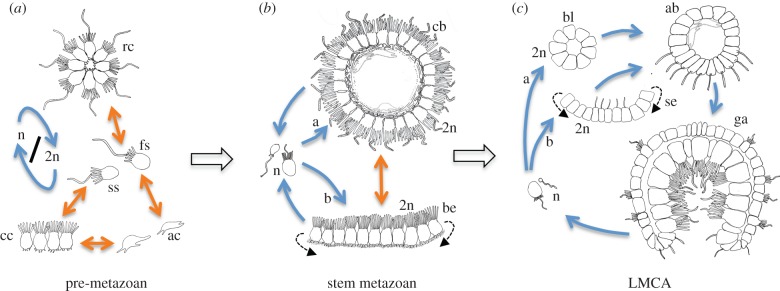
“Filopodia are highly dynamic structures that probably played a role in anchoring and stabilizing cells in the blastaea (figure 2a,b).”
§ Gastric pouches and the mucociliary sole: setting the stage for nervous system evolution > The choanoblastaea, a sphere of choanoflagellate-like cells > The first metazoan cells: choanoflagellate-like and multifunctional
hedgedconditional- Asserted: passes — The authors put it forward as true.
- Checkable: passes — It can be checked against evidence.
- Load-bearing: unclear — It is unclear whether the paper’s conclusions depend on it.
- Based: passes — The paper gives a reason why it holds.
In the paper
“a recent study comparing cellular transcriptomes indicates that a hierarchical tree structure indeed dominates cell-type interrelationships [6]”
§ Gastric pouches and the mucociliary sole: setting the stage for nervous system evolution > Introduction
What the sources say
- Not checked yetcites [6] Liang C, Consortium F, Forrest AR, Wagner GP 2015 The statistical geometry of transcriptome divergence in cell-type evolution and cancer. Nat. Commun. 6, 6066 (10.1038/ncomms7066) 25585899 source
hedgedcorrelational- Asserted: passes — The authors put it forward as true.
- Checkable: passes — It can be checked against evidence.
- Load-bearing: passes — The paper’s conclusions depend on it.
- Based: passes — The paper gives a reason why it holds.
In the paper
“Most probably, nutrients were shared with cells inside the choanoblastaea via the primary body cavity [8].”
§ Gastric pouches and the mucociliary sole: setting the stage for nervous system evolution > The choanoblastaea, a sphere of choanoflagellate-like cells > The first metazoan cells: choanoflagellate-like and multifunctional
What the sources say
- Not checked yetcites [8] Nielsen C 2008 Six major steps in animal evolution: are we derived sponge larvae? Evol. Dev. 10, 241– 257. (10.1111/j.1525-142X.2008.00231.x) 18315817 source
hedgedconditional- Asserted: passes — The authors put it forward as true.
- Checkable: passes — It can be checked against evidence.
- Load-bearing: unclear — It is unclear whether the paper’s conclusions depend on it.
- Based: passes — The paper gives a reason why it holds.
- It may state two separate claims as one. 41
- Probably not a substantial claim. 25
A conclusion the paper draws from its own results — it cites no other source for it, so there is none to check. The quote shows it is in the paper.
In the paper
“Animals of this organizational state would have resembled Ediacarian fossils such as Dickinsonia and may have been close to the cnidarian–bilaterian”
§ Gastric pouches and the mucociliary sole: setting the stage for nervous system evolution > Abstract
hedgedcorrelational- Asserted: passes — The authors put it forward as true.
- Checkable: passes — It can be checked against evidence.
- Load-bearing: unclear — It is unclear whether the paper’s conclusions depend on it.
- Based: unclear — It is unclear why the paper says it holds.
It may state two separate claims as one.
A conclusion the paper draws from its own results — it cites no other source for it, so there is none to check. The quote shows it is in the paper.
In the paper
“The concomitant acquisition of bilateral symmetry may have allowed more directed locomotion and, with more demanding coordinative tasks, triggered the evolution of specialized nervous subsystems.”
§ Gastric pouches and the mucociliary sole: setting the stage for nervous system evolution > Abstract
hedgedconditional- Asserted: passes — The authors put it forward as true.
- Checkable: unclear — It is unclear whether it could be checked against evidence.
- Load-bearing: passes — The paper’s conclusions depend on it.
- Based: unclear — It is unclear why the paper says it holds.
It may state two separate claims as one.
A conclusion the paper draws from its own results — it cites no other source for it, so there is none to check. The quote shows it is in the paper.
In the paper
“Second, the inner surface of the animals folded into metameric series of gastric pouches, which optimized nutrient resorption and allowed larger body sizes.”
§ Gastric pouches and the mucociliary sole: setting the stage for nervous system evolution > Abstract
plaindirect- Asserted: passes — The authors put it forward as true.
- Checkable: passes — It can be checked against evidence.
- Load-bearing: passes — The paper’s conclusions depend on it.
- Based: unclear — It is unclear why the paper says it holds.
It may state two separate claims as one.
A conclusion the paper draws from its own results — it cites no other source for it, so there is none to check. The quote shows it is in the paper.
In the paper
“In the bilaterian lineage, the mucociliary sole was used mostly for creeping, or frequently lost.”
§ Gastric pouches and the mucociliary sole: setting the stage for nervous system evolution > Abstract
plain- Asserted: passes — The authors put it forward as true.
- Checkable: passes — It can be checked against evidence.
- Load-bearing: fails — The paper’s conclusions may not depend on it.
- Based: fails — The paper may give no reason why it holds.
Probably not a substantial claim. The paper’s conclusions may not depend on it. The paper may give no reason why it holds. It may state two separate claims as one.
The paper states this without a source or data behind it here, so there is nothing to check it against. The quote shows it is in the paper.
In the paper
“Prerequisite for tracing nervous system evolution is understanding of the body plan, feeding behaviour and locomotion of the first animals in which neurons evolved.”
§ Gastric pouches and the mucociliary sole: setting the stage for nervous system evolution > Abstract
plaindirect- Asserted: passes — The authors put it forward as true.
- Checkable: fails — It may be too vague to check against evidence.
- Load-bearing: passes — The paper’s conclusions depend on it.
- Based: fails — The paper may give no reason why it holds.
Probably not a substantial claim. It may be too vague to check against evidence. The paper may give no reason why it holds.
A conclusion the paper draws from its own results — it cites no other source for it, so there is none to check. The quote shows it is in the paper.
In the paper
“First, the invention of a mucociliary sole entailed a switch from intra- to extracellular digestion and increased the concentration of nutrients flowing into the gastric cavity.”
§ Gastric pouches and the mucociliary sole: setting the stage for nervous system evolution > Abstract
plaindirect- Asserted: passes — The authors put it forward as true.
- Checkable: passes — It can be checked against evidence.
- Load-bearing: passes — The paper’s conclusions depend on it.
- Based: fails — The paper may give no reason why it holds.
Probably not a substantial claim. The paper may give no reason why it holds. It may state two separate claims as one.
A conclusion the paper draws from its own results — it cites no other source for it, so there is none to check. The quote shows it is in the paper.
In the paper
“One possible remnant is the enigmatic Reissner's fibre in the ventral neural tube of cephalochordates and vertebrates.”
§ Gastric pouches and the mucociliary sole: setting the stage for nervous system evolution > Abstract
hedgedcorrelational- Asserted: passes — The authors put it forward as true.
- Checkable: passes — It can be checked against evidence.
- Load-bearing: passes — The paper’s conclusions depend on it.
- Based: fails — The paper may give no reason why it holds.
Probably not a substantial claim. The paper may give no reason why it holds.
A conclusion the paper draws from its own results — it cites no other source for it, so there is none to check. The quote shows it is in the paper.
In the paper
“Starting from cup-shaped, gastraea-like animals with outer and inner choanoflagellate-like cells, two major innovations are discussed that set the stage for nervous system evolution.”
§ Gastric pouches and the mucociliary sole: setting the stage for nervous system evolution > Abstract
plaindirect- Asserted: passes — The authors put it forward as true.
- Checkable: passes — It can be checked against evidence.
- Load-bearing: passes — The paper’s conclusions depend on it.
- Based: fails — The paper may give no reason why it holds.
Probably not a substantial claim. The paper may give no reason why it holds.
In the paper
“The slow myosin is also involved in amoeboid movement [38], which probably belonged to the behavioural repertoire of early metazoan cells.”
§ Gastric pouches and the mucociliary sole: setting the stage for nervous system evolution > The choanoblastaea, a sphere of choanoflagellate-like cells > The first metazoan cells: choanoflagellate-like and multifunctional
What the sources say
- Not checked yetcites [38] Liu YJ, Le Berre M, Lautenschlaeger F, Maiuri P, Callan-Jones A, Heuze M, Takaki T, Voituriez R, Piel M 2015 Confinement and low adhesion induce fast amoeboid migration of slow mesenchymal cells. Cell 160, 659– 672. (10.1016/j.cell.2015.01.007) 25679760
hedgedcorrelational- Asserted: passes — The authors put it forward as true.
- Checkable: passes — It can be checked against evidence.
- Load-bearing: unclear — It is unclear whether the paper’s conclusions depend on it.
- Based: passes — The paper gives a reason why it holds.
It may state two separate claims as one.
In the paper
“The flagellar cilia were both motile and sensory (as reported for unicellular eukaryotes and human airway cilia), and thus contained a very short and direct sensory-effector arc [22].”
§ Gastric pouches and the mucociliary sole: setting the stage for nervous system evolution > The choanoblastaea, a sphere of choanoflagellate-like cells > The first metazoan cells: choanoflagellate-like and multifunctional
What the sources say
- Not checked yetcites [22] Salathe M 2007 Regulation of mammalian ciliary beating. Annu. Rev. Physiol. 69, 401– 422. (10.1146/annurev.physiol.69.040705.141253) 16945069
plaindirect- Asserted: passes — The authors put it forward as true.
- Checkable: passes — It can be checked against evidence.
- Load-bearing: passes — The paper’s conclusions depend on it.
- Based: passes — The paper gives a reason why it holds.
It may state two separate claims as one.
None of the sources cited for this claim have been checked yet.
In the paper
“These ancestors represented an epithelium [14] that took the shape of a sphere, called choanoblastaea [8], which later gave rise to the cup-shaped gastraea”
§ Gastric pouches and the mucociliary sole: setting the stage for nervous system evolution > The choanoblastaea, a sphere of choanoflagellate-like cells
What the sources say
- Not checked yetcites [8] Nielsen C 2008 Six major steps in animal evolution: are we derived sponge larvae? Evol. Dev. 10, 241– 257. (10.1111/j.1525-142X.2008.00231.x) 18315817 source
- Not checked yetcites [14] Leys SP, Riesgo A 2012 Epithelia, an evolutionary novelty of metazoans. J. Exp. Zool. B Mol. Dev. Evol. 318, 438– 447. (10.1002/jez.b.21442) 22057924
plaindirect- Asserted: passes — The authors put it forward as true.
- Checkable: passes — It can be checked against evidence.
- Load-bearing: passes — The paper’s conclusions depend on it.
- Based: passes — The paper gives a reason why it holds.
It may state two separate claims as one.
A conclusion the paper draws from its own results — it cites no other source for it, so there is none to check. The quote shows it is in the paper.
In the paper
“the extensive folding of the inner surface into metameric pouches, which optimized nutrient distribution and resorption”
§ Gastric pouches and the mucociliary sole: setting the stage for nervous system evolution > Introduction
plaindirect- Asserted: passes — The authors put it forward as true.
- Checkable: passes — It can be checked against evidence.
- Load-bearing: passes — The paper’s conclusions depend on it.
- Based: fails — The paper may give no reason why it holds.
Probably not a substantial claim. The paper may give no reason why it holds.
A conclusion the paper draws from its own results — it cites no other source for it, so there is none to check. The quote shows it is in the paper.
In the paper
“the endochoanocytes into cell types specializing in internal nutrient distribution and resorption”
§ Gastric pouches and the mucociliary sole: setting the stage for nervous system evolution > Introduction
plaindirect- Asserted: passes — The authors put it forward as true.
- Checkable: passes — It can be checked against evidence.
- Load-bearing: passes — The paper’s conclusions depend on it.
- Based: fails — The paper may give no reason why it holds.
Probably not a substantial claim. The paper may give no reason why it holds.
A conclusion the paper draws from its own results — it cites no other source for it, so there is none to check. The quote shows it is in the paper.
In the paper
“and the ectochoanocytes into cell types specializing in mechanosensation, information integration and body contractions in response to environmental stimuli”
§ Gastric pouches and the mucociliary sole: setting the stage for nervous system evolution > Introduction
plaindirect- Asserted: passes — The authors put it forward as true.
- Checkable: passes — It can be checked against evidence.
- Load-bearing: passes — The paper’s conclusions depend on it.
- Based: fails — The paper may give no reason why it holds.
Probably not a substantial claim. The paper may give no reason why it holds.
A conclusion the paper draws from its own results — it cites no other source for it, so there is none to check. The quote shows it is in the paper.
In the paper
“One prominent example is the division of labour that accompanied the birth of the first neurons and muscle cells (see §2).”
§ Gastric pouches and the mucociliary sole: setting the stage for nervous system evolution > Introduction
plaincorrelational- Asserted: passes — The authors put it forward as true.
- Checkable: passes — It can be checked against evidence.
- Load-bearing: fails — The paper’s conclusions may not depend on it.
- Based: fails — The paper may give no reason why it holds.
Probably not a substantial claim. The paper’s conclusions may not depend on it. The paper may give no reason why it holds.
In the paper
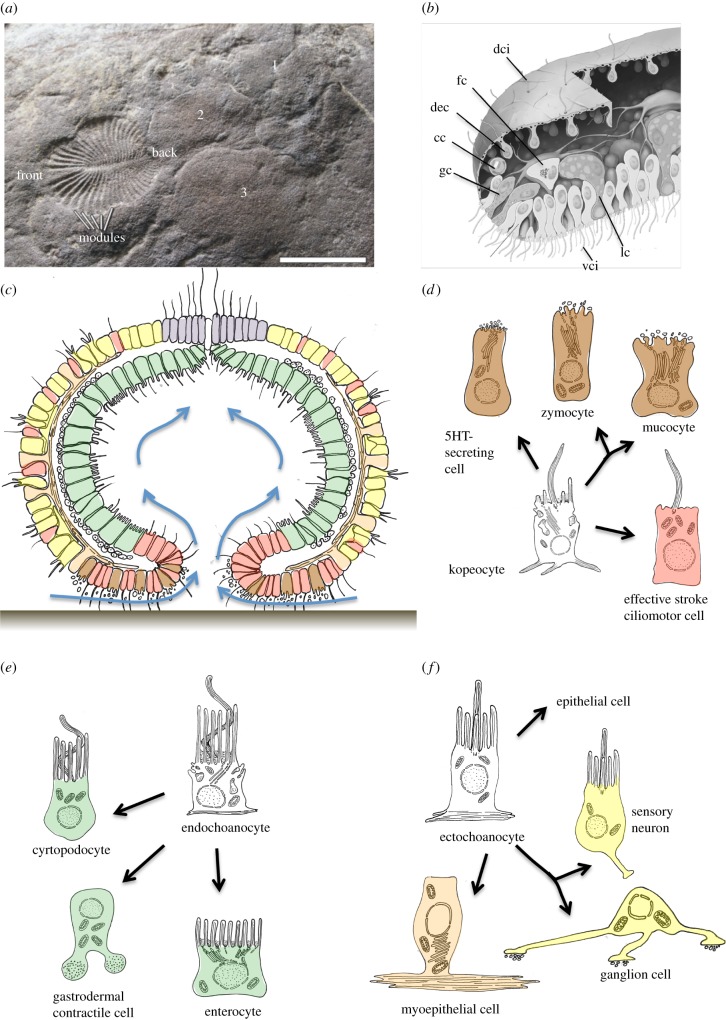
“Various lines of evidence indicate that a new feeding mode evolved in the Precambrian ocean, referred to as mucoid-ciliary particle feeding [3] (figure 4a,b).”
- Also stated in: § Grazing algal mats with mucus and digestive gland cells · hedged
“A rich body of fossil and comparative evidence indicates that mucoid-ciliary particle feeding evolved in early metazoans.”
§ Gastric pouches and the mucociliary sole: setting the stage for nervous system evolution > The benthic gastraea: external digestion with a mucociliary sole
What the sources say
- Not checked yetcites [3] Sperling EA, Vinther J 2010 A placozoan affinity for Dickinsonia and the evolution of Late Proterozoic metazoan feeding modes. Evol. Dev. 12, 201– 209. (10.1111/j.1525-142X.2010.00404.x) 20433459 source
hedgeddirect- Asserted: passes — The authors put it forward as true.
- Checkable: passes — It can be checked against evidence.
- Load-bearing: passes — The paper’s conclusions depend on it.
- Based: passes — The paper gives a reason why it holds.
It may state two separate claims as one.
- Also stated in: § Grazing algal mats with mucus and digestive gland cells · hedged
A conclusion the paper draws from its own results — it cites no other source for it, so there is none to check. The quote shows it is in the paper.
In the paper
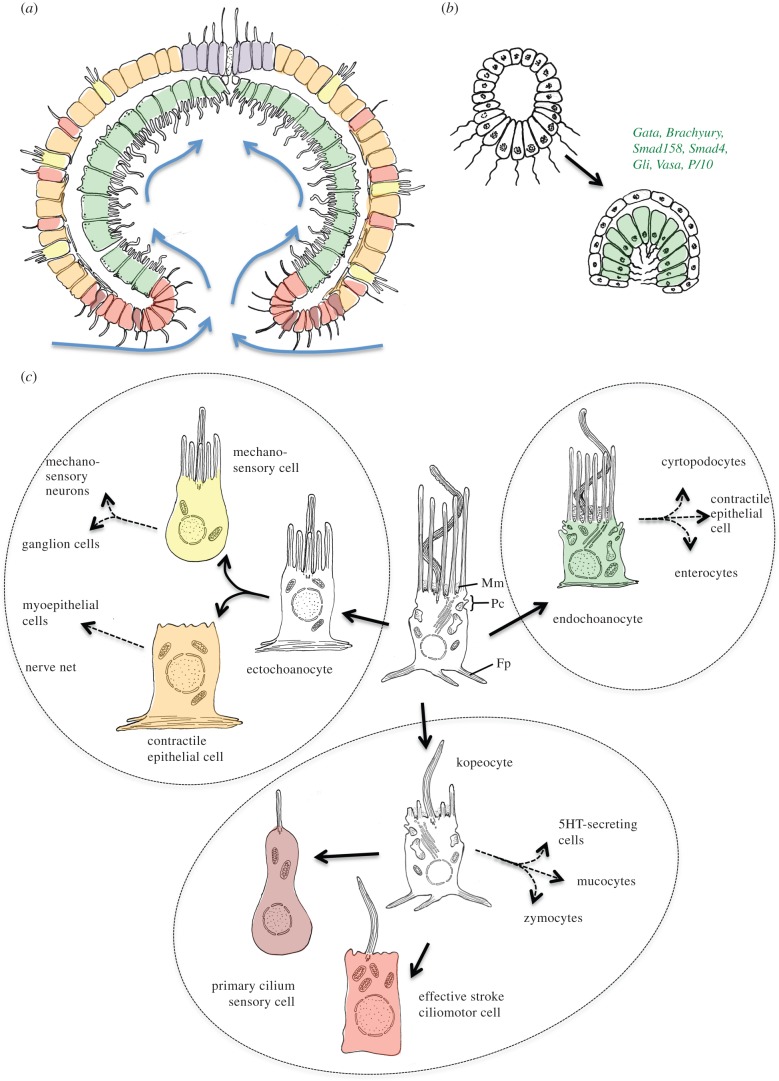
“We will hypothesize that the simple, bilayered, cup-shaped anatomy of this ancestor was reflected by a first diversification at the cellular level, including: (i) the external ‘ectochoanocytes’, mediating interactions with the environment; (ii) the internal ‘endochoanocytes’ that specialized towards particle capture and nutrient resorption; and (iii) the ‘kopeocytes’, regulating water currents”
§ Gastric pouches and the mucociliary sole: setting the stage for nervous system evolution > Introduction
hedgeddirect- Asserted: fails — The authors may not put it forward as true.
- Checkable: passes — It can be checked against evidence.
- Load-bearing: passes — The paper’s conclusions depend on it.
- Based: fails — The paper may give no reason why it holds.
Probably not a substantial claim. The authors may not put it forward as true. The paper may give no reason why it holds.
None of the sources cited for this claim have been checked yet.
In the paper
“choanoflagellates and metazoans share synaptic adhesion/signalling molecules, a primordial neurosecretory apparatus active on the apical cell surface (but no presynaptic active zone proteins) [32], postsynaptic density proteins such as Homer or Shank [33,34] and a variety of receptors including the metabotropic glutamate receptor [35] (but not ionotropic glutamate receptors, which only appeared in”
§ Gastric pouches and the mucociliary sole: setting the stage for nervous system evolution > The choanoblastaea, a sphere of choanoflagellate-like cells > The first metazoan cells: choanoflagellate-like and multifunctional
What the sources say
- Not checked yetcites [32] Burkhardt P 2015 The origin and evolution of synaptic proteins—choanoflagellates lead the way. J. Exp. Biol. 218, 506– 514. (10.1242/jeb.110247) 25696814 source
- Not checked yetcites [33] Alie A, Manuel M 2010 The backbone of the post-synaptic density originated in a unicellular ancestor of choanoflagellates and metazoans. BMC Evol. Biol. 10, 34 (10.1186/1471-2148-10-34) 20128896 PMC2824662
- Not checked yetcites [34] Ryan TJ, Grant SG 2009 The origin and evolution of synapses. Nat. Rev. Neurosci. 10, 701– 712. (10.1038/nrn2717) 19738623
- Not checked yetcites [35] Krishnan A, Schioth HB 2015 The role of G protein-coupled receptors in the early evolution of neurotransmission and the nervous system. J. Exp. Biol. 218, 562– 571. (10.1242/jeb.110312) 25696819 source
plaincorrelational- Asserted: passes — The authors put it forward as true.
- Checkable: passes — It can be checked against evidence.
- Load-bearing: passes — The paper’s conclusions depend on it.
- Based: passes — The paper gives a reason why it holds.
It may state two separate claims as one.
A conclusion the paper draws from its own results — it cites no other source for it, so there is none to check. The quote shows it is in the paper.
In the paper
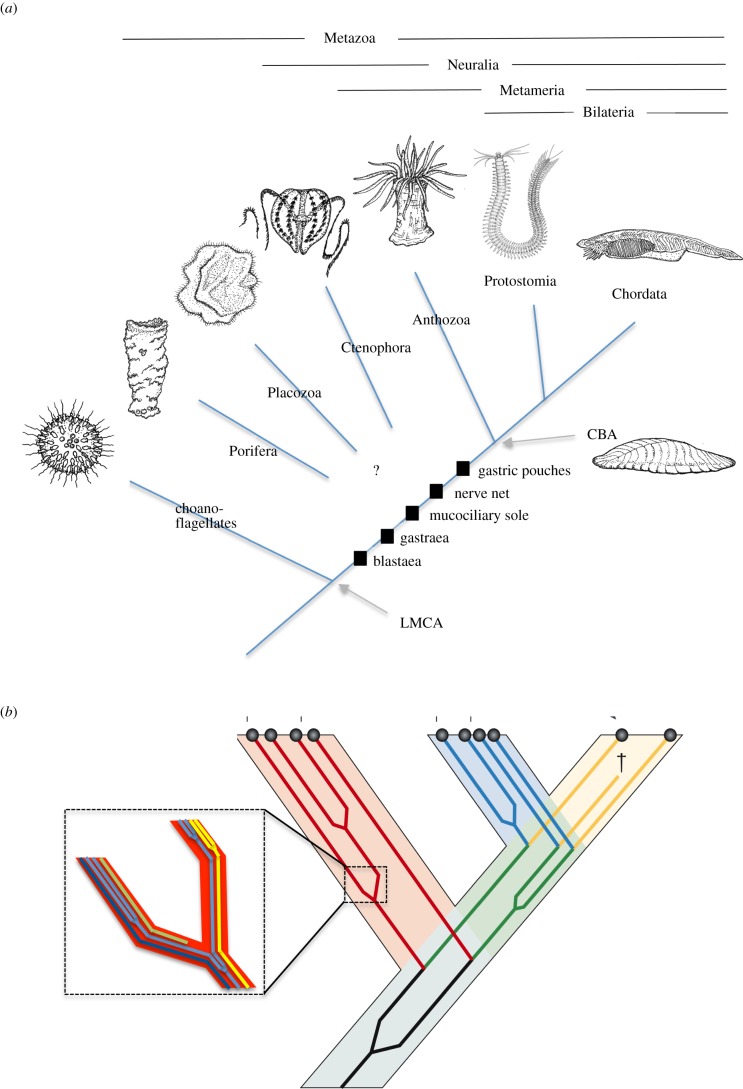
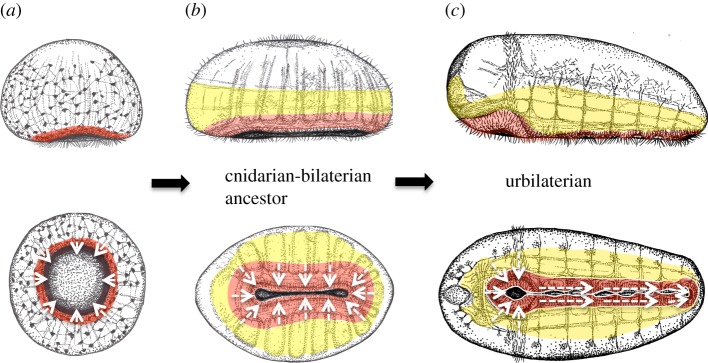
“We propose that, with these changes, basal metazoans had reached the organizational grade of the Ediacaran fossil Dickinsonia, which may have been close to the last common ancestor of cnidarians and bilaterians (that we collectively refer to as ‘Metameria’, figure 1a).”
§ Gastric pouches and the mucociliary sole: setting the stage for nervous system evolution > Introduction
hedgeddirect- Asserted: passes — The authors put it forward as true.
- Checkable: passes — It can be checked against evidence.
- Load-bearing: passes — The paper’s conclusions depend on it.
- Based: unclear — It is unclear why the paper says it holds.
It may state two separate claims as one.
In the paper
“Cell-type diversification involves the segregation and divergence of existing cellular modules or functions [5].”
§ Gastric pouches and the mucociliary sole: setting the stage for nervous system evolution > Introduction
What the sources say
- Not checked yetcites [5] Arendt D 2008 The evolution of cell types in animals: emerging principles from molecular studies. Nature reviews. Genetics 9, 868– 882. (10.1038/nrg2416) 18927580
plaindirect- Asserted: passes — The authors put it forward as true.
- Checkable: passes — It can be checked against evidence.
- Load-bearing: passes — The paper’s conclusions depend on it.
- Based: passes — The paper gives a reason why it holds.
Probably not a substantial claim.
A conclusion the paper draws from its own results — it cites no other source for it, so there is none to check. The quote shows it is in the paper.
In the paper
“Sponges might be regarded as representatives of a gastraea-type organization (which then would have undergone surface extension independent of other metazoan lineages”
§ Gastric pouches and the mucociliary sole: setting the stage for nervous system evolution > The microphageous gastraea
hedgedconditional- Asserted: passes — The authors put it forward as true.
- Checkable: passes — It can be checked against evidence.
- Load-bearing: passes — The paper’s conclusions depend on it.
- Based: fails — The paper may give no reason why it holds.
Probably not a substantial claim. The paper may give no reason why it holds. It may state two separate claims as one.
A conclusion the paper draws from its own results — it cites no other source for it, so there is none to check. The quote shows it is in the paper.
In the paper
“Food was predigested externally in a layer of mucus and the predigested nutrients transported into the body cavity with water currents.”
§ Gastric pouches and the mucociliary sole: setting the stage for nervous system evolution > The benthic gastraea: external digestion with a mucociliary sole
plaindirect- Asserted: passes — The authors put it forward as true.
- Checkable: passes — It can be checked against evidence.
- Load-bearing: passes — The paper’s conclusions depend on it.
- Based: passes — The paper gives a reason why it holds.
It may state two separate claims as one.
In the paper
“Its most characteristic feature is the infolding of the lower body surface, resulting in an outer ectoderm, an inner gastroderm and a gastric opening (figure 3a).”
§ Gastric pouches and the mucociliary sole: setting the stage for nervous system evolution > The microphageous gastraea
What the sources say
- Not checked yetcites [9] Haeckel E 1874 Die Gastraea-Theorie, die phylogenetische Classification des Thierreiches und die Homologie der Keimblätter. Jena Z. Naturwiss. 8, 1– 55.
plaindirect- Asserted: passes — The authors put it forward as true.
- Checkable: passes — It can be checked against evidence.
- Load-bearing: passes — The paper’s conclusions depend on it.
- Based: passes — The paper gives a reason why it holds.
Probably not a substantial claim.
None of the sources cited for this claim have been checked yet.
In the paper
“classical authors agreed that the first metazoan cells had an apical collar with an undulating flagellum [16,17]”
§ Gastric pouches and the mucociliary sole: setting the stage for nervous system evolution > The choanoblastaea, a sphere of choanoflagellate-like cells
What the sources say
- Not checked yetcites [16] Hibberd DJ 1975 Observations on the ultrastructure of the choanoflagellate Codosiga botrytis (Ehr.) Saville-Kent with special reference to the flagellar apparatus. J. Cell Sci. 17, 191– 219. 1089676
- Not checked yetcites [17] Leadbeater BSC 1983 Distribution and chemistry of microfilaments in choanoflagellates, with special reference to the collar and other tentacle systems. Protistologia 10, 157– 166.
plain- Asserted: passes — The authors put it forward as true.
- Checkable: passes — It can be checked against evidence.
- Load-bearing: fails — The paper’s conclusions may not depend on it.
- Based: passes — The paper gives a reason why it holds.
Probably not a substantial claim. The paper’s conclusions may not depend on it.
A conclusion the paper draws from its own results — it cites no other source for it, so there is none to check. The quote shows it is in the paper.
In the paper
“Digestive enzymes were secreted into this mucus layer for external digestion. The coordinated and directional beating of effective stroke cilia distributed and transported the mucus over the digestive epithelium and washed the nutrients into the gastric cavity.”
§ Gastric pouches and the mucociliary sole: setting the stage for nervous system evolution > The benthic gastraea: external digestion with a mucociliary sole
plaindirect- Asserted: passes — The authors put it forward as true.
- Checkable: passes — It can be checked against evidence.
- Load-bearing: passes — The paper’s conclusions depend on it.
- Based: passes — The paper gives a reason why it holds.
It may state two separate claims as one.
None of the sources cited for this claim have been checked yet.
In the paper
“It is a long-standing notion that the second step in the evolution of the metazoan body was the transformation of the spherical blastaea into the gastraea [8,9], which may have been close to the last metazoan common ancestor (figure 1b).”
§ Gastric pouches and the mucociliary sole: setting the stage for nervous system evolution > The microphageous gastraea
What the sources say
- Not checked yetcites [8] Nielsen C 2008 Six major steps in animal evolution: are we derived sponge larvae? Evol. Dev. 10, 241– 257. (10.1111/j.1525-142X.2008.00231.x) 18315817 source
- Not checked yetcites [9] Haeckel E 1874 Die Gastraea-Theorie, die phylogenetische Classification des Thierreiches und die Homologie der Keimblätter. Jena Z. Naturwiss. 8, 1– 55.
hedged- Asserted: passes — The authors put it forward as true.
- Checkable: passes — It can be checked against evidence.
- Load-bearing: passes — The paper’s conclusions depend on it.
- Based: passes — The paper gives a reason why it holds.
Probably not a substantial claim. It may state two separate claims as one.
In the paper
“Even in sponges, a transitory cup-like stage forms during metamorphosis, as recently confirmed [41]; and in cnidarians and ctenophores, the overall body form resembles that of a gastrula during the entire life cycle—at larval, polyp and medusa stages.”
§ Gastric pouches and the mucociliary sole: setting the stage for nervous system evolution > The microphageous gastraea
What the sources say
- Not checked yetcites [41] Leys SP, Eerkes-Medrano D 2005 Gastrulation in calcareous sponges: in search of Haeckel's gastraea. Integr. Comp. Biol. 45, 342– 351. (10.1093/icb/45.2.342) 21676779
boosted- Asserted: passes — The authors put it forward as true.
- Checkable: passes — It can be checked against evidence.
- Load-bearing: passes — The paper’s conclusions depend on it.
- Based: passes — The paper gives a reason why it holds.
It may state two separate claims as one.
A conclusion the paper draws from its own results — it cites no other source for it, so there is none to check. The quote shows it is in the paper.
In the paper
“the transition to bilateral symmetry, which enabled directed movement, facilitated food search and avoided grazing the same area twice”
§ Gastric pouches and the mucociliary sole: setting the stage for nervous system evolution > Introduction
plaindirect- Asserted: fails — The authors may not put it forward as true.
- Checkable: passes — It can be checked against evidence.
- Load-bearing: passes — The paper’s conclusions depend on it.
- Based: fails — The paper may give no reason why it holds.
Probably not a substantial claim. The authors may not put it forward as true. The paper may give no reason why it holds. It may state two separate claims as one.
A conclusion the paper draws from its own results — it cites no other source for it, so there is none to check. The quote shows it is in the paper.
In the paper
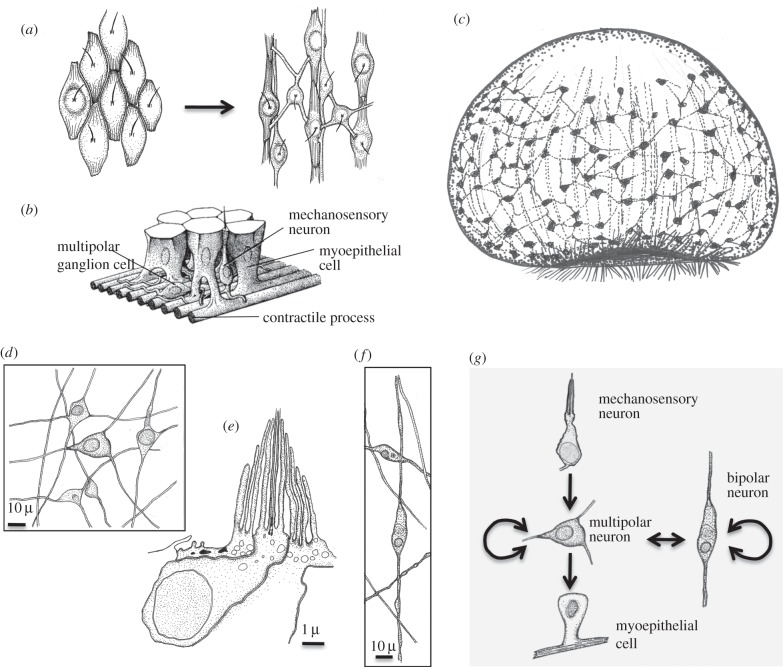
“These latter cells would have constituted the first nerve net, which possibly controlled some form of amoeboid locomotion.”
§ Gastric pouches and the mucociliary sole: setting the stage for nervous system evolution > Introduction
hedgedconditional- Asserted: passes — The authors put it forward as true.
- Checkable: passes — It can be checked against evidence.
- Load-bearing: passes — The paper’s conclusions depend on it.
- Based: unclear — It is unclear why the paper says it holds.
It may state two separate claims as one.
None of the sources cited for this claim have been checked yet.
In the paper
“They were swimming or lived partially benthic in shallow waters, filtering and concentrating dissolved organic carbon and bacteria as microphageous suspension feeders [3,15].”
§ Gastric pouches and the mucociliary sole: setting the stage for nervous system evolution > The choanoblastaea, a sphere of choanoflagellate-like cells
What the sources say
- Not checked yetcites [3] Sperling EA, Vinther J 2010 A placozoan affinity for Dickinsonia and the evolution of Late Proterozoic metazoan feeding modes. Evol. Dev. 12, 201– 209. (10.1111/j.1525-142X.2010.00404.x) 20433459 source
- Not checked yetcites [15] Leys SP 2015 Elements of a ‘nervous system’ in sponges. J. Exp. Biol. 218, 581– 591. (10.1242/jeb.110817) 25696821 source
plain- Asserted: passes — The authors put it forward as true.
- Checkable: passes — It can be checked against evidence.
- Load-bearing: unclear — It is unclear whether the paper’s conclusions depend on it.
- Based: passes — The paper gives a reason why it holds.
It may state two separate claims as one.
A conclusion the paper draws from its own results — it cites no other source for it, so there is none to check. The quote shows it is in the paper.
In the paper
“Subsequently, the kopeocytes may have further diversified into cell types specializing in ciliary movement and control, mucus production and secretion of digestive enzymes, thus enabling external digestion and forming a ‘mucociliary sole’ around the gastric opening”
§ Gastric pouches and the mucociliary sole: setting the stage for nervous system evolution > Introduction
hedgedconditional- Asserted: passes — The authors put it forward as true.
- Checkable: fails — It may be too vague to check against evidence.
- Load-bearing: passes — The paper’s conclusions depend on it.
- Based: fails — The paper may give no reason why it holds.
Probably not a substantial claim. It may be too vague to check against evidence. The paper may give no reason why it holds. It may state two separate claims as one.
A conclusion the paper draws from its own results — it cites no other source for it, so there is none to check. The quote shows it is in the paper.
In the paper
“However, digestion was intracellular at first and took place in the same multifunctional cells that also trapped the food—just as in unicellular eukaryotes.”
§ Gastric pouches and the mucociliary sole: setting the stage for nervous system evolution > The choanoblastaea, a sphere of choanoflagellate-like cells > The first metazoan cells: choanoflagellate-like and multifunctional
plain- Asserted: passes — The authors put it forward as true.
- Checkable: passes — It can be checked against evidence.
- Load-bearing: passes — The paper’s conclusions depend on it.
- Based: passes — The paper gives a reason why it holds.
It may state two separate claims as one.
In the paper
“The sister cell-type concept [5] posits that cell-type evolution can be resolved into a scheme of stepwise diversifications, giving rise to sister cell types [5]”
§ Gastric pouches and the mucociliary sole: setting the stage for nervous system evolution > Introduction
What the sources say
- Not checked yetcites [5] Arendt D 2008 The evolution of cell types in animals: emerging principles from molecular studies. Nature reviews. Genetics 9, 868– 882. (10.1038/nrg2416) 18927580
plaindirect- Asserted: passes — The authors put it forward as true.
- Checkable: passes — It can be checked against evidence.
- Load-bearing: passes — The paper’s conclusions depend on it.
- Based: passes — The paper gives a reason why it holds.
Probably not a substantial claim.
None of the sources cited for this claim have been checked yet.
In the paper
“Five subfamilies of transient receptor potential (TRP) channels were present [24], among which TRPV (vanilloid TRP) channels likely played an ancient role in mechanosensation”
§ Gastric pouches and the mucociliary sole: setting the stage for nervous system evolution > The choanoblastaea, a sphere of choanoflagellate-like cells > The first metazoan cells: choanoflagellate-like and multifunctional
What the sources say
- Not checked yetcites [24] Cai X, Clapham DE 2012 Ancestral Ca2+ signaling machinery in early animal and fungal evolution. Mol. Biol. Evol. 29, 91– 100. (10.1093/molbev/msr149) 21680871 PMC4037924
- Not checked yetcites [25] Fujiu K, Nakayama Y, Iida H, Sokabe M, Yoshimura K 2011 Mechanoreception in motile flagella of Chlamydomonas. Nat. Cell Biol. 13, 630– 632. (10.1038/ncb2214) 21478860
hedgedconditional- Asserted: passes — The authors put it forward as true.
- Checkable: passes — It can be checked against evidence.
- Load-bearing: unclear — It is unclear whether the paper’s conclusions depend on it.
- Based: passes — The paper gives a reason why it holds.
It may state two separate claims as one.
The paper states this without a source or data behind it here, so there is nothing to check it against. The quote shows it is in the paper.
In the paper
“From Haeckel's times until today, strong support for the gastraea hypothesis comes from the prevalence of gastrula-like stages during animal development that are interpreted as recapitulation of the gastraea-like ancestral body plan.”
§ Gastric pouches and the mucociliary sole: setting the stage for nervous system evolution > The microphageous gastraea
boostedcorrelational- Asserted: passes — The authors put it forward as true.
- Checkable: passes — It can be checked against evidence.
- Load-bearing: fails — The paper’s conclusions may not depend on it.
- Based: fails — The paper may give no reason why it holds.
Probably not a substantial claim. The paper’s conclusions may not depend on it. The paper may give no reason why it holds.
A conclusion the paper draws from its own results — it cites no other source for it, so there is none to check. The quote shows it is in the paper.
In the paper
“The initial function of this nerve net might have been the control of amoeboid locomotion of the gastraea, grazing on algal mats (resembling the movement of an amoeba, but at multicellular scale).”
§ Gastric pouches and the mucociliary sole: setting the stage for nervous system evolution > The benthic gastraea: evolution of the nerve net
hedgedconditional- Asserted: passes — The authors put it forward as true.
- Checkable: passes — It can be checked against evidence.
- Load-bearing: fails — The paper’s conclusions may not depend on it.
- Based: fails — The paper may give no reason why it holds.
Probably not a substantial claim. The paper’s conclusions may not depend on it. The paper may give no reason why it holds.
In the paper
“the thyroid-related transcription factors TTF-2/foxE4, foxq1 and foxA are jointly expressed in the amphioxus and ascidian endostyle, a presumed homolog of the thyroidea that harbours mucus-secreting and motile ciliated cells; and this function of the Fox genes is considered ancestral for the chordates [119].”
§ Gastric pouches and the mucociliary sole: setting the stage for nervous system evolution > The benthic gastraea: external digestion with a mucociliary sole > A link between the mucociliary cell types and Fox family evolution
What the sources say
- Not checked yetcites [119] Hiruta J, Mazet F, Yasui K, Zhang P, Ogasawara M 2005 Comparative expression analysis of transcription factor genes in the endostyle of invertebrate chordates. Dev. Dyn. 233, 1031– 1037. (10.1002/dvdy.20401) 15861404
hedgedcorrelational- Asserted: passes — The authors put it forward as true.
- Checkable: passes — It can be checked against evidence.
- Load-bearing: unclear — It is unclear whether the paper’s conclusions depend on it.
- Based: passes — The paper gives a reason why it holds.
It may state two separate claims as one.
In the paper
“Feeding traces indicate that one of the most characteristic fossils of the Ediacaran fauna, Dickinsonia, was grazing on the sea floor, which was covered by ubiquitous microbial mats [3] (figure 4a).”
§ Gastric pouches and the mucociliary sole: setting the stage for nervous system evolution > The benthic gastraea: external digestion with a mucociliary sole > Grazing algal mats with mucus and digestive gland cells
What the sources say
- Not checked yetcites [3] Sperling EA, Vinther J 2010 A placozoan affinity for Dickinsonia and the evolution of Late Proterozoic metazoan feeding modes. Evol. Dev. 12, 201– 209. (10.1111/j.1525-142X.2010.00404.x) 20433459 source
hedged- Asserted: passes — The authors put it forward as true.
- Checkable: passes — It can be checked against evidence.
- Load-bearing: passes — The paper’s conclusions depend on it.
- Based: passes — The paper gives a reason why it holds.
It may state two separate claims as one.
- The authors state this as an assumption: Dickinsonia's entire ventral body surface was a digestive sole covered with mucus and cilia.
A conclusion the paper draws from its own results — it cites no other source for it, so there is none to check. The quote shows it is in the paper.
In the paper
“Importantly, neuromuscular orthogon and mucociliary sole appear to have overlapped, because longitudinal muscles reach the gastric opening (at least in cnidarians).”
§ Gastric pouches and the mucociliary sole: setting the stage for nervous system evolution > The benthic gastraea: evolution of the nerve net > The neuromuscular orthogon
hedgedcorrelational- Asserted: passes — The authors put it forward as true.
- Checkable: passes — It can be checked against evidence.
- Load-bearing: unclear — It is unclear whether the paper’s conclusions depend on it.
- Based: passes — The paper gives a reason why it holds.
It may state two separate claims as one.
None of the sources cited for this claim have been checked yet.
In the paper
“As a rule, the ectodermal muscle fibres associated with the nerve are oriented longitudinally, that is in parallel to the primary body axis (while the inner layer forms circular fibres [61,62]).”
§ Gastric pouches and the mucociliary sole: setting the stage for nervous system evolution > The benthic gastraea: evolution of the nerve net > The neuromuscular orthogon
What the sources say
- Not checked yetcites [61] Hertwig O, Hertwig R 1879 Die Actinien. In Studien zur Blättertheorie. Jena, Germany: Gustav Fischer.
- Not checked yetcites [62] Hyman LH 1940 The invertebrates: protozoa through Ctenophora. New York, NY: McGraw-Hill Book Company.
plaincorrelational- Asserted: passes — The authors put it forward as true.
- Checkable: passes — It can be checked against evidence.
- Load-bearing: passes — The paper’s conclusions depend on it.
- Based: passes — The paper gives a reason why it holds.
It may state two separate claims as one.
None of the sources cited for this claim have been checked yet.
In the paper
“Most prominently, foxj has been identified as an ancient key regulator of motile cilia biogenesis [72,112,113], conserved in cnidarians [72] and even sponges [114].”
§ Gastric pouches and the mucociliary sole: setting the stage for nervous system evolution > The benthic gastraea: external digestion with a mucociliary sole > A link between the mucociliary cell types and Fox family evolution
What the sources say
- Not checked yetcites [72] Vij S et al. 2012 Evolutionarily ancient association of the FoxJ1 transcription factor with the motile ciliogenic program. PLoS Genet. 8, e1003019 (10.1371/journal.pgen.1003019) 23144623 PMC3493443
- Not checked yetcites [112] Stubbs JL, Oishi I, Izpisua Belmonte JC, Kintner C 2008 The forkhead protein Foxj1 specifies node-like cilia in Xenopus and zebrafish embryos. Nat. Genet. 40, 1454– 1460. (10.1038/ng.267) 19011629 PMC4648715
- Not checked yetcites [113] Yu X, Ng CP, Habacher H, Roy S 2008 Foxj1 transcription factors are master regulators of the motile ciliogenic program. Nat. Genet. 40, 1445– 1453. (10.1038/ng.263) 19011630
plaindirect- Asserted: passes — The authors put it forward as true.
- Checkable: passes — It can be checked against evidence.
- Load-bearing: passes — The paper’s conclusions depend on it.
- Based: passes — The paper gives a reason why it holds.
It may state two separate claims as one.
None of the sources cited for this claim have been checked yet.
In the paper
“A choanocyte-origin has been previously postulated for enterocytes [45] and for flame cells [46], based on morphological, functional and molecular resemblance.”
§ Gastric pouches and the mucociliary sole: setting the stage for nervous system evolution > The benthic gastraea: external digestion with a mucociliary sole > Diversification of endochoanocytes: enterocytes and excretory cells
What the sources say
- Not checked yetcites [45] Takashima S, Gold D, Hartenstein V 2012 Stem cells and lineages of the intestine: a developmental and evolutionary perspective. Dev. Genes Evol. 223, 85– 102. (10.1007/s00427-012-0422-8) 23179635 PMC3873164
- Not checked yetcites [46] Jacobs DK, Nakanishi N, Yuan D, Camara A, Nichols SA, Hartenstein V 2007 Evolution of sensory structures in basal metazoa. Integr. Comp. Biol. 47, 712– 723. (10.1093/icb/icm094) 21669752
plaincorrelational- Asserted: passes — The authors put it forward as true.
- Checkable: passes — It can be checked against evidence.
- Load-bearing: fails — The paper’s conclusions may not depend on it.
- Based: passes — The paper gives a reason why it holds.
Probably not a substantial claim. The paper’s conclusions may not depend on it.
None of the sources cited for this claim have been checked yet.
In the paper
“Interestingly, the metazoan foxA, B, C, D and E subfamilies are evolutionarily related [120–122] and resulted from duplications of an ancient precursor gene;”
§ Gastric pouches and the mucociliary sole: setting the stage for nervous system evolution > The benthic gastraea: external digestion with a mucociliary sole > A link between the mucociliary cell types and Fox family evolution
What the sources say
- Not checked yetcites [120] Adell T, Muller WE 2004 Isolation and characterization of five Fox (Forkhead) genes from the sponge Suberites domuncula. Gene 334, 35– 46. (10.1016/j.gene.2004.02.036) 15256253
- Not checked yetcites [121] Mazet F, Yu JK, Liberles DA, Holland LZ, Shimeld SM 2003 Phylogenetic relationships of the Fox (Forkhead) gene family in the Bilateria. Gene 316, 79– 89. (10.1016/S0378-1119(03)00741-8) 14563554
- Not checked yetcites [122] Magie CR, Pang K, Martindale MQ 2005 Genomic inventory and expression of Sox and Fox genes in the cnidarian Nematostella vectensis. Dev. Genes Evol. 215, 618– 630. (10.1007/s00427-005-0022-y) 16193320
plaindirect- Asserted: passes — The authors put it forward as true.
- Checkable: passes — It can be checked against evidence.
- Load-bearing: unclear — It is unclear whether the paper’s conclusions depend on it.
- Based: passes — The paper gives a reason why it holds.
It may state two separate claims as one.
In the paper
“Placozoans move by ciliary gliding with the thick mucociliary sole facing the sea floor, and by concomitant contraction of the syncytial fibre cells (figure 4b).”
§ Gastric pouches and the mucociliary sole: setting the stage for nervous system evolution > The benthic gastraea: external digestion with a mucociliary sole > Grazing algal mats with mucus and digestive gland cells
What the sources say
- Not checked yetcites [104] Ruthmann A, Behrendt G, Wahl R 1986 The ventral epithelium of Trichoplax adhaerens (Placozoa): cytoskeletal structures, cell contacts and endocytosis. Zoomorphology 106, 115– 122. (10.1007/BF00312113)
plaindirect- Asserted: passes — The authors put it forward as true.
- Checkable: passes — It can be checked against evidence.
- Load-bearing: passes — The paper’s conclusions depend on it.
- Based: passes — The paper gives a reason why it holds.
It may state two separate claims as one.
In the paper
“Such an ectodermal nerve net essentially controlled body wall contractions, possibly mediating local to more widespread ‘avoidance’ responses to mechanical stimuli [141].”
§ Gastric pouches and the mucociliary sole: setting the stage for nervous system evolution > The benthic gastraea: evolution of the nerve net > The neuromuscular orthogon
What the sources say
- Not checked yetcites [141] Pantin CFA 1956 The origin of the nervous system. Pubbl. Staz. Zool. Napoli 28, 171– 181.
hedgedconditional- Asserted: passes — The authors put it forward as true.
- Checkable: passes — It can be checked against evidence.
- Load-bearing: passes — The paper’s conclusions depend on it.
- Based: passes — The paper gives a reason why it holds.
It may state two separate claims as one.
What the paper did — it cites no source for this, so there is none to check. The quote shows it is in the paper.
In the paper
“Necessarily, in the absence of comparative molecular data for most of the cell types discussed here, the postulated sequence of cell-type diversification events underlying these transitions remains tentative.”
§ Gastric pouches and the mucociliary sole: setting the stage for nervous system evolution > Conclusion
hedgedconditional- Asserted: passes — The authors put it forward as true.
- Checkable: passes — It can be checked against evidence.
- Load-bearing: passes — The paper’s conclusions depend on it.
- Based: passes — The paper gives a reason why it holds.
Probably not a substantial claim.
A conclusion the paper draws from its own results — it cites no other source for it, so there is none to check. The quote shows it is in the paper.
In the paper
“In essence, we hypothesize that such locomotion required more sensory integration and coordination with increasing body size (and that the increase in body size in turn resulted from the invention of the mucociliary sole with external digestion).”
§ Gastric pouches and the mucociliary sole: setting the stage for nervous system evolution > The benthic gastraea: evolution of the nerve net > The neuromuscular orthogon
hedgeddirect- Asserted: fails — The authors may not put it forward as true.
- Checkable: passes — It can be checked against evidence.
- Load-bearing: passes — The paper’s conclusions depend on it.
- Based: fails — The paper may give no reason why it holds.
Probably not a substantial claim. The authors may not put it forward as true. The paper may give no reason why it holds. It may state two separate claims as one.
None of the sources cited for this claim have been checked yet.
In the paper
“These diverticulae have been compared with cnidarian pouches repeatedly [169,170] (figure 6e), which would imply that modern cnidarians resemble ‘a grade of Late Precambrian organization from which bilaterians evolved’ [171].”
§ Gastric pouches and the mucociliary sole: setting the stage for nervous system evolution > Evolution of the Metamera: the invention of gastric pouches > The Dickinsoniids
What the sources say
- Not checked yetcites [169] Valentine JW 1992 Dickinsonia as a polypoid organism. Palaeobiology 18, 178– 182. source
- Not checked yetcites [170] Malakhov VV 2004 New ideas on the origin of bilateral animals. Russ. J. Mar. Biol. 30, S22– S33. (10.1007/s11179-005-0019-4)
- Not checked yetcites [171] Budd GE, Jensen S 2000 A critical reappraisal of the fossil record of the bilaterian phyla. Biol. Rev. 75, 253– 295. (10.1017/S000632310000548X) 10881389 source
hedgedcorrelational- Asserted: passes — The authors put it forward as true.
- Checkable: passes — It can be checked against evidence.
- Load-bearing: passes — The paper’s conclusions depend on it.
- Based: passes — The paper gives a reason why it holds.
Probably not a substantial claim. It may state two separate claims as one.
A conclusion the paper draws from its own results — it cites no other source for it, so there is none to check. The quote shows it is in the paper.
In the paper
“Our scenario explains the evolutionary origin of this fibre, yet cannot explain why it is so persistent in extant vertebrates.”
§ Gastric pouches and the mucociliary sole: setting the stage for nervous system evolution > Towards the Bilateria > From digestive sole to creeping sole and Reissner's fibre
plain- Asserted: passes — The authors put it forward as true.
- Checkable: passes — It can be checked against evidence.
- Load-bearing: unclear — It is unclear whether the paper’s conclusions depend on it.
- Based: passes — The paper gives a reason why it holds.
It may state two separate claims as one.
In the paper
“The obvious advantage of this innovation was the extension of the internal surface, i.e. the surface of the resorptive epithelium, and would have intensified body physiology and probably allowed the maintenance and movement of larger body forms [163]”
§ Gastric pouches and the mucociliary sole: setting the stage for nervous system evolution > Evolution of the Metamera: the invention of gastric pouches
What the sources say
- Not checked yetcites [163] Laflamme M, Xiao S, Kowalewski M 2009 From the cover: osmotrophy in modular Ediacara organisms. Proc. Natl Acad. Sci. USA 106, 14 438– 14 443. (10.1073/pnas.0904836106) PMC2732876 19706530 source
hedgedconditional- Asserted: passes — The authors put it forward as true.
- Checkable: passes — It can be checked against evidence.
- Load-bearing: passes — The paper’s conclusions depend on it.
- Based: passes — The paper gives a reason why it holds.
It may state two separate claims as one.
None of the sources cited for this claim have been checked yet.
In the paper
“Similar ideas have been put forward repeatedly [5,66,67] and imply that the first synapse arose from the aggregation of vesicle-related intercellular signalling modules, including synaptotagmin, SNARE-complex components and postsynaptic receptor complexes, as extensively reviewed elsewhere [15,32,34,46,60].”
§ Gastric pouches and the mucociliary sole: setting the stage for nervous system evolution > The benthic gastraea: evolution of the nerve net > The birth of first neurons by division of labour
What the sources say
- Not checked yetcites [15] Leys SP 2015 Elements of a ‘nervous system’ in sponges. J. Exp. Biol. 218, 581– 591. (10.1242/jeb.110817) 25696821 source
- Not checked yetcites [32] Burkhardt P 2015 The origin and evolution of synaptic proteins—choanoflagellates lead the way. J. Exp. Biol. 218, 506– 514. (10.1242/jeb.110247) 25696814 source
- Not checked yetcites [34] Ryan TJ, Grant SG 2009 The origin and evolution of synapses. Nat. Rev. Neurosci. 10, 701– 712. (10.1038/nrn2717) 19738623
- Not checked yetcites [46] Jacobs DK, Nakanishi N, Yuan D, Camara A, Nichols SA, Hartenstein V 2007 Evolution of sensory structures in basal metazoa. Integr. Comp. Biol. 47, 712– 723. (10.1093/icb/icm094) 21669752
- Not checked yetcites [60] Nickel M 2010 Evolutionary emergence of synaptic nervous systems: what can we learn from the non-synaptic, nerveless Porifera? Invertebrate Biol. 129, 1– 16. (10.1111/j.1744-7410.2010.00193.x) source
plaindirect- Asserted: passes — The authors put it forward as true.
- Checkable: passes — It can be checked against evidence.
- Load-bearing: fails — The paper’s conclusions may not depend on it.
- Based: passes — The paper gives a reason why it holds.
Probably not a substantial claim. The paper’s conclusions may not depend on it.
None of the sources cited for this claim have been checked yet.
In the paper
“In cerianthids, these are the only neurons to directly receive sensory innervation, to connect to each other, and to directly innervate, via multiple collaterals, the underlying myofibres [128]; they can thus be regarded as the core of the ancestral nerve net [130].”
§ Gastric pouches and the mucociliary sole: setting the stage for nervous system evolution > The benthic gastraea: evolution of the nerve net > Cell types of the nerve net
What the sources say
- Not checked yetcites [128] Peteya DJ 1973 A light and electron microscope study of the nervous system of Ceriantheopsis americanus (Cnidaria, Ceriantharia). Z. Zellforsch. 141, 301– 317. (10.1007/BF00307408) 4147590
- Not checked yetcites [130] McFarlane ID 1984 Nerve nets and conducting systems in sea anemones: two pathways excite tentacle contractions in Calliactis parasitica. J. Exp. Biol. 108, 137– 149.
plaincorrelational- Asserted: passes — The authors put it forward as true.
- Checkable: passes — It can be checked against evidence.
- Load-bearing: passes — The paper’s conclusions depend on it.
- Based: passes — The paper gives a reason why it holds.
It may state two separate claims as one.
None of the sources cited for this claim have been checked yet.
In the paper
“These data suggest that glutamate was the first excitatory transmitter in nerve net neurons, and that GABA acted as an inhibitory signal, possibly released in a refractory manner by the innervated muscle cells themselves.”
§ Gastric pouches and the mucociliary sole: setting the stage for nervous system evolution > The benthic gastraea: evolution of the nerve net > Glutamate and GABA
What the sources say
- Not checked yetcites [15] Leys SP 2015 Elements of a ‘nervous system’ in sponges. J. Exp. Biol. 218, 581– 591. (10.1242/jeb.110817) 25696821 source
- Not checked yetcites [156] Moroz LL et al. 2014 The ctenophore genome and the evolutionary origins of neural systems. Nature 510, 109– 114. (10.1038/nature13400) 24847885 PMC4337882 source
- Not checked yetcites [158] Delgado LM, Couve E, Schmachtenberg O 2010 GABA and glutamate immunoreactivity in tentacles of the sea anemone Phymactis papillosa (LESSON 1830). J. Morphol. 271, 845– 852. 20309875
hedgeddirect- Asserted: passes — The authors put it forward as true.
- Checkable: passes — It can be checked against evidence.
- Load-bearing: passes — The paper’s conclusions depend on it.
- Based: passes — The paper gives a reason why it holds.
It may state two separate claims as one.
A conclusion the paper draws from its own results — it cites no other source for it, so there is none to check. The quote shows it is in the paper.
In the paper
“First, external digestion with the mucociliary sole would have enabled external digestion and thus enhanced the concentration of nutrients in the gastric cavity.”
§ Gastric pouches and the mucociliary sole: setting the stage for nervous system evolution > Conclusion
hedgeddirect- Asserted: passes — The authors put it forward as true.
- Checkable: passes — It can be checked against evidence.
- Load-bearing: passes — The paper’s conclusions depend on it.
- Based: unclear — It is unclear why the paper says it holds.
It may state two separate claims as one.
In the paper
“The medial section corresponds to the tissue of the former mucociliary sole; this tissue most probably evolved into the medial motor column of the bilaterian nerve cord [44], and the more lateral section into the lateral sensory-integrative columns.”
§ Gastric pouches and the mucociliary sole: setting the stage for nervous system evolution > Towards the Bilateria
What the sources say
- Not checked yetcites [44] Arendt D, Tosches MA, Marlow H In press From nerve net to nerve ring, nerve cord and brain—evolution of animal nervous systems. Nat. Rev. Neurosci. 26675821
hedgedconditional- Asserted: passes — The authors put it forward as true.
- Checkable: passes — It can be checked against evidence.
- Load-bearing: passes — The paper’s conclusions depend on it.
- Based: passes — The paper gives a reason why it holds.
It may state two separate claims as one.
None of the sources cited for this claim have been checked yet.
In the paper
“It has long been suggested that the invention of gastric pouches predated the CBA [164]; this notion can now be revived based on molecular evidence [44].”
§ Gastric pouches and the mucociliary sole: setting the stage for nervous system evolution > Evolution of the Metamera: the invention of gastric pouches
What the sources say
- Not checked yetcites [164] Sedgwick A 1884 On the origin of metameric segmentation and some other morphological questions. Q. J. Microsc. Sci. 24, 43– 82.
- Not checked yetcites [44] Arendt D, Tosches MA, Marlow H In press From nerve net to nerve ring, nerve cord and brain—evolution of animal nervous systems. Nat. Rev. Neurosci. 26675821
hedged- Asserted: passes — The authors put it forward as true.
- Checkable: passes — It can be checked against evidence.
- Load-bearing: unclear — It is unclear whether the paper’s conclusions depend on it.
- Based: passes — The paper gives a reason why it holds.
It may state two separate claims as one.
A conclusion the paper draws from its own results — it cites no other source for it, so there is none to check. The quote shows it is in the paper.
In the paper
“Second, the substantial increase of the internal nutrient-resorbing surface via folding into gastric pouches might have boosted physiology and, consequently, energy supply for locomotion, thus triggering the regionalization and specialization of parts of the nerve net needed for the control of more sophisticated and targeted movements.”
§ Gastric pouches and the mucociliary sole: setting the stage for nervous system evolution > Conclusion
hedgedconditional- Asserted: passes — The authors put it forward as true.
- Checkable: passes — It can be checked against evidence.
- Load-bearing: passes — The paper’s conclusions depend on it.
- Based: unclear — It is unclear why the paper says it holds.
It may state two separate claims as one.
A conclusion the paper draws from its own results — it cites no other source for it, so there is none to check. The quote shows it is in the paper.
In the paper
“Plausibly, body movement changed from multidirectional to unidirectional towards the new anterior end. This would have allowed more targeted food search and avoided passing through areas that had already been grazed (cf. figure 4a).”
§ Gastric pouches and the mucociliary sole: setting the stage for nervous system evolution > Evolution of the Metamera: the invention of gastric pouches > Optimizing water flow
hedgedconditional- Asserted: passes — The authors put it forward as true.
- Checkable: passes — It can be checked against evidence.
- Load-bearing: unclear — It is unclear whether the paper’s conclusions depend on it.
- Based: passes — The paper gives a reason why it holds.
It may state two separate claims as one.
The paper relies on this without support.
A nervous system was present in the last common ancestor of cnidarians and bilaterians (the cnidarian-bilaterian ancestor, CBA).
“Almost certainly, a nervous system was present in the last common ancestor of cnidarians and bilaterians (cnidarian-bilaterian ancestor, CBA)”
The authors state this as an assumption.
The ancient gastraea crept on the sea floor with the gastric opening facing downwards.
“The ancient gastraea is originally assumed as creeping on the sea floor, with the gastric opening facing downwards”
The authors state this as an assumption.
Dickinsonia's entire ventral body surface was a digestive sole covered with mucus and cilia.
“It is assumed that their entire ventral body surface was a digestive ‘sole’ covered with mucus and cilia [3].”
The authors state this as an assumption.
A nerve net existed in the last common ancestor of cnidarians, ctenophores and bilaterians (Neuralia), at the exclusion of sponges and placozoans.
“As sponges and placozoans do not form a nerve net, the most parsimonious assumption appears to be that a nerve net existed in the last common ancestor of cnidarians, ctenophores and bilaterians (a grouping referred to as Neuralia by Nielsen [8]); yet, in light of the current uncertainties about the placement of the ctenophores [137], the existence of the ‘Neuralia’ at the exclusion of sponges and”
The authors state this as an assumption.
The overall establishment of internal currents passing through the surface-extended pouches closely resembled that of some extant cnidarians.
“Apart from that, we can assume that the overall establishment of internal currents passing through the surface-extended pouches might have closely resembled that of some extant cnidarians.”
Claims other papers make about this one
Each is checked against this paper’s own text: does it say what the citing paper says it does?
In the citing paper
“The ciliated mechanosensory cells in cnidarians are also similar to the hair cells of vertebrates, and may represent descendants of an ancient metazoan sensory cell type [64].”
From Back to the Basics: Cnidarians Start to Fire (2017) · cites this paper as [64]
Citations
Cites
Non-muscle myosin II takes centre stage in cell adhesion and migration
Vicente‐Manzanares, M., Ma, X., Adelstein, R. S., & Horwitz, A. R. (2009) · Nature Reviews Molecular Cell Biology · doi:10.1038/nrm2786 · Cited by 2,137
The Primary Cilium as the Cell's Antenna: Signaling at a Sensory Organelle
Singla, V., & Reiter, J. F. (2006) · Science · doi:10.1126/science.1124534 · Cited by 1,218
Confinement and Low Adhesion Induce Fast Amoeboid Migration of Slow Mesenchymal Cells
Liu, Y., Berre, M. L., Lautenschläger, F., Maiuri, P., Callan-Jones, A., Heuzé, M. L., Takaki, T., Voituriez, R., & Piel, M. (2015) · Cell · doi:10.1016/j.cell.2015.01.007 · Cited by 866
The ctenophore genome and the evolutionary origins of neural systems
Moroz, L. L., Kocot, K. M., Citarella, M. R., Dosung, S., Norekian, T. P., Povolotskaya, I. S., Grigorenko, A. P., Dailey, C., Berezikov, E., Buckley, K. M., et al. (2014) · Nature · doi:10.1038/nature13400 · Cited by 716
(1940) · Andalas University Repository (Andalas University) · Cited by 591
The origin and evolution of synapses
Ryan, T. J., & Grant, S. G. N. (2009) · Nature reviews. Neuroscience · doi:10.1038/nrn2717 · Cited by 535
The evolution of cell types in animals: emerging principles from molecular studies
Arendt, D. (2008) · Nature Reviews Genetics · doi:10.1038/nrg2416 · Cited by 525
Self-citationatonal is the proneural gene for Drosophila photoreceptors
Jarman, A. P., Grell, E. H., Ackerman, L. D., Jan, L. Y., & Jan, Y. N. (1994) · Nature · doi:10.1038/369398a0 · Cited by 512
Foxj1 transcription factors are master regulators of the motile ciliogenic program
Yu, X., Ng, C. P., Habacher, H., & Roy, S. (2008) · Nature Genetics · doi:10.1038/ng.263 · Cited by 495
The VGL-Chanome: A Protein Superfamily Specialized for Electrical Signaling and Ionic Homeostasis
Yu, F. H., & Catterall, W. A. (2004) · Science s STKE · doi:10.1126/stke.2532004re15 · Cited by 488
Research works printed but not linked: 7
- Haeckel E, 1874, Die Gastraea-Theorie, die phylogenetische Classification des Thierreiches und die Homologie der Keimblätter, Jena Z. Naturwiss, 8, 1
- Leadbeater BSC, 1983, Distribution and chemistry of microfilaments in choanoflagellates, with special reference to the collar and other tentacle systems, Protistologia, 10, 157
- Aiello E, 1974, Cilia and flagella, 353
- Arendt D, 2004, Gastrulation
- Hertwig O, 1879, Die Actinien. In Studien zur Blättertheorie
- Bullock TH, 1965, Structure and function in the nervous system of invertebrates
- Hernandez-Nicaise ML, 1991, Microscopic anatomy of the invertebrates, volume Placozoa, Porifera, Cnidaria, and Ctenophora, 359
Cited by
Sorted by citations
The origin and evolution of cell types
Arendt, D., Musser, J. M., Baker, C. V. H., Bergman, A., Cepko, C., Erwin, D. H., Pavlicev, M., Schlosser, G., Widder, S., Laubichler, M. D., et al. (2016) · Nature Reviews Genetics · doi:10.1038/nrg.2016.127 · Cited by 764
Self-citationThe Origin of Animal Multicellularity and Cell Differentiation
(2017) · doi:10.1016/j.devcel.2017.09.016 · Cited by 419
Self-citationThe origin of Metazoa: a unicellular perspective
Sebé-Pedrós, A., Degnan, B. M., & Ruiz-Trillo, I. (2017) · Nature Reviews Genetics · doi:10.1038/nrg.2017.21 · Cited by 332
From nerve net to nerve ring, nerve cord and brain — evolution of the nervous system
Arendt, D., Tosches, M. A., & Marlow, H. (2016) · Nature Reviews Neuroscience · doi:10.1038/nrn.2015.15 · Cited by 279
Self-citationProfiling cellular diversity in sponges informs animal cell type and nervous system evolution
Musser, J. M., Schippers, K. J., Nickel, M., Mizzon, G., Kohn, A. B., Pape, C., Ronchi, P., Papadopoulos, N., Tarashansky, A. J., Hammel, J. U., et al. (2021) · Science · doi:10.1126/science.abj2949 · Cited by 242
Self-citationThe system of cerebrospinal fluid-contacting neurons.
VIGH-TEICHMANN, I., & VIGH, B. (1983) · Archivum histologicum japonicum · doi:10.1679/aohc.46.427 · Cited by 195
Light-regulated collective contractility in a multicellular choanoflagellate
(2019) · doi:10.1126/science.aay2346 · Cited by 169
Self-citationPluripotency and the origin of animal multicellularity
(2019) · doi:10.1038/s41586-019-1290-4 · Cited by 146
Back to the Basics: Cnidarians Start to Fire
Bosch, T. C. G., Klimovich, A., Domazet-Lošo, T., Gründer, S., Holstein, T. W., Jékely, G., Miller, D. J., Murillo-Rincon, A. P., Rentzsch, F., Richards, G. S., et al. (2017) · Trends in Neurosciences · doi:10.1016/j.tins.2016.11.005 · Cited by 144
Bacterial lipids activate, synergize, and inhibit a developmental switch in choanoflagellates
Woznica, A., Cantley, A. M., Beemelmanns, C., Freinkman, E., Clardy, J., & King, N. (2016) · Proceedings of the National Academy of Sciences · doi:10.1073/pnas.1605015113 · Cited by 139
Evolution of neuronal types and families
Arendt, D., Bertucci, P. Y., Achim, K., & Musser, J. M. (2019) · Current Opinion in Neurobiology · doi:10.1016/j.conb.2019.01.022 · Cited by 128
Self-citationHigh Cell Diversity and Complex Peptidergic Signaling Underlie Placozoan Behavior
Varoqueaux, F., Williams, E. A., Grandemange, S., Truscello, L., Kamm, K., Schierwater, B., Jékely, G., & Fasshauer, D. (2018) · Current Biology · doi:10.1016/j.cub.2018.08.067 · Cited by 122
On the evolution of bilaterality
Genikhovich, G., & Technau, U. (2017) · Development · doi:10.1242/dev.141507 · Cited by 118
Neuropeptidergic integration of behavior in Trichoplax adhaerens, an animal without synapses
Senatore, A., Reese, T. S., & Smith, C. L. (2017) · Journal of Experimental Biology · doi:10.1242/jeb.162396 · Cited by 113
Morphological Coordination: A Common Ancestral Function Unifying Neural and Non-Neural Signaling
Fields, C., Bischof, J., & Levin, M. G. (2019) · Physiology · doi:10.1152/physiol.00027.2019 · Cited by 89
Minimal physicalism as a scale-free substrate for cognition and consciousness
Fields, C., Glazebrook, J. F., & Levin, M. G. (2021) · Neuroscience of Consciousness · doi:10.1093/nc/niab013 · Cited by 99
A flagellate-to-amoeboid switch in the closest living relatives of animals
Brunet, T., Albert, M., Roman, W., Coyle, M. C., Spitzer, D. C., & King, N. (2021) · eLife · doi:10.7554/elife.61037 · Cited by 75
Self-citationVergara, H. M., Bertucci, P. Y., Hantz, P., Tosches, M. A., Achim, K., Vopálenský, P., & Arendt, D. (2017) · Proceedings of the National Academy of Sciences · doi:10.1073/pnas.1610602114 · Cited by 81
Self-citationEarly animal evolution: a morphologist's view
Nielsen, C. (2019) · Royal Society Open Science · doi:10.1098/rsos.190638 · Cited by 77
Diversity of cilia-based mechanosensory systems and their functions in marine animal behaviour
Bezares-Calderón, L. A., Berger, J., & Jékely, G. (2019) · Philosophical Transactions of the Royal Society B Biological Sciences · doi:10.1098/rstb.2019.0376 · Cited by 82
Paganos, P., Voronov, D., Musser, J. M., Arendt, D., & Arnone, M. I. (2021) · eLife · doi:10.7554/elife.70416 · Cited by 73
Self-citationEvolution of the bilaterian mouth and anus
Nielsen, C., Brunet, T., & Arendt, D. (2018) · Nature Ecology & Evolution · doi:10.1038/s41559-018-0641-0 · Cited by 70
Self-citationA non-bilaterian perspective on the development and evolution of animal digestive systems
Steinmetz, P. R. H. (2019) · Cell and Tissue Research · doi:10.1007/s00441-019-03075-x · Cited by 67
“…has long been proposed that the similarities of both cell types are due to a common ancestry, and that the last common ancestor of all animals therefore consisted of a uniform, ball-like colony of choanocyte-like cells (Arendt et al. 2015; Brunet and King 2017; Cavalier-Smith 2017; Nielsen 2008).”
BackgroundArendt, D. (2021) · Philosophical Transactions of the Royal Society B Biological Sciences · doi:10.1098/rstb.2020.0347 · Cited by 75
Self-citationThe Evolutionary Assembly of Neuronal Machinery
Arendt, D. (2020) · Current Biology · doi:10.1016/j.cub.2020.04.008 · Cited by 72
Self-citationSmith, C. L., Reese, T. S., Govezensky, T., & Barrio, R. A. (2019) · Proceedings of the National Academy of Sciences · doi:10.1073/pnas.1815655116 · Cited by 62
Phylogenetic origins of biological cognition: convergent patterns in the early evolution of learning
van Duijn, M. (2017) · Interface Focus · doi:10.1098/rsfs.2016.0158 · Cited by 60
Xenacoelomorpha's significance for understanding bilaterian evolution
Hejnol, A., & Pang, K. (2016) · Current Opinion in Genetics & Development · doi:10.1016/j.gde.2016.05.019 · Cited by 58
Getting Nervous: An Evolutionary Overhaul for Communication
Varoqueaux, F., & Fasshauer, D. (2017) · Annual Review of Genetics · doi:10.1146/annurev-genet-120116-024648 · Cited by 47
Dufour, S. C., & McIlroy, D. (2016) · Geological Society London Special Publications · doi:10.1144/sp448.5 · Cited by 48
The animal sensorimotor organization: a challenge for the environmental complexity thesis
Keijzer, F., & Arnellos, A. (2017) · Biology & Philosophy · doi:10.1007/s10539-017-9565-3 · Cited by 47
Constructional and functional anatomy of Ediacaran rangeomorphs
Butterfield, N. J. F. (2020) · Geological Magazine · doi:10.1017/s0016756820000734 · Cited by 47
Mayorova, T. D., Hammar, K. M., Winters, C. A., Reese, T. S., & Smith, C. L. (2019) · Biology Open · doi:10.1242/bio.045674 · Cited by 40
Early evolution of radial glial cells in Bilateria
Helm, C., Karl, A., Beckers, P., Kaul-Strehlow, S., Ulbricht, E., Kourtesis, I., Kuhrt, H., Hausen, H., Bartolomaeus, T., Reichenbach, A., et al. (2017) · Proceedings of the Royal Society B Biological Sciences · doi:10.1098/rspb.2017.0743 · Cited by 40
Animal Evolution: Convergent Nerve Cords?
Arendt, D. (2018) · Current Biology · doi:10.1016/j.cub.2018.01.056 · Cited by 40
Self-citationAlternative neural systems: What is a neuron? (Ctenophores, sponges and placozoans)
Moroz, L. L., & Romanova, D. Y. (2022) · Frontiers in Cell and Developmental Biology · doi:10.3389/fcell.2022.1071961 · Cited by 39
Events in Early Nervous System Evolution
Paulin, M. G., & Cahill‐Lane, J. (2021) · Topics in Cognitive Science · doi:10.1111/tops.12461 · Cited by 35
Sponges as models to study emergence of complex animals
Adamska, M. (2016) · Current Opinion in Genetics & Development · doi:10.1016/j.gde.2016.05.026 · Cited by 34
Following the logic behind biological interpretations of the Ediacaran biotas
Runnegar, B. N. (2021) · Geological Magazine · doi:10.1017/s0016756821000443 · Cited by 33
Insights into the evolution of digestive systems from studies of Trichoplax adhaerens
Smith, C. L., & Mayorova, T. D. (2019) · Cell and Tissue Research · doi:10.1007/s00441-019-03057-z · Cited by 29
Hox genes and body segmentation
Arendt, D. (2018) · Science · doi:10.1126/science.aav0692 · Cited by 29
Self-citationChoanoflagellates and the ancestry of neurosecretory vesicles
Göhde, R., Naumann, B. T., Laundon, D., Imig, C., McDonald, K. L., Cooper, B. H., Varoqueaux, F., Fasshauer, D., & Burkhardt, P. (2021) · Philosophical Transactions of the Royal Society B Biological Sciences · doi:10.1098/rstb.2019.0759 · Cited by 28
Placozoan fiber cells: mediators of innate immunity and participants in wound healing
Mayorova, T. D., Hammar, K. M., Jung, J. H., Aronova, M. A., Zhang, G., Winters, C. A., Reese, T. S., & Smith, C. L. (2021) · Scientific Reports · doi:10.1038/s41598-021-02735-9 · Cited by 26
Johnson, C. J., Razy‐Krajka, F., Zeng, F., Piekarz, K. M., Biliya, S., Rothbächer, U., & Stolfi, A. (2024) · PLoS Biology · doi:10.1371/journal.pbio.3002555 · Cited by 22
Environmentally regulated clonal-aggregative multicellularity in a choanoflagellatePreprint
Ros-Rocher, N., Reyes-Rivera, J., Horo, U., Combredet, C., Foroughijabbari, Y., Larson, B. T., Coyle, M. C., Houtepen, E., Vermeij, M. J. A., Steenwyk, J. L., et al. (2024) · bioRxiv (Cold Spring Harbor Laboratory) · doi:10.1101/2024.03.25.586565 · Cited by 22
Self-citationCell contractility in early animal evolution
Brunet, T. (2023) · Current Biology · doi:10.1016/j.cub.2023.07.054 · Cited by 20
Self-citationThe Role of the Gustatory System in the Coordination of Feeding
Thoma, V., Kobayashi, K., & Tanimoto, H. (2017) · eNeuro · doi:10.1523/eneuro.0324-17.2017 · Cited by 19
The Enigmatic Reissner’s Fiber and the Origin of Chordates
Aboitiz, F., & Montiel, J. F. (2021) · Frontiers in Neuroanatomy · doi:10.3389/fnana.2021.703835 · Cited by 18
Complex structures from patterned cell sheets
Misra, M., Audoly, B., & Shvartsman, S. Y. (2017) · Philosophical Transactions of the Royal Society B Biological Sciences · doi:10.1098/rstb.2015.0515 · Cited by 18
Evolution of Metazoan Life Cycles and the Origin of Pelagic Larvae
Malakhov, V. V., Bogomolova, E., Kuzmina, T. V., & Temereva, E. N. (2019) · Russian Journal of Developmental Biology · doi:10.1134/s1062360419060043 · Cited by 17
Cell polarity in the protist-to-animal transition
Brunet, T., & Booth, D. S. (2023) · Current topics in developmental biology/Current Topics in Developmental Biology · doi:10.1016/bs.ctdb.2023.03.001 · Cited by 12
Self-citationCoral calcification, mucus, and the origin of skeletal organic molecules
Hohn, S., & Reymond, C. E. (2019) · Coral Reefs · doi:10.1007/s00338-019-01826-4 · Cited by 16
Dufour, S. C., & McIlroy, D. (2017) · Philosophical Transactions of the Royal Society B Biological Sciences · doi:10.1098/rstb.2017.0148 · Cited by 17
Introduction to ‘Origin and evolution of the nervous system’
Strausfeld, N. J., & Hirth, F. (2015) · Philosophical Transactions of the Royal Society B Biological Sciences · doi:10.1098/rstb.2015.0033 · Cited by 15
The Origin and Main Trends in the Evolution of Bilaterally Symmetrical Animals
Malakhov, V. V., & Ганцевич, М. М. (2022) · Paleontological Journal · doi:10.1134/s0031030122080044 · Cited by 13
Hydrodynamics in early animal evolution
Nielsen, C. (2022) · Biological reviews/Biological reviews of the Cambridge Philosophical Society · doi:10.1111/brv.12909 · Cited by 14
Developmental Biology: Reissner’s Fiber and Straightening of the Body Axis
Driever, W. (2018) · Current Biology · doi:10.1016/j.cub.2018.05.080 · Cited by 14
Bodily Complexity: Integrated Multicellular Organizations for Contraction-Based Motility
Arnellos, A., & Keijzer, F. (2019) · Frontiers in Physiology · doi:10.3389/fphys.2019.01268 · Cited by 15
The Single-Celled Ancestors of Animals: A History of HypothesesPreprint
Brunet, T., & King, N. (2020) · Preprints.org · doi:10.20944/preprints202011.0302.v1 · Cited by 13
Self-citationFields, C., & Levin, M. G. (2020) · Communicative & Integrative Biology · doi:10.1080/19420889.2020.1729601 · Cited by 11
Unde venisti PGRMC? Grand-Scale Biology from Early Eukaryotes and Eumetazoan Animal Origins
Cahill, M. A. (2022) · Frontiers in Bioscience-Landmark · doi:10.31083/j.fbl2711317 · Cited by 9
Knoflacher, M. (2024) · Springer eBooks · doi:10.1007/978-3-662-69423-7_6 · Cited by 9
Dynamics of neural activity in early nervous system evolution
Kennedy, A., & Weissbourd, B. (2024) · Current Opinion in Behavioral Sciences · doi:10.1016/j.cobeha.2024.101437 · Cited by 12
Evolution of homology: From archetype towards a holistic concept of cell type
Rusin, L. Y. (2023) · Journal of Morphology · doi:10.1002/jmor.21569 · Cited by 8
Architectural modelling of the fractal-like Ediacaran rangeomorph C harnia masoni
McIlroy, D. (2025) · Journal of the Geological Society · doi:10.1144/jgs2024-242 · Cited by 8
Placozoan secretory cell types implicated in feeding, innate immunity and regulation of behavior
Mayorova, T. D., Koch, T. L., Kachar, B., Jung, J. H., Reese, T. S., & Smith, C. L. (2025) · PLoS ONE · doi:10.1371/journal.pone.0311271 · Cited by 7
Evolutionary Development of Marine Larvae
(2017) · Oxford University Press eBooks · doi:10.1093/oso/9780198786962.003.0002 · Cited by 7
Light-modulated neural control of sphincter regulation in the evolution of through-gut
Yaguchi, J., Sakai, K., Horiuchi, A., Yamamoto, T., Yamashita, T., & Yaguchi, S. (2024) · Nature Communications · doi:10.1038/s41467-024-53203-7 · Cited by 6
On the Origin of Tentacles and Limbs in Deuterostomia
Malakhov, V. V., & Ezhova, O. V. (2023) · Russian Journal of Marine Biology · doi:10.1134/s1063074023080047 · Cited by 6
That Stinging Sensation: Modularity and the Origin of the Stinging Cell
Babonis, L. S. (2025) · Integrative and Comparative Biology · doi:10.1093/icb/icaf070 · Cited by 8
Vertebrate decision making leads to the interdependence of behaviour and wellbeing
Giske, J., Budaev, S. V., Eliassen, S., Higginson, A. D., Jørgensen, C., & Mangel, M. (2025) · Animal Behaviour · doi:10.1016/j.anbehav.2025.123101 · Cited by 5
Lindemann, C. B. (2021) · BioEssays · doi:10.1002/bies.202100143 · Cited by 6
Planar cell polarity coordination in a cnidarian embryo provides clues to animal body axis evolutionPreprint
Uveira, J., Donati, A., Léria, M., Lechable, M., Lahaye, F., Vesque, C., Houliston, E., & Momose, T. (2025) · eLife · doi:10.7554/elife.104508 · Cited by 6
Metabolic and microbial perspectives on the “evolution of evolution”
Powell, R., & O’Malley, M. A. (2019) · Journal of Experimental Zoology Part B Molecular and Developmental Evolution · doi:10.1002/jez.b.22898 · Cited by 4
Planar cell polarity coordination in a cnidarian embryo provides clues to animal body axis evolution
Uveira, J., Donati, A., Léria, M., Lechable, M., Lahaye, F., Vesque, C., Houliston, E., & Momose, T. (2025) · eLife · doi:10.7554/elife.104508.3 · Cited by 3
Escherichia coli self-organizes developmental rosettes
Puri, D., & Allison, K. R. (2024) · Proceedings of the National Academy of Sciences · doi:10.1073/pnas.2315850121 · Cited by 4
The integrative approach to inferring homology: morphology and development combined
Kourki, A. N. (2022) · Biology & Philosophy · doi:10.1007/s10539-022-09846-1 · Cited by 5
The evolutionary and mechanical principles shaping the Drosophila embryonic ventral nerve cord
Karkali, K., & Martı́n-Blanco, E. (2024) · Cells and Development · doi:10.1016/j.cdev.2024.203973 · Cited by 2
Malakhov, V. V., & Ezhova, O. V. (2024) · Paleontological Journal · doi:10.1134/s0031030124601191 · Cited by 2
Mucociliary cell type compositions - bridging the gap between genes and emergent tissue functions
Walentek, P. (2025) · Cells and Development · doi:10.1016/j.cdev.2025.204019 · Cited by 3
Beyond Congruence: Evidential Integration and Inferring the Best Evolutionary ScenarioPreprint
Kourki, A. N. (2021) · Preprints.org · doi:10.20944/preprints202105.0767.v1 · Cited by 2
Planar cell polarity coordination in a cnidarian embryo provides clues to animal body axis evolutionPreprint
Uveira, J., Donati, A., Léria, M., Lechable, M., Lahaye, F., Vesque, C., Houliston, E., & Momose, T. (2025) · eLife · doi:10.7554/elife.104508.1 · Cited by 2
Brāzma, A. (2023) · doi:10.1093/oso/9780192871947.001.0001 · Cited by 1
Early transitions in the evolution of cognition
Kourki, A. N. (2025) · History & Philosophy of the Life Sciences · doi:10.1007/s40656-025-00709-y · Cited by 2
Protostomia and Deuterostomia: Do They Exist?
Malakhov, V. V., & Ezhova, O. V. (2025) · Paleontological Journal · doi:10.1134/s003103012560074x · Cited by 1
From skin to brain: modelling a whole-body coordination scenario of nervous system origin
de Wiljes, O. (2020) · University of Groningen research database (University of Groningen / Centre for Information Technology) · doi:10.33612/diss.123420732
The Integrative Approach to Inferring Homology: Morphology and Development CombinedPreprint
Kourki, A. N. (2021) · Preprints.org · doi:10.20944/preprints202106.0578.v1
Beyond congruence: evidential integration and inferring the best evolutionary scenario
Kourki, A. N. (2022) · Biology & Philosophy · doi:10.1007/s10539-022-09867-w
Evolution and Origins of Nervous Systems
Duruz, J., & Sprecher, S. G. (2022) · Learning materials in biosciences · doi:10.1007/978-3-031-07793-7_8
Brāzma, A. (2023) · Oxford University Press eBooks · doi:10.1093/oso/9780192871947.003.0006
(2023) · Oxford University Press eBooks · doi:10.1093/oso/9780192871947.002.0004
Brāzma, A. (2023) · Oxford University Press eBooks · doi:10.1093/oso/9780192871947.003.0001
Brāzma, A. (2023) · Oxford University Press eBooks · doi:10.1093/oso/9780192871947.003.0007
Brāzma, A. (2023) · Oxford University Press eBooks · doi:10.1093/oso/9780192871947.003.0010
Brāzma, A. (2023) · Oxford University Press eBooks · doi:10.1093/oso/9780192871947.003.0005
Brāzma, A. (2023) · Oxford University Press eBooks · doi:10.1093/oso/9780192871947.003.0002
Brāzma, A. (2023) · Oxford University Press eBooks · doi:10.1093/oso/9780192871947.003.0009
(2023) · Oxford University Press eBooks · doi:10.1093/oso/9780192871947.002.0005
(2023) · Oxford University Press eBooks · doi:10.1093/oso/9780192871947.002.0008
Brāzma, A. (2023) · Oxford University Press eBooks · doi:10.1093/oso/9780192871947.003.0004
Metadata
- Authors
- Arendt, D., Benito-Gutierrez, E., Brunet, T., & Marlow, H.
- Affiliations
- Heidelberg University (DE)
- European Molecular Biology Laboratory, Meyerhofstrasse 1, 69012 Heidelberg, Germany
- European Molecular Biology Laboratory (DE)
- Corresponding author
- Arendt, Detlev
- Venue
- Philosophical Transactions of the Royal Society B: Biological Sciences
- Publisher
- The Royal Society
- Published
- 2015-12-19
- Volume
- 370
- Issue
- 1684
- Pages
- 20150286
- ISSN
- 0962-8436 (ISSN-L)
- 1471-2970
- PMC
- PMC4650134
- OpenAlex
- W2178149281
- Cited by
- 112
- References
- 178
- Citations by year
- 2026: 6 · 2025: 11 · 2024: 8 · 2023: 19 · 2022: 7 · 2021: 12 · 2020: 5 · 2019: 16 · 2018: 6 · 2017: 13 · 2016: 7 · 2015: 2
- FWCI
- 1.18
- Type
- journal article
- Language
- en
- Open access
- hybrid
- doi.org
- Locations
- Philosophical Transactions of the Royal Society B Biological Sciences (publishedVersion, cc-by)
- PubMed Central (publishedVersion, cc-by)
- PubMed (publishedVersion)
- Apollo (University of Cambridge) (submittedVersion, cc-by)
- Apollo (cc-by)
- Topics
- Life Sciences › Agricultural and Biological Sciences › Animal Science and Zoology › Marine Invertebrate Physiology and Ecology
- Life Sciences › Biochemistry, Genetics and Molecular Biology › Molecular Biology › Developmental Biology and Gene Regulation
- Life Sciences › Biochemistry, Genetics and Molecular Biology › Molecular Biology › Planarian Biology and Electrostimulation
- Keywords
- nervous system evolution, gastric pouch, feeding behaviour, locomotion, nerve net, bilateral symmetry, Ediacaran fossils, Dickinsonia, cephalochordates, nutrient resorption
- MeSH terms
- Animals, Biological Evolution, Fossils, Nerve Net, Nervous System, Gastrointestinal Tract
About these checks
Registry, retraction, Cites and statistics results are computed, not judged, with one exception: a printed reference that no index lists is read once by a model before it counts as a citation error. Claims are extracted by a model and kept only when their quote appears verbatim in the text; each cited source is then checked, with a model’s help, for whether it says what the claim relies on. Those verdicts can be wrong — read the claim’s quote and the cited source before relying on one.
A language model drew the claims from the paper on 2026-10-06, under version 3 of the claim definition (model deepseek-v4.1-flash, prompt extract-v3).
A second model labelled each claim on 2026-10-06 (model jev-1.13-20260917, definition revision gold-guideline-v0.2).
Statistics and arithmetic are recomputed, not judged.
Confidence bands are shown only for fields calibrated on our annotated test set. None is calibrated yet, so no band is shown.
What counts as a claim ›How we measure confidence ›How we check this ›
Are you an author, or do you see a problem with this page? Request a review
