

New insights on the genetic etiology of Alzheimer’s and related dementia
Open accessPreprint — published as 10.1038/s41588-022-01024-z · Paper page
The DOI matches its Crossref record; 50 of the 50 references it cites were found in a registry or an index.
Abstract
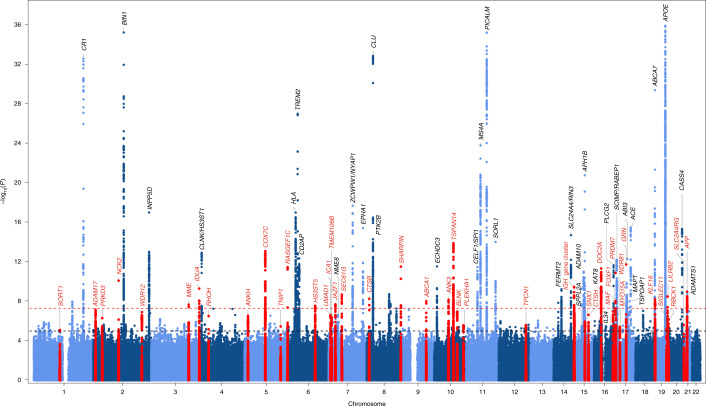
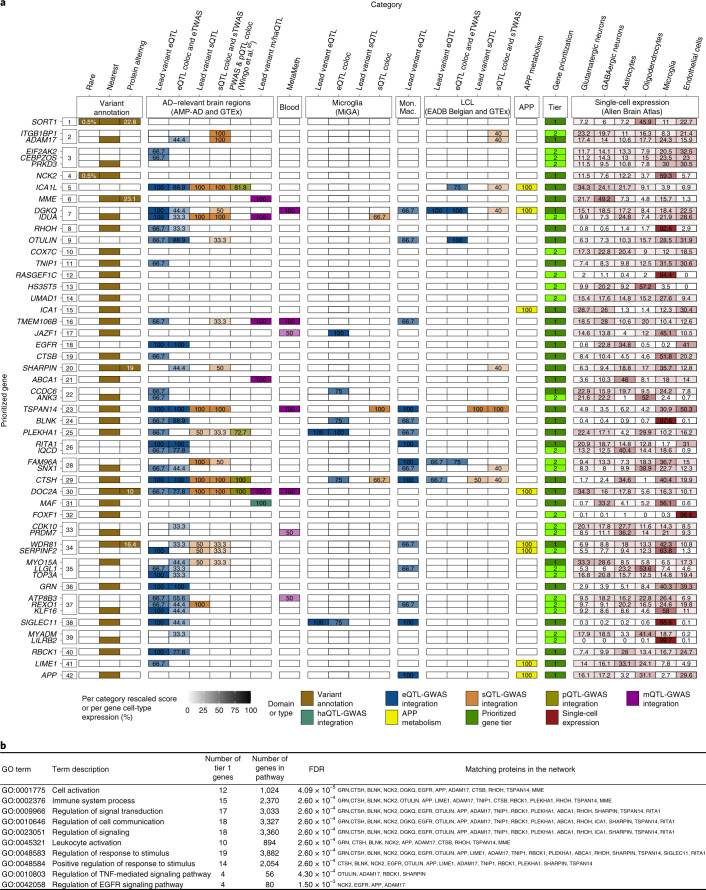
Alzheimer’s disease (AD) is a severe and incurable neurodegenerative disease, and the failure to find effective treatments suggests that the underlying pathology remains poorly understood. Due to its strong heritability, deciphering the genetic landscape of AD and related dementia (ADD) is a unique opportunity to advance our knowledge. We completed a meta-analysis of genome-wide association studies (39,106 clinically AD-diagnosed cases, 46,828 proxy-ADD cases and 401,577 controls) with the most promising signals followed-up in 25,392 independent AD cases and 276,086 controls. We report 75 risk loci for ADD, including 42 novel ones. Pathway-enrichment analyses confirm the involvement of amyloid/Tau pathways, highlight the role of microglia and its potential interaction with APP metabolism. Numerous genes exhibited differential expression or splicing in AD-related conditions and gene prioritization implies EGFR signaling and TNF-α pathway through LUBAC complex. We also generated a novel polygenic risk score strongly associated with the risk of future dementia or progression from mild cognitive impairment to dementia. In conclusion, by more than doubling the number of loci associated with ADD risk, our study offers new insights into the pathophysiological processes underlying AD and offers additional therapeutic entry-points and tools for translational genomics.
Overview
The claims and statistics of this paper haven’t been checked yet.
Free: it reads the open-access text and checks the first 5 claims that cite a source we can check. Create a free account to check every claim.
Integrity signals
Registry
Cites
Statistics
Figures
Verification
Claims the paper makes
The claims and statistics of this paper haven’t been checked yet.
Free: it reads the open-access text and checks the first 5 claims that cite a source we can check. Create a free account to check every claim.
Claims other papers make about this one
Each is checked against this paper’s own text: does it say what the citing paper says it does?
In the citing paper
“As mentioned above, a recent meta-GWAS analysis has identified GWS signals in the IGH (immunoglobulin heavy chain) gene cluster on chromosome 14 ([79]; Table 2), which confirms the WES findings about the involvement of IGHG3 and IGHV3-7 genes in AD risk.”
From Genomics and Functional Genomics of Alzheimer's Disease (2022) · cites this paper as [79]
In the citing paper
“Strikingly, a massive GWAS/GWAX study in 2020 reported 75 AD risk loci, including 42 novel loci, by meta-analysing samples from the UKB and numerous European GWAS consortia, including 39,106 AD cases, 46,828 proxy cases, and 401,577 controls [33].”
From Genomics of Alzheimer’s disease implicates the innate and adaptive immune systems (2021) · cites this paper as [33]
In the citing paper
“Almost all large-scale GWAS have used eQTL association test between GWAS variants and gene expression levels (mRNA transcript or protein) in various AD-related tissue types, e.g. brain and blood, to prioritise the candidate causal genes in susceptibility loci [29–33].”
From Genomics of Alzheimer’s disease implicates the innate and adaptive immune systems (2021) · cites this paper as [33]
In the citing paper
“The myeloid-related innate immune pathways are argued to play a central role in AD pathogenesis and microglia in the brain are regarded as one of the key players [28, 32, 33].”
From Genomics of Alzheimer’s disease implicates the innate and adaptive immune systems (2021) · cites this paper as [33]
In the citing paper
“These studies have further used methylation QTL, histone acetylation QTL, splicing QTL, and chromatin interaction mapping to identify the candidate genes involved in the interaction between SNPs and nearby or distant genes [30, 33].”
From Genomics of Alzheimer’s disease implicates the innate and adaptive immune systems (2021) · cites this paper as [33]
3 more claims about this paper
Create a free account to see every claim other papers make about this one.
Self-check
Percentages, sums and reported differences re-computed from the paper’s own numbers.
The self-check needs the paper’s full text.
Citations
Cites
Integrating single-cell transcriptomic data across different conditions, technologies, and species
Butler, A., Hoffman, P., Smibert, P., Papalexi, E., & Satija, R. (2018) · Nature Biotechnology · doi:10.1038/nbt.4096 · Cited by 13,174
Second-generation PLINK: rising to the challenge of larger and richer datasets
Chang, C. C., Chow, C. C., Tellier, L. C., Vattikuti, S., Purcell, S. M., & Lee, J. J. (2015) · Gigascience · doi:10.1186/s13742-015-0047-8 · Cited by 12,709
Statistical significance for genomewide studies
Storey, J. D., & Tibshirani, R. (2003) · Proceedings of the National Academy of Sciences · doi:10.1073/pnas.1530509100 · Cited by 9,692
LD Score regression distinguishes confounding from polygenicity in genome-wide association studies
Schizophrenia Working Group of the Psychiatric Genomics Consortium, Bulik-Sullivan, B. K., Loh, P.-R., Finucane, H. K., Ripke, S., Yang, J., Patterson, N., Daly, M. J., Price, A. L., & Neale, B. M. (2015) · Nature Genetics · doi:10.1038/ng.3211 · Cited by 5,559
METAL: fast and efficient meta-analysis of genomewide association scans
Willer, C. J., Li, Y., & Abecasis, G. R. (2010) · Bioinformatics · doi:10.1093/bioinformatics/btq340 · Cited by 5,205
Meta-Analysis of 74,046 Individuals Identifies 11 New Susceptibility Loci for Alzheimer’s Disease
(EADI), E. A. D. I., Lambert, J.-C., (GERAD), G. A. E. R. I. A. D., Alzheimer's Disease Genetic Consortium (ADGC), (CHARGE), C. F. H. A. A. R. I. G. E., Ibrahim-Verbaas, C. A., Harold, D., Naj, A. C., Sims, R., Bellenguez, C., et al. (2013) · Nature Genetics · doi:10.1038/ng.2802 · Cited by 4,336
Self-citationNext-generation genotype imputation service and methods
Das, S., Forer, L., Schönherr, S., Sidore, C., Locke, A. E., Kwong, A., Vrieze, S. I., Chew, E. Y., Levy, S., McGue, M., et al. (2016) · Nature Genetics · doi:10.1038/ng.3656 · Cited by 3,808
MAGMA: Generalized Gene-Set Analysis of GWAS Data
de Leeuw, C. A., Mooij, J. M., Heskes, T., & Posthuma, D. (2015) · PLOS Computational Biology · doi:10.1371/journal.pcbi.1004219 · Cited by 3,653
Self-citationAlzheimer Disease Genetics Consortium (ADGC), Kunkle, B. W., The European Alzheimer’s Disease Initiative (EADI), Cohorts for Heart and Aging Research in Genomic Epidemiology Consortium (CHARGE), Genetic and Environmental Risk in AD/Defining Genetic, P. A. E. R. F. A. D. C. (., Grenier-Boley, B., Sims, R., Bis, J. C., Damotte, V., Naj, A. C., et al. (2019) · Nature Genetics · doi:10.1038/s41588-019-0358-2 · Cited by 2,946
Self-citationA reference panel of 64,976 haplotypes for genotype imputation
the Haplotype Reference Consortium (2016) · Nature Genetics · doi:10.1038/ng.3643 · Cited by 2,836
Research works printed but not linked: 53
- Schwartzentruber J Genome-wide meta-analysis, fine-mapping and integrative prioritization implicate new Alzheimer’s disease risk genes Nat. Genet. 2021 53 392 402 10.1038/s41588-020-00776-w 33589840 PMC7610386 · DOI · Paper page
- Wightman DP A genome-wide association study with 1,126,563 individuals identifies new risk loci for Alzheimer’s disease Nat. Genet. 2021 53 1276 1282 10.1038/s41588-021-00921-z 34493870 PMC10243600 · DOI · Paper page
- Rodgers MA The linear ubiquitin assembly complex (LUBAC) is essential for NLRP3 inflammasome activation J. Exp. Med. 2014 211 1333 1347 10.1084/jem.20132486 24958845 PMC4076580 · DOI · Paper page
- Iwai K LUBAC-mediated linear ubiquitination: a crucial regulator of immune signaling Proc. Jpn. Acad. Ser. B Phys. Biol. Sci. 2021 97 120 133 10.2183/pjab.97.007 33692228 PMC8019854 · DOI · Paper page
- Venegas C Microglia-derived ASC specks crossseed amyloid-β in Alzheimer’s disease Nature 2017 552 355 361 10.1038/nature25158 29293211 · DOI · Paper page
- Ising C NLRP3 inflammasome activation drives tau pathology Nature 2019 575 669 673 10.1038/s41586-019-1769-z 31748742 PMC7324015 · DOI · Paper page
- Nakayama Y Linear polyubiquitin chain modification of TDP-43-positive neuronal cytoplasmic inclusions in amyotrophic lateral sclerosis J. Neuropathol. Exp. Neurol. 2020 79 256 265 10.1093/jnen/nlz135 31951008 · DOI · Paper page
- Black RA A metalloproteinase disintegrin that releases tumour-necrosis factor-∅ from cells Nature 1997 385 729 733 10.1038/385729a0 9034190 · DOI · Paper page
- Verstrepen L Carpentier I Verhelst K Beyaert R ABINs: A20 binding inhibitors of NF-κB and apoptosis signaling Biochem. Pharmacol. 2009 78 105 114 10.1016/j.bcp.2009.02.009 19464428 · DOI · Paper page
- Spitz C Non-canonical Shedding of TNFα by SPPL2a is determined by the conformational flexibility of its transmembrane helix iScience 2020 23 101775 10.1016/j.isci.2020.101775 33294784 PMC7689174 · DOI · Paper page
- Tang W The growth factor progranulin binds to tnf receptors and is therapeutic against inflammatory arthritis in mice Science 2011 332 478 484 10.1126/science.1199214 21393509 PMC3104397 · DOI · Paper page
- He P Deletion of tumor necrosis factor death receptor inhibits amyloid β generation and prevents learning and memory deficits in Alzheimer’s mice J. Cell Biol. 2007 178 829 841 10.1083/jcb.200705042 17724122 PMC2064547 · DOI · Paper page
- Shi JQ Anti-TNF-α reduces amyloid plaques and tau phosphorylation and induces CD11c-positive dendritic-like cell in the APP/PS1 transgenic mouse brains Brain Res. 2011 1368 239 247 10.1016/j.brainres.2010.10.053 20971085 · DOI · Paper page
- Bezbradica JS Coll RC Schroder K Sterile signals generate weaker and delayed macrophage NLRP3 inflammasome responses relative to microbial signals Cell. Mol. Immunol. 2017 14 118 126 10.1038/cmi.2016.11 26996064 PMC5214936 · DOI · Paper page
- Decourt B Lahiri DK Sabbagh MN Targeting tumor necrosis factor alpha for Alzheimer’s disease Curr. Alzheimer Res. 2016 14 412 425 10.2174/1567205013666160930110551 PMC5328927 27697064 · DOI · Paper page
- Gong K TNF-driven adaptive response mediates resistance to EGFR inhibition in lung cancer J. Clin. Invest. 2018 128 2500 2518 10.1172/JCI96148 29613856 PMC5983340 · DOI · Paper page
- Rhinn H Abeliovich A Differential aging analysis in human cerebral cortex identifies variants in TMEM106B and GRN that regulate aging phenotypes Cell Syst. 2017 4 404 415 10.1016/j.cels.2017.02.009 28330615 · DOI · Paper page
- Vass R Risk genotypes at TMEM106B are associated with cognitive impairment in amyotrophic lateral sclerosis Acta Neuropathol. 2011 121 373 380 10.1007/s00401-010-0782-y 21104415 PMC3095217 · DOI · Paper page
- Baizabal-Carvallo JF Jankovic J Parkinsonism, movement disorders and genetics in frontotemporal dementia Nat. Rev. Neurol. 2016 12 175 185 10.1038/nrneurol.2016.14 26891767 · DOI · Paper page
- Tropea TF TMEM106B Effect on cognition in Parkinson disease and frontotemporal dementia Ann. Neurol. 2019 85 801 811 10.1002/ana.25486 30973966 PMC6953172 · DOI · Paper page
- Pencina MJ D’Agostino RB Pencina KM Janssens ACJW Greenland P Interpreting incremental value of markers added to risk prediction models Am. J. Epidemiol. 2012 176 473 481 10.1093/aje/kws207 22875755 PMC3530349 · DOI · Paper page
- Dourlen P Chapuis J Lambert J-C Using high-throughput animal or cell-based models to functionally characterize GWAS signals Curr. Genet. Med. Rep. 2018 6 107 115 10.1007/s40142-018-0141-1 30147999 PMC6096908 · DOI
- Paushter DH Du H Feng T Hu F The lysosomal function of progranulin, a guardian against neurodegeneration Acta Neuropathol. 2018 136 1 17 10.1007/s00401-018-1861-8 29744576 PMC6117207 · DOI · Paper page
- Feng T Lacrampe A Hu F Physiological and pathological functions of TMEM106B: a gene associated with brain aging and multiple brain disorders Acta Neuropathol. 2021 141 327 339 10.1007/s00401-020-02246-3 33386471 PMC8049516 · DOI · Paper page
- Steyerberg EW Assessing the performance of prediction models: a framework for traditional and novel measures Epidemiology 2010 21 128 138 10.1097/EDE.0b013e3181c30fb2 20010215 PMC3575184 · DOI · Paper page
- Harrell FE Califf RM Pryor DB Lee KL Rosati RA Evaluating the yield of medical tests JAMA 1982 247 2543 2546 10.1001/jama.1982.03320430047030 7069920 · DOI · Paper page
- Gerds TA Kattan MW Schumacher M Yu C Estimating a time-dependentconcordance index for survival prediction models with covariate dependent censoring Stat. Med. 2013 32 2173 2184 10.1002/sim.5681 23172755 · DOI · Paper page
- Pencina MJ D’Agostino RB Steyerberg EW Extensions of net reclassification improvement calculations to measure usefulness of new biomarkers Stat. Med. 2011 30 11 21 10.1002/sim.4085 21204120 PMC3341973 · DOI · Paper page
- Kattan MW Gerds TA The index of prediction accuracy: an intuitive measure useful for evaluating risk prediction models Diagnostic Progn. Res. 2018 2 7 10.1186/s41512-018-0029-2 PMC6460739 31093557 · DOI · Paper page
- Viechtbauer W Conducting meta-analyses in R with the metafor J. Stat. Softw. 2010 36 1 48 10.18637/jss.v036.i03 · DOI · Paper page
- Ozenne B Sørensen AL Scheike T Torp-Pedersen C Gerds T riskRegression: predicting the risk of an event using Cox regression models R. J. 2017 9 440 460 10.32614/RJ-2017-062 · DOI
- Zhang Q Risk prediction of late-onset Alzheimer’s disease implies an oligogenic architecture Nat. Commun. 2020 11 1 11 10.1038/s41467-019-13993-7 32968074 PMC7511365 · DOI · Paper page
- Holstege H Exome sequencing identifies novel AD-associated genes medRxiv 2020 18 24
- Taliun D Sequencing of 53,831 diverse genomes from the NHLBI TOPMed Program Nature 2021 590 290 299 10.1038/s41586-021-03205-y 33568819 PMC7875770 · DOI · Paper page
- Yurko R Roeder K Devlin B G’Sell M H‐MAGMA, inheriting a shaky statistical foundation, yields excess false positives Ann. Hum. Genet. 2021 85 97 100 10.1111/ahg.12412 33372276 · DOI · Paper page
- Coelho, D. M., L. I. da Cruz Carvalho, Melo-de-Farias, A. R., Lambert, J.-C. & Costa, M. R. Differential transcript usage unravels gene expression alterations in Alzheimer’s disease human brains. NPJ Aging Mech. Dis. 7, 2 (2021). PMC7782705 33398016
- de Leeuw CA Stringer S Dekkers IA Heskes T Posthuma D Conditional and interaction gene-set analysis reveals novel functional pathways for blood pressure Nat. Commun. 2018 9 3768 10.1038/s41467-018-06022-6 30218068 PMC6138636 · DOI · Paper page
- Haass C Kaether C Thinakaran G Sisodia S Trafficking and proteolytic processing of APP Cold Spring Harb. Perspect. Med. 2012 2 a006270 10.1101/cshperspect.a006270 22553493 PMC3331683 · DOI · Paper page
- Cleynen A Expressed fusion gene landscape and its impact in multiple myeloma Nat. Commun. 2017 8 1893 10.1038/s41467-017-00638-w 29196615 PMC5711960 · DOI
- Szklarczyk D STRING v11: Protein-protein association networks with increased coverage, supporting functional discovery in genome-wide experimental datasets Nucleic Acids Res. 2019 47 D607 D613 10.1093/nar/gky1131 30476243 PMC6323986 · DOI · Paper page
- Barbeira AN Exploiting the GTEx resources to decipher the mechanisms at GWAS loci Genome Biol. 2021 22 49 10.1186/s13059-020-02252-4 33499903 PMC7836161 · DOI · Paper page
- Edgar RD Jones MJ Meaney MJ Turecki G Kobor MS BECon: a tool for interpreting DNA methylation findings from blood in the context of brain Transl. Psychiatry 2017 7 e1187 10.1038/tp.2017.171 28763057 PMC5611738 · DOI · Paper page
- Freytag V Genetic estimators of DNA methylation provide insights into the molecular basis of polygenic traits Transl. Psychiatry 2018 8 31 10.1038/s41398-017-0070-x 29382824 PMC5802460 · DOI
- Barbeira AN Exploring the phenotypic consequences of tissue specific gene expression variation inferred from GWAS summary statistics Nat. Commun. 2018 9 1825 10.1038/s41467-018-03621-1 29739930 PMC5940825 · DOI · Paper page
- Kerimov, N. et al. eQTL catalogue: a compendium of uniformly processed human gene expression and splicing QTLs. Preprint at bioRxiv10.1101/2020.01.29.924266 (2020).
- Wingo AP Integrating human brain proteomes with genome-wide association data implicates new proteins in Alzheimer’s disease pathogenesis Nat. Genet. 2021 53 143 146 10.1038/s41588-020-00773-z 33510477 PMC8130821 · DOI · Paper page
- De, K. et al. Atlas of genetic effects in human microglia transcriptome across brain regions, aging and disease pathologies. Preprint at bioRxiv10.1101/2020.10.27.356113 (2020). · DOI · Paper page
- 10.1101/2020.03.19.20038703 · doi:10.1101/2020.03.19.20038703
- Allen M Human whole genome genotype and transcriptome data for Alzheimer’s and other neurodegenerative diseases Sci. Data 2016 3 160089 10.1038/sdata.2016.89 27727239 PMC5058336 · DOI · Paper page
- Mostafavi S A molecular network of the aging human brain provides insights into the pathology and cognitive decline of Alzheimer’s disease Nat. Neurosci. 2018 21 811 819 10.1038/s41593-018-0154-9 29802388 PMC6599633 · DOI · Paper page
- Bennett DA Religious orders study and rush memory and aging project J. Alzheimer’s Dis. 2018 64 S161 S189 10.3233/JAD-179939 29865057 PMC6380522 · DOI · Paper page
- Wang M The Mount Sinai cohort of large-scale genomic, transcriptomic and proteomic data in Alzheimer’s disease Sci. Data 2018 5 180185 10.1038/sdata.2018.185 30204156 PMC6132187 · DOI · Paper page
- GTEx Consortium The GTEx Consortium atlas of genetic regulatory effects across human tissues Science 2020 369 1318 1330 10.1126/science.aaz1776 32913098 PMC7737656 · DOI · Paper page
Cited by
The probabilistic model of Alzheimer disease: the amyloid hypothesis revised
Frisoni, G. B., Altomare, D., Thal, D. R., Ribaldi, F., van der Kant, R., Ossenkoppele, R., Blennow, K., Cummings, J., van Duijn, C., Nilsson, P. M., et al. (2022) · Nature Reviews Neuroscience · doi:10.1038/s41583-021-00533-w · Cited by 513
Self-citationMoulton, M. J., Barish, S., Ralhan, I., Chang, J., Goodman, L. D., Harland, J. G., Marcogliese, P. C., Johansson, J. O., Ioannou, M. S., & Bellen, H. J. (2021) · Proceedings of the National Academy of Sciences · doi:10.1073/pnas.2112095118 · Cited by 180
Recent advances in the modeling of Alzheimer’s disease
Sasaguri, H., Hashimoto, S., Watamura, N., Sato, K., Takamura, R., Nagata, K., Tsubuki, S., Ohshima, T., Yoshiki, A., Sato, K., et al. (2022) · Frontiers in Neuroscience · doi:10.3389/fnins.2022.807473 · Cited by 157
Walker, K. A., Chen, J., Shi, L., Yang, Y., Fornage, M., Zhou, L., Schlosser, P., Surapaneni, A., Grams, M. E., Duggan, M. R., et al. (2023) · Science Translational Medicine · doi:10.1126/scitranslmed.adf5681 · Cited by 148
Tau Oligomer–Containing Synapse Elimination by Microglia and Astrocytes in Alzheimer Disease
Taddei, R. N., Perbet, R., Mate de Gerando, A., Wiedmer, A. E., Sanchez-Mico, M., Connors Stewart, T., Gaona, A., Melloni, A., Amaral, A. C., Duff, K., et al. (2023) · JAMA Neurology · doi:10.1001/jamaneurol.2023.3530 · Cited by 110
Genomics of Alzheimer’s disease implicates the innate and adaptive immune systems
Li, Y., Laws, S. M., Miles, L. A., Wiley, J. S., Huang, X., Masters, C. L., & Gu, B. J. (2021) · Cellular and Molecular Life Sciences · doi:10.1007/s00018-021-03986-5 · Cited by 109
Terminal complement pathway activation drives synaptic loss in Alzheimer’s disease models
Carpanini, S. M., Torvell, M., Bevan, R. J., Byrne, R. A. J., Daskoulidou, N., Saito, T., Saido, T. C., Taylor, P. R., Hughes, T. R., Zelek, W. M., et al. (2022) · Acta Neuropathologica Communications · doi:10.1186/s40478-022-01404-w · Cited by 95
Association of Rare APOE Missense Variants V236E and R251G With Risk of Alzheimer Disease
Le Guen, Y., Belloy, M. E., Grenier-Boley, B., de Rojas, I., Castillo-Morales, A., Jansen, I., Nicolas, A., Bellenguez, C., Dalmasso, C., Küçükali, F., et al. (2022) · JAMA Neurology · doi:10.1001/jamaneurol.2022.1166 · Cited by 93
Self-citationGenomics and Functional Genomics of Alzheimer's Disease
Kamboh, M. I. (2022) · Neurotherapeutics · doi:10.1007/s13311-021-01152-0 · Cited by 73
Challenge accepted: uncovering the role of rare genetic variants in Alzheimer’s disease
Khani, M., Gibbons, E., Bras, J., & Guerreiro, R. (2022) · Molecular Neurodegeneration · doi:10.1186/s13024-021-00505-9 · Cited by 39
Challenges at the APOE locus: a robust quality control approach for accurate APOE genotyping
Belloy, M. E., Eger, S. J., Le Guen, Y., Damotte, V., Ahmad, S., Ikram, M. A., Ramirez, A., Tsolaki, A. C., Rossi, G., Jansen, I. E., et al. (2022) · Alzheimer's Research & Therapy · doi:10.1186/s13195-022-00962-4 · Cited by 22
Self-citationGamache, J., Gingerich, D., Shwab, E. K., Barrera, J., Garrett, M. E., Hume, C., Crawford, G. E., Ashley-Koch, A. E., & Chiba-Falek, O. (2023) · Cell & Bioscience · doi:10.1186/s13578-023-01120-5 · Cited by 20
Metadata
- Authors
- Bellenguez, C., Küçükali, F., Jansen, I., Andrade, V., Moreno-Grau, S., Amin, N., Naj, A. C., Grenier-Boley, B., Campos-Martin, R., Holmans, P. A., Boland, A., Kleineidam, L., Damotte, V., van der Lee, S. J., Kuulasmaa, T., Yang, Q., de Rojas, I., Bis, J. C., Yaqub, A., Prokic, I., Costa, M. R., Chapuis, J., Ahmad, S., Giedraitis, V., Boada, M., Aarsland, D., García-González, P., Abdelnour, C., Alarcón-Martín, E., Alegret, M., Alvarez, I., Álvarez, V., Armstrong, N. J., Tsolaki, A., Antúnez, C., Appollonio, I., Arcaro, M., Archetti, S., Pastor, A. A., Arosio, B., Athanasiu, L., Bailly, H., Banaj, N., Baquero, M., Belén Pastor, A., Benussi, L., Berr, C., Besse, C., Bessi, V., Binetti, G., Bizzarro, A., Alcolea, D., Blesa, R., Borroni, B., Boschi, S., Bossù, P., Bråthen, G., Bresner, C., Brookes, K. J., Brusco, L. I., Bûrger, K., Bullido, M. J., Burholt, V., Bush, W. S., Calero, M., Dufouil, C., Carracedo, Á., Cecchetti, R., Cervera-Carles, L., Charbonnier, C., Chillotti, C., Brodaty, H., Ciccone, S., Claassen, J. A. H. R., Clark, C., Conti, E., Corma-Gómez, A., Costantini, E., Custodero, C., Daian, D., Dalmasso, M. C., Daniele, A., Dardiotis, E., Dartigues, J.-F., de Deyn, P. P., de Paiva Lopes, K., de Witte, L. D., Debette, S., Deckert, J., del Ser, T., Denning, N., DeStefano, A., Dichgans, M., Diehl-Schmid, J., Diez-Fairen, M., Rossi, P. D., Djurovic, S., Duron, E., Düzel, E., Engelborghs, S., Escott-Price, V., Espinosa, A., Buiza-Rueda, D., Ewers, M., Tagliavini, F., Nielsen, S. F., Farotti, L., Fenoglio, C., Fernández-Fuertes, M., Hardy, J., Ferrari, R., Ferreira, C. B., Ferri, E., Fin, B., Fischer, P., Fladby, T., Fließbach, K., Fortea, J., Fostinelli, S., Fox, N. C., Franco-Macías, E., Frank-García, A., Froelich, L., Galimberti, D., García-Alberca, J. M., Garcia-Madrona, S., García-Ribas, G., Chene, G., Ghidoni, R., Giegling, I., Giaccone, G., Goldhardt, O., González-Pérez, A., Graff, C., Grande, G., Green, E., Grimmer, T., Grünblatt, E., Guetta-Baranes, T., Haapasalo, A., Hadjigeorgiou, G., Haines, J. L., Hamilton-Nelson, K. L., EADB, Gra@ce, ADGC, Charge, DemGen, FinnGen, EADI, GERAD, Hampel, H., Hanon, O., Hartmann, A. M., Hausner, L., Harwood, J., Heilmann-Heimbach, S., Helisalmi, S., Heneka, M. T., Hernández, I., Herrmann, M. J., Hoffmann, P., Holmes, C., Holstege, H., Vilas, R. H., Hulsman, M., Humphrey, J., Biessels, G. J., Johansson, C., Kehoe, P. G., Kilander, L., Ståhlbom, A. K., Kivipelto, M., Koivisto, A., Kornhuber, J., Kosmidis, M. H., Kuksa, P. P., Kunkle, B. W., Lage, C., Laukka, E. J., Lauria, A., Lee, C.-Y., Lehtisalo, J., Satizabal, C. L., Lerch, O., Lleó, A., Lopez, R., Lopez, O., de Munain, A. L., Love, S., Löwemark, M., Luckcuck, L., Macías, J., MacLeod, C. A., Maier, W., Mangialasche, F., Spallazzi, M., Marquié, M., Marshall, R., Martin, E. R., Martín Montes, A., Rodríguez, C. M., Masullo, C., Mayeux, R., Mead, S., Mecocci, P., Medina, M., Meggy, A., Mendoza, S., Menéndez-González, M., Mir, P., Periñán, M. T., Mol, M., Molina-Porcel, L., Montrreal, L., Morelli, L., Moreno, F., Morgan, K., Nöthen, M. M., Muchnik, C., Nacmias, B., Ngandu, T., Nicolas, G., Nordestgaard, B. G., Olaso, R., Orellana, A., Orsini, M., Ortega, G., Padovani, A., Caffarra, P., Papenberg, G., Parnetti, L., Pasquier, F., Pastor, P., Pérez-Cordón, A., Pérez-Tur, J., Pericard, P., Peters, O., Pijnenburg, Y. A. L., Pineda, J. A., Piñol-Ripoll, G., Pisanu, C., Polak, T., Popp, J., Posthuma, D., Priller, J., Puerta, R., Quenez, O., Quintela, I., Thomassen, J. Q., Rábano, A., Rainero, I., Ramakers, I., Real, L. M., Reinders, M. J. T., Riedel-Heller, S., Riederer, P., Rodriguez-Rodriguez, E., Rongve, A., Allende, I. R., Rosende-Roca, M., Royo, J. L., Rubino, E., Rujescu, D., Sáez, M. E., Sakka, P., Saltvedt, I., Sanabria, Á., Sánchez-Arjona, M. B., Sanchez-Garcia, F., Mehrabian, S., Sánchez-Juan, P., Sánchez-Valle, R., Sando, S. B., Scamosci, M., Scarmeas, N., Scarpini, E., Scheltens, P., Scherbaum, N., Scherer, M., Schmid, M., Schneider, A., Schott, J. M., Selbæk, G., Sha, J., Shadrin, A. A., Skrobot, O., Snijders, G. J. L., Soininen, H., Solfrizzi, V., Solomon, A., Sorbi, S., Sotolongo-Grau, O., Spalletta, G., Spottke, A., Squassina, A., Tartari, J. P., Tárraga, L., Tesí, N., Thalamuthu, A., Tegos, T., Traykov, L., Tremolizzo, L., Tybjærg-Hansen, A., Uitterlinden, A., Ullgren, A., Ulstein, I., Valero, S., Van Broeckhoven, C., van der Lugt, A., Van Dongen, J., van Rooij, J., van Swieten, J., Vandenberghe, R., Verhey, F., Vidal, J.-S., Vogelgsang, J., Vyhnalek, M., Wagner, M., Wallon, D., Wang, L.-S., Wang, R., Weinhold, L., Wiltfang, J., Windle, G., Woods, B., Yannakoulia, M., Zhao, Y., Zulaica, M., Serrano-Rios, M., Seripa, D., Stordal, E., Farrer, L. A., Psaty, B. M., Ghanbari, M., Raj, T., Sachdev, P., Mather, K., Jessen, F., Ikram, M. A., de Mendonça, A., Hort, J., Tsolaki, M., Pericak-Vance, M. A., Amouyel, P., Williams, J., Frikke-Schmidt, R., Clarimon, J., Deleuze, J.-F., Rossi, G., Seshadri, S., Andreassen, O. A., Ingelsson, M., Hiltunen, M., Sleegers, K., Schellenberg, G. D., van Duijn, C. M., Sims, R., van der Flier, W. M., Ruiz, A., Ramirez, A., & Lambert, J.-C.
- Affiliations
- Inserm (FR)
- University of Antwerp (BE)
- Erasmus MC (NL)
- Commissariat à l'Énergie Atomique et aux Énergies Alternatives (FR)
- University of Cologne (DE)
- Amsterdam Neuroscience (NL)
- University of Eastern Finland (FI)
- Boston University (US)
- Instituto de Salud Carlos III (ES)
- University of Washington (US)
- Uppsala University (SE)
- Stavanger University Hospital (NO)
- Hospital Universitario Central de Asturias (ES)
- Aristotle University of Thessaloniki (GR)
- Hospital Universitario Virgen de la Arrixaca (ES)
- Fondazione IRCCS Ca' Granda Ospedale Maggiore Policlinico (IT)
- Hospital Universitari de Santa Maria (ES)
- University of Milan (IT)
- University of Oslo (NO)
- Université Paris Cité (FR)
- Fondazione Santa Lucia (IT)
- Hospital Universitari i Politècnic La Fe (ES)
- Centro San Giovanni di Dio Fatebenefratelli (IT)
- Azienda Ospedaliero-Universitaria Careggi (IT)
- Agostino Gemelli University Polyclinic (IT)
- Universitat Autònoma de Barcelona (ES)
- University of Brescia (IT)
- University of Turin (IT)
- Norwegian University of Science and Technology (NO)
- Cardiff University (GB)
- Nottingham Trent University (GB)
- Universidad de Buenos Aires (AR)
- University of Auckland (NZ)
- Université de Bordeaux (FR)
- Universidade de Santiago de Compostela (ES)
- University of Perugia (IT)
- Azienda Ospedaliero-Universitaria Cagliari (IT)
- UNSW Sydney (AU)
- Radboud University Medical Center (NL)
- University of Zurich (CH)
- University of Milano-Bicocca (IT)
- University of Bari Aldo Moro (IT)
- University of Thessaly (GR)
- Icahn School of Medicine at Mount Sinai (US)
- Universitätsklinikum Würzburg (DE)
- Fundacion Centro De Investigacion De Enfermedades Neurologicas (ES)
- LMU Klinikum (DE)
- German Center for Neurodegenerative Diseases (DE)
- Vrije Universiteit Brussel (BE)
- Fondazione IRCCS Istituto Neurologico Carlo Besta (IT)
- Herlev Hospital (DK)
- UCL Queen Square Institute of Neurology (GB)
- Texas Tech University (US)
- University of Lisbon (PT)
- Instituto de Biomedicina de Sevilla (ES)
- Heidelberg University (DE)
- Medical University of Vienna (AT)
- TUM Klinikum (DE)
- Karolinska University Hospital (SE)
- Stockholm University (SE)
- University of Cambridge (GB)
- Charles University (CZ)
- University of Pennsylvania (US)
- Genentech (US)
- University Hospital Bonn (DE)
- University of Bonn (DE)
- University of Southampton (GB)
- University Medical Center Utrecht (NL)
- Karolinska Institutet (SE)
- University of Bristol (GB)
- University of Helsinki (FI)
- Friedrich-Alexander-Universität Erlangen-Nürnberg (DE)
- University of Cyprus (CY)
- University of Parma (IT)
- University of Miami (US)
- Università Cattolica del Sacro Cuore (IT)
- MRC Prion Unit (GB)
- Universitat Internacional de Catalunya (ES)
- Consejo Nacional de Investigaciones Científicas y Técnicas (AR)
- University of Nottingham (GB)
- Don Carlo Gnocchi Foundation (IT)
- Finnish Institute for Health and Welfare (FI)
- Baylor College of Medicine (US)
- University of Cagliari (IT)
- Centre Hospitalier Universitaire Vaudois (CH)
- Rigshospitalet (DK)
- Delft University of Technology (NL)
- Fonna Hospital Trust (NO)
- Azienda Ospedaliera Citta' della Salute e della Scienza di Torino (IT)
- Alexandrovska Hospital (BG)
- National and Kapodistrian University of Athens (GR)
- University of Duisburg-Essen (DE)
- University Medical Center Hamburg-Eppendorf (DE)
- Oslo University Hospital (NO)
- Azienda Ospedaliera San Gerardo (IT)
- University of Copenhagen (DK)
- Bangor University (GB)
- Harokopio University of Athens (GR)
- Ospedale Vito Fazzi (IT)
- Namsos Hospital (NO)
- National Institutes of Health (US)
- Universidade Federal do Rio Grande do Norte (BR)
- Corresponding author
- Bellenguez, Céline
- Venue
- Nature Genetics
- Publisher
- openRxiv
- Published
- 2020-10-04
- Volume
- 54
- Issue
- 4
- Pages
- 412-436
- ISSN
- 1061-4036 (ISSN-L)
- PMC
- PMC9005347
- OpenAlex
- W4223591189
- Semantic Scholar
- 7c0052d78aa16b3235a649bd8863dfe73ca26104
- Cited by
- 2,499
- References
- 50
- Citations by year
- 2026: 515 · 2025: 692 · 2024: 676 · 2023: 398 · 2022: 172 · 2021: 45 · 2020: 1
- FWCI
- 305.92
- Type
- journal article
- Language
- en
- Open access
- hybrid
- doi.org
- Licence
- cc-by
- Locations
- Nature Genetics (publishedVersion, cc-by)
- medRxiv (acceptedVersion, cc-by-nc-nd)
- PubMed Central (publishedVersion, cc-by)
- PubMed (publishedVersion)
- Kölner Universitäts PublikationsServer (Universität zu Köln) (publishedVersion)
- Research Publications (Maastricht University) (publishedVersion, cc-by)
- Research Portal (King's College London) (publishedVersion, other-oa)
- Research at the University of Copenhagen (University of Copenhagen) (publishedVersion, cc-by)
- EUR Research Repository (Erasmus University Rotterdam) (publishedVersion, cc-by)
- LA Referencia (Red Federada de Repositorios Institucionales de Publicaciones Científicas) (publishedVersion, other-oa)
- Explore Bristol Research (publishedVersion, cc-by)
- VU Research Portal (publishedVersion, other-oa)
- SERVAL (Université de Lausanne) (publishedVersion, cc-by)
- ORCA Online Research @Cardiff (Cardiff University) (acceptedVersion)
- Zurich Open Repository and Archive (University of Zurich) (acceptedVersion, cc-by)
- IUScholarWorks (Indiana University) (submittedVersion, cc-by)
- ArTS Archivio della ricerca di Trieste (University of Trieste https://www.units.it/) (submittedVersion, cc-by)
- UEF eRepo (University of Eastern Finland) (submittedVersion, cc-by)
- eScholarship (California Digital Library) (submittedVersion, cc-by)
- Florence Research (University of Florence) (submittedVersion, other-oa)
- IRIS (submittedVersion, cc-by)
- Institutional Research Information System University of Turin (University of Turin) (submittedVersion, other-oa)
- Lirias (KU Leuven) (submittedVersion, other-oa)
- Open Repository and Bibliography (University of Luxembourg) (submittedVersion, other-oa)
- Edinburgh Research Explorer (University of Edinburgh) (submittedVersion, cc-by)
- Research Portal (Queen's University Belfast) (submittedVersion, cc-by)
- PuSH - Publication Server of Helmholtz Zentrum München (submittedVersion, cc-by)
- Biblos-e Archivo (Universidad Autónoma de Madrid) (submittedVersion, public-domain)
- UCrea (University of Cantabria) (submittedVersion, cc-by)
- VUBIR (Vrije Universiteit Brussel) (submittedVersion)
- RISalud Institutional Health Repository of Andalucía (submittedVersion, cc-by)
- Digital Commons-TMC (Texas Medical Center) (submittedVersion)
- UKnowledge (University of Kentucky) (submittedVersion)
- EUR Research Repository (Erasmus University Rotterdam) (submittedVersion, cc-by)
- KTH Publication Database DiVA (KTH Royal Institute of Technology) (submittedVersion, other-oa)
- HAL (submittedVersion, cc-by)
- Archivio Istituzionale della Ricerca (Universita Degli Studi Di Milano) (submittedVersion, other-oa)
- BOA (University of Milano-Bicocca) (submittedVersion, cc-by)
- NORA - Norwegian Open Research Archives (submittedVersion, other-oa)
- Cronfa (Swansea University) (submittedVersion, cc-by)
- Dipòsit Digital de Documents de la UAB (Universitat Autònoma de Barcelona) (submittedVersion, cc-by)
- DIGITAL.CSIC (Spanish National Research Council (CSIC)) (submittedVersion, cc-by)
- Utrecht University Repository (Utrecht University) (submittedVersion, other-oa)
- UCL Discovery (University College London) (submittedVersion)
- Open access LMU (Ludwid Maxmilian's Universitat Munchen) (submittedVersion, cc-by)
- Työväentutkimus Vuosikirja (submittedVersion, other-oa)
- Hispana (submittedVersion)
- LA Referencia (Red Federada de Repositorios Institucionales de Publicaciones Científicas) (submittedVersion, other-oa)
- Deposito de Investigacion Universidad de Sevilla (University of Seville) (submittedVersion, cc-by)
- University of Thessaly Institutional Repository (University of Thessaly) (submittedVersion)
- Nottingham Trent University's Institutional Repository (Nottingham Trent Repository) (submittedVersion, cc-by)
- Institutional Research Information System (Università degli Studi di Brescia) (submittedVersion)
- UNICA IRIS Institutional Research Information System (University of Cagliari) (submittedVersion, other-oa)
- LillOA (Université de Lille (University Of Lille)) (submittedVersion, other-oa)
- mediaTUM (Technical University of Munich) (submittedVersion)
- mediaTUM – the media and publications repository of the Technical University Munich (Technical University Munich) (submittedVersion, other-oa)
- Oskar-Bordeaux (Universite de Bordeaux) (submittedVersion, cc-by)
- DZNE Pub (submittedVersion, cc-by)
- GoeScholar The Publication Server of the Georg-August-Universität Göttingen (Georg-August-Universität Göttingen) (submittedVersion, cc-by)
- Amsterdam UMC (VU Amsterdam) - Institutional Repository (submittedVersion, other-oa)
- University of Groningen research database (University of Groningen / Centre for Information Technology) (submittedVersion, cc-by)
- Radboud Repository (Radboud University) (submittedVersion)
- Bangor University Research Portal (Bangor University) (submittedVersion, other-oa)
- ResearchSpace (University of Auckland) (submittedVersion, cc-by)
- CINECA IRIS Institutional Research Information System (University of Bari Aldo Moro) (submittedVersion, cc-by)
- Research Repository (Delft University of Technology) (submittedVersion)
- NORA - Norwegian Open Research Archives (submittedVersion, cc-by)
- STM:n Hallinnonalan avoin julkaisuarkisto (Julkari) (submittedVersion)
- Apollo (University of Cambridge) (submittedVersion, cc-by)
- Repository for Publications and Research Data (ETH Zurich) (submittedVersion, cc-by)
- Zurich Open Repository and Archive (University of Zurich) (submittedVersion, cc-by)
- Radboud Repository (Radboud University) (submittedVersion, other-oa)
- Data Archiving and Networked Services (DANS) (submittedVersion, other-oa)
- Research Publications (Maastricht University) (submittedVersion, other-oa)
- Apollo
- ETH Zürich Research Collection (cc-by)
- Zurich Open Repository and Archive (University of Zurich)
- Funders
- U.S. Department of Defense (U01 AG024904, W81XWH, W81XWH-12-2-, W81XWH1220012, AG024904)
- Foundation for the National Institutes of Health (AG017586, W81XWH-12-2-0012, U01AG024904, Grant U01 AG024904, AG024904)
- Howard Hughes Medical Institute
- U.S. Department of Veterans Affairs (U01 AG024904)
- Alzheimer's Association (IIRG-05–14147, 18910276/8/9/2011, P50 AG005681, IIRG-08-89720, U01 AG024904, ZEN‐01‐3151, IIRG-09-133014, W81XWH-12-2-0012, R01 AG019085)
- Bristol-Myers Squibb (U01 AG024904, Ricerca Corrente 2018-2020, AG024904, W81XWH-12-2-0012)
- Eli Lilly and Company (FP6-2004-LIFESCIHEALTH-5, U01 AG024904, AG024904, W81XWH-12-2-0012)
- Pfizer (AG024904, W81XWH-12-2-0012, U01 AG024904)
- Massachusetts General Hospital
- Biogen (W81XWH-12-2-0012, U01 AG024904, AG024904)
- University of Southern California (W81XWH-12-2-0012, U01 AG024904)
- BrightFocus Foundation (U01 AG006786, R01 AG003949, A2111048, R01 AG018023, R01 AG025711, R01 AG017216, U01 AG046139, P50 AG016574, U01 AG006576, R01 AG032990)
- Office of Research and Development
- Vanderbilt University (R01 AG019085)
- University of Miami
- McLean Hospital
- F. Hoffmann-La Roche (W81XWH-12-2-0012, AG024904, U01 AG024904)
- Meso Scale Diagnostics (U01 AG024904, AG024904, W81XWH-12-2-0012)
- Texas Tech University
- School of Medicine, Boston University
- Washington University in St. Louis
- Univerzita Karlova v Praze (00064203, 699012)
- Fundación BBVA
- BioClinica (U01 AG024904, W81XWH-12-2-0012, AG024904)
- Itä-Suomen Yliopisto
- University of Washington
- Novartis Pharmaceuticals Corporation (W81XWH-12-2-0012, U01 AG024904, AG024904)
- Rush University
- University of South Florida
- University of North Texas
- National Institute for Social Care and Health Research
- South London and Maudsley NHS Foundation Trust
- Northern California Institute for Research and Education (U01 AG024904, W81XWH-12-2-0012)
- Yrjö Jahnssonin Säätiö
- Wellcome Trust
- Università degli Studi di Cagliari
- EU Joint Programme – Neurodegenerative Disease Research
- Consortium canadien en neurodégénérescence associée au vieillissement
- Development of Innovative Strategies for a Transdisciplinary approach to ALZheimer's disease
- Université de Lille
- Alzheimer's Society
- Dipartimenti di Eccellenza (Dipartimenti di Eccellenza 2018-2022, 2018–2022)
- Alzheimer's Research Trust
- York University
- National Institute for Health and Care Research (2018-2020, U01 AG024904, NIHR202421)
- Higher Education Funding Council for Wales
- Motor Neurone Disease Association (ALCHALABI-DOBSON/APR14/829-791)
- University of Cambridge
- University of Southampton
- King's College London
- Newcastle University
- European Commission (301220, 2018-2022, HORIZON2020, FP6-2004-LIFESCIHEALTH-5, 307866, 667375)
- University of Nottingham
- Cardiff University
- National Research Foundation (W81XWH-12-2-0012, U01 AG024904)
- Universität Heidelberg
- Agence Nationale de la Recherche (ANR-13-JPRF-0001, 2016-2020, ANR-19-JPW2-0006, 2018-2022)
- Institut National de la Santé et de la Recherche Médicale (U1245)
- Schweizerischer Nationalfonds zur Förderung der Wissenschaftlichen Forschung (51657, 141179, 109308, 10276)
- Ministerstvo Školství, Mládeže a Tělovýchovy (LQ1605)
- AXA Research Fund
- Academy of Finland (2018-2022, W81XWH-12-2-0012, U01 AG024904, 307866)
- Bundesministerium für Bildung und Forschung (01GI0102, 01GY1322D, 01GI0715, 01GI0429, 01GI0434, 01GI0423, 01ED1619A, 01GI0422, 01GY1322A, 01GY1322B, 01GY1322C, 01GY1322D, 01GY1322E, 01GY1322F, 01GY1322G, 01GY1322B, 01GY1322C, 01GI0712, 01GY1322F, 01GI0711, 01GI0716, 01GI0431, 01GI0713, 01GI0420, 01GI0710, 01GI0714, 01GY1322E, 01GI0433, 01GY1322G, 01GI0710, 01GI0711, 01GI0712, 01GI0713, 01GI0714, 01GI0715, 01GI0716, 01GY1322A)
- Generalitat de Catalunya (SLT002/16/00329, PERIS 2016–2020, 2017-SGR, SLT002)
- Stichting MS Research
- Suomen Kulttuurirahasto
- Fonds Wetenschappelijk Onderzoek
- Ministero della Salute (2018‐2020, 2018-, "5 x 1000"., RF-2018-12366665, RF-2018)
- Ministerstvo Zdravotnictví Ceské Republiky (00064203, 16‐27611A, 699012, 2018-2022, NV19-04-00270, Grant No. 699012, No. 00064203, LQ1605)
- Ministerio de Economía y Competitividad (PI14/, PI16/, PI12/)
- Ministero dell’Istruzione, dell’Università e della Ricerca (20182022, U01 AG024904, 2018-2020)
- Lundbeckfonden (R278–2018-804)
- Eisai (W81XWH-12-2-0012, U01 AG024904, AG024904)
- Juho Vainion Säätiö
- Karolinska Institutet
- Knut och Alice Wallenbergs Stiftelse (2018-2022)
- Novo Nordisk
- Stockholms Läns Landsting
- Vetenskapsrådet (2013–8,717, 2015-02830, 2015-06799, 2018-, 2015-02926, 2018-2022, 2015-02830, 2013-8717, 2018-02754)
- North Bristol NHS Trust
- Banco Bilbao Vizcaya Argentaria
- National and Kapodistrian University of Athens
- Deutsches Zentrum für Neurodegenerative Erkrankungen
- Socialdepartementet
- Sahlgrenska Universitetssjukhuset
- Universitat de Barcelona
- Sigrid Juséliuksen Säätiö (301220, 307866)
- Fundación Salud 2000
- Universiteit Antwerpen
- Universität zu Köln
- Rheinische Friedrich-Wilhelms-Universität Bonn
- Universität Duisburg-Essen
- Hersenstichting
- University College London Hospitals NHS Foundation Trust
- Harokopio University
- Servier (AG024904, W81XWH-12-2-0012, U01 AG024904)
- Vlaamse regering
- H. Lundbeck A/S (U01 AG024904, AG024904, W81XWH-12-2-0012)
- Centro de Investigación Biomédica en Red Diabetes y Enfermedades Metabólicas Asociadas
- Stichting ALS Nederland
- Centro de Investigación Biomédica en Red sobre Enfermedades Neurodegenerativas (Program1)
- IXICO (AG024904, W81XWH-12-2-0012, U01 AG024904)
- Ludwig Boltzmann Gesellschaft
- Grifols
- UK Dementia Research Institute
- Région Normandie
- Associazione Italiana Ricerca Alzheimer
- Sorbonne Université
- Seinäjoen Keskussairaala
- Demensfonden
- Fondation pour la Recherche sur Alzheimer
- National Institutes of Health (5rc2ag036502-02, n01hc085082-026, n01hc085081-021, n01hc085079-024, 3u01ag024904-10s2, n01hc085083-027, 1r21ag063130-01a1, n01hc085080-026, 2018-2022, 5r01ag027944-05, n01hc085086-022, -0001, W81XWH, n01hc25195-41-0-1, n01hc55222-0-0-0, 1r56ag055824-01a1, W81XWH-12-2-0012, 1rf1ag061872-01, 7r01ag019757-06, 5r37ag015473-15, U01-AG024904, Grant U01 AG024904, AG024904, AG005681, AG017586, AG066597, AG037985, MH60451, AG 03991, AG042437, AG033514, AG025711, UL1TR001445)
- Genentech (W81XWH-12-2-0012, AG024904, U01 AG024904)
- University of California, Los Angeles
- University of California, Davis
- University of North Carolina at Chapel Hill
- University of California, San Diego
- University of California, Irvine
- Wake Forest School of Medicine
- Leonard M. Miller School of Medicine
- Leonard M. Miller School of Medicine, University of Miami
- Canadian Institutes of Health Research (U01 AG024904, W81XWH-12-2-0012)
- Medical Research Council (MR/L023784/2, MR/L023784/1, MC_PC_16031, MR/N029402/1, MR/L501517/1, 350833, U01 AG024904, MR/K013041/1, G0801418, MR/R024804/1, G0801418/1, MR/L501529/1, MR/L010305/1, MC_PC_17112, MR/T04604X/1)
- Biotechnology and Biological Sciences Research Council (BB/W008793/1)
- Economic and Social Research Council (RES-060–25–0060, ES/L008238/1, ES/G035954/1)
- National Health and Medical Research Council (568969, 109308, 2018-2022, 350833)
- Fundação para a Ciência e a Tecnologia (UID/BIM/04501/2013, 00329)
- Instituto de Salud Carlos III (PI16/, PI160235, PI15/00878, PI14/01126, PI11/, PI17/00670, PI14/, PI12/02288, PI08/0139, PI17/01019, PI16/01652, PI17/01895, PI11/02526)
- European Regional Development Fund (2016-2020, UID/BIM/04501/2013, 9/2011)
- Center for Innovative Medicine
- National Institute on Aging (U01-AG-024904, RC2AG036650, R01AG017917, P01AG010491, P30AG053760, P30AG010129, P30AG010133, P30AG066512, R01AG019085, P50AG005144, R01AG028786, R01AG042437, U01AG058654, R01AG030146, R01AG023651, U01AG049505, AG03991, W81XWH-12-2–0012, R01AG037212, U19AG062418, U01AG058589, P30AG028383, AG037985, P30AG012300, R01AG041718, U01AG068880, R01AG018023, P50AG005133, R01AG036836, AG 024904, P30AG028377, U01AG006781, F99AG073565, R01AG062622, U01AG016976, P50AG005131, P50AG005138, R01AG022374, R01AG054005, R01AG048015, R01AG048927, U01AG052409, P50AG016570, U01AG046152, U01AG006786, R01AG020098, P01AG003949, R01AG011101, P01AG066597, P30AG010124, P50AG016573, R01AG021547, R01AG036042, P01AG017586, R01AG041232, R56AG057191, R01AG030653, R01AG015819, P30AG008017, AG-033514, P30AG010161, R01AG054076, RF1AG061351, AG019085, U01AG032984, MR/L023784/1, RF1AG059319, R01AG049607, R01AG012101, R01AG033040, P30AG008051, U01AG061356, R01AG041797, P50AG016582, P50AG008702, AG066597, RC2AG036547, P50AG033514, AG026276, P50AG025711, AG025711, P50AG005681, P50AG005142, R01AG032990, P30AG019610, R01AG026916, P50AG005146, P01 AG0 3991, U01AG046161, P01AG003991, P01AG017216, AG-017586, U24AG026395, U01AG046139, P30AG013846, P50AG005136, P50AG005134, R01AG023629, RF1AG057519, P30AG013854, K99AG066849, R01AG025259, P50AG025688, R01AG009029, K08AG065463, R01AG017173, RC2AG036528, R01AG037985, R01AG033193, P01AG002219, R01AG013616, AG005681, RF1AG057473, RF1AG059421, U19AG068753, U24AG056270, P01AG019724, U24AG041689, P30AG066462, P30AG066444, U19AG024904, P30AG072972, P30AG072976, P30AG062422, P30AG072980, P30AG066514, R01AG022018, P30AG066509, P30AG062715, P30AG066530, U24AG072122, P30AG072977, P30AG072979, P01AG026276, U24AG021886, P30AG066546, P30AG066511, P50AG023501, R01AG020688, P50AG016574, R01AG035137, R01AG009956, AG041232)
- National Heart, Lung, and Blood Institute (N01-HC-85081, N01HC-85083, 75N 92021D00006, N01‐HC25195, N01HC85082, HHSN268201500001I, N01 HC85086, R01HL087652, R01HL103612, HHSN 268200800007C, HHSN268201800001C, N01HC85080, U01HL130114, N01 HC55222, HHSN268201200036C, R01HL105756, U01HL080295, N01-HC85079)
- National Institute of Mental Health (U01 AG024904, MH60451, W81XWH-12-2-0012, 01GI0711, 01GI0102, 01GI0420, 307866, AG017586)
- National Human Genome Research Institute (U01HG004610, U01HG006375)
- National Eye Institute (T32EY007157)
- National Institute of Diabetes and Digestive and Kidney Diseases (U01DK066134, NIDDK U01, P30DK063491)
- National Institute of Neurological Disorders and Stroke (NS3 9764, UH2NS100605, R01NS080820, R01NS059873, U24NS072026, MH60451, NIMH MH60451, P50NS039764, R01NS017950, R01NS118146)
- National Institute of Biomedical Imaging and Bioengineering (W81XWH-12-2-0012, U01 AG024904, AG024904)
- National Center for Research Resources (KL2RR024151, UL1RR029893)
- National Institute on Minority Health and Health Disparities (P20MD000546)
- Topics
- Life Sciences › Neuroscience › Cellular and Molecular Neuroscience › Alzheimer's disease research and treatments
- Health Sciences › Medicine › Psychiatry and Mental health › Dementia and Cognitive Impairment Research
- Life Sciences › Biochemistry, Genetics and Molecular Biology › Genetics › Genetic Associations and Epidemiology
- Keywords
- Alzheimer's disease, related dementias, genetic susceptibility loci, microglia, LUBAC, polygenic risk score, APOE ε4, genetic etiology
- MeSH terms
- Alzheimer Disease, Humans, tau Proteins, Genome-Wide Association Study, Cognitive Dysfunction
About these checks
Registry, retraction, Cites and statistics results are computed, not judged, with one exception: a printed reference that no index lists is read once by a model before it counts as a citation error. Claims are extracted by a model and kept only when their quote appears verbatim in the text; each cited source is then checked, with a model’s help, for whether it says what the claim relies on. Those verdicts can be wrong — read the claim’s quote and the cited source before relying on one.
Statistics and arithmetic are recomputed, not judged.
Confidence bands are shown only for fields calibrated on our annotated test set. None is calibrated yet, so no band is shown.
What counts as a claim ›How we measure confidence ›How we check this ›
Are you an author, or do you see a problem with this page? Request a review
Data sources
Bibliographic data: Semantic Scholar, OpenAlex, Crossref.
Contains information from the Semantic Scholar Academic Graph Datasets, made available under the ODC Attribution License (ODC-BY 1.0).
Semantic Scholar’s data is described in: Kinney, R., et al. (2023). The Semantic Scholar Open Data Platform. arXiv:2301.10140.
