

Transmission, infectivity, and antibody neutralization of an emerging SARS-CoV-2 variant in California carrying a L452R spike protein mutation
Open accessPreprint — published as 10.1016/j.cell.2021.04.025 · Paper page
The DOI matches its Crossref record; 66 of the 66 references it cites were found in a registry or an index.
Abstract
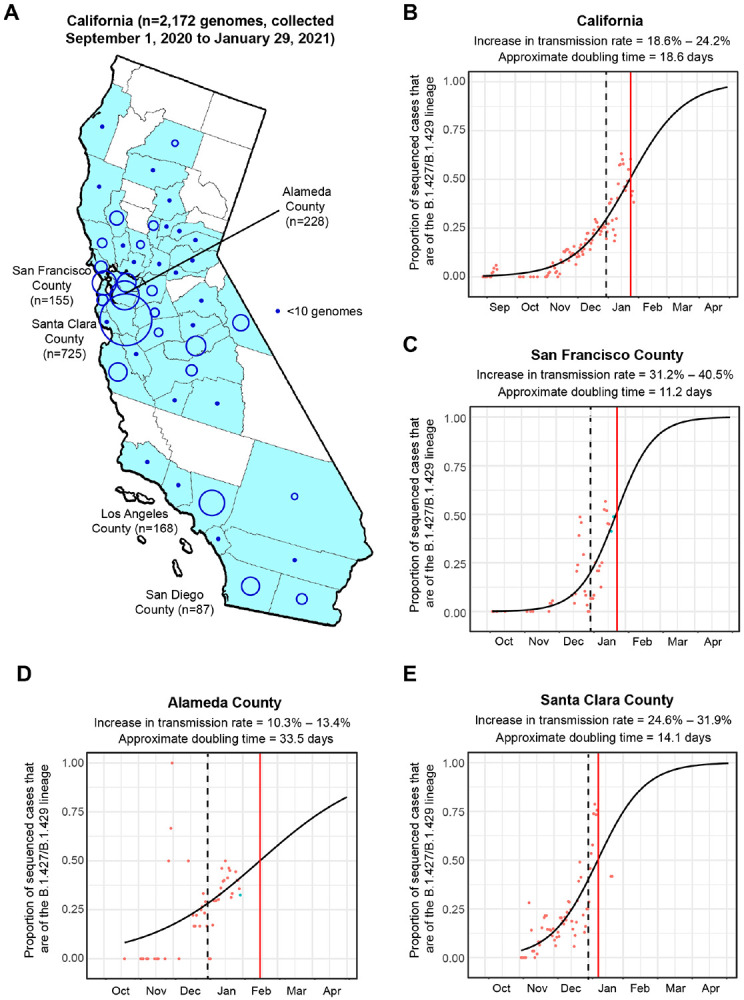
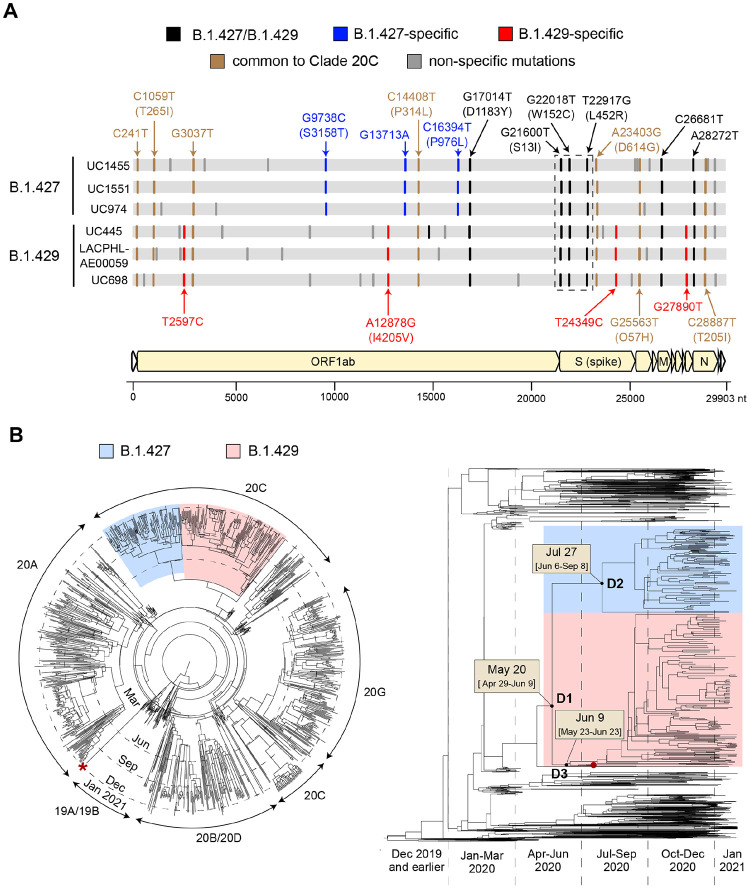
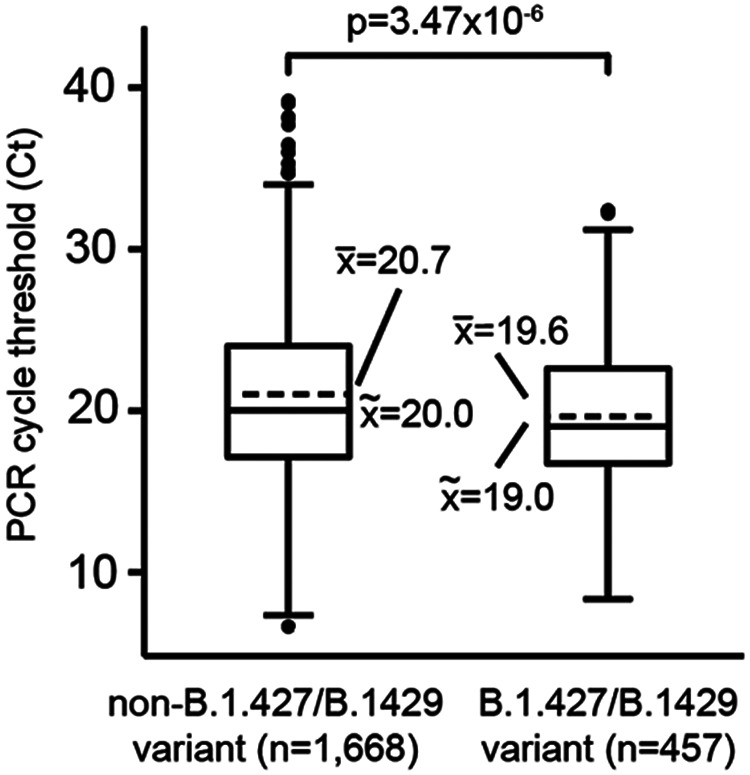
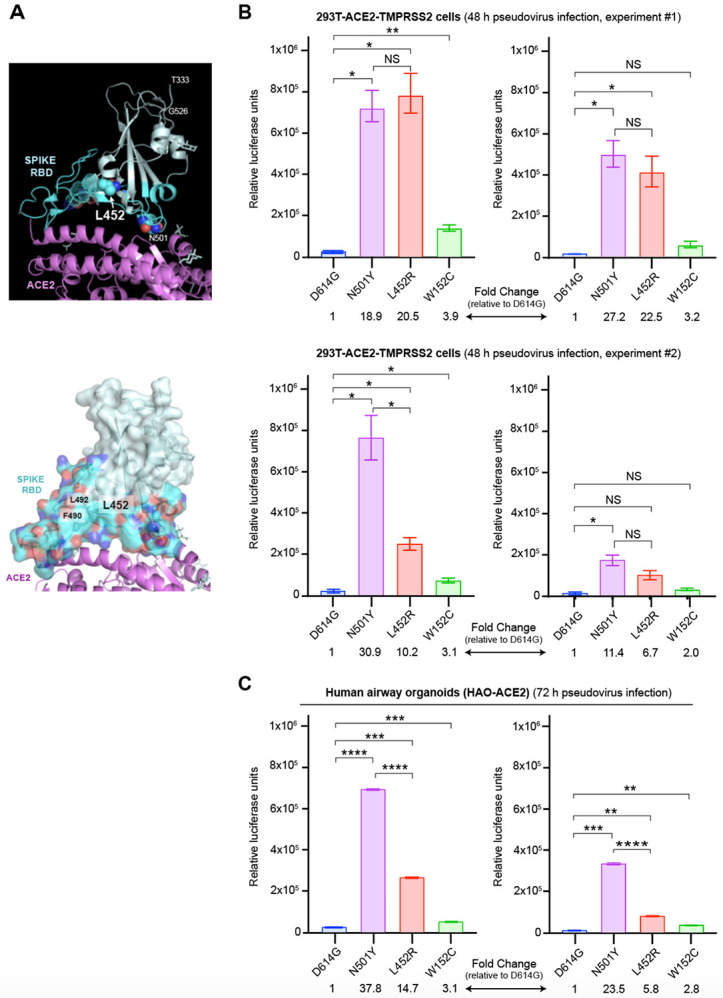
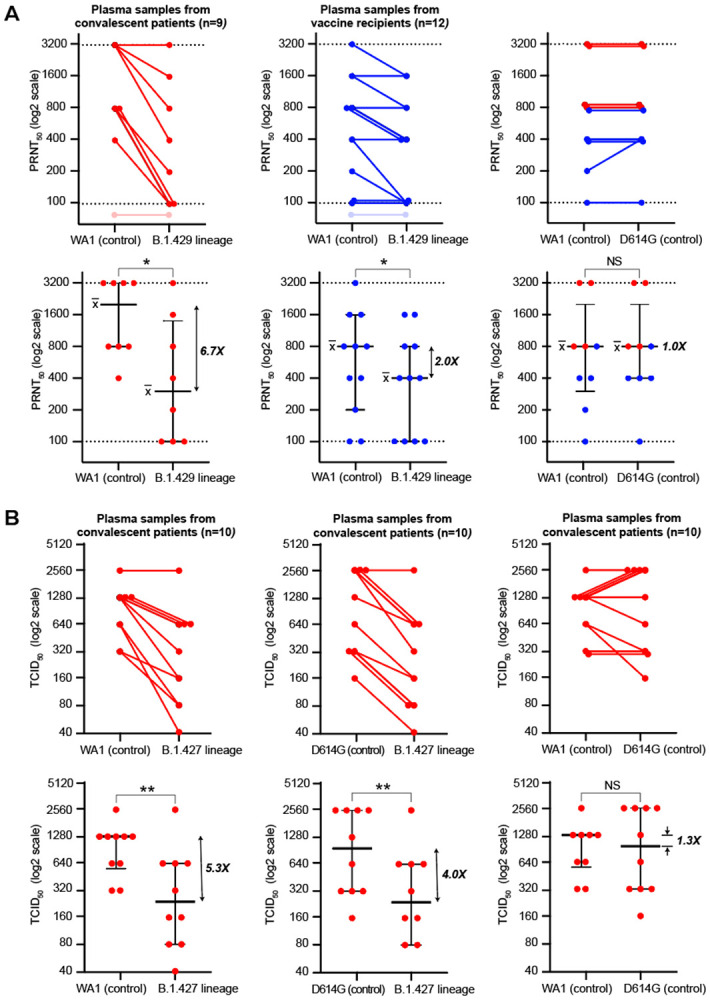
We identified a novel SARS-CoV-2 variant by viral whole-genome sequencing of 2,172 nasal/nasopharyngeal swab samples from 44 counties in California. Named B.1.427/B.1.429 to denote its 2 lineages, the variant emerged around May 2020 and increased from 0% to >50% of sequenced cases from September 1, 2020 to January 29, 2021, exhibiting an 18.6-24% increase in transmissibility relative to wild-type circulating strains. The variant carries 3 mutations in the spike protein, including an L452R substitution. Our analyses revealed 2-fold increased B.1.427/B.1.429 viral shedding in vivo and increased L452R pseudovirus infection of cell cultures and lung organoids, albeit decreased relative to pseudoviruses carrying the N501Y mutation found in the B.1.1.7, B.1.351, and P.1 variants. Antibody neutralization assays showed 4.0 to 6.7-fold and 2.0-fold decreases in neutralizing titers from convalescent patients and vaccine recipients, respectively. The increased prevalence of a more transmissible variant in California associated with decreased antibody neutralization warrants further investigation.
Overview
The claims and statistics of this paper haven’t been checked yet.
Free: it reads the open-access text and checks the first 5 claims that cite a source we can check. Create a free account to check every claim.
Integrity signals
Registry
Cites
Statistics
Figures
Verification
Claims the paper makes
The claims and statistics of this paper haven’t been checked yet.
Free: it reads the open-access text and checks the first 5 claims that cite a source we can check. Create a free account to check every claim.
Claims other papers make about this one
Each is checked against this paper’s own text: does it say what the citing paper says it does?
The cited source doesn’t support the claim as written.
In the citing paper
“This variant showed reduced resistance to neutralization by convalescent (4–6.7-fold) and post-vaccination sera (2–2.9-fold) against this variant [38, 39].”
From Waves and variants of SARS-CoV-2: understanding the causes and effect of the COVID-19 catastrophe (2022) · cites this paper as [38]
Checked by a reasoning model — may be wrong.
Experimental — accuracy not yet measured
Self-check
Percentages, sums and reported differences re-computed from the paper’s own numbers.
The self-check needs the paper’s full text.
Citations
Cites
MAFFT Multiple Sequence Alignment Software Version 7: Improvements in Performance and Usability
Katoh, K., & Standley, D. M. (2013) · Molecular Biology and Evolution · doi:10.1093/molbev/mst010 · Cited by 46,209
A novel coronavirus from patients with pneumonia in China, 2019
Zhu, N., Zhang, D., Wang, W., Li, X., Yang, B., Song, J., Zhao, X., Huang, B., Shi, W., Lu, R., et al. (2020) · New England Journal of Medicine · doi:10.1056/nejmoa2001017 · Cited by 28,244
Hoffmann, M., Kleine-Weber, H., Schroeder, S., Krüger, N., Herrler, T., Erichsen, S., Schiergens, T. S., Herrler, G., Wu, N.-H., Nitsche, A., et al. (2020) · Cell · doi:10.1016/j.cell.2020.02.052 · Cited by 20,286
Kearse, M., Moir, R., Wilson, A., Stones-Havas, S., Cheung, M., Sturrock, S., Buxton, S., Cooper, A., Markowitz, S., Duran, C., et al. (2012) · Bioinformatics · doi:10.1093/bioinformatics/bts199 · Cited by 20,027
Posterior summarization in Bayesian phylogenetics using tracer 1.7
Rambaut, A., Drummond, A. J., Xie, D., Baele, G., & Suchard, M. A. (2018) · Systematic Biology · doi:10.1093/sysbio/syy032 · Cited by 11,159
Bayesian Phylogenetics with BEAUti and the BEAST 1.7
Drummond, A. J., Suchard, M. A., Xie, D., & Rambaut, A. (2012) · Molecular Biology and Evolution · doi:10.1093/molbev/mss075 · Cited by 10,063 · cited 3×
“The resulting maximum clade credibility (MCC) tree was generated using 530 TreeAnnotator v.2.6.3 (Drummond et al., 2012) and visualized using FigTree v.1.4.4 531 (Rambaut, 2021).”
MethodInfluentialStructure of the SARS-CoV-2 spike receptor-binding domain bound to the ACE2 receptor
Lan, J., Ge, J., Yu, J., Shan, S., Zhou, H., Fan, S., Zhang, Q., Shi, X., Wang, Q., Zhang, L., et al. (2020) · Nature · doi:10.1038/s41586-020-2180-5 · Cited by 5,983
Korber, B., Fischer, W. M., Gnanakaran, S., Yoon, H., Theiler, J., Abfalterer, W., Hengartner, N., Giorgi, E. E., Bhattacharya, T., Foley, B., et al. (2020) · Cell · doi:10.1016/j.cell.2020.06.043 · Cited by 4,281
GISAID: Global initiative on sharing all influenza data – from vision to reality
Shu, Y., & McCauley, J. (2017) · Eurosurveillance · doi:10.2807/1560-7917.es.2017.22.13.30494 · Cited by 3,039 · cited 7×
“508 Multiple sequence alignment of 6 B.1.427/B.1.429 genomes and the Wuhan Hu-1 509 prototypical genome (GISAID ID: EPI_ISL_402125, GenBank accession number 510 MN908947) was performed using the MAFFT aligner v7.”
MethodInfluentialA dynamic nomenclature proposal for SARS-CoV-2 lineages to assist genomic epidemiology
Rambaut, A., Holmes, E. C., O’Toole, Á., Hill, V., McCrone, J. T., Ruis, C., du Plessis, L., & Pybus, O. G. (2020) · Nature Microbiology · doi:10.1038/s41564-020-0770-5 · Cited by 2,543
Research works printed but not linked: 2
- Chand M., Hopkins S., Dabreara G., Allen H., Lamagni T., Edeghere O., Achison C., Myers R., Barclay W., Ferguson N., (2020). Investigation of SARS-CoV-2 variants of concern in England, P.H. England, ed. (Crown), pp. 11.
- Davies N.G., Jarvis C.I., Edmunds W.J., Jewell N.P., Diaz-Ordaz K., and Keogh R.H. (2021). Increased hazard of death in community-tested cases of SARS-CoV-2 Variant of Concern 202012/01. medRxiv.
Cited by
SARS-CoV-2 B.1.617.2 Delta variant replication and immune evasion
Mlcochova, P., Kemp, S. A., Dhar, M. S., Papa, G., Meng, B., Ferreira, I. A. T. M., Datir, R., Collier, D. A., Albecka, A., Singh, S., et al. (2021) · Nature · doi:10.1038/s41586-021-03944-y · Cited by 1,337
Fiolet, T., Kherabi, Y., MacDonald, C.-J., Ghosn, J., & Peiffer-Smadja, N. (2022) · Clinical Microbiology and Infection · doi:10.1016/j.cmi.2021.10.005 · Cited by 911
Tarke, A., Sidney, J., Methot, N., Yu, E. D., Zhang, Y., Dan, J. M., Goodwin, B., Rubiro, P., Sutherland, A., Wang, E., et al. (2021) · Cell Reports Medicine · doi:10.1016/j.xcrm.2021.100355 · Cited by 706
SARS-CoV-2 spike L452R variant evades cellular immunity and increases infectivity
Motozono, C., Toyoda, M., Zahradnik, J., Saito, A., Nasser, H., Tan, T. S., Ngare, I., Kimura, I., Uriu, K., Kosugi, Y., et al. (2021) · Cell Host & Microbe · doi:10.1016/j.chom.2021.06.006 · Cited by 586
“429 lineage, which forms a single clade (Deng et al., 2021) (Figure 3A; Table S4).”
InfluentialOmicron Variant (B.1.1.529): Infectivity, Vaccine Breakthrough, and Antibody Resistance
Chen, J., Wang, R., Gilby, N. B., & Wei, G.-W. (2022) · Journal of Chemical Information and Modeling · doi:10.1021/acs.jcim.1c01451 · Cited by 653
Mapping mutations to the SARS-CoV-2 RBD that escape binding by different classes of antibodies
Greaney, A. J., Starr, T. N., Barnes, C. O., Weisblum, Y., Schmidt, F., Caskey, M., Gaebler, C., Cho, A., Agudelo, M., Finkin, S., et al. (2021) · Nature Communications · doi:10.1038/s41467-021-24435-8 · Cited by 433
Novel SARS-CoV-2 variants: the pandemics within the pandemic
Boehm, E., Kronig, I., Neher, R. A., Eckerle, I., Vetter, P., & Kaiser, L. (2021) · Clinical Microbiology and Infection · doi:10.1016/j.cmi.2021.05.022 · Cited by 345
“Transmissibility/viral load and duration These variants are estimated to be 18e24% more transmissible [51], and secondary household attack rate is elevated [52].”
SARS-CoV-2 Vaccines Based on the Spike Glycoprotein and Implications of New Viral Variants
Martínez-Flores, D., Zepeda-Cervantes, J., Cruz-Reséndiz, A., Aguirre-Sampieri, S., Sampieri, A., & Vaca, L. (2021) · Frontiers in Immunology · doi:10.3389/fimmu.2021.701501 · Cited by 240
A Comprehensive Review of COVID-19 Virology, Vaccines, Variants, and Therapeutics
Forchette, L., Sebastian, W., & Liu, T. (2021) · Current Medical Science · doi:10.1007/s11596-021-2395-1 · Cited by 254
Multiplex qPCR discriminates variants of concern to enhance global surveillance of SARS-CoV-2
Vogels, C. B. F., Breban, M. I., Ott, I. M., Alpert, T., Petrone, M. E., Watkins, A. E., Kalinich, C. C., Earnest, R., Rothman, J. E., Goes de Jesus, J., et al. (2021) · PLOS Biology · doi:10.1371/journal.pbio.3001236 · Cited by 226
“429 (no gene target failure) have been recognized as VOCs since the initial development of our assay [19], but neither cause ORF1a or spike target failures.”
BackgroundWang, Y., Chen, R., Hu, F., Lan, Y., Yang, Z., Zhan, C., Shi, J., Deng, X., Jiang, M., Zhong, S., et al. (2021) · EClinicalMedicine · doi:10.1016/j.eclinm.2021.101129 · Cited by 209
Self-citationWaves and variants of SARS-CoV-2: understanding the causes and effect of the COVID-19 catastrophe
Thakur, V., Bhola, S., Thakur, P., Patel, S. K. S., Kulshrestha, S., Ratho, R. K., & Kumar, P. (2022) · Infection · doi:10.1007/s15010-021-01734-2 · Cited by 195
The Global Epidemic of the SARS-CoV-2 Delta Variant, Key Spike Mutations and Immune Escape
Tian, D., Sun, Y., Zhou, J., & Ye, Q. (2021) · Frontiers in Immunology · doi:10.3389/fimmu.2021.751778 · Cited by 198
“SARS-CoV-2 invades host cells by binding the spike protein to angiotensin-converting enzyme-2 (ACE2) (19–21).”
BackgroundInfluentialOmicron (B.1.1.529): Infectivity, vaccine breakthrough, and antibody resistancePreprint
Chen, J., Wang, R., Gilby, N. B., & Wei, G. (2021) · PubMed · doi:10.48550/arxiv.2112.01318 · Cited by 78
“In addition, the predicted mutation-induced BFE changes on L452R and N501Y for the ACE2-RBD complex have a near perfect correlation with experimental luciferase data [11,30].”
BackgroundImmune Evasion of SARS-CoV-2 Emerging Variants: What Have We Learnt So Far?
Lazarevic, I., Pravica, V., Miljanovic, D., & Cupic, M. (2021) · Viruses · doi:10.3390/v13071192 · Cited by 189
Ai, Y., Davis, A., Jones, D., Lemeshow, S., Tu, H., He, F., Ru, P., Pan, X., Bohrerova, Z., & Lee, J. (2021) · Science of The Total Environment · doi:10.1016/j.scitotenv.2021.149757 · Cited by 176
SARS-CoV-2 B.1.617 Mutations L452R and E484Q Are Not Synergistic for Antibody Evasion
Ferreira, I. A. T. M., Kemp, S. A., Datir, R., Saito, A., Meng, B., Rakshit, P., Takaori-Kondo, A., Kosugi, Y., Uriu, K., Kimura, I., et al. (2021) · The Journal of Infectious Diseases · doi:10.1093/infdis/jiab368 · Cited by 151
“It was also associated with increased ACE2 binding, increased infectivity [4], and 3- to 6-fold loss of neutralization sensitivity to vaccine-elicited sera in experiments with pseudotyped virus (PV) particles [5].”
SARS-CoV-2 immune evasion by variant B.1.427/B.1.429
McCallum, M., Bassi, J., Marco, A. D., Chen, A., Walls, A. C., Iulio, J. D., Tortorici, M. A., Navarro, M.-J., Silacci-Fregni, C., Saliba, C., et al. (2021) · bioRxiv (Cold Spring Harbor Laboratory) · doi:10.1101/2021.03.31.437925 · Cited by 127
“Total number of SARS-CoV-2 (grey) and B.1.427/B.1.429 VOC (blue/orange) sequences deposited on a monthly basis worldwide (C), in the US (D) and in California (E).”
BackgroundInfluentialThe emerging SARS-CoV-2 variants of concern
Sanyaolu, A. O., Okorie, C., Marinkovic, A., Haider, N., Abbasi, A. F., Jaferi, U., Prakash, S., & Balendra, V. (2021) · Therapeutic Advances in Infectious Disease · doi:10.1177/20499361211024372 · Cited by 137
Chen, X., Chen, Z., Azman, A. S., Sun, R., Lu, W., Zheng, N., Zhou, J., Wu, Q., Deng, X., Zhao, Z., et al. (2022) · Clinical Infectious Diseases · doi:10.1093/cid/ciab646 · Cited by 113
Self-citationThe Spike of Concern—The Novel Variants of SARS-CoV-2
Winger, A., & Caspari, T. (2021) · Viruses · doi:10.3390/v13061002 · Cited by 131
“Y453 forms an electrostatic interaction with H34 in hAce2 and lies at the bottom of the concave binding site next to L452 (mutated in USA B.1.429 and Indian B.1.617 Spike) (Figures 4a and 5f).”
BackgroundInfluentialSARS‐CoV‐2 variants and vulnerability at the global level
Chavda, V. P., Patel, A., & Vaghasiya, D. D. (2022) · Journal of Medical Virology · doi:10.1002/jmv.27717 · Cited by 146
“The most typical lineage of variations is debated.(35)”
BackgroundThe global epidemic of SARS‐CoV‐2 variants and their mutational immune escape
Tian, D., Sun, Y., Zhou, J., & Ye, Q. (2021) · Journal of Medical Virology · doi:10.1002/jmv.27376 · Cited by 117
“6%–24% increase in transmissibility relative to wild strains.(91) In throat swab”
BackgroundThe Emerging Concern and Interest SARS-CoV-2 Variants
Janik, E., Niemcewicz, M., Podogrocki, M., Majsterek, I., & Bijak, M. (2021) · Pathogens · doi:10.3390/pathogens10060633 · Cited by 123
Omicron BA.2 (B.1.1.529.2): high potential to becoming the next dominating variantPreprint
Chen, J., & Wei, G. (2022) · Research Square · doi:10.21203/rs.3.rs-1362445/v1 · Cited by 78
Deshpande, A. A., Harris, B. D., Martínez‐Sobrido, L., Kobie, J. J., & Walter, M. R. (2021) · Frontiers in Immunology · doi:10.3389/fimmu.2021.691715 · Cited by 101
“Recent data suggests that the D614G mutation stabilizes the S trimer and is necessary to observe the functional impact of the N501Y and L452R mutations on cell infectivity (47, 48).”
BackgroundMlcochova, P., Kemp, S., Dhar, M. S., Papa, G., Meng, B., Mishra, S., Whittaker, C., Mellan, T., Ferreira, I., Datir, R., et al. (2021) · doi:10.1101/2021.05.08.443253 · Cited by 90
Variant SARS-CoV-2 mRNA vaccines confer broad neutralization as primary or booster series in mice
(2021) · doi:10.1016/j.vaccine.2021.11.001 · Cited by 101
Gupta, M., Azumaya, C. M., Moritz, M., Pourmal, S., Diallo, A., Merz, G. E., Jang, G., Bouhaddou, M., Fossati, A., Brilot, A. F., et al. (2021) · doi:10.1101/2021.05.10.443524 · Cited by 89
Self-citationSignatures in SARS-CoV-2 spike protein conferring escape to neutralizing antibodies
Alenquer, M., Ferreira, F., Lousa, D., Valério, M., Medina-Lopes, M., Bergman, M., Gonçalves, J., Demengeot, J., Leite, R. B., Lilue, J., et al. (2021) · PLoS Pathogens · doi:10.1371/journal.ppat.1009772 · Cited by 107
“Interestingly, N501Y, L452R and S417N have been associated with increased viral transmission [18,19,26,36] and, when combined with E484K, augmented resistance to neutralizing antibodies.”
BackgroundCOVID-19 Pandemic and Vaccines Update on Challenges and Resolutions
Khan, W. H., Hashmi, Z., Goel, A., Ahmad, R., Gupta, K., Khan, N., Alam, I., Ahmed, F., & Ansari, M. A. (2021) · Frontiers in Cellular and Infection Microbiology · doi:10.3389/fcimb.2021.690621 · Cited by 117
“…GH/ 452R.V1 (B.1.429) USA S13I, W152C, L452R, D614G ~20% increased transmissibility, Reduced neutralization by convalescent and postvaccination sera (Deng et al., 2021) Scientists are looking into how effective a vaccination might be in protecting persons infected with SARS-CoV-2 variants.”
BackgroundInfluentialHIV-1 and SARS-CoV-2: Patterns in the evolution of two pandemic pathogens
Fischer, W. M., Giorgi, E. E., Chakraborty, S., Nguyen, K., Bhattacharya, T., Theiler, J. P., Goloboff, P. A., Yoon, H., Abfalterer, W., Foley, B. T., et al. (2021) · Cell Host & Microbe · doi:10.1016/j.chom.2021.05.012 · Cited by 114
The puzzling mutational landscape of the SARS‐2‐variant Omicron
Fantini, J., Yahi, N., Colson, P., Chahinian, H., Scola, B. L., & Raoult, D. (2022) · Journal of Medical Virology · doi:10.1002/jmv.27577 · Cited by 91
“Indeed, the omicron variant lacks the typical L452R mutation which is characteristic of most delta variants.(6,7) Second, initial assessments of omicron propagation in South”
BackgroundWang, H., Miller, J. A., Verghese, M., Sibai, M., Solis, D., Mfuh, K. O., Jiang, B., Iwai, N., Mar, M., Huang, C., et al. (2021) · Journal of Clinical Microbiology · doi:10.1128/jcm.00859-21 · Cited by 99
“Our results are consistent with a large-scale whole-genome sequencing initiative of 2,172 specimens from 44 counties in California (12).”
ResultSalleh, M. Z., Derrick, J. P., & Deris, Z. Z. (2021) · International Journal of Molecular Sciences · doi:10.3390/ijms22147425 · Cited by 88
One Year of SARS-CoV-2: Genomic Characterization of COVID-19 Outbreak in Qatar
Benslimane, F. M., Al Khatib, H. A., Al-Jamal, O., Albatesh, D., Boughattas, S., Ahmed, A. A., Bensaad, M., Younuskunju, S., Mohamoud, Y. A., Al Badr, M., et al. (2021) · Frontiers in Cellular and Infection Microbiology · doi:10.3389/fcimb.2021.768883 · Cited by 68
“Despite the published reports about its increased transmissibility by 20%, only sporadic cases (12 cases) were reported in Qatar from May 2020 to March 2021 [42].”
BackgroundCantón, R., Ramos, P. D. L., Botella, A. G., García‐Lledó, A., Gómez‐Pavón, J., del Castillo, J. M. G., Hernández‐Sampelayo, T., Delgado, M. C. M., Martín‐Sánchez, F. J., Martínez‐Sellés, M., et al. (2021) · Revista Española de Quimioterapia · doi:10.37201/req/071.2021 · Cited by 76
SARS-CoV-2 variants and COVID-19 vaccines: Current challenges and future strategies
Gong, W., Parkkila, S., Wu, X., & Aspatwar, A. (2022) · International Reviews of Immunology · doi:10.1080/08830185.2022.2079642 · Cited by 82
Revealing the Threat of Emerging SARS-CoV-2 Mutations to Antibody Therapies
Chen, J., Gao, K., Wang, R., & Wei, G. (2021) · Journal of Molecular Biology · doi:10.1016/j.jmb.2021.167155 · Cited by 76
“351 variants cause negative effects on the neutralization by emergency use authorization (EUA) monoclonal antibody therapeutics [17, 18], and the moderate reductions in neutralizing activity were observed by using convalescent and post-vaccination sera [19].”
InfluentialTherapeutic monoclonal antibodies for COVID-19 management: an update
Chavda, V. P., Prajapati, R., Lathigara, D., Nagar, B., Kukadiya, J., Redwan, E. M. M. M., Uversky, V. N., Kher, M. N., & Patel, R. (2022) · Expert Opinion on Biological Therapy · doi:10.1080/14712598.2022.2078160 · Cited by 76
Jhun, H., Park, H., Hisham, Y., Song, C., & Kim, S. (2021) · Immune Network · doi:10.4110/in.2021.21.e32 · Cited by 68
“6~24% increase in transmissibility comparing to wild type (WT) (52,53).”
BackgroundWang, H., Jean, S., Eltringham, R., Madison, J., Snyder, P. J., Tu, H., Jones, D. M., & Leber, A. L. (2021) · Journal of Clinical Microbiology · doi:10.1128/jcm.00926-21 · Cited by 76
Airborne transmission of SARS-CoV-2 in indoor environments: A comprehensive review
Shen, J., Kong, M., Dong, B., Birnkrant, M. J., & Zhang, J. “. (2021) · Science and Technology for the Built Environment · doi:10.1080/23744731.2021.1977693 · Cited by 73
COVID-19 and SARS-CoV-2 Variants: Current Challenges and Health Concern
Zeyaullah, M., AlShahrani, A. M., Muzammil, K., Ahmad, I., Alam, S., Khan, W. H., & Ahmad, R. (2021) · Frontiers in Genetics · doi:10.3389/fgene.2021.693916 · Cited by 77
“CDC, 2021b; Faria et al., 2021 B.1.427 + B.1.429 United States D614G, L452R S13I, W152C Around 20% increased transmissibility, reduced neutralization by convalescent and post vaccination sera Deng et al., 2021 VUI-21FEB-03 or B.1.525 U.”
BackgroundInfluentialmRNA-1273 protects against SARS-CoV-2 beta infection in nonhuman primates
Corbett, K. S., Werner, A. P., Connell, S. O., Gagne, M., Lai, L., Moliva, J. I., Flynn, B., Choi, A., Koch, M., Foulds, K. E., et al. (2021) · Nature Immunology · doi:10.1038/s41590-021-01021-0 · Cited by 57
Pirolli, D., Righino, B., Camponeschi, C., Ria, F., Sante, G. D., & Rosa, M. C. D. (2023) · Scientific Reports · doi:10.1038/s41598-023-28716-8 · Cited by 78
One year into the pandemic: Short-term evolution of SARS-CoV-2 and emergence of new lineages
Gónzález‐Candelas, F., Shaw, M., Phan, T. G., Kulkarni‐Kale, U., Paraskevis, D. N., Luciani, F., Kimura, H., & Sironi, M. (2021) · Infection Genetics and Evolution · doi:10.1016/j.meegid.2021.104869 · Cited by 70
The ins and outs of SARS-CoV-2 variants of concern (VOCs)
Salehi-Vaziri, ., Fazlalipour, M., Khorrami, S. M. S., Azadmanesh, K., Pouriayevali, M. H., Jalali, T., Shoja, Z., & Maleki, A. (2022) · Archives of Virology · doi:10.1007/s00705-022-05365-2 · Cited by 67
“Finally, the appearance of several new mutations over a short period is expected [67].”
BackgroundJacobson, K. B., Pinsky, B. A., Montez Rath, M. E., Wang, H., Miller, J. A., Skhiri, M., Shepard, J., Mathew, R., Lee, G., Bohman, B., et al. (2022) · Clinical Infectious Diseases · doi:10.1093/cid/ciab554 · Cited by 62
Pormohammad, A., Zarei, M., Ghorbani, S., Mohammadi, M., Aghayari Sheikh Neshin, S., Khatami, A., Turner, D. L., Djalalinia, S., Mousavi, S. A., Mardani-Fard, H. A., et al. (2021) · Vaccines · doi:10.3390/vaccines10010023 · Cited by 62
“The L452R mutation, which is in the receptor-binding domain of the S1 subunit, can prevent the binding of the neutralizing antibodies to the virus and decrease the efficacy of vaccine-induced antibodies [45].”
BackgroundEmerging SARS-CoV-2 variants: impact on vaccine efficacy and neutralizing antibodies
Sharun, K., Tiwari, R., Dhama, K., Emran, T. B., Rabaan, A. A., & Mutair, A. S. A. (2021) · Human Vaccines & Immunotherapeutics · doi:10.1080/21645515.2021.1923350 · Cited by 53
Rapid characterization of spike variants via mammalian cell surface display
Javanmardi, K., Chou, C., Terrace, C. I., Annapareddy, A., Kaoud, T. S., Guo, Q., Lutgens, J., Zorkic, H., Horton, A. P., Gardner, E. C., et al. (2021) · Molecular Cell · doi:10.1016/j.molcel.2021.11.024 · Cited by 56
“429 variant also exhibits improved transmissibility relative to the parental strain (Deng et al., 2021).”
The Robustness of Cellular Immunity Determines the Fate of SARS-CoV-2 Infection
Moga, E., Lynton‐Pons, E., & Domingo, P. (2022) · Frontiers in Immunology · doi:10.3389/fimmu.2022.904686 · Cited by 52
Genetic emergence of B.1.617.2 in COVID-19
Kirola, L. (2021) · New Microbes and New Infections · doi:10.1016/j.nmni.2021.100929 · Cited by 58
“The B.1.427/B.1.429 lineages have such VOC called L452R mutation ( fi rst identi fi ed in the USA), and this has been shown to be almost >20% higher transmissibility in comparison to pre-existing reported variants [8].”
InfluentialBradley, B. T., Bryan, A. B., Fink, S. L., Goecker, E. A., Roychoudhury, P., Huang, M.-L. W., Zhu, H., Chaudhary, A., Madarampalli, B., Lu, J., et al. (2021) · Journal of Clinical Microbiology · doi:10.1128/jcm.00989-21 · Cited by 56
“429 variants demonstrate an L452R mutation in the RBD and may be associated with increased transmissibility (36).”
BackgroundRapid lateral flow tests for the detection of SARS-CoV-2 neutralizing antibodies
Wang, J. J., Zhang, N., Richardson, S. A., & Wu, J. V. (2021) · Expert Review of Molecular Diagnostics · doi:10.1080/14737159.2021.1913123 · Cited by 51
“429 [56] showed moderate to high resistance to current COVID-19 vaccines.”
BackgroundSARS-CoV-2 journey: from alpha variant to omicron and its sub-variants
Hattab, D., Amer, M. F. A., Al‐Alami, Z. M., & Bakhtiar, A. (2024) · Infection · doi:10.1007/s15010-024-02223-y · Cited by 51
“Other coding and non-coding mutations are found in the non-spike region (Table 1) [33].”
BackgroundInfluentialHaslwanter, D., Dieterle, M. E., Wec, A. Z., O’Brien, C. M., Sakharkar, M., Florez, C., Tong, K., Rappazzo, C. G., Lasso, G., Vergnolle, O., et al. (2021) · mBio · doi:10.1128/mbio.02473-21 · Cited by 57
“mutations that counteract the immune response (22, 46).”
BackgroundInfluentialGreaney, A. J., Starr, T. N., Barnes, C., et al. (2021) · bioRxiv · doi:10.1101/2021.03.17.435863 · Cited by 45
SARS-CoV-2 Variants and Their Relevant Mutational Profiles: Update Summer 2021
Alkhatib, M., Svicher, V., Salpini, R., Ambrosio, F. A., Bellocchi, M. C., Carioti, L., Piermatteo, L., Scutari, R., Costa, G., Artese, A., et al. (2021) · Microbiology Spectrum · doi:10.1128/spectrum.01096-21 · Cited by 65
Biological Properties of SARS-CoV-2 Variants: Epidemiological Impact and Clinical Consequences
Hoteit, R., & Yassine, H. M. (2022) · Vaccines · doi:10.3390/vaccines10060919 · Cited by 51
“7-fold higher entry efficiency in human airway lung organoids (HAOs) (293T cells and HAOs can stably express ACE2) [254].”
BackgroundHuang, S., & Wang, S. (2021) · International Journal of Molecular Sciences · doi:10.3390/ijms22063060 · Cited by 56
COVID-19 one year into the pandemic: from genetics and genomics to therapy, vaccination, and policy
Novelli, G., Biancolella, M., Mehrian‐Shai, R., Colona, V. L., Brito, A. F., Grubaugh, N. D., Vasiliou, V., Luzzatto, L., & Reichardt, J. K. V. (2021) · Human Genomics · doi:10.1186/s40246-021-00326-3 · Cited by 57
“429, both showing three amino acid substitutions: S:S13I, S:W152C, and S:L452R [19].”
BackgroundInfluentialJohnson, R., Sharma, J. R., Ramharack, P., Mangwana, N., Kinnear, C. J., Viraragavan, A., Glanzmann, B., Louw, J., Abdelatif, N., Reddy, T., et al. (2022) · Scientific Reports · doi:10.1038/s41598-022-05110-4 · Cited by 44
Socher, E., Heger, L., Paulsen, F. P., Zunke, F., & Arnold, P. (2022) · Computational and Structural Biotechnology Journal · doi:10.1016/j.csbj.2022.02.015 · Cited by 40
“For variants carrying this L452R mutation, stronger affinity of the spike protein for the ACE2 receptor was described [13–14].”
Dikdan, R. J., Marras, S. A. E., Field, A. P., Brownlee, A., Cironi, A., Hill, D. A., & Tyagi, S. (2022) · Journal of Molecular Diagnostics · doi:10.1016/j.jmoldx.2022.01.004 · Cited by 48
The variants of SARS‐CoV‐2 and the challenges of vaccines
Han, X., & Ye, Q. (2021) · Journal of Medical Virology · doi:10.1002/jmv.27513 · Cited by 46
Meyers, L. M., Gutiérrez, A. H., Boyle, C., Terry, F. E., McGonnigal, B., Salazar, A. Μ., Princiotta, M. F., Martin, W. D., Groot, A. S. D., & Moise, L. (2021) · npj Vaccines · doi:10.1038/s41541-021-00331-6 · Cited by 45
(2021) · doi:10.1101/2021.04.14.21255431 · Cited by 62
“429 variant, which carries a L452R substitution mutation in the spike protein(10), was first detected in October 2020 and by January 2021 accounted for 35% of all SARS-CoV-2 cases detected in California.”
BackgroundRecent Progress on Rapid Lateral Flow Assay-Based Early Diagnosis of COVID-19
Zhang, Y., Chai, Y., Hu, Z., Xu, Z., Li, M., Chen, X., Yang, C., & Liu, J. (2022) · Frontiers in Bioengineering and Biotechnology · doi:10.3389/fbioe.2022.866368 · Cited by 45
Yang, Z. L., Zhang, S., Tang, Y., Zhang, S., Xu, D.-Q., Yue, S., & Liu, Q. (2022) · Aging and Disease · doi:10.14336/ad.2021.1210 · Cited by 52
On the Selectivity of Heparan Sulfate Recognition by SARS-CoV-2 Spike Glycoprotein
Chittum, J. E., Sankaranarayanan, N. V., O’Hara, C. P., & Desai, U. R. (2021) · ACS Medicinal Chemistry Letters · doi:10.1021/acsmedchemlett.1c00343 · Cited by 36
Emerging vaccine-breakthrough SARS-CoV-2 variantsPreprint
Wang, R., Chen, J., Hozumi, Y., Yin, C., & Wei, G. (2021) · arXiv (Cornell University) · doi:10.48550/arxiv.2109.04509 · Cited by 20
“c Comparison of predicted BFE changes and relative luciferase units [25] for pseudovirus infection changes of ACE2 and S protein complex induced by mutations L452R and N501Y.”
BackgroundEvaluation of the United States COVID-19 vaccine allocation strategy
Islam, M. R., Oraby, T. F., McCombs, A., Chowdhury, M. M., Al-Mamun, M. A., Tyshenko, M. G., & Kadelka, C. (2021) · PLoS ONE · doi:10.1371/journal.pone.0259700 · Cited by 38
“429 with an estimated 20% increased transmissibility [44], and the rest with standard transmissibility (S5 Fig).”
BackgroundHow will emerging SARS-CoV-2 variants impact herd immunity?
Lippi, G., & Henry, B. M. (2021) · Annals of Translational Medicine · doi:10.21037/atm-21-893 · Cited by 33
“419 strains, which recently appeared in California, are paradigmatic examples, as they contain a L452R mutation which seems to reinforce the interplay between ACE2 and SARS-CoV-2 spike protein, thus enhancing by up to 25% its transmissibility and associating with 2- to 7-fold reduction in anti-SASRCoV-2 neutralizing a…”
BackgroundWilson, P. C., Changrob, S., Fu, Y., Guthmiller, J. J., Halfmann, P., Li, L., Stamper, C. T., Dugan, H. L., Accola, M. A., Rehrauer, W. M., et al. (2021) · Research Square · doi:10.21203/rs.3.rs-678247/v1 · Cited by 3
Chen, H.-Y., Huang, C., Tian, L., Huang, X., Zhang, C., Llewellyn, G. N., Rogers, G. L., Andresen, K., O’Gorman, M. R. G., Chen, Y., et al. (2021) · Journal of Virology · doi:10.1128/jvi.00966-21 · Cited by 33
“16 2 variants, where both full-length (43, 75) and truncated Spike proteins (26, 36, 40) 331 have been used in studies investigating the impact of mutations on Spike protein 332 properties such as ACE2 binding, transduction efficiency or sensitivity to neutralization.”
MethodHumoral Immunity against SARS-CoV-2 and the Impact on COVID-19 Pathogenesis
Lee, E.-J., & Oh, J. E. (2021) · Molecules and Cells · doi:10.14348/molcells.2021.0075 · Cited by 30
“: BNT162b2 (Pfizer) (Deng et al., 2021), mRNA-1273 (Moderna)”
Structural basis for broad sarbecovirus neutralization by a human monoclonal antibodyPreprint
Tortorici, M. A., Czudnochowski, N., Starr, T. N., Marzi, R., Walls, A. C., Zatta, F., Bowen, J. E., Jaconi, S., di Iulio, J., Wang, Z., et al. (2021) · bioRxiv (Cold Spring Harbor Laboratory) · doi:10.1101/2021.04.07.438818 · Cited by 22
Emerging SARS-CoV-2 Variants Can Potentially Break Set Epidemiological Barriers in COVID-19
Kumar, A., Parashar, R., Kumar, S., Faiq, M. A., Kumari, C., Kulandhasamy, M., Narayan, R. K., Jha, R. K., Singh, H. N., Prasoon, P., et al. (2021) · Journal of Medical Virology · doi:10.1002/jmv.27467 · Cited by 55
Basheer, A., & Zahoor, I. (2021) · Microorganisms · doi:10.3390/microorganisms9122609 · Cited by 30
“429 lineages (Epsilon), also collectively 93 known as 20C/S452R [19] are two more variants of concern which are based on several spike 94 protein mutations, including L452R, which is associated with increased cell entry and reduced 95 susceptibility to neutralization by convalescent and vaccine recipient plasma in vit…”
BackgroundDevelopment of potent and effective synthetic SARS-CoV-2 neutralizing nanobodies
Stefan, M. A., Light, Y. K., Schwedler, J. L., McIlroy, P. R., Courtney, C. M., Saada, E. A., Thatcher, C. E., Phillips, A. M., Bourguet, F. A., Mageeney, C. M., et al. (2021) · mAbs · doi:10.1080/19420862.2021.1958663 · Cited by 28
Functional Effects of Receptor-Binding Domain Mutations of SARS-CoV-2 B.1.351 and P.1 Variants
Bayarri‐Olmos, R., Jarlhelt, I., Johnsen, L. B., Hansen, C. B., Helgstrand, C., Bjelke, J. R., Matthiesen, F., Nielsen, S. D., Iversen, K. K., Ostrowski, S. R., et al. (2021) · Frontiers in Immunology · doi:10.3389/fimmu.2021.757197 · Cited by 31
Morris, C. P., Luo, C. H., Amadi, A., Schwartz, M. C., Gallagher, N., Ray, S. C., Pekosz, A. S., & Mostafa, H. H. (2021) · Clinical Infectious Diseases · doi:10.1093/cid/ciab636 · Cited by 28
“These variants are characterized by the S: L452R, which could affect neutralization by monoclonal antibodies [18, 19].”
BackgroundRapid test to assess the escape of SARS-CoV-2 variants of concern
Heggestad, J. T., Britton, R. J., Kinnamon, D., Wall, S. A., Joh, D. Y., Hucknall, A., Olson, L. B., Anderson, J. G., Mazur, A., Wolfe, C. R., et al. (2021) · Science Advances · doi:10.1126/sciadv.abl7682 · Cited by 26
“As of late 2020, several new variants of interest have been identified that are circulating in New York ( 57 ), California ( 58 ), India ( 59 ), and other locations 6) to determine whether anti-RBD–binding antibodies were present, despite low blocking activity.”
Wang, H., Miller, J. A., Verghese, M., et al. (2021) · medRxiv · doi:10.1101/2021.04.20.21255480 · Cited by 22
“Our results are consistent with a large-scale whole-genome 282 sequencing initiative of 2,172 specimens from 44 counties in California.(12) This series suggested a 19-24% 283 increase in transmissibility relative to wild-type circulating strains, and was the basis for L452R 284 All rights reserved.”
ResultDecomposing the sources of SARS-CoV-2 fitness variation in the United States
Kepler, L. M., Hamins-Puértolas, M., & Rasmussen, D. A. (2021) · Virus Evolution · doi:10.1093/ve/veab073 · Cited by 29
“B.1.526, which has spread rapidly in New York and carries the suspected antigenic escape mutation Spike E484K, is estimated to have the largest estimated transmission fitness effect (MLE: 1.397, 95% CI: 1.35-1.49) of all currently circulating lineages.”
BackgroundInfluentialReview of the mechanisms of SARS-CoV-2 evolution and transmissionPreprint
Chen, J., Wang, R., & Wei, G. (2021) · arXiv (Cornell University) · doi:10.48550/arxiv.2109.08148 · Cited by 26
“Further, our predicted BFE changes induced by RBD mutations L452R and N501Y for ACE2 and RBD complex have a highly similar trend with experimental data in relative luciferase units [8, 11].”
ResultThe rapid adaptation of SARS-CoV-2–rise of the variants: transmission and resistance
Soh, S. M., Kim, Y., Kim, C., Jang, U. S., & Lee, H.-R. (2021) · The Journal of Microbiology · doi:10.1007/s12275-021-1348-5 · Cited by 53
“The B.1.617L452R mutation identifies with the L452R mutation in the B.1.427 and B.1.429 variants (Deng et al., 2021; Singh et al., 2021).”
BackgroundInfluentialEdwards, L., Fowlkes, A., Wesley, M. G., Kuntz, J. L., Odean, M. J., Caban-Martinez, A. J., Dunnigan, K., Phillips, A. L., Grant, L., Herring, M. K., et al. (2021) · JMIR Research Protocols · doi:10.2196/31574 · Cited by 29
Zoonosis and zooanthroponosis of emerging respiratory viruses
Khalil, A. M., Martínez‐Sobrido, L., & Mostafa, A. (2024) · Frontiers in Cellular and Infection Microbiology · doi:10.3389/fcimb.2023.1232772 · Cited by 33
Iaconis, D., Bordi, L., Matusali, G., Talarico, C., Manelfi, C., Cesta, M. C., Zippoli, M., Caccuri, F., Bugatti, A., Zani, A., et al. (2022) · Cell Death and Disease · doi:10.1038/s41419-022-04961-z · Cited by 21
“20C), characterized by increased transmissibility, 66 immune evasion and higher virulence [14-20].”
BackgroundRemdesivir: A Closer Look at Its Effect in COVID-19 Pandemic
Taha, H. R., Keewan, N., Slati, F., & Al‐Sawalha, N. A. (2021) · Pharmacology · doi:10.1159/000518440 · Cited by 34
Epidemiological characteristics of the B.1.526 SARS-CoV-2 variant
Yang, W., Greene, S. K., Peterson, E. R., Li, W., Mathes, R. W., Graf, L. E., Lall, R., Hughes, S., Wang, J., & Fine, A. D. (2022) · Science Advances · doi:10.1126/sciadv.abm0300 · Cited by 20
Sánchez-Calvo, J. M., Alados, J. C., Vidal, L. R., de Francisco, J. L., & Prieto, M. D. L. (2021) · Diagnostic Microbiology and Infectious Disease · doi:10.1016/j.diagmicrobio.2021.115491 · Cited by 17
“We do not know whether other VOCs, such as B.1.351, P.1, B.1.427 and B.1.429, are able to affect the sensitivity and speci fi city of the N gene (Deng et al., 2021).”
InfluentialSARS-CoV-2–Specific Vaccine Candidates; the Contribution of Structural Vaccinology
Pack, S. M., & Peters, P. J. (2022) · Vaccines · doi:10.3390/vaccines10020236 · Cited by 20
“617 emerged at the end of 2020 and contained a pair of mutations (L452R and E484Q) in the RBD associated with improved infectivity and greater affinity to the ACE2 receptor (Figure 3) [81].”
BackgroundTorres, C., Mojsiejczuk, L. N., Acuña, D., Alexay, S., Amadío, A., Aulicino, P. C., Debat, H., Fay, F. F., Fernández, F. D., Giri, A. A., et al. (2021) · Frontiers in Medicine · doi:10.3389/fmed.2021.755463 · Cited by 25
Potential SARS-CoV-2 vaccines: Concept, progress, and challenges
Hosseini, S. A., Zahedipour, F., Mirzaei, H., & Oskuee, R. K. (2021) · International Immunopharmacology · doi:10.1016/j.intimp.2021.107622 · Cited by 28
An overview of the ongoing challenges in SARS-CoV-2 global control
Shehata, A. A., Parvin, R., Nagy, A., Wang, Y., Azhar, T. M., Attia, Y. A., Azhar, E. I., Paul, A. K., & Rahmatullah, M. (2021) · German Journal of Microbiology · doi:10.51585/gjm.2021.2.0006 · Cited by 24
Metadata
- Authors
- Deng, X., Garcia-Knight, M. A., Khalid, M. M., Servellita, V., Wang, C., Morris, M. K., Sotomayor-González, A., Glasner, D. R., Reyes, K. R., Gliwa, A. S., Reddy, N. P., Sanchez San Martin, C., Federman, S., Cheng, J., Balcerek, J., Taylor, J., Streithorst, J. A., Miller, S., Kumar, G. R., Sreekumar, B., Chen, P.-Y., Schulze-Gahmen, U., Taha, T. Y., Hayashi, J., Simoneau, C. R., McMahon, S., Lidsky, P. V., Xiao, Y., Hemarajata, P., Green, N. M., Espinosa, A., Kath, C., Haw, M., Bell, J., Hacker, J. K., Hanson, C., Wadford, D. A., Anaya, C., Ferguson, D., Lareau, L. F., Frankino, P. A., Shivram, H., Wyman, S. K., Ott, M., Andino, R., & Chiu, C. Y.
- Affiliations
- University of California, San Francisco (US)
- Gladstone Institutes (US)
- California Department of Public Health (US)
- Los Angeles County Department of Public Health (US)
- Monterey County Health Department (US)
- Innovative Genomics Institute (US)
- Corresponding author
- Andino, Raul
- Chiu, Charles Y.
- ORCID
- Deng, Xianding
- Garcia-Knight, Miguel A
- Khalid, Mir M.
- Servellita, Venice
- Wang, Candace
- Morris, Mary Kate
- Sotomayor-González, Alicia
- Glasner, Dustin R
- Reyes, Kevin R
- Federman, Scot
- Cheng, Jing
- Balcerek, Joanna
- Taylor, Jordan
- Miller, Steve
- Kumar, G. Renuka
- Sreekumar, Bharath
- Taha, Taha Y.
- Hayashi, Jennifer
- Simoneau, Camille R.
- McMahon, Sarah
- Lidsky, Peter V.
- Xiao, Yinghong
- Hemarajata, Peera
- Green, Nicole M.
- Bell, John
- Hacker, Jill K.
- Hanson, Carl
- Wadford, Debra A.
- Lareau, Liana F.
- Frankino, Phillip A.
- Shivram, Haridha
- Wyman, Stacia K.
- Andino, Raul
- Chiu, Charles Y.
- Venue
- Cell
- Publisher
- openRxiv
- Published
- 2021-03-09
- Volume
- 184
- Issue
- 13
- Pages
- 3426-3437.e8
- ISSN
- 0092-8674 (ISSN-L)
- PMC
- PMC7987058
- OpenAlex
- W3155554970
- Cited by
- 651
- References
- 55
- Citations by year
- 2026: 10 · 2025: 26 · 2024: 59 · 2023: 64 · 2022: 234 · 2021: 257
- FWCI
- 48.62
- Type
- journal article
- Language
- en
- Open access
- bronze
- doi.org
- Locations
- Cell (publishedVersion)
- medRxiv (acceptedVersion, cc-by-nc-nd)
- PubMed Central (publishedVersion)
- PubMed (publishedVersion)
- eScholarship (California Digital Library) (submittedVersion)
- PubMed Central (submittedVersion, cc-by-nc-nd)
- Funders
- California Department of Public Health (NU50CK000539)
- Roddenberry Foundation
- Innovative Genomics Institute
- National Institutes of Health (4r33ai120977-03)
- Centers for Disease Control and Prevention (U50CI000498, NU50CK000539, 6NU50CK000539, U01CK000539, NU50CK000498, 6 NU50CK000498)
- University of California, San Francisco
- Canadian Institutes of Health Research
- National Heart, Lung, and Blood Institute (R01HL105704)
- National Institute on Drug Abuse (DP1DA038043)
- National Institute of Allergy and Infectious Diseases (R33-AI120977, R21AI129455)
- Topics
- Health Sciences › Medicine › Infectious Diseases › SARS-CoV-2 and COVID-19 Research
- Health Sciences › Medicine › Infectious Diseases › COVID-19 Clinical Research Studies
- Physical Sciences › Mathematics › Modeling and Simulation › COVID-19 epidemiological studies
- Keywords
- SARS-CoV-2, L452R mutation, spike protein mutations, viral transmissibility, viral shedding, antibody neutralization, N501Y mutation, convalescent sera, COVID-19 vaccines, lung organoids, California
About these checks
Registry, retraction, Cites and statistics results are computed, not judged, with one exception: a printed reference that no index lists is read once by a model before it counts as a citation error. Claims are extracted by a model and kept only when their quote appears verbatim in the text; each cited source is then checked, with a model’s help, for whether it says what the claim relies on. Those verdicts can be wrong — read the claim’s quote and the cited source before relying on one.
Statistics and arithmetic are recomputed, not judged.
Confidence bands are shown only for fields calibrated on our annotated test set. None is calibrated yet, so no band is shown.
What counts as a claim ›How we measure confidence ›How we check this ›
Are you an author, or do you see a problem with this page? Request a review
Data sources
Bibliographic data: Semantic Scholar, OpenAlex, Crossref.
Contains information from the Semantic Scholar Academic Graph Datasets, made available under the ODC Attribution License (ODC-BY 1.0).
Semantic Scholar’s data is described in: Kinney, R., et al. (2023). The Semantic Scholar Open Data Platform. arXiv:2301.10140.
