

Platforms in the peer-to-peer sharing economy
Open accessThe DOI matches its Crossref record; 99 of the 99 references it cites were found in a registry or an index; 25 of the 122 sources its claims cite were checked for support.
Abstract
Purpose The purpose of this paper is to examine peer-to-peer sharing platform business models, their sources of competitive advantage, and the roles, motivations and behaviors of key actors in their ecosystems. Design/methodology/approach This paper uses a conceptual approach that is rooted in the service, tourism and hospitality, and strategy literature. Findings First, this paper defines key types of platform business models in the sharing economy anddescribes their characteristics. In particular, the authors propose the differentiation between sharing platforms of capacity-constrained vs capacity-unconstrained assets and advance five core properties of the former. Second, the authors contrast platform business models with their pipeline business model counterparts to understand the fundamental differences between them. One important conclusion is that platforms cater to vastly more heterogeneous assets and consumer needs and, therefore, require liquidity and analytics for high-quality matching. Third, the authors examine the competitive position of platforms and conclude that their widely taken “winner takes it all” assumption is not valid. Primary network effects are less important once a critical level of liquidity has been reached and may even turn negative if increased listings raise friction in the form of search costs. Once a critical level of liquidity has been reached, a platform’s competitive position depends on stakeholder trust and service provider and user loyalty. Fourth, the authors integrate and synthesize the literature on key platform stakeholders of platform businesses (i.e. users, service providers, and regulators) and their roles and motivations. Finally, directions for further research are advanced. Practical implications This paper helps platform owners, service providers and users understand better the implications of sharing platform business models and how to position themselves in such ecosystems. Originality/value This paper integrates the extant literature on sharing platforms, takes a novel approach in delineating their key properties and dimensions, and provides insights into the evolving and dynamic forms of sharing platforms including converging business models.
Overview
CoChat Summary
TL;DR
This conceptual paper defines peer-to-peer sharing economy platforms as access-based, peer-to-peer platforms for capacity-constrained assets and contrasts them with pipeline businesses. It argues the “winner takes all” assumption is overstated because direct network effects weaken after critical liquidity, and competitive advantage then depends on trust, governance, and provider/user loyalty.
Key findings
- Proposes five core properties of peer-to-peer sharing platforms: no transfer of ownership; peer-to-peer exchange mediated by a digital platform; sharing of capacity-constrained tangible assets sometimes enhanced by labor; indirect network effects and liquidity improve matching quality; and direct network effects matter only up to a threshold (Table I).
- Contrasts platform and pipeline models: platforms are multi-sided, asset-light, have near-zero marginal costs, use dynamic pricing and analytics for heterogeneous supply/demand, and rely on ecosystem innovation; pipeline firms have high fixed costs, standardized offerings, and internalized innovation. Examples include Airbnb charging hosts a 3 percent service fee and guests 0–20 percent, and Uber’s surge pricing.
- Rejects the “winner takes all” view: once critical liquidity is reached, additional listings can add competition and search friction. Citing Li and Netessine, the paper reports that as hosts and travelers doubled, inquiries rose 18.3 percent to hosts and 19.6 percent to travelers; traveler confirmation rates dropped 15.4 percent, host occupancy dropped 15.9 percent, and the platform lost 5.6 percent of potential transactions.
- Synthesizes stakeholder roles across the consumer journey, provider motivations, and policy issues. Reported examples include that approximately two-thirds of Uber drivers use the platform as additional income and one-fifth use it as their only personal income source; Uber provides $1m in third-party liability coverage; and Airbnb’s Superhost program requires at least ten trips over a year.
Methods
- Conceptual approach rooted in the service, tourism and hospitality, and strategy literature; no primary empirical sample or new data collection.
- Synthesizes extant literature to define platform types, develop dimensions and core properties, contrast peer-to-peer sharing platforms with pipeline business models, and derive future research questions.
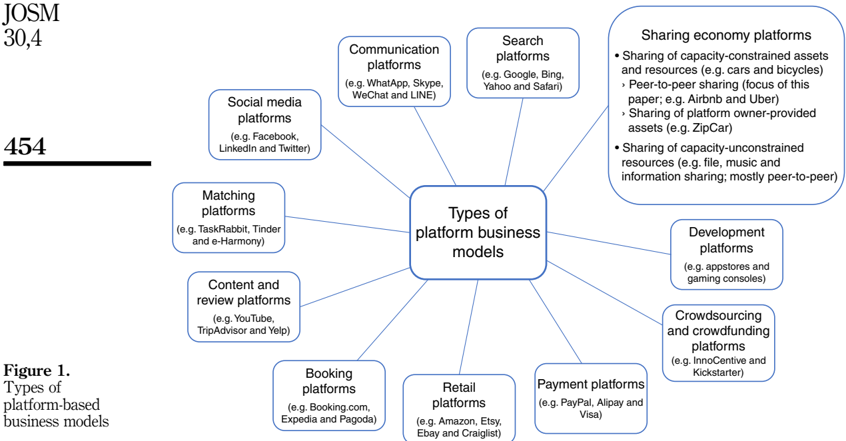
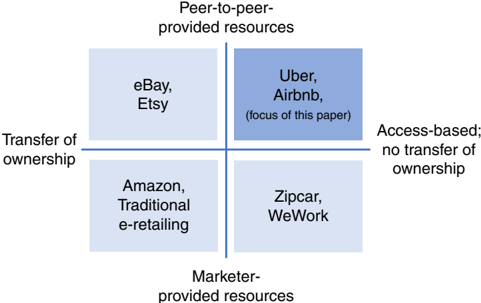
- Scope is for-profit, access-based, peer-to-peer platforms matching capacity-constrained assets and resources (e.g., Airbnb, Uber); it excludes marketer/platform-provided asset platforms (e.g., Zipcar, WeWork) and capacity-unconstrained sharing.
Limitations
- Stated limitations: Not stated in the paper.
- Evident: the paper is a conceptual synthesis without primary empirical testing, so its conclusions rely on cited studies and illustrative examples.
- Evident: the scope is deliberately limited to for-profit, access-based, peer-to-peer, capacity-constrained platforms; findings may not generalize to marketer-provided asset platforms, capacity-unconstrained platforms, or non-profit models.
Model-written summary. Check it against the paper before relying on it.
Integrity signals
Registry
Cites
Statistics
Figures
Verification
Claims the paper makes
21 Valid · 17 Not valid · 57 Not checked · 78 Own results and interpretations
The cited sources support only part of this claim — read each source’s verdict below.
In the paper
“This minimum viable platform size is determined by the nature of the network effects linking the platform's two or more-sided markets, the heterogeneity of assets and “tastes” of the actors (Akbar and Tracogna, 2018;Evans and Schmalensee, 2010), and equilibrium dynamics between service providers and users that allow stakeholder utilities to be maximized at a given price (Evans and Schmalensee, 201”
§ Platforms in the peer-to-peer sharing economy > Network effects and liquidity
What the sources say
- Partly supportedcites Akbar and Tracogna, 2018 matched to “The sharing economy and the future of the hotel industry: Transaction cost theory and platform economics” (2018) sourceExperimental — accuracy not yet measured
Section 2.1, “The economics of platforms” (page unavailable), says platform owners need to reach a minimum viable size and describes same-side and cross-side network effects. The paper also discusses asset specificity, but the passages do not establish that heterogeneity of assets or actors’ “tastes” determines that minimum size. The equilibrium-and-utility clause is cited to Evans and Schmalensee, not to this paper. (LLM, conf=0.83)
- Partly supportedcites Evans and Schmalensee, 2010 matched to “Failure to Launch: Critical Mass in Platform Businesses” (2010) sourceExperimental — accuracy not yet measured
Split into 2 atoms — 1 confirmed, 1 partially supported, 0 disputed, 0 misattributed, 0 unverifiable. Expand the claim to see per-atom verdicts.
plainstates a cause- Asserted: passes — The authors put it forward as true.
- Checkable: passes — It can be checked against evidence.
- Load-bearing: passes — The paper’s conclusions depend on it.
- Based: passes — The paper gives a reason why it holds.
- Partly supported
The cited sources support only part of this claim — read each source’s verdict below.
In the paper
“platforms have demonstrated the ability to develop and use highly sophisticated algorithms and analytics that can mitigate the effects of capacity constraints caused by heterogeneity much more effectively than pipeline businesses”
§ Platforms in the peer-to-peer sharing economy > JOSM 30,4
What the sources say
- Partly supportedcites Duch-Brown, 2017Experimental — accuracy not yet measured
Section 4 says that greater user heterogeneity can create capacity constraints and that using data to personalise offers or advertising can overcome their effects. It also discusses the algorithms needed to operate platforms. But it does not establish that sophisticated algorithms and analytics do this much more effectively than those of pipeline businesses. (LLM, conf=0.85)
boostedstates a cause- Asserted: passes — The authors put it forward as true.
- Checkable: passes — It can be checked against evidence.
- Load-bearing: passes — The paper’s conclusions depend on it.
- Based: passes — The paper gives a reason why it holds.
- Partly supported
The cited sources support only part of this claim — read each source’s verdict below.
In the paper
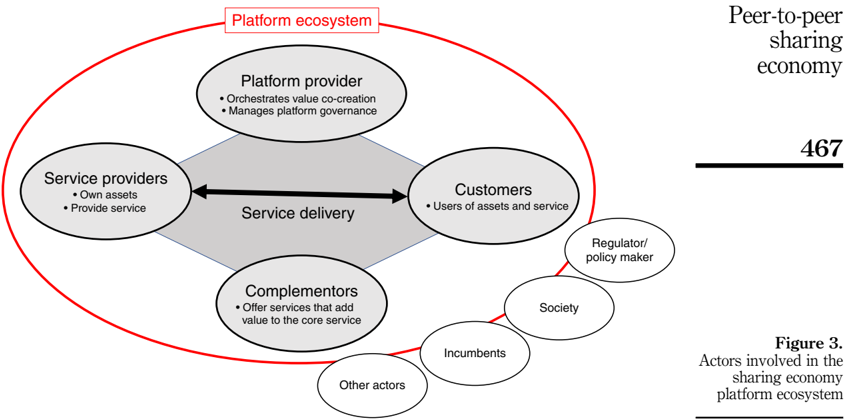
“Value co-creation among the platform, providers, consumers and complementors is fundamental to the platform's value creation process”
§ Platforms in the peer-to-peer sharing economy > Market-level characteristics
What the sources say
- Partly supportedcites Andreassen et al., 2018 matched to “Business model innovation and value-creation: the triadic way” (2018) sourceExperimental — accuracy not yet measured
Section 4 identifies suppliers, buyers, and the platform organization as the three actors in the paper’s value-creation model; the Additional information section explicitly describes co-creation through their interaction. The claim’s inclusion of complementors as a fundamental participant is not supported by these passages. Page numbers are not available in our copy. (LLM, conf=0.87)
plainstates a cause- Asserted: passes — The authors put it forward as true.
- Checkable: passes — It can be checked against evidence.
- Load-bearing: unclear — It is unclear whether the paper’s conclusions depend on it.
- Based: passes — The paper gives a reason why it holds.
- Partly supported
Every source the paper cites for this claim was checked and supports it.
In the paper
“instead of buying and owning things, consumers also increasingly prefer access and temporary use”
§ Platforms in the peer-to-peer sharing economy > 466 JOSM 30,4
What the sources say
- Supportedcites Bardhi and Eckhardt, 2012 matched to “Access-Based Consumption: The Case of Car Sharing: Table 1.” (2012) source
The ‘Emergence of Access-Based Consumption’ section describes a proliferation of access systems over the preceding decade. The paper also says consumers may choose access over ownership, while ‘Dimensionalizing the Field of Access’ explains that access generally involves more temporary use than ownership. Together, these support the broad paraphrase; the paper does not quantify how many consumers prefer access. (LLM, conf=0.86)
plain- Asserted: passes — The authors put it forward as true.
- Checkable: passes — It can be checked against evidence.
- Load-bearing: unclear — It is unclear whether the paper’s conclusions depend on it.
- Based: passes — The paper gives a reason why it holds.
- Supported
The cited sources support only part of this claim — read each source’s verdict below.
In the paper
“risk and uncertainty are mitigated through instilling and managing trust via institutional and legal governance mechanisms”
§ Platforms in the peer-to-peer sharing economy > Platform governance and trust
What the sources say
- Partly supportedcites Akbar and Tracogna, 2018 matched to “The sharing economy and the future of the hotel industry: Transaction cost theory and platform economics” (2018) sourceExperimental — accuracy not yet measured
Section 4 (Propositions development; page unavailable) says platform owners reassure users facing uncertain transactions by adopting integration mechanisms. Section 3 describes reputation-building as a way to establish trust, and contracts, rules and guarantees as additional institutional roles. The claim blurs the paper’s distinction between peer-to-peer and more integrated platforms: it does not establish that peer-to-peer transactions generally have their risks mitigated through legal governance mechanisms. (LLM, conf=0.82)
- Supportedcites Perren and Kozinets, 2018 matched to “Lateral Exchange Markets: How Social Platforms Operate in a Networked Economy” (2018) source
In “Patterns of Assurance in Trusted Platforms,” the paper says institutional arrangements help create the trust needed for lateral exchange and describes verification, insurance, guarantees, and warranties as ways to manage transaction trust. It also links these measures to uncertainty in matching buyers with service providers. (LLM, conf=0.93)
plainstates a cause- Asserted: passes — The authors put it forward as true.
- Checkable: passes — It can be checked against evidence.
- Load-bearing: passes — The paper’s conclusions depend on it.
- Based: passes — The paper gives a reason why it holds.
- Partly supported
85 more claims · 5 with their cited sources checked
Create a free account to see all 173 claims and to verify the 20 references still open.
- It may state two separate claims as one. 59
- Probably not a substantial claim. 44
- The quote only partly states this claim. 2
Self-check
Percentages, sums and reported differences re-computed from the paper’s own numbers.
Each contradiction between two passages listed here was confirmed by an independent check.
Rated minor: it would not touch a result — a value no result rests on, a p-value that stays on the same side of the significance level, or a conflict that is clerical, resolved elsewhere in the paper, or outside its own findings.
In the paper
§ Platforms in the peer-to-peer sharing economy > 468 JOSM 30,4
“the more casual Airbnb hosts who deliver authentic experiences”
§ Platforms in the peer-to-peer sharing economy > 468 JOSM 30,4
“While in the latter case social and authentic experiences may be diminished, accessibility and convenience are increased.”
Citations
Cites
Deep Residual Learning for Image Recognition
He, K., Zhang, X., Ren, S., & Sun, J. (2016) · 2016 IEEE Conference on Computer Vision and Pattern Recognition (CVPR) · doi:10.1109/cvpr.2016.90 · Cited by 235,474
The Effect of Word of Mouth on Sales: Online Book Reviews
Chevalier, J. A., & Mayzlin, D. (2006) · Journal of Marketing Research · doi:10.1509/jmkr.43.3.345 · Cited by 6,003 · cited 1×
“For example, convolutional neural networks can detect features in texts and images to encode meaning and emotional expressions (Chevalier and Mayzlin, 2006; He et al., 2016).”
BackgroundDeep Residual Learning for Image Recognition
He, K., Zhang, X., Ren, S., & Sun, J. (2015) · arXiv · doi:10.48550/arxiv.1512.03385 · Cited by 4,196
The sharing economy: Why people participate in collaborative consumption
Hamari, J., Sjöklint, M., & Ukkonen, A. (2016) · Journal of the Association for Information Science and Technology · doi:10.1002/asi.23552 · Cited by 3,439 · cited 7×
“We therefore consider sharing economy platforms as only those that provide access to assets, resources and services without the transfer of ownership, which is consistent with much of the sharing economy literature (e.g. Benoit et al., 2017; Hamari et al., 2016; Kumar et al., 2018; Schaefers et al., 2016; Zervas et al…”
BackgroundResultInfluentialIndustry Platforms and Ecosystem Innovation
Gawer, A., & Cusumano, M. A. (2014) · Journal of Product Innovation Management · doi:10.1111/jpim.12105 · Cited by 2,394 · cited 2×
“In contrast, platform business models typically require “curator” leadership practices that emphasize: resource integration whereby leaders design a platform architecture that facilitates building a strong network of service providers who bring their capacity-constrained assets to the platform; resource orchestration,…”
BackgroundThe Rise of the Sharing Economy: Estimating the Impact of Airbnb on the Hotel Industry
Zervas, G., Proserpio, D., & Byers, J. W. (2017) · Journal of Marketing Research · doi:10.1509/jmr.15.0204 · Cited by 2,376 · cited 10×
“Cost structure represents an important differentiator between platform and pipeline business models whereby a platform’s fixed and marginal costs are typically lower compared to their pipeline business model counterparts (Zervas et al., 2017).”
BackgroundResultInfluentialBrave new world: service robots in the frontline
Wirtz, J., Patterson, P. G., Kunz, W. H., Gruber, T., Lu, V. N., Paluch, S., & Martins, A. (2018) · Journal of Service Management · doi:10.1108/josm-04-2018-0119 · Cited by 2,315 · cited 1×
“Can service robots or chat bots be developed to take on communications and decision making for both service provides and customers (cf. Wirtz et al., 2018)?”
BackgroundSelf-citationReducing buyer search costs: Implications for electronic marketplaces
Bakos, J. Y. (1997) · Management Science · doi:10.1287/mnsc.43.12.1676 · Cited by 2,259 · cited 1×
“That is, it is relatively easier and costs less to advertise one’s assets and services on a platform compared to listing on websites or running one’s own website, which tends to be expensive and ineffective as these channels typically lack in transaction liquidity (Bakos, 1997; Zervas et al., 2017).”
BackgroundAccess-Based Consumption: The Case of Car Sharing: Table 1.
Bardhi, F., & Eckhardt, G. M. (2012) · Journal of Consumer Research · doi:10.1086/666376 · Cited by 2,015 · cited 1×
“Furthermore, instead of buying and owning things, consumers also increasingly prefer access and temporary use (i.e. experiences over possessions; Bardhi and Eckhardt, 2012).”
BackgroundExtended Self in a Digital World: Table 1.
Belk, R. W. (2013) · Journal of Consumer Research · doi:10.1086/671052 · Cited by 1,698
Research works printed but not linked: 12
- 19. Dellarocas, C. (2000), "The design of reliable trust management systems for electronic trade communities", working paper, Sloan School of Management, Massachusetts Institute of Technology, Cambridge, MA.
- 24. Eckhardt, G. and Bardhi, A. (2015), "The sharing economy isn't about sharing at all", Harvard Business Review, Vol. 93 No. 4, pp. 881-989.
- 28. Evans, D.S. and Schmalensee, R. (2016), The Matchmakers: The new Economics of Multisided Platforms, Harvard Business Review Press, Boston, MA.
- 36. Hagiu, A. and Rothman, S. (2016), "Network effects aren't enough", Harvard Business Review, Vol. 94 No. 4, pp. 64-71.
- 43. Hassan, M. and Tovey, M. (2012), The Reputation Society: How Online Opinions are Reshaping the Offline World, MIT Press, Cambridge, MA.
- 72. Parker, G.G., Van Alstyne, M.W. and Choudary, S.P. (2016), Platform Revolution: How Networked Markets are Transforming the Economy and How to Make Them Work for You, WW Norton & Company, New York, NY.
- 77. Porter, M.E. (1985), Competitive Advantage: Creating and Sustaining Superior Performance, Simon and Schuster, New York, NY.
- 81. Razli, I., Jamal, S. and Zahari, M.S. (2017), "Perceived value in peer-to-peer (P2P) accommodation: a case of Airbnb", Journal of Tourism, Hospitality & Culinary Arts, Vol. 9 No. 2, pp. 213-224.
- 90. Tiwana, A. (2013), Platform Ecosystems: Aligning Architecture, Governance, and Strategy, Morgan Kaufmann, Waltham, MA.
- 100. Wirtz, J. and Lovelock, C. (2016), Services Marketing: People, Technology, Strategy, World Scientific, Singapore.
- 110. Zhu, F. and Furr, N. (2016), "Products to platforms: making the leap", Harvard Business Review, Vol. 94 No. 4, pp. 72-78.
- 112. About the authors Jochen Wirtz is Professor of Marketing and Vice Dean Graduate Studies at NUS Business School, National University of Singapore (NUS), Singapore. He published over 200 academic articles, book chapters and industry reports, including five features in Harvard Business Review. His over 20 books include Services Marketing: People, Technology, Strategy (World Scientific, 8th ed., 2016); Essentials of Services Marketing (Pearson Education, 3rd ed., 2018); Winning in Service Markets (World Scientific, 2017); and the Winning in Service Markets Series (Vol. 1 through 13; World Scientific, 2018). For free
Cited by
Items 301–400 of 411
Digitale Plattformen als soziale Systeme?Vorarbeiten zu einer allgemeinen Theorie
Rachlitz, K., Waag, P., Gehrmann, J., & Grossmann-Hensel, B. (2021) · Soziale Systeme · doi:10.1515/sosys-2021-0003 · Cited by 10
Paylaşım ekonomisi konusunda Türkiye’de yapılmış lisansüstü tezlerin betimsel içerik analizi
Küçükoğlu, M. T. (2023) · Ömer Halisdemir Üniversitesi İktisadi ve İdari Bilimler Fakültesi Dergisi · doi:10.25287/ohuiibf.1251964 · Cited by 2
Fitz, L. R. G., & Scheeg, J. (2024) · Lecture notes in business information processing · doi:10.1007/978-3-031-76365-6_12 · Cited by 3
Oe, H., & Thuy, L. L. (2020) · International Journal of Business Innovation and Research · doi:10.1504/ijbir.2020.10039379 · Cited by 6
Platforms and trust as two columns of sharing economy
Szabó, K. (2024) · Észak-magyarországi Stratégiai Füzetek · doi:10.32976/stratfuz.2024.19 · Cited by 1
AbedRabbo, M., AlMalak, Z., Oliveira, J. S., & Talay, C. (2025) · The Journal of Marketing Theory and Practice · doi:10.1080/10696679.2025.2479744 · Cited by 1
Iwao, S., Park, Y.-C., Park, Y., & Hong, P. C. (2022) · IEEE Access · doi:10.1109/access.2022.3233391 · Cited by 1
Prihanto, Y. J. N., Wenehenubun, S. P., & Sudiyono, K. A. (2024) · Environment-Behaviour Proceedings Journal · doi:10.21834/e-bpj.v9isi19.5759 · Cited by 3
Beyond Money: How Social Motives Drive Green Purchases in the Sharing Economy
Wu, Y., So, K. K. F., Fang, X., & Wang, R. (2025) · Journal of Service Research · doi:10.1177/10946705251374531 · Cited by 2
Self-citationAlternative digital platforms: comparative analysis through the lens of Corporate Aikido
Fitz, L. R. G., & Scheeg, J. (2025) · Information Systems and e-Business Management · doi:10.1007/s10257-025-00703-8 · Cited by 2
Vidickienė, D. (2023) · Springer eBooks · doi:10.1007/978-3-031-47186-5_8 · Cited by 1
Zou, Y., Zhang, Y., & Lu, X. (2024) · Electronic Markets · doi:10.1007/s12525-024-00689-0 · Cited by 1
Plataformas peer-to-peer na economia compartilhada: status atual e agenda de pesquisa futura
Viana, L. C., & da Cunha, C. F. (2023) · Future Studies Research Journal Trends and Strategies · doi:10.24023/futurejournal/2175-5825/2024.v16i1.781
“We Are Here to Stay Longer” A Relational Benefits Perspective in RideHailing Services
Rahman, N. I. A., Suanda, J., & Mahmud, M. (2023) · International Journal of Economics and Management · doi:10.47836/ijeam.17.3.07 · Cited by 5
Devadiga, I., & Aithal, P. S. (2026) · Poornaprajna International Journal of Management Education & Social Science (PIJMESS) · doi:10.64818/pijmess.3107.4626.0045 · Cited by 1
Manufacturer’s Decisions for Sharing Products: Challenges, Opportunities and Optimal Strategic Plan
Keshari, A., & Tiwari, M. K. (2023) · Springer eBooks · doi:10.1007/978-981-19-7071-9_7 · Cited by 1
Consumer perception of service quality The case of Airbnb and Couchsurfing
Dewitte, M., Mallargé, J., & Decrop, A. (2021) · Goodfellow Publishers Ltd eBooks · doi:10.23912/9781911635765-4840 · Cited by 1
Gadola, S., Pek, S., Trabucchi, D., & Buganza, T. (2026) · Technological Forecasting and Social Change · doi:10.1016/j.techfore.2026.124725 · Cited by 3
A contemporary social network analysis of sharing economy literature
Leković, M., Dimitrovski, D., & Stanišić, T. (2024) · Acta Oeconomica · doi:10.1556/032.2024.00006 · Cited by 2
Pang, J., Fu, X., Luan, R., & Bai, L. (2025) · International Journal of Hospitality Management · doi:10.1016/j.ijhm.2025.104481 · Cited by 1
Enablers and inhibitors of word-of-mouth in ridesharing apps: a dual perspective on user involvement
Park, J., Ye, C., & Chen, Y. (2026) · Journal of Retailing and Consumer Services · doi:10.1016/j.jretconser.2026.104896 · Cited by 1
Researching the post-industrial society development prospects (exemplified by a municipal entity)
Rozhkov, E. V. (2021) · Муниципалитет: экономика и управление · doi:10.22394/2304-3385-2021-3-47-57 · Cited by 2
Matchmaking In Crowd-Shipping Platforms: The Effects Of Mediator Control
Kulkarni, P., & Krejci, C. C. (2023) · Winter Simulation Conference · doi:10.1109/wsc60868.2023.10407822 · Cited by 2
A Study on Collaborative Fashion Consumption Platform
Cho, M., & Ko, E. (2020) · Fashion & Textile Research Journal · doi:10.5805/sfti.2020.22.6.777 · Cited by 1
Rose, A. S., Hewett, K., & Rose, R. L. (2022) · The Journal of Marketing Theory and Practice · doi:10.1080/10696679.2022.2048182 · Cited by 2
Cross-Market Entry of Gig Platforms Under Shared Labor
(2026) · doi:10.1109/tem.2026.3692454 · Cited by 1
Geçti, F., Yasatekin, H., BAYNİŞ, İ. K., & Üner, Ö. F. (2022) · Trafik ve Ulaşım Araştırmaları Dergisi · doi:10.38002/tuad.1173248 · Cited by 2
Kittur, P. V., Goswami, R., & Chatterjee, S. (2025) · European Journal of Marketing · doi:10.1108/ejm-05-2024-0426 · Cited by 4
Guest editorial: The sharing economy in a post-pandemic world
So, K. K. F., Viglia, G., Liu, S., & Wang, D. (2023) · International Journal of Contemporary Hospitality Management · doi:10.1108/ijchm-04-2023-086 · Cited by 1
Self-citationSantana, A. A., David-Negre, T., Gil, S. M., & Coca‐Stefaniak, J. A. (2022) · Goodfellow Publishers Ltd eBooks · doi:10.23912/9781915097064-5093 · Cited by 2
Platform Stress in Hospitality – Focusing on the Technology dimension
Park, J. E., Chung, N., & Koo, C. (2022) · Springer eBooks · doi:10.1007/978-3-030-94751-4_27
Chen, S., Dai, Z., Chen, W., Luo, X., Zhang, S., & Sun, K. (2025) · Internet Research · doi:10.1108/intr-01-2024-0062 · Cited by 2
Hansmeier, P. (2025) · Lecture notes in information systems and organisation · doi:10.1007/978-3-031-80125-9_4
Sarker, P., & Rashid, M. H. A. (2026) · IFIP advances in information and communication technology · doi:10.1007/978-3-032-16779-8_9 · Cited by 1
Heredero, J. D. A. (2024) · UVaDOC UVaDOC University of Valladolid Documentary Repository (University of Valladolid) · doi:10.35376/10324/71599 · Cited by 1
Digitalization and the Gig Economy
Pazim, K. H., Uchiyama, Y., Furuoka, F., Lim, B., & Li, J. (2023) · Routledge eBooks · doi:10.4324/9781003367093-10 · Cited by 3
Social businesses and digital platforms: analysis from the perspective of business models
de Moura, V. F. (2023) · Digital Library of Theses and Dissertations (Universidade de São Paulo) · doi:10.11606/t.12.2023.tde-12032024-153519
SAGLIA, M., Zulauf, K., Paul, D. I. O. N., & Wagner, R. (2025) · Management Dynamics in the Knowledge Economy · doi:10.2478/mdke-2025-0019
Mingyue, F., Jiaxu, T., & Qalati, S. A. (2023) · Research Square · doi:10.21203/rs.3.rs-3212583/v1
Wibowo, A. J. I., Sumarwan, U., Suharjo, B., & Simanjuntak, M. (2022) · Jurnal Manajemen Indonesia · doi:10.25124/jmi.v22i2.4291 · Cited by 3
آسیابرکی, م. ه., Nazari-Shirkouhi, S., & Bozorgi-Amiri, A. (2023) · Research Square · doi:10.21203/rs.3.rs-2288311/v1
Platform Business Models Operations in Industry 5.0
Hashim, M. A. M., Tlemsani, I., Matthews, R., El-Temtamy, O., Gilani, S. A. M., & Tantry, A. (2025) · Studies in systems, decision and control · doi:10.1007/978-3-031-87372-0_13
Crowdsourcing to Tackle Online Child Sexual Exploitation
Ilbiz, E., & Kaunert, C. (2023) · Advanced sciences and technologies for security applications · doi:10.1007/978-3-031-20274-2_6
Digital inequalities in the sharing economy: A qualitative text analysis from focus groups
Coy-Mesa, D., Guerrero, Y. M. N., & Morales‐Alonso, G. (2026) · PLoS ONE · doi:10.1371/journal.pone.0357784
The Core Framework: A Rubric for Identifying Sharing Economy PlatformsPreprint
Güçlü, M. S. (2026) · SSRN Electronic Journal · doi:10.2139/ssrn.7493669
Basak, E., & Iris, Ç. (2025) · Transportation Research Part A Policy and Practice · doi:10.1016/j.tra.2025.104740 · Cited by 3
Panel Method in Hedging: Evidence from The Indonesian Agricultural Sector
Mubarok, F., & Utami, R. N. (2020) · Jurnal Dinamika Akuntansi · doi:10.15294/jda.v12i2.24676 · Cited by 3
Stranded futures? Quantifying the asset risks of industrial decarbonisation in developed economies
AbdulRafiu, A. (2026) · Energy Research & Social Science · doi:10.1016/j.erss.2026.104621
Estrutura de monitoramento e controle como base para a inovação em governança: o caso TáxiGov
Giovanini, A., Bertolini, L. B., Salm, V. M., & Bittencourt, P. F. (2023) · Revista do Serviço Público · doi:10.21874/rsp.v74i2.7816 · Cited by 3
Simple rules in the development of multi-sided platforms
Groenewegen, B. F. (2021)
BARRIERS AND DRIVERS OF THE SHARING ECONOMY IN EUROPE: INSIGHTS FROM A SYSTEMATIC LITERATURE REVIEW
Ryczko, A., & Michalski, M. (2025) · Współczesna Gospodarka · doi:10.26881/wg.2025.1.01
An illustration of the practical use of a taxonomy-based canvas in platform revenue model design
Bartels, N., Scherr, S. A., Koch, M. A., Schmitt, A., & Gordijn, J. (2026) · Journal of Business Models · doi:10.1108/jobm-04-2026-0004
Malodia, S., Dhir, A., Walsh, S., & Kaur, P. (2026) · European Journal of Marketing · doi:10.1108/ejm-04-2023-0291
Exploring Design Principles for SME Complementor-Suitable Digital Platforms
Fitz, L. R. G., & Scheeg, J. (2026) · Acta Informatica Pragensia · doi:10.18267/j.aip.307 · Cited by 1
Doligalski, T. (2022) · SSRN Electronic Journal · doi:10.2139/ssrn.4161108
Performance Analysis of the Basic Queue Model for Digital Sharing Economy Platforms
Liu, H.-L., Li, Q., & Zhang, C. (2026) · Methodology And Computing In Applied Probability · doi:10.1007/s11009-026-10297-4
Optimal operations strategies of customer-to-customer sharing platforms
Sun, Y., Yan, S., & Bian, Y. (2025) · Elsevier eBooks · doi:10.1016/b978-0-443-28993-4.00043-3
Arıcı, N. Ç., & Köseoğlu, M. A. (2026) · Quality & Quantity · doi:10.1007/s11135-026-02577-5
Economia colaborativa: enquadramento económico
Correia, I. M., & Veiga, P. A. C. V. (2023) · doi:10.21814/uminho.ed.100.1 · Cited by 2
DIGITAL PLATFORM AS A GLOBAL BUSINESS MODEL OF INDUSTRY 4.0
Stupnytskyy, O., Panikar, G., & Morozov, V. (2024) · ACTUAL PROBLEMS OF INTERNATIONAL RELATIONS · doi:10.17721/apmv.2024.160.1.95-109 · Cited by 1
ÖZAYDIN, Ö., & Acar, H. (2026) · International Journal of Urban Sciences · doi:10.1080/12265934.2026.2664485
КРОСС-КУЛЬТУРНЫЕ АСПЕКТЫ УПРАВЛЕНИЯ ГЛОБАЛЬНЫМИ ЦИФРОВЫМИ ПЛАТФОРМАМИ
Bostoganashvili, E. (2026) · Экономика и предпринимательство · doi:10.34925/eip.2026.186.1.181
Understanding the Behavioral Aspects Impacting Service Providers and Consumers in Sharing Economy
Idug, Y. (2024) · University of North Texas Digital Library (University of North Texas) · doi:10.12794/metadc2356142
Jia, Y., Xiao, F., & Park, S.-D. (2026) · Sustainability · doi:10.3390/su18125811
SEP Is Facilitating Electronic Word-of-Mouth (eWOM): The Case of Xiaohongshu Platform
Fan, Y., & Yuan, R. (2024) · Springer eBooks · doi:10.1007/978-981-97-5404-5_5
Hosting via Airbnb Motivations and operational complexities
Ozanne, L. K., Prayag, G., & Martin-Neuninger, R. (2022) · Goodfellow Publishers Ltd eBooks · doi:10.23912/9781915097064-5110
The Challenges in Implementing Mixed Economy of Care Practices in Child Welfare Network in Malaysia
Rauf, S. H. A., Ah, S. H. A. B., Wahab, H. B. A., & Azam, S. B. M. (2021) · Advances in Social Science, Education and Humanities Research/Advances in social science, education and humanities research · doi:10.2991/assehr.k.210615.082
Bueno, S., Gallego, E. M., Montealegre, R., & Gallego, M. D. (2025) · Economies · doi:10.3390/economies13080246 · Cited by 1
The Sharing Economy for a Public-Private Partnership
Ilbiz, E., & Kaunert, C. (2023) · Advanced sciences and technologies for security applications · doi:10.1007/978-3-031-20274-2_3
Mohammadi, N., & Razghandi, E. (2026) · Array · doi:10.1016/j.array.2026.101293
Direct and indirect customer orientation in multi-sided platforms: a stakeholder perspective
Mohamed, N. O. M., & Schumann, J. H. (2026) · Journal of service management · doi:10.1108/josm-11-2025-0582
Carneiro, L. L., Moscon, D. C. B., & Gondim, S. (2024) · Ariadna Ediciones eBooks · doi:10.26448/ae9789566276166.92 · Cited by 4
Technical Report: Rethink waste
Benavides, M. M., Eberle, C., Ramesh, A., Ramírez, A., & Guerra, F. (2025) · UNU Collections (United Nations University) · doi:10.53324/cmwp6625 · Cited by 1
Ojha, A., & Kumar, D. S. (2026) · Journal of Services Marketing · doi:10.1108/jsm-03-2025-0190
Mendieta-Aragón, A., Navío-Marco, J., Sevilla, C., & Ruiz-Gómez, L. M. (2025) · Current Issues in Tourism · doi:10.1080/13683500.2025.2526717 · Cited by 1
Li, C., Zheng, C., & Lv, Z. (2026) · Frontiers in Public Health · doi:10.3389/fpubh.2026.1847810
Zahari, N. M., Ahmad, Z., & Ismail, H. (2024) · International Journal of Innovation and Industrial Revolution · doi:10.35631/ijirev.616003
Artificial Intelligence – Encounters And Openings For Global HRM A Appraisal And Investigate Schema
(2025) · REST Journal on Data Analytics and Artificial Intelligence · doi:10.46632/jdaai/3/4/6
Auer, C., Bartsch, S., & Meyer, A. (2020) · Springer eBooks · doi:10.1007/978-3-658-28672-9_35
Yoho Bed: Scaling Up a Platform Business in the Hospitality Industry
Mirza, J., & Ensign, P. C. (2024) · Springer eBooks · doi:10.1007/978-981-97-1891-7_7
Urban Life Matters: The Heterogeneous Effects of On-Demand Bike Sharing Platforms on Urban TransitPreprint
Basak, E., & Iris, Ç. (2025) · SSRN Electronic Journal · doi:10.2139/ssrn.5262556
Digital platforms’ business models: a literature review and research agenda
de Moura, V. F., Scornavacca, E., & Souza, C. A. (2026) · Journal of Business Models · doi:10.1108/jobm-04-2026-0003
Srai, D. K. (2026) · The International Journal on Media Management · doi:10.1080/14241277.2026.2693626
Il consumo dei beni di lusso nel contesto della sharing economy: un caso di studio italiano
Capestro, M., & Chiavegato, G. (2023) · ECONOMIA E SOCIETÀ REGIONALE · doi:10.3280/es2023-001005
A CRIAÇÃO DE CONFIANÇA ATRAVÉS DE INTERFACES DIGITAIS
Amorim, V., & Quaresma, M. (2022) · Ergodesign & HCI · doi:10.22570/ergodesignhci.v10i2.1779
Proposal of an integrated design framework for digital-enabled life cycle ecosystem
Tamura, T., Odagaki, R., Umeda, Y., Miyake, G., Matsuda, G., Tajima, A., & Kishita, Y. (2025) · Procedia CIRP · doi:10.1016/j.procir.2024.12.149
From Local Upstart to Global Challenger
Banerjee, G. D., Saqib, N., & Bashir, G. (2026) · IGI Global eBooks · doi:10.4018/979-8-2600-3194-0.ch010
Which online narratives transfer memorability in peer-to-peer accommodation?
Bigné, E., Medina, M. L. F., & Marrero, S. M. (2026) · Journal of Hospitality and Tourism Insights · doi:10.1108/jhti-07-2025-0793
Ramawela, M. E., & Holtzhausen, N. (2025) · Administratio publica. · doi:10.61967/adminpub.2025.33.4.5
Metadata
- Authors
- Wirtz, J., So, K. K. F., Mody, M. A., Liu, S. Q., & Chun, H. H.
- Affiliations
- National University of Singapore (SG)
- University of South Carolina (US)
- Boston University (US)
- The Ohio State University (US)
- Cornell University (US)
- Corresponding author
- Wirtz, Jochen
- Venue
- Journal of Service Management
- Publisher
- Emerald
- Published
- 2019-10-16
- Volume
- 30
- Issue
- 4
- Pages
- 452-483
- ISSN
- 1757-5818 (ISSN-L)
- OpenAlex
- W2973057865
- Cited by
- 414
- References
- 92
- Citations by year
- 2026: 34 · 2025: 44 · 2024: 70 · 2023: 70 · 2022: 75 · 2021: 60 · 2020: 50 · 2019: 11
- FWCI
- 64.28
- Type
- journal article
- Language
- en
- Open access
- hybrid
- doi.org
- Licence
- cc-by
- www.emerald.com/insight/site-policies (tdm)
- Locations
- Journal of service management (publishedVersion, cc-by)
- National University of Singapore (submittedVersion)
- OpenBU (Boston University) (submittedVersion, cc-by)
- Funders
- Ministry of Education - Singapore (MOE2016-SSRTG-059)
- Ministry of Education, India
- Topics
- Social Sciences › Business, Management and Accounting › Marketing › Sharing Economy and Platforms
- Social Sciences › Business, Management and Accounting › Strategy and Management › Digital Platforms and Economics
- Social Sciences › Sociology and Political Science › Digital Economy and Work Transformation
- Keywords
- sharing platforms, platform business models, network effects, liquidity, matching quality, competitive advantage, stakeholder trust, user loyalty, platform regulation, platform ecosystems
About these checks
Registry, retraction, Cites and statistics results are computed, not judged, with one exception: a printed reference that no index lists is read once by a model before it counts as a citation error. Claims are extracted by a model and kept only when their quote appears verbatim in the text; each cited source is then checked, with a model’s help, for whether it says what the claim relies on. Those verdicts can be wrong — read the claim’s quote and the cited source before relying on one.
The claim verdicts this report counts are experimental: their accuracy is not yet measured.
A language model drew the claims from the paper on 2026-09-29, under version 3 of the claim definition (model deepseek-v4.1-flash, prompt extract-v3).
A second model labelled each claim on 2026-09-29 (model jev-1.13-20260917, definition revision gold-guideline-v0.2).
Cited sources are checked with a language model’s help (gpt-6-sol and qwen3.8-omni-flash).
Statistics and arithmetic are recomputed, not judged.
Confidence bands are shown only for fields calibrated on our annotated test set. None is calibrated yet, so no band is shown.
What counts as a claim ›How we measure confidence ›How we check this ›
Are you an author, or do you see a problem with this page? Request a review
Data sources
Bibliographic data: Semantic Scholar, OpenAlex, Crossref.
Contains information from the Semantic Scholar Academic Graph Datasets, made available under the ODC Attribution License (ODC-BY 1.0).
Semantic Scholar’s data is described in: Kinney, R., et al. (2023). The Semantic Scholar Open Data Platform. arXiv:2301.10140.
