

Platforms in the peer-to-peer sharing economy
Open accessThe DOI matches its Crossref record; 99 of the 99 references it cites were found in a registry or an index; 25 of the 122 sources its claims cite were checked for support.
Abstract
Purpose The purpose of this paper is to examine peer-to-peer sharing platform business models, their sources of competitive advantage, and the roles, motivations and behaviors of key actors in their ecosystems. Design/methodology/approach This paper uses a conceptual approach that is rooted in the service, tourism and hospitality, and strategy literature. Findings First, this paper defines key types of platform business models in the sharing economy anddescribes their characteristics. In particular, the authors propose the differentiation between sharing platforms of capacity-constrained vs capacity-unconstrained assets and advance five core properties of the former. Second, the authors contrast platform business models with their pipeline business model counterparts to understand the fundamental differences between them. One important conclusion is that platforms cater to vastly more heterogeneous assets and consumer needs and, therefore, require liquidity and analytics for high-quality matching. Third, the authors examine the competitive position of platforms and conclude that their widely taken “winner takes it all” assumption is not valid. Primary network effects are less important once a critical level of liquidity has been reached and may even turn negative if increased listings raise friction in the form of search costs. Once a critical level of liquidity has been reached, a platform’s competitive position depends on stakeholder trust and service provider and user loyalty. Fourth, the authors integrate and synthesize the literature on key platform stakeholders of platform businesses (i.e. users, service providers, and regulators) and their roles and motivations. Finally, directions for further research are advanced. Practical implications This paper helps platform owners, service providers and users understand better the implications of sharing platform business models and how to position themselves in such ecosystems. Originality/value This paper integrates the extant literature on sharing platforms, takes a novel approach in delineating their key properties and dimensions, and provides insights into the evolving and dynamic forms of sharing platforms including converging business models.
Overview
CoChat Summary
TL;DR
This conceptual paper defines peer-to-peer sharing economy platforms as access-based, peer-to-peer platforms for capacity-constrained assets and contrasts them with pipeline businesses. It argues the “winner takes all” assumption is overstated because direct network effects weaken after critical liquidity, and competitive advantage then depends on trust, governance, and provider/user loyalty.
Key findings
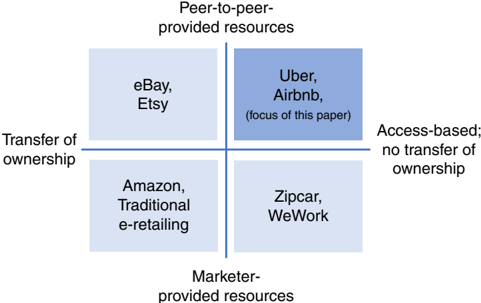
- Proposes five core properties of peer-to-peer sharing platforms: no transfer of ownership; peer-to-peer exchange mediated by a digital platform; sharing of capacity-constrained tangible assets sometimes enhanced by labor; indirect network effects and liquidity improve matching quality; and direct network effects matter only up to a threshold (Table I).
- Contrasts platform and pipeline models: platforms are multi-sided, asset-light, have near-zero marginal costs, use dynamic pricing and analytics for heterogeneous supply/demand, and rely on ecosystem innovation; pipeline firms have high fixed costs, standardized offerings, and internalized innovation. Examples include Airbnb charging hosts a 3 percent service fee and guests 0–20 percent, and Uber’s surge pricing.
- Rejects the “winner takes all” view: once critical liquidity is reached, additional listings can add competition and search friction. Citing Li and Netessine, the paper reports that as hosts and travelers doubled, inquiries rose 18.3 percent to hosts and 19.6 percent to travelers; traveler confirmation rates dropped 15.4 percent, host occupancy dropped 15.9 percent, and the platform lost 5.6 percent of potential transactions.
- Synthesizes stakeholder roles across the consumer journey, provider motivations, and policy issues. Reported examples include that approximately two-thirds of Uber drivers use the platform as additional income and one-fifth use it as their only personal income source; Uber provides $1m in third-party liability coverage; and Airbnb’s Superhost program requires at least ten trips over a year.
Methods
- Conceptual approach rooted in the service, tourism and hospitality, and strategy literature; no primary empirical sample or new data collection.
- Synthesizes extant literature to define platform types, develop dimensions and core properties, contrast peer-to-peer sharing platforms with pipeline business models, and derive future research questions.
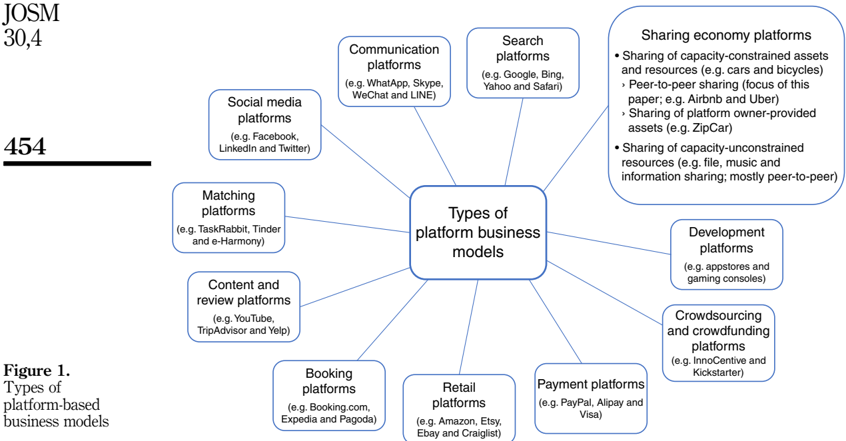
- Scope is for-profit, access-based, peer-to-peer platforms matching capacity-constrained assets and resources (e.g., Airbnb, Uber); it excludes marketer/platform-provided asset platforms (e.g., Zipcar, WeWork) and capacity-unconstrained sharing.
Limitations
- Stated limitations: Not stated in the paper.
- Evident: the paper is a conceptual synthesis without primary empirical testing, so its conclusions rely on cited studies and illustrative examples.
- Evident: the scope is deliberately limited to for-profit, access-based, peer-to-peer, capacity-constrained platforms; findings may not generalize to marketer-provided asset platforms, capacity-unconstrained platforms, or non-profit models.
Model-written summary. Check it against the paper before relying on it.
Integrity signals
Registry
Cites
Statistics
Figures
Verification
Claims the paper makes
21 Valid · 17 Not valid · 57 Not checked · 78 Own results and interpretations
The cited sources support only part of this claim — read each source’s verdict below.
In the paper
“This minimum viable platform size is determined by the nature of the network effects linking the platform's two or more-sided markets, the heterogeneity of assets and “tastes” of the actors (Akbar and Tracogna, 2018;Evans and Schmalensee, 2010), and equilibrium dynamics between service providers and users that allow stakeholder utilities to be maximized at a given price (Evans and Schmalensee, 201”
§ Platforms in the peer-to-peer sharing economy > Network effects and liquidity
What the sources say
- Partly supportedcites Akbar and Tracogna, 2018 matched to “The sharing economy and the future of the hotel industry: Transaction cost theory and platform economics” (2018) sourceExperimental — accuracy not yet measured
Section 2.1, “The economics of platforms” (page unavailable), says platform owners need to reach a minimum viable size and describes same-side and cross-side network effects. The paper also discusses asset specificity, but the passages do not establish that heterogeneity of assets or actors’ “tastes” determines that minimum size. The equilibrium-and-utility clause is cited to Evans and Schmalensee, not to this paper. (LLM, conf=0.83)
- Partly supportedcites Evans and Schmalensee, 2010 matched to “Failure to Launch: Critical Mass in Platform Businesses” (2010) sourceExperimental — accuracy not yet measured
Split into 2 atoms — 1 confirmed, 1 partially supported, 0 disputed, 0 misattributed, 0 unverifiable. Expand the claim to see per-atom verdicts.
plainstates a cause- Asserted: passes — The authors put it forward as true.
- Checkable: passes — It can be checked against evidence.
- Load-bearing: passes — The paper’s conclusions depend on it.
- Based: passes — The paper gives a reason why it holds.
- Partly supported
The cited sources support only part of this claim — read each source’s verdict below.
In the paper
“platforms have demonstrated the ability to develop and use highly sophisticated algorithms and analytics that can mitigate the effects of capacity constraints caused by heterogeneity much more effectively than pipeline businesses”
§ Platforms in the peer-to-peer sharing economy > JOSM 30,4
What the sources say
- Partly supportedcites Duch-Brown, 2017Experimental — accuracy not yet measured
Section 4 says that greater user heterogeneity can create capacity constraints and that using data to personalise offers or advertising can overcome their effects. It also discusses the algorithms needed to operate platforms. But it does not establish that sophisticated algorithms and analytics do this much more effectively than those of pipeline businesses. (LLM, conf=0.85)
boostedstates a cause- Asserted: passes — The authors put it forward as true.
- Checkable: passes — It can be checked against evidence.
- Load-bearing: passes — The paper’s conclusions depend on it.
- Based: passes — The paper gives a reason why it holds.
- Partly supported
The cited sources support only part of this claim — read each source’s verdict below.
In the paper
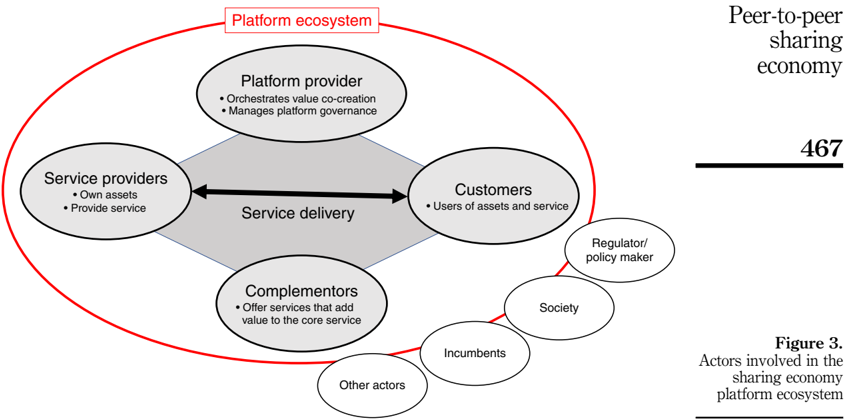
“Value co-creation among the platform, providers, consumers and complementors is fundamental to the platform's value creation process”
§ Platforms in the peer-to-peer sharing economy > Market-level characteristics
What the sources say
- Partly supportedcites Andreassen et al., 2018 matched to “Business model innovation and value-creation: the triadic way” (2018) sourceExperimental — accuracy not yet measured
Section 4 identifies suppliers, buyers, and the platform organization as the three actors in the paper’s value-creation model; the Additional information section explicitly describes co-creation through their interaction. The claim’s inclusion of complementors as a fundamental participant is not supported by these passages. Page numbers are not available in our copy. (LLM, conf=0.87)
plainstates a cause- Asserted: passes — The authors put it forward as true.
- Checkable: passes — It can be checked against evidence.
- Load-bearing: unclear — It is unclear whether the paper’s conclusions depend on it.
- Based: passes — The paper gives a reason why it holds.
- Partly supported
Every source the paper cites for this claim was checked and supports it.
In the paper
“instead of buying and owning things, consumers also increasingly prefer access and temporary use”
§ Platforms in the peer-to-peer sharing economy > 466 JOSM 30,4
What the sources say
- Supportedcites Bardhi and Eckhardt, 2012 matched to “Access-Based Consumption: The Case of Car Sharing: Table 1.” (2012) source
The ‘Emergence of Access-Based Consumption’ section describes a proliferation of access systems over the preceding decade. The paper also says consumers may choose access over ownership, while ‘Dimensionalizing the Field of Access’ explains that access generally involves more temporary use than ownership. Together, these support the broad paraphrase; the paper does not quantify how many consumers prefer access. (LLM, conf=0.86)
plain- Asserted: passes — The authors put it forward as true.
- Checkable: passes — It can be checked against evidence.
- Load-bearing: unclear — It is unclear whether the paper’s conclusions depend on it.
- Based: passes — The paper gives a reason why it holds.
- Supported
The cited sources support only part of this claim — read each source’s verdict below.
In the paper
“risk and uncertainty are mitigated through instilling and managing trust via institutional and legal governance mechanisms”
§ Platforms in the peer-to-peer sharing economy > Platform governance and trust
What the sources say
- Partly supportedcites Akbar and Tracogna, 2018 matched to “The sharing economy and the future of the hotel industry: Transaction cost theory and platform economics” (2018) sourceExperimental — accuracy not yet measured
Section 4 (Propositions development; page unavailable) says platform owners reassure users facing uncertain transactions by adopting integration mechanisms. Section 3 describes reputation-building as a way to establish trust, and contracts, rules and guarantees as additional institutional roles. The claim blurs the paper’s distinction between peer-to-peer and more integrated platforms: it does not establish that peer-to-peer transactions generally have their risks mitigated through legal governance mechanisms. (LLM, conf=0.82)
- Supportedcites Perren and Kozinets, 2018 matched to “Lateral Exchange Markets: How Social Platforms Operate in a Networked Economy” (2018) source
In “Patterns of Assurance in Trusted Platforms,” the paper says institutional arrangements help create the trust needed for lateral exchange and describes verification, insurance, guarantees, and warranties as ways to manage transaction trust. It also links these measures to uncertainty in matching buyers with service providers. (LLM, conf=0.93)
plainstates a cause- Asserted: passes — The authors put it forward as true.
- Checkable: passes — It can be checked against evidence.
- Load-bearing: passes — The paper’s conclusions depend on it.
- Based: passes — The paper gives a reason why it holds.
- Partly supported
85 more claims · 5 with their cited sources checked
Create a free account to see all 173 claims and to verify the 20 references still open.
- It may state two separate claims as one. 59
- Probably not a substantial claim. 44
- The quote only partly states this claim. 2
Self-check
Percentages, sums and reported differences re-computed from the paper’s own numbers.
Each contradiction between two passages listed here was confirmed by an independent check.
Rated minor: it would not touch a result — a value no result rests on, a p-value that stays on the same side of the significance level, or a conflict that is clerical, resolved elsewhere in the paper, or outside its own findings.
In the paper
§ Platforms in the peer-to-peer sharing economy > 468 JOSM 30,4
“the more casual Airbnb hosts who deliver authentic experiences”
§ Platforms in the peer-to-peer sharing economy > 468 JOSM 30,4
“While in the latter case social and authentic experiences may be diminished, accessibility and convenience are increased.”
Citations
Cites
Deep Residual Learning for Image Recognition
He, K., Zhang, X., Ren, S., & Sun, J. (2016) · 2016 IEEE Conference on Computer Vision and Pattern Recognition (CVPR) · doi:10.1109/cvpr.2016.90 · Cited by 235,474
The Effect of Word of Mouth on Sales: Online Book Reviews
Chevalier, J. A., & Mayzlin, D. (2006) · Journal of Marketing Research · doi:10.1509/jmkr.43.3.345 · Cited by 6,003 · cited 1×
“For example, convolutional neural networks can detect features in texts and images to encode meaning and emotional expressions (Chevalier and Mayzlin, 2006; He et al., 2016).”
BackgroundDeep Residual Learning for Image Recognition
He, K., Zhang, X., Ren, S., & Sun, J. (2015) · arXiv · doi:10.48550/arxiv.1512.03385 · Cited by 4,196
The sharing economy: Why people participate in collaborative consumption
Hamari, J., Sjöklint, M., & Ukkonen, A. (2016) · Journal of the Association for Information Science and Technology · doi:10.1002/asi.23552 · Cited by 3,439 · cited 7×
“We therefore consider sharing economy platforms as only those that provide access to assets, resources and services without the transfer of ownership, which is consistent with much of the sharing economy literature (e.g. Benoit et al., 2017; Hamari et al., 2016; Kumar et al., 2018; Schaefers et al., 2016; Zervas et al…”
BackgroundResultInfluentialIndustry Platforms and Ecosystem Innovation
Gawer, A., & Cusumano, M. A. (2014) · Journal of Product Innovation Management · doi:10.1111/jpim.12105 · Cited by 2,394 · cited 2×
“In contrast, platform business models typically require “curator” leadership practices that emphasize: resource integration whereby leaders design a platform architecture that facilitates building a strong network of service providers who bring their capacity-constrained assets to the platform; resource orchestration,…”
BackgroundThe Rise of the Sharing Economy: Estimating the Impact of Airbnb on the Hotel Industry
Zervas, G., Proserpio, D., & Byers, J. W. (2017) · Journal of Marketing Research · doi:10.1509/jmr.15.0204 · Cited by 2,376 · cited 10×
“Cost structure represents an important differentiator between platform and pipeline business models whereby a platform’s fixed and marginal costs are typically lower compared to their pipeline business model counterparts (Zervas et al., 2017).”
BackgroundResultInfluentialBrave new world: service robots in the frontline
Wirtz, J., Patterson, P. G., Kunz, W. H., Gruber, T., Lu, V. N., Paluch, S., & Martins, A. (2018) · Journal of Service Management · doi:10.1108/josm-04-2018-0119 · Cited by 2,315 · cited 1×
“Can service robots or chat bots be developed to take on communications and decision making for both service provides and customers (cf. Wirtz et al., 2018)?”
BackgroundSelf-citationReducing buyer search costs: Implications for electronic marketplaces
Bakos, J. Y. (1997) · Management Science · doi:10.1287/mnsc.43.12.1676 · Cited by 2,259 · cited 1×
“That is, it is relatively easier and costs less to advertise one’s assets and services on a platform compared to listing on websites or running one’s own website, which tends to be expensive and ineffective as these channels typically lack in transaction liquidity (Bakos, 1997; Zervas et al., 2017).”
BackgroundAccess-Based Consumption: The Case of Car Sharing: Table 1.
Bardhi, F., & Eckhardt, G. M. (2012) · Journal of Consumer Research · doi:10.1086/666376 · Cited by 2,015 · cited 1×
“Furthermore, instead of buying and owning things, consumers also increasingly prefer access and temporary use (i.e. experiences over possessions; Bardhi and Eckhardt, 2012).”
BackgroundExtended Self in a Digital World: Table 1.
Belk, R. W. (2013) · Journal of Consumer Research · doi:10.1086/671052 · Cited by 1,698
Trust and reputation in the sharing economy: The role of personal photos in Airbnb
Ert, E., Fleischer, A., & Magen, N. (2016) · Tourism Management · doi:10.1016/j.tourman.2016.01.013 · Cited by 1,295 · cited 2×
“…of consumers on Chinese platforms, Chen et al. (2009) found that two types of trust are essential for building platform loyalty: mutual trust among members and members’ trust in the platform itself (a number of further studies validated these findings; Abrate and Viglia, 2019; Ert et al., 2016).”
BackgroundPutting the sharing economy into perspective
Frenken, K., & Schor, J. (2017) · Environmental Innovation and Societal Transitions · doi:10.1016/j.eist.2017.01.003 · Cited by 1,105
Hagiu, A., & Wright, J. (2015) · International Journal of Industrial Organization · doi:10.1016/j.ijindorg.2015.03.003 · Cited by 995
Lamberton, C. P., & Rose, R. L. (2012) · Journal of Marketing · doi:10.1509/jm.10.0368 · Cited by 955 · cited 3×
“Evidence is gathering that the sharing economy and platform business models are significantly changing ecosystems, markets and consumption patterns (Caldieraro et al., 2018; Lamberton and Rose, 2012; Zervas et al., 2017).”
BackgroundRide On! Mobility Business Models for the Sharing Economy
Cohen, B., & Kietzmann, J. (2014) · Organization & Environment · doi:10.1177/1086026614546199 · Cited by 943
Aguirre, E., Mahr, D., Grewal, D., de Ruyter, K., & Wetzels, M. (2015) · Journal of Retailing · doi:10.1016/j.jretai.2014.09.005 · Cited by 868 · cited 1×
“Given their access to millions of user profiles, such platforms’ revenue models rely largely on targeted advertising (Aguirre et al., 2015).”
Background(2016) · Harvard business review · Cited by 812
Impacts of Peer-to-Peer Accommodation Use on Travel Patterns
Tussyadiah, I. P., & Pesonen, J. (2016) · Journal of Travel Research · doi:10.1177/0047287515608505 · Cited by 804
Sustainable consumption: opportunities for consumer research and public policy
Prothero, A., Dobscha, S., Freund, J., Kilbourne, W. E., Luchs, M. G., Ozanne, L. K., & Thøgersen, J. (2011) · Journal of Public Policy & Marketing · doi:10.1509/jppm.30.1.31 · Cited by 762
Why Tourists Choose Airbnb: A Motivation-Based Segmentation Study
Guttentag, D., Smith, S., Potwarka, L., & Havitz, M. (2018) · Journal of Travel Research · doi:10.1177/0047287517696980 · Cited by 726
Managing brands and customer engagement in online brand communities
Wirtz, J., den Ambtman, A., Bloemer, J., Horváth, C., Ramaseshan, B., van de Klundert, J., Gurhan Canli, Z., & Kandampully, J. (2013) · Journal of Service Management · doi:10.1108/09564231311326978 · Cited by 713
Self-citationAn Analysis of the Labor Market for Uber’s Driver-Partners in the United States
Hall, J. V., & Krueger, A. B. (2018) · ILR Review · doi:10.1177/0019793917717222 · Cited by 701 · cited 3×
“Approximately two-thirds of Uber drivers use the platform as an additional income source over regular employment; Uber is the only source of personal income only for one-fifth of drivers (Hall and Krueger, 2018).”
BackgroundInfluentialOpen Innovation: Where We've Been and Where We're Going
Chesbrough, H. (2012) · Research-Technology Management · doi:10.5437/08956308x5504085 · Cited by 576
Benoit, S., Baker, T. L., Bolton, R. N., Gruber, T., & Kandampully, J. (2017) · Journal of Business Research · doi:10.1016/j.jbusres.2017.05.004 · Cited by 554 · cited 17×
“See also Benoit et al. (2017) for an excellent review for consumer motives and behaviors related to collaborative consumption, which includes peer-to-peer sharing.”
BackgroundResultInfluentialReputation and Feedback Systems in Online Platform Markets
Tadelis, S. (2016) · Annual Review of Economics · doi:10.1146/annurev-economics-080315-015325 · Cited by 524
Min, S., So, K. K. F., & Jeong, M. (2019) · Journal of Travel & Tourism Marketing · doi:10.1080/10548408.2018.1507866 · Cited by 489
Self-citationA strategic framework for a profitable business model in the sharing economy
Kumar, V., Lahiri, A., & Dogan, O. B. (2018) · Industrial Marketing Management · doi:10.1016/j.indmarman.2017.08.021 · Cited by 482
Motivations and constraints of Airbnb consumers: Findings from a mixed-methods approach
So, K. K. F., Oh, H., & Min, S. (2018) · Tourism Management · doi:10.1016/j.tourman.2018.01.009 · Cited by 453
Self-citationThe Sound of Silence in Online Feedback: Estimating Trading Risks in the Presence of Reporting Bias
Dellarocas, C., & Wood, C. A. (2008) · Management Science · doi:10.1287/mnsc.1070.0747 · Cited by 451
Lateral Exchange Markets: How Social Platforms Operate in a Networked Economy
Perren, R., & Kozinets, R. V. (2018) · Journal of Marketing · doi:10.1509/jm.14.0250 · Cited by 396
The accommodation experiencescape: a comparative assessment of hotels and Airbnb
Mody, M. A., Suess, C., & Lehto, X. (2017) · International Journal of Contemporary Hospitality Management · doi:10.1108/ijchm-09-2016-0501 · Cited by 379 · cited 4×
“Platform businesses can also create experiencescapes that offer added dimensions such as entertainment, education, escapism, aesthetics, serendipity and personalization (Mody et al., 2017).”
BackgroundInfluentialSelf-citationTussyadiah, I. P., & Pesonen, J. (2018) · Current Issues in Tourism · doi:10.1080/13683500.2016.1141180 · Cited by 366
Be a “Superhost”: The importance of badge systems for peer-to-peer rental accommodations
Liang, S., Schuckert, M., Law, R., & Chen, C.-C. (2017) · Tourism Management · doi:10.1016/j.tourman.2017.01.007 · Cited by 330
Mao, Z., & Lyu, J. (2017) · International Journal of Contemporary Hospitality Management · doi:10.1108/ijchm-08-2016-0439 · Cited by 325
Airbnb: Online targeted advertising, sense of power, and consumer decisions
Liu, S. Q., & Mattila, A. S. (2017) · International Journal of Hospitality Management · doi:10.1016/j.ijhm.2016.09.012 · Cited by 299
Self-citationZhu, G., So, K. K. F., & Hudson, S. (2017) · International Journal of Contemporary Hospitality Management · doi:10.1108/ijchm-09-2016-0496 · Cited by 298 · cited 6×
“, 2017), which, in turn, leads to superior functional value (Razli et al., 2017; Zhu et al., 2017) at an attractive price.”
BackgroundInfluentialSelf-citationWhen More Alternatives Lead to Less Choice
Kuksov, D., & Villas-Boas, J. M. (2010) · Marketing Science · doi:10.1287/mksc.1090.0535 · Cited by 286
Ma, Y., Xiang, Z., Du, Q., & Fan, W. (2018) · International Journal of Hospitality Management · doi:10.1016/j.ijhm.2017.12.008 · Cited by 284
Two-sided Internet platforms: A business model lifecycle perspective
Muzellec, L., Ronteau, S., & Lambkin, M. (2015) · Industrial Marketing Management · doi:10.1016/j.indmarman.2015.02.012 · Cited by 274
How traditional firms must compete in the sharing economy
Cusumano, M. A. (2015) · Communications of the ACM · doi:10.1145/2688487 · Cited by 262
Failure to Launch: Critical Mass in Platform Businesses
Evans, D. S., & Schmalensee, R. (2010) · Review of Network Economics · doi:10.2202/1446-9022.1256 · Cited by 256
Cost-effective service excellence
Wirtz, J., & Zeithaml, V. (2018) · Journal of the Academy of Marketing Science · doi:10.1007/s11747-017-0560-7 · Cited by 230
Self-citationPriporas, C.-V., Stylos, N., Rahimi, R., & Vedanthachari, L. N. (2017) · International Journal of Contemporary Hospitality Management · doi:10.1108/ijchm-08-2016-0420 · Cited by 228
OM Forum—Innovative Online Platforms: Research Opportunities
Chen, Y.-J., Dai, T., Korpeoglu, C. G., Körpeoğlu, E., Sahin, O., Tang, C. S., & Xiao, S. (2020) · Manufacturing & Service Operations Management · doi:10.1287/msom.2018.0757 · Cited by 226 · cited 9×
“Potential responses are tools to build loyalty include evangelizing, milestoning, badging and documenting (Perren and Kozinets, 2018), and incentive systems for service providers to increase their activity on the platform (Chen et al., 2018).”
BackgroundInfluentialHow the burdens of ownership promote consumer usage of access-based services
Schaefers, T., Lawson, S. J., & Kukar-Kinney, M. (2016) · Marketing Letters · doi:10.1007/s11002-015-9366-x · Cited by 221
Rauch, D. E., & Schleicher, D. (2015) · SSRN Electronic Journal · doi:10.2139/ssrn.2549919 · Cited by 219
Do we need rules for “what's mine is yours”? Governance in collaborative consumption communities
Hartl, B., Hofmann, E., & Kirchler, E. (2016) · Journal of Business Research · doi:10.1016/j.jbusres.2015.11.011 · Cited by 217
Akbar, Y. H., & Tracogna, A. (2018) · International Journal of Hospitality Management · doi:10.1016/j.ijhm.2017.12.004 · Cited by 213 · cited 10×
“In fact, some feel that many of these markets will be dominated by one or two platforms in a “winner takes all or most”manner (Akbar and Tracogna, 2018; Johnson, 2017).”
BackgroundInfluentialThe Role of Mutual Trust in Building Members' Loyalty to a C2C Platform Provider
Chen, J., Zhang, C., & Xu, Y. (2009) · International Journal of Electronic Commerce · doi:10.2753/jec1086-4415140105 · Cited by 213
Price Determinants on Airbnb: How Reputation Pays Off in the Sharing Economy
(2017) · Journal of Self-Governance and Management Economics · doi:10.22381/jsme5420173 · Cited by 206 · cited 1×
“For example, Teubner et al. (2017) demonstrated that trust-building mechanisms on Airbnb translated into tangible economic value by attracting more demand and enabling higher prices.”
BackgroundRegulatory Focus Theory, Trust, and Privacy Concern
Wirtz, J., & Lwin, M. O. (2009) · Journal of Service Research · doi:10.1177/1094670509335772 · Cited by 202 · cited 2×
“…the “rules of engagement,” including the information to be provided on listings, pricing schedules, search criteria and ratings for uses to search, interact and transact (Chen et al., 2018), and stakeholder privacy protection and data security (cf. Lwin et al., 2016; Wirtz and Lwin, 2009).”
BackgroundSelf-citationCorporate Social Responsibility and Corporate Governance: Role of Context in International Settings
Young, S., & Thyil, V. (2013) · Journal of Business Ethics · doi:10.1007/s10551-013-1745-8 · Cited by 199
Trust and Reputation in the Sharing Economy: The Role of Personal Photos on Airbnb
Ert, E., Fleischer, A., & Magen, N. (2015) · SSRN Electronic Journal · doi:10.2139/ssrn.2624181 · Cited by 199
Someone’s been sleeping in my bed
Karlsson, L., & Dolnicar, S. (2016) · Annals of Tourism Research · doi:10.1016/j.annals.2016.02.006 · Cited by 188
Why are customers loyal in sharing-economy services? A relational benefits perspective
Yang, S., Song, Y., Chen, S., & Xia, X. (2017) · Journal of Services Marketing · doi:10.1108/jsm-01-2016-0042 · Cited by 188
Airbnb – an exploration of value co-creation experiences in Jamaica
Johnson, A.-G., & Neuhofer, B. (2017) · International Journal of Contemporary Hospitality Management · doi:10.1108/ijchm-08-2016-0482 · Cited by 184
Mody, M., & Hanks, L. (2020) · Journal of Travel Research · doi:10.1177/0047287519826233 · Cited by 181
Self-citationPiscicelli, L., Ludden, G. D. S., & Cooper, T. (2018) · Journal of Cleaner Production · doi:10.1016/j.jclepro.2017.08.170 · Cited by 161
Business model innovation and value-creation: the triadic way
Andreassen, T. W., Lervik-Olsen, L., Snyder, H., Van Riel, A. C. R., Sweeney, J. C., & Van Vaerenbergh, Y. (2018) · Journal of Service Management · doi:10.1108/josm-05-2018-0125 · Cited by 160
Past experience, traveler personality and tripographics on intention to use Airbnb
Poon, K. Y., & Huang, W.-J. (2017) · International Journal of Contemporary Hospitality Management · doi:10.1108/ijchm-10-2016-0599 · Cited by 158 · cited 6×
“Platforms businesses often offer a lower price than pipeline businesses which constitutes a powerful decision factor for many consumers (Poon and Huang, 2017; So et al., 2018; Tussyadiah and Pesonen, 2018; Yang and Ahn, 2016).”
BackgroundInfluentialHazée, S., Delcourt, C., & Van Vaerenbergh, Y. (2017) · Journal of Service Research · doi:10.1177/1094670517712877 · Cited by 139
Personal or Product Reputation? Optimizing Revenues in the Sharing Economy
Abrate, G., & Viglia, G. (2019) · Journal of Travel Research · doi:10.1177/0047287517741998 · Cited by 131
App Popularity: Where in the World are Consumers Most Sensitive to Price and User Ratings?
Kübler, R., Pauwels, K., Yildirim, G., & Fandrich, T. (2018) · Journal of Marketing · doi:10.1509/jm.16.0140 · Cited by 127
The Determinants of Online Review Informativeness: Evidence from Field Experiments on AirbnbPreprint
Fradkin, A., Grewal, E., & Holtz, D. (2018) · SSRN Electronic Journal · doi:10.2139/ssrn.2939064 · Cited by 124
When empathy prevents negative reviewing behavior
Pera, R., Viglia, G., Grazzini, L., & Dalli, D. (2019) · Annals of Tourism Research · doi:10.1016/j.annals.2019.01.005 · Cited by 123
Booking now or later: Do online peer reviews matter?
Zhang, Z., Liang, S., Li, H., & Zhang, Z. (2019) · International Journal of Hospitality Management · doi:10.1016/j.ijhm.2018.06.024 · Cited by 113
Modelling a grading scheme for peer-to-peer accommodation: Stars for Airbnb
Martín-Fuentes, E., Fernández, C. C., Mateu, C., & Mariné-Roig, E. (2017) · International Journal of Hospitality Management · doi:10.1016/j.ijhm.2017.10.016 · Cited by 103
Etzioni, A. (2017) · Journal of Business Ethics · doi:10.1007/s10551-017-3627-y · Cited by 103
Strategic Information Transmission in Peer-to-Peer Lending Markets
Caldieraro, F., Zhang, J. Z., Cunha, M., & Shulman, J. D. (2018) · Journal of Marketing · doi:10.1509/jm.16.0113 · Cited by 101 · cited 3×
“Evidence is gathering that the sharing economy and platform business models are significantly changing ecosystems, markets and consumption patterns (Caldieraro et al., 2018; Lamberton and Rose, 2012; Zervas et al., 2017).”
BackgroundFont Vivanco, D., Kemp, R., & van der Voet, E. (2015) · Journal of Cleaner Production · doi:10.1016/j.jclepro.2015.04.019 · Cited by 99
Brand personality of Airbnb: application of user involvement and gender differences
Lee, S., & Kim, D.-Y. (2018) · Journal of Travel & Tourism Marketing · doi:10.1080/10548408.2017.1284030 · Cited by 95
Failure to Launch: Critical Mass in Platform BusinessesPreprint
Evans, D. S., & Schmalensee, R. (2009) · SSRN Electronic Journal · doi:10.2139/ssrn.1353502 · Cited by 88
Lwin, M. O., Wirtz, J., & Stanaland, A. J. S. (2016) · Internet Research · doi:10.1108/intr-05-2014-0134 · Cited by 83 · cited 1×
“…the “rules of engagement,” including the information to be provided on listings, pricing schedules, search criteria and ratings for uses to search, interact and transact (Chen et al., 2018), and stakeholder privacy protection and data security (cf. Lwin et al., 2016; Wirtz and Lwin, 2009).”
BackgroundSelf-citationBaumeister, C., Scherer, A., & von Wangenheim, F. (2015) · Journal of the Academy of Marketing Science · doi:10.1007/s11747-015-0440-y · Cited by 79
The Role of Authenticity in Airbnb Experiences
Lalicic, L., & Weismayer, C. (2017) · Information and Communication Technologies in Tourism 2017 · doi:10.1007/978-3-319-51168-9_56 · Cited by 77 · cited 4×
“Furthermore, customers tend to develop commitment to a platform (e.g. Airbnb) rather than service providers (e.g. a host; Lalicic and Weismayer, 2017; Mody and Hanks, 469 Peer-to-peer sharing economy 2019; Yang et al., 2017).”
BackgroundInfluentialThe three-stage model of service consumption
Tsiotsou, R. H., & Wirtz, J. (2015) · Edward Elgar Publishing eBooks · doi:10.4337/9781781000410.00015 · Cited by 77
Self-citationPlatform Business: From Resources to Relationships
(2017) · doi:10.1515/gfkmir-2017-0004 · Cited by 76
The future of hotel chains: Branded marketplaces driven by the sharing economy
Richard, B., & Cleveland, S. (2016) · Journal of Vacation Marketing · doi:10.1177/1356766715623827 · Cited by 70
Manifesto for the Reputation Society
Masum, H., & Zhang, Y. (2004) · First Monday · doi:10.5210/fm.v9i7.1158 · Cited by 68
Firms’ Intentions to Use Nonownership Services
Wittkowski, K., Moeller, S., & Wirtz, J. (2013) · Journal of Service Research · doi:10.1177/1094670512471997 · Cited by 67
Self-citationA Brief History of the Business Model ConceptPreprint
Nielsen, C., & Lund, M. (2015) · SSRN Electronic Journal · doi:10.2139/ssrn.2579439 · Cited by 49
Liang, S., Schuckert, M. R., & Law, R. (2016) · Journal of Travel & Tourism Marketing · doi:10.1080/10548408.2016.1156613 · Cited by 47
Relational Governance Mechanisms and Uncertainties in Nonownership Services
Ndubisi, N. O., Ehret, M., & Wirtz, J. (2016) · Psychology & Marketing · doi:10.1002/mar.20873 · Cited by 43
Self-citationYang, S., & Ahn, S. (2016) · Advanced Science and Technology Letters · doi:10.14257/astl.2016.129.36 · Cited by 41
Transformative Power of e-Business Over Consumer Brands
(2001) · doi:10.1016/s0263-2373(01)00088-3 · Cited by 40
Airbnb and the Hotel Industry in Warsaw: An Example of the Sharing Economy?
Gyódi, K. (2017) · Central European Economic Journal · doi:10.1515/ceej-2017-0007 · Cited by 36
Unique Features of the Networks
Dolničar, S. (2017) · Goodfellow Publishers Ltd eBooks · doi:10.23912/9781911396512-3599 · Cited by 31
Innovative Online Platforms: Research Opportunities
Chen, Y.-J., Dai, T., Korpeoglu, C. G., Körpeoğlu, E., Sahin, O., Tang, C. S., & Xiao, S. (2018) · doi:10.2139/ssrn.3098921 · Cited by 21
Asset-Based Strategies for Capturing Value in the Service Economy
Wirtz, J., & Ehret, M. (2018) · Service science: research and innovations in the service economy · doi:10.1007/978-3-319-98512-1_35 · Cited by 17
Self-citationCost-effective service excellence in healthcare
Wirtz, J. (2019) · AMS Review · doi:10.1007/s13162-019-00139-7 · Cited by 16
Self-citationMarket thickness and matching (in)efficiency: evidence from a quasi-experiment
Li, J., & Netessine, S. (2017) · SSRN Electronic Journal · doi:10.2139/ssrn.3041960 · Cited by 9
An Assessment of the Sharing Economy and Its Policy Solutions Through the Lens of Sustainability
An, C. (2018) · Scholarship @ Claremont (The Claremont Colleges) · Cited by 3
Shared Moments of Sociality: Embedded Sharing within Peer-to-peer Hospitality Platforms
Hellwig, K., Russell, B., Morhart, F. M., & Ince, A. (2015) · IRIS · Cited by 3
(2017) · doi:10.4324/9781315660646-11 · Cited by 2
Lamberton, C. P., & Rose, R. L. (2011) · doi:10.2139/ssrn.1939289
Why are Customers Loyal in Sharing-Economy Services? A Relational Benefits Perspective
Yang, S., Song, Y., Chen, S., & Xia, X. (2016) · doi:10.2139/ssrn.2831317
(2017) · Econstor (Econstor)
Research works printed but not linked: 12
- 19. Dellarocas, C. (2000), "The design of reliable trust management systems for electronic trade communities", working paper, Sloan School of Management, Massachusetts Institute of Technology, Cambridge, MA.
- 24. Eckhardt, G. and Bardhi, A. (2015), "The sharing economy isn't about sharing at all", Harvard Business Review, Vol. 93 No. 4, pp. 881-989.
- 28. Evans, D.S. and Schmalensee, R. (2016), The Matchmakers: The new Economics of Multisided Platforms, Harvard Business Review Press, Boston, MA.
- 36. Hagiu, A. and Rothman, S. (2016), "Network effects aren't enough", Harvard Business Review, Vol. 94 No. 4, pp. 64-71.
- 43. Hassan, M. and Tovey, M. (2012), The Reputation Society: How Online Opinions are Reshaping the Offline World, MIT Press, Cambridge, MA.
- 72. Parker, G.G., Van Alstyne, M.W. and Choudary, S.P. (2016), Platform Revolution: How Networked Markets are Transforming the Economy and How to Make Them Work for You, WW Norton & Company, New York, NY.
- 77. Porter, M.E. (1985), Competitive Advantage: Creating and Sustaining Superior Performance, Simon and Schuster, New York, NY.
- 81. Razli, I., Jamal, S. and Zahari, M.S. (2017), "Perceived value in peer-to-peer (P2P) accommodation: a case of Airbnb", Journal of Tourism, Hospitality & Culinary Arts, Vol. 9 No. 2, pp. 213-224.
- 90. Tiwana, A. (2013), Platform Ecosystems: Aligning Architecture, Governance, and Strategy, Morgan Kaufmann, Waltham, MA.
- 100. Wirtz, J. and Lovelock, C. (2016), Services Marketing: People, Technology, Strategy, World Scientific, Singapore.
- 110. Zhu, F. and Furr, N. (2016), "Products to platforms: making the leap", Harvard Business Review, Vol. 94 No. 4, pp. 72-78.
- 112. About the authors Jochen Wirtz is Professor of Marketing and Vice Dean Graduate Studies at NUS Business School, National University of Singapore (NUS), Singapore. He published over 200 academic articles, book chapters and industry reports, including five features in Harvard Business Review. His over 20 books include Services Marketing: People, Technology, Strategy (World Scientific, 8th ed., 2016); Essentials of Services Marketing (Pearson Education, 3rd ed., 2018); Winning in Service Markets (World Scientific, 2017); and the Winning in Service Markets Series (Vol. 1 through 13; World Scientific, 2018). For free
Cited by
Corporate digital responsibility
Lobschat, L., Mueller, B., Eggers, F., Brandimarte, L., Diefenbach, S., Kroschke, M., & Wirtz, J. (2021) · Journal of Business Research · doi:10.1016/j.jbusres.2019.10.006 · Cited by 573
“• Service literature addresses the effects of service robots and privacy issues related to facial recognition, constant monitoring of consumers, decision making by AI (Van Doorn et al., 2017; Wirtz et al., 2018), and the vast amount of personal and transaction data captured by platform businesses such as Airbnb and Ub…”
BackgroundInfluentialSelf-citationLu, V. N., Wirtz, J., Kunz, W. H., Paluch, S., Gruber, T., Martins, A., & Patterson, P. G. (2020) · Journal of Service Theory and Practice · doi:10.1108/jstp-04-2019-0088 · Cited by 596
Self-citationArtificial intelligence in marketing: Topic modeling, scientometric analysis, and research agenda
Mustak, M., Salminen, J., Plé, L., & Wirtz, J. (2021) · Journal of Business Research · doi:10.1016/j.jbusres.2020.10.044 · Cited by 555
Self-citationDe Keyser, A., Verleye, K., Lemon, K. N., Keiningham, T. L., & Klaus, P. (2020) · Journal of Service Research · doi:10.1177/1094670520928390 · Cited by 457
Hermes, S., Riasanow, T., Clemons, E. K., Böhm, M., & Krcmar, H. (2020) · Business Research · doi:10.1007/s40685-020-00125-x · Cited by 330
Metadata
- Authors
- Wirtz, J., So, K. K. F., Mody, M. A., Liu, S. Q., & Chun, H. H.
- Affiliations
- National University of Singapore (SG)
- University of South Carolina (US)
- Boston University (US)
- The Ohio State University (US)
- Cornell University (US)
- Corresponding author
- Wirtz, Jochen
- Venue
- Journal of Service Management
- Publisher
- Emerald
- Published
- 2019-10-16
- Volume
- 30
- Issue
- 4
- Pages
- 452-483
- ISSN
- 1757-5818 (ISSN-L)
- OpenAlex
- W2973057865
- Cited by
- 414
- References
- 92
- Citations by year
- 2026: 34 · 2025: 44 · 2024: 70 · 2023: 70 · 2022: 75 · 2021: 60 · 2020: 50 · 2019: 11
- FWCI
- 64.28
- Type
- journal article
- Language
- en
- Open access
- hybrid
- doi.org
- Licence
- cc-by
- www.emerald.com/insight/site-policies (tdm)
- Locations
- Journal of service management (publishedVersion, cc-by)
- National University of Singapore (submittedVersion)
- OpenBU (Boston University) (submittedVersion, cc-by)
- Funders
- Ministry of Education - Singapore (MOE2016-SSRTG-059)
- Ministry of Education, India
- Topics
- Social Sciences › Business, Management and Accounting › Marketing › Sharing Economy and Platforms
- Social Sciences › Business, Management and Accounting › Strategy and Management › Digital Platforms and Economics
- Social Sciences › Sociology and Political Science › Digital Economy and Work Transformation
- Keywords
- sharing platforms, platform business models, network effects, liquidity, matching quality, competitive advantage, stakeholder trust, user loyalty, platform regulation, platform ecosystems
About these checks
Registry, retraction, Cites and statistics results are computed, not judged, with one exception: a printed reference that no index lists is read once by a model before it counts as a citation error. Claims are extracted by a model and kept only when their quote appears verbatim in the text; each cited source is then checked, with a model’s help, for whether it says what the claim relies on. Those verdicts can be wrong — read the claim’s quote and the cited source before relying on one.
The claim verdicts this report counts are experimental: their accuracy is not yet measured.
A language model drew the claims from the paper on 2026-09-29, under version 3 of the claim definition (model deepseek-v4.1-flash, prompt extract-v3).
A second model labelled each claim on 2026-09-29 (model jev-1.13-20260917, definition revision gold-guideline-v0.2).
Cited sources are checked with a language model’s help (gpt-6-sol and qwen3.8-omni-flash).
Statistics and arithmetic are recomputed, not judged.
Confidence bands are shown only for fields calibrated on our annotated test set. None is calibrated yet, so no band is shown.
What counts as a claim ›How we measure confidence ›How we check this ›
Are you an author, or do you see a problem with this page? Request a review
Data sources
Bibliographic data: Semantic Scholar, OpenAlex, Crossref.
Contains information from the Semantic Scholar Academic Graph Datasets, made available under the ODC Attribution License (ODC-BY 1.0).
Semantic Scholar’s data is described in: Kinney, R., et al. (2023). The Semantic Scholar Open Data Platform. arXiv:2301.10140.
