

Sim-to-Real Transfer of Robotic Control with Dynamics Randomization
Open accessThe DOI matches its Crossref record; 50 of the 50 references it cites were found in a registry or an index; 2 of the 5 sources its claims cite were checked for support.
Abstract
Simulations are attractive environments for training agents as they provide an abundant source of data and alleviate certain safety concerns during the training process. But the behaviours developed by agents in simulation are often specific to the characteristics of the simulator. Due to modeling error, strategies that are successful in simulation may not transfer to their real world counterparts. In this paper, we demonstrate a simple method to bridge this “reality gap”. By randomizing the dynamics of the simulator during training, we are able to develop policies that are capable of adapting to very different dynamics, including ones that differ significantly from the dynamics on which the policies were trained. This adaptivity enables the policies to generalize to the dynamics of the real world without any training on the physical system. Our approach is demonstrated on an object pushing task using a robotic arm. Despite being trained exclusively in simulation, our policies are able to maintain a similar level of performance when deployed on a real robot, reliably moving an object to a desired location from random initial configurations. We explore the impact of various design decisions and show that the resulting policies are robust to significant calibration error.
Overview
CoChat Summary
TL;DR
The paper demonstrates that randomizing simulator dynamics during training lets recurrent policies transfer directly to a real 7-DOF Fetch arm for a puck-pushing task without any real-world training. The LSTM policy retained comparable performance in simulation and reality, while feedforward and non-randomized baselines transferred poorly or failed.
Key findings
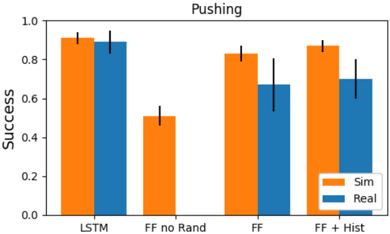
- The LSTM policy trained only in simulation achieved real-robot success of 0.89 ± 0.06 over 28 trials, comparable to its simulated success of 0.91 ± 0.03 over 100 randomized-dynamics trials.
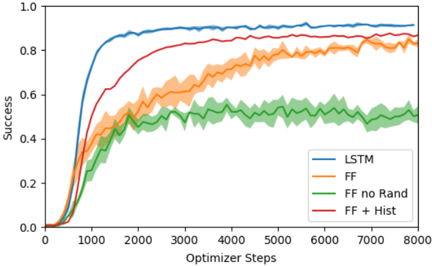
- Memoryless feedforward policies transferred worse: FF no Rand had sim 0.51 ± 0.05 and real 0.0 ± 0.0 (10 trials); FF had sim 0.83 ± 0.04 and real 0.67 ± 0.14 (12 trials); FF + Hist had sim 0.87 ± 0.03 and real 0.70 ± 0.10 (20 trials).
- Ablating randomization hurt real-robot success: fixed action timestep 0.29 ± 0.11 (17 trials), no observation noise 0.25 ± 0.12 (12 trials), fixed link mass 0.64 ± 0.10 (22 trials), fixed puck friction 0.48 ± 0.10 (27 trials), versus 0.89 ± 0.06 (28 trials) for all randomized parameters.
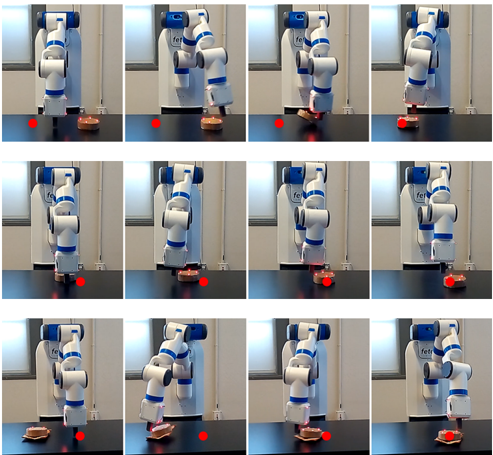
- When contact dynamics were altered by attaching a packet of chips to the puck, the LSTM policy achieved 0.91 ± 0.04 success, comparable to 0.89 ± 0.06 without the attachment.
Methods
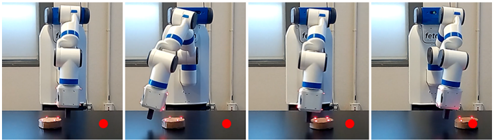
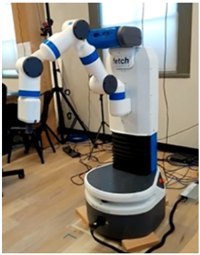
- Task: a 7-DOF Fetch Robotics arm pushed a puck to a randomly sampled target on a table; reward was binary (0 if puck within 0.07 m of target, otherwise -1). State was 52D (joint positions/velocities, gripper position, puck position/orientation/linear and angular velocities); action was 7D target joint-angle offsets. Simulation used MuJoCo with 0.002 s timestep and 20 simulation steps per control step; episodes were 100 control steps in simulation and 200 timesteps on the real robot.
- Dynamics randomization: at each episode start, 95 parameters were sampled and held fixed, including link masses, joint damping, puck mass/friction/damping, table height, controller gains, action timestep, and observation noise. Action timestep varied per step via Δt ∼ Δt0 + Exp(λ), with Δt0 = 0.04 s and λ fixed per episode; observation noise was Gaussian with standard deviation 5% of each feature’s running standard deviation; action exploration noise had standard deviation 0.01 rad.
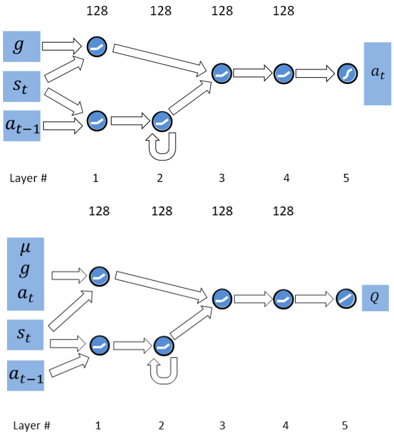
- Training and analysis: policies were trained with Recurrent Deterministic Policy Gradient (RDPG) and Hindsight Experience Replay (HER, k = 0.8), using an LSTM policy and an omniscient critic that received simulator dynamics parameters. ADAM used stepsize 5 × 10⁻⁴, batches of 128 episodes with 100 steps each, about 8000 update iterations, roughly 100 million samples, and about 8 hours on a 100-core cluster. Performance was compared across architectures and randomization ablations in simulation and on the real robot.
Limitations
- Stated: little calibration was performed to make simulation match the real robot, and the authors note that more extensive calibration would likely improve performance; they also state future work should extend to richer tasks and modalities such as vision.
- Evident from the text: evaluation is limited to a single puck-pushing task with a 7-DOF arm, and real-robot trials are small (10–28 trials per condition), so broader task and statistical generalization are not established.
- Evident from the text: the method relies on simulation-only training and does not test direct real-world fine-tuning or vision-based transfer.
Model-written summary. Check it against the paper before relying on it.
Integrity signals
Registry
Cites
Statistics
Figures
Verification
Claims the paper makes
1 Valid · 0 Not valid · 2 Not checked · 29 Own results and interpretations
The cited sources support only part of this claim — read each source’s verdict below.
In the paper
“Furthermore, it has been observed that DeepRL policies are prone to exploiting idiosyncrasies of the simulator to realize behaviours that are infeasible in the real world [2], [7].”
What the sources say
- Could not verifycites [2] [2] T. P. Lillicrap, J. J. Hunt, A. Pritzel, N. Heess, T. Erez, Y. Tassa, D. Silver, and D. Wierstra, 'Continuous control with deep reinforcement learning,' CoRR , vol. abs/1509.02971, 2015. [Online]. Available: http://arxiv.org/abs/1509.02971 - sourceExperimental — accuracy not yet measured
The Results (p. 4) describe testing DDPG in simulated physical environments, but do not report policies exploiting simulator quirks. Searches for simulator artifacts, unrealistic behavior, and real-world feasibility found no passage addressing the claimed tendency. (LLM, conf=0.72)
- Partly supportedcites [7] [7] N. Heess, D. TB, S. Sriram, J. Lemmon, J. Merel, G. Wayne, Y. Tassa, T. Erez, Z. Wang, S. M. A. Eslami, M. A. Riedmiller, and D. Silver, 'Emergence of locomotion behaviours in rich environments,' CoRR , vol. abs/1707.02286, 2017. [Online]. Available: http://arxiv.org/abs/1707.02286 - sourceExperimental — accuracy not yet measured
The Introduction (p. 1) says agents may find idiosyncratic solutions that work in one setting but are not robust across settings. The Results (p. 8) report that a simulated humanoid can exploit redundancies in the task specification, producing visually unsatisfactory gaits. Neither passage says the policies exploit quirks of the simulator or that their behaviours are infeasible in the real world. (LLM, conf=0.82)
plainstates a cause- Asserted: passes — The authors put it forward as true.
- Checkable: passes — It can be checked against evidence.
- Load-bearing: passes — The paper’s conclusions depend on it.
- Based: passes — The paper gives a reason why it holds.
- Could not verify
A result the paper reports from its own data — it cites no other source for it, so there is none to check. The quote shows it is in the paper.
In the paper
“We explore the impact of various design decisions and show that the resulting policies are robust to significant calibration error.”
- Also stated in: § B. Domain Randomization · p. 2 · plain
“Unlike previous methods which often require meticulous calibration of the simulation to closely conform to the physical system, our policies are able to adapt to significant calibration error.”
- Also stated in: § C. Non-prehensile Manipulation · p. 2 · plain
“The resulting policies are able accommodate large calibration errors when deployed on a real robot and also generalize to variability in the dynamics of the physical system.”
plain- Asserted: passes — The authors put it forward as true.
- Checkable: passes — It can be checked against evidence.
- Load-bearing: passes — The paper’s conclusions depend on it.
- Based: passes — The paper gives a reason why it holds.
- Also stated in: § B. Domain Randomization · p. 2 · plain
A result the paper reports from its own data — it cites no other source for it, so there is none to check. The quote shows it is in the paper.
In the paper
“The feedforward network trained without randomization is unable to perform the task under the real world dynamics.”
plainstates a cause- Asserted: passes — The authors put it forward as true.
- Checkable: passes — It can be checked against evidence.
- Load-bearing: passes — The paper’s conclusions depend on it.
- Based: passes — The paper gives a reason why it holds.
A result the paper reports from its own data — it cites no other source for it, so there is none to check. The quote shows it is in the paper.
In the paper
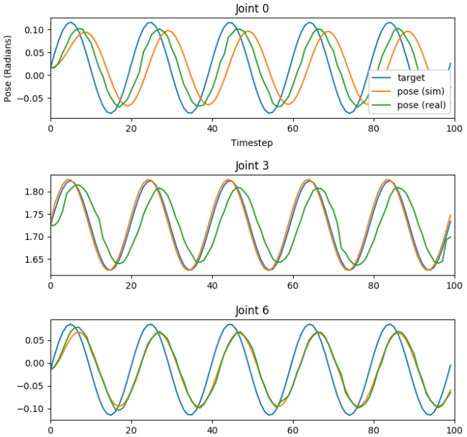
“Given the same target trajectory, the pose trajectories of the simulated and real robot differ significantly, with varying degrees of mismatch across joints.”
plainstates an association- Asserted: passes — The authors put it forward as true.
- Checkable: passes — It can be checked against evidence.
- Load-bearing: passes — The paper’s conclusions depend on it.
- Based: passes — The paper gives a reason why it holds.
A result the paper reports from its own data — it cites no other source for it, so there is none to check. The quote shows it is in the paper.
In the paper
“Policies trained without randomizing the action timestep and observation noise show particularly noticeable drops in performance.”
plainstates a cause- Asserted: passes — The authors put it forward as true.
- Checkable: passes — It can be checked against evidence.
- Load-bearing: passes — The paper’s conclusions depend on it.
- Based: passes — The paper gives a reason why it holds.
13 more claims
Create a free account to see all 32 claims and to verify the 3 references still open.
- It may state two separate claims as one. 9
- Probably not a substantial claim. 6
Claims other papers make about this one
Each is checked against this paper’s own text: does it say what the citing paper says it does?
The cited source doesn’t support the claim as written.
In the citing paper
“We instantiate SIMPLER on top of the SAPIEN physics simulator [68], but show in Section VI-D that our contributions are independent of the used simulator and can be reproduced in Isaac Sim [49].”
From Evaluating Real-World Robot Manipulation Policies in Simulation (2024) · cites this paper as [49]
Checked by a reasoning model — may be wrong.
Experimental — accuracy not yet measuredThe source backs part of the claim, not all of it — or backs it for a different population, condition or comparison.
In the citing paper
“Residual policy learning restores dynamic feasibility on the robot by learning small corrections to the retargeted reference, reusing the same residual formulation as physics refinement, so that the resulting policy transfers directly to hardware (Peng et al., 2018).”
From Dexterous Robot Manipulation from Human Demonstrations via Contact-Anchored Retargeting and Residual Policy Learning (2026) · cites this paper as Peng et al., 2018
Experimental — accuracy not yet measuredThe source backs part of the claim, not all of it — or backs it for a different population, condition or comparison.
In the citing paper
“Synthesis rollouts under domain randomization (Peng et al., 2018) produce additional dynamically feasible robot trajectories from each retargeted reference.”
From Dexterous Robot Manipulation from Human Demonstrations via Contact-Anchored Retargeting and Residual Policy Learning (2026) · cites this paper as Peng et al., 2018
Experimental — accuracy not yet measuredThe cited source says what the claim attributes to it.
In the citing paper
“Another is randomization of physical parameters that vary between simulation and reality, such that the controller becomes robust to a range of conditions that cover those that arise in physical deployment, without the necessity to precisely model these conditions a priori [21].”
From Learning quadrupedal locomotion over challenging terrain (2020) · cites this paper as [21]
The cited source says what the claim attributes to it.
In the citing paper
“Peng et al. [44] shows the effectiveness of memory-based policies (i.e., policies learnt by using past memory for future learning [95] [97]) to deal with the RG, introducing DR to generalise environment dynamics.”
From Crossing the Reality Gap: A Survey on Sim-to-Real Transferability of Robot Controllers in Reinforcement Learning (2021) · cites this paper as [44]
1 more claim about this paper
Create a free account to see every claim other papers make about this one.
Citations
Cites
Adam: A Method for Stochastic Optimization
Kingma, D. P., & Ba, J. (2014) · arXiv · doi:10.48550/arxiv.1412.6980 · Cited by 98,946
Human-level control through deep reinforcement learning
Mnih, V., Kavukcuoglu, K., Silver, D., Rusu, A. A., Veness, J., Bellemare, M. G., Graves, A., Riedmiller, M., Fidjeland, A. K., Ostrovski, G., et al. (2015) · Nature · doi:10.1038/nature14236 · Cited by 30,357 · cited 1×
“In simulated domains, agents have been developed to perform a diverse array of challenging tasks [1], [2], [3].”
BackgroundContinuous control with deep reinforcement learning
Lillicrap, T. P., Hunt, J. J., Pritzel, A., Heess, N., Erez, T., Tassa, Y., Silver, D., & Wierstra, D. (2015) · arXiv · doi:10.48550/arxiv.1509.02971 · Cited by 10,782
Domain-Adversarial Training of Neural Networks
Ganin, Y., Ustinova, E., Ajakan, H., Germain, P., Larochelle, H., Laviolette, F., Marchand, M., & Lempitsky, V. (2017) · Advances in Computer Vision and Pattern Recognition · doi:10.1007/978-3-319-58347-1_10 · Cited by 8,318
(1999) · Cited by 5,147
MuJoCo: A physics engine for model-based control
Todorov, E., Erez, T., & Tassa, Y. (2012) · 2012 IEEE/RSJ International Conference on Intelligent Robots and Systems · doi:10.1109/iros.2012.6386109 · Cited by 4,767 · cited 1×
“All simulations are performed using the MuJoCo physics engine [39] with a simulation timestep of 0.”
MethodMulti-Agent Actor-Critic for Mixed Cooperative-Competitive Environments
Lowe, R., Wu, Y., Tamar, A., Harb, J., Abbeel, P., & Mordatch, I. (2017) · arXiv · doi:10.48550/arxiv.1706.02275 · Cited by 3,377
Self-citationDomain randomization for transferring deep neural networks from simulation to the real world
Tobin, J., Fong, R., Ray, A., Schneider, J., Zaremba, W., & Abbeel, P. (2017) · 2017 IEEE/RSJ International Conference on Intelligent Robots and Systems (IROS) · doi:10.1109/iros.2017.8202133 · Cited by 3,124
Self-citationLevine, S., Pastor, P., Krizhevsky, A., Ibarz, J., & Quillen, D. (2018) · The International Journal of Robotics Research · doi:10.1177/0278364917710318 · Cited by 1,971
Andrychowicz, M., Wolski, F., Ray, A., Schneider, J., Fong, R., Welinder, P., McGrew, B., Tobin, J., Abbeel, P., & Zaremba, W. (2017) · arXiv · doi:10.48550/arxiv.1707.01495 · Cited by 1,355
Self-citation
Research works printed but not linked: 1
- [32] D. H. Ignasi Clavera and P. Abbeel, 'Policy transfer via modularity,' in IROS . IEEE, 2017. -
Cited by
Items 501–600 of 935
Seong, H., & Shim, D. H. (2024) · IEEE Robotics and Automation Letters · doi:10.1109/lra.2024.3477092 · Cited by 7
“We also append the previous action a t − 1 ∈ R 4 to the state, allowing our policy to infer the ownship’s underlying dynamics using aircraft states and past action [29].”
MethodSun, H., Bi, Z., Jiang, W., et al. (2024) · Proceedings - ACM IEEE Design Automation Conference · doi:10.1145/3649329.3656523 · Cited by 4
“We propose a generalization method based on Domain randomization technique[10] to enhance the ability of migration.”
Tsuji, C., Coronado, E., Osorio, P., & Venture, G. (2024) · IEEE Robotics and Automation Letters · doi:10.1109/lra.2024.3497713 · Cited by 13
“Beyond visual domain randomization, dynamics randomization, which involves randomizing physical properties like mass and friction, has been explored to improve real-world generalization [14].”
Lee, G., Hou, B., Choudhury, S., & Srinivasa, S. S. (2021) · IEEE/RSJ International Conference on Intelligent Robots and Systems (IROS) · doi:10.1109/iros51168.2021.9636163 · Cited by 11
“[34] use Long Short-Term Memory (LSTM) [18] to encode a history of observations to generate an action.”
MethodLearning Controllers for Adaptive Spreading of Carbon Fiber Tows
Krützmann, J., Schiendorfer, A., Beratz, S., Moosburger‐Will, J., Reif, W., & Horn, S. (2020) · Lecture notes in computer science · doi:10.1007/978-3-030-64580-9_6 · Cited by 4
“One common approach to reduce this issue is to pre-train RL models on simulations, before adapting them carefully to the real environment requiring less real data [12].”
Addressing partial observability in reinforcement learning for energy management
Biemann, M., Liu, X., Zeng, Y., & Huang, L. (2021) · ACM International Conference on Systems for Energy-Efficient Buildings, Cities, and Transportation (BuildSys) · doi:10.1145/3486611.3488730 · Cited by 9
“For SAC-LSTM, we use the architecture from [29].”
MethodCoupling Vision and Proprioception for Navigation of Legged Robots
Fu, Z., Kumar, A., Agarwal, A., Qi, H., Malik, J., & Pathak, D. (2022) · IEEE/CVF Conference on Computer Vision and Pattern Recognition Workshops (CVPRW) · doi:10.1109/cvprw56347.2022.00508 · Cited by 7
Weakly Supervised Correspondence Learning
Wang, Z., Cao, Z., Hao, Y., & Sadigh, D. (2022) · Proceedings - IEEE International Conference on Robotics and Automation/Proceedings · doi:10.1109/icra46639.2022.9811729 · Cited by 14
Bayesian Optimisation for Robust Model Predictive Control under Model Parameter Uncertainty
Guzman, R., Oliveira, R. S., & Ramos, F. T. (2022) · Proceedings - IEEE International Conference on Robotics and Automation/Proceedings · doi:10.1109/icra46639.2022.9812406 · Cited by 9
MasKGrasp: Mask-based Grasping for Scenes with Multiple General Real-world Objects
Lee, J., Hur, J., Hwang, I., & Kim, Y. M. (2022) · IEEE/RSJ International Conference on Intelligent Robots and Systems (IROS) · doi:10.1109/iros47612.2022.9982130 · Cited by 5
“For example, the sim-to-real gap commonly appears when a method is trained in a simulated environment [38], [39] and transferred to a target domain where annotated data is not available.”
BackgroundReal-Time Reinforcement Learning for Vision-Based Robotics Utilizing Local and Remote Computers
Wang, Y., Vasan, G., & Mahmood, A. R. (2023) · Proceedings - IEEE International Conference on Robotics and Automation/Proceedings · doi:10.1109/icra48891.2023.10160684 · Cited by 18
Bin-Picking of Novel Objects Through Category-Agnostic-Segmentation: RGB Matters
Raj, P., Bhadang, S., Chaudhary, G., Behera, L., & Sandhan, T. (2023) · IEEE International Conference on Robotic Computing (IRC) · doi:10.1109/irc59093.2023.00045 · Cited by 6
“A variety of methods have been proposed for sim-to-real transfer, including domain randomization [18], [30], data augmentation [31], and adversarial training [32].”
MethodTowards Radar Emitter Recognition in Changing Environments with Domain Generalization
Wu, H., Li, X., Lan, L., Xu, L., & Tang, Y. (2023) · International Conference on Signal Processing, Computer Networks and Communications (SPCNC) · doi:10.1145/3654446.3654448 · Cited by 4
“Data manipulation and representation learning are two major methods, in which the data manipulation method involves two popular techniques, i.e., data augmentation [11] [12] [13] and data generation [14 ] [15] [16].”
MethodProcess Simulation Using Physical Joining Models for Learning Robot-based Assembly Tasks
Lämmle, A., & Bálint, B. A. (2020) · IEEE International Conference on Emerging Technologies and Factory Automation (ETFA) · doi:10.1109/etfa46521.2020.9212140 · Cited by 4
“Therefore, to overcome the resulting gap between the simulation and the real world, several advanced modelling platforms and methods have been developed to represent the real physical world as closely as needed [12, 13].”
BackgroundAcceleration-based Quadrotor Guidance Under Time Delays Using Deep Reinforcement Learning
Hovell, K., Ulrich, S., & Bronz, M. (2021) · AIAA SciTech Forum · doi:10.2514/6.2021-1751 · Cited by 4
Adaptability Preserving Domain Decomposition for Stabilizing Sim2Real Reinforcement Learning
Gao, H., Yang, Z., Su, X. B., Tan, T., & Chen, F. (2020) · IEEE/RSJ International Conference on Intelligent Robots and Systems (IROS) · doi:10.1109/iros45743.2020.9341124 · Cited by 5
“1a, 1b), is widely adopted [7]–[9] to strengthen the adaptability of RL policy.”
BackgroundMethodInfluentialA fully distributed multi-robot navigation method without pre-allocating target positions
Zhang, J., Xu, Z., Yu, F., & Tang, Q. (2021) · Autonomous Robots · doi:10.1007/s10514-021-09981-w · Cited by 4
“Because training on a physical system is expensive and dangerous, many researchers train policies using synthetic data generated by simulator, then deployed on physical robotic systems after transfer learning (Peng et al. 2018).”
BackgroundLearning Pre-grasp Pushing Manipulation of Wide and Flat Objects Using Binary Masks
Wu, J., Zhong, S., & Li, Y. (2021) · Lecture notes in computer science · doi:10.1007/978-3-030-92273-3_30 · Cited by 4
A sim2real framework enabling decentralized agents to execute MADDPG tasks
Suh, Y., Woo, S., Kim, H., & Park, D.-H. (2019) · doi:10.1145/3366622.3368146 · Cited by 4
“Generally, the approaches can be classified into system identification[6], domain adaptation[4–6], and domain randomization[2, 10, 12].”
BackgroundData Driven Joining Models for Simulation-based Assembly Learning
Lämmle, A., Krauß, J., & Awad, R. (2021) · Procedia CIRP · doi:10.1016/j.procir.2021.11.083 · Cited by 4
Evaluating Real-World Robot Manipulation Policies in Simulation
Li, X., Hsu, K., Gu, J., Pertsch, K., Mees, O., Walke, H. R., Fu, C., Lunawat, I., Sieh, I., Kirmani, S., et al. (2024) · arXiv · doi:10.48550/arxiv.2405.05941 · Cited by 4
Improving Offline Reinforcement Learning with Inaccurate Simulators
Hou, Y., Sun, H., Ma, J., & Wu, F. (2024) · Proceedings - IEEE International Conference on Robotics and Automation/Proceedings · doi:10.1109/icra57147.2024.10610833 · Cited by 8
“Domain randomization randomizes the simulation to cover the real distribution of real-world data, including visual randomization [38]–[40] and dynamics randomization [41].”
MethodAREPO: Uncertainty-Aware Robot Ensemble Learning Under Extreme Partial Observability
Du, Y., Hanut, L., Bruyninckx, H., & Detry, R. J. (2025) · IEEE Robotics and Automation Letters · doi:10.1109/lra.2025.3554451 · Cited by 5
“Many approaches assume near-complete observability, rely on precise environmental modeling through domain randomization or physics-based methods [7], [8], or require continuous adaptation with cheap access to the target domain [9], [10].”
A Propagation Perspective on Recursive Forward Dynamics for Systems With Kinematic Loops
Chignoli, M., Adrian, N., Kim, S., & Wensing, P. M. (2025) · IEEE Transactions on Robotics · doi:10.1109/tro.2025.3593081 · Cited by 4
“Techniques, such as domain randomization [49], can make policies trained with these approximate dynamics robust to such modeling errors, but typically at the cost of sample complexity and the optimality of the policy.”
Robust and Efficient Walking of a Bipedal Humanoid Robot via Reinforcement Learning
Ji, C., Liu, D., Gao, W., & Zhang, S. (2025) · IEEE International Conference on Real-time Computing and Robotics (RCAR) · doi:10.1109/rcar65431.2025.11139510 · Cited by 5
IntuiGrasp: Bio-Inspired Dexterous Hand with Intuitive Teaching
Zhou, Y., Huang, H., Yang, C., & Ye, W. (2025) · Artificial Intelligence Science and Engineering · doi:10.23919/aise.2025.000015 · Cited by 3
Robust Reinforcement Learning: Methods, Benchmarks and Challenges
Gu, J., Zhou, M., Guo, X., & Wang, Y. (2026) · Artificial Intelligence Science and Engineering · doi:10.23919/aise.2026.000002 · Cited by 4
Robotic Grasping Based on Deep Learning: A Survey
Rashed, M. A., Farhan, R. N., & Jasim, W. M. (2023) · International Conference on Advanced Computer Applications (ACA) · doi:10.1109/aca57612.2023.10346726 · Cited by 6
“The reality gap makes implementing the models trained on simulated data not directly applicable [62].”
MethodThe Role of Time Delay in Sim2real Transfer of Reinforcement Learning for Unmanned Aerial Vehicles
Elocla, N. M., Chehadeh, M. S., Boiko, I. M., Swei, S. S.-M., & Zweiri, Y. (2023) · International Conference on Advanced Robotics (ICAR) · doi:10.1109/icar58858.2023.10406926 · Cited by 4
“The techniques included in DR can be divided into two groups: dynamics randomization [6], and random perturbations of states and actions.”
MethodLAGOON: Language-Guided Motion Control
Xu, S., Wang, H., Ouyang, Y., Gao, J., Mei, Z., Yu, C., & Wu, Y. (2024) · Proceedings - IEEE International Conference on Robotics and Automation/Proceedings · doi:10.1109/icra57147.2024.10610467 · Cited by 7
“3) Robust control with domain randomization: In order to learn robust control policies, we adopt domain randomization [6] during RL training.”
MethodCross Domain Policy Transfer with Effect Cycle-Consistency
Zhu, R., Dai, T., & Çeliktutan, O. (2024) · Proceedings - IEEE International Conference on Robotics and Automation/Proceedings · doi:10.1109/icra57147.2024.10611110 · Cited by 7
“Domain randomization methods learn invariant task-specific representation by randomizing some factors of the domains, such as lights, and textures [24]–[26].”
BackgroundDeep Reinforcement Learning for Mobile Robots: Overview and Issues
Haja, Z., Aissi, M., Habchi, A. E., Kelmoua, L., Berrich, J., Bouchentouf, T., & Rahmoune, M. (2024) · Lecture notes in networks and systems · doi:10.1007/978-3-031-68660-3_48 · Cited by 4
Kadokawa, Y., Tahara, H., & Matsubara, T. (2025) · IEEE Transactions on Automation Science and Engineering · doi:10.1109/tase.2025.3590068 · Cited by 8
“This paper applies a domain randomization (DR) technique [56], [57] to learn robust policies for reality gaps between the simulation and the real world.”
Hathaway, J., Stolkin, R., & Rastegarpanah, A. (2024) · IEEE/RSJ International Conference on Intelligent Robots and Systems (IROS) · doi:10.1109/iros58592.2024.10802660 · Cited by 4
“…environments, learning-based approaches have shown promise in adapting to uncertainties across various applications, albeit mainly to non-destructive tasks [1], [2], [3], though sim-to-real adaptation for destructive tasks like cutting or milling, although possible [4], remains challenging.”
Generalized reinforcement learning control algorithm for fully automated insulin delivery system
Rachim, V. P., Yoo, J., Lee, J., Lee, Y., & Park, S. (2025) · Expert Systems with Applications · doi:10.1016/j.eswa.2025.126909 · Cited by 5
Evaluating Robustness of Reinforcement Learning Algorithms for Autonomous Shipping
Lesy, B., Anwar, A., & Mercelis, S. (2024) · International Conference on Robotics, Automation and Artificial Intelligence (RAAI) · doi:10.1109/raai64504.2024.10949512 · Cited by 4
“Much research aims to improve the robustness of RL algorithms, with methods such as domain randomization [19] and dynamics randomization [10] showing promising results and successfully transferring policies to the real world.”
Kamaras, G., & Ramamoorthy, S. (2025) · IEEE Robotics and Automation Letters · doi:10.1109/lra.2025.3581744 · Cited by 4
“Learning policies in simulation and then performing a Sim2Real deployment [3], [8] follows the hypothesis that multiple simulated iterations of a task will robustify the learnt policy to parametric variations [9].”
Convivial Fabrication: Towards Relational Computational Tools For and From Craft Practices
Batra, R. K., Zunder, R., Cheatle, A., Kwatra, A., Mandel, I., Roumen, T. J., & Jackson, S. J. (2026) · CHI Conference on Human Factors in Computing Systems · doi:10.1145/3772318.3790395 · Cited by 4
“Rather than pursuing perfect and intractable material simulation (see Sim2Real gap in robotic manipulation [68]), this offers a practical path forward: make material “imperfections” leg-ible and navigable to both craftspeople and computational tools.”
Modeling Task Uncertainty for Safe Meta-Imitation Learning
Matsushima, T., Kondo, N., Iwasawa, Y., Nasuno, K., & Matsuo, Y. (2020) · Frontiers in Robotics and AI · doi:10.3389/frobt.2020.606361 · Cited by 6
“These algorithms train a general policy on simulated and diverse environments and then this policy is deployed to the real environment of interest (Tobin et al., 2017; Peng et al., 2018; James et al., 2019).”
BackgroundLearning from Demonstration without Demonstrations
Blau, T., Morere, P., & Francis, G. (2021) · Proceedings - IEEE International Conference on Robotics and Automation/Proceedings · doi:10.1109/icra48506.2021.9561119 · Cited by 3
“to-real transfer [40]: a policy can be trained in simulation, where the assumption is easily satisfied, then transferred to physical environments using sim-to-real techniques.”
BackgroundA Conformal Mapping-based Framework for Robot-to-Robot and Sim-to-Real Transfer Learning
Gao, S., & Bezzo, N. (2021) · IEEE/RSJ International Conference on Intelligent Robots and Systems (IROS) · doi:10.1109/iros51168.2021.9636682 · Cited by 6
“The modeling gap can be closed by retraining the pre-trained model in real world [10].”
BackgroundFault-Aware Robust Control via Adversarial Reinforcement Learning
Yang, F., Yang, C., Guo, D., Liu, H., & Sun, F. (2021) · IEEE International Conference on Cyber Technology in Automation, Control, and Intelligent Systems · doi:10.1109/cyber53097.2021.9588329 · Cited by 15
“In [17]–[19], the authors propose domain randomization methods.”
BackgroundPartial Consistency for Stabilizing Undiscounted Reinforcement Learning
Gao, H., Yang, Z., Tan, T., Zhang, T., Ren, J., Sun, P., Guo, S., & Chen, F. (2022) · IEEE Transactions on Neural Networks and Learning Systems · doi:10.1109/tnnls.2022.3165941 · Cited by 6
“The undiscounted return has been used as the testing criteria in many application fields [2], [5], [16], [30], [31].”
BackgroundMethodInfluentialTowards Dynamic Obstacle Avoidance for Robot Manipulators with Deep Reinforcement Learning
Zindler, F., Lucchi, M., Wohlhart, L., Pichler, H., & Hofbaur, M. (2022) · Mechanisms and machine science · doi:10.1007/978-3-031-04870-8_11 · Cited by 5
Closing the Dynamics Gap via Adversarial and Reinforcement Learning for High-Speed Racing
Niu, J., Hu, Y., Li, W., Huang, G., Han, Y., & Li, X. (2022) · International Joint Conference on Neural Networks (IJCNN) · doi:10.1109/ijcnn55064.2022.9892424 · Cited by 4
“DR methods build several source domains by randomizing physical parameters for policy training [10]–[14].”
BackgroundMethodMulti-Virtual-Agent Reinforcement Learning for a Stochastic Predator-Prey Grid Environment
Lin, Y., Ni, Z., & Zhong, X. (2022) · International Joint Conference on Neural Networks (IJCNN) · doi:10.1109/ijcnn55064.2022.9891898 · Cited by 3
“In [7], the authors involved an explicitly training agent on various perturbations with an average learning error and used a training policy that can determine online environments [8].”
BackgroundCognitive Robotics - Towards the Development of Next-Generation Robotics and Intelligent Systems
Zouganeli, E., & Lentzas, A. (2022) · Communications in computer and information science · doi:10.1007/978-3-031-17030-0_2 · Cited by 7
Christmann, G. H. G., Luo, Y., Soeseno, J. H., & Chen, W.-C. (2023) · Proceedings - IEEE International Conference on Robotics and Automation/Proceedings · doi:10.1109/icra48891.2023.10160776 · Cited by 4
“By randomizing the physics parameters and the agent’s properties during training, the policy becomes robust in a variety of environments [36].”
BackgroundMethodSim-to-Real Policy and Reward Transfer with Adaptive Forward Dynamics Model
Juan, R., Ju, H., Huang, J., Gómez, R., Nakamura, K., & Li, G. (2023) · Proceedings - IEEE International Conference on Robotics and Automation/Proceedings · doi:10.1109/icra48891.2023.10161298 · Cited by 3
“With domain randomization, an agent first learns by randomizing visual information [5] and/or physical parameters [13] in simulation.”
MethodLearn from Robot: Transferring Skills for Diverse Manipulation via Cycle Generative Networks
Yang, Q., Stork, J. A., & Stoyanov, T. (2023) · IEEE International Conference on Automation Science and Engineering (CASE) · doi:10.1109/case56687.2023.10260484 · Cited by 6
“Previous work has been applied to overcome discrepancy due to variations in hardware by using domain randomization for robot dynamics [5], [6].”
MethodRAP Vol: Robust Adversary Populations With Volume Diversity Measure
Yang, J., & Zhang, J. (2023) · IEEE Transactions on Neural Networks and Learning Systems · doi:10.1109/tnnls.2023.3317145 · Cited by 3
“Peng et al. [22] randomize the dynamics of the simulator in a training phase.”
Domain-Adaptive Vision Transformers for Generalizing Across Visual Domains
Cho, Y., Yun, J., Kwon, J., & Kim, Y. (2023) · IEEE Access · doi:10.1109/access.2023.3324545 · Cited by 3
“The creation of real-world-like data [42], which mitigates the reality gap through domain randomization [14], contributes to improving model generalization.”
BackgroundFang, K., Migimatsu, T., Mandlekar, A., Fei-Fei, L., & Bohg, J. (2023) · IEEE/RSJ International Conference on Intelligent Robots and Systems (IROS) · doi:10.1109/iros55552.2023.10341727 · Cited by 14
“Several works use procedurally generated environments in simulation with randomized object properties and dynamics [5,26].”
MethodOgundipe, C., & Ellery, A. A. (2024) · Expert Systems · doi:10.1111/exsy.13549 · Cited by 3
“The prevailing approach is to train an RL-based controller in a physics simulation environment and thereafter transfer to the real world using several sim-to-real techniques (Peng et al., 2018; Tobin et al., 2017).”
On Practical Robust Reinforcement Learning: Adjacent Uncertainty Set and Double-Agent Algorithm
Hwang, U., & Hong, S. (2024) · IEEE Transactions on Neural Networks and Learning Systems · doi:10.1109/tnnls.2024.3385234 · Cited by 8
“This mismatch is referred to as the reality gap , which can degrade the performance of the standard RL algorithms when they are deployed in real-world systems [3], [4], [5].”
Tang, W., Jiang, Y., Zeng, C., Zhang, H., & Zhong, H. (2024) · IEEE International Conference on Industrial Technology (ICIT) · doi:10.1109/icit58233.2024.10570082 · Cited by 6
“Therefore, performing exploration operations during the learning process may cause harm to the robot body and its environment [8].”
BackgroundNFScaler: AI-Powered 5G-and-Beyond Network Function Scaler for QoS Assurance and Energy Efficiency
Rage, A. A. A., Wang, N., & Tafazolli, R. (2024) · IEEE International Conference on Network Softwarization (NetSoft) · doi:10.1109/netsoft60951.2024.10588892 · Cited by 3
“By incorporating domain randomisation, the differences between simulation and real-world environments are modelled as variations in the simulation environment [18].”
MethodReinforcement learning-based estimation for spatio-temporal systems
Mowlavi, S., & Benosman, M. (2024) · Scientific Reports · doi:10.1038/s41598-024-72055-1 · Cited by 8
Safe and Efficient Auto-tuning to Cross Sim-to-real Gap for Bipedal Robot
Du, Y., Chen, X., Yu, Z., Zhang, Y., Zhou, Z., Zhang, J., Zhang, J., Liu, B., & Huang, Q. (2024) · IEEE/RSJ International Conference on Intelligent Robots and Systems (IROS) · doi:10.1109/iros58592.2024.10801318 · Cited by 3
BayRnTune: Adaptive Bayesian Domain Randomization via Strategic Fine-tuning
Huang, T., Sontakke, N., Kumar, K. N., Essa, I. A., Nikolaidis, S., Hong, D. W., & Ha, S. (2024) · IEEE/RSJ International Conference on Intelligent Robots and Systems (IROS) · doi:10.1109/iros58592.2024.10802145 · Cited by 6
“This includes domain randomization [4], [19], [20], [21], adaptation [20], [22], [23], meta-learning [24], [17], and fine-tuning simulation-trained policies on hardware [25].”
Skill Transfer and Discovery for Sim-to-Real Learning: A Representation-Based Viewpoint
Ma, H., Ren, Z., Dai, B., & Li, N. (2024) · IEEE/RSJ International Conference on Intelligent Robots and Systems (IROS) · doi:10.1109/iros58592.2024.10801637 · Cited by 2
“The trained policies are directly applied to the real world and no knowledge will be learned from real-world data.”
A quadruped robot designed to complete a marathon on a single battery charge
Lee, C., Youm, D., Park, J., Lee, J. H., Choi, S., Ji, G., Mun, J., Jung, M., Choi, H. C., Kim, H., et al. (2026) · Nature · doi:10.1038/s41586-026-11102-5 · Cited by 4
“…optimization hyperpa-rameters listed in Extended Data Table 2e. Unlike previous approaches that heavily rely on extensive domain randomization 57 , our strategy reduces the dependence on wide-range randomization and instead focuses on modelling sensor noise and joint friction (Extended Data…”
SPSD: Semantics and Deep Reinforcement Learning Based Motion Planning for Supermarket Robot
Cai, J., Huang, W., You, Y., Zhan, C. H. E. N., Ren, B., & Hong, L. I. U. (2023) · IEICE Transactions on Information and Systems · doi:10.1587/transinf.2022dlp0057 · Cited by 5
Data-Driven Contact Clustering for Robot Simulation
Kim, M., Yoon, J., Son, D., & Lee, D. (2019) · Proceedings - IEEE International Conference on Robotics and Automation/Proceedings · doi:10.1109/icra.2019.8793938 · Cited by 5
“This accuracy, of course, is crucial to ensure the results of those data-driven techniques be transferrable from simulation to real-world robotic systems [15], [16].”
BackgroundDengler, C., & Lohmann, B. (2020) · Robotics · doi:10.3390/robotics9020029 · Cited by 4
“Different from [9], the approach that is introduced in this section can use time-dependent cost functions and equality constraints to define the behavior of the system.”
BackgroundMethodInfluentialHörger, T., Dresia, K., Waxenegger-Wilfing, G., Werling, L. K., & Schlechtriem, S. (2021) · AIAA Propulsion and Energy Forum · doi:10.2514/6.2021-3223 · Cited by 4
Lämmle, A., Xiang, Z., & Bálint, B. A. (2022) · Procedia CIRP · doi:10.1016/j.procir.2022.05.151 · Cited by 5
Online vs. Offline Adaptive Domain Randomization Benchmark
Tiboni, G., Arndt, K., Averta, G., Kyrki, V., & Tommasi, T. (2023) · Springer proceedings in advanced robotics · doi:10.1007/978-3-031-22731-8_12 · Cited by 7
Yusmiati, Y., Machfud, M., Marimin, M., et al. (2024) · F1000Research · doi:10.12688/f1000research.133317.2 · Cited by 2
Generalizable Multi-Modal Adversarial Imitation Learning for Non-Stationary Dynamics
Li, Y.-C., Chao, N., Zhang, Z., Zhang, F., Yuan, L., & Yu, Y. (2025) · IEEE Transactions on Pattern Analysis and Machine Intelligence · doi:10.1109/tpami.2025.3552228 · Cited by 3
“Inspired by domain randomization [15] and meta RL [16], we propose to train a universal policy in several randomly sampled dynamics, by leveraging a multi-modal expert dataset collected from different transition functions.”
Cai, Y., Yanbing, M., Sha, L., Cao, H., & Caccamo, M. (2025) · ACM Transactions on Cyber-Physical Systems · doi:10.1145/3744351 · Cited by 6
Visual-Based Forklift Learning System Enabling Zero-Shot Sim2Real Without Real-World Data
Oishi, K., Kato, T., Makino, H., & Ito, S. (2025) · Proceedings - IEEE International Conference on Robotics and Automation/Proceedings · doi:10.1109/icra55743.2025.11127682 · Cited by 6
“These studies used domain randomization, which randomizes the environment during training [8], [9].”
LIMT: Language-Informed Multi-Task Visual World Models
Aljalbout, E., Sotirakis, N., van der Smagt, P., Karl, M., & Chen, N.-T. (2024) · IEEE International Conference on Robotics and Automation · doi:10.1109/icra55743.2025.11128817 · Cited by 5
“However, this process is not trivial and presents multiple challenges [18, 2, 32, 4, 3].”
UniROS: ROS-Based Reinforcement Learning Across Simulated and Real-World Robotics
Kapukotuwa, J., Lee, B., Devine, D. M., & Qiao, Y. (2025) · Sensors · doi:10.3390/s25185679 · Cited by 5
“Many domain randomization approaches [43,44] either dynamically adjust the simulation parameters based on real-world data or vary the simulation parameters to improve the sim-to-real transfer.”
Jin, S., Ke, K., Gao, B., Fu, L., & Huang, X. (2025) · Chinese Journal of Mechanical Engineering · doi:10.1186/s10033-025-01356-x · Cited by 5
“In a similar vein, Peng et al. have integrated dynamic attributes into the simulation milieu to align it more closely with the sim-to-real transition process [101].”
VOCALoco: Viability-Optimized Cost-Aware Adaptive Locomotion
Wu, S., Danesh, M. H., Li, S., Yurchyk, H., Abyaneh, A., Houssaini, A. E., Meger, D., & Lin, H.-C. (2025) · IEEE Robotics and Automation Letters · doi:10.1109/lra.2025.3632604 · Cited by 6
“Part of the success can be attributed to closing the sim-2-real gap with domain and dynamics randomization [16], [17], learning to estimate terrain and environment properties [18], [19], [20], learning with GPU-acceleration and a game-style curriculum [21], and simulating realistic actuator…”
Malmir, M., Josifovski, J., Klarmann, N., & Knoll, A. (2025) · IEEE Transactions on Control Systems Technology · doi:10.1109/tcst.2025.3634677 · Cited by 14
“D ESPITE the recent advances in devising sample-e ffi cient reinforcement learning (RL) algorithms like model-based or o ffl ine RL, there are still many limitations for direct training of the RL agents on actual robots [1] and only a few successes [2], [3].”
InfluentialImplementation of Deep Reinforcement Learning for Radio Telescope Control and Scheduling
Puangragsa, S., Sahavisit, T., Laon, P., Puangragsa, U., & Phasukkit, P. (2025) · Galaxies · doi:10.3390/galaxies13060137 · Cited by 5
“While a successful policy during simulation is not guaranteed to be able to transfer its performance to real-world environments due to modeling error, various techniques have been developed to mitigate this problem [17,18].”
Mantovani, L. Q., & Schaub, H. (2026) · Journal of Aerospace Information Systems · doi:10.2514/1.i011697 · Cited by 5
DSADF: Thinking Fast and Slow for Decision Making
Dou, Z., Cui, D., Yan, J., Wang, W., Chen, B., Wang, H., Xie, Z., & Zhang, S. (2026) · International Journal of Computer Vision · doi:10.1007/s11263-026-02866-4 · Cited by 14
“RL has demonstrated remarkable success in a range of applications, including robotics [1, 2], video games [3], dialogue systems [4], and autonomous vehicles [5].”
Precise aggressive aerial maneuvers with sensorimotor policies
Wu, T., Xu, G., Wang, Z., Lin, J., Chen, T., Wu, Y., Han, Z., Liu, Z., & Gao, F. (2026) · Science Robotics · doi:10.1126/scirobotics.aeb0180 · Cited by 17
Lee, Y., Kim, W. K., Choi, S. H., Yeom, I., & Woo, H. (2021) · IEEE Access · doi:10.1109/access.2021.3125008 · Cited by 2
“[47] developed an RL-based robot arm controller operating in dynamic environments.”
BackgroundCo-Training an Observer and an Evading Target
Brandenburger, A., Hoffmann, F., & Charlish, A. (2021) · International Conference on Information Fusion (FUSION) · doi:10.23919/fusion49465.2021.9627024 · Cited by 5
“Such a sim-to-real transfer is actively researched in the reinforcement learning and robotics communities, using techniques like domain randomization with promising results [19], [20].”
Avoiding Lingering in Learning Active Recognition by Adversarial Disturbance
Fan, L., & Wu, Y. N. (2023) · IEEE Winter Conference on Applications of Computer Vision · doi:10.1109/wacv56688.2023.00459 · Cited by 3
“Recently, there have been a bunch of works [31, 30, 20, 27] showing interest in building robust reinforced agents by adversarial attacking.”
BackgroundLow-level controller in response to changes in quadrotor dynamics
Cho, J., Kim, C., Jaffar, M. K. M., Otte, M., & Kim, S.-W. (2023) · Proceedings - IEEE International Conference on Robotics and Automation/Proceedings · doi:10.1109/icra48891.2023.10160987 · Cited by 2
Learning a simulation-based visual policy for real-world peg in unseen holes
Xie, L., Yu, H., Xu, K., Yang, T., Wang, M., Lu, H., Xiong, R., & Wang, Y. (2023) · Review of Scientific Instruments · doi:10.1063/5.0168544 · Cited by 3
Human-Guided Transfer Learning for Autonomous Robot
Oriyama, M., Hartono, P., & Sawada, H. (2023) · Communications in computer and information science · doi:10.1007/978-981-99-8126-7_15 · Cited by 3
Ji, C., Liu, D., Gao, W., & Zhang, S. (2023) · IEEE International Conference on Robotics and Biomimetics (ROBIO) · doi:10.1109/robio58561.2023.10354629 · Cited by 2
“…control methods, reinforcement learning can generate appropriate policies through the interaction between the agent and the environment, by utilizing the sensory input and historical information of the agent, and rewarding or punishing the agent’s behavior during training [17], [18], [19].”
BackgroundSim-to-Real Transfer for Robotics Using Model-Free Curriculum Reinforcement Learning
Diprasetya, M. R., Pullani, A. N., & Schwung, A. (2024) · IEEE International Conference on Industrial Technology (ICIT) · doi:10.1109/icit58233.2024.10540995 · Cited by 5
“The policy retained a similar performance with the real robot as in simulation by successfully adapting to the real-world dynamics [13].”
BackgroundTolerance of Reinforcement Learning Controllers Against Deviations in Cyber Physical Systems
Zhang, C., Kapoor, P., Meira-Góes, R., Garlan, D., Kang, E., Ganlath, A., Mishra, S., & Ammar, N. (2024) · Lecture notes in computer science · doi:10.1007/978-3-031-71177-0_17 · Cited by 4
NeuronsGym: A Hybrid Framework and Benchmark for Robot Navigation With Sim2Real Policy Learning
Li, H., Hu, G., Liu, S., Ma, M., Chen, Y., & Zhao, D. (2024) · IEEE Transactions on Emerging Topics in Computational Intelligence · doi:10.1109/tetci.2024.3488732 · Cited by 17
“In addition, the same scenario and task are set in each system to study the sim2real of the robot policy. system identification [40], [41], domain randomization [42], [43], [44], action transformation [45], [46], and so on.”
Su, Z., Zheng, S., Xu, Z., Cheng, L., Tao, C., Qie, R., Feng, W., Zhang, Z., & Xu, Y. (2024) · Drones · doi:10.3390/drones8110655 · Cited by 5
“This can result in the reinforcement learning algorithm making decisions that do not lead to the correct state transitions for the system in a given state [38].”
Robust Visual Reinforcement Learning by Prompt Tuning
Tran, T. A., Than, K., & Vargas, D. V. (2024) · Lecture notes in computer science · doi:10.1007/978-981-96-0969-7_23 · Cited by 2
“Data augmentation for RL. Domain randomization [4,32–34] and data augmentation [12,13,41,43] are effective strategies for achieving generalization across visually diverse environments.”
A Simulation Pipeline to Facilitate Real-World Robotic Reinforcement Learning Applications
Silveira, J., Marshall, J. A., & Givigi, S. N. (2025) · IEEE International Systems Conference (SysCon) · doi:10.1109/syscon64521.2025.11014852 · Cited by 5
“In contrast, [12] performs a comprehensive randomization of parameters (e.g., table size, arm dynamics, controller gains, links’ mass, friction, noise levels, and time steps) on a robotic arm application, totalling 95 randomized parameters, resulting in a successful sim-to-real transfer without…”
Multi-fidelity reinforcement learning for time-optimal quadrotor re-planning
Ryou, G., Wang, G., & Karaman, S. (2025) · The International Journal of Robotics Research · doi:10.1177/02783649251364393 · Cited by 10
“One approach involves introducing random perturbations to the input of policy (Sadeghi et al. (2018); Akkaya et al. (2019)) or dynamics model (Peng et al. (2018); Mordatch et al. (2015)) during RL training.”
Li, Z., Chen, W., Wang, S., Wang, P., Yuan, Y., Wu, T., Zhang, J., & Li, Q. (2025) · Complex & Intelligent Systems · doi:10.1007/s40747-025-02056-8 · Cited by 2
“Figures13, 14, 15 illustrate the error distributions across translational ( ξ x , ξ y , ξ z ) and rotational ( ε r ) metrics at velocities (cid:18) = { 0 .”
Cross-Platform Learning-Based Fault Tolerant Surfacing Controller for Underwater Robots
Hamamatsu, Y., Remmas, W., Rebane, J., Kruusmaa, M., & Ristolainen, A. (2025) · Proceedings - IEEE International Conference on Robotics and Automation/Proceedings · doi:10.1109/icra55743.2025.11127355 · Cited by 3
“The differences from the real world and the simplified model are complemented by a training process using domain randomization techniques that add random values to the simulation parameters [32].”
H2O+: An Improved Framework for Hybrid Offline-and-Online RL with Dynamics Gaps
Niu, H., Ji, T., Liu, B., Zhao, H., Zhu, X., Zheng, J., Huang, P., Zhou, G., Hu, J., & Zhan, X. (2025) · Proceedings - IEEE International Conference on Robotics and Automation/Proceedings · doi:10.1109/icra55743.2025.11127503 · Cited by 21
“However, the dynamics modeling within the simulator can be hard to strictly align with the diverse and complex real-world scenarios, leading to severe performance degradation due to dynamics mismatch [10]–[12].”
Tsinganos, K., Chatzilygeroudis, K. I., Hadjivelichkov, D., Komninos, T., Dermatas, E., & Kanoulas, D. (2022) · Frontiers in Robotics and AI · doi:10.3389/frobt.2022.974537 · Cited by 2
Adaptive Variance for Changing Sparse-Reward Environments
Lin, X., Guo, P., Florensa, C., & Held, D. (2019) · Proceedings - IEEE International Conference on Robotics and Automation/Proceedings · doi:10.1109/icra.2019.8793650 · Cited by 5
“Then the robot can just identify which of the previously observed environments it is encountering, either explicitly [22] or implicitly, using a latent representation [23], [24], [25], [26], [27].”
Background
Metadata
- Authors
- Peng, X. B., Andrychowicz, M., Zaremba, W., & Abbeel, P.
- Affiliations
- University of California, Berkeley (US)
- OpenAI (United States) (US)
- ORCID
- Abbeel, Pieter
- Venue
- 2018 IEEE International Conference on Robotics and Automation (ICRA)
- Publisher
- IEEE
- Published
- 2018-05
- Pages
- 3803-3810
- ISSN
- 1050-4729 (ISSN-L)
- OpenAlex
- W2767050701
- Cited by
- 1,309
- References
- 39
- Citations by year
- 2026: 149 · 2025: 167 · 2024: 155 · 2023: 158 · 2022: 159 · 2021: 197 · 2020: 178 · 2019: 109 · 2018: 34
- FWCI
- 52.88
- Type
- conference paper
- Language
- en
- Open access
- green
- arxiv.org
- Locations
- Proceedings - IEEE International Conference on Robotics and Automation/Proceedings (publishedVersion)
- arXiv (Cornell University) (submittedVersion)
- arXiv (Cornell University)
- Topics
- Physical Sciences › Computer Science › Artificial Intelligence › Reinforcement Learning in Robotics
- Physical Sciences › Engineering › Control and Systems Engineering › Robot Manipulation and Learning
- Physical Sciences › Computer Science › Artificial Intelligence › Domain Adaptation and Few-Shot Learning
- Keywords
- sim-to-real transfer, robot control, reality gap, object pushing, robot manipulators, policy generalization
About these checks
Registry, retraction, Cites and statistics results are computed, not judged, with one exception: a printed reference that no index lists is read once by a model before it counts as a citation error. Claims are extracted by a model and kept only when their quote appears verbatim in the text; each cited source is then checked, with a model’s help, for whether it says what the claim relies on. Those verdicts can be wrong — read the claim’s quote and the cited source before relying on one.
The claim verdicts this report counts are experimental: their accuracy is not yet measured.
A language model drew the claims from the paper on 2026-10-10, under version 3 of the claim definition (model deepseek-v4.1-flash, prompt extract-v3).
A second model labelled each claim on 2026-10-10 (model jev-1.13-20260917, definition revision gold-guideline-v0.2).
Cited sources are checked with a language model’s help (gpt-6-sol).
Statistics and arithmetic are recomputed, not judged.
Confidence bands are shown only for fields calibrated on our annotated test set. None is calibrated yet, so no band is shown.
What counts as a claim ›How we measure confidence ›How we check this ›
Are you an author, or do you see a problem with this page? Request a review
Data sources
Bibliographic data: Semantic Scholar, OpenAlex, Crossref.
Contains information from the Semantic Scholar Academic Graph Datasets, made available under the ODC Attribution License (ODC-BY 1.0).
Semantic Scholar’s data is described in: Kinney, R., et al. (2023). The Semantic Scholar Open Data Platform. arXiv:2301.10140.
