

Sim-to-Real Transfer of Robotic Control with Dynamics Randomization
Open accessThe DOI matches its Crossref record; 50 of the 50 references it cites were found in a registry or an index; 2 of the 5 sources its claims cite were checked for support.
Abstract
Simulations are attractive environments for training agents as they provide an abundant source of data and alleviate certain safety concerns during the training process. But the behaviours developed by agents in simulation are often specific to the characteristics of the simulator. Due to modeling error, strategies that are successful in simulation may not transfer to their real world counterparts. In this paper, we demonstrate a simple method to bridge this “reality gap”. By randomizing the dynamics of the simulator during training, we are able to develop policies that are capable of adapting to very different dynamics, including ones that differ significantly from the dynamics on which the policies were trained. This adaptivity enables the policies to generalize to the dynamics of the real world without any training on the physical system. Our approach is demonstrated on an object pushing task using a robotic arm. Despite being trained exclusively in simulation, our policies are able to maintain a similar level of performance when deployed on a real robot, reliably moving an object to a desired location from random initial configurations. We explore the impact of various design decisions and show that the resulting policies are robust to significant calibration error.
Overview
CoChat Summary
TL;DR
The paper demonstrates that randomizing simulator dynamics during training lets recurrent policies transfer directly to a real 7-DOF Fetch arm for a puck-pushing task without any real-world training. The LSTM policy retained comparable performance in simulation and reality, while feedforward and non-randomized baselines transferred poorly or failed.
Key findings
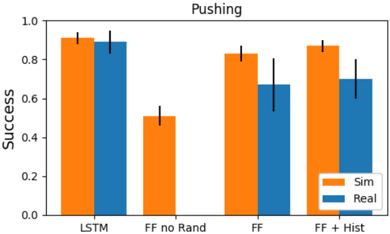
- The LSTM policy trained only in simulation achieved real-robot success of 0.89 ± 0.06 over 28 trials, comparable to its simulated success of 0.91 ± 0.03 over 100 randomized-dynamics trials.
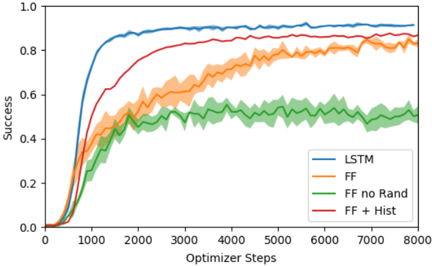
- Memoryless feedforward policies transferred worse: FF no Rand had sim 0.51 ± 0.05 and real 0.0 ± 0.0 (10 trials); FF had sim 0.83 ± 0.04 and real 0.67 ± 0.14 (12 trials); FF + Hist had sim 0.87 ± 0.03 and real 0.70 ± 0.10 (20 trials).
- Ablating randomization hurt real-robot success: fixed action timestep 0.29 ± 0.11 (17 trials), no observation noise 0.25 ± 0.12 (12 trials), fixed link mass 0.64 ± 0.10 (22 trials), fixed puck friction 0.48 ± 0.10 (27 trials), versus 0.89 ± 0.06 (28 trials) for all randomized parameters.
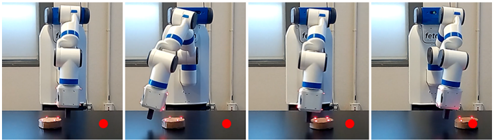
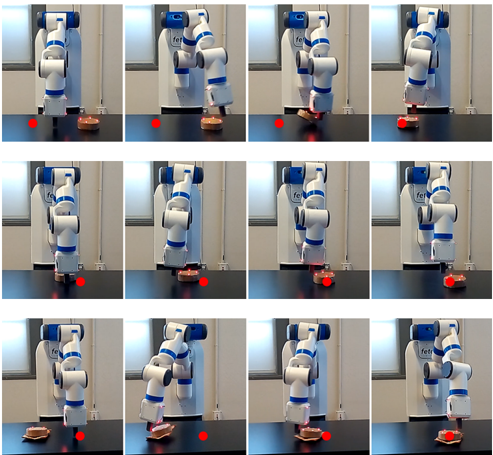
- When contact dynamics were altered by attaching a packet of chips to the puck, the LSTM policy achieved 0.91 ± 0.04 success, comparable to 0.89 ± 0.06 without the attachment.
Methods
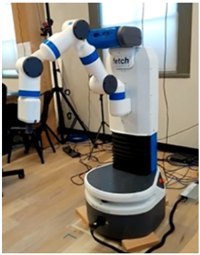
- Task: a 7-DOF Fetch Robotics arm pushed a puck to a randomly sampled target on a table; reward was binary (0 if puck within 0.07 m of target, otherwise -1). State was 52D (joint positions/velocities, gripper position, puck position/orientation/linear and angular velocities); action was 7D target joint-angle offsets. Simulation used MuJoCo with 0.002 s timestep and 20 simulation steps per control step; episodes were 100 control steps in simulation and 200 timesteps on the real robot.
- Dynamics randomization: at each episode start, 95 parameters were sampled and held fixed, including link masses, joint damping, puck mass/friction/damping, table height, controller gains, action timestep, and observation noise. Action timestep varied per step via Δt ∼ Δt0 + Exp(λ), with Δt0 = 0.04 s and λ fixed per episode; observation noise was Gaussian with standard deviation 5% of each feature’s running standard deviation; action exploration noise had standard deviation 0.01 rad.
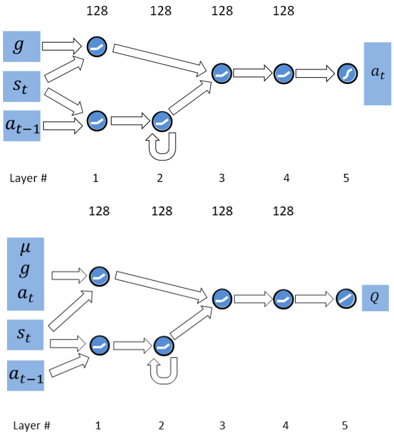
- Training and analysis: policies were trained with Recurrent Deterministic Policy Gradient (RDPG) and Hindsight Experience Replay (HER, k = 0.8), using an LSTM policy and an omniscient critic that received simulator dynamics parameters. ADAM used stepsize 5 × 10⁻⁴, batches of 128 episodes with 100 steps each, about 8000 update iterations, roughly 100 million samples, and about 8 hours on a 100-core cluster. Performance was compared across architectures and randomization ablations in simulation and on the real robot.
Limitations
- Stated: little calibration was performed to make simulation match the real robot, and the authors note that more extensive calibration would likely improve performance; they also state future work should extend to richer tasks and modalities such as vision.
- Evident from the text: evaluation is limited to a single puck-pushing task with a 7-DOF arm, and real-robot trials are small (10–28 trials per condition), so broader task and statistical generalization are not established.
- Evident from the text: the method relies on simulation-only training and does not test direct real-world fine-tuning or vision-based transfer.
Model-written summary. Check it against the paper before relying on it.
Integrity signals
Registry
Cites
Statistics
Figures
Verification
Claims the paper makes
1 Valid · 0 Not valid · 2 Not checked · 29 Own results and interpretations
The cited sources support only part of this claim — read each source’s verdict below.
In the paper
“Furthermore, it has been observed that DeepRL policies are prone to exploiting idiosyncrasies of the simulator to realize behaviours that are infeasible in the real world [2], [7].”
What the sources say
- Could not verifycites [2] [2] T. P. Lillicrap, J. J. Hunt, A. Pritzel, N. Heess, T. Erez, Y. Tassa, D. Silver, and D. Wierstra, 'Continuous control with deep reinforcement learning,' CoRR , vol. abs/1509.02971, 2015. [Online]. Available: http://arxiv.org/abs/1509.02971 - sourceExperimental — accuracy not yet measured
The Results (p. 4) describe testing DDPG in simulated physical environments, but do not report policies exploiting simulator quirks. Searches for simulator artifacts, unrealistic behavior, and real-world feasibility found no passage addressing the claimed tendency. (LLM, conf=0.72)
- Partly supportedcites [7] [7] N. Heess, D. TB, S. Sriram, J. Lemmon, J. Merel, G. Wayne, Y. Tassa, T. Erez, Z. Wang, S. M. A. Eslami, M. A. Riedmiller, and D. Silver, 'Emergence of locomotion behaviours in rich environments,' CoRR , vol. abs/1707.02286, 2017. [Online]. Available: http://arxiv.org/abs/1707.02286 - sourceExperimental — accuracy not yet measured
The Introduction (p. 1) says agents may find idiosyncratic solutions that work in one setting but are not robust across settings. The Results (p. 8) report that a simulated humanoid can exploit redundancies in the task specification, producing visually unsatisfactory gaits. Neither passage says the policies exploit quirks of the simulator or that their behaviours are infeasible in the real world. (LLM, conf=0.82)
plainstates a cause- Asserted: passes — The authors put it forward as true.
- Checkable: passes — It can be checked against evidence.
- Load-bearing: passes — The paper’s conclusions depend on it.
- Based: passes — The paper gives a reason why it holds.
- Could not verify
A result the paper reports from its own data — it cites no other source for it, so there is none to check. The quote shows it is in the paper.
In the paper
“We explore the impact of various design decisions and show that the resulting policies are robust to significant calibration error.”
- Also stated in: § B. Domain Randomization · p. 2 · plain
“Unlike previous methods which often require meticulous calibration of the simulation to closely conform to the physical system, our policies are able to adapt to significant calibration error.”
- Also stated in: § C. Non-prehensile Manipulation · p. 2 · plain
“The resulting policies are able accommodate large calibration errors when deployed on a real robot and also generalize to variability in the dynamics of the physical system.”
plain- Asserted: passes — The authors put it forward as true.
- Checkable: passes — It can be checked against evidence.
- Load-bearing: passes — The paper’s conclusions depend on it.
- Based: passes — The paper gives a reason why it holds.
- Also stated in: § B. Domain Randomization · p. 2 · plain
A result the paper reports from its own data — it cites no other source for it, so there is none to check. The quote shows it is in the paper.
In the paper
“The feedforward network trained without randomization is unable to perform the task under the real world dynamics.”
plainstates a cause- Asserted: passes — The authors put it forward as true.
- Checkable: passes — It can be checked against evidence.
- Load-bearing: passes — The paper’s conclusions depend on it.
- Based: passes — The paper gives a reason why it holds.
A result the paper reports from its own data — it cites no other source for it, so there is none to check. The quote shows it is in the paper.
In the paper
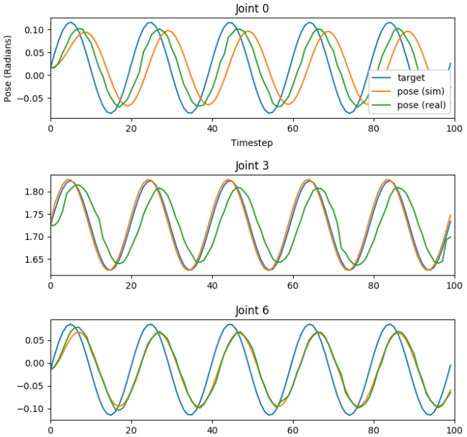
“Given the same target trajectory, the pose trajectories of the simulated and real robot differ significantly, with varying degrees of mismatch across joints.”
plainstates an association- Asserted: passes — The authors put it forward as true.
- Checkable: passes — It can be checked against evidence.
- Load-bearing: passes — The paper’s conclusions depend on it.
- Based: passes — The paper gives a reason why it holds.
A result the paper reports from its own data — it cites no other source for it, so there is none to check. The quote shows it is in the paper.
In the paper
“Policies trained without randomizing the action timestep and observation noise show particularly noticeable drops in performance.”
plainstates a cause- Asserted: passes — The authors put it forward as true.
- Checkable: passes — It can be checked against evidence.
- Load-bearing: passes — The paper’s conclusions depend on it.
- Based: passes — The paper gives a reason why it holds.
13 more claims
Create a free account to see all 32 claims and to verify the 3 references still open.
- It may state two separate claims as one. 9
- Probably not a substantial claim. 6
Claims other papers make about this one
Each is checked against this paper’s own text: does it say what the citing paper says it does?
The cited source doesn’t support the claim as written.
In the citing paper
“We instantiate SIMPLER on top of the SAPIEN physics simulator [68], but show in Section VI-D that our contributions are independent of the used simulator and can be reproduced in Isaac Sim [49].”
From Evaluating Real-World Robot Manipulation Policies in Simulation (2024) · cites this paper as [49]
Checked by a reasoning model — may be wrong.
Experimental — accuracy not yet measuredThe source backs part of the claim, not all of it — or backs it for a different population, condition or comparison.
In the citing paper
“Residual policy learning restores dynamic feasibility on the robot by learning small corrections to the retargeted reference, reusing the same residual formulation as physics refinement, so that the resulting policy transfers directly to hardware (Peng et al., 2018).”
From Dexterous Robot Manipulation from Human Demonstrations via Contact-Anchored Retargeting and Residual Policy Learning (2026) · cites this paper as Peng et al., 2018
Experimental — accuracy not yet measuredThe source backs part of the claim, not all of it — or backs it for a different population, condition or comparison.
In the citing paper
“Synthesis rollouts under domain randomization (Peng et al., 2018) produce additional dynamically feasible robot trajectories from each retargeted reference.”
From Dexterous Robot Manipulation from Human Demonstrations via Contact-Anchored Retargeting and Residual Policy Learning (2026) · cites this paper as Peng et al., 2018
Experimental — accuracy not yet measuredThe cited source says what the claim attributes to it.
In the citing paper
“Another is randomization of physical parameters that vary between simulation and reality, such that the controller becomes robust to a range of conditions that cover those that arise in physical deployment, without the necessity to precisely model these conditions a priori [21].”
From Learning quadrupedal locomotion over challenging terrain (2020) · cites this paper as [21]
The cited source says what the claim attributes to it.
In the citing paper
“Peng et al. [44] shows the effectiveness of memory-based policies (i.e., policies learnt by using past memory for future learning [95] [97]) to deal with the RG, introducing DR to generalise environment dynamics.”
From Crossing the Reality Gap: A Survey on Sim-to-Real Transferability of Robot Controllers in Reinforcement Learning (2021) · cites this paper as [44]
1 more claim about this paper
Create a free account to see every claim other papers make about this one.
Citations
Cites
Adam: A Method for Stochastic Optimization
Kingma, D. P., & Ba, J. (2014) · arXiv · doi:10.48550/arxiv.1412.6980 · Cited by 98,946
Human-level control through deep reinforcement learning
Mnih, V., Kavukcuoglu, K., Silver, D., Rusu, A. A., Veness, J., Bellemare, M. G., Graves, A., Riedmiller, M., Fidjeland, A. K., Ostrovski, G., et al. (2015) · Nature · doi:10.1038/nature14236 · Cited by 30,357 · cited 1×
“In simulated domains, agents have been developed to perform a diverse array of challenging tasks [1], [2], [3].”
BackgroundContinuous control with deep reinforcement learning
Lillicrap, T. P., Hunt, J. J., Pritzel, A., Heess, N., Erez, T., Tassa, Y., Silver, D., & Wierstra, D. (2015) · arXiv · doi:10.48550/arxiv.1509.02971 · Cited by 10,782
Domain-Adversarial Training of Neural Networks
Ganin, Y., Ustinova, E., Ajakan, H., Germain, P., Larochelle, H., Laviolette, F., Marchand, M., & Lempitsky, V. (2017) · Advances in Computer Vision and Pattern Recognition · doi:10.1007/978-3-319-58347-1_10 · Cited by 8,318
(1999) · Cited by 5,147
MuJoCo: A physics engine for model-based control
Todorov, E., Erez, T., & Tassa, Y. (2012) · 2012 IEEE/RSJ International Conference on Intelligent Robots and Systems · doi:10.1109/iros.2012.6386109 · Cited by 4,767 · cited 1×
“All simulations are performed using the MuJoCo physics engine [39] with a simulation timestep of 0.”
MethodMulti-Agent Actor-Critic for Mixed Cooperative-Competitive Environments
Lowe, R., Wu, Y., Tamar, A., Harb, J., Abbeel, P., & Mordatch, I. (2017) · arXiv · doi:10.48550/arxiv.1706.02275 · Cited by 3,377
Self-citationDomain randomization for transferring deep neural networks from simulation to the real world
Tobin, J., Fong, R., Ray, A., Schneider, J., Zaremba, W., & Abbeel, P. (2017) · 2017 IEEE/RSJ International Conference on Intelligent Robots and Systems (IROS) · doi:10.1109/iros.2017.8202133 · Cited by 3,124
Self-citationLevine, S., Pastor, P., Krizhevsky, A., Ibarz, J., & Quillen, D. (2018) · The International Journal of Robotics Research · doi:10.1177/0278364917710318 · Cited by 1,971
Andrychowicz, M., Wolski, F., Ray, A., Schneider, J., Fong, R., Welinder, P., McGrew, B., Tobin, J., Abbeel, P., & Zaremba, W. (2017) · arXiv · doi:10.48550/arxiv.1707.01495 · Cited by 1,355
Self-citation
Research works printed but not linked: 1
- [32] D. H. Ignasi Clavera and P. Abbeel, 'Policy transfer via modularity,' in IROS . IEEE, 2017. -
Cited by
Items 801–900 of 935
A DRL Approach for Mapless Planar Pushing of Arbitrary Objects in Cluttered Environments
Luz, G. S., & Macharet, D. G. (2025) · Anais Estendidos do XVII Simpósio Brasileiro de Robótica (SBR 2025) e do XVI Workshop de Robótica na Educação (WRE 2025) · doi:10.5753/sbrlars_estendido.2025.248248
Cubides, C., Amaya, C., & Duchon, M. (2025) · IEEE PES Innovative Smart Grid Technologies Europe · doi:10.1109/isgteurope64741.2025.11305410
“Parameter randomization can lead to robust policies under stochastic dynamics and model uncertainty [16], and it has even been explored for grid inertia and load uncertainty, but selecting impactful parameters requires deep domain expertise and may still leave unmodeled modes [17].”
Chenyu, G., & Li, J. (2026) · Mechanisms and machine science · doi:10.1007/978-3-032-01363-7_60
IDM-TD3: An Improved Reinforcement Learning Algorithm Based on Inverse Dynamic Model
Luo, Y., Li, D., Zeng, Y., Zhu, X., & Pang, Z. (2025) · IEEE International Conference on Industrial Informatics (INDIN) · doi:10.1109/indin64977.2025.11278962
“These include the use of progressive neural networks [8] to gradually transition from one environment to another [9], and the randomization of environment parameters to enhance model robustness [10], among others.”
Xu, Z., Zhang, X., Zhang, L., & Liu, Y. (2026) · Lecture notes in computer science · doi:10.1007/978-981-95-5740-0_16
Akamisaka, A., & Nagao, K. (2026) · Sensors · doi:10.3390/s26020566
“…domain randomization [30], which ran-domizes the physical parameters and appearance of simulators, are known to enhance the generalization performance of strategies learned through simulation and play a crucial role in successfully transferring them to real-world environments (Sim-to-Real) [31,32].”
AffordGen: Affordance-Based Dataset Generator for Robot Manipulation Learning*
Dorneles, G. A., Lemos, J. F. S. S., Kappel, K. S., Guerra, R. S., & Drews, P. (2025) · International Conference on Advanced Robotics (ICAR) · doi:10.1109/icar65334.2025.11338672
“Closing this gap has become a significant area of interest in robotics, as it can potentially expand the applicability of algorithms confined to simulated environments [15].”
Reinforcement Learning for Real-World Non-Stationary Systems: An Observation-Aware SurveyPreprint
padha, Y. (2026) · Research Square · doi:10.21203/rs.3.rs-8701502/v1
Illy-Net: A GMM Based Performance Evaluation Framework for Sim-to-Real Transfer of RL Policies
Im, S., & Lee, J. (2025) · IEEE International Conference on Intelligent Reality (ICIR) · doi:10.1109/icir68135.2025.11361591
“Zhao et al.[12] survey a wide range of transfer strate-gies—including domain adaptation and system identifica-tion—used in robotic RL. Peng et al.[13] introduce dynamics randomization to improve policy robustness across different physical conditions.”
Benkedadra, M., Saoudi, A., Gloesener, M., Mahmoudi, S. A., & Mancaş, M. (2025) · International Conference on Computational Intelligence and Intelligent Systems (CIIS) · doi:10.1145/3787256.3787261
“Bridgingthesim-to-realgaphasbeenalongstandingchallenge[12, 19].”
RAISE: Robust and Adversarially Informed Safe Explanations for Reinforcement Learning
Kim, S., & Shibuya, T. (2026) · Electronics · doi:10.3390/electronics15030666
Fault Tolerant Control With Reinforcement Learning for Evasive Maneuvers Using a Scaled Vehicle
Silva, A. D., Müller, S., Birkner, C., Jazar, R. N., & Marzbani, H. (2026) · IEEE Access · doi:10.1109/access.2026.3661179
“According to [74], incorporating dynamic random effects and perturbations into the controller design enhances its robustness.”
Parameter-Robust MPPI for Safe Online Learning of Unknown Parameters
Vahs, M., Choi, J., Schmid, N., Tumova, J., & Fan, C.-C. (2026) · IEEE Robotics and Automation Letters · doi:10.1109/lra.2026.3662531 · Cited by 2
“Reinforcement learning often employs domain randomization to bridge the sim-to-real gap, training policies that are robust to a wide range of simulator parameters [1].”
A Practical Multi-Body Model Enabling a Flexible-Wheeled Robot to Learn Blind Stair Climbing
Yoon, C.-Y., & Cho, B. (2026) · IEEE Robotics and Automation Letters · doi:10.1109/lra.2026.3662534 · Cited by 1
“This gap is exacerbated in dynamic tasks with frequent, unpredictable contacts, and bridging it through randomization has become a consistent trend [30], [11].”
Gong, C., Xu, J., Ou, S. S., & Lin, Y. S. (2026) · IEEE Transactions on Vehicular Technology · doi:10.1109/tvt.2026.3663010
“[33]randomizedthe dynamicsofthesimulatorduringtraining,enablingRLagentsto adapttovariousdynamicconditionsandenhancingthegeneral-izationcapabilityofRLacrossdiverseenvironments.”
A Comprehensive Review on Humanoid Robots: Perspectives from Academia and Industry
Li, W., Yang, G., Wu, J., Pan, C., Sheng, L., & Zhang, Q. (2026) · ENGINEERING Information Technology & Electronic Engineering · doi:10.1631/eng.itee.2025.0105 · Cited by 27
Adaptive Generative Simulation for Robust Prosthetic Arm Control
Hadi, M. A., Mustansar, Z., Shah, S. I. A., & Ayaz, Y. (2025) · International Conference on Engineering & Computing Technologies (ICECT) · doi:10.1109/icect66235.2025.11381660
“Domain randomization of object properties, con tact/friction, and sensor/actuator noise encourages invariances that persist on hardware [7], [8].”
InfluentialHuang, S., Wang, T., Zhu, J., et al. (2025) · IEEE International Conference on Robotics and Biomimetics (ROBIO) · doi:10.1109/robio66223.2025.11376330
“These gaps arise from inaccurate modeling, unmodeled physical effects (e.g., friction changes, delays, sensor noise), and calibration errors, often leading to policy failure upon deployment [18].”
Expert-Guided Imitation for Learning Humanoid Loco-Manipulation from Motion Capture
Singh, R., Léziart, P., Murooka, M., Morisawa, M., Yoshida, E., & Kanehiro, F. (2026) · IEEE/SICE International Symposium on System Integration (SII) · doi:10.1109/sii64115.2026.11404507
“Although training policies in simulation before transferring them to the real world has been a popular approach for a while [26], [27], it has now been boosted by several GPU-based simulators capable of simulating thousands of robots in parallel [28], [29], which has streamlined this process [30].”
A Real2Sim2Real Transformer Policy System for Bimanual R2R2H Tasks
Jaramillo, I. E., Choi, Y.-H., Lee, K., Oh, J.-H., Pahk, K. J., & Kim, T. (2026) · ACM/IEEE International Conference on Human-Robot Interaction (HRI) · doi:10.1145/3776734.3794489
InverseLight: Inverse Dynamics Enabling Policy Transfer with Limited Data for Traffic Signal Control
Zhang, Y., Bian, Z., Liu, Q., & Li, Z. (2025) · IEEE International Conference on Intelligent Transportation Systems (ITSC) · doi:10.1109/itsc60802.2025.11423052
“These approaches, inspired by works like [11], [12], focus on calibrating simulator dynamics through action-space transformations and parameter adjustments.”
Feng, K., Yang, T., & Luo, S. (2026) · Neural Computing and Applications · doi:10.1007/s00521-025-11808-z
Optimizing Path Tracking Performance in NAO Robots via Multiobjective Reinforcement Learning
Ibtissem, C., & Ladhari, T. (2025) · IEEE International Conference on Advances in Data-Driven Analytics and Intelligent Systems (ADACIS) · doi:10.1109/adacis65663.2025.11436275
MI-MRL: A Meta-Reinforcement Learning Method Based on Memory Information for Bipedal Locomotion Task
Tan, W., Fang, X., Chen, Y., Li, Z., Song, R., Wang, R., & Zhang, W. (2026) · IEEE Transactions on Industrial Electronics · doi:10.1109/tie.2026.3672826
“With the assistance of domain randomization [10], [13] and some other specific learning techniques, some RL-based methods demonstrated sufficient robustness to limited environmental variations, sensor noise, and minor discrepancies in robot dynamic parameters, and showcased good policy transfer from…”
In-Situ Learning in Drones: Rethinking Embodied Intelligence Without Sim-to-Real
Chen, A. S., Meng, S. S., & Li, Z. (2026) · IOP Conference Series Materials Science and Engineering · doi:10.1088/1757-899x/1343/1/012015
Méta-apprentissage par renforcement pour le contrôle adaptatif
Jaafra, Y. (2020) · theses.fr (ABES) · doi:10.70675/4a9b4240zabb1z45abz8446z5a014f63e1c0
Active Vibration Control of Piezoelectric Beams under Uncertain Delay via a DDR-PPO Approach
Wu, J., & Zhang, T. (2026) · Journal of Vibration Engineering & Technologies · doi:10.1007/s42417-026-02453-4
Automatic Curriculum Learning for Developmental Machine Learners
Portelas, R. (2022) · theses.fr (ABES) · doi:10.70675/947677c7z2ec1z4b61zbae3z6f358c02b050
Experiment-free learning of exoskeleton assistance remains an unsolved problemPreprint
Collins, S. H., Groote, F. D., Gregg, R. D., Huang, H., Lenzi, T., Sartori, M., Sawicki, G. S., Si, J., Slade, P., & Young, A. J. (2026) · bioRxiv (Cold Spring Harbor Laboratory) · doi:10.64898/2026.04.01.715109 · Cited by 2
“Transferring learned policies to real systems is notoriously difficult 13 , requiring large amounts of high-quality data, excellent system models, and significant computation 14 .”
Carton, F. (2021) · theses.fr (ABES) · doi:10.70675/9aa0cab2z7ec4z456az9f57z1c8be2733b1b · Cited by 4
Reinforcement learning of a navigation method for contact planning on humanoid robots
Chemin, J. (2022) · theses.fr (ABES) · doi:10.70675/33c2dfdfz2981z4a99z8b89zd59487b2e7fd
Kamienny, P.-A. (2023) · theses.fr (ABES) · doi:10.70675/eb3ca119z46c6z44c2zb8a4z75d2bd53def8 · Cited by 1
Deep Reinforcement Learning Control Method for Quadruped Robots Based on Recurrent Neural Networks
Qiao, Z., Chen, F., & Zhang, J. (2026) · Lecture notes in mechanical engineering · doi:10.1007/978-981-95-7113-0_11
Improving Novelty Search Sample Efficiency with Models or Archive Bootstrapping
Hanna, E. (2024) · theses.fr (ABES) · doi:10.70675/9d7e6e4ezde3bz4cfcz88c4z5b5ab36619f1
Song, M., Huo, Y., Zhou, B., Yin, S., Xiao, Z., Long, J., Zhang, Z., & Yu, C. (2026) · International World Wide Web Conference (WWW) · doi:10.1145/3774904.3792129 · Cited by 3
On, S. K., Jeong, S., Lee, J., & Yang, I. (2026) · International Journal of Control Automation and Systems · doi:10.1007/s12555-026-00082-x · Cited by 3
Knowledge Retention for Generic Reinforcement Learning Policies in Autonomous Cyber Defence
Sylvester, J., & Lemos, R. D. (2026) · Lecture notes in computer science · doi:10.1007/978-3-032-16165-9_3
AeroBridge-TTA: Test-Time Adaptive Language-Conditioned Control for UAVs
Lyu, L. (2026) · IEEE Conference on Cybernetics and Intelligent Systems · doi:10.1109/cis-ram71614.2026.11668516 · Cited by 1
“Domain randomisation [23], [24] trains over a dynamics distribution.”
Luo, J., Yang, S., Zheng, C., 范金秋, Gao, Y., Song, R., & Zhang, W. (2026) · IEEE Transactions on Automation Science and Engineering · doi:10.1109/tase.2026.3686977 · Cited by 1
“In real-world deployments, robots are often required to operate across heterogeneous platforms, dynamic workspaces, and previously unseen scenes, yet most existing methods assume deployment on the same robot and in the same scene where the demonstrations were collected [16], [17], [18].”
Abstract Sim2Real Through Approximate Information States
Deng, Y., Li, Y., & Hanna, J. P. (2026) · IEEE Robotics and Automation Letters · doi:10.1109/lra.2026.3688068 · Cited by 1
“Simulatorsofferasaferandlesscostlyalternativetoreal-worldlearning,butstandardsim2realmethods—includingdo-main randomization [5], system identification, and learned dynamics corrections—assume that the simulator and the target domain share the same state-action space and differ only in dynamics…”
Zhang, X., Li, G., Shokouhi, S., & Thein, M.-W. L. (2026) · Actuators · doi:10.3390/act15050235 · Cited by 1
Autonomous Multi-Agent Navigation in Crowded Environments: A Comprehensive Survey and Analysis
James, G. M. (2025) · International Journal of Technical Research Studies (IJTRS) · doi:10.63090/ijtrs/3139.1788.0002
Alfonso-Arsuaga, M., Dominguez-Elvira, H., Casas-Guerrero, J., Castiella-Aguirrezabala, A., Costabile-Dominguez, L., García-González, J., Naranjo-Almeida, M., Trinidad, M. C., & López‐Moreno, J. (2026) · IEEE Winter Conference on Applications of Computer Vision · doi:10.1109/wacv61042.2026.00163
“However, policies and perception models trained in simulation frequently underperform when deployed on physical robots due to the well-known sim-to-real gap—a mismatch between virtual and real-world domains caused by differences in visual appearance, sensor noise, and object physics [21, 27, 36].”
Zero-shot MARL benchmark in the Cyber-Physical Mobility Lab
Beerwerth, J., Xu, J., Schäfer, S., Belderink, F., & Alrifaee, B. (2026) · at - Automatisierungstechnik · doi:10.1515/auto-2025-0057
“These techniques have been successfully applied to manipulation tasks, urban driving scenarios, and autonomous racing [4], [9].”
Dynamic Dense Packing of Unknown Objects Based on Perception
Cao, S., & Xiao, J. (2026) · IEEE Transactions on Automation Science and Engineering · doi:10.1109/tase.2026.3691769
“Bridging the gap between simulation and reality has been a major challenge for similar RL-based approaches [21], [22].”
Robust Manipulation of Deformable Linear Objects
Envall, J., & Coros, S. (2026) · IEEE Robotics and Automation Letters · doi:10.1109/lra.2026.3692099
“This idea is reminiscent of domain randomization that is often used in data driven approaches [18], [19], [20].”
Wei, J., Tian, Y., Zhao, G., Zhang, W., Li, H., & Wang, Y. (2026) · International Conference on Communications, Information System and Computer Engineering (CISCE) · doi:10.1109/cisce69494.2026.11504956
“Motivated by this observation, we further propose a domain-randomized training strategy for PPO, termed Robust-PPO, to improve resilience under distribution shifts [13],[14] .”
LineRides: Line-Guided Reinforcement Learning for Bicycle Robot Stunts
Rho, S., Fahmi, S., Kim, J., Ilvonen, A., Ha, S., & Nelson, G. (2026) · IEEE Robotics and Automation Letters · doi:10.1109/lra.2026.3693936
“Domain Randomization: To reduce the sim-to-real gap, we apply domain randomization [35], [36] in both driving and stunt modes.”
Farhadi, A., Amoli, D. M., Fallahzadeh, A., & Zamnifar, A. (2026) · Springer eBooks · doi:10.1007/978-3-032-15088-2_9
A Comparative Study of PPO and SAC for End-to-End Visual Peg-in-Hole Insertion
Zhou, H., Wang, W., & Cai, Y. (2026) · International Conference on Robot Perception and Intelligent Control (RPIC) · doi:10.1109/rpic68328.2026.11518077
“Dynamics randomization is likewise a standard route for improving robustness and sim-to-real transfer [13].”
Guan, Y., Tang, L., Lyu, Y., Li, S. W., Yang, Y., Sheng, K., Zhang, B., He, L., & Li, K. (2026) · IEEE Transactions on Automation Science and Engineering · doi:10.1109/tase.2026.3695533 · Cited by 5
“Sim-to-real transfer has been widely studied through domain randomization [62], dynamics randomization [63], and broader randomized-simulation pipelines reviewed in [64].”
Patel, T., Kulkarni, C., Purushothaman, R., Kole, D., Parikh, M., & Keshava, R. (2026) · International Conference on Current Research in Artificial Intelligence and Data Science (ICCRAIDS) · doi:10.1109/iccraids67816.2026.11519729
“3) Robustness and Generalization: Domain randomization [29], [30] improves robustness to environmental variations by training on diverse simulation parameters.”
Scaling Vision–Language–Action Policy Adaptation via Action-Conditioned World Models
Yeboah, Y., Buertey, J. T. I., Agyapong-Kodua, K., Farisi, Z., & Brace, R. (2026) · International Conference on Mechatronics and Robotics Engineering (ICMRE) · doi:10.1109/icmre69538.2026.11533985
“Domain randomization techniques have been proposed to improve sim-to-real robustness by exposing policies to wide variability in simulated environments [32,33].”
Ou, C., Peng, Y., & Zhang, F. (2026) · Healthcare · doi:10.3390/healthcare14111523 · Cited by 1
Generalized 3D Energy-Aware Path Planning Under Dynamic Turbulent Wind Conditions
Rocha, S. A., & Sun, L. (2026) · AIAA AVIATION Forum · doi:10.2514/6.2026-4636
Zhang, D., 魏康琪, Yang, H., Tang, Y., & Wu, F. (2026) · IEEE Internet of Things Journal · doi:10.1109/jiot.2026.3700997
“To mitigate the sim-to-real gap, our framework incorporates several techniques beyond standard fine-tuning [43], [44].”
Digital twins in advanced robotics
Kaarlela, T., Pitkäaho, T., Bobadilla, L., Fuentes, J., Padrão, P., & Dianatfar, M. (2026) · Elsevier eBooks · doi:10.1016/b978-0-443-43896-7.00033-9
Govender, S., & Jeewa, A. (2026) · Communications in computer and information science · doi:10.1007/978-3-032-29003-8_31
Yang, Z., Xu, Z., & Ren, Q. (2026) · Chinese Control and Decision Conference (CCDC) · doi:10.1109/ccdc69976.2026.11560188
“], [8], and domain randomization [9], [10].”
Depth-Fused Imitation Learning for Manipulator-Assisted Spacecraft BerthingPreprint
Koo, J., Cho, T., Son, C., & Choi, A. J. (2026) · SSRN Electronic Journal · doi:10.2139/ssrn.6999268
Jin, Z., Wang, H., Tang, Y., Dong, Z., Feng, C., & Shao, Y. (2026) · SSRN Electronic Journal · doi:10.2139/ssrn.7029004
Jin, Z., Wang, H., Sun, X., & Shao, Y. (2026) · Advanced Engineering Informatics · doi:10.1016/j.aei.2026.104823 · Cited by 1
“To expose sensitivity to construction variability, initial window pose is randomized within bounded tolerances, surface friction coefficients are sampled from prescribed ranges, and selected numerical contact parameters are perturbed within stable simulation regimes [60– 62].”
Xu, W. Q., Liu, Z., Yang, C.-X., Nie, A., & Zhang, H. (2026) · IEEE Transactions on Automation Science and Engineering · doi:10.1109/tase.2026.3708974
“From the evolution of representative studies, Peng et al. further extended this idea to dynamics randomization, allowing control policies to remain transferable under variations in mass, friction, and latency [136].”
Deep Reinforcement Learning for Collision-Aware Leader–Follower Formation Control
Romaniuk, S., & Budnik, J. (2026) · Sensors · doi:10.3390/s26134162
Cai, Y., Zhang, X., Liu, S., LOU, J., & Yuan, C. (2026) · Nonlinear Dynamics · doi:10.1007/s11071-026-12695-2 · Cited by 1
“Pio-neering domain randomization methodologies [7, 38–42] demonstrated the empirical viability of this formulation.”
Straub, F., Schmidt, M., & Dietrich, S. (2025) · IEEE International Conference on Cybernetics, Cognition and Machine Learning Applications (ICCCMLA) · doi:10.1109/icccmla66092.2025.11580723
“…strategies include a range of methodologies, including domain randomization, which introduces substantial variability to encompass real-world appearance, and domain adaptation, which aligns synthetic and real distributions via GAN-based refinements or feature-space adversarial training [27]–[29].”
Sim-to-Real Transfer Learning for Humanoid Robot Control: A Mini-Review
Zhao, Z., Zhou, M., & LingFeng, F. (2026) · International Conference on Computer Supported Cooperative Work in Design (CSCWD) · doi:10.1109/cscwd68734.2026.11582160
“Training a control policy within this high-fidelity simulation, often by applying domain randomization to the learned actuator model, is critical for bridging the Sim-to-Real gap for dynamic humanoid control [35].”
Jiang, Y. (2026) · International Annual Conference on Complex Systems and Intelligent Science (CSIS-IAC) · doi:10.1109/csis-iac70275.2026.11585057
“Peng et al. further investigated sim-to-real transfer of robotic control through dynamics randomization [5].”
Optimization of Robot Grasping Using Reinforcement Learning in Simulation
Belke, M., Phatak, M., Petrović, O., & Brecher, C. (2026) · Springer eBooks · doi:10.1007/978-3-031-91463-8_26
Guided Latent-Context Online Adaptation for Learned Vehicle Dynamics
Park, G., Lee, W., & Park, F. C. (2026) · IEEE Robotics and Automation Letters · doi:10.1109/lra.2026.3711372
“Dynamics randomization trains a single global model over a broad distribution of environments to improve robustness [4], [5], [18].”
Matas, F., Rusiňák, D., & Virgala, I. (2026) · Cognitive Models and Artificial Intelligence Conference (AICCONF) · doi:10.1109/aicconf69182.2026.11600732
“A common strategy to mitigate the reality gap is to randomize physical parameters during training to promote robustness to modeling errors [7].”
Boase, D., Miah, M. S., & Gueaieb, W. (2026) · International Journal of Intelligent Robotics and Applications · doi:10.1007/s41315-026-00560-9
A scoping review of reinforcement learning methods for long horizon robotic manipulation
Acs, M., & Zhong, X. (2026) · Discover Robotics · doi:10.1007/s44430-026-00037-1
“These factors further increase the gap between simulation-based learning and real-world deployment [18, 19].”
Kim, S. (2026) · JMIR Nursing · doi:10.2196/96848
“In conventional robotics, simulation-to-real transfer is treated primarily as a technical challenge: closing the gap between simulated and physical dynamics through domain randomization [19], dynamics randomization [20], and system identification.”
A Review of Language-Guided Dexterous Grasping with Human-in-the-Loop Adaptation
Jeong, E., & Lim, S. (2026) · Mathematics · doi:10.3390/math14152709
Alboni, E., Crestaz, P. N., Fontanari, E., & Prete, A. D. (2026) · Robotics · doi:10.3390/robotics15080144 · Cited by 2
Lê, T. S., Le, H. S., Tuyen, N. T. V., & Tuyen, N. T. V. (2026) · Advanced Robotics · doi:10.1080/01691864.2026.2707053
EGP2: A sample-efficient and generalizable reinforcement learning framework for UAV path planning
Li, Z., Shan, Y., & Mo, H. (2026) · Robotics and Autonomous Systems · doi:10.1016/j.robot.2026.105670 · Cited by 1
Zhang, L., Xu, T., Cai, M., & Zhang, M. (2026) · Springer eBooks · doi:10.1007/978-981-95-8204-4_3
Tang, Q. (2025) · International Conference Mechatronics and Mechanical Engineering · doi:10.1109/icmme66407.2025.00039
“However, their reliance on extensive training datasets and sim-to-real transferability issues has hindered widespread deployment [8].”
Kaixi, Y., & Qu, S. (2026) · Sensors · doi:10.3390/s26154869
“Domain randomization has been widely used to improve sim-to-real transfer by randomizing visual, environmental, or physical parameters during training, so that the learned model is less likely to over-specialize to a single source-domain condition [16–18].”
Zhang, H., Li, W., & Li, M. (2026) · Youth Academic Annual Conference of Chinese Association of Automation (YAC) · doi:10.1109/yac71005.2026.11615876
On the Fragility of State-Space Augmentation in Diffusion-Based Robot Imitation Learning
Prosser, T., Plastropoulos, A., & Perrusquía, A. (2026) · International Conference on Control, Decision and Information Technologies · doi:10.1109/codit70676.2026.11630859
“Data augmentation is a common strategy to improve robustness and sample efficiency by [16], state-space augmen-tations such as noise injection and trajectory perturbations have also been applied to improve robustness in robotics [17], [18].”
Action Residual Compensation for Dynamics-Mismatch Adaptation in Autonomous Search
Zhang, X., Luo, X., & Xie, S. (2026) · International Conference on Electronic Information Technology and Computer Engineering (EITCE) · doi:10.1109/eitce70137.2026.11634468
“Dynamics randomization improves sim-to-real transfer by varying physical parameters during training [2].”
Zhang, X., Luo, X., & Xie, S. (2026) · International Conference on Electronic Information Technology and Computer Engineering (EITCE) · doi:10.1109/eitce70137.2026.11634316
“The second baseline is PPO+UniformDR, which follows the standard domain randomization paradigm [2], [3] and samples disturbance configurations uniformly.”
Applications of Reinforcement Learning for Autonomous Surgical Robotics: A Systematic Review
Shahid, M., Abdullah, A., Fatima, Z., Feroze, W., Torres-Ruiz, M. J., Saldaña-Pérez, M., Sanchéz-Mejorada, C. G., & Quintero, R. (2026) · Biomimetics · doi:10.3390/biomimetics11080577 · Cited by 2
RL-Based Weightlifting for a Small-Size Humanoid Robot
Vlasenko, A., Сивак, В., Chaikovskaia, E., & Gorbachev, R. (2026) · International Siberian workshops and tutorials on electron devices and materials · doi:10.1109/edm69524.2026.11632088
Tianchen, P., Song, H., Tao, Z., et al. (2026) · International Conference on Mechanical Engineering and Robotics Research (ICMERR) · doi:10.1109/icmerr70056.2026.11643167
“…results indicate that the proposed framework was tested in a simulation robot peg-in-hole assembly task[9]; it achieved smooth and stable force control without any parameter tuning, significantly enhancing the robustness and generalization capability of the system in complex contact tasks[10].”
A Unified Conditional Policy for Multi-Robot Navigation via LiDAR-to-Vision Distillation
Amani, A. M., Amani, S., & MajidiRad, A. (2026) · Machines · doi:10.3390/machines14080936
Rodríguez, I. J. T., Ghilardi, M., Fargas, J. M., et al. (2026) · Actuators · doi:10.3390/act15080451
Reducing Distribution Shift in Imitation Learning with an Expert for Stable Flight
Boudlal, A., Khafaji, A., & Elabbadi, J. (2026) · Lecture notes in networks and systems · doi:10.1007/978-3-032-28094-7_27
Zhang, Z., Meng, W., Wan, L., Yin, Y., & Pan, G. (2026) · Pattern Recognition · doi:10.1016/j.patcog.2026.114558 · Cited by 1
Ahn, H., 이호영, Kang, B., Choi, J., Yoon, Y., & Kim, J. (2026) · IEEE Access · doi:10.1109/access.2026.3725709 · Cited by 1
“More importantly, a training process that relies on random exploration can cause the loss of physical equipment or mission failures when applied to real maritime environments [11], [12].”
CubeSat Interaction Dynamics Simulation Using a Mobile Manipulator System
Tchapdieu, J. E., & Bazzocchi, M. C. F. (2026) · Journal of Spacecraft and Rockets · doi:10.2514/1.a36402
Randomize and Identify for Stable Flight
Boudlal, A., Khafaji, A., & Elabbadi, J. (2026) · Lecture notes in networks and systems · doi:10.1007/978-3-032-28097-8_17
Peng, Y.-C., Lin, F.-C., Chang, J.-G., et al. (2026) · IEEE International Conference on Consumer Electronics - Taiwan (ICCE-Taiwan) · doi:10.1109/icce-taiwan71481.2026.11652389
Geometry-Preserving Coupled Augmentation for Data-Efficient Robot Imitation Learning
Furqon, E. N., Islam, J., & Lin, C. (2026) · IEEE International Conference on Consumer Electronics - Taiwan (ICCE-Taiwan) · doi:10.1109/icce-taiwan71481.2026.11652531
“Alternatively, simulation-based approaches [4] generate synthetic demonstrations but suffer from the reality gap and require significant computational resources.”
Metadata
- Authors
- Peng, X. B., Andrychowicz, M., Zaremba, W., & Abbeel, P.
- Affiliations
- University of California, Berkeley (US)
- OpenAI (United States) (US)
- ORCID
- Abbeel, Pieter
- Venue
- 2018 IEEE International Conference on Robotics and Automation (ICRA)
- Publisher
- IEEE
- Published
- 2018-05
- Pages
- 3803-3810
- ISSN
- 1050-4729 (ISSN-L)
- OpenAlex
- W2767050701
- Cited by
- 1,309
- References
- 39
- Citations by year
- 2026: 149 · 2025: 167 · 2024: 155 · 2023: 158 · 2022: 159 · 2021: 197 · 2020: 178 · 2019: 109 · 2018: 34
- FWCI
- 52.88
- Type
- conference paper
- Language
- en
- Open access
- green
- arxiv.org
- Locations
- Proceedings - IEEE International Conference on Robotics and Automation/Proceedings (publishedVersion)
- arXiv (Cornell University) (submittedVersion)
- arXiv (Cornell University)
- Topics
- Physical Sciences › Computer Science › Artificial Intelligence › Reinforcement Learning in Robotics
- Physical Sciences › Engineering › Control and Systems Engineering › Robot Manipulation and Learning
- Physical Sciences › Computer Science › Artificial Intelligence › Domain Adaptation and Few-Shot Learning
- Keywords
- sim-to-real transfer, robot control, reality gap, object pushing, robot manipulators, policy generalization
About these checks
Registry, retraction, Cites and statistics results are computed, not judged, with one exception: a printed reference that no index lists is read once by a model before it counts as a citation error. Claims are extracted by a model and kept only when their quote appears verbatim in the text; each cited source is then checked, with a model’s help, for whether it says what the claim relies on. Those verdicts can be wrong — read the claim’s quote and the cited source before relying on one.
The claim verdicts this report counts are experimental: their accuracy is not yet measured.
A language model drew the claims from the paper on 2026-10-10, under version 3 of the claim definition (model deepseek-v4.1-flash, prompt extract-v3).
A second model labelled each claim on 2026-10-10 (model jev-1.13-20260917, definition revision gold-guideline-v0.2).
Cited sources are checked with a language model’s help (gpt-6-sol).
Statistics and arithmetic are recomputed, not judged.
Confidence bands are shown only for fields calibrated on our annotated test set. None is calibrated yet, so no band is shown.
What counts as a claim ›How we measure confidence ›How we check this ›
Are you an author, or do you see a problem with this page? Request a review
Data sources
Bibliographic data: Semantic Scholar, OpenAlex, Crossref.
Contains information from the Semantic Scholar Academic Graph Datasets, made available under the ODC Attribution License (ODC-BY 1.0).
Semantic Scholar’s data is described in: Kinney, R., et al. (2023). The Semantic Scholar Open Data Platform. arXiv:2301.10140.
