

Sim-to-Real Transfer of Robotic Control with Dynamics Randomization
Open accessThe DOI matches its Crossref record; 50 of the 50 references it cites were found in a registry or an index; 2 of the 5 sources its claims cite were checked for support.
Abstract
Simulations are attractive environments for training agents as they provide an abundant source of data and alleviate certain safety concerns during the training process. But the behaviours developed by agents in simulation are often specific to the characteristics of the simulator. Due to modeling error, strategies that are successful in simulation may not transfer to their real world counterparts. In this paper, we demonstrate a simple method to bridge this “reality gap”. By randomizing the dynamics of the simulator during training, we are able to develop policies that are capable of adapting to very different dynamics, including ones that differ significantly from the dynamics on which the policies were trained. This adaptivity enables the policies to generalize to the dynamics of the real world without any training on the physical system. Our approach is demonstrated on an object pushing task using a robotic arm. Despite being trained exclusively in simulation, our policies are able to maintain a similar level of performance when deployed on a real robot, reliably moving an object to a desired location from random initial configurations. We explore the impact of various design decisions and show that the resulting policies are robust to significant calibration error.
Overview
CoChat Summary
TL;DR
The paper demonstrates that randomizing simulator dynamics during training lets recurrent policies transfer directly to a real 7-DOF Fetch arm for a puck-pushing task without any real-world training. The LSTM policy retained comparable performance in simulation and reality, while feedforward and non-randomized baselines transferred poorly or failed.
Key findings
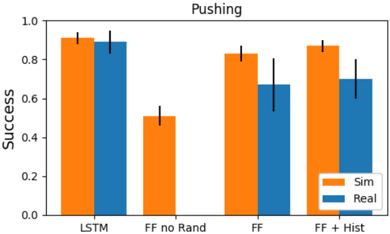
- The LSTM policy trained only in simulation achieved real-robot success of 0.89 ± 0.06 over 28 trials, comparable to its simulated success of 0.91 ± 0.03 over 100 randomized-dynamics trials.
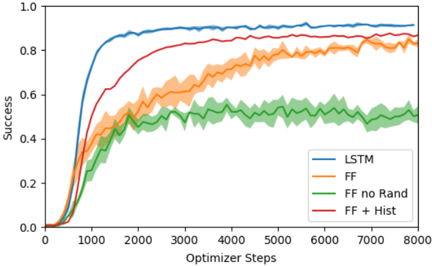
- Memoryless feedforward policies transferred worse: FF no Rand had sim 0.51 ± 0.05 and real 0.0 ± 0.0 (10 trials); FF had sim 0.83 ± 0.04 and real 0.67 ± 0.14 (12 trials); FF + Hist had sim 0.87 ± 0.03 and real 0.70 ± 0.10 (20 trials).
- Ablating randomization hurt real-robot success: fixed action timestep 0.29 ± 0.11 (17 trials), no observation noise 0.25 ± 0.12 (12 trials), fixed link mass 0.64 ± 0.10 (22 trials), fixed puck friction 0.48 ± 0.10 (27 trials), versus 0.89 ± 0.06 (28 trials) for all randomized parameters.
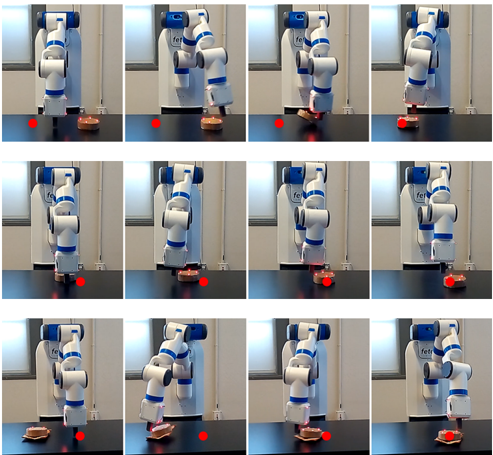
- When contact dynamics were altered by attaching a packet of chips to the puck, the LSTM policy achieved 0.91 ± 0.04 success, comparable to 0.89 ± 0.06 without the attachment.
Methods
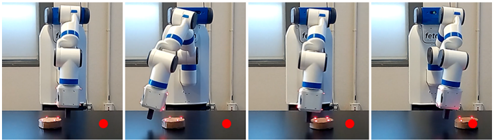
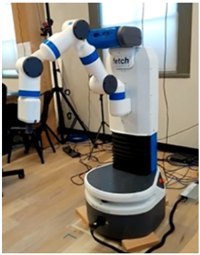
- Task: a 7-DOF Fetch Robotics arm pushed a puck to a randomly sampled target on a table; reward was binary (0 if puck within 0.07 m of target, otherwise -1). State was 52D (joint positions/velocities, gripper position, puck position/orientation/linear and angular velocities); action was 7D target joint-angle offsets. Simulation used MuJoCo with 0.002 s timestep and 20 simulation steps per control step; episodes were 100 control steps in simulation and 200 timesteps on the real robot.
- Dynamics randomization: at each episode start, 95 parameters were sampled and held fixed, including link masses, joint damping, puck mass/friction/damping, table height, controller gains, action timestep, and observation noise. Action timestep varied per step via Δt ∼ Δt0 + Exp(λ), with Δt0 = 0.04 s and λ fixed per episode; observation noise was Gaussian with standard deviation 5% of each feature’s running standard deviation; action exploration noise had standard deviation 0.01 rad.
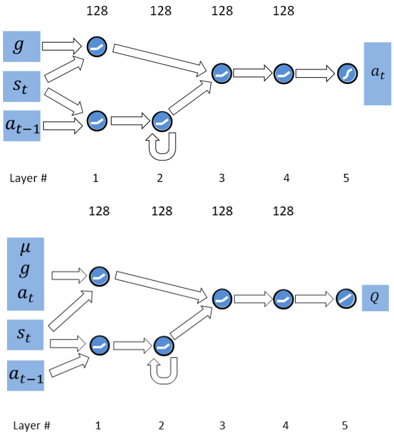
- Training and analysis: policies were trained with Recurrent Deterministic Policy Gradient (RDPG) and Hindsight Experience Replay (HER, k = 0.8), using an LSTM policy and an omniscient critic that received simulator dynamics parameters. ADAM used stepsize 5 × 10⁻⁴, batches of 128 episodes with 100 steps each, about 8000 update iterations, roughly 100 million samples, and about 8 hours on a 100-core cluster. Performance was compared across architectures and randomization ablations in simulation and on the real robot.
Limitations
- Stated: little calibration was performed to make simulation match the real robot, and the authors note that more extensive calibration would likely improve performance; they also state future work should extend to richer tasks and modalities such as vision.
- Evident from the text: evaluation is limited to a single puck-pushing task with a 7-DOF arm, and real-robot trials are small (10–28 trials per condition), so broader task and statistical generalization are not established.
- Evident from the text: the method relies on simulation-only training and does not test direct real-world fine-tuning or vision-based transfer.
Model-written summary. Check it against the paper before relying on it.
Integrity signals
Registry
Cites
Statistics
Figures
Verification
Claims the paper makes
1 Valid · 0 Not valid · 2 Not checked · 29 Own results and interpretations
The cited sources support only part of this claim — read each source’s verdict below.
In the paper
“Furthermore, it has been observed that DeepRL policies are prone to exploiting idiosyncrasies of the simulator to realize behaviours that are infeasible in the real world [2], [7].”
What the sources say
- Could not verifycites [2] [2] T. P. Lillicrap, J. J. Hunt, A. Pritzel, N. Heess, T. Erez, Y. Tassa, D. Silver, and D. Wierstra, 'Continuous control with deep reinforcement learning,' CoRR , vol. abs/1509.02971, 2015. [Online]. Available: http://arxiv.org/abs/1509.02971 - sourceExperimental — accuracy not yet measured
The Results (p. 4) describe testing DDPG in simulated physical environments, but do not report policies exploiting simulator quirks. Searches for simulator artifacts, unrealistic behavior, and real-world feasibility found no passage addressing the claimed tendency. (LLM, conf=0.72)
- Partly supportedcites [7] [7] N. Heess, D. TB, S. Sriram, J. Lemmon, J. Merel, G. Wayne, Y. Tassa, T. Erez, Z. Wang, S. M. A. Eslami, M. A. Riedmiller, and D. Silver, 'Emergence of locomotion behaviours in rich environments,' CoRR , vol. abs/1707.02286, 2017. [Online]. Available: http://arxiv.org/abs/1707.02286 - sourceExperimental — accuracy not yet measured
The Introduction (p. 1) says agents may find idiosyncratic solutions that work in one setting but are not robust across settings. The Results (p. 8) report that a simulated humanoid can exploit redundancies in the task specification, producing visually unsatisfactory gaits. Neither passage says the policies exploit quirks of the simulator or that their behaviours are infeasible in the real world. (LLM, conf=0.82)
plainstates a cause- Asserted: passes — The authors put it forward as true.
- Checkable: passes — It can be checked against evidence.
- Load-bearing: passes — The paper’s conclusions depend on it.
- Based: passes — The paper gives a reason why it holds.
- Could not verify
A result the paper reports from its own data — it cites no other source for it, so there is none to check. The quote shows it is in the paper.
In the paper
“We explore the impact of various design decisions and show that the resulting policies are robust to significant calibration error.”
- Also stated in: § B. Domain Randomization · p. 2 · plain
“Unlike previous methods which often require meticulous calibration of the simulation to closely conform to the physical system, our policies are able to adapt to significant calibration error.”
- Also stated in: § C. Non-prehensile Manipulation · p. 2 · plain
“The resulting policies are able accommodate large calibration errors when deployed on a real robot and also generalize to variability in the dynamics of the physical system.”
plain- Asserted: passes — The authors put it forward as true.
- Checkable: passes — It can be checked against evidence.
- Load-bearing: passes — The paper’s conclusions depend on it.
- Based: passes — The paper gives a reason why it holds.
- Also stated in: § B. Domain Randomization · p. 2 · plain
A result the paper reports from its own data — it cites no other source for it, so there is none to check. The quote shows it is in the paper.
In the paper
“The feedforward network trained without randomization is unable to perform the task under the real world dynamics.”
plainstates a cause- Asserted: passes — The authors put it forward as true.
- Checkable: passes — It can be checked against evidence.
- Load-bearing: passes — The paper’s conclusions depend on it.
- Based: passes — The paper gives a reason why it holds.
A result the paper reports from its own data — it cites no other source for it, so there is none to check. The quote shows it is in the paper.
In the paper
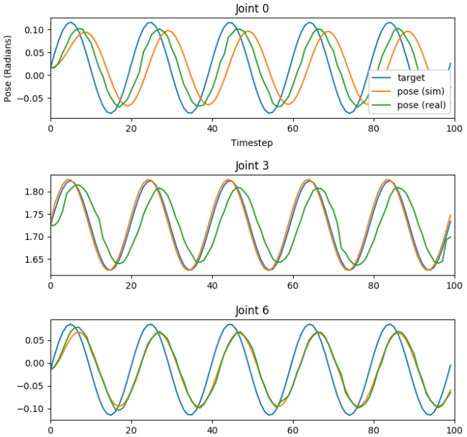
“Given the same target trajectory, the pose trajectories of the simulated and real robot differ significantly, with varying degrees of mismatch across joints.”
plainstates an association- Asserted: passes — The authors put it forward as true.
- Checkable: passes — It can be checked against evidence.
- Load-bearing: passes — The paper’s conclusions depend on it.
- Based: passes — The paper gives a reason why it holds.
A result the paper reports from its own data — it cites no other source for it, so there is none to check. The quote shows it is in the paper.
In the paper
“Policies trained without randomizing the action timestep and observation noise show particularly noticeable drops in performance.”
plainstates a cause- Asserted: passes — The authors put it forward as true.
- Checkable: passes — It can be checked against evidence.
- Load-bearing: passes — The paper’s conclusions depend on it.
- Based: passes — The paper gives a reason why it holds.
13 more claims
Create a free account to see all 32 claims and to verify the 3 references still open.
- It may state two separate claims as one. 9
- Probably not a substantial claim. 6
Claims other papers make about this one
Each is checked against this paper’s own text: does it say what the citing paper says it does?
The cited source doesn’t support the claim as written.
In the citing paper
“We instantiate SIMPLER on top of the SAPIEN physics simulator [68], but show in Section VI-D that our contributions are independent of the used simulator and can be reproduced in Isaac Sim [49].”
From Evaluating Real-World Robot Manipulation Policies in Simulation (2024) · cites this paper as [49]
Checked by a reasoning model — may be wrong.
Experimental — accuracy not yet measuredThe source backs part of the claim, not all of it — or backs it for a different population, condition or comparison.
In the citing paper
“Residual policy learning restores dynamic feasibility on the robot by learning small corrections to the retargeted reference, reusing the same residual formulation as physics refinement, so that the resulting policy transfers directly to hardware (Peng et al., 2018).”
From Dexterous Robot Manipulation from Human Demonstrations via Contact-Anchored Retargeting and Residual Policy Learning (2026) · cites this paper as Peng et al., 2018
Experimental — accuracy not yet measuredThe source backs part of the claim, not all of it — or backs it for a different population, condition or comparison.
In the citing paper
“Synthesis rollouts under domain randomization (Peng et al., 2018) produce additional dynamically feasible robot trajectories from each retargeted reference.”
From Dexterous Robot Manipulation from Human Demonstrations via Contact-Anchored Retargeting and Residual Policy Learning (2026) · cites this paper as Peng et al., 2018
Experimental — accuracy not yet measuredThe cited source says what the claim attributes to it.
In the citing paper
“Another is randomization of physical parameters that vary between simulation and reality, such that the controller becomes robust to a range of conditions that cover those that arise in physical deployment, without the necessity to precisely model these conditions a priori [21].”
From Learning quadrupedal locomotion over challenging terrain (2020) · cites this paper as [21]
The cited source says what the claim attributes to it.
In the citing paper
“Peng et al. [44] shows the effectiveness of memory-based policies (i.e., policies learnt by using past memory for future learning [95] [97]) to deal with the RG, introducing DR to generalise environment dynamics.”
From Crossing the Reality Gap: A Survey on Sim-to-Real Transferability of Robot Controllers in Reinforcement Learning (2021) · cites this paper as [44]
1 more claim about this paper
Create a free account to see every claim other papers make about this one.
Citations
Cites
Adam: A Method for Stochastic Optimization
Kingma, D. P., & Ba, J. (2014) · arXiv · doi:10.48550/arxiv.1412.6980 · Cited by 98,946
Human-level control through deep reinforcement learning
Mnih, V., Kavukcuoglu, K., Silver, D., Rusu, A. A., Veness, J., Bellemare, M. G., Graves, A., Riedmiller, M., Fidjeland, A. K., Ostrovski, G., et al. (2015) · Nature · doi:10.1038/nature14236 · Cited by 30,357 · cited 1×
“In simulated domains, agents have been developed to perform a diverse array of challenging tasks [1], [2], [3].”
BackgroundContinuous control with deep reinforcement learning
Lillicrap, T. P., Hunt, J. J., Pritzel, A., Heess, N., Erez, T., Tassa, Y., Silver, D., & Wierstra, D. (2015) · arXiv · doi:10.48550/arxiv.1509.02971 · Cited by 10,782
Domain-Adversarial Training of Neural Networks
Ganin, Y., Ustinova, E., Ajakan, H., Germain, P., Larochelle, H., Laviolette, F., Marchand, M., & Lempitsky, V. (2017) · Advances in Computer Vision and Pattern Recognition · doi:10.1007/978-3-319-58347-1_10 · Cited by 8,318
(1999) · Cited by 5,147
MuJoCo: A physics engine for model-based control
Todorov, E., Erez, T., & Tassa, Y. (2012) · 2012 IEEE/RSJ International Conference on Intelligent Robots and Systems · doi:10.1109/iros.2012.6386109 · Cited by 4,767 · cited 1×
“All simulations are performed using the MuJoCo physics engine [39] with a simulation timestep of 0.”
MethodMulti-Agent Actor-Critic for Mixed Cooperative-Competitive Environments
Lowe, R., Wu, Y., Tamar, A., Harb, J., Abbeel, P., & Mordatch, I. (2017) · arXiv · doi:10.48550/arxiv.1706.02275 · Cited by 3,377
Self-citationDomain randomization for transferring deep neural networks from simulation to the real world
Tobin, J., Fong, R., Ray, A., Schneider, J., Zaremba, W., & Abbeel, P. (2017) · 2017 IEEE/RSJ International Conference on Intelligent Robots and Systems (IROS) · doi:10.1109/iros.2017.8202133 · Cited by 3,124
Self-citationLevine, S., Pastor, P., Krizhevsky, A., Ibarz, J., & Quillen, D. (2018) · The International Journal of Robotics Research · doi:10.1177/0278364917710318 · Cited by 1,971
Andrychowicz, M., Wolski, F., Ray, A., Schneider, J., Fong, R., Welinder, P., McGrew, B., Tobin, J., Abbeel, P., & Zaremba, W. (2017) · arXiv · doi:10.48550/arxiv.1707.01495 · Cited by 1,355
Self-citation
Research works printed but not linked: 1
- [32] D. H. Ignasi Clavera and P. Abbeel, 'Policy transfer via modularity,' in IROS . IEEE, 2017. -
Cited by
Items 601–700 of 935
Omnipush: accurate, diverse, real-world dataset of pushing dynamics with RGB-D video
Bauzá, M., Alet, F., Lin, Y.-C., Lozano‐Pérez, T., Kaelbling, L. P., Isola, P., & Rodríguez, A. (2019) · IEEE/RSJ International Conference on Intelligent Robots and Systems (IROS) · doi:10.1109/iros40897.2019.8967920 · Cited by 25
“have demonstrated the potential use of learned dynamic models for planning and control [20, 18, 21, 22].”
BackgroundError-Aware Policy Learning: Zero-Shot Generalization in Partially Observable Dynamic Environments
Kumar, V. C. V., Ha, S., & Liu, C. K. (2021) · Robotics: Science and Systems · doi:10.15607/rss.2021.xvii.065 · Cited by 3
“Although some of these methods have been validated in the real world [22, 23], DR often requires manual engineering of the range in which the parameters are varied to make sure that the true system model lies within the range of variation.”
BackgroundMethodInfluentialCAD-to-real: enabling deep neural networks for 3D pose estimation of electronic control units
Bäuerle, S., Böhland, M., Barth, J., Reischl, M., Steimer, A., & Mikut, R. (2021) · at - Automatisierungstechnik · doi:10.1515/auto-2021-0020 · Cited by 3
Dresia, K., Adler, A., Saraf, A. M., Hahn, R. H. S., Kurudzija, E., Traudt, T., Deeken, J. C., & Waxenegger-Wilfing, G. (2023) · AIAA SciTech Forum · doi:10.2514/6.2023-0137 · Cited by 4
Cyborg insects: From free-state control to autonomous intelligent regulation
Ma, Q., Wang, H., Hong, H., Pan, G., & Zheng, N. (2023) · Chinese Science Bulletin (Chinese Version) · doi:10.1360/tb-2023-0186 · Cited by 2
Topological Neural Networks: theory and applications
Hartono, P. (2023) · World Symposium on Digital Intelligence for Systems and Machines (DISA) · doi:10.1109/disa59116.2023.10308945 · Cited by 2
“This Sim-to-real transfer [24], [25] significantly reduces the learning challenges of robots in a physical environment.”
BackgroundGeneralized Robot Dynamics Learning and Gen2Real Transfer
Xing, D., Yang, Y., Wang, Z., Li, J., & Xu, B. (2023) · IEEE/RSJ International Conference on Intelligent Robots and Systems (IROS) · doi:10.1109/iros55552.2023.10342406 · Cited by 2
“Different from the structures used in the previous subsections, we choose the LSTM adopted in [2] with 4 × 128 neurons and similarly a 5-layer feedforward network with approximately 7200 neurons in total.”
BackgroundMethodInfluentialDeep Active Robotic Perception for Improving Face Recognition Under Occlusions
Dimaridou, V., Passalis, N., & Tefas, A. (2023) · IEEE Symposium Series on Computational Intelligence (SSCI) · doi:10.1109/ssci52147.2023.10372039 · Cited by 2
“However, the former approaches require the creation of appropriate datasets, which can be costly, while the latter suffers from well-known problems, such as distribution shifts [13], requiring the use of appropriate sim-to-real methodologies before deployment.”
BackgroundDomain Adaption as Auxiliary Task for Sim-to-Real Transfer in Vision-based Neuro-Robotic Control
Gäde, C., Habekost, J.-G., & Wermter, S. (2024) · International Joint Conference on Neural Networks (IJCNN) · doi:10.1109/ijcnn60899.2024.10650722 · Cited by 9
“1) Domain Randomization: In order to make a trained model more robust to changes in its environment, domain randomization methods alter different visual features [7] or dynamics [18] of the scene for the model to interpret the real environment as another variation of the simulation.”
BackgroundScaling simulation-to-real transfer by learning a latent space of robot skills
Julian, R., Heiden, E., He, Z., Zhang, H., Schaal, S., Lim, J. J., Sukhatme, G. S., & Hausman, K. (2020) · The International Journal of Robotics Research · doi:10.1177/0278364920944474 · Cited by 8
“This is in contrast to existing methods, which have mostly focused on direct alignment between simulation and real (Visser et al., 2011), or data augmentation to generalize the policy using brute force (Peng et al., 2018; Sadeghi and Levine, 2017).”
BackgroundResultChen, C., Li, H.-Y., Dharmawan, A. G., Ismail, K., Liu, X., & Tan, U.-X. (2019) · IEEE International Conference on Robotics and Biomimetics (ROBIO) · doi:10.1109/robio49542.2019.8961517 · Cited by 2
Artificial Neural Network enabling Clinically Meaningful Biological Image Data Generation
Ha, J., Kim, S., Baik, Y., Lee, D., Lee, W., & Suh, S. (2020) · Annual International Conference of the IEEE Engineering in Medicine and Biology Society (EMBC) · doi:10.1109/embc44109.2020.9176621 · Cited by 2
“For example, strategies trained in realistic simulation can be transferred to real agent [6].”
BackgroundA Metric Space Perspective on Self-Supervised Policy Adaptation
Bodnar, C., Hausman, K., Dulac-Arnold, G., & Jonschkowski, R. (2021) · IEEE Robotics and Automation Letters · doi:10.1109/lra.2021.3068100 · Cited by 5
“Another class of methods tries to train robust policies by applying various types of domain randomizations [21]–[23].”
BackgroundSimulation to reality and back: A robot's guide to crossing the reality gap
Collins, J. T. (2022) · Queensland University of Technology · doi:10.5204/thesis.eprints.230537 · Cited by 4
Golemo, F. (2018) · theses.fr (ABES) · doi:10.70675/d4395fe3z9853z4cf5za781zf746f7e0da47 · Cited by 7
The Principle of Unchanged Optimality in Reinforcement Learning Generalization
Irpan, A., & Song, X. (2019) · arXiv · doi:10.48550/arxiv.1906.00336 · Cited by 2
Modular transfer learning with transition mismatch compensation for excessive disturbance rejection
Wang, T., Lu, W., Yu, H., & Liu, D. (2022) · International Journal of Machine Learning and Cybernetics · doi:10.1007/s13042-022-01641-4 · Cited by 1
“Peng et al. [57] proposed to learn a policy in simulation through randomizing the physical parameters of the environment, then transfer the learned policy to a real robot for a puck pushing task.”
BackgroundInfluentialAgarwal, A., Veer, S., Ren, A. Z., & Majumdar, A. (2022) · Proceedings - IEEE International Conference on Robotics and Automation/Proceedings · doi:10.1109/icra46639.2022.9811565 · Cited by 4
Trajectory-based Split Hindsight Reverse Curriculum Learning
Wu, J., Zhang, D., Zhong, S., & Qiao, H. (2021) · IEEE/RSJ International Conference on Intelligent Robots and Systems (IROS) · doi:10.1109/iros51168.2021.9636842 · Cited by 2
“Based on domain randomization [26] [27], we add noise to the object size and position on task 2.”
MethodSim-to-real: Quadruped Robot Control with Deep Reinforcement Learning and Parallel Training
Jiang, H., Chen, T., Cao, J., Bi, J. Q., Lu, G., Zhang, G., Rong, X., & Li, Y. (2022) · IEEE International Conference on Robotics and Biomimetics (ROBIO) · doi:10.1109/robio55434.2022.10011921 · Cited by 4
“If dynamics randomization is not added in the training process, the robot will show vibrations due to model differences and other reasons after the simulation model is deployed [18].”
MethodAutonomous Stair Ascending and Descending by Quadruped Wheelchairs
Akamisaka, A., & Nagao, K. (2023) · International Conference on Ubiquitous Robots (UR) · doi:10.1109/ur57808.2023.10202377 · Cited by 1
“In addition, research attempting to achieve all gait acquisition in a learning-based manner [24,25] and research to adapt policies acquired in a simulator to the real world [26-28] have recently become popular.”
BackgroundXu, Y., Pu, Z., Cai, Q., Li, F., & Chai, X. (2023) · Lecture notes in computer science · doi:10.1007/978-3-031-44223-0_5 · Cited by 1
Evolutionary Machine Learning in Robotics
Medvet, E., Nadizar, G., Pigozzi, F., & Salvato, E. (2023) · Genetic and evolutionary computation · doi:10.1007/978-981-99-3814-8_23 · Cited by 3
Trentsios, P., Wolf, M., & Gerhard, D. (2024) · Procedia CIRP · doi:10.1016/j.procir.2024.03.004 · Cited by 1
Using reinforcement learning to autonomously identify sources of error for agents in group missions
Utimula, K., Hayaschi, K.-T., Bihl, T., Hongo, K., & Maezono, R. (2024) · Frontiers in Control Engineering · doi:10.3389/fcteg.2024.1402621 · Cited by 1
Model-based Reinforcement Learning for Sim-to-Real Transfer in Robotics using HTM neural networks
Diprasetya, M. R., Pullani, A. N., Schwung, A., & Schwung, D. (2024) · International Conference on Control, Decision and Information Technologies (CoDIT) · doi:10.1109/codit62066.2024.10708424 · Cited by 1
“In [22], the authors created around 100 random parameter combinations by randomizing different aspects of the real environment.”
BackgroundAnomalous State Sequence Modeling to Enhance Safety in Reinforcement Learning
Kweider, L., Kassem, M. A., & Sandouk, U. (2024) · IEEE Access · doi:10.1109/access.2024.3486549 · Cited by 1
“In this context, the reward function is adjusted by adding a penalizing term for risk, which helps balance the trade-off between expected rewards and potential risks.”
BackgroundRobot Vision-Based Autonomous Navigation Method Using Sim2Real Domain Adaptation
Zhang, M., Duan, S., & Xu, C. (2024) · IEEE International Symposium on Parallel and Distributed Processing with Applications (ISPA) · doi:10.1109/ispa63168.2024.00161 · Cited by 3
“However, due to the inefficiency and high cost of training in the real world, researchers commonly choose to train and test robots in simulated environments [1], [2], [3].”
Learn to Adapt: A Policy for History-Based Online Adaptation
Farkas, P., Szőke, L., Aradi, S., & Bécsi, T. (2025) · IEEE Transactions on Emerging Topics in Computational Intelligence · doi:10.1109/tetci.2025.3552696 · Cited by 1
“Ontheotherhand,agentscanalsobepreparedforaltered [10],[11], [12].”
Robust Offline Reinforcement Learning for Non-Markovian Decision Processes
Huang, R., Liang, Y., & Yang, J. (2025) · IEEE Transactions on Information Theory · doi:10.1109/tit.2025.3587509 · Cited by 1
“Yet, pre-collected data su ff ers from either noisy simulation or out-of-date measurements, and causes the so-called Sim-to-real problem [7], [8].”
Tao, J., Zhang, Y. F., Rajendran, S. K., & Zhang, F. (2025) · IEEE/ASME Transactions on Mechatronics · doi:10.1109/tmech.2025.3592717 · Cited by 3
“While this method is typically used in the field of manipulation and locomotion [39], [40], its integration into the control of artificial muscle-driven robots is largelyunderexplored.”
Comparative Benchmark of Sampling-Based and DRL Motion Planning Methods for Industrial Robotic Arms
Astorquia, I. F., Villate-Castillo, G., Tellaeche, A., & Vázquez, J. I. (2025) · Sensors · doi:10.3390/s25175282 · Cited by 6
“Moreover, DRL policies produce deterministic outputs at inference time, making them appealing in applications where latency and repeatability are critical [49].”
Embodied AI: Bridging Simulation and Reality in Robotics
Xu, P. (2025) · International Symposium on Robotics, Artificial Intelligence and Information Engineering (RAIIE) · doi:10.1109/raiie65740.2025.11140070 · Cited by 3
“…(2) dynamic environments, such as those involving human-robot interaction, remain challenging due to the unpredictable behavior of external agents [11]; and (3) existing benchmarks [10] lack standardized evaluation metrics, making cross-method comparisons difficult and potentially unreliable.”
Lee, K. M., Ye, S., Xiao, Q., Wu, Z., Zaidi, Z., D’Ambrosio, D. B., Sanketi, P., & Gombolay, M. (2025) · Proceedings - IEEE International Conference on Robotics and Automation/Proceedings · doi:10.1109/icra55743.2025.11127310 · Cited by 12
“RL and Learning from Demonstration (LfD) are the predominant robot learning methods used to solve agile tasks.”
Yang, M., Cao, H., Zhao, L., Zhang, C., & Chen, Y. (2025) · Proceedings - IEEE International Conference on Robotics and Automation/Proceedings · doi:10.1109/icra55743.2025.11128837 · Cited by 3
“Traditional approaches to addressing the sim-to-real gap typically involve applying reinforcement learning algorithms in simulators [1], followed by transferring them to real systems with the aid of domain randomization [2], [3] or transfer learning [4]–[6] in real-world settings.”
Learning Robust Quadruped Locomotion using Dynamic Reward Shaping and Domain Randomization
Liu, W., & Tan, N. (2025) · IEEE International Conference on Real-time Computing and Robotics (RCAR) · doi:10.1109/rcar65431.2025.11139749 · Cited by 1
“Recently, simulation-based learning methods have sparked a new wave of innovation in the field of robot control [4], [5], and have led to significant advancements in the motion control of legged robots.”
Learning to Drive from a World Model
Goff, M., Hogan, G., Hotz, G., Locmaria, A. D. P., Raczy, K., Schäfer, H., Shihadeh, A., Zhang, W., & Yousfi, Y. (2025) · IEEE/CVF Conference on Computer Vision and Pattern Recognition Workshops (CVPRW) · doi:10.1109/cvprw67362.2025.00184 · Cited by 15
“Simulating these effects is needed for transferring policies trained in simulation to the real world, and is often referred to as Domain Randomization (sim2real) [20, 24, 28].”
DiffCoTune: Differentiable Co-Tuning for Cross-Domain Robot Control
Krishna, L., Cheng, S., Li, J., Hovakimyan, N., & Nguyen, Q. (2025) · IEEE Robotics and Automation Letters · doi:10.1109/lra.2025.3610021 · Cited by 2
“Scaling these distinct notions, model-free learning-based control has conceptually equivalent techniques, namely domain randomization [4], domain adaptation [5], and sysId using deep neural networks (DNNs) [6].”
A Generalist Agent Learning Architecture for Versatile Quadruped Locomotion
Chen, Y., Song, R., Sheng, J., Fang, X., Tan, W., Li, Y., & Zhang, W. (2025) · IEEE Transactions on Automation Science and Engineering · doi:10.1109/tase.2025.3612147 · Cited by 2
“Existing methods [6], [7], [8], [9], [10], [11], [12] typically apply a dedicated policy network or controller for each motor behavior.”
He, N., Yang, Z., Fan, X., Que, W., Liu, S., Xu, H., Bu, C., & Zhang, B. (2025) · IEEE Transactions on Automation Science and Engineering · doi:10.1109/tase.2025.3620908 · Cited by 1
“Despite progress in improving policy robustness via domain randomization [22], [23] and disturbance injection [24], [25], these methods face intrinsic limitations when deployed in real-world, highly dynamic environments.”
A Lightweight Physics-Informed Neural Network for Sim-to-Real of Biped Robot
Liu, Y., Zang, X., Zhang, X., et al. (2025) · IEEE Robotics and Automation Letters · doi:10.1109/lra.2025.3632659 · Cited by 1
“Common methods, e.g., domain randomization [8] and domain adaptation [9], inject variability into simulator parameters so that learned policies generalize across a wider range of conditions; however, this strategy often yields overly conservative behaviors.”
Kalaria, D., Lin, Q., & Dolan, J. M. (2025) · IEEE/RSJ International Conference on Intelligent Robots and Systems (IROS) · doi:10.1109/iros60139.2025.11246408 · Cited by 8
“However, for agile tasks, simulators often fail to provide accurate dynamics, leading to a significant sim-to-real gap, primarily caused by inaccuracies in friction and contact modeling [17], [18].”
Learning Smooth Humanoid Locomotion through Lipschitz-Constrained Policies
Chen, Z., He, X., Wang, Y., Liao, Q., Ze, Y., Li, Z., Sastry, S., Wu, J., Sreenath, K., Gupta, S., et al. (2025) · IEEE/RSJ International Conference on Intelligent Robots and Systems (IROS) · doi:10.1109/iros60139.2025.11246506 · Cited by 60
“It has 12 degrees of freedom, with 6 joints in each leg and 2 joints in each ankle.”
Self-citationYao, Y., Wentao, H., Gu, C., Du, J., Tan, F., Zhu, Z., & Lu, J. (2025) · IEEE/RSJ International Conference on Intelligent Robots and Systems (IROS) · doi:10.1109/iros60139.2025.11246492 · Cited by 8
A Comprehensive Survey of Deep Reinforcement Learning Techniques for Soft Mobile Robots
Mohammad, H. G., Hamed, S., & Keivan, T. (2025) · Drones and autonomous vehicles/Drones and Autonomous Vehicles · doi:10.70322/dav.2025.10022 · Cited by 3
Fan, J., Xu, H., Ma, H., et al. (2026) · Proceedings of the Institution of Mechanical Engineers Part C Journal of Mechanical Engineering Science · doi:10.1177/09544062251406970 · Cited by 1
Transfer Learning in Reinforcement Learning for Mobile Robots: A Comprehensive Overview
Haja, Z., Kelmoua, L., Berrich, J., & Bouchentouf, T. (2026) · Lecture notes in networks and systems · doi:10.1007/978-3-032-07915-2_39 · Cited by 1
Enclosing Control Based on Deep Reinforcement Learning for Underactuated AUV Swarms
Huang, F., Zhang, W., Guo, D., Wang, L., & Cui, Y. (2025) · Asia-Pacific Conference on Intelligent Robot Systems (ACIRS) · doi:10.1109/acirs66343.2025.11360904 · Cited by 1
“To further demonstrate the effectiveness of the designed guidance error with a variable weight, we replace the guidance error component with the most commonly used position errors, denoted as Method 2, and compare it with our method.”
A Survey of Physical AI: Foundations in OpenUSD, GR00T, VLMs, and the NVIDIA Omniverse Ecosystem
Caballero-Roa, S., Martínez-Páez, J., Rahouti, M., & Ghani, N. (2025) · Computing, Communications and IoT Applications (ComComAp) · doi:10.1109/comcomap68359.2025.11353140 · Cited by 4
“The sim-to-real gap, where policies trained in simulation fail in the physical world, remains a critical bottleneck [13].”
Robotic Disassembly of Electrical Cable Connectors: A Critical Review
Dall’Olio, M., Idà, E., & Carricato, M. (2026) · Robotics · doi:10.3390/robotics15030060 · Cited by 2
“…gap caused by discrepancies between simulated and real-world dynamics, techniques such as domain randomization are widely employed to randomize physical parameters (e.g., friction, mass) and visual textures during training, thereby enhancing the policy’s robustness to real-world variability [127].”
Sim-to-real diffusion models for microstructure prediction in metal additive manufacturing
Xie, Z., Fu, Z., Zhang, J., Zhang, K., Zeng, T., Wu, Y., Liao, S., Li, X., & Xue, T. (2026) · Engineering With Computers · doi:10.1007/s00366-026-02290-9 · Cited by 1
“Analogous to the sim-to-real training in robotics [32, 33 ], to avoid the significant expense of collecting experiment data for training, our model is first trained on an extensive set of simulation data that spans a wide range of the process window for the typical metal AM process of 316 L…”
Zbinden, L., Nelson, N., Chen, J.-T., Chen, X., Kim, J. W., Azizian, M., Krieger, A., & Huver, S. D. (2026) · IEEE Robotics and Automation Letters · doi:10.1109/lra.2026.3675962 · Cited by 13
“State-of-the-art approaches increasingly rely on learned simulators and predictive models not only to improve sample efficiency [7], but also to foster generalization and robustness under distribution shift and real-world variability [8], [9].”
From knowing to doing: Learning diverse motor skills through instruction learning
Ye, L., Cheng, Y., Li, J., Wang, X., Liang, B., & Peng, Y. (2026) · Biomimetic Intelligence and Robotics · doi:10.1016/j.birob.2026.100286 · Cited by 13
Fu, Y., Guo, J., Li, D., Chen, J., Han, L., Qu, Y., & Pan, Y. (2026) · Robotica · doi:10.1017/s0263574726103282 · Cited by 1
“A major challenge is ensuring that trained policies can be effectively transferred to real-world systems, which is known as the “sim-to-real” gap [24].”
Simplified Geometric Inverse Kinematic Approach for Collaborative Robot
Kholodilin, I. Y., Kuznetsova, Y. S., Saranceva, K. M., Egorova, K. A., Filimonova, V. A., & Андреевич, Р. Л. (2026) · doi:10.1109/elcon-cp69823.2026.11452159 · Cited by 1
“Beyond code portability, our evaluation embraces a sim-to-real mindset emphasizing simple, explainable controllers and consistent interfaces, in order to reduce the “reality gap” during deployment [14], [15].”
Towards Scalable Spatial Intelligence Via 2D-To-3D Data Lifting
Miao, X., Duan, H., Qian, Q., Wang, J., Long, Y., Shao, L., Zhao, D., Xu, R., & Zhang, G. (2025) · IEEE/CVF International Conference on Computer Vision (ICCV) · doi:10.1109/iccv51701.2025.00096 · Cited by 12
“…each faces distinct drawbacks: • Simulation-based approaches: Although simulation-based methods using game-engine simulators (e.g., NVIDIA Isaac Gym [75]) enable fast and cost-effective data generation under controlled conditions, they often encounter a substantial sim-to-real gap [3, 80, 81, 94].”
A Data‐Driven Inverse Design Methodology for Magnetic Soft Millirobots Navigating in Confined Spaces
Ren, Z., Wang, H., Tse, C. W., Zheng, Y., Chen, X., & Hu, W. (2026) · Advanced Science · doi:10.1002/advs.75714 · Cited by 1
“Second, to bridge the reality gap where sim-to-real discrepancies in contact dynamics typically lead to severe locomotion failures, domain randomization [ 31, 32 ] is employed.”
WU, J., & Yu, S. (2026) · Robotica · doi:10.1017/s0263574726103518 · Cited by 1
“Recent work on sim-to-real transfer [19] and domain randomization [20] addresses this but may not capture true physical constraints.”
Multiagent Policy-Sharing and Safety-Aware Action Correction for Multi-ASV Cooperative Encirclement
Wu, Y. N., Tian, S., Tao, W., Ji, Z., & Wei, C. (2026) · IEEE Internet of Things Journal · doi:10.1109/jiot.2026.3709862 · Cited by 1
“However, moderate and well-controlled observation perturbations can enhance the policy’s adaptability to environmental variations and distributional shifts, enabling the learning of more robust state representations and decision behaviors [49], [50].”
Wang, W., Bahri, I., & Diallo, D. (2026) · Electricity · doi:10.3390/electricity7030087 · Cited by 3
“The levels represent increasing evidentiary scope but are neither universally cumulative nor interchangeable: HIL can reveal interface and deadline failures, whereas only a physical switching converter exposes the learned controller to the complete closed-loop plant and protection path.”
Pushing cylinders: Expanding on object-based manipulation
Garcia-Vaglio, D., Peralta-Saenz, J., & Ruiz-Ugalde, F. (2021) · IEEE-RAS International Conference on Humanoid Robots (Humanoids) · doi:10.1109/humanoids47582.2021.9555771 · Cited by 1
Adapt the Driving Policy to Local Traffic before Entering the New Area
Deng, N., Cao, Z. L., Zhou, W., Jiang, K., & Yang, D. (2021) · IEEE International Conference on Intelligent Transportation Systems (ITSC) · doi:10.1109/itsc48978.2021.9564711 · Cited by 1
Two-Policy Cooperative Transfer for Alleviation of Sim-to-Real Gap
Wu, L., Xiong, F., & Liu, Z. (2022) · International Conference on Artificial Intelligence in Information and Communication (ICAIIC) · doi:10.1109/icaiic54071.2022.9722630 · Cited by 1
DAGA: Dynamics Aware Reinforcement Learning With Graph-Based Rapid Adaptation
Ji, J., Nie, B., & Gao, Y. (2023) · IEEE Robotics and Automation Letters · doi:10.1109/lra.2023.3249632 · Cited by 2
“One approach is to add random noises to the states’ representation in simulators [8], [9].”
BackgroundReinforcement Learning and Action Space Shaping for a Humanoid Agent in a Highly Dynamic Environment
Song, J.-T., Christmann, G. H. G., Jeong, J., & Baltes, J. (2023) · Studies in computational intelligence · doi:10.1007/978-3-031-26135-0_4 · Cited by 2
MEET: A Monte Carlo Exploration-Exploitation Trade-Off for Buffer Sampling
Ott, J., Servadei, L., Arjona-Medina, J. A., Rinaldi, E., Mauro, G., Lopera, D. S., Stephan, M., Stadelmayer, T., Santra, A., & Wille, R. (2023) · IEEE International Conference on Acoustics Speech and Signal Processing · doi:10.1109/icassp49357.2023.10095236 · Cited by 2
“A When training data comes from a different distribution, Deep Neural Network (DNN) trained with supervised learning techniques may underperform in tests [21].”
MethodAdversarial Reinforcement Learning for Steering Cars from Virtual to Real World
Lin, S., Li, Y., & Fang, Y. (2023) · Communications in computer and information science · doi:10.1007/978-981-99-7549-5_26 · Cited by 1
On-Robot Bayesian Reinforcement Learning for POMDPs
Nguyen, H. V., Katt, S., Xiao, Y., & Amato, C. (2023) · IEEE/RSJ International Conference on Intelligent Robots and Systems (IROS) · doi:10.1109/iros55552.2023.10342114 · Cited by 3
“However, simulators cannot capture the real world exactly; therefore, additional techniques are required for successful transfers, such as online system identification [4] or domain randomization [5].”
BackgroundMasked Imitation Learning: Discovering Environment-Invariant Modalities in Multimodal Demonstrations
Hao, Y., Wang, R., Cao, Z., Wang, Z., Cui, Y., & Sadigh, D. (2023) · IEEE/RSJ International Conference on Intelligent Robots and Systems (IROS) · doi:10.1109/iros55552.2023.10341728 · Cited by 6
“To address this, domain randomization approaches [45, 46, 47] try creating diverse environments by randomizing factors such as texture, lighting, etc.”
BackgroundDistributionally Robust Behavioral Cloning for Robust Imitation Learning
Panaganti, K., Xu, Z., Kalathil, D. M., & Ghavamzadeh, M. (2023) · IEEE Conference on Decision and Control (CDC) · doi:10.1109/cdc49753.2023.10383976 · Cited by 3
Uncertainty-Aware Robot Control via Model-Based Reinforcement Learning
Zhou, Z. (2024) · International Conference on Neural Networks, Information and Communication Engineering (NNICE) · doi:10.1109/nnice61279.2024.10498155 · Cited by 1
“In recent times, model-free reinforcement learning (MFRL) has emerged as an alternative, adopting an end-to-end approach to learn robot control policies in a data-driven manner [7][8][9].”
MethodPretrained Dynamics Learning of Numerous Heterogeneous Robots and Gen2Real Transfer
Xing, D., Yang, Y., & Li, J. (2024) · IEEE Transactions on Cognitive and Developmental Systems · doi:10.1109/tcds.2024.3454240 · Cited by 1
“…is applied to solve dynamics-related tasks, namely dynamics randomization [20], and is suitable for developing policies by randomizing simulated dynamics [5], learning predictive dynamics in inference [21], and designing a universal policy based on training over a wide array of dynamics models [4].”
InfluentialDual Action Policy for Robust Sim-to-Real Reinforcement Learning
Terence, N. W. Z., & Jianda, C. (2024) · Lecture notes in computer science · doi:10.1007/978-3-031-72341-4_25 · Cited by 1
Simulation-Aided Policy Tuning for Black-Box Robot Learning
He, S., von Rohr, A., Baumann, D., Ji, X., & Trimpe, S. (2025) · IEEE Transactions on Robotics · doi:10.1109/tro.2025.3539192 · Cited by 8
“…differsfromexistingmethodsthatleveragesimulatorsandtackle theproblemoftheso-calledrealitygapusing,e.g.,domain randomization[16],[17],[18]ordomainadaptation[19],[20], [21],asinourmethodthelearneractivelydecideswhichdata source it needs to improve the policy for the robot (not…”
A Fast Adaptive AUV Control Policy Based on Progressive Networks with Context Information
Xu, C., Fang, T., Xu, D., Yang, S., Zhang, Q., & Li, S. (2024) · Journal of Marine Science and Engineering · doi:10.3390/jmse12122159 · Cited by 2
Choi, M.-H., Kim, D., Moon, J., Kim, M., & Um, J. (2024) · Lecture notes in mechanical engineering · doi:10.1007/978-3-031-74482-2_12 · Cited by 2
Zero-Shot Transfer of a Tactile-based Continuous Force Control Policy from Simulation to Robot
Lach, L., Haschke, R., Tateo, D., Peters, J., Ritter, H. J., Borràs, J., & Torras, C. (2024) · IEEE/RSJ International Conference on Intelligent Robots and Systems (IROS) · doi:10.1109/iros58592.2024.10802386 · Cited by 1
“Peng et al. [7] chose to learn and transfer an object-pushing policy for the Fetch o w W robot.”
InfluentialAdaptive Trajectory Database Learning for Nonlinear Control with Hybrid Gradient Optimization
Tseng, K.-Y., Zhang, M., Hauser, K. K., & Dullerud, G. E. (2024) · IEEE/RSJ International Conference on Intelligent Robots and Systems (IROS) · doi:10.1109/iros58592.2024.10801717 · Cited by 1
“Different techniques are utilized to bridge the gap, such as dynamics randomization [15], [14] and domain randomization [17].”
Skill Q-Network: Learning Adaptive Skill Ensemble for Mapless Navigation in Unknown Environments
Seong, H., & Shim, D. H. (2024) · IEEE/RSJ International Conference on Intelligent Robots and Systems (IROS) · doi:10.1109/iros58592.2024.10801531 · Cited by 1
Mix-Spectrum for Generalization in Visual Reinforcement Learning
Lee, J. W., & Hwang, H. (2025) · IEEE Access · doi:10.1109/access.2025.3526959 · Cited by 1
“Numerous studies have focused on enhancing the generalization in visual RL using techniques such as data augmentation [2], [21], [22], domain randomization [23], [24], [25], self-supervised learning [26], [27], [28], and knowledge distillation [29], [30], [31].”
Zhang, J., Zhang, H., & Zhao, C. (2025) · IEEE Transactions on Systems Man and Cybernetics Systems · doi:10.1109/tsmc.2025.3539349 · Cited by 1
“The necessary notations are presented in Table I for clarity.”
Achieving time-critical control in Edge Robotics Systems over 5G
Baxi, A., Mageshkumar, V., Murthy, G. S., Merwaday, A., Raju, A., Hosamane, G., Prabhu, S., Natarajan, V., Sudhakaran, S., Cavalcanti, D. A., et al. (2025) · International Conference on Communication Systems & Networks (COMSNETS) · doi:10.1109/comsnets63942.2025.10885713 · Cited by 2
“Researchers have explored domain randomization [11][12] or domain adaptation [13] to improve robustness of pretrained agents, however, some of these strategies might not be feasible as a single policy may not generalize in different environments.”
Kim, H. (2024) · Proceedings of the IEEE Conference on Decision & Control, including the Symposium on Adaptive Processes · doi:10.1109/cdc56724.2024.10886297 · Cited by 1
Quadruped Robot Mastering Obstacle Avoidance: Integrating Perception and Decision-making
Zhao, K., Zhang, J., Liu, W., Lai, R., Guo, B., & He, L. (2024) · IEEE Smart World Congress (SWC) · doi:10.1109/swc62898.2024.00225 · Cited by 1
“To bridge this gap, we employed the sim2real method [35], using various technologies to narrow the differences between simulation and real environments.”
Robust contact-rich manipulation through implicit motor adaptation
Xue, T., Razmjoo, A., Shetty, S., & Calinon, S. (2025) · The International Journal of Robotics Research · doi:10.1177/02783649251344638 · Cited by 6
“Therefore, robot learning in simulation and transferring to the real world is a promising idea (Peng et al. 2018).”
A Tutorial on Autonomy and Advanced Air Mobility: Aviation Paradigm Change
Gregory, I. M., Cheng, S., Theodorou, E. A., et al. (2025) · Proceedings of the ... American Control Conference/Proceedings of the American Control Conference · doi:10.23919/acc63710.2025.11107723 · Cited by 1
“The distribution shift problem that a simulator-based learned controller encounters in its deployment on a real system can be broadly classified under the sim2real transfer problem [36], [37], [38].”
Reservoir Computing Encodes Physical Adaptations for Reinforcement Learning
Giannetto, C., Atadjanov, I. R., Iida, F., & Abdulali, A. (2025) · Proceedings - IEEE International Conference on Robotics and Automation/Proceedings · doi:10.1109/icra55743.2025.11127876 · Cited by 1
“This conflation can result in overfitting to specific body configurations encountered during training, causing a significant drop in performance when the agent faces variations in its own dynamics or when transferring from simulation to reality [5].”
Physical State Exploration for Reinforcement Learning from Scratch
Pinosky, A., Berrueta, T. A., Li, O., & Murphey, T. D. (2025) · IEEE International Conference on Automation Science and Engineering (CASE) · doi:10.1109/case58245.2025.11164095 · Cited by 1
“As a result, sim-to-real transfer agents still experience a degradation in policy performance referred to as the “reality gap” [14].”
Pan, H., Huang, K., Chen, X., et al. (2025) · IEEE/RSJ International Conference on Intelligent Robots and Systems (IROS) · doi:10.1109/iros60139.2025.11247117 · Cited by 1
“However, existing DRL methods remain constrained by parameter sensitivity, sim-to-real transfer gaps [10], and limited generalization to 3D terrains.”
Policy Gradient for LQR with Domain Randomization
Fujinami, T., Lee, B. D., Matni, N., & Pappas, G. J. (2025) · IEEE Conference on Decision and Control (CDC) · doi:10.1109/cdc57313.2025.11312642 · Cited by 12
“Recently, the approach has been applied in areas like autonomous racing [6] and robotic control [2, 3].”
Nakata, Y., & Arai, S. (2019) · Transactions of the Japanese Society for Artificial Intelligence · doi:10.1527/tjsai.g-j73 · Cited by 1
Sim-to-Real: Designing Locomotion Controller for Six-Legged Robot
Yang, C., Gao, Y., Tian, C., & Yao, Q. (2019) · IEEE International Conference on Cyber Technology in Automation, Control, and Intelligent Systems · doi:10.1109/cyber46603.2019.9066720 · Cited by 2
“Therefore, engineers have to bridge this “reality gap” when transferring polices from simulation to real environment [5] [6].”
BackgroundMethodStiffness Estimation in Single Degree of Freedom Mechanisms using Regression
Balasubramanian, A. B., Magee, D. P., & Taylor, D. G. (2021) · Proceedings of the Annual Conference of the IEEE Industrial Electronics Society · doi:10.1109/iecon48115.2021.9590002 · Cited by 1
“However, an experimental approach must limit the amount of data collected from the hardware, as it is a time-consuming and expensive exercise [9].”
BackgroundIkeda, S., Kono, H., Watanabe, K., et al. (2022) · Actuators · doi:10.3390/act11050140 · Cited by 1
Manyari, Y. E., Dolle, L., & Callet, P. L. (2022) · IEEE International Conference on Autonomous Robot Systems and Competitions · doi:10.1109/icarsc55462.2022.9784774 · Cited by 1
Heo, J., & Lim, H. W. (2022) · Journal of Robotics · doi:10.1155/2022/9916292 · Cited by 1
Sheng, K., Zhang, S., Zhang, S., He, Y., Beau, M., Qu, P., Liu, X., Zhang, Y., Ma, L., & Du, K. (2022) · bioRxiv (Cold Spring Harbor Laboratory) · doi:10.1101/2022.10.03.510694 · Cited by 2
Comparing Task Simplifications to Learn Closed-Loop Object Picking Using Deep Reinforcement Learning
Breyer, M., Furrer, F., Novkovic, T., Siegwart, R., & Nieto, J. (2018) · arXiv · doi:10.48550/arxiv.1803.04996 · Cited by 1
Virtual-to-Real Transfer via Dynamics Models (poster)
Jang, S., & Son, Y.-S. (2019) · International Conference on Mobile Systems, Applications, and Services · doi:10.1145/3307334.3328602
“To mitigate the reality gap, Peng et al. [3] randomizes dynamics of the robot and the objects it interacts with in training phase to develop robust policy.”
BackgroundAdversarial Imitation Learning between Agents with Different Numbers of State Dimensions
Taketo, Y., & Kuniyoshi, Y. (2019) · IEEE International Conference on Artificial Intelligence and Knowledge Engineering (AIKE) · doi:10.1109/aike.2019.00040
“In reinforcement learning, domain randomization is often used to solve the reality gap of a simulator [42] [43] [8] [44] [45] [46] [47].”
Method
Metadata
- Authors
- Peng, X. B., Andrychowicz, M., Zaremba, W., & Abbeel, P.
- Affiliations
- University of California, Berkeley (US)
- OpenAI (United States) (US)
- ORCID
- Abbeel, Pieter
- Venue
- 2018 IEEE International Conference on Robotics and Automation (ICRA)
- Publisher
- IEEE
- Published
- 2018-05
- Pages
- 3803-3810
- ISSN
- 1050-4729 (ISSN-L)
- OpenAlex
- W2767050701
- Cited by
- 1,309
- References
- 39
- Citations by year
- 2026: 149 · 2025: 167 · 2024: 155 · 2023: 158 · 2022: 159 · 2021: 197 · 2020: 178 · 2019: 109 · 2018: 34
- FWCI
- 52.88
- Type
- conference paper
- Language
- en
- Open access
- green
- arxiv.org
- Locations
- Proceedings - IEEE International Conference on Robotics and Automation/Proceedings (publishedVersion)
- arXiv (Cornell University) (submittedVersion)
- arXiv (Cornell University)
- Topics
- Physical Sciences › Computer Science › Artificial Intelligence › Reinforcement Learning in Robotics
- Physical Sciences › Engineering › Control and Systems Engineering › Robot Manipulation and Learning
- Physical Sciences › Computer Science › Artificial Intelligence › Domain Adaptation and Few-Shot Learning
- Keywords
- sim-to-real transfer, robot control, reality gap, object pushing, robot manipulators, policy generalization
About these checks
Registry, retraction, Cites and statistics results are computed, not judged, with one exception: a printed reference that no index lists is read once by a model before it counts as a citation error. Claims are extracted by a model and kept only when their quote appears verbatim in the text; each cited source is then checked, with a model’s help, for whether it says what the claim relies on. Those verdicts can be wrong — read the claim’s quote and the cited source before relying on one.
The claim verdicts this report counts are experimental: their accuracy is not yet measured.
A language model drew the claims from the paper on 2026-10-10, under version 3 of the claim definition (model deepseek-v4.1-flash, prompt extract-v3).
A second model labelled each claim on 2026-10-10 (model jev-1.13-20260917, definition revision gold-guideline-v0.2).
Cited sources are checked with a language model’s help (gpt-6-sol).
Statistics and arithmetic are recomputed, not judged.
Confidence bands are shown only for fields calibrated on our annotated test set. None is calibrated yet, so no band is shown.
What counts as a claim ›How we measure confidence ›How we check this ›
Are you an author, or do you see a problem with this page? Request a review
Data sources
Bibliographic data: Semantic Scholar, OpenAlex, Crossref.
Contains information from the Semantic Scholar Academic Graph Datasets, made available under the ODC Attribution License (ODC-BY 1.0).
Semantic Scholar’s data is described in: Kinney, R., et al. (2023). The Semantic Scholar Open Data Platform. arXiv:2301.10140.
