

An Introduction to Deep Learning for the Physical Layer
Open accessThe DOI matches its Crossref record; 90 of the 92 references it cites were found in a registry or an index, and 2 are not checked yet; 8 of the 32 sources its claims cite were checked for support.
Abstract
We present and discuss several novel applications of deep learning for the physical layer. By interpreting a communications system as an autoencoder, we develop a fundamental new way to think about communications system design as an end-to-end reconstruction task that seeks to jointly optimize transmitter and receiver components in a single process. We show how this idea can be extended to networks of multiple transmitters and receivers and present the concept of radio transformer networks as a means to incorporate expert domain knowledge in the machine learning model. Lastly, we demonstrate the application of convolutional neural networks on raw IQ samples for modulation classification which achieves competitive accuracy with respect to traditional schemes relying on expert features. This paper is concluded with a discussion of open challenges and areas for future investigation.
Verified 2026-11-19 · 2 references not checked yet
Overview
CoChat Summary
TL;DR
The paper introduces deep learning for the physical layer by treating a communications system as an autoencoder that jointly learns transmitter and receiver implementations end-to-end. It also extends this idea to multi-user interference channels, proposes radio transformer networks (RTNs) to inject expert domain knowledge, and shows CNNs on raw IQ samples can outperform expert-feature modulation classifiers.
Key findings
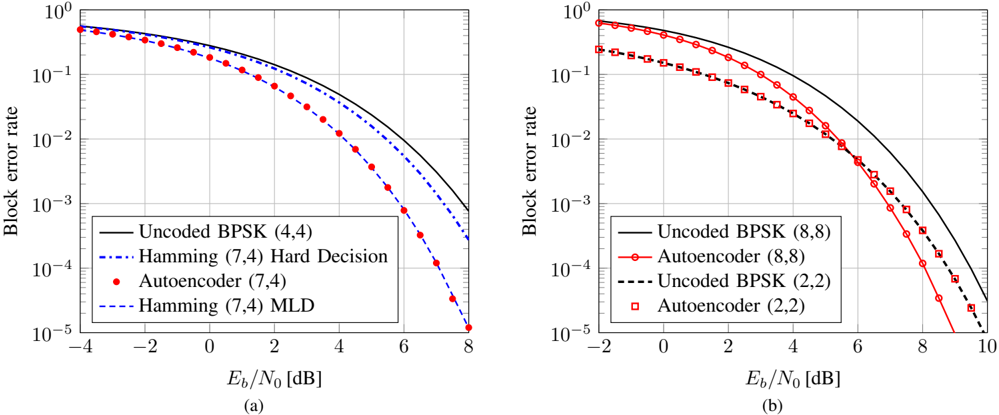
- A learned autoencoder for a (7,4) system at rate R = 4/7 achieves the same block error rate (BLER) as a Hamming (7,4) code with maximum likelihood decoding, while an (8,8) autoencoder outperforms uncoded BPSK over the full E_b/N_0 range, indicating learned joint coding and modulation.
- For the two-user AWGN interference channel, the autoencoder matches time-sharing for (1,1) and (2,2), but achieves gains of about 0.7 dB for (4,4) and 1 dB for (4,8) at a BLER of 10^-3.
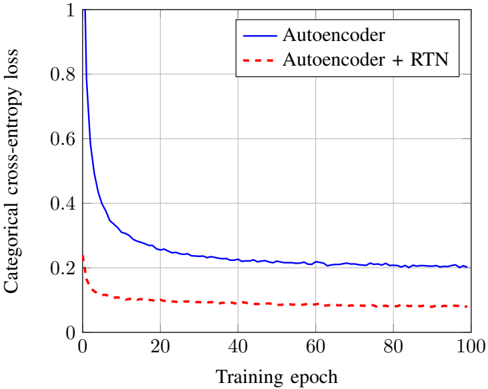
- An autoencoder (8,4) with an RTN over a multipath fading channel with L = 3 Rayleigh taps outperforms differential BPSK with maximum likelihood sequence estimation and a Hamming (7,4) code, whereas the plain autoencoder struggles to match it; RTNs also show faster training convergence.
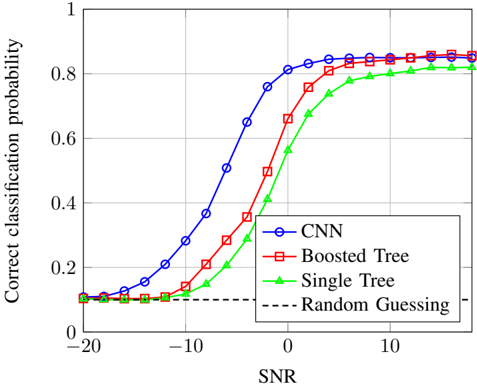
- For modulation classification on 1.2M sequences of 128 complex-valued IQ samples across ten modulation schemes and SNRs from -20 dB to 18 dB, the CNN outperforms a boosted expert-feature classifier by around 4 dB in the low-to-medium SNR range, with almost identical high-SNR performance; a single tree is about 6 dB worse at medium SNR and 3.5% worse at high SNR.
Methods
- The transmitter, channel, and receiver are represented as one deep neural network trained as an autoencoder: one-hot message input, dense layers, normalization layer for transmit constraints, additive noise channel layer, and softmax receiver output, trained with categorical cross-entropy using SGD/Adam at learning rate 0.001 and fixed E_b/N_0 = 7 dB.
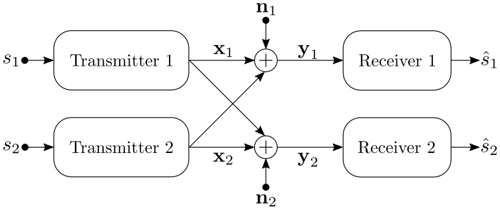
- The autoencoder concept is extended to multiple transmitter-receiver pairs in a two-user interference channel, with dynamic loss weights α_t per mini-batch to balance the two cross-entropy losses; performance is compared against 2^{2k/n}-QAM with time-sharing.
- RTNs combine a learned parameter estimator, a differentiable parametric transform, and a discriminative network; the paper demonstrates phase-offset compensation and multipath inverse filtering. For modulation classification, a VGG-like CNN with 324,330 trainable parameters is trained on the RML2016.10b dataset.
Limitations
- The paper states that scalability to large message sets M is a major challenge: for k = 100 bits, training complexity is prohibitive because the autoencoder must see at least every message once.
- The paper states that optimal data representations, loss functions, training SNR, and hyperparameters are not well understood; training at one SNR does not necessarily generalize to others, and no common communications benchmarks or datasets comparable to MNIST or ImageNet exist.
- The paper states that end-to-end learning over real channels requires system identification because backpropagation assumes a known channel transfer function; complex-valued neural networks are not supported by current DL libraries. Evident from the text: the reported results are simulation-based, use small (n,k) settings, assume known channel models during training, and the paper explicitly leaves detailed performance comparisons for various channel types and parameters to future work.
Model-written summary. Check it against the paper before relying on it.
Integrity signals
Registry
Cites
Statistics
Figures






Verification
Claims the paper makes
6 Valid · 4 Not valid · 18 Not checked · 65 Own results and interpretations
Every source the paper cites for this claim was checked and supports it.
In the paper
“For instance in [22], it was shown that training with a single codeword is sufficient since the structure of the code is embedded in the NN through the Tanner graph.”
What the sources say
- Supportedcites [22] [22] E. Nachmani, Y. Be'ery, and D. Burshtein, 'Learning to decode linear codes using deep learning,' in Proc. IEEE Annu. Allerton Conf. Commun., Control, and Computing (Allerton) , 2016, pp. 341-346. - source
The Introduction says the decoder uses a Tanner graph representing the code and that one codeword suffices for training. Section III explains the precise condition: over a binary memoryless symmetric channel, the decoder’s error rate is independent of the transmitted codeword, so training can use noisy versions of a single codeword. (LLM, conf=0.91)
boostedstates a cause- Asserted: passes — The authors put it forward as true.
- Checkable: passes — It can be checked against evidence.
- Load-bearing: unclear — It is unclear whether the paper’s conclusions depend on it.
- Based: passes — The paper gives a reason why it holds.
- Supported
A result the paper reports from its own data — it cites no other source for it, so there is none to check. The quote shows it is in the paper.
In the paper
“We study the use of NNs on complex-valued IQ samples for the problem of modulation classification and show that convolutional neural networks (CNNs), which are the cornerstone of most DL systems for computer vision, can outperform traditional classification techniques based on expert features.”
plainstates a cause- Asserted: passes — The authors put it forward as true.
- Checkable: passes — It can be checked against evidence.
- Load-bearing: passes — The paper’s conclusions depend on it.
- Based: passes — The paper gives a reason why it holds.
The paper states this without a source or data behind it here, so there is nothing to check it against. The quote shows it is in the paper.
In the paper
“Training at low SNR for instance does not allow for the discovery of structure important in higher SNR scenarios.”
plainstates a cause- Asserted: passes — The authors put it forward as true.
- Checkable: passes — It can be checked against evidence.
- Load-bearing: unclear — It is unclear whether the paper’s conclusions depend on it.
- Based: unclear — It is unclear why the paper says it holds.
A result the paper reports from its own data — it cites no other source for it, so there is none to check. The quote shows it is in the paper.
In the paper
“Another advantage of RTNs is faster training convergence which can be seen from Fig. 10 that compares the validation loss of the autoencoder with and without RTN as a function of the training epochs.”
plainstates a cause- Asserted: passes — The authors put it forward as true.
- Checkable: passes — It can be checked against evidence.
- Load-bearing: unclear — It is unclear whether the paper’s conclusions depend on it.
- Based: passes — The paper gives a reason why it holds.
A result the paper reports from its own data — it cites no other source for it, so there is none to check. The quote shows it is in the paper.
In the paper
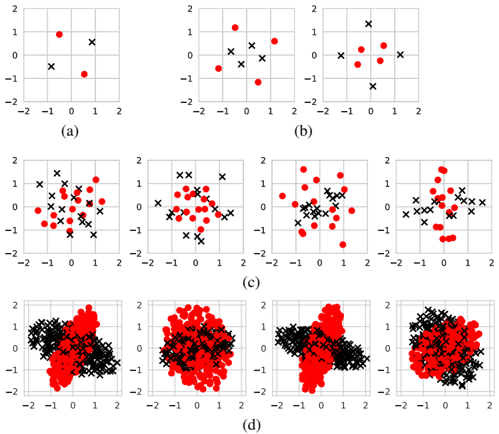
“Similarly, Fig. 4b shows a (4 , 2) system which leads to a rotated 16-PSK constellation.”
plainstates a cause- Asserted: passes — The authors put it forward as true.
- Checkable: passes — It can be checked against evidence.
- Load-bearing: unclear — It is unclear whether the paper’s conclusions depend on it.
- Based: passes — The paper gives a reason why it holds.
39 more claims
Create a free account to see all 93 claims and to verify the 4 references still open.
- Probably not a substantial claim. 29
- It may state two separate claims as one. 24
Self-check
Percentages, sums and reported differences re-computed from the paper’s own numbers.
Each contradiction between two passages listed here was confirmed by an independent check.
Rated minor: it would not touch a result — a value no result rests on, a p-value that stays on the same side of the significance level, or a conflict that is clerical, resolved elsewhere in the paper, or outside its own findings.
In the paper
§ A. Autoencoders for end-to-end communications systems · p. 5
“Similarly, Fig. 4b shows a (4 , 2) system which leads to a rotated 16-PSK constellation.”
§ A. Autoencoders for end-to-end communications systems · p. 6
“Figure 4: Constellations produced by autoencoders using parameters ( n, k ) : (a) (2 , 2) (b) (2 , 4) , (c) (2 , 4) with average power constraint, (d) (7 , 4) 2-dimensional t-SNE embedding of received symbols.”
Citations
Cites
Very Deep Convolutional Networks for Large-Scale Image Recognition
Simonyan, K., & Zisserman, A. (2014) · arXiv · doi:10.48550/arxiv.1409.1556 · Cited by 114,148 · cited 1×
“dense/fully-connected layers and terminated with a dense softmax layer for our classifier (similar to a VGG architecture [55]).”
BackgroundAdam: A Method for Stochastic Optimization
Kingma, D. P., & Ba, J. (2014) · arXiv · doi:10.48550/arxiv.1412.6980 · Cited by 98,946 · cited 4×
“Training was done at a fixed value of Eb/N0 = 7 dB (see Section IV-B) using Adam [46] with learning rate 0.”
BackgroundMethodInfluentialA Mathematical Theory of Communication
Shannon, C. E. (1948) · Bell System Technical Journal · doi:10.1002/j.1538-7305.1948.tb01338.x · Cited by 88,486
Scikit-learn: Machine Learning in Python
Pedregosa, F., Varoquaux, G., Gramfort, A., Michel, V., Thirion, B., Grisel, O., Blondel, M., Müller, A., Nothman, J., Louppe, G., et al. (2012) · arXiv · doi:10.48550/arxiv.1201.0490 · Cited by 71,016 · cited 1×
“11, we compare the classification accuracy of the CNN against that of extreme gradient boosting7 with 1000 estimators, as well as a single scikit-learn decision tree [56], operating on a mix of 16 analog and cumulant expert features as proposed in [53] and [57].”
Method(2014) · Cited by 33,419
(2008) · Journal of Machine Learning Research · Cited by 33,051
Human-level control through deep reinforcement learning
Mnih, V., Kavukcuoglu, K., Silver, D., Rusu, A. A., Veness, J., Bellemare, M. G., Graves, A., Riedmiller, M., Fidjeland, A. K., Ostrovski, G., et al. (2015) · Nature · doi:10.1038/nature14236 · Cited by 30,357
(2007) · Electronics: A First Course · doi:10.4324/9780080477527-64 · Cited by 24,923
Pan, S. J., & Yang, Q. (2010) · IEEE Transactions on Knowledge and Data Engineering · doi:10.1109/tkde.2009.191 · Cited by 23,387 · cited 1×
“learning [64] is one appealing candidate for adapting an endto-end communications system trained on a statistical model to”
BackgroundMultilayer feedforward networks are universal approximators
Hornik, K., Stinchcombe, M., & White, H. (1989) · Neural Networks · doi:10.1016/0893-6080(89)90020-8 · Cited by 21,728 · cited 1×
“Third, it has been shown that NNs are universal function approximators [13] and recent work has shown a remarkable”
Background
Research works printed but not linked: 2
- [35] I. Goodfellow, Y. Bengio, and A. Courville, Deep Learning . MIT Press, 2016. -
- [52] J. Estaran et al. , 'Artificial neural networks for linear and non-linear impairment mitigation in high-baudrate IM/DD systems,' in Proc. 42nd European Conf. Optical Commun. (ECOC) . VDE, 2016, pp. 1-3. -
Cited by
Items 1,401–1,500 of 2,995
A Signal processing method of OFDM communication receiver based on CNN
Wang, B., Dai, H. C., Xu, K., Sun, Y., Zhang, Y., & Li, P. (2023) · Physical Communication · doi:10.1016/j.phycom.2023.102055 · Cited by 7
Deep Autoencoder-based Z-Interference Channels
Zhang, X., & Vaezi, M. (2023) · IEEE Wireless Communications and Networking Conference · doi:10.1109/wcnc55385.2023.10118986 · Cited by 6
“This is different from the existing DAEs designs [12]–[14], [17] which generate symbols with fixed power.”
BackgroundMethodAer, S., Wang, Z., Wang, K., Zhang, X., & Gao, H. (2023) · IEEE Transactions on Instrumentation and Measurement · doi:10.1109/tim.2023.3282290 · Cited by 6
“10a Dataset: In this research, we compared the results with TCNet SRIQ ( L = 4 ) , TCNet IQ, and seven state-of-the-art models ( CNN [34], ResNet [35], CLDNN [36], CBAM [42], TFA-SCNN [43], TADCNN [53], and AMRMIDAN [56] ) .”
MethodElfikky, A., Soltani, M., & Rezki, Z. (2023) · IEEE Communications Letters · doi:10.1109/lcomm.2023.3312584 · Cited by 8
“In addition, we compare our system against the uncoded IM/DD, LDPC IM/DD, the sparse AE, and the AE system presented in [5] in the presence of twouser IC for Log-normal fading channel.”
BackgroundMethodResultInfluentialComponent Training of Turbo Autoencoders
Clausius, J., Geiselhart, M., & ten Brink, S. (2023) · International Symposium on Turbo Codes and Iterative Information Processing · doi:10.1109/istc57237.2023.10273543 · Cited by 6
“However, in more complex situations or scenarios with hardware impairments or when no suitable channel models is known, machine learning-aided communication systems that are trained to optimize the end-to-end performance can out-perform classical systems [3], [4].”
BackgroundYichen, 张. Z., Chen, J., Mengxin, 赵. Z., Zehai, 周. Z., & Yingxiong, 宋. S. (2023) · Acta Optica Sinica · doi:10.3788/aos230554 · Cited by 6
Multi-User Semantic Communication on Hybrid NOMA
Meng, Z., Huang, L., Li, Q., Zhang, W., Tang, B. T., Wang, C., & Ge, X. (2023) · Asia-Pacific Conference on Communications (APCC) · doi:10.1109/apcc60132.2023.10460651 · Cited by 6
“Moreover, we note that to emulate the complex signals in neural network training, where the data are real numbers, the floating-point numbers in constellation point vectors x p and x s are split into two halves: one half constitutes the real part and the other half the imaginary part [22].”
BackgroundDeep Learning Based Uplink Multi-User SIMO Beamforming Design
Vahapoglu, C., O’Shea, T. J., Roy, T., & Ulukuş, Ş. (2024) · IEEE International Conference on Machine Learning for Communication and Networking (ICMLCN) · doi:10.1109/icmlcn59089.2024.10625057 · Cited by 10
“…generally focused on waveform design, channel characterization, and the developments of signaling and detection techniques, including tasks such as interference management, design of transmitter and receiver chains, and implementing error correction algorithms to provide reliable data transfer [1].”
BackgroundSelf-citationModel-free Reinforcement Learning of Semantic Communication by Stochastic Policy Gradient
Beck, E., Bockelmann, C., & Dekorsy, A. (2024) · IEEE International Conference on Machine Learning for Communication and Networking (ICMLCN) · doi:10.1109/icmlcn59089.2024.10625190 · Cited by 7
“This allows for joint optimization of both θ and φ, as demonstrated in recent works [10], treating unsupervised optimization of AEs as a supervised learning problem.”
MethodArtificial Intelligence in Future Evolution of Mobile Communication
Dahlman, E., Parkvall, S., Peisa, J., Tullberg, H., Murai, H., & 藤岡, 雅. (2019) · International Conference on Artificial Intelligence in Information and Communication (ICAIIC) · doi:10.1109/icaiic.2019.8669012 · Cited by 8
Deep Learning-Based Quantization of L-Values for Gray-Coded Modulation
Arvinte, M., Vishwanath, S., & Tewfik, A. H. (2019) · IEEE Globecom Workshops (GC Wkshps) · doi:10.1109/gcwkshps45667.2019.9024547 · Cited by 7
“Deep learning has recently gained a foothold in wireless communications and signal processing with experimental results showing that it can be used for various tasks ranging from channel code design [1] to black-box communication schemes [2].”
BackgroundAutoencoder Model for OFDM-based Optical Wireless Communication
Pachpande, P. G., Khadr, M. H., Hussien, H., Elgala, H., & Saha, D. (2019) · OSA Advanced Photonics Congress · doi:10.1364/sppcom.2019.spt2e.3 · Cited by 8
Performance Evaluation of Autoencoder for Coding and Modulation in Wireless Communications
Xu, J., Chen, W., Ai, B., He, R., Li, Y., Wang, J., Juhana, T., & Kurniawan, A. (2019) · International Conference on Wireless Communications and Signal Processing (WCSP) · doi:10.1109/wcsp.2019.8928071 · Cited by 9
“An innovative perspective considers wireless communication system as an end-to-end autoencoder [3].”
BackgroundPolicy Based Synthesis: Data Generation and Augmentation Methods For RF Machine Learning
Miller, R. D., Kokalj-Filipović, S., Vanhoy, G., & Morman, J. (2019) · IEEE Global Conference on Signal and Information Processing · doi:10.1109/globalsip45357.2019.8969160 · Cited by 6
“State-of-the-art deep-learning (DL) techniques have been applied to both over-the-air (OTA) and synthesized RF data to accomplish classification, waveform design, channel decoding and other tasks [1, 2].”
MethodMohamed, S., Dong, J., Hongwei, L., & Decheng, Z. (2020) · Microprocessors and Microsystems · doi:10.1016/j.micpro.2020.103017 · Cited by 8
3D Interference Mapping for Indoor IoT Scenarios
Ivanov, A., Stoynov, V., Angelov, K. N., Stefanov, R., Atamyan, D., Tonchev, K., & Poulkov, V. K. (2020) · International Conference on Telecommunications and Signal Processing (TSP) · doi:10.1109/tsp49548.2020.9163556 · Cited by 6
Examining Machine Learning for 5G and Beyond Through an Adversarial Lens
Usama, M., Ilahi, I., Qadir, J., Mitra, R. N., & Marina, M. K. (2021) · IEEE Internet Computing · doi:10.1109/mic.2021.3049190 · Cited by 45
“the parameter-configurations provided in [16].”
Supervised Deep Learning for MIMO Precoding
Pathapati, A. G., Chakradhar, N., Havish, P. N. V. S. S. K., Somayajula, S. A., & Amuru, S. (2020) · IEEE 5G World Forum (5GWF) · doi:10.1109/5gwf49715.2020.9221261 · Cited by 8
“Specifically, Hoydis et al., in [7], proposed autoencoders to model the transmitter and receiver.”
BackgroundInfluentialRate-Adapted Decentralized Learning Over Wireless Networks
Sato, K., & Sugimura, D. (2021) · IEEE Transactions on Cognitive Communications and Networking · doi:10.1109/tccn.2021.3074908 · Cited by 6
A New Modulation Recognition Method Based on Flying Fish Swarm Algorithm
Gao, J., Wang, X., Wu, R., & Xu, X. (2021) · IEEE Access · doi:10.1109/access.2021.3079131 · Cited by 6
“O’Shea presents the concept of radio transformer networks as a means to incorporate expert domain knowledge in the machine learning model, which achieves competitive accuracy with respect to traditional schemes relying on expert features [18].”
BackgroundOver The Air Performance of Deep Learning for Modulation Classification across Channel Conditions
Sathyanarayanan, V., Wagner, M., & Gerstoft, P. (2020) · Asilomar Conference on Signals, Systems and Computers (ACSSC) · doi:10.1109/ieeeconf51394.2020.9443424 · Cited by 6
“7 [7], [11], [15].”
MethodTurbo-AI, Part II: Multi-Dimensional Iterative ML-Based Channel Estimation for B5G
Chen, Y., Mohammadi, J. A., Wesemann, S., & Wild, T. (2021) · IEEE Vehicular Technology Conference · doi:10.1109/vtc2021-spring51267.2021.9448950 · Cited by 9
“Regarding to the disruptive technologies, enumerated at the very beginning for 5G in [1]–[2], potential employments have already been identified for PHY layer [3] with AI-based solutions.”
BackgroundAI-based Inter-Tower Communication Networks: Challenges and Benefits
Bilbao, I., Iradier, E., Montalbán, J., Angueira, P., Wu, Y., & Zhang, L. (2021) · IEEE International Symposium on Broadband Multimedia Systems and Broadcasting (BMSB) · doi:10.1109/bmsb53066.2021.9547159 · Cited by 6
A Real-Time Deep Learning OFDM Receiver
Brennsteiner, S., Arslan, T., Thompson, J., & McCormick, A. C. (2021) · ACM Transactions on Reconfigurable Technology and Systems · doi:10.1145/3494049 · Cited by 6
“• Higher performance over complex or unmodeled channels [47] • Automatic compensation of hardware impairments [38] • Increased performance due to the removal of functional block boundaries of traditional algorithms [38, 47] • Ease of design and processing due to well-established machine learning techniques.”
BackgroundDefensive Distillation Based End-to-end Auto-encoder Communication System
Gao, Q., Cao, Z., & Li, D. (2021) · IEEE International Conference on Computer and Communications (ICCC) · doi:10.1109/iccc54389.2021.9674255 · Cited by 6
Few‐Shot Specific Emitter Identification Based on Variational Mode Decomposition and Meta‐Learning
Xie, C., Zhang, L., & Zhong, Z. (2022) · Wireless Communications and Mobile Computing · doi:10.1155/2022/4481416 · Cited by 6
“The ReLU function was used to activate the convolution layers and introduce nonlinear factors, which was helpful in the extraction of complex deep features [26, 27].”
MethodDeep Learning-Based Autonomous UAV-BSs for NGWNs: Overview and a Novel Architecture
Demirtaş, A. M., Seyfioğlu, M. S., Bor-Yaliniz, I., Tavlı, B., & Yanıkömeroğlu, H. (2022) · IEEE Consumer Electronics Magazine · doi:10.1109/mce.2022.3201366 · Cited by 6
“communications thus far, the performance attained by CNN-based solutions are promising.(6) Main con-”
BackgroundTheoretical Analysis of Deep Neural Networks in Physical Layer Communication
Liu, J., Zhao, H., Ma, D., Mei, K., & Wei, J. (2022) · IEEE Transactions on Communications · doi:10.1109/tcomm.2022.3201931 · Cited by 8
“Hoydis consider the linear and nonlinear steps of processing 54 the received signal as a radio transformer network (RTN) 55 in [7], which can be integrated into the end-to-end training 56 process.”
BackgroundEstimation of Rayleigh flat channel coefficients using deep learning
Drakshayini, M. N., & Kounte, M. R. (2022) · Transactions on Emerging Telecommunications Technologies · doi:10.1002/ett.4651 · Cited by 6
“In Reference 20, an efficient ANN model has been proposed for CE with a single carrier PSK modulation.”
MethodWang, Y., Liu, Z., & Xu, Y. (2022) · IEEE International Conference on Civil Aviation Safety and Information Technology (ICCASIT) · doi:10.1109/iccasit55263.2022.9986725 · Cited by 7
“…to 20dB, their proposed 2 layers of specified convolutional neural network (CNN) as dynamic routing convolutional neural network (DRCNN) excellences other neural networks including recurrent neural network (RNN), deep neural network (DNN) and the Tim O’Shea et al.’s fundamental CNN framework[8].”
BackgroundDeveloping Novel Robust Loss Functions-Based Classification Layers for DLLSTM Neural Networks
Houran, M. A., Essai, M. H., Abdel-Raman, A. B., Badry, E. A., Hassan, A., & Atallah, H. A. (2023) · IEEE Access · doi:10.1109/access.2023.3275964 · Cited by 7
Sagduyu, Y. E., Erpek, T., Yener, A., & Ulukuş, Ş. (2024) · IEEE International Symposium on Dynamic Spectrum Access Networks · doi:10.1109/dyspan60163.2024.10632831 · Cited by 6
“Hyperparameters are selected by gradually increasing the number of layers and layer sizes to determine the configuration with the best performance.”
BackgroundContinuous-Time Sparse Signal Recovery
Wadayama, T., & Nakai-Kasai, A. (2024) · IEEE Access · doi:10.1109/access.2024.3447652 · Cited by 6
Low Complexity Autoencoder based End-to-End Learning of Coded Communications Systems
Rajapaksha, N., Rajatheva, N., & Latva‐aho, M. (2020) · IEEE Vehicular Technology Conference · doi:10.1109/vtc2020-spring48590.2020.9128456 · Cited by 6
“As first introduced in [3], communications task can be interpreted as an autoencoder.”
BackgroundMethodInfluentialAn Improved One-bit OFDM Receiver Based on Model-Driven Deep Learning
Lu, Z., Li, W., & Xu, Y. (2019) · IEEE International Conference on Computer and Communications (ICCC) · doi:10.1109/iccc47050.2019.9064391 · Cited by 6
A Stacked-Autoencoder Based End-to-End Learning Framework for Decode-and-Forward Relay Networks
Gupta, A. K., & Sellathurai, M. (2020) · IEEE International Conference on Acoustics Speech and Signal Processing · doi:10.1109/icassp40776.2020.9054512 · Cited by 8
“Recently, deep learning (DL) based methods have been used in modulation [6], signal detection [7], channel estimation [8] and channel coding [9] in the area of communications.”
MethodInfluentialHan, M., Seo, H., Abebe, A. T., & Kang, C. G. (2020) · IEEE International Conference on Communications workshops · doi:10.1109/iccworkshops49005.2020.9145347 · Cited by 6
“In [3], for example, the end-to-end learning of AE is used to optimize single-user multi-dimensional modulation (SU-MDM) while employing Hamming (7,4) codes for channel coding and maximum likelihood-based detection (MLD).”
BackgroundMethodInfluentialConvolutional-Type Neural Networks for Fading Channel Forecasting
Ahrens, L., Ahrens, J., & Schotten, H. D. (2020) · IEEE Access · doi:10.1109/access.2020.3032933 · Cited by 8
“In wireless communications, machine learning methods employing neural networks have been applied to a wide range of problems related to the physical layer of radio transmission [16], [17], including transmitter and receiver design, e.”
MethodRemoving Channel Estimation by Location-Only Based Deep Learning for RIS Aided Mobile Edge Computing
Hu, X., Masouros, C., & Wong, K. (2021) · International Conference on Communications · doi:10.1109/icc42927.2021.9500961 · Cited by 6
“To tackle this issue, deep learning architectures provide a promising way to achieve offline training and online implementation [16].”
BackgroundGuo, L., Wang, S., Yin, J., Wang, Y., Yang, J., & Gui, G. (2021) · Physical Communication · doi:10.1016/j.phycom.2021.101438 · Cited by 7
Jha, N. K., & Lau, V. K. N. (2021) · IEEE Internet of Things Journal · doi:10.1109/jiot.2021.3113679 · Cited by 7
Model-Aware End-to-End Learning for SISO Optical Wireless Communication Over Poisson Channel
Si-Ma, L.-H., Zhu, Z., & Yu, H. (2020) · IEEE photonics journal · doi:10.1109/jphot.2020.3038534 · Cited by 7
“More recently, the success of DL in solving very complicated optimization problems has promoted the applications of various DL techniques in the communication field [16].”
BackgroundPower Allocation in Multi-user Cellular Networks With Deep Q Learning ApproachPreprint
Meng, F. Y., Chen, P., & Wu, L. (2018) · arXiv (Cornell University) · doi:10.48550/arxiv.1812.02979 · Cited by 8
Deep Learning and Gaussian Process based Band Assignment in Dual Band Systems.Preprint
Burghal, D., Wang, R., & Molisch, A. F. (2019) · arXiv (Cornell University) · Cited by 6
MIST: A Novel Training Strategy for Low-latency Scalable Neural Net DecodersPreprint
Yashashwi, K., Anand, D., Pillai, S. R. B., Chaporkar, P., & Ganesh, K. (2019) · arXiv (Cornell University) · doi:10.48550/arxiv.1905.08990 · Cited by 6
“In [8], a deep learning based auto-encoder strategy for designing an end-to-end communication system was proposed for low block lengths.”
BackgroundA Modular Neural Network Based Deep Learning Approach for MIMO Signal DetectionPreprint
Xue, S., Ma, Y., Yi, N., & Dodgson, T. E. (2020) · arXiv (Cornell University) · doi:10.48550/arxiv.2004.00404 · Cited by 7
“To facilitate the learning and communication procedure, it is usual practice to convert complex signals to their real signal equivalent version using (31) (see [5]–[7], [17], [32]).”
MethodResultDiscriminative Mutual Information Estimators for Channel Capacity LearningPreprint
Letizia, N. A., & Tonello, A. M. (2021) · arXiv (Cornell University) · doi:10.48550/arxiv.2107.03084 · Cited by 8
“The reinterpretation of the whole communication chain as an autoencoder-based system [2] pioneered a number of related works [6], [10], [11] aimed at showing the potentiality of deep learning techniques applied to wireless communications.”
BackgroundYadav, S. S., Hiremath, S. M., Surisetti, P., Kumar, V., & Patra, S. K. (2022) · Wiley eBooks · doi:10.1002/9781119792642.ch5 · Cited by 6
Zhang, N., Wang, D., & Wang, L. (2024) · Digital Signal Processing · doi:10.1016/j.dsp.2024.104944 · Cited by 6
A deep learning based covert communication method in internet of things
Duan, C. (2025) · Telecommunication Systems · doi:10.1007/s11235-025-01274-2 · Cited by 5
“Autoencoder based wireless communications method was first investigated in [22] and showed outstanding performance improvement in multiple wireless environments.”
InfluentialVijay, E. V., Aparna, K., & Kumar, K. M. V. M. (2025) · Engineering Research Express · doi:10.1088/2631-8695/adf48c · Cited by 5
Luong, H. V. D., Chien, T. V., Anh, L. H. N., & Bình, H. T. T. (2025) · Genetic and Evolutionary Computation Conference Companion (GECCO Companion) · doi:10.1145/3712255.3726540 · Cited by 5
“The architecture and the training process of the autoencoder systems in the attack scenarios are derived from literatures [5–7].”
An Elastic Coding and Decoding Method for Satellite Remote Sensing Image Semantic Transmission
Zhang, Z., Zhang, S., Li, H., Shi, G., Xue, J., & Li, B. (2025) · IEEE Transactions on Network Science and Engineering · doi:10.1109/tnse.2025.3632547 · Cited by 5
Khan, M. A., Liu, S., Bilal, M., Zuberi, H. H., & Wang, Y. (2025) · IEEE Transactions on Communications · doi:10.1109/tcomm.2025.3634268 · Cited by 5
Noncoherent MIMO Communications: Theoretical Foundation, Design Approaches, and Future Challenges
Ngo, K., Cuevas, D., Gil, R. D. M., Baeza, V. M., Armada, A. G., & Santamaría, I. (2025) · IEEE Open Journal of Vehicular Technology · doi:10.1109/ojvt.2025.3649122 · Cited by 18
“Methods based on deep learning, including deep unfolding and autoencoder-inspired structures, offer practical means to approximate optimal detection rules while maintaining reasonable computational complexity [144].”
Gao, Y., Chen, Q., He, L., Wang, Z., Huang, Y., Zhang, J., Gao, Y. M., & Xu, Z. (2026) · Chinese Journal of Electronics · doi:10.23919/cje.2025.00.049 · Cited by 9
Discriminative Mutual Information Estimation for the Design of Channel Capacity Driven Autoencoders
Letizia, N. A., & Tonello, A. M. (2022) · International Balkan Conference on Communications and Networking (BalkanCom) · doi:10.1109/balkancom55633.2022.9900818 · Cited by 9
“As a consequence, physical layer design has been reinterpreted using machine learning techniques to improve the coding and decoding scheme performance [1]– [4].”
BackgroundMethodInfluentialTransfer Learning for CNN Based Modulation Classification in Time-Variant A WGN Channels
Zhang, P., & Zhu, Z. (2022) · IEEE International Conference on Computer and Communications (ICCC) · doi:10.1109/iccc56324.2022.10065718 · Cited by 5
Autoencoder assisted subcarrier optimization for nonlinear frequency division multiplexing
Ge, P., Xi, L., Deng, J., Wei, J., Du, S., & Zhang, X. (2023) · Optics Express · doi:10.1364/oe.500473 · Cited by 5
Yu, E., Zhu, J., Li, Q., Liu, Z., Chen, H., Shamai, S. S., & Poor, H. V. (2023) · IEEE Transactions on Wireless Communications · doi:10.1109/twc.2023.3332617 · Cited by 5
“In contrast to the conventional one-step end-to-end network [24], the nested FC-FNNs cooperate with the NBD precoder and are trained with refined objectives.”
BackgroundDistributed learning for automatic modulation recognition in bandwidth-limited networks
Rashvand, N., Witham, K., Maldonado, G. D. C., Katariya, V., Sultan, A., Schirner, G., & Tabkhi, H. (2024) · Signal processing, sensor fusion, and target recognition. Conference · doi:10.1117/12.3013532 · Cited by 5
Rao, Z., Tan, W., Wang, J., Zhou, Y., Xue, Y., & Hu, S. (2024) · BMC Medical Imaging · doi:10.1186/s12880-024-01299-0 · Cited by 5
“The echo path is as follows: Here e is the velocity constant defined in this article in the propagation medium [23].”
BackgroundAn improved autoencoder for denoising acoustic emission signals in rock fracturing
Wang, T., Qin, Y., Zhao, W., Gamage, R. P., Jiang, J., & Du, X. (2024) · Nondestructive Testing And Evaluation · doi:10.1080/10589759.2024.2383325 · Cited by 6
“The sharing of parameters within the intelligent neural network facilitates ease of optimisation, contributing to the dataset’s robust generalisation ability [41].”
An Efficient Spoofing Attack Detection Using Deep Learning Based Physical Layer Security Technique
Mohan, S. B., Annadurai, A., & Gunaseelan, K. (2024) · Defence Science Journal · doi:10.14429/dsj.74.19468 · Cited by 5
“The spread spectrum technique used in Wireless Sensor Networks (WSN) has some drawbacks, such as key management, susceptibility to jamming, limited scalability, etc., and these disadvantages lead to an underestimation of the system’s security 11 .”
MethodLiu, X., Zhang, J., Zhu, M., Xin, Z., Tong, W., Zhong, Q., Cai, Y., Hua, B., Lei, M., Ding, J., et al. (2024) · Journal of Lightwave Technology · doi:10.1109/jlt.2024.3446573 · Cited by 5
Autoencoder-Based MIMO Cooperative Communications With Quantize–Forward Relaying
Shin, J., & Jin, X. (2024) · IEEE Transactions on Vehicular Technology · doi:10.1109/tvt.2024.3445912 · Cited by 6
Qi, X., Liu, Y., & Ye, Y. (2024) · Sensors · doi:10.3390/s24196464 · Cited by 5
“DL techniques can detect and mitigate various types of attacks by learning from historical data and identifying patterns indicative of malicious behavior [13,14].”
BackgroundModular Hypernetworks for Scalable and Adaptive Deep MIMO Receivers
Raviv, T., & Shlezinger, N. (2025) · IEEE Open Journal of Signal Processing · doi:10.1109/ojsp.2025.3526548 · Cited by 13
“A common approach to deal with dynamic channels, coined joint learning [8], trains the DNN over a wide range of channel conditions.”
Residual CNN-Based Transceiver With Attention-Aided GAN for Unknown Channels
Han, H., Wang, S., Lu, W., Zheng, S., & Yang, X. (2025) · IEEE Transactions on Cognitive Communications and Networking · doi:10.1109/tccn.2025.3527689 · Cited by 6
“Although this modular approach simplifies implementation and maintenance, it potentially compromises end-to-end (E2E) optimization, thereby affecting the reliability of communication [2], [3], [4], [5].”
Nielsen, S. F. V., Ros, F. D., Schmidt, M. N., & Zibar, D. (2025) · Journal of Lightwave Technology · doi:10.1109/jlt.2025.3528542 · Cited by 5
“Index Terms —Digital communication, end-to-end learning, intensity modulation, intersymbol interference.”
Ranjan, A., & Sahana, B. C. (2025) · Journal of Ambient Intelligence and Humanized Computing · doi:10.1007/s12652-025-04952-w · Cited by 7
Deep Learning-Based Transceiver Design for Additive Non-Gaussian Impulsive Noise Channels
Zhao, C., Wang, J., Peng, Q., Wei, H., Chen, X., Zhao, Z., & Le‐Ngoc, T. (2025) · IEEE Transactions on Cognitive Communications and Networking · doi:10.1109/tccn.2025.3547726 · Cited by 5
“The E2E communication system was first proposed by [20], which utilized an auto-encoder to jointly optimize the communication system.”
Deep-Learning-Based Compensation Mechanism for UAV Sensing via OTFS Signaling
Yan, Z., Yuan, W., Zhang, X., Liu, C., Wu, J., & Quek, T. Q. S. (2025) · IEEE Internet of Things Journal · doi:10.1109/jiot.2025.3571754 · Cited by 5
“DL is gradually being widely used in communication systems, especially in the design of transmitters and receivers, and holds promise for performance improvements in complex C&S scenarios [23], [24], [25].”
Harnessing the Power of Pre-Trained Models for Efficient Semantic Communication of Text and Images
Kutay, E., & Yener, A. (2025) · Entropy · doi:10.3390/e27080813 · Cited by 6
Interference-Aware Super-Constellation Design for NOMA
Vaezi, M., & Zhang, X. (2025) · International Conference on Communications · doi:10.1109/icc52391.2025.11162002 · Cited by 5
“The idea of employing AEs for communication was first introduced in [10] and later refined and extended to various domains including interference management [11]–[14], uplink NOMA [15], [16], and downlink NOMA [17]–[20].”
Deep Learning Method for Generalized Modulation Classification under Varying Noise Condition
Wang, Y., Gui, G., Zhao, N., Huang, H., Liu, M., Sun, J., Gacanin, H., Sari, H., & Fumiyuki, A. (2020) · 2012 International Conference on Computing, Networking and Communications (ICNC) · doi:10.1109/icnc47757.2020.9049786 · Cited by 5
“T. O’Shea et al. were first to propose a convolutional neural network (CNN)-based MSC method using the in-phase and quadrature (IQ) component of signals [29].”
MethodA Review of Machine Learning Based Techniques for Demodulation
Shi, Y., Yan, D., Liu, P., Chen, Y., Li, C., & Lu, Z. (2020) · IEEE Joint International Information Technology and Artificial Intelligence Conference (ITAIC) · doi:10.1109/itaic49862.2020.9339005 · Cited by 5
“The training data is composed of the information of channel and some impairments of transmitter [20].”
BackgroundDeep Learning-Based End-to-End Carrier Signal Detection in Broadband Power Spectrum
Huang, H., Wang, P., Wang, J., & Li, J. (2022) · Electronics · doi:10.3390/electronics11121896 · Cited by 5
“O’Shea et al. [14] discussed several deep learning applications for the physical layer.”
BackgroundApplication Design in Preschool Education Resource System Platform Based on Deep Learning Technology
Chen, C. (2022) · Lecture notes on data engineering and communications technologies · doi:10.1007/978-3-031-05484-6_92 · Cited by 5
Design of Nonorthogonal Multiple Access Systems: An Information Bottleneck Perspective
Yuan, Q., Guo, Q., Wang, Z., & Yang, W. (2022) · IEEE Communications Letters · doi:10.1109/lcomm.2022.3177412 · Cited by 5
“• Joint optimization based on the conventional end-to-end network: Unlike the IB-based loss function in (15) and (16), the autoencoder is trained using the cross-entropy loss function in [19].”
MethodZhang, G., Ma, C., Chen, K., Li, Y., Li, H., & Han, C. (2022) · Physical Communication · doi:10.1016/j.phycom.2022.101922 · Cited by 5
Spectrally Efficient Backscatter Systems: A Hardware-Oriented Survey
Alhassoun, M. (2023) · IEEE Access · doi:10.1109/access.2023.3237941 · Cited by 5
“nications in for modulation classification [78], [79].”
Learning-Based Near-Orthogonal Superposition Code for MIMO Short Message Transmission
Bian, C., Hsu, C.-W., Lee, C. S. G., & Kim, H.-S. (2023) · IEEE Transactions on Communications · doi:10.1109/tcomm.2023.3274158 · Cited by 9
“coding and modulation [12], [13], [14], [15], [16].”
MethodTransformer-Based Detection for Highly Mobile Coded OFDM Systems
Wang, L., Zhou, W., Tong, Z., Zeng, X., Zhan, J., Li, J., & Chen, R. (2023) · Entropy · doi:10.3390/e25060852 · Cited by 5
Intelligent Reception of Frequency Hopping Signals Based on CVDP
Yuan, Z., Zhao, Z., Zhang, Y., Zheng, S., & Dai, S. (2023) · Applied Sciences · doi:10.3390/app13137604 · Cited by 5
Zeng, R., Lu, Z., Zhang, X., & Wang, J. (2023) · IEEE Transactions on Vehicular Technology · doi:10.1109/tvt.2023.3294672 · Cited by 5
Machine learning assisted adaptive LDPC coded system design and analysis
Xie, C., El‐Hajjar, M., & Ng, S. X. (2023) · IET Communications · doi:10.1049/cmu2.12707 · Cited by 6
Universal Function Approximation Through Over-the-Air Computing: A Deep Learning Approach
Bouzinis, P. S., Evgenidis, N. G., Mitsiou, N. A., Tegos, S. A., Diamantoulakis, P. D., & Karagiannidis, G. K. (2024) · IEEE Open Journal of the Communications Society · doi:10.1109/ojcoms.2024.3392508 · Cited by 8
“The work in [20], [21] trained a DNN as an autoencoder to represent and jointly optimize the transmitter and receiver of a communication system in an end-to-end fashion.”
MethodCao, Y., & Zhou, M. (2024) · Intelligent Decision Technologies · doi:10.3233/idt-240298 · Cited by 5
“CNN’s competitiveness and precision in this field were demonstrated, and future research directions were discussed [10].”
Deep learning aided underwater acoustic OFDM receivers: Model-driven or data-driven?
Zhao, H., Wen, M., Ji, F., Liang, Y., Yu, H. X., & Yang, C. (2024) · Digital Communications and Networks · doi:10.1016/j.dcan.2024.10.006 · Cited by 8
6G communication systems: concept, trends, physical level technologies
Pokamestov, D. A., Kryukov, Y. V., Abenov, R., Rogozhnikov, E. V., Brovkin, A. A., Shinkevich, A. S., & Shalin, G. N. (2024) · Радиотехника и электроника · doi:10.31857/s0033849424010016 · Cited by 8
Yang, C., Qin, H., Lan, T., Gao, Y., Wang, J., Zhao, Y., & Chang-Hasnain, C. J. (2024) · Journal of Lightwave Technology · doi:10.1109/jlt.2024.3505415 · Cited by 5
Zeybek, M., Çetin, B. K., & Engın, E. Z. (2025) · Electronics · doi:10.3390/electronics14061130 · Cited by 5
Machine Learning Assisted Wiretapping
Besser, K.-L., Lin, P.-H., Janda, C. R., & Jorswieck, E. A. (2018) · Asilomar Conference on Signals, Systems and Computers (ACSSC) · doi:10.1109/acssc.2018.8645088 · Cited by 5
“An even more general approach was taken in [7], [8], where the authors used NNs not only as decoders but as full communication systems.”
A Learning Approach for Optimal Codebook Selection in Spatial Modulation Systems
Saxena, V., Cavarec, B., Jaldén, J., Bengtsson, M., & Tullberg, H. (2018) · Asilomar Conference on Signals, Systems and Computers (ACSSC) · doi:10.1109/acssc.2018.8645407 · Cited by 5
“Recently, machine learning has emerged as an attractive approach for learning the optimal physical layer parameters for arbitrary channel distributions [8], [9].”
BackgroundReliable Low Resolution OFDM Receivers via Deep Learning
Balevi, E., & Andrews, J. G. (2018) · Asilomar Conference on Signals, Systems and Computers (ACSSC) · doi:10.1109/acssc.2018.8645190 · Cited by 6
“Furthermore, [14]-[16] model the end-to-end communication system as an autoencoder for reliable detection without crafting complex modulation and coding schemes.”
Dual Domain Learning of Optimal Resource Allocations in Wireless Systems
Eisen, M., Zhang, C., Chamon, L. F. O., Lee, D. D., & Ribeiro, A. (2019) · IEEE International Conference on Acoustics Speech and Signal Processing · doi:10.1109/icassp.2019.8683150 · Cited by 6
MIMO Signal Multiplexing and Detection Based on Compressive Sensing and Deep Learning
Liu, C., Zhou, Q., Wang, X., & Chen, K. (2019) · IEEE Access · doi:10.1109/access.2019.2937490 · Cited by 5
“These models struggle in complex scenarios with many imperfections and nonlinearities [35], although they may capture some features in conventional channels.”
BackgroundA Deep Learning Method Based Receiver Design
Liu, L., Lin, T. R., & Zhou, Y. (2020) · IEEE International Conference on Computer and Communications (ICCC) · doi:10.1109/iccc51575.2020.9344965 · Cited by 5
“The significant potential of DL has also motivated many related works devoting to solving traditional communication problems with the benefits of the neural network [2].”
BackgroundPeople counting using visible and infrared images
Filipic, J., Biagini, M., Mas, I., Pose, C., Giribet, J. I., & Parisi, D. R. (2021) · Neurocomputing · doi:10.1016/j.neucom.2021.03.089 · Cited by 5
Metadata
- Authors
- O'Shea, T., & Hoydis, J.
- Affiliations
- Nokia (France) (FR)
- Venue
- IEEE Transactions on Cognitive Communications and Networking
- Published
- 2017-12
- Volume
- 3
- Issue
- 4
- Pages
- 563-575
- ISSN
- 2332-7731 (ISSN-L)
- OpenAlex
- W2734408173
- Semantic Scholar
- 78989616eeeac55b202e3e4205225e7135054185
- Cited by
- 2,980
- References
- 69
- Citations by year
- 2026: 307 · 2025: 327 · 2024: 305 · 2023: 368 · 2022: 432 · 2021: 409 · 2020: 406 · 2019: 322 · 2018: 95 · 2017: 9
- FWCI
- 122.29
- Type
- journal article
- Language
- en
- Open access
- green
- arxiv.org
- Locations
- IEEE Transactions on Cognitive Communications and Networking (publishedVersion)
- arXiv (Cornell University) (submittedVersion)
- arXiv (Cornell University)
- Topics
- Physical Sciences › Computer Science › Artificial Intelligence › Wireless Signal Modulation Classification
- Physical Sciences › Engineering › Electrical and Electronic Engineering › Advanced Wireless Communication Techniques
- Physical Sciences › Engineering › Electrical and Electronic Engineering › Advanced Wireless Communication Technologies
- Keywords
- end-to-end reconstruction, domain knowledge integration, convolutional neural networks, automatic modulation classification, IQ samples
About these checks
Registry, retraction, Cites and statistics results are computed, not judged, with one exception: a printed reference that no index lists is read once by a model before it counts as a citation error. Claims are extracted by a model and kept only when their quote appears verbatim in the text; each cited source is then checked, with a model’s help, for whether it says what the claim relies on. Those verdicts can be wrong — read the claim’s quote and the cited source before relying on one.
The claim verdicts this report counts are experimental: their accuracy is not yet measured.
A language model drew the claims from the paper on 2026-11-07, under version 3 of the claim definition (model deepseek-v4.1-flash, prompt extract-v3).
A second model labelled each claim on 2026-11-07 (model jev-1.13-20260917, definition revision gold-guideline-v0.2).
Cited sources are checked with a language model’s help (gpt-6-sol).
Statistics and arithmetic are recomputed, not judged.
Confidence bands are shown only for fields calibrated on our annotated test set. None is calibrated yet, so no band is shown.
What counts as a claim ›How we measure confidence ›How we check this ›
Are you an author, or do you see a problem with this page? Request a review
Data sources
Bibliographic data: Semantic Scholar, OpenAlex, Crossref.
Contains information from the Semantic Scholar Academic Graph Datasets, made available under the ODC Attribution License (ODC-BY 1.0).
Semantic Scholar’s data is described in: Kinney, R., et al. (2023). The Semantic Scholar Open Data Platform. arXiv:2301.10140.
