

An Introduction to Deep Learning for the Physical Layer
Open accessThe DOI matches its Crossref record; 90 of the 92 references it cites were found in a registry or an index, and 2 are not checked yet; 8 of the 32 sources its claims cite were checked for support.
Abstract
We present and discuss several novel applications of deep learning for the physical layer. By interpreting a communications system as an autoencoder, we develop a fundamental new way to think about communications system design as an end-to-end reconstruction task that seeks to jointly optimize transmitter and receiver components in a single process. We show how this idea can be extended to networks of multiple transmitters and receivers and present the concept of radio transformer networks as a means to incorporate expert domain knowledge in the machine learning model. Lastly, we demonstrate the application of convolutional neural networks on raw IQ samples for modulation classification which achieves competitive accuracy with respect to traditional schemes relying on expert features. This paper is concluded with a discussion of open challenges and areas for future investigation.
Verified 2026-11-19 · 2 references not checked yet
Overview
CoChat Summary
TL;DR
The paper introduces deep learning for the physical layer by treating a communications system as an autoencoder that jointly learns transmitter and receiver implementations end-to-end. It also extends this idea to multi-user interference channels, proposes radio transformer networks (RTNs) to inject expert domain knowledge, and shows CNNs on raw IQ samples can outperform expert-feature modulation classifiers.
Key findings
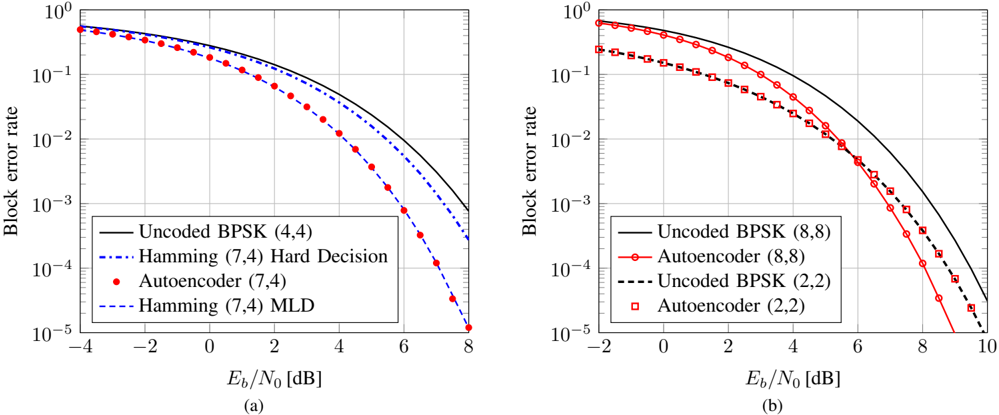
- A learned autoencoder for a (7,4) system at rate R = 4/7 achieves the same block error rate (BLER) as a Hamming (7,4) code with maximum likelihood decoding, while an (8,8) autoencoder outperforms uncoded BPSK over the full E_b/N_0 range, indicating learned joint coding and modulation.
- For the two-user AWGN interference channel, the autoencoder matches time-sharing for (1,1) and (2,2), but achieves gains of about 0.7 dB for (4,4) and 1 dB for (4,8) at a BLER of 10^-3.
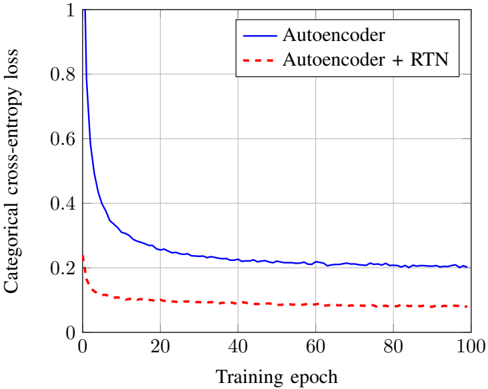
- An autoencoder (8,4) with an RTN over a multipath fading channel with L = 3 Rayleigh taps outperforms differential BPSK with maximum likelihood sequence estimation and a Hamming (7,4) code, whereas the plain autoencoder struggles to match it; RTNs also show faster training convergence.
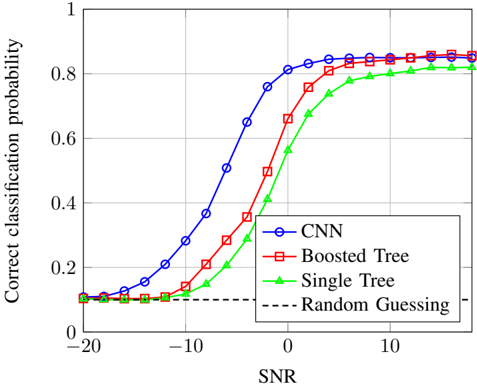
- For modulation classification on 1.2M sequences of 128 complex-valued IQ samples across ten modulation schemes and SNRs from -20 dB to 18 dB, the CNN outperforms a boosted expert-feature classifier by around 4 dB in the low-to-medium SNR range, with almost identical high-SNR performance; a single tree is about 6 dB worse at medium SNR and 3.5% worse at high SNR.
Methods
- The transmitter, channel, and receiver are represented as one deep neural network trained as an autoencoder: one-hot message input, dense layers, normalization layer for transmit constraints, additive noise channel layer, and softmax receiver output, trained with categorical cross-entropy using SGD/Adam at learning rate 0.001 and fixed E_b/N_0 = 7 dB.
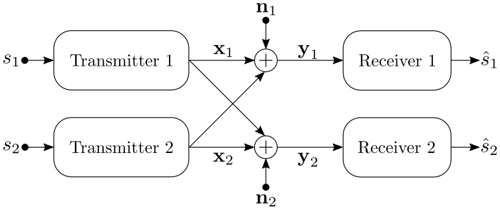
- The autoencoder concept is extended to multiple transmitter-receiver pairs in a two-user interference channel, with dynamic loss weights α_t per mini-batch to balance the two cross-entropy losses; performance is compared against 2^{2k/n}-QAM with time-sharing.
- RTNs combine a learned parameter estimator, a differentiable parametric transform, and a discriminative network; the paper demonstrates phase-offset compensation and multipath inverse filtering. For modulation classification, a VGG-like CNN with 324,330 trainable parameters is trained on the RML2016.10b dataset.
Limitations
- The paper states that scalability to large message sets M is a major challenge: for k = 100 bits, training complexity is prohibitive because the autoencoder must see at least every message once.
- The paper states that optimal data representations, loss functions, training SNR, and hyperparameters are not well understood; training at one SNR does not necessarily generalize to others, and no common communications benchmarks or datasets comparable to MNIST or ImageNet exist.
- The paper states that end-to-end learning over real channels requires system identification because backpropagation assumes a known channel transfer function; complex-valued neural networks are not supported by current DL libraries. Evident from the text: the reported results are simulation-based, use small (n,k) settings, assume known channel models during training, and the paper explicitly leaves detailed performance comparisons for various channel types and parameters to future work.
Model-written summary. Check it against the paper before relying on it.
Integrity signals
Registry
Cites
Statistics
Figures






Verification
Claims the paper makes
6 Valid · 4 Not valid · 18 Not checked · 65 Own results and interpretations
Every source the paper cites for this claim was checked and supports it.
In the paper
“For instance in [22], it was shown that training with a single codeword is sufficient since the structure of the code is embedded in the NN through the Tanner graph.”
What the sources say
- Supportedcites [22] [22] E. Nachmani, Y. Be'ery, and D. Burshtein, 'Learning to decode linear codes using deep learning,' in Proc. IEEE Annu. Allerton Conf. Commun., Control, and Computing (Allerton) , 2016, pp. 341-346. - source
The Introduction says the decoder uses a Tanner graph representing the code and that one codeword suffices for training. Section III explains the precise condition: over a binary memoryless symmetric channel, the decoder’s error rate is independent of the transmitted codeword, so training can use noisy versions of a single codeword. (LLM, conf=0.91)
boostedstates a cause- Asserted: passes — The authors put it forward as true.
- Checkable: passes — It can be checked against evidence.
- Load-bearing: unclear — It is unclear whether the paper’s conclusions depend on it.
- Based: passes — The paper gives a reason why it holds.
- Supported
A result the paper reports from its own data — it cites no other source for it, so there is none to check. The quote shows it is in the paper.
In the paper
“We study the use of NNs on complex-valued IQ samples for the problem of modulation classification and show that convolutional neural networks (CNNs), which are the cornerstone of most DL systems for computer vision, can outperform traditional classification techniques based on expert features.”
plainstates a cause- Asserted: passes — The authors put it forward as true.
- Checkable: passes — It can be checked against evidence.
- Load-bearing: passes — The paper’s conclusions depend on it.
- Based: passes — The paper gives a reason why it holds.
The paper states this without a source or data behind it here, so there is nothing to check it against. The quote shows it is in the paper.
In the paper
“Training at low SNR for instance does not allow for the discovery of structure important in higher SNR scenarios.”
plainstates a cause- Asserted: passes — The authors put it forward as true.
- Checkable: passes — It can be checked against evidence.
- Load-bearing: unclear — It is unclear whether the paper’s conclusions depend on it.
- Based: unclear — It is unclear why the paper says it holds.
A result the paper reports from its own data — it cites no other source for it, so there is none to check. The quote shows it is in the paper.
In the paper
“Another advantage of RTNs is faster training convergence which can be seen from Fig. 10 that compares the validation loss of the autoencoder with and without RTN as a function of the training epochs.”
plainstates a cause- Asserted: passes — The authors put it forward as true.
- Checkable: passes — It can be checked against evidence.
- Load-bearing: unclear — It is unclear whether the paper’s conclusions depend on it.
- Based: passes — The paper gives a reason why it holds.
A result the paper reports from its own data — it cites no other source for it, so there is none to check. The quote shows it is in the paper.
In the paper
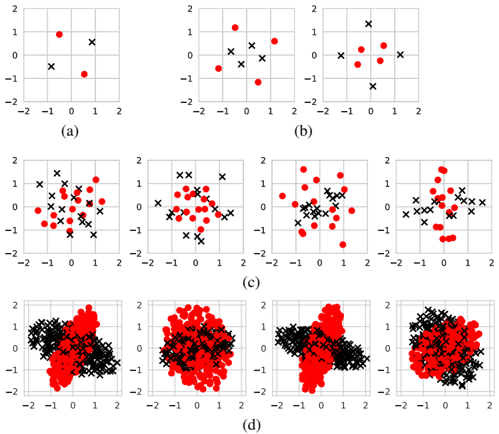
“Similarly, Fig. 4b shows a (4 , 2) system which leads to a rotated 16-PSK constellation.”
plainstates a cause- Asserted: passes — The authors put it forward as true.
- Checkable: passes — It can be checked against evidence.
- Load-bearing: unclear — It is unclear whether the paper’s conclusions depend on it.
- Based: passes — The paper gives a reason why it holds.
39 more claims
Create a free account to see all 93 claims and to verify the 4 references still open.
- Probably not a substantial claim. 29
- It may state two separate claims as one. 24
Self-check
Percentages, sums and reported differences re-computed from the paper’s own numbers.
Each contradiction between two passages listed here was confirmed by an independent check.
Rated minor: it would not touch a result — a value no result rests on, a p-value that stays on the same side of the significance level, or a conflict that is clerical, resolved elsewhere in the paper, or outside its own findings.
In the paper
§ A. Autoencoders for end-to-end communications systems · p. 5
“Similarly, Fig. 4b shows a (4 , 2) system which leads to a rotated 16-PSK constellation.”
§ A. Autoencoders for end-to-end communications systems · p. 6
“Figure 4: Constellations produced by autoencoders using parameters ( n, k ) : (a) (2 , 2) (b) (2 , 4) , (c) (2 , 4) with average power constraint, (d) (7 , 4) 2-dimensional t-SNE embedding of received symbols.”
Citations
Cites
Very Deep Convolutional Networks for Large-Scale Image Recognition
Simonyan, K., & Zisserman, A. (2014) · arXiv · doi:10.48550/arxiv.1409.1556 · Cited by 114,148 · cited 1×
“dense/fully-connected layers and terminated with a dense softmax layer for our classifier (similar to a VGG architecture [55]).”
BackgroundAdam: A Method for Stochastic Optimization
Kingma, D. P., & Ba, J. (2014) · arXiv · doi:10.48550/arxiv.1412.6980 · Cited by 98,946 · cited 4×
“Training was done at a fixed value of Eb/N0 = 7 dB (see Section IV-B) using Adam [46] with learning rate 0.”
BackgroundMethodInfluentialA Mathematical Theory of Communication
Shannon, C. E. (1948) · Bell System Technical Journal · doi:10.1002/j.1538-7305.1948.tb01338.x · Cited by 88,486
Scikit-learn: Machine Learning in Python
Pedregosa, F., Varoquaux, G., Gramfort, A., Michel, V., Thirion, B., Grisel, O., Blondel, M., Müller, A., Nothman, J., Louppe, G., et al. (2012) · arXiv · doi:10.48550/arxiv.1201.0490 · Cited by 71,016 · cited 1×
“11, we compare the classification accuracy of the CNN against that of extreme gradient boosting7 with 1000 estimators, as well as a single scikit-learn decision tree [56], operating on a mix of 16 analog and cumulant expert features as proposed in [53] and [57].”
Method(2014) · Cited by 33,419
(2008) · Journal of Machine Learning Research · Cited by 33,051
Human-level control through deep reinforcement learning
Mnih, V., Kavukcuoglu, K., Silver, D., Rusu, A. A., Veness, J., Bellemare, M. G., Graves, A., Riedmiller, M., Fidjeland, A. K., Ostrovski, G., et al. (2015) · Nature · doi:10.1038/nature14236 · Cited by 30,357
(2007) · Electronics: A First Course · doi:10.4324/9780080477527-64 · Cited by 24,923
Pan, S. J., & Yang, Q. (2010) · IEEE Transactions on Knowledge and Data Engineering · doi:10.1109/tkde.2009.191 · Cited by 23,387 · cited 1×
“learning [64] is one appealing candidate for adapting an endto-end communications system trained on a statistical model to”
BackgroundMultilayer feedforward networks are universal approximators
Hornik, K., Stinchcombe, M., & White, H. (1989) · Neural Networks · doi:10.1016/0893-6080(89)90020-8 · Cited by 21,728 · cited 1×
“Third, it has been shown that NNs are universal function approximators [13] and recent work has shown a remarkable”
Background
Research works printed but not linked: 2
- [35] I. Goodfellow, Y. Bengio, and A. Courville, Deep Learning . MIT Press, 2016. -
- [52] J. Estaran et al. , 'Artificial neural networks for linear and non-linear impairment mitigation in high-baudrate IM/DD systems,' in Proc. 42nd European Conf. Optical Commun. (ECOC) . VDE, 2016, pp. 1-3. -
Cited by
Items 1,201–1,300 of 2,995
A UAV Air-to-Ground Channel Estimation Algorithm Based on Deep Learning
Mai, Z., Chen, Y., Zhao, H., Du, L., & Hao, C. (2022) · Wireless Personal Communications · doi:10.1007/s11277-021-09459-z · Cited by 10
“The development of Artificial Intelligence (AI), especially Deep Learning (DL), provides another method for solving nonlinear problems in the mobile communication system [2, 14].”
MethodDeepIC: Coding for Interference Channels via Deep Learning
Chahine, K., Ye, N., & Kim, H. (2021) · Globecom · doi:10.1109/globecom46510.2021.9685430 · Cited by 9
“literature [4] that neural network based codes, in particular, feedforward networks, can outperform the time division for a very short block length, such as K = 4 bits, this work is the first to show that such improvement is possible for longer blocklengths, such as K = 100 bits.”
BackgroundMethodInfluentialCombined Classifier‐Demodulator Scheme Based on LSTM Architecture
Dampage, U., Amarasooriya, S. M. R. P., Samarasinghe, R. A. S. M., & Karunasingha, N. A. (2022) · Wireless Communications and Mobile Computing · doi:10.1155/2022/5584481 · Cited by 9
“Studies conducted by O’Shea and Hoydis [11] and Kulgod et al. [8] introduced modulation classifiers based on convolutional neural networks (CNNs).”
MethodInfluentialAuto-Encoder Learning-Based UAV Communications for Livestock Management
Alanezi, M. A., Mohammad, A., Sha’aban, Y. A., Bouchekara, H. R. E. H., & Shahriar, M. S. (2022) · Drones · doi:10.3390/drones6100276 · Cited by 9
Hybrid Quantum-Classical Autoencoders for End-to-End Radio Communication
Tabi, Z., Bakó, B., Nagy, D., Vaderna, P., Kallus, Z., Hága, P., & Zimborás, Z. (2022) · IEEE/ACM Symposium on Edge Computing (SEC) · doi:10.1109/sec54971.2022.00071 · Cited by 14
“Also, the number of transmit-receive pairs can be increased to get a Multiple-Input and Multiple-Output (MIMO) system [15], [16].”
InfluentialImplementation of Deep-Learning-Based CSI Feedback Reporting on 5G NR-Compliant Link-Level Simulator
Riviello, D. G., Tuninato, R., Zimaglia, E., Fantini, R., & Garello, R. (2023) · Sensors · doi:10.3390/s23020910 · Cited by 13
Deep learning based MIMO systems using open-loop autoencoder
Bui, T. T. T., Tran, X. N., & Phan, A. H. (2023) · AEU - International Journal of Electronics and Communications · doi:10.1016/j.aeue.2023.154712 · Cited by 10
Interference-Aware Constellation Design for Z-Interference Channels with Imperfect CSI
Zhang, X., Vaezi, M., & Zheng, L. (2023) · International Conference on Communications · doi:10.1109/icc45041.2023.10278970 · Cited by 9
“Particularly, [12], [15], [16] have studied communication over the IC.”
BackgroundXu, Q. M., Gao, R., Chang, H., Li, Z., Wang, F., Cui, Y., Liu, J., Guo, D., Pan, X., Zhu, L., et al. (2023) · Optics Express · doi:10.1364/oe.502563 · Cited by 9
Learning Physical-Layer Communication With Quantized Feedback
Song, J., Peng, B., Häger, C., Wymeersch, H., & Sahai, A. (2019) · IEEE Transactions on Communications · doi:10.1109/tcomm.2019.2951563 · Cited by 10
“More recently, endto-end learning of both the transmitter and receiver has been proposed for various physical-layer applications including wireless [3], [4], nonlinear optical [5]–[7], and visible light communication [8].”
BackgroundSahu, N., Peng, D., & Sharif, H. (2020) · SN Applied Sciences · doi:10.1007/s42452-020-1992-0 · Cited by 10
Noncoherent MIMO Codes Construction Using Autoencoders
ElMossallamy, M. A., Han, Z., Pan, M., Jäntti, R., Seddik, K. G., & Li, G. Y. (2019) · Globecom · doi:10.1109/globecom38437.2019.9013199 · Cited by 11
“Recent applications include signal detection [2]–[6], channel estimation and quantization [7]– [9], channel coding/decoding [10]–[12], and even end-to-end learning of a complete communications system [13]–[17].”
BackgroundMethodInfluentialNeural Estimators for Conditional Mutual Information Using Nearest Neighbors Sampling
Molavipour, S., Bassi, G., & Skoglund, M. (2021) · IEEE Transactions on Signal Processing · doi:10.1109/tsp.2021.3050564 · Cited by 17
“Neural networks have been proposed in communication systems as part of the encoder/decoder blocks [28], [29].”
BackgroundUnsupervised-Learning Power Allocation for the Cell-Free Downlink
Nikbakht, R., Jönsson, A., & Lozano, A. (2020) · IEEE International Conference on Communications workshops · doi:10.1109/iccworkshops49005.2020.9145146 · Cited by 11
“This paper tackles this challenge and shows that an unsupervised feedforward NN can also map the system’s largescale channel gains to the downlink transmit powers for performance metrics of interest, adding to the growing body of applications of NNs to communications [13], [14].”
BackgroundUnsupervised Learning for Cellular Power Control
Nikbakht, R., Jönsson, A., & Lozano, A. (2020) · IEEE Communications Letters · doi:10.1109/lcomm.2020.3027994 · Cited by 10
“The unsupervised-learning approach to parametric optimization described in [1] is very effective for cellular power control, adding to the body of works that leverage NNs to tackle wireless communication problems [2]–[5], [17]–[21].”
BackgroundDeep Learning-Based Cell-Level and Beam-Level Mobility Management System
Klus, R., Klus, L., Solomitckii, D., Talvitie, J., & Valkama, M. (2020) · Sensors · doi:10.3390/s20247124 · Cited by 9
A Deep Learning based Detector for FSO System Considering Imperfect CSI Scenario
Amirabadi, M. A., Kahaei, M. H., & Nezamalhosseini, S. A. (2020) · West Asian Symposium on Optical and Millimeter-wave Wireless Communications (WASOWC) · doi:10.1109/wasowc49739.2020.9410006 · Cited by 9
“…including use of support vector machine for detection [20], use of artificial neural network for distortion correction in a FSO system with sensor-less adaptive optics [21], and use of conventional neural network for demodulation in a turbo-coded FSO system with orbital angular momentum [22].”
MethodBai, K., Thiem, C., McDonald, N., Loomis, L., & Yi, Y. (2021) · International Symposium on Quality Electronic Design (ISQED) · doi:10.1109/isqed51717.2021.9424319 · Cited by 10
Learning Autonomy in Management of Wireless Random Networks
Lee, H., Lee, S. H., & Quek, T. Q. S. (2021) · IEEE Transactions on Wireless Communications · doi:10.1109/twc.2021.3089701 · Cited by 9
“This becomes prominent even in the latest DL approaches [6]–[15] since the corresponding DNNs should be trained independently in specific network configurations for universal use.”
BackgroundMethodModel-Based Deep Learning of Joint Probabilistic and Geometric Shaping for Optical Communication
Neskorniuk, V., Carnio, A., Marsella, D., Turitsyn, S. K., Prilepsky, J. E., & Aref, V. (2022) · Conference on Lasers and Electro-Optics · doi:10.1364/cleo_si.2022.sw4e.5 · Cited by 9
A Transceiver Design Based on an Autoencoder Network for Multi-Color VLC Systems
Zhang, D., Yu, H., Zhu, Y.-J., & Zhu, Z.-R. (2020) · IEEE photonics journal · doi:10.1109/jphot.2020.2990957 · Cited by 9
“As in [20], we define BLER as Pr { ˆ b (cid:6)= b } , which is used to measure accuracy of the classification model in this paper.”
BackgroundMethodInfluentialDigital Signal Processing Using Deep Neural Networks
Shevitski, B., Watkins, Y., Man, N., & Girard, M. (2023) · OSTI OAI (U.S. Department of Energy Office of Scientific and Technical Information) · doi:10.2172/1984848 · Cited by 10
Redefining Wireless Communication for 6G:Signal Processing Meets Deep Learning with Deep UnfoldingPreprint
Jagannath, A., Jagannath, J., & Melodia, T. (2021) · doi:10.36227/techrxiv.16434855.v2 · Cited by 10
Redefining Wireless Communication for 6G:Signal Processing Meets Deep Learning with Deep UnfoldingPreprint
Jagannath, A., Jagannath, J., & Melodia, T. (2021) · doi:10.36227/techrxiv.16434855.v1 · Cited by 12
Non-Terrestrial Networks with UAVs:A Projection on Flying Ad-Hoc NetworksPreprint
Nemati, M., Homssi, B. A., Krishnan, S., Park, J., Loke, S. W., & Choi, J. (2022) · doi:10.36227/techrxiv.20445015.v1 · Cited by 9
Physically Parameterized Differentiable MUSIC for DoA Estimation with Uncalibrated Arrays
Chatelier, B., Mateos-Ramos, J. M., Corlay, V., Häger, C., Crussière, M., Wymeersch, H., & Magoarou, L. L. (2025) · International Conference on Communications · doi:10.1109/icc52391.2025.11161736 · Cited by 8
“Machine learning has recently emerged as an alternative to classical signal processing methods in many fields of wireless communication [16], [17], including beamforming [18], channel estimation [19], localization [20] or decoding [21].”
Ouamna, H., Kharbouche, A., El-Haryqy, N., Madini, Z., & Zouine, Y. (2025) · Applied System Innovation · doi:10.3390/asi8040090 · Cited by 8
LWM: A Pre-trained Wireless Foundation Model for Universal Feature Extraction
Alikhani, S., Charan, G., & Alkhateeb, A. (2025) · IEEE International Conference on Machine Learning for Communication and Networking (ICMLCN) · doi:10.1109/icmlcn64995.2025.11140266 · Cited by 33
“Deep learning has emerged as a promising alternative, offering data-driven (model-based or model-free) solutions for optimizing network performance, resource allocation, and signal processing [5]–[9].”
IQFM—A Wireless Foundation Model for I / Q Streams in AI-Native 6G
Mashaal, O., & Abou-Zeid, H. (2026) · IEEE Open Journal of the Communications Society · doi:10.1109/ojcoms.2026.3661435 · Cited by 36
Pan, G., Tao, Y., Yang, Z., Li, J., Peng, Y., Bao, X., Zhang, Y., Hua, Z., Wang, S., Zhang, R., et al. (2026) · IEEE Transactions on Cognitive Communications and Networking · doi:10.1109/tccn.2026.3676045 · Cited by 10
“Their dependence on handcrafted features leaves them a step behind adaptive adversaries, resulting in poor generalization against novel threats [16].”
Abdollahi, J., Nouri-Moghaddam, B., Mirzaei, A., Derakhshanfard, N., & ebrahimi, T. (2026) · Discover Artificial Intelligence · doi:10.1007/s44163-026-00922-z · Cited by 9
Supervised Contrastive Learning‐Based Modulation Classification of Underwater Acoustic Communication
Gao, D., Hua, W., Su, W., Xu, Z., & Chen, K. (2022) · Wireless Communications and Mobile Computing · doi:10.1155/2022/3995331 · Cited by 8
“In [11, 12], adaption of deep learning to the complex temporal signal domain is studied, and first proposed a CNN-based classifier to solve the problem of excessive Hindawi Wireless Communications and Mobile Computing Volume 2022, Article ID 3995331, 10 pages https://doi.”
Symbol-Level Online Channel Tracking for Deep Receivers
Finish, R. A., Cohen, Y., Raviv, T., & Shlezinger, N. (2022) · IEEE International Conference on Acoustics Speech and Signal Processing · doi:10.1109/icassp43922.2022.9747026 · Cited by 8
Performance improvement of a CAP VLC system employing a deep learning-based post equalizer
Pouralizadeh, A., Baghersalimi, G., Ghassemlooy, Z. F., & Nassiri, M. (2022) · Optics Communications · doi:10.1016/j.optcom.2022.128741 · Cited by 9
Pre-Trained Models Based Receiver Design With Natural Redundancy for Chinese Characters
Wang, Z., Yu, H., Shen, C., Zhu, Z., Shen, Z., & Du, J. (2022) · IEEE Communications Letters · doi:10.1109/lcomm.2022.3193644 · Cited by 8
“Although many studies based on deep learning (DL) have emerged in the communications field in recent years [7]–[10], these studies hardly consider the utilization of NR in the transmitted sources.”
BackgroundZhu, L.-J., & Huang, L. (2022) · Mobile Information Systems · doi:10.1155/2022/4277149 · Cited by 11
Signature-Aware RF Exploitation (SNARE) Fingerprinting using Deep Learning to identify UAVs
Jafari, H., Blasch, E., Pham, K. D., & Chen, G. (2022) · IEEE Aerospace Conference (AERO) · doi:10.1109/aero53065.2022.9843479 · Cited by 9
Jee, J., Kwon, G., & Park, H. (2022) · IEEE Transactions on Vehicular Technology · doi:10.1109/tvt.2022.3226799 · Cited by 10
“2) Machine Learning for MIMO Systems: Recently, machine learning-based techniques have shown a great potential to solve existing complicated problems in the area of wireless communications [22], [23], [24], [25], [26], [27], [28], [29], [30], [31], [38], [39], [40], [41], [42], [43], [44], [45].”
BackgroundOn Attacking Future 5G Networks with Adversarial Examples: Survey
Zolotukhin, M., Zhang, D., Hämäläinen, T., & Miraghaei, P. (2022) · Network · doi:10.3390/network3010003 · Cited by 10
List Autoencoder: Towards Deep Learning Based Reliable Transmission Over Noisy Channels
Saber, H., Hatami, H., & Bae, J. H. (2022) · Globecom · doi:10.1109/globecom48099.2022.10001468 · Cited by 10
“One of the main application of over-complete AEs is that the higher-dimensional representation can be transmitted over a noisy channel allowing the receiver to reliably decode the input data [15]- [21].”
BackgroundMulti-Dimensional Joint Constellation and Precoding Design for MIMO Systems
Zhang, X., & Vaezi, M. (2023) · IEEE Wireless Communications Letters · doi:10.1109/lwc.2023.3241199 · Cited by 8
“The first singular value of the channel λ 1 varies within [1, 2] with an interval of 0.1, while the second singular value λ 2 is fixed as 1.”
BackgroundInfluentialFeng, X., El‐Hajjar, M., Xu, C., & Hanzo, L. (2023) · IEEE Transactions on Vehicular Technology · doi:10.1109/tvt.2023.3241440 · Cited by 9
“Deep Learning (DL) has also been shown to be efficient in signal detection [36], especially in MIMO detection [37].”
MethodTowards Programmable Networking With CoopNet: A Horizontal Parallel Multipath Approach
Voicu, R. C., & Chang, Y. (2023) · 2012 International Conference on Computing, Networking and Communications (ICNC) · doi:10.1109/icnc57223.2023.10074094 · Cited by 8
“In [7] the authors demonstrate adversarial networks with multi-transmitter/receiver competing for capacity as Neural Networks.”
BackgroundWu, J., Wei, Z., Zhang, J., Guo, X., Jia, D., Xu, J., Zhang, Y., Li, Q., & Zhou, H. (2023) · IEEE Transactions on Antennas and Propagation · doi:10.1109/tap.2023.3273332 · Cited by 9
“These networks are applied to solving the problem of feature extraction, such as radio modulation recognition [31], multichannel impairment learning [32], and auto-encoders for end-to-end communication [33].”
MethodWang, H., Wang, Q., Chen, L., Fu, G., Liu, X., Dong, Z., & Panayırcı, E. (2023) · IEEE Internet of Things Journal · doi:10.1109/jiot.2023.3295397 · Cited by 8
“With the development of deep learning, many works have used neural networks (NNs) for signal recognition and achieved remarkable performance [9], [10], [11], [12].”
BackgroundLin, W., Chang, T. H., & Tseng, S. (2023) · Symmetry · doi:10.3390/sym15111968 · Cited by 8
A Weighted Autoencoder-Based Approach to Downlink NOMA Constellation Design
Ninković, V., Vukobratović, D., Pastore, A., & Antón‐Haro, C. (2023) · IEEE International Workshop on Signal Processing Advances in Wireless Communications (SPAWC) · doi:10.1109/spawc53906.2023.10304541 · Cited by 10
“The conventional point-to-point communication system with a transmitter and a receiver has been redesigned from the deep learning perspective in the form of an end-to-end autoencoder (AE) [5], as illustrated in Fig.”
BackgroundMethodInfluentialYang, Y., Yang, J., Xu, C., & Shen, X. (2024) · IEEE Sensors Journal · doi:10.1109/jsen.2023.3346896 · Cited by 8
“The BMC technology has been widely applied in civil and military fields such as spectrum sensing and monitoring, cognitive radio, noncooperative communication reconnaissance, and communication electronic warfare [2], [3].”
BackgroundThe Use of Deep Learning Techniques in OFDM Receivers for 5G NR: A Survey
Shammaa, M., Mashaly, M. E., & El-mahdy, A. (2024) · Procedia Computer Science · doi:10.1016/j.procs.2023.12.154 · Cited by 9
DNN and LS Based Channel Estimation in OTFS System
Hu, J., Bai, Z., Yang, J., Cai, Y., Zhou, D., Wang, Y., & Kwak, K. (2023) · IEEE International Conference on Communication Technology (ICCT) · doi:10.1109/icct59356.2023.10419855 · Cited by 8
“There are two main characteristics or reasons for applying DL into the field of wireless communications [5].”
BackgroundNeural Sum Rate Maximization with Deep Unrolling
Chen, S., & Tan, C. W. (2023) · Globecom · doi:10.1109/globecom54140.2023.10437390 · Cited by 9
Zhang, B., & Huynh, N. V. (2023) · Globecom · doi:10.1109/globecom54140.2023.10436824 · Cited by 12
“Recently, deep learning (DL) technique has been applied to the communication system design, which interprets the E2E communication system as a DNN-based auto-encoder over an interference channel [3].”
MethodDetecting and Localizing Wireless Spoofing Attacks on the Internet of Medical Things
Jayaraj, I. A., Shanmugam, B., Azam, S., & Thennadil, S. N. (2024) · Journal of Sensor and Actuator Networks · doi:10.3390/jsan13060072 · Cited by 8
Guo, S., Li, L., Li, X., & Zhu, J. (2024) · IEEE Transactions on Instrumentation and Measurement · doi:10.1109/tim.2024.3502777 · Cited by 8
Asynchronous Online Adaptation via Modular Drift Detection for Deep Receivers
Uzlaner, N., Raviv, T., Shlezinger, N., & Todros, K. (2025) · IEEE Transactions on Wireless Communications · doi:10.1109/twc.2025.3533959 · Cited by 15
“The direct approach to tackle this, coined joint learning [8], trains over a broad range of channel conditions.”
Wu, W. Q., Zhu, C., Hu, L., & Liu, P. (2025) · Sensors · doi:10.3390/s25134202 · Cited by 8
Clipping Noise Compensation with Neural Networks in OFDM Systems
Sang, T.-H., & Xu, Y. (2020) · Signals · doi:10.3390/signals1010005 · Cited by 8
“They range from the application of DL [9,10] to utilizing simple linear filters to combat complicated issues such as narrowband noise or inter-carrier interference [15,20–23].”
BackgroundToward an RF side-channel reverse engineering tool
Wilt, M., Baker, M. M., & Papadakis, S. J. (2020) · IEEE Physical Assurance and Inspection of Electronics (PAINE) · doi:10.1109/paine49178.2020.9337729 · Cited by 8
“Recently, work in the speech and wireless communication domains has shown that deep networks can operate on raw waveforms [26], [27].”
BackgroundWiener Filter versus Recurrent Neural Network-based 2D-Channel Estimation for V2X Communications
Fischer, M. B., Dörner, S., Cammerer, S., Shimizu, T., Cheng, B., Lu, H., & ten Brink, S. (2021) · IEEE Intelligent Vehicles Symposium · doi:10.1109/iv48863.2021.9575620 · Cited by 12
Airport network traffic prediction in 5G scenarios: a deep learning approach
Ji, S., Yang, H., Gong, L., Li, Z., Kadoch, M., & Cheriet, M. (2020) · IEEE International Symposium on Broadband Multimedia Systems and Broadcasting (BMSB) · doi:10.1109/bmsb49480.2020.9379722 · Cited by 8
“The success in other areas has prompted DL to be applied in communication problems[14].”
BackgroundPerformance of Deep Learning Methods in DF Based Cooperative Communication Systems
Akdemir, B., Karabulut, M. A., & İlhan, H. (2021) · IEEE International Black Sea Conference on Communications and Networking · doi:10.1109/blackseacom52164.2021.9527814 · Cited by 9
Web Page Classification Algorithm Based on Deep Learning
Yu, Y. (2022) · Computational Intelligence and Neuroscience · doi:10.1155/2022/9534918 · Cited by 8
“It showed how to extend this idea to a network composed of multiple transmitters and receivers and proposed the concept of a wireless transformer network as a means of integrating expert domain knowledge into a machine learning model [7].”
BackgroundDeep Learning-Based Massive MIMO CSI Acquisition for 5G Evolution and 6G
Wang, X., Hou, X., Chen, L., Kishiyama, Y., & Asai, T. (2022) · IEICE Transactions on Communications · doi:10.1587/transcom.2022ebp3009 · Cited by 8
“processors, such as graphics processing units (GPUs) or tensor processing units (TPUs), DL networks trained with big data can usually find a better efficient solution to intractable problems compared with legacy optimization methods, especially for those in NP-hard families and those that are difficult to mathematical…”
BackgroundNeural signaling and communication using machine learning
Olaniyan, O. T., Adetunji, C. O., Dare, A., Adeyomoye, O., Adeniyi, M. J., & Enoch, A. (2022) · Elsevier eBooks · doi:10.1016/b978-0-323-90277-9.00010-9 · Cited by 11
Neural Network-Assisted Receiver Design via Learning Trellis Diagram Online
Yang, J., Du, Q., & Jiang, Y. F. (2022) · IEEE Transactions on Communications · doi:10.1109/tcomm.2022.3219141 · Cited by 8
“As related works, machine learning-assisted wireless communications have attracted broad attentions in recent years [2], [3], [4], [5], [6], such as machine learning-assisted channel decoding [7], [8], [9], [10], [11] and symbol detection in a multi-input multi-output (MIMO) system [12], [13],…”
BackgroundQin, X., Yang, C., Guo, H., Gao, Y., Zhou, Q., Wang, X., & Wang, Z. (2022) · Journal of Lightwave Technology · doi:10.1109/jlt.2022.3225523 · Cited by 8
“tured and are difficult to compensate with traditional DSP algorithms [13].”
BackgroundLearning photonic neural network initialization for noise-aware end-to-end fiber transmission
Kirtas, M., Passalis, N., Mourgias-Alexandris, G., Dabos, G., Pleros, N., & Tefas, A. (2022) · European Signal Processing Conference (EUSIPCO) · doi:10.23919/eusipco55093.2022.9909781 · Cited by 8
“Over the recent years, there is an increasing interest in employing DL in the communication domain [2], ranging from”
BackgroundNair, M., Cappello, T. A., Dang, S., & Beach, M. A. (2022) · IEEE Transactions on Microwave Theory and Techniques · doi:10.1109/tmtt.2022.3223122 · Cited by 8
“However, all of the contemporary literature on RF fingerprinting [9], [25], [26], [27], [28], [29] implicitly assume that a classification dataset is orthogonally separable.”
BackgroundInfluentialOn the Performance of Autoencoder-Based Space Optical Communications
Elfikky, A., & Rezki, Z. (2022) · Globecom · doi:10.1109/globecom48099.2022.10001440 · Cited by 8
“Coding and decoding [9], [5], modulation classifications [9] and channel estimation and equalization [10], [11] are examples of classic communication problems that have improved when creatively coupled with deep learning.”
BackgroundAn Assessment of Entropy-Based Data Reduction for SEI Within IoT Applications
Taha, M. A., Fadul, M. K. M., Tyler, J. H., Reising, D. R., & Loveless, T. D. (2022) · IEEE Military Communications Conference (MILCOM) · doi:10.1109/milcom55135.2022.10017570 · Cited by 9
“Recently, Deep Learning (DL) has received a lot of attention within the SEI community due to its demonstrated success within the fields of: spectrum management [8], [9], modulation identification [10], and system design [10]–[14].”
BackgroundMethodZheng, H., Zhang, L., Dong, Z., Zhuang, H., Wu, Z., Wang, L., & Xu, W. (2023) · IEEE Transactions on Vehicular Technology · doi:10.1109/tvt.2023.3266553 · Cited by 11
“various communication tasks, such as end-to-end transceiver design [14], channel estimation [15], modulation identification [16], and data-driven frameworks [17].”
BackgroundIoT Device Authentication Using Self-Organizing Feature Map Data Sets
Nair, M., Dang, S., & Beach, M. A. (2023) · IEEE Communications Magazine · doi:10.1109/mcom.002.2200705 · Cited by 8
“IEEE TCC 2017 [7] 8PSK/DSB-AM/ BPSK/ CPFSK/GFSK/ PAM4 16QAM/64QAM/ QPSK/WBFM 1.”
Augmenting Beam Alignment for mmWave Communication Systems via Channel Attention
Kim, J., & Kim, J. (2023) · Electronics · doi:10.3390/electronics12204318 · Cited by 8
Probabilistic Neural Network and Word Embedding for Sentiment Analysis
Alam, S., & Yao, N. (2018) · International Journal of Advanced Computer Science and Applications · doi:10.14569/ijacsa.2018.090708 · Cited by 8
“For example, it is almost near to impossible to write a powerful algorithm to detect handwriting or objects in an image, it is now a simple implementation of a DL algorithm that learns to perform tasks that exceed human accuracy levels [3].”
BackgroundPerformance Improvement in Rayleigh Faded Channel using Deep Learning
Ganesh, S., Sunder, V. S., & Thakre, A. (2018) · International Conference on Advances in Computing, Communications and Informatics (ICACCI) · doi:10.1109/icacci.2018.8554830 · Cited by 9
“The authors in [15] call this auto-encoder with the extra estimation module as Radio Transformer Network.”
BackgroundMethodInfluentialDeep Learning for Real-Time Energy-Efficient Power Control in Mobile Networks
Matthiesen, B., Zappone, A., Jorswieck, E. A., & Debbah, M. A. (2019) · IEEE International Workshop on Signal Processing Advances in Wireless Communications (SPAWC) · doi:10.1109/spawc.2019.8815516 · Cited by 8
“[5], [6].”
Spatio-Radio Resource Management and Hybrid Beamforming for Limited Feedback Massive MIMO Systems
Khammari, H., Ahmed, I., Bhatti, G. M., & Alajmi, M. (2019) · Electronics · doi:10.3390/electronics8101061 · Cited by 10
“Machine learning (ML) applications for the physical layer of wireless communication systems have been widely reported in [16].”
BackgroundCSI Classification for 5G via Deep Learning
Vora, A., Thomas, P.-X., Chen, R., & Kang, K. (2019) · IEEE Vehicular Technology Conference · doi:10.1109/vtcfall.2019.8891133 · Cited by 11
“In a real-world environment, however, an implemented system may not prove as robust as seen in the analysis for various reasons [3]–[10].”
BackgroundImproving Energy Efficiency Fairness of Wireless Networks: A Deep Learning Approach
Lee, H., Jang, H. S., & Jung, B. C. (2019) · Energies · doi:10.3390/en12224300 · Cited by 8
“The possibility of the DL was investigated in [13–17] for a design of end-to-end physical layer communication modules.”
BackgroundMethodInfluentialLaban, N., Abdellatif, B., Ebied, H. M., Shedeed, H. A., & Tolba, M. F. (2019) · International Conference on Computer Engineering & Systems (ICCES) · doi:10.1109/icces48960.2019.9068145 · Cited by 8
“Deep learning algorithms have achieved outstanding advance in many machine learning problems specially Convolutional Neural Networks (CNNs) and Recurrent Neural networks (RNNs) [8–15].”
BackgroundRecurrent Neural Network Assisted Equalization for FTN Signaling
Lai, S., & Li, M. (2020) · International Conference on Communications · doi:10.1109/icc40277.2020.9148769 · Cited by 14
“On the other hand, various deep learning approaches recently have been used to address the problems in wireless physical layer and achieve valuable result[8].”
BackgroundLiu, L., Solomon, A., Salamatian, S., & Médard, M. (2020) · International Conference on Communications · doi:10.1109/icc40277.2020.9149399 · Cited by 9
“For example, learning the physical layer representation is studied for single-input and single-output (SISO) system in [1], multiple input and multiple output (MIMO) system in [2] and orthogonal frequencydivision multiplexing (OFDM) system in [3].”
BackgroundChen, J., Luo, S., Zhang, L., Zhang, C., & Cao, B. (2020) · Digital Communications and Networks · doi:10.1016/j.dcan.2020.07.009 · Cited by 8
Neural Network-Aided BCJR Algorithm for Joint Symbol Detection and Channel Decoding
Tsai, W.-C., Teng, C.-F., Ou, H.-M., & Wu, A.-Y. A. (2020) · SiPS ... design and implementation - IEEE Workshop on Signal Processing Systems · doi:10.1109/sips50750.2020.9195225 · Cited by 8
“Due to its revolutionized breakthroughs in many fields, deep learning (DL) is considered as one of the most promising solutions to address the rigorous challenges toward 5G and beyond 5G (B5G) [1]-[2].”
BackgroundWhat can Machine Learning do for Radio Spectrum Management?
Almazrouei, E., Gianini, G., Almoosa, N. I., & Damiani, E. (2020) · ACM Symposium on QoS and Security for Wireless and Mobile Networks (Q2SWinet) · doi:10.1145/3416013.3426443 · Cited by 9
“A DL based autoencoder has been proposed over an Additive White Gaussian Noise (AWGN) channel to optimize end-to-end communication system performance for small block code [47].”
BackgroundMethodInfluentialEarly results on deep unfolded conjugate gradient‐based large‐scale MIMO detection
Ouameur, M. A., & Massicotte, D. (2021) · IET Communications · doi:10.1049/cmu2.12076 · Cited by 9
“In order to provide tangible benefits, any machine learning (ML)- or deep learning (DL)-based approach must pass a high bar of performance [1].”
BackgroundTurbo-AI, Part I: Iterative Machine Learning Based Channel Estimation for 2D Massive Arrays
Chen, Y., Mohammadi, J. A., Wesemann, S., & Wild, T. (2021) · IEEE Vehicular Technology Conference · doi:10.1109/vtc2021-spring51267.2021.9449026 · Cited by 8
“There is a plurality of potential AI applications for the PHY layer, enumerated in [5], such as blind channel decoding and data detection, modulation recognition, channel estimation, and many others.”
BackgroundImproved MIMO Signal Detection Based on DNN in MIMO-OFDM System
Ro, J.-H., Ha, J.-G., Lee, W.-S., You, Y., & Song, H. (2021) · Computers, materials & continua/Computers, materials & continua (Print) · doi:10.32604/cmc.2022.020596 · Cited by 8
High Accuracy RF-PUF for EM Security through Physical Feature Assistance using Public Wi-Fi Dataset
Bari, M. F., Chatterjee, B., Sivanesan, K., Yang, L., & Sen, S. (2021) · IEEE MTT-S International Microwave Symposium digest · doi:10.1109/ims19712.2021.9574917 · Cited by 9
“Recently, a growing number of works are using deep learning-based methods where raw or slightly processed data are fed into a deep neural network [4], [11], [12], [13].”
BackgroundForecasting Mobile Traffic to Achieve Greener 5G Networks: When Machine Learning is Key
Piovesan, N., Domenico, A. D., Bernabe, M., López‐Pérez, D., Baohongqiang, H., Geng, X., Wang, X., & Debbah, M. A. (2021) · IEEE International Workshop on Signal Processing Advances in Wireless Communications (SPAWC) · doi:10.1109/spawc51858.2021.9593102 · Cited by 8
Li, J., Zhao, H., Huang, Y., Zhang, M., & Lal, S. P. (2022) · Alexandria Engineering Journal · doi:10.1016/j.aej.2021.12.047 · Cited by 11
Signal Processing Aspects of Massive MIMO and IRS-Aided Communications
Özdoğan, Ö. (2022) · Linköping studies in science and technology. Dissertations · doi:10.3384/9789179291655 · Cited by 12
Interleaver Design and Pairwise Codeword Distance Distribution Enhancement for Turbo Autoencoder
Yıldız, H., Hatami, H., Saber, H., Cheng, Y., & Bae, J. H. (2021) · Globecom · doi:10.1109/globecom46510.2021.9685086 · Cited by 10
“Deep learning can also be used for end-to-end design of encoder and decoder [1], [13]–[20].”
BackgroundSTO Estimation for OFDM System Using CDM
Chaudhari, M. S., & Majhi, S. (2022) · IEEE Communications Letters · doi:10.1109/lcomm.2022.3197812 · Cited by 8
“However, these limitations are easily be alleviated by the data-driven approaches [14], [15].”
BackgroundAutoencoder for end-to-end learning communication system based on NOMA
Choubey, N., Trivedi, A., & Kushwah, V. S. (2022) · IEEE Conference on Information and Communication Technology (CICT) · doi:10.1109/cict56698.2022.9997900 · Cited by 8
“However, as an end-to-end task, a DLbased communication system has taken its place [3].”
BackgroundLearning Maximum Margin Channel Decoders
Tsvieli, A., & Weinberger, N. (2023) · IEEE Transactions on Information Theory · doi:10.1109/tit.2023.3243869 · Cited by 8
“INTRODUCTION THE success of machine learning (ML) based methods in various domains have spurred a great contemporary interest in the application of ML algorithms to communication problems [1], [2], [3], [4], [5], [6], [7], [8], [9], [10],”
BackgroundResultUsing Sequence to Sequence Learning for Digital BPSK and QPSK Demodulation
Kaladè, Š., Crockett, L. H., & Stewart, R. W. (2018) · IEEE 5G World Forum (5GWF) · doi:10.1109/5gwf.2018.8517049 · Cited by 10
“Artificial Intelligence (AI) is a hot topic when talking about next generation wireless networks [1], and a reasoned demonstration of Deep Learning (DL) in the radio physical layer has been made in [2].”
BackgroundVedula, K., Paffenroth, R. C., & Brown, D. R. (2020) · IEEE International Conference on Acoustics Speech and Signal Processing · doi:10.1109/icassp40776.2020.9053716 · Cited by 9
“We design the encoder and decoder similar to [4, 5] as shown in Figure 1.”
BackgroundMethodAdaptive modem and interference suppression based on deep learning
Peng, W., Wang, S., & Luo, J. (2021) · Transactions on Emerging Telecommunications Technologies · doi:10.1002/ett.4220 · Cited by 8
“In Reference 17, unsupervised representation learning of radio communication signals was studied in raw sampled time series representation, and convolutional autoencoder was used to learn the modulation basis function and visually recognize their relationship to the analytic bases used in digital communications.”
BackgroundMethodInfluentialModel-free machine learning of wireless SISO/MIMO communications
García, D., Lacruz, J. O., Badini, D., Donno, D. D., & Widmer, J. (2021) · Computer Communications · doi:10.1016/j.comcom.2021.09.033 · Cited by 11
“It was first used for modulation recognition [28, 4, 33, 41], but has also been applied to channel estimation [40] and equalization [13, 8, 43, 20], and ML is now even being used to design the entire physical layer itself [28, 29, 2, 12, 44, 27, 3].”
BackgroundMethodInfluential
Metadata
- Authors
- O'Shea, T., & Hoydis, J.
- Affiliations
- Nokia (France) (FR)
- Venue
- IEEE Transactions on Cognitive Communications and Networking
- Published
- 2017-12
- Volume
- 3
- Issue
- 4
- Pages
- 563-575
- ISSN
- 2332-7731 (ISSN-L)
- OpenAlex
- W2734408173
- Semantic Scholar
- 78989616eeeac55b202e3e4205225e7135054185
- Cited by
- 2,980
- References
- 69
- Citations by year
- 2026: 307 · 2025: 327 · 2024: 305 · 2023: 368 · 2022: 432 · 2021: 409 · 2020: 406 · 2019: 322 · 2018: 95 · 2017: 9
- FWCI
- 122.29
- Type
- journal article
- Language
- en
- Open access
- green
- arxiv.org
- Locations
- IEEE Transactions on Cognitive Communications and Networking (publishedVersion)
- arXiv (Cornell University) (submittedVersion)
- arXiv (Cornell University)
- Topics
- Physical Sciences › Computer Science › Artificial Intelligence › Wireless Signal Modulation Classification
- Physical Sciences › Engineering › Electrical and Electronic Engineering › Advanced Wireless Communication Techniques
- Physical Sciences › Engineering › Electrical and Electronic Engineering › Advanced Wireless Communication Technologies
- Keywords
- end-to-end reconstruction, domain knowledge integration, convolutional neural networks, automatic modulation classification, IQ samples
About these checks
Registry, retraction, Cites and statistics results are computed, not judged, with one exception: a printed reference that no index lists is read once by a model before it counts as a citation error. Claims are extracted by a model and kept only when their quote appears verbatim in the text; each cited source is then checked, with a model’s help, for whether it says what the claim relies on. Those verdicts can be wrong — read the claim’s quote and the cited source before relying on one.
The claim verdicts this report counts are experimental: their accuracy is not yet measured.
A language model drew the claims from the paper on 2026-11-07, under version 3 of the claim definition (model deepseek-v4.1-flash, prompt extract-v3).
A second model labelled each claim on 2026-11-07 (model jev-1.13-20260917, definition revision gold-guideline-v0.2).
Cited sources are checked with a language model’s help (gpt-6-sol).
Statistics and arithmetic are recomputed, not judged.
Confidence bands are shown only for fields calibrated on our annotated test set. None is calibrated yet, so no band is shown.
What counts as a claim ›How we measure confidence ›How we check this ›
Are you an author, or do you see a problem with this page? Request a review
Data sources
Bibliographic data: Semantic Scholar, OpenAlex, Crossref.
Contains information from the Semantic Scholar Academic Graph Datasets, made available under the ODC Attribution License (ODC-BY 1.0).
Semantic Scholar’s data is described in: Kinney, R., et al. (2023). The Semantic Scholar Open Data Platform. arXiv:2301.10140.
