

An Introduction to Deep Learning for the Physical Layer
Open accessThe DOI matches its Crossref record; 90 of the 92 references it cites were found in a registry or an index, and 2 are not checked yet; 8 of the 32 sources its claims cite were checked for support.
Abstract
We present and discuss several novel applications of deep learning for the physical layer. By interpreting a communications system as an autoencoder, we develop a fundamental new way to think about communications system design as an end-to-end reconstruction task that seeks to jointly optimize transmitter and receiver components in a single process. We show how this idea can be extended to networks of multiple transmitters and receivers and present the concept of radio transformer networks as a means to incorporate expert domain knowledge in the machine learning model. Lastly, we demonstrate the application of convolutional neural networks on raw IQ samples for modulation classification which achieves competitive accuracy with respect to traditional schemes relying on expert features. This paper is concluded with a discussion of open challenges and areas for future investigation.
Verified 2026-11-19 · 2 references not checked yet
Overview
CoChat Summary
TL;DR
The paper introduces deep learning for the physical layer by treating a communications system as an autoencoder that jointly learns transmitter and receiver implementations end-to-end. It also extends this idea to multi-user interference channels, proposes radio transformer networks (RTNs) to inject expert domain knowledge, and shows CNNs on raw IQ samples can outperform expert-feature modulation classifiers.
Key findings
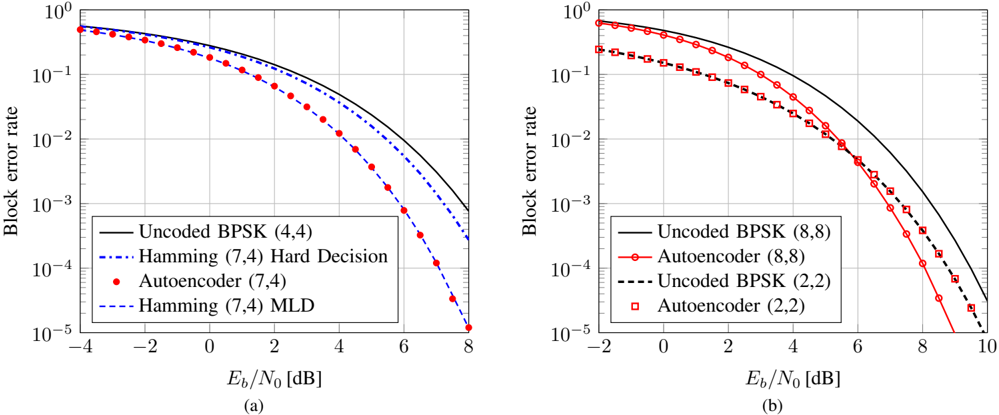
- A learned autoencoder for a (7,4) system at rate R = 4/7 achieves the same block error rate (BLER) as a Hamming (7,4) code with maximum likelihood decoding, while an (8,8) autoencoder outperforms uncoded BPSK over the full E_b/N_0 range, indicating learned joint coding and modulation.
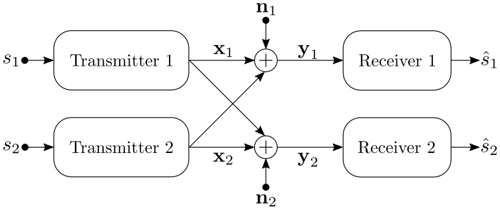
- For the two-user AWGN interference channel, the autoencoder matches time-sharing for (1,1) and (2,2), but achieves gains of about 0.7 dB for (4,4) and 1 dB for (4,8) at a BLER of 10^-3.
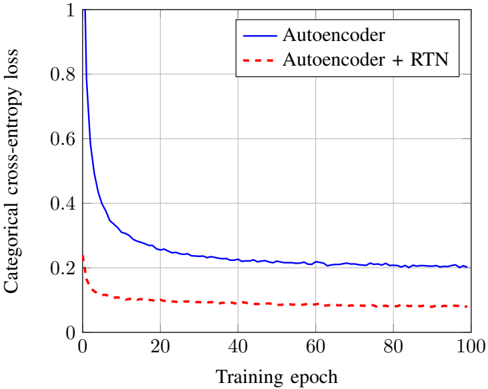
- An autoencoder (8,4) with an RTN over a multipath fading channel with L = 3 Rayleigh taps outperforms differential BPSK with maximum likelihood sequence estimation and a Hamming (7,4) code, whereas the plain autoencoder struggles to match it; RTNs also show faster training convergence.
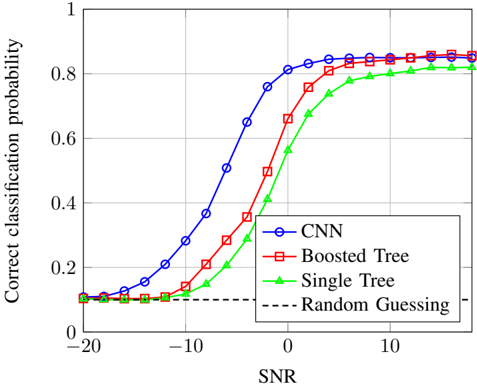
- For modulation classification on 1.2M sequences of 128 complex-valued IQ samples across ten modulation schemes and SNRs from -20 dB to 18 dB, the CNN outperforms a boosted expert-feature classifier by around 4 dB in the low-to-medium SNR range, with almost identical high-SNR performance; a single tree is about 6 dB worse at medium SNR and 3.5% worse at high SNR.
Methods
- The transmitter, channel, and receiver are represented as one deep neural network trained as an autoencoder: one-hot message input, dense layers, normalization layer for transmit constraints, additive noise channel layer, and softmax receiver output, trained with categorical cross-entropy using SGD/Adam at learning rate 0.001 and fixed E_b/N_0 = 7 dB.
- The autoencoder concept is extended to multiple transmitter-receiver pairs in a two-user interference channel, with dynamic loss weights α_t per mini-batch to balance the two cross-entropy losses; performance is compared against 2^{2k/n}-QAM with time-sharing.
- RTNs combine a learned parameter estimator, a differentiable parametric transform, and a discriminative network; the paper demonstrates phase-offset compensation and multipath inverse filtering. For modulation classification, a VGG-like CNN with 324,330 trainable parameters is trained on the RML2016.10b dataset.
Limitations
- The paper states that scalability to large message sets M is a major challenge: for k = 100 bits, training complexity is prohibitive because the autoencoder must see at least every message once.
- The paper states that optimal data representations, loss functions, training SNR, and hyperparameters are not well understood; training at one SNR does not necessarily generalize to others, and no common communications benchmarks or datasets comparable to MNIST or ImageNet exist.
- The paper states that end-to-end learning over real channels requires system identification because backpropagation assumes a known channel transfer function; complex-valued neural networks are not supported by current DL libraries. Evident from the text: the reported results are simulation-based, use small (n,k) settings, assume known channel models during training, and the paper explicitly leaves detailed performance comparisons for various channel types and parameters to future work.
Model-written summary. Check it against the paper before relying on it.
Integrity signals
Registry
Cites
Statistics
Figures






Verification
Claims the paper makes
6 Valid · 4 Not valid · 18 Not checked · 65 Own results and interpretations
Every source the paper cites for this claim was checked and supports it.
In the paper
“For instance in [22], it was shown that training with a single codeword is sufficient since the structure of the code is embedded in the NN through the Tanner graph.”
What the sources say
- Supportedcites [22] [22] E. Nachmani, Y. Be'ery, and D. Burshtein, 'Learning to decode linear codes using deep learning,' in Proc. IEEE Annu. Allerton Conf. Commun., Control, and Computing (Allerton) , 2016, pp. 341-346. - source
The Introduction says the decoder uses a Tanner graph representing the code and that one codeword suffices for training. Section III explains the precise condition: over a binary memoryless symmetric channel, the decoder’s error rate is independent of the transmitted codeword, so training can use noisy versions of a single codeword. (LLM, conf=0.91)
boostedstates a cause- Asserted: passes — The authors put it forward as true.
- Checkable: passes — It can be checked against evidence.
- Load-bearing: unclear — It is unclear whether the paper’s conclusions depend on it.
- Based: passes — The paper gives a reason why it holds.
- Supported
A result the paper reports from its own data — it cites no other source for it, so there is none to check. The quote shows it is in the paper.
In the paper
“We study the use of NNs on complex-valued IQ samples for the problem of modulation classification and show that convolutional neural networks (CNNs), which are the cornerstone of most DL systems for computer vision, can outperform traditional classification techniques based on expert features.”
plainstates a cause- Asserted: passes — The authors put it forward as true.
- Checkable: passes — It can be checked against evidence.
- Load-bearing: passes — The paper’s conclusions depend on it.
- Based: passes — The paper gives a reason why it holds.
The paper states this without a source or data behind it here, so there is nothing to check it against. The quote shows it is in the paper.
In the paper
“Training at low SNR for instance does not allow for the discovery of structure important in higher SNR scenarios.”
plainstates a cause- Asserted: passes — The authors put it forward as true.
- Checkable: passes — It can be checked against evidence.
- Load-bearing: unclear — It is unclear whether the paper’s conclusions depend on it.
- Based: unclear — It is unclear why the paper says it holds.
A result the paper reports from its own data — it cites no other source for it, so there is none to check. The quote shows it is in the paper.
In the paper
“Another advantage of RTNs is faster training convergence which can be seen from Fig. 10 that compares the validation loss of the autoencoder with and without RTN as a function of the training epochs.”
plainstates a cause- Asserted: passes — The authors put it forward as true.
- Checkable: passes — It can be checked against evidence.
- Load-bearing: unclear — It is unclear whether the paper’s conclusions depend on it.
- Based: passes — The paper gives a reason why it holds.
A result the paper reports from its own data — it cites no other source for it, so there is none to check. The quote shows it is in the paper.
In the paper
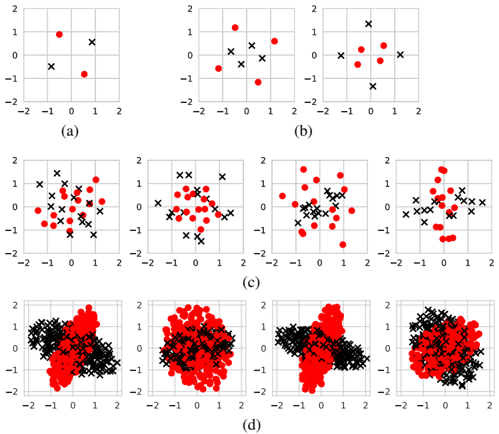
“Similarly, Fig. 4b shows a (4 , 2) system which leads to a rotated 16-PSK constellation.”
plainstates a cause- Asserted: passes — The authors put it forward as true.
- Checkable: passes — It can be checked against evidence.
- Load-bearing: unclear — It is unclear whether the paper’s conclusions depend on it.
- Based: passes — The paper gives a reason why it holds.
39 more claims
Create a free account to see all 93 claims and to verify the 4 references still open.
- Probably not a substantial claim. 29
- It may state two separate claims as one. 24
Self-check
Percentages, sums and reported differences re-computed from the paper’s own numbers.
Each contradiction between two passages listed here was confirmed by an independent check.
Rated minor: it would not touch a result — a value no result rests on, a p-value that stays on the same side of the significance level, or a conflict that is clerical, resolved elsewhere in the paper, or outside its own findings.
In the paper
§ A. Autoencoders for end-to-end communications systems · p. 5
“Similarly, Fig. 4b shows a (4 , 2) system which leads to a rotated 16-PSK constellation.”
§ A. Autoencoders for end-to-end communications systems · p. 6
“Figure 4: Constellations produced by autoencoders using parameters ( n, k ) : (a) (2 , 2) (b) (2 , 4) , (c) (2 , 4) with average power constraint, (d) (7 , 4) 2-dimensional t-SNE embedding of received symbols.”
Citations
Cites
Very Deep Convolutional Networks for Large-Scale Image Recognition
Simonyan, K., & Zisserman, A. (2014) · arXiv · doi:10.48550/arxiv.1409.1556 · Cited by 114,148 · cited 1×
“dense/fully-connected layers and terminated with a dense softmax layer for our classifier (similar to a VGG architecture [55]).”
BackgroundAdam: A Method for Stochastic Optimization
Kingma, D. P., & Ba, J. (2014) · arXiv · doi:10.48550/arxiv.1412.6980 · Cited by 98,946 · cited 4×
“Training was done at a fixed value of Eb/N0 = 7 dB (see Section IV-B) using Adam [46] with learning rate 0.”
BackgroundMethodInfluentialA Mathematical Theory of Communication
Shannon, C. E. (1948) · Bell System Technical Journal · doi:10.1002/j.1538-7305.1948.tb01338.x · Cited by 88,486
Scikit-learn: Machine Learning in Python
Pedregosa, F., Varoquaux, G., Gramfort, A., Michel, V., Thirion, B., Grisel, O., Blondel, M., Müller, A., Nothman, J., Louppe, G., et al. (2012) · arXiv · doi:10.48550/arxiv.1201.0490 · Cited by 71,016 · cited 1×
“11, we compare the classification accuracy of the CNN against that of extreme gradient boosting7 with 1000 estimators, as well as a single scikit-learn decision tree [56], operating on a mix of 16 analog and cumulant expert features as proposed in [53] and [57].”
Method(2014) · Cited by 33,419
(2008) · Journal of Machine Learning Research · Cited by 33,051
Human-level control through deep reinforcement learning
Mnih, V., Kavukcuoglu, K., Silver, D., Rusu, A. A., Veness, J., Bellemare, M. G., Graves, A., Riedmiller, M., Fidjeland, A. K., Ostrovski, G., et al. (2015) · Nature · doi:10.1038/nature14236 · Cited by 30,357
(2007) · Electronics: A First Course · doi:10.4324/9780080477527-64 · Cited by 24,923
Pan, S. J., & Yang, Q. (2010) · IEEE Transactions on Knowledge and Data Engineering · doi:10.1109/tkde.2009.191 · Cited by 23,387 · cited 1×
“learning [64] is one appealing candidate for adapting an endto-end communications system trained on a statistical model to”
BackgroundMultilayer feedforward networks are universal approximators
Hornik, K., Stinchcombe, M., & White, H. (1989) · Neural Networks · doi:10.1016/0893-6080(89)90020-8 · Cited by 21,728 · cited 1×
“Third, it has been shown that NNs are universal function approximators [13] and recent work has shown a remarkable”
Background
Research works printed but not linked: 2
- [35] I. Goodfellow, Y. Bengio, and A. Courville, Deep Learning . MIT Press, 2016. -
- [52] J. Estaran et al. , 'Artificial neural networks for linear and non-linear impairment mitigation in high-baudrate IM/DD systems,' in Proc. 42nd European Conf. Optical Commun. (ECOC) . VDE, 2016, pp. 1-3. -
Cited by
Items 2,901–2,995 of 2,995
Overcoming Channel Determinism in Maritime UAV Networks via RIS-Assisted PLKG with Deep Learning
Zhang, B., Wang, D., Ding, L., & Zhong, Y. (2026) · International Conference on Computer Communication and Artificial Intelligence (CCAI) · doi:10.1109/ccai69603.2026.11641926
“To address this, we introduce a deep learning network (e.g., an Autoencoder) parameterized by Θ to perform intelligent feature denoising and reconciliation [12].”
Nordio, A., Riviello, D. G., Paonessa, F., Virone, G., Tarable, A., & Malandrino, F. (2026) · IEEE International Workshop on Metrology for AeroSpace (MetroAeroSpace) · doi:10.1109/metroaerospace69299.2026.11646738
“Foundational work has established deep learning as a viable tool for physical-layer tasks and has clarified design challenges and opportunities when replacing or augmenting classical receiver blocks with neural networks [2].”
M4: A Multi-Scale Dual-Domain Feature Fusion Transformer for Automatic Modulation Classification
Liu, Z., Li, Y., & Xiong, W. (2026) · IEEE Access · doi:10.1109/access.2026.3724783
“O’Shea and Hoydis [1] showed that CNNs operating on raw I/Q data substantially outperform handcrafted-feature classifiers on RadioML2016.”
Aboghazalah, M. M., Mohamed, A. S., Hassanain, A. A., Hammami, N. E., & Helmy, M. (2026) · IEEE Access · doi:10.1109/access.2026.3724769
Advancements in AI for 6G Networks
Khan, I., Khan, A. H., & Sharma, P. (2026) · International Conference on Sustainable Computing and Integrated Communication in Changing Landscape of AI (ICSCAI) · doi:10.1109/icscai68849.2026.11648659
Deep Learning Based Adversarial Defense Method for LEO-OFDM Systems
Liu, Y., Li, Y., Fang, X. F., Duan, X., & Wang, X. (2026) · International Conference on Optical Communications and Networks (ICOCN) · doi:10.1109/icocn70692.2026.11656191
“In recent years, deep learning (DL) has shown strong potential in physical-layer signal processing [2].”
Sagheer, F., Desgreys, P., Chollet, P., Morche, D., & Perrier, R. (2026) · SSRN Electronic Journal · doi:10.2139/ssrn.7323041
MIMO optimization with deep learning: thematic analysis of 5G and beyond applications
Efe, E. M., & Böcekçı, V. G. (2026) · Telecommunication Systems · doi:10.1007/s11235-026-01508-x
“Deep learning-based autoencoder approaches offer effective solutions for critical applications such as modulation clas-sification, signal detection, and performance enhancement under complex channel conditions [84, 85].”
Vijayarani, R., Aparna, R., Divya, K., & Sharmila, E. (2026) · Mobile Networks and Applications · doi:10.1007/s11036-026-02517-5
Wang, P., Luo, Y., Chen, W., Yang, L., Zhang, D., & Zhu, J. (2026) · Applied Optics · doi:10.1364/ao.605566
Open-Set Single-Channel Blind Source Separation: Per-Source Modulation Detection is SNR-DependentPreprint
Nong, B., Fu, W., & Jiang, Z. (2026) · SSRN Electronic Journal · doi:10.2139/ssrn.7357277
Doppler-Aware Temporal Transformer for Link Degradation Diagnosis in LEO Satellite Communications
Mao, Z., Liu, T., Wang, S., & Yang, T. (2026) · International Conference on Electronics and Communication, Network and Computer Technology (ECNCT) · doi:10.1109/ecnct70535.2026.11661548
“Deep learning has been studied for wireless communication systems and sequence modeling [13]–[15].”
An Attention-Based Variational Autoencoder for End-to-End Wireless Communication Systems
Choubey, N., & Trivedi, A. (2026) · IETE Journal of Research · doi:10.1080/03772063.2026.2719004
GPU-Accelerated Deep Learning Algorithms for MIMO Signal Detection
Perea-Trejo, L. R., Ibarra-Hernández, R. F., Castillo-Soria, F. R., Puerto-Flores, J. A. D., Acosta‐Elías, J., García-Barrientos, A., & Reyes, B. A. (2026) · Telecom · doi:10.3390/telecom7050108
Kaplan, Y., & Saray, U. (2026) · Savunma Bilimleri Dergisi · doi:10.17134/khosbd.1905964
Liu, X., Li, Y., Wang, Q., Guo, Y., Zhu, C., & Zhang, N. (2026) · Sensors · doi:10.3390/s26175540
“10B, which are released by the DeepSIG platform [41,42].”
Akbar, S., Zhou, H., Nishat, M., & Nishat, F. (2026) · Information systems engineering and management · doi:10.1007/978-3-032-22426-2_26
Li, Q., Xiang, X., Hu, M., & Liang, Y. (2026) · Mathematics · doi:10.3390/math14173131
TCD: Time-Conditioned Diffusion Decoding for Binary Short Block Codes
Zheng, J., Ni, J., Li, Z., Sun, Y., Tan, X., Huang, Y., & Zhang, C. (2026) · IEEE Transactions on Cognitive Communications and Networking · doi:10.1109/tccn.2026.3712754
“Complementing graph-based approaches, “model-free” DL decoders [4], [11], [12] have gained significant attention due to their code-agnostic property, making them universally applicable to arbitrary binary block codes [13], [14].”
An Explainable Deep Learning Based Signal Recovery Framework for Avionics Communication
Akınet, İ., Kankılıç, C., Demir, A. Y., Arslan, H., & Can, Y. (2026) · International Conference on Recent Advances in Space Technologies · doi:10.1109/rast69551.2026.11672323
“…systems with notable BER improvements [19], Kalman-filter-based channel estimation methods have been proposed for OFDM systems in time-varying channels [17], and end-to-end autoencoder-based transceivers have been proposed to jointly optimize transmission and reception over noisy channels [20].”
Τρίγκα, Μ., & Dritsas, E. (2026) · International Journal of Data Science and Analytics · doi:10.1007/s41060-026-01274-8
“This mutual dependence invalidates the assumptions of inde-123 pendent sampling, stationary data distributions, and strict separation between training and deployment, which underpin much of the conventional ML theory [13, 14].”
Hawarey, M. (2026) · AIR Journal of Engineering & Technology · doi:10.65737/airjet2026867
A Transformer-Based Spatiotemporal Fusion Network for Automatic Modulation Classification
Xu, M., Zhao, G., Zhang, Y., Zheng, D., & Liu, J. (2026) · Entropy · doi:10.3390/e28090990
Label-Free Environment Adaptation for Wireless Receivers via Physics-Informed Constraints
Cheng, L., Liu, X., Kong, L., Xiong, J., Zhao, H., & Wei, J. (2026) · IEEE Transactions on Wireless Communications · doi:10.1109/twc.2026.3730873
“D EEP learning (DL) has proven a viable alternative to traditional wireless receivers [1], [2], [3], [4], [5].”
Fu, Z., Chen, S., Zhang, G., Ma, J., Song, X., Li, N., Hu, Z., Wang, C., & Xu, X. (2026) · Journal of Lightwave Technology · doi:10.1109/jlt.2026.3731361
Learning conjugate fringe decomposition for single-shot fringe projection profilometry
Zhou, C. (2026) · Applied Optics · doi:10.1364/ao.611321
Alam, A., & Alam, M. S. (2026) · IEEE Microwave Magazine · doi:10.1109/mmm.2026.3710765
Deep Learning-Based Fault Detection for Chiplet Interconnect Signals
Kawatkar, P., Khalil, K., & Bayoumi, M. (2026) · IEEE International Midwest Symposium on Circuits and Systems (MWSCAS) · doi:10.1109/mwscas67364.2026.11680947
“Deep learning has demonstrated strong performance in pattern recognition tasks involving time-series signals, communication systems, and signal processing applications [7]– [9].”
RF-Based UAV Recognition with Dual-Band Paired Segments and Multi-Representation Learning
林, 成. (2026) · Computer Science and Application · doi:10.12677/csa.2026.169296
Multiple-symbol Noncoherent Learning Detection for LDPC-Coded OFDM in 5G NR Networks
Li, J., Zhang, G., Zheng, R., & Zhu, C. (2026) · International Joint Conference on Information and Communication Engineering (JCICE) · doi:10.1109/jcice71302.2026.11682579
“Deep Learning (DL) has emerged as a promising alternative for physical-layer processing [10], [11].”
Heshmat, S., Khaled, S., Ezzat, A., Abdelhameed, D., Essai, M. H., Althbiti, A., Alsairy, N., & Elnazer, S. (2026) · IEEE Access · doi:10.1109/access.2026.3732996
Adversarial poisoning attacks for online deep receivers
Huang, H., Wu, K., Liu, H., Luo, C., Qin, J., Chen, S., & Jiang, W. (2026) · Physical Communication · doi:10.1016/j.phycom.2026.103367
Automatic Modulation Recognition and Spectrum Monitoring in Cognitive Radio
Mudda, M., Ambika, M., Ganesh Kumar, G., Lahari, K., Pavithra, B., & Gnanada, S. (2026) · International Conference on Inventive Systems and Control (ICISC) · doi:10.1109/icisc69558.2026.11681655
Zhang, R., Gayan, S., Luckshan, C., & İnaltekin, H. (2026) · IEEE/CIC International Conference on Communications in China (ICCC) · doi:10.1109/iccc70295.2026.11680062
“Second, training an AE with the usual categorical cross-entropy (CCE) loss [5] produces symbol constellations that are irregular and inconsistent.”
Temporal Convolutional Networks for Robust Beam-Domain UAV Channel Prediction
Zhang, Y., Chang, H., Zhang, W., Sun, J. F., & Bai, L. (2026) · IEEE/CIC International Conference on Communications in China (ICCC) · doi:10.1109/iccc70295.2026.11680194
Deep Learning-Based Geometric Constellation Shaping for Joint Coding and Modulation
Yang, C., Yan, J., Lin, H., Tang, X., & Zhao, Z. (2026) · IEEE/CIC International Conference on Communications in China (ICCC) · doi:10.1109/iccc70295.2026.11680475
“Recently, deep learning (DL) has been applied to physical layer design [6], with autoencoder-based approaches showing great potential for learning optimized GCS [7], [8].”
Narrowband mmWave Channel Estimation Using SDAE-DNN for Chaotic Wireless Communications
Yin, H., Li, J., & Yuan, W. (2026) · IEEE/CIC International Conference on Communications in China (ICCC) · doi:10.1109/iccc70295.2026.11680378
“Along with the rapid development of deep learning technology, it has been increasingly used in wireless communication field, including signal detection, channel estimation , modulation recognition, and resource optimization [18], [19].”
Multi-Wavelength Adaptive Autoencoder for Underwater Optical Wireless Communication
Zhao, L., Yang, Z., & Jiang, M. Y. (2026) · IEEE Transactions on Communications · doi:10.1109/tcomm.2026.3734328
“Furthermore, an autoencoder (AE) was proposed in [16], which treats the entire physical layer as a neural network that can be jointly optimized.”
Choube, V. H. K., Asif, H., & Malek, M. F. A. (2026) · International Conference Computational Vision and Bio Inspired Computing · doi:10.1109/iccvbic71195.2026.11689021
“O'Shea and Hoydis [10] demonstrated deep learning-based transceiver design, while Alkhateeb et al. [9] showed that CNNs can reduce pilot overhead through beam prediction.”
Machine Learning for PRACH Interference Detection in 5G NR NetworksPreprint
Kabore, A., Guel, D., & Ouédraogo, F. (2026) · Research Square · doi:10.21203/rs.3.rs-10744504/v1
Deep Learning-Based Signal Detection and Anti-Jamming Techniques for Space Communication Systems
Xu, Y. (2026) · Communications in computer and information science · doi:10.1007/978-3-032-39708-9_20
A lightweight two-stage neural receiver for statistical mismatch in urban expressway scenarios
Chen, X., Yang, C., Zhu, Y., Fu, Y., & Han, K. (2026) · Signal Image and Video Processing · doi:10.1007/s11760-026-05726-3
“For physical-layer reception, O’Shea and Hoydis [8], Hoydis et al. [9], He et al. [10], Honkala et al. [11], and Ait Aoudia and Hoydis [12] demonstrated the potential of deep learning, AI-native air interfaces, model-driven wireless learning, fully convolutional receivers, and end-to-end OFDM…”
An offline-to-online training method for deep learning based communications over the air
Yu, Q., Duan, C., Yu, J., Liao, X., & Yang, S. (2026) · Computers & Electrical Engineering · doi:10.1016/j.compeleceng.2026.111556
CNN-Based Adaptive Pilot Position Selection for OFDM in Time-Varying Channel Conditions
Choudhary, S., Dasgupta, O., Neog, M., Yadav, N., & Chaudhury, K. (2026) · International Journal of Innovative Research in Computer Science & Technology · doi:10.55524/ijircst.2026.14.5.1
TAP-SNet: Lightweight Few-Shot Modulation Recognition via Selective Mamba Mechanism
Zhang, C., Jiang, D., Qi, X., Hu, J. P., Xiang, J., Lai, X., & Xu, S. (2026) · IEEE Wireless Communications Letters · doi:10.1109/lwc.2026.3735468
“With the rise of DL, O’Shea and Hoydis [6] CLDNNs [7], and Transformers [8] were introduced.”
Kumar, A., Revathi, V., Gaur, N., & Nanthaamornphong, A. (2026) · Results in Optics · doi:10.1016/j.rio.2026.101159
Nonlinear Encoding Technology for Semantic Communication
Kong, X. (2026) · ITM Web of Conferences · doi:10.1051/itmconf/20269101028
“O'Shea et al. first proposed the groundbreaking idea of treating the physical layer as an end-to-end autoencoder in 2017, and provided the theoretical basis for intelligent nonlinear coding [10].”
CNN-Based Channel Estimation for 5G OFDM Systems
Zhou, S. (2026) · ITM Web of Conferences · doi:10.1051/itmconf/20269101034
“…proved that the neural network can capture the complex nonlinear mapping inherent in the communication process, thus laying the foundation for data-driven channel estimation and emphasizing its ability to solve the modeling difficulties faced by traditional methods in complex environments [2] [3].”
Rethinking deep learning in MIMO systems: From capability analyses to design principles
Yao, L., Ma, K., & Wang, Z. (2026) · Digital Communications and Networks · doi:10.1016/j.dcan.2026.09.011
Herrera-Loera, C., Del-Valle-Soto, C., Valdivia, L. J., & Mex-Perera, C. (2026) · Sensors · doi:10.3390/s26196123
Osman, K. A. Y. A., Karabulut, M. A., Eyüpoğlu, C., & Karakuş, O. (2026) · Sensors · doi:10.3390/s26196124
C2D-RT-DETR-Based Wideband Signal Detection and Parameter ExtractionPreprint
Shi, Z., Zhu, R., Liu, L., Chen, Y., Gao, L., & Gheng, H. (2026) · Research Square · doi:10.21203/rs.3.rs-10869246/v1
Deep Spatio-Temporal Graph Learning with Batch Normalization for Modulation Classification
Prabhakar, A. S. A. D. B. (2026) · International Journal of Advanced Research in Science Communication and Technology · doi:10.48175/ijarsct-38518
Baker, Y. A., & Bousquet, J. (2026) · IEEE Journal of Radio Frequency Identification · doi:10.1109/jrfid.2026.3738523
“In fully connected layers, each neuron is connected to all neurons in the next layer, and the output is computed as [25]: where w l is the weight matrix, b l is the bias vector, and σ ( · ) is the activation function [25].”
InfluentialORION-SDR: Operational RF Intelligence and Observability for Networked Spectrum Monitoring
Amoah, B., Zhang, J., Periaswamy, S. C., Patton, J., & Mao, S. (2026) · International Conference on Future and Intelligent Networking (FINE) · doi:10.1109/fine71157.2026.00027
“The machine-learning components of our system align with the broader shift toward neural modulation recognition from raw or lightly normalized IQ streams [16]–[18].”
SAGE-AAMV: SNR-Adaptive Gated Ensemble for Over-the-Air Collaborative Recognition
Xiong, Y., Yu, Z., & Wu, J. (2026) · IEEE Communications Letters · doi:10.1109/lcomm.2026.3738577
“Automatic modulation recognition (AMR) therefore supports cognitive spectrum management, interference awareness, and adaptive transmission by identifying modulation formats without prior signaling information [6], [7].”
Gaber, A. M., Abdelmohdy, A. A., & Elenany, M. O. (2026) · Research Square · doi:10.21203/rs.3.rs-10956804/v1
Canaza, A. D. H., Quispe, J. O. M., Silva, M. M., & Quiroga, H. E. (2026) · Congreso de Tecnología, Aprendizaje y Enseñanza de la Electrónica (TAEE) · doi:10.1109/taee68119.2026.11701809
“As an additional reference, an ANN architecture may be considered when the analysis is extended to more flexible modeling schemes, in line with recent applications of machine learning at the physical layer of telecommunications [14].”
Polat, O., Söğüt, E., & Nebi, Z. Ş. (2026) · Türk doğa ve fen dergisi :/Türk doğa ve fen dergisi · doi:10.46810/tdfd.1995088
UA-ConstNet: Uncertainty-Aware Dual-View Fusion for Automatic Modulation Classification
Chen, S., Gao, Z., Huang, X., & Zhang, K. (2026) · International Conference on Mechanical, Electronics and Electrical and Automation Control (METMS) · doi:10.1109/metms70800.2026.11705922
“Early CNN-based studies showed that raw I/Q samples are effective for AMC [3, 4].”
Kumar, A., Revathi, V., Гаур, Н., & Nanthaamornphong, A. (2026) · Engineering Technology & Applied Science Research · doi:10.48084/etasr.19931
“The use of deep learning for physical-layer detection was systematically introduced by authors in [11], who framed transmitter–receiver pairs as end-to-end autoencoders that jointly learn constellation shaping and detection.”
Real-Time Automatic Modulation Classification Using Deep Learning on Software-Defined Radio Testbeds
Öztürk, G., & Yılmaz, R. (2026) · Deu Muhendislik Fakultesi Fen ve Muhendislik · doi:10.21205/deufmd.2026288415
Names, A. S., Abdullah, A. A., Faraj, S. H., Ahmed, M. N., & Rajab, A. E. (2026) · Journal of Optical Communications · doi:10.1515/joc-2026-0360
Learning Ray-Tracing Propagation with Graph Neural Networks for Efficient Base Station Planning
Satpathy, S., Nazzal, M., & Khreishah, A. A. (2026) · IEEE International Symposium on Personal, Indoor and Mobile Radio Communications (PIMRC) · doi:10.1109/pimrc69400.2026.11711586
“Convolutional neural networks have been used to learn radio maps from rasterized environment representations [4], while reinforcement learning methods optimize deployment parameters through repeated simulator interaction [5]– [7].”
Autoencoder-Based End-to-End Communication
Kaythry, P., Vinu, R., Nagarajan, K., & Nithya, S. (2026) · International Conference on Soft Computing for Security Applications (ICSCSA) · doi:10.1109/icscsa69367.2026.11708249
“The introduction of Radio Transformer Networks (RTNs) has been proposed to enhance performance in fading channels, including CNNs for modulation classification [10].”
SlotScope: Slot-Aligned Multi-Layer Observability for CPU-Resident AI-RAN Workload Assessment
Abbas, A. K., Chiejina, A., & Shah, V. K. (2026) · ACM International Workshop on Wireless Network Testbeds, Experimental Evaluation and Characterization (WiNTECH) · doi:10.1145/3831662.3844163
Lightweight Frequency-Wise Multi-Label Sensing for LPWAN Coexistence
Huang, J., Lahoud, S., & Trappenberg, T. P. (2026) · IEEE International Symposium on Personal, Indoor and Mobile Radio Communications (PIMRC) · doi:10.1109/pimrc69400.2026.11711988
“Several approaches operate on time-domain in-phase/quadrature (IQ) waveforms [4], [5].”
(2026) · Emerald Group Publishing Limited eBooks · doi:10.1108/978-1-80686-849-020261003
Cho, S. (2025) · IEEE International Workshop on Technologies for Defense and Security (TechDefense) · doi:10.1109/techdefense67306.2025.11721014
“[15] The downside, however, is their computational complexity and potential over-reliance on the training domain.”
Ma, Z., Pei, Z., Wei, W., Luo, Z., & Yue, Z. (2026) · Sensors · doi:10.3390/s26206408
An Overlapping Multi-Signal Detection Framework Based on Masked Pretraining and Repulsion Loss
Ren, J., Zeng, X., Wang, X., & Xu, H. (2026) · Sensors · doi:10.3390/s26206423
“Traditional signal detection methods, such as energy detection and cyclostationary feature analysis, rely on handcrafted features and fixed decision thresholds [3,4].”
Mobility-Aware BiLSTM Channel Estimation for Massive MIMO-OFDM with Imperfect CSI
Iswarya, N., Gangasri, R., Pavithradevi, R., Siva Saranya, K., & Vithur Vaibhav, K. S. (2026) · International Conference on Smart Systems for Electrical, Electronics, Communication and Computer Engineering (ICSSEECC) · doi:10.1109/icsseecc69062.2026.11722144
Deep Learning for RF Signal Identification and Segmentation
Rolly, R. M., Thomas, N. M., Paul, N., Regi, R. M., & George, S. (2026) · International Conference on Trends in Engineering Systems and Technologies (ICTEST) · doi:10.1109/ictest69239.2026.11722594
“Inspired by recent advances in end-to-end wireless signal processing [1], spectrogram representations are generated from RF signal frames and used as inputs to deep neural networks.”
Distributed DISTA Network with Adaptive Inter-DU Cooperation for Massive MIMO Detection
zhang, J., Zhang, Y., & Huang, G. (2026) · Applied Sciences · doi:10.3390/app162010223
Shin, S., Subedi, P., & Vuran, M. C. (2026) · IEEE Transactions on Cognitive Communications and Networking · doi:10.1109/tccn.2026.3744082
“5 − 5 dB gains over feature-based classifiers [31], while LSTM [6], ResNet [5], and complex-valued networks [7] demonstrate further improvements.”
Imtiaz, W. A., & Iqbal, A. (2026) · Optics Communications · doi:10.1016/j.optcom.2026.133856
Nourollahi, H., Hosseini, S. A., & Shahzadi, A. (2026) · Engineering Reports · doi:10.1002/eng2.71103
Haq, M. I. U., Koorapati, S., Sheikh, Z. R., Bahadar, K., & Deng, Y. (2026) · Journal of Signal Processing Systems · doi:10.1007/s11265-026-02026-4
“Deep Neural Networks (DNNs) [ 11–13], particularly convolutional and recurrent architectures, later demonstrated greater robustness than classical statistical techniques for automatic modulation classification and interference identification across broader SNR ranges [14 , 15].”
Aranda-Cubillo, J., Rabadan, J. A., & Pérez‐Jiménez, R. (2026) · Sensors · doi:10.3390/s26206641
Hoyos, E. A., Orozco, H. F. B., & Rodríguez-Idrobo, N. C. (2026) · Future Internet · doi:10.3390/fi18100572
Machine Learning-Based Source Separation of RF Signals for Digital Communications
Karsch, N., & Musch, T. (2026) · International Conference on Electromagnetics in Advanced Applications (ICEAA) · doi:10.23919/iceaa69870.2026.11725206
“Unsupervised methods are especially attractive in scenarios where labeled training data is not available, while supervised methods can learn complex non-linear mappings when sufficient training data is provided [7]– [9].”
CSI-Adaptive Semantic DeepJSCC for Bandwidth Efficient 6G Edge Networks
Duru, K. K., Jahnavi, K. V., Gadiparthi, H., Yogita, C. H. S., Sai, P. D. N., & Dodda, V. C. (2026) · IEEE International Conference on Recent Advances in Electronics, Communication, Computing, Automation and Power (RECCAP) · doi:10.1109/reccap69368.2026.11723507
“O’Shea and Hoydis showed that autoencoders can successfully extract features from the physical layer by considering the whole communication process as a reconstruction process rather than a mathematical process involving multiple steps [6].”
Quantum Machine Learning-Based Efficient Channel Estimation for MISO Systems
Choi, M., Tong, K.-C., Jung, Y.-G., Seo, D.-W., Yu, H.-S., & Song, H. (2026) · International Conference on Computer and Communications Management (ICCCM) · doi:10.1145/3841323.3841334
Parameter-Efficient QCNN-Based Signal Detector for GEO Satellite SISO Communications
Tong, K.-C., Jung, Y.-G., Choi, M., Seo, D.-W., Youn, Y.-H., & Song, H. (2026) · International Conference on Computer and Communications Management (ICCCM) · doi:10.1145/3841323.3841329
“Learning-basedreceivers,includingCNN-based andmodel-driven neural detectors, have been studied for physical-layer signal detection because they can learn nonlinear decision functions from data when model mismatch or imperfect CSI is present [8, 13, 17, 22].”
Autoencoder-Based Modulation with Large Distance for Beyond-5G Communications
E, M. A., Anwar, K., Pramudita, A. A., & Wibowo, F. X. A. (2026) · International Seminar on Application for Technology of Information and Communication (iSemantic) · doi:10.1109/isemantic71495.2026.11742598
A Deep Learning Approach for Thickness Determination of AZO Thin Films
Guerrero-Sosa, V. M., Carrillo-Verduzco, A., Alonso, J. C., Amaro-Colin, A. G., Esquivel-García, M., & Bokhimi, X. (2026) · ACS Omega · doi:10.1021/acsomega.6c10558
Flores-Cruz, J., Ruiz, E., Puerto-Flores, J. A. D., Mass-Sanchez, J., Espinoza-Ruiz, A., & Borrego, G. (2026) · Network · doi:10.3390/network6040095
Dual attention based CNN for multi-user spectrum sensing in cognitive radio systems
Narayan, A. S., Preetha, M. M. S. J., & Grace, K. S. V. (2026) · Engineering Research Express · doi:10.1088/2631-8695/aea673
“Hierarchical representations can be obtained through convolutional neural networks (CNNs) despite a demand for explicit feature engineering [8, 9].”
Position-Aware Neural Precoding Using Physics-Based Ray-Tracing Channels
Lin, P.-C., & Liu, J. W. (2026) · doi:10.3390/engproc2026159033
Wang, M., Quan, C., Wang, J., & Zou, H. (2026) · Drones · doi:10.3390/drones10110813
Self-Supervised Deep Neural System for Real-Time Spectrum Allocation
Rani, T., Suganya, J., Bernish, T. A., Linu Babu, P., Manjuleeswari, P., & Kumar, N. M. (2026) · doi:10.1109/icact70625.2026.11748780
FIMA-Net: A Deep Multi-View Fusion Network with Fractal InfoMax Attention for Few-Shot AMC
Zahid, M. F., & Zahid, M. U. (2026) · International Bhurban Conference on Applied Sciences and Technology (IBCAST) · doi:10.1109/ibcast71075.2026.11762165
A survey on AI methods for energy-efficient cell-free MIMO networks
Lee, M., Oh, S. M., Kim, J., & Park, S. (2026) · ICT Express · doi:10.1016/j.icte.2026.10.012
Metadata
- Authors
- O'Shea, T., & Hoydis, J.
- Affiliations
- Nokia (France) (FR)
- Venue
- IEEE Transactions on Cognitive Communications and Networking
- Published
- 2017-12
- Volume
- 3
- Issue
- 4
- Pages
- 563-575
- ISSN
- 2332-7731 (ISSN-L)
- OpenAlex
- W2734408173
- Semantic Scholar
- 78989616eeeac55b202e3e4205225e7135054185
- Cited by
- 2,980
- References
- 69
- Citations by year
- 2026: 307 · 2025: 327 · 2024: 305 · 2023: 368 · 2022: 432 · 2021: 409 · 2020: 406 · 2019: 322 · 2018: 95 · 2017: 9
- FWCI
- 122.29
- Type
- journal article
- Language
- en
- Open access
- green
- arxiv.org
- Locations
- IEEE Transactions on Cognitive Communications and Networking (publishedVersion)
- arXiv (Cornell University) (submittedVersion)
- arXiv (Cornell University)
- Topics
- Physical Sciences › Computer Science › Artificial Intelligence › Wireless Signal Modulation Classification
- Physical Sciences › Engineering › Electrical and Electronic Engineering › Advanced Wireless Communication Techniques
- Physical Sciences › Engineering › Electrical and Electronic Engineering › Advanced Wireless Communication Technologies
- Keywords
- end-to-end reconstruction, domain knowledge integration, convolutional neural networks, automatic modulation classification, IQ samples
About these checks
Registry, retraction, Cites and statistics results are computed, not judged, with one exception: a printed reference that no index lists is read once by a model before it counts as a citation error. Claims are extracted by a model and kept only when their quote appears verbatim in the text; each cited source is then checked, with a model’s help, for whether it says what the claim relies on. Those verdicts can be wrong — read the claim’s quote and the cited source before relying on one.
The claim verdicts this report counts are experimental: their accuracy is not yet measured.
A language model drew the claims from the paper on 2026-11-07, under version 3 of the claim definition (model deepseek-v4.1-flash, prompt extract-v3).
A second model labelled each claim on 2026-11-07 (model jev-1.13-20260917, definition revision gold-guideline-v0.2).
Cited sources are checked with a language model’s help (gpt-6-sol).
Statistics and arithmetic are recomputed, not judged.
Confidence bands are shown only for fields calibrated on our annotated test set. None is calibrated yet, so no band is shown.
What counts as a claim ›How we measure confidence ›How we check this ›
Are you an author, or do you see a problem with this page? Request a review
Data sources
Bibliographic data: Semantic Scholar, OpenAlex, Crossref.
Contains information from the Semantic Scholar Academic Graph Datasets, made available under the ODC Attribution License (ODC-BY 1.0).
Semantic Scholar’s data is described in: Kinney, R., et al. (2023). The Semantic Scholar Open Data Platform. arXiv:2301.10140.
