

An Introduction to Deep Learning for the Physical Layer
Open accessThe DOI matches its Crossref record; 90 of the 92 references it cites were found in a registry or an index, and 2 are not checked yet; 8 of the 32 sources its claims cite were checked for support.
Abstract
We present and discuss several novel applications of deep learning for the physical layer. By interpreting a communications system as an autoencoder, we develop a fundamental new way to think about communications system design as an end-to-end reconstruction task that seeks to jointly optimize transmitter and receiver components in a single process. We show how this idea can be extended to networks of multiple transmitters and receivers and present the concept of radio transformer networks as a means to incorporate expert domain knowledge in the machine learning model. Lastly, we demonstrate the application of convolutional neural networks on raw IQ samples for modulation classification which achieves competitive accuracy with respect to traditional schemes relying on expert features. This paper is concluded with a discussion of open challenges and areas for future investigation.
Verified 2026-11-19 · 2 references not checked yet
Overview
CoChat Summary
TL;DR
The paper introduces deep learning for the physical layer by treating a communications system as an autoencoder that jointly learns transmitter and receiver implementations end-to-end. It also extends this idea to multi-user interference channels, proposes radio transformer networks (RTNs) to inject expert domain knowledge, and shows CNNs on raw IQ samples can outperform expert-feature modulation classifiers.
Key findings
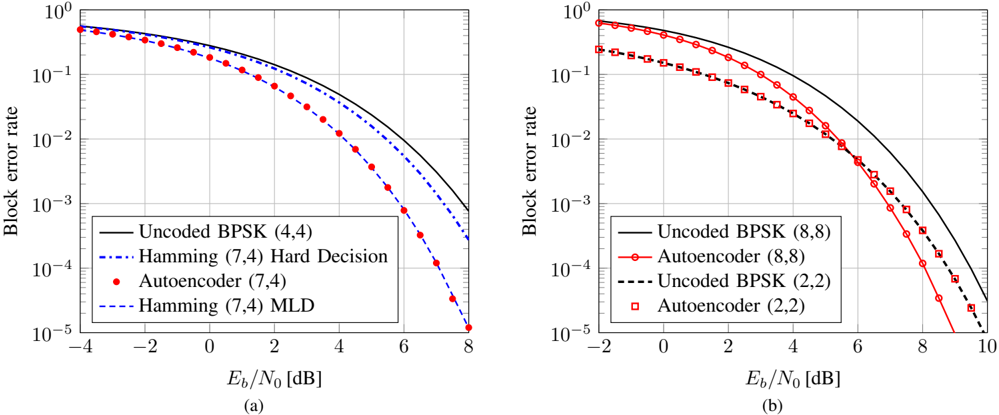
- A learned autoencoder for a (7,4) system at rate R = 4/7 achieves the same block error rate (BLER) as a Hamming (7,4) code with maximum likelihood decoding, while an (8,8) autoencoder outperforms uncoded BPSK over the full E_b/N_0 range, indicating learned joint coding and modulation.
- For the two-user AWGN interference channel, the autoencoder matches time-sharing for (1,1) and (2,2), but achieves gains of about 0.7 dB for (4,4) and 1 dB for (4,8) at a BLER of 10^-3.
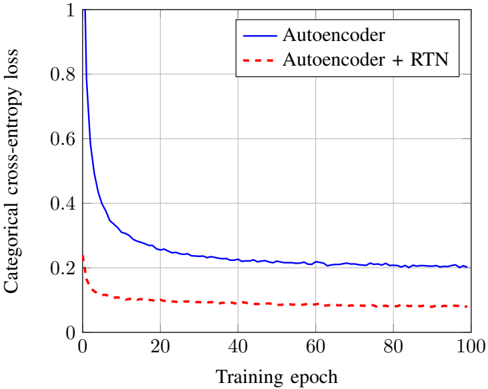
- An autoencoder (8,4) with an RTN over a multipath fading channel with L = 3 Rayleigh taps outperforms differential BPSK with maximum likelihood sequence estimation and a Hamming (7,4) code, whereas the plain autoencoder struggles to match it; RTNs also show faster training convergence.
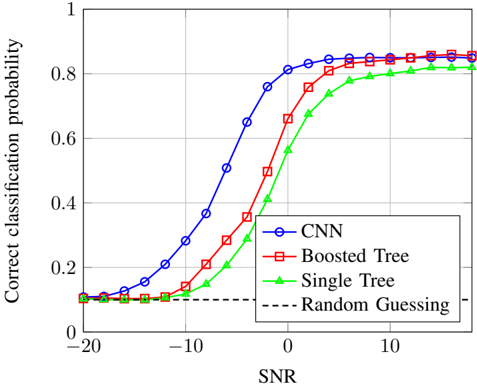
- For modulation classification on 1.2M sequences of 128 complex-valued IQ samples across ten modulation schemes and SNRs from -20 dB to 18 dB, the CNN outperforms a boosted expert-feature classifier by around 4 dB in the low-to-medium SNR range, with almost identical high-SNR performance; a single tree is about 6 dB worse at medium SNR and 3.5% worse at high SNR.
Methods
- The transmitter, channel, and receiver are represented as one deep neural network trained as an autoencoder: one-hot message input, dense layers, normalization layer for transmit constraints, additive noise channel layer, and softmax receiver output, trained with categorical cross-entropy using SGD/Adam at learning rate 0.001 and fixed E_b/N_0 = 7 dB.
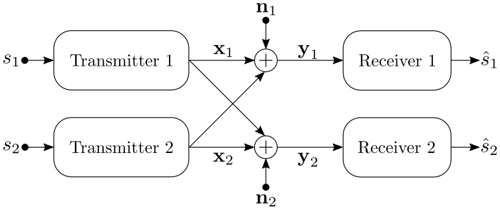
- The autoencoder concept is extended to multiple transmitter-receiver pairs in a two-user interference channel, with dynamic loss weights α_t per mini-batch to balance the two cross-entropy losses; performance is compared against 2^{2k/n}-QAM with time-sharing.
- RTNs combine a learned parameter estimator, a differentiable parametric transform, and a discriminative network; the paper demonstrates phase-offset compensation and multipath inverse filtering. For modulation classification, a VGG-like CNN with 324,330 trainable parameters is trained on the RML2016.10b dataset.
Limitations
- The paper states that scalability to large message sets M is a major challenge: for k = 100 bits, training complexity is prohibitive because the autoencoder must see at least every message once.
- The paper states that optimal data representations, loss functions, training SNR, and hyperparameters are not well understood; training at one SNR does not necessarily generalize to others, and no common communications benchmarks or datasets comparable to MNIST or ImageNet exist.
- The paper states that end-to-end learning over real channels requires system identification because backpropagation assumes a known channel transfer function; complex-valued neural networks are not supported by current DL libraries. Evident from the text: the reported results are simulation-based, use small (n,k) settings, assume known channel models during training, and the paper explicitly leaves detailed performance comparisons for various channel types and parameters to future work.
Model-written summary. Check it against the paper before relying on it.
Integrity signals
Registry
Cites
Statistics
Figures






Verification
Claims the paper makes
6 Valid · 4 Not valid · 18 Not checked · 65 Own results and interpretations
Every source the paper cites for this claim was checked and supports it.
In the paper
“For instance in [22], it was shown that training with a single codeword is sufficient since the structure of the code is embedded in the NN through the Tanner graph.”
What the sources say
- Supportedcites [22] [22] E. Nachmani, Y. Be'ery, and D. Burshtein, 'Learning to decode linear codes using deep learning,' in Proc. IEEE Annu. Allerton Conf. Commun., Control, and Computing (Allerton) , 2016, pp. 341-346. - source
The Introduction says the decoder uses a Tanner graph representing the code and that one codeword suffices for training. Section III explains the precise condition: over a binary memoryless symmetric channel, the decoder’s error rate is independent of the transmitted codeword, so training can use noisy versions of a single codeword. (LLM, conf=0.91)
boostedstates a cause- Asserted: passes — The authors put it forward as true.
- Checkable: passes — It can be checked against evidence.
- Load-bearing: unclear — It is unclear whether the paper’s conclusions depend on it.
- Based: passes — The paper gives a reason why it holds.
- Supported
A result the paper reports from its own data — it cites no other source for it, so there is none to check. The quote shows it is in the paper.
In the paper
“We study the use of NNs on complex-valued IQ samples for the problem of modulation classification and show that convolutional neural networks (CNNs), which are the cornerstone of most DL systems for computer vision, can outperform traditional classification techniques based on expert features.”
plainstates a cause- Asserted: passes — The authors put it forward as true.
- Checkable: passes — It can be checked against evidence.
- Load-bearing: passes — The paper’s conclusions depend on it.
- Based: passes — The paper gives a reason why it holds.
The paper states this without a source or data behind it here, so there is nothing to check it against. The quote shows it is in the paper.
In the paper
“Training at low SNR for instance does not allow for the discovery of structure important in higher SNR scenarios.”
plainstates a cause- Asserted: passes — The authors put it forward as true.
- Checkable: passes — It can be checked against evidence.
- Load-bearing: unclear — It is unclear whether the paper’s conclusions depend on it.
- Based: unclear — It is unclear why the paper says it holds.
A result the paper reports from its own data — it cites no other source for it, so there is none to check. The quote shows it is in the paper.
In the paper
“Another advantage of RTNs is faster training convergence which can be seen from Fig. 10 that compares the validation loss of the autoencoder with and without RTN as a function of the training epochs.”
plainstates a cause- Asserted: passes — The authors put it forward as true.
- Checkable: passes — It can be checked against evidence.
- Load-bearing: unclear — It is unclear whether the paper’s conclusions depend on it.
- Based: passes — The paper gives a reason why it holds.
A result the paper reports from its own data — it cites no other source for it, so there is none to check. The quote shows it is in the paper.
In the paper
“Similarly, Fig. 4b shows a (4 , 2) system which leads to a rotated 16-PSK constellation.”
plainstates a cause- Asserted: passes — The authors put it forward as true.
- Checkable: passes — It can be checked against evidence.
- Load-bearing: unclear — It is unclear whether the paper’s conclusions depend on it.
- Based: passes — The paper gives a reason why it holds.
39 more claims
Create a free account to see all 93 claims and to verify the 4 references still open.
- Probably not a substantial claim. 29
- It may state two separate claims as one. 24
Self-check
Percentages, sums and reported differences re-computed from the paper’s own numbers.
Each contradiction between two passages listed here was confirmed by an independent check.
Rated minor: it would not touch a result — a value no result rests on, a p-value that stays on the same side of the significance level, or a conflict that is clerical, resolved elsewhere in the paper, or outside its own findings.
In the paper
§ A. Autoencoders for end-to-end communications systems · p. 5
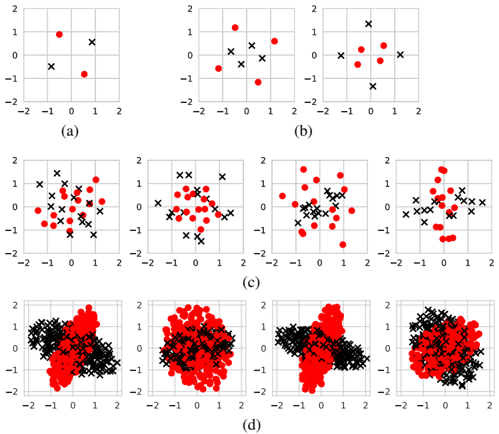
“Similarly, Fig. 4b shows a (4 , 2) system which leads to a rotated 16-PSK constellation.”
§ A. Autoencoders for end-to-end communications systems · p. 6
“Figure 4: Constellations produced by autoencoders using parameters ( n, k ) : (a) (2 , 2) (b) (2 , 4) , (c) (2 , 4) with average power constraint, (d) (7 , 4) 2-dimensional t-SNE embedding of received symbols.”
Citations
Cites
Very Deep Convolutional Networks for Large-Scale Image Recognition
Simonyan, K., & Zisserman, A. (2014) · arXiv · doi:10.48550/arxiv.1409.1556 · Cited by 114,148 · cited 1×
“dense/fully-connected layers and terminated with a dense softmax layer for our classifier (similar to a VGG architecture [55]).”
BackgroundAdam: A Method for Stochastic Optimization
Kingma, D. P., & Ba, J. (2014) · arXiv · doi:10.48550/arxiv.1412.6980 · Cited by 98,946 · cited 4×
“Training was done at a fixed value of Eb/N0 = 7 dB (see Section IV-B) using Adam [46] with learning rate 0.”
BackgroundMethodInfluentialA Mathematical Theory of Communication
Shannon, C. E. (1948) · Bell System Technical Journal · doi:10.1002/j.1538-7305.1948.tb01338.x · Cited by 88,486
Scikit-learn: Machine Learning in Python
Pedregosa, F., Varoquaux, G., Gramfort, A., Michel, V., Thirion, B., Grisel, O., Blondel, M., Müller, A., Nothman, J., Louppe, G., et al. (2012) · arXiv · doi:10.48550/arxiv.1201.0490 · Cited by 71,016 · cited 1×
“11, we compare the classification accuracy of the CNN against that of extreme gradient boosting7 with 1000 estimators, as well as a single scikit-learn decision tree [56], operating on a mix of 16 analog and cumulant expert features as proposed in [53] and [57].”
Method(2014) · Cited by 33,419
(2008) · Journal of Machine Learning Research · Cited by 33,051
Human-level control through deep reinforcement learning
Mnih, V., Kavukcuoglu, K., Silver, D., Rusu, A. A., Veness, J., Bellemare, M. G., Graves, A., Riedmiller, M., Fidjeland, A. K., Ostrovski, G., et al. (2015) · Nature · doi:10.1038/nature14236 · Cited by 30,357
(2007) · Electronics: A First Course · doi:10.4324/9780080477527-64 · Cited by 24,923
Pan, S. J., & Yang, Q. (2010) · IEEE Transactions on Knowledge and Data Engineering · doi:10.1109/tkde.2009.191 · Cited by 23,387 · cited 1×
“learning [64] is one appealing candidate for adapting an endto-end communications system trained on a statistical model to”
BackgroundMultilayer feedforward networks are universal approximators
Hornik, K., Stinchcombe, M., & White, H. (1989) · Neural Networks · doi:10.1016/0893-6080(89)90020-8 · Cited by 21,728 · cited 1×
“Third, it has been shown that NNs are universal function approximators [13] and recent work has shown a remarkable”
Background
Research works printed but not linked: 2
- [35] I. Goodfellow, Y. Bengio, and A. Courville, Deep Learning . MIT Press, 2016. -
- [52] J. Estaran et al. , 'Artificial neural networks for linear and non-linear impairment mitigation in high-baudrate IM/DD systems,' in Proc. 42nd European Conf. Optical Commun. (ECOC) . VDE, 2016, pp. 1-3. -
Cited by
Items 1,101–1,200 of 2,995
Similarity-Based Prediction for Channel Mapping and User Positioning
Magoarou, L. L. (2021) · IEEE Communications Letters · doi:10.1109/lcomm.2021.3049849 · Cited by 11
“Machine learning holds promise for wireless communications (see [8], [9] for exhaustive surveys).”
BackgroundDiagnosis-Steganography-Transmission: An Innovative Integrated Paradigm for ECG Healthcare
Sahu, N., Peng, D., & Sharif, H. (2021) · SN Computer Science · doi:10.1007/s42979-021-00721-6 · Cited by 12
End-to-end Autoencoder for Superchannel Transceivers with Hardware Impairment
Song, J., Häger, C., Schröder, J., Amat, A. G. I., & Wymeersch, H. (2021) · Optical Fiber Communication Conference · doi:10.1364/ofc.2021.f4d.6 · Cited by 11
“Furthermore, for the baseline, we use a geometrically-shaped constellation set obtained by training a standard AE [18] over the AWGN channel at SNR = 18dB, and apply the arcsin with clipping based DPD [3], according to B̃: =min{+clip,arcsin(B: )}, where +clip is referred to as the clipping factor and arcsin(·) operate…”
BackgroundMethodInfluentialEnd-to-End Learning of Communication System without Known Channel
Jiang, H., & Dai, L. (2021) · International Conference on Communications · doi:10.1109/icc42927.2021.9500550 · Cited by 13
“Thus, the E2E learning of communication system could reach or even outperform the conventional system with lower complexity [2], [6].”
BackgroundMethodInfluentialGeometric Constellation Shaping Using Initialized Autoencoders
Omidi, A., Zeng, M., Lin, J., & Rusch, L. A. (2021) · IEEE International Black Sea Conference on Communications and Networking · doi:10.1109/blackseacom52164.2021.9527735 · Cited by 11
“They exploit feedforward neural networks to encode binary symbols into in-phase and quadrature (I/Q) components at the transmitter and to decode I/Q components to binary symbols at the receiver [9].”
BackgroundMethodDesign and Analysis of MIMO Systems Using Energy Detectors for Sub-THz Applications
Bicaïs, S., Falempin, A., Doré, J., & Savin, V. (2021) · IEEE Transactions on Wireless Communications · doi:10.1109/twc.2021.3123220 · Cited by 15
“Indeed, there has been a growing interest in wireless communications regarding the use of deep learning techniques for communications as it is addressed in [11], [12] and [13].”
BackgroundOn the Design of Channel Coding Autoencoders With Arbitrary Rates for ISI Channels
Zhang, Y., Wu, H., & Coates, M. (2021) · IEEE Wireless Communications Letters · doi:10.1109/lwc.2021.3131848 · Cited by 11
Multimedia Data Processing Technology and Application Based on Deep Learning
Li, G., & Liu, W. (2023) · Advances in Multimedia · doi:10.1155/2023/4184425 · Cited by 11
RetractedA RNN Decoder for Channel Decoding under Correlated Noise
Zhang, X., & Luo, T. (2019) · IEEE/CIC International Conference on Communications in China - Workshops (CIC/ICCC) · doi:10.1109/iccchinaw.2019.8849949 · Cited by 11
“O’Shea et al propose a new idea to design a communication system for the physical layer through the deep learning [9].”
BackgroundEnd-to-End Learning in Optical Fiber Communications: Concept and Transceiver Design
Karanov, B., Bayvel, P., & Schmalen, L. (2020) · European Conference on Optical Communication · doi:10.1109/ecoc48923.2020.9333174 · Cited by 14
Challenges of AI in Wireless Networks for IoTPreprint
Ahmad, I., Shahabuddin, S., Kumar, T., Harjula, E., Meisel, M., Juntti, M. J., Sauter, T., & Ylianttila, M. (2020) · arXiv (Cornell University) · doi:10.48550/arxiv.2007.04705 · Cited by 15
“However, many of such algorithms are based on the assumption of a simple and linear system model [51].”
BackgroundDeep Learning in Network-Level Performance Prediction Using Cross-Layer Information
Cao, Q., Pun, M.-O., & Yi, C. (2022) · IEEE Transactions on Network Science and Engineering · doi:10.1109/tnse.2022.3163274 · Cited by 13
“Interestingly, it has been observed from [10]–[15] that the trained autoencoder works like a conventional channel coder when the BS has redundant bits to represent the messages.”
BackgroundAbbass, A. M., & Fyath, R. S. (2024) · Results in Optics · doi:10.1016/j.rio.2024.100629 · Cited by 10
NNCTC: Physical Layer Cross-Technology Communication via Neural Networks
Wang, H., Wang, J., Gao, D., & Jiang, W. (2024) · ACM/IEEE International Conference on Information Processing in Sensor Networks (IPSN) · doi:10.1109/ipsn61024.2024.00009 · Cited by 13
Yuan, W., Chen, C., Li, Y., Zhang, H., Liu, Y., Li, F., Li, Z., Shen, C., Zhang, J., Chi, N., et al. (2024) · Journal of Lightwave Technology · doi:10.1109/jlt.2024.3446236 · Cited by 10
Xiang, S., Lu, S., Li, J., Xie, K., Zhu, R., Wang, H., Huang, K., Li, C., Wu, J., Chen, S., et al. (2025) · ACS Applied Energy Materials · doi:10.1021/acsaem.4c02759 · Cited by 10
Nidagundi, P., Darvekar, A., Amber, M., & Ramesh, R. (2025) · Results in Engineering · doi:10.1016/j.rineng.2025.105409 · Cited by 15
Wu, G., He, Y., Cao, X., & Yuen, C. (2025) · IEEE Internet of Things Journal · doi:10.1109/jiot.2025.3579940 · Cited by 15
“CNNs can handle complex signal-processing tasks [19].”
A Tutorial on AI-Empowered Integrated Sensing and Communications
Vaezi, M., Baduge, G. A. A., Ollila, E., & Vorobyov, S. A. (2026) · IEEE Communications Surveys & Tutorials · doi:10.1109/comst.2026.3665143 · Cited by 26
“DL designs based on data-driven, model-driven, and their hybrids have been investigated for a variety of physical-layer communication and sensing problems [12], [13], [14], [15], [16], [17].”
InfluentialNeural Network-based Equalizer by Utilizing Coding Gain in Advance
Teng, C.-F., Ou, H.-M., & Wu, A.-Y. A. (2019) · IEEE Global Conference on Signal and Information Processing · doi:10.1109/globalsip45357.2019.8969437 · Cited by 10
“With more and more revolutionary breakthroughs in the fields of computer vision and natural language processing, machine learning-assisted communication systems have gradually attracted attention in recent years [1]-[2].”
BackgroundAutoencoder for Optical Wireless Communication System in Atmospheric Turbulence
Liu, X., Wei, Z., Pepe, A., Wang, Z., & Fu, H. Y. (2020) · Opto-Electronics and Communications Conference (OECC) · doi:10.1109/oecc48412.2020.9273524 · Cited by 13
“As one neural network based learnable communication system, end-to-end learning of communication system has been implemented in many communication scenarios, from the initial implementation in additive white Gaussian noise (AWGN) channel [2] to different variables subjected to different tasks like OFDM-Autoencoder [3]…”
BackgroundMethodTunnel Geology Prediction Using a Neural Network Based on Instrumented Drilling Test
Fang, Y., Wu, Z., Sheng, Q., Tang, H., & Liang, D. (2020) · Applied Sciences · doi:10.3390/app11010217 · Cited by 11
Hwang, M.-H., Shin, J., Seo, H., Im, J.-S., & Cho, H. (2021) · Mobile Information Systems · doi:10.1155/2021/9987462 · Cited by 13
“O’Shea and Hoydis [20] developed a new fundamental method of considering communications system design as an end-to-end reconstruction task.”
MethodRF Fingerprint Recognition Based On Spectrum Waterfall Diagram
Liu, D., Wang, M., & Wang, H. (2021) · International Computer Conference on Wavelet Active Media Technology and Information Processing (ICCWAMTIP) · doi:10.1109/iccwamtip53232.2021.9674155 · Cited by 11
“…protocols, which are mainly focused on the software level, but wireless network security protocols are usually flawed [1], [2] and attackers are able to access wireless devices through cracking, identity forgery, and information theft, causing great harm to the security of the entire network [3-4].”
BackgroundGenetic Algorithm-Based Deep Learning Models: A Design Perspective
Sarkar, D., Mishra, N., & Biswas, A. (2022) · Advances in intelligent systems and computing · doi:10.1007/978-981-16-6890-6_27 · Cited by 10
Tayakout, H., Boutellaa, E., & Bouchibane, F. Z. (2022) · International Conference on Image and Signal Processing and their Applications (ISPA) · doi:10.1109/ispa54004.2022.9786339 · Cited by 10
“Hence, DL has been also introduced to AMC problem in [15-17].”
Application of Key Technologies of College English Online Teaching Platform in Deep Learning
Du, M. (2022) · Mathematical Problems in Engineering · doi:10.1155/2022/1464122 · Cited by 10
“O’shea and Hoydis [5] presented and discussed several new applications of deep learning at the physical level.”
BackgroundMethodAI-based Inter-Tower Communication Networks: First approach
Bilbao, I., Iradier, E., Montalbán, J., Hong, Z. H., Zhang, L., Li, W., & Wu, Y. (2022) · IEEE International Symposium on Broadband Multimedia Systems and Broadcasting (BMSB) · doi:10.1109/bmsb55706.2022.9828767 · Cited by 10
SNR-aware Automatic Modulation Recognition based on Modified Deep Residual Networks
Yang, J., Peng, Y., Zhou, Y., Liu, L., & Qi, Y. (2022) · IEEE Vehicular Technology Conference · doi:10.1109/vtc2022-spring54318.2022.9860547 · Cited by 10
“The simulations show that our proposed GuResNet can obtain nearly 6% and 10% improvement compared with the existing DrCNN [9] and MaxConvNet [17] when SNR exceeds 0dB.”
MethodResultAcoustic Channel-aware Autoencoder-based Compression for Underwater Image Transmission
Anjum, K., Li, Z., & Pompili, D. (2022) · Underwater Communications and Networking Conference (UComms) · doi:10.1109/ucomms56954.2022.9905691 · Cited by 14
“communication system [10]–[15], which is then validated under additive white Gaussian noise (AWGN) and Rayleigh slow fading channel.”
BackgroundA Review of Recent Developments on Secure Authentication Using RF Fingerprints Techniques
Parmaksız, H., & Karakuzu, C. (2022) · Sakarya University Journal of Computer and Information Sciences · doi:10.35377/saucis...1084024 · Cited by 10
Optimized Deep Learning Model for Effective Spectrum Sensing in Dynamic SNR Scenario
Arunachalam, G., & Sureshkumar, P. (2022) · Computer Systems Science and Engineering · doi:10.32604/csse.2023.031001 · Cited by 10
A Novel Method for Few-Shot Specific Emitter Identification in Non-Cooperative Scenarios
Xie, C., Zhang, L., & Zhong, Z. (2022) · IEEE Access · doi:10.1109/access.2022.3229890 · Cited by 11
“With the development of artificial intelligence technology [14], [15], [16], [17], [18], deep learning has been applied to SEI applications.”
BackgroundErnest, T. Z. H., & Madhukumar, A. S. (2023) · IEEE Open Journal of the Communications Society · doi:10.1109/ojcoms.2023.3236319 · Cited by 10
“Finally, softmax [43] is used as the activation function for the output layer and the Adam optimiser is employed for weight update.”
MethodMachine learning techniques for received signal strength indicator prediction
Azoulay, R., Edery, E., Haddad, Y., & Rozenblit, O. (2023) · Intelligent Data Analysis · doi:10.3233/ida-226750 · Cited by 13
Deep Learning Aided 5G Channel Estimation
Lakshmi, M. V. (2023) · International Journal for Research in Applied Science and Engineering Technology · doi:10.22214/ijraset.2023.54202 · Cited by 10
Yuan, W., Li, Y., Zhang, H., Shen, C., Chi, N., & Shi, J. (2023) · Photonics · doi:10.3390/photonics10070809 · Cited by 10
Minelli, L., Forghieri, F., Shao, T., Shahpari, A., & Gaudino, R. (2023) · Journal of Lightwave Technology · doi:10.1109/jlt.2023.3318295 · Cited by 10
UAV-assisted Distributed Learning for Environmental Monitoring in Rural Environments
Ninković, V., Vukobratović, D., & Mišković, D. (2024) · International Balkan Conference on Communications and Networking (BalkanCom) · doi:10.1109/balkancom61808.2024.10557191 · Cited by 15
“Consequently, ˆ z = z ⊙ q , where ⊙ represents element–wise multiplication [22].”
Akrout, M., Mezghani, A., Hossain, E., Bellili, F., & Heath, R. W. (2024) · IEEE Communications Magazine · doi:10.1109/mcom.001.2300456 · Cited by 25
“This result not only shows that the train E b /N 0 = 7 dB selected in [7] is not the best choice, but also demonstrates how noisy training can be more beneficial for better generalization.”
BackgroundMethodInfluentialShehzad, M. K., Rose, L., Wesemann, S., Assaad, M., & Hassan, S. A. (2024) · IEEE Transactions on Cognitive Communications and Networking · doi:10.1109/tccn.2024.3435915 · Cited by 12
Deepmod: An Over-the-Air Trainable Machine Modem for Resilient PHY Layer Communications
Anderson, A., Young, S. R., Karnowski, T. P., & Vann, J. M. (2018) · IEEE Military Communications Conference (MILCOM) · doi:10.1109/milcom.2018.8599807 · Cited by 11
Demonstrating Deep Learning Based Communications Systems Over the Air In Practice
O’Shea, T. J., Roy, T., West, N., & Hilburn, B. C. (2018) · IEEE International Symposium on Dynamic Spectrum Access Networks · doi:10.1109/dyspan.2018.8610491 · Cited by 10
“Recent work has demonstrated that the powerful machine learning tools used in computer vision advances such as selfdriving cars and natural language retrieval and translation can be readily applied to core radio signal processing problems as well [4].”
BackgroundSelf-citationHe, Z., Peng, Y., Zhao, Y., Yang, J., Wang, L., Zheng, B., & Gui, G. (2019) · International Conference on Wireless Communications and Signal Processing (WCSP) · doi:10.1109/wcsp.2019.8927972 · Cited by 11
“In paper [15], the authors proposed an adoption of convolutional neural networks (CNN) to directly extract the features from a modulated signal without designing manmade features.”
BackgroundSDR Demonstration of Signal Classification in Real-Time Using Deep Learning
Gravelle, C., & Zhou, R. (2019) · IEEE Globecom Workshops (GC Wkshps) · doi:10.1109/gcwkshps45667.2019.9024661 · Cited by 13
Mohammad, A. S., Rattani, A., & Derakhshani, R. R. (2018) · Journal of computing sciences in colleges · doi:10.5555/3204979.3205007 · Cited by 10
Improving Medium Access Efficiency With Intelligent Spectrum Learning
Yang, B. F., Cao, X., Omotere, O., Li, X., Han, Z., & Qian, L. (2020) · IEEE Access · doi:10.1109/access.2020.2995398 · Cited by 11
“This in turn poses many challenges for the DL for WLAN’s physical (PHY) layer [6] (e.”
BackgroundAdaptive Channel Estimation based on Deep Learning
Gizzini, A. K., Chafii, M., Nimr, A., & Fettweis, G. P. (2020) · IEEE Vehicular Technology Conference · doi:10.1109/vtc2020-fall49728.2020.9348501 · Cited by 10
“The potential applications of DL in physical layers are discussed in [7].”
Bilinear Convolutional Auto-encoder based Pilot-free End-to-end Communication Systems
Ye, H., Li, G. Y., & Juang, B.-H. F. (2020) · International Conference on Communications · doi:10.1109/icc40277.2020.9149030 · Cited by 14
“Recently, an end-to-end communication framework based on deep learning has been proposed [1], [2], [3] and has attracted more and more attention.”
BackgroundMethodEnd-to-End Learning-based Amplify-and-Forward Relay Networks using Autoencoders
Gupta, A. K., & Sellathurai, M. (2020) · International Conference on Communications · doi:10.1109/icc40277.2020.9149449 · Cited by 11
“The authors in [9] devised a novel end-to-end learning based framework by using autoencoders, wherein they utilized joint coding and modulation design leading to significant performance gains.”
BackgroundMethodInfluentialDoubly Residual Neural Decoder: Towards Low-Complexity High-Performance Channel Decoding
Liao, S., Deng, C., Yin, M., & Yuan, B. (2021) · Proceedings of the AAAI Conference on Artificial Intelligence · doi:10.1609/aaai.v35i10.17040 · Cited by 11
A Novel Algorithm to Report CSI in MIMO-Based Wireless Networks
Shehzad, M. K., Rose, L., & Assaad, M. (2021) · International Conference on Communications · doi:10.1109/icc42927.2021.9500480 · Cited by 10
“Recently, machine learning (ML) techniques for wireless communications have attracted attention of researchers [8], [9].”
BackgroundMixed Numerology Interference Recognition Approach for 5G NR
Wu, F., Tan, R., Zhang, C., Fan, W., Chen, X., Niyato, D. T., & Liu, Y. (2021) · IEEE Wireless Communications Letters · doi:10.1109/lwc.2021.3094928 · Cited by 12
Distance-Agnostic Auto-Encoders for Short Reach Fiber Communications
Karanov, B., Schmalen, L., & Alvarado, A. (2021) · Optical Fiber Communication Conference · doi:10.1364/ofc.2021.tu5d.1 · Cited by 10
Symbol-Based Over-the-Air Digital Predistortion Using Reinforcement Learning
Wu, Y., Song, J., Häger, C., Gustavsson, U., Amat, A. G. I., & Wymeersch, H. (2022) · International Conference on Communications · doi:10.1109/icc45855.2022.9839091 · Cited by 10
“A symbol-based criterion has been used to optimize the constellation mapper and demapper in [16] and the pulse-shaping/matched filters in [17], [18] in an end-to-end manner via supervised learning (SL), but SL requires differential models for all hardware and channel, which limits the usage in real communication syste…”
MethodFederated spatial reuse optimization in next-generation decentralized IEEE 802.11 WLANS
Wilhelmi, F., Hribar, J., Yilmaz, S. F., Özfatura, E., Özfatura, K., Yıldız, Ö., Gündüz, D., Chen, H., Ye, X., You, L., et al. (2022) · ITU Journal on Future and Evolving Technologies · doi:10.52953/tnyt6291 · Cited by 12
OPTCOMNET: Optimized Neural Networks for Low-Complexity Channel Estimation
van Lier, M., Balatsoukas‐Stimming, A., Corporaal, H., & Živković, Z. (2020) · International Conference on Communications · doi:10.1109/icc40277.2020.9149049 · Cited by 10
Model-Based Machine Learning for Joint Digital Backpropagation and PMD Compensation
Häger, C., Pfister, H. D., Bütler, R. M., Liga, G., & Alvarado, A. (2020) · Optical Fiber Communication Conference · doi:10.1364/ofc.2020.w3d.3 · Cited by 10
Reference Datasets for Training and Evaluating RF Signal Detection and Classification Models
Hall, T. A., Caromi, R., Souryal, M. R., & Wunderlich, A. (2019) · IEEE Globecom Workshops (GC Wkshps) · doi:10.1109/gcwkshps45667.2019.9024532 · Cited by 10
Ghayal, V. S., & Jeyachitra, R. K. (2020) · Lecture notes in electrical engineering · doi:10.1007/978-981-15-5558-9_57 · Cited by 11
End-to-end optimized nonlinear Fourier transform-based coherent communications
Gaiarin, S., Jones, R. T., Ros, F. D., & Zibar, D. (2020) · Conference on Lasers and Electro-Optics · doi:10.1364/cleo_si.2020.sf2l.4 · Cited by 10
SimNet: Simplified Deep Neural Networks for OFDM Channel Estimation
Bao, Y., Tan, Z., Sun, H., & Jiang, Z. (2020) · International Conference on Information Communication and Signal Processing (ICICSP) · doi:10.1109/icicsp50920.2020.9232124 · Cited by 10
“In recent years, machine learning, especially deep learning and neural networks have been widely used in the physical layer of wireless communication to promote the development of intelligent communication [3].”
BackgroundAlmazrouei, E., Gianini, G., Almoosa, N. I., & Damiani, E. (2021) · Sensors · doi:10.3390/s21072414 · Cited by 13
“Some signal processing functions can be learned within the physical layer as discussed in [13]: ML is used only for modulation classification of single-carrier modulation schemes using the CNN on radio frequency time-series data [13].”
MethodHuman and object detection using Hybrid Deep Convolutional Neural Network
Mukilan, P., & Semunigus, W. (2022) · Signal Image and Video Processing · doi:10.1007/s11760-022-02151-0 · Cited by 11
“As the number of errors decreases, the level of precision increases [16, 17].”
BackgroundEffects of Forward Error Correction on Communications Aware Evasion Attacks
DelVecchio, M., Flowers, B., & Headley, W. C. (2020) · IEEE International Symposium on Personal, Indoor and Mobile Radio Communications (PIMRC) · doi:10.1109/pimrc48278.2020.9217343 · Cited by 10
Deep Learning Techniques for Decoding Polar Codes
Gross, W. J., Doan, N., Mambou, E. N., & Hashemi, S. A. (2019) · Wiley eBooks · doi:10.1002/9781119562306.ch15 · Cited by 10
Robust Wireless Fingerprinting: Generalizing Across Space and Time.Preprint
Cekic, M., Gopalakrishnan, S., & Madhow, U. (2020) · arXiv (Cornell University) · Cited by 10
Pi, S., Zhang, S., Wang, S., Guo, B., & Yan, W. Q. (2022) · Electronics · doi:10.3390/electronics12010096 · Cited by 9
A review on deep learning aided pilot decontamination in massive MIMO
Victor, C. M., Mvuma, A. N., & Mrutu, S. I. (2024) · Cogent Engineering · doi:10.1080/23311916.2024.2322822 · Cited by 9
“Using DRNs is also known as end-to-end learning (O ’ Shea & Hoydis, 2017).”
Real-Time Barge Detection Using Traffic Cameras and Deep Learning on Inland Waterways
Agorku, G. E., Hernandez, S. V., Falquez, M., Poddar, S., & Amankwah-Nkyi, K. (2024) · Transportation Research Record Journal of the Transportation Research Board · doi:10.1177/03611981241263574 · Cited by 9
“For this work, SSD [46], EfficientDet [47], YOLOv5 [48], and YOLOv8 [49], four widely recognized pre-trained CNN models, were chosen based on their architectural strengths in object detection and their reported successes in related research domains [12], [26], [50].”
Corn Leaf Disease Detection using Deep Learning Techniques
Santhi, S. G., Murugan, M., Srinivasan, T., & Shanthi, K. G. (2024) · International Conference on Sustainable Computing and Smart Systems (ICSCSS) · doi:10.1109/icscss60660.2024.10625229 · Cited by 10
Gradient Estimation for Federated Learning over Massive MIMO Communication Systems.
Jeon, Y., Amiri, M. M., Li, J., & Poor, H. V. (2020) · Cited by 10
Mayouche, A., Spano, D., Tsinos, C. G., Chatzinotas, S., & Ottersten, B. (2020) · IEEE Open Journal of the Communications Society · doi:10.1109/ojcoms.2020.2989738 · Cited by 13
“In [32], a new way of end-to-end system design was proposed using DL, where the system can learn the whole transmitter and receiver processes for a given channel model.”
MethodAutoencoder based Robust Transceivers for Fading Channels using Deep Neural Networks
Mattu, S. R., Narasimhan, T. L., & Chockalingam, A. (2020) · IEEE Vehicular Technology Conference · doi:10.1109/vtc2020-spring48590.2020.9129175 · Cited by 9
“In [2], [5], autoencoders were employed to design FEC codes and corresponding encoders and decoders.”
BackgroundMethodInfluentialLearning to Modulate for Non-coherent MIMO
Wang, Y., & Koike–Akino, T. (2020) · International Conference on Communications · doi:10.1109/icc40277.2020.9149438 · Cited by 9
“As noted in the literature [1], [2], this general concept is analogous to training an autoencoder, but with a noisy channel inserted between the encoder and decoder, which has led several works [1]–[10] to use deep neural networks to realize both the encoder and decoder mappings.”
A Variational Auto-Encoder Approach for Image Transmission in Noisy Channel
Estiri, A. H., Sabramooz, M. R., Banaei, A., Dehghan, A. H., Jamialahmadi, B., & Siavoshani, M. J. (2020) · International Symposium on Telecommunications · doi:10.1109/ist50524.2020.9345813 · Cited by 13
“It is shown in [4] that some of the state-of-the-art results in the field of communication, in particular the results for the point-to-point channel, can be recovered using such a DL approach.”
BackgroundMethodDeep Sparse Learning for Automatic Modulation Classification Using Recurrent Neural Networks
Zang, K., Wu, W., & Luo, W. (2021) · Sensors · doi:10.3390/s21196410 · Cited by 11
“64 ms of modulated speech per example) and low information rate with frequent silence between words [43].”
BackgroundIntelligent Jamming of Deep Neural Network Based Signal Classification for Shared Spectrum
Zhang, W., Krunz, M., & Ditzler, G. (2021) · IEEE Military Communications Conference (MILCOM) · doi:10.1109/milcom52596.2021.9653072 · Cited by 9
“Recently, deep neural networks (DNNs) have been applied to RF signal classification problems, including modulation and coding scheme (MCS) identification [4], [5], unknown signal detection [6], and protocol classification [1].”
MethodSurvey on macro-scale molecular communication prototypes
黄, 煜., 季, 飞., 温, 淼., 陈, 绚., 唐, 元., & 郑, 倍. (2021) · Scientia Sinica Informationis · doi:10.1360/ssi-2020-0159 · Cited by 9
Application of Convolutional Neural Network in Image Processing
Sun, Y. P., Zheng, W., & Ren, Z. (2022) · Lecture notes on data engineering and communications technologies · doi:10.1007/978-3-031-05484-6_47 · Cited by 9
Çoruk, R. B., Yalçınkaya, B., Benzaghta, M., & Kara, A. (2022) · Wireless Personal Communications · doi:10.1007/s11277-022-09795-8 · Cited by 10
“On the other hand, deep learning (DL) has received a great attention in AMC implementations [25, 26] while this paper focuses only on classical ML based classifications.”
BackgroundLi, Z., Huang, C., Jia, J., Li, G., Shen, W., Shi, J., Shen, C., Li, Z., Zhang, J., & Chi, N. (2022) · OptoElectronics and Communications Conference and International Conference on Photonics in Switching and Computing (OECC/PSC) · doi:10.23919/oecc/psc53152.2022.9850008 · Cited by 9
A Flexible CNN Architecture for Real-Time FPGA Implementation
Coutinho, F. D. L., Silva, H. S., Georgieva, P., & Oliveira, A. S. R. (2022) · IEEE International Conference on Machine Learning and Applied Network Technologies (ICMLANT) · doi:10.1109/icmlant56191.2022.9996537 · Cited by 9
“In particular, the convolutional neural networks (CNN) have demonstrated their effectiveness in various processing functions regarding wireless and optical communications, as the channel estimation [2] and the modulation classification [3].”
BackgroundModulation classification with data augmentation based on a semi-supervised generative model
Yin, L., Xiang, X., Liang, Y., & Liu, K. (2023) · Wireless Networks · doi:10.1007/s11276-023-03331-7 · Cited by 9
“Initially, O’Shea et al. [17, 18] found the potential of applying convolutional neural networks (CNNs) to the modulation classification framework, which is the first attempt to combine DL with modulation clas-sification.”
Masih, A., & Kaur, G. (2023) · International Journal of Communication Systems · doi:10.1002/dac.5518 · Cited by 10
Deep Autoencoder-Based Z-Interference Channels With Perfect and Imperfect CSI
Zhang, X., & Vaezi, M. (2023) · IEEE Transactions on Communications · doi:10.1109/tcomm.2023.3328026 · Cited by 16
“These studies indicate that the DAE surpasses current solutions and enhances performance beyond conventional methods [24].”
BackgroundMethodInfluentialStandardization and technology trends of artificial intelligence for mobile systems
Choongil, Y., Choi, Y.-S., Ko, Y., & Kim, I. (2023) · Computer Communications · doi:10.1016/j.comcom.2023.11.004 · Cited by 12
Federated Generative-Adversarial-Network-Enabled Channel Estimation
Guo, Y., Qin, Z., Tao, X., & Dobre, O. A. (2023) · Intelligent Computing · doi:10.34133/icomputing.0066 · Cited by 11
Task-Oriented Edge Networks: Decentralized Learning Over Wireless Fronthaul
Lee, H., & Kim, S. (2023) · IEEE Internet of Things Journal · doi:10.1109/jiot.2023.3347234 · Cited by 9
“Unlike existing joint source-channel coding approaches [7], [8], [9], [10] which train a pair of neural encoder–decoder to enhance the communication performance, the task-oriented network aims at maximizing the AI task execution performance at the cloud.”
BackgroundFrequency-Selective Adversarial Attack Against Deep Learning-Based Wireless Signal Classifiers
Ke, D., Wang, X., & Huang, Z. (2024) · IEEE Transactions on Information Forensics and Security · doi:10.1109/tifs.2024.3352423 · Cited by 9
“State-of-the-art modulation classification schemes consider f θ is a DNN classifier [5], [6], [7], [8], [9], θ denotes the neural network weights, and f θ ( y ) are the so-called logit values for the class labels s ∈ S.”
BackgroundMethodAutoencoder-Based Spatial Modulation for the Next Generation of Wireless Networks
Shrestha, S., Naser, S. A., Bariah, L., Muhaidat, S., Sofotasios, P. C., Elgala, H., & Damiani, E. (2024) · IEEE Internet of Things Journal · doi:10.1109/jiot.2024.3390443 · Cited by 9
“Then, the modulated signal is passed through a normalization layer to ensure that the transmitted signal complies with practical constraints imposed by the transmitter, such as the normalized energy constraint, i.e., E = 1 or the normalized power constraint, i.e., P avg = 1 [24].”
BackgroundLiu, H., He, C., Yu, Y., Bai, Y., & Han, Y. (2024) · Sensors · doi:10.3390/s24092846 · Cited by 11
SEECAD: Semantic End-to-End Communication for Autonomous Driving
Ribouh, S., & Hadid, A. (2024) · IEEE Intelligent Vehicles Symposium · doi:10.1109/iv55156.2024.10588546 · Cited by 15
“In fact, Machine Learning (ML) algorithms has been widely explored to address various challenges throughout the physical layer stack in the future wireless communication systems, like channel estimation, equalization, and frame detection [6] [7].”
BackgroundTowards Efficient and Portable Software Modulator via Neural Networks for IoT Gateways
Wang, J., Jiang, W., Liu, R., & Wang, S. (2024) · IEEE Transactions on Mobile Computing · doi:10.1109/tmc.2024.3444768 · Cited by 10
Automatic Modulation Classification Based on Time-Attention Mechanism and LSTM Neural Networks
Liu, T., & Wu, S. (2024) · International Conference on Information Communication and Signal Processing (ICICSP) · doi:10.1109/icicsp62589.2024.10809243 · Cited by 9
“• This dataset comprises 11 distinct digital modulation schemes [10-11].”
On Unsupervised Deep Learning Solutions for Coherent MU-SIMO Detection in Fading Channels
Xue, S., Ma, Y., Li, A., Yi, N., & Tafazolli, R. (2019) · International Conference on Communications · doi:10.1109/icc.2019.8761999 · Cited by 9
“Deep learning has also been employed for joint MU-MIMO transmitter and receiver design in [11], which extends the autoencoder-based approach originally proposed in [12] for single-input single-output (SISO) systems.”
MethodA Mixture Density Channel Model for Deep Learning-Based Wireless Physical Layer Design
Martí, D. G., Palacios, J., Lacruz, J. O., & Widmer, J. (2020) · ACM International Conference on Modeling, Analysis and Simulation of Wireless and Mobile Systems (MSWiM) · doi:10.1145/3416010.3423229 · Cited by 10
“In [21], the authors use an additive noise layer to replicate the effects of an AWGN channel, showing that the autoencoder can perform as well as Quadrature Phase Shift Keying (QPSK).”
BackgroundMethodDeep Unfolded Multicast Beamforming
Takabe, S., & Wadayama, T. (2020) · Global Communications Conference · doi:10.1109/globecom42002.2020.9322114 · Cited by 10
“The main problem when we apply DL techniques to beamforming design is that it is impossible to obtain an optimal solution for supervised data in general, which is totally different from the end-to-end approach for signal detection or channel coding [4].”
MethodBlind Recognition of LDPC Codes Using Convolutional Neural Networks
Li, L., Huang, Z., Liu, C., Zhou, J., & Zhang, Y. (2021) · International Conference on Electronics Technology (ICET) · doi:10.1109/icet51757.2021.9450940 · Cited by 9
“The application of deep learning methods in communication systems has progressed rapidly in recent years [15-17].”
BackgroundFeature Engineering for Machine Learning and Deep Learning Assisted Wireless Communication
Kumar, V., & Patra, S. K. (2021) · Studies in computational intelligence · doi:10.1007/978-3-030-70542-8_4 · Cited by 11
Metadata
- Authors
- O'Shea, T., & Hoydis, J.
- Affiliations
- Nokia (France) (FR)
- Venue
- IEEE Transactions on Cognitive Communications and Networking
- Published
- 2017-12
- Volume
- 3
- Issue
- 4
- Pages
- 563-575
- ISSN
- 2332-7731 (ISSN-L)
- OpenAlex
- W2734408173
- Semantic Scholar
- 78989616eeeac55b202e3e4205225e7135054185
- Cited by
- 2,980
- References
- 69
- Citations by year
- 2026: 307 · 2025: 327 · 2024: 305 · 2023: 368 · 2022: 432 · 2021: 409 · 2020: 406 · 2019: 322 · 2018: 95 · 2017: 9
- FWCI
- 122.29
- Type
- journal article
- Language
- en
- Open access
- green
- arxiv.org
- Locations
- IEEE Transactions on Cognitive Communications and Networking (publishedVersion)
- arXiv (Cornell University) (submittedVersion)
- arXiv (Cornell University)
- Topics
- Physical Sciences › Computer Science › Artificial Intelligence › Wireless Signal Modulation Classification
- Physical Sciences › Engineering › Electrical and Electronic Engineering › Advanced Wireless Communication Techniques
- Physical Sciences › Engineering › Electrical and Electronic Engineering › Advanced Wireless Communication Technologies
- Keywords
- end-to-end reconstruction, domain knowledge integration, convolutional neural networks, automatic modulation classification, IQ samples
About these checks
Registry, retraction, Cites and statistics results are computed, not judged, with one exception: a printed reference that no index lists is read once by a model before it counts as a citation error. Claims are extracted by a model and kept only when their quote appears verbatim in the text; each cited source is then checked, with a model’s help, for whether it says what the claim relies on. Those verdicts can be wrong — read the claim’s quote and the cited source before relying on one.
The claim verdicts this report counts are experimental: their accuracy is not yet measured.
A language model drew the claims from the paper on 2026-11-07, under version 3 of the claim definition (model deepseek-v4.1-flash, prompt extract-v3).
A second model labelled each claim on 2026-11-07 (model jev-1.13-20260917, definition revision gold-guideline-v0.2).
Cited sources are checked with a language model’s help (gpt-6-sol).
Statistics and arithmetic are recomputed, not judged.
Confidence bands are shown only for fields calibrated on our annotated test set. None is calibrated yet, so no band is shown.
What counts as a claim ›How we measure confidence ›How we check this ›
Are you an author, or do you see a problem with this page? Request a review
Data sources
Bibliographic data: Semantic Scholar, OpenAlex, Crossref.
Contains information from the Semantic Scholar Academic Graph Datasets, made available under the ODC Attribution License (ODC-BY 1.0).
Semantic Scholar’s data is described in: Kinney, R., et al. (2023). The Semantic Scholar Open Data Platform. arXiv:2301.10140.
