

An Introduction to Deep Learning for the Physical Layer
Open accessThe DOI matches its Crossref record; 90 of the 92 references it cites were found in a registry or an index, and 2 are not checked yet; 8 of the 32 sources its claims cite were checked for support.
Abstract
We present and discuss several novel applications of deep learning for the physical layer. By interpreting a communications system as an autoencoder, we develop a fundamental new way to think about communications system design as an end-to-end reconstruction task that seeks to jointly optimize transmitter and receiver components in a single process. We show how this idea can be extended to networks of multiple transmitters and receivers and present the concept of radio transformer networks as a means to incorporate expert domain knowledge in the machine learning model. Lastly, we demonstrate the application of convolutional neural networks on raw IQ samples for modulation classification which achieves competitive accuracy with respect to traditional schemes relying on expert features. This paper is concluded with a discussion of open challenges and areas for future investigation.
Verified 2026-11-19 · 2 references not checked yet
Overview
CoChat Summary
TL;DR
The paper introduces deep learning for the physical layer by treating a communications system as an autoencoder that jointly learns transmitter and receiver implementations end-to-end. It also extends this idea to multi-user interference channels, proposes radio transformer networks (RTNs) to inject expert domain knowledge, and shows CNNs on raw IQ samples can outperform expert-feature modulation classifiers.
Key findings
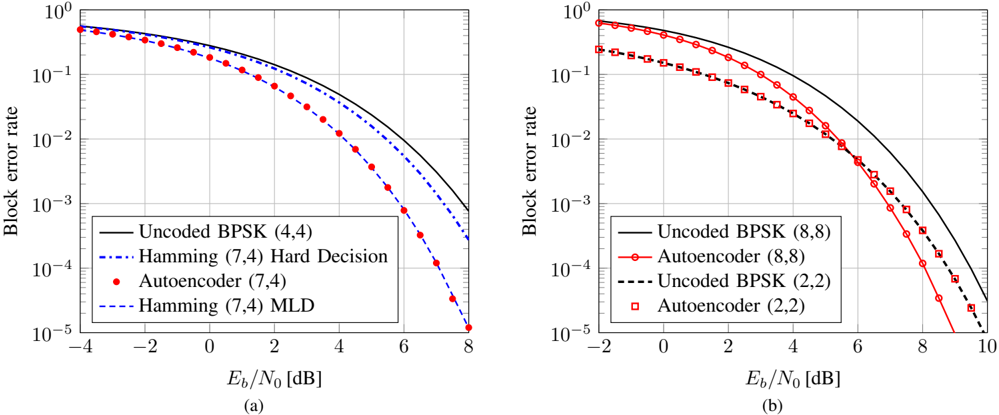
- A learned autoencoder for a (7,4) system at rate R = 4/7 achieves the same block error rate (BLER) as a Hamming (7,4) code with maximum likelihood decoding, while an (8,8) autoencoder outperforms uncoded BPSK over the full E_b/N_0 range, indicating learned joint coding and modulation.
- For the two-user AWGN interference channel, the autoencoder matches time-sharing for (1,1) and (2,2), but achieves gains of about 0.7 dB for (4,4) and 1 dB for (4,8) at a BLER of 10^-3.
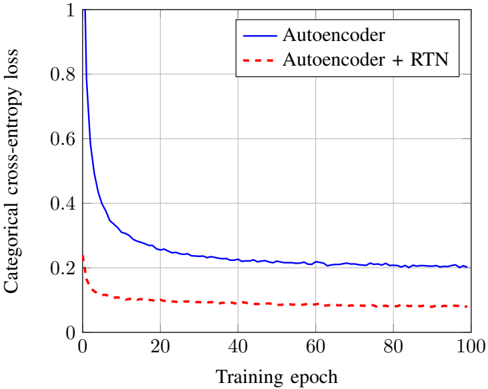
- An autoencoder (8,4) with an RTN over a multipath fading channel with L = 3 Rayleigh taps outperforms differential BPSK with maximum likelihood sequence estimation and a Hamming (7,4) code, whereas the plain autoencoder struggles to match it; RTNs also show faster training convergence.
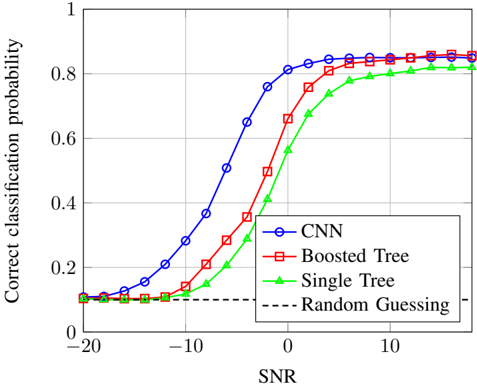
- For modulation classification on 1.2M sequences of 128 complex-valued IQ samples across ten modulation schemes and SNRs from -20 dB to 18 dB, the CNN outperforms a boosted expert-feature classifier by around 4 dB in the low-to-medium SNR range, with almost identical high-SNR performance; a single tree is about 6 dB worse at medium SNR and 3.5% worse at high SNR.
Methods
- The transmitter, channel, and receiver are represented as one deep neural network trained as an autoencoder: one-hot message input, dense layers, normalization layer for transmit constraints, additive noise channel layer, and softmax receiver output, trained with categorical cross-entropy using SGD/Adam at learning rate 0.001 and fixed E_b/N_0 = 7 dB.
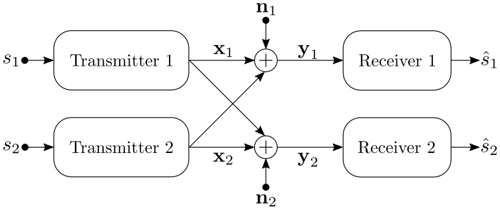
- The autoencoder concept is extended to multiple transmitter-receiver pairs in a two-user interference channel, with dynamic loss weights α_t per mini-batch to balance the two cross-entropy losses; performance is compared against 2^{2k/n}-QAM with time-sharing.
- RTNs combine a learned parameter estimator, a differentiable parametric transform, and a discriminative network; the paper demonstrates phase-offset compensation and multipath inverse filtering. For modulation classification, a VGG-like CNN with 324,330 trainable parameters is trained on the RML2016.10b dataset.
Limitations
- The paper states that scalability to large message sets M is a major challenge: for k = 100 bits, training complexity is prohibitive because the autoencoder must see at least every message once.
- The paper states that optimal data representations, loss functions, training SNR, and hyperparameters are not well understood; training at one SNR does not necessarily generalize to others, and no common communications benchmarks or datasets comparable to MNIST or ImageNet exist.
- The paper states that end-to-end learning over real channels requires system identification because backpropagation assumes a known channel transfer function; complex-valued neural networks are not supported by current DL libraries. Evident from the text: the reported results are simulation-based, use small (n,k) settings, assume known channel models during training, and the paper explicitly leaves detailed performance comparisons for various channel types and parameters to future work.
Model-written summary. Check it against the paper before relying on it.
Integrity signals
Registry
Cites
Statistics
Figures






Verification
Claims the paper makes
6 Valid · 4 Not valid · 18 Not checked · 65 Own results and interpretations
Every source the paper cites for this claim was checked and supports it.
In the paper
“For instance in [22], it was shown that training with a single codeword is sufficient since the structure of the code is embedded in the NN through the Tanner graph.”
What the sources say
- Supportedcites [22] [22] E. Nachmani, Y. Be'ery, and D. Burshtein, 'Learning to decode linear codes using deep learning,' in Proc. IEEE Annu. Allerton Conf. Commun., Control, and Computing (Allerton) , 2016, pp. 341-346. - source
The Introduction says the decoder uses a Tanner graph representing the code and that one codeword suffices for training. Section III explains the precise condition: over a binary memoryless symmetric channel, the decoder’s error rate is independent of the transmitted codeword, so training can use noisy versions of a single codeword. (LLM, conf=0.91)
boostedstates a cause- Asserted: passes — The authors put it forward as true.
- Checkable: passes — It can be checked against evidence.
- Load-bearing: unclear — It is unclear whether the paper’s conclusions depend on it.
- Based: passes — The paper gives a reason why it holds.
- Supported
A result the paper reports from its own data — it cites no other source for it, so there is none to check. The quote shows it is in the paper.
In the paper
“We study the use of NNs on complex-valued IQ samples for the problem of modulation classification and show that convolutional neural networks (CNNs), which are the cornerstone of most DL systems for computer vision, can outperform traditional classification techniques based on expert features.”
plainstates a cause- Asserted: passes — The authors put it forward as true.
- Checkable: passes — It can be checked against evidence.
- Load-bearing: passes — The paper’s conclusions depend on it.
- Based: passes — The paper gives a reason why it holds.
The paper states this without a source or data behind it here, so there is nothing to check it against. The quote shows it is in the paper.
In the paper
“Training at low SNR for instance does not allow for the discovery of structure important in higher SNR scenarios.”
plainstates a cause- Asserted: passes — The authors put it forward as true.
- Checkable: passes — It can be checked against evidence.
- Load-bearing: unclear — It is unclear whether the paper’s conclusions depend on it.
- Based: unclear — It is unclear why the paper says it holds.
A result the paper reports from its own data — it cites no other source for it, so there is none to check. The quote shows it is in the paper.
In the paper
“Another advantage of RTNs is faster training convergence which can be seen from Fig. 10 that compares the validation loss of the autoencoder with and without RTN as a function of the training epochs.”
plainstates a cause- Asserted: passes — The authors put it forward as true.
- Checkable: passes — It can be checked against evidence.
- Load-bearing: unclear — It is unclear whether the paper’s conclusions depend on it.
- Based: passes — The paper gives a reason why it holds.
A result the paper reports from its own data — it cites no other source for it, so there is none to check. The quote shows it is in the paper.
In the paper
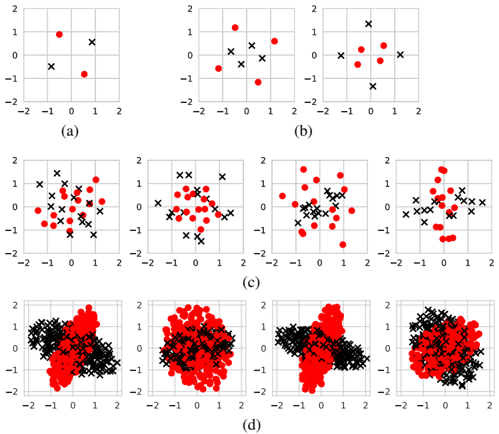
“Similarly, Fig. 4b shows a (4 , 2) system which leads to a rotated 16-PSK constellation.”
plainstates a cause- Asserted: passes — The authors put it forward as true.
- Checkable: passes — It can be checked against evidence.
- Load-bearing: unclear — It is unclear whether the paper’s conclusions depend on it.
- Based: passes — The paper gives a reason why it holds.
39 more claims
Create a free account to see all 93 claims and to verify the 4 references still open.
- Probably not a substantial claim. 29
- It may state two separate claims as one. 24
Self-check
Percentages, sums and reported differences re-computed from the paper’s own numbers.
Each contradiction between two passages listed here was confirmed by an independent check.
Rated minor: it would not touch a result — a value no result rests on, a p-value that stays on the same side of the significance level, or a conflict that is clerical, resolved elsewhere in the paper, or outside its own findings.
In the paper
§ A. Autoencoders for end-to-end communications systems · p. 5
“Similarly, Fig. 4b shows a (4 , 2) system which leads to a rotated 16-PSK constellation.”
§ A. Autoencoders for end-to-end communications systems · p. 6
“Figure 4: Constellations produced by autoencoders using parameters ( n, k ) : (a) (2 , 2) (b) (2 , 4) , (c) (2 , 4) with average power constraint, (d) (7 , 4) 2-dimensional t-SNE embedding of received symbols.”
Citations
Cites
Very Deep Convolutional Networks for Large-Scale Image Recognition
Simonyan, K., & Zisserman, A. (2014) · arXiv · doi:10.48550/arxiv.1409.1556 · Cited by 114,148 · cited 1×
“dense/fully-connected layers and terminated with a dense softmax layer for our classifier (similar to a VGG architecture [55]).”
BackgroundAdam: A Method for Stochastic Optimization
Kingma, D. P., & Ba, J. (2014) · arXiv · doi:10.48550/arxiv.1412.6980 · Cited by 98,946 · cited 4×
“Training was done at a fixed value of Eb/N0 = 7 dB (see Section IV-B) using Adam [46] with learning rate 0.”
BackgroundMethodInfluentialA Mathematical Theory of Communication
Shannon, C. E. (1948) · Bell System Technical Journal · doi:10.1002/j.1538-7305.1948.tb01338.x · Cited by 88,486
Scikit-learn: Machine Learning in Python
Pedregosa, F., Varoquaux, G., Gramfort, A., Michel, V., Thirion, B., Grisel, O., Blondel, M., Müller, A., Nothman, J., Louppe, G., et al. (2012) · arXiv · doi:10.48550/arxiv.1201.0490 · Cited by 71,016 · cited 1×
“11, we compare the classification accuracy of the CNN against that of extreme gradient boosting7 with 1000 estimators, as well as a single scikit-learn decision tree [56], operating on a mix of 16 analog and cumulant expert features as proposed in [53] and [57].”
Method(2014) · Cited by 33,419
(2008) · Journal of Machine Learning Research · Cited by 33,051
Human-level control through deep reinforcement learning
Mnih, V., Kavukcuoglu, K., Silver, D., Rusu, A. A., Veness, J., Bellemare, M. G., Graves, A., Riedmiller, M., Fidjeland, A. K., Ostrovski, G., et al. (2015) · Nature · doi:10.1038/nature14236 · Cited by 30,357
(2007) · Electronics: A First Course · doi:10.4324/9780080477527-64 · Cited by 24,923
Pan, S. J., & Yang, Q. (2010) · IEEE Transactions on Knowledge and Data Engineering · doi:10.1109/tkde.2009.191 · Cited by 23,387 · cited 1×
“learning [64] is one appealing candidate for adapting an endto-end communications system trained on a statistical model to”
BackgroundMultilayer feedforward networks are universal approximators
Hornik, K., Stinchcombe, M., & White, H. (1989) · Neural Networks · doi:10.1016/0893-6080(89)90020-8 · Cited by 21,728 · cited 1×
“Third, it has been shown that NNs are universal function approximators [13] and recent work has shown a remarkable”
Background
Research works printed but not linked: 2
- [35] I. Goodfellow, Y. Bengio, and A. Courville, Deep Learning . MIT Press, 2016. -
- [52] J. Estaran et al. , 'Artificial neural networks for linear and non-linear impairment mitigation in high-baudrate IM/DD systems,' in Proc. 42nd European Conf. Optical Commun. (ECOC) . VDE, 2016, pp. 1-3. -
Cited by
Items 901–1,000 of 2,995
Anomaly Detection in Self-Organizing Networks: Conventional Versus Contemporary Machine Learning
Küçük, M. F., & Uysal, I. (2022) · IEEE Access · doi:10.1109/access.2022.3182014 · Cited by 16
Hybrid attention-enhanced explainable model for encrypted traffic detection and classification
Sharma, A., & Lashkari, A. H. (2025) · International Journal of Information Security · doi:10.1007/s10207-025-01064-6 · Cited by 19
Optical Fiber Communication Systems Based on End-to-End Deep Learning : (Invited Paper)
Karanov, B., Chagnon, M., Aref, V., Lavery, D., Bayvel, P., & Schmalen, L. (2020) · IEEE Photonics Conference · doi:10.1109/ipc47351.2020.9252544 · Cited by 16
“OPTICAL FIBER AUTO-ENCODER: IMPLEMENTATION AND PERFORMANCE Fully learnable communication systems are based on the idea of implementing the complete chain of transmitter, channel and receiver as an end-to-end deep artificial neural network [1], [2].”
BackgroundDeep reinforcement learning approach to MIMO precoding problem: Optimality and RobustnessPreprint
Lee, H., Girnyk, M. A., & Jeong, J. (2020) · arXiv (Cornell University) · doi:10.48550/arxiv.2006.16646 · Cited by 19
“In [8], an autoencoder is trained in supervised learning (SL) for optimizing an end-to-end system performance.”
MethodDeep learning for location based beamforming with NLOS channelsPreprint
Magoarou, L. L., Yassine, T., Paquelet, S., & Crussière, M. (2022) · arXiv (Cornell University) · doi:10.48550/arxiv.2201.01386 · Cited by 16
“Machine learning (ML) techniques have been applied successfully to wireless communications in recent years (see [1, 2] for exhaustive surveys).”
BackgroundEnd-to-end Learning of Waveform Generation and Detection for Radar Systems
Jiang, W., Haimovich, A. M., & Simeone, O. (2019) · Asilomar Conference on Signals, Systems and Computers (ACSSC) · doi:10.1109/ieeeconf44664.2019.9049027 · Cited by 15
“Notably, in [5], it is proposed to jointly train encoder and decoder of a communication link by treating the cascade of encoder, channel, and decoder as an autocoder [6], [7].”
BackgroundAutoEncoders for Training Compact Deep Learning RF Classifiers for Wireless Protocols
Kokalj-Filipović, S., Miller, R., & Morman, J. (2019) · IEEE International Workshop on Signal Processing Advances in Wireless Communications (SPAWC) · doi:10.1109/spawc.2019.8815550 · Cited by 15
“DL of the PHY layer is still embryonic [7].”
Signal Detection in Uplink Pilot-Assisted Multi-User MIMO Systems with Deep Learning
Hua, H., Wang, X., & Xu, Y. (2019) · Computing, Communications and IoT Applications (ComComAp) · doi:10.1109/comcomap46287.2019.9018672 · Cited by 18
“Nowadays, with the improvement of computer computing ability and the advance in optimization algorithms, deep learning has been applied to various engineering fields including wireless communications [5]-[7].”
BackgroundNeural Network MIMO Detection for Coded Wireless Communication with Impairments
Sholev, O., Permuter, H. H., Ben-Dror, E., & Liang, W. (2020) · IEEE Wireless Communications and Networking Conference · doi:10.1109/wcnc45663.2020.9120517 · Cited by 20
“Recent developments in machine learning, and, specifically, in the field of deep learning, have motivated the use of data-driven techniques to solve various wireless communication tasks, one of which is the MIMO detection problem [4], [5].”
BackgroundPreamble-Based Packet Detection in Wi-Fi: A Deep Learning Approach
Ninković, V., Vukobratović, D., Valka, A., & Dumic, D. (2020) · IEEE Vehicular Technology Conference · doi:10.1109/vtc2020-fall49728.2020.9348765 · Cited by 19
“In recent years, data-based approaches relying on deep learning (DL) demonstrated excellent performance when applied for signal processing tasks at the wireless receiver side [6], [7].”
BackgroundAutoencoder-Based Unequal Error Protection Codes
Ninković, V., Vukobratović, D., Häger, C., Wymeersch, H., & Amat, A. G. I. (2021) · IEEE Communications Letters · doi:10.1109/lcomm.2021.3108845 · Cited by 18
A Deep Learning-Based Detector for IM-MIMO-OFDM
Alawad, M. A., & Hamdi, K. A. (2021) · IEEE Vehicular Technology Conference · doi:10.1109/vtc2021-fall52928.2021.9625569 · Cited by 16
“For example, localisation based on CSI [4], channel equalisation [9], replacing both the transmitter and the receiver of the communication system [13], reducing the peak-to-average-ratio of an OFDM system [14], and for designing a joint-channel estimation and signal-detection receiver for an OFDM…”
MethodSingh, K. K., Makarim, A. F., Hasan, H., Li, C., & Haas, Z. J. (2022) · IEEE Transactions on Vehicular Technology · doi:10.1109/tvt.2022.3208830 · Cited by 16
“such as modulation classification [33], antenna selection [34], and channel coding [35] wherein the solutions obtained by DL have surpassed the existing classical methods.”
MethodDeep-learning-based multi-user framework for end-to-end fiber-MMW communications
Li, Z., Jia, J., Li, G., Dong, B., Shen, W., Huang, C., Shi, J., Chi, N., & Zhang, J. (2023) · Optics Express · doi:10.1364/oe.479500 · Cited by 15
An Investigation on Intelligent Relay assisted Semantic Communication Networks
Ma, S., Liang, W., Zhang, B., & Wang, D. (2023) · IEEE Wireless Communications and Networking Conference · doi:10.1109/wcnc55385.2023.10118657 · Cited by 18
“Specifically, DNNs can be pre-trained from datasets in a supervised manner by optimizing end-to-end loss functions (e.g., CE and MSE) [26].”
BackgroundA Deep Learning-Based Indoor Radio Estimation Method Driven by 2.4 GHz Ray-Tracing Data
Pyo, C., Sawada, H., & Matsumura, T. (2023) · IEEE Access · doi:10.1109/access.2023.3340204 · Cited by 19
CRNN-ResNet: Combined CRNN and ResNet Networks for OFDM Receivers
Mei, R., Wang, Z., & Chen, X. (2024) · IEEE Transactions on Cognitive Communications and Networking · doi:10.1109/tccn.2024.3378225 · Cited by 23
“DL has been developed for a variety of tasks in the physical layer of wireless communications, including signal classification [8], [11], CFO compensation [7], [12], [13], channel estimation [7], [14], [15], [16], [17], [18], [19], [20], [21], [22], [23], [24], [25], [26], channel equalization [13],…”
BackgroundMachine learning approach on synchronization for FEC enabled channels
Chadov, T. A., Дмитриевич, Е. С., & Tikhonyuk, A. I. (2018) · 2018Systems of Signal Synchronization, Generating and Processing in Telecommunications (SYNCHROINFO) · doi:10.1109/synchroinfo.2018.8456985 · Cited by 15
“As soon as at [6] and [17] exist good and deep explanation of the basics for the deep neural network autoencoder, we consider specifying the difference only here.”
BackgroundMethodInfluentialIntelligent Anti-Jamming Relay Communication System Based on Reinforcement Learning
Zhang, Z., Wu, Q., Zhang, B., & Peng, J. (2019) · International Conference on Communication Engineering and Technology (ICCET) · doi:10.1109/iccet.2019.8726916 · Cited by 17
Channel Estimation under Hardware Impairments: Bayesian Methods versus Deep Learning
Demir, Ö. T., & Björnson, E. (2019) · International Symposium on Wireless Communication Systems · doi:10.1109/iswcs.2019.8877221 · Cited by 15
“We refer to [10], [11] for further details on deep learning.”
BackgroundSun, C., Shi, Z., & Jiang, F. (2020) · IEEE Access · doi:10.1109/access.2019.2963468 · Cited by 15
“At present, much attempts have been made to apply DL in areas of physical layer [5], resource allocation such as power control [6], [7], and beamforming [8]–[10].”
BackgroundConvolutional Neural Network for Cooperative Spectrum Sensing with Spatio-Temporal Dataset
Shachi, P., Sudhindra, K. R., & Suma, M. N. (2020) · International Conference on Artificial Intelligence and Signal Processing (AISP) · doi:10.1109/aisp48273.2020.9073175 · Cited by 16
“[9] gives insights on the role of deep learning in physical layer of a communication system.”
BackgroundTime-Domain Learned Digital Back-Propagation
Sillekens, E., Yi, W., Semrau, D., Ottino, A., Karanov, B., Lavery, D., Galdino, L., Bayvel, P., Killey, R. I., Zhou, S., et al. (2020) · SiPS ... design and implementation - IEEE Workshop on Signal Processing Systems · doi:10.1109/sips50750.2020.9195253 · Cited by 15
“Machine learning has been subject to a lot of research interest in recent years for communication systems [8], [9], in particular optical fibre systems[10], [11], [12].”
BackgroundMulti-Task Learning Based Underwater Acoustic OFDM Communications
Zhao, H., Ji, F., Wen, M., Yu, H. X., & Guan, Q. (2021) · IEEE International Conference on Signal Processing, Communications and Computing (ICSPCC) · doi:10.1109/icspcc52875.2021.9564511 · Cited by 16
Han, M., Seo, H., Abebe, A. T., & Kang, C. G. (2021) · IEEE Transactions on Cognitive Communications and Networking · doi:10.1109/tccn.2021.3130308 · Cited by 15
“Following the seminal paper with deep learning (DL) by O’shea et al. [15], in particular, an end-to-end optimized architecture that exploits the similarity between a communication system and an autoencoder (AE) has gained considerable attention [16]–[27].”
BackgroundMethodInfluentialLearning to Cooperate in Decentralized Wireless Networks
Kim, M., de Kerret, P., & Gesbert, D. (2018) · Asilomar Conference on Signals, Systems and Computers (ACSSC) · doi:10.1109/acssc.2018.8645377 · Cited by 16
“Note that the DNNs we envision for message sharing maybe compared with DNNs used in autoencoder fashion in [8].”
MethodDesign of fully interpretable neural networks for digital coherent demodulation
Huang, X., Jiang, W., Yi, X., Zhang, J., Jin, T., Zhang, Q., Xu, B., & Qiu, K. (2022) · Optics Express · doi:10.1364/oe.472406 · Cited by 15
Learning Linear MMSE Precoder for Uplink Massive MIMO Systems With One-Bit ADCs
Lin, Q., Shen, H., & Zhao, C. (2022) · IEEE Wireless Communications Letters · doi:10.1109/lwc.2022.3198286 · Cited by 14
“Recently, deep learning (DL) has been widely investigated in wireless communications [8].”
BackgroundSnoap, J. A., Latshaw, J. A., Popescu, D. C., & Spooner, C. M. (2022) · IEEE Military Communications Conference (MILCOM) · doi:10.1109/milcom55135.2022.10017507 · Cited by 19
“In recent years, machine learning (ML) techniques have also been explored for classifying digitally modulated signals, and in this direction we note the work in [5]– [8], which uses the I/Q signal components for training and signal recognition/classification, or the alternative approaches in [9]–[13], in which the amp…”
MethodA Novel Pilot-Aided Channel Estimation Scheme Based on RNN for FDD-LTE systems
Gu, J., Shan, C., Chen, X., Yin, H., & Wang, W. (2018) · International Conference on Wireless Communications and Signal Processing (WCSP) · doi:10.1109/wcsp.2018.8555634 · Cited by 15
“Therefore, a DL-based scheme has been introduced to many communication tasks, such as modulation and channel coding [3], decoding [4], cognitive radio [5], beamforming [6], OFDM design [7], and channel estimation.”
Pham, T. L., Nguyen, H. Q., Nguyen, T., & Jang, Y. M. (2019) · Applied Sciences · doi:10.3390/app9112242 · Cited by 18
Lightweight Machine Learning for Efficient Frequency-Offset-Aware Demodulation
Siyari, P., Rahbari, H., & Krunz, M. (2019) · IEEE Journal on Selected Areas in Communications · doi:10.1109/jsac.2019.2933956 · Cited by 15
“, [17], [18]) and decisiontree-based methods (e.”
Automatic Modulation Classification in the Presence of Interference
Triantaris, P., Tsimbalo, E., Chin, W. H., & Gündüz, D. (2019) · European Conference on Networks and Communications · doi:10.1109/eucnc.2019.8802004 · Cited by 15
“Recent publications further exploit the capabilities of deep neural networks and feed the sampled raw time series signals [7], [8], or, alternatively, a transformed representation (e.”
BackgroundMethodInfluentialNeural Network Assisted Active Constellation Extension for PAPR Reduction of OFDM System
Zhang, M., Liu, M., & Zhong, Z. D. (2019) · International Conference on Wireless Communications and Signal Processing (WCSP) · doi:10.1109/wcsp.2019.8928056 · Cited by 17
Deep UL2DL: Channel Knowledge Transfer from Uplink to DownlinkPreprint
Safari, M. S., Pourahmadi, V., & Sodagari, S. (2018) · arXiv (Cornell University) · doi:10.48550/arxiv.1812.07518 · Cited by 15
“Deep learning has been also used in physical layer communications [16]–[23].”
BackgroundMethodRedefining Wireless Communication for 6G:Signal Processing Meets Deep Learning with Deep UnfoldingPreprint
Jagannath, A., Jagannath, J., & Melodia, T. (2021) · doi:10.36227/techrxiv.16434855 · Cited by 15
Deep Learning-Based Detection for Moderate-Density Code Multiple Access in IoT Networks
Han, Y. L., Wang, Z., Guo, Q., & Xiang, W. (2019) · IEEE Communications Letters · doi:10.1109/lcomm.2019.2952392 · Cited by 15
“In [8], the authors interpret a communication system as an autoencoder.”
BackgroundChen, W., Gu, Z., Liu, Z., Fu, Y., Ye, Z., Zhang, X., & Xiao, L. (2021) · Complexity · doi:10.1155/2021/6296811 · Cited by 15
Time-Frequency Component-Aware Convolutional Neural Network for Wireless Interference Classification
Wang, P., Cheng, Y., Shang, G., Wang, J., & Li, S. (2022) · IEEE Wireless Communications Letters · doi:10.1109/lwc.2022.3204756 · Cited by 15
“The FB methods rely on the analysis of features of interference signals [6], [7].”
MethodDeep Learning based Wireless Channel Prediction: 5G Scenario
Varshney, R., Gangal, C., Sharique, M., & Ansari, M. S. (2023) · Procedia Computer Science · doi:10.1016/j.procs.2023.01.236 · Cited by 24
Developing RFML Intuition: An Automatic Modulation Classification Architecture Case Study
Clark, W. H., Arndorfer, V., Brook, T., Kim, D., Vives, C., Morris, H., Wong, L. J., & Headley, W. C. (2019) · IEEE Military Communications Conference (MILCOM) · doi:10.1109/milcom47813.2019.9020949 · Cited by 15
“The SSE exhibited by the Image architecture were used to determine the convolutional layers’ filter size as the filters were first tested with longer filters as in [6]; however, there were significant numbers of SSEs leading to the use of smaller filters as in [7], [8].”
BackgroundMethodPU-DetNet: Deep Unfolding Aided Smart Sensing Framework for Cognitive Radio
Soni, B., Patel, D. K., Shah, S. B., López‐Benítez, M., & Govindasamy, S. (2022) · IEEE Access · doi:10.1109/access.2022.3206814 · Cited by 16
Sozos, K., Deligiannidis, S., Sarantoglou, G., Mesaritakis, C., & Bogris, A. (2023) · Journal of Lightwave Technology · doi:10.1109/jlt.2023.3282999 · Cited by 21
“One option is end-to-end learning introduced in [15], which utilizes an autoencoder to optimize the communication”
BackgroundDeng, Z., Cao, Y., Zhou, X., Yi, Y., Jiang, Y., & You, I. (2020) · Sensors · doi:10.3390/s20102866 · Cited by 17
“Nowadays, after improvements in various dimensions, deep learning shows outstanding success in different areas, including natural language processing (NLP) [19], speech recognition [20], computer vision [21], etc.”
BackgroundGao, Q., & Wei, Y. (2023) · Current Psychology · doi:10.1007/s12144-023-04320-x · Cited by 19
“O’shea and Hoydis (2017) proposes and discusses at the physical level some new applications which the communication system under-stands as an auto-encoding process and regards it as a new end-to-end reconstruction.”
BackgroundIqbal, M., Ghafoor, S., Ahmad, A., Aljohani, A. J., Mirza, J., Aziz, I., & Potì, L. (2024) · Frontiers in Physics · doi:10.3389/fphy.2024.1387284 · Cited by 17
Deep Learning-Based Low Complexity MIMO Detection via Partial MAP
Bai, L., Zeng, Q., Han, R., Choi, J., & Zhang, W. (2024) · IEEE Transactions on Wireless Communications · doi:10.1109/twc.2024.3516738 · Cited by 18
“…to automatically extract hierarchical features from data in complex environments, leading to a promising application potential in revolutionizing various aspects of physical layer communications [23], [24], especially in channel estimation [25], resource management [26] and signal processing [27].”
Sowjanya, P. S., & Satyanarayana, P. (2020) · Journal of Ambient Intelligence and Humanized Computing · doi:10.1007/s12652-020-02010-1 · Cited by 14
“…(Krishnaveni and Sutha 2020), IoT applications (Mehmood et al. 2019), natural language processing (Young et al. 2018), modulation recognition (O’Shea and Hoydis 2017), modulation classification (Dobre et al. 2007; Wang et al. 2017a), channel estimation (Soltani et al. 2019; Cheng et al.…”
BackgroundRetractedDCGAN-based symmetric encryption end-to-end communication systems
An, Y., Wang, M., Chen, L., & Ji, Z. (2022) · AEU - International Journal of Electronics and Communications · doi:10.1016/j.aeue.2022.154297 · Cited by 14
Towards Hardware Implementation of Neural Network-based Communication Algorithms
Aoudia, F. A., & Hoydis, J. (2019) · IEEE International Workshop on Signal Processing Advances in Wireless Communications (SPAWC) · doi:10.1109/spawc.2019.8815398 · Cited by 16
“NN-based transceivers [7] were implemented on field-programmable gate array (FPGA) in [10].”
Self-citationError-Corrected Margin-Based Deep Cross-Modal Hashing for Facial Image Retrieval
Taherkhani, F., Talreja, V., Valenti, M. C., & Nasrabadi, N. M. (2020) · IEEE Transactions on Biometrics Behavior and Identity Science · doi:10.1109/tbiom.2020.2983467 · Cited by 14
“Additionally, in [52], a communication system has been formulated as an autoencoder for a small block code.”
MethodDeep Soft Interference Cancellation for MIMO Detection
Shlezinger, N., Fu, R., & Eldar, Y. C. (2020) · IEEE International Conference on Acoustics Speech and Signal Processing · doi:10.1109/icassp40776.2020.9054732 · Cited by 18
“ML schemes are gradually influencing the design of communication systems, resulting in a multitude of recent works on DNNs for communications; see detailed surveys in [11]–[16].”
BackgroundLeveraging triplet loss and nonlinear dimensionality reduction for on-the-fly channel charting
Yassine, T., Magoarou, L. L., Paquelet, S., & Crussière, M. (2022) · IEEE International Workshop on Signal Processing Advances in Wireless Communications (SPAWC) · doi:10.1109/spawc51304.2022.9834035 · Cited by 14
Design and Prototyping of Neural Network Compression for Non-Orthogonal IoT Signals
Xu, T., & Darwazeh, I. (2019) · IEEE Wireless Communications and Networking Conference · doi:10.1109/wcnc.2019.8885830 · Cited by 16
“It should be noted that instead of the autoencoder training for entire communication systems in [1], [4], the aim of this work is to train a neural network specifically for signal detection.”
BackgroundZhang, H., Zhang, L., Cheng, J., Jiang, Y., & Wu, Z. (2021) · IEEE Transactions on Cognitive Communications and Networking · doi:10.1109/tccn.2021.3111981 · Cited by 17
Deep Learning-Based Automatic Modulation Classification Over MIMO Keyhole Channels
Dileep, P., Singla, A., Das, D., & Bora, P. K. (2022) · IEEE Access · doi:10.1109/access.2022.3195229 · Cited by 15
“The initial works mostly discussed the AMC for single input single output systems (SISO) [12]–[15].”
BackgroundMethodInfluentialAutomated deep learning-based wide-band receiver
Azari, B., Cheng, H., Soltani, N., Li, H., Li, Y., Belgiovine, M., Imbiriba, T., D’Oro, S., Melodia, T., Wang, Y., et al. (2022) · Computer Networks · doi:10.1016/j.comnet.2022.109367 · Cited by 16
“Therefore, deep learning-based solutions are less prone to inaccuracies and approximations baked in the model, and can thus learn their own representation of the model and detect the most relevant features as demonstrated in [15,16].”
Intelligent MIMO Detection Using Meta Learning
Huo, H., Xu, J., Su, G., Xu, W., & Wang, N. (2022) · IEEE Wireless Communications Letters · doi:10.1109/lwc.2022.3197158 · Cited by 15
“It has been shown that DL can provide significant performance improvement for signal processing and communication problems, such as decoding, demodulation, and detection [5], [6].”
BackgroundEnd-to-End Learning for Symbol-Level Precoding and Detection With Adaptive Modulation
Liu, R., Bo, Z., Li, M., & Liu, Q. (2022) · IEEE Wireless Communications Letters · doi:10.1109/lwc.2022.3216848 · Cited by 14
“Concurrently, machine learning and specifically deep learning (DL) [6], [7], [8] have been applied to the physical”
MethodEnd-to-End Underwater Acoustic Communication Based on Autoencoder with Dense Convolution
Xie, F., Zhu, Y., Wang, B., Wang, W., & Jin, P. (2023) · Electronics · doi:10.3390/electronics12020253 · Cited by 16
Jalili, F., Tafuri, F. F., Jensen, O. K., Chen, Q., Shen, M., & Pedersen, G. F. (2023) · IEEE Access · doi:10.1109/access.2023.3242648 · Cited by 14
Classification-Oriented Distributed Semantic Communication for Multivariate Time Series
Zhao, B., Xing, H., Wang, X., Xiao, Z., & Xu, L. (2023) · IEEE Signal Processing Letters · doi:10.1109/lsp.2023.3265330 · Cited by 19
“However, continuously transferring a large amount of time series data significantly consumes bandwidth resource, bringing heavy pressure to the communication system [3], [4], [5].”
BackgroundGeneralization Bounds for Neural Belief Propagation Decoders
Adiga, S., Xiao, X. W., Tandon, R., Vasic, B. V., & Bose, T. (2024) · IEEE Transactions on Information Theory · doi:10.1109/tit.2024.3361388 · Cited by 20
Al-Baidhani, A., & Fan, H. H. (2019) · 2012 International Conference on Computing, Networking and Communications (ICNC) · doi:10.1109/iccnc.2019.8685517 · Cited by 14
“Such a detection scheme, similar to that of [1], is quite inefficient.”
BackgroundMethodInfluentialDeep Learning Based Preamble Detection and TOA Estimation
Sun, H., Kaya, A. Ö., Macdonald, M., Viswanathan, H., & Hong, M. (2019) · Globecom · doi:10.1109/globecom38437.2019.9013265 · Cited by 17
“Recent works of deep learning also have been applied to wireless communications [4].”
BackgroundDeep Learning and Channel Estimation
Thakkar, K., Goyal, A., & Bhattacharyya, B. (2020) · International Conference on Advanced Computing and Communication Systems (ICACCS) · doi:10.1109/icaccs48705.2020.9074414 · Cited by 18
“• Graphical processing units (GPUs) have potentially shown exceptional performance and energy efficiency when leveraged by concurrent algorithms [1].”
BackgroundTowards More Reliable Deep Learning-Based Link Adaptation for WiFi 6
Hussien, M., Ahmed, M. F. A., Dahman, G. S., Nguyen, K. K., Cheriet, M., & Poitau, G. (2021) · International Conference on Communications · doi:10.1109/icc42927.2021.9500828 · Cited by 14
“The convolutional neural networks (CNNs) have showed superior performance in di erent domains including computer vision, natural language processing, speech synthesis, etc [3].”
BackgroundMachine-Learning-Aided Optical OFDM for Intensity Modulated Direct Detection
Zhang, X., Luong, T. V., Petropoulos, P., & Hanzo, L. (2022) · Journal of Lightwave Technology · doi:10.1109/jlt.2022.3141222 · Cited by 16
Signals Recognition by CNN Based on Attention Mechanism
Tian, F., Wang, L., & Xia, M. (2022) · Electronics · doi:10.3390/electronics11132100 · Cited by 14
Using Capsule Networks to Classify Digitally Modulated Signals with Raw I/Q Data
Latshaw, J. A., Popescu, D. C., Snoap, J. A., & Spooner, C. M. (2022) · International Conference on Communications (COMM) · doi:10.1109/comm54429.2022.9817229 · Cited by 17
“This is visible in similar digital modulation classification approaches [1]–[3], [17].”
BackgroundMethodChannel hopping for blind rendezvous in cognitive radio networks: A review
Guerra, E. O., Reguera, V. A., Durán-Faúndez, C., & Nguyen, T. M. T. (2022) · Computer Communications · doi:10.1016/j.comcom.2022.08.011 · Cited by 14
A low-complexity AMP detection algorithm with deep neural network for massive mimo systems
Zhang, Z., Li, Y., Yan, X., & Ouyang, Z. (2022) · Digital Communications and Networks · doi:10.1016/j.dcan.2022.11.011 · Cited by 18
Zhang, Y., Chang, J., Liu, Y., Shen, X., & Bai, W. (2022) · IEEE International Conference on Signal Processing, Communications and Computing (ICSPCC) · doi:10.1109/icspcc55723.2022.9984340 · Cited by 17
“…the block-based system framework and combine traditional data processing methods together for system optimization, such as the radio transformer networks (RTNs) [13] and ComNet [14], which incorporate expert knowledge and DL by employing neural networks in predefined task modules in the receiver.”
MethodImplementation of DNN-Based Physical-Layer Network Coding
Wang, X., & Lu, L. (2023) · IEEE Transactions on Vehicular Technology · doi:10.1109/tvt.2023.3237589 · Cited by 15
“In a DNN, the way that we explain the action that encoders take to transform the input into the output depends on the “bit per channel use” k/n [28].”
BackgroundLiu, X., Zhang, J., Zhu, M., Tong, W., Xin, Z., Wang, Y., Lei, M., Hua, B., Cai, Y., Zou, Y., et al. (2023) · Optics Express · doi:10.1364/oe.493470 · Cited by 15
“To guarantee optimal performance, [20] recommends optimizing the entire system as an end-to-end (E2E) solution rather than individual modules to coordinate the optimization between the transmitter and receiver.”
Spiking Neural Networks—Part III: Neuromorphic Communications
Skatchkovsky, N., Jang, H., & Simeone, O. (2021) · IEEE Communications Letters · doi:10.1109/lcomm.2021.3050212 · Cited by 14
“To use spectral resources more effectively, a recently emerging line of research [4]–[8] focuses on applying ML to train a communication system in an end-to-end fashion by targeting directly application-level performance criteria.”
MethodMachine Learning–Based Adaptive Modulation and Coding Design
Zhang, L., & Wu, Z. (2019) · Wiley eBooks · doi:10.1002/9781119562306.ch9 · Cited by 14
Denoising Generalization Performance of Channel Estimation in Multipath Time-Varying OFDM Systems
Li, Y., Bian, X., & Li, M. (2023) · Sensors · doi:10.3390/s23063102 · Cited by 19
Artificial Intelligence Augmentation for Channel State Information in 5G and 6G
Li, Y., Hu, Y., Min, K., Park, H., Yang, H.-Y., Wang, T., Sung, J., Seol, J., & Zhang, J. C. (2023) · IEEE Wireless Communications · doi:10.1109/mwc.005.2200245 · Cited by 14
“In the first category, the system can often be jointly optimized as an autoencoder; for example, in [4], the autoencoder is used to design for both a single-input single-output (SISO) communication system and a MIMO communication system.”
MethodHuang, C., Tao, L., Li, Z., Jia, J., Dong, B., Xing, S., Li, G., Shi, J., Shen, C., Li, Z., et al. (2024) · Optics Express · doi:10.1364/oe.514366 · Cited by 14
Tefera, M. K., Jin, Z., & Zhang, S. (2022) · Sensors · doi:10.3390/s22093589 · Cited by 15
Li, M., Li, O., Liu, G., & Zhang, C. (2019) · Applied Sciences · doi:10.3390/app9051010 · Cited by 14
“O’Shea et al. [16–18] introduced Convolutional Neural Network (CNN) to AMR domain, by directly applying classification with the time domain in-phase and quadrature (IQ) signal captures.”
MethodPAPR Reduction Scheme for Deep Learning-Based Communication Systems Using Autoencoders
Vahdat, M., Roshandeh, K. P., Ardakani, M., & Jiang, H. (2020) · IEEE Vehicular Technology Conference · doi:10.1109/vtc2020-spring48590.2020.9128513 · Cited by 15
“4: BER and PAPR for the T-PR-AE, the original AE(AE) [6] and the PAPR reduced AE based on minimizing the PAPR in the loss function [12] (L-PR-AE). α and β for T-PR-AE are 1 .”
BackgroundMethodInfluentialA Machine Learning Approach to Enhance the Performance of D2D-Enabled Clustered Networks
Aslam, S., Alam, F., Hasan, S. F., & Rashid, M. A. (2021) · IEEE Access · doi:10.1109/access.2021.3053045 · Cited by 17
Omondi, G., & Olwal, T. O. (2023) · e-Prime - Advances in Electrical Engineering Electronics and Energy · doi:10.1016/j.prime.2023.100376 · Cited by 23
Channel charting based beamforming
Magoarou, L. L., Yassine, T., Paquelet, S., & Crussière, M. (2022) · Asilomar Conference on Signals, Systems and Computers (ACSSC) · doi:10.1109/ieeeconf56349.2022.10051826 · Cited by 17
“One can cite for example detection [1], [2], channel estimation [3], [4], [5], [6] and even end-to-end system learning [7], [8] (see [9], [10] for exhaustive surveys on this topic).”
BackgroundMachine Learning based Antenna Selection and Power Allocation in Multi-user MISO Systems
Vu, T. X., Lei, L., Chatzinotas, S., & Ottersten, B. (2019) · International Symposium on Modeling and Optimization in Mobile, Ad Hoc, and Wireless Networks (WiOpt) · doi:10.23919/wiopt47501.2019.9144088 · Cited by 16
“Recently, the use of machine learning (ML) in communications systems has attracted much attention [8], [9].”
BackgroundFederated Generative Adversarial Networks based Channel Estimation
Guo, Y., Qin, Z., & Dobre, O. A. (2022) · IEEE International Conference on Communications workshops · doi:10.1109/iccworkshops53468.2022.9814633 · Cited by 15
Synthetic Power Line Communications Channel Generation with Autoencoders and GANs
Righini, D., Letizia, N. A., & Tonello, A. M. (2019) · IEEE International Conference on Communications, Control, and Computing Technologies for Smart Grids (SmartGridComm) · doi:10.1109/smartgridcomm.2019.8909700 · Cited by 13
“Due to non-linearities introduced by the NN architecture, the learned representation can provide data quasi-equally informative which can be used also for communication purposes [9], e.”
BackgroundSoftware Demodulation of Weak Radio Signals using Convolutional Neural Network
Kozlenko, M., Lazarovych, I., Tkachuk, V. M., & Vialkova, V. (2020) · IEEE International Conference on Energy Smart Systems (ESS) · doi:10.1109/ess50319.2020.9160035 · Cited by 13
“In the work [14] some new applications of DL for the physical layer are presented and discussed.”
MethodDeep Learning of Transferable MIMO Channel Modes for 6G V2X Communications
Cazzella, L., Tagliaferri, D., Mizmizi, M., Badini, D., Mazzucco, C., Matteucci, M., & Spagnolini, U. (2022) · IEEE Transactions on Antennas and Propagation · doi:10.1109/tap.2022.3169950 · Cited by 13
“DL learns complex tasks from data where model-based techniques fail or turn out to be sub-optimal, exploiting Deep Neural Networks (DNNs) [16]–[18].”
BackgroundLiu, S., Guo, W., He, H., Wang, H., Chen, Y., Hu, D., Jiang, Y., & Chen, L. (2022) · Sensors · doi:10.3390/s23010055 · Cited by 14
“Deep learning can alleviate these problems, as it is a meaningful technology that can bring promising applications to the physical layer [21], i.”
BackgroundX-ray PCB defect automatic diagnosis algorithm based on deep learning and artificial intelligence
Liu, Y., Wang, P., Liu, J., & Liu, C. (2023) · Neural Computing and Applications · doi:10.1007/s00521-023-08499-9 · Cited by 14
“Oshea [6] shows and discusses several new approaches to deep learning in the PHY layers.”
BackgroundSemantic Text Compression for Classification
Kutay, E., & Yener, A. (2023) · IEEE International Conference on Communications workshops · doi:10.1109/iccworkshops57953.2023.10283705 · Cited by 14
“Reference [9] shows that replacing the conventional communication blocks with NN and performing end-to-end optimization with an autoencoder”
BackgroundLiu, C., Cai, Z., & Zhang, B. (2023) · IEEE International Conference on Communication Technology (ICCT) · doi:10.1109/icct59356.2023.10419774 · Cited by 13
“It consists of eight digital modulation schemes, such as 8PSK, BPSK, and 16QAM, as well as three and WBFM[20].”
MethodPRORL: Proactive Resource Orchestrator for Open RANs Using Deep Reinforcement Learning
Staffolani, A., Darvariu, V.-A., Foschini, L., Girolami, M., Bellavista, P., & Foschini, M. M. (2024) · IEEE Transactions on Network and Service Management · doi:10.1109/tnsm.2024.3373606 · Cited by 19
“…Input, Multiple Output (MIMO) [1], millimeter wave and sub-terahertz communications [2], network-based sensing [3], virtualization through Network Functions Virtualization (NFV) and Software-Defined Networking (SDN) [4], and Machine Learning (ML)-based digital signal processing [5], among others.”
MethodPhysical Layer Cross-Technology Communication via Explainable Neural Networks
Wang, H., Wang, J., Jiang, W., Wang, S., & Gao, D. (2024) · IEEE Transactions on Mobile Computing · doi:10.1109/tmc.2024.3480109 · Cited by 16
Wu, H., Chen, Z., Liu, Z., Geng, X., Zhao, Y., & Liu, Z. (2025) · IEEE Transactions on Wireless Communications · doi:10.1109/twc.2025.3542426 · Cited by 16
“Deep learning (DL) has proven its great potential in many areas [22], [23], [24], [25], and has been applied in the physical layer design of communication systems [26], [27], [28].”
Two-Stage Learning for Uplink Channel Estimation in One-Bit Massive MIMO
Balevi, E., & Andrews, J. G. (2019) · Asilomar Conference on Signals, Systems and Computers (ACSSC) · doi:10.1109/ieeeconf44664.2019.9048915 · Cited by 14
“There has been a growing interest to make use of deep learning in communication systems [8], [9], [10], [11] including channel estimation [12], [13], [14].”
Noncoherent Energy-Modulated Massive SIMO in Multipath Channels: A Machine Learning Approach
Zhang, H., Lan, M., Huang, J., Huang, C. Z., & Cui, S. R. (2020) · IEEE Internet of Things Journal · doi:10.1109/jiot.2020.2989078 · Cited by 14
“Along with a different revenue, point-to-point communication was treated as an end-to-end reconstruction task [23] in machine learning, where the transmitter and receiver are represented as two independent NNs while being trained jointly.”
Background
Metadata
- Authors
- O'Shea, T., & Hoydis, J.
- Affiliations
- Nokia (France) (FR)
- Venue
- IEEE Transactions on Cognitive Communications and Networking
- Published
- 2017-12
- Volume
- 3
- Issue
- 4
- Pages
- 563-575
- ISSN
- 2332-7731 (ISSN-L)
- OpenAlex
- W2734408173
- Semantic Scholar
- 78989616eeeac55b202e3e4205225e7135054185
- Cited by
- 2,980
- References
- 69
- Citations by year
- 2026: 307 · 2025: 327 · 2024: 305 · 2023: 368 · 2022: 432 · 2021: 409 · 2020: 406 · 2019: 322 · 2018: 95 · 2017: 9
- FWCI
- 122.29
- Type
- journal article
- Language
- en
- Open access
- green
- arxiv.org
- Locations
- IEEE Transactions on Cognitive Communications and Networking (publishedVersion)
- arXiv (Cornell University) (submittedVersion)
- arXiv (Cornell University)
- Topics
- Physical Sciences › Computer Science › Artificial Intelligence › Wireless Signal Modulation Classification
- Physical Sciences › Engineering › Electrical and Electronic Engineering › Advanced Wireless Communication Techniques
- Physical Sciences › Engineering › Electrical and Electronic Engineering › Advanced Wireless Communication Technologies
- Keywords
- end-to-end reconstruction, domain knowledge integration, convolutional neural networks, automatic modulation classification, IQ samples
About these checks
Registry, retraction, Cites and statistics results are computed, not judged, with one exception: a printed reference that no index lists is read once by a model before it counts as a citation error. Claims are extracted by a model and kept only when their quote appears verbatim in the text; each cited source is then checked, with a model’s help, for whether it says what the claim relies on. Those verdicts can be wrong — read the claim’s quote and the cited source before relying on one.
The claim verdicts this report counts are experimental: their accuracy is not yet measured.
A language model drew the claims from the paper on 2026-11-07, under version 3 of the claim definition (model deepseek-v4.1-flash, prompt extract-v3).
A second model labelled each claim on 2026-11-07 (model jev-1.13-20260917, definition revision gold-guideline-v0.2).
Cited sources are checked with a language model’s help (gpt-6-sol).
Statistics and arithmetic are recomputed, not judged.
Confidence bands are shown only for fields calibrated on our annotated test set. None is calibrated yet, so no band is shown.
What counts as a claim ›How we measure confidence ›How we check this ›
Are you an author, or do you see a problem with this page? Request a review
Data sources
Bibliographic data: Semantic Scholar, OpenAlex, Crossref.
Contains information from the Semantic Scholar Academic Graph Datasets, made available under the ODC Attribution License (ODC-BY 1.0).
Semantic Scholar’s data is described in: Kinney, R., et al. (2023). The Semantic Scholar Open Data Platform. arXiv:2301.10140.
